
Pacific Economic Development Canada’s Quarterly Financial Report for the quarter ended December 31, 2025
View the print-friendly version (PDF, 502 kB)
Statement outlining results, risks and significant changes in operations, personnel and programs
Introduction
This quarterly financial report should be read in conjunction with Main Estimates, Supplementary Estimates (A), and Supplementary Estimates (B). It has been prepared by management as required by section 65.1 of the Financial Administration Act (FAA) and in the form and manner prescribed by the Treasury Board. This quarterly report has not been subject to an external audit or review.
Authority, mandate and program activities
PacifiCan is the Regional Development Agency focused on British Columbia’s evolving economy. PacifiCan leads in building a strong, competitive Canadian economy by supporting business, innovation and community economic development unique to British Columbia. PacifiCan operates under the provision of the Western Economic Diversification Act.
PacifiCan is mandated to “support the growth and diversification of British Columbia’s economy and advance the interests of the region in national economic policy, programs and projects.”
The Departmental Plan and Main Estimates provide further information on PacifiCan's authority, mandate and program activities.
Basis of presentation
This quarterly report has been prepared by management using an expenditure basis of accounting. The accompanying Statement of Authorities includes the department’s spending authorities granted by Parliament and those used by the department, consistent with the Main Estimates and supplementary estimates for the 2025-2026 fiscal year. This quarterly report has been prepared using a special purpose financial reporting framework designed to meet financial information needs with respect to the use of spending authorities.
The authority of Parliament is required before money can be spent by the Government. Approvals are given in the form of annually approved limits through appropriation acts, or through legislation in the form of statutory spending authority for specific purposes.
The Agency uses the full accrual method of accounting to prepare and present its annual departmental financial statements that are part of the results reporting process. However, the spending authorities voted by Parliament remain on an expenditure basis.
Financial structure
PacifiCan manages its expenditures under two votes:
- Vote 1 – Net operating expenditures include salary, and other operating costs (e.g., transportation and communications; professional and special services).
- Vote 5 – Grants and contributions include all transfer payments.
Budgetary statutory authorities represent payments made under legislation approved by Parliament and include items such as the Government of Canada's share of Employee Benefit Plans (EBP).
Highlights of fiscal quarter and fiscal year-to-date (YTD) results
The following section highlights significant changes to fiscal quarter results as of December 31, 2025.
Statement of authorities: Vote 1 – Net operating expenditures
Total authorities available for use for fiscal year 2025-2026 are $32.7 million, a net decrease of $1.3 million compared to $34.0 million for 2024-2025. The net decrease is explained by:
- $1.7 million increase in operating funding for the Regional Defence Investment Initiative;
- $1.4 million increase in operating funding for the Regional Tariff Response Initiative;
- $0.2 million net funding increase for time-limited programs and other operating funding; and
- $4.6 million decrease reflects the conclusion of funding supports to establish seven new offices across British Columbia and headquarters office in Surrey.
Total authorities used year-to-date are $18.7 million for the quarter ended December 31, 2025 compared to $20.3 million at December 31, 2024. The decrease of $1.6 million is due to lower spending in transportation, professional and special services.
Graph 1 illustrates total authorities available for use for the fiscal year, and authorities used at quarter-end
(In thousands of dollars)
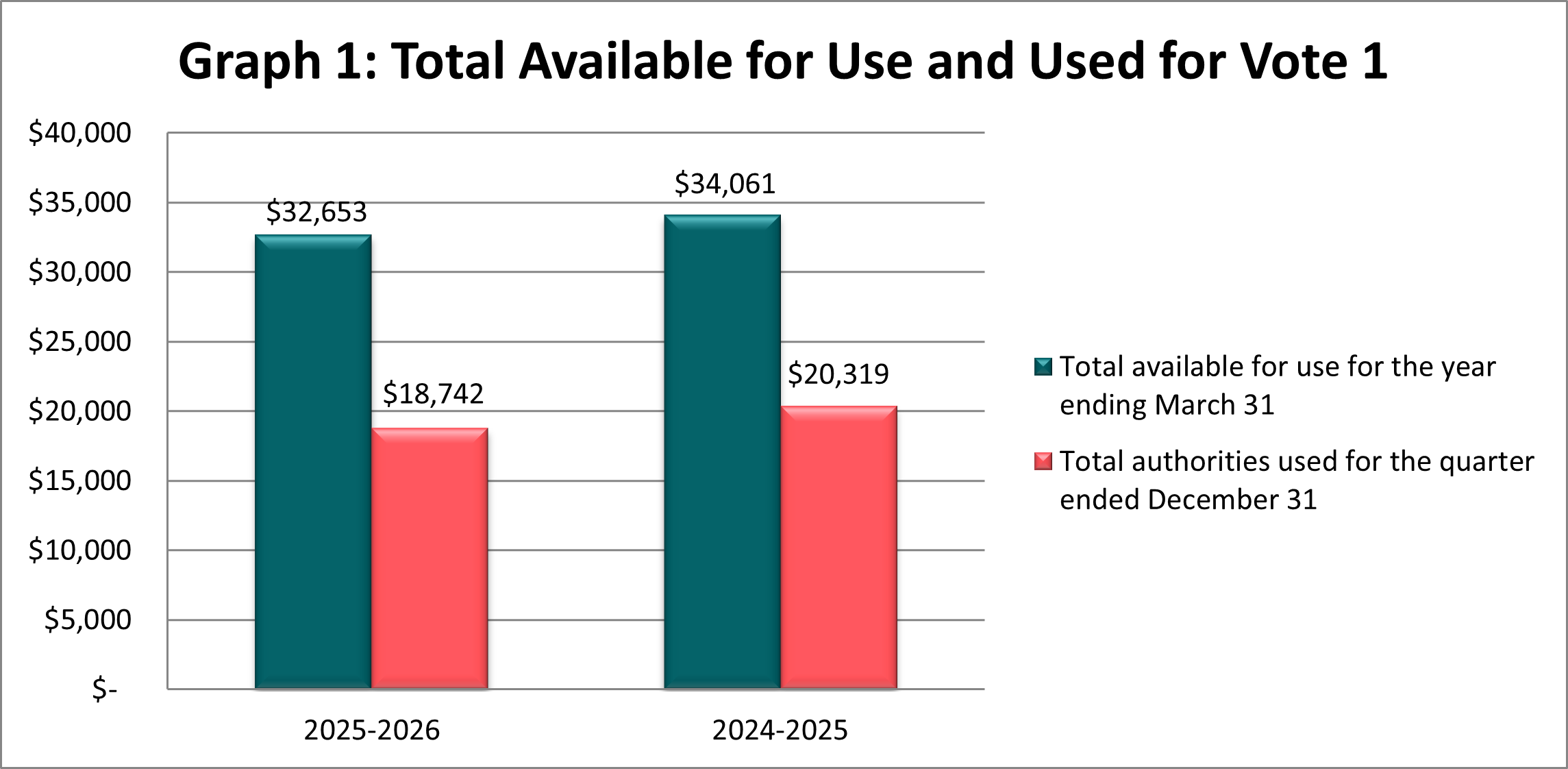
Text version: Total available for use and used for Vote 1 (in thousands of dollars)
This bar graph breaks down total authorities available for use for fiscal year 2025-26 and compares the authorities used at quarter end.
2025-2026
- $32,653 represents total available for use for the year ending March 31
- $18,742 represents total authorities used for the quarter ending December 31
2024-2025
- $34,061 represents total available for use for the year ending March 31
- $20,319 represents total authorities used for the quarter ending December 31
Statement of authorities: Vote 5 – Grants and contributions
Total authorities available for use for fiscal year 2025-2026 are $172.1 million, a net increase of $67.0 million compared to $105.1 million for 2024-2025. The net increase is mainly due to:
- $32.1 million increase in funding for the Regional Tariff Response Initiative;
- $30.0 million increase in funding for the Regional Defence Investment Initiative;
- $2.6 million increase in funding for the Regional Artificial Intelligence Initiative; and
- $2.3 million increase in funding for the Lytton Home and Business Rebuild programs.
Total authorities used year-to-date for the quarter ended December 31, 2025 are $26.4 million compared to $30.8 million at December 31, 2024. The $4.4 million decrease is mainly explained by:
- $2.2 million net decrease in payment timing differences made to support network partners;
- $2.1 million net decrease in payments made under the Pacific Economic Development Program (PEDP) and other programs;
- $0.2 million net decrease in payments made under the Regional Economic Investment Initiative program; and
- $0.1 million net increase in payments made to support the Lytton Business Restart and Lytton Homeowner Resilient Rebuild programs.
Graph 2 illustrates total authorities available for use for the fiscal year, and authorities used at quarter-end.
(In thousands of dollars)
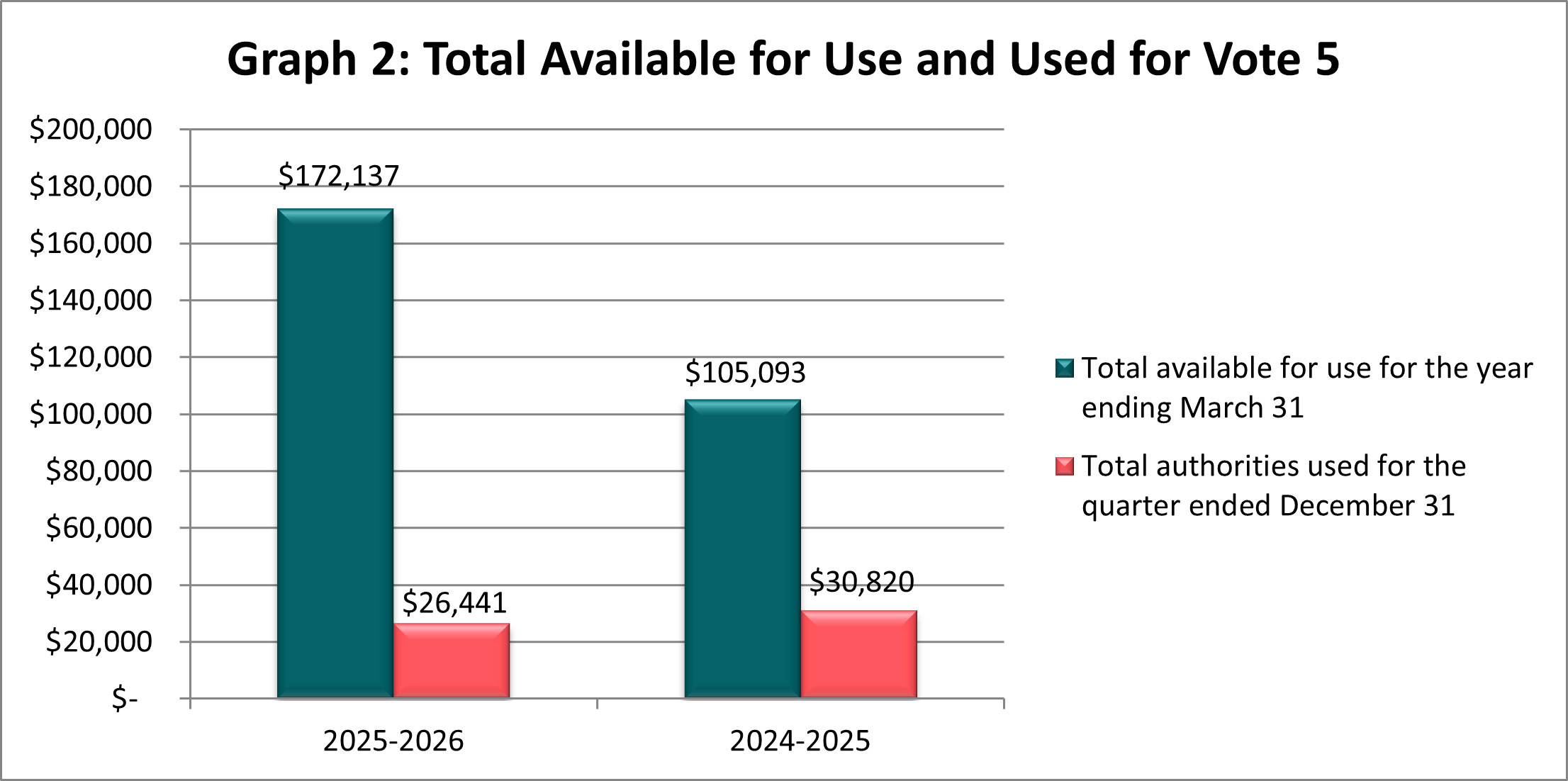
Text version: Total available for use and used for Vote 5 (in thousands of dollars)
This bar graph breaks down total authorities available for use for fiscal year 2025-26 and compares the authorities used at quarter end.
2025-2026
- $172,137 represents total available for use for the year ending March 31
- $26,441 represents total authorities used for the quarter ending December 31
2024-2025
- $105,093 represents total available for use for the year ending March 31
- $30,820 represents total authorities used for the quarter ending December 31
Statement of authorities: Budgetary statutory authorities
Budgetary statutory authorities for use in fiscal year 2025-2026 are $3.4 million, an increase of $0.3 million when compared to $3.1 million in 2024-2025. The variance is due to minor adjustments in funding.
Budgetary statutory authorities used in fiscal year 2025-2026 are $2.3 million, an increase of $0.5 million when compared to $1.8 million in 2024-2025. The variance is due to increased payments for employee benefit plans.
Graph 3 illustrates total authorities available for use for the fiscal year, and authorities used at quarter-end.
(In thousands of dollars)
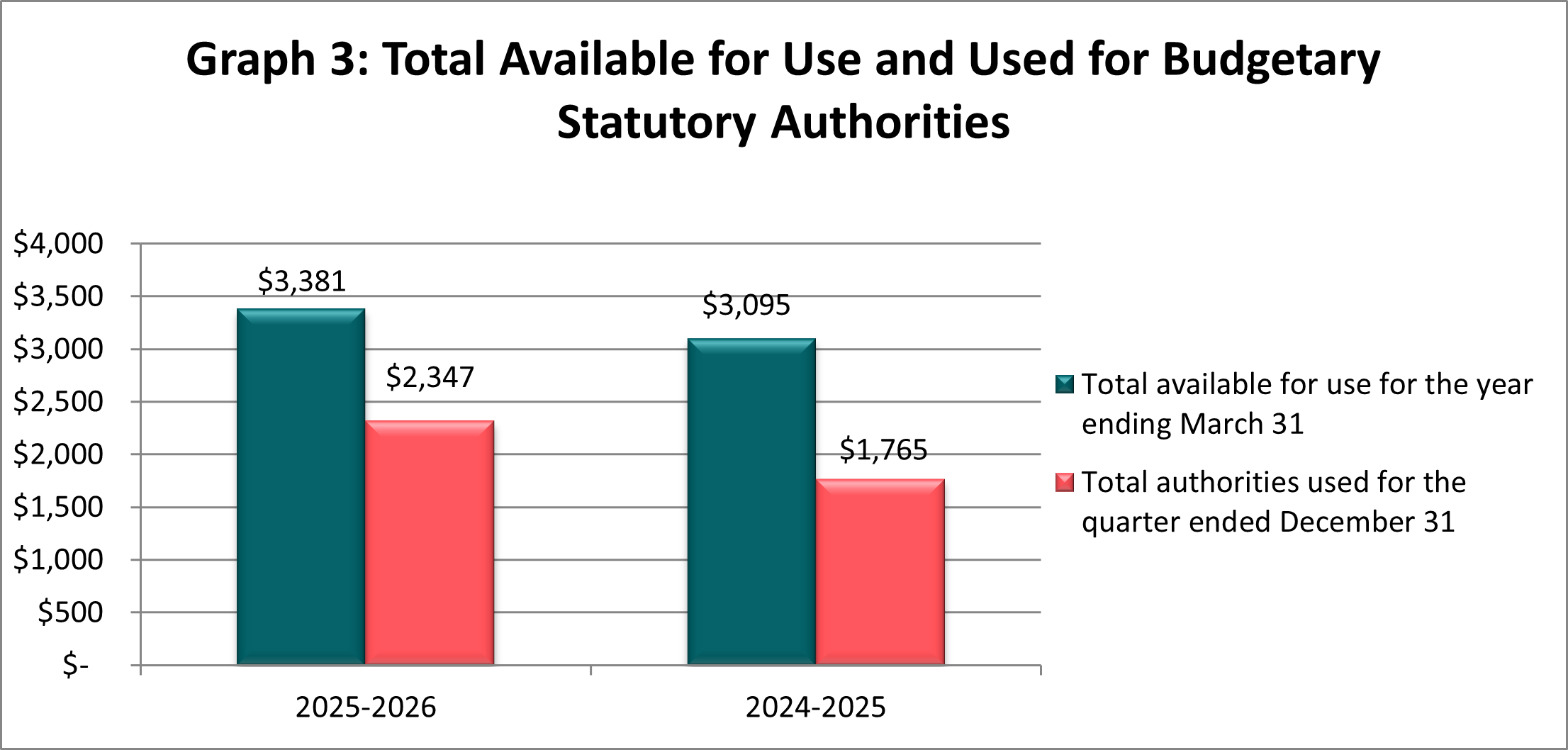
Text version: Total available for use and used for budgetary statutory authorities (in thousands of dollars)
This bar graph breaks down total authorities available for use for fiscal year 2025-26 and compares the authorities used at quarter end.
2025-2026- $3,381 represents total available for use for the year ending March 31
- $2,347 represents total authorities used for the quarter ending December 31
2024-2025
- $3,095 represents total available for use for the year ending March 31
- $1,765 represents total authorities used for the quarter ending December 31
Statement of the departmental budgetary expenditures by standard object
Expenditures by standard object for the quarter ended December 31, 2025 are $24.3 million, compared to $29.0 million at December 31, 2024. The $4.7 million decrease is explained by:
- $5.4 million net decrease in transfer payments made to the Regional Economic Growth through Innovation (REGI) program, Pacific Economic Development Program (PEDP) and other programs;
- $0.2 million decrease in transportation, information services and equipment expenses; and
- $0.9 million increase in personnel, rental and other expenses.
Additional information can be found in the Statement of Authorities, Vote 1 and Vote 5 sections above.
(In thousands of dollars)
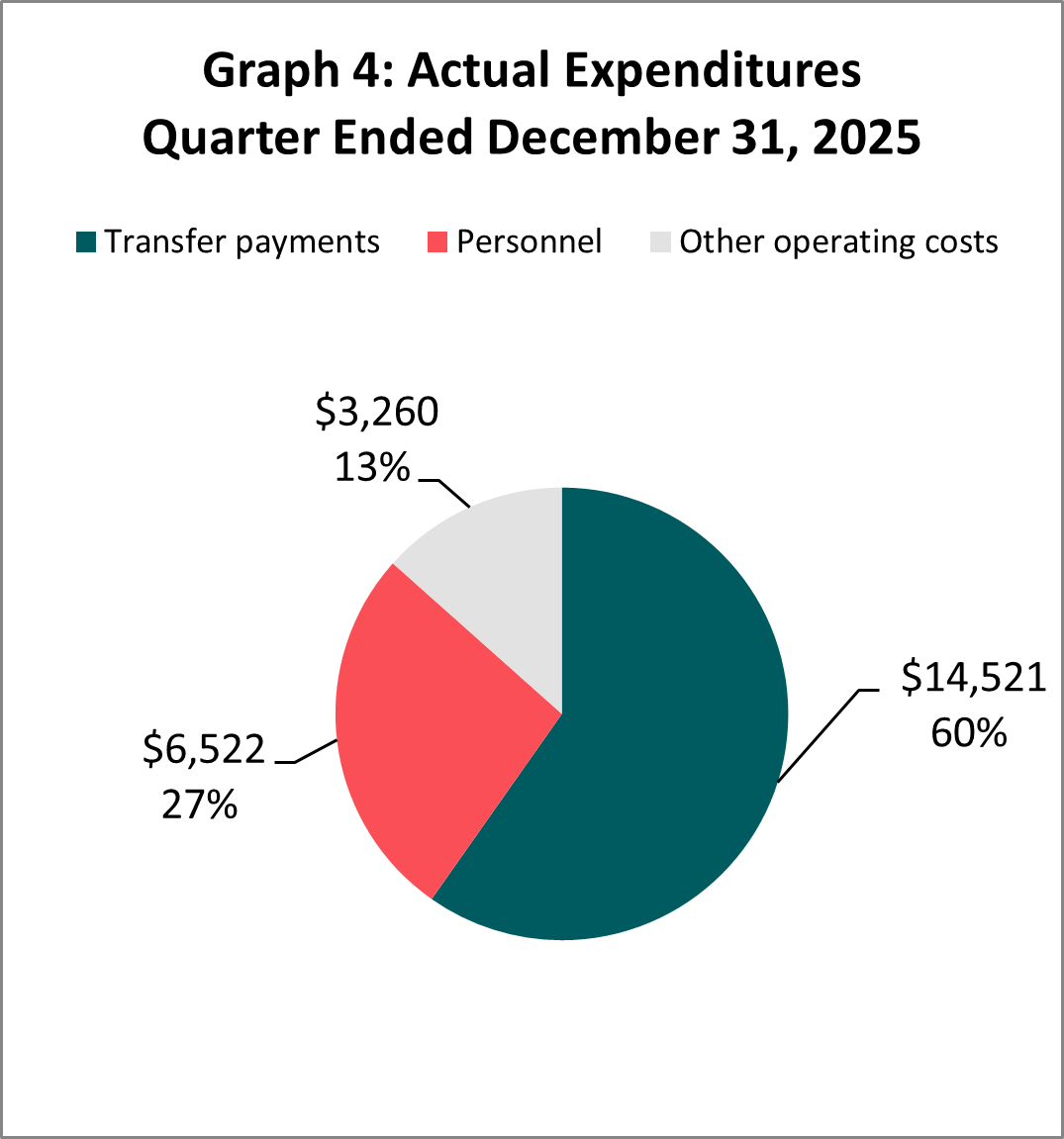
Text version: Actual expenditures quarter ended December 31, 2025 (in thousands of dollars)
This pie chart breaks down actual expenditures for quarter ended December 31, 2025.
- $14,521 represents actual spending on Transfer Payments, which accounts for 60% of Actual Expenditures quarter ended December 31, 2025
- $6,522 represents actual spending on Personnel, which accounts for 27% of Actual Expenditures quarter ended December 31, 2025
- $3,260 represents actual spending on Other operating costs, which accounts for 13% of Actual Expenditures quarter ended December 31, 2025
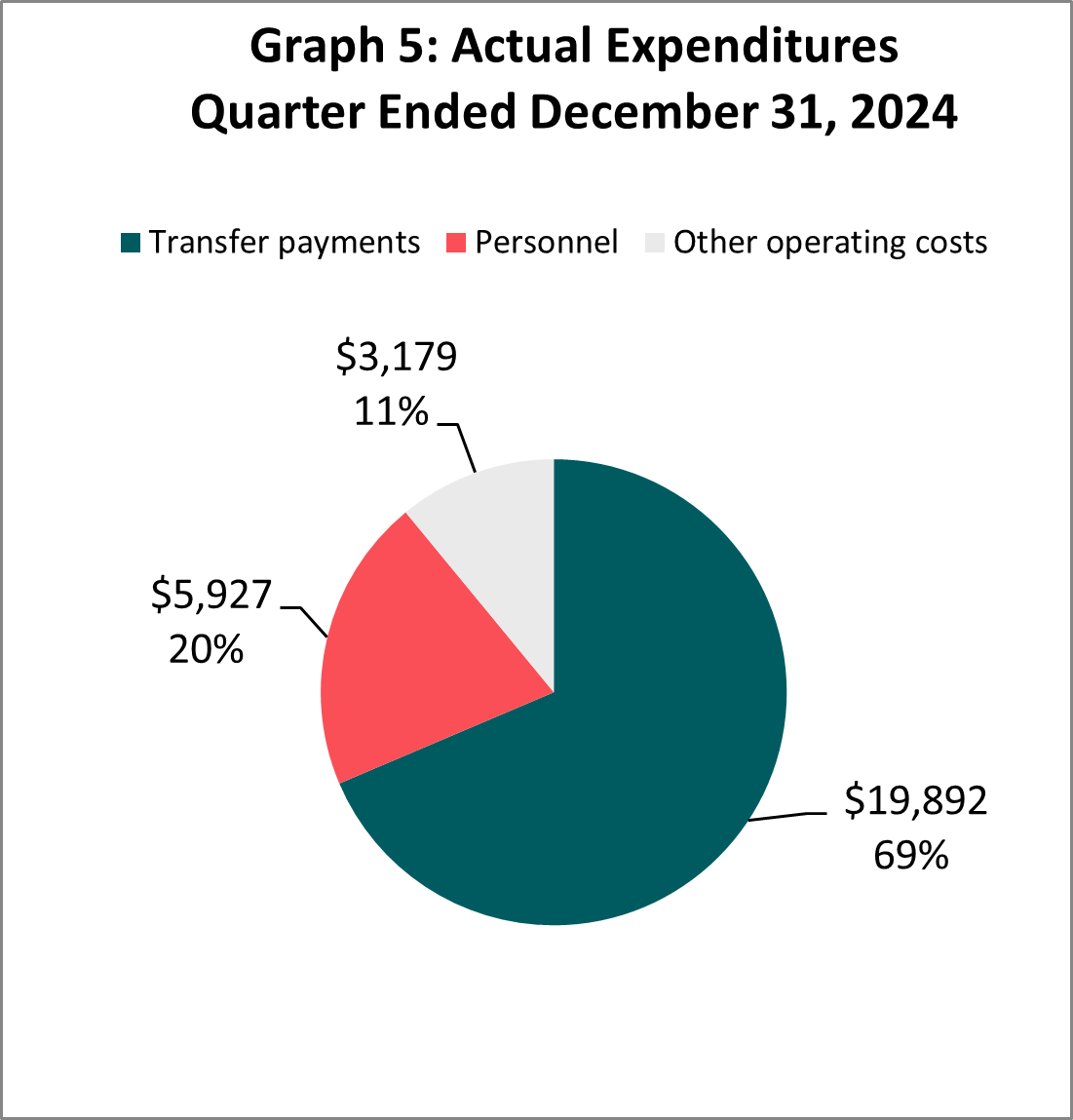
Text version: Actual expenditures quarter ended December 31, 2024 (in thousands of dollars)
This pie chart breaks down actual expenditures for quarter ended December 31, 2024.
- $19,892 represents actual spending on Transfer Payments, which accounts for 69% of Actual Expenditures quarter ended December 31, 2024
- $5,927 represents actual spending on Personnel, which accounts for 20% of Actual Expenditures quarter ended December 31, 2024
- $3,179 represents actual spending on Other operating costs, which accounts for 11% of Actual Expenditures quarter ended December 31, 2024
Risks and uncertainties
The agency is managing the allocation of resources within a well-defined framework of accountabilities, policies and procedures including a system of budgets, reporting and other internal controls to manage within available resources and authorities from Treasury Board.
PacifiCan’s internal operations, staff recruitment and retention are affected by the high cost of living in the Lower Mainland, the bilingual position requirements in a unilingual region, and the demands of delivering a wide range of temporary programs. The agency recognizes the potential risk of reduced spending capacity, which could impact the organizational responsiveness, internal support and service delivery. The agency will monitor risks and allocate resources to priority functions to mitigate risks on the delivery of our mandate.
British Columbians continue to face economic challenges such as rising costs of doing business, supply chain disruptions, labour disruptions, and increasingly severe weather events. These and other such risks continue to pose challenges for businesses, innovators, and communities in British Columbia. Moreover, any modifications to international or North American trade policies and systems, such as changes to tariffs, may negatively impact the Canadian economy. To mitigate risks, PacifiCan proactively collaborates with applicants and recipients to address challenges and structure projects accordingly, while maintaining agility and responsiveness to clients’ needs through effective mandates delivery, strategic resource reallocation, and timely implementation of budget initiatives.
Significant changes in relation to operations, personnel and programs
There are no significant changes in relation to operations for this reporting period.
Approval by senior officials
Approved by:
Original signed by:
________________________
Naina Sloan
President
Vancouver, Canada
Date:
Original signed by:
________________________
Mona Luke
Chief Financial Officer
Statement of authorities (unaudited)
| Authorities | Total available for use for the year ending March 31, 2026* | Used during the quarter ended December 31, 2025 | Year-to-date used at quarter-end |
|---|---|---|---|
| Vote 1 - Net operating expenditures | $32,653 | $8,977 | $18,742 |
| Vote 5 - Grants and contributions | 172,137 | 14,521 | 26,441 |
| Budgetary statutory authorities - Employee Benefit Plans and Collection Agency Fees | 3,381 | 805 | 2,347 |
| Total authorities | $208,171 | $24,303 | $47,530 |
*Includes only authorities available for use and granted by Parliament at quarter-end.
| Authorities | Total available for use for the year ending March 31, 2025* | Used during the quarter ended December 31, 2024 | Year-to-date used at quarter-end |
|---|---|---|---|
| Vote 1 - Net operating expenditures | $34,061 | $8,519 | $20,319 |
| Vote 5 - Grants and contributions | 105,093 | 19,892 | 30,820 |
| Budgetary statutory authorities - Employee Benefit Plans | 3,095 | 588 | 1,765 |
| Total authorities | $142,249 | $28,999 | $52,904 |
*Includes only authorities available for use and granted by Parliament at quarter-end.
Departmental budgetary expenditures by standard object (unaudited)
| Expenditures | Total available for use for the year ending March 31, 2026* | Expended during the quarter ended December 31, 2025 | Year-to-date used at quarter-end |
|---|---|---|---|
| Personnel | $26,198 | $6,522 | $17,143 |
| Transportation and communications | 860 | 167 | 314 |
| Information | 1,009 | 37 | 117 |
| Professional and special services | 6,751 | 2,814 | 3,130 |
| Rentals | 348 | 168 | 251 |
| Repair and maintenance | 0 | 0 | 0 |
| Utilities, materials and supplies | 85 | 15 | 21 |
| Acquisition of machinery and equipment | 783 | 69 | 82 |
| Transfer payments | 172,137 | 14,521 | 26,441 |
| Other subsidies and payments | 0 | (10) | 31 |
| Total net budgetary expenditures | $208,171 | $24,303 | $47,530 |
*Includes only authorities available for use and granted by Parliament at quarter-end.
| Expenditures | Total available for use for the year ending March 31, 2025* | Expended during the quarter ended December 31, 2024 | Year-to-date used at quarter-end |
|---|---|---|---|
| Personnel | $23,564 | 5,927 | 16,325 |
| Transportation and communications | 1,356 | 244 | 627 |
| Information | 1,206 | 62 | 134 |
| Professional and special services | 9,413 | 2,678 | 4,705 |
| Rentals | 798 | 18 | 53 |
| Repair and maintenance | 0 | 0 | 0 |
| Utilities, materials and supplies | 132 | 12 | 20 |
| Acquisition of machinery and equipment | 686 | 165 | 217 |
| Transfer payments | 105,094 | 19,892 | 30,820 |
| Other subsidies and payments | 0 | 1 | 3 |
| Total net budgetary expenditures | $142,249 | $28,999 | $52,904 |
*Includes only authorities available for use and granted by Parliament at quarter-end.