
Annual Report on the Administration of the Cultural Property Export and Import Act 2023-2024
On this page
- Introduction
- Minister’s message
- Annual Report on the Administration of the Cultural Property Export and Import Act 2023-2024
- Appendices
List of figures
List of tables
- Table 1. Category A and B designations, fiscal year 2023-2024.
- Table 2. Export permit applications, fiscal year 2023-2024.
Introduction
Since its adoption in 1977, the Cultural Property Export and Import Act (Act) has served to encourage and ensure the preservation in Canada of significant examples of our artistic, historic, and scientific heritage. The Act accomplishes this objective through the following five provisions:
- Designation of organizations that have demonstrated the capacity to preserve cultural property and make it accessible to the public;
- Tax incentives to encourage Canadians to donate or sell significant cultural property to designated organizations;
- Grants to assist designated organizations with the purchase of cultural property;
- Export control; and
- Import control.
The responsibility for carrying out these provisions is shared by the Minister of Canadian Identity and Culture and an independent administrative tribunal established by the Act, the Canadian Cultural Property Export Review Board, together with other government organizations responsible for administering and enforcing specific elements of the legislation.
This report will cover the aspects of the Act that are the responsibility of the Minister of Canadian Identity and Culture from April 1, 2023 to March 31, 2024. Activities under the Act that are the responsibility of the Board, including the certification of cultural property for income tax purposes and the review of refused export permits, are covered in a separate report, issued by the Board.
Minister’s message

As Minister of Canadian Identity and Culture, I am proud to present the Annual Report on the Administration of the Cultural Property Export and Import Act for 2023–2024. Since its adoption in 1977, the Act has helped ensure the preservation of significant examples of Canada’s artistic, historic and scientific heritage.
This report refers solely to the work of the Department of Canadian Heritage to support the administration of the Act. The Canadian Cultural Property Export Review Board has prepared a separate report detailing its own work administering the Act. I am pleased to table both reports before Parliament and make them available to Canadians.
International highlights – Canada participated in the G7 and G20 Ministers of Culture meetings and continued to promote its commitments to the fight against illicit trafficking of cultural property, protecting cultural property in danger and working with multilateral and bilateral partners in this regard. The implementation of the Cultural Property Export and Import Act supports and advances national and international commitments to the protection of cultural heritage/property.
National highlights – The McMichael Canadian Art Collection received a Movable Cultural Property grant to support the purchase of Canadian artist Marian Dale Scott’s painting Portrait of Lois Gordon in a Russian Dress, 1935. The painting was repatriated to Canada after being privately owned in the United Kingdom and was most recently featured in the exhibition Uninvited: Canadian Women Artists in the Modern Moment.
Arts and culture are at the very heart of our identity. They connect us, foster new understandings and envision future possibilities. To learn more about the accomplishments of the Department under the Cultural Property Export and Import Act in 2023–2024, I invite you to continue reading this report. I would like to thank everyone who has demonstrated vigilance and professionalism to help safeguard cultural properties, both here in Canada and around the world.
The Honourable Marc Miller
Annual Report on the Administration of the Cultural Property Export and Import Act 2023-2024
Overview
Under the Cultural Property Export and Import Act, Department of Canadian Heritage is responsible for:
- assessing organizations for the purpose of designation;
- assessing applications for Movable Cultural Property grants;
- export control; and
- import control.
Designation of organizations
Organizations such as museums, art galleries, libraries, archives, municipalities, and public authorities must be designated in order to be eligible to apply for the certification of cultural property or for a Movable Cultural Property grant. Designation is a ministerial responsibility and a means of ensuring that cultural property certified by the Review Board or acquired with the assistance of a Movable Cultural Property grant is housed in organizations that have the capacity to ensure its long-term preservation and to make it accessible to the public through research, exhibitions, and in print or online publication.
Organizations may be designated as Category A or B. Under Category A, organizations are designated in relation to any cultural property that falls within their collecting mandate. Under Category B, organizations are designated only in relation to a specific cultural property or collection.
In 2023-2024
A total of five organizations were designated as Category A or B:
| Category | Object Class or objects | Organization | Effective Date |
|---|---|---|---|
| A | 9 | Cinémathèque québécoise | October 3, 2023 |
| B | Outdoor sculpture | Corporation of the Township of Archipelago | November 10, 2023 |
| B | Outdoor sculpture | Musée d’art de Joliette | November 28, 2023 |
| A | 9 | University of Toronto, Thomas Fisher Rare Book Library | January 3, 2024 |
| B | Bronze plaque and posters | Canadian Railroad Historical Association – Association canadienne d’histoire ferroviaire | January 5, 2024 |
A total of five organizations were designated in 2023-2024 which includes two Category A designations and three Category B designations. Four more organizations were under review as of March 31, 2024. Among these four organizations, one was part of the Department’s targeted review of designated organizations collecting audiovisual material and digital records. These organizations are now required to obtain a designation for Class 9 objects to ensure they have the capacity to preserve these specialized materials for the long-term. A total of 11 organizations were identified as part of this exercise, which was launched in 2019. Five organizations have been so far designated through this initiative and three have elected to withdraw themselves from the exercise, which is expected to be fully completed in 2024.
In February 2024, the Designation program launched its first newsletter for Category A organizations and other key stakeholders. To be published three times a year, each issue will feature short articles on matters pertaining to designation, including updates to the Program, changes in policies and reminders on the conditions related to designation. The newsletter will also feature other relevant information and notices such as export delay periods related to significant cultural property, which may be available for purchase by designated organizations.
For a complete list of Category A organizations, please refer to the corresponding page of the departmental website.
Movable Cultural Property grants
Under Section 35 of the Act, the Minister may provide grants to designated organizations to assist with the purchase of cultural property that has been denied an export permit or that is outside of Canada but available for sale on the international market and related to the national heritage.
In 2023-2024
The Movable Cultural Property grant program awarded $25,000 to the McMichael Canadian Art Collection to purchase the painting Portrait of Lois Gordon in a Russian Dress (1935) by Marian Dale Scott.
Scott was a Canadian artist from Montreal whose seventy-year career closely mirrored the evolution of modern art in Quebec. Portrait of Lois Gordon in a Russian Dress, considered her most precise and best realized portrait that depicts her friend Lois Gordon, was repatriated to Canada after being privately owned in the United Kingdom. The painting was most recently featured in the exhibition Uninvited: Canadian Women Artists in the Modern Moment through the support of the Museums Assistance Program.

Figure 1. Marian Dale Scott, Portrait of Lois Gordon in a Russian Dress, 1935. Photo: Jerry Moeran. © Estate of Marian Dale Scott, used with permission.
Export control
Archaeological, historical, cultural, artistic, and scientific objects are all considered movable cultural property, but only certain types of cultural property are subject to export control under the Act. The Cultural Property Export and Import Act defines classes of property that are subject to export control based on age and value (see Appendix 1-1 for a summary of the groups on this list).
If cultural property is included on the Canadian Cultural Property Export Control List (Control List) an export permit is required for its temporary or permanent removal from the country regardless of the reason. The Department liaises with and responds to questions from Canada Border Services Agency permit-issuing offices, expert examiners, and members of the public to ensure that the export-control system works effectively. Movable Cultural Property also interprets the Control List for these stakeholders.
Export permits
Temporary and permanent export permits are issued by permit officers in 16 Canada Border Services Agency permit offices located across Canada. Applications for temporary export, for objects that have been in Canada less than 35 years or which are being returned after a loan to a Canadian institution by a non-resident will all be issued automatically by the Canada Border Services Agency. All other applications for permanent export will be reviewed by an expert examiner (i.e., for sale on an international market, delivery to foreign buyers, or moving abroad).
Close to 80 institutions are designated to act as expert examiners. These include museums, art galleries, archives, libraries and universities across Canada. The role of expert examiners is to advise Canada Border Services Agency as to whether cultural property faced with export meets the criteria of outstanding significance and national importance as set out in the Act.
If the permit officer determines that an object subject to permanent export is included on the Control List and has been in the country for more than 35 years, the officer must forward a copy of the application to an expert examiner for a recommendation as to whether that object is of outstanding significance and national importance. If the expert examiner deems this to be the case, the officer will refuse the permit and the applicant will have thirty days to request a review; otherwise, it will be issued.
In 2023-2024
The Department received 389 applications for permanent or temporary permits:
| Types of export permit applications | Number of applications |
|---|---|
| Temporary permits (i.e., for exhibition, conservation, or research) | 69 |
| Permanent permits (includes permits issued automatically and reviewed by an expert examiner) | 320 |
| Approved permits | 382 |
| Refused permits | 7 |
| Total applications received | 389 |
Information regarding reviews of refused permit applications is available in the report of the activities of the Canadian Cultural Property Export Review Board. For an infographic of the steps involved in the Cultural Property Export Process under the Cultural Property Export and Import Act, please refer to Appendix 1-2.
General export permits
A general permit may be issued to any resident of Canada who regularly exports cultural property that falls under the Control List. General permits may be granted to organizations whose core business is unduly inconvenienced by the necessity of applying for individual permits or to organizations which have a large volume of cultural property exports.
A general permit will be issued when it can be demonstrated that the property to be exported would routinely be approved for export. Routinely approved permits include temporary permits, permits for objects that have been in Canada less than 35 years or permits for objects returned after loan to a Canadian institution or public authority. Cultural property that must be reviewed by an expert examiner under the permanent export permit process would not normally be considered eligible for a general permit.
In 2023-2024
Three general permits were renewed or issued in 2023-24, including two issued to new organizations. There are currently 15 active general permits.
Illegal exports
Pursuant to Article 1 of the 1970 UNESCO Convention, Section 38 of the Act states that any cultural property included on the Control List is designated by Canada to be of importance for archaeology, ethnography, history, culture, art, or science. The Act contains provisions making it a criminal offence to export or attempt to export from Canada any property included on the Control List except under the authority of and in accordance with a temporary or permanent permit issued under the Act. Penalties upon conviction of an offence under the Act include a fine, imprisonment, or both. Under the terms of the 1970 UNESCO Convention, if illegally exported cultural property is imported into a fellow signatory state, Canada may be afforded the opportunity to request its return.
In 2023-2024
There were no convictions under the Act.
Import control
International cooperation under the 1970 UNESCO Convention
In 1978, Canada became a signatory to the 1970 UNESCO Convention on the Means of Prohibiting and Preventing the Illicit Import, Export and Transfer of Ownership of Cultural Property. This Convention places the onus on each signatory state to develop its own legislation to protect and preserve its cultural heritage and to establish measures to facilitate the return of illegally exported cultural property to its country of origin. The Act contains provisions making it an offence to import into Canada cultural property that has been illegally exported from a state that is a fellow signatory to an international cultural property agreement. Penalties upon conviction of an offence under the Act include a fine, imprisonment, or both.
Since the 1970 UNESCO Convention came into force in Canada in 1978, Canada has returned over 22,000 objects on 27 occasions to 14 different states in Africa, Asia, Europe, the Middle East as well as South and Central America.
In 2023-2024
The Department reviewed over 40 imports detained by the Canada Border Services Agency in a timely manner. There were no returns of illegally imported cultural property in 2023-24.
International cooperation under the 1954 UNESCO Hague Convention
The UNESCO Convention for the Protection of Cultural Property in the Event of Armed Conflict, known as the 1954 Hague Convention, was developed in response to concerns over the destruction of cultural property, including monuments, museums, libraries and archives, during the Second World War. The Convention is regarded as one of the most important components of the international effort to protect cultural heritage.
The two Protocols to the Convention make it illegal to export cultural property from occupied territories as well and provide for the return of any illegally exported property. They also impose obligations on the prosecution of violations of the Convention.
Canadians who participate in the deliberate destruction or illegal export of cultural property, either during peace time or during conflict, may be committing an offence under the Criminal Code or the Cultural Property Export and Import Act.
Since 2005, it is also an offence under the Criminal Code for Canadians to damage or destroy cultural property anywhere outside Canada at any time.
In 2023-2024
There were no convictions for offences committed by Canadians against cultural property outside of Canada.
Appendices
Appendix 1-1: Canadian Cultural Property Export Control List
The following list describes the groups of cultural property controlled under the Cultural Property Export and Import Act:
- Group I: Objects recovered from the soil or waters of Canada
- Group II: Objects of ethnographic material culture
- Group III: Military objects
- Group IV: Objects of applied and decorative art
- Group V: Objects of fine art
- Group VI: Scientific or technological objects
- Group VII: Textual records, graphic records, and sound recordings
- Group VIII: Musical instruments
Appendix 1-2: The Cultural Property Export Process
An infographic of the steps involved in the Cultural Property Export Process as per the Cultural Property Export and Import Act.
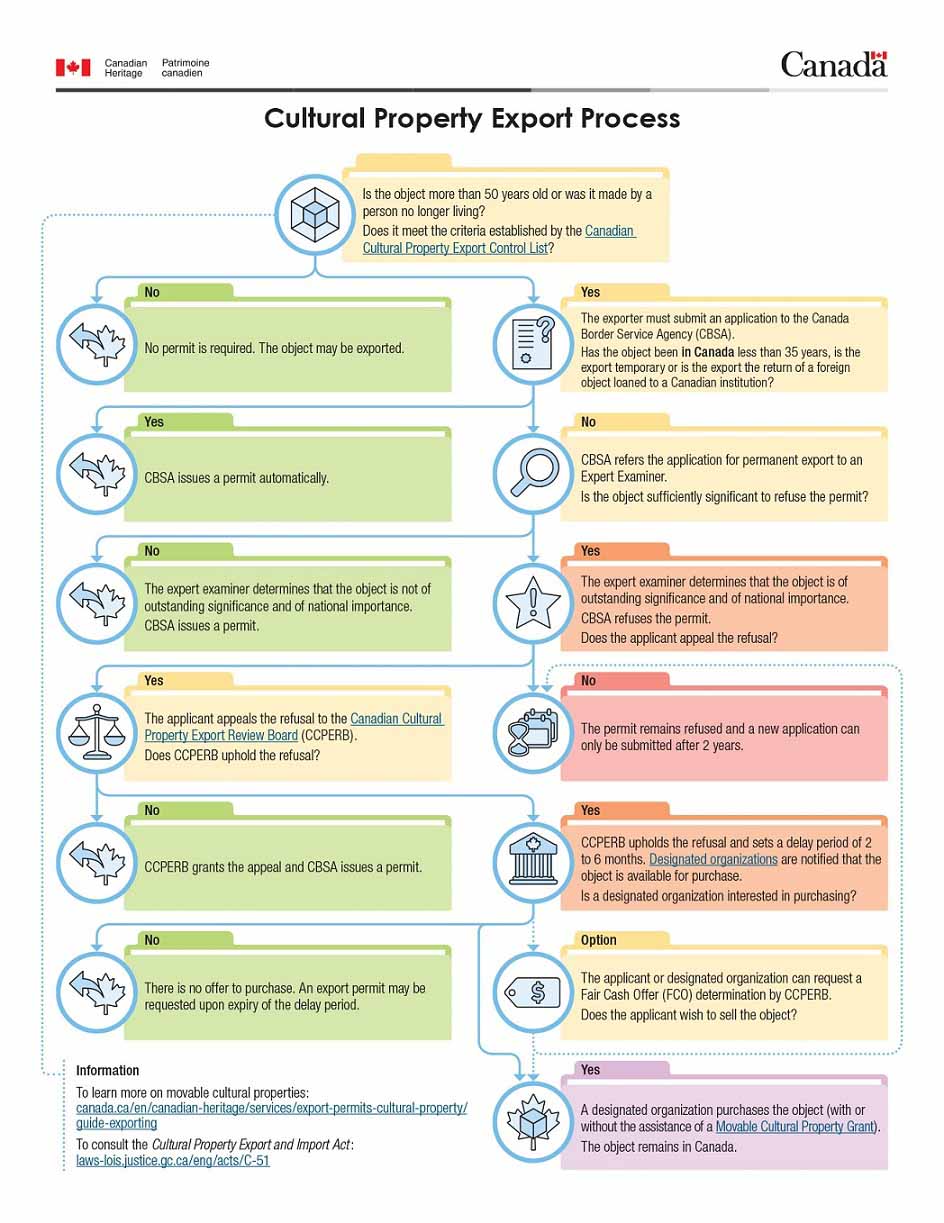
The Cultural Property Export Process – Text version
The process begins with an exporter asking whether an object meets the criteria established by the Canadian Cultural Property Export Control List.
If the answer is no, no permit is required and the object may be exported from Canada.
If the answer is yes, the exporter must submit an application to the Canada Border Services Agency.
Next step: the application form will ask if the object has been in Canada less than 35 years, if the export is temporary or if the export is to return an object loaned to an institution.
If the answer to any of these questions is yes, the Canada Border Services Agency will issue a permit automatically and the object may be exported from Canada.
If the answer to all of these questions is no, the Canada Border Services Agency will refer the application for permanent export to an Expert Examiner.
Next step: the Expert Examiner will review the object listed on the application to determine if it is sufficiently significant to refuse the permit application.
If the Expert Examiner determines that the object is not of outstanding significance and national importance to Canada, the Canada Border Services Agency will issue a permit and the object may be exported from Canada.
If the Expert Examiner determines that the object is of outstanding significance and national importance, the Canada Border Services Agency will refuse the permit.
The permit applicant may appeal the refusal to the Canadian Cultural Property Export Review Board.
If the applicant does not appeal to the Canadian Cultural Property Export Review Board, the permit remains refused and a new application can only be submitted in two years.
If the applicant appeals to the Canadian Cultural Property Export Review Board, it must either uphold the refusal or allow the permit to be issued.
If the Board allows the permit to be issued, the Canada Border Services Agency will issue a permit and the object may be exported.
If the Board upholds the refusal, it will set a delay period of two to six months. Designated organizations in Canada will be notified that the object is available for purchase.
If no designated organization is interested in purchasing the object, an export permit may be requested upon the expiry of the delay period. The object may be exported from Canada.
If a designated institution purchases the object, they may do so with or without the assistance of a Movable Cultural Property grant. The object will remain in Canada.
Option: In certain circumstances, the applicant or a designated organization can request a fair cash offer determination by the Canadian Cultural Property Export Review Board.
If the applicant does not wish to sell the object, the permit remains refused and a new application can only be submitted in two years.
If a designated institution purchases the object, they may do so with or without the assistance of a Movable Cultural Property grant. The object will remain in Canada.
To learn more about movable cultural properties consult the Guide to Exporting Cultural Property at https://www.canada.ca/en/canadian-heritage/services/export-permits-cultural-property/guide-exporting.html
The Cultural Property Export and Import Act is online at https://laws-lois.justice.gc.ca/eng/acts/C-51/
© His Majesty the King in Right of Canada, as represented by the Minister of Canadian Heritage, 2025
Catalogue No. CH1-31E-PDF
ISSN 2368-0741