
Briefing binder created for the Deputy Minister of Finance on the occasion of his appearance at the Standing Committee on Public Accounts on February 9, 2026 on the 2024 and 2025 Public Accounts of Canada
Table of contents
Core Narratives
- Economic Narrative
- Inflation Narrative
- Productivity Narrative
- Fiscal Narrative
- Debt Management Strategy
- International Trade
- Budget 2025
Other Issues
- Affordability (Overview of Government Actions)
- Audits
- Automotive Sector Support
- Bank of Canada and Foreign Exchange Reserves
- Bank of Canada Gold Reserves
- Capital Budgeting Framework and New Budget Cycle
- Climate Policy
- Comprehensive Expenditure Review
- Housing Sector Overview
- Immigration and Levels Plan
- Tax Debt and Corporate Write-offs
- Trans Mountain
Public Accounts of Canada
- Public Accounts of Canada Overview 2024 and 2025
- Contingent Liabilities
- Department of Finance Significant Balances and Sensitive Transactions 2024 and 2025
- Major Transfers to Provinces and Territories in 2024 and 2025
Annexes
- Annex A: Meeting Overview
- Annex B: Committee Member Bios (PACP)
- Annex C: Public Accounts of Canada
Economic Narrative
Key Messages
- The Canadian economy remains resilient. Despite some volatility, overall economic activity has evolved largely as expected.
- Real GDP expanded in the second half of 2025 after nearly stalling in the first half of the year,
the labour market has stabilized, and business and consumer confidence have improved:
- Total employment is up by 159,000 since January 2025, with 104,000 more full-time jobs and 155,000 more private sector jobs.
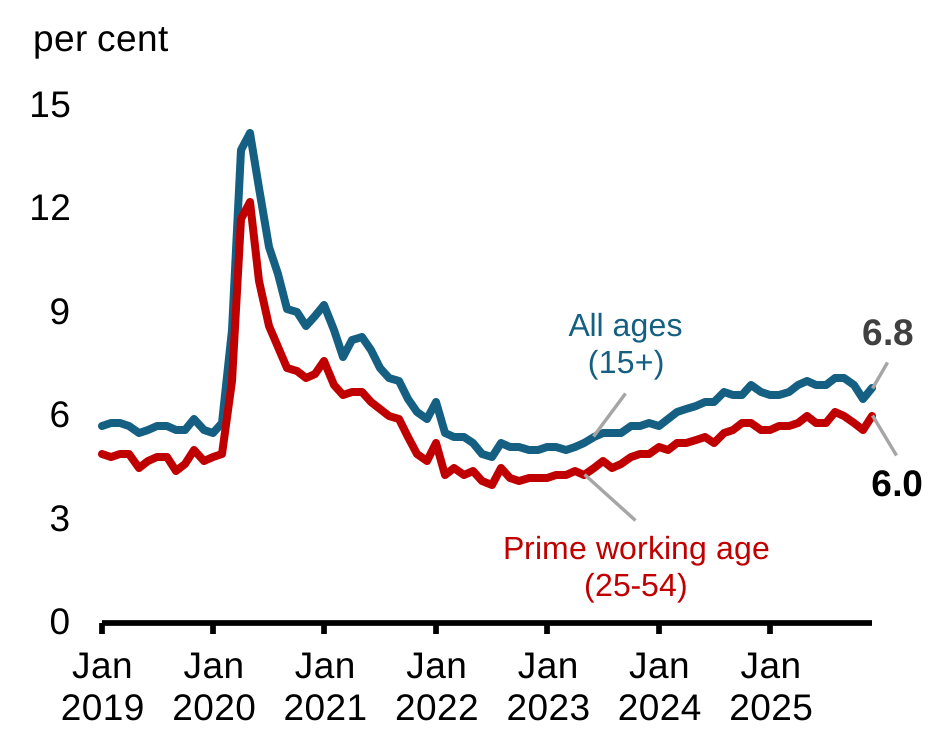
- The unemployment rate is 6.8%, below Budget 2025 expectations, and more people are returning to the labour force.
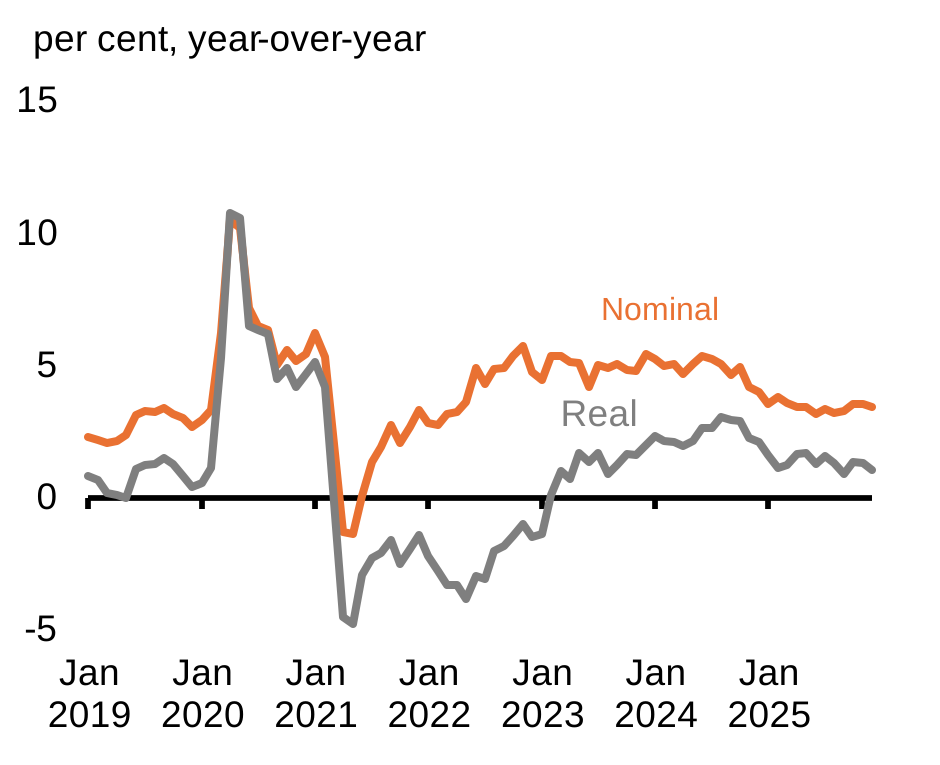
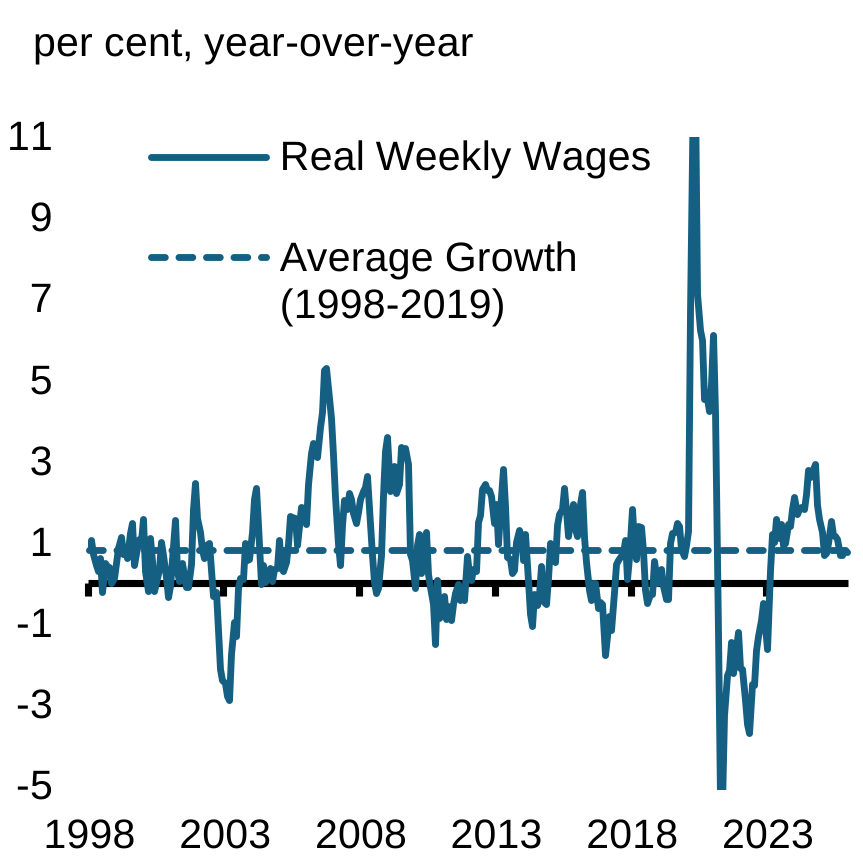
- Nominal average hourly wages rose by 3.4% in December, above the 2010-2019 average of 2.3%.
- Inflation has been close to 2 per cent for two full years, supporting household purchasing power.
- The economy is still expected to remain in a soft patch in the coming months. The trade conflict has weakened demand for exports and heightened uncertainty has led some businesses to postpone expansion plans. This is hampering the economy's ability to grow.
- But strong foundations are in place for growth to pick-up.
- The IMF expects Canada to have the second-strongest economy this year among G7 countries, after the U.S.
- While U.S. tariffs remain a challenge, 85 per cent of Canada's trade with the U.S. is tariff free and Canada enjoys the lowest effective U.S. tariff rate globally at 5.4 per cent.
- Budget 2025 is making significant, strategic capital investments to raise long-term growth and build the strongest economy in the G7.
Details & Supplementary Information
- After a weak first half of 2025, economic activity resumed in the second half of the year as global conditions stabilized and domestic demand held up better than expected. While growth remains subdued, recent data suggest the slowdown has been less pronounced than anticipated at the time of Budget 2025.
- The economic backdrop has improved modestly since Budget 2025 was tabled. Job creation has totaled 159,000 since January of last year, more than 100,000 of which has been in full-time work. This has helped bring the unemployment rate down to 6.8% as of December, below the expectations of private sector economists at the time of Budget 2025.
- Business sentiment is also improving. Firms are adapting to the new trade environment and partly mitigated the impact of tariffs by diversifying export markets and building inventories. Furthermore, 85% of Canada's trade with the U.S. remains tariff-free, and the average tariff rate on Canadian goods is about 5.4%—the lowest among U.S. trading partners.
- Inflation remains well contained. Headline inflation edged up slightly late in 2025 due to temporary factors, while underlying inflation pressures continue to ease overall. This environment has supported real household purchasing power and allowed interest rates to move lower. *Redacted*.
- Looking ahead, the economy is expected to regain momentum gradually throughout 2026. *Redacted*. Risks to Canada's economic outlook remain closely tied to the duration of U.S. tariffs and the uncertainty they create for capital-intensive, globally dependent industries.
- Budget 2025 is making generational investments in housing, infrastructure, defence, productivity and competitiveness. These investments will drive productivity, boost the capacity of Canada's economy and secure a prosperous future for Canadians.
| Quarterly Annualized Growth (2025Q3) |
Year-over-Year Growth (2025Q3/2024Q3) |
|
|---|---|---|
| US | 4.3 | 2.3 |
| Canada | 2.6 | 1.4 |
| France | 2.2 | 0.9 |
| Italy | 0.5 | 0.6 |
| UK | 0.4 | 1.3 |
| Germany | 0.0 | 0.3 |
| Japan | -2.3 | 0.7 |
| 2025 | 2026 | 2027 | |
|---|---|---|---|
| OECD Economic Outlook – December 2025 | 1.1 | 1.3 | 1.7 |
| IMF World Economic Outlook – January 2026 | 1.6 | 1.6 | 1.9 |
| Bank of Canada Monetary Policy Report – January 2026 | 1.7 | 1.1 | 1.5 |
| PBO Economic and Fiscal Outlook – September 2025 | 1.2 | 1.3 | 1.8 |
| *Redacted* | *Redacted* | ||
| Department of Finance – Budget 2025 | 1.1 | 1.2 | 2.0 |
Inflation Narrative
Key Messages
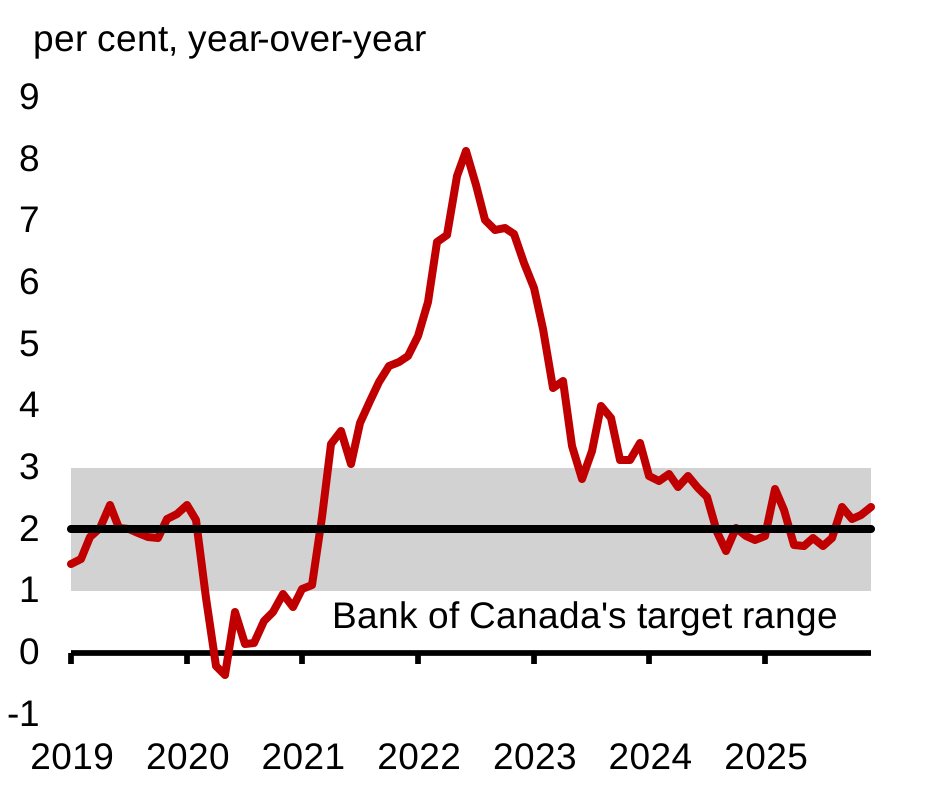
- Inflation remains close to 2%. Headline inflation was 2.4% in December 2025 and has remained within the Bank of Canada's 1-3 % target range for the past 24 consecutive months.
- Inflation is expected to remain near 2%. Both the Bank of Canada and private-sector forecasters anticipate inflation staying close to target over the foreseeable future.
- Canadians remain concerned about the cost of living – including high food prices. In a market economy like ours, there will always be some prices rising faster than 2%, and some more slowly. For example, grocery prices were up 5% in December, while gasoline was down almost 14%.
- Elevated food inflation reflects the tail end of input cost pressures earlier this year, and this is not unique to Canada. Many advanced economies have experienced elevated food inflation, and Canada sat roughly mid-range among peer countries in 2025.
- Lower overall inflation has allowed the Bank of Canada to reduce interest rates, which has significantly reduced mortgage costs for Canadians.
- This government recognizes that many Canadians are feeling the pressures of everyday expenses and need relief right now. Building on past actions to provide relief, like the elimination of the consumer carbon price, the government has proposed the new Canada Groceries and Essentials Benefit.
- At the same time, the government continues to plan to create better-paying jobs, increasing productivity and building the strongest economy in the G7, which will support stronger income growth.
Details & Supplementary Information
- Inflation reached a height of 8.1% in June 2022, driven by pandemic-related disruptions, supply chain congestion, and surging commodity prices following Russia's illegal full-scale invasion of Ukraine. Since then, inflation has come down and has been close to 2% for two years.
- In December, inflation picked up to 2.4% from 2.2% in November, reflecting the base-year effects from last winter's temporary GST/HST holiday. This particularly affected services excluding shelter. For example, restaurant prices increased by 8.5% year-over-year. Excluding indirect taxes, inflation eased from 2.8% in November to 2.5% in December.
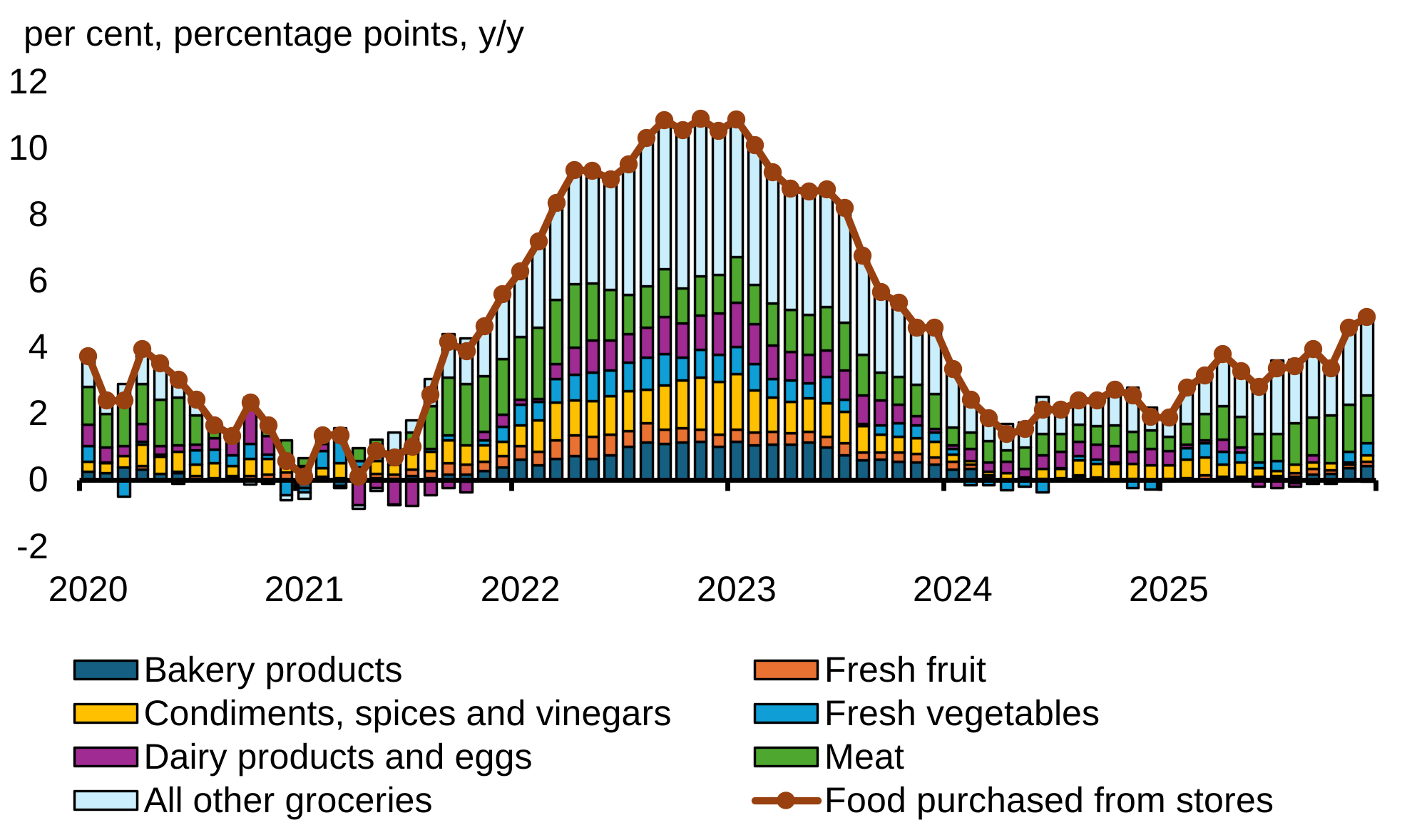
- On the flip side, higher food prices are still being boosted by earlier input cost pressures and this is
mitigating the broader moderation in inflation. The year over year pace for grocery inflation picked up
to 5.0%, well above its historical average of 2.0%.
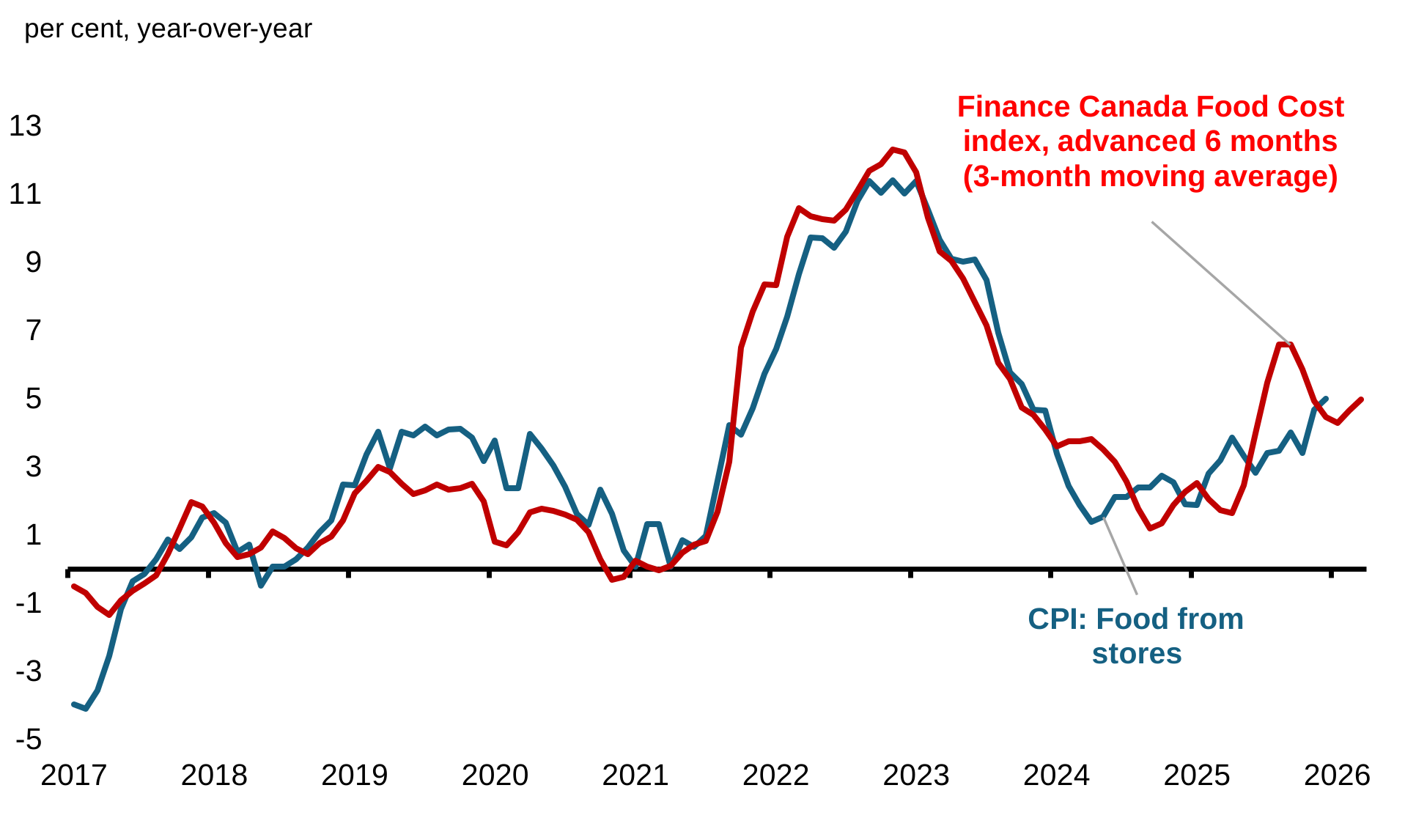
- Low crop yield, severe weather, transportation costs and other input costs have put upward pressures on food prices.
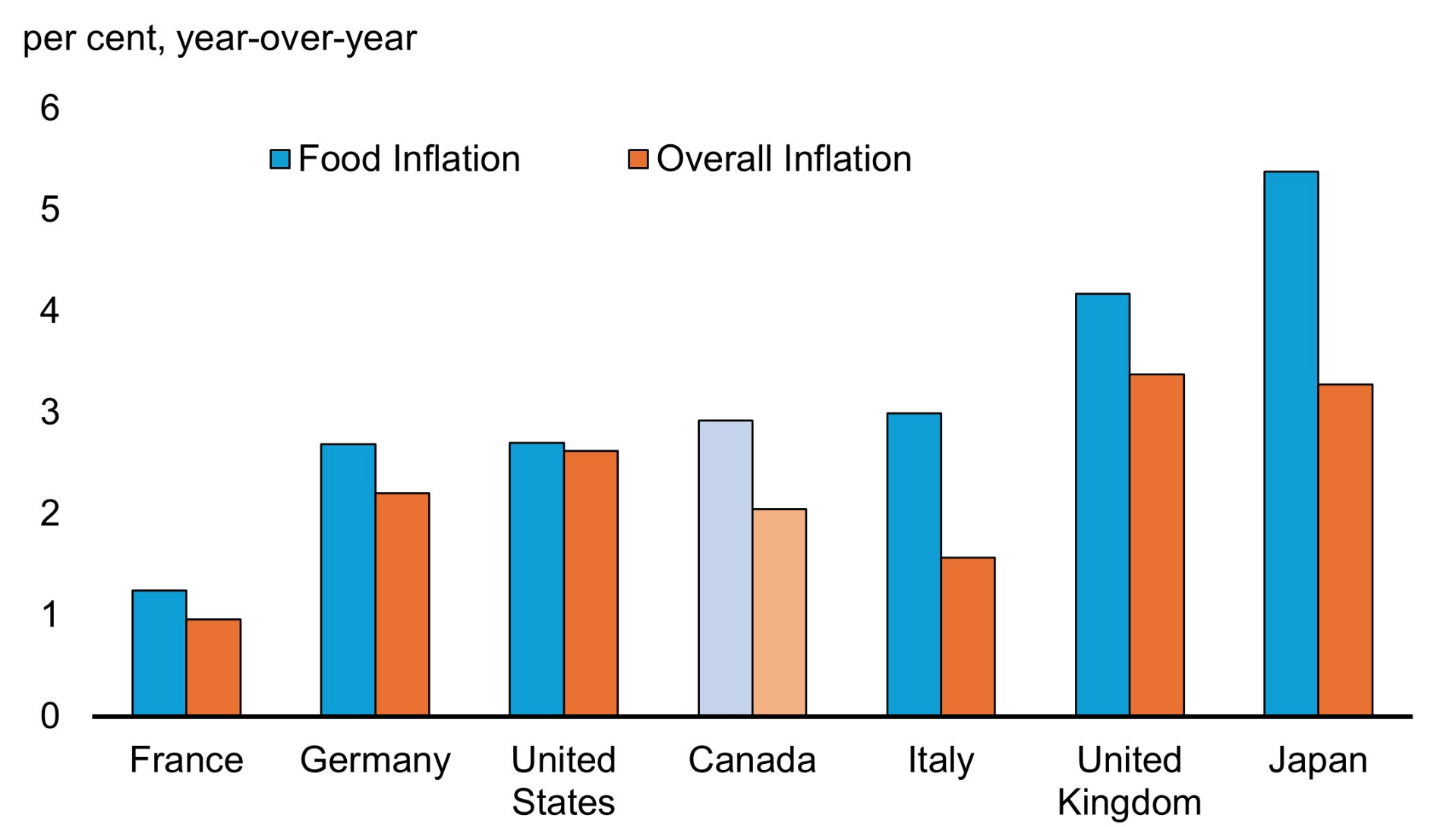
- These cost pressures are being experienced around the world, and Canada sits mid-range among peer countries for 2025.
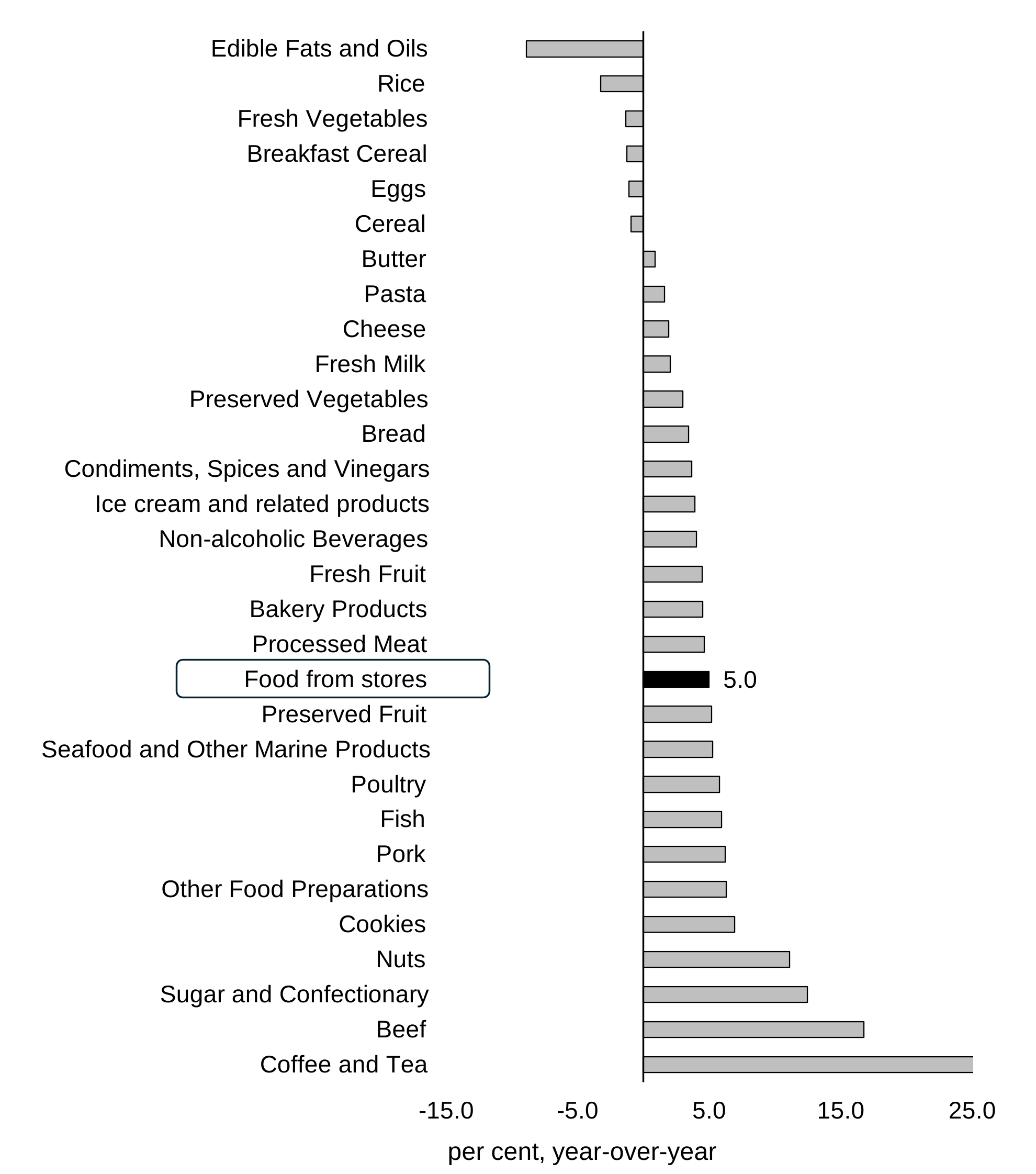
- This is particularly evidenced in inflation for products that are facing supply issues such as beef, poultry, coffee, and confectionary products.
- Growth in input costs has moved lower recently, so food price inflation should ease in the months ahead.
- There are many reasons inflation is expected to remain close to 2%:
- Measures of core inflation continue to ease. The average of measures of core inflation eased to 2.6% in December. The three-month annualized rate dropped to below 2%, showing a significant easing in momentum and pointing to further easing in year over year measures ahead.
- Input cost growth is easing and unit labour costs have been steady.
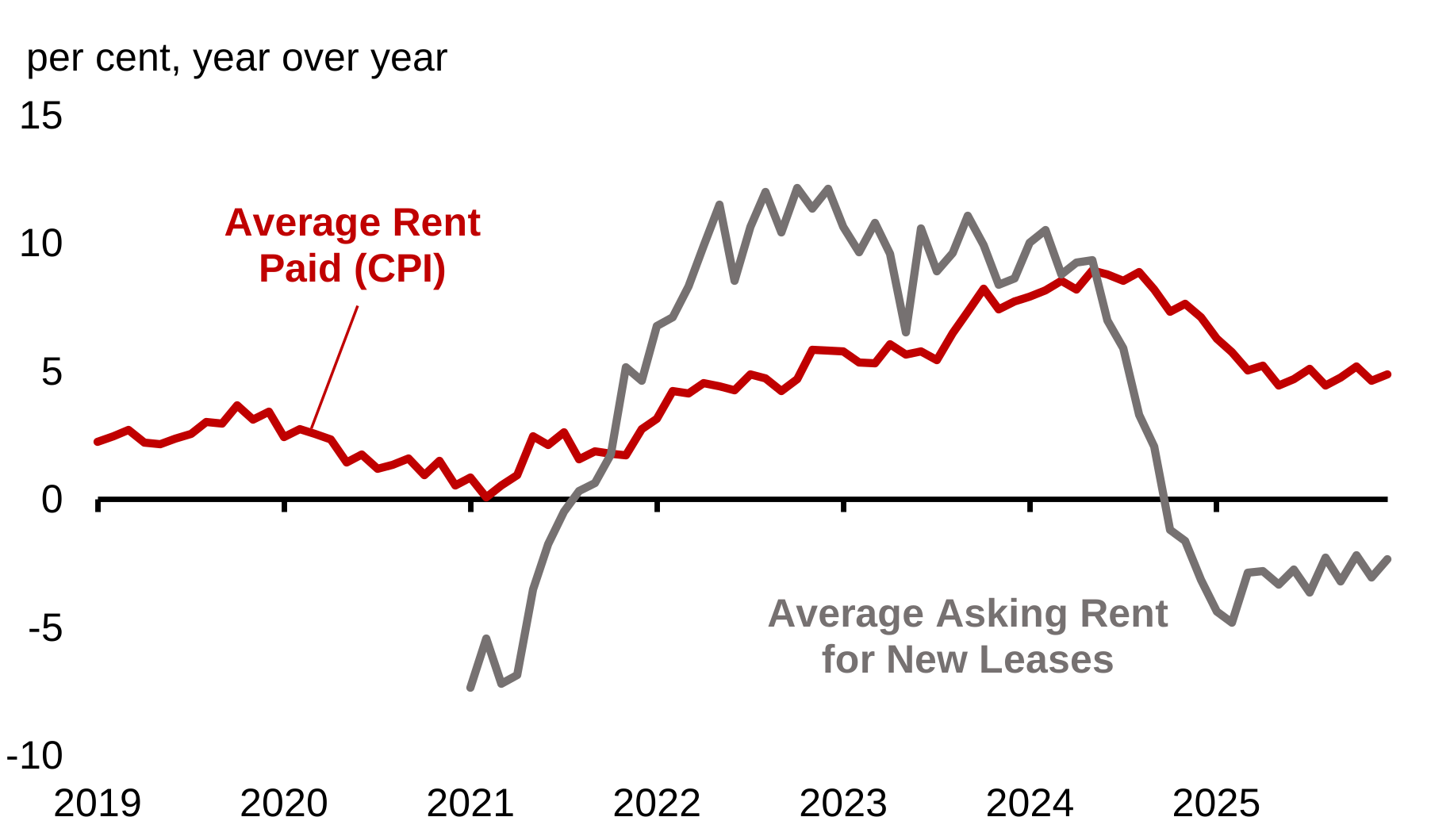
- Rent CPI inflation remains high at 4.9% in December, but slowing population growth and increased construction should contribute to easing pressure. Asking rents for new leases are down $300–400 in Toronto and Vancouver over last two years
| 2025 | 2026 | 2027 | |
|---|---|---|---|
| Finance Private Sector Survey – Budget 2025 | 2.1 | 2.0 | 2.0 |
| Bank of Canada Monetary Policy Report – January 2026 | 2.1 | 2.0 | 2.1 |
| OECD Economic Outlook – December 2025 | 2.0 | 2.1 | 2.0 |
| IMF World Economic Outlook – October 2025 | 2.0 | 2.0 | 2.1 |
| PBO Economic and Fiscal Outlook – September 2025 | 1.9 | 1.6 | 1.8 |
| 2024 Fall Economic Statement – December 2024 | 2.0 | 2.0 | 2.0 |
| Oct-25 | Nov-25 | Dec-25 | Latest Change | |
|---|---|---|---|---|
| Russia | 7.7% | 6.7% | n.a. | -1.0 p.p. |
| OECD | n.a. | 3.9% | n.a. | n.a. |
| G20 | n.a. | 3.6% | n.a. | n.a. |
| United Kingdom1 | 3.8% | 3.5% | n.a. | -0.3 p.p. |
| Norway | 3.1% | 3.0% | 3.2% | 0.2 p.p. |
| Australia2 | 2.4% | 2.1% | 3.2% | 1.1 p.p. |
| Japan | 3.0% | 2.9% | n.a. | -0.1 p.p. |
| Netherlands | 3.1% | 2.9% | 2.8% | -0.1 p.p. |
| United States | n.a. | 2.7% | 2.7% | 0.0 p.p. |
| G7 | n.a. | 2.5% | n.a. | n.a. |
| Canada | 2.2% | 2.2% | 2.4% | 0.2 p.p. |
| Euro area | 2.1% | 2.1% | 2.0% | -0.1 p.p. |
| Denmark | 2.1% | 2.1% | 1.9% | -0.2 p.p. |
| Germany | 2.3% | 2.3% | 1.8% | -0.5 p.p. |
| Italy | 1.2% | 1.1% | 1.2% | 0.1 p.p. |
| China | 0.2% | 0.7% | 0.8% | 0.1 p.p. |
| France | 0.9% | 0.9% | 0.8% | -0.1 p.p. |
| Sweden | 0.9% | 0.3% | 0.3% | 0.0 p.p. |
| Switzerland | 0.1% | 0.0% | 0.1% | 0.1 p.p. |
|
1 Inflation for the U.K. presented here is HCPI (CPI including owner occupied housing costs) for greater comparability with Canada. The U.K.'s headline inflation (excluding owner occupied housing costs and commonly reported in the media) was 3.6% in October. 2 Australia reports inflation on a quarterly basis. Inflation data is for 2025Q1, 2025Q2, and 2025Q3. |
||||
| Aug-2025 | Sep-2025 | Oct-2025 | Nov-2025 | Dec-2025 | 2025 average |
|
|---|---|---|---|---|---|---|
| Norway | 5.4 | 6.3 | 6.2 | 4.7 | 5.2 | 5.7 |
| Japan | 6.5 | 6.6 | 6.5 | 6.1 | 5.8 | 5.4 |
| Denmark | 5.8 | 5.3 | 4.5 | 3.5 | 3.5 | 4.9 |
| Sweden | 4.7 | 3.3 | 3.7 | 3.1 | 3.7 | 4.3 |
| United Kingdom | 5.1 | 4.5 | 4.9 | 4.2 | 4.5 | 4.2 |
| Netherlands | 4.2 | 4.3 | 4.3 | 3.4 | 3.3 | 4.0 |
| Ireland | 5.1 | 4.7 | 4.5 | 4.3 | 4.1 | 4.0 |
| Austria | 5.2 | 3.9 | 4.0 | 3.6 | 3.9 | 3.7 |
| Canada | 3.4 | 3.8 | 3.4 | 4.2 | 6.2* | 3.2 |
| Italy | 4.0 | 3.7 | 2.5 | 1.9 | 2.3 | 2.9 |
| Portugal | 4.0 | 4.0 | 3.5 | 3.5 | 3.5 | 2.8 |
| Belgium | 2.6 | 3.4 | 2.8 | 3.0 | 2.8 | 2.8 |
| United States | 3.1 | 3.0 | n/a | 2.6 | 3.0 | 2.7 |
| Germany | 3.2 | 2.9 | 2.0 | 1.8 | 1.4 | 2.6 |
| Spain | 2.3 | 2.4 | 2.4 | 2.8 | 3.0 | 2.4 |
| Finland | 2.6 | 2.5 | 1.6 | 1.7 | 2.0 | 2.1 |
| Greece | 2.2 | 1.4 | 2.3 | 2.8 | 3.6 | 2.0 |
| France | 1.8 | 1.9 | 1.4 | 1.5 | 1.8 | 1.3 |
| Switzerland | -0.5 | -0.8 | -0.5 | -0.4 | -0.8 | -0.5 |
|
*Includes food from restaurants. * The base-year effect of the December 2024 through February 2025 GST/HST holiday boosted inflation for food in restaurants in Canada in December 2025. This represented a contribution of approximately 1.8 percentage points towards Canada's reported food inflation of 6.2% in the month. Without the GST/HST holiday base year effect, food inflation in Canada would have been about 4.4% in December 2025. |
||||||
| Latest Price ($) | Year-over-year growth (%) | Nov 2019 Price ($) | |
|---|---|---|---|
| Beef top sirloin cuts, per kg | $27.25 | 38.9 | $14.72 |
| Ground beef, per kg | $15.54 | 19.3 | $9.69 |
| Pork rib cuts, per kg | $9.14 | 8.4 | $8.53 |
| Chicken breasts, per kg | $15.19 | 17.1 | $12.21 |
| Chicken thigh, per kg | $11.84 | 3.0 | $10.17 |
| Bacon, 500 g | $7.38 | 15.9 | $5.88 |
| Wieners, 400 g | $4.39 | 5.3 | $3.24 |
| Salmon, per kg | $26.21 | -0.5 | $25.07 |
| Shrimp, 300 g | $7.57 | 2.4 | $6.93 |
| Canned tuna, 170 g | $1.67 | 9.2 | $1.58 |
| Meatless burgers, 226 g | $6.80 | 15.3 | $5.51 |
| Milk, 2 l | $5.38 | 2.1 | $4.19 |
| Cream, 1 litre | $4.69 | 2.6 | $3.62 |
| Butter, 454 g | $5.62 | 0.2 | $3.83 |
| Block cheese, 500 g | $6.86 | -0.3 | $5.87 |
| Yogurt, 500 g | $3.73 | 4.5 | $2.57 |
| Eggs, 1 dozen | $4.74 | -2.3 | $3.50 |
| Apples, per kg | $4.81 | 5.5 | $4.13 |
| Oranges, per kg | $4.46 | 13.8 | $3.45 |
| Bananas, per kg | $1.67 | 1.8 | $1.60 |
| Strawberries, 454 g | $6.66 | 12.3 | $4.79 |
| Potatoes, per kg | $5.00 | 2.7 | $4.07 |
| Tomatoes, per kg | $5.06 | -13.9 | $4.67 |
| Carrots, 1.36 kgs | $3.09 | -12.2 | $2.50 |
| Onions, per kg | $5.36 | -4.5 | $4.26 |
| Celery, unit | $3.34 | 0.0 | $2.74 |
| Cucumber, unit | $1.66 | -7.3 | $1.88 |
| Mushrooms, 227 g | $2.26 | -7.8 | $1.88 |
| Iceberg lettuce, unit | $3.93 | 22.8 | $2.82 |
| Broccoli, unit | $2.58 | -1.9 | $2.58 |
| Peppers, per kg | $8.89 | -5.6 | $7.09 |
| Salad greens, 142 g | $4.48 | -0.4 | $3.99 |
| Frozen french fries, 750 g | $3.69 | 3.9 | $2.34 |
| Frozen vegetables, 750 g | $4.12 | 7.6 | $3.17 |
| Frozen pizza, 390 g | $4.71 | -1.7 | $4.05 |
| White bread, 675 g | $3.55 | 1.7 | $2.83 |
| Cookies, 300 g | $0.00 | 0.0 | $0.00 |
| Dry or fresh pasta, 500 g | $3.32 | 7.8 | $2.39 |
| White rice, 2 kgs | $9.59 | 3.2 | $7.77 |
| Cereal, 400 g | $4.21 | 1.4 | $3.15 |
| Wheat flour, 2.5 kgs | $5.03 | -1.9 | $4.43 |
| White sugar, 2 kgs | $2.97 | 4.2 | $2.09 |
| Orange juice, 2 l | $6.26 | 12.2 | $3.55 |
| Roasted/ground coffee, 340 g | $0.00 | 0.0 | $0.00 |
| Tea (20 bags) | $4.29 | 4.9 | $3.36 |
| Ketchup, 1 litre | $4.82 | 0.4 | $3.23 |
| Vegetable oil, 3 l | $10.30 | 3.7 | $6.13 |
| Baby food, 128 ml | $1.56 | -1.9 | $1.30 |
| Infant formula, 900 g | $50.97 | 11.5 | $29.47 |
| Peanut butter, 1 kg | $6.07 | -0.7 | $4.44 |
| Mayonnaise, 890 ml | $6.28 | -1.9 | $4.33 |
| Canned baked beans, 398 ml | $1.73 | -4.4 | $1.09 |
| Canned soup, 284 ml | $1.36 | 2.3 | $1.01 |
| Dry beans and legumes, 900 g | $3.45 | 1.5 | $2.80 |
| Tofu, 350 g | $2.88 | 8.3 | $2.26 |
| Hummus, 227 g | $3.69 | -1.3 | $3.40 |
| Salsa, 418 ml | $4.89 | 4.9 | $3.31 |
| Pasta sauce, 650 ml | $3.41 | 3.3 | $2.17 |
| Salad dressing, 475 ml | $3.52 | 4.1 | $2.44 |
| Almonds, 200 g | $5.21 | 14.3 | $4.93 |
| Peanuts, 450 g | $4.35 | 13.3 | $2.99 |
Productivity Narrative
Key Messages
- Productivity growth is the driving force behind sustained increases in living standards and economic competitiveness.
- When productivity grows, everyone benefits. The wages and incomes of hard-working Canadians rise, businesses have the conditions to grow and to create more jobs, and Canada stays competitive in global markets.
- A strong economy driven by productivity growth also provides the revenues needed to fund public services that Canadians count on.
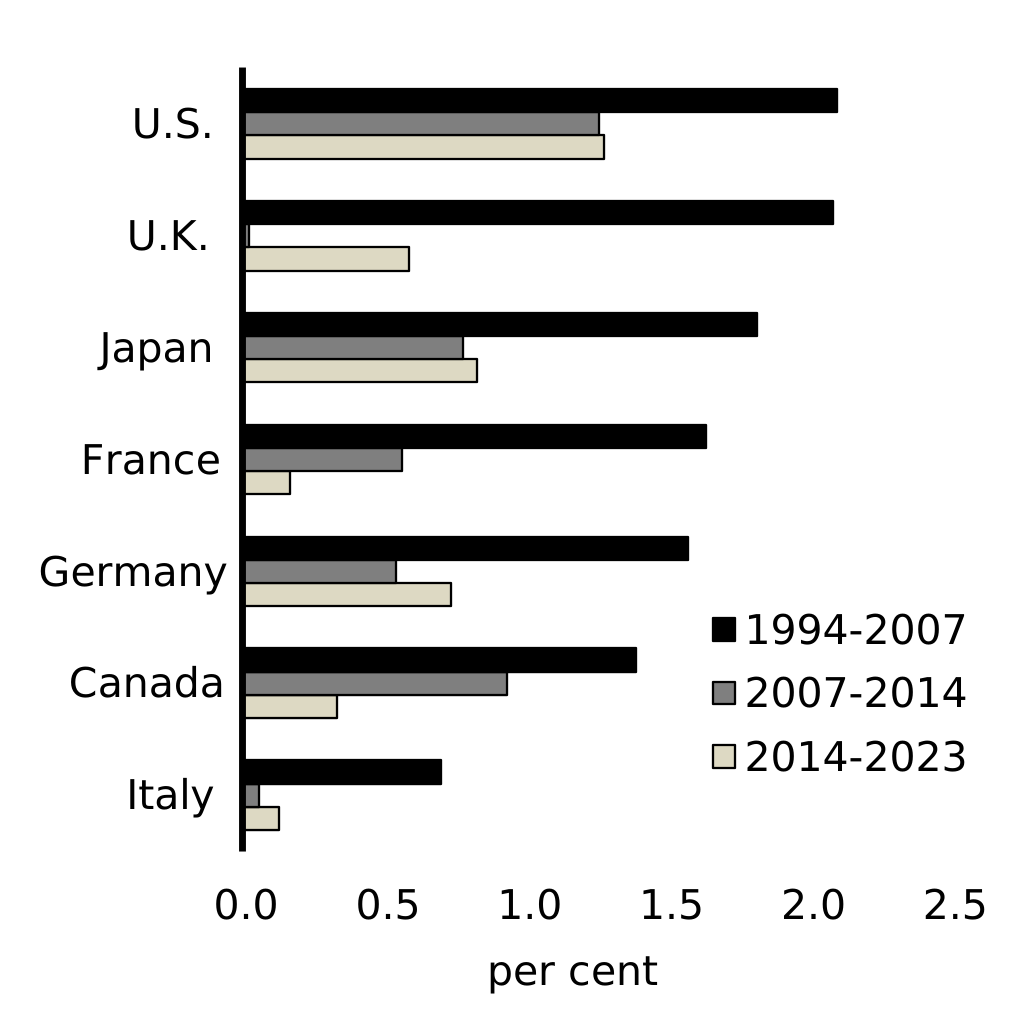
- Canada's productivity growth lags that of other G7 economies. Over the past decade, Canada's productivity grew by only 0.3 per cent annually.
- The economic impact of this gap is significant—if Canada's productivity growth had matched the U.S. from 2017 to 2023, the median income of a family with one child would be nearly $11,000 higher.
- Perennially weak productivity growth is closely tied to longstanding weakness in business investment.
- For decades, Canadian firms have invested less per worker than their American counterparts.
- Across many sectors, Canada's economy has seen weak investment in machinery and equipment, research and development, and intangible assets like intellectual property, data, and software.
- The most immediate way to jumpstart productivity growth is to address structural impediments and increase investment—in machinery, equipment, innovation, and infrastructure that allow workers to build faster and at a more competitive cost.
- Budget 2025 does exactly this with significant investments in infrastructure and emerging technologies, lower taxes on new investment and research and development—including through a Productivity Super-Deduction—and regulatory reforms to cut red tape, accelerate major projects, and increase competition.
Details & Supplementary Information
- Canada's productivity growth has been persistently weak and has generally lagged most G7 peers (Chart 1).
- From 2014 to 2023, it slowed to well below its pace over the 1994–2014 period.
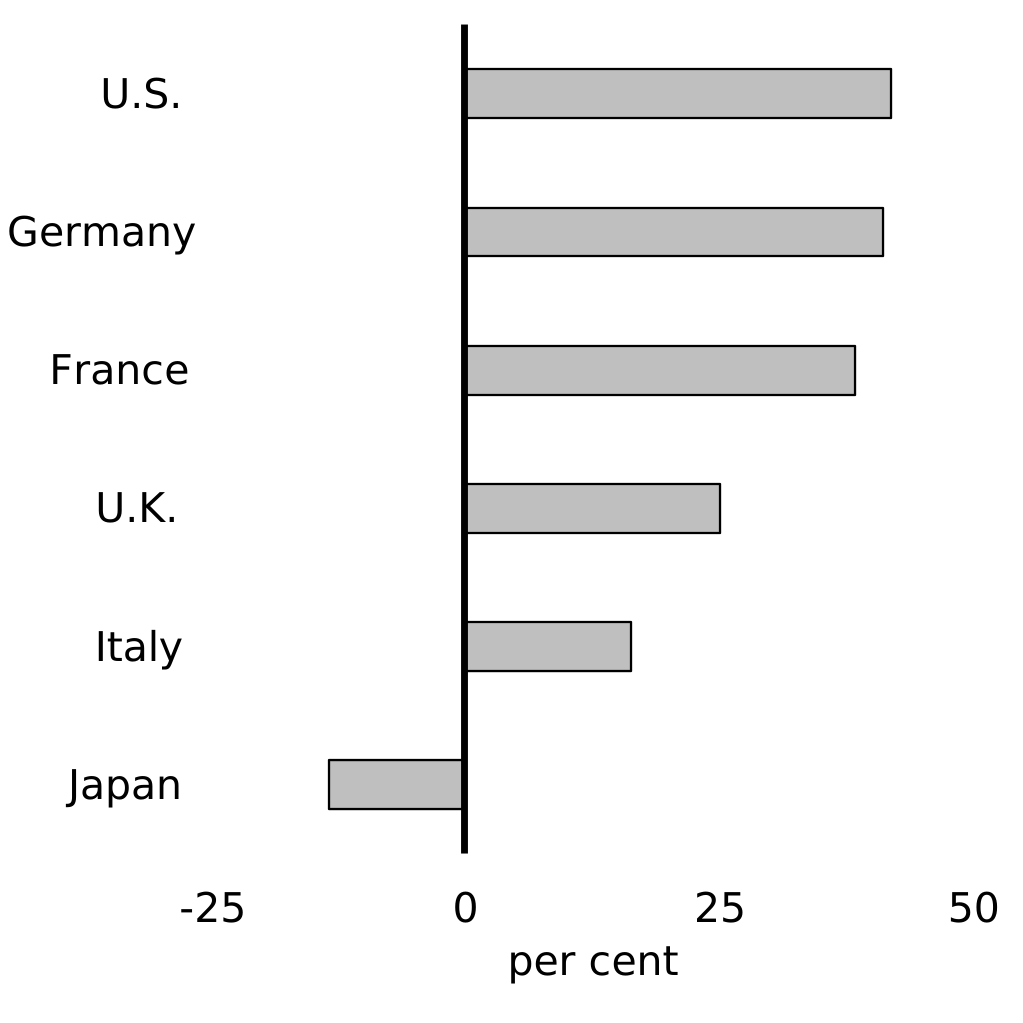
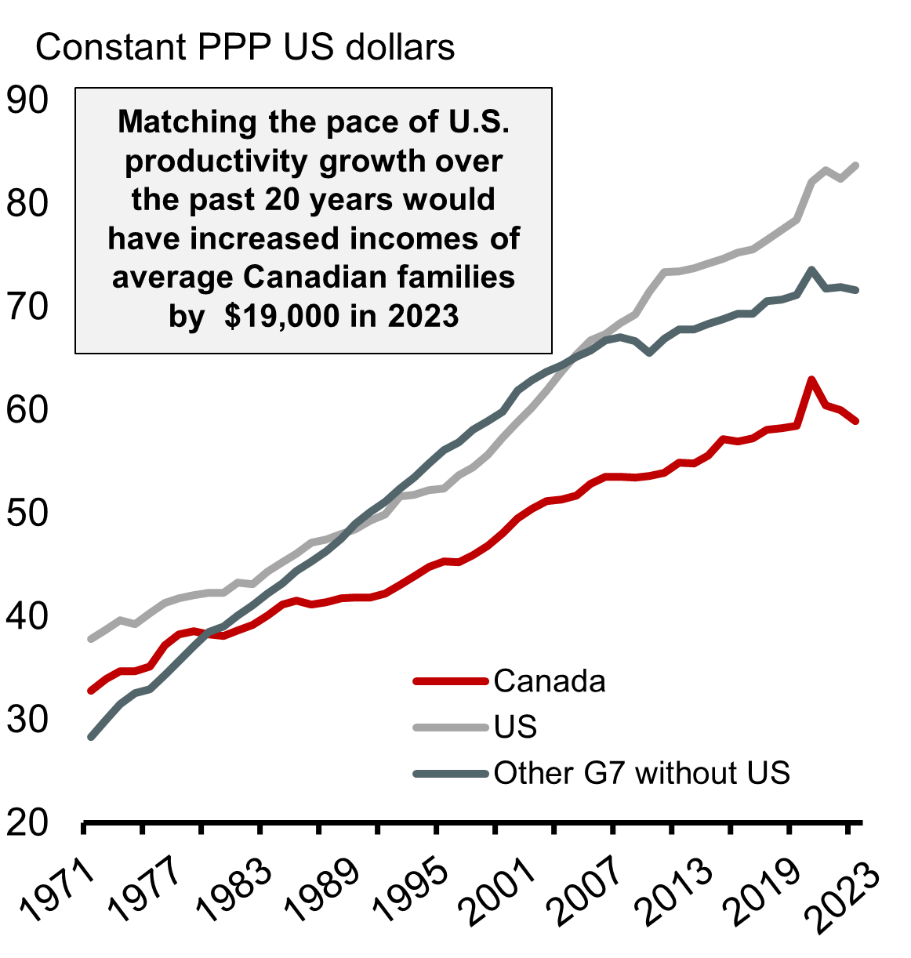
- This has contributed to a substantial productivity level gap between Canada and other G7 economies (Chart 2).
- The economic impact of this gap is significant—if Canada's productivity growth had matched the U.S. from 2017 to 2023, the median income of a family with one child would be nearly $11,000 higher.
Labour Productivity Growth, Total Economy, G7
Labour Productivity Level Relative to Canada, Total Economy, 2023
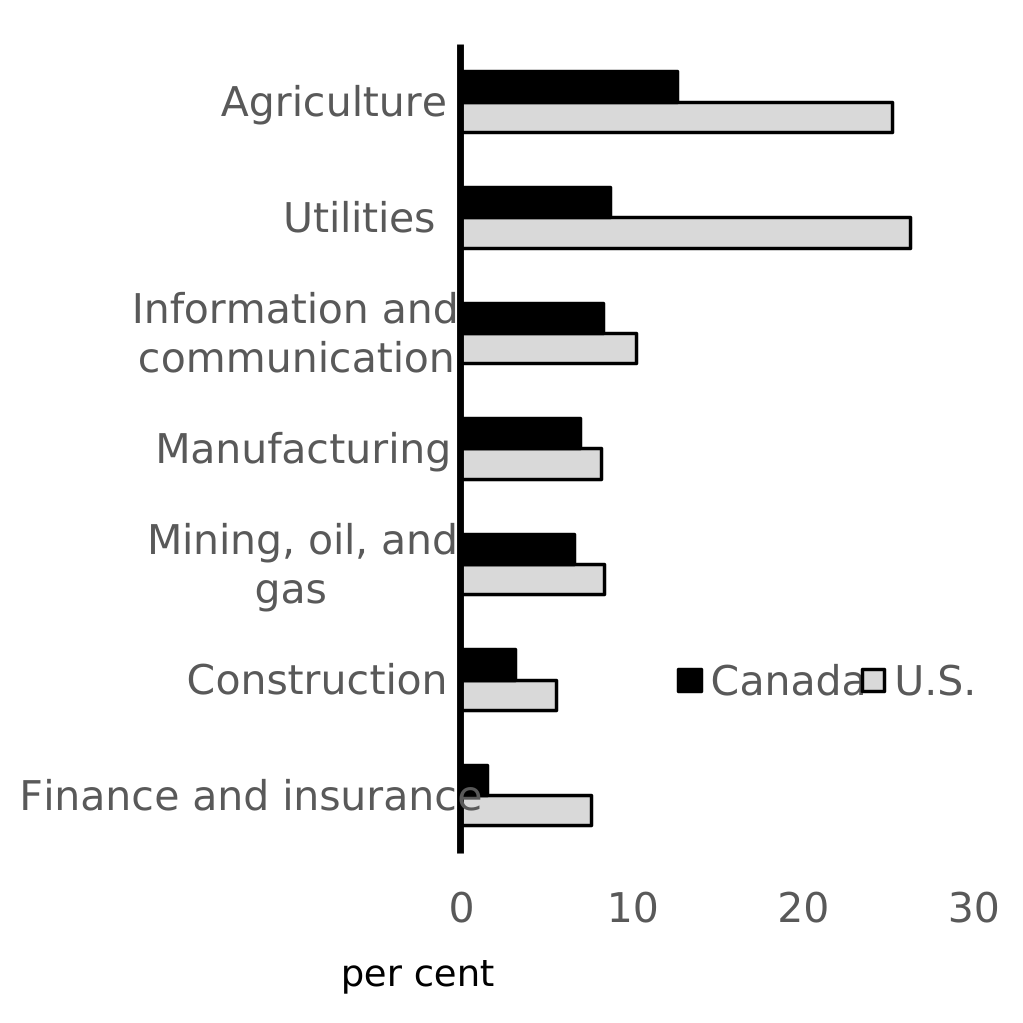
- Low business investment has been an important reason for our low productivity growth. Investment intensity in machinery and equipment and intangible assets, key drivers of productivity, have been lower than in the U.S for decades. As well, this investment gap has been pervasive across sectors (Chart 3).
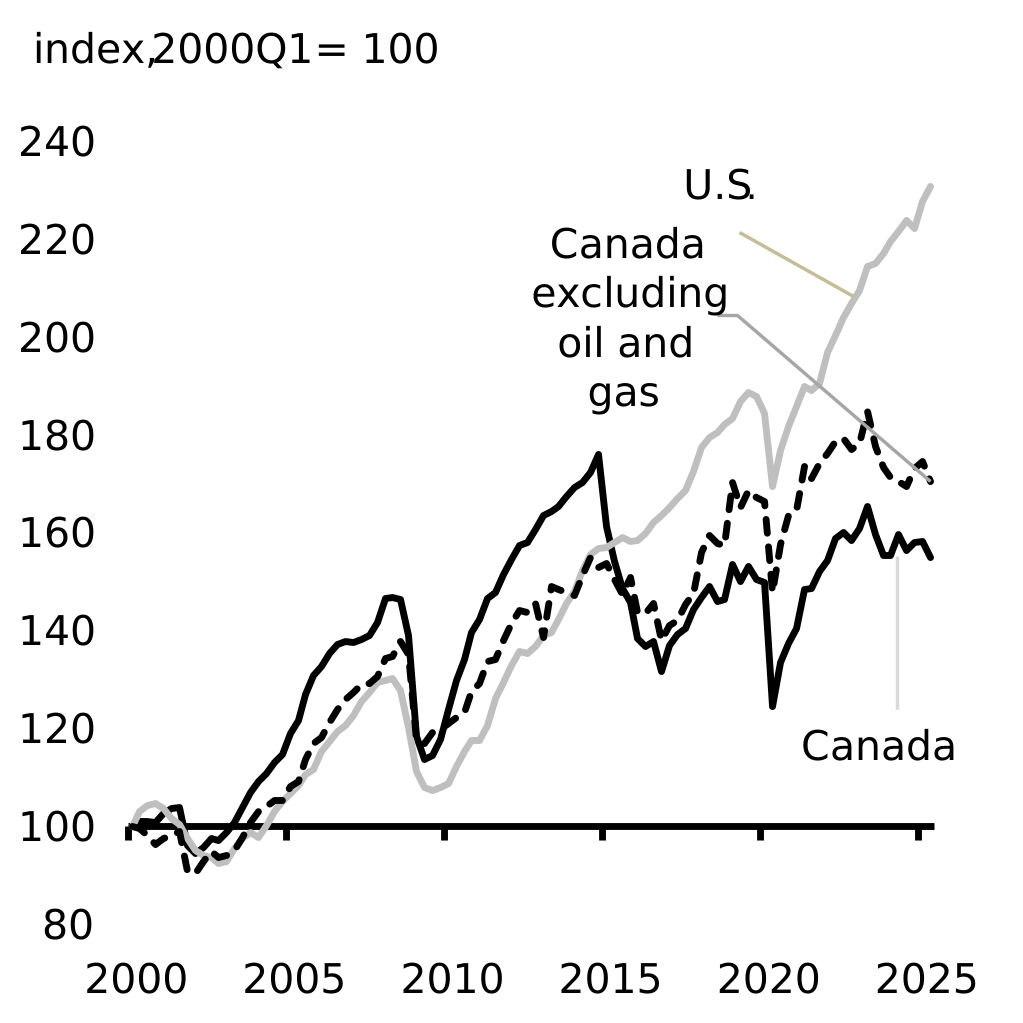
- Since 2015, Canada's relatively poor investment performance has worsened. Business investment in
Canada has been flat over the past decade, while business investment in the U.S. has risen sharply
(Chart 4).
- Much of this gap has been driven by a retrenchment in capital spending by Canada's energy sector following the sharp decline in global oil prices in 2015, and the contrasting increase in U.S. technology investment in recent years.
Machinery and Equipment Investment as a Share of Value Added by Industry, 2019
Real Business Investment Since 2000, Canada and U.S.
- Businesses often perceive the risks and costs of investments in high-risk and innovative assets as outweighing the rewards, a mindset reinforced by structural impediments such as the regulatory environment, limited competition, and scale constraints.
- The most immediate way to jumpstart productivity growth is to address structural impediments and increase investment—in machinery, equipment, innovation, and infrastructure that allow workers to build faster and at a more competitive cost.
- With a new comprehensive industrial strategy, the Budget 2025 is investing in trade diversification, housing and infrastructure, and advanced technology that can unlock Canada's economic potential. At the same time, it is providing tax incentives for new investment by the private sector. The government is also streamlining regulations and project approval process while promoting competition in key network sectors (i.e., telecom, financial service) to remove impediments to productivity growth.
The following provides further detail about Canada's relative investment performance in productive assets.
| 2000 | 2005 | 2010 | 2015 | 2020 | 2023 | |
|---|---|---|---|---|---|---|
| Canada | 1.1 | 1.1 | 0.9 | 0.9 | 1.1 | 1.1 |
| United States | 2.0 | 1.7 | 1.9 | 2.0 | 2.6 | 2.7 |
| OECD | 1.5 | 1.5 | 1.5 | 1.6 | 1.9 | 2.0 |
| Ratio Canada/U.S. | 0.6 | 0.6 | 0.5 | 0.4 | 0.4 | 0.4 |
| Ratio Canada/OECD | 0.7 | 0.7 | 0.6 | 0.6 | 0.6 | 0.5 |
| Software & Database | ICT Hardware | Total | |
|---|---|---|---|
| U.S. | 2.4 | 1.2 | 3.7 |
| Japan | 1.9 | 1.3 | 3.2 |
| France | 2.6 | 0.4 | 3.0 |
| U.K. | 2.1 | 0.7 | 2.8 |
| Canada (Ratio Canada / U.S.) | 1.6 (0.64) | 1.0 (0.78) | 2.5 (0.69) |
| Italy | 1.5 | 0.8 | 2.3 |
| Germany | 0.8 | 0.7 | 1.4 |
Fiscal Narrative
Key Messages
- At this pivotal moment, Canada faces a changing global order from a position of strength. With Budget 2025, the government is making generational investments that will protect and transform our industries, strengthen our economy, and empower Canadians.
- To remain fiscally sustainable, these investments are anchored by a new approach to fiscal discipline
and strategic investment. One that:
- Balances day-to-day operating spending with revenues by 2028–29, shifting spending toward investments that grow the economy; and
- Maintains a declining deficit-to-GDP ratio to ensure disciplined fiscal management for future generations.
- As announced in Budget 2025, the Comprehensive Expenditure Review will rein in government spending—saving $13 billion annually by 2028-29, for a total with other savings and revenues of $60 billion over five years.
- With these efforts, Budget 2025 makes the investments needed to grow our economy, while meeting both fiscal anchors, with a deficit of $78.3 billion, or 2.5 per cent of GDP in 2025-26, falling to $56.6 billion, or 1.5 per cent of GDP by 2029-30.
- Budget 2025 also projects the federal debt-to-GDP ratio to remain relatively stable across the horizon, rising from 42.4 per cent in 2025-26 to 43.1 per cent in 2029-30.
- As detailed in the latest Fiscal Monitor, the budgetary deficit for the April to November period of the 2025-26 fiscal year was $26.4 billion, compared to a deficit of $22.7 billion for the same period of 2024-25.
If pressed, contingent liability
- A contingent liability is recorded when the probability of a future payment is considered likely and the amount can be reasonably estimated.
- As of 2024-25, the total contingent liabilities recorded in the Public Accounts was $55 billion. The majority of this is associated with active alternative dispute resolution processes and pending or potential litigation.
Details & Supplementary Information
Table A1.7 outlines the summary of statement of transactions from Budget 2025.
Fiscal anchors in Budget 2025:
Balance operating spending with revenues by 2028-29, shifting the composition of spending from day-to-day operations to investments that support capital formation and productivity.
Maintain a declining deficit-to-GDP ratio, reflecting disciplined fiscal management that safeguards economic stability for future generations.
Source: Fiscal anchors, Page 59, Economic and Fiscal Overview, Budget 2025.
Annual Stock of Contingent Liabilities from 2011-12 to 2024-25
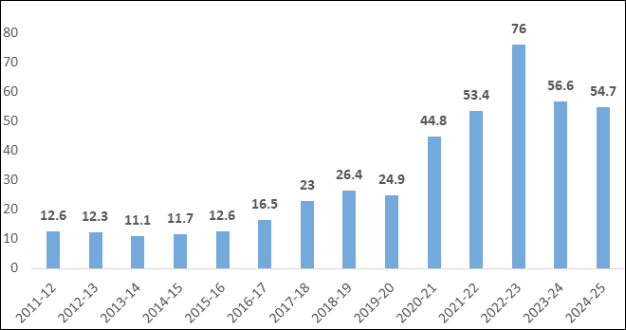
Each year previously recognized contingent liabilities may be reduced or extinguished through payments, while new obligations or revaluations are recorded to reflect updated estimates. The resulting balance represents the stock of outstanding contingent liabilities.
Changes in provisions due to revisions in estimates or the addition of new obligations are reflected in direct program expenses in the budget and impact the budgetary balance in the year the liabilities are recorded. In recent years, this expense has averaged over $10 billion per year.
Debt Management Strategy 2026-27
Key Messages
- The 2026-27 domestic borrowing program is projected to be $589 billion, $20 billion lower than
in 2025-26 ($609 billion).
- Despite an increase of financial requirements, the year-over-year reduction of the borrowing program is due to fewer bond maturities.
- The maturity of COVID-era 5-year bonds led to an elevated maturity profile in 2025-26.
- The Budget proposes to increase the maximum amount of borrowing under Section 4 of the Borrowing Authority Act (BAA) from $2,126 billion to $2,541 billion to ensure uninterrupted borrowing capacity to meet government's priorities over the next three fiscal years.
- Public debt charges for 2025-2026 were 1.8% of GDP, far below the long-term average of 3.2% over the past 40 years.
- Canada has the lowest net debt-to GDP ratio in the G7 (12.5% for 2025), according to the IMF.
- Canada is rated AAA by S&P, Moody's and DBRS, and AA+ by Fitch.
Details & Supplementary Information
Q: Can you provide a breakdown of the domestic borrowing program?
Q: What is the Government's average term to maturity?
The Average Term to Maturity (ATM) of the government's market debt at the end of 2024-25 was 6.47 years. ATM is expected to be 6.80 years by the end of 2025-26 and 6.75 years by the end of 2026-27.
This is in the range of 6-7 years seen in recent years and represents a prudent balance of cost and risk. It is also within the range of Canada's peers.
| Canada | Australia | Germany | U.S. | U.K. | France | Japan | Italy | |
|---|---|---|---|---|---|---|---|---|
| ATM | 6.5 | 6.3 | 7.8 | 5.9 | 13.9 | 8.5 | 8.7 | 7.1 |
| Source: Bloomberg, as of March 31 2025 | ||||||||
Q: What is the amount of outstanding debt stock under the BAA?
Public Accounts 2025 reflect that the debt stock under the BAA was estimated at $1,787 billion at the end of March 31, 2025. The debt stock is projected to reach $1,928 billion by the end 2025-26. The maximum debt stock under the BAA includes Government of Canada market debt securities, eligible borrowings from agent Crown corporations, and Canada Mortgage Bonds (CMBs) not held by the Government of Canada.
Q: How did you arrive at the proposed maximum BAA amounts?
The proposed $2,541 billion includes:
- the expected debt stock of $1,787 billion as of March 31, 2025 (per Public Accounts),
- the government's anticipated incremental borrowing needs until March 31, 2029, of $580 billion (per Budget Annex 1 financial sources and uses)
- the expected net increase in outstanding CMBs of $47 billion over the same period,
- $12.5 billion of anticipated incremental borrowing by agent Crown corporations (per corporate plans) over the same period, and
- a contingency margin, as has been the practice in the three previous maximum borrowing amounts.
Q: When will the government issue a Transition Bond?
The government remains committed to regular green bond issuances and will explore the development of a sustainable bond framework that would allow the issuance of both green and transition bonds.
Work is underway to develop Canada's sustainable investment guidelines (also known as a taxonomy) by the end of 2026. These guidelines will credibly identifying "green" and "transition" investments and are required to support the development of transition bonds.
International Trade
Key Messages
- The government's primary focus is on diversifying our trade partnerships and attracting investment into Canada. Canada has what the world wants, including strong fundamentals, energy, critical minerals, sophisticated investors, and the most educated population in the world.
- Canada has secured a dozen international trade and security partnerships on four continents in six months. We are also the only G7 country with a free trade agreement with all the other G7 countries.
- The government remains prepared to engage with the U.S. to resolve outstanding tariffs, as well as on the upcoming CUSMA review.
Trade Relations with the United States
- The U.S. maintains harmful and unjustified tariffs on Canadian exports in strategic sectors – 50 per cent on steel, aluminum, and copper products, 25 per cent on autos and trucks, and 10 per cent on lumber. Tariffs also apply on upholstered furniture and kitchen cabinets (25 per cent) and buses (10 per cent).
- The government continues to maintain tariffs on imports on $51.4 billion of annual steel, aluminum,
and autos imports from the U.S. – sectors directly affected by U.S. actions – to defend our interests.
- With respect to the Public Accounts of Canada 2025, of the $6.3 billion in total customs import duties for FY2024–25, $388 million (net amount) are attributed to the counter-tariffs on imports from the U.S.
- This figure is relatively low since some of the countermeasures were only implemented as of March 2025, near the end of the fiscal year.
- Budget 2025 projects net revenues from the counter-tariffs to amount to approximately $4.4 billion for the 2024-25 to 2026-27 fiscal years.
- While we work to achieve reductions in U.S. tariffs, the government is focused on improving Canada's resilience, such as strengthening our steel sector, increasing global competitiveness, and further diversifying our trade.
Trade Relations with China
- China is the world's second-largest economy and Canada's second-biggest trading partner, with $130.9 billion in two-way trade in 2024.
- To diversify our trade partnerships and increase Canada's economic resilience, the government is focused on pursuing a pragmatic, results-driven relationship with China.
- To that end, Canada reached an agreement-in-principle to remove tariffs and to boost exports to China by 50 per cent by 2030.
- Together, these results will help unlock nearly $3 billion in export orders for Canadian workers and businesses. Both countries will also keep working to resolve remaining trade challenges in the months ahead.
- The agreement-in-principle includes commitments on electric vehicles (EVs), agriculture, seafood, and
steel and aluminium:
- For EVs, Canada committed to eliminate the 100 per cent surtax for 49,000 units.
A portion of the quota volumes (reaching 50 per cent by 2030) will be reserved for
imports of low-priced EVs of $35,000 or less, to ensure the availability of affordable EVs.
- This represents less than 3 per cent of Canada's new vehicle market and restores import volumes to 2023-24 levels before the 100 per cent surtax took effect in October 2024.
- For EVs, Canada committed to eliminate the 100 per cent surtax for 49,000 units.
A portion of the quota volumes (reaching 50 per cent by 2030) will be reserved for
imports of low-priced EVs of $35,000 or less, to ensure the availability of affordable EVs.
- For the surtaxes on Chinese steel and aluminum, Canada committed to extend the remission, which expired at the end of 2025, for the 2026 calendar year and to add nine products to that remission, in addition to certain steel derivative goods (i.e., metal furniture).
- In return, Canada expects China to reduce the combined tariff on canola seed from 84.8 per cent to approximately 15 per cent and to suspend its anti-discrimination tariffs on canola meal of 100 per cent, and on lobster, crab and peas at 25 per cent from March 1 to December 31, 2026.
Details & Supplementary Information
Current U.S. tariffs imposed on Canadian goods
- In aggregate, the current U.S. effective tariff rate against all Canadian exports is estimated to be 5.4 per cent, with 85 per cent of Canadian exports entering the U.S. tariff-free.
- U.S. International Emergency Economic Powers Act (IEEPA) tariffs: As of August 1, 2025, U.S. tariffs of 35 per cent on all Canadian non-CUSMA originating goods, and 10 per cent on energy resources (including critical minerals) and potash imports. Currently, 97.5 per cent of Canadian exports covered by the IEEPA tariffs are CUSMA-compliant and enter the U.S. duty-free. The U.S. Supreme Court is expected to rule on the legality of these tariffs in early 2026.
- U.S. Section 232 Tariffs: The U.S. currently maintains Section 232 "national security" tariffs on $150.5 billion of Canadian exports in specific sectors. These include: steel, aluminum, copper, non-CUSMA compliant autos and trucks and CUSMA-compliant auto and truck parts, lumber and wood products (i.e., upholstered furniture, kitchen cabinets and vanities) and buses. The U.S. also maintains tariffs on certain advanced computing chips and derivatives, as well non-CUSMA compliant pharmaceutical products, but the impacts of these are more limited for Canada
- Potential future Section 232 sectoral tariffs: The Section 232 investigation on processed critical minerals and their derivative products (PCMDPs) is completed, with the President directing negotiations on a trade agreement with the threat of tariffs if negotiations to adjust the imports of PCMDPs into the U.S. are unsuccessful. Additional Section 232 investigations are ongoing for the following sectors, which could result in additional tariffs: (1) commercial aircraft and jet engines; (2) polysilicon; (3) unmanned aircraft systems; (4) wind turbines and their components; (5) robotics and industrial machinery; and (6) medical products.
Canadian counter-tariffs on the U.S. and tariff-based mitigation measures
- Canada initially imposed counter-tariffs on the U.S. affecting approximately $95 billion of annual imports from the U.S. Since September 1, 2025, the government has maintained counter-tariffs on $51.4 billion of annual steel, aluminum, and autos imports from the U.S. (sectors directly affected by U.S. actions).
- To minimize the negative effects of the counter-tariffs, the government established a remission framework to provide exceptional tariff relief on a case-by-case basis. More broadly, the government has extended temporary tariff relief (remission), until June 30, 2026, for all goods imported from the U.S. for the manufacturing of motor vehicles, aerospace goods, and their parts, as well as those that support public health, public safety, and national security. Tariff remission is also provided for goods used in manufacturing, processing, food and beverage packaging, or agricultural production to provide time for Canadian businesses to adjust their supply chains, until January 31, 2026 (for steel imports) and June 30, 2026 (for aluminum imports).
- For autos, the government provided a performance-based remission framework that allows automakers to import a certain number of U.S.-assembled, CUSMA-compliant vehicles into Canada, free of the counter-tariffs. This remission is contingent on the automakers continuing to produce vehicles in Canada and on completing planned investments. In this context, on October 23, 2025, the government reduced General Motors' annual remission quota by 24.2 per cent, and Stellantis' annual remission quota by 50 per cent, in response respectively to GM's decision to reduce their production in Oshawa and in Ingersoll facilities, and Stellantis' decision to cancel its production plans for the Brampton assembly plant. The remission framework will remain in force until April 2026.
Revenues from U.S. counter-tariffs
- As of October 17, 2025, the government assessed more than $3.7 billion revenue, net of remissions and other relief programs, from Canada's counter-tariffs on U.S. goods, as detailed in Chart A1.1 of Budget 2025.
- For the 2024-25 to 2026-27 fiscal years, combined net revenues from the counter-tariffs are projected in Budget 2025 to amount to approximately $4.4 billion, as detailed in the table below.
| 2024– 2025 |
2025– 2026 |
2026– 2027 |
2027– 2028 |
2028– 2029 |
2029– 2030 |
|
|---|---|---|---|---|---|---|
| Countermeasures and Remission1 | -359 | -4,025 | -16 | 0 | 0 | 0 |
| U.S. Surtax Order 2025 (Revenue) | -273 | -2,300 | 0 | 0 | 0 | 0 |
|
Expected remission and other duties
relief
|
0 | 662 | 0 | 0 | 0 | 0 |
| U.S. Surtax Order (Steel and Aluminum 2025) (Revenue) | -86 | -3,200 | 0 | 0 | 0 | 0 |
|
Expected remission and other duties
relief
|
0 | 1,524 | 0 | 0 | 0 | 0 |
| U.S. Surtax Order (Motor Vehicles 2025) (Revenue) | 0 | -3,222 | -72 | 0 | 0 | 0 |
|
Expected remission and other duties
relief
|
0 | 2,511 | 56 | 0 | 0 | 0 |
| Revenues | -359 | -8,722 | -72 | 0 | 0 | 0 |
| Remission and other duties relief | 0 | 4,697 | 56 | 0 | 0 | 0 |
CUSMA review
- The U.S. has indicated its intent to initiate the review of CUSMA in January 2026. Minister LeBlanc is expected to speak to the United States Trade Representative (USTR) in January for further clarity on process and next steps.
- The USTR reported to Congress on December 17, 2025, that it intends to raise the following issues with Canada: expanded dairy market access, reforms to online streaming and news acts affecting U.S. digital services, ending provincial boycotts of U.S. alcohol, and addressing provincial procurement and customs issues. The USTR did not foreclose the possibility of U.S. withdrawal from the agreement and/or reverting to separate agreements with Canada and Mexico.
Canada-China Trade Relations
At the invitation of President Xi Jinping, Prime Minister Mark Carney made his official visit to Beijing, China (January 14-17), where leaders secured a preliminary agreement-in-principle to address trade issues:
| Canada Outcomes | China Outcomes | |
|---|---|---|
| Electric Vehicles | Potential Chinese joint-venture investments for auto jobs and EV supply chain; 50 per cent quota reserved for affordable EVs ($35,000 CAD or less) by 2030. | Access to Canadian market with 49,000 EV quota/year at reduced 6.1 per cent most-favoured-nation rate (less than 3% of Canadian new vehicle market). |
| Canola Seeds | China lowers tariffs to 15 per cent combined rate by March 1, 2026 (from 84 per cent), improving access for $4 billion in annual exports | |
| Canola Meal, Lobsters, Peas, Crabs & Others | No anti-discrimination tariffs on specified products (valued at $2.6 billion in exports) from March 1-Dec 31, 2026; accelerated resumption of market access for beef, pet food, animal genetics. | |
| Steel and Aluminum | Canada will expand and extend to the end of 2026 previous remission measures for certain Chinese steel and aluminium products that are in short supply in Canada. |
Revenues from China Surtax Order (2024)
- The Fall Economic Statement 2024 projected revenues from the China Surtax Order (2024) to amount to approximately $1.1 billion over six years (from 2024-25 to 2029-30). Budget 2025 projected the China Surtax Remission Order (2024) would lead to foregone revenues of $183 million over two years (from 2024-25 to 2025-26). The expected increase in foregone revenue as a result of the China outcomes will be confirmed once the remission extension is implemented by Order in Council.
Trade Measures on Steel Products
The government implemented trade measures to mitigate the acute risk of diversion arising from U.S. actions, as well as to facilitate the steel industry's long-term adjustment and to promote domestic opportunities for Canadian producers.
- Steel Tariff Rate Quotas (TRQs): Initially imposed in June 2025, this measure currently limit imports from non-CUSMA FTA and non-FTA partners to 75 per cent and 20 per cent, respectively, of 2024 import levels above which a 50 per cent surtax applies.
- Steel Goods and Aluminum Goods Surtax Order: Effective July 30, 2025, Canada imposed a 25 per cent surtax on steel goods containing steel melted and poured in China, and aluminum goods containing aluminum smelted and cast in China.
- Steel Derivative Goods Surtax Order: Effective December 26, 2025, Canada imposed a 25 per cent surtax on imports of steel derivative products from all countries.
Remission remains available for these surtax measures.
Budget 2025: Broad Key Messages
Key Messages
- Budget 2025 is our plan to respond to a pivotal moment for Canada and the world. The rules-based global order that drove Canada's prosperity for decades has been ruptured, putting Canada's prosperity at risk.
- To meet the challenges of our time and seize new opportunities, Canada must make generational investments to build strength at home—by protecting and transforming our industries, reducing reliance on other economies, and empowering Canadians.
- Through Budget 2025, the government is taking a proactive approach that drives investment and strengthens our economy while addressing key public policy priorities—improving affordability for Canadians and protecting our industries, workers, and sovereignty.
- Key elements include:
- Improving affordability by eliminating the consumer carbon tax, introducing a middle-class tax cut, and making the National School Food Program permanent
- Building affordable housing at scale through Build Canada Homes
- Accelerating major projects to attract more capital
- Increasing investment in trade-enabling and other infrastructure
- Investing in defence industry to boost our industrial capabilities
- A Buy Canadian policy to boost domestic production
- Budget 2025 introduces a new approach for matching responsible fiscal management with the need to
drive strategic investment:
- Balancing day-to-day operating spending with revenues by 2028–29, shifting spending toward investments that grow the economy; and,
- Maintaining a declining deficit-to-GDP (gross domestic product) ratio.
- Budget 2025 also delivers on the Comprehensive Expenditure Review—which will rein in government spending—saving $13 billion annually by 2028-29, for a total with other savings and revenues of $60 billion over five years.
Details & Supplementary Information
Key Facts and Figures
- Budget 2025 projects the budgetary deficit in 2025-26 to be $78.3 billion, or 2.5 per cent of GDP, falling to $56.6 billion, or 1.5 per cent of GDP by 2029-30.
- Budget 2025 also projects the federal debt-to-GDP ratio to remain relatively stable across the horizon.
- Comprehensive Expenditure Review: To remain fiscally sustainable, the shift in spending toward capital investment requires a reduction in day-to-day operating spending. Budget 2025 delivers on the Comprehensive Expenditure Review (CER), which will achieve savings of $9 billion in 2026-27, $10 billion in 2027-28, and $13 billion in 2028-29. Combined with other savings and revenues in Budget 2025, this will total $60 billion over five years, starting in 2025-26.
Summary of statement of transactions from Budget 2025:
Table A1.7 of Annex 1: Details of economic and fiscal projections, Budget 2025.
Capital Investments
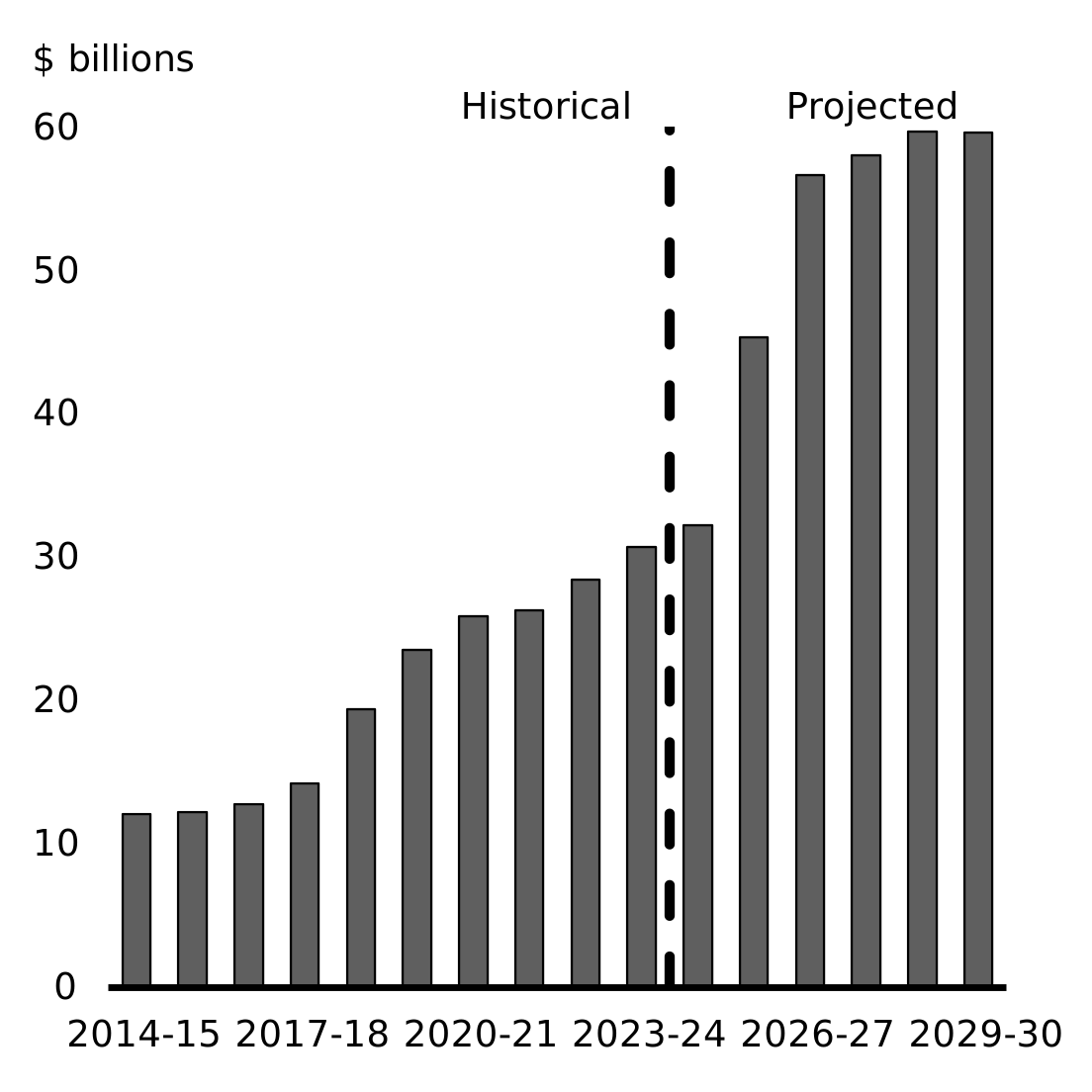
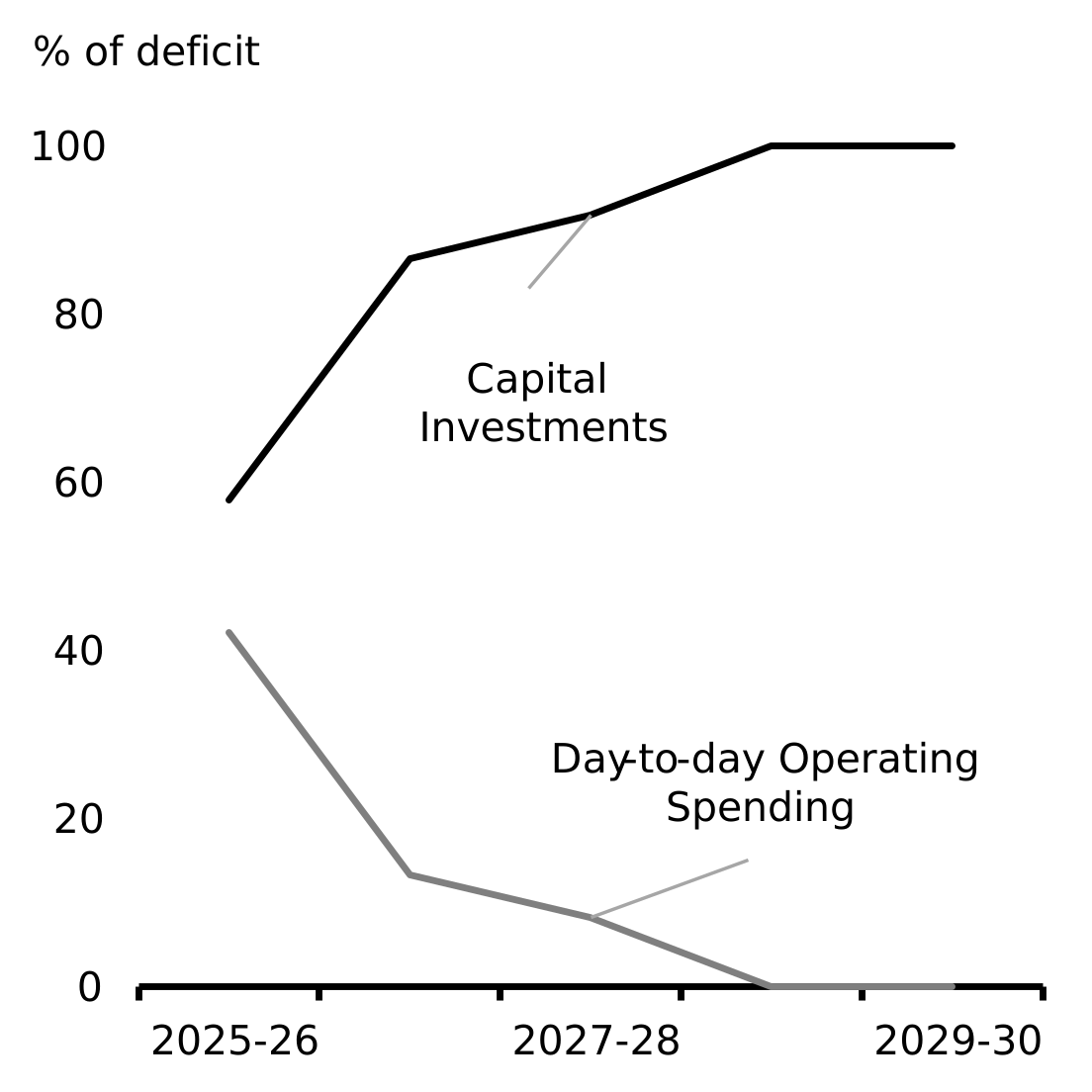
The following charts illustrate the historical and projected levels of capital investment presented in Budget 2025, along with the relative shares of capital investments and operating spending as a per cent of deficit.
Capital investments, historical and projected
Spending Less to Invest More
Budget 2025: Defence
Key Messages
- Budget 2025 announced that Canada will spend an additional $84.8 billion on defence over five
years on a cash basis, starting in 2025-26. This consists of:
- $81.8 billion over five years on a cash basis, starting in 2025-26, to rebuild, rearm, and reinvest in the Canadian Armed Forces (CAF).
- $30.8 million over four years, starting in 2026-27, and $7.7 million ongoing to establish a new Defence Investment Agency.
- $52.5 million over five years, starting in 2026-27, and $12.2 million ongoing to modernise and increase capacity for the Industrial Security Program to meet the needs of the new Agency and support Canada's defence industry.
- $2.7 billion over three years on a cash basis, starting in 2026-27, to renew Operation REASSURANCE, the CAF's largest overseas mission.
- $300.1 million over three years on a cash basis, starting in 2025-26, to support Operation AMARNA, the CAF's operation in the Middle East.
Details & Supplementary Information
Budget 2025 announced $81.8 billion over five years on a cash basis, starting in 2025-26, to rebuild, rearm, and reinvest in the Canadian Armed Forces (CAF), which includes over $9 billion in 2025-26 that was announced by the Prime Minister in June 2025. Key investments are as follows:
- $20.4 billion over five years to recruit and retain a strong fighting force, including generational pay raises for the CAF, and support for CAF health care.
- $19.0 billion over five years to repair and sustain CAF capabilities and invest in defence infrastructure, including expanding ammunition and training infrastructure.
- $10.9 billion over five years for upgrades to Department of National Defence, CAF, and Communications Security Establishment digital infrastructure, including those needed for modern warfare, such as cyber defence.
- $17.9 billion over five years to expand Canada's military capabilities, including investments in additional logistics utility, light utility, and armoured vehicles, counter-drone and long-range precision strike capabilities, and domestic ammunition production, among other investments.
- $6.6 billion over five years to strengthen Canada's defence industry through a Defence Industrial Strategy, the implementation of which will develop our defence industrial base so that more of our military capabilities are procured from Canadian supply chains.
- $6.2 billion over five years to expand Canada's defence partnerships, including expanded military assistance to Ukraine and increased military training and international policy programming.
- $805 million over five years to the Canadian Coast Guard, the Canadian Security Intelligence Service, and Public Services and Procurement Canada for complementary initiatives to support Canada's defence capabilities.
Budget 2025: Housing
Key Messages
- Through Bill C-15, Budget 2025 Implementation Act, No. 1, the Government is proposing to invest
$13 billion to help double the pace of affordable homebuilding over the next decade through Build
Canada Homes.
- This includes an $11.5 billion appropriation to Build Canada Homes to support affordable housing projects across the country and catalyse the housing industry.
- It also includes $1.515 billion to capitalize Canada Lands Company Ltd to support housing construction on its properties held by the corporation, in partnership with Build Canada Homes.
- These investments complement the government's commitment to eliminate the GST for first-time home buyers on homes up to $1 million and to reduce the GST on homes between $1 million and $1.5 million. This measure is included in Bill C-4, introduced in Spring 2025.
- This builds on its efforts and investments in recent years to reduce local barriers to build, support more development through the tax system, significantly increase financing available to builders, and support housing-enabling infrastructure.
Budget 2025: Infrastructure
Key Messages
- Budget 2025 identified $115.2 billion over the next five years in infrastructure capital investments, including core public infrastructure (e.g., water, public transit); trade and transportation infrastructure; Indigenous community and municipal infrastructure; and other infrastructure (e.g., health, innovation).
- Key investments include:
- Build Communities Strong Fund: $51 billion over 10 years, starting in 2026-27, and $3.0 billion ongoing per year in new and existing funding to Housing, Infrastructure and Communities Canada to support public infrastructure projects of local and regional significance.
- Canada Infrastructure Bank (CIB): Division 4 of Part 5 of the Budget Implementation Act proposes to amend the Canada Infrastructure Bank Act, No.1 to increase the CIB's statutory envelope from $35 billion to $45 billion. Budget 2025 also announced that the CIB would be enabled to make investments in any nation-building projects referred to the Major Projects Office, to invest in artificial intelligence infrastructure, and to increase investment target for Indigenous infrastructure to at least $3 billion across its priority sectors.
- Trade Diversification Corridors Fund: $5 billion over seven years, starting in 2025-26, to Transport Canada to strengthen supply chains, unlock new export opportunities, and build a more resilient, diversified economy by funding trade infrastructure, including port, air, rail, and road infrastructure, that will alleviate key trade bottlenecks.
- Arctic Infrastructure Fund: $1 billion over four years, starting in 2025-26, to Transport Canada to support transportation projects in Canada's North, including deep-water ports, sealift infrastructure, airstrips, and all-season roads, that would directly support dual-use capabilities for military and non-military purposes.
- First Mile and Last Mile Fund (formerly the Critical Minerals Infrastructure Fund): $371.8 million over four years, starting in 2026-27, for Natural Resources Canada to provide $1.5 billion through 2029-30 to support the development of critical minerals projects and supply chains at the upstream and midstream segments.
Details & Supplementary Information
Build Communities Strong Fund
- The Build Communities Strong Fund will include three streams:
- a Provincial and Territorial Stream to support provincial and territorial infrastructure projects and priorities. Funding will support housing-enabling infrastructure (e.g. water/wastewater, roads), health-related infrastructure (e.g. hospitals), and infrastructure at colleges and universities. To access funds, PTs must agree to cost-match federal funding and to substantially reduce development charges and not levy other taxes that hinder the housing supply. As part of this stream, $5.0 billion over three years will be dedicated for a Health Infrastructure Fund.
- a Direct Delivery Stream to support projects that are regionally significant, large building retrofits, climate adaptation, and community infrastructure.
- a Community Stream consisting of a rebranded Canada Community-Building Fund to support local infrastructure projects.
- The Build Communities Strong Fund will be funded in part by repurposing unallocated funding under the Canada Housing Infrastructure Fund.
- Community Projects: Funding was announced for several infrastructure projects with funding to be sourced from the Direct Delivery stream of the Build Communities Strong Fund, or from other existing federal programs, where appropriate.
Canada Infrastructure Bank
- The CIB is an independent Crown corporation and makes its own investment decisions. Unlike other projects the CIB invests in, projects referred to the CIB by the Major Projects Office (MPO) will not need to fall within the CIB's priority sectors. However, the CIB will only be able to invest in projects referred by the MPO that fall within the CIB's legal mandate (i.e., projects that are revenue generating, that crowd in private capital and that are infrastructure projects in the public interest).
Responsive Lines
If pressed on the Build Communities Strong Fund / community projects:
- More information about the Build Communities Strong Fund and the community projects will be released by the Government in due course.
- The Minister of Housing and Infrastructure is responsible for the Build Communities Strong Fund. I encourage you to engage with him to share your views on program design elements as the program is developed.
If pressed about what is included in the generational investments figure ($115 billion over five years):
- This figure is presented on an accrual basis and the total includes all federal capital investments in infrastructure, both existing and newly announced in Budget 2025 like the Trade Diversification Corridors Fund and the Build Communities Strong Fund. Capital investment is broadly defined as spending that supports capital formation.
If pressed on what portion of the generational investments in infrastructure referenced in budget ($115 billion over five years) is new spending:
- Budget 2025 announced the government's intention to invest $115 billion in infrastructure. This includes existing and new investments including the Build Communities Strong Fund, the Trade Diversification Corridors Fund, and the Arctic Infrastructure Fund.
- For the Build Communities Strong Fund, Budget 2025 provided incremental funding over the fiscal horizon of $9 billion over five years (out of a total of $20.1 billion). The incremental funding over the 10-year period is $17.4 billion (out of a total of $51 billion).
- When we add other infrastructure investments announced in Budget 2025, such as the Trade Diversification Corridors Fund ($5 billion over 7 years) and the Arctic Infrastructure Fund ($1 billion over 4 years), Budget 2025 provided $13.2 billion over five years in incremental funding for infrastructure (out of a total of $24.3 billion). In percentage terms, 54% of this funding over 5 years is incremental. Over 10 years, Budget 2025 provided $23.4 billion in incremental funding for infrastructure (out of a total of $57 billion), or 41% incremental.
If pressed on the increase of the CIB statutory envelope and the impact of the CIB on the government's fiscal position:
- Funding provided to the CIB to finance its investing activities, including the proposed increase in its statutory capital envelope, does not have a direct impact on the government's deficit, as this represents an internal cash transaction within the government. Loans and investments recorded by the CIB through its deployment of those additional funds would be captured as part of the government's total loans, investments and advances. Revenues and expenses flowing from the CIB's loans and investments, such as interest revenues or loan loss provisions, would however have a direct accrual impact on the government's deficit.
Budget 2025: Major Projects Office
Key Messages
- The Major Projects Office (MPO) will advance efforts to catalyze $500 billion in private sector investment over the next five years in Canada, paving the way for a total investment of $1 trillion.
- Launched in August 2025, the MPO seeks to accelerate the delivery of nation-building projects in Canada and act as a single window for project proponents into the federal regulatory process to simplify and accelerate project approvals.
- Projects referred to the MPO are the kinds of projects that will expand Canadian exports to new global partners, unleash Canada's considerable resource potential, and fuel economic growth.
- The MPO is leading a review of Canada's regulatory approval process to ensure all major projects receive federal legislative and regulatory decisions within two years. This will accelerate decision-making and enhance certainty for investors while maintaining responsible and sustainable development that respects the rights of Indigenous Peoples.
- Proponents of projects that are not referred to the MPO will still benefit from regulatory streamlining and financial coordination as they move through other departments more efficiently.
Details & Supplementary Information
PROJECTS REFERRED TO THE MAJOR PROJECTS OFFICE REPRESENT $116 BILLION IN CAPITAL INVESTMENT
1 port project, 3 electricity projects, 5 mining projects, 2 energy projects
- LNG Canada Phase 2 (Kitimat, BC): This project would double the facility's LNG production, making it the world's second largest LNG terminal and attracting $33 billion in private capital. It will deliver low carbon Canadian LNG to global markets and strengthen local economic growth. Budget 2025 introduced measures to improve LNG competitiveness, including longer export licences and accelerated capital cost allowances for top performing low carbon facilities.
- Darlington New Nuclear Project (Bowmanville, ON): This project will make Canada the first G7 country to operate a grid scale small modular reactor. Its first unit will power 300,000 homes and support 200 permanent and 1,600 construction jobs. Up to $3 billion in equity from the Canada Growth Fund and the Building Ontario Fund is helping de risk construction, and Budget 2025 confirmed a 15% Clean Electricity Investment Tax Credit for eligible nuclear equipment.
- Contrecœur Terminal Container Project (Contrecœur, QC): This expansion will increase the Port of Montreal's container capacity by 60%, strengthening supply chains and creating thousands of jobs. Work is advancing under a Memorandum of Understanding between the Major Projects office, the Canada Infrastructure Bank, and the Port Authority, and preparatory construction began in October 2025 following federal permitting.
- McIlvenna Bay Foran Copper Mine (East Central SK): This project will supply low emission copper and zinc for clean energy and advanced manufacturing while creating hundreds of jobs. Budget 2025 expanded eligibility for the Clean Technology Manufacturing Investment Tax Credit to include polymetallic mining equipment.
- Red Chris Mine Expansion (Northwestern BC): This expansion will extend the mine's life by more than a decade, increase Canada's copper output by over 15%, and support 1,500 operational and 1,800 construction jobs. Budget 2025 confirmed expanded tax credit eligibility for polymetallic mining.
- North Coast Transmission Line (Northwestern BC): This three-phase project will twin major transmission lines from Prince George to Terrace and north to Bob Quinn, bolstering telecommunications and electricity access for remote communities and major industrial projects. It is now linked to the Yukon–BC Grid Connect initiative to extend clean power benefits further north.
- Ksi Lisims LNG (Pearse Island, Nisg̱a'a Territory, BC): This floating LNG facility will be one of the world's lowest emission LNG operations, attracting nearly $30 billion in investment and creating thousands of skilled careers. The project received coordinated federal and provincial environmental assessment approvals in September 2025.
- Canada Nickel's Crawford Project (Timmins, ON): This project will produce high quality, low carbon nickel for batteries and green steel, drawing $5 billion in investment and creating thousands of jobs.
- Nouveau Monde Graphite – Matawinie Mine (Saint Michel des Saints, QC): This project will support QC's battery hub through an integrated graphite mine and materials plant, creating more than 1,000 jobs and attracting $1.8 billion in investment.
- Northcliff Resources' Sisson Mine (Sisson Brook, NB): This project would restore Canada's tungsten production—critical for defence and advanced manufacturing—and produce molybdenum for high strength steel and superalloys. It would reestablish Canada as a secure supplier of tungsten.
- Iqaluit Nukkiksautiit Hydro Project (Iqaluit, Nunavut): This 15–30 MW Inuit owned hydro project will replace Iqaluit's reliance on 15 million litres of imported diesel each year, eliminating 130,000 tonnes of emissions and delivering affordable, reliable, emissions free power.
TRANSFORMATIVE STRATEGIES UNDER DEVELOPMENT BY THE MPO
- Alto High-Speed Rail: Canada's first high-speed railway, spanning approximately 1,000 km from Toronto to Québec City and reaching speeds of up to 300 km/hour to cut travel times in half and connect close to half of Canada's population.
- Port of Churchill Plus: This project will upgrade the Port of Churchill and expand trade corridors with an all-weather road, an upgraded rail line, a new energy corridor, and marine ice-breaking capacity.
- Critical Minerals Strategy: A priority for the Major Projects Office will be to get more critical minerals projects to final investment decisions, with a focus on sustainability and regulatory certainty.
- Atlantic Energy: A project that would leverage over 60 GWs of wind power potential in NS, and more across Atlantic Canada, connecting that renewable, emissions-free energy to Eastern and Atlantic Canada to meet rapidly growing demand.
- Pathways Plus: An Alberta-based carbon capture, utilization, and storage project with additional energy infrastructure that would support a strong conventional energy sector while driving down emissions and emissions intensity from the oil sands. Pathways creates the prospect of facilitating low-carbon oil exports from the Alberta oil sands to a variety of potential markets.
- The Northwest Critical Conservation Corridor (Northwest BC and the Yukon): Canada's northwestern coast is home to the Golden Triangle - one of the world's richest reserves of the minerals and metals that are essential for the energy transition as well as defence supply chains for Canada and our allies.
- Arctic Economic and Security Corridor: The Arctic and Security Corridor is a strategic lifeline. Designed as dual-use infrastructure, it supports both Canada's defence and economic goals. From fortified ports and all-season roads to runways and communications systems, it is built to serve military operations and commercial development alike.
Affordability Measures Overview
- This fall, the government launched Build Canada Homes, a new federal agency that will build affordable housing at scale with an initial investment of $13 billion over five years. The government is also eliminating the GST for first-time home buyers on new homes up to $1 million and reducing it on new homes between $1 million and $1.5 million.
- In May 2025, the government announced a middle-class tax cut that would lower the first marginal personal income tax rate by one per cent, from 15% to 14%, effective July 1, 2025. Nearly 22 million Canadians would see tax savings of up to $420 per person in 2026.
- The government committed to starting automatic federal benefits for the 2026 tax year that will reach up to 5.5 million low-income Canadians by the 2028 tax year. This will help eligible individuals receive the government benefits they qualify for such as the GST/HST credit and the Canada Child Benefit.
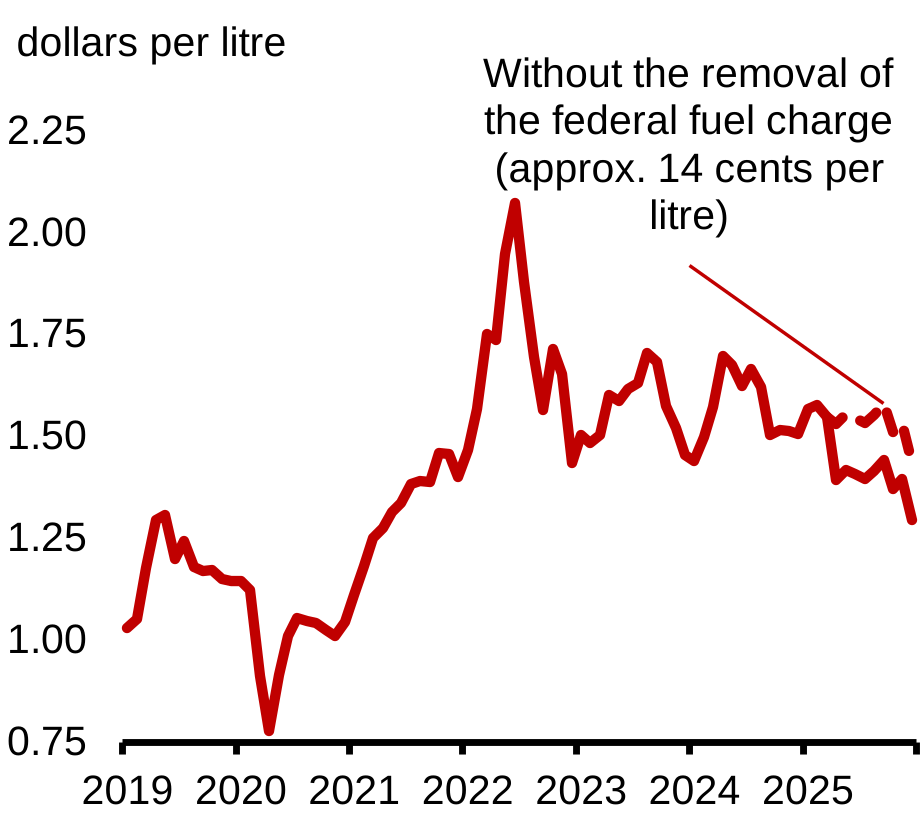
- The government cancelled the consumer carbon price, bringing down gasoline prices by approximately 18 cents per liter in most provinces and territories, effective April 1, 2025.
- The government will make the National School Food Program permanent—beyond the initial investment of $1 billion over five years. It aims to provide meals for 400,000 more kids every year, beyond those served by existing school food programs.
- The government is making groceries and other essentials more affordable through the new Canada Groceries and Essentials Benefit, which will provide a family of four up to $1,890 this year, and about $1,400 a year for the next four years. We are also taking steps to tackle food insecurity, support producers, and strengthen supply chains.
- The government remains focused on empowering Canadians—by lowering costs, expanding opportunity, and protecting the vital social programs Canadians rely on, including child care and dental care.
Details & Supplementary Information
Launching Build Canada Homes
The government launched Build Canada Homes (BCH) in the fall—a new federal agency that will build affordable housing at scale. It is mandated with building and financing more affordable homes and catalyzing a new housing industry. The government also announced the agency's first four investments and initiatives. This includes protecting existing affordable housing by launching the $1.5 billion Canada Rental Protection Fund under Build Canada Homes. Additionally, BCH will provide $1 billion to build transitional and supportive housing for people who are homeless or at risk of homelessness.
First-Time Home Buyers' GST Rebate
Bill C-4, the Making Life More Affordable for Canadians Act, which was tabled in Spring 2025 and is currently before Parliament, would eliminate the GST for first-time home buyers on new homes at or under $1 million and reduce the GST for first-time home buyers on new homes between $1 million and $1.5 million by introducing a new First-Time Home Buyers' GST Rebate. As a result of this rebate, first-time home buyers will be able to save up to $50,000 on a new home. This measure is expected to deliver $3.9 billion in tax savings to Canadians over five years, starting in 2025-26.
Middle-class Tax Cut
In May 2025, the government announced it would lower the first marginal personal income tax rate from 15 per cent to 14 per cent. The rate reduction, which is currently before Parliament as part of Bill C-4, applies to the first $58,523 of an individual's taxable income. Nearly 22 million Canadians will benefit from tax relief of up to $420 per person, saving two-income families up to $840 this year.
The majority of tax relief will go to Canadians with incomes in the two lowest tax brackets. Nearly 45 per cent of the tax relief will go to Canadians with income below $58,523 (the first tax bracket) and 40 per cent to Canadians with income approximately between $58,523 and $117,045 (the second tax bracket).
Automatic Federal Benefits
To help lower-income individuals receive the benefits to which they are entitled, the government committed to implementing Automatic Federal Benefits for the 2026 tax year, which will reach up to 5.5 million low-income Canadians by the 2028 tax year. Budget 2025 also proposed:
- To amend the Income Tax Act to allow the CRA to file a tax return on behalf of certain eligible individuals with lower incomes in simple tax situations who do not owe tax and do not file themselves.
- To provide $71 million over five years, starting in 2025-26, with $10.4 million in remaining amortisation and $8.3 million ongoing, to the CRA to implement these new services.
Consumer Fuel Charge
On March 14, 2025, the government announced that it will cease the application of the federal fuel charge, effective April 1, 2025. It also removed the requirement for provinces and territories to maintain a consumer-facing carbon price. These actions have reduced gasoline prices at the pump in most provinces and territories by up to 18 ¢/L compared to 2024–25 levels, thereby contributing to lower headline inflation.
The government is winding down mechanisms used to return direct fuel charge proceeds to
Canadians, small and medium-sized businesses, farmers, and Indigenous governments. Eliminating the fuel
charge, which is currently before Parliament as part of Bill C-4, will give Canadian consumers and
businesses certainty that the consumer carbon price is being permanently removed from legislation.
National School Food Program
Originally announced on April 1, 2024 with an investment of $1 billion over five years, the program aimed at providing meals to 400,000 more kids every year, beyond those served by existing school food programs. In Budget 2025, the program received permanent funding of $216.6 million per year, starting in 2029-30.
Bill C-15 (Budget Implementation Act, 2025) enacts the National School Food Program Act, which sets out the Government of Canada's vision for the National School Food Program and commits to maintaining long-term funding to provinces, territories, and Indigenous peoples for the ongoing implementation and maintenance of the Program.
As of March 2025, all 13 provinces and territories have signed agreements with the federal government to flow funding under the program until March 2027. The rollout of the program's distinctions-based funding for First Nations on reserve as well as Inuit, Métis, and Modern Treaty and Self-Government agreement holders remains ongoing.
Canada Groceries and Essentials Benefit
The Canada Groceries and Essentials Benefit would build on the existing Goods and Services Tax (GST) Credit and provide $11.7 billion in additional support over six years to over 12 million individuals and families, by:
- providing a one-time top-up payment to be paid as early as possible this spring and no later than June 2026 (based on January 2026 eligibility)—equal to a 50% increase in the annual 2025-26 value of the GST Credit. This would deliver $3.1 billion in immediate assistance to individuals and families who currently get the GST Credit.
- increasing the value of the Canada Groceries and Essentials Benefit by 25% for five years starting in July 2026. This increase would deliver $8.6 billion in additional support over the 2026-27 to 2030-31 period, including to 500,000 new individuals and families.
These changes are subject to Royal Assent of enabling legislation.
Recipients would not need to apply for the additional payments, but should file their 2024 tax return if they have not done so already to be able to receive the top-up, and must file their 2025 tax return to receive the increased Canada Groceries and Essentials Benefit payments as of July 2026.
Tackle food insecurity, support producers, and strengthen supply chains
To help keep food affordable for Canadians and strengthen the resilience of Canada's food supply chain, the government has announced targeted measures to support businesses, producers, and local organisations, including:
- The government is setting aside $500 million from the Strategic Response Fund to help businesses address the costs of supply chain disruptions without passing those costs on to Canadians at the checkout line.
- For the same purpose, the government will create a $150 million Food Security Fund under the existing Regional Tariff Response Initiative for small and medium enterprises and the organisations that support them.
- To lower the cost of food production, the government is introducing immediate expensing for greenhouse buildings. This allows producers to fully write off greenhouses acquired on or after November 4, 2025, and that become available for use before 2030. This measure supports increased domestic supply and investment in food production over the medium-term.
- To ease immediate pressures with food banks, the government is providing $20 million to the Local Food Infrastructure Fund. This supports food banks and other national, regional, and local organisations to deliver more nutritious food to families in need.
- To tackle the root causes of food insecurity, the government is developing a National Food Security Strategy – one that strengthens domestic food production and improves access to affordable, nutritious food. This strategy will also include measures to implement unit price labelling and support the work of the Competition Bureau in monitoring and enforcing competition in the market, including food supply chains.
Canadian Dental Care Plan
The Canadian Dental Care Plan is available to uninsured Canadians with a family income of less than $90,000, with no co-pays for families under $70,000. The program first launched in 2023, starting with seniors. Program eligibility gradually expanded to individuals with a valid Disability Tax Credit, children under the age of 18, and then individuals between the ages of 18 to 64. As of May 2025, all eligible uninsured Canadians of all ages can apply.
Canada-wide child care system
As part of Budget 2021 the government committed to build a Canada-wide Early Learning and Child Care system with PTs. Key targets that PTs have committed to through bilateral agreements under the Canada-wide system include:
- Reduce fees for regulated child care by 50% by December 2022 (completed);
- Reduce fees for regulated child care to an average of $10-a-day by March 2026; and
- Build 250,000 new regulated child care spaces by March 2026.
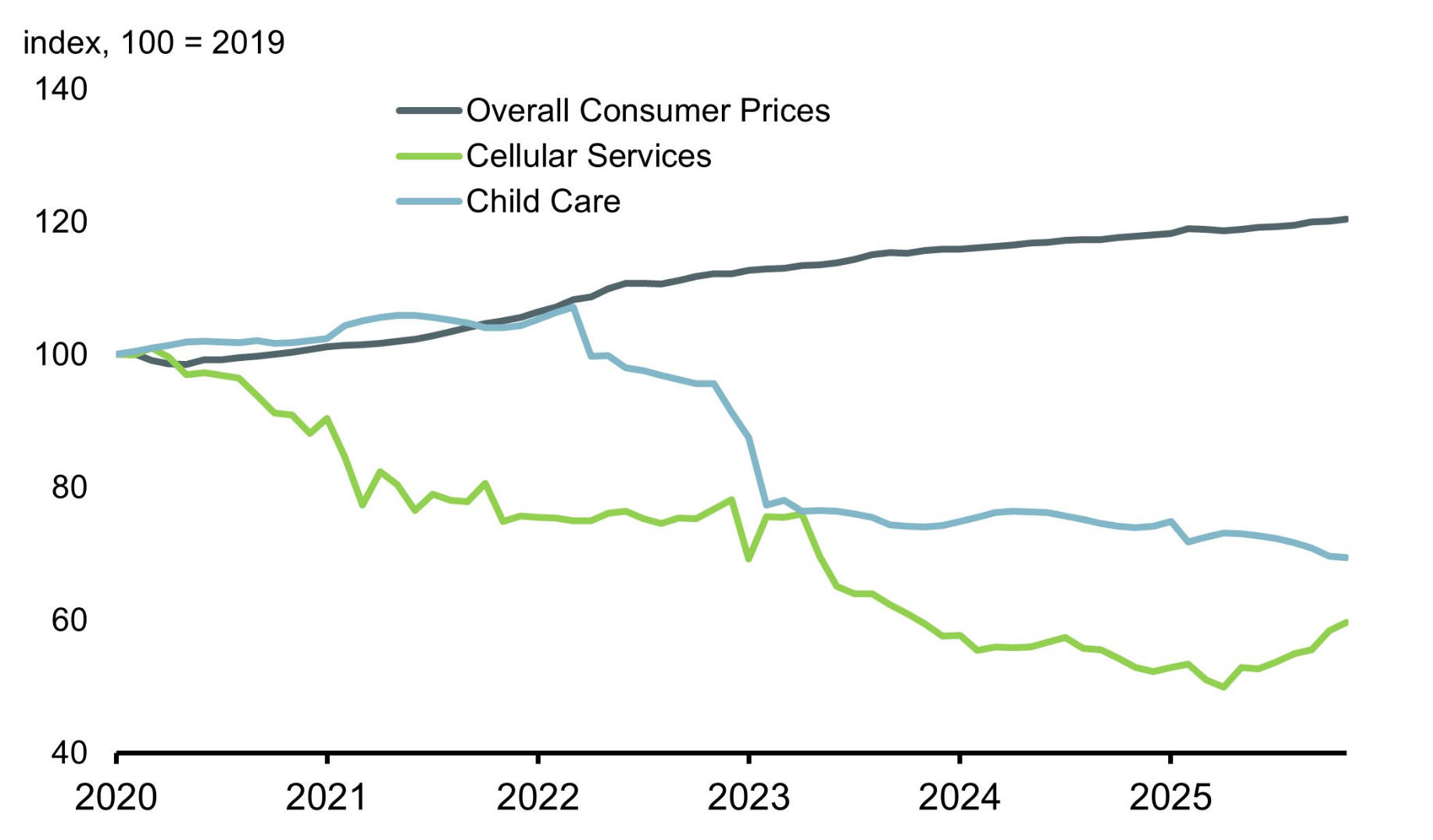
The majority of PTs have signed extension agreements for 2026-27 to 2030-31, which provide them with a 3 per cent funding top-up to sustain their systems without any additional targets. Alberta, Saskatchewan and Ontario have not yet signed extension agreements. As of March 31, 2026, the government will have provided over $35 billion for ELCC, including for Indigenous ELCC, and committed to ongoing funding of $9.2 billion annually.
Section 1: Economic Context and Affordability
Headline CPI Inflation
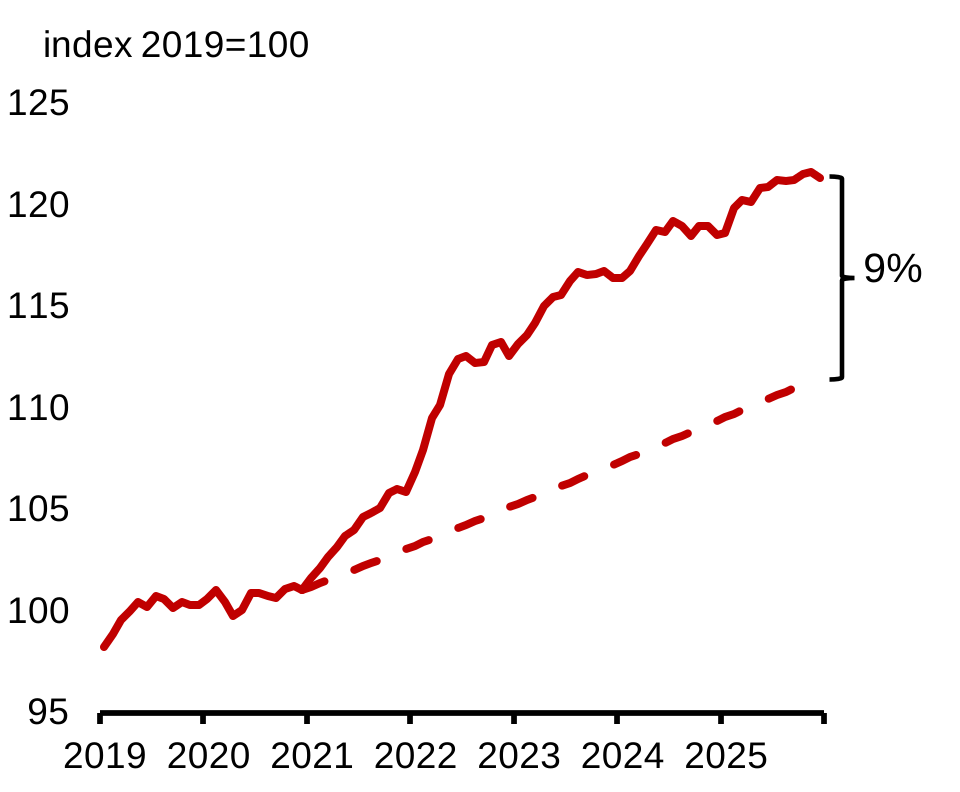
Consumer Price Index
Unemployment Rate by Age Group
Wage Growth, Nominal Versus Real
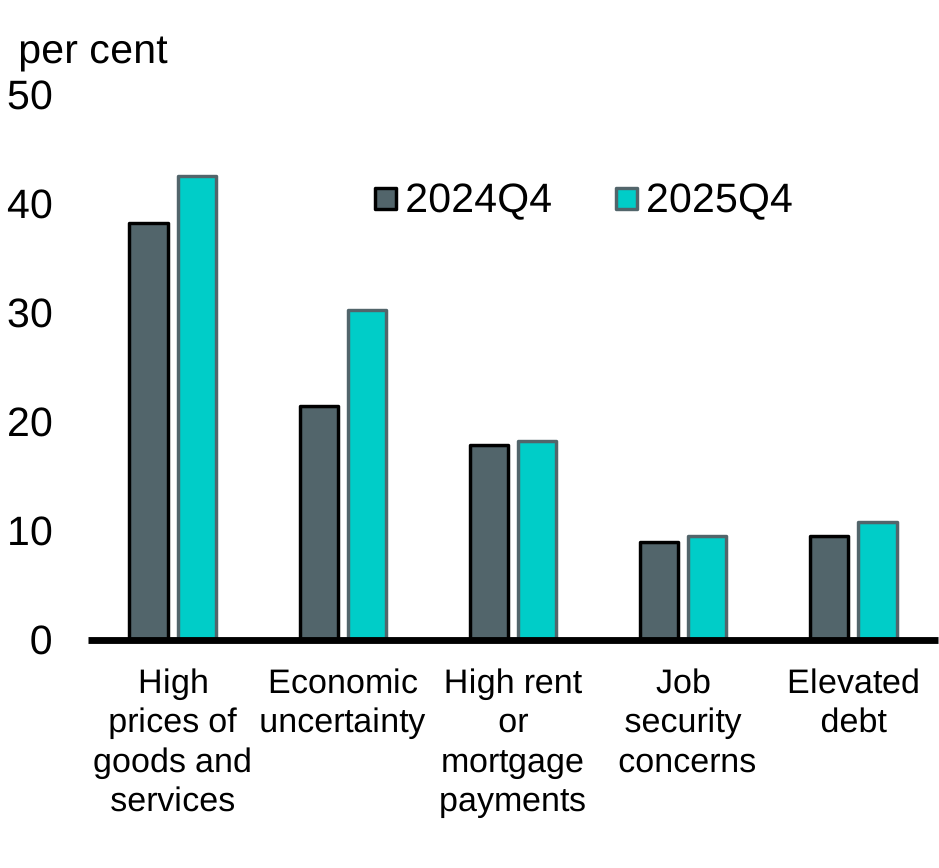
Factors Negatively Affecting Consumer Spending
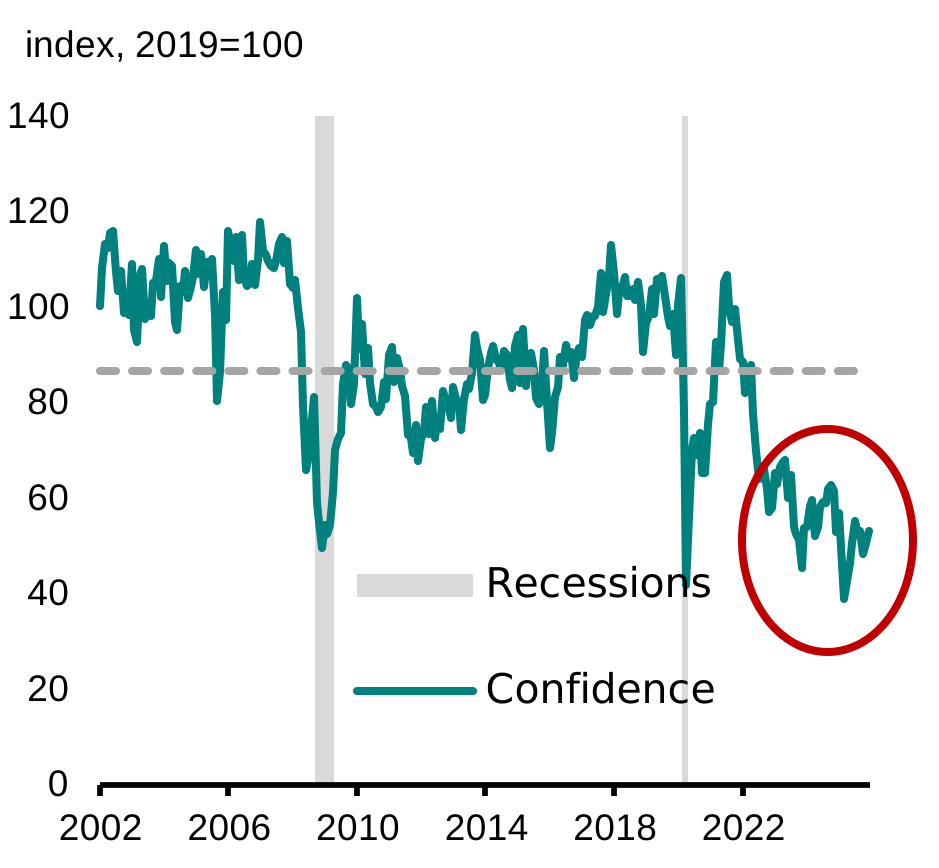
Consumer Confidence
CPI Inflation
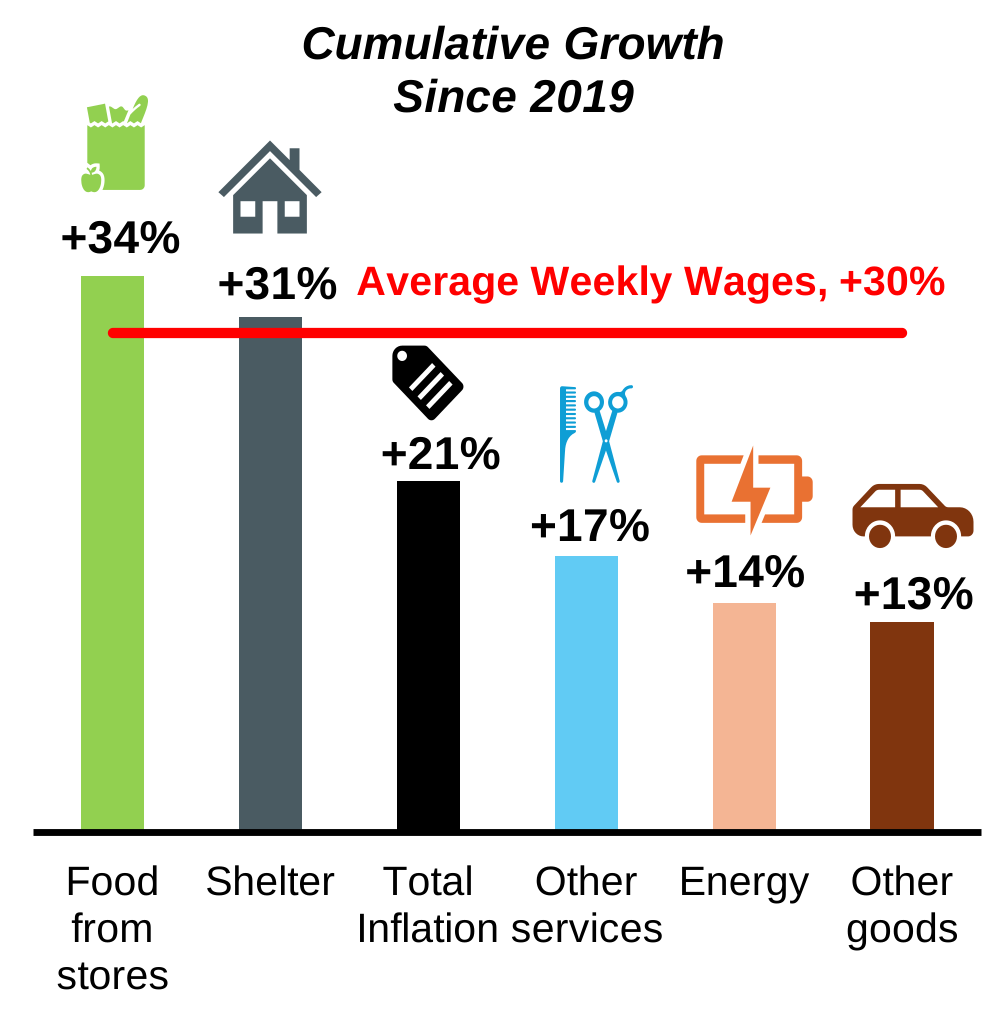
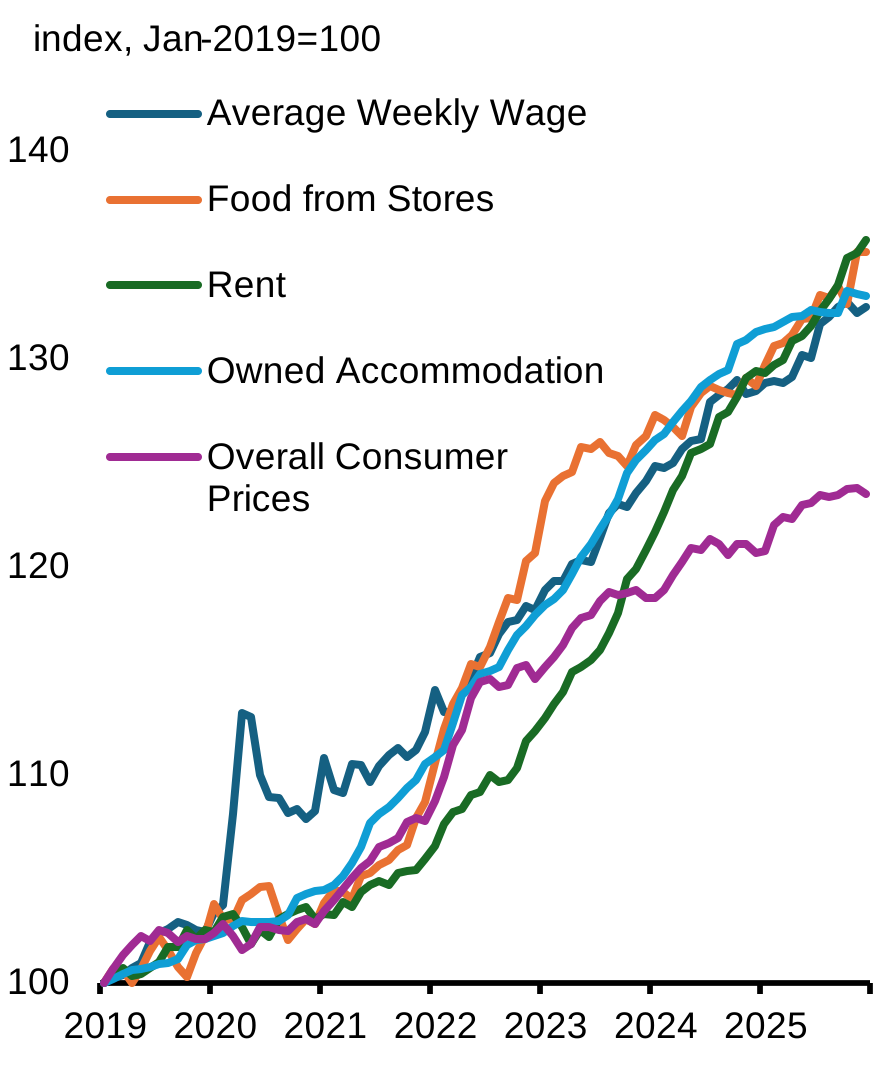
Change in Key Prices and Nominal Wages Since 2019
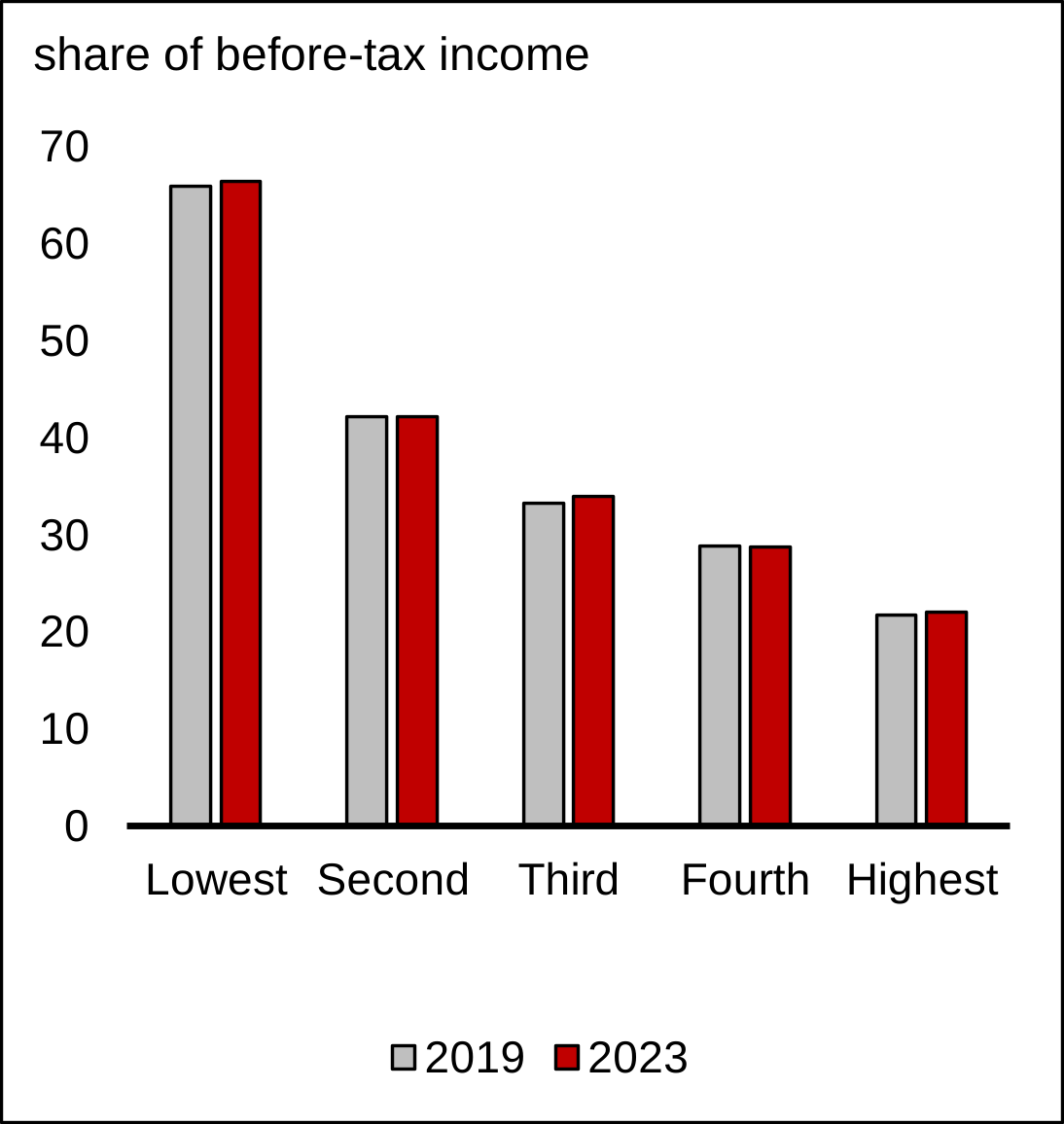
Median Share of Income Spent on Food and Shelter, by Income Quintiles
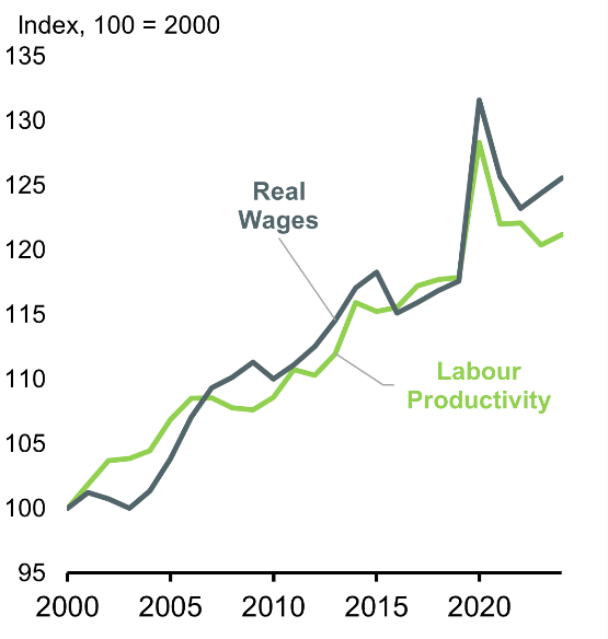
Labour Productivity and Real Wages
Labour Productivity Level
Section 2: Grocery Prices
Headline and Food from Stores Inflation
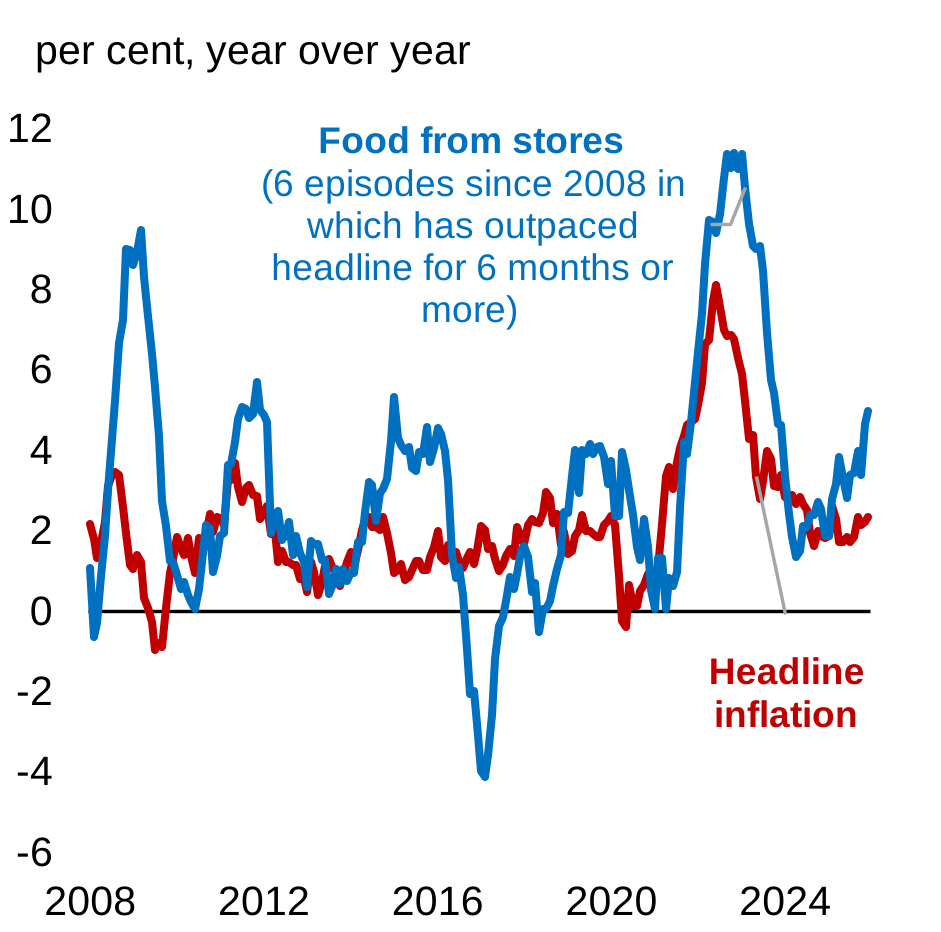
Food from Stores Inflation
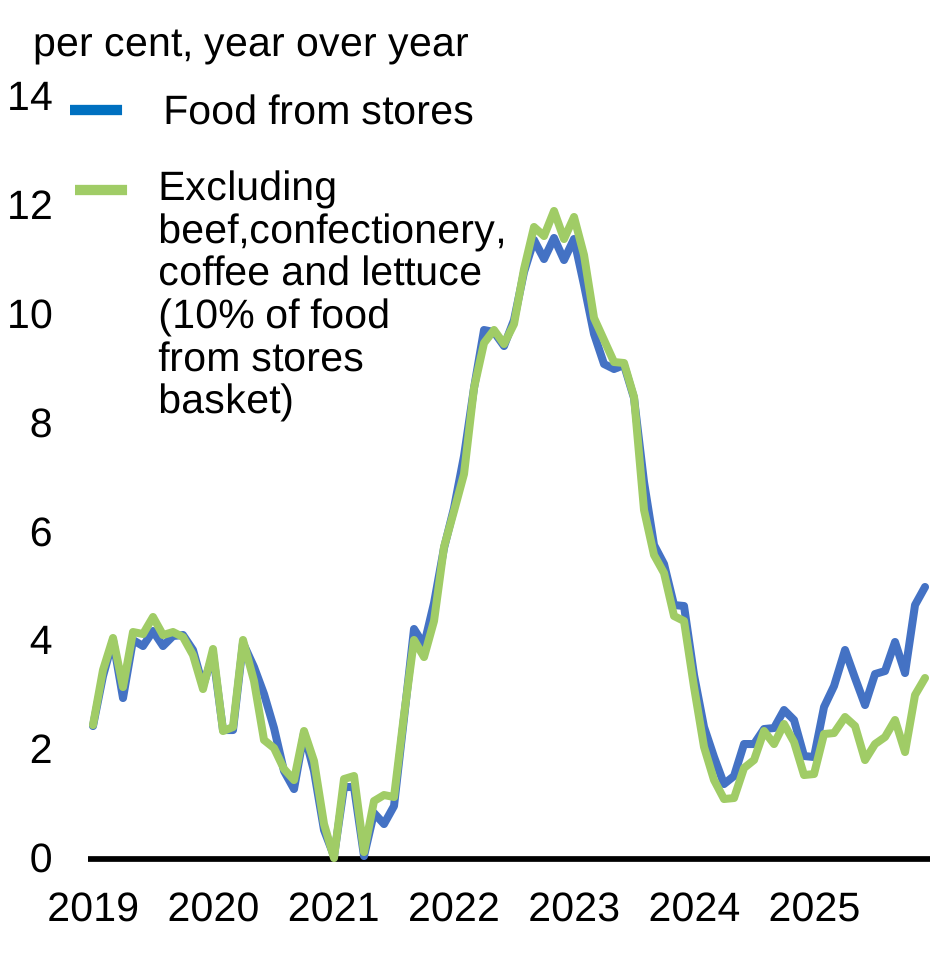
Contributions to Grocery Price Inflation by Component
Grocery Inflation by Component, December 2025
Food Inflation and Underlying Input Costs
Grocery and Overall Inflation, G7 Countries
Jan-Nov 2025 vs. Jan-Nov 2024
Section 3: Housing, rent and other important prices
Rent Inflation Metrics
| Jurisdiction | Asking rents (2 bedrooms) | Y/Y |
|---|---|---|
| Alberta | $1,819 | -3.1% |
| Calgary | $1,847 | -4.4% |
| Edmonton | $1,625 | -1.8% |
| Nova Scotia | $2,477 | 2.4% |
| Halifax | $2,522 | -2.0% |
| British Columbia | $2,640 | -5.6% |
| Vancouver | $3,255 | -5.1% |
| Ontario | $2,450 | -4.4% |
| Toronto | $2,797 | -9.1% |
| Mississauga | $2,467 | -8.3% |
| Burlington | $2,463 | -2.6% |
| Kingston | $2,550 | 23.5% |
| Ottawa | $2,455 | -1.2% |
| London | $2,057 | -4.9% |
| Windsor | $1,921 | -2.9% |
| Saskatchewan | $1,517 | 6.9% |
| Saskatoon | $1,591 | 8.3% |
| Regina | $1,553 | 7.9% |
| Quebec | $2,166 | -0.6% |
| Montreal | $2,260 | -0.3% |
| Gatineau | $2,088 | -3.2% |
| Quebec City | $1,668 | -13.2% |
MLS Benchmark Home Price
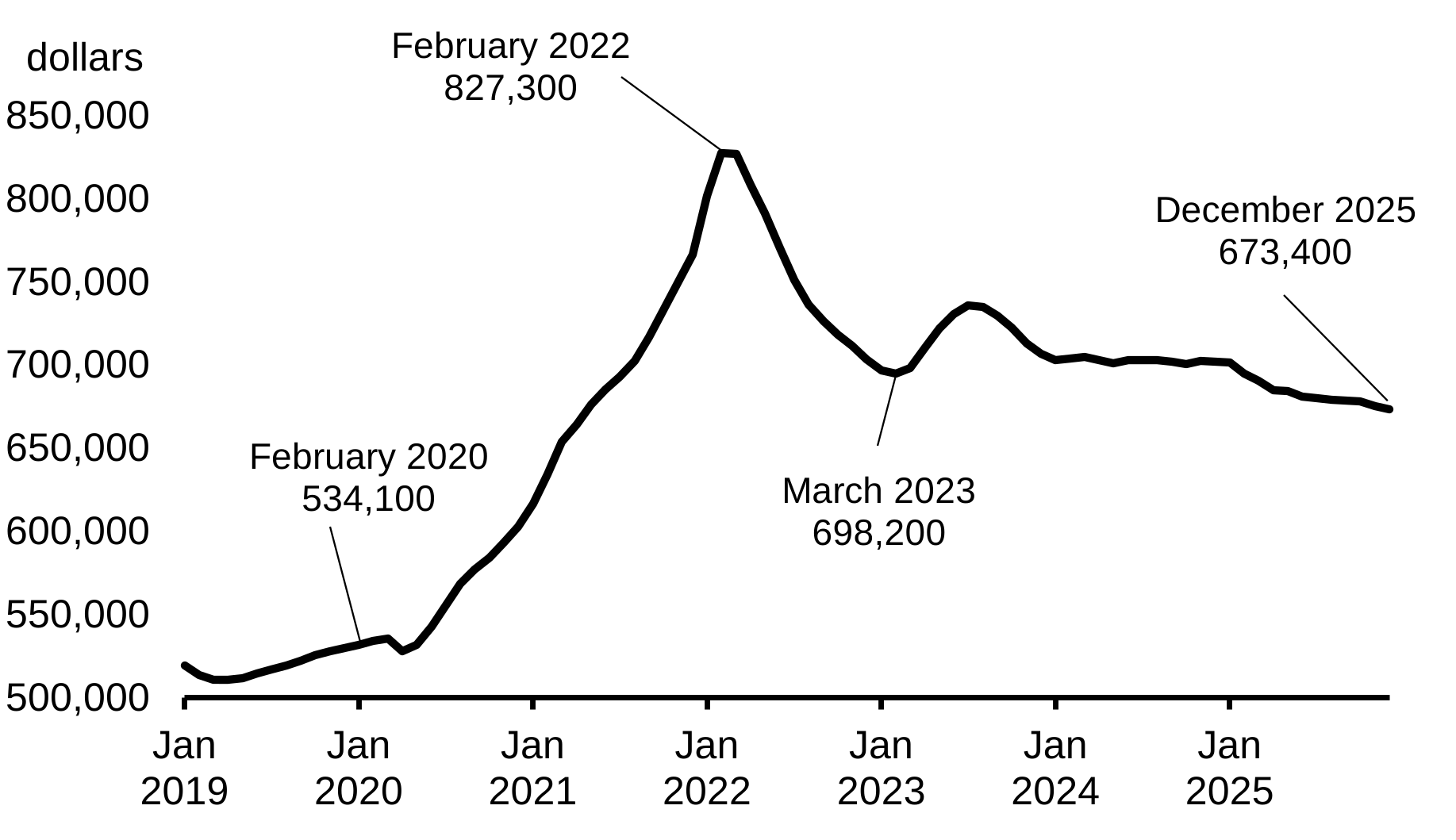
Home Price Changes as of December 2025, Selected Cities
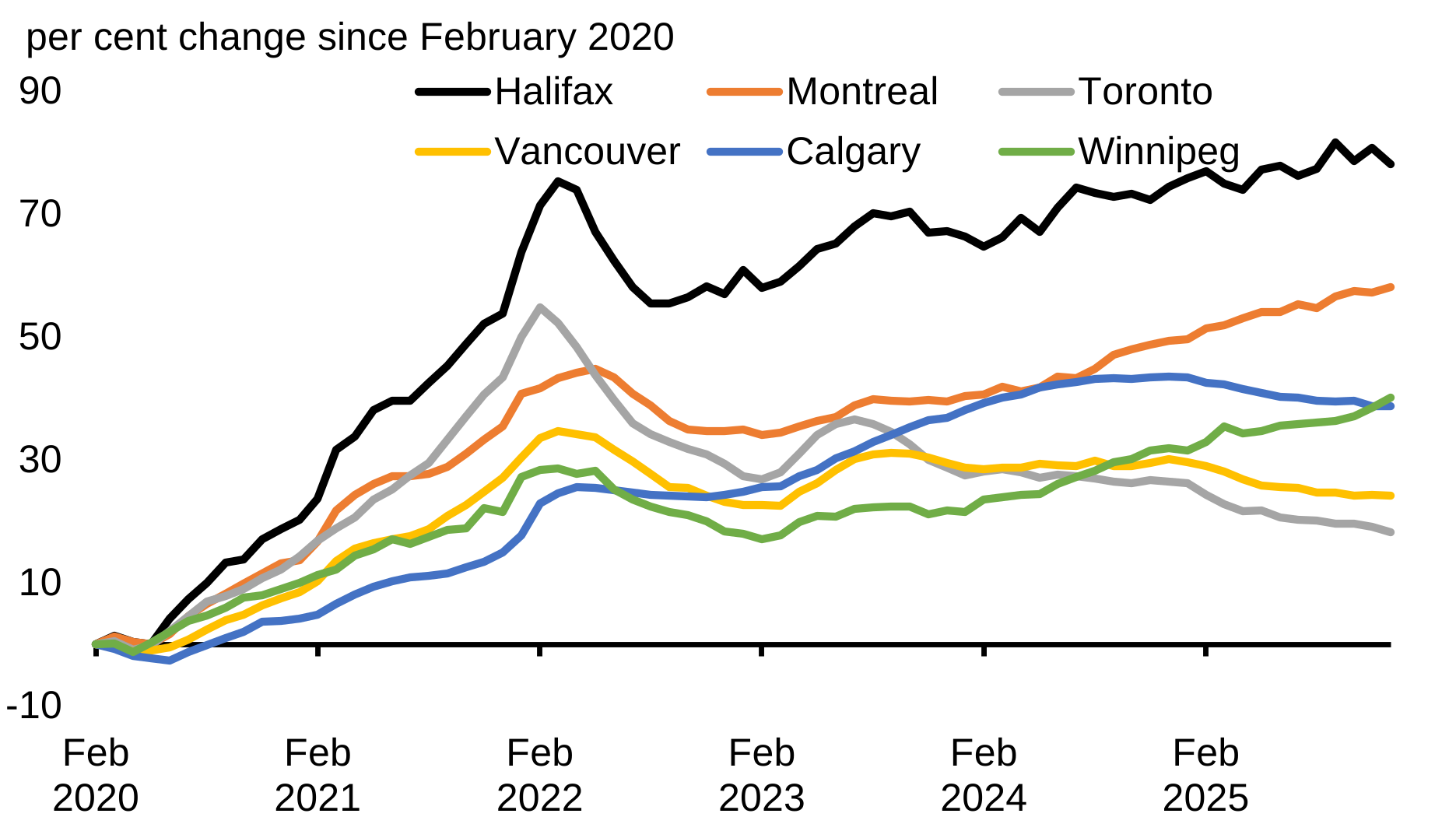
| m/m | y/y | vs. Feb 2020 | |
|---|---|---|---|
| Halifax | -1.5 | 2.1 | 78.0 |
| Montreal | 0.6 | 5.8 | 58.1 |
| Quebec | 3.2 | 17.0 | 79.6 |
| Toronto | -0.7 | -6.4 | 18.3 |
| Hamilton | -0.4 | -7.4 | 25.6 |
| Waterloo | -0.6 | -8.6 | 24.8 |
| Ottawa | 0.0 | 0.3 | 36.6 |
| Winnipeg | 1.2 | 6.2 | 40.0 |
| Saskatoon | 0.5 | 6.5 | 38.3 |
| Calgary | 0.1 | -3.4 | 38.7 |
| Edmonton | -0.3 | 3.1 | 23.4 |
| Fraser Valley | -0.2 | -6.2 | 34.9 |
| Vancouver | -0.1 | -4.5 | 24.1 |
| Victoria | 0.0 | -0.6 | 37.1 |
National Housing Affordability Index
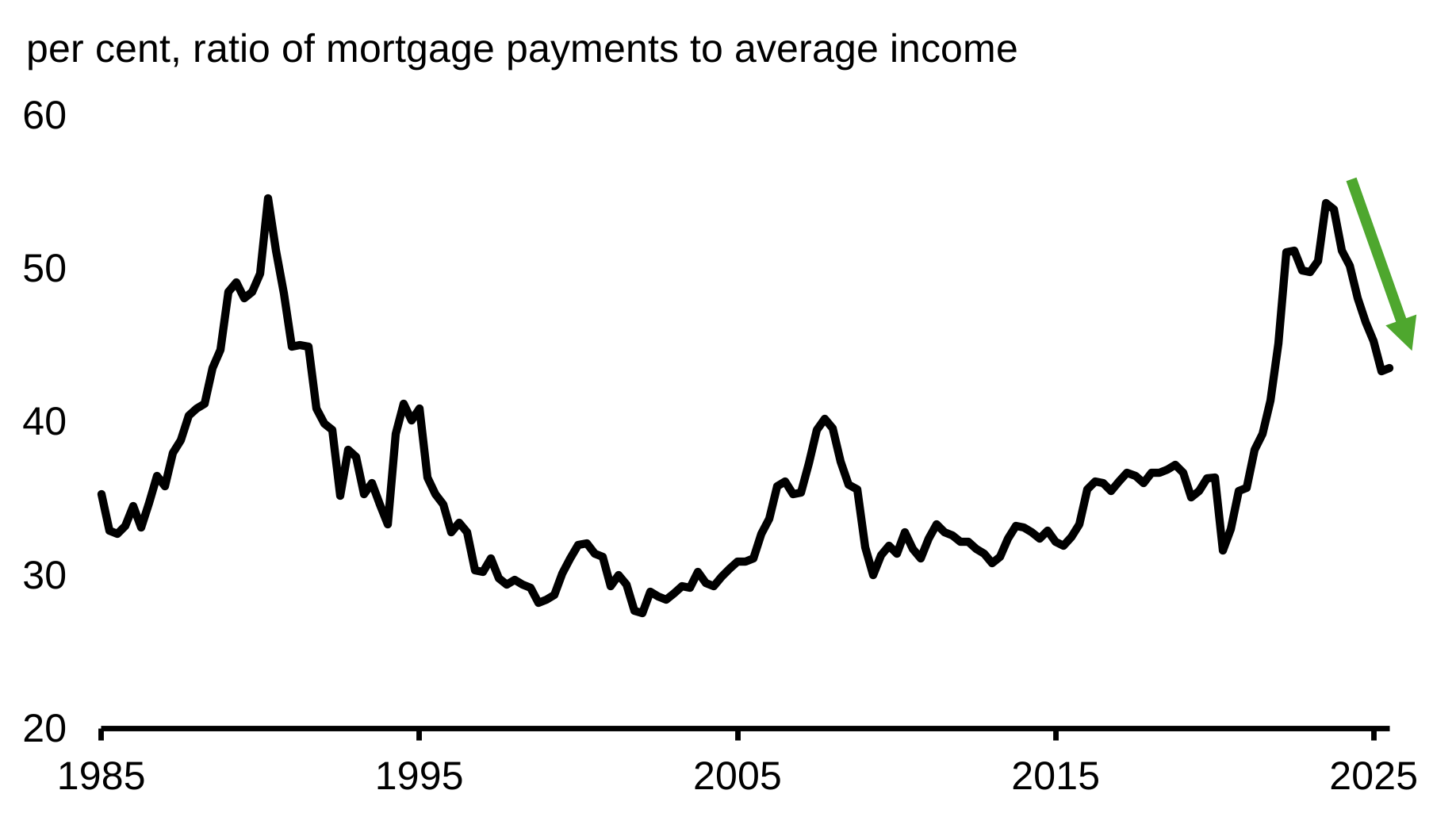
Retail Gasoline Prices, Canada
WTI Crude Oil Price
Price of Child Care and Cellular Services
Appendix: Additional Wage Charts
Real Weekly Wage Growth
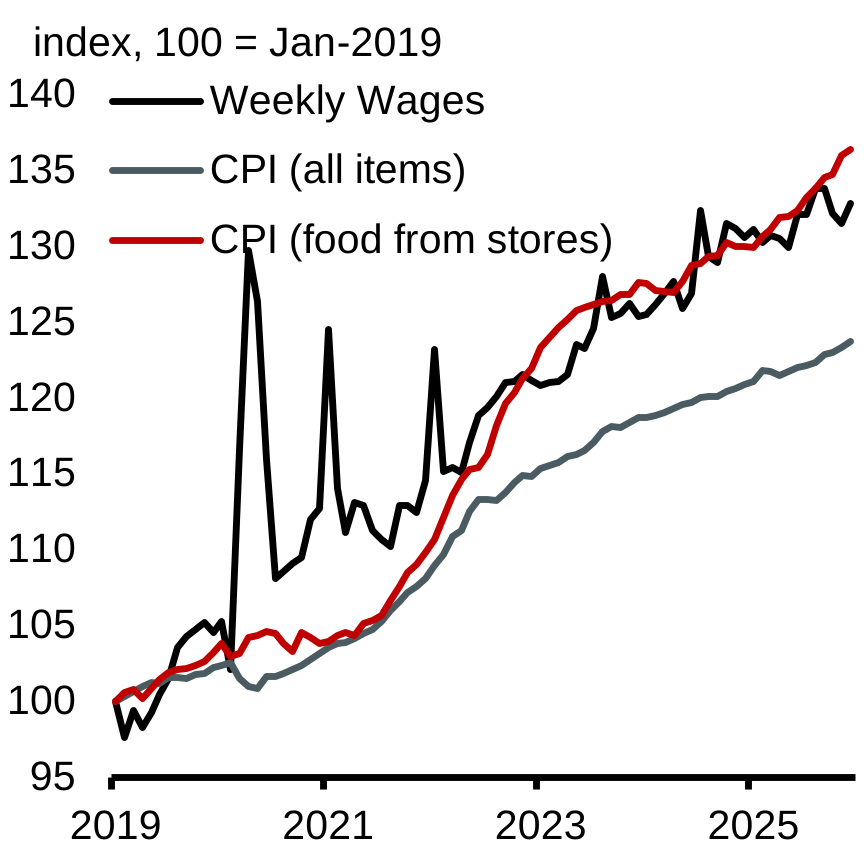
Wages and Inflation – Lowest Wage Quintile
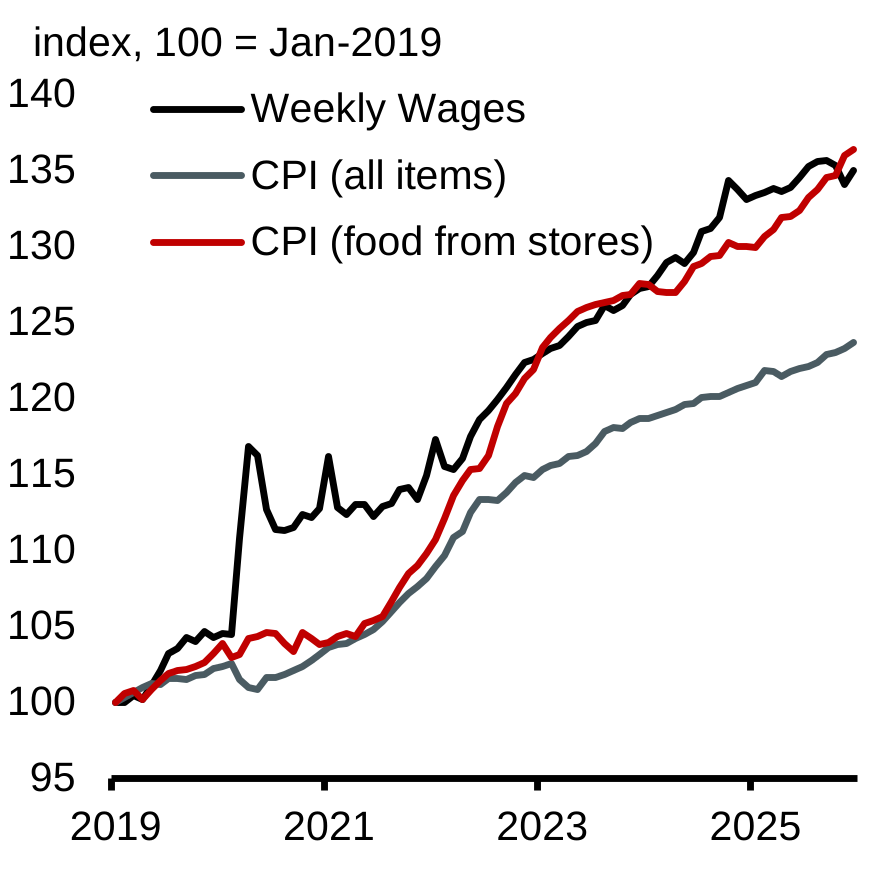
Wages and Inflation – Second Wage Quintile
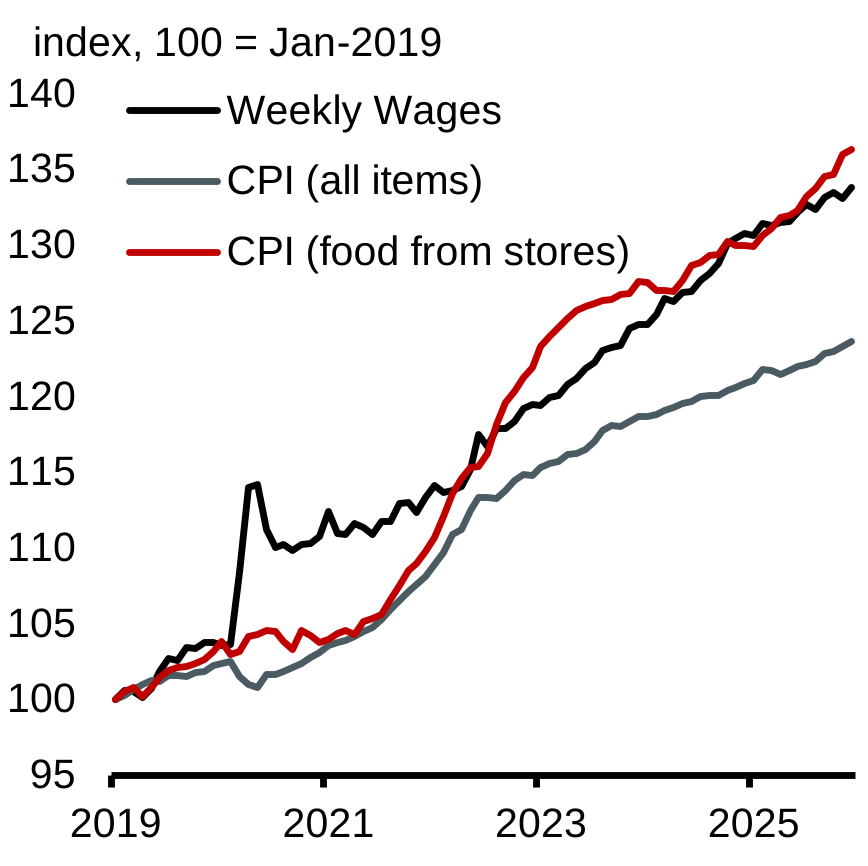
Wages and Inflation – Middle Wage Quintile
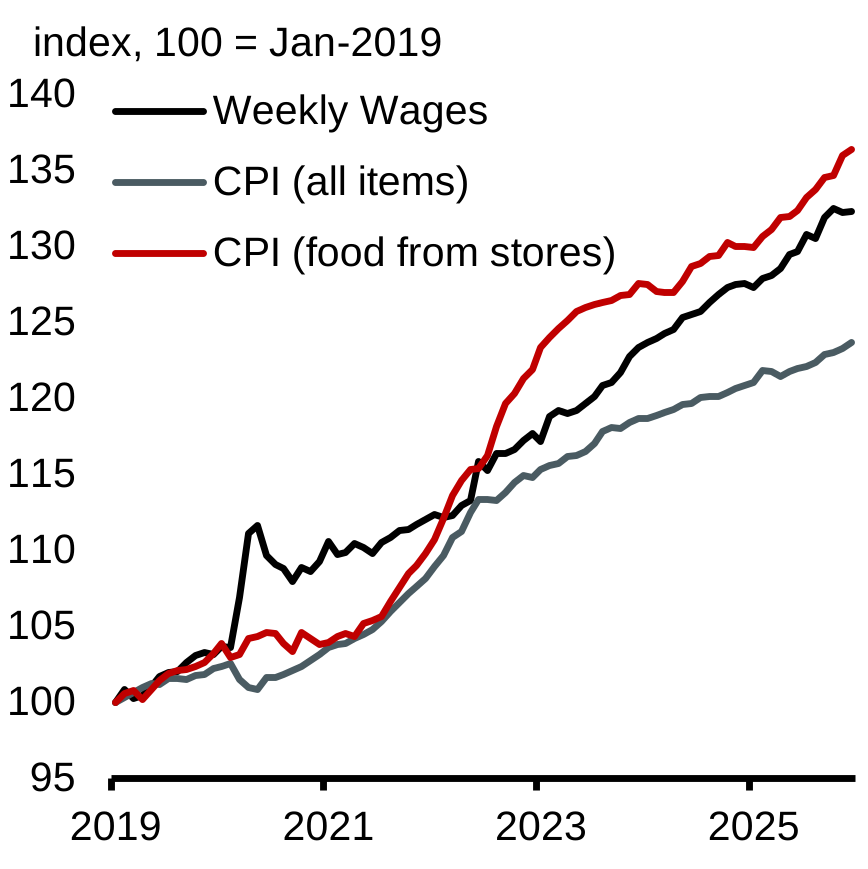
Wages and Inflation – Fourth Wage Quintile
Wages and Inflation – Highest Wage Quintile
Grocery Affordability and Food Inflation
Key Messages
- Grocery affordability is top of mind for Canadians and also for the Government. All families in Canada deserve access to affordable, safe, nutritious and high-quality food.
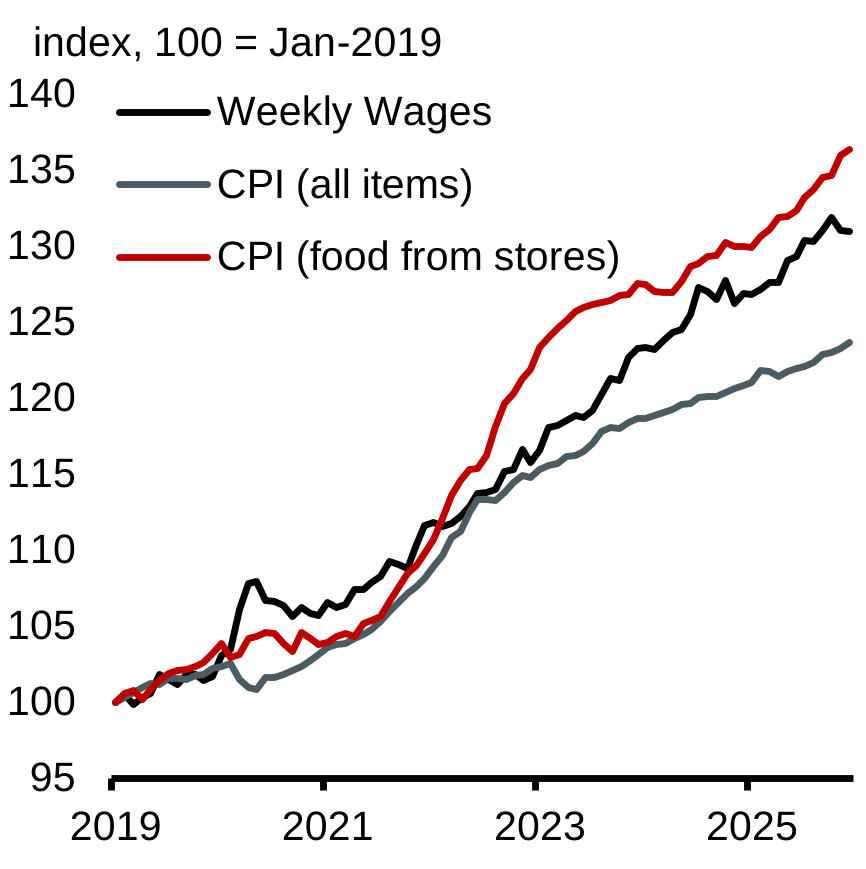
- Recently, food price increases have been mainly limited to specific products such as beef, coffee, cocoa, and lettuce. These are largely due to global supply factors. However, grocery prices are running ahead of CPI by approximately 2.5 per cent since February 2025.
- On January 26, the government announced new measures to make groceries and other essentials more
affordable:
- A Canada Groceries and Essentials Benefit – formerly the Goods and Services Tax (GST) Credit – that will increase by 25% for five years beginning in July 2026, and a one-time payment, equivalent to a 50% increase this year.
- $500 million set aside from the Strategic Response Fund to help businesses address the costs of supply chain disruptions.
- $150 million Food Security Fund under the existing Regional Tariff Response Initiative.
- Immediate expensing for greenhouse buildings.
- $20 million for food banks through the Local Food Infrastructure Fund.
- Developing a National Food Security Strategy which will include measures to implement unit price labelling and support the work of the Competition Bureau.
- Existing measures to tackle these rising food prices include:
- Over $130 million in funding for the Local Food Infrastructure Fund and food banks;
- $14.9 million to support food security in the North through the regional development agencies;
- Over $1.5 billion in funding for Nutrition North Canada; and
- $1 billion investment into the National School Food Program, which we have made permanent with ongoing funding of $216.6 million per year starting in 2029-30.
Details & Supplementary Information
Grocery price inflation, at 4.7 per cent year-on-year in November 2025, has been running ahead of both headline CPI and its pre-pandemic pace (both 2.2 per cent) by 2.5 per cent since February 2025.
PM News Release (Jan 26): "To bring down your costs, Canada's new government is:
- Putting more money back in Canadians' pockets
- The government is introducing the new Canada Groceries and Essentials Benefit – formerly the Goods and Services Tax (GST) Credit. We are increasing its amount by 25% for five years beginning in July 2026.
- In addition to that, we are providing a one-time payment, equivalent to a 50% increase this year.
- Combined, this means that a family of four will receive up to $1,890 this year, and about $1,400 a year for the next four years; and a single person will receive up to $950 this year, and about $700 a year for the next four years.
- The new Canada Groceries and Essentials Benefit will provide additional, significant support for more than 12 million Canadians.
- Tackling food insecurity, supporting producers, and strengthening supply chains
- The government is setting aside $500 million from the Strategic Response Fund to help businesses address the costs of supply chain disruptions without passing those costs on to Canadians at the checkout line.
- For the same purpose, the government will create a $150 million Food Security Fund under the existing Regional Tariff Response Initiative for small and medium enterprises and the organisations that support them.
- To lower the cost of food production, we are introducing immediate expensing for greenhouse buildings. This allows producers to fully write off greenhouses acquired on or after November 4, 2025, and that become available for use before 2030. This measure supports increased domestic supply and investment in food production over the medium-term.
- To ease immediate pressures with food banks, the government is providing $20 million to the Local Food Infrastructure Fund. This supports food banks and other national, regional, and local organizations to deliver more nutritious food to families in need.
- To tackle the root causes of food insecurity, we are developing a National Food Security Strategy – one that strengthens domestic food production and improves access to affordable, nutritious food.
- This strategy will also include measures to implement unit price labelling and support the work of the Competition Bureau in monitoring and enforcing competition in the market, including food supply chains."
Housing Affordability (and Immigration)
Key Messages
- The Government has committed to making homes more affordable for Canadians. In Spring 2025, the government tabled legislation to eliminate the GST for first-time home buyers on homes up to $1 million and to reduce the GST on homes between $1 million and $1.5 million.
- The Government has committed doubling the pace of residential construction over the next decade. This commitment is supported by an initial $13 billion investment in Build Canada Homes to catalyze the housing industry.
- This builds on efforts and investments made in recent years, including to reduce local barriers to build, support more development through the tax system such as the removal of GST on purpose-built rental housing, significantly increasing financing available to builders, and supporting housing-enabling infrastructure.
- In parallel, the Government has taken steps to align permanent and temporary immigration more closely with housing capacity and to remove federal barriers to trade and labour mobility.
- The 2026-2028 Immigration Levels Plan maintains permanent resident arrivals at less than one per cent of the population beyond 2027 and reduces the total number of temporary residents to less than five per cent of Canada's population by the end of 2027.
Details & Supplementary Information
- Budget 2025 included significant commitments related to housing affordability, such as:
- Launching Build Canada Homes: As announced on September 14, 2025. The 2025 Budget Implementation Act would establish a statutory appropriation of up to $11.5 billion to defray costs related to Build Canada Homes and a statutory appropriation of up to $1.515 billion to capitalize Canada Lands Company Ltd. The Government also proposes to introduce legislation establishing the final organizational form of Build Canada Homes.
- Building More Multi-Unit Homes: Budget 2025 announced that the government will increase the Canada Mortgage Bond (CMB) annual issuance limit from $60 billion to $80 billion, starting in 2026 to unlock incremental funding for mortgage providers to support thousands of new multi-unit housing units per year.
- Eliminating the Goods and Services Tax (GST) for First-Time Home Buyers: Bill C-4, the Making Life More Affordable for Canadians Act, which was tabled in Spring 2025, would eliminate the GST for first-time home buyers on new homes at or under $1 million and reduce the GST for first-time home buyers on new homes between $1 million and $1.5 million.
- Improving Foreign Credential Recognition: As announced on October 27, 2025, Budget 2025 proposed to provide $97 million over five years, starting in 2026-27, to Employment and Social Development Canada to establish the Foreign Credential Recognition Action Fund to work with the provinces and territories to improve the fairness, transparency, timeliness, and consistency of foreign credential recognition, with a focus on health and construction sectors. This funding will be sourced from existing departmental resources.
- Expanding the Union Training and Innovation Program: Budget 2025 proposed to provide $75 million over three years, starting in 2026-27, to Employment and Social Development Canada to expand the Union Training and Innovation Program, which supports union-based apprenticeship training in the Red Seals trades.
- In addition, Budget 2025 announced that the 2026-2028 Immigration Levels Plan stabilises permanent resident admission targets at 380,000 per year for three years, while setting a target for new temporary resident arrivals at 385,000 in 2026 and 370,000 in 2027 and 2028. The fiscal cost is $168.2 million over four years, starting in 2026-27, and $35.7 million ongoing.
The Free Trade and Labour Mobility in Canada Act received Royal Assent on June 26, 2025, demonstrating the government's continued commitment to remove federal barriers for trade and labour mobility, including those which are important to the homebuilding sector.
- Specifically, federal standards for licenses and certifications for workers are now considered met when authorized provincially/territorially and goods and services that meet provincial/territorial requirements are also recognized federally. Many provinces have entered into related bilateral agreements.
Canada Emergency Business Account (CEBA)
Auditor General Report
Key Messages
- Between 2020 and 2021, the Canada Emergency Business Account (CEBA) program provided $49 billion to approximately 900,000 businesses during the COVID pandemic.
- Over 80% of loan holders fully repaid their loan and received partial loan forgiveness by March 2024.
- As of December 2025, $7.4 billion in loans remain outstanding. Finance Canada continues to work with Export Development Canada (EDC) and the Canada Revenue Agency (CRA) on recovering outstanding loans in a cost-effective manner.
- On December 2, 2024, Auditor General Karen Hogan tabled a report in the House of Commons which concluded that while the CEBA program worked to quickly provide Canadian small businesses with loans during the COVID-19 pandemic, overall, the program was not managed with due regard for value for money.
- Finance Canada, in working with EDC and the CRA, has made and continues to make good progress in implementing the OAG's recommendations.
Details & Supplementary Information
In March 2020, the Government of Canada introduced the CEBA program to help eligible small and medium-sized businesses cover operating costs during the COVID-19 pandemic. The CEBA program provided interest-free loans of up to $60,000 that would qualify for partial loan forgiveness of up to one-third of the loan value if repaid by a set deadline. The program accepted loan applications between April 2020 and June 2021 and provided more than $49 billion in funding to nearly 900,000 businesses. The deadline for repayment to qualify for partial loan forgiveness was extended to January 2024 and approximately 80% of CEBA loans were repaid at this time.
As of December 2025, of the $49 billion CEBA portfolio, $41.1 billion has been forgiven or repaid, $0.58 billion has been written off, and $7.4 billion remains outstanding. This is down from December 2024, when there was $7.9 billion outstanding.
Following from the OAG performance audit, four recommendations concern the Department of Finance Canada. Finance Canada agrees with all but one of the recommendations of the audit report:
- Recommendation 24: EDC should work with Finance Canada to consider appropriate
actions, including legal implications and options to recoup loan forgiveness from ineligible small
businesses. EDC should then identify the full population of ineligible recipients in the non-deferrable
expense stream.
- Departmental Response: Agreed. The Department agreed to work with EDC to consider appropriate follow-up actions, including examining legal implications and options to recoup loan forgiveness from ineligible recipients in the non-deferrable expense stream. This work has been completed.
- Recommendation 43: Finance Canada should provide analysis to support the development
of a complete plan, including spending limits, for all actions required to collect on defaulted loans
through to the end of the CEBA program
- Departmental Response: Agreed. The Department of Finance Canada has already provided analysis on the remaining relevant aspects of the CEBA program. The Department is working with EDC and CRA to develop a complete plan, including spending limits, towards closure of the program.
- Recommendation 44: Finance Canada and GAC should clarify who has the lead for key
program activities such as risk mitigation and overall program outcomes.
- Departmental Response: Agreed. The Department worked with Global Affairs Canada, EDC, and CRA to develop a program charter identifying the lead for key program activities. The program charter was signed by the four deputy heads in April 2025.
- Recommendation 48: In its role as policy lead, the Department of Finance Canada should
address the accountability and oversight gaps for the CEBA program, including oversight of administrative
expenditures on the CEBA program that are paid through the Canada Account.
- Departmental Response: Disagreed. Finance Canada has no legislative authorities to provide oversight of administrative expenditures on the CEBA program. As the administration of the CEBA program was delegated to EDC, the Board of Directors of EDC is responsible for providing oversight of the administrative expenses of the CEBA program.
Other recommendations targeting EDC and/or CRA include:
- EDC should strengthen contract management processes and monitoring.
- EDC should develop a detailed plan to transition data management to the government.
- EDC and the CRA should reassess their individual collection plans and include missing elements, such as performance metrics. CRA should coordinate with EDC to obtain the information needed to set its own performance metrics.
- EDC should enforce the existing terms and conditions of its agreements with financial institutions to ensure data collection is timely and can inform CRA planning.
Commissioner of the Environment and Sustainable Development
Audit Report: Poverty Reduction
Key Messages
- The Department supports the poverty reduction goal of the Federal Sustainable Development Strategy and the target to reduce the poverty rate by 50% from its 2015 level by 2030.
- As set out in Finance Canada's 2023 to 2027 Departmental Sustainable Development Strategy, the Department is committed to sustainable development that aligns with its plan to keep the economy growing in a way that benefits more people today, and in the future, contributing to a better quality of life for all Canadians.
- The Department is responsible for the policy advice and legislation underpinning income-tested benefits that are delivered by the Canada Revenue Agency through the tax system, like the Canada Child Benefit (benefitting 3.5 million families) and the Canada Workers Benefit (benefitting 3 million recipients and their families).
- The Department agrees to continue to follow guidelines prepared by Environment and Climate Change Canada and to strive to ensure that departmental actions include relevant performance indicators that can be linked to measurable and achievable targets according to strategy timeframes.
Details & Supplementary Information
- The 2022 to 2026 Federal Sustainable Development Strategy is aligned to the United Nations Sustainable Development Goals. Goal 1 is to end poverty in all its forms and is supported by measurable targets and actions that each department reports in their respective Departmental Sustainable Development Strategies.
- On November 6, 2025, the Commissioner of the Environment and Sustainable Development tabled an audit report examining actions by five federal organizations who contributed to the poverty reduction target of the Federal Sustainable Development Strategy: Employment and Social Development Canada, the Canada Revenue Agency, the Department of Finance Canada, Statistics Canada, and Indigenous Services Canada.
- The audit found that, from 2015 to 2020, Canada's poverty rate decreased from 14.5% to 6.4%; however, since 2020, the poverty rate has been trending upwards, from 6.4% to 10.2% in 2023. The report notes that the government will need to ensure that its poverty reduction efforts contribute to the overall downward trend since 2015 if it is to meet its commitment to reduce poverty by 50% from its 2015 level by 2030 and mitigate post-2020 increases in the poverty rate. The news release upon tabling of the report in Parliament spoke of a need to reverse an upward trend in poverty since 2020.
- It is important to note, however, that the 2020 rate of 6.4% was achieved due to unprecedented levels of support provided by COVID-19 emergency benefits, while the federal government posted a budget deficit of $327.7 billion in 2020-21. Further, the 4.3 percentage point reduction from 14.5% in 2015 to 10.2% in 2023 implies that about 60% of the distance towards the 2030 target of 7.25% has been achieved.
- The Department of Finance's implementation strategy as it relates to Goal 1 in the 2023-27 Departmental Sustainable Development Strategy included the Canada Child Benefit (CCB) and Canada Workers Benefit (CWB) as relevant departmental actions.
- The audit found that while all five federal organizations followed the applicable guidance to develop their departmental strategies, four of the five organizations' actions either did not yet achieve their expected results, or the organizations were unable to assess their progress; only Statistics Canada achieved its results.
- The audit recommends that departments (including Finance Canada) should ensure their sustainable development strategies include relevant performance indicators that measure outcomes or outputs and measurable targets, and ensure to report the results of their contributions to the achievement of federal poverty reduction targets in accordance with their strategy timeframes.
- Finance Canada's implementation strategy included relevant performance indicators but not targets, as the outcomes of these measures are largely fixed and determined by legislation.
- Finance Canada agrees with the audit recommendation and committed in its response to strive to ensure that, in its next departmental sustainable development strategy, departmental actions include relevant performance indicators that can be linked to measurable and achievable targets.
Commissioner of the Environment and Sustainable Development
Audit Report: Net-Zero Accountability
Key Messages
- The Department of Finance supports the achievement of Canada's 2030 greenhouse gas mitigation target of 40-45% below 2005 levels, and leads the development of annual reports on key measures the federal public administration has taken to manage financial climate-related risks and opportunities.
- The Department of Finance agrees with the four audit recommendations identified in the 2025 Report of the Commissioner of the Environment and Sustainable Development (CESD) on Implementing the Canadian Net-Zero Emissions Accountability Act – Financial Measures.
- The Department has already fulfilled the first recommendation through Budget 2025 where the Government announced the Clean Electricity investment tax credit which is included in Bill C-15, the Budget Implementation Act.
Details & Supplementary Information
- The Canadian Net-Zero Emissions Accountability Act (the Act) was enacted by Parliament in 2021 to focus on promoting transparency and accountability in the federal government's efforts to enable Canada to achieve net-zero greenhouse gas emissions (GHGs) by 2050.
- Provisions in the Act require the Government to set national targets every five years, as well as to develop plans for achieving those targets (e.g., the 2030 Emissions Reduction Plan) and progress reports.
- Pursuant to section 23 of the Act, the Minister of Finance must, in cooperation with the Minister of Environment and Climate Change, prepare and release an annual report respecting key measures the federal public administration has taken to manage its climate-related financial risks and opportunities related to climate change.
- Pursuant to section 24(1) of the Act, the Commissioner must at least once every five years examine and report on the Government of Canada's implementation of the measures aimed at mitigating climate change.
- The report tabled on November 6, 2025, is the third report tabled by the Commissioner under the Act and sixteenth overall related to emission reduction measures. In total the Commissioner has examined 40 of the 149 emission reduction measures from the 2030 Emissions Reduction Plan and made 85 recommendations.
- The objectives of the audit were to determine whether:
- selected federal entities had made progress toward effectively implementing selected emission reduction measures to achieve Canada's greenhouse gas emission targets, and
- the Department of Finance Canada, in cooperation with Environment and Climate Change Canada, had reported publicly on climate-related financial risks and opportunities in a manner that aligns with best practices.
- The audit also examined progress made by the Office of the Superintendent of Financial Institutions and Environment and Climate Change Canada in advancing previous audit recommendations related to carbon pricing and climate-related risk disclosures of federally-regulated financial institutions.
- Regarding the Department of Finance, the audit found that
- nine financial measures (see below) were not effectively implemented to reduce emissions,
- limited progress had been made in supporting the development of the sustainable investment guidelines, and
- the Department's first report on climate-related financial risk management missed opportunities to align with corporate reporting best practices.
- The nine referenced financial measures are:
- Clean Hydrogen Investment Tax Credit
- Investment Tax Credit for Carbon Capture, Utilization and Storage,
- Canada Growth Fund
- Green Bonds
- Investment Tax Credit for Clean Technology Manufacturing
- Clean Technology Investment Tax Credit
- Clean Electricity Investment Tax Credit
- Cutting corporate taxes for manufacturers and producers of zero-emissions technologies
- Phasing out inefficient fossil fuel subsidies
| CESD Recommendation | Department's Response |
|---|---|
| Provide an update on the status for the implementation of the Clean Electricity investment tax credit. | Agreed. The Department of Finance will provide an update on the status of implementation of the Clean Electricity investment tax credit. |
| Publish the next steps that include a timeline to develop and implement the sustainable investment guidelines | Agreed. Once a third-party organisation(s) is selected by the government to lead the development of sustainable investment guidelines, the Department will publish next steps that include a timeline to develop and implement the guidelines. |
| Evaluate the social, environmental and economic outcomes of the Clean Economy investment tax credits and publish the results, working with other Departments. | Agreed. The Department will evaluate the social, environmental, and economic outcomes of the Clean Economy investment tax credits and publish its findings in a future edition of the Report on Federal Tax Expenditures. |
| Report on key measures taken by the federal public administration to manage climate-related financial risks and opportunities using an approach that aligns with climate-related financial disclosure frameworks. | Agreed. The Department will consider available public sector disclosure frameworks, where applicable to legislative requirements under the Canadian Net-Zero Emissions Accountability Act, for future reports. |
Automotive Sector Support
Key Messages
- The Government recognizes that the Canada's automotive manufacturing sector, and the 125,000 direct jobs it supports, are facing an existential threat due to unwarranted and unjustified U.S. tariffs.
- In response to U.S. tariffs on Canadian vehicles, we implemented reciprocal counter-tariffs on vehicles imported from the U.S. These measures are designed to defend Canadian interests, signal that unfair trade actions will not go unanswered, and encourage a return to rules‑based trade.
- To support auto companies continuing to manufacture vehicles in Canada during this period of uncertainty, we announced a performance-based remission framework. The remission granted is contingent on these companies continuing to produce vehicles in Canada and on completing planned investments.
- Recognizing the need for near-term flexibility, we also announced a pause of the Electric Vehicle Availability Standard requirements for model year 2026 vehicles, along with a 60-day review of the regulations. This review will help determine whether the framework remains effective, realistic and aligned with current market conditions.
- Since March 2025, the federal government has announced more than $25 billion in new measures to support workers and businesses most impacted by U.S. tariffs and other trade disruptions, including those in the automotive sector. These measures reflect the scale of the challenge and the government's commitment to responding with resolve.
- Among these supports, the Strategic Response Fund can help companies adapt to tariffs and position themselves for future growth. At the same time, auto workers are benefiting from a comprehensive reskilling package, a more flexible Employment Insurance system with extended benefits, and from a new digital jobs and training platform being developed with private-sector partners to connect Canadians more quickly to careers.
Details & Supplementary Information
U.S. Tariffs
- On April 3, 2025, under Section 232 of the Trade Expansion Act, the U.S. implemented 25 per cent tariffs on all passenger vehicles and light trucks, applicable to imports from all countries. For vehicles imported in compliance with CUSMA, the 25 per cent tariff will apply to the value of non-U.S. content only.
- On May 3, 2025, the U.S. implemented 25 per cent tariffs on all auto parts for passenger vehicles and light trucks, applicable to imports from all countries. CUSMA-compliant auto parts are currently not subject to these tariffs.
- In response to the U.S. section 232 tariffs on autos, Canada imposed countermeasures on April 9,
2025, which included:
- 25 per cent tariffs on non-CUSMA compliant vehicles imported into Canada from the U.S.; and,
- 25 per cent tariffs on non-Canadian and non-Mexican content of CUSMA compliant vehicles imported into Canada from the U.S.
- On April 15, 2025, the government implemented a performance-based autos remission framework for the five companies that produce autos in Canada to incentivize production and investment in Canada. This is in recognition that Canadian sales of imported U.S. vehicles support domestic manufacturing. Remission is contingent on continued production in Canada. If companies reduce their production, the number of vehicles they are permitted to import without paying tariffs will also be reduced.
- Since November 1, 2025, Canadian-made medium/heavy duty vehicles also face a 25 per cent U.S. tariff on non-U.S. content. There is also a 10 per cent tariff on buses with no exemption for U.S. content.
Electric Vehicle Availability Standard
- On September 5, 2025, to support the automotive sector as it navigates the immediate challenges from U.S. trade actions while preparing for a zero-emissions future, the government announced it will remove the 2026 target from the Electric Vehicle Availability Standard (EVAS) and launch a 60-day review of the overall regulation.
- The EVAS currently requires that at least 20 per cent of new light-duty vehicle sales in Canada be zero emissions by 2026, rising to 60 per cent by 2030 and reaching 100 per cent by 2035. The EVAS has been amended to remove the target for the 2026 model year vehicles to help reduce the economic pressure due to tariffs.
- The review of the EVAS will ensure that it continues to reflect market realities, remains effective for Canadians, and does not place undue burden on automakers.
Surtax on Chinese Electric Vehicles
- On January 16, Canada and China announced commitments to reduce certain trade barriers. As part of this, Canada committed to allow 49,000 Chinese EVs to be imported into Canada free or any surtax (only Canada's 6.1 per cent most-favoured nation tariff will apply). This amount is subject to a 6.5 per cent annual growth rate. The deal also requires a certain amount of imports to be less than $35,000 (culminating in 50 per cent of imports by 2030) to support EV adoption in Canada and limit competition with Canadian-produced vehicles.
- The deal is intended to catalyse new Chinese joint-venture investment in Canada with trusted partners to protect and create new auto manufacturing jobs for Canadian workers, and ensure a robust build-out of Canada's EV supply chain.
Business and Worker Support Measures
- Since March 2025, the federal government has announced more than $25 billion in new measures to protect workers and businesses in sectors most impacted by U.S. tariffs and other trade disruptions. This includes $5 billion over six years, starting in 2025-26 for the Strategic Response Fund to address trade pressures by ensuring companies can pivot, grow, or diversify their operations. Up to $1 billion over three years, starting in 2025-26, was provided to the Regional Development Agencies for the Regional Tariff Response Initiative to support businesses impacted by tariffs across all sectors, including automotive and automotive parts companies. The government has also introduced liquidity measures to assist small, medium, and large Canadian businesses.
- With regard to worker supports, the government is implementing a new reskilling package for workers – including workers in the automative sector ($570 million over three years, starting in 2025-26), will launch new Workforce Alliances and a new Workforce Innovation Fund to bring together employers, unions and industry groups to work on ways to help businesses and workers succeed in the changing labour market ($382.9 million over five years, starting in 2026-27, and $56.1 million ongoing), has made Employment Insurance – including the Work-Sharing program – more flexible and with extended benefits, and is launching a new digital jobs and training platform with private-sector partners to connect Canadians more quickly to careers ($50 million over five years, starting in 2026-27, and $8 million ongoing).
Bank of Canada and Foreign Exchange Reserves
Key Messages
Bank of Canada Negative Equity
- Beginning in March 2020, in response to the COVID crisis, the Bank of Canada purchased over $300 billion in Government of Canada bonds at historically low interest rates.
- As interest rates rose, the variable interest (based on the policy rate) the Bank pays on the settlement balances it created to purchase government bonds has exceeded the fixed interest it receives on the bonds it purchased, so the Bank is now incurring net interest losses.
- Losses associated with COVID-era quantitative easing are a common outcome internationally, with central banks including the United States Federal Reserve, the European Central Bank, and the Reserve Bank of Australia — alongside the Bank of Canada — experiencing significant losses following rapid post-pandemic rate increases.
- In the Budget Implementation Act, 2023, No. 1 (BIA-1 2023), the government amended the Bank of Canada Act to allow the Bank to not pay the government dividends until such time as the Bank is no longer reporting a negative equity position on their balance sheet.
- According to the Bank's 2024 annual report, the Bank recorded a net loss of $3.1 billion as at December 31, 2024. The Bank also reported a negative equity (deficiency) position of $8.7 billion as at December 31, 2024.
- The negative equity position has stabilized at $8.7 billion, as of September 30, 2025. The Bank's third quarter positive net income was its first since 2022.
- The Bank projects a modest return to profitability in 2025-2026. The negative equity position is expected to persist until 2028-2029, after which dividends to government will resume.
- Negative equity is not expected to affect the Bank's ability to conduct monetary policy.
Foreign Exchange Reserves
- The Government of Canada has a highly liquid foreign exchange reserves portfolio valued at US$128 billion. This portfolio is meant to support the currency or provide the government with emergency liquidity during a crisis.
- We do not hold any gold in our foreign exchange reserves. Instead, we believe that highly liquid financial assets are best suited to meeting the purposes of the portfolio.
- The foreign exchange reserves are more like an insurance fund than an investment fund.
Details & Supplementary Information
Negative Equity
- In March 2020 during COVID, the Bank of Canada (Bank) introduced the Government of Canada Bond Purchase Program (GBPP) to provide liquidity to the Canadian financial system.
- At the peak of the purchase program, the Bank had purchased over $300 billion in Government of Canada bonds. These bonds are now declining over time as they mature.
- As interest rates rise, the variable interest (based on the policy rate) the Bank pays on the settlement balances it created to purchase government securities under GBPP has exceeded the fixed interest it receives on the bonds it purchased, so the Bank is now incurring net interest losses.
- The accumulation of these losses has resulted in the Bank of Canada reporting a negative equity position on their balance sheet.
- According to the Bank's 2024 annual report, the Bank recorded a net loss of $3.1 billion as at December 31, 2024. The Bank also reported a negative equity (deficiency) position of $8.7 billion as at December 31, 2024.
- The Bank projects a modest return to profitability in 2025-2026 and the negative equity position is expected to persist until 2028-2029, after which dividends to government will resume.
- Going forward, the size and duration of these losses will depend on the path of interest rates.
- Such losses are not unique to the Bank. Many other central banks, including Australia, the U.K. and U.S., are also experiencing such losses.
- Negative equity is not expected to affect the Bank's ability to conduct monetary policy.
- In the Budget Implementation Act, 2023, No. 1 (BIA-1 2023), the government amended the Bank of Canada Act to allow the Bank to not pay the government dividends until such time as the Bank is no longer reporting a negative equity position on their balance sheet.
Foreign Exchange Reserves
- Canada's foreign exchange reserves are held in the name of the Minister of Finance. Department of Finance officials have responsibility for the management of this portfolio delegated to them by the Minister, while the Bank of Canada (as the fiscal agent for the government) is responsible for the day-to-day management of the portfolio.
- Canada's foreign exchange reserves were valued at US$128 billion in December 2025. The vast majority of these reserves are held in the Exchange Fund Account, which consists of highly liquid securities and deposits along with International Monetary Fund (IMF) Special Drawing Rights. The remainder of reserves consist of other IMF assts.
- Securities and deposits held in the portfolio are denominated in US dollars (70%), euros (16%), pound sterling (8%), and Japanese yen (6%). These assets are held in bonds issued by sovereigns, supranational agencies (e.g. World Bank, multilateral development banks, etc.), and agencies (e.g. highly rated government agencies separate from the sovereign). These highly liquid financial instruments must have a minimum A- credit rating and are meant to be able to be drawn upon during a crisis.
- The foreign exchange reserves portfolio does not hold any gold assets. In the early 1980s, the Government of Canada decided to convert the bulk of its gold holdings into high credit quality, marketable fixed-income securities that earn interest income and are denominated in foreign currencies. Canada's final gold assets were sold in 2016. Compared to gold, investments in liquid fixed-income securities are more clearly aligned with the purpose of the EFA.
Gold Reserves
Potential Question
- Why did Canada sell its gold reserves? Was this a mistake?
Key Messages
- The purpose of Canada's foreign reserves has changed significantly over the last 50 years.
- The end of the Bretton Woods system in the early 1970s meant that governments and central banks no longer needed to hold large amounts of gold as a principal reserve asset to back their currencies.
- Since then, Canada (along with other governments and central banks) has rebalanced foreign reserves away from gold and toward foreign government bonds, such as U.S. treasuries.
- Foreign bonds are better suited to meet the long-term objectives of Canada's foreign reserves –
- they are subject to less price volatility,
- they pay interest, and
- they are significantly more liquid in times of stress.
- Against this backdrop, over 90 percent of the gold reserves were sold from 1970 to 1980, following the collapse of the Bretton Woods system. The remainder was sold over the years that followed.
*Redacted*
Annex – Background
Exchange Fund Account (EFA)
- The EFA, which is held in the name of the Minister of Finance, represents the largest component of Canada's official international reserves. It is a portfolio that is primarily made up of liquid foreign currency securities, deposits and special drawing rights (SDRs) (i.e., Canada's reserve position at the IMF) (Charts 1 & 2). The current value of the EFA holdings is US$118 billion.
- The legislative purposes of the EFA, as specified in the Currency Act, are to: (i) aid in the control and protection of the external value of the Canadian dollar; and (ii) to provide a source of emergency liquidity for the government.
- As fiscal agent of the Government, the Bank of Canada executes funding and investment transactions and manages EFA cash flows.
Bretton Woods System
- The Bretton Woods System (1944–1971) created a gold-dollar standard that pegged currencies to the U.S. dollar, which was convertible to gold at a fixed rate. This system effectively made gold the anchor of international monetary stability and, during that time, central banks (including the Bank of Canada) held large gold reserves to support the value of their currencies.
- When the U.S. suspended dollar convertibility into gold in 1971, countries moved to floating exchange rates and gold ceased to play a central role in currency valuation. Central banks shifted to holding foreign exchange reserves (e.g., USD, euros) instead of gold.
- Post-Bretton Woods, holding gold became economically inefficient – gold doesn't earn interest, and its price can be volatile. Canada began favoring more liquid and interest-bearing assets like foreign currencies and government bonds.
Canada's Gold Holdings
- The volume (value) of the gold reserves peaked in 1965 at 33 million ounces (US$1.2 billion).
Canada reduced most of its gold holdings over the late-1960s and early-1970s. In December 1979, the
Minister of Finance announced a policy to sell-off the remaining gold reserves (then just under
2 million ounces). The Bank of Canada facilitated these sales over the following twenty years, and the
last gold bullion was sold in 2003 (Chart 3).
- At today's prices, this 1965 amount of gold would be worth about US$130 billion. *Redacted*.
- While many advanced economies reduced their gold holdings post-Bretton Woods, Canada is the only G7 nation
without gold reserves (Chart 5).
- *Redacted*
Key Charts
Charts 1 & 2: The breakdown of Canada's reserves over time and the current makeup of Canada's Exchange Fund Account (EFA).
Canada's Foreign Reserves
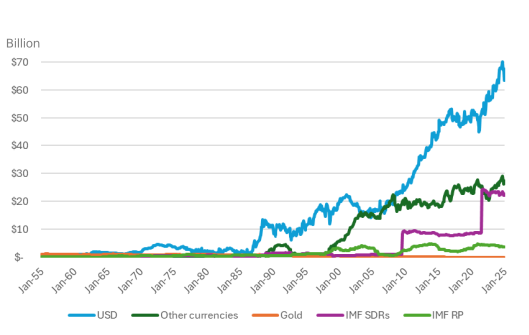
*Chart redacted*
Chart 3: The decline in Canada's gold holdings since the mid 1950s.
Gold as part of Canada's Reserves
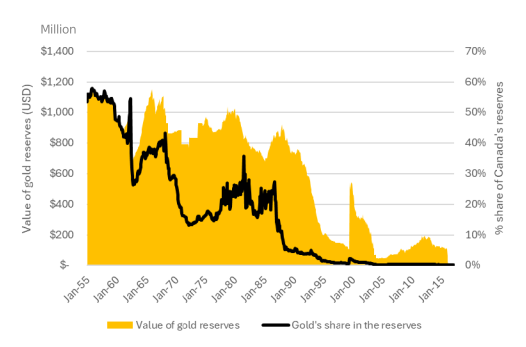
*Chart redacted*
Chart 5: Canada is an outlier among sovereigns in not have any gold reserves.
International Gold Reserves, 2024
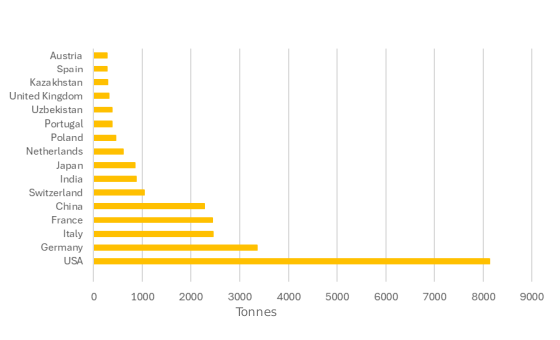
Author: Will Bradley (FMD-FRM)
Capital Budgeting Framework and New Budget Cycle
Key Messages
Capital Budgeting Framework
- The government has introduced a new approach to fiscal discipline and strategic investment, underpinned by a new Capital Budgeting Framework.
- The Framework provides a consistent way to classify spending that contributes to capital investment from day-to-day operating spending.
- A significant portion of net new spending in Budget 2025 is classified as capital investment, totaling
more than $32.5 billion over five years. This includes:
- Generational investments in infrastructure,
- Driving growth through a new productivity super deduction.
- Supercharging homebuilding and productivity through Build Canada Homes.
- Rebuilding domestic production capacity through a Defense Industrial Strategy.
New Budgeting Cycle
- With Budget 2025, the government also transitioned to a new fall budgeting cycle.
- This new timing will facilitate expenditure oversight by Parliamentarians and help builders, investors, and every level of government to make smarter, faster decisions.
- Providing certainty and predictability is what unlocks investment—so that projects can begin as soon as construction season starts.
- Fall budgets will be complemented by economic and fiscal updates in the spring.
Details & Supplementary Information
Capital Budgeting
- Cumulative capital investment over the 2024-25 to 2029-30 period, inclusive of planned investments in Budget 2025, is projected to total $311.5 billion on an accrual basis, or $502.2 billion on a cash basis.
- Capital investments over the budget horizon account for a larger share of spending than during the previous decade (see chart below).
Capital investments, historical and projected
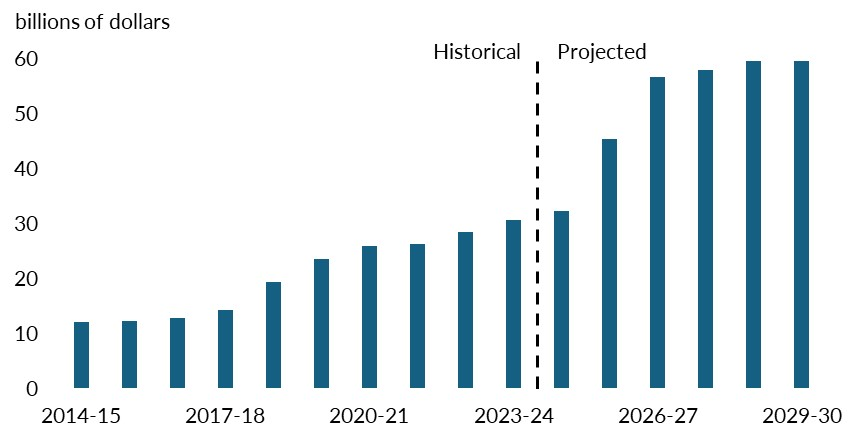
Fall Budgeting Cycle
| The new fall budgeting cycle* | ||
|---|---|---|
| Before a new fiscal year** | ||
| JUNE - AUG | Pre-budget consultations | |
| FALL | FEDERAL BUDGET | |
| Federal | Provincial / Territorial*** | |
| FEB - APRIL | Main estimates | Budgets Main estimates |
| Departmental plans | ||
| Interim supply | ||
| During the fiscal year | ||
| SPRING | Economic and Fiscal Update | |
| MAY | Supplementary estimates (A) | |
| JUNE | Approval of full supply / End of supply period | |
| OCT - NOV | Supplementary estimates (B) | |
| DEC | End of supply period | |
| FEB | Supplementary estimates (C) | |
| MAR | End of supply period | |
| After the fiscal year | ||
| SPRING TO FALL | Traditional construction season | |
| OCT | Public Accounts of Canada | |
| NOV | Departmental results reports | |
|
*Table replicated from the House of Commons' Financial Procedures website ("An Overview of the Financial Cycle"), with date adjustments to reflect the change to a fall budgeting cycle, provincial and territorial budgeting dates, and the timing of the traditional construction season. **Presently, House of Commons Standing Order 83.1 provides that the Standing Committee on Finance shall conduct a pre-Budget consultations study each September to December. In light of the Government's change to a fall Budget, the House may decide to change its Standing Orders to require the committee to conduct this study in the spring for the following fall Budget. ***Dates vary by province and territory and may occasionally fall outside of these conventional timelines. Source: Department of Finance Canada. |
||
Timing of Federal Budgets and Estimates
- Previously, the federal budget has conventionally tabled in February or March, with some exceptions particularly in recent years.
| Year | Budget Date | BIA Introduction Date |
|---|---|---|
| 2011 | 6-Jun-2011 | 14-Jun-2011 |
| 2012 | 29-Mar-2012 | 26-Apr-2012 |
| 2013 | 21-Mar-2013 | 29-Apr-2013 |
| 2014 | 11-Feb-2014 | 28-Mar-2014 |
| 2015 | 21-Apr-2015 | 7-May-2015 |
| 2016 | 22-Mar-2016 | 20-Apr-2016 |
| 2017 | 22-Mar-2017 | 11-Apr-2017 |
| 2018 | 27-Feb-2018 | 27-Mar-2018 |
| 2019 | 19-Mar-2019 | 8-Apr-2019 |
| 2021 | 19-Apr-2021 | 30-Apr-2021 |
| 2022 | 7-Apr-2022 | 28-Apr-2022 |
| 2023 | 28-Mar-2023 | 20-Apr-2023 |
| 2024 | 16-Apr-2024 | 2-May-2024 |
| 2025 | 04-Nov-2025 | |
| Source: Department of Finance Canada. | ||
- Release dates for the Estimates follow the supply calendar:
- Period ending June 23: Usually considers full supply of Main Estimates which, under House of Commons Standing Orders, must be tabled by March 1 each year and Supplementary Estimates (A).
- Period ending December 10: Considers Supplementary Estimates (B).
- Period ending March 26: Considers Supplementary Estimates (C) and interim for Main Estimates.
Timing of PT Budgets and Estimates
- Provincial and territorial governments have their own fiscal cycles and schedules.
- Budget dates generally vary within an 8-week period, with March being the most typical month.
- The Main Estimates are released annually, generally either at the same time as budgets or shortly thereafter.
- Supplementary Estimates are released as needed throughout the year. They are rare for some jurisdictions. In some instances, they may be published along with periodic economic and fiscal updates rather than stand-alone documents.
Typical Provincial Budget Dates
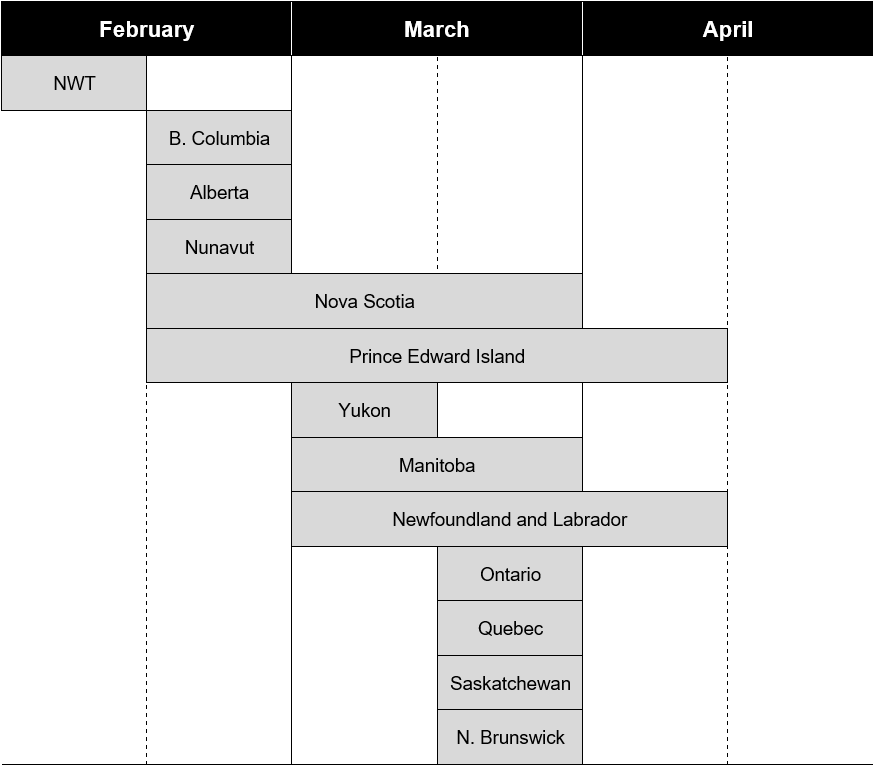
| 2023 | 2024 | 2025 | |
|---|---|---|---|
| British Columbia | |||
| Budget | Feb 28 | Feb 22 | Mar 4 |
| Main estimates | Feb 28 | Feb 22 | Mar 4 |
| Supplementary Estimates | – | – | – |
| Public Accounts | Aug 29 | Aug 22 | Aug 7 |
| Alberta | |||
| Budget | Feb 28 | Feb 29 | Feb 27 |
| Main estimates | Feb 28 | Feb 29 | Feb 27 |
| Supplementary Estimates | – | – | – |
| Public Accounts | Jun 29 | Jun 27 | Jun 27 |
| Saskatchewan | |||
| Budget | Mar 22 | Mar 20 | Mar 19 |
| Main estimates | Mar 22 | Mar 20 | Mar 19 |
| Supplementary Estimates | – | Dec 5 | – |
| Public Accounts | Jun 29 | Jun 27 | Jun 30 |
| Manitoba | |||
| Budget | Mar 7 | Apr 2 | Mar 20 |
| Main estimates | Mar 7 | Apr 2 | Mar 20 |
| Supplementary Estimates | – | – | – |
| Public Accounts | Sep 29 | Sep 27 | Sep 26 |
| Ontario | |||
| Budget | Mar 23 | Mar 26 | May 15 |
| Main estimates | Apr 20 | Apr 17 | Jun 4 |
| Supplementary Estimates | Nov 29 | – | – |
| Public Accounts | Sep 27 | Sep 19 | Sep 26 |
| Quebec | |||
| Budget | Mar 21 | Mar 12 | Mar 25 |
| Main estimates | Mar 20 | Mar 12 | Mar 25 |
| Supplementary Estimates | – | – | – |
| Public Accounts | Dec 11 | Oct 2 | Sep 26 |
| New Brunswick | |||
| Budget | Mar 22 | Mar 19 | Mar 18 |
| Main estimates | Mar 22 | Mar 19 | Mar 18 |
| Supplementary Estimates | – | – | – |
| Public Accounts | Sep 27 | Sep 16 | Sep 29 |
| Nova Scotia | |||
| Budget | Mar 23 | Feb 29 | Feb 18 |
| Main estimates | Mar 23 | Feb 29 | Feb 18 |
| Supplementary Estimates | – | – | – |
| Public Accounts | Sep 12 | Jul 26 | Sep 22 |
| Prince Edward Island | |||
| Budget | May 25 | Feb 29 | Apr 10 |
| Main estimates | May 25 | Feb 29 | Apr 10 |
| Supplementary Estimates | – | – | – |
| Public Accounts | Nov 6 | Oct 11 | Oct 8 |
| Newfoundland and Labrador | |||
| Budget | Mar 23 | Mar 20 | Apr 9 |
| Main estimates | Mar 23 | Mar 20 | Apr 9 |
| Supplementary Estimates | – | – | – |
| Public Accounts | Oct 30 | Oct 29 | Sep 8 |
| Yukon | |||
| Budget | Mar 2 | Mar 7 | Mar 6 |
| Main estimates | Mar 2 | Mar 7 | Mar 6 |
| Supplementary Estimates | – | – | – |
| Public Accounts | Nov 21 | Oct 24 | Oct 31 |
| Northwest Territories | |||
| Budget | Feb 8 | May 24 | Feb 6 |
| Main estimates | Feb 8 | May 24 | Feb 6 |
| Supplementary Estimates | – | – | – |
| Public Accounts | Dec 19 | Nov 15 | Nov 14 |
| Nunavut | |||
| Budget | Feb 23 | Feb 26 | Feb 24 |
| Main estimates | Feb 23 | Feb 26 | Feb 24 |
| Supplementary Estimates | – | – | – |
| Public Accounts | May 7 | Dec 20 | N/A |
| Source: Department of Finance Canada. | |||
| Province | Notes |
|---|---|
| British Columbia | The budget must be delivered on (or before) the fourth Tuesday of February unless an election year, and the main estimates also have to be tabled on or before that same date. |
| Alberta | Under the Financial Administration Act (FAA), the Government of Alberta is required to prepare and table its budget in the Legislative Assembly. While the FAA does not prescribe a specific date for tabling the budget, it mandates that the budget, known as the "Estimates," be tabled before the end of February each year. |
| Ontario | The estimates are required to be tabled within 12 sessional days of the budget." (Schedule of estimates | Legislative Assembly of Ontario) |
| Yukon | The Financial Administration Act requires that the Public Accounts be tabled by October 31. |
| Northwest Territories | The Financial Administration Act mandates that the Government of the Northwest Territories prepare and table its public accounts in the Legislative Assembly on or before December 31 following the end of the fiscal year; or if the Legislative Assembly is not then in session, on or before the fifth day of the next sitting of the Legislative Assembly. |
| Source: Department of Finance Canada. | |
Climate Policy
Key Messages
Government Climate Agenda
- Climate action is not just a moral obligation—it's an economic necessity. To compete internationally, Canada will need to reduce its carbon intensity to meet the growing demand from global markets for products with low associated greenhouse gas emissions.
- Budget 2025 outlined the government's Climate Competitiveness Strategy, creating the conditions for the investment needed to build an affordable net-zero future.
- The government's commitment to a low-carbon economy is reflected in the work of the Major Projects Office. One of the criteria for designation as a "Project of National Interest" is how a project will contribute to clean growth and to Canada's objectives with respect to climate change.
Impact of Removal of Fuel Charge
- On March 14, 2025, the government announced that it will cease the application of the federal fuel charge, effective April 1, 2025. It also removed the requirement for provinces and territories to maintain a consumer-facing carbon price as of that date. These actions have reduced gasoline prices at the pump in most provinces and territories by up to 18 ¢/L compared to 2024–25 levels, thereby contributing to lower headline inflation.
- The government is winding down mechanisms used to return direct fuel charge proceeds to Canadians, small and medium-sized businesses, farmers, and Indigenous governments.
- Eliminating the fuel charge, which is currently before Parliament as part of Bill C-4, will give Canadian consumers and businesses certainty that the consumer carbon price is being permanently removed from legislation.
Impact of Clean Fuel Regulations
- The goal of the Clean Fuel Regulations is to significantly reduce pollution by making the fuels cleaner, while increasing incentives for the development and adoption of clean fuels, technologies and processes.
- The regulations require liquid fossil fuel (gasoline and diesel) suppliers to gradually reduce the carbon intensity – or the amount of pollution – from the fuels they produce and sell for use in Canada, leading to a decrease of approximately 15% (below 2016 levels) in the carbon intensity of gasoline and diesel used in Canada by 2030.
- The CFR are anticipated to increase the cost of fuels with an estimated price impact of $0.06 to $0.13 per litre for gasoline and $0.07 to $0.16 per litre for diesel (2021 dollars) in 2030.
Canada-Alberta MOU
- The Canada-Alberta Memorandum of Understanding, signed on November 27, 2025, outlines a shared commitment to collaborate on major energy and economic projects, including expanding electricity generation, advancing large-scale carbon capture and storage, and ensuring meaningful Indigenous participation
- The agreement emphasizes improving regulatory efficiency and coordination, including aligning carbon pricing, methane reduction measures, and using federal investment tax credits to support clean energy projects and attract private investment.
- It also focuses on developing future energy infrastructure, such as new interprovincial electricity interties and a nuclear power strategy, to achieve a net-zero power grid by 2050.
- The Canada-Alberta Memorandum of Understanding also commits to expanding federal Investment Tax Credits to
encourage large scale carbon capture investments, including the Pathways projects and enhanced oil recovery
projects.
- Once constructed, the Pathways projects would help reduce the carbon intensity of Alberta oil and make some oil production among the lowest carbon-intensity in the world.
- Enhanced oil recovery generates demand for captured CO2, which can enable additional carbon capture projects to be financially viable while storing the captured CO2 so it is not released into the atmosphere.
2030 Emissions Reduction Plan
- Canada's 2030 Emissions Reduction Plan was established in 2022, providing a sector-by-sector pathway towards achieving Canada's 2030 emissions reduction target and a road to net-zero by 2050, supported by $9.1 billion in federal investments.
- In December 2025, the government released the 2025 Progress Report on the 2030 Emissions Reduction Plan. It stated that Canada's announced measures are expected to reduce emissions by 28 per cent below 2005 levels by 2030 – below the government's 40-45 per cent target, which continues to be an ambitious target for Canada and serves as an important milestone on the path to net-zero by 2050.
- The Government of Canada will continue to explore the full suite of tools available to reduce emissions, including implementing those discussed in the Climate Competitiveness Strategy.
Details & Supplementary Information
- The Climate Competitiveness Strategy is anchored by three pillars:
- Boosting investment through Clean Economy Investment Tax Credits to meet
growing demand for clean energy, modernize electricity grids, and expand renewables, energy storage,
and interprovincial interties.
- Four of the Clean Economy investment tax credits have already been delivered and are now available to claim, which includes the Carbon Capture, Utilization, and Storage, Clean Technology, Clean Hydrogen, and Clean Technology Manufacturing investment tax credits.
- Bill C-15 introduces legislation to deliver the 15% Clean
Electricity investment tax credit and enhancements to investment tax credits
that have already been implemented:
- Expand eligibility to include systems that produce electricity, heat, or both electricity and heat from waste biomass and change the eligibility requirements for small nuclear energy under the Clean Technology investment tax credit.
- Expand eligibility to include qualifying equipment used in eligible polymetallic mining projects and expand the list of critical minerals eligible under the Clean Technology Manufacturing investment tax credit.
- Extend the availability of full credit rates for the Carbon Capture, Utilization, and Storage investment tax credit by five years, to 2035.
- The government will be introducing legislation to deliver expanded eligibility to include hydrogen produced from methane pyrolysis under the Clean Hydrogen investment tax credit.
- Strengthening industrial carbon pricing to reduce emissions and provide
long-term certainty for businesses and investors. Effective industrial carbon markets are integral
to driving investment in clean growth and emissions reductions. The Strategy will:
- Engage with provinces and territories to develop a post-2030 carbon pricing trajectory. The government will set an industrial carbon price trajectory that supports net-zero by 2050, giving businesses the confidence they need to make long-term investments in climate competitiveness.
- Engage with provincial and territorial governments on improvements to the federal benchmark. This process will ensure pricing systems across the country are working effectively and enable the implementation of a strengthened benchmark. Additionally, the government will explore opportunities to harmonize or link carbon credit markets.
- Apply the federal backstop whenever a provincial or territorial system falls below a strengthened federal benchmark, to ensure a stringent price signal and level playing field across the country.
- Boosting investment through Clean Economy Investment Tax Credits to meet
growing demand for clean energy, modernize electricity grids, and expand renewables, energy storage,
and interprovincial interties.
- The Canada Growth Fund will continue to issue contracts for difference as a means of further improving future carbon price certainty for investors making large, long-duration capital investments.
- Clarifying greenhouse gas regulations, including finalizing enhanced methane regulations for the oil and gas sector. By tightening these regulations, we will significantly reduce emissions across Canada, while providing clarity and predictability for industry. The government has also finalize new methane regulations for landfills. Methane is one of the most potent greenhouse gases—80 times more harmful than carbon dioxide over a 20-year period—and one of the easiest to reduce.
Comprehensive Expenditure Review
Key Messages
Government-wide messages
- Budget 2025 outlines the details of the Government of Canada's Comprehensive Expenditure Review (CER), which will contribute to balancing the government's operating budget by 2028-29.
- The CER will achieve savings of $9 billion in 2026-27, $10 billion in 2027-28 and $13 billion in 2028-29. Combined with other savings and revenues in Budget 2025, this will total $60 billion over five years, starting in 2025-26.
- Statutory transfer payments to provinces, territories and individuals were outside the scope of the review.
- Participating organizations are in the process of communicating these measures to their employees and collective bargaining agents, and the federal government will continue to identify more efficiencies and potential savings, which will be communicated in the 2026-27 Main Estimates and Departmental Plans.
Department of Finance
- The Department of Finance will implement CER measures resulting in savings of $10.7 million in 2026–27, increasing to $14.2 million in 2027–28 and $21.3 million in 2028–29 and ongoing, representing a cumulative reduction of 94 full-time equivalent positions by 2029–30.
- CER savings are being implemented through a planned reduction in staffing levels over three years, supported by workforce realignment and organizational changes that maintain delivery of core policy and corporate functions. As a result of careful planning, vacancy management, and limiting external staffing, the Department has already achieved approximately 60 per cent of the required CER savings.
- The remaining savings are being focused on reorganizing resources within and across policy branches, centralizing administrative functions across the Department, and achieving efficiencies in internal service areas by modernizing tools, processes, and functions.
- In December 2025, the Department provided affected letters to 84 employees, advising them that their services may no longer be required and introducing a voluntary departure program that will run to February 3rd. The Department plans to reduce up to 40 positions through the voluntary departure program or subsequent workforce adjustment measures, as required.
Details & Supplementary Information
- The CER is not an across-the-board reduction exercise. It is a measured and strategic approach to improve public service productivity. To achieve this objective, federal departments and agencies undertook a thorough review of their organizations, identifying programs and activities that were underperforming, duplicative, or that had strayed away from the core federal mandate.
- The process applied to federally appropriated organizations, with the following exceptions:
- agents of parliament and arms-length organizations to preserve their independence, and
- cost-recovered organizations, because including them would not generate savings.
- Departments were directed to develop proposals using Gender-Based Analysis Plus to understand how Canadians,
including vulnerable groups, would be affected. Planned savings fall under three themes generally:
- Modernizing Government Operations ($25.2 billion over four years)
- Streamlining Program Delivery ($1.5 billion over four years)
- Recalibrating Government Programs ($17.5 billion over four years)
- Savings from the CER across departments and programs vary, reflecting the need to protect the important
mandates that some organisations have in delivering frontline services, social programs, and priorities such
as defence and security. As such, the government is setting a lower savings target of 2% for the
following organizations:
- Canada Border Services Agency (CBSA)
- Canadian Institutes of Health Research (CIHR)
- Canadian Security Intelligence Service (CSIS)
- Communications Security Establishment (CSE)
- Crown-Indigenous Relations and Northern Affairs Canada (CIRNAC)
- Indigenous Services Canada (ISC)
- Department for Women and Gender Equality (WAGE)
- Department of National Defence (DND)
- Natural Sciences and Engineering Research Council (NSERC)
- Royal Canadian Mounted Police (RCMP)
- Social Sciences and Humanities Research Council (SSHRC)
- The savings identified through CER will contribute to returning the size of the public service to a more sustainable level, with an estimated reduction of 16,000 full-time equivalents, or roughly 4.5% of the workforce as of March 2025. Of these reductions, some 650 will be executive positions, representing about 7% of the executive population. These reductions will continue the trend towards a more sustainable public service size of roughly 330,000 by 2028-29.
- Savings will involve workforce adjustments and attrition to return the size of the public service to a more sustainable level. To manage these reductions to the greatest extent possible through attrition and voluntary departures, Budget 2025 proposes to offer a voluntary Early Retirement Incentive through the Public Service Pension Plan. Public servants at age 50 or above for Group 1 and age 55 or above for Group 2 who have at least ten years of employment, with at least two years of pensionable service in the Plan may apply to participate under parameters set by Treasury Board. Eligible employees will be able to retire with an immediate pension based on years of service with no penalty for early retirement. Implementation would proceed by January 15, 2026, or – as now is the case – when legislation receives Royal Assent, and the government intends to conclude the process within one year.
Housing Sector Overview
Key Messages
- Housing market activity softened in early 2025 amid trade policy uncertainty. Activity has since partially recovered but remains subdued, with most markets moving sideways or down in recent months.
- That said, housing starts remained elevated in 2025 and ended the year on a strong note, rising 11% in December following a similar gain in November. Overall, starts proved resilient in 2025, with nearly 260,000 units—up 5.6% from 2024.
- Federal policies have supported record levels of rental construction.
- Pent-up demand for housing, reflecting past strength in population growth, will continue to support residential investment.
- Housing affordability has improved but remains a challenge for people in major urban centers such as Toronto and Vancouver, suggesting growth in residential investment will be uneven across markets.
- Slower population growth combined with a steady increase in housing supply is helping the housing market gradually rebalance.
- Home prices are about 19 per cent below their February 2022 peak, easing the upfront cost of homeownership.
- Lower mortgage rates have reduced financing costs, with average monthly payments for new homebuyers down by more than $400 over the last two years.
- Rental market conditions have also improved in many regions. Rent inflation in December slowed to 4.9% from a peak of 8.9% in August 2024. The average asking monthly rent for an apartment has fallen by $330 in Toronto and $400 in Vancouver over the last two years.
- Through Budget 2025 and other targeted measures, the government is taking concrete action to expand the housing stock, support affordability, and ensure Canadians have access to the housing they need.
Details & Supplementary Information
- Housing affordability deteriorated sharply during the pandemic, as rapid price growth coincided with higher interest rates.
- As a result, the Bank of Canada's Housing Affordability Index—measuring the share of income a new homebuyer must devote to housing costs—rose from a 2015–2019 average of 36% to a peak of 54% in 2023Q3.
- Conditions have since improved. Home prices have declined to $673,000, and interest rates have moderated. As a result, housing affordability has improved from its peak, with the index declining to 44%, though it remains above pre-pandemic norms.
- Housing supply has responded. Housing starts remained strong in 2025, totalling 259,000 units for the year—well above the 2015–2019 average of 206,000 units. Recent policy measures have helped sustain elevated construction activity, with a notable surge in purpose-built rental housing, partially offsetting softer activity in the ownership and oversupplied condo segments.
- Resale market pressures have eased. The sales-to-new-listings ratio, a key indicator of resale market tightness, eased to 52% in December 2025 from a peak of 87% in January 2021, signalling a return to broadly balanced market conditions at the national level and reducing upward pressure on home prices.
|
|
2015-2019 Average |
Pre-pandemic |
Peak |
Year Ago |
Latest |
|
|---|---|---|---|---|---|---|
|
National Home Price Index ($) |
$496,000 |
$534,000 (Feb 2020) |
$827,000 (Feb 2022) |
$702,000 (Dec 2024) |
$673,000 (Dec 2025) |
|
|
Bank of Canada's Housing Affordability Index |
35.5% |
36.3% (2019 Q4) |
54.3% (2023 Q3) |
46.5% (2024 Q4) |
43.5% (2025 Q3) |
|
|
Housing Starts (units, 6-month moving average) |
206,000 |
209,000 (Feb 2020) |
285,000 (Jun 2021) |
243,000 (Dec 2024) |
264,000 (Dec 2025) |
|
|
Sales-to-New-Listings Ratio |
58.4% |
64.4% (Feb 2020) |
86.6% (Jan 2021) |
55.8% (Dec 2024) |
52.3% (Dec 2025) |
|
|
National Average Asking Rents ($) |
N/A |
$1,784 (Feb 2020) |
$2,202 (May 2024) |
$2,109 (Dec 2024) |
$2,060 (Dec 2025) |
|
Immigration and Levels Plan
Key Messages
- The 2026-2028 Immigration Levels Plan will stabilise permanent resident admission targets at 380,000 per year for three years, down from 395,000 in 2025, while increasing the share of economic migrants from 59% to 64%.
- The plan will reduce the target for new temporary resident admissions from 673,650 in 2025 to 385,000 in 2026, and 370,000 in 2027 and 2028.
- Budget 2025 also announced two one-time measures to convert up to 115,000 eligible Protected Persons in Canada and up to 33,000 work permit holders to permanent residency.
- These targets keep permanent resident arrivals at less than one per cent of the population beyond 2027 and will reduce the total number of temporary residents to less than five per cent of Canada's population by the end of 2027.
- Budget 2025 also announced the International Talent Attraction Strategy and Action Plan, including funding to recruit over a thousand highly qualified international researchers to Canada and a plan to launch an accelerated pathway for H-1B visa holders.
- As a result of recent policy changes, population growth has slowed sharply since mid-2024. The share of temporary residents in the total population has declined to 6.8% from a peak of 7.6%, driven by reductions in both student and worker populations. The pace of asylum claims has also moderated, with claims down by a third in 2025 compared to the previous year.
- The plan is expected to boost GDP per capita and ease pressures in both the labour and housing markets. We are already seeing effects in the rental market: lower immigration, combined with new supply, is helping push rents down. Over the past two years, average monthly rents have fallen by about $330 in Toronto and $400 in Vancouver.
Details & Supplementary Information
Canada's annual Immigration Levels Plan establishes the number and mix of permanent residents that Canada intends to admit across all classes of immigration over a three-year period. Since the 2025-2027 plan, it also includes targets for new temporary resident admissions. The Minister of Immigration is required to table the Levels Plan on or before November 1 each year.
As presented in Budget 2025, the targets in the 2026-2028 Immigration Levels Plan keep permanent resident arrivals at less than one per cent of the population beyond 2027 and will reduce the total number of temporary residents to less than five per cent of Canada's population by the end of 2027.
- Annex 1 provides an overview of permanent and temporary resident admission targets presented in Budget 2025.
- The fiscal cost of the 2026-2028 Plan is $168.2 million over four years, starting in 2026-27, and $35.7 million ongoing. These costs primarily represent the net loss in fee revenue, driven by fewer temporary resident admissions.
Budget 2025 also announced funding for the following immigration-related measures:
- $478.5 million over three years, starting in 2025-26, for Immigration, Refugees and Citizenship Canada (IRCC), the Canada Border Services Agency (CBSA), and Justice Canada to enhance asylum system capacity, including for claim processing, security screenings, removals and legal aid services.
- $66.5 million over two years, starting in 2026-27, to the Immigration and Refugee Board of Canada to support asylum claim processing.
- $1.0 billion over two years, starting in 2025-26, for IRCC for the Interim Federal Health Program, which provides temporary essential healthcare coverage to asylum claimants and refugees.
- $54.1 million in 2025-26 to renew existing capacity at Employment and Social Development Canada to deliver the Temporary Foreign Worker (TFW) Program, including for application processing and compliance initiatives, such as inspections.
- $67 million in 2025-26 for IRCC to extend, until September 30, 2025, temporary accommodations for asylum claimants who would otherwise not have shelter, serving as a backstop to provincial and municipal immigration shelter programs.
Annex 1: Targets in the 2026-2028 Immigration Levels Plan
| 2026 | 2027 | 2028 | |
|---|---|---|---|
| Overall Projected Admissions & Ranges | 385,000 (375,000–395,000) | 370,000 (360,000–380,000) | 370,000 (360,000–380,000) |
| Workers (1) | 230,000 | 220,000 | 220,000 |
| Students (2) | 155,000 | 150,000 | 150,000 |
|
(1) Projected number of new work permits for foreign nationals entering Canada under one of two programs, the Temporary Foreign Worker Program (TFW Program) or the International Mobility Program (IMP) including work permits issued under humanitarian public policies. (2) Projected number of new study permits issued to foreign nationals studying for six (6) months or more in Canada at a Designated Learning Institution (DLI). |
|||
| 2026 | 2027 | 2028 | ||||
|---|---|---|---|---|---|---|
| Overall Projected Admissions & Ranges | 380,000 (350,000 – 420,000) | 380,000 (350,000 – 420,000) | 380,000 (350,000 – 420,000) | |||
| Economic Immigration (3) | 239,800 | 244,700 | 244,700 | |||
| Low | High | Low | High | Low | High | |
| 224,000 | 264,000 | 229,000 | 268,000 | 229,000 | 268,000 | |
| Family Reunification | 84,000 | 81,000 | 81,000 | |||
| Low | High | Low | High | Low | High | |
| 78,500 | 92,000 | 75,000 | 90,000 | 75,000 | 90,000 | |
| Refugees, Protected Persons, Humanitarian and Compassionate, and Other | 56,200 | 54,300 | 54,300 | |||
| Low | High | Low | High | Low | High | |
| 48,000 | 64,000 | 46,000 | 62,000 | 46,000 | 62,000 | |
| French-speaking admissions outside of Quebec (overall) | 9% (30,267) | 9.5% (31,825) | 10.5% (35,175) | |||
|
(3) Under the Canada-Quebec Accord, Quebec has responsibility for the selection of economic immigrants destined to Quebec. |
||||||
Comparison with the 2025-2027 Immigration Levels Plan
- Last year's 2025-2027 Levels Plan reduced admission targets to better align temporary and permanent resident immigration levels with community capacity.
- The 2026-2028 Levels Plan decreased the target further for all TR arrivals in 2026 by 25 percent compared to the 2026 target that was previously announced in the 2025-2027 plan.
| 2025 | 2026 | 2027 | |
|---|---|---|---|
| Overall Target | 673,650 | 516,600 | 543,600 |
| Workers | 367,750 | 210,700 | 237,700 |
|
International Mobility Program
|
285,750 | 128,700 | 155,700 |
|
Temporary Foreign Worker Program
|
82,000 | 82,000 | 82,000 |
| Students | 305,900 | 305,900 | 305,900 |
| New TRs - 2026-2028 Plan | 2025 | 2026 | 2027 | 2028 |
|---|---|---|---|---|
| Overall Target | 673,650 | 385,000 | 370,000 | 370,000 |
| Workers | 367,750 | 230,000 | 220,000 | 220,000 |
|
International Mobility Program
|
285,750 | 170,000 | 170,000 | 170,000 |
|
Temporary Foreign Worker Program
|
82,000 | 60,000 | 50,000 | 50,000 |
| Students | 305,900 | 155,000 | 150,000 | 150,000 |
- The 2026-2028 Levels Plan stabilized permanent resident admissions at 380,000 over the next three years.
- The permanent resident admission targets from the last three Levels Plans are provided below for reference.
| Number of Admissions | 2024 | 2025 | 2026 |
|---|---|---|---|
| TOTAL | 485,000 | 500,000 | 500,000 |
| Economic | 255,465 | 283,300 | 288,000 |
| Family | 119,000 | 123,000 | 123,000 |
| Refugees and Protected Persons | 78,535 | 77,300 | 78,400 |
|
Humanitarian and Compassionate
|
32,000 | 16,400 | 10,600 |
| Number of Admissions | 2025 | 2026 | 2027 |
|---|---|---|---|
| TOTAL | 395,000 | 380,000 | 365,000 |
| Economic | 232,150 | 229,750 | 225,350 |
| Family | 94,500 | 88,000 | 81,000 |
| Refugees and Protected Persons | 58,350 | 55,350 | 54,350 |
|
Humanitarian and Compassionate
|
10,000 | 6,900 | 4,300 |
| Number of Admissions | 2026 | 2027 | 2028 |
|---|---|---|---|
| TOTAL | 380,000 | 380,000 | 380,000 |
| Economic | 239,800 | 244,700 | 244,700 |
| Family | 84,000 | 81,000 | 81,000 |
| Refugees and Protected Persons | 49,300 | 49,300 | 49,300 |
|
Humanitarian and Compassionate
|
6,900 | 5,000 | 5,000 |
Tax Debt and Corporate Write-offs
Key Messages
- The Canada Revenue Agency (CRA) is responsible for collecting tax debts owed to federal, provincial, and territorial governments under various acts, including the Income Tax Act and Excise Tax Act.
- Once the CRA has exhausted all avenues of collection, the CRA will deem the debt to be uncollectible, at which point it will be administratively written-off.
- With certain limited exceptions (e.g., debts that have reached collection limitation period), writing off a debt does not release the taxpayer from their obligation to pay off the debt. An improvement in the taxpayer's financial situation will result in efforts to collect the debt once again.
- In 2024-25, $5.3 billion in tax debt was written-off, including $1.0 billion in corporate tax debt. This is up from 2023-24, when $4.9 billion was written-off, including $0.5 billion in corporate tax debt.
- Corporate tax debt was the third largest write-off category, following GST/HST, and individuals and trusts.
- Under section 241 of the Income Tax Act, the CRA is legally prohibited from releasing "taxpayer information," which reveals the identity of a taxpayer, including corporations.
- The CRA continues to develop and implement collection strategies to improve its capacity to manage tax debt and avoid new debt from accumulating.
- Information relating to debts, obligations and claims written off or forgiven are itemized under each relevant federal act. They are available online under the Public Accounts of Canada, Volume III, Section 2 for each fiscal year.
Details & Supplementary Information
Write-offs
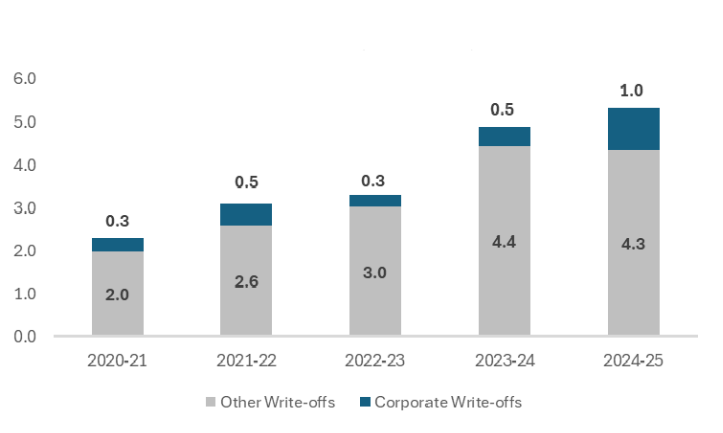
- Corporate write-offs have averaged $0.5 billion annually. This is an average 13.1 per cent of total write-offs over the last five fiscal years (based upon Note 3 of the CRA Financial Statements and Public Accounts of Canada, Volume III, Section 2).
- Other write-offs, including debts owing from GST/HST, employers, individuals and trusts, non-residents, COVID-19 recoveries and excise taxes and duties, were 82 per cent of all write-offs in 2024-25.
- A corporation may have multiple accounts (for example, a corporate account, a GST/HST account, and a payroll account), a credit on one account may be applied to a debt on another related account.
Trans Mountain
Key Messages
- The government's acquisition of the Trans Mountain Corporation and the completion of the expansion of the pipeline system was a necessary investment in the national interest.
- The expanded pipeline system has been operating for over a year and is providing a unique outlet for Canadian energy to global markets, and pricing support for Western Canadian oil, which in turn supports jobs and producers.
- The project is expected to generate up to $38 billion in additional provincial royalties and $21 billion in corporate income taxes, and to increase GDP by up to $127 billion over 20 years, according to Ernst & Young.
- Trans Mountain continues to explore growth projects that could further increase capacity and the value of the pipeline in the coming years.
- The government remains committed to Indigenous economic participation in Trans Mountain as an opportunity to create economic benefits for Indigenous communities.
Details & Supplementary Information
Project Benefits
- Trans Mountain helps Canada get a fair price for its oil and refined petroleum products by increasing export capacity to international markets. Since the start of commercial operations in May 2024, shipments have been exported to Asia (particularly China, but also South Korea, India and Brunei) and the US.
- The project is expected to generate up to $38 billion in additional provincial royalties and $21 billion in corporate income taxes, and to increase GDP by up to $127 billion over 20 years, according to Ernst & Young.
- The Trans Mountain Expansion Project created 37,000 jobs, with 25% of contracts awarded to Indigenous businesses and partnerships, totalling $6.5 billion.
Project Costs/Government's Investment
- The pipeline represents a long-term investment, and the government continues to work towards a positive return on its investment over time.
- The cost of the expansion project is estimated at $34.5 billion, based on TMC's 2025-2029 Corporate Plan summary published in June.
- TMC paid $938 million in in interest and dividends in the first three quarters of 2025 to the government, as owner.
Government Financing to Trans Mountain
- In December 2024, the government replaced Trans Mountain's third-party financing with government financing to considerably reduce interest costs. This provides savings to taxpayers of approximately $3.5 billion.
If pressed
- Accounting standards require that when government financing has a lower interest rate than market financing, this is termed a "government grant". This does not alter the expectation that all financing provided to TMC will be repaid.
Toll Hearings
- Tolls are the regulated fees shippers pay to move oil on the Trans Mountain system, set by the Canada Energy Regulator (CER) to recover operating and capital costs fairly.
- The CER has been conducting a regulatory process to approve Trans Mountain tolls that are just and reasonable.
- On October 27, 2025, at the request of Trans Mountain and with the support of certain shippers, the CER granted an abeyance of the toll hearings to allow Trans Mountain and its shippers to pursue discussions that would result in a new toll settlement; an update to the CER will be provided no later than February 6, 2026.
Trans Mountain Optimization
- Trans Mountain is proposing to upgrade pumps, pipeline sections, and facilities to move more oil. These projects could raise capacity from 890,000 to about 1.25 million barrels per day within two to five years.
- This projected total incudes flow additives and operating improvements that on their own could add another 50,000 to 90,000 barrels per day within 12 to 18 months.
- Port of Vancouver is leading dredging works to increase shipping efficiency near the Second Narrows. This project would allow tankers to load more fully, potentially reducing the number of transits, even while supporting the higher pipeline capacity.
Indigenous Engagement
- Indigenous economic participation in Trans Mountain will be an opportunity to create economic benefits for Indigenous communities.
- In September 2023, government officials met with Indigenous groups in Vancouver to share details about the next steps in the process. The government is working to re-engage with groups at the right moment to advance the process.
Public Accounts of Canada 2024 and 2025
Key Messages
2024 results compared to Budget 2024
- The $61.9-billion deficit recorded in 2024 was $21.8 billion higher than the $40.0-billion deficit
projected in Budget 2024.
- Revenues were $5.5 billion, or 1.2%, lower than forecast due mainly to lower personal income tax revenues, reflecting prior year reassessments recorded in 2023-24. In addition, lower corporate profitability reduced corporate income tax revenues.
- Program expenses, excluding net actuarial losses, were $16.4 billion, or 3.6%, higher than projected, largely a result of higher provisions for Indigenous claims and revised allowances for doubtful accounts for receivables and loans.
2025 results compared to the 2024 Fall Economic Statement
- The $36.3-billion deficit recorded in 2025 was $12.0 billion lower than the $48.3-billion deficit
projected in the 2024 Fall Economic Statement.
- Revenues were $15.7 billion, or 3.2%, higher than forecast mainly due to stronger personal and corporate income tax revenues. This reflects strong labour market performance and wage growth, and a likely pull-forward impact from the planned, then annulled, capital gains inclusion rate increase.
- Program expenses, excluding net actuarial losses, were $4.1 billion, or 0.9%, higher than projected, largely a result of higher than anticipated provisions for claims, and revised allowances for doubtful accounts for receivables and loans.
Details & Supplementary Information
- COVID-related exposures: As of March 31, 2025, the amount of money still owed to government for COVID-19 income support for individuals and Canada Emergency Business Accounts (CEBA) loans totalled $20.7 billion. While collection activities are ongoing, the government has recorded allowances for $15.8 billion, as these amounts are assessed as unlikely to be recovered (see Tables 1 and 2).
| $ billion | March 31, 2025 | March 31, 2024 |
|---|---|---|
| Gross receivables | 13.0 | 11.4 |
| Allowance for doubtful accounts | 10.5 | 6.3 |
| Net receivables | 2.5 | 5.1 |
|
Source: Government of Canada consolidated financial statements, note 17 |
||
| $ billion | March 31, 2025 | March 31, 2024 |
|---|---|---|
| Loans receivable | 7.8 | 8.5 |
| Allowance | 5.4 | 4.9 |
| Loans receivable, net of allowance | 2.4 | 3.6 |
- Table 3 summarizes the results for 2023-24 and 2024-25. Tables 4 and 5 provide the 2023-24 and 2024-25 results respectively in comparison to projections provided in budgetary publications.
| 2024–25 | 2023–24 | |
|---|---|---|
| Budgetary transactions | ||
| Revenues | 511.0 | 459.5 |
| Expenses | ||
|
Program expenses, excluding net actuarial losses
|
489.9 | 466.7 |
|
Public debt charges
|
53.4 | 47.3 |
|
Total expenses, excluding net actuarial losses
|
543.3 | 513.9 |
| Budgetary balance, excluding net actuarial losses | (32.3) | (54.4) |
|
Net actuarial losses
|
4.0 | 7.5 |
| Budgetary balance | (36.3) | (61.9) |
| Financial position | ||
|
Total liabilities
|
2,182.3 | 2,057.8 |
|
Total financial assets
|
788.8 | 705.0 |
|
Net debt
|
(1,393.6) | (1,352.8) |
|
Non-financial assets
|
127.1 | 116.6 |
| Federal debt (accumulated deficit) | (1,266.5) | (1,236.2) |
| Financial results (per cent of GDP) | ||
| Revenues | 16.6 | 15.7 |
| Total program expenses | 16.1 | 16.2 |
| Public debt charges | 1.7 | 1.6 |
| Budgetary balance | (1.2) | (2.1) |
| Federal debt (accumulated deficit) | 41.2 | 42.1 |
|
Note: Numbers may not add due to rounding. Nov. 7, 2025 |
||
| Actual | Budget 20241 | Difference | ||
|---|---|---|---|---|
| ($ billions) | ($ billions) | ($ billions) | (per cent) | |
| Revenues | ||||
| Income tax | ||||
|
Personal
|
217.7 | 222.3 | -4.6 | -2.1 |
|
Corporate
|
82.5 | 83.9 | -1.4 | -1.7 |
|
Non-resident
|
12.5 | 12.6 | -0.1 | -0.7 |
|
Total
|
312.7 | 318.8 | -6.1 | -1.9 |
| Other taxes and duties | ||||
|
Goods and Services Tax
|
51.4 | 51.5 | -0.1 | -0.1 |
|
Energy taxes
|
5.6 | 5.9 | -0.3 | -4.7 |
|
Customs import duties
|
5.6 | 5.6 | 0.0 | 0.3 |
|
Other excise taxes and duties
|
6.8 | 7.2 | -0.4 | -5.2 |
|
Total
|
69.4 | 70.1 | -0.7 | -1.0 |
| Employment Insurance premiums | 29.6 | 29.1 | 0.4 | 1.4 |
| Pollution pricing proceeds | 10.5 | 10.4 | 0.1 | 0.6 |
| Other revenues | 37.4 | 36.6 | 0.8 | 2.2 |
| Total revenues | 459.5 | 465.1 | -5.5 | -1.2 |
| Program expenses | ||||
| Major transfers to persons | ||||
|
Elderly benefits
|
76.0 | 75.9 | 0.2 | 0.2 |
|
Employment Insurance and support measures
|
23.1 | 23.0 | 0.2 | 0.7 |
|
Children's benefits
|
26.3 | 26.1 | 0.2 | 0.8 |
|
COVID-19 income support for workers
|
-4.8 | -4.4 | -0.5 | -10.3 |
|
Total
|
120.7 | 120.6 | 0.0 | 0.0 |
| Major transfers to other levels of government | 100.2 | 100.2 | 0.0 | 0.0 |
| Pollution pricing proceeds returned | 9.9 | 9.9 | -0.1 | -0.7 |
| Canada Emergency Wage Subsidy | -0.4 | -0.3 | -0.1 | -40.0 |
| Other direct program expenses | 236.4 | 219.9 | 16.5 | 7.5 |
| Total program expenses, excluding net actuarial losses | 466.7 | 450.3 | 16.4 | 3.6 |
| Public debt charges | 47.3 | 47.2 | 0.0 | 0.1 |
| Budgetary outcome/estimate before net actuarial losses | -54.4 | -32.5 | -21.9 | |
|
Net actuarial losses
|
7.5 | 7.6 | -0.1 | -0.9 |
| Budgetary outcome/estimate | -61.9 | -40.0 | -21.8 | |
|
Note: Numbers may not add due to rounding. 1 Certain Budget 2024 amounts have been reclassified to conform to the current year's presentation in the consolidated financial statements, with no overall impact on the projected 2023–24 annual deficit. |
||||
| Actual | FES 2024 | Difference | ||
|---|---|---|---|---|
| ($ billions) | ($ billions) | ($ billions) | (per cent) | |
| Revenues | ||||
| Income tax | ||||
|
Personal
|
234.3 | 232.6 | 1.7 | 0.7 |
|
Corporate
|
97.0 | 86.8 | 10.2 | 11.7 |
|
Non-resident
|
13.5 | 13.5 | 0.0 | 0.0 |
|
Total
|
344.8 | 333 | 11.9 | 3.6 |
| Other taxes and duties | ||||
|
Goods and Services Tax
|
52.5 | 51.9 | 0.6 | 1.1 |
|
Energy taxes
|
5.7 | 5.8 | -0.1 | -2.0 |
|
Customs import duties
|
6.3 | 5.6 | 0.7 | 12 |
|
Other excise taxes and duties
|
7.5 | 7.2 | 0.3 | 4.7 |
|
Total
|
71.9 | 70.4 | 1.5 | 2.1 |
| Other taxes | - | 2.3 | -2.3 | -100 |
| Employment Insurance premiums | 31.5 | 30.9 | 0.6 | 2.0 |
| Pollution pricing proceeds | 13.6 | 12.8 | 0.8 | 6.0 |
| Other revenues | 49.2 | 45.8 | 3.4 | 7.4 |
| Total revenues | 511 | 495.2 | 15.7 | 3.2 |
| Program expenses | ||||
| Major transfers to persons | ||||
|
Elderly benefits
|
80.3 | 80.9 | -0.6 | -0.7 |
|
Employment Insurance and support measures
|
24.9 | 27.8 | -3.0 | -10.6 |
|
Children's benefits
|
28.6 | 28.2 | 0.4 | 1.5 |
|
COVID-19 income support for workers
|
-2.2 | -0.3 | -1.8 | -567.4 |
|
Total
|
131.6 | 136.6 | -5.0 | -3.7 |
| Major transfers to other levels of government | 105.1 | 105.2 | -0.1 | -0.1 |
| Pollution pricing proceeds returned | 15.6 | 14.7 | 0.9 | 6.1 |
| Other direct program expenses | 237.6 | 229.3 | 8.3 | 3.6 |
| Total program expenses, excluding net actuarial losses | 489.9 | 485.7 | 4.1 | 0.9 |
| Public debt charges | 53.4 | 53.7 | -0.3 | -0.6 |
| Budgetary outcome/estimate before net actuarial losses | -32.3 | -44.3 | 11.9 | |
|
Net actuarial losses
|
4.0 | 4.0 | 0.0 | -0.6 |
| Budgetary outcome/estimate | -36.3 | -48.3 | 12.0 | |
| Note: Numbers may not add due to rounding. | ||||
Contingent Liabilities
Key Messages
- Consistent with Canadian public sector accounting standards, the government records a contingent liability when the probability of a future payment is considered likely and the amount can be reasonably estimated.
- The amount recorded is an estimate based on available information at the time of closing of the Public Accounts. It reflects assumptions about the outcomes of negotiations, cases and claims, as well as methodologies for calculating damages and settlements.
- Increases in contingent liabilities in recent years have contributed to growth in direct program expenses.
- As of 2024-25, the total contingent liabilities recorded in the Public Accounts was $55 billion, down from $57 billion in 2023-24. The majority of this is associated with active alternative dispute resolution processes and pending or potential litigation.
- Actions are underway to improve visibility and oversight on large areas of contingent liabilities, such as Indigenous-related claims. In addition, experts are also being engaged on how to improve public communication of contingent liabilities.
- The government does not disclose annual amounts recorded for Indigenous-related claims. Year-end balances for Specific Claims and Comprehensive Land Claims are disclosed in Note 9 (Provision for Contingent Liabilities) of the Public Accounts' financial statements.
Details & Supplementary Information
| 2021 | 2022 | 2023 | 2024 | 2025 | |
|---|---|---|---|---|---|
| Claims | |||||
|
Pending litigation and other claims
|
26,644 | 30,765 | 42,702 | 19,725 | 16,142 |
|
Specific claims
|
11,503 | 15,169 | 23,559 | 26,336 | 27,781 |
|
Comprehensive Land Claims
|
6,948 | 7,112 | 9,265 | 9,957 | 10,348 |
| Provisions for guarantees | 720 | 390 | 473 | 570 | 450 |
| Total provision recorded | 44,815 | 53,436 | 75,999 | 56,588 | 54,721 |
| Source: Public Accounts of Canada Volume 1 | |||||
Annual Stock of Contingent Liabilities from 2015-16 to 2024-25
Department of Finance Significant - Balances and Sensitive Transactions 2024
Key Messages
- Assets in the Foreign Exchange Account increased by $10.7 billion or 6.3% primarily due to an increase in investments held in the Exchange Fund Account, while liabilities decreased by $0.1 billion or 0.2% primarily due to foreign exchange revaluations.
- New loans of $2 billion were provided to Ukraine in 2024. The loan remains in good standing.
- The Department of Finance has transactions in the Public Accounts that are sensitive due to public interest. For example, procurement of professional and special services, losses, and Minister's expenditures. The department has controls in place to reduce the risks associated with these transactions.
Details & Supplementary Information
Foreign Exchange Accounts (vol I)
- In 2024, foreign exchange account assets increased by $10.7 billion or 6.3% (from $169.4 billion in 2023 to $180.1 billion in 2024) primarily due to an increase in investments held in the Exchange Fund Account.
- Foreign exchange account liabilities decreased by $0.1 billion or 0.2% (from $44.2 billion in 2023 to 44.1 billion in 2024) primarily due to foreign exchange revaluations. The foreign exchange accounts represent the largest component of the official international reserves of the government.
Financial Assistance – National Governments (vol I)
- In 2024, the government provided $2.0 billion (2023 - $4.9 billion) in financial assistance in the form of interest-bearing loans to Ukraine. As of March 31, 2024, the outstanding loan balance to the Ukraine was $6.1 billion ($4.3 billion as of March 31, 2023).
Contingent Liabilities (vol I)
- The Department of Finance has two loan guarantees and one insurance program guarantee. As at March 31,
2024, there were no provisions for loss made and all guarantees remained in good standing.
- As of March 25, 2024, the European Bank for Reconstruction and Development's (EBRD) credit facility with Naftogaz has been fully repaid, resulting in Canada's guarantee of the facility no longer being in effect. (2024 - nil; 2023 - $53.5 million). Naftogaz is Ukraine's state-owned oil and gas company.
- The loan guarantee to the International Bank for Reconstruction and Development (IBRD) for their loan to the Republic of Iraq increased by $0.3 million or 0.2% (from $159.5 million in 2023 to $159.8 million in 2024) due to changes in the CAD-USD foreign exchange rates.
- The Mortgage or Hypothecary Insurance Protection Program's exposure increased by $7.0 billion or 2.7% (from $261.2 billion in 2023 to $268.2 billion in 2024) based on increases in the outstanding mortgage balances held by insurers under the program.
- No new callable share capital was subscribed to during 2024. The balance increased by $19 million or 0.1% (from $12,972 million in 2023 to $12,991 million in 2024) entirely due to foreign exchange fluctuations as share capital for Multilateral Development Banks are denominated in foreign currencies (USD and EUR).
Losses of Public Money and Property (vol III)
- In 2024, the Department of Finance had losses of public money totalling $2,795 (2023 – $7,753) due to unauthorized use of corporate acquisition cards. The amount recovered during 2024 was $2,295 and the remaining $500 was recovered in 2025. Unauthorized use was either due to compromised cards (recovered by the credit card company), or accidental use by employees (recovered from employees via cheque). Consequently, the Department has implemented enhanced controls, training, and oversight.
- In 2024, two security badges, one cell phone and one computer were stolen totaling $3,043 (2023 – two cell phones, five computers and one other electronic device for a value totalling $7,367). For stolen security badges, Security remotely disables access immediately upon discovery. For stolen phones, the Department securely wipes data. For stolen computers, the Department remotely changes all passwords and monitors to ensure that no unauthorized logins are detected.
- In the normal course of business, there were accidental losses, destruction or damage to cell phones, computers, security badges and other electronics valued at $35,000 (2023 - $93,000).
Professional and Special Services (vol III)
- Professional and special services operating expenditures for the Department of Finance decreased by 1.3 million or 8.2% (from $15.9 million in 2023 to $14.6 million in 2024).
- The most significant variances include a decrease in legal services of $1.8 million or 31.6% (from $5.7 million in 2023 to $3.9 million in 2024) offset by an increase in information services of $0.3 million or 12.5% (from $2.4 million in 2023 to $2.7 million in 2024) and an increase in training and educational services of $0.3 million or 30.0% (from 1.0 million in 2023 to $1.3 million in 2024).
Minister's Office Expenditures (vol III)
- The office expenditures for the Minister of Finance decreased by $0.1 million or 4.0% (from $2.5 million in 2023 to $2.4 million in 2024)
- The office expenditures for the Associate Minister of Finance decreased by $0.3 million or 60% (from $0.5 million in 2023 to $0.2 million in 2024). Office expenditures were minimal in 2024 due to the fact the Associate Minister of Finance left the department in July 2023.
- Only expenditures charged to the Department of Finance budget are reported in the department's Public Accounts. Since the Minister had dual roles, additional expenditures for the Deputy Prime Minister and Minister of Finance were charged to the Privy Council Office (PCO) budget and reported separately. Similarly, additional expenditures for the Minister of Tourism and Associate Minister of Finance were charged to the Innovation, Science and Economic Development Canada (ISED) budget and reported separately.
Travel Expenses of Ministers and Parliamentary Secretaries and International Travel Expenditures of Ministers, Parliamentary Secretaries and Ministers' Staff (vol III)
- Total travel expenditures of ministers and parliamentary secretaries decreased by $5,359 or 4.0% (from $132,692 in 2023 to $127,333 in 2024) and international travel expenditures of ministers and parliamentary secretaries, and ministerial staff decreased by $35,892 or 14.5% (from $247,762 in 2023 to $211,870 in 2024).
Department of Finance - Significant Balances and Sensitive Transactions 2025
Key Messages
- Assets in Foreign Exchange Account increased by $21.3 billion or 11.8% primarily due to an increase in investments held in the Exchange Fund Account, while liabilities increased by $3.6 billion or 8.2% primarily due to foreign exchange revaluations.
- In 2025, the government acquired $28.8 billion Canada Mortgage Bonds (CMBs) issued by Canada Housing Trust.
- In 2025, the Department of Finance issued $2.9 billion of loans to Ukraine.
- $2.5 billion was disbursed under the Extraordinary Revenue Acceleration (ERA) loan agreement.
- $400 million was disbursed through the International Monetary Fund Administered Account for Ukraine.
- The Department of Finance has transactions in the Public Accounts that are sensitive due to public interest. For example, procurement of professional and special services, losses, and Minister's expenditures. The department has controls in place to reduce the risks associated with these transactions.
Details & Supplementary Information
Foreign Exchange Accounts (vol I)
- In 2025, foreign exchange account assets increased by $21.3 billion or 11.8% (from $180.1 billion in 2024 to $201.4 billion in 2025) primarily due to an increase in investments held in the Exchange Fund Account.
- Foreign exchange account liabilities increased by $3.6 billion or 8.2% (from $44.1 billion in 2024 to 47.7 billion in 2025) primarily due to foreign exchange revaluations.
- The foreign exchange accounts represent the largest component of the official international reserves of the government.
Canada Mortgage Bonds (vol I)
- In 2025, the government acquired $28.8 billion (2024 - $7.5 billion) of Canada Mortgage Bonds (CMBs) issued by Canada Housing Trust. The government will purchase an annual maximum of $30 billion under this program.
- CMBs earn a fixed rate of interest, paid semi-annually, over the life of the bond. The investments bear interest at rates from 2.9% to 4.0% (2024 – from 3.72% to 3.99%).
Financial Assistance – National Governments (vol I)
- International Monetary Fund (IMF) Administered Account: In January 2024, the government agreed to provide $2.4 billion in financial support to Ukraine in the form of loans through the IMF Administered Account for Ukraine. The loans are provided pursuant to section 8.3 of the Bretton Woods and Related Agreements Act. During the year, $400 million was disbursed (2024 - $2.0 billion).
- Extraordinary Revenue Acceleration (ERA) Mechanism: The government committed to provide a $5.0 billion loan to Ukraine under the ERA mechanism. The loan is backed by revenues generated from immobilized Russian sovereign assets. $2.5 billion was disbursed in March 2025. The remaining $2.5 billion was disbursed after year end, in June and July 2025. These loans were provided on either Commercial Interest Reference Rates (CIRR), the government's average borrowing rate, or concessional rates and have repayment terms ranging from 5 to 30 years.
- As of March 31, 2025, the carrying value of all outstanding loans with Ukraine was $9.1 billion (2024 - $6.1 billion). The carrying value includes issuances of loans net of discounts for concessionary terms, discount amortization, and foreign exchange revaluations.
Losses of Public Money and Property (vol III)
- In 2025, the Department of Finance had losses of public money totalling $1,879 (2024 – $2,795) due to unauthorized use of corporate acquisition cards. The amount recovered during 2025 was $1,490, with $246 subsequently recovered in 2026 and $143 not recoverable due to exchange rate fluctuations between the initial transaction and the recovery.
- Unauthorized use was either due to compromised cards (recovered by the credit card company), or accidental use by employees (recovered from employees via cheque). Consequently, the Department has implemented enhanced controls, training, and oversight.
- In 2025, one tablet valued at $1,932 was stolen (2024 – two security badges, one cell phone and one computer was stolen totaling $3,043). The Department remotely changes all passwords and monitors devices to ensure that no unauthorized logins are detected.
- In the normal course of business, there were accidental losses or damages to cell phones, computers, security badges and other electronic valued at $22,000 (2024 - $35,000).
Professional and Special Services (vol III)
- Professional and special services operating expenditures for the Department of Finance increased by $0.4 million or 2.7% (from $14.6 million in 2024 to $15.0 million in 2025).
- The most significant variances include an increase in legal services with the Department of Justice for $1.0 million or 25.6% (from $3.9 million in 2024 to $4.9 million in 2025) offset by a decrease in business services of $0.8 million or 27.6% (from $2.9 million in 2024 to $2.1 million in 2025).
Minister's Office Expenditures (vol III)
- The office expenditures for the Minister of Finance decreased by $0.1 million or 4.2% (from $2.4 million in 2024 to $2.3 million in 2025).
- No expenditures were incurred for an Associate Minister of Finance, as the position was vacant this fiscal year (2024 - $0.2 million).
- Costs related to Minister's other roles, such as the previous Deputy Prime Minister role, were recorded and reported by the relevant department (i.e. the Privy Council Office).
Travel Expenses of Ministers, Parliamentary Secretaries, and Ministers' Staff (vol III)
- Total travel expenditures of ministers and parliamentary secretaires decreased by $85,993 or 67.5% (from $127,333 in 2024 to $41,340 in 2025) and international travel expenditures of ministers, parliamentary secretaires, and ministerial staff decreased by $135,406 or 63.9% (from $211,870 in 2024 to $76,464 in 2025).
Major Federal Transfers to Provinces and Territories 2023-24
Key Messages
- In 2023-24, major transfers to other levels of government grew by $9.4 billion from $90.8 billion to $100.2 billion.
- Growth was driven primarily by increases in the major federal transfers to provinces and territories, shown in the table below.
| 2022-23 | 2023-24 | Change | |
|---|---|---|---|
| CHT* | 45,208 | 49,421 | 4,213 (9.3%) |
| CST | 15,938 | 16,416 | 478 (3.0%) |
| Equalization | 21,920 | 23,963 | 2,043 (9.3%) |
| TFF | 4,553 | 4,834 | 282 (6.2%) |
| Total | 87,619 | 94,634 | 7,016 (8.0%) |
| * Does not include the 2022-23 $2 billion Additional Health Payment and the Deductions and Reimbursements to the CHT. | |||
- These transfers are determined based on legislated formulas and are largely unconditional.
Details & Supplementary Information
- What were the main drivers of the legislated growth in determining the 2023-24 major transfer payments?
- Equalization grows in line with the three-year average growth rate of nominal GDP.
- The Canada Health Transfer (CHT) grows at the greater of the three-year average growth of nominal GDP and a legislated minimum rate.
- Annual growth (9.32%) equals the average of GDP growth in 2021 (13.57%), 2022 (11.77%) and 2023 (2.62%). This exceeds the 5% minimum guaranteed growth for CHT announced on February 7, 2023.
- The Canada Social Transfer is legislated to grow at 3% per year.
- Territorial Formula Financing increases are mainly due to growth in provincial/local expenditures, which are major components of the formula.
- What is the Quebec Abatement and how does it work?
- The Quebec Abatement consists of a reduction of 16.5 percentage points of federal personal income tax for all tax filers in Quebec, representing approximately $7.1 billion in 2023-24.
- Abatement allowed the Quebec government to increase the provincial tax rate by an equivalent amount with no impact on Quebec taxpayers. It was originally provided in lieu of cash federal support for certain social programs.
- Since major federal transfers to Quebec are calculated on the same basis as those to other provinces, the abated amounts must be recovered. This has no net impact on Quebec's total federal transfers.
- How were the federal transfers allocated by PT in 2023-24?
| Level | NL | PE | NS | NB | QC | ON | MB | SK | AB | BC | NU | NT | YT | Total |
|---|---|---|---|---|---|---|---|---|---|---|---|---|---|---|
| 2023-24 | ||||||||||||||
| CHT | 666 | 214 | 1,303 | 1,027 | 10,911 | 19,266 | 1,794 | 1,491 | 5,771 | 6,817 | 50 | 55 | 56 | 49,421 |
| CST | 221 | 71 | 433 | 341 | 3,624 | 6,400 | 596 | 495 | 1,917 | 2,264 | 17 | 18 | 19 | 16,416 |
| Equalization | 0 | 561 | 2,803 | 2,631 | 14,037 | 421 | 3,510 | 0 | 0 | 0 | 0 | 0 | 0 | 23,963 |
| TFF | 0 | 0 | 0 | 0 | 0 | 0 | 0 | 0 | 0 | 0 | 1,971 | 1,611 | 1,252 | 4,834 |
| Total | 887 | 847 | 4,539 | 3,999 | 28,572 | 26,087 | 5,900 | 1,986 | 7,688 | 9,081 | 2,038 | 1,684 | 1,327 | 94,634 |
| Change since 2022-23 | ||||||||||||||
| CHT | 48 | 20 | 114 | 88 | 839 | 1,680 | 153 | 122 | 538 | 600 | 3 | 3 | 5 | 4,213 |
| CST | 3 | 3 | 14 | 10 | 73 | 200 | 17 | 13 | 72 | 73 | 0 | 0 | 1 | 478 |
| Equalization | 0 | 59 | 344 | 271 | 371 | 421 | 577 | 0 | 0 | 0 | 0 | 0 | 0 | 2,043 |
| TFF | 0 | 0 | 0 | 0 | 0 | 0 | 0 | 0 | 0 | 0 | 112 | 92 | 78 | 282 |
| Total | 51 | 82 | 472 | 369 | 1,283 | 2,301 | 747 | 135 | 610 | 673 | 115 | 95 | 84 | 7,016 |
| (%) | 6.1% | 10.7% | 11.6% | 10.2% | 4.7% | 9.7% | 14.5% | 7.3% | 8.6% | 8.0% | 6.0% | 6.0% | 6.7% | 8.0% |
|
Totals may not add due to rounding. This table excludes other fiscal arrangements: Deductions and Reimbursements to the CHT, Additional Health Payments, Nova Scotia Offset, Health Agreements with Provinces and Territories, Canada-Wide Early Learning and Child Care, Canada's Cities and Communities Fund, Statutory Subsidies, Quebec Abatement, Fiscal Stabilization, Hibernia Dividend Backed Annuity Agreement with Newfoundland and Labrador, Transfer of Hibernia Net Profits Interest and Incidental Net Profits Interest Net Revenues to Newfoundland and Labrador and repayment of funding for orphan wells to Alberta. |
||||||||||||||
Major Transfers to Provinces and Territories 2024-25
Key Messages
- In 2024-25, major transfers to other levels of government grew by $4.9 billion from $100.2 billion to $105.1 billion.
- Growth was driven primarily by increases in the major federal transfers to provinces and territories, shown in the table below.
Major Federal Transfers to Provinces and Territories
2023-24 and 2024-25 ($ millions)
| 2023-24 | 2024-25 | Change | |
|---|---|---|---|
| CHT* | 49,421 | 52,081 | 2,660 (5.4%) |
| CST | 16,416 | 16,909 | 492 (3.0%) |
| Equalization | 23,963 | 25,253 | 1,290 (5.4%) |
| TFF | 4,834 | 5,159 | 325 (6.7%) |
| Total | 94,634 | 99,401 | 4,767 (5.0%) |
| * Excludes the Deductions and Reimbursements to the CHT | |||
- These transfers are determined based on legislated formulas and are largely unconditional.
Details & Supplementary Information
- What were the main drivers of the legislated growth in determining the 2024-25 major transfer payments?
- Equalization grows in line with the three-year average growth rate of nominal GDP.
- The Canada Health Transfer (CHT) grows at the greater of the three-year average growth of nominal GDP and a
legislated minimum rate. In 2024‑25, the legislated minimum rate was 5%.
- Annual growth (5.38 per cent) equals the average of GDP growth in 2022 (11.77%), 2023 (1.96%) and 2024 (2.42%). This exceeds the 5% minimum guaranteed growth for CHT announced on February 7, 2023.
- The CST is legislated to grow at 3% per year.
- Territorial Formula Financing increases are mainly due to growth in provincial/local government expenditures, which are major components of the formula.
- How do public debt charges compare with health transfers?
- Public debt charges exceeded the Canada Health Transfer in 2024-25 and are expected to continue to do so in each year of the forecast projection.
- By 2028-29 the government will balance day-to-day spending with revenues. At that point deficits will be attributable to investments to support long-term prosperity.
- Despite new nominal highs, debt charges remain relatively low as a share of GDP (currently at a ratio of 1.8%) and are projected to remain sustainable over the medium and long-term.
| Projection | ||||||
|---|---|---|---|---|---|---|
| 2024-25 | 2025-26 | 2026-27 | 2027-28 | 2028-29 | 2029-30 | |
| Canada Health Transfer | 52.1 | 54.7 | 57.4 | 60.3 | 62.5 | 65.0 |
| Public Debt Charges | 53.4 | 55.6 | 60.0 | 66.2 | 71.4 | 76.1 |
- What is the Quebec Abatement and how does it work?
- The Quebec Abatement consists of a reduction of 16.5 percentage points of federal personal income tax for all tax filers in Quebec, representing approximately $7.5 billion in 2024-25.
- Abatement allowed the Quebec government to increase the provincial tax rate by an equivalent amount with no impact on Quebec taxpayers. It was originally provided in lieu of cash federal support for certain social programs.
- Since major federal transfers to Quebec are calculated on the same basis as those to other provinces, the abated amounts must be recovered. This has no net impact on Quebec's total federal transfers.
- How were the federal transfers allocated by PT in 2024-25 and 2025-26?
| Level | NL | PE | NS | NB | QC | ON | MB | SK | AB | BC | NU | NT | YT | Total |
|---|---|---|---|---|---|---|---|---|---|---|---|---|---|---|
| 2024-25 | ||||||||||||||
| CHT | 690 | 227 | 1,367 | 1,083 | 11,354 | 20,378 | 1,883 | 1,575 | 6,196 | 7,158 | 52 | 57 | 60 | 52,081 |
| CST | 224 | 74 | 444 | 352 | 3,686 | 6,616 | 611 | 511 | 2,012 | 2,324 | 17 | 19 | 20 | 16,909 |
| Equalization | 218 | 610 | 3,284 | 2,897 | 13,316 | 576 | 4,352 | 0 | 0 | 0 | 0 | 0 | 0 | 25,253 |
| TFF | 0 | 0 | 0 | 0 | 0 | 0 | 0 | 0 | 0 | 0 | 2,109 | 1,699 | 1,350 | 5,159 |
| Total | 1,133 | 910 | 5,095 | 4,332 | 28,356 | 27,569 | 6,847 | 2,086 | 8,208 | 9,482 | 2,179 | 1,775 | 1,430 | 99,401 |
| Change since 2023-24 | ||||||||||||||
| CHT | 25 | 13 | 63 | 57 | 443 | 1,112 | 89 | 84 | 425 | 341 | 2 | 2 | 4 | 2,660 |
| CST | 3 | 2 | 11 | 11 | 62 | 216 | 15 | 16 | 95 | 60 | 0 | 0 | 1 | 492 |
| Equalization | 218 | 48 | 481 | 266 | -721 | 155 | 843 | 0 | 0 | 0 | 0 | 0 | 0 | 1,290 |
| TFF | 0 | 0 | 0 | 0 | 0 | 0 | 0 | 0 | 0 | 0 | 138 | 89 | 98 | 325 |
| Total | 246 | 63 | 556 | 333 | -216 | 1,483 | 947 | 100 | 520 | 401 | 140 | 91 | 103 | 4,767 |
| (%) | 27.7% | 7.5% | 12.2% | 8.3% | -0.8% | 5.7% | 16.1% | 5.1% | 6.8% | 4.4% | 6.9% | 5.4% | 7.8% | 5.0% |
| 2025-26 | ||||||||||||||
| Level | NL | PE | NS | NB | QC | ON | MB | SK | AB | BC | NU | NT | YT | Total |
| CHT | 722 | 240 | 1,435 | 1,142 | 11,893 | 21,346 | 1,982 | 1,663 | 6,603 | 7,480 | 55 | 60 | 63 | 54,685 |
| CST | 230 | 76 | 457 | 364 | 3,788 | 6,798 | 631 | 530 | 2,103 | 2,382 | 17 | 19 | 20 | 17,416 |
| Equalization | 113 | 666 | 3,465 | 3,123 | 13,567 | 546 | 4,689 | 0 | 0 | 0 | 0 | 0 | 0 | 26,170 |
| TFF | 0 | 0 | 0 | 0 | 0 | 0 | 0 | 0 | 0 | 0 | 2,231 | 1,803 | 1,454 | 5,489 |
| Total | 1,065 | 982 | 5,357 | 4,629 | 29,248 | 28,690 | 7,302 | 2,193 | 8,706 | 9,863 | 2,304 | 1,883 | 1,538 | 103,759 |
| Change since 2024-25 | ||||||||||||||
| CHT | 32 | 13 | 69 | 58 | 539 | 968 | 99 | 88 | 407 | 322 | 3 | 3 | 3 | 2,604 |
| CST | 6 | 3 | 13 | 12 | 101 | 182 | 20 | 18 | 91 | 58 | 1 | 1 | 1 | 507 |
| Equalization | -105 | 56 | 180 | 226 | 251 | -29 | 336 | 0 | 0 | 0 | 0 | 0 | 0 | 917 |
| TFF | 0 | 0 | 0 | 0 | 0 | 0 | 0 | 0 | 0 | 0 | 122 | 104 | 104 | 330 |
| Total | -67 | 72 | 263 | 297 | 892 | 1,121 | 455 | 107 | 498 | 381 | 125 | 108 | 108 | 4,358 |
| (%) | -5.9% | 7.9% | 5.2% | 6.8% | 3.1% | 4.1% | 6.6% | 5.1% | 6.1% | 4.0% | 5.7% | 6.1% | 7.6% | 4.4% |
|
Totals may not add due to rounding. CHT and CST 2024-25 represent the final calculation, 2025-26 represents the second estimate and 2026-27 represents the first estimate. This table excludes other fiscal arrangements: Deductions and Reimbursements to the CHT, Health Agreements with Provinces and Territories, Canada-Wide Early Learning and Child Care, Canada's Cities and Communities Fund, Statutory Subsidies, Quebec Abatement, Fiscal Stabilization, Hibernia Dividend Backed Annuity Agreement with Newfoundland and Labrador, Transfer of Hibernia Net Profits Interest and Incidental Net Profits Interest Net Revenues to Newfoundland and Labrador and repayment of funding for orphan wells to Alberta. |
||||||||||||||
Meeting Overview - Standing Committee on Public Accounts (PACP) - Department of Finance Appearance on the Public Accounts of Canada 2025
February 9, 2026 (11 a.m. to 1 p.m.)
Committee Study of the Public Accounts
- For its study on the Public Accounts, the committee typically holds three meetings:
- An in-camera session to educate members about the technical aspects of the Public Accounts including how they are prepared and presented. This year, that meeting took place on September 18, 2025, with the Canadian Audit and Accountability Foundation.
-
Public meeting with the Auditor General of Canada, Comptroller General of Canada, and Deputy Minister of Finance, which will occur on February 9, 2026, to consider the 2025 Public Accounts.
Typically, members use this meeting to ask questions about that year's public accounts. Many of the questions focus on any issues or areas for improvement noted in the Auditor General's independent auditor's opinion of the consolidated financial statements. Members may also take the opportunity to ask officials questions about other matters within their department's mandate.
- One or more meetings to develop a report to the House on their study.
The committee's reports have typically provided on average of one to four recommendations for improvements to departments and agencies' administrative and financial practices and controls. Usually, the committee requests a government response to its report, which must be tabled within 120 days.
Meeting Day: Questions and Answers
- While it is expected that the Auditor General and Comptroller General will give brief opening statements, *redacted*, as the appearance primarily relates to answering questions on Section 1, Volume I of the Public Accounts, and financial information pertaining to the Department of Finance included in the Public Accounts.
- PACP members ask questions of any witnesses they choose in rotating rounds. The first round provides six minutes for questions and answers to each party (i.e., beginning with Conservatives). For all subsequent rounds, the Liberals and Conservatives receive five minutes, while the Bloc Québécois receives two and a half minutes, until the meeting time is exhausted.
- Finance officials are often asked about the variance between forecast and actual results, as well as the economic and fiscal position of the government, including projections in the federal budget. The briefing binder provided to you focusses on these issues, and current Finance-led issues of importance to opposition members.
- Questions may also be posed about individual departmental line items. Unless a general answer can be provided, Finance officials will normally defer these detailed questions to the responsible department or agency.
Current Parliamentary Environment
Committee Overview
- PACP members are expected to follow-up on previous recommendations related to the Public Accounts. For example, in past reports, PACP has consistently called for amendments to the Financial Administration Act to establish a fixed date in October for tabling of the Public Accounts to better align with the budget cycles of provincial and peer jurisdictions. PACP has also recommended that Crown corporations disclose expenditures in the same manner as federal departments.
- The committee did not publish reports on the 2023 and 2024 Public Accounts. The absence of the 2024 report is largely due to the timing of the 2024 Public Accounts, which were tabled at the end of the fall session (December 16, 2024), shortly before Parliament was prorogued (January 6, 2025) and then dissolved on March 23, 2025. During an appearance with government officials on December 18, 2024, the chair expressed dissatisfaction with the delayed tabling and noted the committee's longstanding recommendations.
- Beyond the Public Accounts, committee members are expected to focus questions on Budget 2025 given its recent tabling. All committee members may raise questions aimed at better understanding the new budgeting framework, and some may express scepticism about it and accuse the Government of using it as a means to hide the true size of the deficit. See below for other Budget 2025-related issues of concern to each party.
- The committee is also in the process of examining several Auditor General reports including the audit of the Canada Revenue Agency's service delivery standards. Given the Minister of Finance's dual mandate, members could raise questions about this audit and the CRA's 100-day plan.
Opposition Party Perspectives
- The Conservative Party is expected to focus on perceived high government spending and question the government's ability to deliver services and programs effectively. They have asserted that government spending has led to higher debt and deficit levels, contributing to increased costs of living. Members frequently reference Canada's GDP-per-capita, productivity, and employment as indicators of Canada's economic underperformance.
- Following Budget 2025, the party has raised questions about the Government's continuation of industrial carbon pricing and its response to U.S. tariffs, namely the negative impact on Canadian workers and industries.
- A key point of contention for the party involves the government's deficit and fiscal anchors (e.g. debt-to-GDP ratio), which they argued have eroded Canadians' living standards. Members have supported their claims by referencing increased goods prices, growing food bank use, rising housing prices, and general affordability challenges. The party has also criticized the Government's overall financial management noting that more money was being spent on servicing the debt than on health transfers, which they argued translates into "more money for bankers and bondholders than for doctors and nurses".
- The Bloc Québécois has been critical of the government's management of public funds, expressing concerns about deficit projections and fiscal management. The party has questioned the government's capacity to effectively deliver programs and services, especially given announced cuts through the Comprehensive Expenditure Review. In previous years, the Bloc has frequently called for greater transparency regarding the expenditures of Crown corporations.
- Following Budget 2025, the party has raised concerns about the growing debt and deficit, continued financial support for oil and gas, Canada's response to U.S. tariffs (i.e., impact on Quebec and perceived lack of relief measures), and federal transfer amounts. A key point of contention for the party relates to Canada Carbon Rebate payments issued to Canadians in spring 2025, ahead of the election. Although Quebec has its own carbon pricing system, the Bloc has maintained that Quebec should be compensated $814 million for its share of the rebate.
- The Liberal Party members are expected to reinforce the need to improve transparency and reporting timelines of the Public Accounts while maintaining accuracy. During past meetings, members have sought information on Canada's overall economic performance, the government's debt management strategy, and public debt charges.
Committee Member Biographies
Standing Committee on Public Accounts (PACP)
About the Committee
The Standing Committee on Public Accounts is Parliament's audit committee, as it reviews the work of the federal government's external auditor, the Auditor General of Canada.
When the Speaker tables a report by the Auditor General in the House of Commons, it is automatically referred to the Public Accounts Committee. The committee selects the chapters of the report it wants to study and calls the Auditor General and senior public servants from the audited organizations to appear before it to respond to the Office of the Auditor General's findings. The committee also reviews the federal government's consolidated financial statements – the Public Accounts of Canada – and examines financial and/or accounting shortcomings raised by the Auditor General. At the conclusion of a study, the committee may present a report to the House that includes recommendations to the government for improvements in administrative and financial practices and controls of federal departments and agencies.
Government policy, and the extent to which policy objectives are achieved, are generally not examined by the committee. Instead, the committee focuses on government administration – the economy and efficiency of program delivery as well as the adherence to government policies, directives, and standards. The committee seeks to hold the government to account for effective public administration and due regard for public funds.
The committee also reviews the federal government's consolidated financial statement and estimates of the Office of the Auditor General as well as makes recommendations to the government for improvements in spending practices.
Other responsibilities include the economy, efficiency and effectiveness of government administration, the quality of administrative practices in the delivery of federal programs, and the government's accountability to Parliament regarding federal spending.
Conservative Party

Gérard Deltell
Conservative, Louis-Saint-Laurent—Akiawenhrahk (Quebec)
Biography
Gérard Deltell has been the Member of Parliament for Louis-Saint-Laurent—Akiawenhrahk since 2015. He currently serves as Conservative Opposition Critic for Revenue.
From 2008 to 2015, Mr. Deltell was a member of the National Assembly of Quebec representing the riding of Chauveau. He also served as leader of the Action démocratique du Quebec (ADQ) from 2009 until it became Coalition Avenir Québec (CAQ) in 2012. In the early 1980s, Mr. Deltell was president of his riding association and president of his school's Progressive Conservative association.
Prior to entering politics, Mr. Deltell spent 20 years in in broadcast journalism working with several TV networks including TQS, Radio-Canada, and TVA. Later in his journalism career, he worked as a parliamentary reporter at the National Assembly until 2008. He also worked as a columnist for various radio stations.
Mr. Deltell holds a history degree Laval University. He also took broadcasting courses at École de radio et de télévision ProMédia.

Ned Kuruc
Conservative, Hamilton East-Stoney Creek (Ontario)
Biography
Ned Kuruc was first elected as the Member of Parliament for Hamilton East-Stoney Creek in 2025.
Previously, he was a local entrepreneur, owning and operating different businesses in Stoney Creek and Hamilton such as Attic Pizza and Neku Cannabis. He was also a global sports entertainment executive.

Stephanie Kusie
Conservative, Calgary Midnapore (Alberta)
Biography
Stephanie Kusie has been the Member of Parliament for Calgary Midnapore since a by-election in 2017. She currently serves as the Conservative Opposition Critic for the Treasury Board and King's Privy Council.
She was previously a diplomat for the Canadian federal government, serving in Argentina in 2006. She was chargée d'affaires and Consul for Canada in El Salvador from 2006-08, and Consul for Canada at the Consulate in Dallas, Texas from 2010-13. She also served as policy advisor to Peter Kent during his time as Minister of State for Foreign Affairs for the Americas in 2009.
Ms. Kusie holds an MBA from Rutgers University and a bachelor's degree in politic science from the University of Calgary.

John Williamson, Chair
Conservative, New Brunswick Southwest (New Brunswick)
Biography
John Williamson has been the Member of Parliament for New Brunswick Southwest since 2019. He also represented the riding from 2011 until 2015.
Previously, Mr. Williamson was the Director of Communications in the Office of the Prime Minister under Stephen Harper from 2009 to 2011. Before entering politics, he served as Ontario Director of the Canadian Taxpayers Federation from 2002 to 2003 and National Director from 2004 to 2008. He has also worked for the Atlantic Institute for Market Studies, is a past Fellow with the Manning Centre for Building Democracy and Senior Fellow with the Fraser Institute. He also worked as an editorial writer for the National Post and was featured in several national publications.
He has a master's degree in economic history from the London School of Economics and a bachelor's degree from McGill University.
Bloc Québécois

Sébastien Lemire, Vice-Chair
Bloc Québécois, Abitibi--Témiscamingue (Quebec)
Sébasiten Lemire has been the Member of Parliament for Abitibi—Témiscamingue since 2019. He is the Bloc Québécois spokesperson for Indigenous Relations, Northern Development, Sports, and Public Accounts.
Prior to entering federal politics, Mr. Lemire was a public relations specialist. He worked at the Fédération de l'UPA d'Abitibi-Témiscamingue, the Mercier—Hochelaga-Maisonneuve borough of the City of Montreal, the Juripop Legal Clinic, Octane Stratégies, and the Forum jeunesse de l'Île de Montréal of the Conférence régionale des élus de Montréal.
Mr. Lemire holds degrees in political communication, public leadership, and corporate governance.
Liberal Party

Anthony Housefather
Liberal, Mount Royal (Quebec)
Anthony Housefather has been the Member of Parliament for Mount Royal since 2015. He serves as Parliamentary Secretary to the Minister of Emergency Management and Community Resilience.
Prior to his election to the House of Commons, he worked at Dialogic Corporation, a multinational technology company, where he eventually became Executive Vice-President of Corporate Affairs and General Counsel. Mr. Housefather was a city councillor and then as Mayor of the City of Cote Saint-Luc for 10 years prior to being elected federally. He has served as a volunteer for many years with several community organizations.
Mr. Housefather holds an MBA from Concordia University's John Molson School of Business as well as a Bachelor of Law and civil law degree from McGill University.

Tom Osborne
Liberal, Cape Spear (Newfoundland and Labrador)
Tom Osborne was first elected as Member of Parliament for Cape Spear in 2025. He currently serves as Parliamentary Secretary to the President of the Treasury Board.
Prior to entering federal politics, Mr. Osborne was a member of the Newfoundland House of Assembly from 1996 to 2024, representing the district of Waterford Valley. During this time, he served as Minister of Health and Community Services, and Minister of Education. He was Speaker of the House of Assembly from 2015 to 2017.

Kristina Tesser Derksen
Liberal, Milton East—Halton Hills South (Ontario)
Kristina Tesser Derksen was first elected as Member of Parliament for Milton East—Halton Hills South in 2025.
Prior to entering federal politics, Ms. Tesser Derksen was a municipal councillor for Milton from 2018 to 2025. She also served on several volunteer boards in her community including the Townsend Smith Foundation, Conservation Halton, and Milton Chamber of Commerce.
Previously, Ms. Tesser Derksen practiced law in downtown Milton.

Jean Yip, Vice-Chair
Liberal, Scarborough—Agincourt (Ontario)
Jean Yip has been the Member of Parliament for Scarborough—Agincourt since a by-election in 2017.
Prior to her election, Ms. Yip pursued a career in insurance and underwriting, becoming a team leader in her field. She completed her degree at the University of Toronto and holds a Fellow Chartered Insurance Professional Designation.
In her community, she taught Sunday school at her church for over 13 years and was involved with the STEM Fellowship Board of Directors which promotes computer literacy and programming capacity among youth.