
Captain Yuasa reflects on Buddhist Chaplaincy in the Canadian Armed Forces at Jodo Shinshu Buddhist Temples of Canada Annual Meeting
August 01, 2024 - Defence Stories
Caption
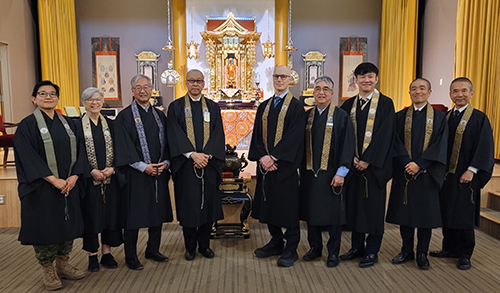
(left to right) Joanne Yuasa, Tanis Moore Sensei, Roland Ikuta, Tatsuya Aoki, Robert Gubenco, Grant Ikuta, Kensho Hashimoto, Kiyonobu Kuwahara, Naoki Hirano
Photo credit: Mr Greg Chor (Treasurer, JSBTC)
The Jodo Shinshu Buddhist Temples of Canada (JSBTC) held their annual general meeting this year at the Buddhist Temple of Southern Alberta in Lethbridge, AB, between 25-28 April. JSBTC is the administrative organization that represents the temples in Canada in the tradition of a Japanese school of Pure Land Buddhism. I was invited to the event as a JSBTC minister, but also to give a presentation on “Buddhism and War” and speak about my experience as a Buddhist CAF chaplain.
I was surprised the ways people reacted to me in CADPAT. Not only is it new for the CAF to have a Buddhist chaplain, but it is also very novel for the JSBTC to have a military chaplain. Many people who had gathered had never met and spoken with someone wearing CADPAT and certainly no one had ever seen a person wear CADPAT under the robes of a minister! Several sangha (community of Buddhists) members took the opportunity to share their own or their family’s history of Canadian military service.
Most notably, I met the youngest sister of BGen Mamoru “Sugi” Sugimoto, who passed away in 2017. Tomiko Sugimoto (88 years) proudly told me about her brother’s many accomplishments including being the first Canadian of Japanese descent to be promoted to the rank of brigadier general in the 1970s.Footnote 1 She also told me about nephews who had graduated RMC as well as a great uncle who served with the Canadian Infantry in the First World War. Pte Sugimoto was killed in action and is buried in Northern France.
I was moved that my presence seemed to open us up to talk about both Buddhist and Japanese Canadian contributions to the Canadian military. Not all Japanese Canadians are Buddhist and not all Buddhists are Japanese Canadians, but they intersect in my own being, and although the community now reflects the diversity of Canadian society, historically, the sangha has overwhelmingly been populated by Japanese Canadians. Canadians of Japanese descent are not as visible in the military not just because of our smaller population, but because of the history of the internment during the Second World War that affected enrolment in subsequent generations. Still, we know Japanese Canadians and Buddhists have served, and continue to serve well. I know the road to my place in the CAF was paved by those who came before me, and I am truly grateful to have had the opportunity to show my Buddhist as well as Japanese Canadian community that they are still represented in the CAF. The representation is even more visible now that I have the honour of wearing the Buddhist Dharmachakra (“Dharma Wheel”) on my uniform above my Japanese name.