Recovery: The secret ingredient for everyday performance
December 1, 2025 - Defence Stories
Estimated read time – 2:15
“Success isn’t just about how hard you push—it’s about how well you recharge.”
Caption
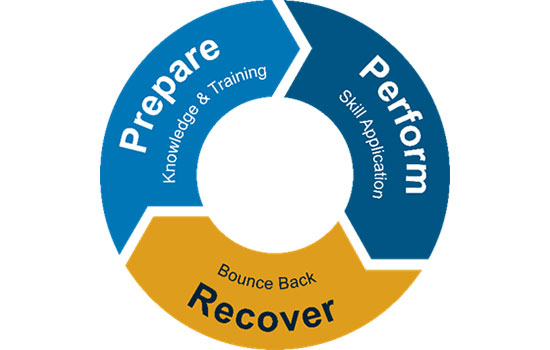
A circular three-part diagram showing the cycle of Prepare, Perform, and Recover. ‘Prepare’ includes knowledge and training, ‘Perform’ focuses on skill application, and ‘Recover’ highlights bouncing back.
In today’s fast-paced world, we often celebrate hustle and productivity, but there’s a critical element that rarely gets the spotlight: recovery. Whether you’re managing a demanding job, juggling family responsibilities, or training to achieve a goal, recovery is the key to sustainable performance and well-being.
Rooted in sports psychology, the Optimized Performance Cycle (OPC)—Prepare, Perform, Recover–was first introduced into the Road for Mental Readiness (R2MR) training for Search and Rescue Technicians in 2015. It reminds us that peak performance isn’t achieved by effort alone. We must balance preparation and performance with adequate recovery if we want to keep showing up at our best every day.
Why recovery matters
Recovery restores energy and replenishes mental resources such as confidence and attention. When it’s neglected, signs like fatigue, irritability, and poor focus appear. Over time, this can lead to burnout, poor decision-making, and health issues. Recovery isn’t passive—it’s an active process that applies to multiple areas of your well-being:
- Mental recovery: Disconnect from work and give your mind a break. Step away from screens, read, or listen to music.
- Emotional recovery: Lift your mood or regulate emotions through journalling or talking to someone you trust.
- Social recovery: Connection matters. Spend time with supportive people, share a meal, or join a group to recharge your sense of belonging.
- Spiritual recovery: Make time for what gives you purpose—meditation, time in nature, volunteering, or reflection.
- Physical recovery: Prioritize sleep, hydration, nutrition, and gentle movement. Stretching, yoga, or short walks help reduce tension and boost energy.
Everyday examples
- Workday reset: After back-to-back meetings, take five minutes for deep breathing or a short walk.
- Family life balance: Between errands, schedule short breaks—10 minutes of quiet time can make a difference.
- Personal fitness goals: Training for a race? Recovery days are just as important as workouts for progress and injury prevention.
Quick recovery tips
Recovery doesn’t require hours of free time. Small, intentional actions can make a big impact:
- Do a quick ‘neck and shoulder check’ to release tension.
- Stretch or breathe deeply every hour.
- Listen to music or a mindfulness podcast.
- Get outside for a mood boost.
- Get active for at least 30 minutes a day.
- Use time off to relax and reconnect, not catch up on work.
- Make sleep a priority—it’s your body’s best recovery tool.
The bottom line
Performance without recovery is unsustainable. By building recovery into everyday life, we protect our well-being and maintain the energy to perform effectively.
The Road to Mental Readiness is a performance and mental health training and education program developed by the Canadian Forces Health Services Directorate of Mental Health to improve well-being and short-term performance, while mitigating any negative long-term mental health problems for Canadian Armed Forces personnel and their families.
For more information on R2MR or to book R2MR Training for CAF Units, please visit: The Road to Mental Readiness.