
From Canada to Latvia: Life as a deployed Pharmacy Officer
January 12, 2026 - Defence Stories
Estimated read time – 2:15
By: Capt Mitchell McGrath, RPh, Task Force Pharmacy Officer, NSE Clinic, National Support Element – Latvia (NSE-L)
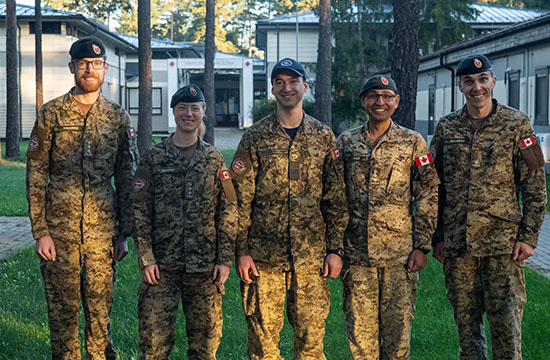
Caption
(Left to right): Capt Calabrese, Capt Gervais, Capt McGrath, Capt Riar, and Maj Hulleman — all deployed Pharmacy Officers in Latvia for Op REASSURANCE, September 2025.
As I write this from a deployed clinic in Latvia supporting Operation REASSURANCE, I’m reminded how different pharmaceutical support can be for our members outside Canada. It feels fitting to share this experience as we mark National Pharmacists Day on January 12 – a chance to reflect on the unique challenges and rewards of providing pharmaceutical care at home and abroad.
In Canada, almost any medication you need is one business day away from being dropped off directly at your pharmacy’s doorstep. When Canadian Armed Forces members are deployed abroad, this is far from the case. As a result, Pharmacy Officers (Pharm Os) are not just deployed pharmacists; they also act as deployed Medical Logistics Officers.
Being the only pharmacist in the clinic on a deployment abroad, it can certainly feel like the task of moving pharmaceuticals, medical consumables, and medical equipment across the globe is the one of the most complicated tasks in theatre. This responsibility makes you feel part of something much bigger and helps drive an esprit de corps that unites us across trade, rank, and even geographical locations.
Being involved in patient care and medical logistics is common for Pharm Os, but when deployed abroad, every patient interaction has a layer of logistics to it. It starts with meeting the patient organically, or through the Task Force Surgeon. The first question is often “Can we support this?” and the answer is almost always “Absolutely.”
From there, Pharm Os go through the work of understanding the entire journey of the medication from the supplier to the patient, considering factors such as:
- At what temperature does it need to be?
- Is it stable at different temperatures for different durations?
- Is it a controlled substance that requires some legal considerations?
- Can the patient bring seven months of it with them?
- In which camp is the patient living and working?
- How will we get it to them once it arrives in theatre?
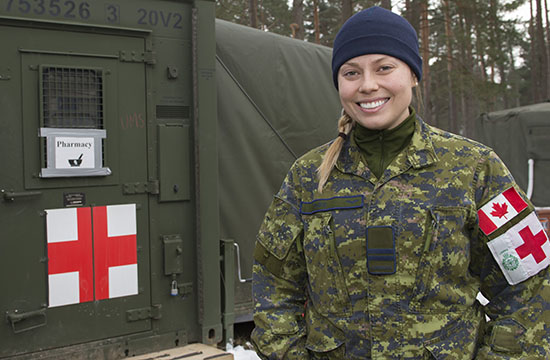
Caption
Canadian Armed Forces Pharmacy Officer Maj (then Capt) Natalie Duke stands in front of a field pharmacy in Latvia while on Op REASSURANCE, February 2018.
Photo credit: Corporal Jean-Roch Chabot.
These are all critical considerations that become routine very quickly, yet each one is essential to safeguarding patient health and maintaining operational readiness in a challenging environment.
In these cases, members also rely upon the Pharm O’s clinical knowledge. Knowing which drugs the clinic has in stock for each therapeutic class to help prescribers navigate the day-to-day is important when they are used to having everything readily available to them at home. Time and space are valuable resources, and the deployed Pharm O is uniquely positioned to maximize both for the clinic.
The job can be demanding and sometimes it certainly feels like a lot – but the people make it all worth it. Seeing colleagues that you know from home, making new friends, and having meaningful interactions with your patients truly reminds you of the value of our work.