
Supporting minds far from home: A Mental Health Nursing Officer’s OUTCAN journey
February 13 2026 - Defence Stories
Estimated read time: 2:09
By: Lieutenant(Navy) Nova Dowling, CD, BScN, RN, Mental Health Nursing Officer, Canadian Forces Health Services Centre (OUTCAN) (CF H Svcs C (O)) Detachment Geilenkirchen, Germany
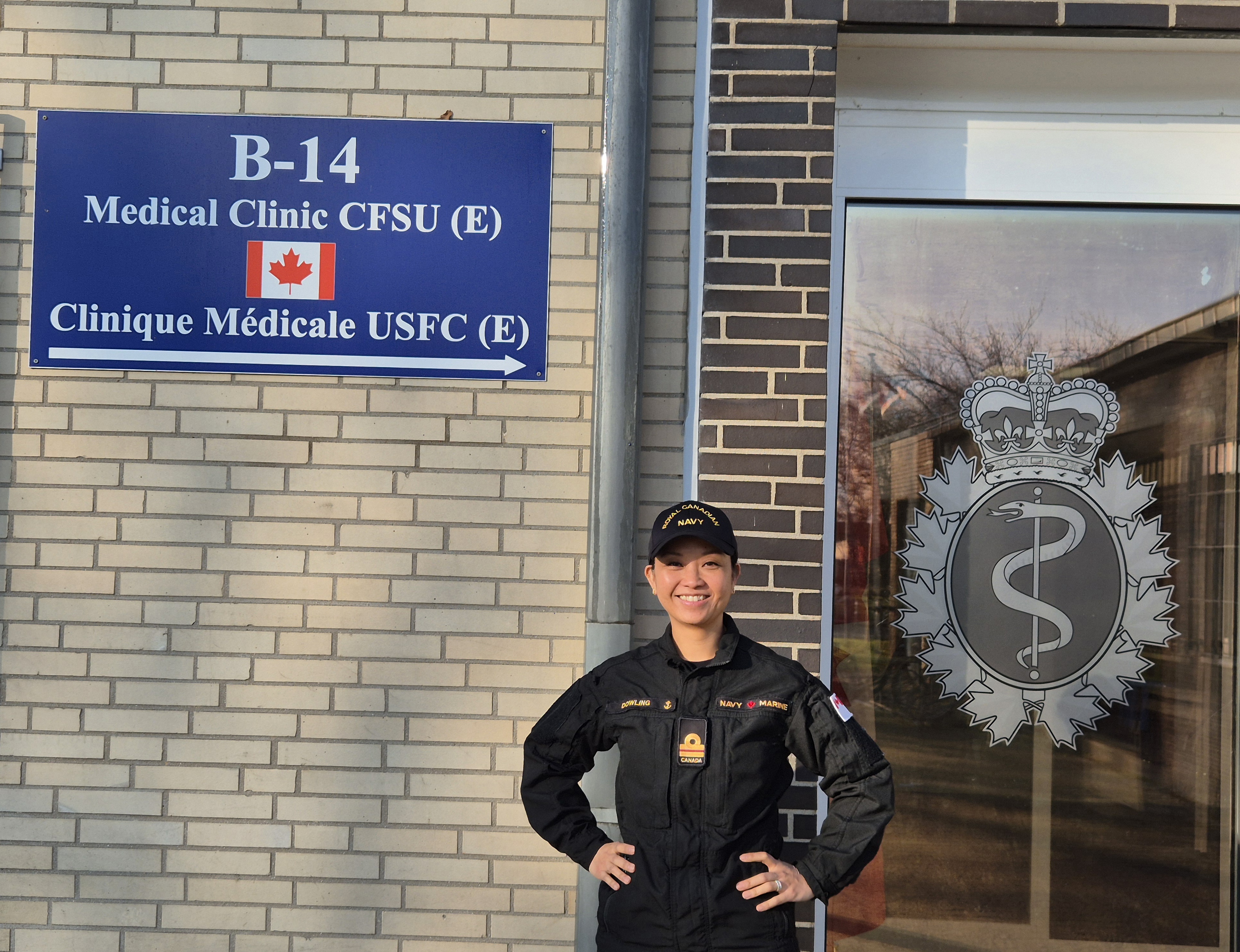
Caption
Lieutenant(Navy) Nova Dowling in front of CFSU (E) Medical Clinic in Geilenkirchen, Germany. Photo credit: Lt Patrick Dowling
In the summer of 2024, I checked off a career bucket-list item when I successfully screened for a Mental Health Nursing Officer (MHNO) position in Geilenkirchen, Germany. Adapting to new environments has long been part of my life, from emigrating from the Philippines as a teenager, fulfilling multiple postings across Canada, sailing across the Atlantic aboard one of His Majesty’s Canadian Ships, and deploying to Kuwait and Latvia. Similarly, being posted in an Outside of Canada (OUTCAN) position has been a truly unique experience.
When people ask what it’s like to be OUTCAN, I often pause and wonder, are they asking about the work, or about living abroad?
In many ways, the role of an MHNO remains unchanged. As registered nurses with specialized training, MHNOs work within interdisciplinary teams to provide timely mental health care, including assessment, counselling, crisis intervention, case coordination, psychoeducation, and support for broader health initiatives such as the annual influenza vaccination campaign.
However, one notable difference of the MHNO overseas experience is the reduced team size. The mental health department of approximately 40 staff you may have in Canada can be reduced to just two when OUTCAN, resulting in fewer opportunities for consultation and a psychiatric support hub that is often several time zones away. At the same time, the scope of responsibility expands. Rather than serving a single geographic area, MHNOs provide virtual care across multiple countries, travel for site visits, and deliver welcome briefs to newly posted personnel throughout Europe.
Another defining aspect of an OUTCAN posting is living and working alongside the population you support. This proximity necessitates that MHNOs be able to keep professional boundaries to protect the integrity of care, while at the same time being able to enjoy fun base-run activities.Healthcare providers are not immune to the same “bumps and bruises” experienced by OUTCAN members and their families, they also sometimes struggle with relocation challenges, language barriers, and adapting to a new culture. Recognizing this overlap reminds providers to check in with themselves regularly, just as they encourage those they support to do.
For me, travelling throughout Europe offers perspective and renewal, whether visiting a museum in Poland, standing in a Canadian war cemetery in the Netherlands, or exploring ancient sites in Germany. Community engagement has also been grounding. Volunteering with initiatives such as the Base Unit Fund Committee, local international schools, and Base Chapel has fostered a sense of belonging that anchors me during the more challenging moments. In an OUTCAN environment, we rely heavily on one another, and these communities exist only through shared commitment.
Being posted OUTCAN as an MHNO is both a responsibility and a privilege. While living abroad is not always easy, moments of connection with patients, colleagues, and the community continually reinforce why supporting the mental health of Canadian Armed Forces members, and ourselves, truly matters.