Mandatory Travel Security Responsibilities: Notice of Intent to Travel (NOIT) and travelling with devices
June 09, 2026 – Defence Stories

Estimated read time: 1:11
Before you travel, make security part of your plan. Submitting a Notice of Intent to Travel (Accessible only on the National Defence network) and preparing your devices ensures you have the information and support you need when it matters most.
Did you know that submitting an NOIT is mandatory for all duty related travel and remains strongly recommended for personal travel - whether a CAF member or a civilian.
While the video below covers the “what, when, and how” of the NOIT, the infographic provides additional tips on travelling with your Portable Information Technology Devices (DWAN phones and laptops), so you don’t face any surprises.
A couple minutes now could save you lot of trouble in the future; worth a quick look!
Video / June 09, 2026
Transcript
A Notice of Intent to Travel(NOIT) isn’t just admin – it’s security.
Why does it matter?
It lets Defence Security know when and where you’re travelling, so they can assess risk and support you if needed.
When do I need to submit one?
- It is mandatory for all DND employees and CAF members for all on-duty/business travel outside of Canada and the U.S.
- This includes House Hunting Trips (outside of Canada) and Temporary Duty
- It is strongly recommended for personal international travel
How do I submit it?
For CAF members: submit through Monitor Mass
For DND employees: through the NOIT web form (Accessible only on the National Defence network).
What happens next?
You will receive a country specific briefing by email.
If you’re travelling to a country of security concern, you may be contacted for a security briefing.
How long will it take?
Responses are automated and usually received within 24 hours.
Are any countries restricted?
Travel to Ukraine, Belarus, and Russia are restricted to CDS approved duties only due to high security risks.
Always submit an NOIT before travelling and check current travel advisories.
More info:
- NDSOD Standard 4D (Accessible only on the National Defence network)
- vcd.travelandcontactsecurity@forces.gc.ca
What information you received in a NOIT/Travel Contact Security briefing
- Emergency contacts
- Canadian Embassy, consular support, and local emergency numbers
- Threat overview
- Current risks, security levels of crime and violence, and areas to avoid
- Key security risks
- Crime, scams, violence, and common threat tactics
- Personal safety tips
- Practical guidance to stay safe and reduce risk
- Transportation guidance
- Safe travel methods, road risks, and transport advice
- Health information
- Medical care, health risks, and insurance considerations
- Local laws & customs
- Entry requirements and important legal differences
- Environment & hazards
- Weather, natural disasters, and seasonal risks
- What to do if something goes wrong
- Clear steps for emergencies, incidents, or reporting
Security starts before you depart — and NOIT is your first step
For more information: VCD.TravelandContactSecurity@forces.gc.ca
To view a variety of security topics, visit the Security Awareness Toolkit (Accessible only on the National Defence network), available through the Director General Defence Security(DGDS) intranet page.
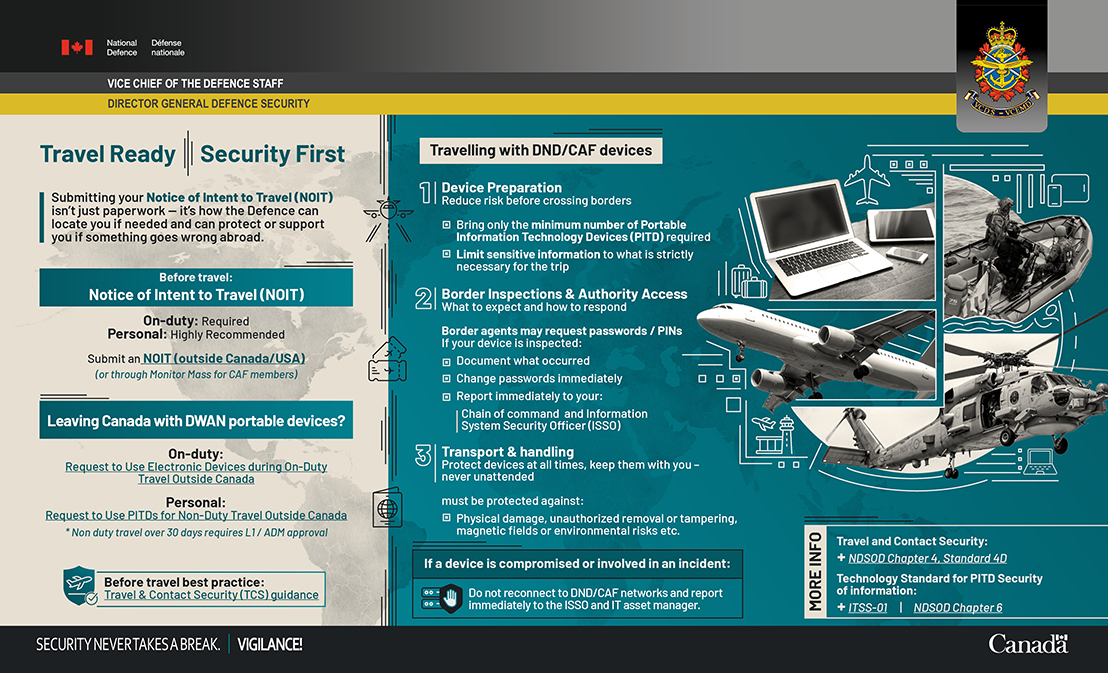
Infographic - Text version
Travel Ready. Security First.
Submitting your Notice of Intent to Travel(NOIT) isn’t just paperwork — it’s how the Defence can locate you if needed and can protect or support you if something goes wrong abroad.
Before travel
- Notice of Intent to Travel(NOIT)
- On-duty: Required
- Personal: Highly Recommended
- Submit an NOIT (outside Canada/USA) (Accessible only on the National Defence network)
(or through Monitor Mass for CAF members) - Leaving Canada with DWAN portable devices?
- On-duty:
- Request to Use Electronic Devices during On-Duty (Accessible only on the National Defence network)
- On-duty:
- Personal:
- Request to Use PITDs for Non-Duty Travel Outside Canada (Accessible only on the National Defence network)
- * Non duty travel over 30 days requires L1/ADM approval
Before travel best practice:
- Travel & Contact Security(TCS) guidance (Accessible only on the National Defence network)
Traveling with DND/CAF devices
- Device Preparation
- Reduce risk before crossing borders
- Bring only the minimum number of Portable Information Technology Device (PITD) required
- Limit sensitive information to what is strictly necessary for the trip
- Reduce risk before crossing borders
- Border Inspections & Authority Access
- What to expect and how to respond
- Border agents may request passwords/PINs
- If your device is inspected:
- Document what occurred
- Change passwords immediately
- Report immediately to your:
- Chain of command
- Information System Security Officer(ISSO)
- If your device is inspected:
- Border agents may request passwords/PINs
- What to expect and how to respond
- Transport & handling
- Protect devices at all times, keep them with you – never unattended must be protected against:
- Physical damage, unauthorized removal or tampering, magnetic fields or environmental risks etc.
- Protect devices at all times, keep them with you – never unattended must be protected against:
If a device is compromised or involved in an incident:
- Do not reconnect to DND/CAF networks
- report immediately to the ISSO and IT asset manager.
More info:
- Travel and Contact Security:
- Technology Standard for Portable Information Technology Devices and Security of information
- ITSS-01 (Accessible only on the National Defence network)
- NDSOD Chapter 6 (Accessible only on the National Defence network)