
Operating drones in the Arctic: Separating myth from reality
August 31, 2026 - Defence Stories
Estimated read time – 2:15

Caption
A quadcopter drone hovers in midair during a flight demonstration.
Canada’s Arctic is vast, remote, and central to national security. Defence Research and Development Canada (DRDC) is advancing drone capabilities to help the Canadian Armed Forces (CAF) maintain operational advantage.
However, operating in the Arctic, one of the world’s most demanding environments, can be harder than many realize.
Myth 1: A drone that works anywhere can work in the Arctic
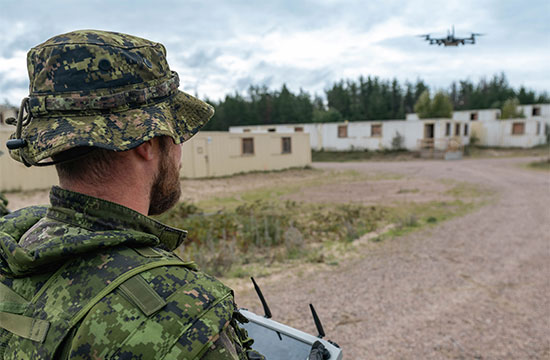
Caption
A soldier operates a remote-controlled drone during a field training exercise.
Reality: The Arctic challenges both the aircraft and its connection to the operator.
Extreme cold, often below −30°C, rapidly drains batteries. Ice buildup, strong winds, and snow can affect flight stability and sensor performance.
Connectivity can also be challenging, with less reliable satellite coverage and degraded GPS signals.
Operating in the Arctic requires technologies designed and tested for one of the world’s most demanding environments. That’s why DRDC is testing autonomous systems during exercises such as Operation NANOOK, evaluating navigation in GPS-denied environments, convoying, cold-weather performance, and resilient operations when communications are disrupted.
Myth 2: Drones require constant human control
Reality: Advancements in autonomy have made it possible for drones to go further with one operator managing multiple systems.
Because communication can be limited, DRDC is also developing drones that can operate more independently. Future systems will be able to carry out tasks and continue functioning even when links to operators are disrupted.
Myth 3: Harsh conditions outweigh the benefits of drones
Reality: Drones can travel long distances, reach remote areas, and operate for extended periods at a lower cost than crewed aircraft.
Unlike crewed aircraft, drones can carry out many surveillance and monitoring tasks without placing aircrew in remote and potentially hazardous conditions. This can reduce risk to personnel while allowing more persistent coverage of vast Arctic areas, enabling crewed aircraft to focus on missions that require human presence, judgment, or specialized capabilities.
As climate change accelerates in the Arctic, thawing permafrost is affecting communities and critical infrastructure, creating a growing need for persistent monitoring and situational awareness. Drones can help assess terrain changes, monitor infrastructure, and collect data in remote areas more safely and efficiently than traditional methods, supporting both Arctic security and climate resilience.
Myth 4: Drones operate independently from existing defence systems

Caption
A drone flies over a field during the trials.
Credit: Mike Franz / DRDC
Reality: They are part of a broader modernization effort.
Drones play an important role in Canada’s NORAD modernization plan. While systems such as Arctic Over-the-Horizon Radar provide long-range awareness, drones can operate in areas where fixed systems cannot, helping to fill critical gaps and strengthen overall situational awareness.
DRDC is developing drones that can work alongside Royal Canadian Air Force aircraft and defence systems, helping monitor larger areas and improve awareness of activities in remote regions.
Myth 5: Advancing drone capabilities is only about improving operations in the Arctic
Reality: It is also about strengthening Canada’s defence ecosystem.
DRDC’s work contributes to Canada’s Defence Industrial Strategy by supporting innovation in drone technologies and building partnerships with industry and academia.
These efforts help turn research into practical capabilities while strengthening the domestic defence sector and creating opportunities for Canadian companies. This work will be accelerated through the new BOREALIS UxS Defence Innovation Secure Hub (DISH), where government, industry, academia, and innovators can collaborate to advance and test uncrewed systems technologies.