
Gus' Edwards ' a man of honour, courage and conviction
News Article / June 22, 2012
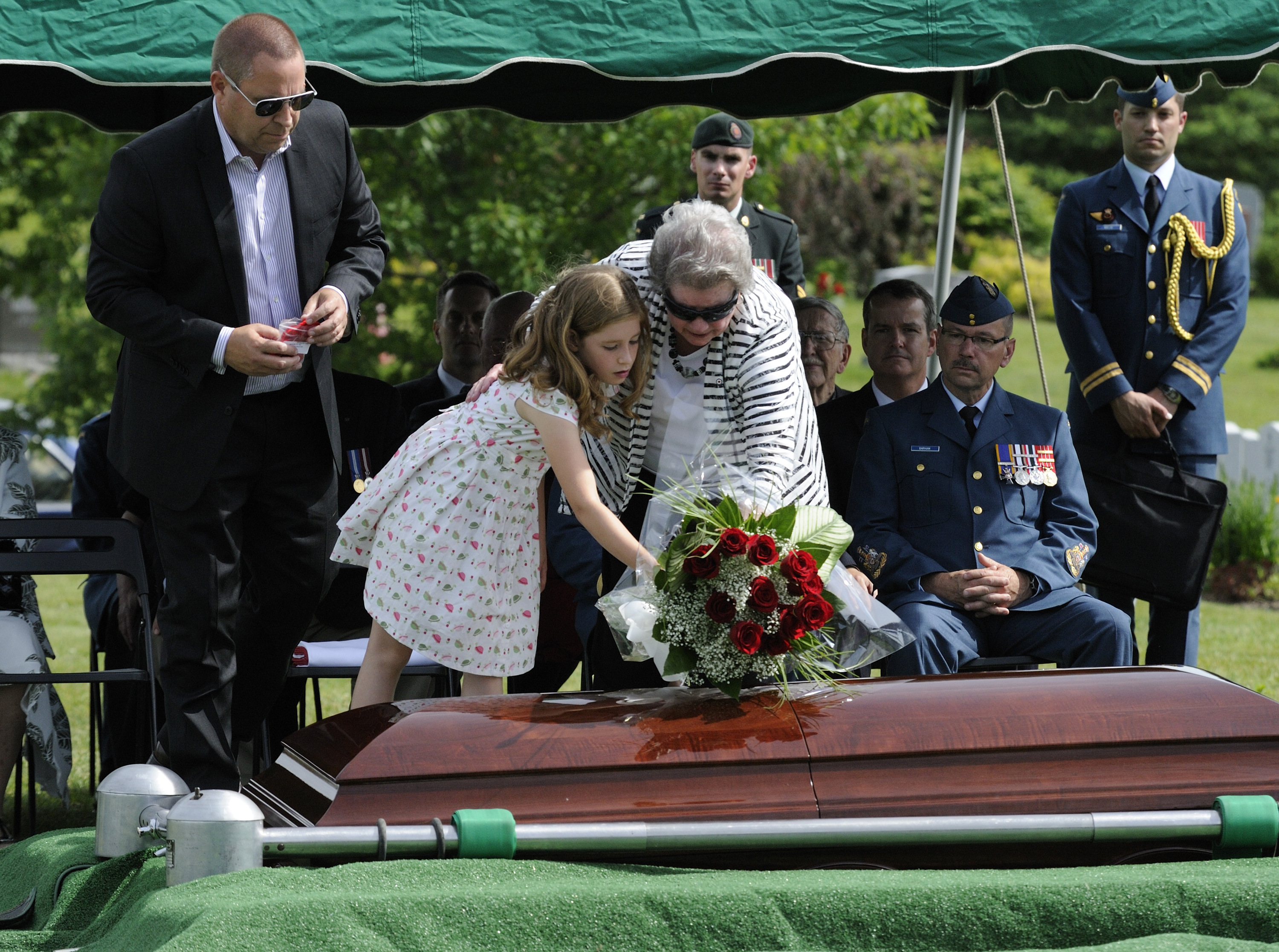
As the warm spring breeze carried the scent of flowers across the grave, Air Marshal Harold ‘Gus’ Edwards, CB, was laid to rest beside his comrades-in-arms in Canada’s National Military Cemetery (NMC), located within Beechwood Cemetery in Ottawa, more than 60 years after his death.
The graveside service, conducted with military honours, was held June 15, 2012.
During the Second World War, as Air Officer Commanding-in Chief of the RCAF Overseas, A/M Edwards championed the controversial “Canadianization” of the Royal Canadian Air Force, which led to the creation of Canadian squadrons, manned by Canadian personnel and under Canadian command, to fight in the conflict.
In 2011, Legion Magazine named him one of “Canada’s 25 Most Renowned Military Leaders”, and on June 14, 2012 he was inducted into Canada's Aviation Hall of Fame.
A/M Edwards died in 1952 and was buried in the civilian section of Beechwood Cemetery on Feb. 29, 1952. He had retired from the Royal Canadian Air Force and, under the regulations of the day, could not be buried in the military section of the cemetery because he was no longer on active service.
Moreover, his beloved wife and daughter, Bea and Suzanne, were not present at the graveside service – although they attended the funeral, held at Dominion Chalmers Church in downtown Ottawa. “There was a full military funeral, but women were not permitted to go to the gravesite,” said Suzanne Edwards.
Watch a video of A/M Edwards’ 1952 funeral procession and graveside service.
In 2001, when the National Military Cemetery was established, Ms Edwards began working towards the goal of having her father reburied where he so rightly belonged, alongside other members of the Navy, Army and Air Force in the NMC. “When I saw [the cemetery] was opening, I thought that’s exactly where Gus should be,” said Ms Edwards.
Over the years Ms Edwards approached various organizations for assistance reburying her father in the NMC. Ms Edwards explained that the various organizations, including National Defence, had been unable to assist “not because they didn’t want it to happen…but because the funds were not available to finance the transfer.
“I tried various routes for getting him transferred, none of which worked until I spoke to Colonel Sam Michaud [a former commander of 12 Wing Shearwater, N.S.] and he said ‘well, leave it with me and I will see what I can do’….That was last September.”
The Vimy Foundation, whose mission is “to preserve and promote Canada’s First World War legacy”, raised funds through private donations to cover the costs of the re-interment. The RCAF provided the ceremonial elements, including an honour guard, bearer party, bugler, piper and chaplain.
“[This] brings my mother’s wish to fruition. I’ve been working on this for the past decade, so it’s been a wonderful day for me and the members of my family,” said Ms Edwards. “I’m very grateful to the Air Force and to the Department of National Defence for taking up the cause and following it through.
“It’s an amazing day,” she said. “I finally see the end that I was not allowed to see before.”
Lieutenant-General André Deschamps called the re-interment a “full circle moment”.
Because of the relatively short history and small size of the pre-war Royal Canadian Air Force, he explained, A/M Edwards was the first air force member promoted to that rank (equivalent to today’s lieutenant-general) and, in 1952, he became the first RCAF officer of that rank to be pass away and be buried.
“In this ironic twist of fate,” said LGen Deschamps, “he will now also be the last [air marshal] to be buried because that rank no longer exists in the RCAF.”
During the re-interment ceremony, the funeral guard fired rifle volleys, a bugler played The Last Post and an RCAF piper played the lament “The Flowers of the Forest”.
Ms Edwards was accompanied by friends and members of her family, including her cousin, Mrs. Jane Ready, her nephew, Mr. Bogart Edwards, and his daughter Isabella, who is A/M Edwards’ great-granddaughter. Ms Edwards’ mother passed away in 1973 and her only sibling, Billy Edwards, died in 1995.
At the end of the ceremony, family and friends placed flowers and poppies on A/M Edwards’ casket, and Ms Edwards was presented with the Canadian flag that had draped the casket. That flag was previously flown over 12 Wing Shearwater, N.S., the air base that A/M Edwards commanded in the 1930s.
“I know he would certainly want to be with other troops who had served with courage and honour and distinction,” said Ms Edwards. “This is where he belongs.”
LGen Deschamps paid tribute to both A/M Edwards and his daughter in his remarks during the service. “Ms Edwards, today we salute your father again as he is re-interred beside his comrades in our National Military Cemetery.
“We are grateful for this opportunity to honour his legacy, and we are thankful for his service. He was a man of honour, a man of courage, and a man of conviction.
“And I salute you, for your tenacity in seeking your father’s re-interment in this place where he belongs.
“I believe the former motto of the Royal Canadian Air Force applies to both you and your father, Air Marshal Harold Edwards. Per Ardua ad Astra – through adversity to the stars.”
A champion of “Canadianization”
Air Marshall Edwards was a man whose life and career intersected with key moments in the history of Canada and the Royal Canadian Air Force.
He left school at the age of 14 to work in the brutal conditions of a Cape Breton coal mine, although his natural intelligence, drive and talent soon brought him out of the pit, and he became chief electrician for the mine.
During the First World War, he flew as a fighter pilot, was shot down and taken prisoner. After several escape attempts, one of which was nearly successful, he decided to use his time to continue the demanding régime of self-education that he established when he left school.
Following the war, he flew with the Royal Air Force in Russia, supporting the White Russians against the communist revolutionary factions. Later, he joined the Canadian Air Force, where, among other things, he was instrumental in the aerial mapping of Manitoba, and the redevelopment of RCAF Station Dartmouth from a small sea plane base to a fully-fledged air station, now known as 12 Wing Shearwater.
In 1936, he flew in supplies to the site of the Moose River gold mine disaster in Nova Scotia and then flew the survivors to hospital in Halifax. This event has gone down in Canadian history because CBC Radio broadcast half-hourly reports for 56 hours straight – the North America’s first live 24-hour news event – until the two survivors were rescued. Ms Edwards said her father was interviewed about the RCAF’s role in the effort. “I remember as a child, when I was five, Mum saying ‘come quickly, Dad’s on the radio!’ ”
“If these were his only accomplishments, Air Marshal Edwards would be remembered simply as an interesting man of many accomplishments, who overcame his humble beginnings to make valuable contributions to the RCAF and to his country,” said LGen Deschamps.
“But today we remember and honour him as a pivotal leader in the development of the Royal Canadian Air Force.”
In 1939, the British Commonwealth Air Training Plan was established in Canada to train pilots from the Commonwealth and other nations in the skills that were so badly needed to win the air war against Nazi forces. Air Marshal Edwards managed the personnel aspects of the Plan – and was directly involved in an initiative to recruit civilian and military American flyers for the Plan, a task that had to be handled with delicacy and tact to respect American neutrality.
His finest hour came, however, when he was transferred to London, England, in 1942.
The Plan’s agreement called for graduates from the air forces of Canada, Australia and New Zealand to be assigned to squadrons formed by their own air forces. During his two-year tenure as Air Officer Commanding-in-Chief, RCAF Overseas, Air Marshal Edwards fought long and hard – and ultimately successfully – to make Canadian squadrons, manned by Canadian personnel, a reality.
In the early months of the war, Commonwealth airmen and airwomen were assigned to Royal Air Force squadrons. But A/M Edwards understood the operational importance of Canadians being under Canadian command, and he knew that being part of a Canadian chain of command was vital for the management, career progression, morale and welfare of Canadian air and ground crew.
“He was very tenacious,” said Ms Edwards. “Once he thought something was right, he fought for it to the end.”
His push for Canadianization created a storm of attention among military and civilian leadership in Great Britain and in Canada, and in the media. In the words of Canadian military historian C.P. Stacey, A/M Edwards “at different times, incurred the displeasure of both sides, and become known as the most controversial officer in the Royal Canadian Air Force.”
Nevertheless, although many Canadian aircrew and ground crew continued to serve in Royal Air Force squadrons, more than 40 Canadian squadrons – the 400-series squadrons that serve with distinction to this day – were formed. Canadianization also led to the formation of Number 6 (Bomber) Group – the only Canadian formation of that level to serve during the Second World War.
In 1943, A/M Edwards was awarded the Order of the Bath in the degree of Companion. As well as First and Second World War service decorations, he received decorations from other nations, including the Order of St. Anne and the Order of St. Stanislaus from Russia, la Légion d’Honneur (Officer) and Croix de Guerre avec Palme from France, the Military Order of the White Lion “for Victory” 1st Class from Czechoslovakia and the Legion of Merit (Commander) from the United States.
A/M Edwards was recalled to Canada in 1943, and retired in 1944. His health, which had always been a challenge, declined precipitously and on Feb. 23, 1952, he passed away at the young age of 59.
Ms Edwards has written two books about her father’s life: the biography Gus: From Trapper Boy to Air Marshal, and a children’s book The Adventures of a Trapper Boy, which has been shortlisted for the 2013 Hackmatack Children's Choice Book Award. Both are published by General Store Publishing House.