
RCAF introduces new high tech firefighting vehicles
News Article / March 26, 2013
Ever year, Royal Canadian Air Force firefighters respond to almost 3,000 calls at Air Force wings across the country – everything from mopping up fuel spills to rushing out to the flight line to meet an aircraft in trouble.
Altogether there are 13 categories of incidents that RCAF firefighters must be able to respond to – quickly, effectively and without unnecessary delays.
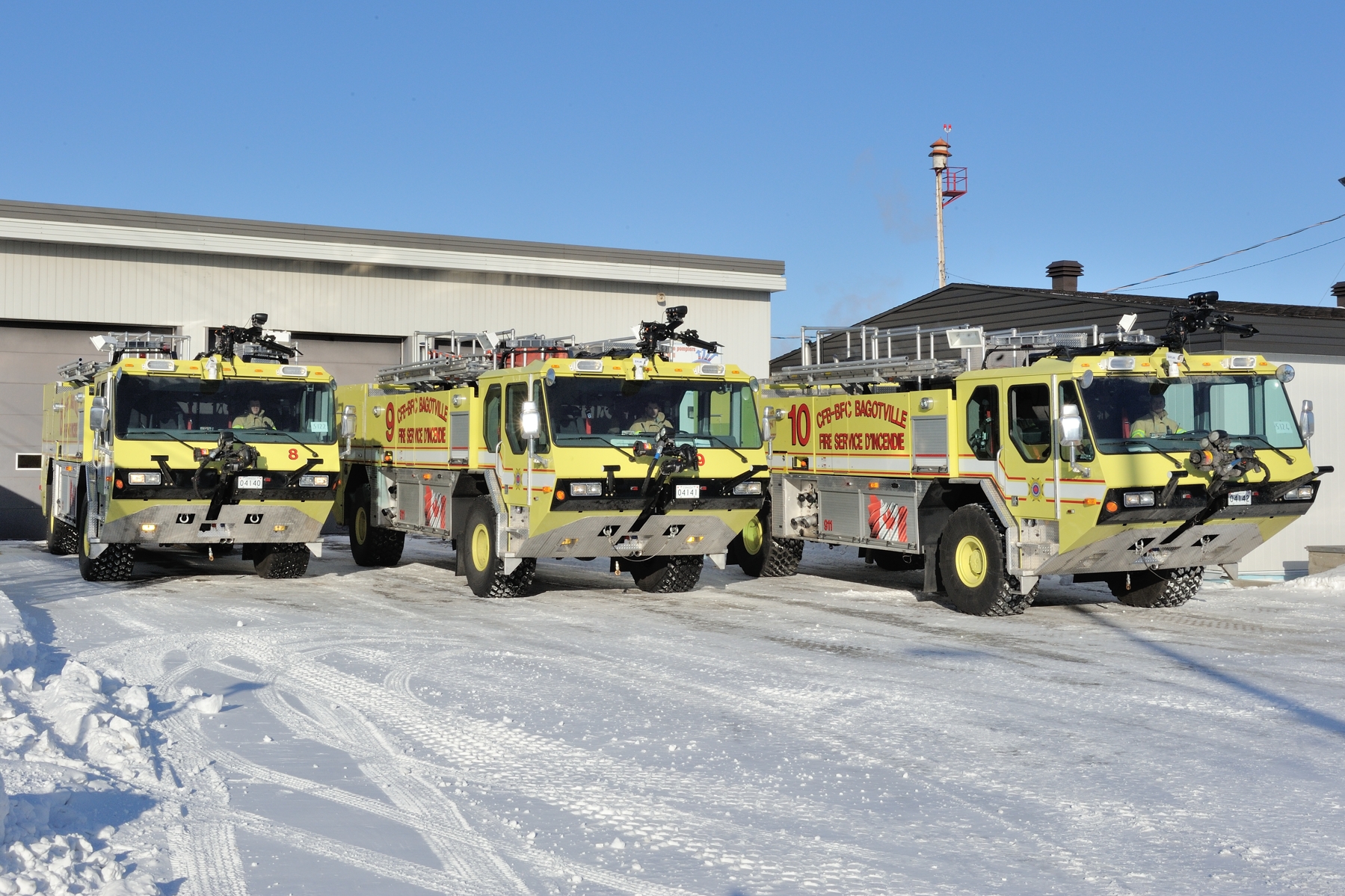
A new capability that allows firefighters to do just that is the 6000 LE1 aircraft rescue and firefighting vehicle (ARFF), which is now being used at 19 Wing Comox, B.C., 4 Wing Cold Lake, Alta., 17 Wing Winnipeg, Man., 3 Wing Bagotville, Que., and 14 Wing Greenwood, N.S.
Altogether, 12 new trucks are in service.
“This is an outstanding new capability for the RCAF,” says Major Martin Breton, the RCAF’s aircraft rescue and fire fighting vehicle project director. “Our current vehicles are well past their service lives, and needed to be replaced. These new ARFF vehicles will ensure the RCAF maintains a modern aircraft emergency response capability to support air operations at its main operating bases.”
Each truck carries 6,000 litres of water and a full complement of foam and dry chemicals. In addition to a high performance roof turret and an adjustable angle bumper turret (for 180o dispensing of either foam or water), the trucks are equipped with advanced electronics, modern navigation systems and infrared vision that allow drivers to see through smoke, fog and blackout conditions.
Due their large size, the trucks also have rear view and blind spot cameras to reduce the risk of collision. The trucks are equipped with electrical Jaws of Life apparatus that do not require a generator, which reduces response times and improves equipment handling.
3 Wing Bagotville’s fire chief, Chief Warrant Officer Des Desruisseaux, says fire trucks have come a long way since he first joined the Canadian Armed Forces 34 years ago.
“When I joined in 1979 there were at least four firefighters operating the truck...the driver, the platoon chief on the side running the pump, a firefighter on the back and there was me, the poor private on top, operating the turret. It was all manual so we had to use our arms to rotate it left, right, up and down.
“Now it’s all electric, a one-person operation. The driver does everything – drive the vehicle, use the radio, control the pump. It’s basically like a big video game. Today our younger firefighters are so agile with their fingers, so used to playing video games, that this type of technology is very familiar. You know an old man like me sometimes we need more practice but those kids they can drive the truck quickly.
“I am really excited about these new trucks because our serviceability will be higher so it will be safer for our wing, our pilots, our planes and the military community,” says CWO Desruisseaux.
The RCAF fire marshal, Major Rick Dunning, agrees.
“A modern ARRF vehicle fleet that ensures the effective delivery of fire fighting agents, personnel and equipment increases the safety of fire fighting personnel improves airport flight safety and provides wings with superior operational support. These trucks are a brand new asset and I’m really glad we have them.”
In December 2011, the Government of Canada awarded a multi-year contract to Techno-Feu Inc. of St. Francois du Lac, Que., for the acquisition of 12 modern 4 x 4 ARFF vehicles at a cost of $8.2 million. The directorate of support vehicles program management at the Department of National Defence managed the acquisition.
About the aircraft rescue fire fighting vehicles
The ARFF fleet is the largest of the fire apparatus within the Department of National Defence and the Canadian Armed Forces. It comprises 43 percent of all apparatus and are therefore the most important in terms of investment and support.
ARFF vehicles are used to transport personnel and equipment to the scene of an aircraft emergency to rescue occupants and conduct firefighting operations.
They are used both on and off paved surfaces. Off-pavement capability is important to ensure timely and effective response to aircraft accident sites that are located off improved surfaces. They are extremely fast, given their size, and deliver large amounts of extinguishing agent in a very short period of time.