
RCAF tests J-model Herc's tactical ground refuelling capability
News Article / July 23, 2012
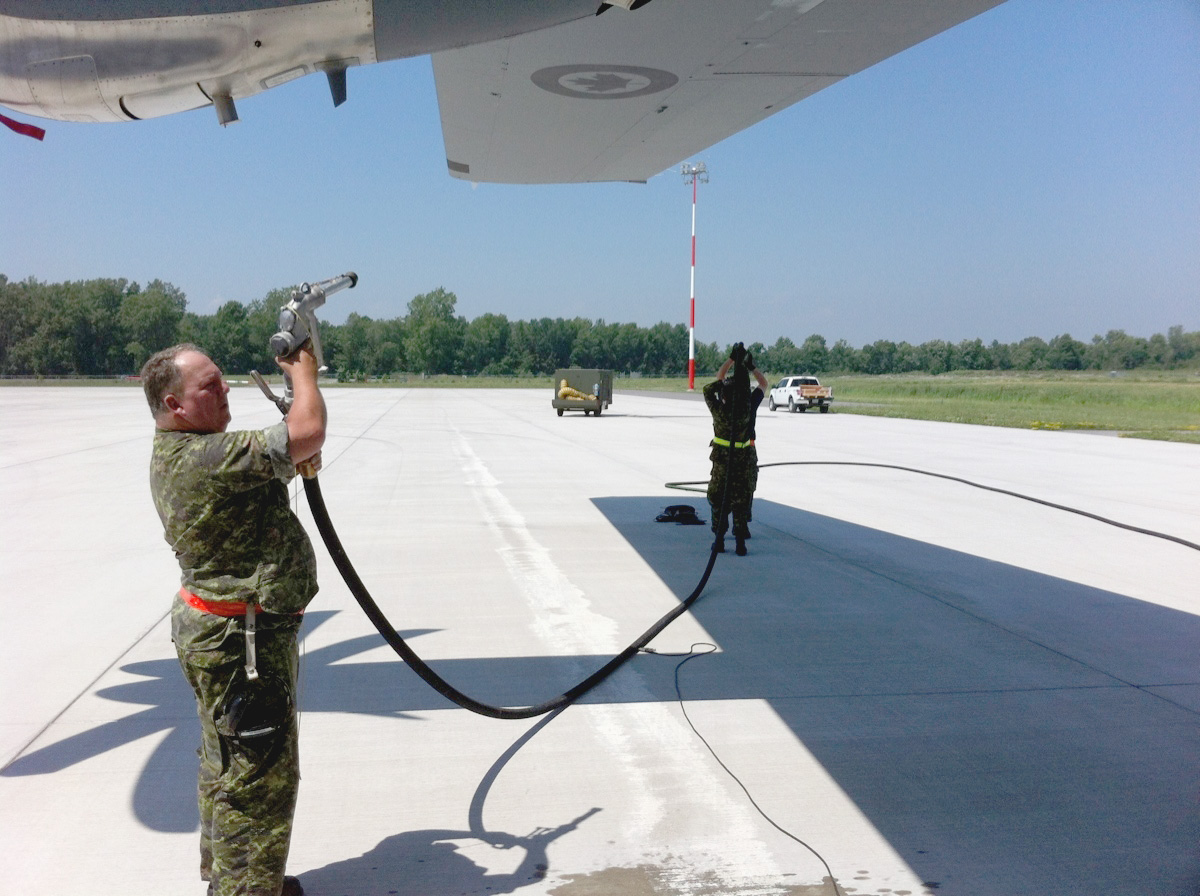
The Royal Canadian Air Force evaluated the CC-130J Hercules aircraft’s capability to refuel vehicles and other aircraft using the forward arming and refuelling point (FARP) system on June 21, 2012, at 8 Wing Trenton, Ont. The evaluation was deemed a success.
With the FARP system in place, the CC-130J can supply other aircraft or military vehicles with fuel that could be pumped from a tank in its cargo compartment.
“This is significant to us because we now have the capability to support deployed operations in remote or austere conditions by refuelling aircraft or vehicles [in their location],” said Major Greg Castagner, operations officer of 436 Transport Squadron.
“This capability significantly lessens the logistical burden on short term deployed operations in remote areas such as the Canadian Arctic region. It also allows the Canadian Forces to operate equipment, which may have special fuel requirements, in nearly any environment where the CC-130J could land.”
The recent FARP evaluation at 8 Wing, overseen by Master Warrant Officer Gary Rodrigue, was conducted by 436 Squadron members Sergeant Les Page, Master Corporal Robert Joy, Corporal Vince Belisle and Private Peter Brown, with assistance from Hugh Copeland, a technical expert from the Hercules’ manufacturer, Lockheed Martin.
Aerospace and Telecommunications Engineering Support Squadron (ATESS) provided a CT-114 Tutor aircraft to be used for the refuelling test, which was coordinated by Warrant Officer Chris Leiska. The 8 Wing Fire Hall put a crash truck on standby to ensure everyone’s safety.
1 Canadian Air Division initiated the evaluation to prove that the CC-130J is capable of performing the FARP mission and to determine safe and effective operating practices, including communication between the flight deck and ground handlers, set-up and tear-down of the system, refuelling procedures and safety protocols.
“We handily met all of our test objectives,” said Maj Castagner.
According to MWO Rodrigue, the FARP system follows a very straightforward process. The internal fuel pumps on the CC-130J are used to generate pressure in the fuel system, which can be configured to upload or download fuel. In this case, the pumps are configured to offload fuel and a refuelling hose is connected to the single point refuelling port on the CC-130J.
The hose is then pumped full of fuel and the nozzle on the end of the hose is used to refuel the vehicle or aircraft. The loadmaster remains on the flight deck and operates the fuel control panel while the technical crewman watches over the ground operations. During the process, the loadmaster and technical crewman are in constant communication via the aircraft intercom system; the technical crewman communicates via hand signals with the personnel at the nozzle end of the hose, maintaining a safety watch to ensure all goes smoothly.
The CC-130J crew, with assistance from the unit receiving the fuel, sets up and tears down the FARP system once the refuelling is completed.
“For this evaluation we followed the FARP job-guide from the CC-130H and combined procedures from the CC-130J refuelling operations; our team then experimented with various methods of installing and uninstalling the system, developed communication protocols and evaluated different methods of draining the wet hose after the operation is complete,” said MWO Rodrigue.
“Careful notes and measurements were taken and all personnel involved in the evaluation were asked for input on proposals to improve the process, which we then reported back to 1 Canadian Air Division.”
The FARP capability will benefit the CF in most of its operations as all CF equipment that uses JP-8 (a kerosene based jet fuel) as well as other fuels can be refuelled on-site, including armoured vehicles in the field. The system could also be used to refill fuel bladders or remote fuel caches anywhere the CC-130J could land.
The FARP capability will be used on Operation Northern Reach in July when the CC-130J will refuel the Snowbirds Demonstration Team as they perform for the first time in many years in Norman Wells and Watson Lake, N.W.T.
“While this capability is still developmental, once mature it will benefit many RCAF missions including search and rescue and northern sovereignty operations across the Canadian Arctic,” Maj Castagner noted. “We not only carry the load, we can supply fuel everywhere!”