
My first Gulf mission: December 17, 1990
News Article / January 29, 2016
Canada’s air contribution to the Gulf War began in the autumn of 1990 when Canadian CF-188 Hornets, mainly from 409 Squadron, augmented with elements of 421 and 439 Squadrons, plus support staff deployed to the Gulf region under Operation Scimitar to provide top cover for Canadian ships in the region as part of Operation Friction.
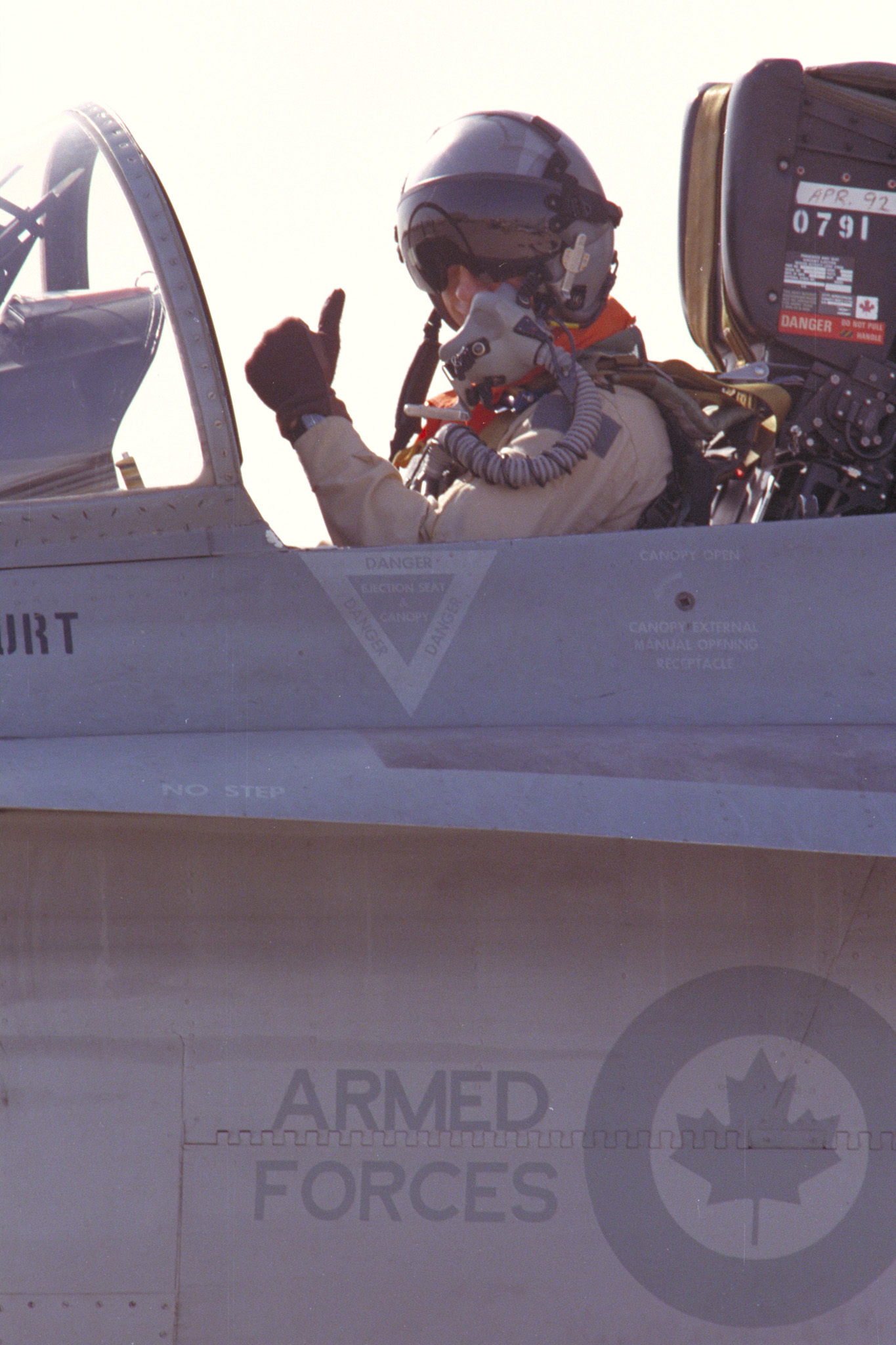
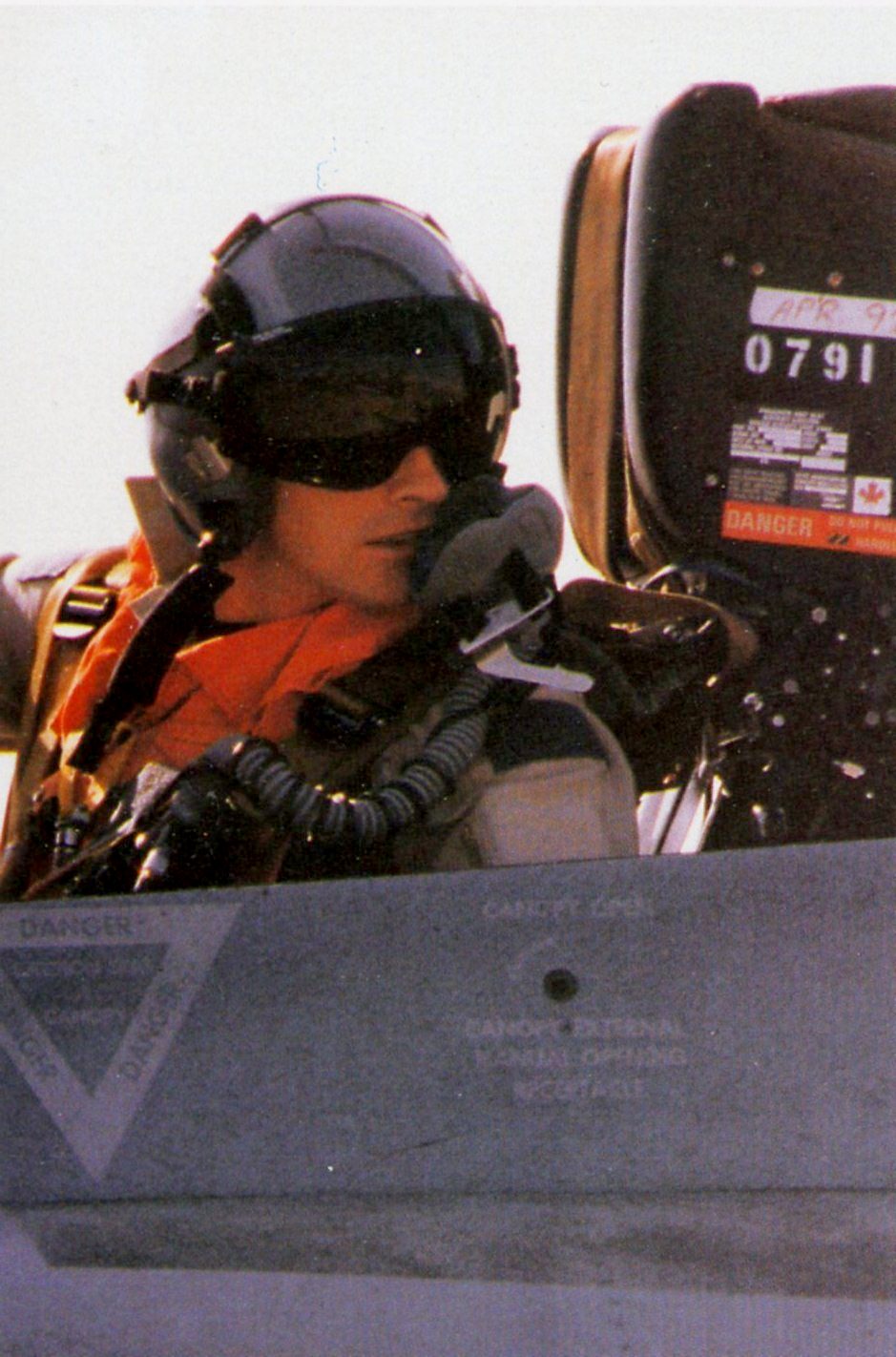
Canadian Air Force pilots flew combat air patrols during the period leading up to the launch of the aerial bombing campaign on January 17, 1991, as well as during the bombing campaign. In the following article, a CF-188 pilot describes his first combat air patrol mission on December 17, 1990.
By Captain (retired) David Deere
The seven hours of sleep was much needed. However, starting your day at 02:00 in the morning really does a job on one’s internal time clock. After a quick bowl of corn flakes, some toast and three coffees I was more than ready for my first real-time operational mission in the Persian Gulf.
Take-off time was 03:25. We spent the hour prior to launch getting the latest intelligence, briefing the “what-ifs,” signing out our pistols and war book (which included threat locations, routes/points of missile engagement zone, friendly forces, etc.), and getting dressed in our flight gear. The latter now included, among the usual survival equipment, sand storm goggles, shark repellent and bottles/bags of water in every available pocket.
It was a 10-minute drive to the alert area where 10 CF-188 Hornets sat anxiously poised for action. It was an awesome sight. All 10 Hornets, illuminated by portable floodlights, sharply stood out of a pitch-black background, ominously displaying their maximum load of air-to-air missiles.
Approaching my jet for the pre-flight check reminded me of the same scene in Top Gun. One-by-one, selecting the missile arm switch to “Arm,” the adrenalin surged through my body like the water in a creek during a spring flood. In over 1,300 hours of flying jets, I’d never flown with armed missiles... I’d never had a need to...
With the pre-flight check done, I strapped in, cranked the engines and within seconds the quiescent desert atmosphere was filled with the roar of GE 404s. The generators illuminated my cockpit instruments. I was once again reminded of the extreme lethality I had at my fingertips as the weapon stores display indicated my weapons load.
We checked in, all systems go, taxied the short distance to the runway and took-off with full afterburner. As this was my first mission in the Gulf, I was the wingman. It felt great as the burners pushed me down the runway to follow the 20-foot [six-metre] blue flame of my lead as we transitioned from the ground into the dark unfamiliar skies of the Persian Gulf.
After about 30 minutes of transit straight north, we established the CAP [combat air patrol] altitude, airspeed and formation. Above us were thousands of stars, below the dark waters of the Gulf with dimly lit flames from numerous oil rigs, and, in front – the bright lights of occupied Kuwait City. It was a phenomenon quite difficult to come to terms with – seeing so much of this area, country and city on the news for over four months and there it was directly in front of my eyes!
The actual mission was relatively uneventful.
There was only the occasional radar contact with U.S. Marine Corps fighters and tankers. They were performing the same task we were – air defence for the Allied ships in the Gulf.
After an hour of surveillance and patrol had passed we were relieved by two other CF-188s. This procedure continued for an eight-hour liability period.
When we turned back south to return to base, the half-hour of transit “home” allowed us to watch one of the most astonishing sunrises I’ve seen. The sun’s slow ascent from below the horizon gave the sharp silhouette of the Iranian mountains a bright gold outline. It was as if a flexible neon light was placed on top to follow the rugged contours of the crests and troughs.
Once we reached the Qatar peninsula, we pushed the throttles up, rolled inverted and dove for the sand. The last bit of the flight was at low level over the desert searching for, among other unusual sights, camels. But all we saw was an occasional white Bedouin tent in the middle of nowhere – and I thought Cold Lake was isolated!
We landed, shut-down, discussed with intelligence everything we saw – or rather, didn’t see – and called it a day at 08:00.
So, although little action occurred throughout, my first operational mission will be etched in my memory forever.
Captain (retired) Dave Deere of Calgary, Alberta, was a CF-188 pilot during the Gulf War. This article is from his book Desert Cats: The Canadian Fighter Squadron in the Gulf War, published in 1991. It was published in Volume 35, No. 1 of Airforce Magazine in 2011, and is translated and reproduced with permission.