
Profile of Courage: Flight Cadet Wilfred Cecil Alcock
News Article / May 8, 2017
To see more images, click on the photograph under “Image Gallery”.
By Major Bill March
Born in Knutsford, Cheshire, England, 21-year-old Wilfred Cecil Alcock left his family in the fall of 1912 to seek his future in the United States. He eventually settled in the small town of New Bedford, just outside Boston, Massachusetts. He carved a niche for himself within the community, working as the print manager at a local publication company and joining the local Masonic lodge.
Alcock paid close attention to the war back home. However, unless he wished to travel back to England, opportunities to join a British unit were limited. Finally, in the summer of 1917, he travelled to Toronto, Ontario, and joined the Royal Flying Corps Canada, which had set up shop that spring. On September 6, 1917, Cadet Alcock, No. 74783, was sworn in and introduced to the joy that is service life.
During the remainder of September and into to early autumn, he learned about military aviation at the School of Aeronautics located on the grounds of the University of Toronto. With his head full of facts about aeroplanes, wireless and machine guns, and his legs sore from a fair amount of “square-bashing”—drill—he had just begun flight training at Borden, Ontario, about 100 kilometres north of Toronto, when the time arrived for the “big move.”
Brigadier-General Cuthbert Gurney Hoare, the officer commanding the Royal Flying Corps Canada, was trying to prevent any delays in training that might result from a Canadian winter. Accordingly, he had negotiated an agreement with the United States military whereby, in return for training a number of U.S. personnel, two full Royal Flying Corps Canada wings—42 Wing Borden and 43 Wing Deseronto (just east of Toronto)—would be housed at airfields located in sunny Texas. In early November 1917, Alcock found himself on a special train undertaking a journey of about 1600 kilometres to his new home just outside Fort Worth, Texas.
The train arrived on November 17 with only one serious incident en route: a cadet lost his life during the transfer when he fell off the train. Alcock and his friends soon found themselves under canvas at the No. 2 (Everman Field) aerodrome. Combined with Taliaferro No. 1 (Hicks’ Field) and No. 3 (Carruther’s Field), the three training areas were known collectively as Camp Taliaferro.
One can only imagine the look on Alcock’s face when, after settling in to camp routine and getting as restful a night’s sleep as possible, he awoke to a heavy snowfall. That part of Texas was to experience an exceptionally harsh winter in 1917/18. As he broke the ice covering the communal sink in order to shave for morning parade, Alcock must have wondered why the Royal Flying Corps Canada bothered to exchange Canadian for American snow… it was just as bloody cold!
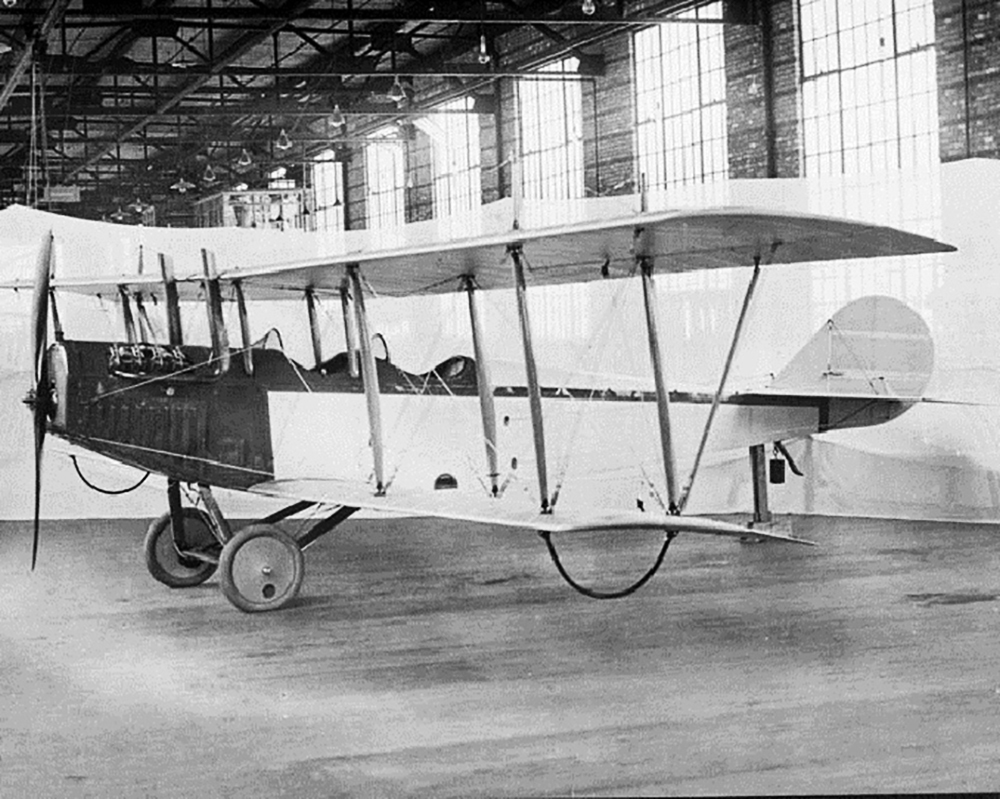
Despite the snow and the subsequent muddy landing areas, training got underway almost immediately. A capable student, Alcock quickly completed basic flight instruction with 79 Canadian Training Squadron, and was soon going aloft solo in the respected Curtiss JN-4 aircraft.
On November 24, a week after arriving in Texas, he was flying JN-4 C-760, apparently practising formation flying with another JN-4 piloted by Cadet James Harold Thompson. After “stunting around” in the air for a bit, Alcock found himself slightly below Thompson when something caused the two JN-4s to slam into each other. According to the casualty card, the “centre section of [Alcock’s] machine was carried away by the undercarriage of [Thompson’s] machine”, and the JN-4 tumbled from the sky. Alcock did not survive the fall. Thompson crash-landed his aircraft, suffering minor injuries.
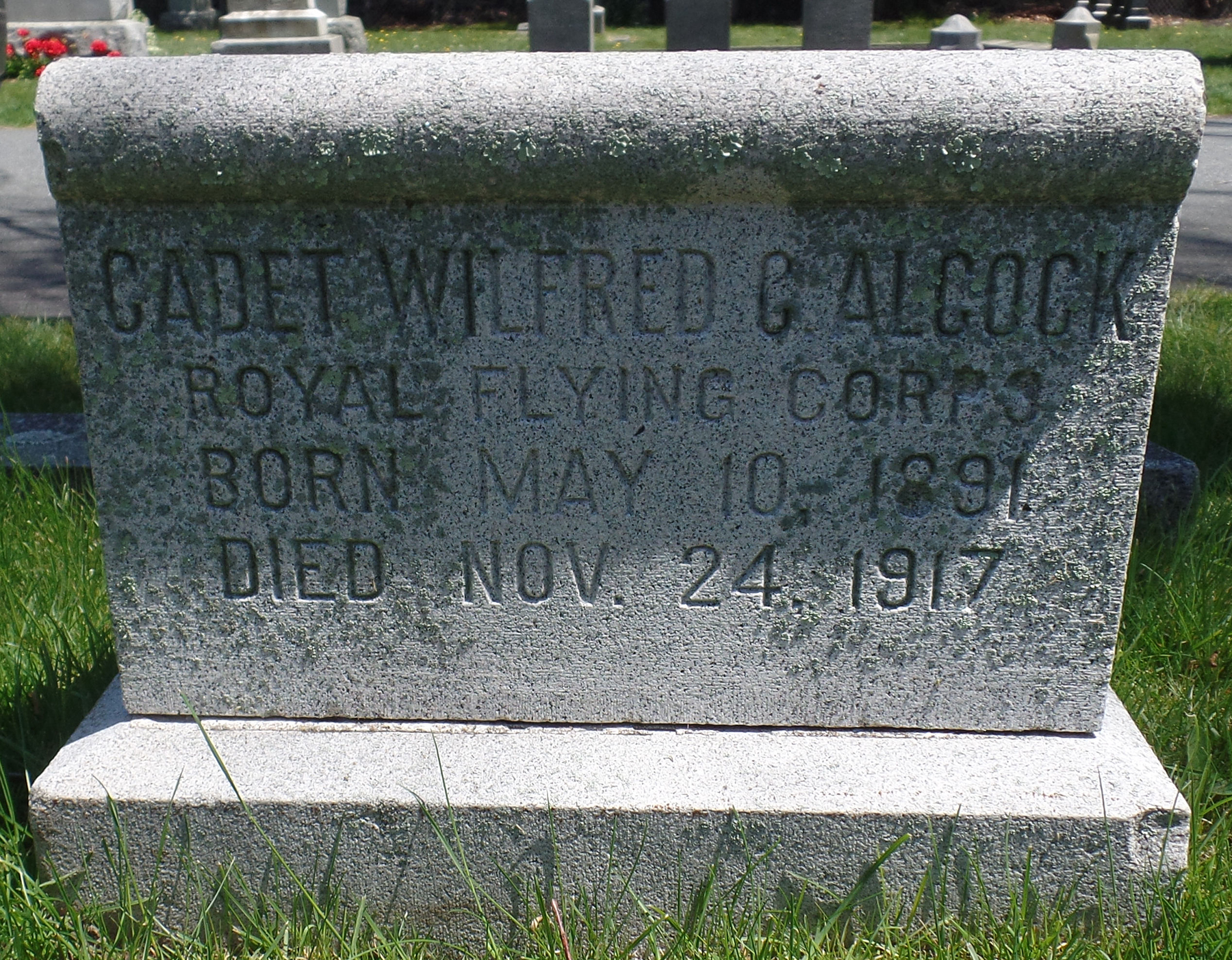
As was the practice in North America, Cadet Wilfred Alcock’s remains were returned to his hometown and he was laid to rest on November 28 in New Bedford’s Oak Grove Cemetery. He was 26.