
Search and Rescue (SAR) in Western Canada
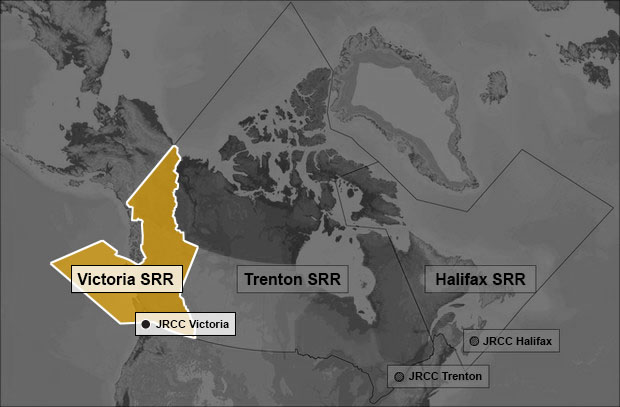
Joint Rescue Coordination Centre (JRCC) Victoria leads and directs all SAR missions in the Victoria search and rescue region (SRR). This region covers Western Canada. The commander of Joint Task Force Pacific (JTFP) is responsible for SAR operations in the Victoria SRR.
The Victoria SRR covers the following land and sea areas:
- British Columbia and the Yukon. This is about 1,427,000 square kilometers of mainly mountainous terrain.
- Approximately 687,000 square kilometers of the Pacific Ocean. The area extends to about 600 nautical miles off Canada's west coast.
Much of the land area of the Victoria SRR is remote and rugged. There are few people and the area is not easily accessed. However, there is plenty of recreational activity, which can result in SAR incidents. The region also includes the city of Vancouver, which is one of the largest shipping ports of North America.
Regional SAR response centre
JRCC Victoria is located in Esquimalt, British Columbia It includes members of the Canadian Armed Forces (CAF) and the Canadian Coast Guard (CCG). JRCC Victoria monitors the Western Canada region for SAR incidents. It also directs SAR alerts and emergency response in the region.
JRCC Victoria received an average of 1,969 calls for assistance per year between 2021 and 2025. This breaks down approximately as follows:
- 67 percent related to maritime incidents
- 18 percent are air incidents
- 15 percent are requests for humanitarian aid
CAF SAR units in Western Canada
The primary CAF SAR squadron for the region is 442 Transport and Rescue Squadron. It is located at 19 Wing Comox on Vancouver Island. The squadron flies:
Any other CAF or CCG unit may be called upon to support the designated SAR units. JRCC Victoria can give any unit the task of any SAR or SAR-like mission if they are available, suitable, and capable.
CAF assets are tasked to respond to approximately 200 SAR missions each year in Western Canada.