
Canada–Chile Commission for Environmental Cooperation 2012 to 2013 annual report: chapter 5
Annex I - Commission for Environmental Cooperation
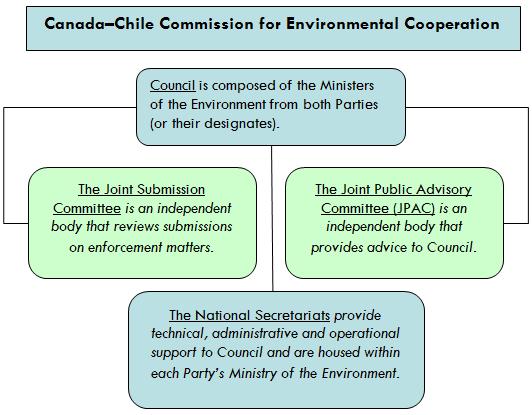
Established under the Canada-Chile Agreement for Environmental Cooperation, the Canada-Chile Commission for Environmental Cooperation consists of a Council, a Joint Public Advisory Committee (JPAC) and a Joint Submission Committee (JSC). The Commission is assisted in the implementation of the Agreement by two National Secretariats, respectively located in each country’s Ministry of the Environment.
National Secretariat Executive Directors: Daniel Hallman (Canada), Ricardo Irarrázabal Sánchez (Chile) [1]
Members of the Joint Public Advisory Committee: Lindsay Brumwell (Canada), Dominique Bellemare (Canada), Andrés Varela (Chile), Marcela Fernández (Chile)
Members of the Joint Submissions Committee: Julio Arboleda (Canada), Jorge Correa Sutil (Chile)
For more information about the Canada-Chile Agreement for Environmental Cooperation (CCAEC), visit our websites: www.ec.gc.ca/can-chil and www.mma.gob.cl/chilecanada
Annex II - Obligations
The following are the obligations articulated in the Agreement for both Parties.
| State of the Environment Reports | Article 2(1)(a) of the Agreement provides that each Party shall, with respect to its territory, periodically prepare reports on the state of the environment and make them publicly available. |
| Environmental Emergency Preparedness Measures | Article 2(1)(b) of the Agreement provides that each Party shall, with respect to its territory, develop and review environmental emergency preparedness measures. |
| Environmental Education | Article 2(1)(c) of the Agreement provides that each Party shall, with respect to its territory, promote education in environmental matters, including environmental law. |
| Scientific Research and Technology Development | Article 2(1)(d) of the Agreement provides that each Party shall, with respect to its territory, further scientific research and technology development in respect of environmental matters. |
| Environmental Impact Assessment | Article 2(1)(e) of the Agreement provides that each Party shall, with respect to its territory, assess, as appropriate, environmental impacts. |
| Economic Instruments | Article 2(1)(f) of the Agreement provides that each Party shall, with respect to its territory, promote the use of economic instruments for the efficient achievement of environmental goals. |
| Export Controls | Article 2(3) of the Agreement provides that each Party shall consider prohibiting the export to the territory of the other Party of a pesticide or toxic substance whose use is prohibited within the Party’s territory. When a Party adopts a measure prohibiting or severely restricting the use of a pesticide or toxic substance in its territory, it shall notify the other Party of the measure, either directly or through an appropriate international organization. |
| Levels of Protection | Article 3 of the Agreement provides that each Party shall ensure that its laws and regulations provide for high levels of environmental protection and shall strive to continue to improve those laws and regulations. |
| Publication | Article 4 of the Agreement provides that each Party shall ensure that its laws, regulations, procedures and administrative rulings of general application respecting any matter covered by this Agreement are promptly published or otherwise made available in such a manner as to enable interested persons and the other Party to become acquainted with them. |
| Government Enforcement Action | Article 5 of the Agreement provides that each Party shall (1) effectively enforce its environmental laws and regulations through appropriate governmental action; and (2) ensure that judicial, quasi-judicial or administrative enforcement proceedings are available under its law to sanction or remedy violations of its environmental laws and regulations. Also, that these sanctions and remedies shall, as appropriate (a) take into consideration the nature and gravity of the violation, any economic benefit derived from the violation by the violator, the economic condition of the violator, and other relevant factors; and (b) include compliance agreements, fines, imprisonment, injunctions, the closure of facilities, and the cost of containing or cleaning up pollution. |
| Private Access to remedies | Article 6 of the Agreement provides that each Party shall ensure that (1) interested persons may request the Party's competent authorities to investigate alleged violations of its environmental laws and regulations and shall give such requests due consideration in accordance with law; and (2) persons with a legally recognized interest under its law in a particular matter have appropriate access to administrative, quasi-judicial or judicial proceedings for the enforcement of the Party's environmental laws and regulations. Also, private access to remedies shall include rights, in accordance with the Party’s law. |
| Procedural guarantees | Article 7 of the Agreement provides that each Party shall (1) ensure that its administrative, quasi-judicial and judicial proceedings are fair, open and equitable; (2) provide that final decisions on the merits of the case in such proceedings are (a) in writing and preferably state the reasons on which the decisions are based, (b) made available without undue delay to the parties to the proceedings and, consistent with its law, to the public, and (c) based on information or evidence in respect of which the parties were offered the opportunity to be heard; (3) provide, as appropriate, that parties to such proceedings have the right, in accordance with its law, to seek review and, where warranted, correction of final decisions issued in such proceedings; and (4) ensure that tribunals that conduct or review such proceedings are impartial and independent and do not have any substantial interest in the outcome of the matter. |