
Autumn 2016: Climate Trends and Variations Bulletin
PDF format [372 KB]
This bulletin summarizes recent climate data and presents it in a historical context. It first examines the national average temperature for the season or year, and then highlights interesting regional temperature information. Precipitation is examined in the same manner.
National temperature
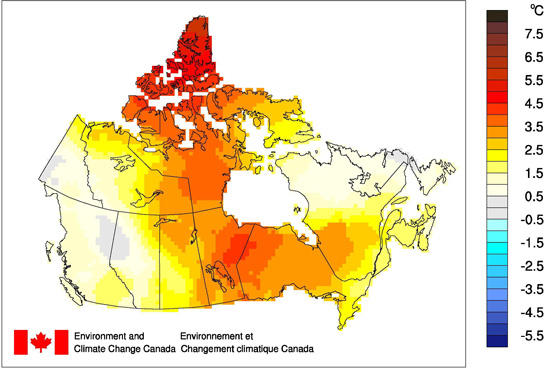
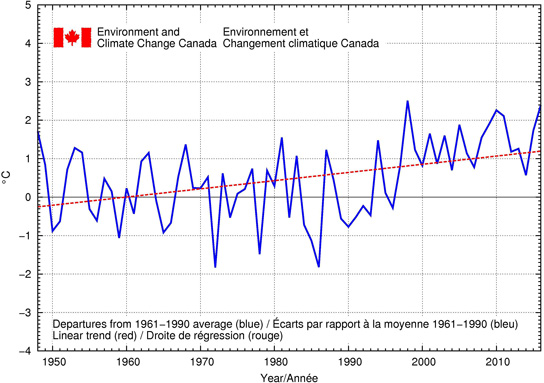
The national average temperature for the autumn of 2016 was 2.4°C above the baseline average (defined as the mean over the 1961-1990 reference period), based on preliminary data, which is the second warmest observed since nationwide recording began in 1948. The warmest autumn occurred in 1998, when the national average temperature was 2.5°C above the baseline average. The coldest autumn occurred in 1972, when the national average temperature was 1.8°C below the baseline average. The temperature departures map for autumn 2016 (below) shows that most of Nunavut, the eastern Northwest Territories, eastern Saskatchewan, Manitoba, northern Ontario and western Quebec experienced temperatures more than 2.5°C above the baseline average. Temperatures slightly above or near the baseline average were found in the rest of the country.
Long description
The temperature departures map for autumn 2016 shows that most of Nunavut, the eastern Northwest Territories, eastern Saskatchewan, Manitoba, northern Ontario and western Quebec experienced temperatures more than 2.5°C above the baseline average. Temperatures slightly above or near the baseline average were found in the rest of the country.
The time series graph (below) shows that, when averaged across the country, autumn temperatures have fluctuated from year to year over the period 1948-2016. The linear trend indicates that autumn temperatures averaged across the nation have warmed by 1.7°C over the past 69 years.
Long description
The time series graph shows that, when averaged across the country, autumn temperatures have fluctuated from year to year over the period 1948-2016. The linear trend indicates that autumn temperatures averaged across the nation have warmed by 1.7°C over the past 69 years.
Regional temperature
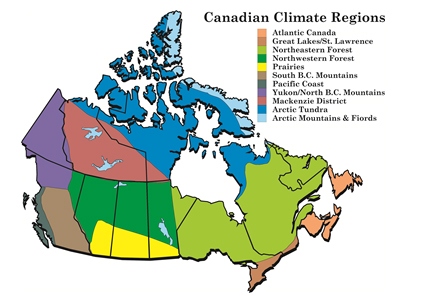
When examined on a regional basis, average autumn temperatures for 2016 were among the 10 warmest on record since 1948 for nine of the eleven climate regions: the Great Lakes/St. Lawrence (warmest at 2°C above average), the Northeastern Forest (third warmest at 2.4°C above average), the Pacific Coast (third warmest at 1.2°C above average), the Arctic Mountains and Fiords (4th warmest at 3.6°C above average), the Arctic Tundra (4th warmest at 3.2°C above average), the Northwestern Forest (4th warmest at 2.3°C above average), the Prairies (5th warmest at 2.2°C above average), the Mackenzie District (6th warmest at 2.4°C above average), and Atlantic Canada (8th warmest at 1.4°C above average). None of the eleven climate regions experienced an average autumn temperature for 2016 that ranked among the 10 coldest since 1948. All eleven climate regions exhibit positive trends in autumn temperatures over the 69 years of record. The strongest trend is observed in the Arctic Tundra and the Artic Mountains and Fjords regions (2.5°C) while the weakest trend (0.6°C) is found in the South B.C. Mountains. A table listing the regional and national temperature departures and rankings from 1948 to 2016 and a table that summarizes regional and national trends and extremes are available on request to ec.btvc-ctvb.ec@canada.ca.
Long description
A map that shows the Canadian Climate Regions: Atlantic Canada, Great Lakes/St. Lawrence Lowlands, Northeastern Forest, Northwestern Forest, Prairies, South British Columbia Mountains, Pacific Coast, North British Columbia Mountains/Yukon, Mackenzie District, Arctic Tundra, Arctic Mountains and Fiords.
National precipitation
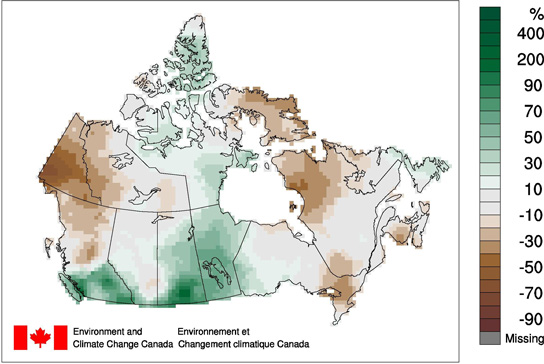
The national average precipitation for the autumn of 2016 was 4.6% above the baseline average, based on preliminary data, making it the 25th wettest autumn since nationwide recording began in 1948. The wettest autumn was 2010 (14.5% above the baseline average) and the driest autumn was 1952 (23.3% below the baseline average). The precipitation percent departure map for the autumn of 2016 (below) shows that conditions were considerably wetter-than-average in the southern B.C., southern Alberta, most of Saskatchewan, Manitoba, western Ontario, and most of central Nunavut. The Yukon, northern B.C. Mountains, western Northwest Territories, eastern Nunavut, western Quebec, southern Quebec, southern Ontario, and New Brunswick show drier-than-average conditions.
Long description
The precipitation percent departure map for the autumn of 2016 shows that conditions were considerably wetter-than-average in the southern B.C., southern Alberta, most of Saskatchewan, Manitoba, western Ontario, and most of central Nunavut. The Yukon, northern B.C. Mountains, western Northwest Territories, eastern Nunavut, western Quebec, southern Quebec, southern Ontario, and New Brunswick show drier-than-average conditions.
It should be noted that "average" precipitation in northern Canada is generally much less than it is in southern Canada, and hence a percent departure in the north represents much less precipitation than the same percentage in the south. The national precipitations rankings are therefore often skewed by the northern departures and do not necessarily represent rankings for the volume of water falling on the country.
The precipitation percent departures graph (below) shows that, when averaged across the nation, autumn precipitation amounts have tended to be wetter than the 1961-1990 average since the beginning of the 1970s.
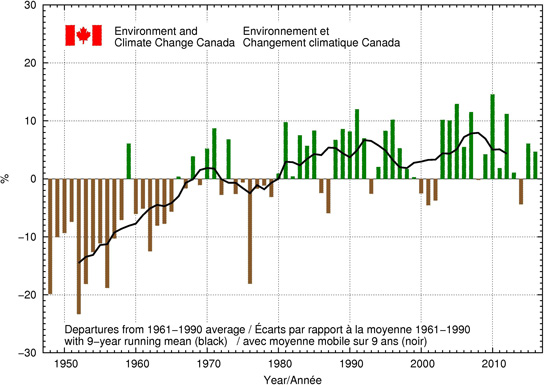
Long description
The precipitation percent departures graph shows that, when averaged across the nation, autumn precipitation amounts have tended to be wetter than the 1961-1990 average since the beginning of the 1970s.
Regional precipitation
Autumn precipitation for 2016 was among the 10 wettest recorded since 1948 in four of the eleven climate regions: the Pacific Coast (4th wettest at 26.9% above average); the Northwestern Forest (6th wettest at 25.2% above average); the South B.C. Mountains (6th wettest at 23.3% above average); and the Prairies (7th wettest at 46.1% above average). Autumn precipitation for 2016 was amongst the 10 driest recorded since 1948 in only one of the eleven climate regions: the Yukon/North B.C. Mountains (2nd driest at 35.1% below average). A table listing the regional and national precipitation departures and rankings from 1948 to 2016 and a table that summarizes regional and national extremes are available on request to ec.btvc-ctvb.ec@canada.ca.