
Consultation document: Acadian Redfish (Bonne Bay Population)
As part of the consultation process, the Government of Canada would like to hear your comments on the potential impacts of listing Acadian Redfish, Bonne Bay population (Sebastes fasciatus), as “special concern” under the Species at Risk Act (SARA). Fisheries and Oceans Canada (DFO) has prepared this summary to provide information on the state of the Bonne Bay population of Acadian Redfish.
As part of its strategy for the protection of species at risk, the Government of Canada proclaimed the Species at Risk Act (SARA) in 2003. One of the purposes of the SARA is to provide for the legal protection of wildlife species and the conservation of biological diversity. The Committee on the Status of Endangered Wildlife in Canada (COSEWIC) has the mandate to conduct assessments on the status of wildlife species and categorize them according to their level of risk for extinction (extinct, extirpated, endangered, threatened, or special concern). The Government of Canada considers the scientific evidence, the comments received from Canadians during consultations, and the potential socio-economic impacts before making a decision whether or not to include the species on the List of Wildlife Species at Risk under SARA. Recovery planning is undertaken for all listed species, and prohibitions are put in place protecting species assessed as extirpated, endangered or threatened, from being harmed.
Figure 1. Acadian Redfish

Long description for Figure 1
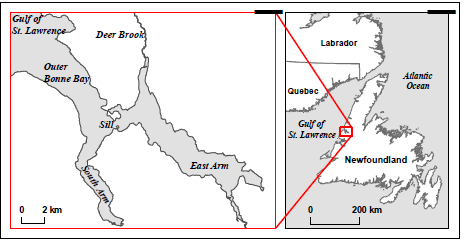
Acadian Redfish are spiny-rayed fishes of flame-red colour, commonly reaching 45 cm in length. Visually, they are virtually indistinguishable from Deepwater Redfish, S. mentella. Acadian Redfish are typically found at depths between 150 and 300 m. Their distribution is limited to the Northwestern Atlantic extending from the Gulf of Maine north to the Labrador Sea. The Bonne Bay population of Acadian Redfish is found in the East Arm of Bonne Bay Fjord. It is physically and genetically different from the Atlantic population, and it is isolated from that population due to limited water exchange between the Bonne Bay Fjord and the Gulf of St. Lawrence, and the shallow sill (~ 50 m in depth) at the entrance of the East Arm. Biological and ecological data on this population are lacking; however, other populations of the species are known to be long-lived and late maturing.
Figure 2. Location of Bonne Bay Fjord, Newfoundland. The Bonne Bay population of Acadian Redfish occurs in the East Arm of the fjord.
Long description for Figure 2
The level of protection and recovery actions undertaken for a species listed under SARA depends on its assessed level of risk for extinction. Acadian Redfish, Bonne Bay population, has been assessed by COSEWIC as a species of “special concern”. This is the lowest level of risk category and indicates that this species is not presently endangered, but is considered to be sensitive to human activities and natural events due to biological factors and/or threats. The designation of “special concern” for this population reflects a low resilience due to a long life span, slow growth, late maturity, small population range and size, and isolation from other Acadian Redfish populations.
COSEWIC noted that due to its small range and size, this population could be subject to environmental threats such as an oil or effluent spill from a highway along the north shore of the fjord.
There is currently no directed commercial fishery for Acadian Redfish in Bonne Bay. There may, however, be incidental catches of redfish in other commercial fisheries and in recreational fisheries. It is not known if Acadian Redfish, Bonne Bay population, has any historical significance to Aboriginal peoples or local communities, nor is it known to be used for food, social, or ceremonial purposes. No Aboriginal or community traditional knowledge about these fish has been collected at this time.
If the Bonne Bay population of Acadian Redfish is added to the List of Wildlife Species at Risk as a species of “special concern”, it will not be subject to prohibitions under SARA; however, DFO will be required to produce a management plan for the species in an effort to ensure that it does not become further at risk due to human activity. A SARA management plan will include conservation measures for the species and set goals and objectives for maintaining sustainable population levels.
If the Bonne Bay population of Acadian Redfish is listed under SARA, DFOwill, in collaboration and consultation with stakeholders and partners, use the best available information to develop a management plan.
As part of the consultation process, the Government of Canada would like to hear your opinions on listing Acadian Redfish, Bonne Bay population, as “special concern” under SARA, and any comments on the potential positive and negative impacts this listing would have on you, your industry, and/or the ecosystem. Your answers to the following questions will be used to help inform the decision whether or not to list the species under SARA:
- How would your activities be affected if the Bonne Bay population of Acadian Redfish was listed as “special concern” under SARA?
- What would be the environmental, social, cultural, and economic impacts of listing this species under SARA?
- Do you support listing the Bonne Bay population of Acadian Redfish as “special concern” on the List of Wildlife Species at Risk under SARA? Why or why not?
- Do you represent an industry, community, Aboriginal community or organization, or other group? If so, which group or sector do you represent?
To submit answers to the above questions or share your comments, please contact:
Species at Risk Program
Fisheries and Oceans Canada
P. O. Box 5667
St. John’s, NL
A1C 5X1
Fax: (709) 772-5562
E-Mail : saranl-leptnl@dfo-mpo.gc.ca
For a copy of the COSEWIC assessment for this species, or for other general inquiries, please visit the SARA Public Registry.
COSEWIC. 2010. COSEWIC assessment and status report on the Deepwater Redfish/Acadian Redfish complex Sebastes mentella and Sebastes fasciatus, in Canada. Committee on the Status of Endangered Wildlife in Canada. Ottawa. x + 80pp.