Branched bartonia (ssp. paniculata) COSEWIC assessment and status report: chapter 3
Species Information
Name and classification
Scientific name: Bartonia paniculata (Michx.) Muhl. ssp. paniculata
Common name: branched bartonia
Family: Gentianaceae (Gentian Family)
Major plant group: Dicot flowering plant
Description
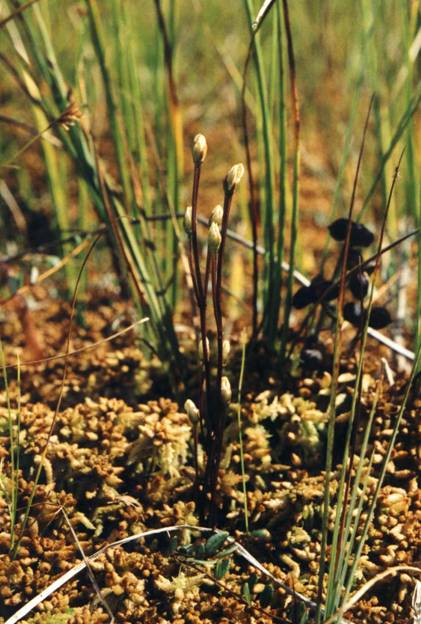
Branched bartonia is an annual herb 1 to 4 dm tall with a green or purple angled and occasionally twining stem. Due to its common habit of growing deeply nestled in sphagnum moss, it generally appears much shorter (see Figure 1). The leaves are reduced to minute scales arranged in an essentially alternate fashion. The inflorescence is usually a panicle of few to numerous small white 4-lobed flowers and divergent or curved ascending branches. The capsule tapers to a blunt tip and averages 4.2 mm long. The seeds average 0.19 mm long x 0.12 mm wide with 1000 to 1500 per capsule (Gillett, 1959; 1963). In view of the plant's greatly reduced leaves and thus its limited photosynthetic capacity, branched bartonia may be heterotrophic, i.e., dependent on soil fungi for much of its nutrient requirements (Reznicek & Whiting, 1976).
The genus has three taxa in Canada. Bartonia virginica also occurs in southern Ontario and Bartonia paniculata ssp. iodandra occurs in Nova Scotia, New Brunswick and on insular Newfoundland. The subspecies iodandra is not presently of conservation concern, overall, in Atlantic Canada. The presence of a slender and lax stem with alternate leaves and pedicels and yellow anthers distinguishes Bartonia paniculata ssp. paniculata from its nearest relatives. Bartonia paniculata ssp. iodandra has a thick stout stem with purple anthers or filaments. Bartonia virginica has opposite leaf scales and pedicels. The present treatment follows Gillett (1959), who did not recognize ssp. paniculata as occurring in Nova Scotia. Roland and Smith (1969), however, considered that there was a gradation of plants from typical ssp. paniculata in southwestern Nova Scotia to plants with distinctive ssp. iodandra features in Cape Breton. Further clarification of the taxonomy of this species in the Maritimes is required. In spite of this possible intergradation between the two subspecies in Nova Scotia, the Ontario populations represent an appropriate designatable unit due to their occurrence in a distinct biogeographic region from that in the Maritimes.
Figure 1. Bartonia paniculata ssp. paniculata nestled in sphagnum moss at Site 3