
Foothill sedge (Carex tumulicola) COSEWIC assessment and status report: chapter 3
Species Information
Name and classification
Scientific name:
Carex tumulicola Mackenzie
Common name:
foothill sedge, Berkeley sedge, splitawn sedge
Family:
Cyperaceae, sedge family
Major plant group:
Monocot flowering plant
Carex hoodii, the most common relative of C. tumulicola, occurs in British Columbia generally south of 55th parallel. Another member of this group, Carex vallicola, has been reported from British Columbia only recently from the Ashnola River Valley (Douglas et al. 2001).
Carex tumulicola is closely allied taxonomically to Carex hookeriana Dewey, which occurs in the Great Plains and is disjunct geographically. Carex occidentalis L.H. Bailey, of the southern Rocky Mountains and the Great Basin region, is a third microspecies of this complex (Hitchcock et al. 1969).
Morphological description
Carex tumulicola is a grass-like perennial from short rhizomes, forming loose tufts up to about 80 cm tall, and occasionally sods (Figure 1). The stems are taller than the leaves, arising in circular clusters with less dense centres. Leaves are flat, 1-2.5 mm wide, and 2 to 3 per stem. Each stem bears 3 to 10 spikes. The spikes are small and few-flowered (with male flowers occurring above the female flowers on the same spike), and loosely aggregated into an oblong- or cylindric-shaped head. Bracts are well developed and awnlike, the lower ones generally longer than the inflorescence. The pale green to pale brown perigynia (sacs encasing the ovaries) are egg-shaped or elliptical and 3.5-5 mm long. The scales are brown with a greenish midvein and translucent margins, short-awned, and as long as the perigynia. The fruits consist of nutlike achenes. These are lens-shaped, smooth, and 1.8-2.2 mm long (Douglas et al. 2001, Ball 2002).
Figure 1. Illustration of Carex tumulicola: entire plant, close-up of inflorescence and a single ripe perigynium (line drawing in Hitchcock et al. 1969 and Douglas et al. 2001; reproduced with permission from University of Washington Press).
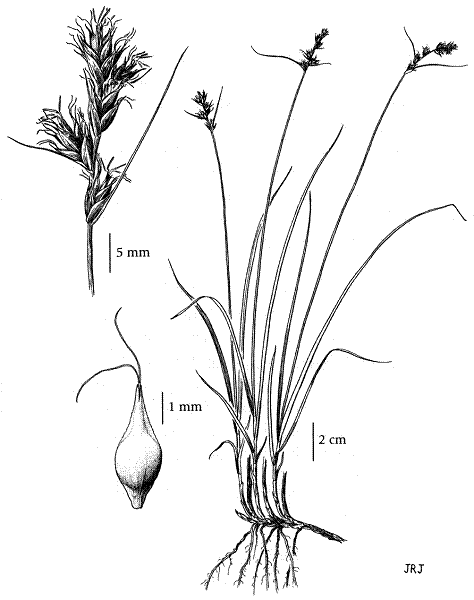
Useful field characteristics include its loosely tufted habit and generally well-developed bract surpassing the lower spike.
Many other Carex species resemble C. tumulicola in general appearance, and positive identification requires mature specimens and use of a technical key and hand lens or microscope. Other sedge species that occur in similar habitats to C. tumulicola and that may be mistaken for it include C. inops (long-stoloned sedge), C. hoodii (Hood’s sedge), and C. vallicola (valley sedge). Carex inops has male and female flowers on separate spikes, hairy perigynia, and 3-angled achenes. Carex hoodii has spikes that are more tightly clustered and more markedly bicoloured. Carex vallicola does not get over about 40 cm tall, and has pale scales usually shorter than the perigynia. The latter two species both lack well developed subtending bracts that surpass the lower spikes.
Genetic description
The population genetic structure of Carex tumulicola in Canada has not been studied. However, given the species’ lack of innate dispersal mechanisms, its non-aquatic habit, and the fairly large distances (10s of kms) that separate many of the C. tumulicola populations on southeastern Vancouver Island, genetic interchange among populations likely occurs infrequently, if at all. Because all Carex pollen is air borne, it is theoretically possible that wind-aided transport of gametes could be acting to link isolated locations to each other, although the chances of this occurring on a regular basis seem remote. Given the likely very small effective sizes of most populations, loss of vigour due to local inbreeding effects could be a limiting factor for this species in Canada.
Designatable units
A single designatable unit is recognized because of the limited geographical range that occurs within a single COSEWIC national ecological area.