
Small-flowered sand-verbena COSEWIC assessment and status report: chapter 3
Species Information
Name and classification
Scientific name:
Tripterocalyx micranthus (Torr.) Hook.
Formerly:
Abronia micrantha Torr.
Common Name:
Small-flowered sand-verbena
Family:
Nyctaginaceae; four-o'clock family
Major Plant Group:
Dicot flowering plant
Description
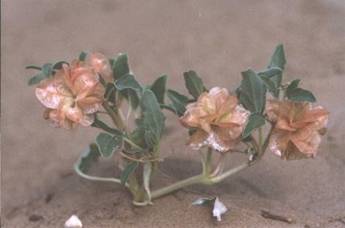
Small-flowered sand-verbena Tripterocalyx micranthus (Torr.) Hook. (formerly Abronia micrantha Torr.) is a member of the Nyctaginaceae, the four-o'clock family so named because the flowers tend to open in the late afternoon. Small-flowered sand-verbena (Figure 1) is an annual, from a taproot, much-branched plant, 2-5 dm high with trailing branches up to 6 dm long, the tips ascending. The succulent, pale stems are enlarged at the nodes. The paired leaves are entire, somewhat round, and have prominent veins. Leaf blades are 2-6 cm long, 1-3 cm wide. Unlike the similar sand dock (Rumex venosus), small-flowered sand-verbena has no sheathing stipules. The tiny greenish-white flowers are quite showy as they are arranged in dense clusters with a ring of bracts underneath. Flowers lack petals but have 5 petal-like lobes formed into a 5 mm broad long tube. There are five stamens, one style, and one superior pistil.
Figure 1. Small-flowered sand-verbena
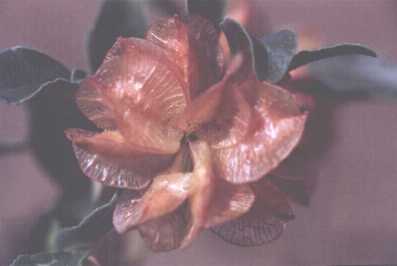
When the ovary develops into the fruit (Figure 2), the base of the calyx tube becomes transformed into a winged structure, closely enclosing the fruit and aiding in its dispersal. These winged fruits are characteristic and look quite attractive as they are pale green with a pink blush. The fruit is about 2 cm long with 2-3 thin, papery, strongly veined nerves.
Figure 2. Small-flowered sand-verbena fruit
Only one other species of the genus Tripterocalyx (formerly Abronia) occurs in Canada, namely, Abronia latifolia Eschsch, the yellow small-flowered sand-verbena. Because, this species is restricted to southwestern British Columbia it cannot be confused in the field with small-flowered sand-verbena.
Small-flowered sand-verbena superficially resembles wild begonia (Rumex venosus), but wild begonia is a perennial plant with stout (not brittle), erect stems; its flowers are borne in leafy, branched clusters at the stem tips. Young small-flowered sand-verbena plants sometimes resemble members of the goosefoot family in shape, colour and mealiness (of the underside of the leaves) (Alberta Native Plant Council 2001).