
Small-flowered sand-verbena COSEWIC assessment and status report: chapter 5
Habitat
Habitat requirements
Small-flowered sand-verbena is found in dry habitats, particularly in loose sands of dune and sandhill areas. Some element of active sand is usually required. The largest populations are on hard packed finer sand on level terrain but it also occurs on south, west, and east-facing slopes and along dune ridge tops. Most sites are on the uplands but the species may also occur in the valleys of the Lost and South Saskatchewan Rivers where sand dunes extend down into the valleys. Common species associated with small-flowered sand-verbena area spear grass (Stipa comata), sand grass (Calamovilfa longifolia), buckbrush (Symphoricarpos occidentalis), rose (Rosa acicularis), chokecherry (Prunus virginiana), silverberry (Elaeagnus commutata), Indian rice grass (Oryzopsis hymenoides), scurf pea (Psoralea lanceolata), June grass (Koeleria macrantha), sand dropseed grass (Sporobolus cryptandrus), golden aster (Heterotheca villosa) and petiolate sunflower (Helianthus petiolaris).
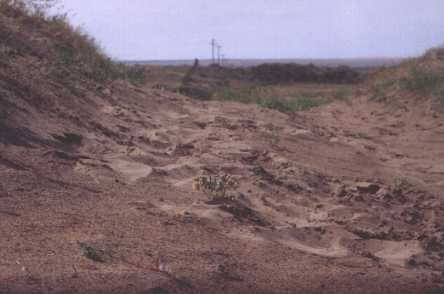
Bow Island, Alberta site - one plant found on a road cut (Figure 5) that has exposed actively blowing sand. At this particular site, the specimen of small-flowered sand-verbena was located on open sand mostly devoid of any other vegetation. The occasional scurf pea, prostrate Amaranth (Amaranthus graecizans), and Indian rice grass were located in the same area. Formerly, this site had supported the largest Canadian population of small-flowered sand-verbena.
Figure 5. Small-flowered sand-verbena habitat at the BowIslandsite. This site formerly supported the largest population.
Trends
In Alberta, about 20% of the rare plants in the grassland and parkland regions are found in sandy soils, principally in sand hill areas. Sand hill areas are locally distributed, and diverse sand hill areas are rare.
There has been a substantial decrease in suitable habitat for small-flowered sand-verbena over its Canadian range. Sand dune stabilization has resulted in a considerable and sometimes total loss of active sand deposition required by the species. Dune stabilization has resulted in the loss of two of the six known Canadian sites. Little active sand remains at any of the sites. The process of dune stabilization has allowed various prairie and weedy species to overtake the open sandy habitat necessary for the survival of small-flowered sand-verbena.
Protection/ownership
All Alberta sites occur on crown land presently held under grazing (Wolf Island, Purple Springs, Bull Pound) or oil/gas leasehold (Bow Island). The Lost River site is located on Dominion Experimental Farm land presently used for grazing cattle. The Suffield site is located within the Suffield National Wildlife Area along the eastern end of Whitco Road. No information on land use was presented by Macdonald (1997) in his report on the wildlife area.
The Saskatchewan site occurs on crown land used for grazing cattle.