
COSEWIC Assessment and Status Report on the Western Waterfan Peltigera gowardii in Canada - 2013
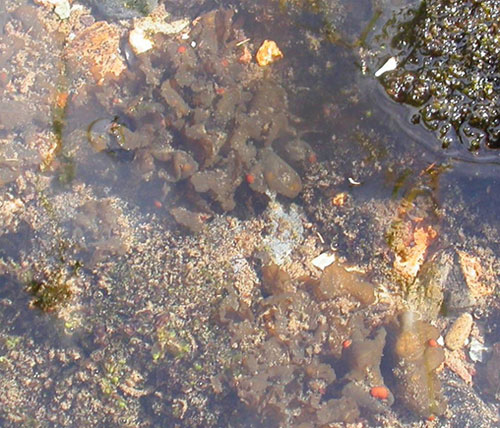
Special Concern
2013
- Document Information
- COSEWIC Assessment Summary
- COSEWIC Executive Summary
- Technical Summary
- Wildlife Species Description and Significance
- Distribution
- Habitat
- Biology
- Population Sizes and Trends
- Threats and Limiting Factors
- Protection, Status, and Ranks
- Acknowledgements and Authorities Contacted
- Information Sources
- Biographical Summary of Report Writers
- Collections Examined
List of Figures
- Figure 1. A colony of Peltigera gowardii growing just above summer water level among wet bryophytes by the side of a stream on Hudson Bay Mountain, Smithers. Note the reddish-brown fruit bodies of the lichen (photo: D. Richardson).
- Figure 2. The distribution of Peltigera aquatica (triangles) in the USA, and of P. gowardii in Canada (circles) (map: R. Cameron).
- Figure 3. The distribution of Peltigera gowardii in Canada. Green dots show occurrences where the lichen has been found. Open black circles show areas searched unsuccessfully since 1970. The red triangles are occurrences with known historical records of this lichen that were not relocated during the 2011 field surveys (map: R. Cameron).
- Figure 4. Major collection sites for macrolichens in British Columbia. These represent data from approximately 5,000 specimens deposited at UBC and currently in the database. There are many other records that exist in other databases or herbaria, but this figure indicates the extensive lichen surveys that have been completed in British Columbia.
- Figure 5. Major collection sites for macrolichens in subalpine and alpine zones in western Canada. Solid circles indicate sites where general surveys of macrolichens were collected within these zones. The black triangles indicate known sites for Western Waterfan.
- Figure 6. A stream on Hudson Bay Mountain, Smithers, B.C., colonized by Peltigera gowardii, elevation about 1600m, showing typical habitat for the species (see Table 2) (photo: D. Richardson).
- Figure 7. The subalpine habitat of Peltigera gowardii on Trophy Mountain, Clearwater, B.C. A path crosses two streams where P. gowardii occurs, one of which, Drinking Water Creek, is the holotype locality for P. gowardii. A board walk has been added to protect the vegetation where the path goes over a boggy area, and culverts have been added to take streams under the path. In spite of these remedial actions, silt from the path was still observed in the streams below the path and such silt is known to adversely affect P. gowardii (photo: D. Richardson).
- Figure 8. Mud bogging is a popular activity with ATVs on mountain wetlands and wet meadows in B.C. This photo was taken on Microwave Mountain, Smithers, B.C. to show disturbance and potential for siltation into nearby streams (photo: D. Richardson). Although P. gowardiiwas not found there, Hudson Bay Mountain, where this lichen occurs, is just as accessible from the town.
List of Tables
- Table 1. A list of the five locations, five occurrences and eight sites where P. gowardii has been found in Canada (as well as the two occurrences where it was not found in recent surveys). To understand this table, note that: a site is where the lichen under study is actually found and the position recorded using GPS or map reference. When two or more sites are less than 1 km apart from each other, they comprise a single occurrence. If sites occur more than a km from one another, they are considered to be separate occurrences. One or more occurrences that are affected by the same major threat or threats are defined as a location (in the IUCN sense that is used by COSEWIC, 2013).
- Table 2. Canadian sites where Peltigera gowardii was found during surveys in 2011. Note that where two sites are within 1 km of each other, they are referred to in the text as comprising a single occurrence. Where a major or probable threat affects more than one occurrence simultaneously, the occurrences concerned are considered to be a single location. Thus there are currently eight sites where P. gowardii has been found in Canada that comprise five occurrences and five locations where It is often difficult to distinguish and enumerate individual thalli of P. gowardii, so they have been assessed as colonies. Streams were searched from upper alpine meadows to where they disappeared underground or where they entered forested areas where no lichens seen. DNC = data not collected
- Table 3. Details of streams searched in Garibaldi Lake and Brew Lake areas near Whistler, British Columbia, in October 2011 by Curtis Björk and Bob Brett. No thalli of P. gowardii were seen except in one creek where it was found on two cobbles. DNC – Data not collected.
- Table 4. Models predicting likely climatic changes over the next 30 years at the various sites where P. gowardii is currently found. Scenario 1 is modelled current climate for each occurrence site. Scenario 2 is the predicted climate using the hot/dry climate model, and Scenario 4 is the predicted climate at each occurrence site using a cool/wet model.
- Table 5. The results of the Threats Classification and Assessment Calculator exercise for P. gowardii.
- Table 6. The threats faced by Peltigera gowardii colonies at the various sites where it occurs or has occurred in British Columbia.

Committee on the Status of Endangered Wildlife in Canada (COSEWIC) status reports are working documents used in assigning the status of wildlife species suspected of being at risk. This report may be cited as follows:
COSEWIC. 2013. COSEWIC assessment and status report on the Western Waterfan Peltigera gowardii in Canada. Committee on the Status of Endangered Wildlife in Canada. Ottawa. xi + 39 pp. (Species at Risk Public Registry website).
COSEWIC would like to acknowledge David H. S. Richardson, Frances Anderson and Robert Cameron for writing the status report on the Western Waterfan, Peltigera gowardii, in Canada, prepared under contract with Environment Canada. This report was overseen and edited by René Belland, Co-chair of the COSEWIC Mosses and Lichens Specialist Subcommittee.
For additional copies contact:
COSEWIC Secretariat
c/o Canadian Wildlife Service
Environment Canada
Ottawa, ON
K1A 0H3
Tel.: 819-953-3215
Fax: 819-994-3684
COSEWIC E-mail
COSEWIC web site
Également disponible en français sous le titre Évaluation et Rapport de situation du COSEPAC sur le Peltigère éventail d’eau de l’Ouest (Peltigera gowardii) au Canada.
Cover illustration/photo:
Western Waterfan - photo D. Richardson.
© Her Majesty the Queen in Right of Canada, 2014.
Catalogue No. CW69-14/686-2014E-PDF
ISBN 978-1-100-23557-8

Assessment Summary - November 2013
The Western Waterfan is a leafy lichen that forms semi-erect, small rosettes that are attached to rocks by holdfasts. The lichen is olive-black and jelly-like when wet but slate gray to black and crisp when dry. The upper surface is smooth and dull, and the lower surface similar except for the presence of distinct pale veins. There are no vegetative propagules. The fruit bodies of this lichen are reddish-brown and contain sacks of colourless, elongate, ascospores. The photosynthetic partner is a cyanobacterium. The Western Waterfan is one of very few leafy lichens that can grow at or below water level.
The Western Waterfan is only found in western North America, occurring from northern Washington to Alaska. In Canada, the Western Waterfan is restricted to British Columbia and has been found near the towns of Clearwater, Smithers, Terrace and Whistler. The best estimate from the 2011 surveys in Canada is that there are currently five locations for Western Waterfan. Recent surveys indicate that two additional occurrences--one near Fight Lake, Clearwater, and one near Garibaldi Lake, Whistler--are extirpated.
The Western Waterfan is found growing at or below water level, in spring-fed streams, in open subalpine and sometimes alpine meadows, above about 1200m elevation a.s.l. The streams are usually one metre or less across with flowing, cool, silt-free water of neutral pH and conductivity near 8µS/cm.
Fruit bodies are common in the Western Waterfan. It is suspected that when thalli are at or above water level, the fungal spores are shot into the air. If they land on a rock in a stream with appropriate water quality, they germinate and are attracted to nearby compatible cyanobacteria, which become enveloped by the fungal strands and eventually grow into a visible lichen. The generation time for lichens varies from ten years in rapidly colonizing lichens, to more than 17 years for old-growth forest species.
Western Waterfan produces no specialized vegetative propagules, but it is likely that asexual reproduction and dispersal are achieved when small pieces of lichen break off and become attached downstream. The cyanobacteria within the lichen provide the fungus with carbohydrates and are also able to fix atmospheric nitrogen.
Historical records of the Western Waterfan have not included estimates of the numbers of mature plants at each site. Abundance varies greatly among locations; in some there are only a few thalli (colonies), while in others the lichen colonizes almost every stone in a stream. In the latter case, colonies are difficult to count, because adjacent individuals often overlap. The Canadian population estimate in 2011 was in the range of 727-1,000 mature individuals, and even allowing for the possibility of a further discovery, it seems unlikely that the total population of this lichen in Canada will exceed 2,000 mature individuals (colonies). However, there is not enough documentation over a long enough time period to make an accurate evaluation.
The main threat to the Western Waterfan is climate change, especially in the interior mountain ranges of B.C. By 2050, summer temperatures are expected to rise by 3-4oC, and summer moisture deficit is also expected to increase. The combined impact of these changes will be severe at all elevations. For subalpine snowmelt-fed streams that support the Western Waterfan, widespread conversion of permanent watercourses to ephemeral streams is anticipated. This and the rising tree line will dramatically restructure all alpine communities. For a rare species like the Western Waterfan, widespread contraction of available habitat could have severe consequences. In addition, in coastal B.C. the winters are likely to become shorter and wetter, while the summer season will be longer and drier. There may be a decline in snowpack with more freeze-thaw events, resulting in denser snow with more crusts and icy layers. Again, such changes could adversely affect Western Waterfan populations.
The second most important factor affecting the Western Waterfan is human disturbance. Mountain roads, often developed to allow tourists to visit subalpine areas, can concentrate water flow and divert natural water drainage systems. At higher elevations, path building / use (pedestrian, ski, ATV, snowmobile) and culvert installation threaten Western Waterfan habitat by changing water flows and increasing sediment loads.
In Canada, the Western Waterfan is listed by NatureServe (2013), as S1S2 for British Columbia, where it is deemed vulnerable to trail development (B.C. CDC). The global status of the Western Waterfan is designated as G4 or ‘Apparently Secure’ (NatureServe 2013). In the USA, the state-level rankings range from S1 (critically imperiled) in Montana and Alaska, to S2 (imperiled) in Washington and S3 (vulnerable) in California; there is no ranking for Oregon.
Only the population on Trophy Mountain in Wells Gray Provincial Park and those in the Black Tusk area in Garibaldi Park are afforded some measure of protection because they are in provincial parks. The others are on Crown land and so not protected by designation or by legislation.
Peltigera gowardii
Demographic Information
Generation time (usually average age of parents in the population; indicate if another method of estimating generation time indicated in the IUCN guidelines (2008) is being used)
Uncertain, but may be 10 to 30 years, likely around 17 years
Is there an [observed, inferred, or projected] continuing decline in number of mature individuals?
Yes, inferred
Estimated percent of continuing decline in total number of mature individuals within [5 years or 2 generations]
Unknown
[Observed, estimated, inferred, or suspected] percent [reduction or increase] in total number of mature individuals over the last [10 years, or 3 generations].
Unknown
[Projected or suspected] percent [reduction or increase] in total number of mature individuals over the next [10 years, or 3 generations].
50% of known colonies in Canada occur on two mountains subject to human disturbance from trails, hiking, etc., related to recreational activities and also likely to be affected by climate change (global warming).
Suspected reduction of 50% over 51 years
[Observed, estimated, inferred, or suspected] percent [reduction or increase] in total number of mature individuals over any [10 years, or 3 generations] period, over a time period including both the past and the future.
Unknown
Are the causes of the decline clearly reversible and understood and ceased?
Changes due to human activities are understood and can be reversed, but those due to changes in weather patterns as a result of climate change cannot.
No
Are there extreme fluctuations in number of mature individuals?
Probably not
Extent and Occupancy Information
Estimated extent of occurrence
116,200 km2
Index of area of occupancy (IAO)
24 km2
Is the total population severely fragmented?
Yes this lichen requires habitat patches with the required conditions (subalpine streams that flow all year with pH around 7) and these are separated by long distances. This lichen also has no means of vegetative reproduction. Furthermore, the sexual spores likely have a limited dispersal and upon germination require a compatible cyanobacterium for resynthesis of the lichen. The Canadian occurrences are widely scattered on mountain tops in British Columbia.
Number of locationsFootnote∗ Eight sites comprising five occurrences that make up five locations.
5
Is there an [observed, inferred, or projected] continuing decline in extent of occurrence?
Yes, observed and inferred. This lichen appears to have disappeared from two occurrences and expected to decline due to global warming.
Is there an [observed, inferred, or projected] continuing decline in index of area of occupancy?
Yes, [observed, inferred, or projected] and inferred. This lichen appears to have disappeared from two occurrences and expected to decline due to global warming.
Is there an [observed, inferred, or projected] continuing decline in number of populations?
Yes, observed and inferred. This lichen appears to have disappeared from two occurrences and expected to decline due to global warming.
Is there an [observed, inferred, or projected] continuing decline in number of locations?
Yes, observed and inferred. This lichen appears to have disappeared from two occurrences and expected to decline due to global warming.
Is there an [observed, inferred, or projected] continuing decline in [area, extent and/or quality] of habitat?
Yes, inferred. Decline in area and extent from global warming and decline in quality of habitat due to human activity siltation.
Are there extreme fluctuations in number of populations?
Unlikely
Are there extreme fluctuations in number of locationsFootnote∗?
No
Are there extreme fluctuations in extent of occurrence?
No
Are there extreme fluctuations in index of area of occupancy?
No
| Population | N Mature Individuals |
|---|---|
| B.C. | 727+ |
| Total population estimate | <2,000 estimated |
Quantitative Analysis
Probability of extinction in the wild is at least [20% within 20 years or 50% in 30 years].
Not done
Threats (actual or imminent, to populations or habitats)
Climate change due to global warming resulting in widespread conversion of what are now permanent watercourses into ephemeral streams, especially in drought years. Rising tree lines will dramatically restructure the subalpine and alpine for all communities. For an already-rare lichen species, this widespread contraction of available habitat could have severe consequences. A second threat is human disturbance leading to siltation and change in stream water quality. This lichen requires clear cool water with a neutral pH.
Rescue Effect (immigration from outside Canada)
Status of outside population(s) In the USA, the state-level rankings range from S1 (critically imperiled) in Montana and Alaska, to S2 (imperiled) in Washington and S3 (vulnerable) in California; there is no ranking for Oregon.
Is immigration known or possible?
Possible but not known
Would immigrants be adapted to survive in Canada?
Probably
Is there sufficient habitat for immigrants in Canada?
At the moment but global warming is likely to drastically reduce the available habitat.
Is rescue from outside populations likely?
Possible but unlikely
Status History
Status and Reasons for Designation
Applicability of Criteria

The Committee on the Status of Endangered Wildlife in Canada (COSEWIC) was created in 1977 as a result of a recommendation at the Federal-Provincial Wildlife Conference held in 1976. It arose from the need for a single, official, scientifically sound, national listing of wildlife species at risk. In 1978, COSEWIC designated its first species and produced its first list of Canadian species at risk. Species designated at meetings of the full committee are added to the list. On June 5, 2003, the Species at Risk Act (SARA) was proclaimed. SARA establishes COSEWIC as an advisory body ensuring that species will continue to be assessed under a rigorous and independent scientific process.
The Committee on the Status of Endangered Wildlife in Canada (COSEWIC) assesses the national status of wild species, subspecies, varieties, or other designatable units that are considered to be at risk in Canada. Designations are made on native species for the following taxonomic groups: mammals, birds, reptiles, amphibians, fishes, arthropods, molluscs, vascular plants, mosses, and lichens.
COSEWIC comprises members from each provincial and territorial government wildlife agency, four federal entities (Canadian Wildlife Service, Parks Canada Agency, Department of Fisheries and Oceans, and the Federal Biodiversity Information Partnership, chaired by the Canadian Museum of Nature), three non-government science members and the co-chairs of the species specialist subcommittees and the Aboriginal Traditional Knowledge subcommittee. The Committee meets to consider status reports on candidate species.
A species, subspecies, variety, or geographically or genetically distinct population of animal, plant or other organism, other than a bacterium or virus, that is wild by nature and is either native to Canada or has extended its range into Canada without human intervention and has been present in Canada for at least 50 years.
The Canadian Wildlife Service, Environment Canada, provides full administrative and financial support to the COSEWIC Secretariat.
Peltigera gowardii is a foliose lichen forming semi-erect, small rosettes, each attached to the rock substratum by several holdfasts. The thallus is olive to black and jelly-like when wet (Figure 1). It is slate gray to black with ruffled margins when dry. The upper surface is smooth and the lower surface similar except for the presence of distinct pale veins composed of parallel, closely spaced, fungal hyphae. There is no distinct photobiont layer and the thallus is 140-160 µm thick. Apothecia are reddish-brown, submarginal, and sessile. The ascospores are hyaline, clavate-fusiform with three septa 24-33 x 6-8µ.
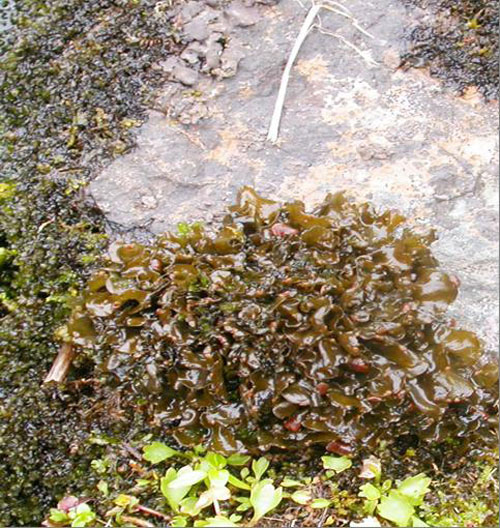
Photo: © D. Richardson
Long description for Figure 1
Photo of a colony of Peltigera gowardii growing just above water level among wet bryophytes by the side of a stream. The thalli are olive green and the apothecia are reddish-brown. Further details can be found in the preceding/next paragraph(s).
Vegetative propagules (soredia, isidia) are lacking.
No lichen substances have been reported for P. gowardii. All spot tests are negative and there is no fluorescence when thalli are placed under ultraviolet light (Lendemer & O’Brien 2011).
Recent work on the phylogeny of P. gowardii indicates a clear genetic distinction from the related species, P. hydrothyria, which is found only in eastern North America (Lendemer & O’Brien 2011). P. gowardii until recently was considered to be composed of two phylogenetic entities, but they were not sufficiently different to justify separate specific or subspecific status. One lineage occurs at northern sites: Washington, British Columbia (Canada) and Alaska (USA). The second is found in the USA south of Washington. Both lineages co-occur on Mt. Baker in Snohomish Co., Washington (Lendemer & O’Brien 2011). Recent more extensive work by Jolanta Miadlikowska and François Lutzoni (pers. comm. 2013) has shown that the two phylogenetic entities are in fact worthy of recognition at the specific rank. The southern species is now known as P. aquatica Miadl & Lutzoni (Figure 2).
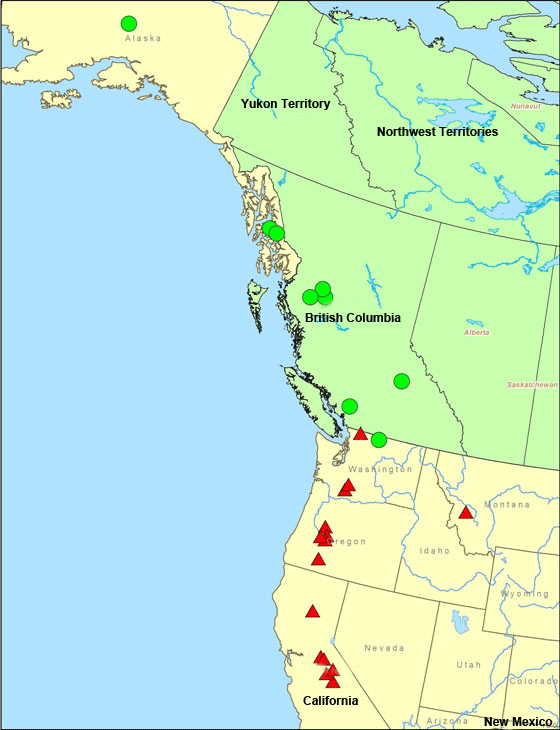
Map: R. Cameron © Environment Canada
Long description for Figure 2
Figure 2. Map of the distribution (symbols) of Peltigera aquatica and Peltigera gowardii. Peltigera aquatica is found in Washington, Oregon, Montana, and California. Peltigera gowardii is found in Alaska, British Columbia, and northern Washington on Mount Baker. Further details can be found in the preceding/next paragraph(s).
One designatable unit is recognized for P. gowardii on the basis of molecular studies (see above).
Only a few macrolichens worldwide have adapted to grow successfully below water in rivers and streams. Peltigera gowardii is endemic to western North America, and is renowned for its ability to colonize this unusual habitat.
Peltigera gowardii is endemic to western North America from Alaska to northern Washington (Figure 2). Attention was drawn to the Canadian population only in 1959 (Otto & Ahti 1967, McCune 1984). The southernmost record occurs at Mount Baker, just south of the Canada/USA border. The most northerly and westerly occurrence is in Denali National Park and Preserve (Walton & Nelson pers. comm. 2011).
The recently segregated, but closely related, P. aquatica occurs from Washington south to Mariposa, California, where it was collected as early as 1866 by H.N. Bolander. Poulsen & Carlberg (2007) reported 43 occurrences of this species, but more recent surveys suggest the number of occurrences in California is closer to 100. There are also 28 occurrences in Washington, 25 in Oregon, and two on the north fork of the Jocko River on Mission Mountain in Montana (Wheeler pers. comm. 2011) (Figure 2). The southernmost site for P. aquatica is in the Sequoia National Forest, California (Lesher et al. 2003, Peterson 2010).
The current known distribution of Peltigera gowardii in Canada is restricted to British Columbia (Figure 3) with five occurrences: one near each of Clearwater, Whistler and Terrace, and two near the town of Smithers (Table 1 and 2). P. gowardii (as Hydrothyria venosa) is listed in the second checklist of lichens of British Columbia (Noble et al. 1987). It is a component of the Columbia Mountains and Highlands Ecoregion (see Goward 1996; Goward & Ahti 1992, Goward et al. 1994, Goward 1996).
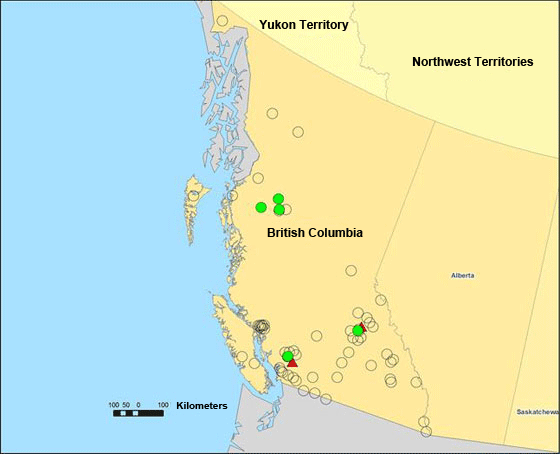
Map: R. Cameron © Environment Canada, 2011
Long description for Figure 3
Figure 3. Map of the distribution of Peltigera gowardii in Canada. Symbols indicate the current known distribution (five occurrences), areas searched unsuccessfully since 1970, and two historical occurrences that were not relocated during field surveys in 2011. Further details can be found in the preceding/next paragraph(s).
| Location number and the estimated number of mature individuals (colonies) | Occurrence number | Site and name of stream where P. gowardii found | Main threat |
|---|---|---|---|
| One (104 colonies) | One Clearwater | One Trophy Mountain Drinking Water Creek | Human disturbance, trail development |
| One (104 colonies) | One Clearwater | Two Trophy Mountain Stream two | Human disturbance, trail development |
| n/a ? extirpated | Clearwater. This was a separate occurrence from one above. | Fight Lake, None found in recent survey | Disappearance possibly due to rising temperature/reduced water flow |
| Two (>400 colonies) | Two Smithers | Three Hudson Bay Mountain Stream one, Smithers | Human disturbance, trails, hiking, increased sediment and rising temperatures |
| Two (>400 colonies) | Two Smithers | Four Hudson Bay Mountain Stream two, Smithers | Human disturbance, trails, hiking, increased sediment and rising temperatures |
| Two (>400 colonies) | Two Smithers | Five Hudson Bay Mountain Stream three, Smithers | Human disturbance, trails, hiking, increased sediment and rising temperatures |
| Three (>200 colonies) | Three Smithers | Six John Brown Creek, Smithers | Rising temperatures as a result of climate change |
| Four (3 colonies) | Four Terrace | Seven Trapline Mountain, Copper River valley, Terrace | Rising temperatures as a result of climate change |
| - | Five Whistler | Black Tusk area, Garibaldi Park. None found in recent survey | Changing weather patterns with late-lying snow |
| Five (>20 colonies) | Five Whistler | Eight Brew Lake Creek, Whistler | Changing weather patterns with late-lying snow |
| Site | Date of discovery | Collector | Date of most recent survey | Surveyors | Estimated number of colonies | Elevation in metres | pH of stream | Area of stream searched | Ownership/ Protection |
|---|---|---|---|---|---|---|---|---|---|
| Trophy Mountain Drinking Water Creek, Clearwater | 1979 | Trevor Goward | Sept. 2011 | David Richardson | 100 | 1938 | 7.0 | 100% | Wells Gray Provincial Park |
| Trophy Mountain Stream two, Clearwater | 2011 | - | Sept. 2011 | David Richardson | 4 | 1941 | 6.3 | 100% | Wells Gray Provincial Park |
| Fight Lake, Clearwater | 1985 | Trevor Goward | 2008 | Trevor Goward and Ted Ahti | None found in most recent survey | DNC | DNC | DNC | - |
| Hudson Bay Mountain Stream one, Smithers | 1980 | Jim Pojar | Sept. 2011 | Jim and Rosamund Pojar and David Richardson | >200 | 1580-1615 | 7.3 | 100% | Crown land but Ski Smithers may have lease on it |
| Hudson Bay Mountain Stream two, Smithers | 1980 | Jim Pojar | Sept. 2011 | Jim and Rosamund Pojar and David Richardson | >100 | 1699-1601 | 6.8 | 100% | Crown (public) land |
| Hudson Bay Mountain Stream three, Smithers | Sept. 2011 | - | Sept. 2011 | Jim and Rosamund Pojar and David Richardson | >100 | 1584 | 6.6 | 70% | Crown land |
| John Brown Creek* Smithers | Aug. 2011 | Jim and Rosamund Pojar | DNC | - | >200 | 1478 | DNC | 50% | Crown land |
| Brew Lake Creek**, Whistler | 1974 | Jim Pojar | Oct. 2011 | Curtis Björk and Bob Bret | <20 | 1429 | DNC | DNC | Crown land |
| Black Tusk Area, Garibaldi Park, Whistler | 1961 | Wilf Schofield | Oct 2011 | Curtis Björk and Bob Bret | None found in most recent survey | 1626-1722 | DNC | DNC | - |
| Trapline Mountain, Copper River Valley***, Terrace | 2011 | Darwyn Coxson | Aug. 2011 | - | 3 | 1390 | DNC | DNC | Crown land |
| Streams searched | Date | Elevation in metres | pH | Temp | Flow direction | Notes |
|---|---|---|---|---|---|---|
| Mimulus Creek, near Garibaldi Lake | 12 October | 1676 | 5.2 | 5.1 | SW | Cobbles, small boulders |
| Parnassas Creek | 12 October | 1702 to 1722 | 7.2 | 4.7 | SW | Cobbles, small boulders |
| Taylor Creek | 12 October, 2011 | 1626 | 6.1 | 2.2 | DNC | Cobbles, small boulders |
| Unnamed creek NE of Brew Lake | 13 October | 1308 | pH meter not working | DNC | ENE | Cobbles, gravel |
| 15 small creeks draining into Brew Lake. All the creeks on E, N and NW sides of the lake were searched | 13 October | 1429 | pH meter not working | 3.5 | Various | One creek yielded two cobbles with tiny lobes of P. hydrothyria |
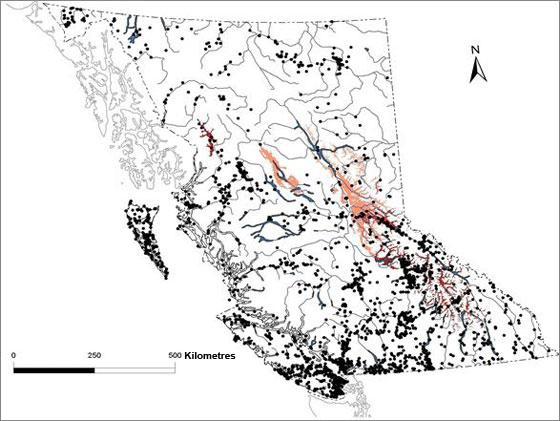
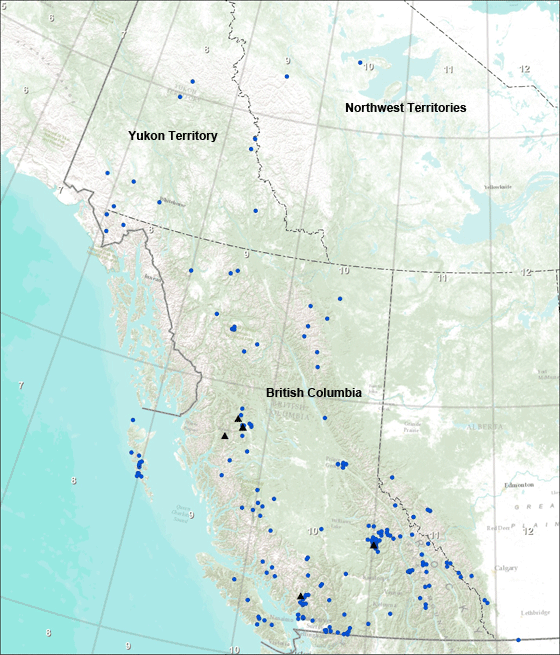
There have been extensive searches for lichens in the province of British Columbia (Figure 4) beginning in the mid-1960s by at least five major professional lichenologists / lichenology teams (Goward et al. 1998). The major vegetation zones where Peltigera gowardii has been found (the alpine and subalpine zones) have also been extensively surveyed for macrolichens in western Canada (Figure 5).
Map: © Environment Canada, 2013
Long description for Figure 4
Figure 4. Map of major collection sites (symbols) for macrolichens in British Columbia, representing data from approximately 5,000 specimens deposited at the University of British Columbia. Further details can be found in the preceding/next paragraph(s).
Map: © Environment Canada, 2013
Long description for Figure 5
Figure 5. Map of major collection sites for macrolichens in subalpine and alpine zones in western Canada. Symbols indicate sites of general surveys of macrolichens, as well as known sites for Peltigera gowardii. Further details can be found in the preceding/next paragraph(s).
Peltigera gowardii appears to have been first recorded in British Columbia in 1959 (see Otto & Ahti 1967), but the exact site is unknown. The earliest specimen was collected in 1966, from Warren Glacier foreland across from Black Tusk in Garibaldi Park. A second collection, in 1974, was from a stream flowing into Brew Lake, near Whistler. Jim Pojar and Trevor Goward were the first to pay particular attention to H. venosa (now P. gowardii) in their lichen surveys from the 1970s onward. The resulting records for P. gowardii in Canada are shown in Figure 3.
Jim Pojar has sought but not found Peltigera gowardii at Akamina-Kishinena Provincial Park, Babine Mountains Provincial Park, Cathedral Lakes Provincial Park, Manning Provincial Park, Mount Edziza Provincial Park, Tatlatui Provincial Park, Spatsizi Wilderness Provincial Park, and Tatshenshini-Alsek Provincial Park. He also did not see it during incidental rather than focused searches in the Rocky Mountain national parks. Furthermore, he has not found P. gowardii in the Yukon, nor on the hypermaritime mountains from northern Vancouver Island to Prince Rupert, where lichens, in and close to streams, appear to be out-competed by bryophytes and sedges. Jim and Rosamund Pojar also surveyed Hudson Bay Mountain and John Brown Creek in the Rocher de Boule Range, both near Smithers, in 2011. In 2012, they searched seven streams in the Babine Mountains Provincial Park but did not find the lichen.
Trevor Goward has searched the mountains in the Clearwater area and found P. gowardii on Trophy and Battle Mountains, but not on any of about 20 other peaks in this area. He also found P. gowardii in a stream east of Fight Lake near Clearwater in the 1980s, but it was absent when he revisited the site in 2008. Darwyn Coxson found P. gowardii on Trapline Mountain in the Zymoetz (Copper) River Valley near Terrace, but not in any of the subalpine and alpine creeks on the south face of Robson Valley, in the Sugarbowl-Grizzly Den Provincial Park (Goward and Coxson pers. comm. 2011). In 2012, Darwyn Coxson also searched rolling tundra and small streams, seemingly suitable habitat in the Coast Mountain range within the Tatshenshini Provincial Park but did not find additional sites for P. gowardii.
Neither Jim Pojar nor Irwin Brodo found P. gowardii on Haida Gwaii, even though the latter, over five field seasons, searched many sites that included subalpine streams which were carefully checked for lichens (Brodo pers. comm 2011).
In September 2011, David Richardson surveyed known sites near Clearwater (Trophy Mountain) and sites near Smithers (Hudson Bay Mountain) to assess the populations of P. gowardii in streams on these mountains where the lichen was known to occur. Richardson also searched a series of streams on Microwave Mountain near Smithers which had not been explored before, but did not find any P. gowardii.
Bob Brett and Curtis Björk carried out a parallel study in October 2011, to assess populations of P. gowardii at known sites in the Whistler area. They searched for P. gowardii in Mimulus Brook, Parnassus Creek and Taylor Creek in the Garibaldi Lake area where it has been found previously, but they did not locate any colonies of P. gowardii. They also searched an unnamed creek flowing into Brew Lake and found a few very small thalli with lobes only 1-2mm in size. During a visit in 1974, there were many more and larger colonies in the creek (Pojar pers. comm. 2011). In addition they examined approximately 15 other small streams flowing into Brew Lake but P. gowardii was not found (Table 5). A possible explanation for the absence of this lichen in 2011 in the Whistler area may be the extreme snow conditions in this area during the winter of 2010 and spring of 2011. The creeks containing known records of P. gowardii only became snow-free in October 2011, rather than in the normal June/July, so that the growth period was likely to have been severely curtailed (Björk pers. comm 2011).
In both Canada and the USA, Peltigera gowardii and the related P. aquatica are found only in streams where the water is free of silt, very close to neutral pH, low in nitrate and low in temperature.
Glavich (2009) and Peterson (2010) have written extensive reports on the habitat of the closely related P. aquatica in the USA, the results of which may be inferred to P. gowardii. It has been found at mid- to high elevation (840-2460 m) in streams that are typically spring-fed with relatively stable flows, and with little scouring or siltation. It is often associated with large elevation drops and waterfalls where the mixing of air and water increase the level of dissolved gases in the water (Davis et al. 2000). In the Pacific Northwest, the streams are associated with older forests. P. aquatica occurs both submerged and at water level. Water temperatures average 5˚C but may range as high as 19˚C (Peterson 2010). Minimum temperatures have not been reported. Water pH ranges from very slightly acidic to neutral (5.75-7.71) (Glavich 2009). P. aquatica has been found in the USA on all sizes of rock from sand to boulders to bedrock and has even been found growing on submerged wood (Glavich 2009, p.60). P. aquatica may be a remnant Arctic lichen, persisting in cool, fresh water following the last glaciation (Davis et al. 2003).
In Canada, P. gowardii is found on rock, at or below water level, in permanent, spring-fed streams through open subalpine or alpine meadows, above about 1200m a.s.l. (Figure 6). The streams are usually one metre or less across, with mean early September water temperature of 8.0oC (range 2.6-11.9), mean pH of 6.9 (range 6.6-7.3) and mean conductivity of 8.4 µS /cm (range 6-16) (n=5) (Table 2).
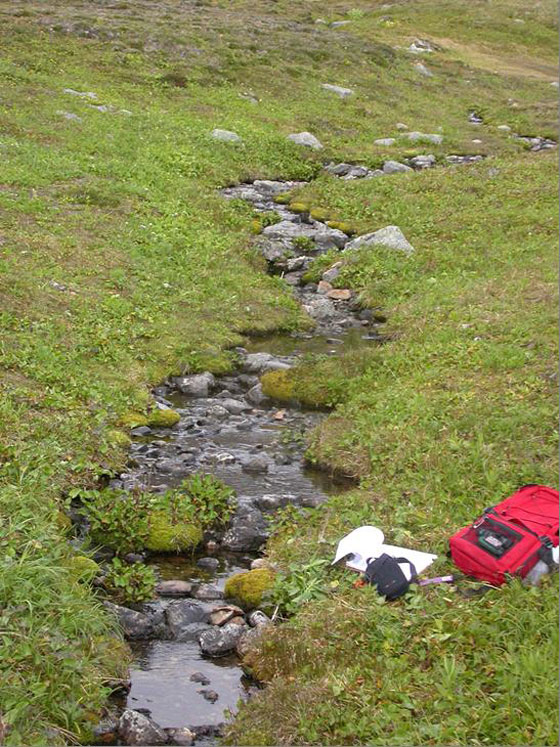
Photo: D. Richardson © Environment Canada, 2013
Long description for Figure 6
Photo of stream showing typical habitat for Peltigera gowardii on Hudson Bay Mountain, near Smithers, British Columbia, The rocky stream is flowing through an open meadow and generally appears to be less than a metre in width. A backpack on the ground to the right of the stream helps indicate scale. Further details can be found in the preceding/next paragraph(s).
Dramatic change has occurred in at least some of the subalpine habitats in British Columbia over the last 40 years. Trees have encroached on the meadows and are rapidly filling them in, especially in the absence of fire (see Threats section below). The apparent disappearance of P. gowardii from one site near Fight Lake, Clearwater, B.C. (Goward pers. comm. 2011) and from another in Black Tusk area near Garibaldi Lake in 2011 (Brett pers. comm. 2011) may be the result of changing weather patterns related to climate change rather than habitat disturbance (see Population Trends below). There seems little doubt that the subalpine habitats will be increasingly affected by climate change (Pojar 2010).
Sexual reproductive structures (apothecia) are common in P. gowardii. It is suspected that when thalli are at or above water level, their asci eject ascospores into the air. Some thalli can be found as much as one metre below the water level (Davis et al. 2003). From what is known about other foliose lichens, it seems unlikely that the asci in the apothecia of P. gowardii are able to discharge their spores when the thalli are under water. Ascospores of thalli growing at water level can be discharged into the air and when they land on a rock in a stream with appropriate water quality, it is presumed that they germinate and grow toward nearby cyanobacteria. If the latter are compatible, the cyanobacteria become enveloped by the fungal strands and together they grow to become a visible thallus (Honegger 2008). Under favourable conditions, thalli can develop into large colonies, 10 cm or more in diameter. The generation time for lichens varies from ten years in rapidly colonizing lichens such as Xanthoria parietina to more 17 years for old-growth forest lichens such as Lobaria pulmonaria (Scheidegger & Goward 2002, Larsson & Gauslaa 2010).
Lesher et al. (2003) state that P. gowardii, sensu lato, and Leptogium rivale share the same cyanobacterium. Free-living Nostoc is often present in streams where both lichens occur but no molecular work has been done to show that the free-living strains are those required by these lichens. Indeed, it has not been confirmed that the photobiont of P. gowardii is indeed Nostoc.
There are no specialized vegetative propagules, but small pieces of thallus that become detached may be able to reattach to rocks further downstream. Similarly, small rocks bearing P. gowardii could be dislodged during high water flow and move down stream (Peterson 2010). No experimental studies on dispersal appear to have been completed, however. Glavich (2009) noted that this lichen is vulnerable to scouring, which can dislodge colonies.
Transplantation can provide a means for re-establishing colonies at sites where P. gowardii has been lost, or for moving colonies upstream of a planned disturbance. For example, Chiska Derr (Lesher et al. 2003) reported successfully transplanting this lichen in the Washington Cascade Mountains. Twenty rocks colonized by P. gowardii were carried to shallow pools above culverts. In the following two years, only one colony failed to thrive because the rock had flipped over, killing the lichen (Geiser pers. comm. 2011).
A wide range of small invertebrates, including Thysanurans, Collembolans, Psocopterans, Lepidopteran larvae, orbatid mites and gastropods, are known to be associated with and feed on lichens (Seaward 2008). However, nothing is known about the invertebrates that might eat or associate with P. gowardii.
The closely related Peltigera aquatica generally grows submerged at a depth ranging from a few centimetres to over one metre (in the USA), and it is reasonable to assume that the ecology of P. gowardii is similar. However, it can also tolerate temporary exposure to air, and is often found above the seasonal low water mark (Glavich 2009). When dried out and then rewetted in the laboratory, however, this lichen did not recover, which indicates that is unable to tolerate drying for extended periods (Davis et al., 2003). Like other cyanobacteria-containing lichens, P. gowardii needs to be wetted with liquid water after becoming dry in order to re-establish photosynthesis (Lange et al. 1986). There is no doubt that water availability is the key to its growth and survival.
As with many lichens of Arctic and alpine regions, P. gowardii may exhibit a high rate of net photosynthesis at low temperatures. Experimental studies in the laboratory on the effects of water temperature on the closely related P. aquatica revealed that if illuminated, thalli maintained in water at 5oC showed little change in weight or photosynthetic capacity for periods as long as 400 days. However, at higher water temperatures, a faster decline in both parameters was observed: at 18oC this decline was evident after just 30 days, whereas at 11oC it was evident after 100 days. The decline in net photosynthesis was due to higher dark respiration rates. The range of water temperatures measured in streams where this lichen was found ranged from 2-16oC with a mean of 5.5oC (Davis et al. 2003).
Cyanobacteria, photobionts of P. gowardii, provide their fungal partner with carbohydrates and fixed atmospheric nitrogen (Jacobs & Ahmadjian 1973). Phosphate uptake, which is key to photosynthesis by the photobiont, is inhibited by low pH (Nash 2008), making these lichens very sensitive to acidification of the stream water by acid rain.
In laboratory studies, nitrate levels at or above 5 mM were found to cause a decline in photosynthesis and thallus weight. However, 2 mM nitrate maintained photosynthesis and a weight increase was observed that was greater than in the absence of this anion (Davis et al. 2000). Clear-cutting and the subsequent release of nutrients from root systems and debris can increase nitrate levels in runoff (Goudie 2006). Both this and the nitrate component of acid rain could increase nitrate levels in stream waters to the extent that P. gowardiipopulations are negatively affected (Davis et al. 2000) (see also Threats section below).
Peltigera gowardii has no specialized vegetative propagules such as soredia or isidia that can provide a means of efficient dispersal of both symbionts simultaneously via wind and water. However, dispersal by fragmentation is probably common; if the lobes dislodge and do not dry out, they may be able to reattach and provide a means of downstream dispersal and migration of P. gowardii within a watershed. Using highly visible red glitter as a dispersal mimic for small seeds of aquatic plants, Levine (2001) found the glitter 4.5 km downstream. Small thallus fragments of P. gowardii could move significant distances downstream in a similar way.
Movement upstream, however, is even more important for the survival of species, like P. gowardii, in alpine habitats that are shifting to higher elevations with climate change. Some colonies dry periodically in summer when water levels are low, and it is conceivable that lobes may be broken off and carried upstream by wind. Fragments of P. gowardii may also be dispersed upstream on the feet of birds, such as the Spotted Sandpiper and American Dipper, that use stream habitats (Wright pers. comm. 2011). During flights, it is conceivable that adult birds could move the lichen to neighbouring watersheds (Peterson 2010). Few studies have examined the efficacy or frequency of bird-mediated lichen dispersal (Bailey & James 1979), but the dispersal of the alpine lichen Thamnolia vermicularis south from the Arctic, from mountain top to mountain top as far as Marin County California, has been ascribed to Robins (Wright 1992). It is interesting that colonies of P. gowardii were found within one metre of the emergence of spring-fed streams on both Trophy Mountain and Hudson Bay Mountain in B.C. (Richardson and Pojar pers. comm. 2011), suggesting that propagules can be dispersed to the emergence point by some means.
Lichen ascospores provide another means of movement upstream and dispersal over longer distances, but this is dependent upon the spore landing on favourable habitat, in proximity to a suitable photobiont. Ascospore dispersal is probably the only means for long-distance dispersal, and is likely responsible for the current distribution of P. gowardii on mountains that are separated by distance and physical barriers (Peterson 2010).
Peltigera gowardii competes with bryophytes and other aquatic lichens for stream rock surfaces. No detailed studies have been done on the lichens and bryophyte associates of P. gowardii. However, the lichen associates of the closely related P. aquatica in the Sierra Nevada parks included Dermatocarpon bachmannii, D. luridum, D. meiophyllizum, D. reticulatum, and Leptogium rivale, and also likely crustose species such as Staurothele fissa and Verrucaria spp. (McCune et al. 2007). A wide range of aquatic and semi-aquatic bryophytes (Dillingham 2006) occur in the same habitat and are another potential source of competition, but such competition has not been assessed experimentally. Finally, at least in the USA, free-living Nostoc colonies that form ear-like lobes on rocks and streams are another potential source of competition for space. These Nostoc colonies are sometimes confused with P. aquatica, but they are bumpy, tend to have a greener colour, and lack the undersurface veins that are characteristic of P. gowardii and P. aquatica (Peterson 2010).
Lichens can be attacked by lichenicolous fungi, which may reduce growth and reproduction, but no attacks have been reported so far for P. gowardii in particular (Hawksworth 1983).
In Canada, P. gowardii occurs in isolated subalpine meadows, which can often only be reached by air. It was not possible to revisit the sites at Fight Lake and John Brown Creek, or several other historic locations, for this report. Prior to 2011 surveys, field data on P. gowardii was limited to recording its presence, the nature of the site, and co-occurring species.
Field surveys in 2011 took place near Clearwater, Smithers, Whistler, and Terrace, British Columbia. At each site, colony numbers were estimated, stream characteristics were recorded, and a specimen was collected. Data on stream temperature, pH and conductivity were recorded and nearby streams were surveyed for the occurrence of P. gowardii.
Where abundance has been estimated, it varies greatly (between a few to hundreds of thalli) among occurrences (an occurrence is defined as one or more sites, where the lichen occurs, that are within 1 km of one another). Where the margins of thalli overlap, it is more difficult to determine thallus and colony numbers. The best estimate from the 2011 surveys is that there are between 727-1,000 colonies (Table 2). Despite the inaccessibility of the species’ preferred habitat, it is unlikely that the total population in Canada will exceed 2,000 colonies, even when additional discoveries are made.
Not enough data have been collected in Canada to document past population fluctuations or trends, although recent visits indicate that this lichen has disappeared from two occurrences. The first is in a stream at Garibaldi Lake near Whistler, first found in 1961 but absent in 2011, and the second in a stream at Fight Lake near Clearwater, found in 1985 but no longer there in 2008 (Table 2, see also Habitat Loss or Degradation in the Threats section).
The US Forest Service reports that P. aquatica has been in decline throughout its current range, although Sierra Mountain populations appear to be stable at this time (Poulsen & Carlberg 2007). The number of known occurrences has increased dramatically since the 1980s, but this is due to the discovery of previously unknown occurrences (increased search effort) rather than to new recruitment (Peterson 2010). P. gowardii also occurs on Mount Baker in Washington and also in Alaska, but no information is available on trends in those populations.
There is very little possibility of rescue of Canadian populations of P. gowardii by thallus fragments or ascospores dispersed from Washington, USA, since the species is known from only one site there. It is more likely that dried thallus fragments could travel from the Alaskan populations, the open, windy alpine meadows of Tongass National Park, 500 km to the north to Canada. Thallus fragments could be transported to Canada on birds’ feet or feathers but this has not been proven (see Dispersal and Migration, above).
There are five locations for P. gowardii in Canada, when one considers the most imminent threats (Table 1). The Threats Calculator (Table 5) indicates that the threats pose a high risk to this species. The impact of human activities is estimated to be low, because these activities are serious at just two of the locations. However, at these two locations (Trophy Mountain and Hudson Bay Mountain), more than half the Canadian population of P. gowardii exists (Table 6). Both locations are currently popular recreation areas where streams supporting P. gowardii are threatened by disturbance and siltation from hiking, path construction and off-road vehicles. Changes in the weather patterns and climate will also likely lead to habitat loss. Climate change is expected to affect each of the five, widely separated locations (Figure 3) in a different way.
Peltigera gowardii is dependent upon climate-dependent ecological attributes at the landscape scale, e.g., enough precipitation to maintain year-round, moderate (but not excessive) silt-free stream flow, and conditions for maintaining low stream temperature and near-neutral pH. Climate change (global warming) is therefore likely to negatively impact the distribution and abundance of P. gowardii.
The effects of global warming on timberlines are not imminent; they have been happening for decades but are nevertheless clear and dramatic. For example, in August, 2011, a Botany B.C. excursion to a subalpine meadow site in Manning Provincial Park observed dramatic changes in the 40 years since the site was first studied (Jim Pojar Ph.D. thesis). Trees have encroached on the meadows and are rapidly filling them in, especially in the absence of fire (Pojar pers. comm. 2012). Similarly, at sites on the Cardinal Divide, on the eastern slope of the Rocky Mountains (Alberta), subalpine vegetation dominated by small trees and shrubs has replaced lichen-rich alpine habitat within the past thirty years (Marsh pers. comm. 2012).
In the interior mountain ranges of British Columbia, where most precipitation currently falls as snow, climate change modelling (Stevenson et al. 2011) suggests that by 2050, mean annual temperature will rise by almost 4oC, diminishing the amount of precipitation that falls as snow by as much 30%.
Data from two models predicting possible climate changes over the next 30 years are displayed in Table 4. These indicate that overall, where P. gowardii is found, the climate will become warmer in summer and the heat/moisture index, evaporation and moisture deficit will all increase significantly. The impact of these changes is likely to be severe in terms of the habitat attributes required by P. gowardii. D. Coxson (pers. comm. 2011) anticipates a widespread conversion of what are now permanent watercourses into ephemeral streams, especially in drought years. This, and rising tree lines, will dramatically restructure the alpine for all plant communities (Pojar 2010). For an already-rare species like P. gowardii, a widespread contraction of available habitat could have severe consequences (Coxson pers. comm. 2011). This conclusion is supported by a recent comprehensive report (Pojar 2010) that concludes that B.C. can expect wetter winters, especially in the north, and progressively warmer and probably drier (at least in the south) summers.
| Scenario | MWMT | MCMT | MAP | SHM | NFFD | PAS | EMT | Tmax_sm | Tmin_wt | PPT_wt | PPT_sm | Eref_sm | CMD_sm |
|---|---|---|---|---|---|---|---|---|---|---|---|---|---|
The models used were suggested by Tongli Wang. See: (PDF; 1.42MB); the site at Centre for Forest Conservation Genetics website is currently being updated. To model current climate, since there aren’t climate stations at the P. gowardii occurrences, climate normal data for 1961-1990 were used. The models for future scenarios selected were: AR4 UKMO HadA1B run 1 (hot / dry) and AR4 UKMO HadCM3 B1 run 1 (cool / wet). The climatic variables are listed below the table and can be found at: Centre for Forest Conservation Genetics website. (The models were run by Dr. Karen Golinski)
|
|||||||||||||
| Trophy Mountain, Clearwater 1 |
9.3 | -11 | 1143 | 19.5 | 99 | 665 | -42.2 | 14.2 | -14.1 | 326 | 310 | 250 | 0 |
| Trophy Mountain, Clearwater 2 |
14.6 | -8.2 | 1095 | 39.8 | 156 | 569 | -38.3 | 19 | -11.6 | 343 | 208 | 295 | 87 |
| Trophy Mountain, Clearwater 4 |
12.6 | -10.9 | 1174 | 29.7 | 131 | 659 | -39.1 | 17 | -13.3 | 377 | 267 | 276 | 16 |
| Hudson Bay Mountain, Smithers 1 |
11 | -11.6 | 830 | 36.1 | 113 | 479 | -42.7 | 16.3 | -14.5 | 263 | 185 | 267 | 82 |
| Hudson Bay Mountain, Smithers 2 |
15.5 | -8.5 | 825 | 57.6 | 163 | 395 | -37.9 | 20.6 | -11.2 | 279 | 159 | 309 | 150 |
| Hudson Bay Mountain, Smithers 4 |
13.5 | -12.7 | 918 | 41.3 | 139 | 471 | -39.7 | 18.5 | -14.2 | 286 | 185 | 287 | 102 |
| John Brown Creek*, Smithers 1 |
11.6 | -10.1 | 1077 | 29.1 | 133 | 565 | -40.7 | 16.6 | -12.7 | 326 | 232 | 263 | 31 |
| John Brown Creek*, Smithers 2 |
16.1 | -6.9 | 1075 | 45.2 | 178 | 440 | -35.6 | 20.8 | -9.5 | 350 | 203 | 303 | 100 |
| John Brown Creek*, Smithers 4 |
14.3 | -11.2 | 1194 | 33.2 | 157 | 549 | -38.3 | 18.7 | -12.5 | 356 | 232 | 283 | 51 |
| Brew Lake Creek, Whistler 1 |
12.7 | -5.5 | 2161 | 30.3 | 155 | 1088 | -33.4 | 17.2 | -7.9 | 846 | 213 | 285 | 72 |
| Brew Lake Creek, Whistler 2 |
18 | -2.9 | 2056 | 57.8 | 208 | 663 | -29.1 | 22.6 | -5.7 | 786 | 121 | 338 | 216 |
| Brew Lake Creek, Whistler 4 |
15.5 | -5.5 | 2197 | 43 | 185 | 887 | -31.8 | 19.6 | -7.1 | 876 | 167 | 308 | 141 |
| Trapline Mountain, Terrace 1 |
10.5 | -10.3 | 1992 | 23.1 | 107 | 1312 | -41 | 16.2 | -13.1 | 748 | 230 | 272 | 46 |
| Trapline Mountain, Terrace 2 |
14.8 | -7.2 | 2018 | 37.2 | 164 | 1029 | -36 | 20.5 | -9.9 | 780 | 198 | 315 | 117 |
| Trapline Mountain, Terrace 4 |
13.2 | -11.6 | 2189 | 27.3 | 135 | 1261 | -38.4 | 18.3 | -12.8 | 799 | 224 | 292 | 68 |
There may be a decline in snowpack with a change in freeze/thaw events (Pederson et al. 2011). This may result in denser snow with more crusts and icy layers. The coastal, or at least sub-maritime, localities like Whistler and Terrace will probably continue to receive lots of snow, albeit perhaps as a lower percentage of the total precipitation. This is also likely to apply to west-central B.C. but the models are somewhat equivocal about precipitation trends; it could become increasingly wet in summer or precipitation could remain about the same (Pojar pers. comm. 2011). Drier summers in the northern half of B.C., including the Smithers and Terrace areas, are less likely to occur than wetter summers. Significantly increased temperatures may overwhelm the present humidity regime if much of the increase in mean annual temperature is during winter, as has been the case in the past 25 years (Pojar pers. comm. 2011).
| Threat Impact | Threat Impact (descriptions) | Level 1 Threat Impact Counts high range |
Level 1 Threat Impact Counts low range |
|---|---|---|---|
| A | Very High | 0 | 0 |
| B | High | 1 | 1 |
| C | Medium | 0 | 0 |
| D | Low | 1 | 1 |
| - | Calculated Overall Threat Impact: | High | High |
| Number | Threat | Impact (calculated) Criterion |
Impact (calculated) |
Scope (next 10 Yrs) |
Severity (10 Yrs or 3 Gen.) |
Timing | Comments |
|---|---|---|---|---|---|---|---|
| 1 | Residential & commercial development | - | - | - | - | - | - |
| 1.3 | Tourism & recreation areas | - | - | - | - | - | See Recreational activities (below). |
| 6 | Human intrusions & disturbance | D | Low | Restricted (11-30%) | Restricted (11-30%) | High (Continuing) | - |
| 6.1 | Recreational activities | D | Low | Restricted (11-30%) | Moderate (11-30%) | High (Continuing) | Increased recreational activity in one or more of the following: hiking, snowmobiles, ski run, ATV activity in Trophy Mountain, Hudson Bay Mountain and Trapline Mountain. |
| 8 | Invasive & other problematic species & genes | - | Not Calculated (outside assessment timeframe) | Restricted (11-30%) | Slight (1-10%) | Low - Insignificant/ Negligible | - |
| 11 | Climate change & severe weather | B | High | Pervasive (71-100%) | Serious (31-70%) | Moderate (Possibly in the short term, <10 yrs/3 gen) | - |
| 11.1 | Habitat shifting & alteration | B | High | Pervasive (71-100%) | Serious (31-70%) | Moderate (Possibly in the short term, <10 yrs/3 gen) | Loss of habitat as climate change leads to loss of habitat as shrubs and trees invade subalpine habitats at the inland sites of P. gowardii. |
| 11.2 | Droughts | B | High | Large (31-70%) | Serious (31-70%) | Moderate (Possibly in the short term, <10 yrs/3 gen) | Increased summer temperature may result in the spring-fed streams drying in summer which would lead to the death of the lichen. |
| 11.3 | Temperature extremes | D | Low | Small (1-10%) | Slight (1-10%) | Moderate (Possibly in the short term, <10 yrs/3 gen) | Weather pattern change leading to late-lying snow and ice which inhibits photosynthesis and growth of the lichen in the Whistler area. |
| Threat | Trophy Mountain, Clearwater | Hudson Bay Mountain, Smithers | Fight Lake Mountain, Clearwater | Brew Mountain, Whistler | Garibaldi Lake Black Tusk area, Whistler | Trapline Mountain, Terrace | John Brown Creek, Smithers |
|---|---|---|---|---|---|---|---|
| Threat Category: Habitat Loss or Degradation Altered water course or underground stream flow via natural processes |
High. Streams observed going underground | High. Recent observation of stream flowing underground and dried colonies were observed in longer term, possible expansion of ski area village could put pressure on surface water sources that feed the P. gowardii streams | The lichen was found at this site in 1980s but was not present when revisited in 2008 | Low. The site is effectively pristine | The lichen was found at this site in 1977 but Thalli not found in 2011 | ? | Low. Hydrology OK and probably secure unless mineral exploration occurs (unlikely given the geology) |
| Threat Category: Habitat Loss or Degradation Unfavourable weather conditions |
Low. Probably within range of historic variability | Low. Probably within range of historic variability | N/A | High. Very small thalli found in 2011, possibly a temporary effect where only basal parts of thalli remain following an extreme snow year | High | Low. Probably within range of historic variability | Low. Probably within range of historic variability |
| Threat Category: Exotic Invasive or Introduced species Alien plants |
Moderate, because of relatively easy access and recreational popularity | Moderate to high. Access road to ski area and easy foot & ATV access to Western Waterfan habitat | N/A | Low. Recreational trail but much less used than Black Tusk Would alien plants be a threat to high elevation streams? What plants might be involved? |
Moderate. Considerable foot (& maybe mountain bike?) traffic on recreational trails Would alien plants be a threat to high elevation streams? What plants might be involved? |
Low | Low. Remote area; inaccessible except on foot (very strenuous hike) or by helicopter |
| Threat Category: Changes in Ecological Dynamics or Natural Processes Increased incidence of storms |
Low. Increasing frequency of intense autumn & early summer rainstorms, but basin hydrology looks relatively secure and resilient | Moderate. Increasing frequency of intense fall & early summer rainstorms, with resultant increased erosion & siltation | N/A | High. An increase in severity or number of storms during winter may bring heavy and late- lying snow. In 2011, snow melt in and around the streams where P. gowardii occurs was delayed from its usual time June/July until October. It appears that the growth of the lichen was curtailed as only fragments of lichen thalli were found in contrast to earlier years. | High. An increase in severity or number of storms during winter may bring heavy and late-lying snow. In 2011, snow melt in and around the streams where P. gowardii occurs was delayed from its usual time June/July until October. It appears that the growth of the lichen was curtailed as only fragments of lichen thalli were found in contrast to earlier years. | ? | Low. Increasing frequency of intense fall & early summer rainstorms, but basin hydrology looks relatively secure and resilient |
| Threat Category: Changes in Ecological Dynamics or Natural Processes Climate change |
A warming trend is predicted for B.C.; but precipitation is projected to increase at least in northern ½ of province. High, during summer. It’s possible that a succession of two or three very dry summers could eliminate P. gowardii from this site. It could result in prolonged reductions in stream flow. |
High. Depends on whether or not warmer temperatures overwhelm projected increases in precipitation, and on the dynamics of winter snowpacks--they could sustain stream flow and temperatures even in droughty summers, but the south aspect and prevailing windy conditions amplify the warming trend. | N/A | Low. Warming trends are unlikely to have much effect on P. gowardii as Pacific storms are likely to bring nearly constant moisture to these sites. | Low. Warming trends are unlikely to have much effect on P. gowardii as Pacific storms are likely to bring nearly constant moisture to these sites. | High? | Moderate, leading to a reduction in stream flow during summer; maybe; difficult to predict because wc B.C. definitely warming but also most likely getting wetter, so will depend on seasonal (summer, winter) ppt trends (also this basin has wetter local climate than H Bay Mtn and captures much more snow) |
| Threat Category: Disturbance or Harm Human activity; hiking paths and silt or soil deposition |
Medium. Silt observed in stream below path | Medium. Silt observed in stream below path | N/A | Low. Not likely a problem at this site as it’s too difficult to access | Low. Silt is not a problem at this site as the soil too organic to yield much silt | ? | N/A. Remote inaccessible; very few humans, mostly mountain goats and grizzly bears |
| Threat Category: Disturbance or Harm Human activity; ski runs/snowmobiles |
Medium. Two large snowmobile events plague this area each winter Release of gasoline during fuelling could cause extirpation of lichen populations downstream |
Medium. A ski run goes through area where Western Waterfan occurs. Fairly frequent backcountry snowshoeing and skiing. Silt deposition with low snow cover or warm temperatures. Rogue snowmobilers a constant threat | N/A | Low. Only back country ski use at this site | Low. Only back country ski use at this site | ? | N/A |
| Threat Category: Disturbance or Harm ATV and mud bogging |
Medium. Serious soil erosion seen on nearby mountain due to ATV (human foot traffic and B.C. Parks-sponsored trail construction. No ATV use allowed in Wells Gray Park | Low. ATV use supposed to be prohibited but rogue users persist | N/A | Low. No chance of ATV disturbance | Low. Only moderate recreational use of this site, so no chance of ATV disturbance | Medium. A lot of soil erosion from ATV activity on adjacent hill slopes | N/A |
| Threat Category: Disturbance or Harm Human activity: film-making |
- | High. Headwaters area of Western Waterfan streams used as a movie set in winter of 2011; resultant mess and its cleanup caused some siltation; associated fuel spills always a threat | - | - | - | - | - |
| Threat Category: Pollution Airborne pollutants, especially acid rain |
Low | Low | N/A | Medium. Whistler, Squamish and Vancouver possible source; but perhaps improved since 1970s because pulpmill at Woodfibre near Squamish no longer operates (I think); No evidence of air pollution effects and prevailing winds would not bring pollution from Vancouver. There is supposedly an asphalt plant in Whistler that might be a source of pollution |
Medium. Whistler, Squamish and Vancouver possible source; but perhaps improved since 1970s because pulpmill at Woodfibre near Squamish no longer operates (I think); No evidence of air pollution effects and prevailing winds would not bring pollution from Vancouver. ? There is supposedly an asphalt plant in Whistler that might be a source of pollution |
Low | Low |
There may be a decline in snowpack with a change in freeze/thaw events (Pederson et al. 2011). This may result in denser snow with more crusts and icy layers. The coastal, or at least sub-maritime, localities like Whistler and Terrace will probably continue to receive lots of snow, albeit perhaps as a lower percentage of the total precipitation. This is also likely to apply to west-central B.C. but the models are somewhat equivocal about precipitation trends; it could become increasingly wet in summer or precipitation could remain about the same (Pojar pers. comm. 2011). Drier summers in the northern half of B.C., including the Smithers and Terrace areas, are less likely to occur than wetter summers. Significantly increased temperatures may overwhelm the present humidity regime if much of the increase in mean annual temperature is during winter, as has been the case in the past 25 years (Pojar pers. comm. 2011).
Alteration of weather patterns or climate (including stochastic weather events) can directly result in a reduction of the amount of habitat available to P. gowardii. For example, during the winter of 2011 there was a combination of unusually heavy snow falls and a very cool spring and summer (until August). The resulting three- to four-month delay in snow-melt in the Whistler area appears to have deleteriously affected the growth of P. gowardii in Garibaldi Park streams (Brett, Björk and Goward pers. comm. 2011), reducing many large colonies to very few small thalli. It is hoped that the remaining small thallus remnants will grow and recolonize the stream in future years, but a series of winters with a similar weather pattern could extirpate this occurrence.
The disappearance of P. gowardii between 1988 and 2008 (Goward pers. comm. 2011) from a stream near Fight Lake may have been due to rising temperatures and/or reduced stream water flow due to climate change (see above and Pojar 2010), which is consistent with US climate change prediction for the region (Peterson 2010). Temperature rise will likely increase stream water temperature and reduce mountain snowpack, changing stream flow rates (Peterson 2010). Such conditions could cause stream water quantity and quality to decline. With the lengthening of dry exposure periods, aquatic lichens are not likely to persist (Glavich 2009).
Finally, spring-fed streams such as those inhabited by P. gowardii have been known to change course; e.g., at one stream on Hudson Bay Mountain, there was evidence that the stream had recently gone underground at a particular point, leaving the lichen dried and dead-looking in the former stream bed. A change of stream course most likely depends on the substratum over which the stream flows. If the rock is coarse, blocky, frost-shattered bedrock (as for example in old felsenmeer) or a loose bed-load of gravel and cobbles, the stream can infiltrate the rock/gravel and ‘disappear’ (Pojar pers. comm. 2011). Earth movement or storms may initiate such stream changes but if substrate is compact glacial till or intact, un-shattered bedrock, the water will likely stay above the more or less impermeable surface.
The populations of Peltigera gowardii at two of the five Canadian occurrences are threatened in the short term by human recreation or communications infrastructure.
Road or trail construction for access or hiking (Figure 7), and the use of ATVs, snowmobiles, and ski-runs can also have serious effects. Road construction can affect hydrology by concentrating water flow and diverting natural water drainage systems (Cameron 2006). Culvert installation and path-building for hiking, ATV or snowmobile trails or ski runs can all be a threat to P. gowardii populations by changing water flows and increasing sediment loads (Lesher et al. 2003). In addition, all-terrain vehicles, whether used for transport or mud-bogging sports (Figure 8), can cause disturbance and increase siltation in mountain streams. To a lesser extent, disturbance by snowmobiles is also a siltation threat.
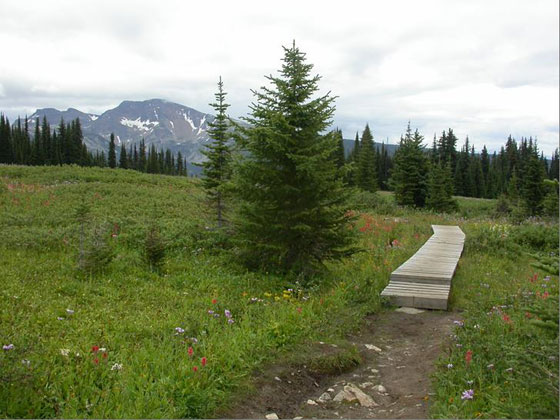
Photo: D. Richardson © Environment Canada, 2013
Long description for Figure 7
Figure 7. Photo of the subalpine habitat of Peltigera gowardii on Trophy Mountain, Clearwater, British Columbia. The foreground shows open meadow. In the middle distance are stands of conifers, and in the far distance are mountain tops with patches of snow. A path cuts through the meadow, and a board walk has been installed to protect the vegetation where the path crosses a boggy area. Further details can be found in the preceding/next paragraph(s).
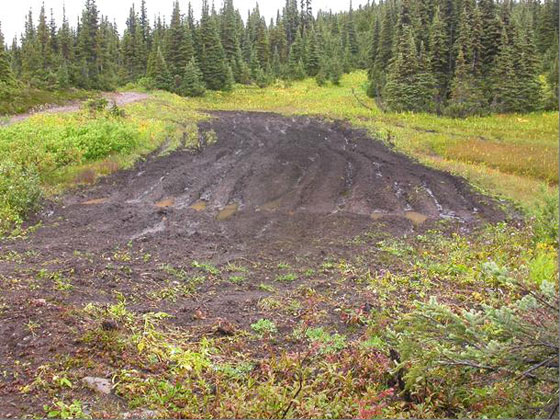
Photo: D. Richardson © Environment Canada, 2013
Long description for Figure 8
Figure 8. Photo of meadowland on Microwave Mountain, Smithers, British Columbia, showing the disturbance resulting from mud bogging. Mud bogging, in which participants drive a vehicle through mud for a certain distance, creates the potential for siltation into nearby streams. Further details can be found in the preceding/next paragraph(s).
The invasive freshwater alga Didymosphenia gemminata (‘Rock Snot’) is an existing and potential threat to streams in B.C. (Anon. 2007). This diatom has been found in several fish streams in the province and also occurs in other parts of Canada and the world. In the Yukon, it has been found in what appeared to be a cold pristine mountain stream (Pojar pers. comm. 2011). If it spreads to rock surfaces inhabited by P. gowardii, it could coat colonies or prevent their attachment to rock substrates.
There is currently no legal status or protection for Peltigera gowardii.
The NatureServe Global Status is G4 (Apparently Secure), but this assessment in January 2008 was done before it was recognized that the taxon was composed of two distinct species.
In 2010, Peltigera gowardii was given a provincial status of S1S2 (Red) in British Columbia (NatureServe 2012), where it is considered to be Vulnerable to trail development. In addition, the General Status of Species in Canada (CESCC 2011) ranks P. gowardii as 2 (May Be at Risk) in B.C.
In the USA, state-level rankings of P. gowardii, sensu lato, range from S1 (Critically Imperiled) in Montana and Alaska (AKNHP 2012), to S2 (Imperiled) in Washington, to S3.2 (Vulnerable) in California. This lichen has not been ranked in Oregon (Peterson 2010).
Only the P. gowardii habitat on Trophy Mountain in the Wells Gray Provincial Park and in the Black Tusk area in Garibaldi Park are afforded some measure of protection. These areas are still subject to lease arrangements, subsurface mineral rights and/or rights of way, and to threats related to climate change and other human activity. For example, the occurrence at Trophy Mountain, within a provincial park, is directly adjacent to one of the most heavily used trail systems, where existing culvert installations and trail-side erosion potentially threaten P. gowardii. The other occurrences are on Crown land and so are not afforded any measure of protection by designation or by legislation.
Assistance with documenting the occurrence and distribution of P. gowardii in Canada has been provided by a number of colleagues. The personal communications cited in the text were all received by email in 2011, and the report writers would like to thank all correspondents for their generous help and time.
The report writers would like to express gratitude, in particular, for the help, information and assistance provided by Jim and Rosamund Pojar, Trevor Goward, Bob Brett, Curtis Björk and Darwyn Coxson that enabled the fieldwork in 2011 to be completed. In addition they provided information stemming from many years of lichen research in the province that helped enormously with the completion of this report.
The report writers would also like to thank Mr. Dave Fraser, Species and Ecosystems at Risk Section, Government of B.C. for help with the threats calculator exercise and Dr. Karen Golinski for running the program that modelled predicted climate change at sites where the Western Waterfan is found. We thank Mr. Greg Baker, Research Instrument Technician, Maritime Provinces Spatial Analysis Research Centre, Saint Mary’s University for help with plotting and developing displays and tables and Mary Jane MacNeil, Saint Mary’s University, for help in formatting, etc., during the preparation of this report.
Assistance with documenting the occurrence and distribution of P. gowardii was provided by the following colleagues and authorities:
AKNHP. 2012. Rare Alaska Lichen List. Alaska Natural Heritage Program, University of Alaska Anchorage. Alaska Natural Heritage Program website.
Anon, 2007. What Is Didymo and How Can We Prevent It From Spreading In Our Rivers?, Québec, ministère du Développement durable, de l’Environnement et des Parcs et ministère des Ressources naturelles et de la Faune, 13 pp.
Anon. 2011 Travel Management Final Environnemental Impact Statement, Chapter 3 Botanical Resources, USDA Sierra National Forest. (PDF; 541KB). Accessed September 2011.
Bailey, R.H. and James, P.W. 1979. Birds and the dispersal of lichen propagules. Lichenologist 11:105-106.
Brodo, I.M., Sharnoff, S,D., and Sharnoff, S. 2001. Lichens of North America. Yale University Press, Newhaven, 795 pp.
Cameron, R.P. 2006. Protected Area-working forest interface: concerns for protected areas management in Canada. Natural Areas Journal 26:403-407.
Casamatta, D.A., Gomez, S.R. and Johansen, J.R. 2006. Rexia erecta gen. et sp. nov. and Capsosira lowei sp. nov. two newly described cyanobacterial taxa from the Great Smokey Mountains National Park (USA). Hydgrobiologia 561:13-26.
Carlberg, T. 2008. Note on Peltigera hydrothyria. Bulletin of the Californian Lichen Society 15:50.
CESCC 2011. Wild Species 2010: The General Status of Species in Canada. Canadian Endangered Species Conservation Council. National General Status Working Group, 302 pp.
COSEWIC 2013. Definitions. In Operations and Procedures Manual, Committee on the Status of Endangered Wildlife in Canada, Environment Canada, August 2013, Appendix C, pp. 144-154
Coxson, D., Connell, S., Déry, D., Eastham, A., Fredeen, A., Jull, M., Lewis, K., Rogers, B., Sanborne, P. and Stevenson, S. 2011. Northern Wetbelt Forests of British Columbia. Figure 2 and 3, Northern Wetbelt Forests of British Columbia website.
Davis, W.C., Gries, C., and Nash, T.H. 2000. The ecophysiological response of the aquatic lichen Hydrothyria venosa to nitrates in terms of weight and photosythesis over long periods of time. Bibliothica Lichenologica 75:201-208.
Davis, W.C., Gries C and Nash, T.H. 2003. The influence of temperature on the weight and net photosynthesis of the aquatic lichen Peltigera hydrothyria over long periods of time. Bibliotheca lichenological86:233-242.
Dillingham, C.P. 2006. Nonvascular botanical field reconnaissance report, Plumas National Forest Feather River Ranger District. 21pp.
Esslinger, T.L. 2010. A cumulative checklist for the lichen forming, lichenicolous, and allied fungi of the continental United States and Canada. North Dakota State University. North Dakota State University website.
Geiser, L.H., Jovan, S.E., Glavich, D.A. and Porter, M.K. 2010. Lichen–based critical loads for atmospheric nitrogen deposition in western Oregon and Washington forests, USA. Environmental Pollution 158:2412-2421.
Glavich, D.A. 2009. Distribution, rarity and habitats of three aquatic lichens on federal land in the US Pacific Northwest. Bryologist 112:53-58.
Glavich, D.A. and Geiser, L.H. 2008. Potential approaches to developing lichen-based critical loads and levels for nitrogen, sulfur and metal-containing atmospheric pollutants in North America. Bryologist 111:638-649.
Goward, T. 1996. (‘1995’). Lichens of British Columbia: rare species and priorities for inventory. Research Branch, B.C. Ministry of Forests, and Habitat Protection Branch, B.C. Ministry of Environment, Lands and Parks, Victoria, B.C. Working Paper 08/1996. 34 pp.
Goudie, A.S. 2006. The human impact on the Environment, 6th edition, Blackwell Scientific, Oxford, pp.146-152.
Goward, T. and Ahti, T. 1992. Macrolichens and their zonal distribution in Wells Gray Provincial Park and its vicinity, British Columbia, Canada. Acta Botanica Fennica 147:1-60.
Goward, T., McCune, B. and Meidinger, D. 1994. The lichens of British Columbia. Illustrated keys. Part 1 - Foliose and squamulose species. B.C. Ministry of Forests, Victoria, B.C., Special Report Series 8. 181 pp.
Goward, T., Brodo, I.M. and Clayden, S.R. 1998. Rare Lichens of Canada. Committee on the Satus of Endangerd Wildlife in Canada, Ottawa, 74 pp.
Hawksworth, D.L. 1983. A key to the lichen-forming, parasitic, parasymbionts and saprophytic fungi growing on lichens in the British Isles. Lichenologist 55:1-44.
Honegger, R. 2008. Morphogenesis. In Lichen Biology, 2nd Edit. (T.H. Nash ed.), pp.69-93. Cambridge University Press, Cambridge.
Jacobs, J.B. and Ahmadjian, V. 1973. The ultrastructure of lichens, V. Hydrothyria venosa, a freshwater lichen. New Phytologist 72:155-160.
Lange, O. L., Killian, E., and Ziegler, H. 1986. Water vapour uptake and photosynthesis in lichens: performance differences in species with green and blue-green algae as phycobionts. Oecologia 71:104-110.
Larsson, P. and Gauslaa, Y. 2010. Rapid juvenile development in old forest lichens. Botany 89:65-72.
Lendemer, J.C. and O’Brien, H.O. 2011. How do you reconcile molecular and non-molecular datasets? A case study where new molecular data prompts a revision of Peltigera hydrothyria s.l. in North America and the recognition of two species. Opuscula Philolichenum 9:99-110.
Lesher, R.D., Derr, C.C. and Geiser, L.H. 2003. Natural history and management considerations for northwest forest plan survey and manage lichens. USDA Forest Service, Pacific Northwest Region. 6-NR-S & M-TP-03-03, pp. 65-70.
Levine, J.M. 2001. Local interactions, dispersal, and native and exotic plant diversity along a California stream. Oikos 95:397-408.
McCune, B. 1984. Lichens with oceanic affinities in the Bitterroot Mountains of Montana and Idaho. Bryologist 87:44-50.
McCune, B., Grenon, J., Mutch, L.S. and Martin, E.P. 2007. Lichens in relation to management issues in the Sierra Nevada national parks. Pacific Northwest Fungi 2:1-38.
Miadlikowska, J., and Lutzoni, F. 2000. Phylogenetic revision of the genus Peltigera (lichen forming Ascomycota) based on morphological, chemical and large subunit nuclear ribosomal DNA data. International Journal of Plant Science 161:925-958.
Nash III, T.H. 2008. Lichen Biology, 2nd Edit. Cambridge University Press, Cambridge.
NatureServe 2013. A network connecting science with conservation.
Noble, W.J., T. Ahti, G.F. Otto, and I.M. Brodo. 1987. A second checklist and bibliography of the lichens and allied fungi of British Columbia. Syllogeus 61:1-95.
Otto, G.F. and T. Ahti. 1967. Lichens of British Columbia, preliminary checklist. Department of Botany, University of British Columbia, Vancouver, B.C. 40 p. (mimeographed).
Pederson, G.T., Gray, S.T., Ault, T., Marsh, W., Fagre, D.B., Bunn, A.G., Woodhouse, C.A. and Graumlich, L.J. 2011. Climatic controls on the snowmelt hydrology of the Northern Rocky Mountains. Journal of Climate 24:1666-1687.
Peterson, E.B. 2010. Conservation assessment with management guidelines for Peltigera hydrothyria Miadlikowska & Lutzoni (a.k.a. Hydrothyria venosa J.L. Russell. Report for US Forest Service, Region 5, 23 pp.
Pojar, J. 2010. A new climate for conservation nature, carbon and climate change in British Columbia. Working Group on Biodiversity, Forests and Climate. 99 pp.
Poulsen, B and Carlberg, T. 2007. Peltigera hydrothyria, sponsorship for the CALS Conservation Committee. Bulletin of the Californian Lichen Society 14 (1):15-18.
Richardson, D.H.S. 1992. Pollution Monitoring with Lichens. Richmond Publishing, Slough.
Russell, J.L. 1853. Hydrothyria venosa; a new genus and species of the Collemaceae. Proceedings of the Essex Institute 1:188-191.
Scheidegger, C. and Goward, T. (2002) Monitoring lichens for conservation: red lists and conservation action plans. In Monitoring with lichens – Monitoring lichens (P.L. Nimis, C. Scheidegger and P.A. Walseley eds.) Kluwer Academic, Dordrecht pp. 163-181.
Seaward, M.R.D. 2008. Environmental role of lichens. In Lichen Biology, 2nd edition. (T.H. Nash ed), pp.274-298. Cambridge University Press, Cambridge.
Stevenson, S., Armleder. H., Arsenault. A., Coxson, D., DeLong, C., and Jull. M. 2011. British Columbia’s Inland Rainforest: Ecology, Conservation and Management. UBC Press. 432 pages.
Szczawinski, A. and V. Krajina. 1959. Lichens. In Field Trip I, British Columbia. T.M.C. Taylor (editor), 9th International Botanical Congress, Montreal, Canada. pp. 14–19.
Wright, D. 1992. Thamnolia (Ascomycotina: Lichenes Imperfecti):first find for California and correction of published mapping of the genus. Bryologist 95:458-60.
David Richardson is Dean Emeritus at Saint Mary’s University. He has studied lichens since 1963 and as sole author written two books on lichens: The Vanishing Lichens and Pollution Monitoring with Lichens. He has also completed over twenty book chapters and 100 research papers on various aspects of lichenology. He has studied lichens in Australia, Canada, Ireland and the United Kingdom.
Frances Anderson is a Research Associate at the Nova Scotia Museum of Natural History, Halifax. She has been carrying out fieldwork on lichens in Nova Scotia for more than five years and has extensive experience in doing field inventories. She is currently working on a macrolichen checklist for the province.
Robert Cameron has been studying lichens for over ten years beginning with a Master’s degree in Biology at Acadia University studying the effects of forestry practices on lichens. More recently, Mr. Cameron has been studying the effects of air pollution on lichens, coastal forest cyanolichens and more specifically boreal felt lichen. He is currently the ecologist with Protected Areas Branch of Nova Scotia Environment and Labour, responsible for the protected areas research program.
- Botanical Museum Munich, Germany
- Consortium of North American Lichen Herbaria
- National Museum of Canada, Ottawa
- Oregon State University Herbarium, Oregon
- Royal B.C Museum, Victoria, B.C
- University of British Columbia Herbarium, British Columbia
- University of Washington Herbarium, Washington
| Site: British Columbia |
Year found | Most recent survey | Estimated number of colonies | Elevation in metres | Stream pH | % of stream searched | Ownership/ protection |
|---|---|---|---|---|---|---|---|
Footnotes of Appendix 1
|
|||||||
| Trophy Mountain Drinking Water Creek, Clearwater | 1979 | Sept. 2011 | 100 | 1938 | 7.0 | 100% | Wells Gray Provincial Park |
| Trophy Mountain Stream two, Clearwater | 2011 | Sept. 2011 | 4 | 1941 | 6.3 | 100% | Wells Gray Provincial Park |
| Hudson Bay Mountain Stream one, Smithers | Aug. 2011 | Sept. 2011 | >200 | 1580-1615 | 7.3 | 100% | Crown land but Ski Smithers may have lease on it |
| Hudson Bay Mountain Stream two, Smithers | 1980 | Sept. 2011 | >100 | 1699-1601 | 6.8 | 100% | Crown (public) land |
| Hudson Bay Mountain Stream three, Smithers | Sept. 2011 | Sept. 2011 | >100 | 1584 | 6.6 | 70% | Crown land |
| John Brown CreekFootnote1of Appendix 1, Smithers | Aug. 2011 | DNC | >200 | 1478 | DNC | 50% | Crown land |
| Brew Lake CreekFootnote2of Appendix 1, Whistler | 1974 | Oct 2011 | <20 | 1429 | DNC | DNC | Crown land |
| Trapline Mountain, Copper River valleyFootnote3of Appendix 1, Terrace | 2011 | Aug. 2011 | 3 | 1390 | DNC | DNC | Crown land |