
Recovery Strategy for the Oregon Forestsnail (Allogona townsendiana) in Canada - 2016
Oregon Forestsnail
2016
Recovery Strategy for the Oregon Forestsnail (Allogona townsendiana) in Canada - 2016

Recommended citation:
Environment Canada. 2016. Recovery Strategy for the Oregon Forestsnail (Allogona townsendiana) in Canada. Species at Risk Act Recovery Strategy Series. Environment Canada, Ottawa. 23 pp. + Annex.
For copies of the recovery strategy, or for additional information on species at risk, including the Committee of the Status of Wildlife in Canada (COSEWIC) Status Reports, residence descriptions, action plans, and other related recovery documents, please visit the Species at Risk (SAR) Public Registry.
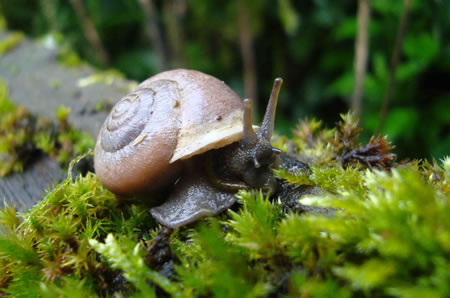
Cover illustration: © Jennifer Heron
Également disponible en français sous le titre
« Programme de rétablissement de l'escargot-forestier de Townsend (Allogona townsendiana) au Canada »
Content (excluding the illustrations) may be used without permission, with appropriate credit to the source.
Recovery Strategy for the Oregon Forestsnail (Allogona townsendiana) in Canada - 2016
Under the Accord for the Protection of Species at Risk (1996), the federal, provincial, and territorial governments agreed to work together on legislation, programs, and policies to protect wildlife species at risk throughout Canada.
In the spirit of cooperation of the Accord, the Government of British Columbia has given permission to the Government of Canada to adopt the "Recovery Strategy for Oregon Forestsnail (Allogona townsendiana) in British Columbia" (Part 2) under Section 44 of the Species at Risk Act. Environment Canada has included an addition which completes the SARA requirements for this recovery strategy.
The federal Recovery Strategy for the Oregon Forestsnail in Canada consists of two parts:
- Part 1 – Federal Addition to the "Recovery Strategy for Oregon Forestsnail (Allogona townsendiana) in British Columbia", prepared by Environment Canada.
- Part 2 – "Recovery Strategy for Oregon Forestsnail (Allogona townsendiana) in British Columbia", prepared by the Oregon Forestsnail Recovery Team for the British Columbia Ministry of Environment.
The federal, provincial, and territorial government signatories under the Accord for the Protection of Species at Risk (1996) agreed to establish complementary legislation and programs that provide for effective protection of species at risk throughout Canada. Under the Species at Risk Act (S.C. 2002, c.29) (SARA), the federal competent ministers are responsible for the preparation of recovery strategies for listed Extirpated, Endangered, and Threatened species and are required to report on progress within five years.
The Minister of the Environment is the competent minister under SARA for the Oregon Forestsnail and has prepared the federal component of this recovery strategy (Part 1), as per section 37 of SARA. To the extent possible, it has been prepared in cooperation with British Columbia Ministry of Environment, the Department of National Defence, and the British Columbia Conservation Data Centre. SARA section 44 allows the Minister to adopt all or part of an existing plan for the species if it meets the requirements under SARA for content (sub-sections 41(1) or (2)). The attached provincial recovery plan (Part 2 of this document) for the species was provided as science advice to the jurisdictions responsible for managing the species in British Columbia. Environment Canada has prepared this federal addition to meet the requirements of SARA.
Success in the recovery of this species depends on the commitment and cooperation of many different constituencies that will be involved in implementing the directions set out in this strategy and will not be achieved by Environment Canada, or any other jurisdiction, alone. All Canadians are invited to join in supporting and implementing this strategy for the benefit of the Oregon Forestsnail and Canadian society as a whole.
This recovery strategy will be followed by one or more action plans that will provide information on recovery measures to be taken by Environment Canada and other jurisdictions and/or organizations involved in the conservation of the species. Implementation of this strategy is subject to appropriations, priorities, and budgetary constraints of the participating jurisdictions and organizations.
The recovery strategy sets the strategic direction to arrest or reverse the decline of the species, including identification of critical habitat to the extent possible. It provides all Canadians with information to help take action on species conservation. When the recovery strategy identifies critical habitat, there may be future regulatory implications, depending on where the critical habitat is identified. SARA requires that critical habitat identified within federal protected areas be described in the Canada Gazette, after which prohibitions against its destruction will apply. For critical habitat located on federal lands outside of federal protected areas, the Minister of the Environment must either make a statement on existing legal protection or make an order so that the prohibition against destruction of critical habitat applies. For critical habitat located on non-federal lands, if the Minister of the Environment forms the opinion that any portion of critical habitat is not protected by provisions in or measures under SARA or other Acts of Parliament, and not effectively protected by the laws of the province or territory, SARA requires that the Minister recommend that the Governor in Council make an order to extend the prohibition against destruction of critical habitat to that portion. The discretion to protect critical habitat on non-federal lands that is not otherwise protected rests with the Governor in Council.
The following sections have been included to address specific requirements of SARA that are either not addressed in the "Recovery Plan for Oregon Forestsnail (Allogona townsendiana) in British Columbia" (see Part 2 of this document, referred to hereafter as the "provincial recovery plan"), or that need more detailed comment. In some cases, these sections may also include updated information or modifications to the provincial recovery plan for adoption by Environment Canada.
This section augments section "Species Status Information" (section 2) in the provincial recovery plan.
Legal Status: SARA Schedule 1 (Endangered) (2005).
Based on recent and historic records combined, the global range extent is estimated at 135,000 km2. The extent of occurrence for B.C. is estimated to be 3313 km2 (including the unsuitable Strait of Georgia between Vancouver Island and the lower Fraser Valley). Although the Canadian population in the Fraser Valley only covers a small proportion of the global range, species experts predict that 10-20% of the global population of Oregon Forestsnail could be in Canada (J. Heron, B.C. Ministry of Environment, pers. comm. (2012).
This section replaces "Population and Distribution Goal" (section 5.1) in the provincial recovery plan. Environment Canada has identified the following Population and Distribution Objective for Oregon Forestsnail:
The following statement augments "Rationale for the Population and Distribution Goal" (section 5.2) from the provincial recovery plan. The population and distribution objective includes currently occupied known and unknown natural occurrences of Oregon Forestsnail; it does not extend to sites established through snail salvage and translocation.
The following text replaces the final paragraph in “Actions Already Completed or Underway” (section 6.1) in the provincial recovery plan:
There are ongoing surveys and management for species at risk, including Oregon Forestsnail, atArea Support Unit (ASU) Chilliwack (Department of National Defence; A. Manweiler, pers. comm., 2011).
This section replaces “Information on Habitat Needed to Meet Recovery Goal” (section 7) in the provincial recovery plan.
Section 41(1)(c) of SARA requires that recovery strategies include an identification of the species’ critical habitat, to the extent possible, as well as examples of activities that are likely to result in its destruction.
This section replaces "Description of Survival/Recovery Habitat" (section 7.1) in the provincial recovery plan.
Critical habitat can only be partially identified at this time. A schedule of studies (section 3.2) has been developed to provide the information necessary to complete the identification of critical habitat that will be sufficient to meet the population and distribution objective. The identification of critical habitat will be updated when the information becomes available, either in a revised recovery strategy or action plan(s).
Critical habitat for Oregon Forestsnail is identified based on known extant and historical occurrences surrounded by an area with a radius equivalent to the maximum known home range/displacement distance for the species, 32.2 m (Edworthy et al. 2012). Though Oregon Forestsnail can be found in edge habitats, the species requires habitat features provided by interior forests (or their functional equivalents) to complete their life cycle. As such, a 50 m Critical Function Zone is also added to maintain minimum constituent microhabitat properties where the snails are found (based on average edge effects distances in coastal forests (Kremsater and Bunnell 1999)). For areas where Terrestrial Ecosystem Mapping (TEM) is available (Blackwell and Associates 2003; Durand 2010; Madrone Environmental Services Ltd. 2008, 2006; Metro Vancouver, unpublished data;), the critical habitat also includes the TEM polygons intersecting the occurrence. The TEM polygon must meet or exceed the minimum area requirement described above, and contain at least one ecosystem type capable of providing the biophysical attributes of critical habitat.
The areas containing critical habitat for Oregon Forestsnail, totaling 1402 ha, are presented in Appendix 1 Figures 1-12. Within the mapped areas, locations that do not possess the biophysical attributes listed below are not critical habitat.
4.1.1 Biophysical attributes of critical habitat
In general, Oregon Forestsnail habitat is low elevation (<360 m above sea level) and has a site context that promotes persistent high moisture. This can include ravines, gullies and depressions with both permanent and ephemeral watercourses; the edges of streams, wetlands, seasonally flooded areas or wet lowlands; moist forest interfaces (including adjacent edge habitats); and moist, densely-vegetated meadows (Oregon Forestsnail Recovery Team 2012). Within these habitats, specific features must be present to support a number of critical functions, including overall maintenance of the moist microclimate, as well as provision of cover; aestivation, nesting, mating, and oviposition substrate; and forage. These critical features include:
- intact deciduous and/or mixed wood and/or dense shrub or herbaceous canopy, to maintain the moist microclimate;
- patches of Stinging Nettle (Urtica dioica), to support feeding, mating, oviposition, and healthy shell growth (Oregon Forestsnail Recovery Team 2012; B.C. Conservation Data Centre 2014; Edworthy et al. 2012; Steensma et al. 2009);
- dense understory vegetation, to provide cover and maintain moisture; and
- coarse woody debris and leaf litter, to provide cover and substrate for aestivation and nesting.
This section replaces the "Studies Needed to Describe Survival/Recovery Habitat" (section 7.2) in the provincial recovery plan.
The purpose of the schedule of studies is to outline the studies required to identify the critical habitat necessary to meet the population and distribution objectives for the species.
| Description of activity | Outcome/rationale | Timeline |
|---|---|---|
| Conduct habitat assessments at known Oregon Forestsnail sites (e.g., coarse woody debris, moisture, soil attributes, plant species composition, etc.). | Data collected in known Oregon Forestsnail habitats will facilitate more accurate identification of key habitat features that predict Oregon Forestsnail presence, and support the development of a habitat suitability model to identify where additional populations/supporting habitat are located. | 2016 - 2018 |
| Conduct mark-recapture studies on Oregon Forestsnail. | A better understanding of snail home range, dispersal, source/sink habitat dynamics, etc. will facilitate more accurate estimates of the amount of habitat (in a patch) required for snail survival. | 2016 - 2018 |
| Develop habitat suitability model from data collected in habitat assessments (above). | An accurate habitat suitability model will support identification of critical habitat for the remainder of the Canadian population. | 2016 - 2018 |
| Survey candidate sites identified as Oregon Forestsnail habitat by the habitat suitability model. | Additional critical habitat identified. | 2017 - 2018 |
| Spatially define habitat polygons at all newly identified Oregon Forestsnail sites (identified through surveys and habitat suitability modelling) using established mapping techniques, plant community classification, coarse woody debris classification guidelines, information from mark–recapture studies, and other existing resources for describing habitat attributes. | This will complete the critical habitat identification. | 2016 - 2018 |
This section replaces the "Specific Human Activities Likely to Damage Survival/Recovery Habitat" (section 7.3) in the provincial recovery plan.
Understanding what constitutes destruction of critical habitat is necessary for the protection and management of critical habitat. Destruction is determined on a case by case basis. Destruction would result if part of the critical habitat were degraded, either permanently or temporarily, such that it would not serve its function when needed by the species. Destruction may result from a single or multiple activities at one point in time or from the cumulative effects of one or more activities over time.
Activities described in Table 2 include those likely to cause destruction of critical habitat for Oregon Forestsnail; destructive activities are not limited to those listed. Where a situation does not clearly fit in with the activities identified in Table 2, but has a potential impact on riparian habitat within identified critical habitat and/or water quality associated with waterways or wetlands that have a direct influence on identified critical habitat, the proponent should contact Environment Canada – Canadian Wildlife Service, Pacific and Yukon Region, for guidance on the activity.
| Description of Activity | Description of how activity would destroy critical habitat |
|---|---|
| Activities that change the hydrology of a site. Examples: Urban and commercial land development; land clearing; trail building. |
Changes to hydrology can alter the plant composition and moisture levels at a site, resulting in loss of all of the critical functions (cover, nesting/ aestivation/ mating/ oviposition substrate, and forage). |
| Excavating, contaminating, or compacting soil. Examples: Recreational activities such as mountain biking and all-terrain vehicle use within occupied habitats, excavating, herbicide application; trail building. |
Significant alterations to the soil can result in loss of suitable substrate for nesting and aestivation. It can also compromise growing conditions for preferred host plants, resulting in loss of mating and oviposition substrate and forage. Compaction/excavation can also increase the potential for flooding or drying of the nest site. |
| Removal of the tree/shrub/high forb canopy. Examples: Forest clearing, trail or road maintenance/construction. |
Removal of the canopy results in drying of the microclimate, altering the moisture regime required for maintenance of an Oregon Forestsnail population. It can also result in long term loss of coarse woody debris (aestivation and nesting substrate). |
| Removal of the understory. Examples: vegetation management activities including herbicide and other chemical applications, mowing, pruning, and brush burning. |
Removal of the understory leads to desiccation and/or reduced humidity at the site, altering the moisture regime required for maintenance of an Oregon Forestsnail population. It also eliminates the critical cover function. Removal of preferred host plants (e.g., Stinging Nettle) results in loss of mating and oviposition substrate and forage. |
| Removal of coarse woody debris. Examples: Hauling away or removing coarse woody debris; cutting downed wood into pieces; removing bark, or otherwise destroying coarse woody debris. |
Removal of coarse woody debris results in loss of suitable substrate for nesting and aestivation and has the potential to reduce microsite moisture. |
| Introduction of non-native plants into Oregon Forestsnail habitat. Examples: planting invasive ornamental species; dumping unwanted compost or vegetation. |
Some invasive plants can alter the understory moisture regime, potentially eliminating the moist conditions required for maintenance of an Oregon Forestsnail population. If they replace preferred host plants (e.g., Stinging Nettle), they may also cause loss of mating and oviposition substrate and forage. |
One or more action plans will be posted on the Species at Risk Public Registry by 2021.
A strategic environmental assessment (SEA) is conducted on all SARA recovery planning documents, in accordance with the Cabinet Directive on the Environmental Assessment of Policy, Plan and Program Proposals. The purpose of a SEA is to incorporate environmental considerations into the development of public policies, plans, and program proposals to support environmentally sound decision-making.
Recovery planning is intended to benefit species at risk and biodiversity in general. However, it is recognized that strategies may also inadvertently lead to environmental effects beyond the intended benefits. The planning process based on national guidelines directly incorporates consideration of all environmental effects, with a particular focus on possible impacts upon non-target species or habitats. The results of the SEA are incorporated directly into the strategy itself, but are also summarized below in this statement.
The following augments “Effects on Other Species” (section 9) in the provincial recovery plan:
Habitat requirements of Oregon Forestsnail overlap those of other SARA-listed species that occur in small streams adjacent to riparian/forest/edge Oregon Forestsnail habitat, or in the same moist forest habitat type as Oregon Forestsnail. These species include Pacific Water Shrew (Sorex bendirii), Salish Sucker (Catostomus catostomus ssp ), Nooksack Dace (Rhinichthys cataractae ssp.), Oregon Spotted Frog (Rana pretiosa), Coastal Giant Salamander (Dicamptodon tenebrosus), Coastal Tailed Frog (Ascaphus truei), Tall Bugbane (Cimicifuga elata), Streambank Lupine (Lupinus rivularis [PDF; 575 KB]), and Phantom Orchid (Cephalanthera austiniae). As threats to these species are similar to the threats for Oregon Forestsnail (e.g., habitat loss, fragmentation, and degradation), recovery actions for all of these species are likely to be mutually beneficial.
- B.C. Conservation Data Centre. 2014. B.C. Species and Ecosystems Explorer. B.C. Ministry of Environment. Victoria, BC. [Accessed March 2012].
- Blackwell and Associates. 2003. Hope Innovative Forestry Practices Agreement (IFPA) Terrestrial Ecosystem Mapping with Wildlife Interpretations. [Accessed April 4, 2013]
- Durand, R. 2010. City of Abbotsford Sumas Mountain Sensitive Ecosystems Inventory. Prepared for the City of Abbotsford, Abbotsford, BC. 86 pp.
- Edworthy, A., K. Steensma, H. Zandberg, and P. Lilley. 2012. Dispersal, home range size and habitat use of an endangered land snail, the Oregon Forestsnail (Allogonal townsendiana). Can. J. Zool. 90(7):875–884.
- Kremsater, L. L. and F.L. Bunnell. 1999. Edges: Theory, evidence, and implications to management of western forests. Pp. 117-153 in J. A. Rochelle, L. A. Lehmann and J. Wisniewski (editors.) Forest Fragmentation: Wildlife and Management Implications. Brill, Leiden, Netherlands.
- Madrone Environmental Services Ltd. 2008. Terrestrial Ecosystem Mapping of the Coastal Douglas-Fir Biogeoclimatic Zone. Prepared for Government of British Columbia, Victoria, BC. 308 pp. [Accessed April 4, 2013]
- Madrone Environmental Services Ltd. 2006. Terrestrial Ecosystem Mapping: McKee Peak, Abbotsford, BC. Prepared for City of Abbotsford, Abbotsford, BC. 34 pp.
- Oregon Forestsnail Recovery Team. 2012. Recovery plan for Oregon Forestsnail (Allogona townsendiana) in British Columbia. Prepared for the B.C. Ministry of Environment, Victoria, BC. 50 pp.
- Steensma, K.M.M., L.P. Lilley, and H.M. Zandberg. 2009. Life history and habitat requirements of the Oregon Forestsnail, Allogona townsendiana (Mollusca, Gastropoda, Pulmonata, Polygyridae), in a British Columbia population. Invert. Biol. 128:232–242.
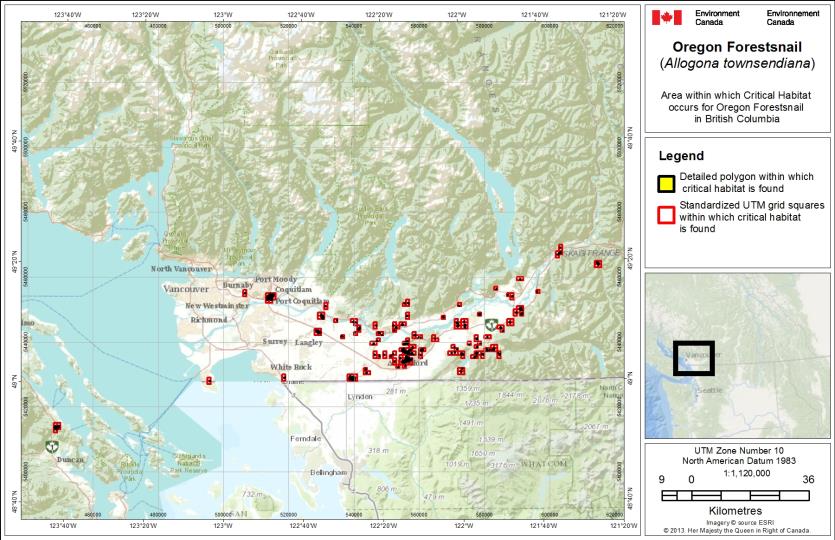
Long description for Figure 1
Figure 1 shows a map of southwestern British Columbia with standardized 1 × 1 km grid squares of the area that contain critical habitat for the Oregon Forestsnail. A few grid squares are located close to Duncan on Vancouver Island, as well as close to White Rock and Port Roberts on the mainland. The rest of the critical habitat locations are along the Fraser River, extending from Burnaby to Hope.

Long description for Figure 2
Figure 2 represents a map with standardized 1 × 1 km grid squares of the area that contain critical habitat for the Oregon Forestsnail in southern Vancouver Island, British Columbia. 6 grid squares are found in Westholme, on Vancouver Island.
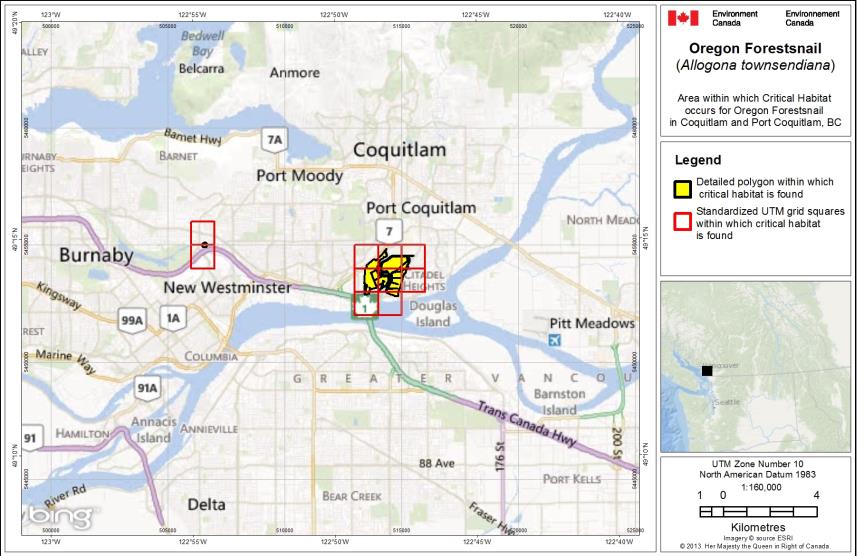
Long description for Figure 3
Figure 3 represents a map with standardized 1 × 1 km grid squares of the area that contain critical habitat for the Oregon Forestsnail in Coquitlam and Port Coquitlam, British Columbia. 2 grid squares are located close to the intersection of the Central Valley Greenway and the Trans Canada highway in Burnaby north to New Westminster. 8 grid squares are found close to the Fraser River and Citadel Heights in Port Coquitlam.

Long description for Figure 4
Figure 4 represents a map with standardized 1 × 1 km grid squares of the area that contain critical habitat for the Oregon Forestsnail in South delta, British Columbia. 2 grid squares exist north of Johnson Road in Point Roberts.

Long description for Figure 5
Figure 5 represents a map with standardized 1 × 1 km grid squares of the area that contain critical habitat for the Oregon Forestsnail in White Rock, British Columbia. 2 grid squares are located between 176 Street and the Vancouver-Blaine Highway just north of the United States border.

Long description for Figure 6
Figure 6 represents a map with standardized 1 × 1 km grid squares of the area that contain critical habitat for the Oregon Forestsnail in Aldergrove, British Columbia. 5 grid squares are located east of 264 Street just north of the United Stated border.

Long description for Figure 7
Figure 7 represents a map with standardized 1 × 1 km grid squares of the area that contain critical habitat for the Oregon Forestsnail in Maple Ridge and Langley, British Columbia. 2 grid squares are located east of Lougheed Highway and about north of Kanaka Creek in Maple Ridge. 4 grid squares are located north west of McMillan Island and covers some mainland. 1 grid square is by the Lougheed highway and in the Fraser River in south eastern Maple Ridge. 6 grid squares arranged longitudinally extend south from Glen Valley. 1 grid square is located west of 264 Street and north of the Trans Canada Highway in Langley. 4 grid squares are located close to Trans Canada Highway and Highway 10 in Langley.

Long description for Figure 8
Figure 8 represents a map with standardized 1 × 1 km grid squares of the area that contain critical habitat for the Oregon Forestsnail in Mission, British Columbia. 2 grid squares are located about north of the Mission Golf and Country Club. 2 grid squares are located west of the intersection of Highways 7 and 11. 1 grid square is located in southern of Matsqui Island, and 2 grid squares are located inland about southwest of the island north of Harris Road. 3 grid squares are located close to Durieu. 2 grid squares are located north west of Hatzic Lake. 6 grid squares extend west from south Hatzic Lake and along the Fraser River. 4 grid squares are located south of the Fraser River and about east of Ridgedale.
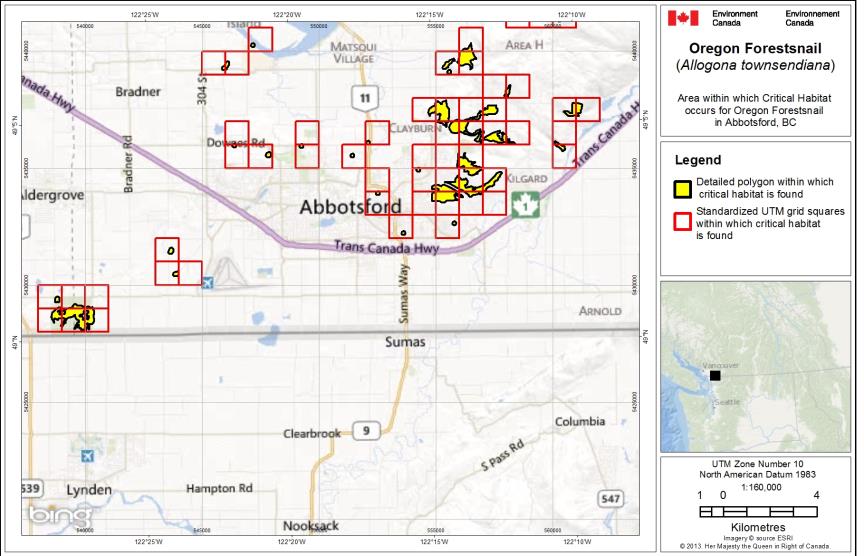
Long description for Figure 9
Figure 9 represents a map with standardized 1 × 1 km grid squares of the area that contain critical habitat for the Oregon Forestsnail in Abbotsford, British Columbia. 3 grid squares are located close to Downes Road east of 304 Street. Another 2 grid squares are located east of the latter described set of grid squares. 3 grid squares are located west of Abbotsford International Airport. 30 grid squares extend from close to Ridgedale south to the Trans Canada Highway and from close to highway 11 east to close to Kilgard. 4 grid squares are located east of the latter described set of grids close to the Trans Canada Highway.
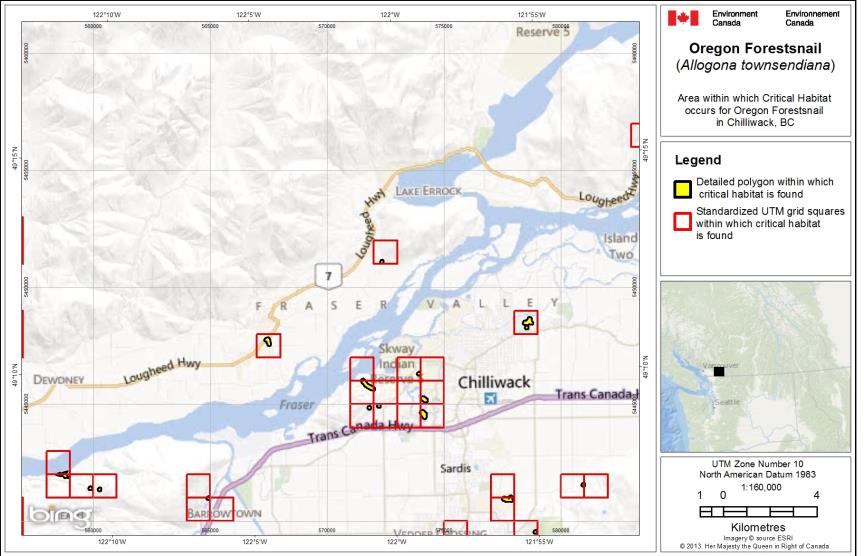
Long description for Figure 10
Figure 10 represents a map with standardized 1 × 1 km grid squares of the area that contain critical habitat for the Oregon Forestsnail in Chilliwack, British Columbia. 1 grid square is located far south of Lake Errock close to Lougheed Highway. Another grid square is located by Lougheed Highway south of Deroche. 11 grid squares are located within and south of the Skway Indian Reserve until the Trans Canada Highway. 1 grid square is located far west of the Meadowlands Golf and Country Club.
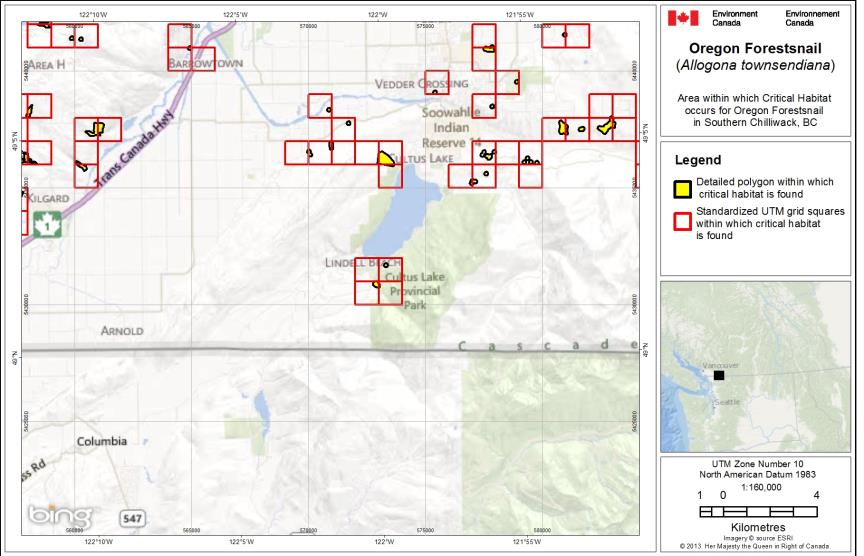
Long description for Figure 11
Figure 11 represents a map with standardized 1 × 1 km grid squares of the area that contain critical habitat for the Oregon Forestsnail in southern Chilliwack, British Columbia. 3 grid squares are located in Barrowtown. 8 grid squares are located north west of Cultus Lake. 4 grid squares are located south of Cultus Lake. 1 grid square and 4 grid squares are located north and north east of the Soowahlie Indian Reserve respectively. 12 grid squares arranged laterally extend east of the Soowahlie Indian Reserve. 2 grid squares are located in about north east of Sardis.
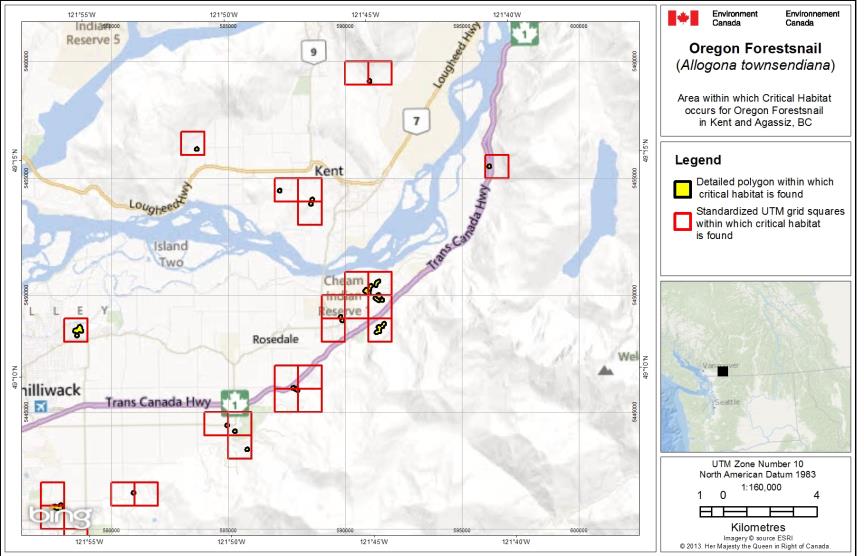
Long description for Figure 12
Figure 12 represents a map with standardized 1 × 1 km grid squares of the area that contain critical habitat for the Oregon Forestsnail in Kent and Agassiz, British Columbia. 1 grid square and 2 grid squares are located north and far north of the Lougheed Highway, and 3 grid squares just south of the highway in Kent. 7 grid squares are located within the Cheam Indian Reserve. 4 grid squares are located in southern Rosedale at the Trans Canada Highway and 3 grid squares are located south of highway south of Rosedale. 1 grid square is located on the Trans Canada Highway east of Herrling Island.
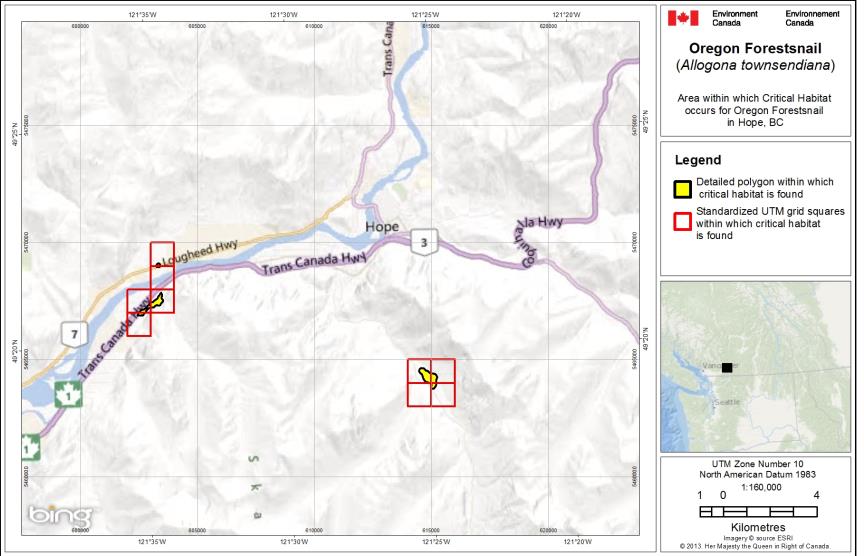
Long description for Figure 13
Figure 13 represents a map with standardized 1 × 1 km grid squares of the area that contain critical habitat for the Oregon Forestsnail in Hope, British Columbia. 5 grid squares extend vertically between Lougheed Highway and the Trans Canada Highway about midway between Floods and Laidlaw. 4 grid squares are located far south of the Trans Canada Highway 3.
Prepared by the Oregon Forestsnail Recovery Team

October 2012
- Recovery Team Members
- Acknowledgements
- Executive Summary
- Recovery Feasibility Summary
- 1. COSEWIC* Species Assessment Information
- 2. Species Status Information
- 3. Species Information
- 4. Threats
- 5. Recovery Goal and Objectives
- 6. Approaches to Meet Objectives
- 7. Information on Habitat to Meet Recovery Goal
- 8. Measuring Progress
- 9. Effects on Other Species
- 10. References
- Appendix 1. Oregon Forestsnail Sites and Land Tenure
- Appendix 2. Threats Applicable to Each Site
- Appendix 3. Gastropod Surveys
- Table 1. Threat classification table for Oregon Forestsnail.
- Table 2. Recovery planning table for Oregon Forestsnail.
- Table 3. Studies needed to describe survival/recovery habitat to meet the recovery goal for Oregon Forestsnail.
- Table 4. Specific human activities likely to damage survival/recovery habitat for Oregon Forestsnail.
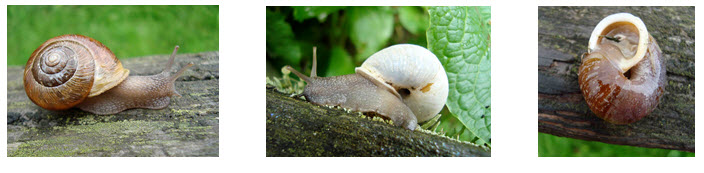
- Figure 1. Oregon Forestsnail adult showing topside (left), underside (centre), and underside of the shell showing the white apertural lip (right), June 11, 2010, Colony Farms – Metro Vancouver Regional Park. Photographs by J. Heron.
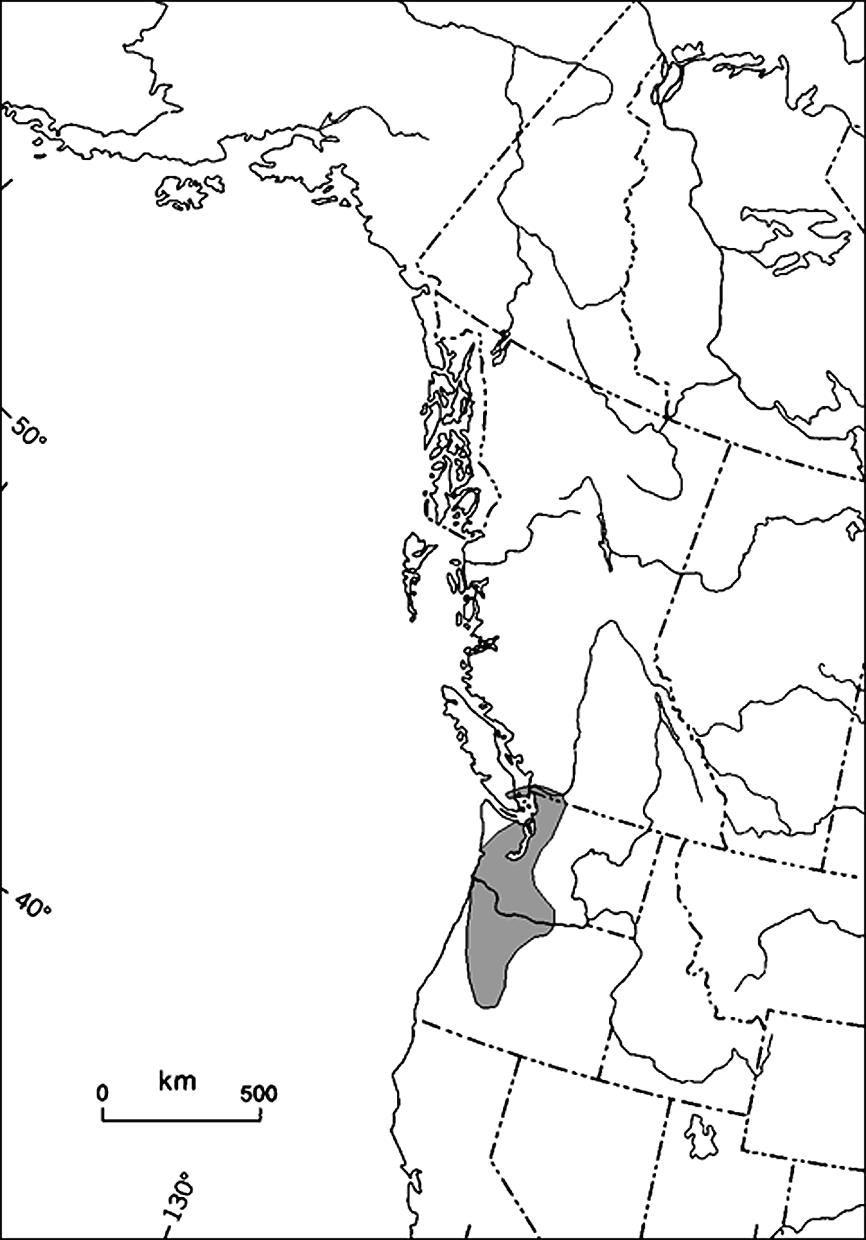
- Figure 2. Global range of Oregon Forestsnail, based on Pilsbry (1940, Figure 508) and B.C. records (B.C. Conservation Data Centre 2012).
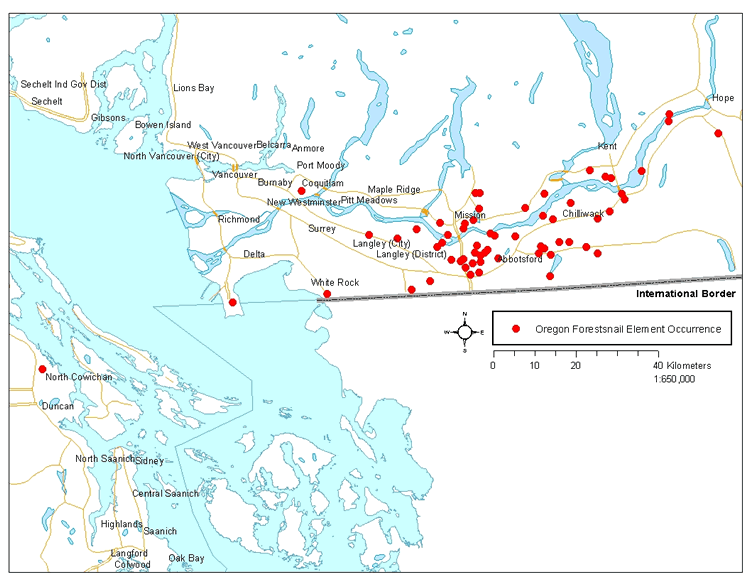
- Figure 3. B.C. Oregon Forestsnail sites from 1901 to 2011 (B.C. Conservation Data Centre 2012).
Recovery Plan for Oregon Forestsnail (Allogona townsendiana) in British Columbia
Prepared by the Oregon Forestsnail Recovery Team
October 2012
This series presents the recovery strategies that are prepared as advice to the Province of British Columbia on the general strategic approach required to recover species at risk. The Province prepares recovery strategies to meet its commitments to recover species at risk under the Accord for the Protection of Species at Risk in Canada, and the Canada – British Columbia Agreement on Species at Risk.
Species at risk recovery is the process by which the decline of an endangered, threatened, or extirpated species is arrested or reversed, and threats are removed or reduced to improve the likelihood of a species' persistence in the wild.
A recovery plan summarizes the best available science-based knowledge of a species or ecosystem to identify goals, objectives, and strategic approaches that provide a coordinated direction for recovery. These documents outline what is and what is not known about a species or ecosystem, identify threats to the species or ecosystem, and explain what should be done to mitigate those threats. When sufficient information to guide implementation for the species can be included, the document is referred to as a recovery plan, and a separate action plan is not required.
To learn more about species at risk recovery in British Columbia, please visit the Ministry of Environment Recovery Planning webpage.
Oregon Forestsnail Recovery Team. 2012. Recovery plan for Oregon Forestsnail (Allogona townsendiana) in British Columbia. Prepared for the B. C. Ministry of Environment, Victoria, BC 50 pp.
Heron, Jennifer
Additional copies can be downloaded from the B.C. Ministry of Environment Recovery Planning webpage.
Library and Archives Canada Cataloguing in Publication
Oregon Forestsnail Recovery Team (Canada)
Recovery plan for Oregon forestsnail (Allogona townsendiana) in
British Columbia [electronic resource] / prepared by the Oregon Forestsnail
Recovery Team.
(British Columbia recovery strategy series)
Includes bibliographical references.
Electronic monograph in PDF format.
ISBN: 978-0-7726-6607-9
1. Polygyridae-Conservation-British Columbia. 2. Rare invertebrates-
British Columbia. I. British Columbia. Ministry of Environment II. Title. III. Series: British Columbia recovery strategy series
QL430.5 P6 O73 2012
333.95'5716
C2012-980180-1
This recovery plan has been prepared by the Oregon Forestsnail Recovery Team, as advice to the responsible jurisdictions and organizations that may be involved in recovering the species. The British Columbia Ministry of Environment has received this advice as part of fulfilling their commitments under the Accord for the Protection of Species at Risk in Canada, and the Canada - British Columbia Agreement on Species at Risk.
This document identifies the recovery strategies that are deemed necessary, based on the best available scientific and traditional information, to recover Oregon Forestsnail populations in British Columbia. Recovery actions to achieve the goals and objectives identified herein are subject to the priorities and budgetary constraints of participatory agencies and organizations. These goals, objectives, and recovery approaches may be modified in the future to accommodate new objectives and findings.
The responsible jurisdictions and all members of the recovery team have had an opportunity to review this document. However, this document does not necessarily represent the official positions of the agencies or the personal views of all individuals on the recovery team.
Success in the recovery of this species depends on the commitment and cooperation of many different constituencies that may be involved in implementing the directions set out in this strategy. The Ministry of Environment encourages all British Columbians to participate in the recovery of Oregon Forestsnail.
- Jennifer Heron (Chair), Ministry of Environment, Vancouver
- Claudio Bianchini, Bianchini Biological Services, Delta
- Trudy Chatwin, Ministry of Forests, Lands and Resource Operations, Nanaimo
- Gord Gadsden, Fraser Valley Regional District, Chilliwack
- Megan Harrison, Canadian Wildlife Service, Environment Canada, Delta
- Joanna Hirner, BC Parks, Ministry of Environment, North Vancouver
- Suzie Lavallee, University of British Columbia, Vancouver
- Patrick Lilley, Raincoast Applied Ecology, Vancouver
- Joshua Malt, Ministry of Forests, Lands and Resource Operations, Surrey
- Angela Manweiler, National Defence ASU, Chilliwack
- Kristiina Ovaska, Biolinx Environmental Research Ltd., Sidney
- Kristina Robbins, Ministry of Forests, Lands and Resource Operations, Surrey
- Lennart Sopuck, Biolinx Environmental Research, North Saanich
- Karen Steensma, Trinity Western University, Langley
- Andrea Tanaka, Canadian Wildlife Service, Environment Canada, Delta
- Kym Welstead, Ministry of Forests, Lands and Resource Operations, Surrey
- Mike Younie, District Municipality of Mission, Mission
Jennifer Heron completed this final version of the recovery plan. Leah Westereng (Ministry of Environment [MoE]) provided extensive review and input into the plan. Scientific advice, review, and revisions have been the collaborative efforts of the Oregon Forestsnail Recovery Team. This recovery plan started a number of years ago and has been updated many times over the past years. Thank you to Kristiina Ovaska and Lennart Sopuck of Biolinx Environmental Research Ltd., Robert Forsyth (private malacologist), Tom Burke (private malacologist), and Terry Frest (private malacologist). The past and ongoing research by Trinity Western University, Karen Steensma, and involving Sooze Waldock, Heather Zandberg, Patrick Lilley, Martyna Kus, Martin Rekers, Deanna Leigh, Amanda Edworthy, Marie DenHaan, Jordan Thiessen, Stephanie Koole, and Melissa Oakes has contributed much to answering some of the knowledge gaps of Oregon Forestsnail. Thank you to Dwayne Lepitzki and Gerry Mackie (co-chairs, Mollusc Specialist Subcommittee, Committee on the Endangered Wildlife in Canada) and Dave Fraser (MoE) for input on the threats and Byron Woods (MoE) for mapping support. Thank you to all the biologists and private citizens who submit data on Oregon Forestsnail.
Additional reviews of the recovery plan were completed by Patrick Daigle (MoE [retired]), Jenny Feick (with MoE at the time), Brenda Costanzo (MoE), Ted Lea (MoE [retired]), Jeff Brown, (with MoE at the time), Laura Darling (MoE), Lucy Reiss (Environment Canada-Canadian Wildlife Service [EC-CWS]), Wendy Dunford (EC-CWS), Lucie Metras (EC-CWS), and Trish Hayes (EC-CWS).
Oregon Forestsnail (Allogona townsendiana) was designated as Endangered by the Committee on the Status of Endangered Wildlife in Canada (COSEWIC) because the species is restricted to a very small area of the southwestern British Columbia (B.C.) mainland and southern Vancouver Island. Populations are severely fragmented with continuing declines observed in extent of occurrence and quality of habitat due mainly to urban development. It is listed as Endangered in Canada on Schedule 1 of the Species at Risk Act (SARA). In B.C., Oregon Forestsnail is ranked S2 (Endangered) by the Conservation Data Centre and is on the provincial Red list. The B.C. Conservation Framework ranks Oregon Forestsnail as a priority 1 under goal 3 (maintain the diversity of native species and ecosystems). Recovery is considered to be biologically and technically feasible.
Oregon Forestsnail is a large, hermaphroditic land snail endemic to western North America. The shell of mature individuals is pale brown or straw yellow, round and flattened in form, and ranges from 28 to 35 mm in diameter. The Oregon Forestsnail in Canada is at the northern limits of its geographical range, and consequently may possess unique adaptations.
Oregon Forestsnail occupies mixedwood and deciduous forest habitat, typically dominated by bigleaf maple (Acer macrophyllum), black cottonwood (Populus trichocarpa), and scattered western redcedar (Thuja plicata). Many records are from riparian habitats and forest edges, where dense cover of low herbaceous native vegetation is typically present. The presence of Oregon Forestsnail is correlated with the presence of stinging nettle (Urtica dioica). All known Canadian Oregon Forestsnail populations are from habitats lower than 360 m above sea level.
Major threats include residential and commercial development; recreational activities; and invasive non-native/alien species. The population and distribution goal is to maintain current (and new) populations and supporting habitat for Oregon Forestsnail throughout the species' natural range and distribution in British Columbia.
The recovery objectives for Oregon Forestsnail are:
- To identify and prioritize important Oregon Forestsnail habitat throughout the species' range in B.C.
- To secure protectionFootnote1 for Oregon Forestsnail habitats within the species' range.
- To assess and reduce threats at all known sites in B.C.
- To address knowledge gaps (e.g., population ecology, habitat associations, dispersal) that currently prevent quantitative population and distribution objectives from being established.
The recovery of Oregon Forestsnail in B.C. is considered biologically and technically feasible based on the criteria outlined by the Government of Canada (2009):
- Individuals of the wildlife species that are capable of reproduction are available now or in the foreseeable future to sustain the population or improve its abundance.
Yes. The persistence of Oregon Forestsnail populations for at least 10 years at 12 or more sites, combined with the known presence of juveniles/eggs at some sites, indicates that individuals capable of reproduction are available. - Sufficient suitable habitat is available to support the species or could be made available through habitat management or restoration.
Yes. Oregon Forestsnail persists in small habitat patches, at least for the short term, and additional localities likely exist within both small (< 1 ha) and larger habitats. The larger-scale patches of suitable habitat for Oregon Forestsnail are located on Sumas Mountain, Chilliwack Mountain, and the areas on the south side of the Fraser River from Langley east to Bridal Veil Falls Provincial Park near Hope. Restoration may be necessary at sites where there has been extensive disturbance and development, and some landowners may want to restore habitats that have already been modified by urban or agricultural practices. For example, potential measures include providing cover for the snails around seepages and other moist habitats, increasing the density of stinging nettle, and restoring habitat connectivity along creeks and waterways. - The primary threats to the species or its habitat (including threats outside Canada) can be avoided or mitigated.
Yes. It is possible to mitigate some of the threat to its habitat from new urban and agricultural developments by protecting core habitats of moist mixedwood forests and leaving forested buffers around such areas. Threats from introduced species may be more difficult to address, although site-specific removal of introduced species is possible. Threats such as fire and flooding may also be minimized at some sites. Managing recreational activities to minimize soil compaction at some sites is also possible and may aid in protecting snail habitat. - Recovery techniques exist to achieve the population and distribution objectives or can be expected to be developed within a reasonable timeframe.
Yes. Techniques used to recover this species are similar to recovery planning techniques applied to species with similar threats and requirements. Examples of recovery techniques include habitat protection, removal of site-specific threats (such as introduced species), and working with land managers and landowners to develop site-specific best management practices guidelines.
Date of Assessment: November 2002
Common Name (population): Oregon Forestsnail
Scientific Name: Allogona townsendiana
COSEWIC Status: Endangered
Reason for Designation: The species is restricted to a very small area of the extreme southwestern British Columbia mainland and southern Vancouver Island. Populations are severely fragmented with continuing declines observed in extent of occurrence, area of occupancy and area, extent and quality of habitat due mainly to urban development. Even though there may be other locations, the species is still very uncommon.
Canadian Occurrence: British Columbia
COSEWIC Status History: Designated Endangered in November 2002. Assessment based on a new status report. Currently undergoing ten year assessment and will be re-assessed by COSEWIC November 2012.
Oregon ForestsnailFootnotea
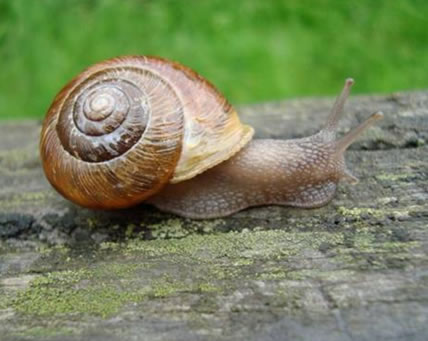
Oregon Forestsnail (Allogona townsendiana) is a large hermaphroditic land snail (adult shell diameter 28–35 mm) endemic to western North America (Figure 1). Snail shell colour varies, ranging from amber to light reddish brown to straw yellow, with white lines running across each segment of the spiral. The shell shape is round and slightly flattened. Adult shells typically have from 5.25 to 6 whorls with fine, wavy spiral striae and irregular, light-coloured, wrinkle-like axial riblets and an overall irregular dimpled sculpture (Pilsbry 1940). As the snail ages the outer periostracal layer (outer surface of shell) flakes, becomes bleached and the fine spiral striae are no longer evident. Fine hair-like structures are not present on Oregon Forestsnail. The main distinguishing feature of Oregon Forestsnail adults is a distinct whitish apertural "lip" or rim at the shell opening, which is thickened, and strongly flared, outward. There is no denticle within the aperture.
Long description for Figure 1
Figure 1 represents 3 photographic images of an adult Oregon Forestsnail. The first photograph shows the topside of the snail with the reddish brown to straw yellow round and slightly flattened shell. The shell has white lines running across each segment of the spiral. The shell typically has from 5.25 to 6 whorls. The second image shows the underside of the snail. The third image shows the underside of the shell of the snail, with a whitish apertural “lip” or rim at the shell opening, which is thickened and strongly flared outward and has no denticle within it.
Oregon Forestsnail eggs are round, globose, opaque and grayish-white, slightly flattened, and with a grainy texture (COSEWIC 2002; Forsyth 2004; Steensma et al. 2009). Eggs are laid singly or in clusters with an average clutch size of 34 eggs in captivity (Steensma et al. 2009). Average egg diameter of captivity laid eggs was 3.1 mm.
Adult and juvenile Oregon Forestsnails are similar in appearance, although juvenile snails have thinner, transparent shells, particularly towards the outermost whorl, and no bleaching of shell colour. Juveniles generally do not have a thickened apertural lip.
Oregon Forestsnail is not likely to be confused with other landsnails within its B.C. range with the exception of Pacific Sideband (Monadenia fidelis). However, the Pacific Side-band does not have a white, thickened apertural lip and when multiple specimens are compared, the overall size of Pacific Sideband is greater than Oregon Forestsnail. Morphological comparisons with other similar land snails found within the global geographic range of Oregon Forestsnail are detailed in the COSEWIC (2002) status report.
The life cycle of Oregon Forestsnail appears closely tied to seasonal temperature, day length, humidity, and climate conditions within the habitat patch it occupies. In general, snail activity levels depend on a combination of day length, moisture, and temperature (Solem and Christensen 1984; Prior 1985). A recent Oregon Forestsnail study assessed population size, reproductive timing and habitats, seasonal behaviors, and juvenile activity over a four-year period at Trinity Western University Ecological Study Area (TWU-ESA) in Langley, B.C. (Steensma et al. 2009). This study provides most of the information summarized below.
3.2.1 Seasonal Activity
Fifteen Oregon Forestsnail individuals were tracked by harmonic detection finder to follow their seasonal pattern over two years (see Steensma et al. 2009). In general, mating begins as early as February, lasting through early June. As the warmer and drier summer months approach, snails seek shelter deep within litter, under logs or the bark of coarse woody debris, or in similar shelter places within the deciduous forests where they predominantly live (see Section 3.3). This aestivation period lasts several weeks and in mid to late September the species becomes active again for the wet fall months. Once the first frost occurs, the individuals enter hibernation until the following spring. Winter hibernation begins sometime in late October to late November and lasts until late February, when temperatures are below 10.6°C, and often drop to freezing overnight (Steensma et al.2009).
During hibernation Oregon Forestsnails seek shelter by burying themselves 2–7 cm within leaf litter, moss, soil, or other forms of cover; they form an ephiphragm and orient themselves with the aperture of the shell upwards (Steensma et al. 2009). Adult snails are not likely to move during the hibernation period, although five tracked adults moved (average distance 14 cm) during the hibernation period, and may have fed during this time (Steensma et al. 2009). Juveniles have been observed at one site during hibernation months (Hawkes and Gatten 2011; Edworthy et al. 2012).
3.2.2 Mating
Oregon Forestsnail is hermaphroditic but it is unlikely that self-fertilization occurs (this could decrease fitness as has been seen in other gastropods) (Forsyth 2004). Like most native gastropods in southwestern B.C., this species is most active during the wet spring months when mating takes place. Oregon Forestsnail mating pairs have been observed at three sites in B.C., showing snails are active beginning in early February with the peak mating period from early March through early May (Steensma et al. 2009), and as late as June (Kus 2005).
Prior to mating, Oregon Forestsnail aggregates in clusters of 8–14 snails and shows social behaviour of antennal and shell touching. Numerous gastropod species exhibit group aggregations, or huddles: groups of slugs aggregate together to prevent water loss (Cook 1981a, 1981b; Prior 1981, 1985; Prior et al. 1983). Huddles create a high humidity microenvironment and reduce dehydration. Oregon Forestsnail mating has been observed to occur directly on or within proximity (< 3 m) of coarse woody debris (e.g., logs). Stinging nettle (Urtica dioica) also grew < 1 m from mating pairs, as observed at three out of four pairs at TWU-ESA (Steensma et al. 2009). Mating first occurred when day length was greater than 11 hours, was with one individual, and was observed to last 225–229 minutes (Steensma et al. 2009).
3.2.3 Nesting
Oregon Forestsnail nesting in B.C. has been observed from April 20 to June 20, peaking in mid-May, and has been found near the edge or interior of forest habitats (Steensma et al. 2009). Oregon Forestsnail nesting and egg-laying are documented from three different sites in B.C.: Cemetary Hill, Nicomekel Slough, and TWU-ESA (B.C. Conservation Data Centre 2012). At the TWU-ESA, 53 nests were surveyed over a two-year period with adult snails digging a 6–10 cm flask-shaped hole, the equivalent of their body size, with their foot. Oviposition occurs after adult Oregon Forestsnails dig or burrow into new or existing nesting holes (Steensma et al. 2009). Most snails dig new nests although some nested within pre-existing depressions in soil, in moss, and under coarse woody debris (Steensma et al. 2009). Snails have also been observed ovipositing at the base of vegetation, such as Creeping Buttercup (Ranunculus repens), and occasionally within the same burrow as another snail and within gravel substrate (Edworthy et al.2012).
3.2.4 Hatching and Juveniles
Juvenile snails hatched approximately 8–9 weeks after oviposition (Steensma et al. 2009). Asynchronous hatching has been observed. Juveniles began dispersing from the nest site within hours of hatching. Following hatching, snail activity included climbing < 1 m on tall vegetation close to the nest. Vegetation favoured by juvenile Oregon Forestsnail individuals included stinging nettle, reed canarygrass (Phalaris arundinacea), Indian-plum (Oemleria cerasiformis), and Himalayan balsam (Impatiens glandulifera). Older juveniles (not hatchlings) were observed feeding on stinging nettle (Steensma et al. 2009).
3.2.5 Adult Maturation
Adults likely reach reproductive maturity by two years and have a life span of at least five (Steensma et al. 2009) to eight years (COSEWIC 2002). This results in an estimated generation time of two to five years.
The global range of Oregon Forestsnail is entirely within western North America (Figure 2). The northernmost extent of its range is in southwestern B.C. The range extends south through the Puget Trough in Washington State and to the Willamette Valley in west-central Oregon. The easternmost records are from west of Hope, B.C., south-central Washington, and north-central Oregon in the Columbia River Valley. Based on recent records (within the past 10 years) and the historic records (combined), the global range extent is estimated at 135,000 km².
Long description for Figure 2
Figure 2 represents a map of the global range of the Oregon Forestsnail in North America. The range extends along the western edge of North America and stretches south from south western British Columbia through the Puget Trough in Washington State and to the Willamette Valley in west-central Oregon. The easternmost records are from west of Hope, British Columbia, south-central Washington, and north-central Oregon in the Columbia River Valley.
The Canadian range of Oregon Forestsnail is restricted to B.C. within the coastal lowlands of the Lower Fraser Valley and one record on southeastern Vancouver Island (Figure 3; Appendix 1). Within the Lower Fraser Valley the most northeastern record is from near Hope, and the most western record is in Tsawwassen, with records throughout the Lower Fraser Valley within the municipal areas of Chilliwack, Mission, Abbotsford, Langley, Burnaby, Surrey, and Delta. On Vancouver Island, Oregon Forestsnail is known from the community of Westholme near Duncan (B.C. Conservation Data Centre 2012). There are no known records on the Gulf Islands. All records are from elevations lower than 360 m above sea level.
Long description for Figure 3
Figure 3 represents a map of the Oregon Forestsnail occurrence sites from 1901 to 2011 in British Columbia. On Vancouver Island, occurrences have been recorded in North Cowichan near Duncan. The rest of the occurrences are within the coastal lowlands of the Lower Fraser Valley from Tsawwassen to Hope, with recordings in municipal areas of Chilliwack, Mission, Abbotsford, Langley, Burnaby, Surrey, and Delta.
Oregon Forestsnail records in B.C. date from 1901 to 2011 (B.C. Conservation Data Centre 2012). Based on recent records (within the past 10 years) and the historic records (combined), the range extent for B.C. is 3313 km² (including the unsuitable salt-water Strait of Georgia, between Vancouver Island and the Lower Fraser Valley). The occurrence on Vancouver Island is < 1 km². Oregon Forestsnail extent of occurrence based on recent records only (since year 2000) is similar to the known historic extent of occurrence.
As of August 2011 there are 67 known sitesFootnote3 (B.C. Conservation Data Centre 2012). The biological area of occupancy calculated by summing the area of all sites is approximately 670 ha (B.C. Conservation Data Centre 2012).
Based on habitat assessments on Vancouver Island, it is possible that Oregon Forestsnail may occur within the lower elevation wet valley bottoms on the eastern side of the island (approximately 100 km north and south of the community of Westholme) although extensive search effort within these areas has yet to reveal any new sites (see Appendix 2).
The presence of Oregon Forestsnail shells is often used as an indicator of site occupancy by live individuals because: (1) shells are concentrated sources of calcium and as such likely are consumed or disintegrate in short amounts of time (i.e., if the shell is present, the snail has not been dead long); (2) Oregon Forestsnail is reported incidentally during other wildlife surveys and not during the ideal survey window (i.e., snails may be hibernating or aestivating), and a shell would likely be visible on the litter surface (in the open) as opposed to a live individual that would likely take cover; and (3) specific Oregon Forestsnail surveys are often not completed during optimal activity periods.
Surveys for Oregon Forestsnail have primarily been by wandering transects through suitable habitat with the main objective to record snail presence, abundance, and habitat information (Appendix 2). Wandering transects follow no pre-determined grid or fixed route and allow the surveyor to change course depending on habitat suitability. Transect routes are usually tracked using a handheld Global Positioning System (GPS) unit to quantify search effort. This methodology has not allowed for population sizes or trends, mostly because sites are not revisited. No baseline information exists on historical abundance of Oregon Forestsnail, making estimates of population trends not possible.
At the most studied population of Oregon Forestsnail in B.C. (TWU-ESA), population estimates among four study areas within this population ranged from 7 to 47 snails with an overall mean density of 1.0 snail/m² (Steensma et al. 2009). At another Oregon Forestsnail population (Chilliwack), the estimated density of Oregon Forestsnail was highest in riparian habitats (0.14 snail/m²) and second-growth mixed deciduous forests (0.13 snail/m²) (Hawkes and Gatten 2011). These data were not gathered in the breeding season, which is considered ideal timing; however, they were collected in the wet fall when snails are known to be active and visible. Until a survey is completed in the spring, the Chilliwack results should be treated with uncertainty.
There are insufficient data to provide an accurate abundance of Oregon Forestsnail across the entire species' range in B.C. However, Oregon Forestsnail sites mapped by the B.C. Conservation Data Centre (2012) and information gathered during the preparation of this document provide some information on Oregon Forestsnail abundance. Oregon Forestsnail site abundance information ranges from one individual (at least 17 sites) to abundance counts > 20 snails (9 sites). The greatest number of snails recorded in a single survey was > 670 individuals at Colony Farms – Metro Vancouver Regional Park (Parkinson and Heron 2010).
There is minimal information on population fluctuation and trends for Oregon Forestsnail. Natural population fluctuations for snails are likely the result of numerous abiotic factors including moisture levels, weather patterns, and seasonal temperature fluctuations (such as early season frost) or erratic flooding. Biotic factors contributing to population fluctuations include parasites, predators, available minerals, and nutrients for healthy shell growth (e.g., through the consumption of plants such as stinging nettle), and availability of substrate within which to take refuge and/or lay eggs.
Although population trend data have not been collected for Oregon Forestsnail, associated Oregon Forestsnail habitat has shown a decline, particularly in the past 10 years. Urban and agricultural land development throughout the Lower Fraser Valley and southeastern Vancouver Island has removed forested habitat, reduced wetland cover, and resulted in a loss of streams. As such, it is likely that historically Oregon Forestsnail exhibited a more extensive metapopulation structure within suitable habitats throughout its known range in southwestern B.C.
3.4.1 Habitat and Biological Needs
Oregon Forestsnail habitat requirements appear to be closely linked to the abiotic and biotic factors that limit an individual's physiological stress: minimizing dehydration; optimizing osmotic uptake of minerals through the integument (whether beneficial [e.g., water, calcium] or harmful [e.g., pesticides, chemicals]); and the amount of available consumptive mineral content (e.g., food) necessary for healthy shell growth. Abiotic factors that limit moisture, such as temperature, water availability, and day length, contribute to the overall activity patterns of gastropods and their presence within a habitat patch. Biotic factors such as coarse woody debris and understory vegetation allow for the moisture retention and high relative humidity (numerous studies summarized in Prior 1985; Steensma et al. 2009). Moisture and microhabitat features, including soil organic matter content and friability, coarse woody debris, understory vegetation, and bryophyte layers, define snail activity and reproductive success, foraging, and persistence within a habitat patch (Prior 1985). Information used to describe Oregon Forestsnail habitat in B.C. includes the collective efforts of occurrence records with the B.C. Conservation Data Centre (2012).
General description
- Low elevation (30–360 m above sea level)
- Deciduous and mixedwood broad-leaf forests with sustained high moisture, relative humidity, and multi-structured microhabitat that maintains high moisture levels.
- Riparian areas and landscape attributes with high site index (forest growth productivity) including ravines, gullies, and depressions containing both permanent and ephemeral watercourses; the wooded edges of streams, marshes, seasonally flooded and wet lowland areas; and similar habitats (B.C. Conservation Data Centre 2012).
- Forest interfaces and edge habitats where moisture is retained (Waldock 2002).
Forest overstory composition
- Typical habitat includes deciduous and mixedwood species with dominant overstory composition > 40% (B.C. Conservation Data Centre 2012).
- Forest stand ages range from 20 to >80 years (B.C. Conservation Data Centre 2012).
- Overstory composition includes large bigleaf maple (Acer macrophyllum), black cottonwood (Populus trichocarpa), and scattered western redcedar (Thuja plicata).
- Additional trees present include paper birch (Betula papyrifera), trembling aspen (Populus tremuloides), red alder (Alnus rubra), and grand fir (Abies grandis) (B.C. Conservation Data Centre 2012).
Dominant shrub species composition
- Oregon Forestsnail tends to inhabit areas with dense shrub vegetation that functions to minimize moisture and evaporative loss from this vegetative layer. In riparian areas, the dense vegetation may be less than other less moist areas.
- Oregon Forestsnail habitats have variable native shrub species composition including a suite of the following species: devil's club (Oplopanax horridus), elderberry (Sambucus racemosa), false azalea (Menziesia ferruginea), beaked hazelnut (Corylus cornuta), Indian-plum (Oemleria cerasiformis), oceanspray (Holodiscus discolor), red-osier dogwood (Cornus stolonifera), rose (Rosa sp.), salmonberry (Rubus spectabilis), salal (Gaultheria shallon), saskatoon (Amelanchier alnifolia), common snowberry (Symphoricarpos albus), thimbleberry (Rubus parviflorus), and vine maple (Acer circinatum) (B.C. Conservation Data Centre 2012).
Herbaceous plant composition
- Oregon Forestsnail inhabits areas with dense herbaceous plant cover consisting of live and senescent vegetation, which provide food and cover during all life stages. Snails are often found at the base of large vegetation clumps or plants (e.g., leaf litter at the base of trees, shrubs, and ferns).
- Herbaceous composition includes bedstraw (Galium sp.), bleeding heart (Dicentra formosa), buttercup (Ranunculus sp.), cow parsnip (Heracleum maxiumum), enchanter's nightshade (Circaea alpina), false lily-of-the-valley (Maianthemum dilatatum), foamflower (Tiarella trifoliata), fringecup (Tellima grandiflora), Cooley's hedge nettle (Stachys chamissonis var. cooleyae), horsetail (Equisetum sp.), miner's lettuce (Claytonia sp.), pathfinder (Adenocaulon bicolor), skunk cabbage (Lysichiton americanum), starflower (Trientalis sp.), stinging nettle, thistle (Cirsium sp.), tiger lily (Lilium columbianum), trillium (Trillium ovatum var. ovatum), twistedstalk (Streptopus sp.), vanilla leaf (Achlys triphylla), waterleaf (Hydrophyllum sp.), and creeping buttercup (Ranunculus repens) (B.C. Conservation Data Centre 2012).
- Ferns commonly recorded within Oregon Forestsnail habitat include bracken fern (Pteridium aquilinum), ladyfern (Athyrium filix-femina), northern maidenhair fern (Adiantum aleuticum), and swordfern (Polystichum munitum) (B.C. Conservation Data Centre 2012).
Presence of stinging nettle within the habitat patch
- Most habitats of Oregon Forestsnail contain patches of stinging nettle (B.C. Conservation Data Centre 2012; Edworthy et al. 2012). Stinging nettle appears to have high importance to Oregon Forestsnail populations especially for mating and egg-laying (COSEWIC 2002; Waldock 2002; Steensma et al. 2009). The daily consumption of stinging nettle is likely needed for healthy shell growth, as the plant contains high levels of calcium and other essential minerals needed to maintain shell durability. Stinging nettle is of significant importance to other land snails (Iglesias and Castillejo 1998). Waldock (2002) examined the association of Oregon Forestsnail with the stinging nettle in detail at TWU-ESA in Langley, and found a positive correlation between the abundance of the snails and stinging nettle. The presence of stinging nettle indicates moist, rich soils with high amounts of nitrogen and phosphorus (Pojar and MacKinnon 1994).
- There are two species of stinging nettle within B.C.: Urtica dioica is native to B.C. and Urtica gracilis is non-native. It is unknown if Oregon Forestsnail exhibits a preference or obligate association with one or both of these stinging nettle species.
Soil characteristics
- Rich, mesic and soft, productive, moist, well-developed mull-typeFootnote4 litter layer soils are important habitat requirements at all life stages (Cameron 1986; COSEWIC 2002; Steensma et al. 2009; B.C. Conservation Data Centre 2012).
- Litter depth (leaf needle) is typically 5–10 cm (Durand, pers. comm., 2012) and often greater than 15 cm in depth. This deep litter layer provides shelter, hibernation, and aestivation sites (Steensma et al. 2009; B.C. Conservation Data Centre 2012).
- Soil pH was recorded at 6.4–6.9 from one site in Langley (Steensma et al. 2009).
- Soil temperature was recorded at 9.9–13°C from one site in Langley (Steensma et al. 2009).
Coarse woody debris
- Oregon Forestsnail is recorded from habitats with abundant coarse woody debris.
- Coarse woody debris is of various stages of decay.
- Size ranges from large-diameter pieces to a forest floor composed of thin, compact needle litter.
- Coarse woody debris is an important habitat attribute for Oregon Forestsnail activity: mating, nesting, aestivation, hibernation, and egg laying (Steensma et al. 2009) and offers protection against daily or seasonal variations in temperature and water availability (as summarized in Prior 1985; Steensma et al. 2009).
- Decaying logs retain moisture and allow for the growth of a thick and healthy moss layer, which provide essential shelter during warm and dry weather conditions. It is important for Oregon Forestsnail to have a suitable resting site from which moisture can be absorbed through the foot; contact re-hydration is crucial for survival of gastropods (Prior 1985).
- Large diameter, damp rotten logs may act as dispersal corridors and shelter during seasonal drought (Burke et al. 1999) and provide sites for aggregating and mating (Steensma et al. 2009; B.C. Conservation Data Centre 2012).
- Oregon Forestsnail has been observed ovipositing within well-decayed wood (Steensma et al. 2009; B.C. Conservation Data Centre 2012).
Moisture requirements
- Moisture is a large influence on habitat suitability for Oregon Forestsnail and its presence within a habitat patch. Snails are continually susceptible to dehydration and experience constant evaporative water loss through the lung surface and integument as well as through the constant deposition of a dilute mucous trail left during locomotion. Gastropods seek shelter and microhabitat that retain water, humidity, and cool temperatures, and activity patterns predominantly coincide with preventing dehydration (Prior 1985).
- Oregon Forestsnail mating pairs require humidity greater than 76% with optimum humidity 81–100%. These results suggest this environmental factor may have more of an influence over mating activity than air temperature (ranged from 7.1 to 17.0°C) (Steensma et al. 2009).
- Soil parameters measured at three out of seven Oregon Forestsnail mating sites at TWU-ESA recorded 30–37% soil moisture (Steensma et al. 2009).
3.4.2 Limiting Factors to Oregon Forestsnail
Dispersal ability
The dispersal ability of Oregon Forestsnail is likely poor, and it is unclear how much spatial area (habitat) is required to sustain a population within a site or habitat patch. One study showed daily maximum distance at 4.5 m and the maximum displacement over three years at 32.2 m (Edworthy et al. 2012). By their very nature, snails are sedentary and cryptic animals, and their natural ability to colonize new areas is likely poor.
Northernmost extent of global range
Oregon Forestsnail is at the northernmost extent of its global range, which likely increases the species' susceptibility to climatic and stochastic population fluctuations.
Require humid environments
When the forest floor becomes increasingly exposed to wind and sunlight, and there is less vegetation growing throughout the understory, terrestrial molluscs are more vulnerable to dehydration (Prior 1985; Burke et al. 1999) and experience high rates of evaporative water loss through their skin (Dainton 1954a, 1954b; Machin 1964a, 1964b, 1964c; Burton 1964, 1966; Prior et al. 1983; as cited in Prior 1985). Snails are known to initiate "water seeking" responses to dehydration after a short-term reduction in locomotor activity (Prior 1985). The physiology and activity patterns of Oregon Forestsnail inherently make them susceptible to continuous water loss through dehydration. All snails deposit a dilute mucous trail, and experience constant evaporative water loss through the lung surface and integument. Numerous ecological and physiological studies show a relationship between body temperature, hydration and locomotor activity (Machin 1975; Peake 1978; Burton 1983; Riddle 1983; Martin 1983 as cited in Prior 1985). Within two hours, active slugs can lose 30–40% of their initial body weight and habitat selection by slugs is correlated with water availability (Prior 1985). Although this information pertains to slug species, it is likely similar for Oregon Forestsnail.
Soil mineral composition
Soil mineral content (including magnesium and calcium) and pH may play an important factor in snail microhabitat preference. Although unstudied in Oregon Forestsnail, these factors have been known to affect habitat preferences in other gastropods (Wareborn 1969; Hylander et al. 2004).
Native predators
Potential native invertebrate predators include the carnivorous Robust Lancetooth snail (Haplotrema vancouverense) and ground beetles (e.g., Snail-killer Carabid, Scaphinotus angusticollis) (K. Ovaska, pers. comm., 2008; L. Sopuck, pers. comm., 2008). Both species are believed to be gastropod specialists (Thiele 1977) and will follow the slime trails of slugs. Robust Lancetooth has been observed to attack and kill slugs (Ovaska and Sopuck, unpubl. data, 2000). These (and other) invertebrate predators are common throughout the same habitats as Oregon Forestsnail, although there is no known obligate association with the species. Concentration of predators in small habitat patches where little escape cover is available will potentially increase predation rates on Oregon Forestsnail. Competition and predation as a limiting factor may become more of a threat when combined with competition and predation from introduced species and further development pressures. Additional invasive vertebrate predators include Canada Goose (Branta canadensis) at some sites.
Threats are defined as the proximate activities or processes that have caused, are causing, or may cause in the future the destruction, degradation, and/or impairment of the entity being assessed (population, species, community, or ecosystem) in the area of interest (globe, nation, or subnation). For purposes of threat assessment, only present and future threats are consideredFootnote5. Threats presented here do not include biological features of the species or population such as inbreeding depression, small population size, and genetic isolation; or likelihood of regeneration or recolonization for ecosystems, which are considered limiting factors.Footnote6
For the most part, threats are related to human activities, but they can be natural. The impact of human activity may be direct (e.g., destruction of habitat) or indirect (e.g., invasive species introduction). Effects of natural phenomena (e.g., fire, hurricane, flooding) may be especially important when the species or ecosystem is concentrated in one location or has few occurrences, which may be a result of human activity (Master et al. 2009). As such, natural phenomena are included in the definition of a threat, though should be applied cautiously. These stochastic events should only be considered a threat if a species or habitat is damaged from other threats and has lost its resilience, and is thus vulnerable to the disturbance (Salafsky et al. 2008) so that this type of event would have a disproportionately large effect on the population/ecosystem compared to the effect they would have had historically.
The threat classification below is based on the IUCN-CMP (World Conservation Union–Conservation Measures Partnership) unified threats classification system and is consistent with methods used by the B.C. Conservation Data Centre and the B.C. Conservation Framework. For a detailed description of the threat classification system, see the CMP website (CMP 2010). Threats may be observed, inferred or projected to occur in the near term. Threats are characterized here in terms of scope, severity, and timing. Threat "impact" is calculated from scope and severity. For information on how the values are assigned, see Master et al., [PDF; 425 Kb] (2009) and table footnotes for details. Threats for the Oregon Forestsnail were assessed for the entire province (Table 1).
| Threat # | Threat description | ImpactFootnoteh | ScopeFootnotei | SeverityFootnotej | TimingFootnotek |
|---|---|---|---|---|---|
| 1 | Residential & commercial development | High | Large (31–70%) | Serious (31–70%) | High |
| 1.1 | Housing & urban areas | High | Large (31–70%) | Extreme (71–100%) | High |
| 1.2 | Commercial & industrial areas | High | Large (31–70%) | Extreme (71–100%) | High |
| 1.3 | Tourism & recreation areas | Low | Small (1–10%) | Slight (1–10%) | High |
| 2 | Agriculture & aquaculture | Low | Restricted (11–30%) | Moderate (11–30%) | High |
| 2.1 | Annual & perennial non-timber crops | Low | Restricted (11–30%) | Moderate (11–30%) | High |
| 2.2 | Wood & pulp plantations | Negligible | Negligible (< 1%) | Slight (1–10%) | Moderate |
| 2.3 | Livestock farming & ranching | Low | Small (1–10%) | Slight (1–10%) | High |
| 3 | Energy production & mining | Low | Small (1–10%) | Extreme (71–100%) | Moderate |
| 3.2 | Mining & quarrying | Low | Small (1–10%) | Extreme (71–100%) | Moderate |
| 3.3 | Renewable energy | Negligible | Negligible (< 1%) | Moderate (11–30%) | High |
| 4 | Transportation & service corridors | Medium | Large (31–70%) | Moderate (11–30%) | High |
| 4.1 | Roads & railroads | Medium | Restricted (11–30%) | Serious (31–70%) | High |
| 4.2 | Utility & service lines | Low | Restricted (11–30%) | Moderate (11–30%) | Moderate |
| 5 | Biological resource use | Low | Small (1–10%) | Serious - Moderate (11–70%) | High |
| 5.1 | Hunting & collecting terrestrial animals | Negligible | Negligible (< 1%) | Serious (31–70%) | High |
| 5.2 | Gathering terrestrial plants | Negligible | Negligible (< 1%) | Unknown | High |
| 5.3 | Logging & wood harvesting | Low | Small (1–10%) | Serious (31–70%) | High |
| 6 | Human intrusions & disturbance | Low | Large (31–70%) | Slight (1–10%) | High |
| 6.1 | Recreational activities | Low | Large (31–70%) | Slight (1–10%) | High |
| 6.2 | War, civil unrest, & military exercises | Negligible | Negligible (< 1%) | Negligible (< 1%) | High |
| 7 | Natural system modifications | Low | Small (1–10%) | Serious (31–70%) | High |
| 7.1 | Fire & fire suppression | Unknown | Large (31–70%) | Unknown | High |
| 7.3 | Other ecosystem modifications | Low | Small (1–10%) | Serious (31–70%) | High |
| 8 | Invasive & other problematic species & genes | Medium - Low | Pervasive (71–100%) | Moderate - Slight (1–30%) | High |
| 8.1 | Invasive non-native/alien species | Medium - Low | Pervasive (71–100%) | Moderate - Slight (1–30%) | High |
| 9 | Pollution | Unknown | Small (1–10%) | Unknown | High |
| 9.3 | Agricultural & forestry effluents | Unknown | Small (1–10%) | Unknown | High |
| 10 | Geological events | Not Calculated | Small (1–10%) | Serious (31–70%) | Unknown |
| 10.1 | Volcanoes | Not Calculated | Unknown | Unknown | Low |
| 10.2 | Earthquakes/tsunamis | Not Calculated | Small (1–10%) | Serious (31–70%) | Unknown |
| 10.3 | Avalanches/landslides | Negligible | Negligible (< 1%) | Moderate (11–30%) | Unknown |
| 11 | Climate change & severe weather | Not Calculated | Restricted – Small (1–30%) | Slight (1–10%) | Low |
| 11.2 | Droughts | Unknown | Pervasive (71–100%) | Unknown | Low |
| 11.4 | Storms & flooding | Not Calculated | Restricted - Small (1–30%) | Slight (1–10%) | Low |
The overall province-wide Threat Impact for this species is Very High to HighFootnote7. The greatest threat is IUCN-CMP Threat 1 Residential and commercial development. Additional threats are discussed below under the Threat Level 1 headings and a summary of the threats by site is provided in Appendix 1.
Oregon Forestsnail's geographic range in southwestern B.C. coincides with the most densely populated and developed part of the province. There has been extensive habitat loss from historic activities (e.g., logging, agriculture, urbanization). In particular, low elevation (< 300 m) habitats within the Coastal Western Hemlock (CWH) biogeoclimatic zone have been extensively modified over the past century as a result of urbanization, forestry, and agriculture. Little of the original forest remains and most habitat patches are < 100 ha. Urban and agricultural development, combined with natural succession, fire suppression, and infilling/draining of lowland wetland riparian habitats, has likely led to the isolation of populations and subsequent inability of Oregon Forestsnails to disperse and recolonize habitat patches. Eventually, isolation combined with threats and limiting factors likely led to its extirpation within some areas of suitable habitat in B.C.
Restricting Oregon Forestsnail sites into smaller habitat patches likely increases the snails' vulnerability to dehydration (e.g., of the forest floor [Prior 1985; Burke et al. 1999]), flooding of the forest floor, reduced genetic diversity, and harmful fluctuations in microclimate (Prior 1985).
1.1 Housing and urban areas and 1.2 Commercial and industrial areas
Natural habitats, large ravines, and riparian areas that represent core habitats for Oregon Forestsnail coincide with the local government jurisdictions of Abbotsford, Mission, Chilliwack, Langley, Fort Langley, and Hope. Expanding human population in these lowland urban areas threatens habitats. Human activities associated with urban developments, specifically those that include clearing or removing Oregon Forestsnail habitat and/or altering natural hydrological patterns that result in habitat conditions that are too dry or wet for prolonged periods, can impact the microhabitat and overall forest stand structure necessary to sustain populations of Oregon Forestsnail.
At a minimum, there have been 73 separate urban housing developments within the core geographic range of Oregon Forestsnail (Abbotsford, Chilliwack, Agassiz, Maple Ridge, Mission and Langley). Of these developments, at least 17 urban housing developments (see Greater Vancouver Real Estate 2011) within the municipalities of Mission, Abbotsford, and Chilliwack appear to have resulted in direct natural deciduous forest habitat conversion and may have impacted Oregon Forestsnail habitat or populations (estimated from Google Earth satellite imagery viewing through Greater Vancouver Real Estate 2011). These urban developments include large-scale new communities with new infrastructure, such as schools, roads, and central shopping amenities and in some cases golf courses and other recreational infrastructure. Most of this development has been within privately owned natural land on Sumas Mountain and other areas of rural Abbotsford, Vedder Mountain, Whatcom, and other natural areas of Chilliwack, within the Lower Fraser Valley (Greater Vancouver Real Estate 2011).
Today, most of the remaining large natural habitats within the core range of Oregon Forestsnail are in private ownership (either owned by the local government or by a private development company [proponent]). Each municipal government has an Official Community Plan with specific areas designated for future housing and commercial development to service the increase in human population. The Local Government Act requires a private landowner who is subdividing their property to dedicate 5% of the land subject to subdivision as a park or to pay cash in lieu of the land. This does not necessarily provide habitat for species at risk; however, local government may be more inclined to take monetary compensation that can then be allocated to community projects elsewhere in the municipality over park land if the Official Community Plan does not designate the type and location of future parkland. As well, if someone is developing a property but is not subdividing (e.g., building a home, barn), this dedication is not required (Green Bylaws Toolkit 2012). Some municipalities have environmentally sensitive development permit areas and can direct development away from these sensitive areas with high ecological (species at risk) values; however, if this is a gap in a municipality's official community plan, then ecosystem values such as Oregon Forestsnail do not get protected.
Industrial and business park expansion plans are published for some municipalities within the Lower Fraser Valley, such as the City in the Country Plan specific to the City of Abbotsford. This plan projects the need for "1,300 acres of employment-generating industrial and business park lands over the next 20 years" with "future residential development accommodated through hillside development…not accommodated by expansion into the Agricultural Land Reserve" (City of Abbotsford 2004).
1.3 Tourism and recreational areas
The demand for tourism and recreational areas within the Lower Fraser Valley and southeastern Vancouver has increased substantially within the past decade. Natural areas continue to be developed into golf courses, campgrounds, parks, and recreation facilities.
This threat applies to two known Oregon Forestsnail sites, although likely more sites because often golf course or recreational developments within existing protected areas are not accurately captured in threat assessments. In the past 10 years, numerous golf courses have been developed within the Lower Fraser Valley within natural habitat that may have had occurrences of Oregon Forestsnail: Abbotsford (two courses), Chilliwack (five courses), Langley (two courses), Aldergrove (one course), and Hope (one course).
Within existing parks, as well as regional and municipal properties, habitat conservation and recreational development potentially conflict with Oregon Forestsnail conservation. Potential threats include construction of new trails and rights-of-way within highly used areas such as Colony Farms, Brunette River Greenway, Brae Island, Cheam Wetlands; creation of new camp sites (e.g., Hope and Chilliwack areas - at least two sites); and creation of golf courses in the Abbotsford, Chilliwack, and Hope areas. For example, within Neilson Regional Park there is a planned expansion of a children's playground into a large patch of stinging nettle where Oregon Forestsnail is known to occupy (J. Heron, pers. obs., 2011). In a separate site also within Neilson Park, Fraser Valley Regional District, Oregon Forestsnail is known to occupy patches of stinging nettle that border a baseball diamond in the park.
Expansion of recreational areas increases the frequency of road and trail building, which may act as corridors (into natural habitats) that facilitate the rapid spread of invasive species (e.g., plant seeds attach to car tires and become dislodged at new sites) (Trombulak and Frissell 2000) (see IUCN-CMP Threat 8).
IUCN-CMP Threat 2 Agriculture and aquaculture
2.1 Annual and perennial non-timber crops
Coniferous forest habitat that is within the Agricultural Land Reserve is subject to clearing and conversion. In some cases, landowners/managers may clear land in anticipation of agricultural development, although no actual crops, grazing, or agricultural practices will occur on the land for a number of years. At present, there is no environmental assessment required for species at risk presence surveys before clearing of land for agricultural purposes. This is a potential threat at many agricultural sites within the Lower Fraser Valley with verges of natural habitat surrounding the agricultural field (e.g., Oregon Forestsnail has been observed adjacent to fields) (C. Bianchini, pers. comm., 2012). This applies to remnant areas of habitat (e.g., ditchside verges, crop verges, and the perimeter of agricultural fields) where Oregon Forestsnail may remain in small habitat patches.
2.2 Wood and pulp plantations
Wood and pulp plantations are throughout the Chilliwack and Hope areas. The first hardwood tree farm licence in the Lower Fraser Valley was granted in 1985 and as a result many of the old-growth cottonwood stands were harvested (Pollon 2010). Conifer plantations do not manage for a diverse, multi-layer understory. Small gaps in wet areas may act as a population sink where Oregon Forestsnail may remain. As well, ongoing harvesting within these stands continues to take place and destroy habitat and these remaining patches.
2.3 Livestock farming and ranching
Detrimental impacts to Oregon Forestsnail habitat from livestock grazing have been recorded from at least three sites (B.C. Conservation Data Centre 2012). The impacts to gastropods from grazing are unknown, but trampling of sensitive riparian areas is often a result of livestock congregating adjacent to watercourses and there would be direct mortality caused by trampling of individuals and habitat (e.g., stinging nettle and other herbaceous plants).
IUCN-CMP Threat 3. Energy production and mining
3.2 Mining and quarrying
Gravel mining is a localized threat at sites in the Lower Fraser Valley, particularly on areas of Sumas Mountain. The overall footprint is small at this time but may expand in the future and results in complete habitat loss where it occurs.
3.3 Renewable energy
Independent Power Projects are numerous throughout the Lower Fraser Valley and impact potential habitat (riparian areas) where Oregon Forestsnail may occur. The overall footprint from these power projects is small, however the cumulative riparian habitat loss due to these substations has potential to impact the species overall.
IUCN-CMP Threat 4. Transportation and service corridors
4.1 Roads and railroads
With increasing human population comes the need for associated transportation infrastructure and access to both new and existing urban areas. Proposed transportation routes are often planned through areas that have the least impact to existing private landowners, such as land (frequently also natural areas) owned by the local or provincial government, land currently within the Agricultural Land Reserve (although the land may be privately owned), or land through natural areas owned by one private landowner or company.
Oregon Forestsnail habitat includes ravines and gullies where both ephemeral and permanent natural watercourses flow. Proposed transportation routes through natural areas frequently result in changes to existing watercourses (e.g., if a roadway bisects a creek; ongoing road and highway expansion projects include plans to divert infill and alter watercourses). At least 10 sites with Oregon Forestsnail have ongoing/finished major works within the past 10 years. Additional sites include areas near Westholme (Vancouver Island) along a railway right-of-way.
Within the geographic range of Oregon Forestsnail extensive roads and other similar transportation corridors already fragment much of the remaining natural habitat and contribute to other threats including increased frequency of use by humans (IUCN-CMP Threat 6.1). Roadsides act as corridors into natural habitats and are known to facilitate the rapid spread of introduced species (e.g., plant seeds attach to car tires, and become dislodged at new sites) (Trombulak and Frissell 2000). The potential spread of introduced species along roadsides may impact local populations through competition and predation, as well as changes to native vegetation ultimately leading to changes in microclimate moisture regimes necessary to sustain Oregon Forestsnail populations (e.g., limit dehydration) (see IUCN-CMP Threat 8.1).
4.2 Utility and service lines
Service lines lead to population isolation; and increased drought from edge effects and stand/wind penetration, leading to increased mortality and ecosystem changes through introduced species. Plans for expansion of hydro rights-of-way and infrastructure are ongoing throughout the Lower Fraser Valley, particularly in areas within large urban developments that require new/improved utility infrastructure. This threat applies to at least five known sites.
At present, there is ongoing construction of a transmission line from Coquitlam to Hope through much potential and unchecked habitat for Oregon Forestsnail. This habitat loss is not in the same areas as roads and the overall impacts are cumulative.
IUCN-CMP Threat 5. Biological resource use
5.1 Hunting and collecting terrestrial animals
There are a few observations of citizens collecting terrestrial snails for consumption (C. Bianchini, pers. comm., 2012); however, the scope of this threat is thought to be negligible at this time. It is also likely that once an individual has removed the readily available snails (e.g., they have cleaned out the snails, up to 70% in an area), it is not likely that the same area will be revisited in the future.
5.2 Gathering terrestrial plants
Stinging nettle is of cultural significance to First Nations people in the region. As well, both First Nations and members of the general public consume the plant. With an increased awareness of local native plants, the consumption of native species and the widespread social trend to consume locally grown produce, some local farms provide stinging nettle to their subscribers. It is likely that these farms are just gathering the plant and not cultivating it (e.g., crops). Currently, this threat is thought to have a negligible impact on Oregon Forestsnail.
5.3 Logging and wood harvesting
The B.C. range of Oregon Forestsnail has been impacted from extensive historic logging and forest resource extraction activities. The forest land base, particularly within the rural areas of Mission, Chilliwack, and Hope, continues to be intensively managed due to the high demand for forest products. Forest management practices, including pre-commercial thinning, pruning, removal of select tree species, fertilization practices, patch-size harvesting, and clearcut harvesting, likely have detrimental effects on populations of Oregon Forestsnail.
Pre-commercial thinning and pruning practices reduce the quantity and/or alter the timing of leaf and branch litter that would otherwise fall to the forest floor and provide shelter for Oregon Forestsnail. Pruning activities that remove lateral branches reduce the overall forest canopy, which results in lower relative humidity and subsequent desiccation of the forest floor. The active removal of trees and machinery used may compact ground cover, crush individuals of Oregon Forestsnail, disturb coarse woody debris and shelter sites, and cause localized impacts within a harvested area. Present day intensive forest management practices target large dead coarse woody debris removal during the second rotation of forest harvesting. Thus, large coarse woody debris may be in short supply in intensively managed forests. These logs are likely important for maintaining stable microclimates for developing eggs, and thus suitable microhabitat for Oregon Forestsnail.
Harvest of forest stands isolates subpopulations further, decreases available habitat, and increases drought from edge effects and stand/wind penetration, leading to increased mortality and ecosystem changes through introduced species. Numerous Oregon Forestsnail records are from provincial Crown land operating under the Chilliwack Forest District (B.C. Ministry of Forests, Lands and Natural Resource Operations). The Chilliwack Forest District covers approximately 1.4 million ha (B.C. Ministry of Forests, Lands and Resource Operations 2012). Potential habitats under 350 m elevation would apply to Oregon Forestsnail habitat.
Areas on Sumas and Vedder Mountains still have small habitat patches used for logging, although once logged the land use will likely change. Hope and Chilliwack areas (easternmost extent of range) have ongoing logging. Harvesting of forest stands isolates subpopulations further, decreases available habitat and increases drought from edge effects and stand/wind penetration, leading to increased mortality and ecosystem changes through introduced species. Soil compaction is a concern during logging, as heavy machinery is often used to harvest trees. This threat applies to 11 sites.
There is also ongoing illegal harvest of older growth western redcedar and hardwood trees throughout the range of Oregon Forestsnail. The impacts of illegal harvest are unknown.
IUCN-CMP Threat 6. Human intrusions and disturbance
6.1 Recreational activities
Recreational activities within Oregon Forestsnail habitat include camping, hiking (e.g., Sumas Mountain Regional Park), foot and bicycle traffic (e.g., Brunette River Greenway – Metro Vancouver Regional Park), and the use of all terrain vehicles (ATVs) and trail bikes (e.g., private land), especially off-trail bikes (e.g., Sumas Mountain). Such activities can result in degradation of habitat quality through soil compaction and can also cause accidental mortality especially along trail edges.
Effects from recreational activities can be pronounced in areas where the species is restricted to small habitat patches (e.g., Brunette River Greenway – Metro Vancouver Regional District Park; Neilson Park – Fraser Valley Regional District). For example, inadvertent trampling of the site could result in significant mortality, especially during the spring breeding period when the snails are active on the forest floor.
Areas with particularly high recreational use include those habitats within Metro Vancouver and Fraser Valley Regional District parks; habitats on Sumas Mountain on B.C. Crown and private land (including local government land); portions of the TSU-ESA; and provincial parks such as Cultus Lake Provincial Park (Chilliwack) and Bridal Falls Provincial Park (outside Hope).
Hiking, ATV, and related activities may also increase the spread of introduced species (see IUCN-CMP Threat 8.1). Recreational use of trails for horseback riding also likely impacts habitat (e.g., trampling of trails/edges and defecation, which increases the spread of fungus, seeds).
The threat of recreational activities applies to at least 58 sites, although at many sites the damage to the species or its habitat is likely limited in scope to trail sides.
6.2 War, civil unrest and military exercises
Activities occurring on Department of National Defence (DND) land that are considered necessary for national security include not only military training but training by other organizations, such as police forces. The Canadian Forces and Royal Canadian Mounted Police (RCMP) both conduct dismounted (on foot) training in forested areas belonging to DND. In addition to training, development to meet operational requirements and maintenance (such as road maintenance) are necessary on training areas to maintain their usefulness.
Populations of Oregon Forestsnail on DND land have been found away from roads in forested areas that will continue to be maintained as such, and are only occasionally used for dismounted training. Although training has been ongoing at the site for over 25 years, the soils do not appear to have been compacted by this use. The fact that there are still extant populations with juveniles indicates that this threat is negligible.
IUCN-CMP Threat 7. Natural system modifications
7.1 Fire and fire suppression
Burke et al. (1999) cited fire as a threat to gastropod populations in Washington State. The threat of fire is present throughout the entire range of Oregon Forestsnail, particularly within large natural tracts of land, in areas adjacent to roadways, and rights-of-way and in recreational areas where campfires occur.
Deciduous forests within the range of Oregon Forestsnail remain moist and wet throughout the year, but the threat of forest fires is possible, particularly in July through September.
Human activities that increase the threat of fire include careless attendance to campfires, discarded cigarettes, improperly wired camping equipment, and machinery used within wilderness areas. Forests fires are yearly occurrences, although efforts are made to control the frequency, size, and spread of fire through fire suppression programs (e.g., brush burning).
Brush clearing, piling, and periodic burning of vegetation and woody debris occur on private and public lands throughout the range of Oregon Forestsnail. Although burning would only impact small areas of land, there is the possibility of overlap with unknown occurrences of Oregon Forestsnail. The smoke generated from periodic brush burning, and the resultant char and burned debris are also detrimental to habitat quality.
All Oregon Forestsnail locations are threatened by fire, however, not at the same time. If or when a fire will occur at a particular site is unknown and the overall impact from fire is not known at this time.
7.3 Other ecosystem modifications
Mowing and cutting of vegetation within sites (often as a form of fire suppression) adversely affect Oregon Forestsnail. Removal of vegetation may impact Oregon Forestsnail through decreasing available moisture retention within habitats and increasing dehydration stress to individuals and direct mortality; as gastropod activity patterns predominantly coincide with preventing dehydration (Prior 1985). This threat is present throughout a small portion of its range especially at the urban interface; roadsides, trails and other rights-of-way; agricultural areas; and recreational areas control campfires.
IUCN-CMP Threat 8. Invasive and other problematic species and genes
8.1 Invasive non-native/alien species
Introduced gastropods, invertebrates, and plant species have been recorded from most Oregon Forestsnail habitats, although the scope of introduction and suite of species present is not fully known. Greater than 90% of sites have introduced species present, particularly Himalayan blackberry (Rubus armeniacus) and other non-native plants, introduced gastropods, earthworms, and various introduced Carabid beetles. Invasive terrestrial gastropods can out-compete and predate upon Oregon Forestsnail.
Introduced invertebrates, particularly introduced gastropods, may pose a threat to Oregon Forestsnail through competition for food and shelter or through predation (COSEWIC 2002). Rollo and Wellington (1979) demonstrated intra- and interspecific aggression among slugs and competition for refuges. Introduced gastropods of European origin are widespread within urban and agricultural areas within the Lower Fraser Valley and southern Vancouver Island, and several species have penetrated forested habitats (Forsyth 1999, 2001). These species continue to spread into new areas with inadvertent assistance from humans when nursery plants, garden ornamentals, or other materials with adhering soil are transported or when garden waste is discarded (Forsyth 1999). Roads are also known to increase the spread of introduced species and predation pressure on gastropods (Trombulak and Frissell 2000).
Three introduced species are locally common in the Lower Fraser Valley: Giant Gardenslug (Limax maximus), Dusky Arion (Arion subfuscus), and Longneck Fieldslug (Deroceras panormitanum), are particularly aggressive. The introduced, carnivorous Dark-bodied Glass-snail (Oxychilus draparnaudi) is locally common in southern Vancouver Island (Victoria area) and greater Vancouver areas (Forsyth 1999) and probably also occurs within the range of Oregon Forestsnail in the Lower Fraser Valley. Dark-bodied Glass-snail could potentially be a significant predator of Oregon Forestsnail eggs and young (K. Ovaska, pers. comm., 2003). This species has been identified as a potential threat to native gastropods in other areas where it has been introduced (Frest and Rhodes 1982). Other introduced gastropod species that may compete with Oregon Forestsnail include Grovesnail (Cepaea nemoralis) and other species of slugs, such as the Chocolate Arion (Arion rufus) and the Gray Fieldslug (Deroceras reticulatum).
Although most invasive gastropods species are primarily in areas of high human use and alteration, some have spread into intact coniferous forest habitats and increased their range extent (K. Ovaska, pers. comm., 2008). Within forests in Washington State, Chocolate Arion is documented from within old-growth forests, and may be displacing native Banana Slug (Ariolimax columbianus) (Burke et al. 1999). Concentration of snails into small habitat patches with less overall shelter and escape cover is likely to increase their vulnerability to predation.
Some invasive plant species are known to change the forest floor vegetation and soil structure and facilitate an increase in light penetrating the understory vegetation to the forest floor. Increases in light levels lead to drier microclimate, understory conditions, and desiccation to the forest floor; they also increase dehydration stress to gastropods that depend upon high water and humidity levels. Invasive plants, such as Scotch broom (Cytisus scoparius), gorse (Ulex europaeus), English holly (Ilex aquifolium), and spurge-laurel (Daphne laureola) are likely to invade disturbed areas. English ivy (Hedera helix) is known to spread and displace the native vegetation on forest floors. Native gastropods are not known to live within vegetation patches of English ivy (Burke et al. 1999). English holly and Himalayan blackberry are also widely spread invasive plants within native ecosystems within southern Vancouver Island, and are known to displace native vegetation and may impact native stinging nettle. Oregon Forestsnail appears to be able to survive within habitat that has Himalayan blackberry (e.g., Colony Farms – Metro Vancouver Regional Park).
The threat of invasive species likely exists at all Oregon Forestsnail sites; however, there is some uncertainty as to the level of impact of this threat.
IUCN-CMP Threat 9. Pollution
9.3 Agricultural and forestry effluents
The use of pesticides, especially those aimed at gastropods, has potential to harm Oregon Forestsnail populations by directly killing both individuals and eggs. The only application of pesticides that specifically target gastropods that is likely to occur is on privately owned properties close to houses, barns, or other human structures where Oregon Forestsnail is mistaken for a pest species. Overall, the general use of herbicides within parks and protected areas is diminishing due to municipal and regional bylaws that limit the use of these chemicals (e.g., City of Richmond). Provincial initiatives that consider the ban on home use of pesticides for cosmetic purposes throughout B.C. are ongoing (Nagel 2011). However, pesticide bans are controversial in some municipalities (e.g., Cassidy 2011).
Agricultural and forestry effluents are likely to harm Oregon Forestsnail habitat and individuals. For example, the use of herbicides to control regeneration of bigleaf maple on commercial forestry lands may also impact snail populations in adjacent, mature stands, through run-off. Young bigleaf maple regeneration within conifer plantations competes with commercial tree species and herbicide treatments (either stump or foliage applications) are applied to control competing vegetation. This herbicide treatment can potentially harm or reduce habitat available to land snails.
Oregon Forestsnail is frequently recorded from forest and trail edge habitats, with at least three sites known to occur adjacent to well-used recreational trails within urban parks. Other land snails, such as Copse Snail (Arianta arbustorum), prefer moving along road verges and avoid crossing roads, including unpaved roads only 3 m wide (Baur and Baur 1990). Spraying herbicides to control road or trail-side vegetation likely harms gastropods within these verges, and the cumulative and persistent effects of herbicides within these environments may lead to long-term declines in gastropod numbers. Herbicides are used less today and many municipalities have bans on certain herbicides, but it is unclear how extensive this practice was (or is currently) within the range of Oregon Forestsnail.
The close association of Oregon Forestsnail with stinging nettle may indirectly be detrimental to Oregon Forestsnail habitat. This is because stinging nettle may be targeted for removal in recreational areas with high human use due to the plant's ability to cause skin irritation.
It is possible agricultural run-off could impact the species. The snail has been found adjacent to agricultural and urban run-off areas, so the overall impact to the species is unknown. Increasing blueberry acreage throughout the Fraser Valley includes many sites potentially adjacent to Oregon Forestsnail habitat. Concern for fruit pests such as Spotted Wing Drosophila (Drosophila suzukii) has resulted in intensive spraying of hedgerows, riparian areas, and other vegetation that includes wild fruits capable of serving as refuge for Spotted Wing Drosophila. This may in turn be a problem for edge species such as Oregon Forestsnail. Human activities such as pesticide and fertilizer application threaten Oregon Forestsnail in much of the remaining areas of suitable habitat, particularly those adjacent to the urban/agricultural interface.
This threat applies to 13 known sites, although there are likely additional sites adjacent to agricultural areas where effluent run-off occurs. The impact of this threat is unknown and requires research.
IUCN-CMP Threat 10. Geological events
10.2 Earthquakes/tsunamis
The distribution of Oregon Forestsnail records and potential habitat includes areas of the Lower Fraser Valley that could potentially be impacted from rising water levels as a result of an earthquakes or tsunamis. However, the timing of such events is unknown.
10.3 Avalanches/landslides
Oregon Forestsnail habitat includes steeper hillsides and riparian areas where minor landslides and washouts could occur, particularly in areas with unstable historic road construction and improper culvert drainage. The forested areas of Chilliwack and Hope are where this threat is most likely to apply. Overall, this threat is thought to be negligible as the amount of Oregon Forestsnail habitat thought to be at risk is negligible.
IUCN-CMP Threat 11. Climate change and severe weather
11.2 Droughts
Increased summer droughts may affect occupied Oregon Forestsnail habitats and will decrease the available site moisture that allows for suitable microhabitat. Combined with other threats, such as water diversion and infilling, drought within natural habitat may increase in the next 10 years. The impact of this threat is unknown.
11.4 Storms and flooding
Some areas of Oregon Forestsnail habitat such as the valley bottom within the Lower Fraser Valley is within the potential flood zone of the Fraser River (B.C. Ministry of Environment 2011b). The greatest vulnerability to flood risk within the range of Oregon Forestsnail includes parts of Langley, Pitt Meadows, Chilliwack, Kent, Abbotsford, Tsawwassen, Mission, Hope, Port Coquitlam, and Surrey (Fraser Basin Council 2011). The Lower Fraser Valley has experienced major floods: the largest in 1894 and the second largest in 1948. Within the next 50 years there is a one-in-three prediction that a flood of similar magnitude will occur within the Lower Fraser Valley (Fraser Basin Council 2011). Overall the severity of this threat is thought to be slight.
The population and distribution goal is to maintain current (and new) populations and supporting habitat for Oregon Forestsnail throughout the species natural range and distribution in British Columbia.
Overall the population and distribution goal aims to ensure no Oregon Forestsnail populations become extirpated. As Oregon Forestsnail has a restricted range in B.C. and low dispersal capability, it will likely always be considered "endangered" unless a significant number of new sites are found and the species' geographic range in Canada is expanded. Historical abundance and distribution information for this species show only a few confirmed extant populations and historic museum records. There is no information to indicate that the species was previously more widespread; therefore, an objective to actively increase the number of populations, which may allow for down listing of the species, is not appropriate.
The population and distribution goal for Oregon Forestsnail cannot be quantified due to knowledge gaps, as population size is unknown at most sites. The resources, time commitments, and difficulty with estimating populations, coupled with the difficulty of tagging and monitoring small gastropods, make population estimates labour-intensive and logistically difficult. The above population and distribution goal sets a minimum population objective (> 1 snail) for each site. This allows the survival/recovery habitat to be aimed at describing and protecting the habitat needed to ensure the site persists.
- To identify and prioritize important Oregon Forestsnail habitat throughout the species' range in B.C.
- To secure protectionFootnote8 for Oregon Forestsnail habitats within the species' range.
- To assess and reduce threats at all known sites in B.C.
- To address knowledge gaps (e.g., population ecology, habitat associations, dispersal) that currently prevents quantitative population and distribution objectives from being established.
Actions listed below have been categorized by the action groups of the B.C. Conservation Framework. Status of the action group for this species is given in brackets.
Compile Status Report (complete)
- COSEWIC report completed (COSEWIC 2002). Update due 2012.
Send to COSEWIC (complete)
- Oregon Forestsnail designated Endangered (COSEWIC 2002). Re-assessment due 2012.
Planning (in progress)
- B.C. Recovery Plan completed (this document, 2012).
Habitat Protection and Private Land StewardshipFootnote9 (in progress)
From 2000 to 2011 there have been substantial search efforts and surveys for Oregon Forestsnail within the species' range in B.C. (Appendix 2). Cumulative search effort has focused on southeastern Vancouver Island, many of the southern Gulf Islands, and areas throughout the Lower Fraser Valley and the Sunshine Coast. Survey effort has also focused on the edges of the species' known range, yet despite the intense search effort, there has been no substantial increase in the known range since the initial status report (COSEWIC 2002).
Surveys (years) by local conservancy groups for species at risk working on a number of the Gulf Islands have not recorded Oregon Forestsnail.
Oregon Forestsnail is easily identifiable and often recorded as an incidental observation submitted to the B.C. Conservation Data Centre (L. Gelling, pers. comm., 2011). In the past 10 years, local government biologists and conservancies have worked to raise the profile of Oregon Forestsnail amongst professional biologists working within the species' range. As a result, researchers, conservancies, biologists, naturalists, and members of the public voluntarily send records to the B.C. Conservation Data Centre (2011) and information on the species' patchy distribution and habitat association has increased substantially.
Oregon Forestsnail habitat adjacent to natural watercourses is indirectly protected through provisions of the B.C. Water Act.
Oregon Forestsnail habitat is also indirectly protected under provisions in the Riparian Areas Regulation under the B.C. Fisheries Act, which requires habitat buffers to remain around watercourses (depending on the size of the watercourse); however, habitat buffer sizes are often not large enough to protect the entire population of the snail.
Oregon Forestsnail is recommended for listing as Identified Wildlife under the B.C. Forest and Range Practices Act. At present, the species is not listed under this Act. Once listed under this Act, it will be possible to protect known habitat for this species within Wildlife Habitat Areas on provincial Crown land.
Oregon Forestsnail has been found in Bridal Veil Falls Provincial Park and Cultus Lake Provincial Park, which are afforded protection through the legal provisions of the B.C. Parks Act. Currently there are no specific management provisions within the respective park master plans for Oregon Forestsnail; however, park staff is aware of the Oregon Forestsnail occurrences in these popular recreational areas.
Metro Vancouver (regional district) land managers are aware of the Oregon Forestsnail and are working to incorporate best management practices into park maintenance planning within parks where the species has been recorded (West Area Parks, M. Merkens, pers. comm., 2011; East Area Parks, J. Jarvis, pers. comm., 2011; and Central Area Parks A. Evelly, pers. comm., 2011).
There are no local (municipal and regional) government bylaws that specifically protect Oregon Forestsnail; however, numerous development permit applications (depending on the jurisdiction) require environmental assessments that include wildlife values and consider impacts to natural habitats as part of the approval process. Some municipalities have an Official Community Plan that designates environmentally sensitive development permit areas and can direct development away from these sensitive areas with high ecological (species at risk) values.
Oregon Forestsnail populations have been recorded from four private conservation areas in the Lower Fraser Valley. One is the TWU-ESA, which is approximately 50 ha of habitat that is partially covenanted under the B.C. Ministry of Environment, for the protection of fish habitat. The other three properties are owned and/or managed by the Fraser Valley Conservancy (L. Fox, pers. comm., 2011): South Fraser Way (1 ha); Auchenway (0.5 ha); and McKee Property (3.2 ha). Another property is managed by Fraser Valley Conservancy, but owned by the City of Abbotsford.
A management plan for Oregon Forestsnail has been put in place at the Area Support Unit (ASU) Chilliwack military lands managed by the Department of National Defence to prevent harm to individuals or destruction of habitat important for the snail (A. Manweiler, pers. comm., 2011).
| Objective | Conservation Framework action group | Actions to meet objectives | ThreatFootnotel or concern addressed | PriorityFootnotem |
|---|---|---|---|---|
| Objective 1. To identify and prioritize important Oregon Forestsnail habitat throughout the species' range in B.C. | Habitat Protection; Land Stewardship | 1. Complete spatial mapping of all suitable Oregon Forestsnail habitats within the B.C. range using information in habitat description. Delineate and label these spatial areas into sites. | Knowledge gap | Essential |
| Objective 1. To identify and prioritize important Oregon Forestsnail habitat throughout the species' range in B.C. | Habitat Protection; Land Stewardship | 2. Create habitat rating system that categorizes Oregon Forestsnail sites as high, medium, low, etc. | Knowledge gap | Essential |
| Objective 1. To identify and prioritize important Oregon Forestsnail habitat throughout the species' range in B.C. | Habitat Protection; Land Stewardship | 3. From spatial mapping, prioritize sites for Oregon Forestsnail inventory based on habitat suitability rating, previous/ongoing inventory or known records; and categorize into habitat protection measure options based on land tenure (e.g., level of government, private, agricultural lands), and other pertinent information. | Knowledge gap | Essential |
| Objective 1. To identify and prioritize important Oregon Forestsnail habitat throughout the species' range in B.C. | Habitat Protection; Land Stewardship | 4. Create standard protocol for gathering habitat information at each site to be inventoried (e.g., proper timing, when to look, where to look, protocols). This will assist with habitat suitability rating (e.g., as prioritized sites for protection) and identifying survival/recovery habitat. | Knowledge gap | Essential |
| Objective 1. To identify and prioritize important Oregon Forestsnail habitat throughout the species' range in B.C. | Habitat Protection; Land Stewardship | 5. Work with South Coast Conservation Program to contact private landowners with priority sites for inventory. Complete private landowner contact and request for inventory. | Knowledge gap | Beneficial |
| Objective 1. To identify and prioritize important Oregon Forestsnail habitat throughout the species' range in B.C. | Habitat Protection; Land Stewardship | 6. Inventory high priority habitat on Crown (federal and provincial) lands within the range of Oregon Forestsnail to prevent land from being disposed, or forest activities from impacting populations on Crown lands. | Knowledge gap | Essential |
| Objective 2. To secure protection for Oregon Forestsnail habitats through active engagement with all levels of government and landowners within the species' range. | Habitat Protection; Land Stewardship | 7. Where Oregon Forestsnail is recorded on Crown lands (federal and provincial), initiate protection measures under existing legislation and government policy. | All | Essential |
| Objective 2. To secure protection for Oregon Forestsnail habitats through active engagement with all levels of government and landowners within the species' range. | Habitat Protection; Land Stewardship | 8. Recommend Oregon Forestsnail to be listed as Identified Wildlife under B.C. Forest and Range Practices Act. | 5.3 | Essential |
| Objective 2. To secure protection for Oregon Forestsnail habitats through active engagement with all levels of government and landowners within the species' range. | Habitat Protection; Land Stewardship | 9. Work with municipalities to use environmental protection tools as afforded under current legislation (e.g., Development Permit Areas, Riparian Areas Regulation). In addition, collaboratively work together to outline and formulate new environmental protective tools that are specific to each local government, that enable locally led protection for private landowners within each jurisdiction (e.g., establish wording to assist with bylaws, Sensitive Development Permit Areas, and pesticide restrictions, specific to the local government). | All | Essential |
| Objective 2. To secure protection for Oregon Forestsnail habitats through active engagement with all levels of government and landowners within the species' range. | Habitat Protection; Land Stewardship | 10. Work with South Coast Conservation Program to contact private landowners regarding stewardship options and other protective measures at sites where inventory resulted in Oregon Forestsnail occurrences. Combine information with other species at risk habitat needs, and define priority sites for stewardship and protection opportunities. | Knowledge gap | Necessary |
| Objective 2. To secure protection for Oregon Forestsnail habitats through active engagement with all levels of government and landowners within the species' range. | Habitat Protection; Land Stewardship | 11. Work with South Coast Conservation Program, additional non-government organizations, as well as government partners, to develop specific best management practices guidelines for private land owners based on the land use (e.g., land managers, housing developers, small property owners, and residents; local government lands; and consultants who work with these private landowners) and include options for managing habitat for forest-floor invertebrates under different land use practices. | All | Necessary |
| Objective 2. To secure protection for Oregon Forestsnail habitats through active engagement with all levels of government and landowners within the species' range. | Habitat Protection; Land Stewardship | 12. Work with South Coast Conservation Program, additional non-government organizations as well as government partners, to increase public understanding and knowledge of Oregon Forestsnail and associated threats to the species. (e.g., prepare a fact sheet or at-risk brochure on all rare terrestrial gastropods in south western B.C.; promote the inclusion of the species in interpretive materials by local government bodies and by provincial and national parks within the species' potential range; provide information on the species at the B.C. Conservation Data Centre website, other provincial websites on species at risk, and the federal agencies responsible for species at risk; develop and present workshops on conservation and restoration of remnant forest ecosystems in the Lower Fraser Valley lowlands and southern Vancouver Island.) | 5.1 6.1 8.1 9.3 |
Necessary |
| Objective 2. To secure protection for Oregon Forestsnail habitats through active engagement with all levels of government and landowners within the species' range. | Habitat Protection; Land Stewardship | 13. Spatially map areas that are protected at each of the site(s) identified in Actions 1 and 2 outlined above. After five years of stakeholder engagement, re-evaluate approach. | Knowledge gap | Necessary |
| Objective 2. To secure protection for Oregon Forestsnail habitats through active engagement with all levels of government and landowners within the species' range. | Habitat Protection; Land Stewardship | 14. Work with parks and protected areas to ensure Oregon Forestsnail is integrated into park management planning activities. Actions such as signage, vegetation management options around occupied habitats, and identification training for parks staff. At all levels of government, implementing recommendations within such plans will ensure threats to the species are minimized within these protected areas. | 6.1 7.1 8.1 9.3 |
Essential |
| Objective 2. To secure protection for Oregon Forestsnail habitats through active engagement with all levels of government and landowners within the species' range. | Habitat Protection; Land Stewardship | 15. Amend provincial park management plans to include management practices that enable the protection of Oregon Forestsnail habitat. | 6.1 7.1 7.3 8.1 9.3 |
Essential |
| Objective 3. To assess and reduce threats at all known sites in B.C. | Habitat Protection; Land Stewardship | 16. When completing inventory, attempt to list, quantify, and rate threats to habitat at each known site through standard protocol thereby assessing reasons snails may or may not be present within certain habitats. Work this threat assessment categorization into Best Management Practices Guidelines and advice during environmental assessments. | All | Essential |
| Objective 3. To assess and reduce threats at all known sites in B.C. | Habitat Protection; Land Stewardship | 17. Using outputs from Objective 1 - Actions 1 and 2, overlay spatial information that shows flood information, forest fire information, immediate development applications (e.g., Water Act approval applications, sensitive ecosystems and other relevant environmental information). This will reveal habitats that may be more vulnerable to these related threats and allow for an estimation of impact should one of these threats occur. | 1.1 1.2 1.3 7.1 11.2 11.4 |
Beneficial |
| Objective 3. To assess and reduce threats at all known sites in B.C. | Habitat Protection; Land Stewardship | 18. Investigate distribution and habitat use patterns of Oregon Forestsnail in relation to those of introduced predators and competitors. | Knowledge gap 8.1 |
Beneficial |
| Objective 3. To assess and reduce threats at all known sites in B.C. | Habitat Protection; Land Stewardship | 19. Work with Invasive Species Council to increase understanding of the importance of native gastropods (to the agricultural, public and gardening community) and the difference between native and non-native species and encourage citizens to prevent the accidental introduction of invasives into new habitats and/or encourage the control of invasives through environmentally friendly means. | 8.1 9.3 |
Beneficial |
| Objective 3. To assess and reduce threats at all known sites in B.C. | Habitat Protection; Land Stewardship | 20. Establish protocol and test sites to monitor the impacts of pesticide run-off on both Oregon Forestsnails and their habitat from properties adjacent to known sites. | 9.3 | Beneficial |
| Objective 3. To assess and reduce threats at all known sites in B.C. | Habitat Protection; Land Stewardship | 21. Work with land developers to ensure that they include the needs of the species in land use plans for urban and rural areas containing Oregon Forestsnail habitat and that habitat is not degraded by developments near occupied habitat. | 1.1 1.2 1.3 |
Essential |
| Objective 3. To assess and reduce threats at all known sites in B.C. | Habitat Protection; Land Stewardship | 22. In parks and recreational areas, identify site-specific threats to minimize damage to Oregon Forestsnail habitat caused by erosion and destruction of vegetation, e.g., fire management (prevention or suppression activities); restrict intensive recreational activities use within known occupied habitats; and invasive species removal/management programs. | 6.1 7.1 8.1 9.3 |
Essential |
| Objective 3. To assess and reduce threats at all known sites in B.C. | Monitor Trends | 23. As part of long-term monitoring program, assess changes in habitat use and distribution due to the effects of climate change (e.g., more frequent drought). | 11.2 11.4 |
Beneficial |
| Objective 3. To assess and reduce threats at all known sites in B.C. | Monitor Trends | 24. Map the spatial habitat loss from the threats of residential, commercial, transportation infrastructure, and recreational development in the Lower Fraser Valley and southeastern Vancouver Island in the past 5, 10, and 50 years. | Knowledge gap 1.1 1.2 1.3 |
Necessary |
| Objective 4. To address knowledge gaps (e.g., population ecology, habitat associations, dispersal, etc.) that currently prevent quantitative population and distribution objectives from being established. | Monitor Trends | 25. Develop protocols and implement test sites that monitor (through mark-recapture studies) salvaged populations of Oregon Forestsnail.Footnoten Concurrently establish mark-recapture studies at protected sites. Gather information on, for example, movements, subsequent threats (e.g., invasive species competition), and other factors. | Knowledge gap | Essential |
| Objective 4. To address knowledge gaps (e.g., population ecology, habitat associations, dispersal, etc.) that currently prevent quantitative population and distribution objectives from being established. | Monitor Trends | 26. Develop monitoring program at known sites (e.g., establish cover boards) to monitor Oregon Forestsnail activity patterns. Investigate the vegetative habitat components and organic components (e.g., coarse woody debris) of each site, and determine what habitat attributes are favoured by Oregon Forestsnail. | Knowledge gap | Necessary |
Threats to Oregon Forestsnail habitat have been identified and habitat is limiting for this species. To meet the population and distribution goal for Oregon Forestsnail in B.C., it is necessary to know the specific habitat requirements of this species. In addition, it is recommended to geospatially describe the locations of the habitat on the landscape to mitigate habitat threats and to facilitate the actions for meeting the population and distribution goal.
A description of the habitat attributes needed for the survival/recovery of Oregon Forestsnail has been provided in Section 3.3.1. This description is based on current knowledge of the habitat that Oregon Forestsnail occupies, although there are some aspects of the species' habitat requirements/preferences that require further study.
It is recommended that sites with suitable habitat are geospatially described. A schedule of studies outlining the work necessary to further describe survival/recovery habitat is provided in Table 3.
| Description of activity | Outcome/rationale | Start date |
|---|---|---|
| Conduct habitat assessments that record descriptive measures at known site (e.g., coarse woody debris, moisture, soil attributes, plant species composition, subspecies of stinging nettle recorded at sites). | Enables comparison of sites for habitat values. | 2013 |
| Conduct mark-recapture studies on Oregon Forestsnail. | Gain a better understanding of home range, dispersal, and sink-source habitat dynamics; whether snails cross trails or roadways or other physical barriers. | 2013 |
| Spatially define habitat polygons at each Oregon Forestsnail site (with suitable habitat and abundant populations) using established mapping techniques, plant community classification, coarse woody debris classification guidelines, and other existing resources for describing habitat attributes. | Enables spatially defined habitat at each site, to direct actions to minimize threats. | 2013 |
Activities described in Table 4 include those likely to damage survival habitat for Oregon Forestsnail; however, destructive activities are not limited to those listed. See also Section 4 for a description of how the threats to Oregon Forestsnail can remove habitat completely or reduce the function of the habitat and attributes necessary for population viability.
| Specific activity | Description of how activity would destroy critical habitat | Related threatFootnoteo |
|---|---|---|
| Hydrological modification of site (e.g., urban and commercial land development, hauling away or removing coarse woody debris; cutting the wood into pieces; removing bark, or otherwise destroying coarse woody debris containing a nest) |
Any activity that changes the hydrology of the site (microclimate of the area) and increases the potential for either flooding or drying of the nest site is considered damaging. | 1.1 1.2 1.3 4.1 6.1 |
| Changes to soil (e.g., recreational activities such as mountain biking and all-terrain vehicle use within occupied habitats, excavating, herbicides) |
Excavating, contaminating, or compacting soil can physically destroy, move, or alter the nest site within the forest litter and can affect its future occupancy or productivity. | 6.1 9.3 |
| Removal of the tree canopy (e.g., forest harvest, clearing for development, campground expansion, trail or road maintenance/construction) |
Removal of the overstory/forest canopy causes drying of the microclimate and eliminates a long-term source of CWD. Removal of forest canopy from the immediate vicinity of the nest will result in drier forest floor conditions, which can be deleterious to the eggs. | 1.1 1.2 1.3 4.1 5.3 |
| Removal of the understory (e.g., forestry activities; herbicide and other chemical applications; fire suppression activities, including mowing, pruning, and brush burning [at inappropriate times of the year]) |
Removal of the understory habitat can lead to desiccation and/or reduced humidity at the site. | 5.3 7.1 7.3 9.3 |
| Modification of understory (e.g., planting, spread of invasive species by dumping unwanted compost or vegetation) |
Planting or dumping of unwanted compost or vegetation can result in the spread of introduced plants into parks, protected areas, or other natural habitats. Invasive plants can impact the microhabitat and understory forest floor structure within sites. | 8.1 |
The successful implementation of recovery actions for Oregon Forestsnail will be indicated through monitoring of populations and habitat trends through time. Oregon Forestsnail may have an annual life cycle and therefore population sizes may vary substantially from year to year and overall population (on a scale of decades) may vary within areas of suitable habitat. Population monitoring will allow for an indication of possible extirpation at a given site, changes in area of extent at a given site, and whether the number of extant populations is stable or increasing. The recovery plan will be reviewed in five years to assess progress and to identify additional approaches or changes that may be required to achieve recovery.
The performance indicators presented below provide a way to define and measure progress toward achieving the population and distribution goal and recovery objectives. Performance measures are listed below for each objective.
Objective 1: To identify and prioritize important Oregon Forestsnail habitat throughout the species range in B.C.
- Spatial mapping of potential Oregon Forestsnail habitat within its B.C. range is completed by 2016.
- Identification and inventory of 5% of potential habitat within the species' range is inventoried each year.
Objective 2: To secure protection for Oregon Forestsnail habitats within the species range.
- Oregon Forestsnail has been recommended for listing as Identified Wildlife under the provincial Forest and Range Practices Act by 2016.
- Stewardship agreements and/or covenants for 25% of known Oregon Forestsnail sites have been established on local government lands by 2016.
Objective 3: To assess and reduce threats at all known sites in B.C.
- Specific management practices guidelines for Oregon Forestsnail for each landowner or land manager, specific to the threats of the site have been drafted by 2016.
Objective 4: To address knowledge gaps (e.g., population ecology, habitat associations, dispersal) that currently prevent quantitative population and distribution objectives from being developed.
- Studies addressing knowledge gaps have been initiated by 2016.
The Oregon Forestsnail, as with other herbivorous land snails, performs important ecological functions in forest ecosystems as decomposers and consumers of live and decaying plant matter (see Mason 1970; Richter 1979, 1980ab; Gervais et al. 1998). Some species also function as dispersal agents for plant seeds and fungal spores, including fungi that form essential mycorrhizal associations with tree roots. The significance of the Oregon Forestsnail in such processes is unknown but may be considerable given the species' relatively large size and local abundance in suitable moist habitats.
Oregon Forestsnail can be observed in high abundance at some sites (B.C. Conservation Data Centre 2012) and may provide a significant food source for other invertebrates, birds and/or small mammals. In particular, the concentration of calcium within shells is likely a significant source for other invertebrates in the ecosystem. There are likely parasitic arthropods that rely on this species to complete their life history, although the obligatory links between these species' are not fully known.
In addition to Oregon Forestsnail, approximately 464 provincially listed (Red or Blue-listed) species at risk inhabit the coastal lowlands of southeastern Vancouver Island and the Lower Fraser Valley (B.C. Conservation Data Centre 2012) and more than 155 of these species have been assessed by COSEWIC (COSEWIC 2010; B.C. Conservation Data Centre 2012).
Coordinated, ecosystem-based approaches are needed to ensure Oregon Forestsnail recovery activities are compatible with recovery activities for other species and ecosystems within its range. Stewardship activities that result in protection or public awareness of the conservation values of Oregon Forestsnail habitat are expected to benefit all wild native species that use these ecosystems. The protection and /or suitable management of key areas will help to restore these ecosystems over the long term. There are no negative impacts anticipated as a result of recovery efforts for this species.
Survey and habitat assessments for Oregon Forestsnail may increase knowledge about other gastropod species at risk within similar habitats and overlapping geographic range including:
- Puget Oregonian Snail (Cryptomastix devia) (COSEWIC Extirpated 2002). The two species overlap in their habitat use and geographic distribution in both the Lower Mainland (Conservation Data Centre 2008) in the United States (Pilsbry 1940).
- Blue-grey Taildropper slug (Prophysaon coeruleum) (COSEWIC Endangered 2006), an older forest associate, which is known from only a few localities in Canada, all on southern Vancouver Island.
- Evening Fieldslug (Deroceras hesperium) (Data Deficient 2003).
- Threaded Vertigo (Nearctula sp. 1) (Special Concern 2010).
- Dromedary Jumping-slug (Hemphillia dromedarius) (Endangered 2003) on southern Vancouver Island.
- Warty Jumping-slug (Hemphillia glandulosa) (Special Concern 2003), on southern Vancouver Island.
Plant species that may benefit as a result of recovery efforts for Oregon Forestsnail (note COSEWIC status is in brackets):
- Scouler's corydalis (Corydalis scouleri) (Threatened 2001).
- Phantom orchid (Cephalanthera austiniae) (Threatened 2000).
- Coastal wood fern (Dryopteris arguta) (Special Concern 2001).
- Streambank lupine (Lupinus rivularis) (Endangered 2002).
- Tall bugbane (Actaea elata) (COSEWIC Endangered, 2001) in the Lower Mainland forests.
The mixed deciduous and coniferous lowland and riparian ecosystems of the Lower Mainland and southern Vancouver Island are overall at risk from urban and rural development, fragmentation and ecological changes from introduced species. Ecosystems that are composed of older deciduous stands with a component of bigleaf maple and an extensive epiphyte component that includes club moss (Selaginella oregana) and abundant true mosses (Hylocomium splendens, Leucolepis menziesii, Isothecium stoloniferum, and Neckera menziesii), lichens (Cladonia, Nephroma, and Crocynia spp.), and the licorice fern (Polypodium glycyrrhiza) are important for many species, including additional at risk arthropods. These ecosystems would benefit from a detailed evaluation of habitat quality and threats facing them from human activities, and habitat work for Oregon Forestsnail will benefit this ecosystem as a whole. Older bigleaf maples support rich epiphyte (moss, lichen, liverwort, fern) communities and contribute significantly to nutrient cycling and calcium sequestration through the weight of their leaf fall, high nutrient content, and relatively rapid decay rates; and they provide abundant coarse woody debris and nurse logs when they fall (Peterson et al. 1999).
- Bains, B., A. Caldicott, and J. Heron. 2009. Surveys for gastropods, aquatic invertebrates and moths in the lower Fraser Valley, British Columbia, B.C. Min. Environ., Wildlife Science Section, Vancouver, BC.
- Baur, A. and B. Baur. 1990. Are roads barriers to dispersal in the land snail Arianta arbustorum? Can. J. Zool. 68:613–617.
- B.C. Conservation Data Centre. 2012. BC Species and Ecosystems Explorer. B.C. Min. Environ., Victoria, BC. [Accessed May 31, 2011]
- B.C. Ministry of Environment. 2011a. Environmental Stewardship Division. Conservation Framework website. [Accessed November 2011]
- B.C. Ministry of Environment. 2011b. Water Stewardship Division. Index of designated flood plain areas by region. [Accessed November 2011]
- B.C. Ministry of Forests, Lands and Resource Operations. 2012. Chilliwack Forest District website [Accessed June 6, 2012]
- Burke, T., J.S. Applegarth, and T.R. Weasma. 1999. Management recommendations for survey and manage terrestrial mollusks 2.0. N. Duncan, ed. October 1999. [PDF;] LINK NOT WORKING
- Burton, R.F. 1964. Variations in the volume and concentration of the blood of the snail, Helix pomatia L., in relation to the water content of the body. Can. J. Zool. 42:1085 – 1097.
- Burton, R.F. 1966. Aspects of ionic regulation in certain terrestrial pulmonata. Comp. Biochem. Physiol. 17:1007–1018.
- Burton, R.F. 1983. Ionic regulation and water balance. In The Mollusca, Vol. V (ed. A.S.M. Saleuddin and K.M. Wilbur), Physiology, Part 2 pp. 291 – 352. Academic Press, New York. Cameron, R.A.D. 1986. Environment and diversities of forest snail faunas from coastal British Columbia. Malacologia 27:341–355.
- Cassidy, A. 2011. Pesticide ban too political (May 6, 2011). Coquitlam Now [Accessed November 20, 2011] LINK NOT WORKING
- City of Abbotsford. 2004. City in the country plan. Enhancing agriculture, preserving community sustainability final report [PDF; 12.6 Mb]. [Accessed September 25, 2011]
- Committee on the Status of Endangered Wildlife in Canada (COSEWIC). 2002. COSEWIC assessment and status report on the Oregon Forestsnail Allogona townsendiana in Canada. Ottawa, ON. vi + 20 pp.
- Committee on the Status of Endangered Wildlife in Canada (COSEWIC). 2010. COSEWIC assessment and status report on the Threaded Vertigo Nearctula sp. in Canada., Ottawa, ON. x + 36 pp.
- Conservation Measures Partnership (CMP). 2010. Threats taxonomy. [Accessed November 19, 2011]
- Cook, A. 1981a. Huddling and the control of water loss by the slug, Limax pseudoflavus Evans. Animal Behaviour 29:289 – 298.
- Cook. A. 1981b. A comparative study of aggregation in pulmonate slugs (genus Limax). J. Animal Ecology 50:703 – 713.
- Dainton, B.H. 1954a. The activity of slugs. I. The induction of activity by changing temperatures. J. Exp. Biol. 32:165–187.
- Dainton, B.H. 1954b. The activity of slugs. II. The effect of light and air currents. J. Exp. Biol. 31:188–197.
- Department of National Defence. 2009. Summary of Survey work for Blue-grey Taildropper slug (Prophysaon coeruleum) at CFB Esquimalt's Rocky Point and Colwood Properties in 2009. Formation Environment, Natural Resources Program, Victoria, BC. Unpubl. Rep. 10 pp.
- Edworthy, A., K. Steensma, H. Zandberg, and P. Lilley. 2012. Dispersal, home range size and habitat use of an endangered land snail, the Oregon Forestsnail (Allogonal townsendiana). Can. J. Zool. 90(7):875–884.
- Forsyth, R.G. 1999. Distribution of nine new or little-known introduced land snails in British Columbia. Can. Field-Nat. 113:559–568.
- Forsyth, R.G. 2001. First records of the European land slug Lehmannia valentiana in British Columbia, Canada. Festivus 33:75–78.
- Forsyth, R.G. 2004. Land snails of British Columbia. Royal B.C. Museum, Victoria, BC. 188 pp.
- Fraser Basin Council. 2011. [Accessed September 21, 2011] LINK NOT WORKING
- Frest, T.J. and R.S. Rhodes II. 1982. Oxychilus draparnaudi in Iowa. Nautilus 96:36–39.
- Gervais, J.A., A. Traveset, and M. Willson. 1998. The potential for seed dispersal by the Banana Slug (Ariolimax columbianus). Am. Midl. Nat. 140:103–110.
- Government of Canada. 2009. Species at Risk Act policies, overarching policy framework – draft [PDF; 644 Kb]. Min. Environ., Ottawa, ON. 38 pp. [Accessed May 3, 2010]
- Greater Vancouver Real Estate. 2011. Greater Vancouver Regional Housing Development Interactive Map. [Accessed October 19, 2011]
- Green Bylaws Toolkit. 2012. Accessed September 11, 2012.
- Hawkes, V. and J. Gatten. 2011. Detailed survey and habitat assessment for Oregon Forestsnail (Allogona townsendiana) on military lands in Chilliwack, B.C. Final report project number CK 10949. Prepared for Angela Knopp, Department of National Defence Canada, ASU, Chilliwack, BC, Natural Resources Program.
- Hylander K, Nilsson C, Jonsson BG, & Go¨thner T 2004. Effects of buffer-strip retention and clear cutting on land snails in boreal riparian forests. Conserv. Biol. 18:1052–1062.
- Iglesias, J. and J. Castillejo. 1998. Field observations on feeding of the land snail Helix aspersa Muller. J. Mollus. Stud. 65(4):411–423.
- Kozloff, E.N. 1976. Plants and animals of the Pacific Northwest, an illustrated guide to the natural history of Western Oregon, Washington, and British Columbia. Univ. Washington Press, Seattle, WA, and London. 264 pp.
- Kus. M. 2005. A study of reproductive strategies and development of a hermaphroditic terrestrial snail, Allogona townsendiana. Undergraduate thesis, Trinity Western University, Langley, BC. 23 pp.
- Lawton, J.H. 1993. Range, population abundance and conservation. Trends Ecol. Evol. 8:409–413.
- Machin, J. 1964a. The evaporation of water from Helix aspersa. I. Nature of the evaporating surface. J. Exp. Biol. 41:783–792.
- Machin, J. 1964b. The evaporation of water from Helix aspersa. II. Measurement of air flow and diffusion of water vapour. J. Exp. Biol. 41:771–781.
- Machin, J. 1964c. The evaporation of water from Helix aspersa. III. The application of evaporative formulae. J. Exp. Biol. 41:783–792.
- Machin, J. 1975. Water relationships in Pulmonates, Vol. I. V. Fretter and J. Peake, eds. pp. 105–163. Academic Press, New York.
- Martin, A.W. 1983. Excretion. In The Mollusca (ed. A.S.M. Saleuddin and K.M. Wilbur), Physiology, Part 2 pp. 353 – 405. Academic Press, New York. Mason, C.F. 1970. Food, feeding rates and assimilation in woodland snails. Oecologia 4:358–373.
- Mason, C.F. 1970. Food, feeding rates and assimilation in woodland snails. Oecologia 4:358–373.
- Master, L., D. Faber-Langendoen, R. Bittman, G.A. Hammerson, B. Heidel, J. Nichols, L. Ramsay, and A. Tomaino. 2009. NatureServe conservation status assessments: factors for assessing extinction risk [PDF;]. NatureServe, Arlington, VA. [Accessed November 2011] LINK NOT WORKING
- Ministry of Environment. 2010b. Conservation framework. B.C. Min. Environ., Victoria, BC. [Accessed November 21, 2011]
- Nagel, J. 2011. B.C. law-makers eye blanket pesticide ban. Abbotsford News (July 7, 2011). [Accessed November 20, 2011] LINK NOT WORKING
- NatureServe. 2011. NatureServe explorer: an online encyclopedia of life [web application]. Version 7.1. Arlington, VA. [Accessed May 31, 2011]
- Ovaska, K., R. Forsyth, and L.G. Sopuck. 2001. Surveys for potentially endangered terrestrial gastropods in southwestern British Columbia, April–October 2000–2001. Report prepared for Endangered Species Recovery Fund and Wildlife Habitat Canada by Biolinx Environmental Research Ltd., Sidney, BC.
- Ovaska, K. and L. Sopuck. 2000. Evaluation of the potential of terrestrial gastropods (slugs and snails) for monitoring ecological effects of logging practices on forest-floor conditions on Vancouver Island, British Columbia. A pilot study, October–November 1999. Report prepared by Biolinx Environmental Research Ltd. for Weyerhaeuser Company Ltd., Nanaimo, BC. 44 pp.
- Ovaska, K. and L. Sopuck. 2001. Potential of terrestrial gastropods and salamanders as indicators for monitoring ecological effects of variable-retention logging practices. A pilot study, in the North Island Timberlands, May-November, 2000. Report prepared by Biolinx Environmental Research Ltd. for Weyerhaeuser Company Ltd., Nanaimo, BC. 105 pp.
- Ovaska, K. and L. Sopuck. 2002a. Terrestrial gastropods and salamanders as indicators for monitoring ecological effects of variable-retention logging practices. A pilot study, May-October, 2001. Report prepared by Biolinx Environmental Research Ltd. for Weyerhaeuser Company Ltd., Nanaimo, BC. 63 p.
- Ovaska, K. and L. Sopuck. 2002b. Surveys for terrestrial and freshwater molluscs on DND lands near Victoria, Vancouver Island, British Columbia. Report prepared by Biolinx Environmental Research Ltd. for DND/CFS Natural Resources Management Program, CFB Esquimalt, Victoria, BC.
- Ovaska, K. and L. Sopuck. 2003a. Terrestrial gastropods as indicators for monitoring ecological effects of variable-retention logging practices. Pre-disturbance surveys at experimental sites, May–October 2002. Unpublished report prepared by Biolinx Environmental Research Ltd. for Weyerhaeuser Company Ltd., Nanaimo, BC. 55 p.
- Ovaska, K. and L. Sopuck. 2003b. Inventory of rare gastropods in southwestern British Columbia. Report prepared by Biolinx Environmental Research Ltd. for B.C. Ministry of Water, Land and Air Protection, Victoria, BC.
- Ovaska, K. and L. Sopuck. 2003c. Surveys for terrestrial gastropod species at risk in Pacific Rim National Park Reserve. Report prepared by Biolinx Environmental Research Ltd. for Parks Canada, Coastal British Columbia Field Unit, Victoria, BC.
- Ovaska, K. and L. Sopuck. 2004a. Surveys for terrestrial gastropods in the Pacific Rim, Gulf Islands, and Gwaii Haanas National Park Reserves Prepared for Parks Canada. Report prepared by Biolinx Environmental Research Ltd for Parks Canada, Coastal British Columbia Field Unit, Victoria, BC.
- Ovaska, K. and L. Sopuck. 2004b. Distribution and status of rare forest slugs in western Canada Results of 2003 and 2004 field seasons. Report prepared by Biolinx Environmental Research Ltd. for Endangered Species Recovery Fund (World Wildlife Fund and Environment Canada).
- Ovaska, K. and L. Sopuck. 2005. Surveys for potential wildlife habitat areas for terrestrial gastropods at risk in southwest British Columbia: Autumn 2004 and Spring 2005. Prepared for B.C. Ministry of Water, Land and Air Protection, Victoria, BC. 61 pp.
- Ovaska, K. and L. Sopuck. 2006a. Surveys for terrestrial gastropods at risk in Pacific Rim National Park Reserve, 2006. Report prepared by Biolinx Environmental Research Ltd for Parks Canada, Western and Northern Service Centre, Victoria, BC.
- Ovaska, K. and L. Sopuck. 2006b. Surveys for the Blue-grey Taildropper and other gastropods at risk within CRD parks and trail systems in 2006. Report prepared by Biolinx Environmental Research Ltd. for Capital Regional District Parks, Victoria, BC.
- Ovaska, K. and L. Sopuck. 2007a. Surveys for the Blue-grey Taildropper slug (Prophysaon coeruleum) on federal lands on southern Vancouver Island, BC, fall 2007. Report prepared by Biolinx Environmental Research Ltd. for CFS/CFB Esquimalt Natural Resources Program, Victoria, BC.
- Ovaska, K. and L. Sopuck. 2007b. Surveys for the Blue-grey Taildropper within CRD Parks and Trails System in 2007. Progress report prepared by Biolinx Environmental Research Ltd. for CRD Parks, Victoria, BC.
- Ovaska, K. and L. Sopuck. 2008. Surveys for the Blue-grey Taildropper and other gastropods at risk within the CRD Parks and Trails System in 2008. Report prepared by Biolinx Environmental Research Ltd. for CRD Parks, Victoria, BC.
- Ovaska, K. and L. Sopuck. 2009a. Surveys for the Blue-grey Taildropper slug (Prophysaon coeruleum) on federal lands on southern Vancouver Island in 2008. Report prepared by Biolinx Environmental Research Ltd. for CFS/CFB Esquimalt Natural Resources Program, Victoria, BC.
- Ovaska, K. and L. Sopuck. 2009b. Surveys for the Blue-grey Taildropper and other gastropods at risk at DND's Royal Roads property, autumn 2009. Report prepared by Biolinx Environmental Research Ltd. for Department of National Defence, Formation Safety and Environment (CFB Esquimalt), Victoria, BC.
- Ovaska, K. and L. Sopuck. 2009c. Surveys for the Blue-grey Taildropper and other gastropods at risk within the CRD Regional Parks and Trails System in 2009. Report prepared by Biolinx Environmental Research Ltd. for CRD Parks, Victoria, BC.
- Ovaska, K. and L. Sopuck. 2010. Surveys for the Blue-grey Taildropper and other gastropods at risk with focus on Capital Regional District Parks, fall 2010. Report prepared by Biolinx Environmental Research Ltd. for Habitat Acquisition Trust, Victoria, BC.
- Ovaska, K., L. Sopuck, and J. Heron. 2011. Surveys for terrestrial gastropods at Burns Bog, October 2009 – March 2011. Report prepared by Biolinx Environmental Research Ltd. for B.C. Ministry of Environment, Victoria, BC.
- Parkinson, L. and J. Heron. 2010. Surveys for two invertebrate species at risk in southwestern British Columbia: Audouin's Night-stalking Tiger Beetle (Omus audouini) and Oregon Forestsnail (Allogona townsendiana). B.C. Min. Environ., Terrestrial Conservation Science Section, Vancouver, BC.
- Peake, J. 1978. Distribution and ecology of the Stylommatophora. Pages 429–526 in Pulmonates, Vol. 2A. V. Fretter and J. Peake, eds. Academic Press, New York, NY. Pilsbry, H.A. 1940. Land mollusca of North America (north of Mexico). Acad. Nat. Sci. Philadelphia, Monogr. 3, 1(2):575–994, i–ix.
- Peterson, E.B., N.M. Peterson, P.G. Comeau, and K.D. Thomas. 1999. Bigleaf maple managers' handbook for British Columbia [PDF; 4.4 Mb]. B.C. Min. For., Research Program, Victoria, BC. [Accessed September 11, 2012]
- Pojar, J. and A. MacKinnon. 1994. Plants of coastal British Columbia. B.C. Min. For. and Lone Pine Publishing, Vancouver, BC.
- Pollon, C. 2010. Dendrology: king of the cottonwoods. Canadian Geographic July/August 2010, [PDF; 1 Mb]. Pages 1–2. [Accessed May 22, 2012]
- Prior, D.J. 1981. Hydration-related behaviour and the effects of osmotic stress of motor function in the slugs. Limax maximus and Limax pseudoflavus. In Advances in Pysiological Sciences Vol. 23, Neurobiology of Invertebrates (ed. J. Salanki), pp. 131 – 145. Pergamon Press, Oxford.
- Prior, D.J. 1985. Water-regulatory behaviour in terrestrial gastropods. Biol. Rev. 60(3):403–424.
- Prior, D.J., M. Hume, D. Varga and S.D. Hess. 1983. Physiological and behavioural aspects of water balance and respiratory function in the terrestrial slug, Limax Maximus. J. Exp. Biol. 104:111 – 127.
- Prior, D.J. 1983. Hydration-induced modulation of feeding responsiveness in terrestrial slugs. Can. J. Exp. Zool. 227:15 – 22.
- Province of British Columbia. 1982. Wildlife Act [RSBC 1996] c. 488. Queen's Printer, Victoria, BC. [Accessed May 31, 2012]
- Province of British Columbia. 2002. Forest and Range Practices Act [RSBC 2002] c. 69. Queen's Printer, Victoria, BC. [Accessed May 31, 2012]
- Richter, K.O. 1979. Aspects of nutrient cycling by Ariolimax columbianus (Mollusca: Arionidae) in Pacific Northwest coniferous forests. Pedobiologia 19:60–74.
- Richter, K.O. 1980a. Evolutionary aspects of mycophagy in Ariolimax columbianus and other slugs. Pages 616–636 in D.L. Dindal, (ed.). Soil biology as related to land use practices. Proceedings of the VII International Colloquium of Soil Biology, USEPA Office of Pesticide and Toxic Substances, Washington, DC. EPA-560/13-80-038.
- Richter, K.O. 1980b. Movement, reproduction, defense, and nutrition as functions of the caudal mucus in Ariolimax columbianus. Veliger 23:43–47.
- Riddle, W.A. 1983. Physiological ecology of land snails and slugs. Pp. 431 – 461. In W.D. Russell-Hunter (ed.) The Mollusca Vol. 6
- Rollo, C.D. and W.G. Wellington. 1979. Intra- and inter-specific agonistic behavior among terrestrial slugs (Pulmonata: Stylommatophora). Can. J. Zool. 57:846–855.
- Salafsky, N., D. Salzer, A.J. Stattersfield, C. Hilton-Taylor, R. Neugarten, S.H.M. Butchart, B. Collen, N. Cox, L.L. Master, S. O'Connor, and D. Wilkie. 2008. A standard lexicon for biodiversity conservation: unified classifications of threats and actions. Conserv. Biol. 22:897–911.
- Solem, A. and C. Christensen. 1984. Camaenid land snail reproductive cycle and growth patterns in semiarid areas of north-western Australia. Australian Can. J. Zool. 32: 471 – 491.
- Sopuck, L. and K. Ovaska. 2010a. Risk assessment for gastropods on the Winter Cove property of Gulf Islands National Park Reserve, March 2009. Report prepared by Biolinx Environmental Research Ltd. for Parks Canada, Sidney, BC.
- Sopuck, L. and K. Ovaska. 2010b. Survey for the Oregon Forestsnail at a proposed subdivision site on Matsqui Main IR #2, October 2010. Report prepared by Biolinx Environmental Research Ltd. for Matsqui FN.
- Steensma, K.M.M., L.P. Lilley, and H.M. Zandberg. 2009. Life history and habitat requirements of the Oregon forestsnail, Allogona townsendiana (Mollusca, Gastropoda, Pulmonata, Polygyridae), in a British Columbia population. Invertebr. Biol. 128:232–242.
- Trinity Western University, Environmental Studies Program. 2001. The ecosystem study area. [Accessed February 2003] LINK NOT WORKING
- Trombulak, S. and C. Frissell. 2000. Review of ecological effects of roads on terrestrial and aquatic communities. Conserv. Biol. 14(1):18–30.
- Waldock, S. 2002. A study of Allogona townsendiana and its correlation with Urtica dioica. Undergraduate thesis. Trinity Western Univ., Langley, BC.
- Wareborn, I. 1969. Land molluscs and their environments in an oligotrophic area in southern Sweden. Oikos 20: 461 – 479.
Personal Communications
Claudio Bianchini. 2011. Bianchini Biological Services, Delta, B.C.
Ryan Durand. 2012. Taara Environmental, Vancouver Island.
Alison Evelly. 2011. Metro Vancouver West Area Parks, Burnaby, B.C.
Lisa Fox. 2011. Fraser Valley Conservancy, Abbotsford, B.C.
Gord Gadson. 2011. Fraser Valley Regional District, Chilliwack, B.C.
Lea Gelling. 2011. B.C. Conservation Data Centre, Victoria, B.C.
Janice Jarvis, Metro Vancouver East Area Parks, Burnaby, B.C.
Denis Knopp. 2011. B.C.'s Wild Heritage Consulting, Sardis, B.C.
Angela Manweiler. 2011. CFB Chilliwack, B.C.
Markus Merkens, Metro Vancouver West Area Parks, Vancouver, B.C.
Kristiina Ovaska. 2011. Biolinx Environmental Research Ltd., Victoria, B.C.
Lennart Sopuck. 2011. Biolinx Environmental Research Ltd., Victoria, B.C.
Note: Some of the content is wider than usual.
| Site nameFootnoteq | Land tenure | No. of ownersFootnoter | Size (ha) |
|---|---|---|---|
| Clayburn, Sahhacum Indian Reserve 1 | First Nations (Sahhacum Indian Reserve 1) | 1 | 0.78 |
| Coquitlam River, west of | Private (Colony Farms – Metro Vancouver Regional Park) | 1 | 5.4 |
| Abbotsford, south of Clayburn | Private | 1 | 0.19 |
| Abbotsford, south of Highway 11 | Private | 1 | 0.19 |
| Nicomen Island | Private | 1 | 2.09 |
| Mountain Slough | Private | Unknown | 3.12 |
| Silver Creek | Private | 1 | Unknown |
| Vedder Crossing | Private | 1 | Unknown |
| Clayburn Creek | Private | 1 | 0.21 |
| Hunter Creek (Hope) | Crown land | 1 | 78.14 |
| Chilliwack, Mount Shannon | Private | 2 | 9.54 |
| Mission, south of Wharton Creek (including Westminster Abbey) | Private | 3 | 0.73 |
| Mission, West Heights | Private | Unknown | 0.19 |
| Sumas Mountain, Mckee Peak | Private | 2 | 6.8 |
| Willband Creek | Private | 1 | 0.78 |
| Tones Creek, south of | Private | 1 | 0.2 |
| Poignant Creek | Private | 1 | 12.5 |
| Abbotsford, Eleanor Avenue | Private | 1 | 0.2 |
| Abbotsford | Private | 2 | 2.2 |
| Abbotsford, Marshall Road | Private | 1 | 0.2 |
| Chilliwack Mountain | Private | 2 | 12.9 |
| Chilliwack, Prairie Central and Patterson Road | Private | 3 | 13.3 |
| Chilliwack, south shore of Fraser River | Private | 3 | 312 |
| Hatzic Prairie, Lagace Creek | Private | 1 | 0.38 |
| Pemberton Hills | Private | 2 | 10.9 |
| Ridgedale, 5 km east of | Private | 1 | 0.012 |
| Straiton, Poignant Creek | Private | 1 | 1.8 |
| Sumas Mountain | Private | 1 | N/A |
| Tsawwassen | Private | 1 | 0.73 |
| Watt Creek (Cultus Lake) | Crown land (Cultus Lake Provincial Park) | 1 | 2.35 |
| Westholme, northeast of Road/Railway Junction | Private; First Nations | 2 | 8.85 |
| Yarrow, south of | Private | 1 | 4.47 |
| Abbotsford, Douglas Taylor Park | Local Government (City of Abbotsford Park) | 1 | 0.78 |
| Chilliwack, Ryder Creek | Private | 3 | 33.74 |
| Tamihi Creek | Crown land; Private | 2 | 4.10 |
| Aldergrove; Aldergrove Regional Park | Private (Fraser Valley Regional District) | 1 | 1.18 |
| Cultus Lake, northwest of; Vedder Mountain | Crown land (Cultus Lake Provincial Park); Private | 2 | 19.18 |
| Luckakuck Creek, Squiaala Indian Reserve 7 | First Nations | 1 | 5.39 |
| Chester Creek, Mission | Private | 1 | 0.28 |
| Sperling | Private | 1 | 3.12 |
| Vedder Mountain, Browne Road | Private | 1 | 0.78 |
| Abbotsford, Downes Road | Private | 1 | 12.5 |
| Cemetery Hill | Private | 1 | 3.12 |
| Fort Langley, approx. 3 km south of; Trinity Western University | Private (conservation land); Crown land (leased) | 2 | 0.78 |
| Sumas Mountain Road | Private | 1 | 3.12 |
| Sumas Mountain, West Slope | Private | 1 | 3.12 |
| Wharton Creek | Private | 1 | 3.12 |
| Sumas Mountain, Cox Road | Private | 1 | 0.78 |
| Bridal Veil Falls | Crown land (Bridal Veil Falls Provincial Park); Private; First Nations | 3 | 3.9 |
| Cheam | Private (Cheam Lake Wetlands Fraser Valley Regional Park) | 1 | 3.9 |
| Chilliwack, Dunville Creek | Private; Crown land | 2 | 2.34 |
| Hatzic Lake, 1 km north of | Private; Crown land | 1 | 1.56 |
| Hatzic Lake, 4.5 km north of | Crown land | 1 | 0.78 |
| Hope, southwest of | Crown land | 1 | - |
| Hopyard Hill | Private | 1 | - |
| - | Private | 1 | - |
| South Surrey, Little Campbell River | Private (Metro Vancouver Regional District); Private | 2 | 1.56 |
| Vedder Canal, Bergman Road | Private | 1 | 0.78 |
| Sumas Mountain, South Slope | Private | 5 | 0.78 |
| D'herbomez Creek | Private | 1 | 0.28 |
| Herrling Island Road | Private | 1 | 3.12 |
| Nicomen Slough | Private | 1 | 3.12 |
| Total | - | - | 615 ha |
| Site nameFootnotes | ThreatFootnotet No 1.1 |
Threat No 1.2 |
Threat No 1.3 |
Threat No 2.3 |
Threat No 4.1 |
Threat No 4.2 |
Threat No 5.3 |
Threat No 6.1 |
Threat No 7.1 |
Threat No 8.1 |
Threat No 8.2 |
Threat No 9.3 |
Threat No 11.1 |
Threat No 11.2 |
Threat No 11.4 |
|---|---|---|---|---|---|---|---|---|---|---|---|---|---|---|---|
| Clayburn, Sahhacum Indian Reserve 1 | 0 | 0 | 0 | 0 | 1 | 0 | 0 | 0 | 1 | 1 | 0 | 0 | 1 | 1 | 1 |
| Coquitlam River, west of | 0 | 0 | 0 | 0 | 0 | 0 | 0 | 1 | 1 | 1 | 1 | 1 | 1 | 1 | 1 |
| Abbotsford, south of Clayburn | 1 | 1 | 0 | 0 | 1 | 0 | 0 | 1 | 1 | 1 | 1 | 1 | 1 | 1 | 1 |
| Abbotsford, south of Highway 11 | 1 | 1 | 0 | 0 | 0 | 0 | 0 | 1 | 1 | 1 | 1 | 1 | 1 | 1 | 1 |
| Nicomen Island | 0 | 0 | 0 | 0 | 0 | 0 | 1 | 0 | 1 | 1 | 0 | 0 | 1 | 1 | 1 |
| Mountain Slough | 1 | 0 | 0 | 0 | 0 | 0 | 0 | 1 | 1 | 1 | 0 | 1 | 1 | 1 | 1 |
| Silver Creek | 0 | 0 | 0 | 0 | 0 | 0 | 0 | 1 | 1 | 1 | 0 | 0 | 1 | 1 | 1 |
| Vedder Crossing | 0 | 0 | 0 | 0 | 0 | 0 | 0 | 1 | 1 | 1 | 0 | 0 | 1 | 1 | 1 |
| Clayburn Creek | 1 | 1 | 0 | 0 | 0 | 0 | 0 | 1 | 1 | 1 | 0 | 0 | 1 | 1 | 1 |
| Hunter Creek (Hope) | 1 | 0 | 0 | 0 | 0 | 0 | 0 | 1 | 1 | 1 | 0 | 0 | 1 | 1 | 1 |
| Chilliwack, Mount Shannon | 1 | 0 | 0 | 0 | 0 | 0 | 0 | 1 | 1 | 1 | 0 | 0 | 1 | 1 | 1 |
| Mission, south of Wharton Creek (including Westminster Abbey) | 1 | 1 | 0 | 0 | 0 | 0 | 0 | 1 | 1 | 1 | 0 | 1 | 1 | 1 | 1 |
| Mission, West Heights | 1 | 1 | 0 | 0 | 1 | 0 | 0 | 1 | 1 | 1 | 0 | 1 | 1 | 1 | 1 |
| Sumas Mountain, Mckee Peak | 1 | 1 | 0 | 0 | 1 | 0 | 0 | 1 | 1 | 1 | 0 | 0 | 1 | 1 | 1 |
| Willband Creek | 1 | 1 | 0 | 0 | 1 | 1 | 0 | 1 | 1 | 1 | 0 | 1 | 1 | 1 | 1 |
| Tones Creek, south of | 0 | 0 | 0 | 0 | 1 | 1 | 0 | 1 | 1 | 1 | 0 | 1 | 1 | 1 | 1 |
| Poignant Creek | 1 | 1 | 0 | 0 | 1 | 0 | 0 | 1 | 1 | 1 | 0 | 0 | 1 | 1 | 1 |
| Abbotsford, Eleanor Avenue | 1 | 1 | 0 | 0 | 1 | 0 | 0 | 1 | 1 | 1 | 0 | 0 | 1 | 1 | 1 |
| Abbotsford | 1 | 1 | 0 | 0 | 1 | 0 | 0 | 1 | 1 | 1 | 0 | 0 | 1 | 1 | 1 |
| Abbotsford, Marshall Road | 1 | 1 | 0 | 0 | 1 | 0 | 0 | 1 | 1 | 1 | 0 | 0 | 1 | 1 | 1 |
| Chilliwack Mountain | 1 | 1 | 0 | 0 | 1 | 0 | 1 | 1 | 1 | 1 | 0 | 0 | 1 | 1 | 1 |
| Chilliwack, Prairie Central and Patterson Road | 0 | 0 | 0 | 0 | 1 | 0 | 1 | 1 | 1 | 1 | 0 | 0 | 1 | 1 | 1 |
| Chilliwack, south shore of Fraser River | 1 | 1 | 0 | 0 | 1 | 0 | 0 | 1 | 1 | 1 | 0 | 0 | 1 | 1 | 1 |
| Hatzic Prairie, Lagace Creek | 1 | 1 | 0 | 0 | 1 | 0 | 0 | 1 | 1 | 1 | 0 | 0 | 1 | 1 | 1 |
| Pemberton Hills | 1 | 1 | 0 | 1 | 1 | 0 | 0 | 1 | 1 | 1 | 0 | 0 | 1 | 1 | 1 |
| Ridgedale, 5 km east of | 1 | 1 | 0 | 0 | 1 | 0 | 1 | 1 | 1 | 1 | 0 | 0 | 1 | 1 | 1 |
| Straiton, Poignant Creek | 1 | 1 | 0 | 0 | 1 | 0 | 0 | 1 | 1 | 1 | 0 | 0 | 1 | 1 | 1 |
| Sumas Mountain | 1 | 1 | 0 | 0 | 1 | 0 | 0 | 1 | 1 | 1 | 0 | 0 | 1 | 1 | 1 |
| Tsawwassen | 1 | 1 | 0 | 0 | 1 | 0 | 0 | 1 | 1 | 1 | 0 | 0 | 1 | 1 | 1 |
| Watt Creek (Cultus Lake) | 1 | 1 | 1 | 0 | 1 | 0 | 0 | 1 | 1 | 1 | 0 | 0 | 1 | 1 | 1 |
| Westholme, northeast of Road/Railway Junction | 1 | 1 | 0 | 1 | 1 | 0 | 0 | 1 | 1 | 1 | 0 | 0 | 1 | 1 | 1 |
| Yarrow, south of | 1 | 1 | 0 | 0 | 1 | 0 | 0 | 1 | 1 | 1 | 0 | 0 | 1 | 1 | 1 |
| Abbotsford, Douglas Taylor Park | 1 | 1 | 0 | 0 | 1 | 0 | 0 | 1 | 1 | 1 | 0 | 0 | 1 | 1 | 1 |
| Chilliwack, Ryder Creek | 0 | 0 | 0 | 0 | 0 | 0 | 0 | 1 | 1 | 1 | 0 | 0 | 1 | 1 | 1 |
| Tamihi Creek | 0 | 0 | 0 | 0 | 0 | 0 | 0 | 1 | 1 | 1 | 0 | 0 | 1 | 1 | 1 |
| Aldergrove, Aldergrove Regional Park | 0 | 0 | 0 | 0 | 0 | 0 | 0 | 1 | 1 | 1 | 0 | 1 | 1 | 1 | 1 |
| Cultus Lake, northwest of; Vedder Mountain | 0 | 0 | 0 | 0 | 1 | 0 | 1 | 1 | 1 | 1 | 0 | 0 | 1 | 1 | 1 |
| Luckakuck Creek, Squiaala Indian Reserve 7 | 0 | 1 | 0 | 0 | 1 | 0 | 0 | 1 | 1 | 1 | 0 | 0 | 1 | 1 | 1 |
| Chester Creek, Mission | 1 | 1 | 0 | 0 | 1 | 0 | 0 | 1 | 1 | 1 | 0 | 0 | 1 | 1 | 1 |
| Sperling | 1 | 1 | 0 | 0 | 1 | 0 | 0 | 1 | 1 | 1 | 0 | 0 | 1 | 1 | 1 |
| Vedder Mountain, Browne Road | 1 | 1 | 0 | 1 | 1 | 0 | 0 | 1 | 1 | 1 | 0 | 1 | 1 | 1 | 1 |
| Abbotsford, Downes Road | 1 | 1 | 0 | 0 | 1 | 0 | 0 | 1 | 1 | 1 | 0 | 0 | 1 | 1 | 1 |
| Cemetery Hill | 1 | 1 | 0 | 0 | 1 | 0 | 0 | 1 | 1 | 1 | 0 | 1 | 1 | 1 | 1 |
| Fort Langley, approx. 3 km south of; Trinity Western University | 0 | 0 | 0 | 0 | 0 | 0 | 0 | 1 | 1 | 1 | 0 | 0 | 1 | 1 | 1 |
| Sumas Mountain Road | 1 | 1 | 0 | 0 | 1 | 0 | 0 | 1 | 1 | 1 | 0 | 0 | 1 | 1 | 1 |
| Sumas Mountain, West Slope | 1 | 1 | 0 | 0 | 1 | 0 | 0 | 1 | 1 | 1 | 0 | 0 | 1 | 1 | 1 |
| Wharton Creek | 1 | 1 | 0 | 0 | 1 | 0 | 0 | 1 | 1 | 1 | 0 | 0 | 1 | 1 | 1 |
| Sumas Mountain, Cox Road | 1 | 1 | 0 | 0 | 1 | 0 | 0 | 1 | 1 | 1 | 0 | 0 | 1 | 1 | 1 |
| Bridal Veil Falls | 1 | 1 | 0 | 0 | 1 | 0 | 0 | 1 | 1 | 1 | 0 | 1 | 1 | 1 | 1 |
| Cheam | 0 | 0 | 1 | 0 | 0 | 0 | 0 | 1 | 1 | 1 | 0 | 0 | 1 | 1 | 1 |
| Chilliwack, Dunville Creek | 1 | 1 | 0 | 0 | 1 | 0 | 1 | 1 | 1 | 1 | 0 | 0 | 1 | 1 | 1 |
| Hatzic Lake, 1 km north of | 0 | 0 | 0 | 0 | 1 | 1 | 1 | 1 | 1 | 1 | 0 | 0 | 1 | 1 | 1 |
| Hatzic Lake, 4.5 km north of | 0 | 0 | 0 | 0 | 1 | 1 | 1 | 1 | 1 | 1 | 0 | 0 | 1 | 1 | 1 |
| Hope, southwest of | 1 | 1 | 0 | 0 | 0 | 0 | 0 | 0 | 1 | 1 | 0 | 0 | 1 | 1 | 1 |
| Hopyard Hill | 1 | 1 | 0 | 0 | 1 | 0 | 0 | 1 | 1 | 1 | 0 | 0 | 1 | 1 | 1 |
| South Surrey, Little Campbell River | 0 | 0 | 0 | 0 | 0 | 0 | 0 | 1 | 1 | 1 | 0 | 0 | 1 | 1 | 1 |
| Vedder Canal, Bergman Road | 1 | 1 | 0 | 0 | 1 | 0 | 0 | 1 | 1 | 1 | 0 | 1 | 1 | 1 | 1 |
| Sumas Mountain, South Slope | 1 | 1 | 0 | 0 | 1 | 0 | 0 | 1 | 1 | 1 | 0 | 0 | 1 | 1 | 1 |
| D'herbomez Creek | 1 | 1 | 0 | 0 | 1 | 1 | 1 | 1 | 1 | 1 | 0 | 0 | 1 | 1 | 1 |
| Herrling Island Road | 0 | 0 | 0 | 0 | 1 | 0 | 1 | 1 | 1 | 1 | 0 | 0 | 1 | 1 | 1 |
| Nicomen Slough | 0 | 0 | 0 | 0 | 1 | 0 | 1 | 1 | 1 | 1 | 0 | 0 | 1 | 1 | 1 |
| Total number of sites with applicable threat |
42 | 40 | 2 | 3 | 44 | 5 | 11 | 58 | 61 | 61 | 3 | 13 | 61 | 61 | 61 |
| Survey year | Report citation | Total # of sites surveyed | # Lower Mainland or Sunshine Coast sites surveyed | # Vancouver Island sites surveyed | # Gulf Islands sites surveyed | Search Effort Time (hours) | Search Effort Distance (km) |
|---|---|---|---|---|---|---|---|
| 1984 | Cameron 1986 | 38 | N/A | N/A | N/A | N/A | N/A |
| 1999–2003 | Ovaska and Sopuck 2000, 2001, 2002a, 2003a | 26 | 2 | 24 | 0 | N/A | N/A |
| 2000-2001 | Ovaska et al. 2001 | 142 | 38 | 104 | 0 | 196.6 | N/A |
| 2002 | Ovaska and Sopuck 2002b | 3 | 0 | 3 | 0 | 71.6 | 5.6 |
| 2003 | Ovaska and Sopuck 2003b | 52 | 30 | 22 | 0 | 19.25 | N/A |
| 2003 | Ovaska and Sopuck 2003c, 2004a | 43 | 0 | 30 | 13 | N/A | N/A |
| 2003–2004 | Ovaska and Sopuck 2004b | 43 | 4 | 39 | 0 | 131.1 | N/A |
| 2004–2005 | Ovaska and Sopuck 2005 | 47 | 47 | 0 | 0 | 57.9 | N/A |
| 2006 | Ovaska and Sopuck 2006a | 26 | 0 | 26 | 0 | N/A | N/A |
| 2006 | Ovaska and Sopuck 2006b | 21 | 0 | 21 | 0 | N/A | N/A |
| 2007 | Ovaska and Sopuck 2007a | 6 | 0 | 6 | 0 | N/A | 9.2 |
| 2007 | Ovaska and Sopuck 2007b | 6 | 0 | 6 | 0 | N/A | - |
| 2008 | COSEWIC 2010 | 17 | 4 | 13 | 0 | - | - |
| 2008 | Ovaska and Sopuck 2008 | 22 | 0 | 22 | 0 | N/A | N/A |
| 2009 | Bains et al. 2009 | 10 | 10 | 0 | 0 | 43 | 49.6 |
| 2008 | Ovaska and Sopuck 2009a | 6 | 0 | 6 | 0 | N/A | N/A |
| 2008 | Ovaska and Sopuck 2009b | 22 | 0 | 22 | 0 | N/A | N/A |
| 2008–2009 | Ovaska and Sopuck 2009c | 22 | 0 | 22 | 0 | N/A | N/A |
| 2009 | Department of National Defence 2009 | 6 | 0 | 6 | 0 | N/A | N/A |
| 2010 | Ovaska and Sopuck 2010 | 10 | 0 | 10 | 0 | N/A | 7.2 |
| 2010 | Parkinson and Heron 2010 | 5 | 5 | 0 | 0 | 30 | 34.3 |
| 2009 | Sopuck and Ovaska 2010a | 5 | 0 | 0 | 5 | N/A | N/A |
| 2010 | Sopuck and Ovaska 2010b | 1 | 1 | 0 | 0 | N/A | N/A |
| 2011 | J. Heron, pers. data, 2011 | 39 | 39 | 0 | 0 | 144 | 418.9 |
| 2009–2011 | Ovaska et al. 2011 | 5 | 5 | 0 | 0 | N/A | N/A |
| 1990–2011 | R. Forsyth, pers. data, 2011 | 450 | N/A | N/A | N/A | 75.5 | N/A |
| Total: 1984–2011 | - | 1083 | 232 | 382 | 18 | 826.9 | 524.8 |