
New and emerging drug threats in Canada: Fentanyl precursors
On this page
- Drug Analysis Service
- Context
- The scheduling of fentanyl precursors
- Fentanyl precursors in Canada
- Evidence of illegal synthetic opioid production in Canada
- Conclusion
- Suggested citation
- Appendix 1: Precursor scheduling in Canada
Drug Analysis Service
Health Canada's Drug Analysis Service (DAS) operates laboratories across Canada that analyze illicit drugs and substances submitted by Canadian law enforcement and public health officials. DAS data is based solely on samples submitted to the laboratories and as such, samples analyzed by DAS may not be completely representative of drug seizures in Canada, including substances circulating on the market. DAS data should therefore be used with caution when determining trends or drawing conclusions about the type and nature of substances circulating in the illicit market. The data in this report when referring to identifications represents the number of times a substance was identified in samples submitted to DAS. A single sample may contain more than one substance. Only samples containing the precursors of interest without fentanyl were included in the analysis and therefore would not be considered impurities.
Context
In recent years, the escalating opioid overdose crisis continues to have a tragic impact on people who use substances, their families, and communities across the country, placing fentanyl, its analogues, and their means of production at the forefront of public health and safety concerns. Fentanyl, a synthetic opioid up to 100 times more potent than morphine, is responsible for the majority of the nation's opioid-related deaths.Footnote 1
Behind this crisis is a complex network of illicit drug production and distribution, with the illegal fentanyl supply constantly evolving as criminal networks try to bypass regulations and controls.Footnote 2 The availability of fentanyl and analogues as well as fentanyl precursors plays a critical role in this crisis. In 2024, fentanyl analogues surpassed fentanyl in their proportion of the illicit opioid supply (Figure 1). Fentanyl precursors are defined as chemicals that are used in the production (synthesis) of fentanyl and its analogues. Monitoring these precursors is crucial, as it enables understanding new patterns in illicit markets and helps inform legislative actions.
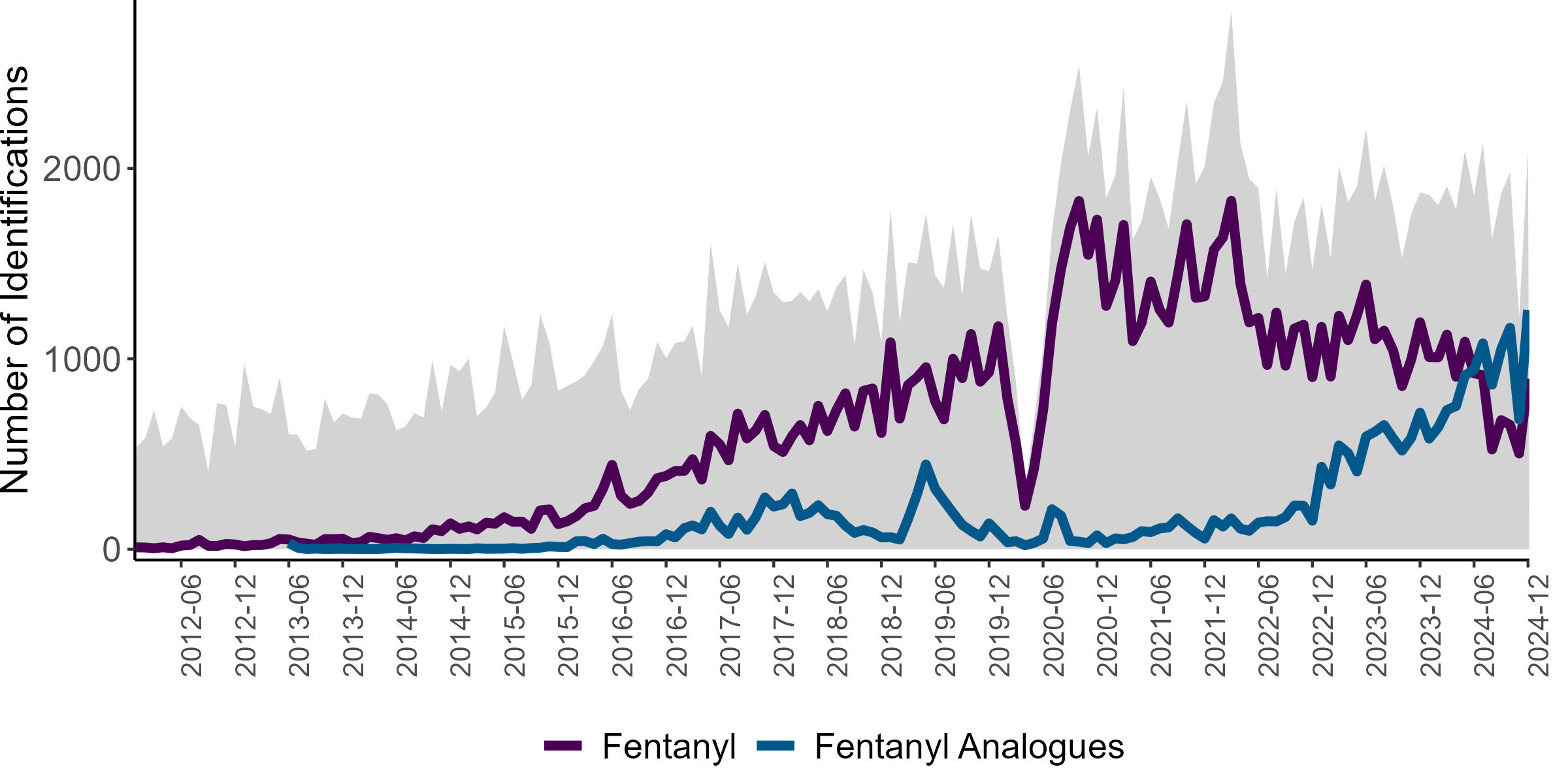
Figure 1 - Text description
| Substance | 2012 | 2013 | 2014 | 2015 | 2016 | 2017 | 2018 | 2019 | 2020 | 2021 | 2022 | 2023 | 2024 |
|---|---|---|---|---|---|---|---|---|---|---|---|---|---|
| Fentanyl | 217 | 446 | 809 | 1,713 | 3,353 | 6,440 | 8,182 | 10,791 | 13,348 | 16,325 | 15,259 | 13,355 | 10,232 |
| Fentanyl analogues | 0 | 48 | 27 | 60 | 463 | 1,734 | 1,946 | 2,195 | 850 | 1,040 | 1,848 | 6,493 | 10,659 |
Note: The gray background represents the total number of samples containing an opioid substance per month.
The scheduling of fentanyl precursors
There are several main synthesis pathways for clandestine fentanyl production. Each of these synthesis pathways involves precursor chemicals that are used to synthesize fentanyl and/or fentanyl analogues.
The first explicit scheduling of fentanyl precursors in Canada occurred in November 2016. This first round of controls added six items to Schedule VI of Canada's Controlled Drugs and Substances Act (CDSA).Footnote 3
In May 2019, following a review of clandestine synthesis pathways and the emergence of novel precursor chemicals, action was taken to amend the CDSA to expand the list of controlled fentanyl precursors to include the analogues, salts and derivatives of 4-anilino-n-phenethylpiperidine (ANPP)—previously controlled as derivative of fentanyl—along with norfentanyl, and benzylfentanyl. These actions allowed the CDSA to capture these classes of precursors, thus increasing regulatory flexibility to address novel precursors designed to evade controls.Footnote 4
Since then, additional fentanyl precursors have also been listed in the Schedules to the CDSA. To consult more recent information regarding the scheduling of fentanyl precursors—including substances outside the scope of this report — see Appendix 1.
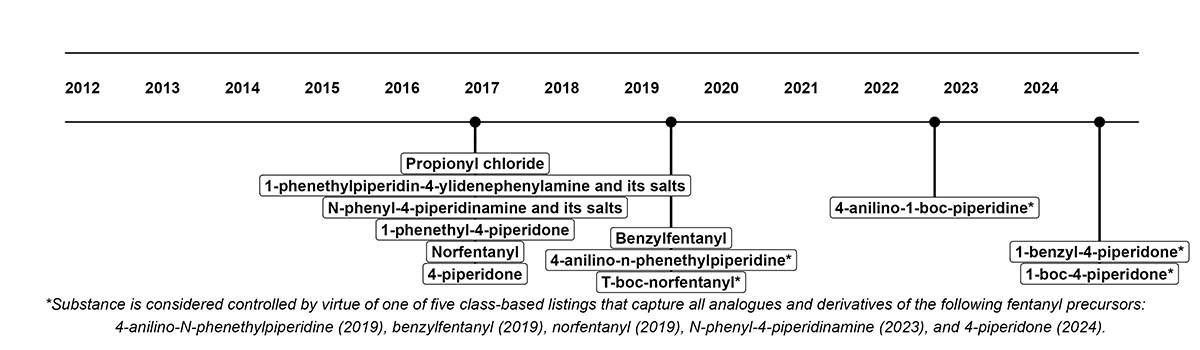
Figure 2 - Text description
| Fentanyl precursors | Control date |
|---|---|
| 4-anilino-n-phenethylpiperidine (ANPP) | 2013-05-16 (as a fentanyl derivative) 2019-05-15 (separate sub-item) |
| Norfentanyl | 2016-11-30 |
| 4-piperidone | 2016-11-30 |
| Propionyl chloride | 2016-11-30 |
| N-phenyl-4-piperidinamine and its salts | 2016-11-30 |
| 1-phenethyl-4-piperidone | 2016-11-30 |
| 1-phenethylpiperidin-4-ylidenephenylamine and its salts | 2016-11-30 |
| Benzylfentanyl | 2019-05-15 |
| T-boc-norfentanyl | 2019-05-06 |
| 4-anilino-1-boc-piperidine | 2022-09-01 |
| 1-benzyl-4-piperidone | 2024-09-24 |
| 1-boc-4-piperidone | 2024-09-24 |
| (2-bromoethyl)benzene | n/a |
| Aniline | n/a |
Fentanyl precursors in Canada
Between January 1, 2019 to December 31, 2024, the most frequently identified fentanyl precursors in samples submitted to DAS were 4-anilino-n-phenethylpiperidine (ANPP), 4-piperidone, (2-bromoethyl)benzene, aniline, and 4-anilino-1-boc-piperidine (Figure 3).
There is an increasing presence of fentanyl precursor chemicals in the Canadian drug market, suggesting both a diversification in the chemicals being used to produce fentanyl in Canada and an attempt of the illicit market to evade controls. This shifting landscape is thought to be, at least in part, a response to the disruption of trafficking networks catalyzed by the recent expansion of international and domestic controls on fentanyl-related substancesFootnote 5.
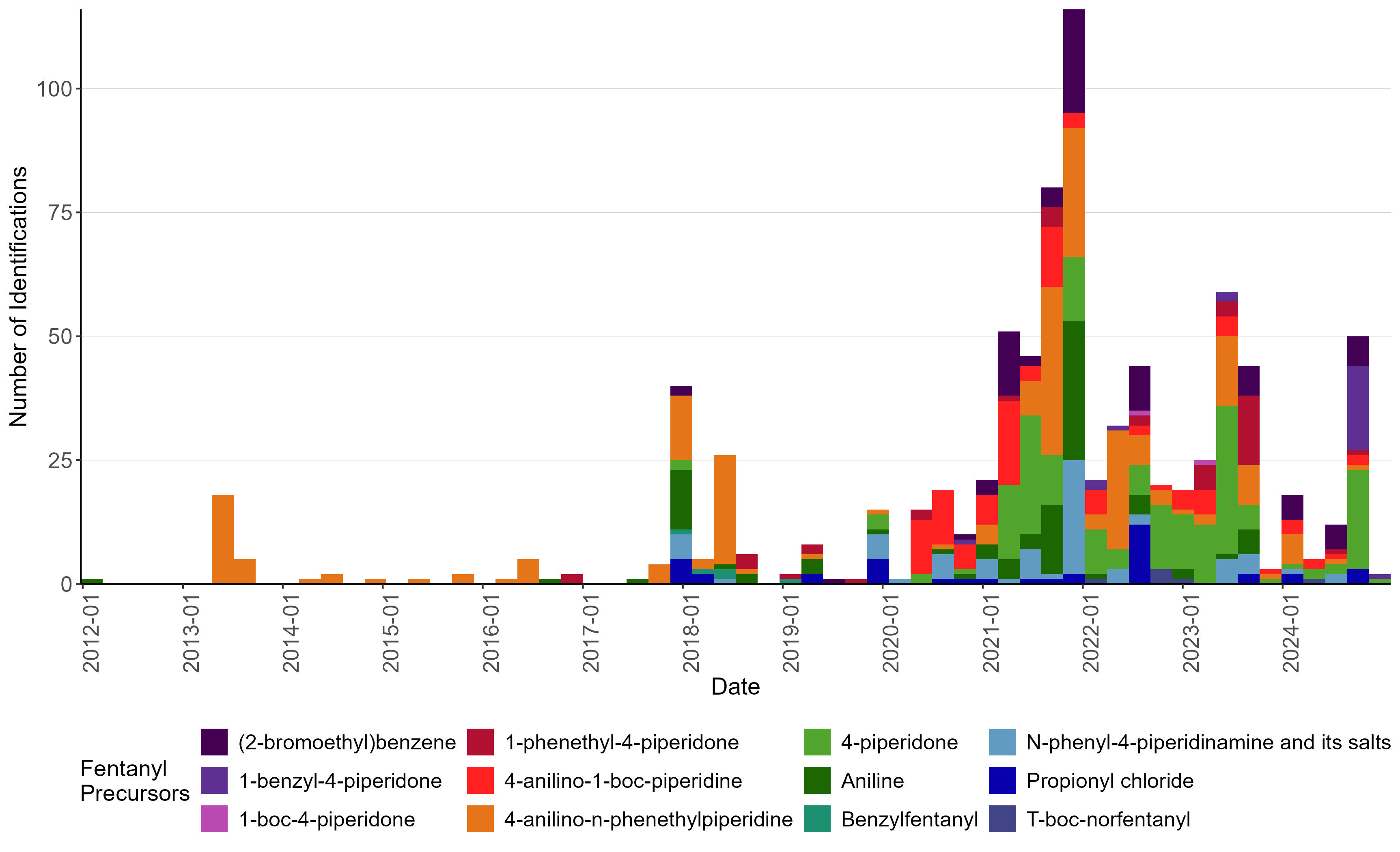
Figure 3 - Text description
| Fentanyl precursors | 2012-2016 | 2017 | 2018 | 2019 | 2020 | 2021 | 2022 | 2023 | 2024 | Total |
|---|---|---|---|---|---|---|---|---|---|---|
| 4-anilino-n-phenethylpiperidine | 36 | 4 | 38 | 1 | 2 | 46 | 61 | 26 | 8 | 222 |
| Norfentanyl | n/a | n/a | n/a | n/a | n/a | n/a | n/a | n/a | n/a | 0Figure 3 footnote * |
| 4-piperidone | n/a | n/a | 2 | n/a | 6 | 49 | 53 | 50 | 27 | 187 |
| Propionyl chloride | n/a | n/a | 7 | 2 | 7 | 3 | 14 | 2 | 5 | 40 |
| N-phenyl-4-piperidinamine and its salts | n/a | n/a | 6 | 2 | 9 | 16 | 24 | 9 | 3 | 69 |
| 1-phenethyl-4-piperidone | 2 | n/a | 3 | 4 | 2 | 5 | 2 | 22 | 2 | 42 |
| Benzylfentanyl | n/a | 1 | 3 | 1 | n/a | n/a | n/a | n/a | n/a | 5 |
| T-boc-norfentanyl | n/a | n/a | n/a | n/a | n/a | n/a | 5 | n/a | 1 | 6 |
| 4-anilino-1-boc-piperidine | n/a | n/a | n/a | n/a | 27 | 39 | 10 | 14 | 8 | 98 |
| 1-benzyl-4-piperidone | n/a | n/a | n/a | n/a | 1 | n/a | 3 | 2 | 18 | 24 |
| 1-boc-4-piperidone | n/a | n/a | n/a | n/a | n/a | n/a | 1 | 1 | n/a | 2 |
| (2-bromoethyl)benzene | n/a | n/a | 2 | 1 | 1 | 22 | 30 | 6 | 16 | 78 |
| Aniline | 2 | 1 | 15 | 3 | 3 | 25 | 32 | 8 | n/a | 89 |
| Total | 40 | 6 | 76 | 14 | 58 | 205 | 235 | 140 | 88 | 862 |
|
||||||||||
Evidence of illegal synthetic opioid production in Canada
A clandestine laboratory (clan lab) or clandestine associated siteFootnote 6 is a location or facility, often hidden or concealed, used to produce illicit drugs. There are several types of fentanyl clandestine laboratories in Canada including:
- Synthesis: Combining precursors and/or essential chemicals to produce fentanyl through a series of chemical reactions. Chemicals, scientific glassware and apparatus are commonly present.
- Pressing/ Tabletting: Pressing fentanyl powder to create uniformly-sized units using a pressing or tabletting machine. While the sizes of the units/pills are consistent, the concentration of fentanyl within them often differs—sometimes significantly—which can lead to unpredictable and potentially dangerous effects, including overdose and death.
- Conversion: Changing the physical properties of finished fentanyl from one form into another (such as mixing fentanyl powder into a liquid). The physical form of the drug is altered, but the drug itself remains the same.
In recent years, over 67% of fentanyl clandestine labs and associated site locationsFootnote 6 (n=52) were synthesis labs (n = 35), followed by approximately 19% pill-pressing labs (n=10), approximately 12% conversion labs (n=6), and approximately 2% that involved both synthesis and pressing (n=1) (Figure 4).
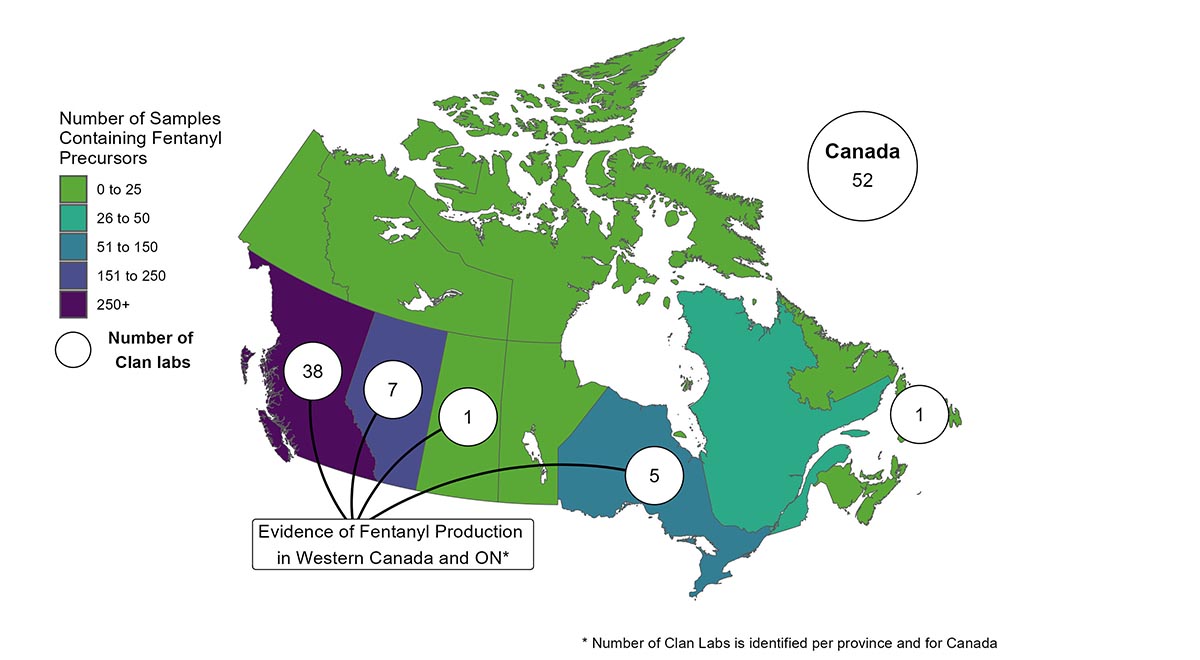
Figure 4 - Text description
| Province/Territory | Number of Clan Labs | Fentanyl precursor identifications |
|---|---|---|
| Alberta | 7 | 239 |
| British Columbia | 38 | 378 |
| Manitoba | 0 | 8 |
| Maritimes | 1 | 4 |
| Ontario | 5 | 57 |
| Quebec | 0 | 34 |
| Saskatchewan | 1 | 2 |
| Territories | 0 | 0 |
Note: This map shows the number of fentanyl precursor identifications is highest in the West where the bulk of fentanyl clandestine laboratories are found (2018-2024). Only samples where fentanyl was not identified as a co-occurrence are pictured.
On average, the DAS supports the dismantling of 25 clandestine laboratories per year. Of these, approximately 20% are fentanyl synthesis laboratories (Figure 4). The number of fentanyl precursor identifications in samples submitted to DAS is highest in the western provinces where the bulk of clandestine laboratories are located. In 2024, one nitazene tabletting clandestine laboratory and two fentanyl analogue clandestine laboratories were uncovered, indicating some innovation in the illicit production of synthetic opioids from synthesis of fentanyl only to the production of different substances.
Conclusion
Beginning in 2019, we have seen a diversification of fentanyl precursors in Canada, reflecting a shift from the illegal importation of fentanyl and fentanyl analogues to the importation of fentanyl precursors into Canada. In recent years, there has been evidence of illegal domestic production, particularly the synthesis of fentanyl in Western Canada. The data presented in this report underscore the need for continued vigilance and new tools to detect and disrupt the illegal fentanyl trade.
Drug Analysis Service - Health Canada
- Michèle Boileau-Falardeau
- Melina Thibault
- Caroline Maurice-Gélinas
- Justin Dyck
- Glenn Wong
- Marie-Line Gilbert
- Thierry Lefrancois
- Janike Pitre
- Benoit Archambault
Canada Border Services Agency
- David de Bellefeuille
- Contraband Intelligence Section Members
Royal Canadian Mounted Police
- Luc Chicoine
- Stéphane Sirois
Office of Legislative and Regulatory Affairs-Health Canada
- Craig Cooke
Suggested citation
Government of Canada. (2025). Health Canada Drug Analysis Service. At-a-glance: New Emerging Drug Threat in Canada – Fentanyl Precursors. Longueuil (QC), 2025. Retrieved from https://canada.ca/en/health-canada/services/publications/healthy-living/new-emerging-drug-threats-canada-fentanyl-precursors.html.
Appendix 1: Precursor scheduling in Canada
- Schedule I Sub-item 16(14): 4-Anilino-N-phenethylpiperidine (ANPP) (N-phenyl-1-(2-phenylethyl)piperidine-4- amine), its derivatives and analogues and salts of derivatives and analogues
- Schedule V Item 2: Phenethyl bromide ((2-bromoethyl)benzene)
- Schedule V Item 3: Propionic anhydride (propanoic anhydride)
- Schedule V Item 4: Benzyl chloride ((chloromethyl)benzene)
- Schedule VI Item 25: Propionyl chloride
- Schedule VI Item 26: 1-Phenethyl-4-piperidone (NPP) and its salts
- Schedule VI Item 27: 4-Piperidone (piperidin-4-one), its salts, derivatives and analogues and salts of derivatives and analogues, including:
- 1-boc-4-piperidone (tert-butyl 4- oxopiperidine-1-carboxylate)
- 3-methyl-4-piperidone (3- methylpiperidin-4-one)
- 1-benzyl-4-piperidone (1-benzylpiperidin-4-one)
- Schedule VI Item 28: Norfentanyl (N-phenyl-N-piperidin-4- ylpropanamide), its salts, derivatives and analogues and salts of derivatives and analogues
- Schedule VI item 29: 1-Phenethylpiperidin-4-ylidenephenylamine and its salts
- Schedule VI Item 30: N-Phenyl-4-piperidinamine (N-phenylpiperidin-4- amine), its salts, derivatives and analogues and salts of derivatives and analogues, including:
- 4-anilino-1-boc-piperidine (tert-butyl 4- (phenylamino)piperidine-1-carboxylate)
- 4-fluoro anilino-1-boc-piperidine (tert-butyl 4-((4-fluorophenyl)amino)piperidine-1- carboxylate)
- N-(4-fluorophenyl)-4-piperidinamine (N-(4- fluorophenyl)piperidin-4-amine)
- 4-bromo anilino-1-boc-piperidine (tert-butyl 4-((4-bromophenyl)amino)piperidine-1- carboxylate)
- Schedule VI Item 32: Benzylfentanyl (N-(1-benzylpiperidin-4-yl)-N-phenylpropionamide), its salts, derivatives and analogues and salts of derivatives and analogues
For more information consult the Controlled Drugs and Substances Act.
Act current to 2025-11-20 and last amended on 2025-04-14.
- Footnote 1
-
Public Health Agency of Canada, "Substance-related Overdose and Mortality Surveillance Task Group on behalf of the Council of Chief Medical Officers of Health," March 2025. [Online]. Available: https://health-infobase.canada.ca/substance-related-harms/opioids-stimulants/.
- Footnote 2
-
Government of Canada, "Spotlight: The evolution of Fentanyl in Canada over the past 11 years," 2023. [Online]. Available: https://www.canada.ca/en/health-canada/services/publications/healthy-living/evolution-fentanyl-canada-11-years.html.
- Footnote 3
-
Government of Canada, "Regulations Amending the Precursor Control Regulations (Fentanyl Precursors)," 30 November 2016. [Online]. Available: https://gazette.gc.ca/rp-pr/p2/2016/2016-11-30/html/sor-dors294-eng.html.
- Footnote 4
-
Health Canada, "Government of Canada takes action to disrupt the illegal importation and distribution of precursor chemicals used to make illegal fentanyl," June 2023. [Online]. Available: https://www.canada.ca/en/health-canada/news/2023/06/government-of-canada-takes-action-to-disrupt-the-illegal-importation-and-distribution-of-precursor-chemicals-used-to-make-illegal-fentanyl.html.
- Footnote 5
-
Canadian Border Service Agency, Data Source, 2023.
- Footnote 6
-
A clandestine laboratory associated site is any location where items used to facilitate illicit drug production are found (for example, chemicals, equipment, or waste), but are not directly associated to a known production site (clan lab). These might include dump sites, where waste from a clan lab has been discarded, or sites where chemicals used in illicit drug production are being stored (for example, storage lockers).