
Documents of a Colonial System: Day Schools Records at Library and Archives Canada

Download the booklet
(PDF document, 3.50 MB, 52 pages)
On this page
- The Day Schools Project
- The Day Schools System: an overview
- About this booklet
- Things to keep in mind
- Understanding the themes
- A closer look at select documents
- Photographs, maps, architectural and technical drawings, and art and materials
- Appendices - Understanding archival file numbers and classification systems
The Day Schools Project
The Day Schools Project (DSP) is an initiative of Library and Archives Canada (LAC) to digitize, describe, and increase the discoverability of up to six million pages of archival documents related to the Federal Indian Day Schools system and its legacy.
The DSP ran from 2022 to 2026. During this time, the DSP team identified, digitized, and created file-level descriptions for a range of records related to various aspects of the Federal Day Schools system, making it easier for Survivors, family members, and researchers to find information in LAC’s public database.
The enhanced file-level descriptions of records related to day schools now include details, when available, on the types of documents contained within each file, the Indigenous communities and school locations mentioned, the names of schools and related institutions, and whether the file includes student or staff names.
Most of the records are restricted by law (Code 32) because they contain personal information. You can request access to restricted files through an Access to Information and Privacy (ATIP) request available on LAC’s website.
Records that are open to the public (Code 90) are identified as such in the online database. If a digital copy of a file exists and has been linked to the file-level description, you can view it online. If no digital copy exists, you can order and consult the file in person, order copies online, or hire a researcher to help. See LAC’s website for more information.
For more information on how to access the records, see the Day Schools Project Research Guide on LAC’s website.
The Day Schools System: an overview
Colonial systems such as Indian Residential Schools and Federal Indian Day Schools (from here on, Day Schools) were used to forcibly assimilate First Nations, Inuit, and Métis Nation children into mainstream society. Between the mid-1800s and 2000s, with many peaking in the 1950s to the 1970s, an estimated 200,000 Indigenous children attended Day Schools in every province and territory, except Newfoundland and Labrador.
These schools were funded and operated by the federal government, often in partnership with church organizations. Like Residential Schools, Day Schools were designed to enforce cultural assimilation into Euro-Canadian society by attempting to erase Indigenous languages, cultures, and identities. Unlike Residential Schools, children did not live at Day Schools; however, they were still subjected to the same forms of abuse and neglect. Many children experienced trauma associated with cultural harms and, in some cases, physical, emotional, and sexual abuse, as well as systemic racism from staff.
Spanning from the 19th century into the 2000s, the records held at LAC were created by the former Department of Indian Affairs and Northern Development, and its predecessors, the Indian and Inuit Affairs Program and the Northern Affairs Program. Originally intended for administrative purposes, the records contain both textual and non-textual documents, including photographs, architectural and technical maps and plans, and artwork.
About this booklet
This booklet is intended to help Survivors, their families, and the public better understand and interpret some of the archival documents found at LAC, including those in the files digitized and described by the DSP. It can be used as a companion to both the DSP Overview and the DSP Research Guide on LAC’s website.
This booklet provides a general overview of the different types of records created by the former Department of Indian Affairs and Northern Development in relation to the Federal Day Schools system. Due to administrative overlap, some records may also relate to the Indian Residential Schools (IRS) system.
The terminology used throughout this booklet reflects the wording used in the documents themselves. We have kept this terminology so that researchers know which keywords to use when searching and to better understand the file-level descriptions. For example, “noon-day lunches,” “nominal roll” and “day school blocks” are the administrative terms used by the department.
For ease of use, the information is organized into the following themes:
- Students
- Schools
- Staff
- Indigenous involvement in education
- Funding
- History and policy
The documents in these files support a wide range of research purposes including, but not limited to, the following:
- Personal and family: for example, individuals looking for information about their own experiences or those of family or community members
- Litigation: for example, research in support of class actions and other legal cases
- Historical and educational: for example, as a teaching tool for educators and a resource for students, communities, and the public
Understanding the documents you may come across in these files will help you narrow down your research and allow you to find records of interest.
Things to keep in mind
Government records related to Day Schools were created and collected over many decades. Thus, they reflect the administrative priorities and recordkeeping practices of their time rather than the lived experiences of students, families, or communities.
When reviewing these documents, be aware that they may contain gaps, inaccuracies, inconsistencies, and culturally inappropriate or harmful terminology. The following notes are intended to help interpret the records:
- Some forms are incomplete
- Some information may be missing, illegible, or difficult to interpret due to handwriting, fading, or damage
- Many administrative records are standardized government forms and templates that include information gathered by government officials for specific bureaucratic purposes
- Documents may contain errors including, but not limited to, spelling, names, or dates
- Discrepancies may appear across standardized forms and templates
- Most government forms used by the Department of Indian Affairs and Northern Development were standardized for First Nations but applied across different groups including Inuit and Métis Nation communities. For example, the heading on a form may say “Band” but the information on the form may pertain to Inuit or Métis Nation communities
- Many documents use culturally inaccurate terminology, reflecting the administrative systems of the time rather than the identities recognized by the people to whom the documents refer
- The department continued to use the same forms for Day Schools as they used for Residential Schools. An example of this would be when the title or headings in a form say “Residential School” but the information on the form is actually about a Day School
- The format, titles, and content of standard government templates and forms changed over time and varied between regions, so documents with a similar purpose may not look the same or contain identical categories of information
- Not every document type exists for each school
Understanding the themes
The files digitized and described by the DSP are mainly textual records. As per the scope of the project, the focus of this booklet is on records containing student and school information.
Additional information on the files listed below can be found in Appendix 1. Some of the documents listed below are described in section A closer look at select documents.
Students
If you are looking for documents that mention students or contain student names, such as school records or class lists, you may find the following file types useful:
- Admission and discharge
- Care of children
- Educational assistance
- Nominal roll system
- Reports and returns
- Student transportation
Some of the documents that contain student names include:
- Admission and discharge forms
- Applications (for educational assistance, for admission)
- Child placement (applications, authority forms)
- Claim for tuition fees forms
- Daily registers
- Enrolment and attendance reports
- Lists (student, class)
- Nominal rolls
- Principal’s monthly reports
- Quarterly returns
- Report cards (progress reports, achievement reports)
- Student action forms
- Teacher’s half-yearly reports
Schools
If you are looking for documents that discuss the schools themselves, including school administration, operation, enrolment, and buildings, you may find the following file types useful:
- School buildings (facilities)
- School establishment
- School inspection reports
- Education statistics
- Joint schools
Some of the documents that pertain to the schools themselves include:
- Federal schools facts and figures forms
- Inspector’s report on the school plant and equipment
- Joint school submissions
- Provincial schools census file cards
- School establishment and organization returns
- School facilities inventories
- Specifications (engineering and construction)
Staff
If you are looking for documents that pertain to teaching staff, you may find the following file types useful:
- Reports and returns
- In-service training of teachers
- Employment of teachers (applications)
- Certification and qualification of teachers/recruitment and retention
- School establishment
Community involvement
If you are looking for documents that pertain to Indigenous community involvement in education, including curriculum development, you may find the following file types useful:
- Minutes of council/band council resolutions
- Education/school committees
- Band control/takeover of education
- Parental and community engagement
- First Nations and Inuit-language curriculum development
Funding
If you are looking for documents that discuss funding or financial matters related to education, you may find the following file types useful:
- Education funding
- Tuition fee agreements
- Contribution agreements/arrangements
History and policy
If you are looking for documents that discuss broader policy or historical matters relating to Day Schools, you may find the following file types useful:
- Education
- Elementary and secondary education
- Education circulars
Other document types you may find useful in your research include:
- Agreements (for example, contribution or education)
- Band council resolutions
- Briefing notes
- Circulars
- Financial documents (for example, statements of expenditures, vouchers, requisitions, paylists)
- Meeting minutes
- Orders in Council
- Treasury Board documents (for example, submissions, approvals, minutes)
A closer look at select documents
The following examples provide a more detailed description of some of the documents listed in section Understanding the themes. They are listed in alphabetical order.
Applications for educational assistance
An application for educational assistance is a standardized form submitted to the Department of Indian Affairs and Northern Development for financial assistance to offset the cost of education. The application may pertain to elementary, secondary, post-secondary, vocational, and other post-school students. It lists schools previously attended, which often include Day Schools. An application for educational assistance is a two-page document.
This form contains:
- Region
- Education district
- Agency
- Student’s full name
- Student’s age and date of birth
- Student’s marital status (and number of dependents)
- Student’s band and band number
- Schools previously attended with location, school year or grade, and highest grade completed
- Name and location of school for which student is applying (may include student’s second or third choices)
- Grade, program, or course and its duration
- Whether student will board in a private home, live in a residence or hostel, or stay at (parental or guardian) home
- Name and mailing address of parent or guardian
- Details of the request
- Record of expenditures which may include seasonal or daily travel, room and board, clothing and school uniforms, tuition fees, education allowance, and books
- Name and address of student’s residence while at school, when applicable
- Signatures including, but not limited to, student, parent or guardian, and education or guidance counsellor
Band Council Resolutions (BCRs)
This is a formal document drafted and approved by a First Nation to authorize a specific action. BCRs are submitted to the Department of Indian Affairs and Northern Development. The BCR is a single page standardized form, with additional pages added, typically one to three, when required. In relation to Day Schools, a BCR may pertain to actions including, but not limited to, teaching staff, school operations, school buildings, school supplies, curriculum, noon-day lunches, and student transportation.
BCRs contain:
- A unique chronological number
- Band council name
- Agency
- Province
- Place
- Date
- Resolution details
- Signatures of chief and councillors
- Section completed by departmental headquarters that includes funding information and signatures
Circulars
The circular letter is a written statement of government policy. Departmental circulars provide information, instructions, guidelines, and directives with regard to departmental policies and programs, including education. Circulars may be broader and higher-level in scope or more specific and may pertain to Day Schools. Circular letters employ a standardized departmental form but vary in length and may include attachments.
Circular letters contain:
- Subject heading
- Unique circular number
- Recipient details
- Date of letter
- Subject details
- Signature block
- Attachments
Daily Registers
Daily Registers are departmental forms that record who attended a school, when they attended, and provide basic information about each student. Daily Registers typically cover a three-month period and can vary in length.
This form contains:
- School name
- Dates
- Student’s full name
- Register number
- Age when admitted
- Date of admission or discharge
- Grade level (usually grades 1–8 or high school)
- Weekly attendance
- Total daily attendance
- Remarks (by teachers or principals)
Each form also contains a summary prepared by the teacher:
- Number of boys and girls enrolled
- Average and total attendance for the quarter
- Number of school days, holidays, and days the school was open
Federal schools facts and figures
This is a departmental form that includes basic information on a school for a given school year. This form is typically half a page in length.
This form contains:
- School year
- Name of school
- School’s religious denomination (if applicable)
- Education district
- Region
- Location of school, including postal address and name of community
- Number of classrooms
- Grades taught
- Current enrolment
- Number of teachers (First Nation and others)
- Number of teacher-aides
- Language of instruction
- Remarks
Initial Child Placement Application and Authority form
This is a standard departmental application form for children in care. While this form does not pertain specifically to Day Schools, many children named on these applications are school-aged and schools may be identified. These forms indicate whether the application pertains to childcare or juvenile delinquency. This application form is typically one page long with a second page containing financial information for departmental accounts only:
Child or children:
- Name
- Band and band number
- Date of birth
- Religion
Parents:
- Name
- Band and band number
- Address on- or off-reserve
- Whether parent is alive
- Whether parent is contributing to support of child
- Next of kin, legal guardians, or nearest relatives, if applicable
Child caring agency or courts:
- Name of agency
- Status of child, including permanent or temporary wardship, non-ward, juvenile delinquent
- Date admitted to care or committed to reform institution
- Brief residence history if child was apprehended off-reserve
Departmental placement:
- Date of placement in foster home or institution
- Reason necessitating placement
- Who requested placement
- Who made placement
- Whether parents signed permission for placement
- Plans for child’s future including education and possible adoption
- Name, address, and location on- or off-reserve of foster parents or placement institution
- Relationship of foster parents to child
- Whether foster parents are First Nation or not, with band and band number, if applicable
- Brief description of foster home environment
Inspector’s report on the school plant and equipment
This is one of several types of school inspection reports, many of which contain similar information including, but not limited to, condition of school facilities, health and sanitation, appearance of children, learning environment, and recommendations for improvements. The inspector’s report on the school plant and equipment is completed by a regional or provincial school inspector and is typically one page in length.
This form contains:
- Name of school
- Date of visit
- School building (classroom number, condition, lighting, ventilation, heating, paintwork, water supply, power, janitor service, basement, and cloakrooms)
- Playground (condition, equipment, and adequacy)
- Toilet facilities (lavatories, wash basins, towels, and drinking facilities)
- Teacher’s residence (condition and furniture)
- Industrial arts and home economics (accommodation, condition, supplies, tools, and equipment)
- Recommendations
- School inspector’s signature
Nominal rolls
Nominal rolls contain lists of students by band and school for a given financial year.
This document contains:
- Fiscal year
- School name and number
- School board
- School type (federal, provincial tuition, provincial joint, band operated, other, not specified)
- City
- Band of financial responsibility
- Student ID (district, band, family number, individual number)
- Student’s full name
- Date of birth
- Status (according to the Indian Act)
- Grade
- Residence code (home, student residence, boarding home, foster home, other, not specified)
- Band number and reserve number
Principal’s monthly reports
The principal’s monthly report was completed by school principals each month to report on the daily functioning of federally run schools. While there are several versions of the principal’s monthly report, most are one to two pages in length and typically contain the following information:
- School name and number (may include school location or address)
- Month and year of report
- School operation (number of classrooms, number of days school was open, number of days and reasons for school closures)
- Staff (including, but not limited to, number of teachers, teacher-aides, professional development activities, absences, and substitute teachers)
- Enrolment (number of pupils registered during school year by category, including sex, First Nation, and non-First Nation)
- Grade distribution (by pupil category)
- Attendance (including, but not limited to, average daily, percentage of all grades, cases of tardiness, and cases of corporal punishment)
- Visits to school (federal officials, provincial officials, parents or guardians, and others)
- Absenteeism (name of pupil with reason for absence)
- Additional student information (admissions, transfers in or out, withdrawals)
- Principal’s signature and date
Provincial (joint) school census file cards
This is a departmental form that includes information on a provincial and/or joint school for October of a given year. This form pertains to pupils enrolled on a full-time basis in elementary or secondary schools or vocational students enrolled in a secondary school. It excludes adult students enrolled in special courses. This form is typically half a page in length.
This form contains:
- Name of school
- Signature of supervising principal or school superintendent
- Year
- Academic and/or vocational enrolment by grade (pre-1 to 13 and special) with total enrolment
- Additional information (for example, school division, school address)
School establishment and organization returns
This is a departmental form that includes basic information on a residential or day school for one school year and, when applicable, recommends changes in relation to the school. Changes include, but are not limited to, number of teaching positions, number of classrooms, a school name change, and school opening or closure. This form typically appears as a single page document or a double-sided card.
This form contains:
- School name
- Reserve
- Band
- Authorized enrolment
- Number of “non-Indian” pupils
- Total enrolment by religion
- Names of teachers with types of duties
- Enrolment by grade for each teacher
- Expected enrolment for upcoming school year
- Recommended changes in establishment and organization with description and approval
Specifications (engineering and construction)
This is a multi-page technical document for engineering or construction projects at residential or day school properties. It may include project descriptions, agreements, lists of materials, labour conditions, and insurance information. This document may also be accompanied by architectural drawings or site plans.
Student Action form
Student Action forms were used to keep track of key changes in a student’s schooling or living situation. They often accompany applications for educational assistance. This is a single page document divided into several sections.
Each form provides the reason for its submission and identifies one of the following:
- Admission
- Discharge or withdrawal
- Change in boarding home
- New rate of payment (a change in the amount the government paid for the student’s education or care)
- Completed and passed grade or year
- Completed but failed grade or year
- Other (any reason not listed above)
The form also contains:
- Student name
- Band and band number
- Date of birth
- Name of parent or guardian and address
- Old and new placement (school, residence, boarding home) and address
- Explanation of change and/or new rate for payments
- Attachments (for example, educational assistance progress reports, statements of expenditures, or student withdrawal forms)
- Approval, signature, and distribution list
Photographs, maps, architectural and technical drawings, and art and materials
Also referred to as specialized media, files containing Day Schools information include non-textual documents such as photographs, architectural and technical drawings, maps and other non-textual media, including photocopies of photographs.
Photographs can be black and white or colour. Most depict school buildings and sites, or other buildings, such as housing. They document site conditions, construction, and show before-and-after repair work on the buildings.
Sometimes notes written on or around the photograph identify the location; otherwise, location is assumed from file contents.
Occasionally there are photographs of students and staff, but these were not often seen in this project.
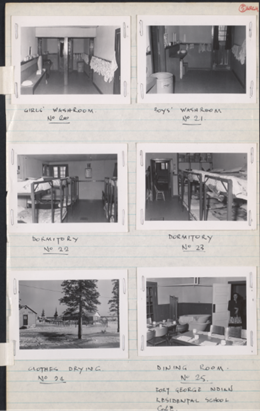
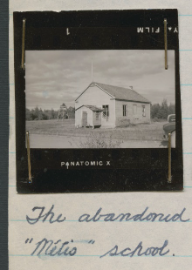
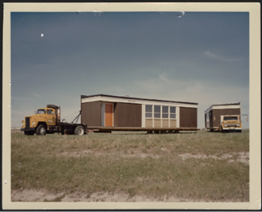
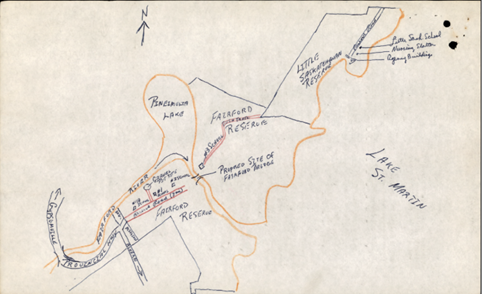
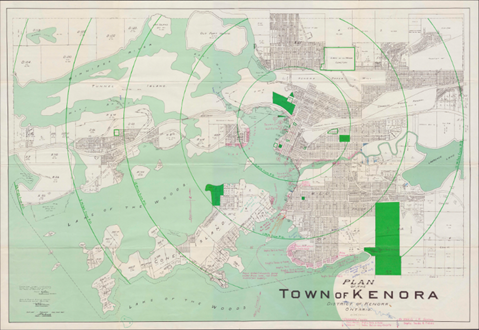
Maps include published maps with written notes, usually identifying locations of communities, schools, existing and proposed transportation routes, as well as hand-drawn maps. There are also aerial maps, either in single sheet form (single image taken from the airplane), or mosaics, which are multiple images connected to make larger maps.
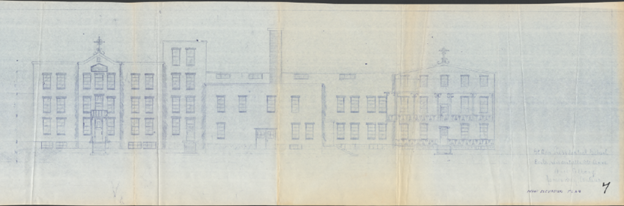
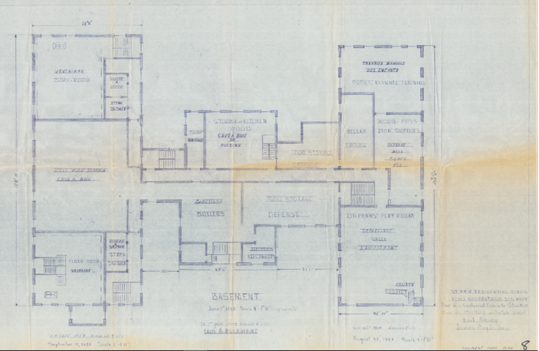
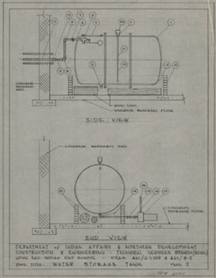
Architectural and technical drawings include building plans that document both existing structures and proposed designs for school buildings and staff residences. These drawings may specify details of electrical and plumbing systems, indicate alterations or renovations, and identify construction materials or methods used.
Site plans form another category of architectural documentation. They provide a broader survey of the land involved in construction projects or property development proposals. Site plans typically identify the location of school buildings and may also indicate related features such as residences, churches, cemeteries, roads, septic systems, and water supplies.
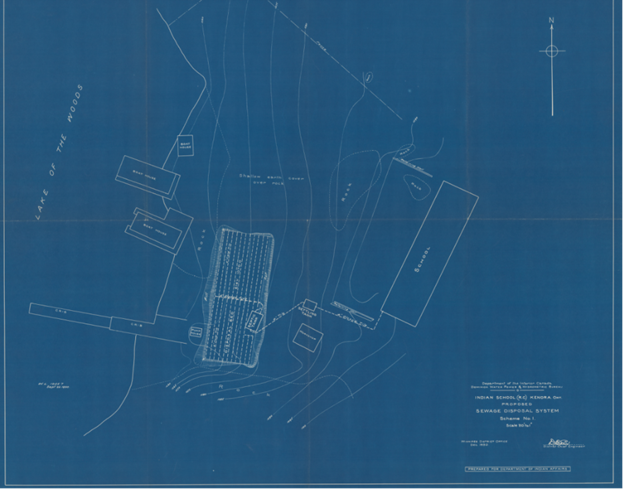
In addition, technical drawings of individual building elements, including heating, electrical, water, and septic systems, record precise dimensions, installation details, and material specifications.
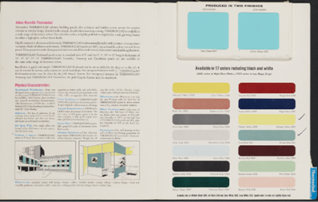
Art and materials primarily consist of drawings created by students using various media, including pencil, pen, and marker. Also included are reproductions of published materials, such as postcards, as well as physical samples of craft supplies, such as beads and fabric, that were either requested or supplied. Additionally, they contain samples related to school construction projects, such as paint chips, color selections, and material boards.
Appendices
Understanding archival file numbers and classification systems
Throughout its history, the former Department of Indian Affairs and Northern Development (and its predecessor departments) used classification systems to organize its records. Each file was assigned a series of numbers to indicate the subject it related to and its place within the department’s bureaucratic filing structure as shown in the examples listed below.
These classification systems reflect the administrative reach of the federal government into nearly every aspect of the lives of First Nations, Inuit, and Métis children, their families, and communities. The systems were created through a colonial lens, and their structure mirrors the priorities and worldview of the colonial administration rather than the people and communities represented in the records.
These records are shaped by government categories, terminology, and perspectives that often obscure or depersonalize the lived experiences behind them.
The intention of this booklet—and of the Day Schools Project more broadly—is to help bridge the gap between government-created records and the real human experiences they document. While we do not explain the department’s filing systems in detail, this section points to types of files drawn from those systems that speak to the story and legacy of Day Schools, helping Survivors, family members, communities and researchers find and connect with the records of interest.
Appendix 1: Sampling of files relating to the Day Schools system and its legacy
Students
- Admission and Discharge (25-2)
- Admission and Discharge of Pupils, Residential Schools for Family Allowance (25-4)
- Assistance to ex-pupils (25-3)
- Care of Children (29-4; 41-6, 6575)
- Children’s Aid Services (29-16)
- Day Pupils at Residential Schools (25-12)
- Educational Assistance (25-8)
- Family Allowances, generally (29-8)
- High School Education (25-14)
- Juvenile Delinquency (18-28)
- Kindergarten Classes (25-19; 4785-3)
- Nominal Roll System (23-18; 25-1-14; 46-4-1; 4700-15)
- Non-Indian Pupils in Indian Schools (25-15)
- Principal’s Monthly Reports (23-16; 4700-13)
- Pupil Guidance/Counsellor’s Quarterly Reports (25-17; 23-3)
- Quarterly Returns Residential Schools (23-26)
- Reports and Returns (23-1; 1445/1900)
- Special Education (4785-7)
- Student Statistics (4700-12)
- Student Transportation (27-8; 4700-43; 4810)
- Transportation of Indian Patients (27-5)
- Truancy (18-24; 4968)
- Welfare Teacher’s Reports (23-24)
Schools
- Church Sites/Cemetery Sites (36-5; 36-7)
- Counsellors Quarterly Returns (23-3)
- Day School Regulations (4700-7)
- Joint Schools (25-11; 4932)
- Noon-Day Lunches, School Children (13-10)
- School Buildings (Facilities) (6-1; 4965- ; 4900-)
- School Establishment (1-13; 4780)
- School Inspection Reports (23-5)
- School Land (36-4)
- School Supplies (13-1;13-2; 4968)
- Statistics (41-)
- Student Residence (25-13)
- Superintendent’s Semi-Annual Reports (23-4)
- Survey, School Building Requirements (6-9; 4965-2)
- Transportation School Supplies (requisitions and transportation contracts) (27-6)
Staff
- Certification and qualification of teachers/recruitment and retention (4740-8; 4740-9)
- Employment of teachers (applications) (4740-2)
- In-service training of teachers/counsellors (25-20; 4805-4;4805-2)
- Reports and returns (23-)
- School Establishment (1-13; 4780)
Community involvement
- Band Control/Takeover of Education (25-5; 4700-10)
- Claims and Disputes (3-11; 4025)
- Complaints and Petitions (3-8; 4000-2)
- Education Associations (4700-34)
- First Nations and Inuit Language Curriculum Development/ School Programs (4785-12; 4787-2)
- Minutes of Council/Band Council Resolutions (3-6; 4215-)
- Parental and Community Engagement (4785-21)
- School Committees on Indian Reserves (25-18; 4700-8)
Funding
- Contribution Agreements/Arrangements (4214)
- Education Funding (4700-16)
- Tuition Fee Agreements (4785-5)
History and policy
- Education (25-1; 4700-1)
- Education Circulars (25-1-1; 4700-1-1)
- Elementary and Secondary Education (4785-1)
- Federal-Provincial Relations (42-1)
Appendix 2: Types of schools and related institutions
Although the Day Schools Project focused primarily on records relating to Day Schools, with some overlap into Residential Schools, the records also contain information on a variety of related educational institutions attended by First Nations, Inuit and Métis children. These include the following:
- Camp schools/temporary remote schools/railcar schools
- Day school blocks (day scholars at residential schools)
- Day schools
- First Nation (band-operated) schools
- Hospital schools (schools for children in hospitals or sanatoria)
- Industrial schools (vocational training residential/boarding)
- Joint schools/integrated schools (Indigenous and non-Indigenous children together under federal-provincial agreement)
- Mission schools (church/mission-run day or boarding schools)
- Private and parochial schools
- Reform and special schools
- Residential schools
- Seasonal and summer schools
- Student residences/hostels/boarding homes (for children attending off-reserve provincial schools)
- Tuition schools (Indigenous children in provincial schools with federal payments)