
User Guide for businesses and workers
Free Trade and Labour Mobility in Canada Act and Regulations
Alternate format:

User Guide for Business and Workers [PDF - 1.15 MB]
Introduction
The Government of Canada introduced the Free Trade and Labour Mobility in Canada Act (the Act) on June 6, 2025, which received royal assent on June 26, 2025. The Act removes federal barriers to interprovincial and territorial trade. Under the Act, if a good or service already complies with a provincial or territorial rule that is comparable to a federal rule, then it can be traded across the country without additional federal requirements. Additionally, if a worker has a provincial or territorial authorization for their occupation, they can more easily obtain a federal work authorization for that same occupation.
To clarify the implementation of the Act, the Government of Canada also introduced the Free Trade and Labour Mobility in Canada Regulations (the Regulations), which were published in Canada Gazette, Part II on November 19, 2025. The Regulations clarify details about the implementation of the Act for businesses and Canadians.
The Act and Regulations will come into force on January 1, 2026, at which point businesses will be able to take advantage of the improvements.
This user guide explains what is and isn’t included in the Act, how it's being implemented, and what businesses and workers need to do in order to benefit.
1. Application of the Act and Regulations
1.1 What’s included: requirements and occupations covered by the Act
The Act could benefit businesses and workers whose work relates to:
- Energy efficiency requirements
- Wild animal and plant trade requirements
- Canada lands surveyors
- Locomotive engineers, conductors, yard foremen and transfer hostlers
Details on how the Act impacts each of these requirements and occupations are included below.
1.1.1 Energy efficiency requirements
The Energy Efficiency Regulations, 2016 (EE Regulations) are managed by Natural Resources Canada (NRCan).
Under the EE Regulations, businesses must report that the product they are importing or shipping interprovincially meets the applicable federal energy efficiency requirements. This reporting is completed through NRCan’s Compliance Regulatory Energy Efficiency Database (CREED) online system.
Under the Act, businesses now have the option to meet the federal requirement by satisfying a comparable provincial or territorial requirement.
Businesses who choose to use provincial compliance to satisfy comparable federal energy efficiency requirements must report using NRCan’s dedicated regulatory email address. This reporting cannot be completed through the CREED system. Please visit NRCan website to learn about how to proceed.
Note the Act only applies to products covered by the EE Regulations that are produced in Canada and shipped interprovincially. Products imported to Canada must satisfy the EE Regulations using the standard methods.
For more information, please contact:
Natural Resources Canada
complianceops-opsconformite@nrcan-rncan.gc.ca
1.1.2 Wild animal and plant trade
Environment and Climate Change Canada enforces the Wild Animal and Plant Protection and Regulation of International and Interprovincial Trade Act (WAPPRIITA) and the Wild Animal and Plant Trade Regulations. Under WAPPRIITA and its regulations, a permit is needed to move certain animals or plants from one province to another.
Provinces and territories have their own regulatory protections for the movement of wild plants and animals. Under WAPPRIITA and its regulations, a movement that complies with provincial or territorial requirements is considered to meet the federal requirements. As such, the Act does not change how federal requirements apply.
For more information, please contact:
Environment and Climate Change Canada
ReglementsFaune-WildlifeRegulations@ec.gc.ca
1.1.3 Canada lands surveyors
Canada Lands Surveyors are licensed professionals who practice exclusively in the three Canadian territories, in Federal parks, on reserves, or on and under the surface of Canada’s oceans. They are regulated by the Canada Lands Surveys Act, which is a federal law that falls under the responsibility of the Minister of Natural Resources.
Before the coming into force of the Act and its regulations, the Canadian professional associations of land surveyors across Canada and the Association of Canada Lands Surveyors established a mutual recognition agreement to facilitate labour mobility. This agreement recognizes the qualifications of professionals already licensed in one Canadian jurisdiction and limits additional requirements when transferring to another, including the federal jurisdiction.
Jurisdictional exam
Land surveyors no longer need to pass the jurisdictional exam to work on “Canada Lands”, as defined in the Canada Lands Surveys Act (federal jurisdiction). The exam used to be required under the mutual recognition agreement on labour mobility for land surveyors in Canada signed by the 11 surveying jurisdictions in Canada.
Steps for land surveyors who want to take advantage of the Act
A surveyor with a licence to practise cadastral surveying in one of the 10 Canadian provinces may become a Canada Lands Surveyor to work in federal jurisdiction. To become one, they must complete the following steps:
- Demonstrate good standing with the provincial regulators overseeing the profession.
- The surveyor with a provincial licence must contact the provincial regulator to get a certificate of professional conduct (proof of being in good standing). This guarantees that the surveyor has met the required level of professional and ethical standards before they can be considered for work in federal jurisdiction.
- The applicant must transmit a certificate of professional conduct from the provincial regulator.
- Apply to the federal regulator (Association of Canada Lands Surveyors), which recognizes the qualifications and gives a commission (i.e., designation as a Canada Lands Surveyor).
- The surveyor with provincial licence starts the process by applying to the Association of Canada Lands Surveyors for licensed membership and pays a one-time fee to open their file.
- The Association of Canada Lands Surveyors checks this information before giving the application to its Board of Examiners.
- The surveyor takes an official oath with the Association (i.e., agreeing to follow the Association's Code of Ethics), and pays the required oath fees.
- The Association then creates a permanent record and issues a commission.
- Pay the annual membership fees to become a member of the Association of Canada Lands Surveyors, with the rights and responsibilities that come with membership.
- The Association of Canada Lands Surveyor issues a membership certificate.
- The member must follow the Canada Lands Surveyors Act, its regulations (including a Code of Ethics) and the by-laws of the Association of Canada Lands Surveyors. Members agree to go through peer reviews of their work and participate in the federal complaint and disciplinary processes, if needed.
- Pay the annual licensing fees to be authorized to perform cadastral surveying on “Canada Lands” (federal jurisdiction).
- The member must fill in the administrative forms and provide proof they have professional liability insurance, so the clients (the public) receive compensation if the surveyor is found to be responsible for damages.
- The Association of Canada Lands Surveyors gives the member a licence to practise.
For more information, please contact:
The Association of Canada Lands Surveyors
communications@acls-aatc.ca
1.1.4 Locomotive engineers, conductors, yard foremen and transfer hostlers
Under the federal rail system, railway companies must train and certify employees before they can perform their duties in safety-critical positions. These positions include locomotive engineers, conductors, yard foremen and transfer hostlers. As railway companies issue the certifications, they are considered federal regulatory bodies under the Act.
The Act will fast-track the qualification process for provincially-qualified candidates. Once the Act takes effect, locomotive engineers, conductors, yard foremen and transfer hostlers who are qualified at the provincial or territorial level will receive federal qualifications for the same positions. However, they must pass all applicable exams and assessments listed in the federal Railway Employee Qualification Standards Regulations.
Steps for locomotive engineers, conductors, yard foremen and transfer hostlers who want to take advantage of the Act
The federal Railway Employee Qualification Standards Regulations (REQSR) apply to certifications issued by railway companies, and an employee must meet the training, examination and assessment requirements identified in the regulations before a railway company can issue them a certification.
Provincial certifications may cover similar skills needed to operate railway equipment, but they are designed for provincial systems. They do not include training on federal rules, procedures that are specific to a federal company, or route-specific training before operating on federal lines.
As a result, a federally regulated railway company may recognize the provincial or territorial certification of an employee working as a locomotive engineer, conductor, yard foreman or transfer hostler only if they also meet the requirements set out it in section 7(b)(iii) in the Regulations of the Free Trade and Labour Mobility in Canada Act. This means that an employee with provincial or territorial authorization must pass the examinations and assessments required by the REQSR. Once they do so and are therefore qualified, the federally regulated railway company can give the employee their federal certification.
The REQSR states what candidates must learn and be tested on for a federally regulated railway company to certify them. The REQSR requires an employee to get at least 80% on a railway company’s classroom exam to be certified. Also, each employee must be retested on the required subjects at least every three years.
The railway company decides when training occurs and how long it takes. Training includes both classroom and on-the-job training.
When hiring an employee with a provincial or territorial certification, the railway company and employee will need to determine what training the employee already has and what other training they need to pass the exam and meet the federal rules.
Additionally, federal railway companies must confirm that candidates for locomotive engineers and transfer hostlers know the company procedures and are familiar with the area where they will work. This is done by assessing them on the job.
For more information, please contact:
Transport Canada
TC.RailSafetyConsultations-ConsultationSecuriteFerroviaire.TC@tc.gc.ca
1.2 What’s not included: Requirements for which the Act does not apply
The Act will not directly impact businesses and workers whose work relates to:
- Food and Agriculture, specifically:
- Collective marketing and supply-managed products
- Food safety, consumer protection and animal welfare requirements
- Hazardous waste and hazardous recyclable materials
- Transportation, specifically:
- Road and rail transportation
- Transportation of Dangerous Goods
- Tobacco and Cannabis
- Canada Labour Code
- Occupations that are solely regulated at either the federal level or the provincial-territorial level (e.g., nurses and doctors, veterinarians, immigration consultants).
- Indigenous rights and land claim obligations.
1.2.1 Food and agriculture
Collective marketing and supply-managed products (dairy, poultry and eggs)
The regulations create an exception to the Act so it does not apply to federal requirements that support the supply management system and collective marketing, including requirements under
- the Agricultural Products Marketing Act,
- the Canadian Dairy Commission Act, and
- the Farm Products Agencies Act.
Businesses must continue to meet all requirements under these acts and associated regulations.
For more information, please contact:
Agriculture and Agri-Food Canada
aafc.regulation-reglementation.aac@agr.gc.ca
Food safety, consumer protection and animal welfare requirements
The regulations create an exception to the Act so it does not apply to:
- the Safe Food for Canadians Act and its regulations, and
- sections B.01.042 and B.01.043 of the Food and Drugs Act Regulations (food compositional standards).
The regulations include an exception for the requirements under these Acts. Businesses must continue to comply with all requirements under these acts and regulations.
For more information, please contact:
Canadian Food Inspection Agency, Government of Canada
cfia.internaltrade-commerceinterieur.acia@inspection.gc.ca
1.2.2 Hazardous waste and hazardous recyclable materials
The regulations restrict the Act so it does not apply to goods defined as or considered hazardous waste or a hazardous recyclable material in the Cross-border Movement of Hazardous Waste and Hazardous Recyclable Material Regulations.
The Act’s goal is to make internal trade easier, not to make it easier to move potentially harmful goods that are intentionally controlled. As a result, the Act does not apply to requirements for the movement of hazardous waste and hazardous recyclable materials between provinces and territories.
For more information, please contact:
Environment and Climate Change Canada
wrmd-drgd@ec.gc.ca
1.2.3 Transportation
Road and rail transportation
Transport Canada’s Canada Transportation Act, the Railway Safety Act and the Motor Vehicle Transport Act include requirements for the interprovincial movement of trucking and railway services. However, per section 9(1) of the Act, as a transportation service provider is never subject to both federal and provincial requirements at the same time, the Act does not apply to these requirements.
To address barriers to interprovincial trade in the trucking sector, work is separately underway with provinces and territories to implement a memorandum of understanding to remove internal trade barriers related to trucking.
Transportation of dangerous goods
Transport Canada’s Transportation of Dangerous Goods Act, 1992, and regulations set requirements that apply to all transportation in Canada. Since the law and regulations do not apply specifically to the movement of goods between provinces or territories, they are out of scope of the Act, and it does not apply.
For more information, please contact:
Transport Canada
TC.RailSafetyConsultations-ConsultationSecuriteFerroviaire.TC@tc.gc.ca
1.2.4 Tobacco and cannabis
Tobacco
The Tobacco and Vaping Products Act (TVPA) and regulations, except for section 9.1 of the TVPA, do not apply specifically to the movement of goods between provinces or territories or to the provision of services between provinces or territories; therefore the Act does not apply.
For section 9.1 of TVPA, which relates to the interprovincial sending and delivering of tobacco products and advertising of an offer for such services, since there are no comparable provincial or territorial requirements, the Act also does not apply.
Cannabis
Health Canada’s Cannabis Act and regulations do not apply specifically to the movement of goods between provinces or territories or to the delivery of services between provinces or territories; therefore, they are out of scope of the Act, and it does not apply.
1.2.5 Canada Labour Code
The Act does not apply to the requirements under the Canada Labour Code (the Code). Because of the constitutional division of powers, the Code applies exclusively to employers that attract federal jurisdiction. Most industries or work activities fall under provincial or territorial jurisdiction, while only certain industries and activities attract federal oversight. A given workplace or work activity cannot be governed by both jurisdictions simultaneously, therefore there is no overlap between federal and provincial or territorial labour codes. Since the federal and provincial or territorial requirements will never apply to a worker at the same time, they are out of scope of the Act, and it does not apply. In practice, this means the Code continues to apply to employers that attract federal jurisdiction.
1.2.6 Occupations not impacted by the Act
The Act does not apply to occupations that are solely regulated by provinces and territories, such as:
- Doctors and nurses
- Construction workers
- Veterinarians
Authority over these occupations remains with provinces and territories.
1.2.7 Indigenous rights and land claims
Given their scope, the Act and regulations are not expected to impact the rights and interests of Indigenous Peoples, including land claims, modern treaties and consultation duties.
The Privy Council Office is committed to continuous engagement with Indigenous partners and businesses to better understand barriers, challenges and opportunities to improve internal trade and labour mobility. See Section 5 for contact information or contact Internal Trade, Privy Council Office at internaltrade-commerceinterieur@pco-bcp.gc.ca for assistance.
2. How it works: understanding the Act and Regulations
One part of the Act supports interprovincial trade in goods and services. Another part focuses on improving worker licensing (“labour mobility”) for certain workers.
The following section explains how each part of the Act works.
2.1 Goods and services
2.1.1 Understanding requirements
Generally, a requirement is a mandatory obligation set by law or regulation. Requirements covered by the Act could include those about:
- a good’s physical properties (for example, size, weight, composition),
- a good or service’s performance (for example, energy efficiency, safety performance), or
- a related activity or process (for example, the production, packaging, labelling, inspection, sampling or testing of a good).
Under the Act, a good or service produced, used, or distributed based on the requirements of a province or territory, if found to be comparable, is considered to meet similar federal requirements for interprovincial trade.
In other words, the federal requirement remains in place, but the government considers it to be met if the similar provincial or territorial requirement has already been met.
For a full definition of “comparable”, please consult sections 8(2) and 9(2) of the Act and section 2 of the Regulations.
2.1.2 Determining whether the Act applies to a federal requirement
Federal regulators are responsible for determining if the Act applies to requirements in their area of responsibility. For the Act to apply to a federal requirement, the answer to each of the following questions must be yes.
- Do both the federal and provincial requirements apply to the good or service?
- Is the federal requirement specific to interprovincial trade or movement?
- Does the federal requirement apply at the same time as the provincial or territorial requirement? (This applies to services only.)
- Do the federal and provincial requirements deal with the same aspect or element?
- Do the federal and provincial requirements have a similar objective?
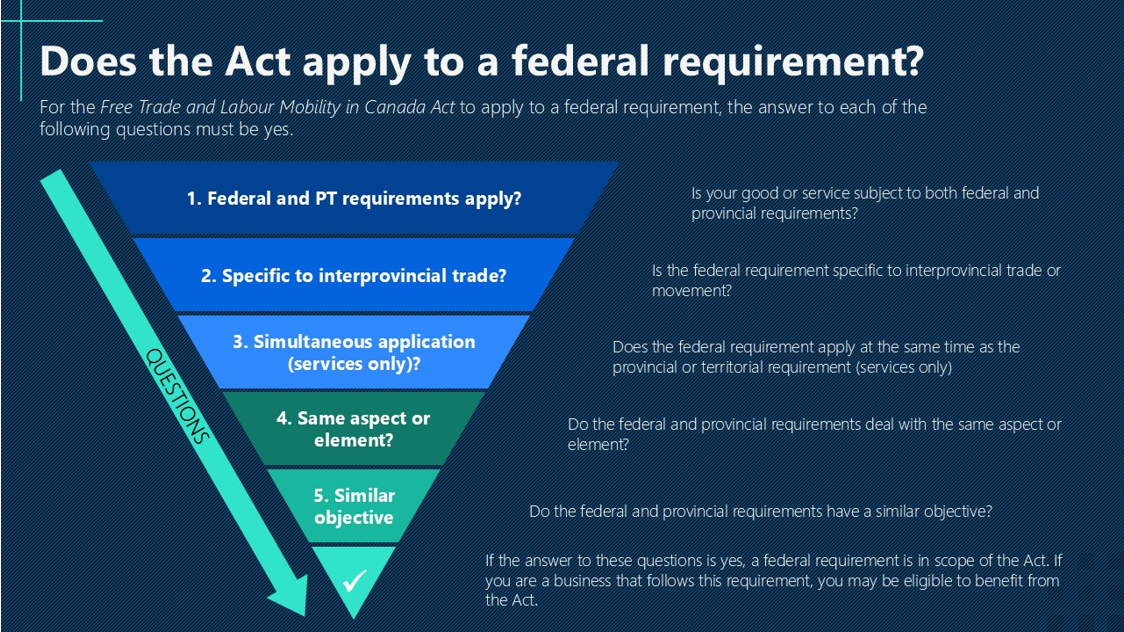
Text version
Does the Act apply to a federal requirement?
For the Free Trade and Labour Mobility in Canada Act to apply to a federal requirement, the answer to each of the following questions must be yes.
Questions
- Federal and PT requirements apply? - Is your good or service subject to both federal and provincial requirements?
- Specific to interprovincial trade? - Is the federal requirement specific to interprovincial trade or movement?
- Simultaneous application (services only)? - Does the federal requirement apply at the same time as the provincial or territorial requirement (services only)
- Same aspect or element? - Do the federal and provincial requirements deal with the same aspect or element?
- Similar objective? - Do the federal and provincial requirements have a similar objective?
- ✔ - If the answer to these questions is yes, a federal requirement is in scope of the Act. If you are a business that follows this requirement, you may be eligible to benefit from the Act.
Questions 1 and 2: Does the Act cover the requirement?
The Act covers a requirement on goods or services if it applies to:
- a good or service that a provincial or territorial requirement also applies to, and
- interprovincial movement of goods or interprovincial delivery of services.
The Act applies to federal requirements that are specific to interprovincial trade (i.e., the movement of goods or delivery of services across provincial and territorial borders). Federal requirements that apply generally to goods and services, whether they move across provincial or territorial borders or not, are not in scope as they do not create interprovincial barriers to trade.
Examples
- Energy efficiency - The Act applies to the Government of Canada’s energy efficiency requirements for appliances. First, both the federal and the provincial/territorial orders of government regulate the energy efficiency of appliances. Second, the federal requirements apply specifically to products shipped from one province or territory to another.
- Lead content in gasoline - The Act does not apply to the Government of Canada’s ban on leaded gasoline in cars. The federal ban applies to gasoline generally, whether it is shipped from one province to another or sold within a province. Therefore, the Act does not apply to this requirement.
Question 3: Does the federal requirement apply at the same time as the provincial/territorial requirement? (This applies to services only.)
The Act affects federal requirements on services only when they apply to a service provider at the same time a provincial or territorial requirement does. The Act does not affect requirements on services where a business or Canadian never has to meet the requirements of the Government of Canada and a province or territory at the same time.
Example
- Trucking - When a trucking company goes from being regulated by a province or territory to being federally regulated by Transport Canada, the provincial or territorial requirements no longer apply. Since there is no possible overlap, federal requirements on trucking are not covered by the Act.
Question 4: Are the requirements comparable?
Once a regulator determines that the Act covers a federal requirement, it must then determine whether the federal requirement is comparable to the provincial or territorial requirement. This means the federal and provincial or territorial requirements are equivalent or similar. Requirements will be comparable if:
- they apply to the same aspect or element of a good or service, and
- they achieve the same goal.
Goods
- the same regulated person or entity, such as the producer or distributor of the good, or the same stage in the good’s life cycle; and
- the same feature, characteristic or function of the good or the same activity or process connected with the good.
Same regulated person or entity - When federal and provincial or territorial requirements apply to an entity (for example, a person, manufacturer, distributor or retailer), they must apply to the same entity to be comparable. This includes cases where the federal requirement does not apply to an entity now but would apply if that entity wanted to do business interprovincially.
Same stage in the good’s life cycle - When federal and provincial or territorial requirements apply to a stage in a good’s life cycle (for example, production, manufacturing, sale or distribution), the requirements must apply to the same stage of the life cycle to be comparable.
The same feature, characteristic or function of the good or the same activity or process connected with the good - To be considered comparable, federal and provincial requirements must apply to the same basic subject matter. This prevents deregulation in areas where federal and provincial governments regulate the same good in a complementary way—meaning each government fulfills a different but necessary role. In such cases, there is no barrier to interprovincial trade and the Act does not apply because the federal, provincial and territorial governments’ requirements complement each other instead of overlap or duplicate.
To address the same subject matter, comparable federal, provincial and territorial requirements must apply to the:
- same feature, characteristic or function of the good; or
- same activity or process connected with the good.
A feature, characteristic or function of a good can include its:
- physical properties (for example, size, weight or composition); and
- performance (for example, energy efficiency or safety performance).
An activity or process connected with a good can include:
- production, manufacturing, packaging or labelling; and
- activities related to assessing the good’s compliance, such as inspection or sampling testing.
Example:
- A federal requirement on the lead content of gasoline would not apply to the same feature, characteristic or function of gasoline or the same activity or process connected with gasoline as a provincial requirement on gasoline’s maximum price would. The federal requirement applies to one feature (lead content) and the provincial requirement applies to another (its price), so they would not be considered comparable.
Service
For a service, the requirements must apply to:
- the same service provider; and
- the same feature, characteristic or function of the service or the same activity or process connected with the service.
Same service provider - Federal and provincial requirements must apply to the same service provider to be considered comparable or equivalent. This includes cases where the federal requirement does not apply to an entity now but would apply if that entity wanted to do business interprovincially.
Example:
- A Government of Canada capital requirement for banks would not be considered comparable to a provincial capital requirement for credit unions, because the two apply to different service providers (banks and credit unions).
The same feature, characteristic or function of the service or the same activity or process connected with the service - Comparable federal and provincial requirements must apply to the same basic subject matter. This is to prevent deregulation in areas where federal and provincial governments play different but necessary roles in regulating the same service. In those cases, regulation does not create barriers to interprovincial trade.
For services to be affected by the Act, the requirements must apply to the:
- same feature, characteristic or function of the service; or
- same activity or process connected with the service.
Example:
- A federal requirement that commercial trucks must have an electronic logging device would not be comparable to a provincial requirement for the driver’s medical condition because they relate to different features of the service.
Licences for goods and services
When determining when requirements apply to the same aspect or element, a federal regulator may still require a licence if one was required before. However, the requirements for getting or keeping the licence could be covered by the Act.
Example:
- A seller would still need a federal licence to sell a consumer product even if provinces’ or territories’ requirements for labelling, packaging, size or weight were considered comparable.
Question 5: Do the requirements achieve a similar goal?
A requirement may be considered to achieve a similar goal if it is designed to protect or promote the same public interest, such as the health, safety and security of people, the environment, and consumer protection. This means requirements can still be considered comparable even if they use different words, formats, or enforcement methods. It guarantees that requirements are interpreted based on mutual recognition, even if requirements are presented in a different manner. Mutual recognition is an arrangement where two or more governments agree to accept each other’s regulations, rules or standards even where they may differ.
Example:
- The Government of Canada applies a requirement on a toxic chemical. The requirement is intended to protect human health and safety. It would not be considered to achieve a similar goal as a provincial requirement on the same chemical that is meant to protect the environment, so the two would not be considered comparable.
Explanation: Geographic location
For a business to take advantage of the Act, it must comply with the regulations of the province or territory where it operates. This guarantees that a business cannot simply choose the easiest or least restrictive rules from another jurisdiction. Allowing this would create gaps and inconsistencies in regulation, making it difficult for provinces and territories to enforce their requirements and protect consumer, workers and the public.
2.2 Labour mobility
This section of the guide discusses how the Act applies to skilled workers and removes barriers to worker mobility.
2.2.1 Defining authorization
The Act allows a person who has authorization for a province or territory to get authorization at the federal level for a similar occupation.
Authorization means:
- A licence or certificate from a provincial or territorial regulatory body that allows someone to practise an occupation;
- A licence or certificate from a federal regulatory body under an Act of Parliament that allows someone to practise an occupation; or
- Both a licence from a federal regulatory body and related membership, if an Act of Parliament says both are needed to practise the occupation.
Note that the Act allows provincial or territorial authorizations to be recognized for similar federal occupations, but some conditions must be met to get federal authorization.
Regulatory bodies can require:
- Proof that the worker is in good standing;
- Payment of all required fees, including licences and membership dues; and
- Proof that the worker passed tests and assessments (see Section 1 - Application of the Act and Regulations for more information).
These conditions are needed to guarantee high-quality services for the public and keep the public safe.
3. Roles and responsibilities under the Act
- The Privy Council Office’s responsibilities include:
- Managing the Act and how it is applied, for the Minister of Internal Trade.
- Helping federal regulators apply the Act in specific areas by providing guidance and explaining the Act’s goals.
- Providing information to businesses and stakeholders on how the Act works, what it does and does not cover, and how businesses can benefit.
- Connecting businesses and stakeholders with federal regulators regarding comparability of provincial or territorial requirements.
- Making sure the Act supports the Government of Canada’s broader efforts to strengthen internal trade, including by working with provinces and territories through the Committee on Internal Trade.
- Federal regulators’ responsibilities include:
- Applying the Act in their areas of responsibility, where applicable.
- Determining comparability of provincial or territorial requirements, including any requirements submitted by businesses, stakeholders and others for review.
- Informing businesses about how they can take advantage of the Act.
- Businesses’ and workers’ responsibilities include:
- Confirming that the Act applies to a requirement before choosing to meet a comparable provincial or territorial requirement instead. If they do not know whether the Act applies to a federal requirement, businesses should work with the Privy Council Office or the right regulatory body to confirm. See Section 5 for contact information or contact Internal Trade, Privy Council Office at internaltrade-commerceinterieur@pco-bcp.gc.ca for assistance identifying the applicable regulatory body.
- Confirming that federal laws or regulations cover an occupation before applying for federal authorization because it is the equivalent of one already regulated provincially. If unsure, the worker should check with the appropriate regulatory body.
- Continuing to meet comparable provincial or territorial requirements (for businesses) or maintaining their provincial or territorial authorization for their occupation (for workers) when taking advantage of the Act. If a business or worker is unsure whether they continue to meet the comparable provincial or territorial requirements, they can contact the Privy Council Office or the right regulatory body for steps they can take to do so.
- Continuing to meet all Government of Canada requirements not covered by the Act.
4. Frequently asked questions
I have a question about the Act. Who can I talk to?
Please email the Internal Trade mailbox and include the regulator or person you would like to speak with in your message. The Privy Council office will call you in a timely manner or provide you with the phone number of the appropriate regulatory official.
How can I take advantage of the Act?
The Act removes regulatory duplication and cuts red tape for businesses and workers.
Depending on your sector or your occupation, you may be able to ignore the federal requirements on your good or service or to get a federal work authorization if you already fulfill similar requirements in your province or territory.
Please refer to the Section 1 - Application of the Act and Regulation of this guide to learn how to take advantage of the Act in specific sectors.
I think the Act covers a federal requirement that is not listed in this document. How do I get it assessed?
Federal regulators are responsible for determining whether the Act covers a federal requirement and whether there are comparable provincial and territorial requirements. Examples of regulators include Natural Resources Canada for energy efficiency and Transport Canada for locomotive engineers.
If you think provincial or territorial requirements are comparable to federal ones, we encourage you to contact the Privy Council Office who will evaluate your request and connect with the regulator.
Section 1 - Application of the Act and Regulations lists the requirements that are or are not covered by the Act. It includes those that are not eligible because they do not have comparable or similar provincial or territorial regulations.
A federal regulator decided that a provincial or territorial requirement is not comparable and I disagree. What can I do?
The federal regulator is responsible for determining if there are comparable provincial or territorial requirements.
If you believe that a federal requirement should be considered comparable to a provincial and territorial requirement, but the regulator decided it is not, please contact the Privy Council Office.
I think that meeting a provincial or territorial requirement instead of a federal one is causing harm. Where can I report this?
The Act includes protections to ensure the safety and well-being of all Canadians, such as the condition that any provincial/territorial requirement must be comparable to the federal one.
If you believe a good, service or worker meeting a provincial or territorial requirement is causing harm, please contact the federal regulator responsible for the comparable requirement directly or go to Section 5 - Contact Information of this guide.
If a provincial or territorial requirement changes, will there be a re-evaluation of comparability?
Should there be any change to a provincial or territorial requirement that impacts the Act or its operation, federal regulators will re-evaluate if the requirement is still comparable. Should the requirement be found no longer comparable, the results will be reflected in this guide.
Do I need to tell the Government of Canada that I am taking advantage of the Act or can I just start moving my goods across provincial or territorial borders?
There is no opt-in process.
Please refer to Section 1 - Application of the Act and Regulations of this guide to find out which requirements and occupations are recognized and if special steps need to be taken.
I currently meet all provincial or territorial requirements for a good or service covered by the Act. Do I automatically satisfy all federal requirements for this good or service as well?
No. There may be other federal requirements that are not comparable to the provincial or territorial ones. You must still meet all other applicable requirements.
Please refer to Section 1 - Application of the Act and Regulations of this guide to find out which requirements and occupations are recognized and if special steps need to be taken.
Is the federal government still enforcing its standards, or do the provinces and territories have to do it now?
The Act does not remove federal requirements. Instead, it allows provincial and territorial requirements to be viewed as satisfying a comparable federal requirement that applies to the interprovincial and interterritorial trade of goods and supply of services.
Therefore, businesses have the option to:
- continue following federal requirements on interprovincial trade as they have in the past, or
- meet comparable provincial and territorial requirements.
The Act does not force businesses that are already following federal requirements on interprovincial trade to start meeting comparable provincial and territorial ones. Businesses can learn about the Act and its regulations at their own speed and take advantage of its benefits when it works for them.
Do I still need to get a federal licence if my provincial or territorial licence is recognized?
Yes. Professionals in the provinces and territories who wish to work at the federal level must first get a federal licence from the regulatory authority or professional association.
Do I still need to pay federal membership dues if my provincial or territorial licence is recognized?
Yes. Professionals who get federal licences must pay annual dues to remain in good standing with the regulatory body. These fees are important for regulators’ job of protecting the public.
Do I need more insurance coverage to practise at the federal level if I already have provincial coverage?
You must have professional insurance that covers your practice at the federal level. Your insurance provider can give you more information.
Can I start following province X’s requirements if I am in province Y?
No. To benefit from the Act, you must meet the requirements of the province where you are physically located and do business.
How does the Act apply to imported goods or services? Can I import a good or service that only meets provincial requirements?
The Act makes it easier to move goods across interprovincial borders, so long as they satisfy certain requirements of at least one province or territory. The Act does not apply to federal requirements for the international import or export of goods or services, which will continue to apply. Imported goods and services must continue to meet all applicable federal requirements.
What will be the impacts on labour mobility?
Most jobs in these sectors have no federal certification or licence requirements. In Canada, only 20% of occupations and trades in the workforce have certificate or licence requirements. Of this national total, only about 10% have federal certificate or licence requirements. Most of these occupations do not have equivalent provincial or territorial occupations.
5. Contact information
- Agriculture and Agri-Food Canada
aafc.regulation-reglementation.aac@agr.gc.ca - Canadian Food Inspection Agency
cfia.internaltrade-commerceinterieur.acia@inspection.gc.ca - Environment and Climate Change Canada
enviroinfo@ec.gc.ca - Intergovernmental Affairs – Internal Trade, Privy Council Office
internaltrade-commerceinterieur@pco-bcp.gc.ca - Natural Resources Canada
- Energy Efficiency:
complianceops-opsconformite@nrcan-rncan.gc.ca - Land Surveyors:
communications@acls-aatc.ca
- Energy Efficiency:
- Transport Canada
TC.RailSafetyConsultations-ConsultationSecuriteFerroviaire.TC@tc.gc.ca