
Polar Knowledge: Aqhaliat Report - volume 5
Aqhaliat
Polar Knowledge Canada’s Magazine | 2025
- X-raying Snow
Studying snow to help predict climate change - Gnawing away at a new problem
Beavers moving into tundra north of Inuvik - Permafrost slump reveals prehistoric ice
- Go behind the scenes at the Canadian High Arctic Research Station
© His Majesty the King in Right of Canada, represented by the President and Chief Executive Officer of Polar Knowledge Canada, 2025
ISSN 2562-6078
Polar Knowledge Canada (POLAR) is a federal agency. Its mission is to conduct worldclass cutting-edge Arctic research. POLAR is responsible for advancing Canada’s knowledge of the Arctic and strengthening Canadian leadership in polar science and technology.
This year, Polar Knowledge Canada marks a decade of advancing polar knowledge and supporting Arctic and Antarctic research. Our official 10-year anniversary graphic with our POLAR STAR as the focal point, represents both our history and our future, highlighting a decade of progress, collaboration, and impact in polar research.

The POLAR Star

A logo was created in 2016 as a brand identifier for the organization.
The POLAR star graphic was created from an abstracted maple leaf design, then stylized into a snowflake. The logo was designed by award-wining designer Wei Yew.
It started with the maple leaf.
It was then stylized.
The design was turned into a snowflake.
Colours were added.
Geographical poles were incorporated.
The snowflake was rotated to reflect the 23.5° tilt of the Earth’s axis.
Aqhaliat Table of Contents
- Aqhaliat Magazine 2025
- Message from the Chief Scientist, Message from the Acting President, Board of Directors
- Polar Knowledge: A meld of science and Indigenous Knowledge
- Polar Timeline
- Supporting research in Canada’s North
- CHARS floor plan
POLAR Research Scientists
STORIES
- In the POLAR collection
- Seeking Kelp in the Western Arctic
- Studying changing muskox habits
- Country Food = Food security
- Role of Community Freezers
- Our future researchers
- Tracking where birds come from
- The sewage BEAST
- Indigenous Knowledge of berries in the NWT
- POLAR Northern Science Award and scholarships
- Moving forward
FEATURES
- X-raying
Researchers from France’s weather service spent eight months in Cambridge Bay analyzing the structure of Arctic snow. - Antarctica — Our southern polar work
- Gnawing away at a new problem
Researchers have noted changes in the tundra ecosystem at the Laurier Trail Valley Creek Research Station in the last 34 years. One of the major changes is the arrival of beavers. - Nanuk
A series of 20 short films documents Inuit Traditional Knowledge of the Davis Strait polar bear population is raising awareness and integral to the management of the animals. - On the Cover
POLAR field technicians Aili Pedersen and Shannon Evetalegak taking measurements for a snow study at CHARS. Photo: Elise Imbeau
Message from the Chief Scientist
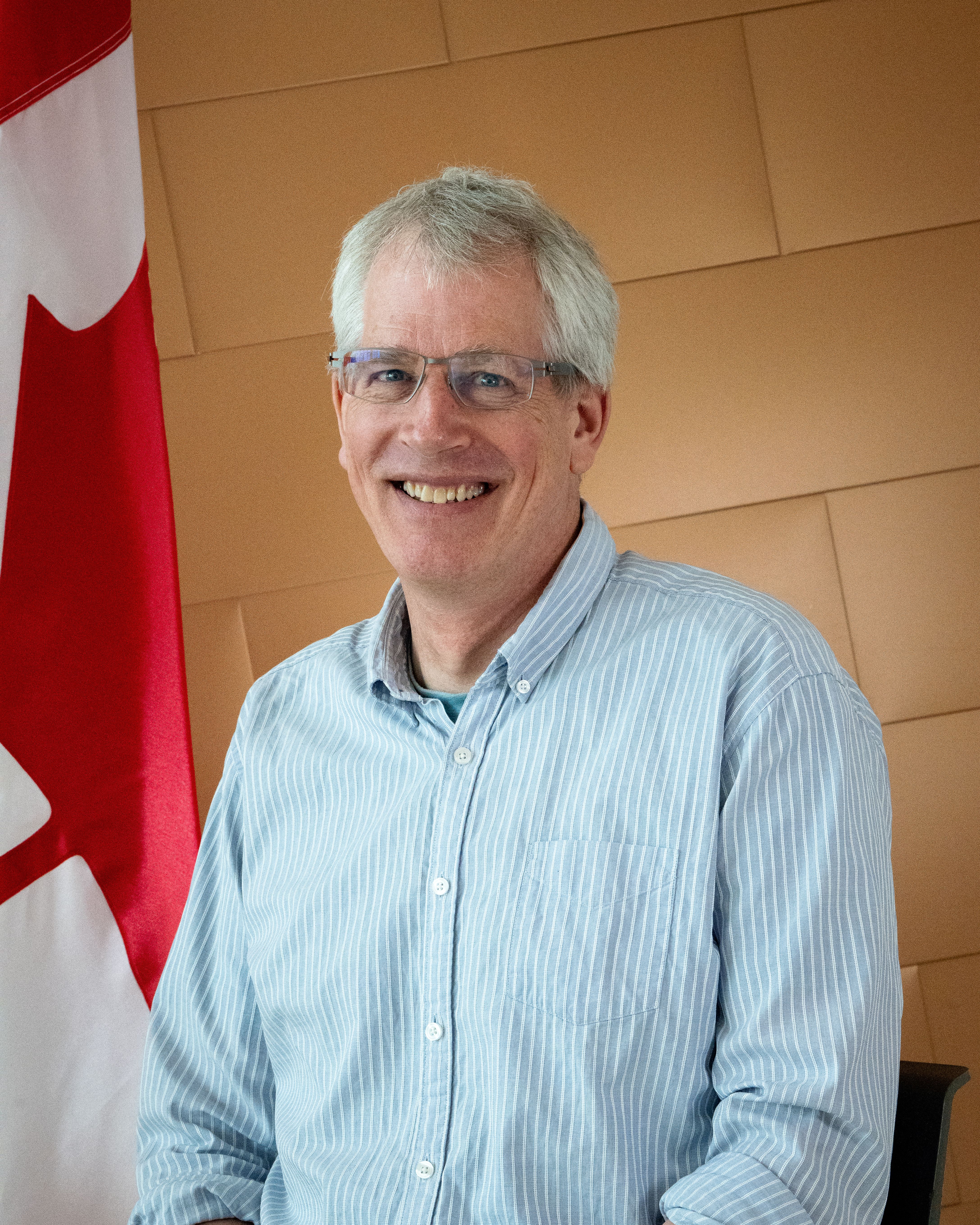
I am delighted to introduce this special issue of Aqhaliat, which highlights some of the research and Indigenous Knowledge supported by Polar Knowledge Canada (POLAR).
The word aqhaliat is Inuinnaqtun for northern lights, the aurora borealis. Auroras occur at both poles. This captures the diversity of topics in this special issue, showcasing research and innovation in both the Arctic and Antarctic.
On our cover, two POLAR field technicians assist researchers from Météo-France study snow. As you’ll read in this feature story, the team also analyzed the snow by x-raying it. Météo-France is an example of an international organization that came to the Canadian High Arctic Research Station (CHARS) to learn more about how the Arctic snow impacts the global climate. It is a terrific example of one of the partnerships that Polar Knowledge Canada has with researchers and research organizations across Canada and around the world.
Inside, you’ll find articles about the projects led by POLAR’s research scientists, including studies of permafrost, mosses, insects, and the atmosphere. You’ll also read about some of the individuals, universities, museums, and other research organizations we partner with that are doing innovative studies to further our knowledge of the polar regions. They are looking at kelp, microbes in glaciers, migrating birds, muskox, community freezers, berries, and much more.
In this issue, we're also excited to share the history of POLAR over the past 10 years and the development of CHARS. We are proud of what has been accomplished so far, and our role in enabling diverse research across the Canadian Arctic and beyond.
I invite you to explore this Aqhaliat to find out more about the incredible research that POLAR has contributed to over our first decade.
____________
David Hik, PhD
Chief Scientist and Vice President, Research
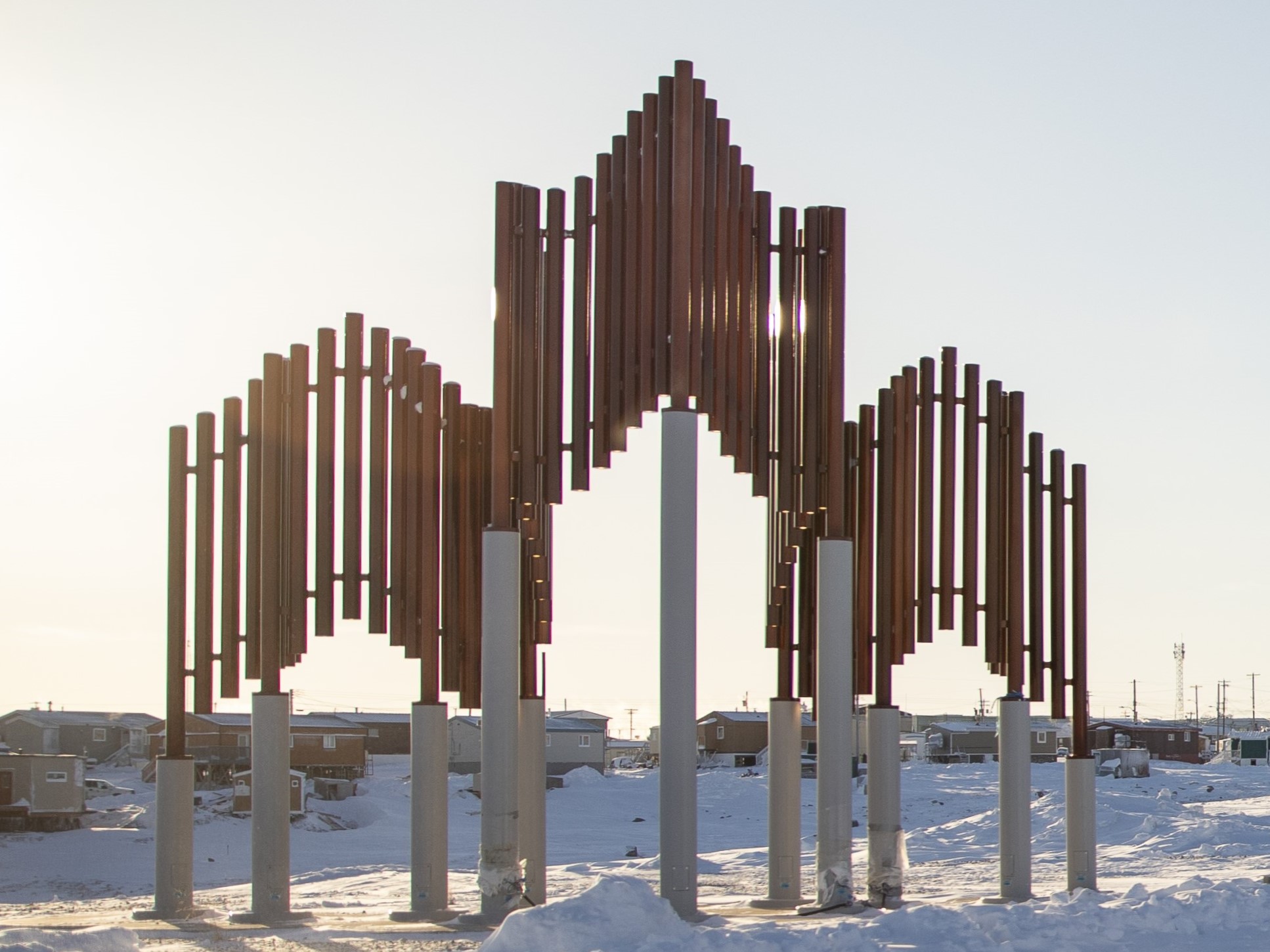
The Polar Aurora art installation outside CHARS.
Message from the Acting President and Chief Executive Officer
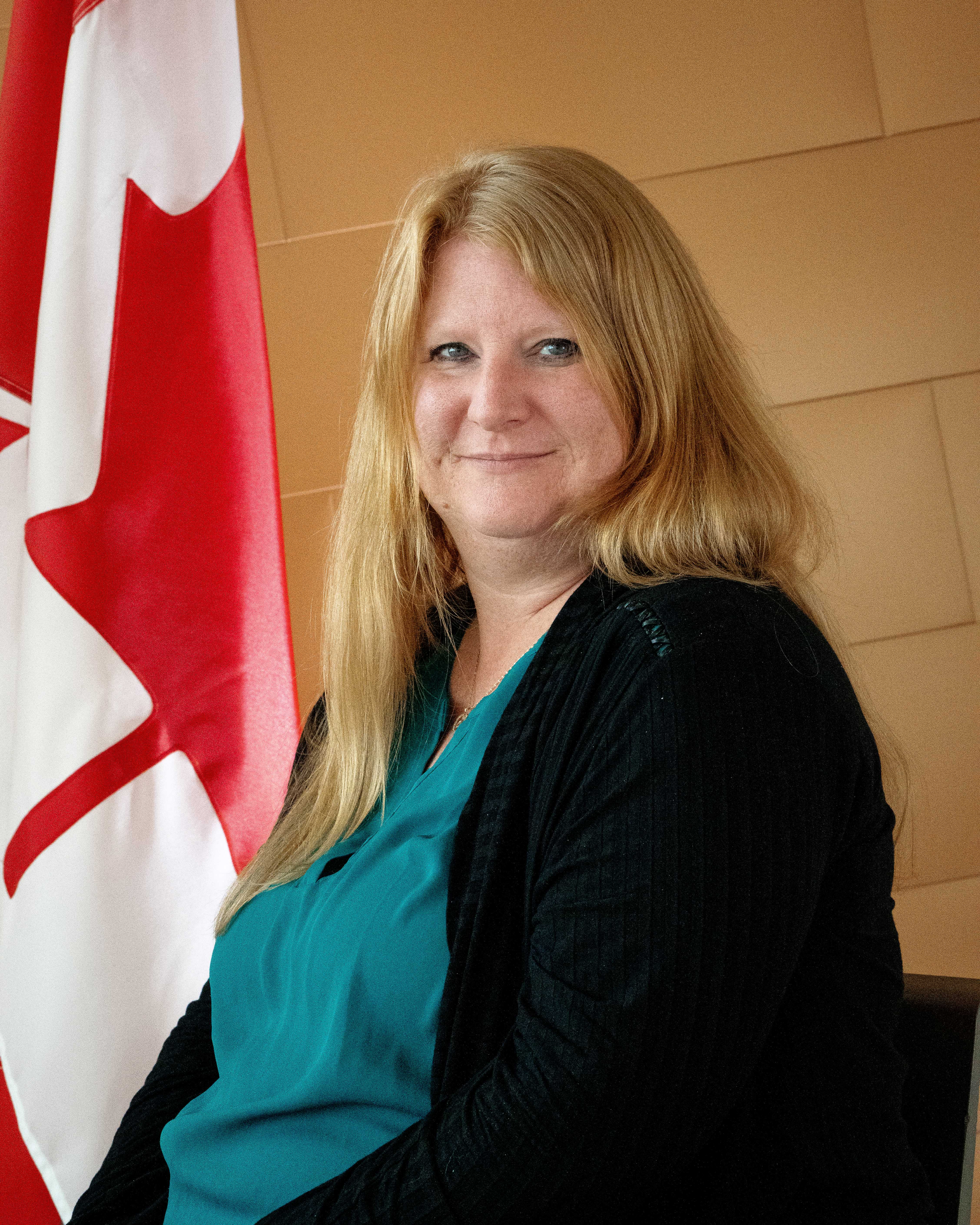
Polar Knowledge Canada celebrates its 10th anniversary in June. We are pleased to commemorate this milestone with this special issue of Aqhaliat.
In the past, our Aqhaliat report focused on POLAR research but was written with a more academic slant. We wanted this issue to have a broader appeal. That’s why we chose a magazine-style, with great photos and stories, for this 10th-commemorative edition. What better way to showcase the Canadian High Arctic Research Station and share the POLAR story with all Canadians?
Over the past decade, POLAR has supported a wide range of research projects carried out by scientists and Knowledge Holders across Canada and around the globe. These researchers’ work has advanced knowledge of the polar regions. We are proud that POLAR’s financial and in-kind support has championed that work.
A number of these projects are included here. Although there is no shortage of research success stories to highlight, we have chosen articles that demonstrate a range of the research being done in Canada’s North. We know there is still much work to do, and POLAR is pleased to be part of ongoing and future polar research.
In these pages, you’ll get a glimpse of some of the fascinating research—new innovations, technologies, science, and polar knowledge—happening in Canada’s Arctic and Antarctica.
Enjoy reading about it in this issue of Aqhaliat.
____________
Suzanne (Sue) Kerr, CPA, CGA
Acting President and Chief Executive Officer
Board of Directors
Polar Knowledge Canada’s Board of Directors is responsible for oversight of the Agency. Its members are selected through a competitive process and appointed by an Order-in-Council based on their experience, knowledge, and how well they can support POLAR’s mandate.
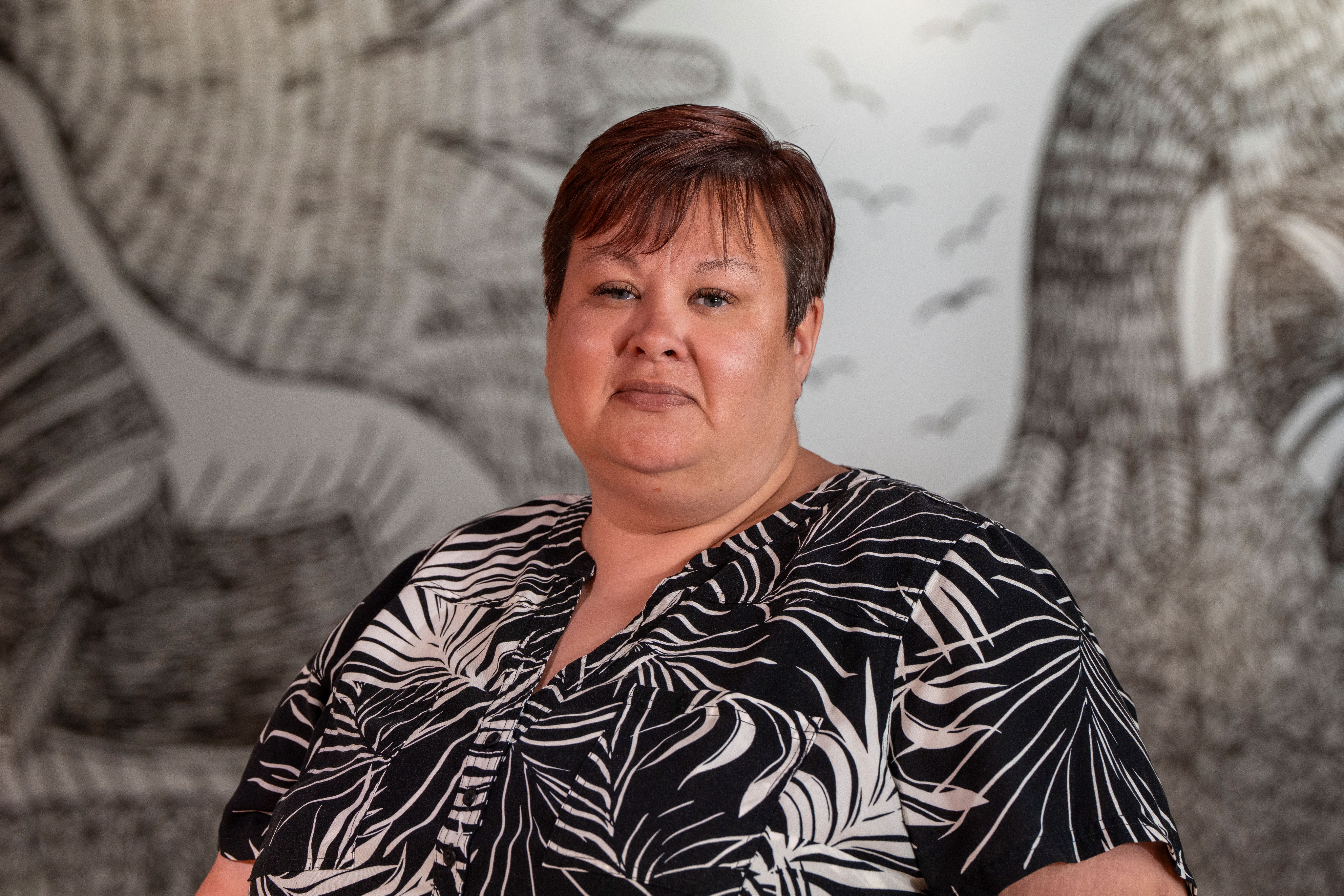
Chairperson – Janet King, PhD
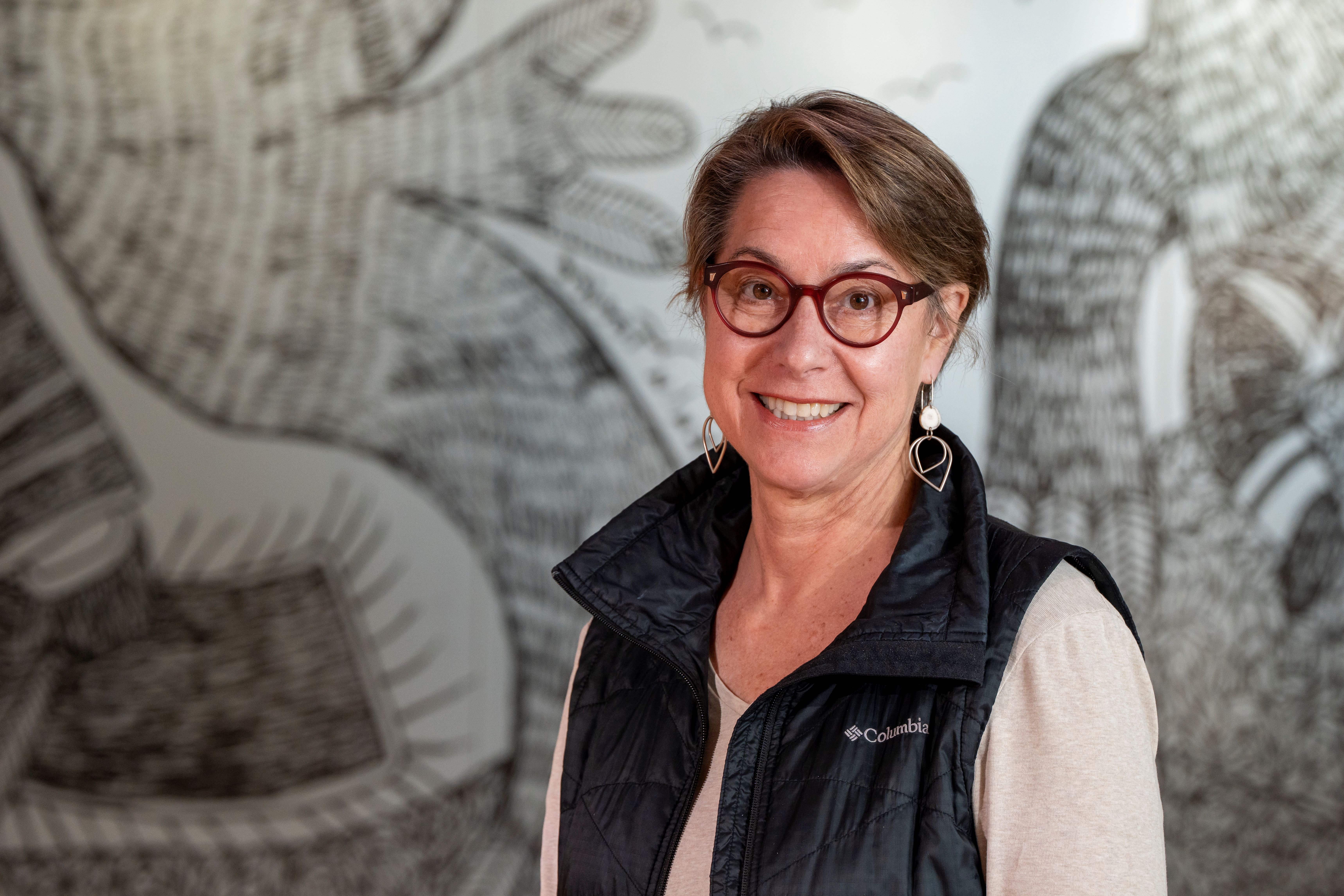
Vice-chairperson – David R. Moore, PEng
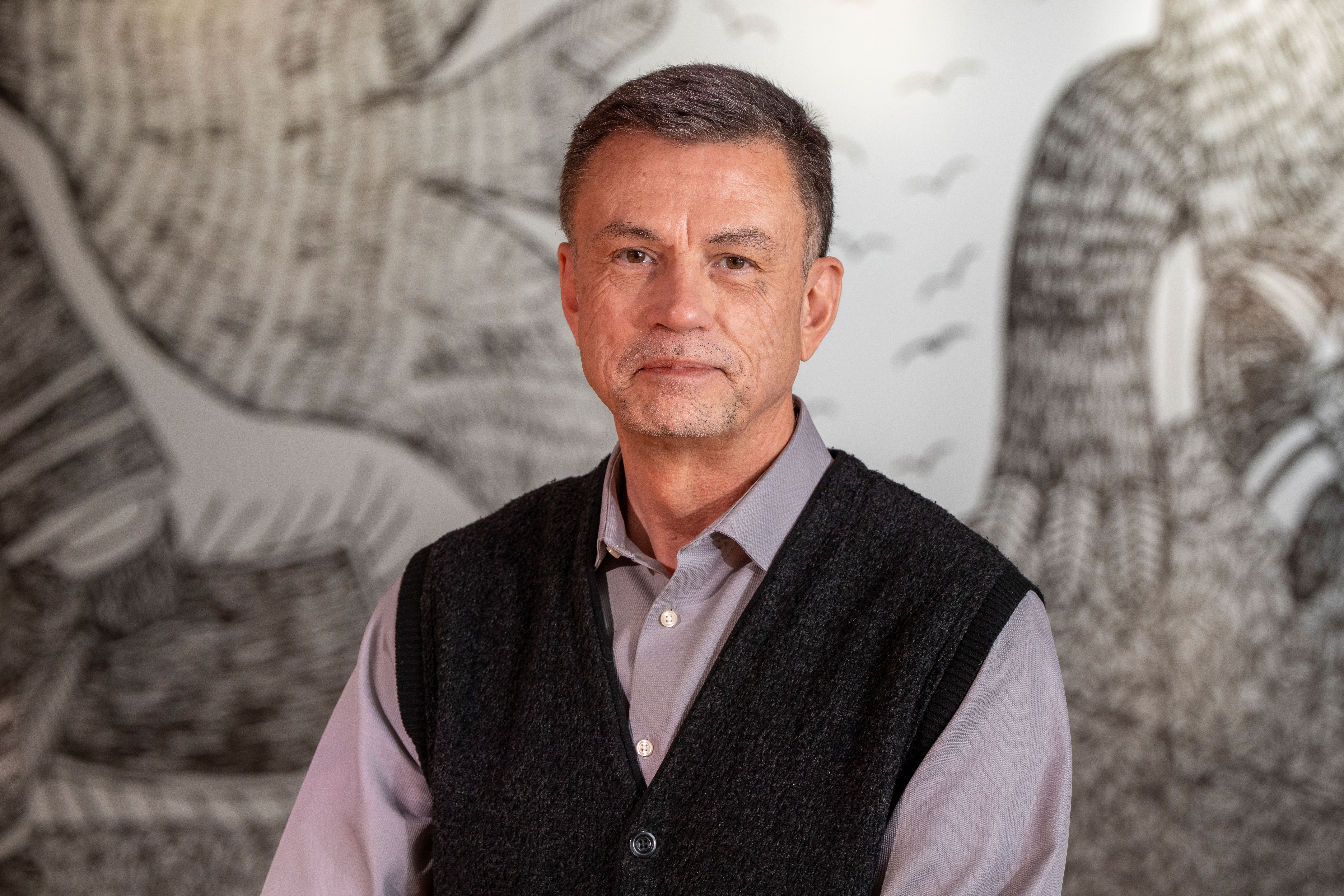
Member – Karen Barnes, PhD
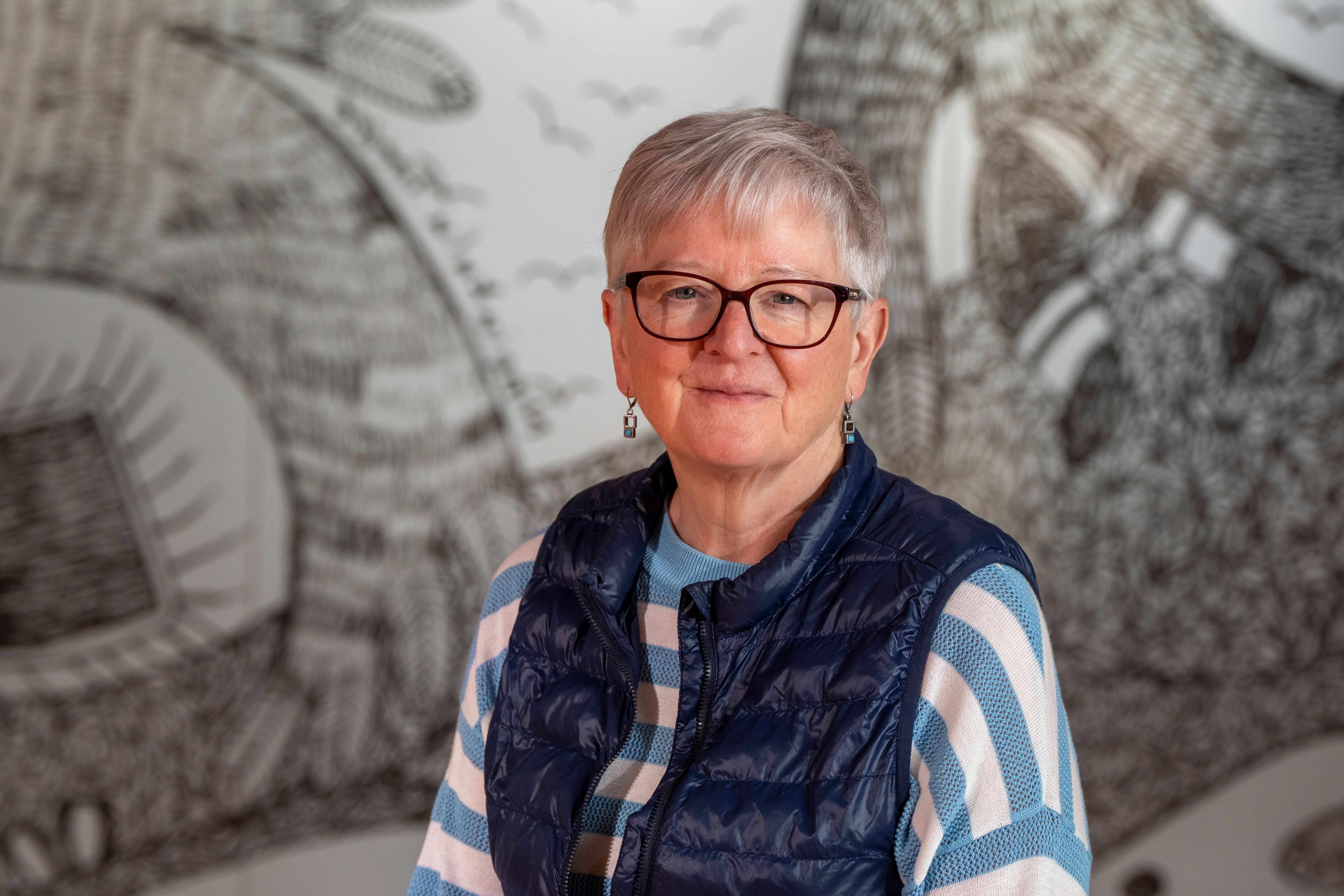
Member – Maribeth S. Murray, PhD
Member – David H. Turpin, CM, PhD, LLD, DSc, FRSC
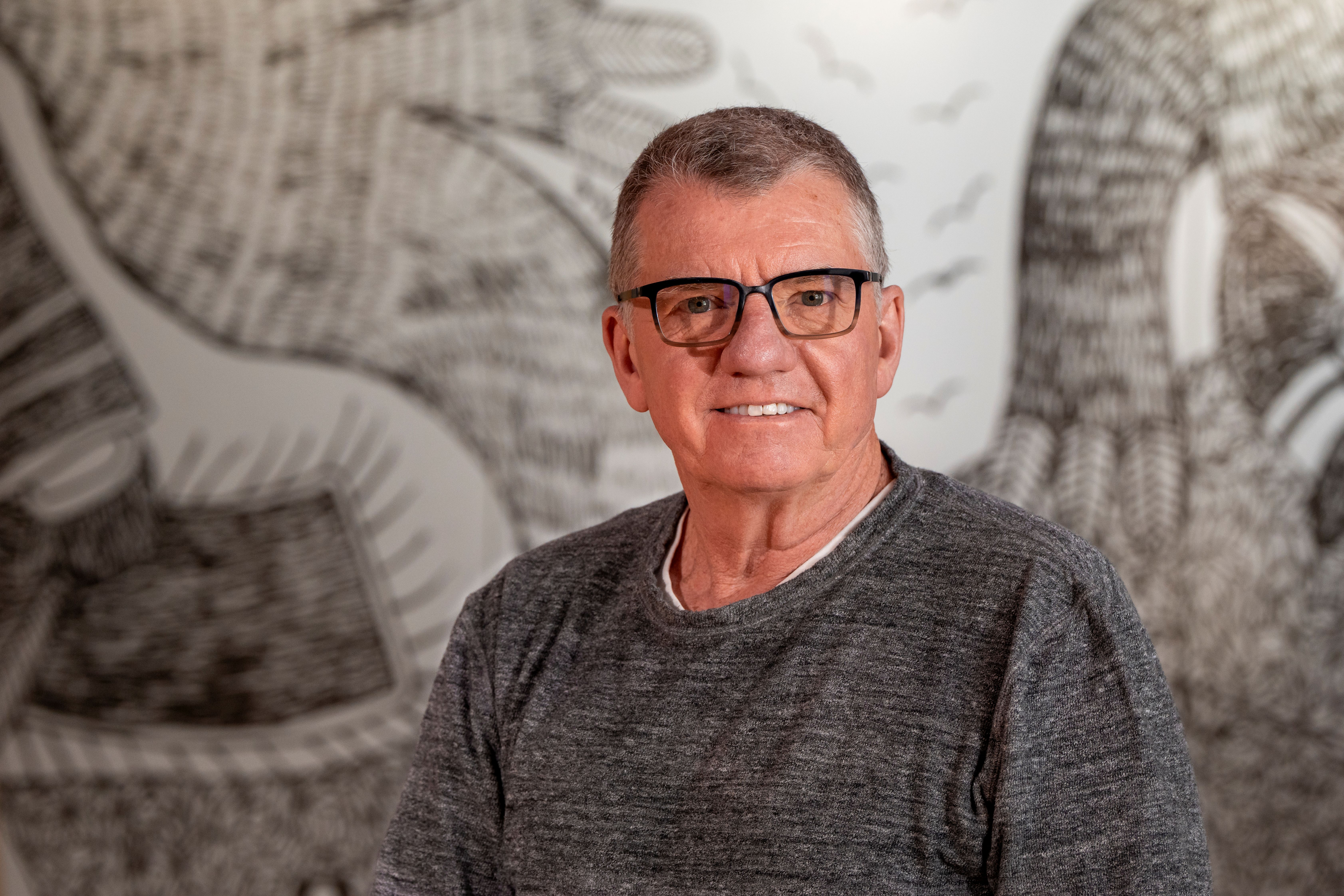
Member – Clive Tesar
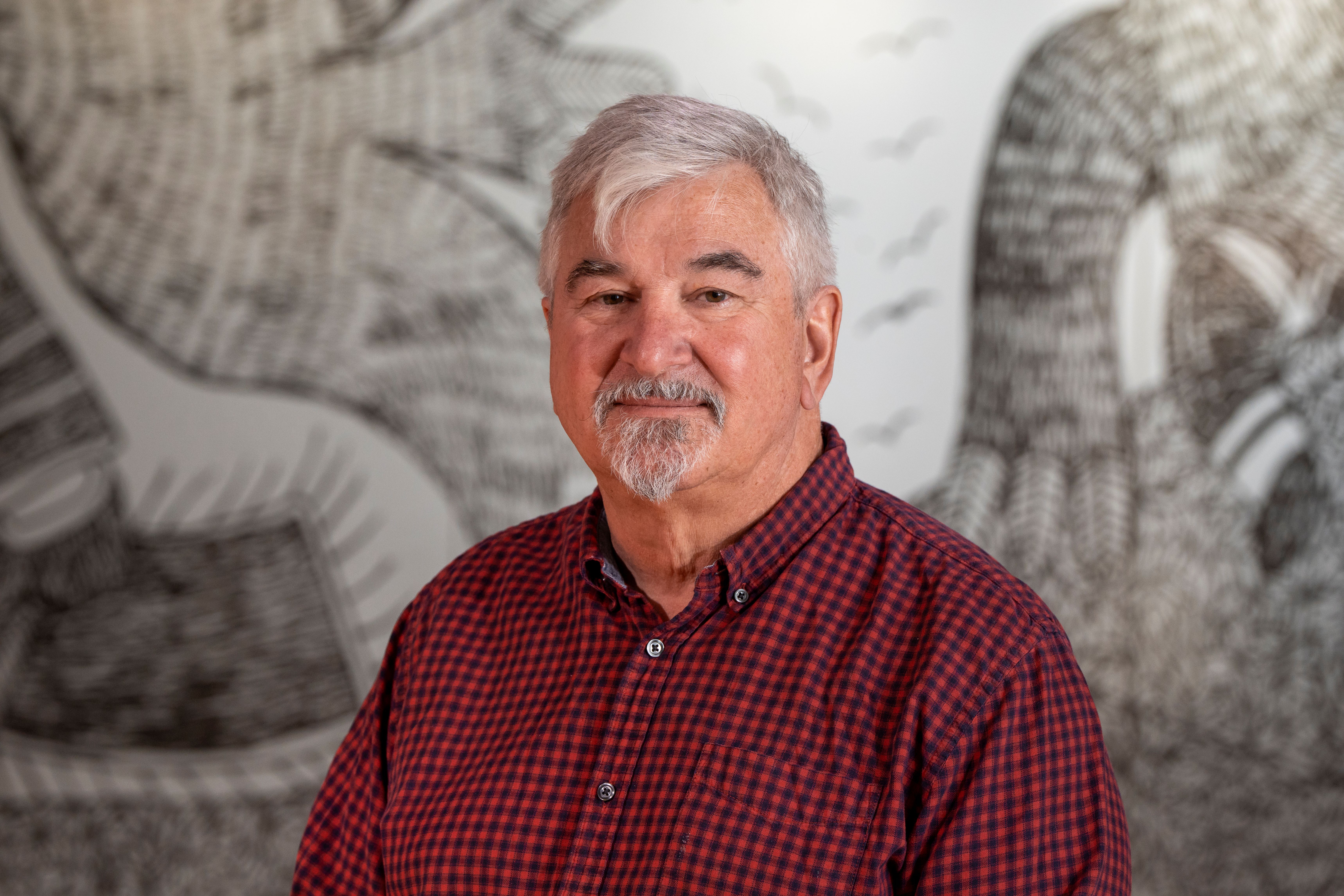
Member – Michelle Gillis
Polar knowledge: a meld of science and Indigenous Knowledge
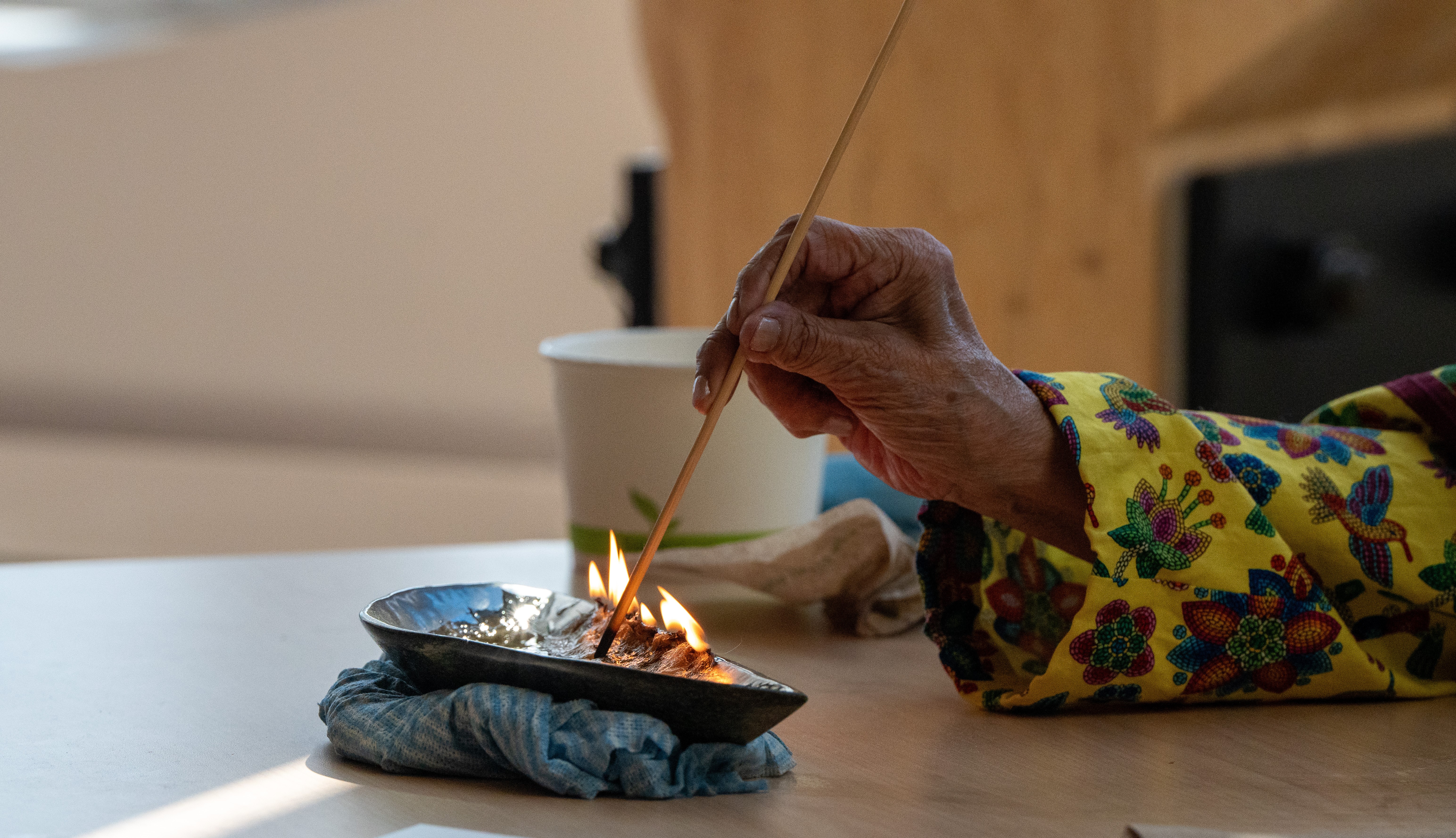
An Elder tends to a traditional qulliq.
“We [Canadians] think of ourselves as a Northern and an Arctic country and so pay attention to what's happening in the North with its people and its environment,” says Whit Fraser, Chair of the Canadian Polar Commission from 1991 to 1999. “The need to address the scientific issues is even greater today, by far, than it was when the Government of Canada created the Polar Commission.”
The Earth’s climate has changed noticeably since the Polar Commission was established in 1991 to advise the federal government on polar affairs. Since the early 2000s, the Arctic has warmed at a rate faster than the global average. This continues to have significant impacts on Northern residents.
Whit says the Polar Commission was concerned with addressing the gaps between academic science and the traditional knowledge of Northerners. Understanding the Arctic’s changes created an opportunity for more collaborative research between scientists and the people who were experiencing the changes firsthand.
Whit notes that when Polar Knowledge Canada (POLAR) was established in 2015, one of the priorities was to close the gap between science research and Indigenous Knowledge, supporting Arctic research and programs.
POLAR was created by the Canadian High Arctic Research Act, which came into force on June 1, 2025. POLAR combined the resources and knowledge of the Canadian Polar Commission and the former Science and Technology program at Aboriginal Affairs and Northern Development Canada (now Crown–Indigenous Relations and Northern Affairs Canada), into one organization.
POLAR was established as a hub for scientific polar research, to be a lead on Arctic issues, and operate the Canadian High Arctic Research Station. Its mandate is to promote the development and dissemination of knowledge of the polar regions, both the Arctic and Antarctica. Advancing knowledge to improve environmental stewardship, economic opportunities, and the quality of life for Canada’s Northern residents is central to the Agency.
Andrew Applejohn, POLAR’s Executive Director of Programs, agrees with Whit that Arctic research must integrate both Western science and Indigenous Knowledge.
“In many ways, Northern Canada was a frontier for science because it was remote. And Northern Canadians, particularly in remote communities, were heavily studied, and the results of those studies didn't necessarily ever benefit or even get communicated to the people who were under study,” says Andrew. “As an agency, I think POLAR has the opportunity to change that dynamic, or to help change that dynamic. To help at least communicate to researchers, from outside the North, that it's incumbent on them to develop the kind of meaningful, lasting, long-term relationships with the people they’re serving.”
Richard Boudreault, PhD, was appointed Chairperson of the Polar Knowledge Canada’s Board of Directors in July 2015. Richard reflects on the early challenges POLAR faced, noting that growing pains were inevitable for any new organization. A change in government a few months after POLAR’s creation slowed some progress, though the board continued working on policies, procedures and a business plan while focusing on building a state-of-the-art research station in the Arctic.
“Also, we had to make sure that Indigenous Knowledge was respected in everything we do, says Richard. “We signed an agreement that was agreeable to our executive and agreeable to ITK [Inuit Tapiriit Kanatami]. It demonstrated that we're moving forward and that we were responsive to the requests of the Northern communities towards how research can be done in the Arctic.” He adds, “And for me, it was a big deal because I wanted to achieve this from day one.”
Jason Tologanak, POLAR’s Director of Knowledge Management and Engagement, agrees that building knowledge of the Arctic is best achieved through collaboration among all stakeholders.
“We want to ensure that not just the research is coming back to the community, but that the actual research itself is what the community and Northerners value as important and meaningful,” says Jason. He notes that POLAR aims to achieve this by building a network of relationships to collaborate and work towards shared objectives.
“We're bringing the academia, and universities, together. We're bringing the researchers and experts together. We're also bringing in community leaders and community knowledge holders who have seen firsthand those changes in their own lifestyles, with hunters and trappers organizations, and local perspectives from individuals, as well. And we’re really trying to find ways to ensure that that traditional knowledge is valued with the same kind of credibility as science.”
Most of the projects POLAR supports are closely connected to the communities where the research takes place. An example of this is the CINUK initiative, the Canada-Inuit Nunangat-United Kingdom Arctic Research Programme 2021–25. This includes strong Inuit involvement that brings together UK, Canadian and Inuit researchers to collaborate on research that is import to Inuit Nunangat communities.
POLAR is confident that conducting research in partnership with all stakeholders and rightsholders leads to more meaningful, comprehensive research and information that is more relevant to Northerners, and to all Canadians.
POLAR Timeline
October 17, 2007– Prime Minister Stephen Harper announces plans to establish a world-class Arctic research station.
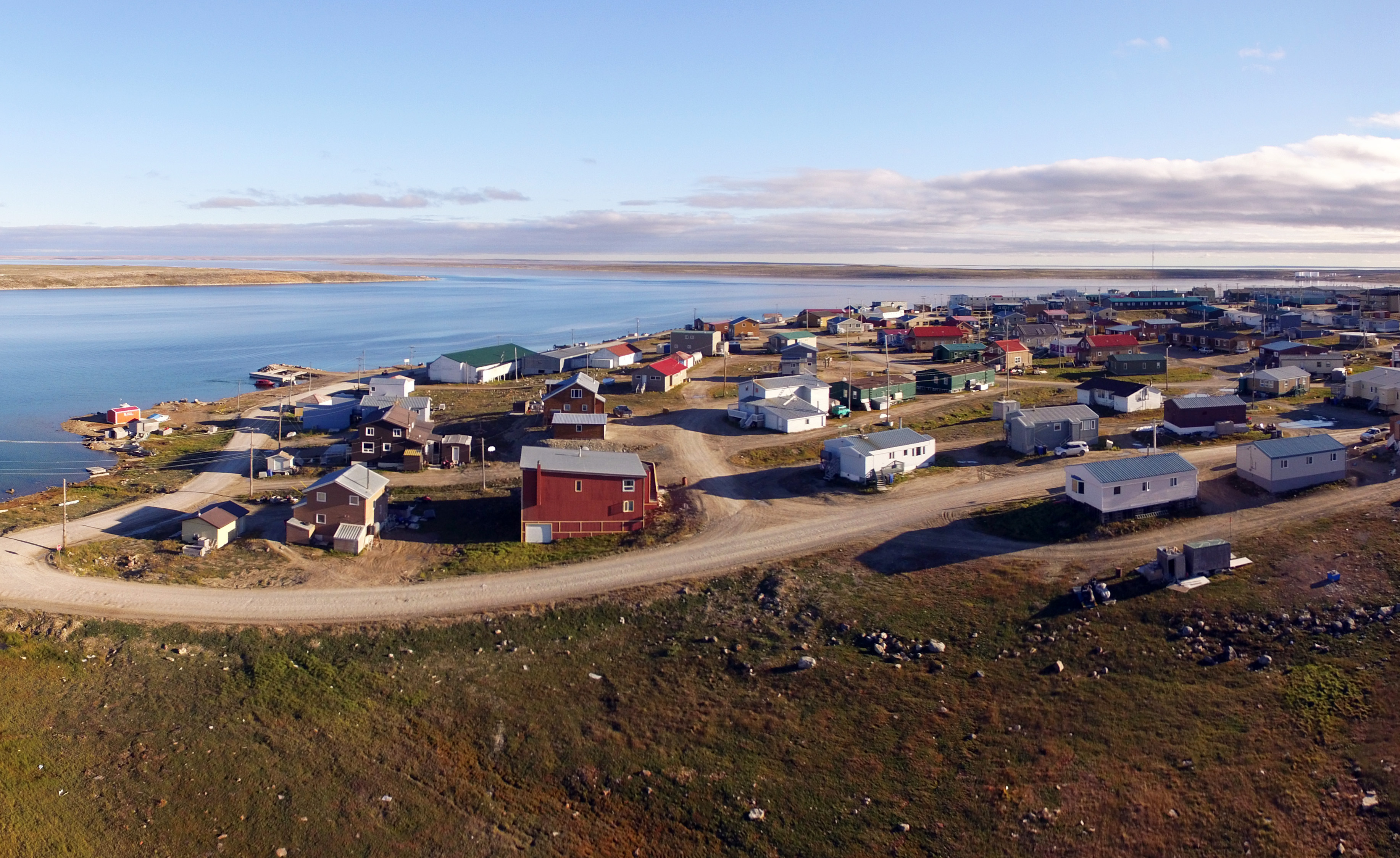
February 2009 – Cambridge Bay, Resolute Bay, and Pond Inlet are shortlisted as potential locations for the new research facility.
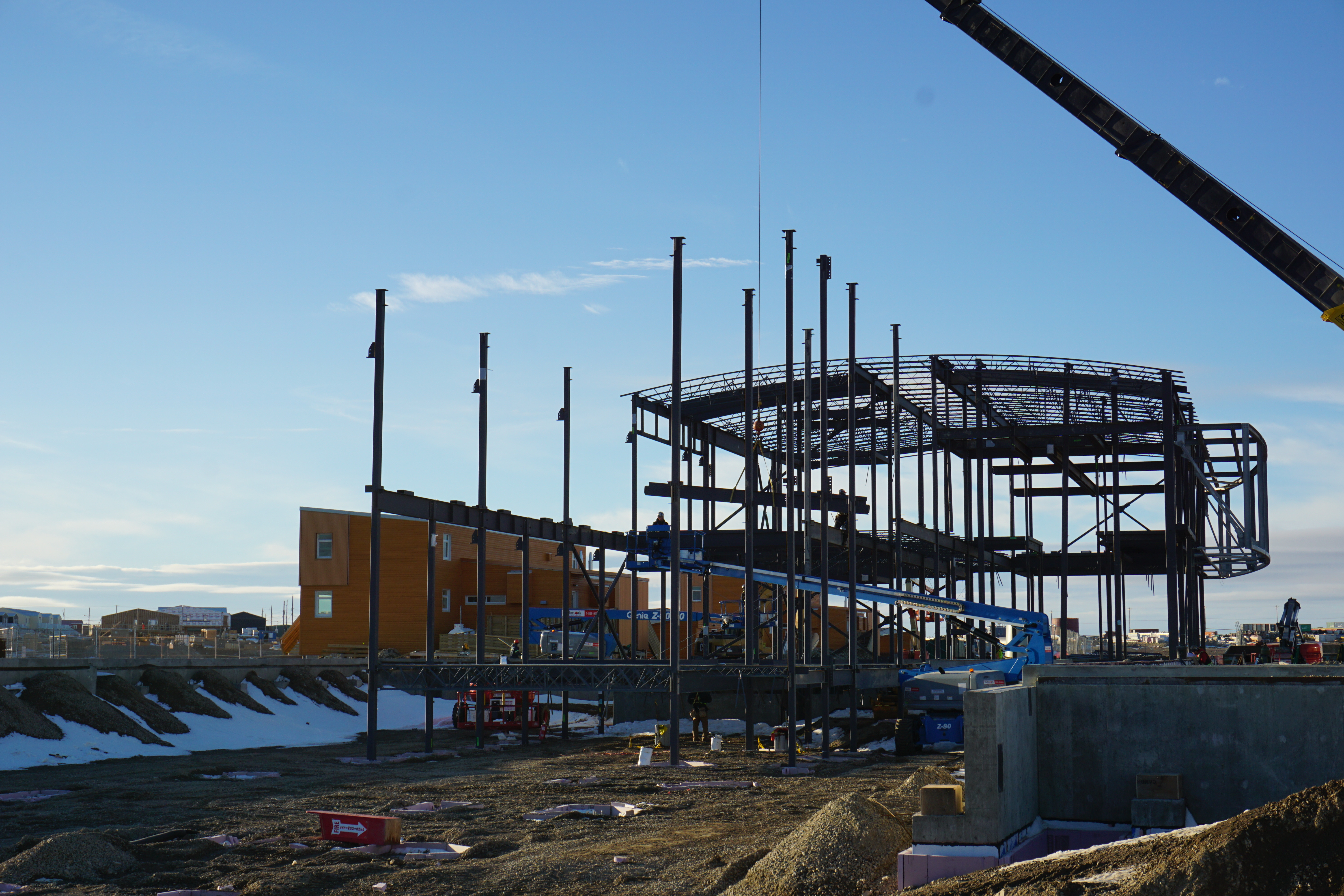
August 24, 2010 – Cambridge Bay is chosen as the site for the Canadian High Arctic research station (CHARS).
August 13, 2012 – The government announces $188 million over six years is earmarked for CHARS including $142.4 million for construction, equipment, and start-up costs; $46.2 million for the science and technology research program.
September 2012– EVOQ project architect Alain Fournier meets with Cambridge Bay Elders, the CHARS committee, local groups, the Nunavut Planning Commission, and members of the public to discuss building plans.
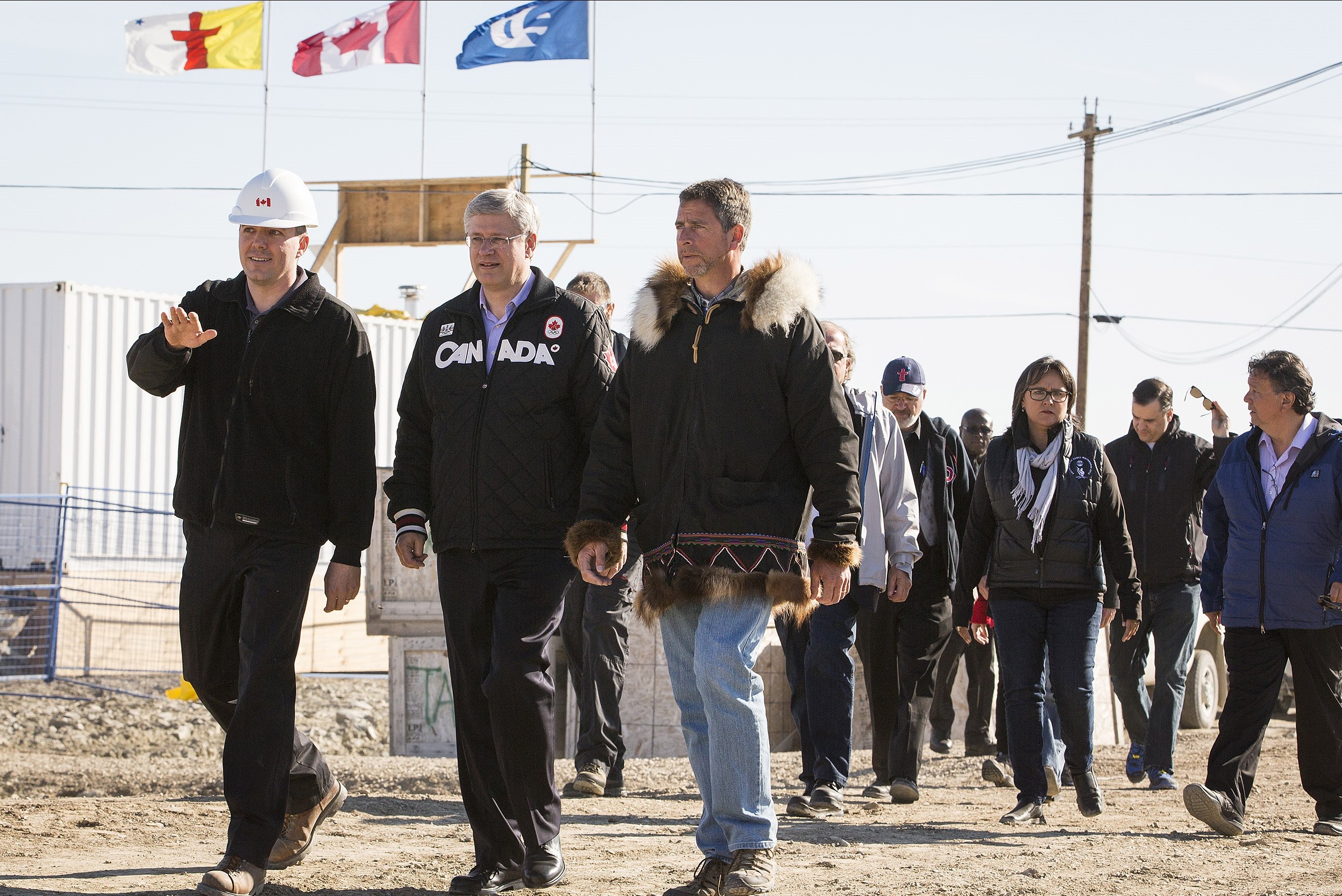
August 23, 2014 – Prime Minister Stephen Harper participates in the groundbreaking ceremony to launch the construction of CHARS.
October 23, 2014 – The CHARS Act is introduced in the House of Commons to establish a new federal research organization, merging the Canadian Polar Commission with the Arctic Science and Technology Directorate within Crown-Indigenous Relations and Northern Affairs Canada (formerly Aboriginal Affairs and Northern Development Canada)).
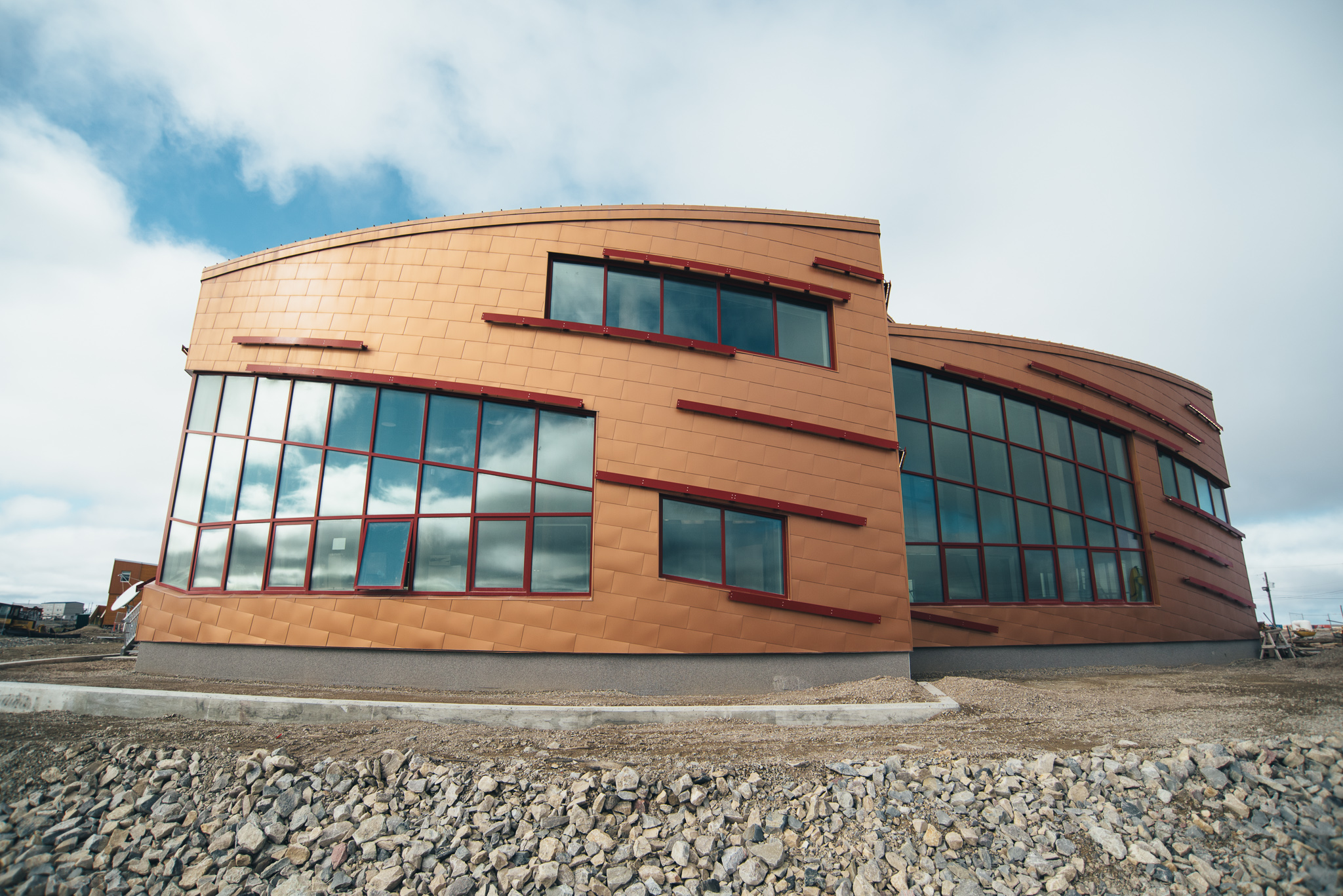
June 1, 2015 – The CHARS Act comes into force and Polar Knowledge Canada is created to operate the research station and be a hub for polar research.
Fall of 2015– POLAR holds introductory meetings with stakeholders, federal departments, Indigenous Peoples, and Canadian and international research organizations about scientific cooperation in the Arctic and Antarctic.
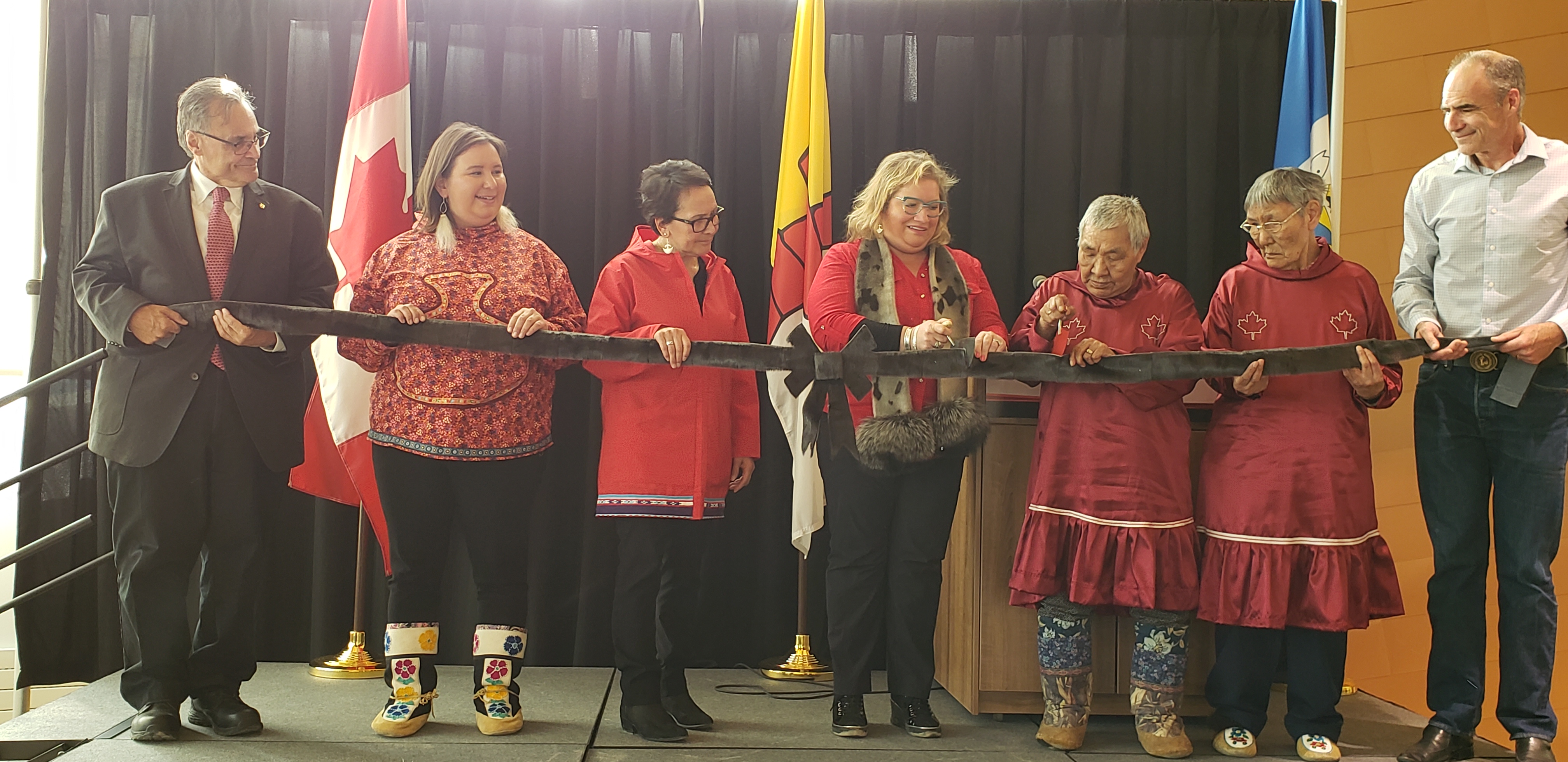
August 21, 2019 – Ribbon cutting ceremony marks the official opening of CHARS.
June 7, 2023 – Custodianship of CHARS property is officially transferred to POLAR by an official order-in-council.
July 17, 2023– CHARS becomes the northernmost Canadian facility to attain Silver-level LEED certification (Leadership in Energy and Environmental Design).
October 2023 – CIRNAC, POLAR, and PSPC are presented with the Excellence in Engagement and Partnerships with Indigenous Peoples Award from Real Property Institute of Canada for the CHARS collaborative building design project.
January 9, 2025 – POLAR opens an office in Whitehorse.

June 1, 2025 – Polar Knowledge Canada celebrates its 10th anniversary.
Supporting research in Canada’s North
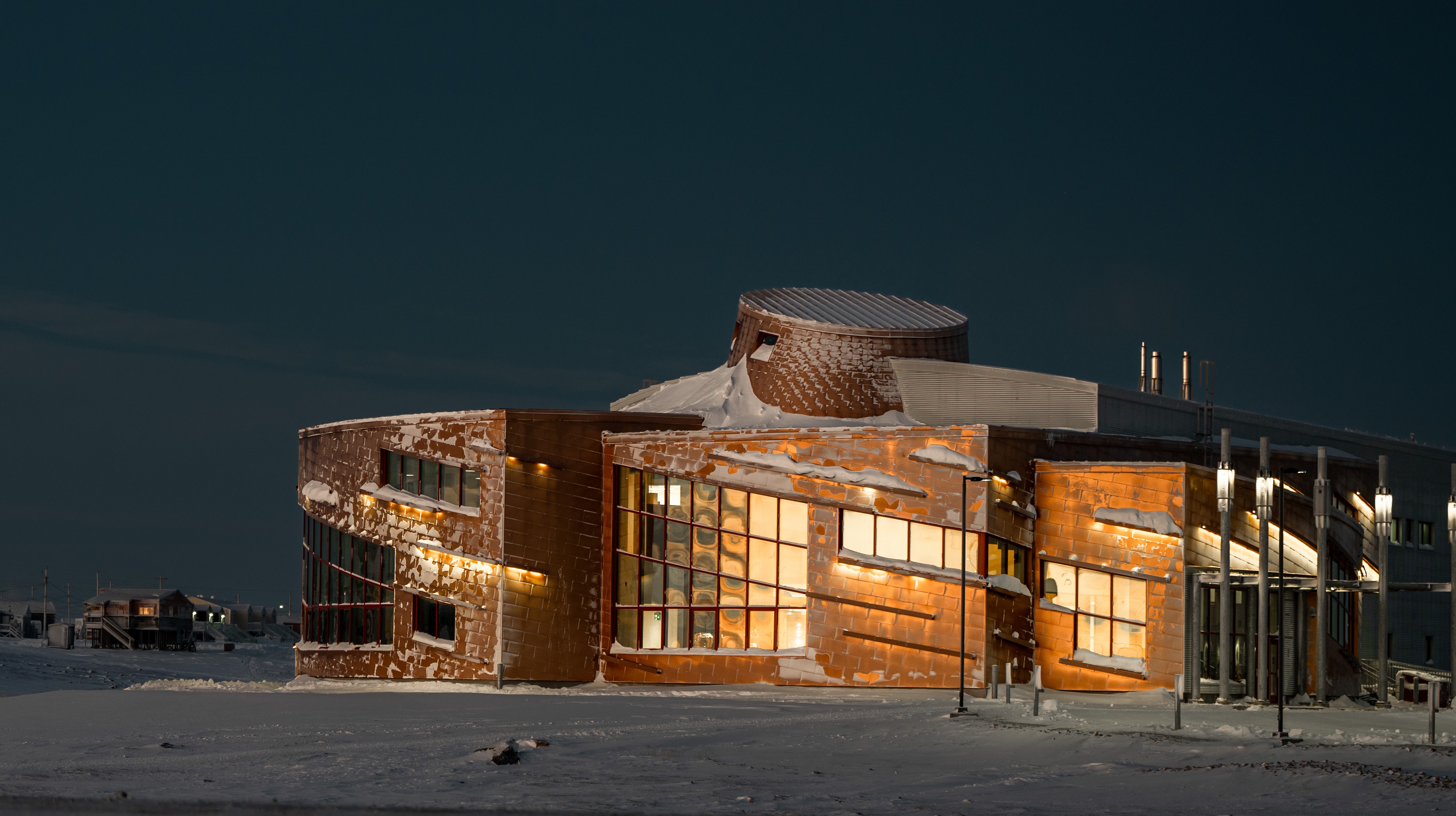
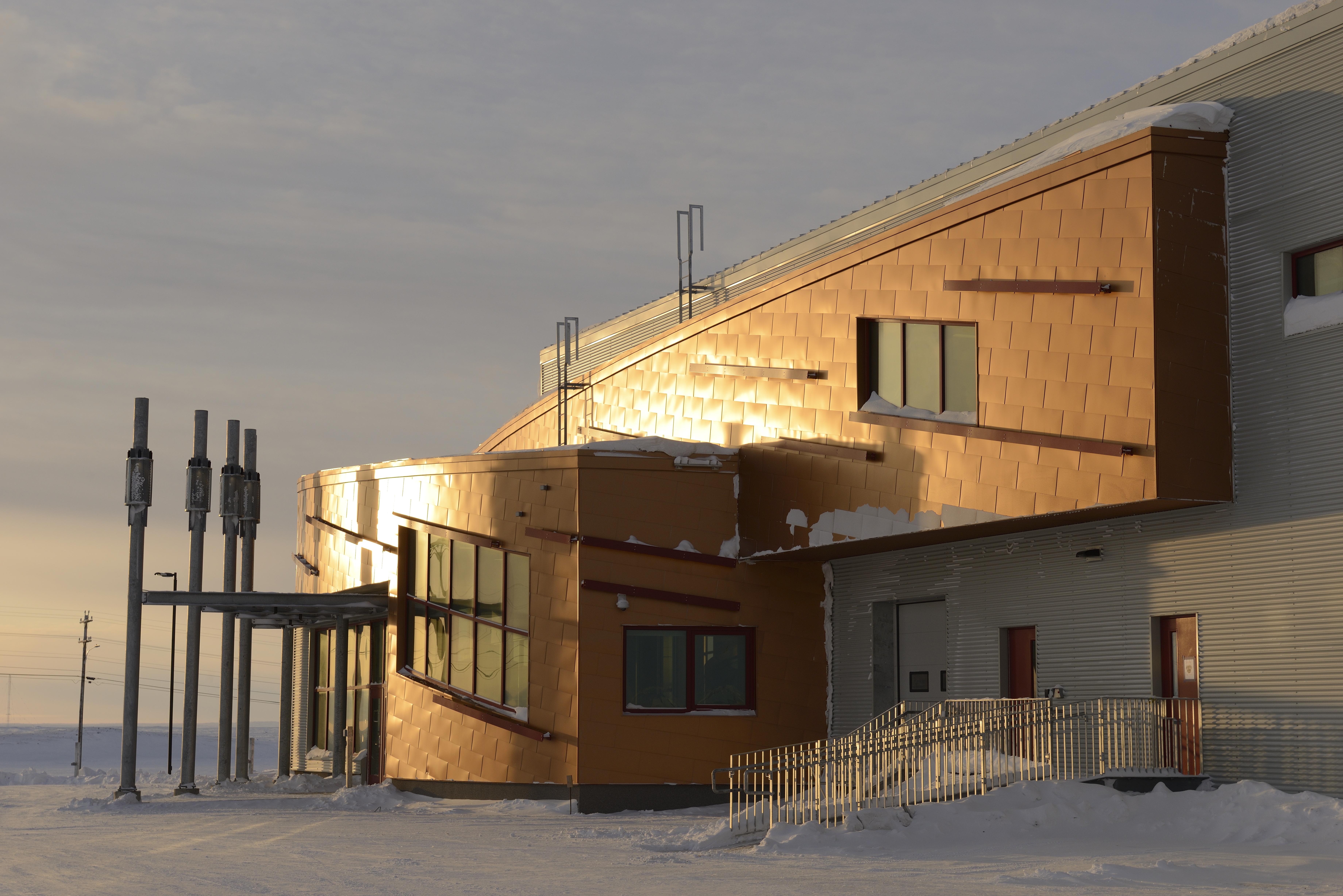
The rows of copper rectangles that cover the main building are laid one above the other in an upward spiral pattern like snow blocks in an igloo.
Inside the entrance, an Inuit carving of a man with a stick is stealthily followed by a white alabaster polar bear. Beyond the sculptures, a glass wall etched with birds, ravens, an enormous owl, and an Inuk holding a feather curves invitingly into the hall. The walls, supported by pale wooden beams, reach up two stories.
The off-white linoleum floor is inlaid with pictures of caribou, seals, whales, dogs pulling a qamutik, hunters with harpoons, and drum dancers. The unique floor captures elements of traditional Inuit lifestyle.
None of this is what you’d expect of a research station. It suggests a space where the research combines Western science with traditional Inuit knowledge. Welcome to the Canadian High Arctic Research Station.
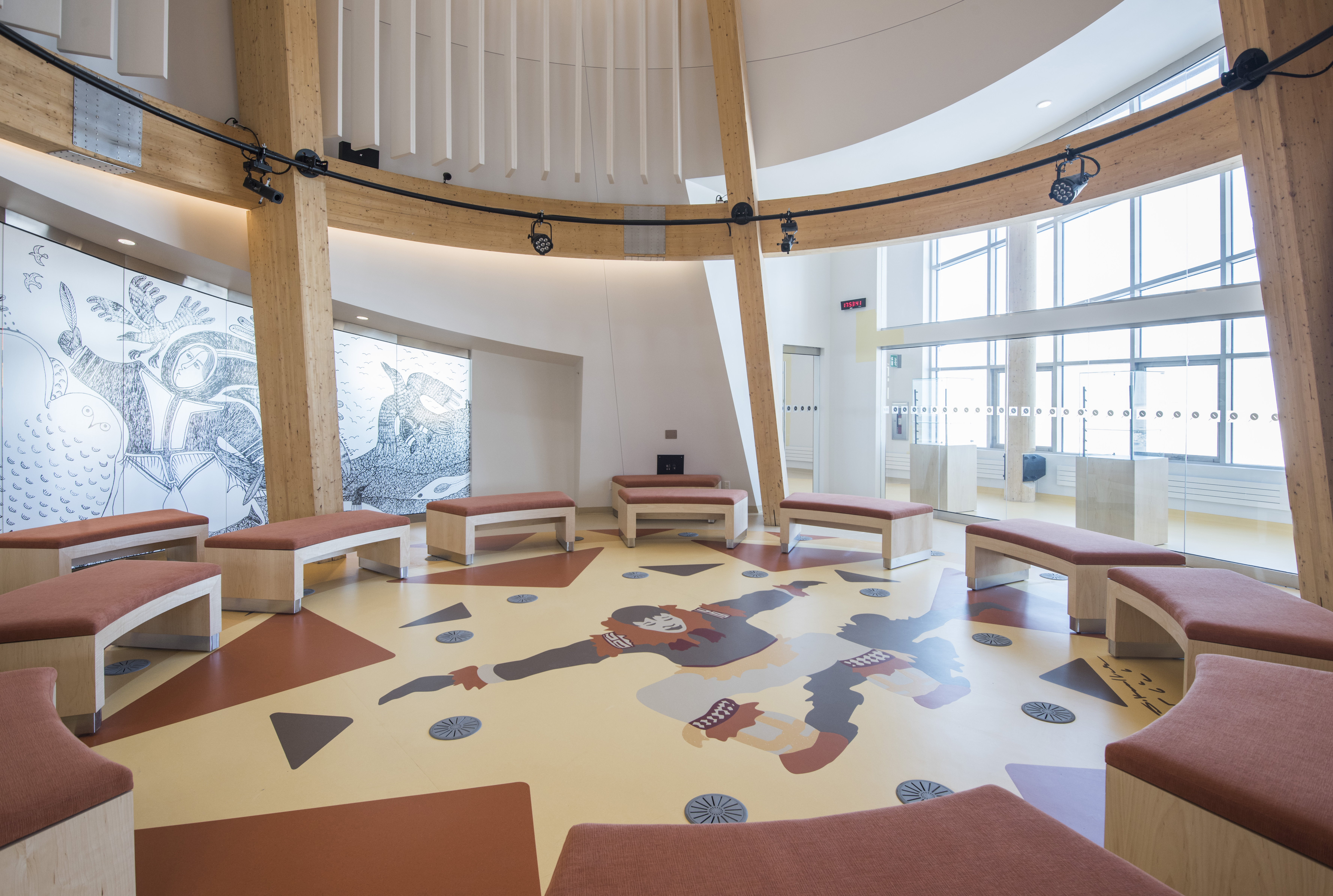
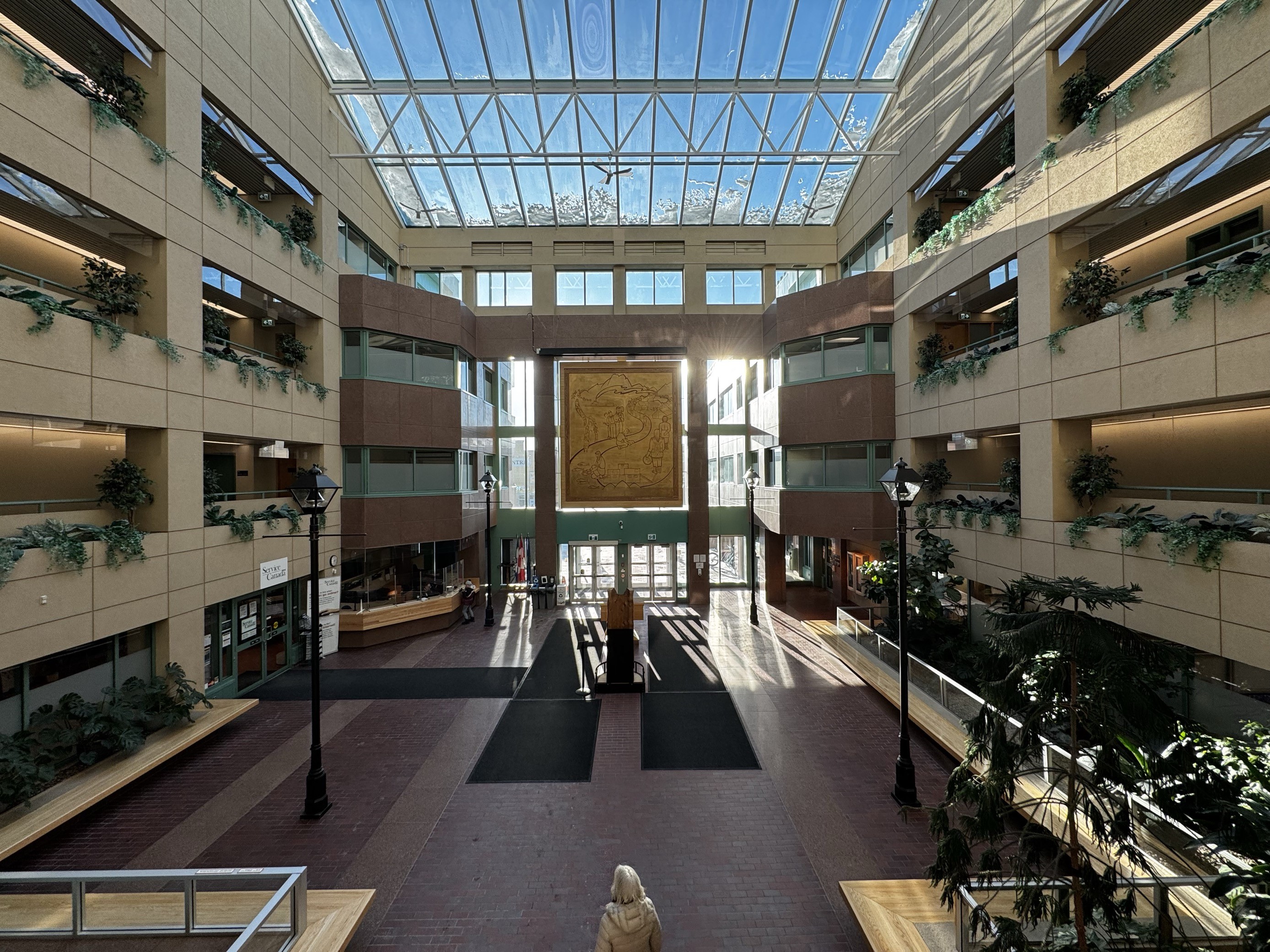
Knowledge Sharing Centre

The main hall at CHARS that leads to the offices and teaching lab
Photos: Alex Fradkin
“Our Government will build a world-class Arctic research station that will be on the cutting edge of Arctic issues, including environmental science and resource development. This station will be built by Canadians, in Canada's Arctic, and it will be there to serve the world.”
— Governor General, Her Excellency the Right Honourable Michaëlle Jean, 2007 Speech from the Throne
Located just outside the hamlet of Cambridge Bay, in Western Nunavut, the Canadian High Arctic Research Station is aptly named. Ikaluktuuttiak, the Inuinnaqtun word for Cambridge Bay, Ikaluktuuttiak, means “good fishing place.” This is reflected in the station’s acronym, CHARS. Char is a popular cold-water fish found in local waters, as well as in lakes and rivers across the Arctic and subarctic. It is central to the regions where CHARS research is conducted.
CHARS also has resident researchers whose work relates to one of POLAR’s three research programs: Ecosystem Science, One Health, and Clean Energy and Technology. Read more about our POLAR Research Scientists in the coming pages.
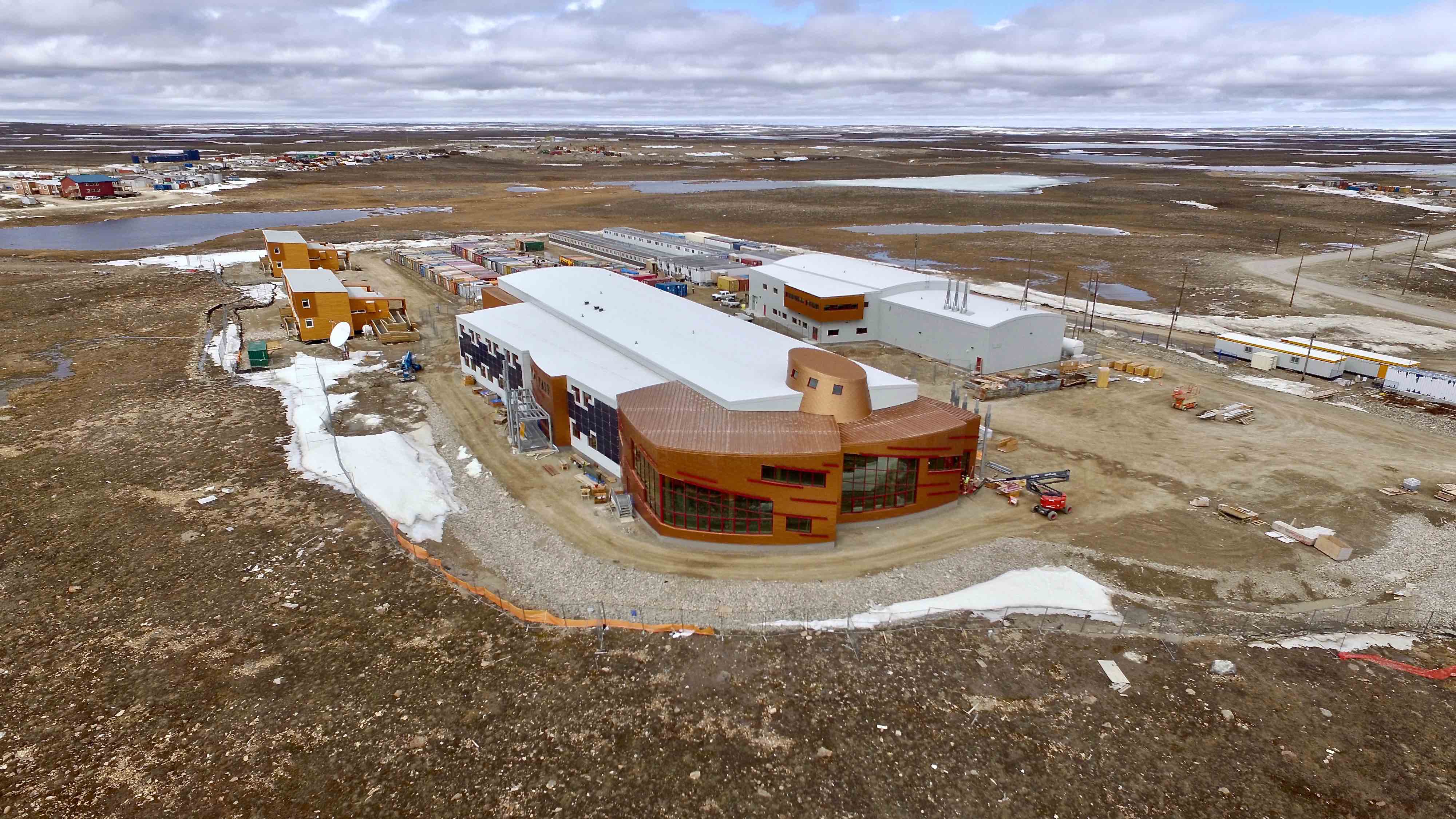
Aerial view of CHARS under construction in 2017. The campus includes the Main Research Building in the foreground; the Field Maintenance Building on the right; and triplexes in the background left, next to the satellite dish.
The two-story Main Research Building has 4,855 square metres of space for science research and knowledge sharing. The building has laboratories, offices, rooms for training, and a multi-use space for collaborative learning and community engagement.

“Doing science in the Arctic is challenging in many ways. But CHARS provides researchers with a place to stay, labs and lab equipment, field equipment like quads and skidoos, and meeting space, making it a lot easier for people to do the science. Having a research station also provides a place to bring researchers, organizations, and Northerners together.” —Emily Koide, POLAR’s Manager of Research Programs
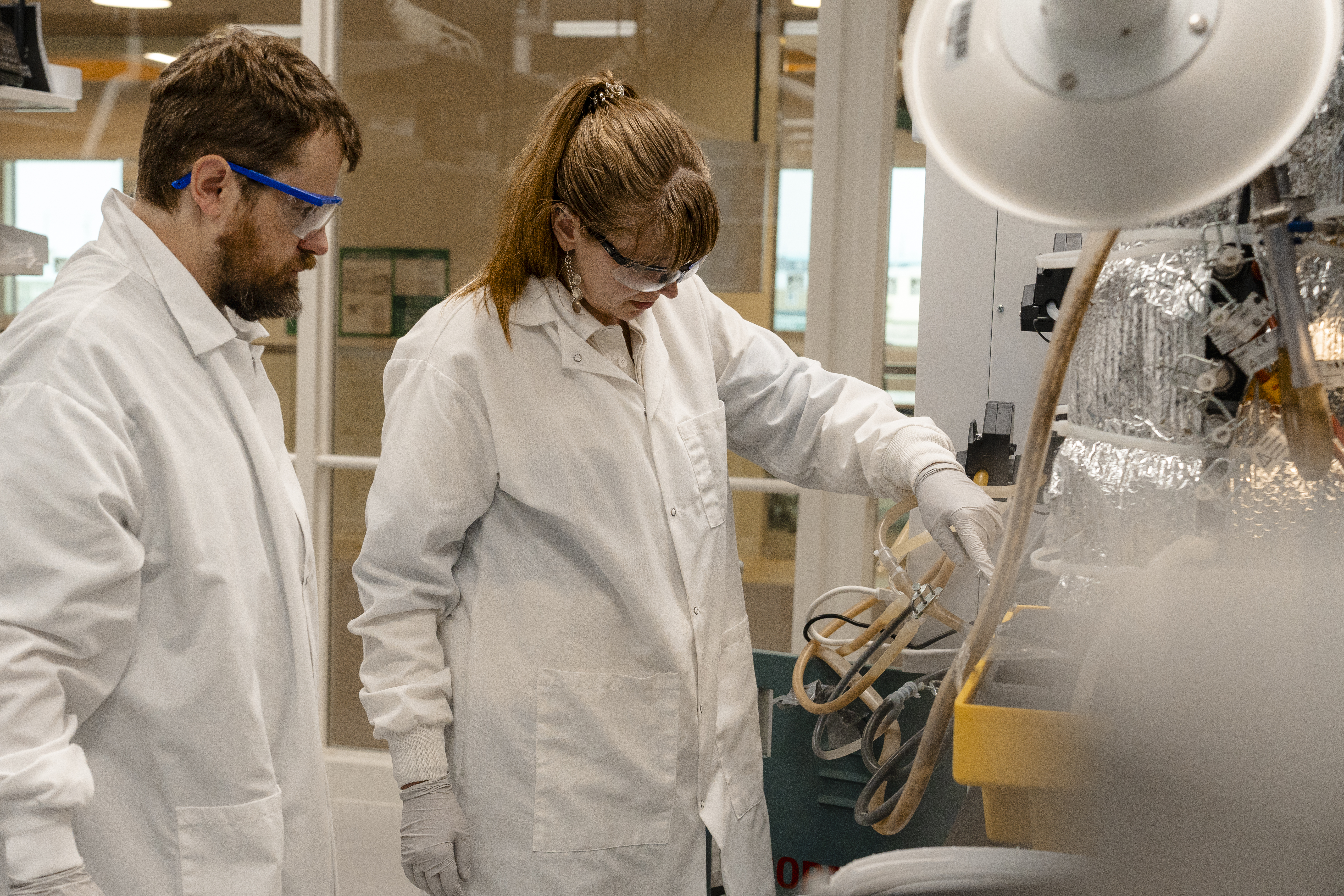
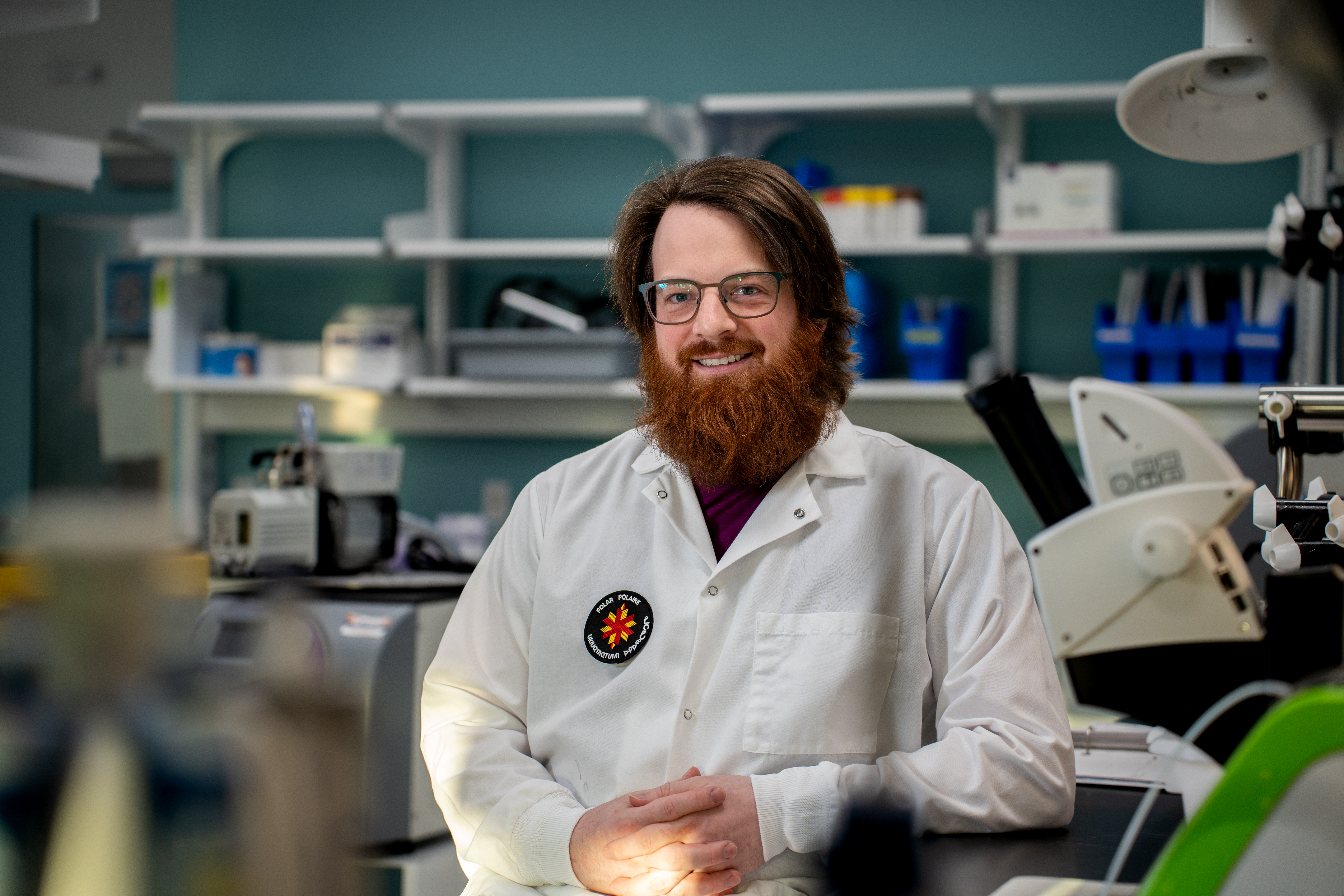
CHARS has several laboratories for analyzing specimens. POLAR employees Jason Maas and Arina Nikolaeva work on a project in the analytics lab.
The microscope lab, which includes an electron microscope, is used by researchers and is also an ideal place to teach science and introduce students to laboratory techniques.
“One of the many goals we had in setting up the labs was for researchers that come here to do as much as they can and go back south with as few samples as possible. Also, some things, like plants and water samples, don’t travel well.” —Nicholas Nantel-Fortier, PhD, POLAR’s Laboratory Manager
“One big area of research CHARS has been assessing biological diversity in the Arctic, using DNA-based approaches to build a genetic library of current life forms. This detailed library will be used to monitor ongoing biological changes that are occurring in Cambridge Bay and throughout the Arctic.” — Ian Hogg, PhD, POLAR Senior Research Scientist
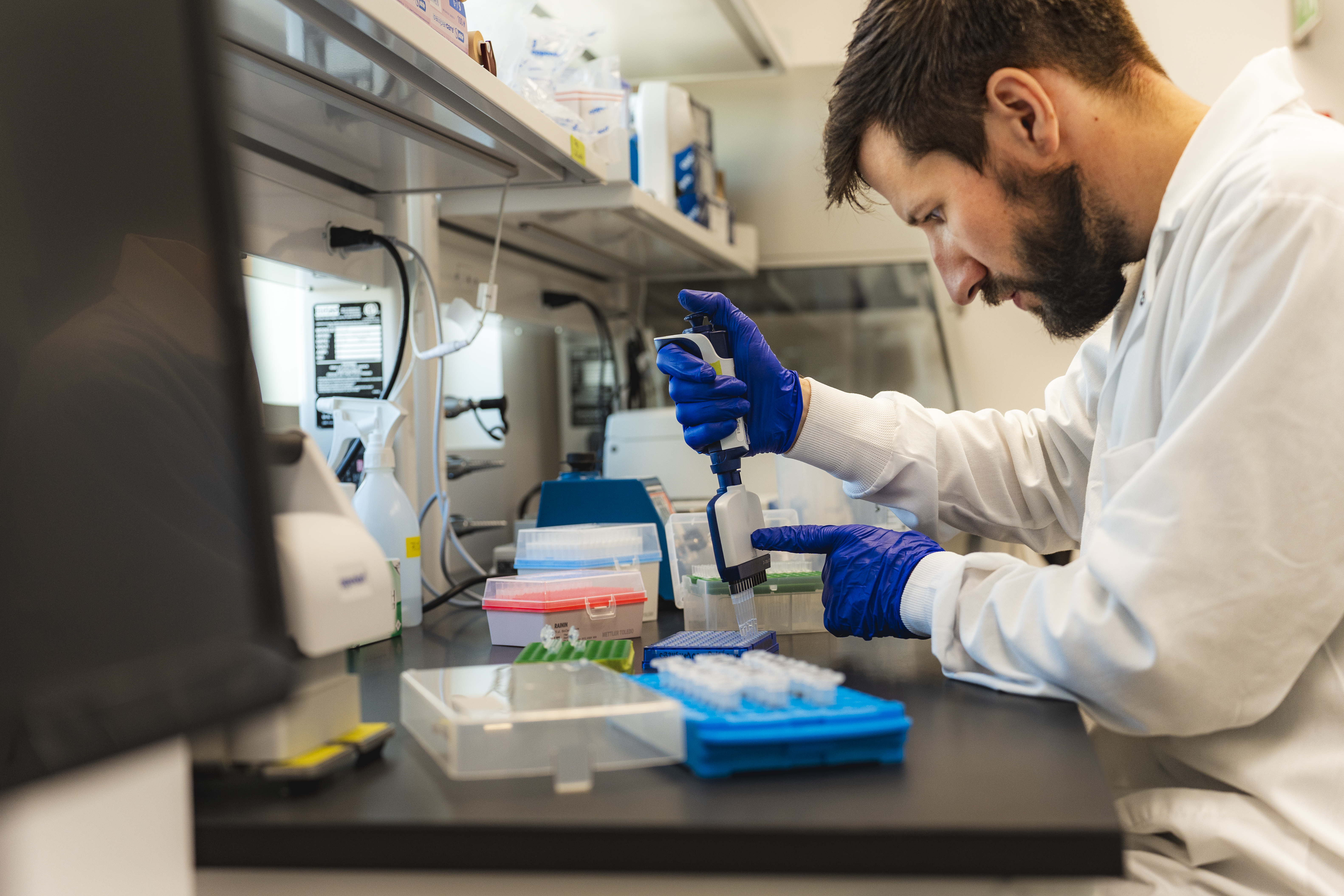
The genomics lab is where researchers, like Spencer Monckton, PhD, from the University of Guelph, can extract DNA and RNA from organic samples.

Photo: Alex Fradkin
Biologists can autopsy large animals, such as muskox, in the necropsy lab. The large doors and crane leading into the lab can lift and carry a whale into the room for examination.

Photo: Pierre Poirier, Canadian Museum of Nature
CHARS has two large, airy rooms designed as welcome spaces for gatherings, community meetings, and knowledge sharing. At our public speaker series events, researchers talk about their work, and community members have an opportunity to ask questions and give feedback.
Below, children look at the sea creatures from Cambridge Bay’s waters at the Canadian Museum of Nature speaker series presentation in September 2022.
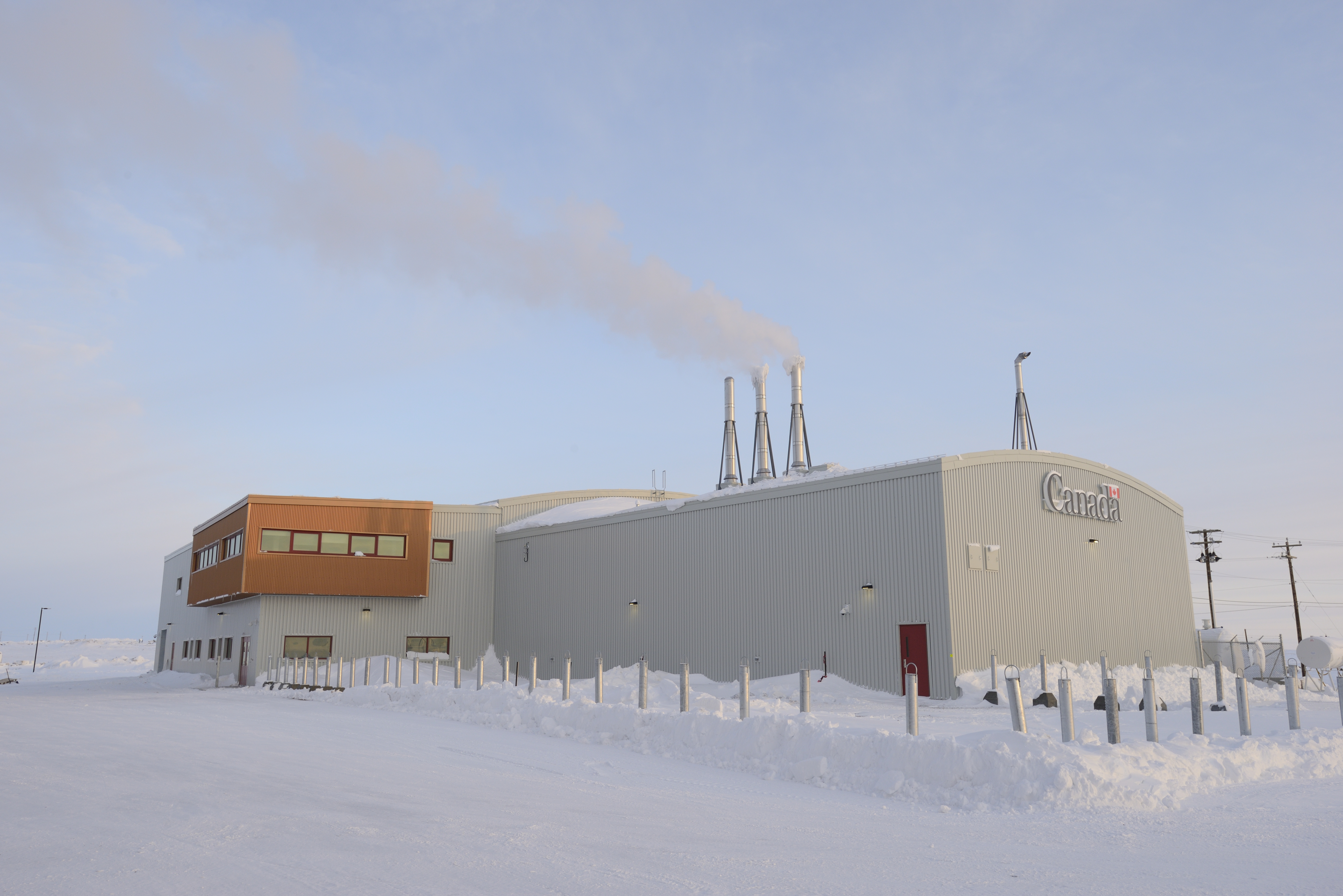
The 1,655 square metreField Maintenance Building, provides space, facilities, and equipment to support researchers in their fieldwork. It includes a woodshop, mechanics room, firearms locker, dive shop, layout room, cold storage, warm storage, offices, and a training room. Researchers also have access to all- terrain vehicles (ATVs), snowmobiles, camping gear, first-aid kits, and scuba diving gear.
“The opportunity to have this platform in Canada's High Arctic that is working to support scientists and communities, who are continuously strengthening Northern Knowledge research of importance to Canadians—whether it's at the community, circumpolar, or international level—that's what it's mandated to do.”
—Janet King, PhD, Chairperson, Polar Knowledge Canada’s Board of Directors

POLAR Field technicians Shannon Evetalegak and Layla Arnaquq
“We help take researchers out in the field and assist them with their work if they need it. In the wintertime, we'll take them out with skidoos and tie a toboggan in the back to carry their equipment. In the summertime, we'll take them out by quads or side-by-sides.” —Layla Arnaquq, POLAR Field Technician
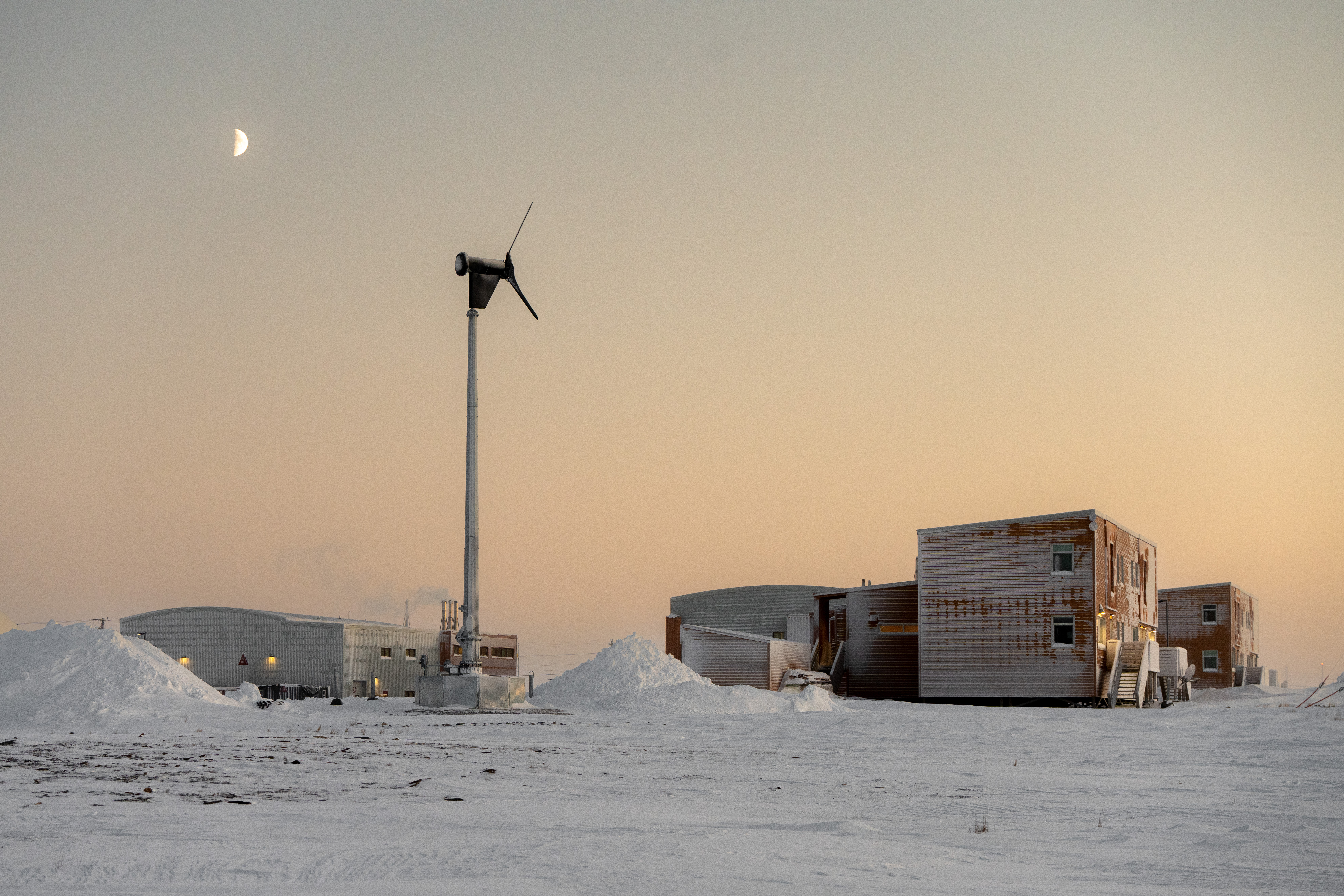
Visiting researchers can stay in CHARS’ onsite accommodation in its triplexes. Each of the two-story buildings (to the right of the wind turbine) has three four-bedroom apartments.
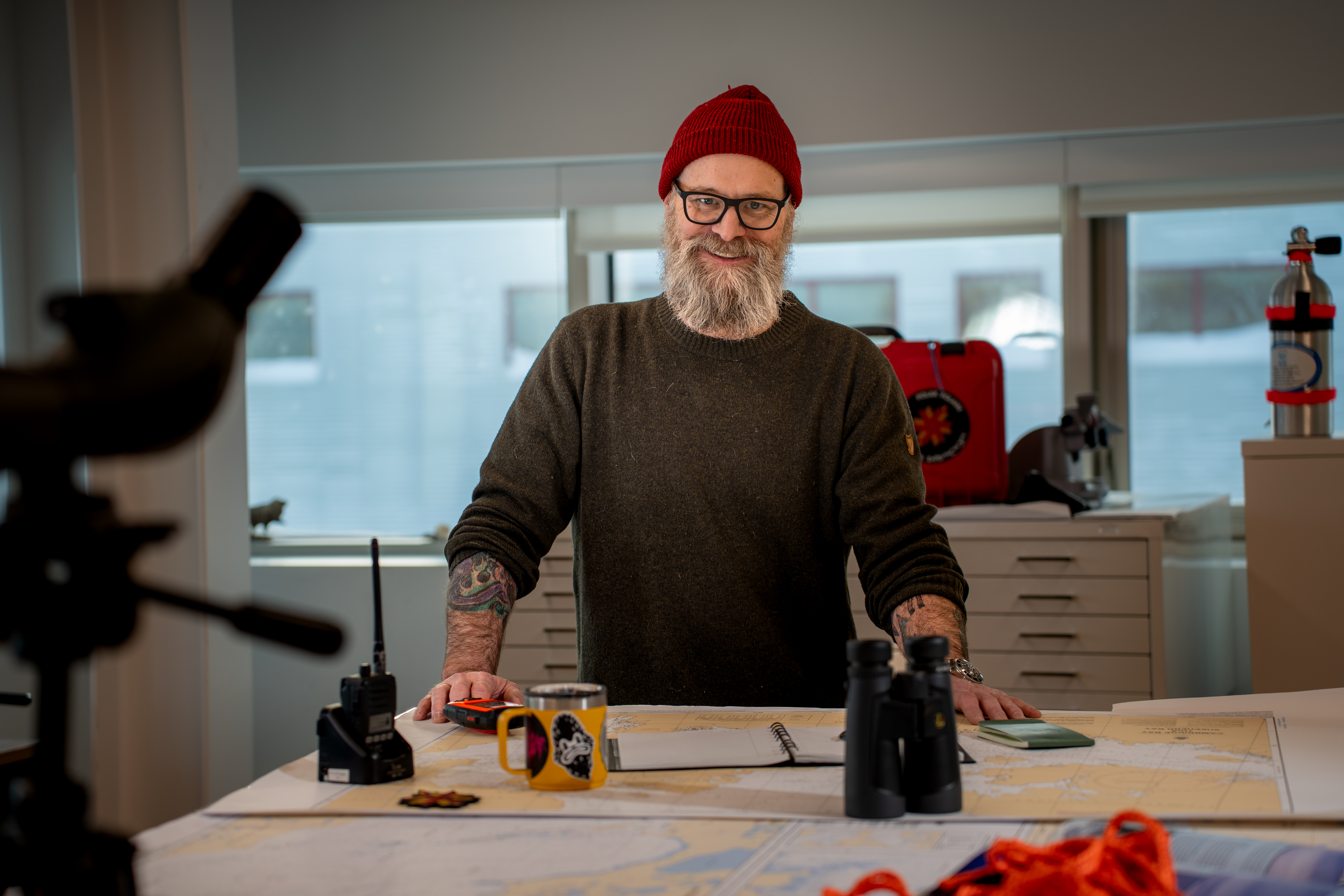
“Anybody that wants to come up to do research here—be they Polar Knowledge Canada employees, our own staff scientists, domestic scientists, researchers with NGOs, or from universities or international organizations— we assist them with data collection. So, if they need to go out on the land and collect samples—whatever it is that they're interested in doing—we have equipment and field technicians to help facilitate that.”
—Scott Johnson, POLAR’s Manager of Field Operations
CHARS floor plan
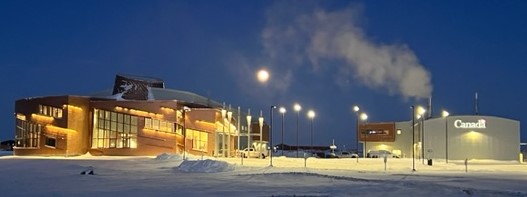
Welcome to CHARS, a world-class research facility in Canada's Arctic. This space welcomes scientists and Knowledge Holders from across Canada and around the world to conduct research.
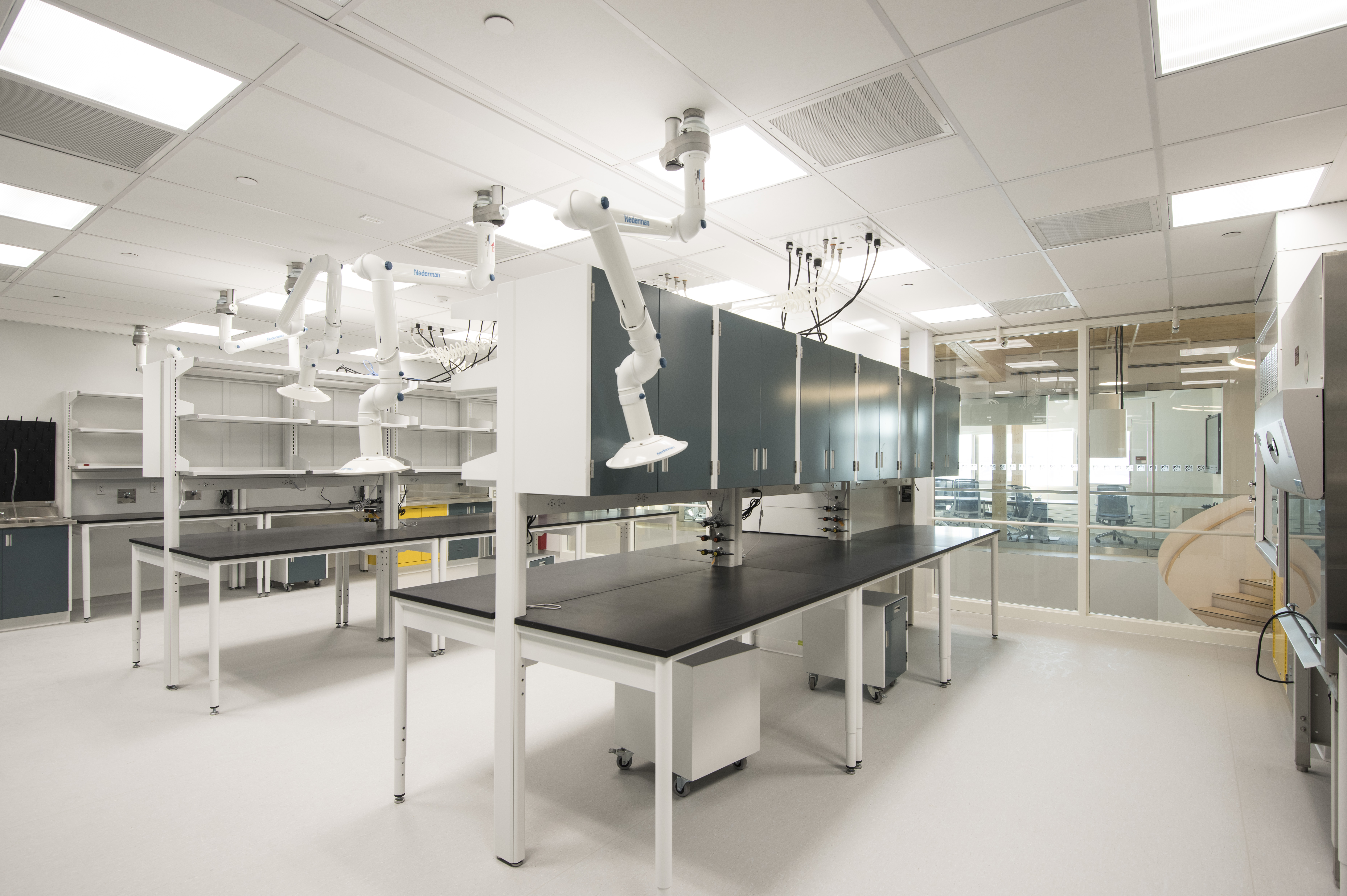
The majority of research laboratories are on the second floor of the Main Research Building
Main Research Building : Knowledge Sharing Centre, Kitchen, Reception, Reference Collection, Teaching Lab, Cold Lab, Clean Lab, Office Workspace, Cold Rooms, Laydown Space, Field Loading Dock, Necropsy Lab, Growth Chamber
Field Maintenance Building : Maintenance Garage, Woodworking Shop, Equipment Storage, Compost Room, Diving Facility, Lab, Marshalling Staging
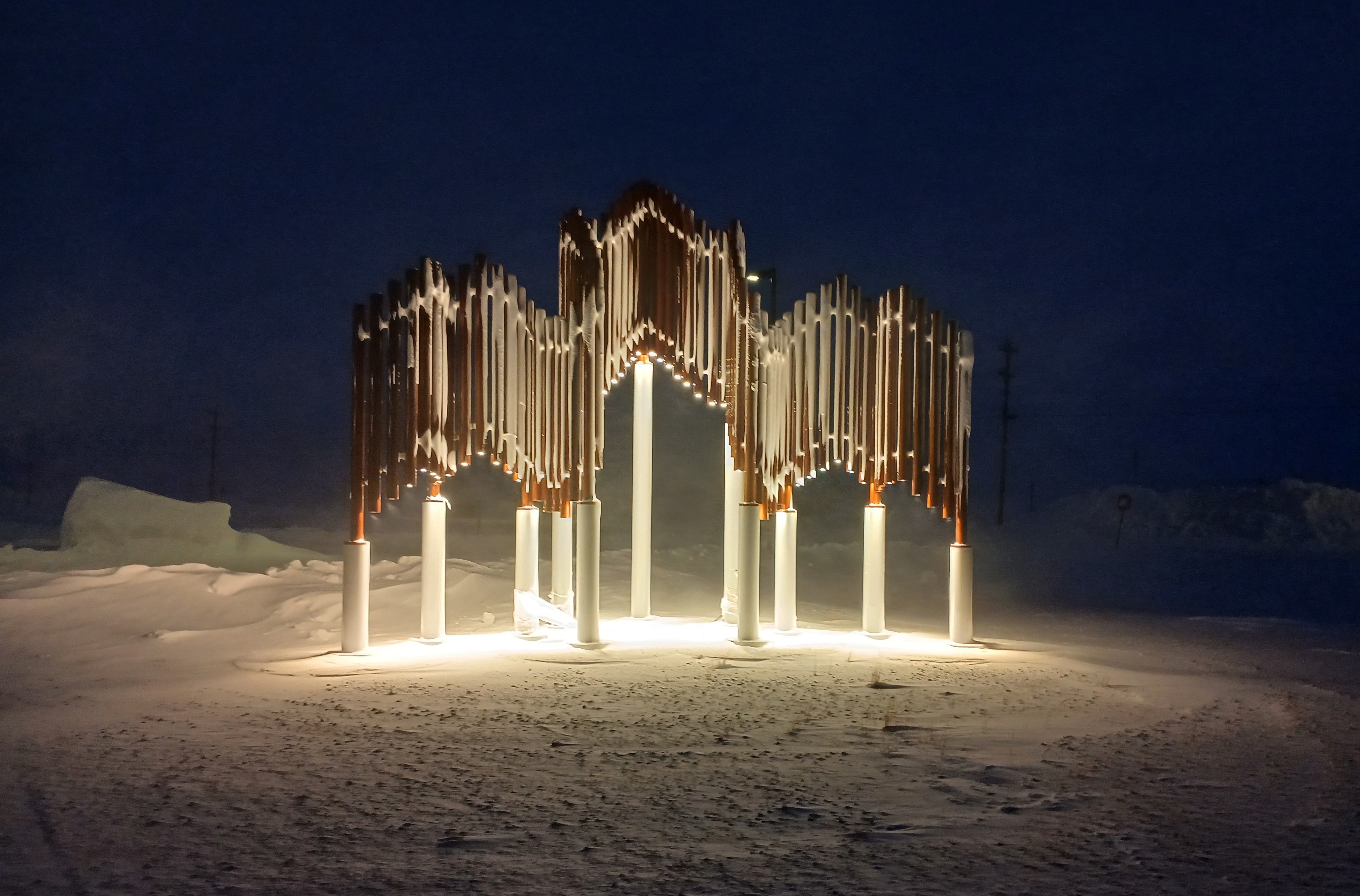
Polar Aurora
Designer Wei Yew designed the large three-dimensional art piece that sits in front of CHARS to welcome visitors. Titled Polar Aurora, the installation is made of copper-coated aluminum pipes to honour ancestral Inuit of the Kitikmeot region who made tools, such as ulus and harpoons, out of copper. It represents a stylized maple leaf, Canada’s national symbol, to signify Canada’s sovereignty in the North. The spacing of the pipes, each fitted with LED lights, mimics the dancing of the Northern Lights (aurora borealis).
Permafrost slump reveals prehistoric ice
Stéphanie Coulombe, PhD
POLAR Research Scientist – Science and Technology Program Team
Research expertise: permafrost and geomorphology

In 2009, while studying a fossil forest on Bylot Island, Nunavut, researchers discovered a massive wall of ice exposed in a permafrost slump. Stéphanie Coulombe, a permafrost expert, was part of the research team who arrived to examine it.
Rain and warmer summer temperatures can melt the thick top layer of normally frozen ground, known as permafrost. This causes the slopes to become unstable and the thawing top layer slides away, like a landslide, creating what’s known as a thaw slump.
“The top layers of the permafrost will slide and expose the frozen permafrost underneath,” says Stéphanie. “This slump exposed glacier ice in the permafrost.”
“About 20,000 years ago, all of the Northern Hemisphere was covered by a mass of glacial land ice. This formed ice sheets, similar to what we have on Greenland and Antarctica,” explains Stéphanie. “The glaciers retreated, and it left parts of glaciers that were then buried under sediments and preserved in permafrost.”
“So typically, we’ve found buried glacier ice that dates back to the last glaciation, which is between 23,000 and 28,000 years ago. But this one that we found on Bylot Island is older than other glacier ice found in the permafrost in the Northern Hemisphere.”
To determine the age of the sediments deposited on the glacier, the research team used paleomagnetic radiocarbon dating. When sediment is deposited in a river or lake, the magnetic properties in its minerals align with Earth’s current geomagnetic field. As the sediment becomes buried, the orientation of these minerals is ‘locked-in,’ preserving a record of the Earth’s magnetic field at that time. Studies of deep cores from the ocean floor have shown that the Earth’s magnetic signal has reversed 183 times in the last 83 million years. These reversals occur irregularly, roughly every 100,000 to one million years.
By comparing the magnetic signal of the sediments found on the glacier exposed on Bylot Island with the Geomagnetic Polarity Time Scale (based on marine sediment records), researchers were able to estimate the glacier’s age.
Stéphanie says the sediments above the glacier recorded evidence of a magnetic reversal 700,000 years ago. This means the ice was there before that event, so is at least 700,000 years old.
“It is the oldest glacier ice found in permafrost landscapes of the Northern Hemisphere.”
Although Stéphanie has not returned to the site on Bylot Island since 2014, she continues to analyze the data from her research. In collaboration with Dr. Daniel Fortier of the Université de Montréal, Stéphanie published these findings in the Geological Society of America’s Geology magazine in September 2024.
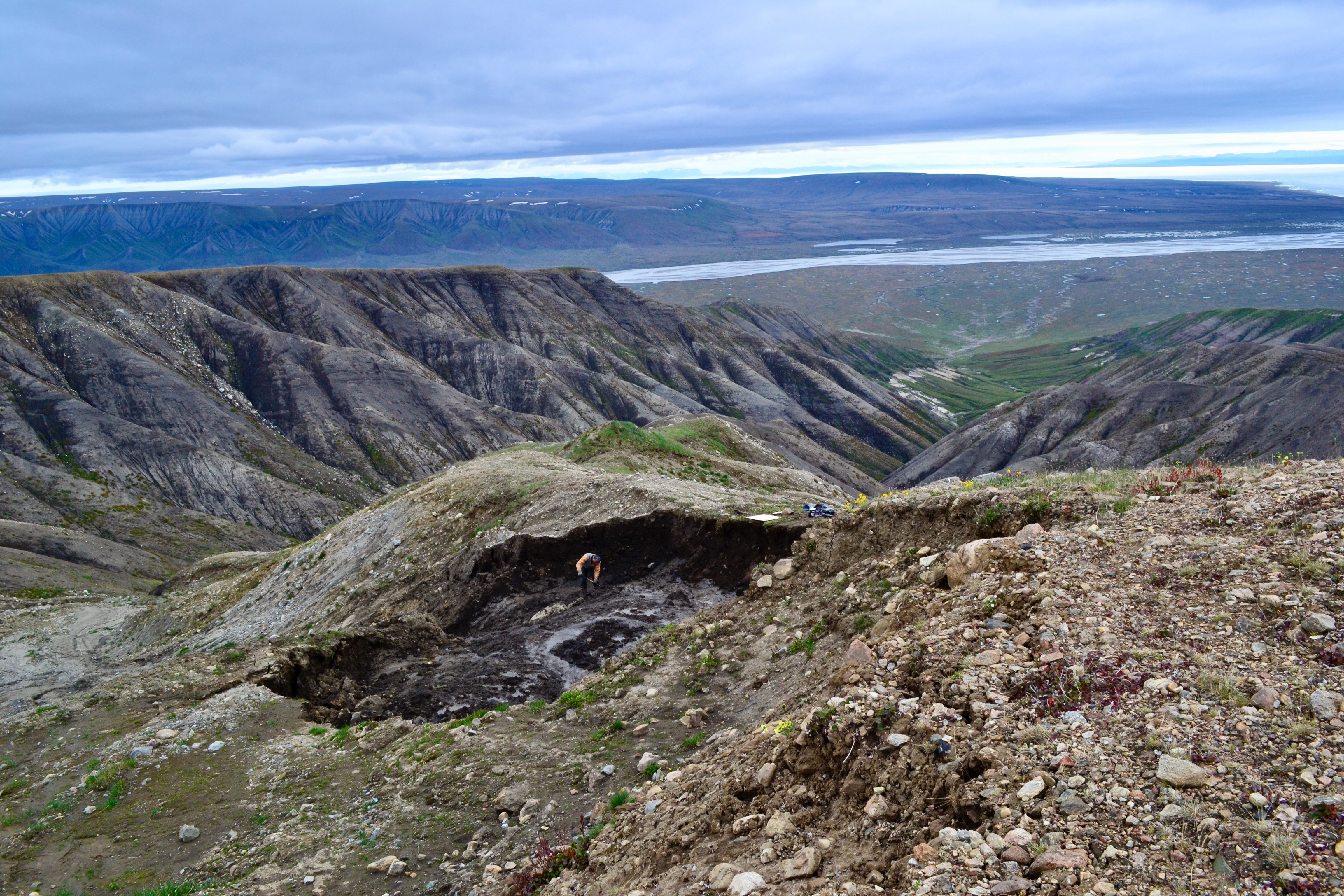
Permafrost slump on Bylot Island that exposed ancient glacier ice.
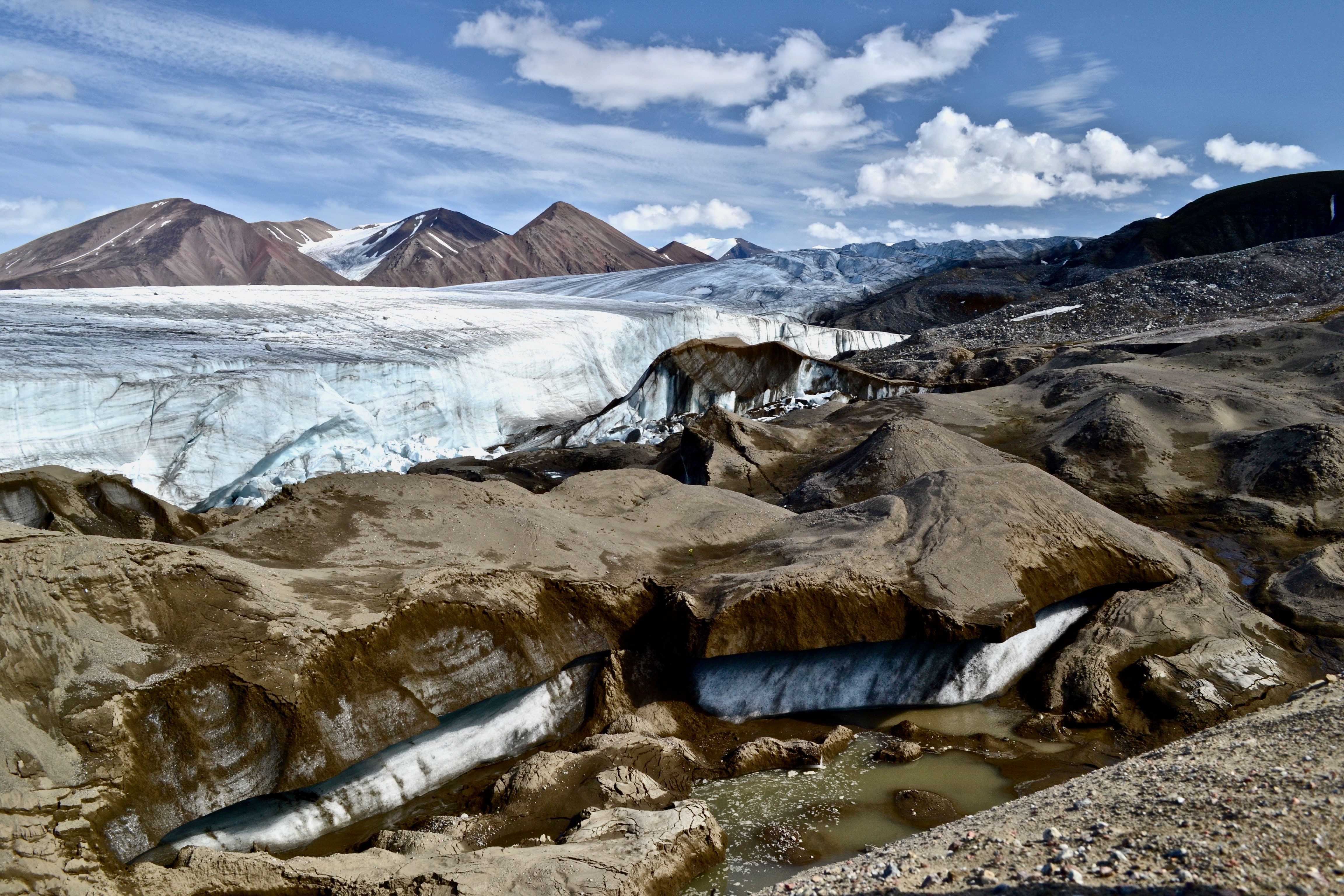
Glacier C-93 on Bylot Island that shows the accumulation of sand on glacier ice. This can bury large portions of glaciers, which may eventually preserve the glacier in permafrost.
Making connections between high elevation and the High Arctic
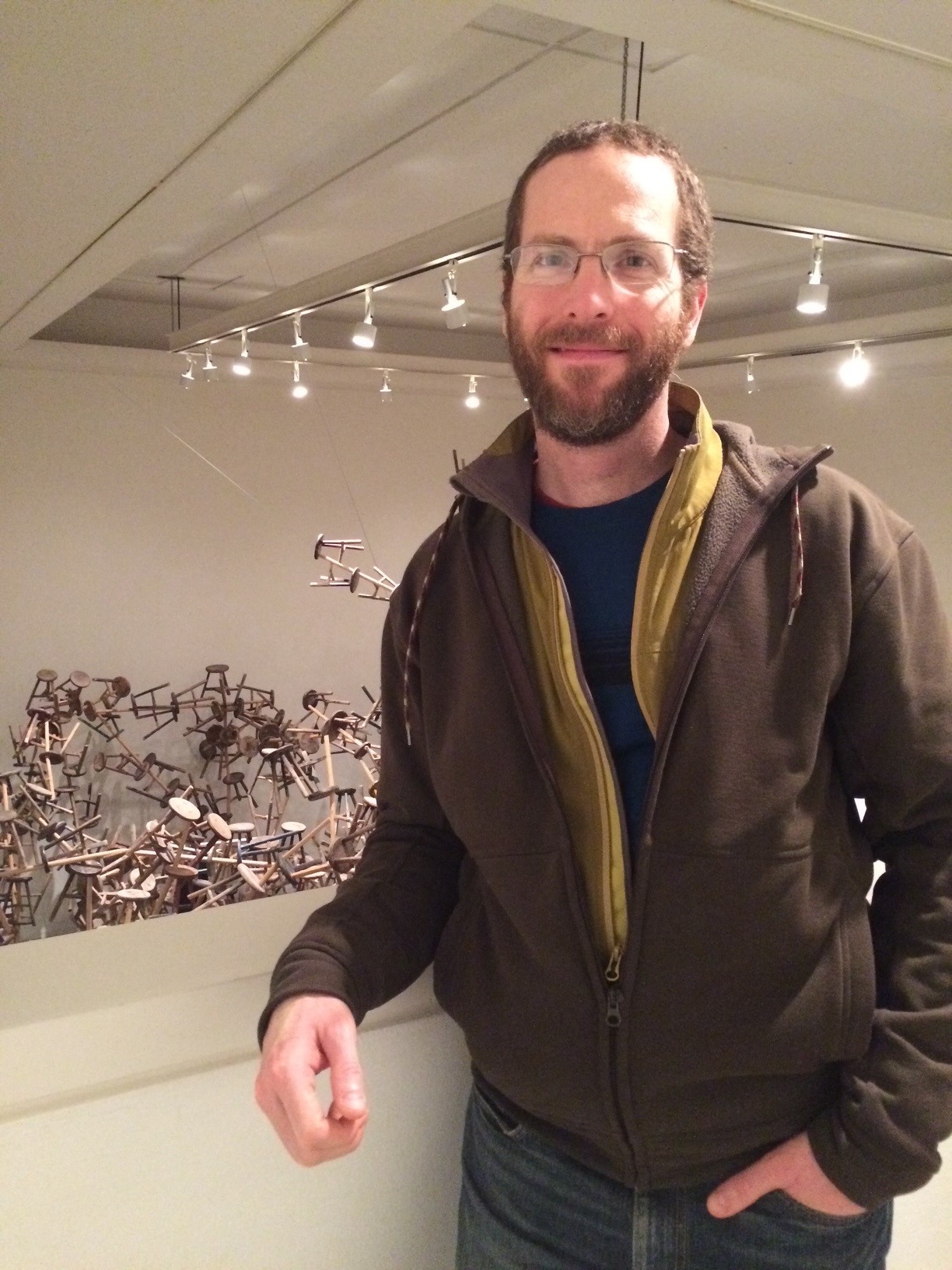
Scott Williamson, PhD
POLAR Research Scientist – Science and Technology Team
Research expertise: atmosphere and cryosphere interaction
Peaks in the St. Elias Mountains in the Yukon are near the top of the troposphere, the lowest level of the Earth’s atmosphere, closer than the tops of taller mountains near the Equator.
The atmosphere starts to get thinner closer to the poles, so the troposphere is lower there as well. As a result, the 6,000-metre-high Saint Elias Mountain Range, located north of 60°N latitude, rises into the troposphere. In fact, these mountains are closer to the top of the troposphere than Mount Everest, which is 8,849 metres high and located at 28°N.
POLAR Research Scientist Scott Williamson calls the mountain range, “one of the most, if not the most, interesting climatological places on the planet.”
“Everybody talks about how rapidly the Arctic is warming. Well, that's nothing compared to the Arctic atmosphere,” says Scott. He notes that the climate in the Saint Elias mountains is warming faster than the global average. “That big St. Elias Mountain range is so important to our understanding of how the rest of the Arctic atmosphere is evolving.”
To monitor this, Polar Knowledge Canada operates four remote meteorological stations in the mountain range. Scott leads a team that analyzes temperature trends and patterns from the stations, radiosonde (weather balloon) measurements, satellite-measured radiance, high-elevation ice cores extracted from the St. Elias Icefield, as well as other climate history and indicators. This information will help the team understand the Earth’s rapidly changing climate system.
The data collected shows that annual surface air temperatures in the St. Elias Mountains have been increasing since 1979 at all elevations from 2,000 to 6,000 metres. The greatest warming rates occur above 5,500 metres.
The warming rate in the St. Elias Mountains is 1.6 times faster than the surface temperature of the rest of the globe.
Why is the air warming faster at these higher elevations?
“It's a greenhouse gas effect—but it's not the greenhouse gas that everybody talks about. It's the important greenhouse gas that nobody talks about, which is water vapour,” says Scott.
Scott explains that warmer air holds more water vapour, which then absorbs heat from the Earth. This process further warms the atmosphere, creating a greenhouse gas effect. As the Arctic warms, more moisture is absorbed into the atmosphere, which warms it further.
Scott says the Saint Elias’ atmospheric warming is “a test bed” for the entire Arctic.
“There are these connections between the High Arctic and high elevation. And if we can work those out, it gives us the ability to comment on mechanisms about why the planet is warming so fast.”
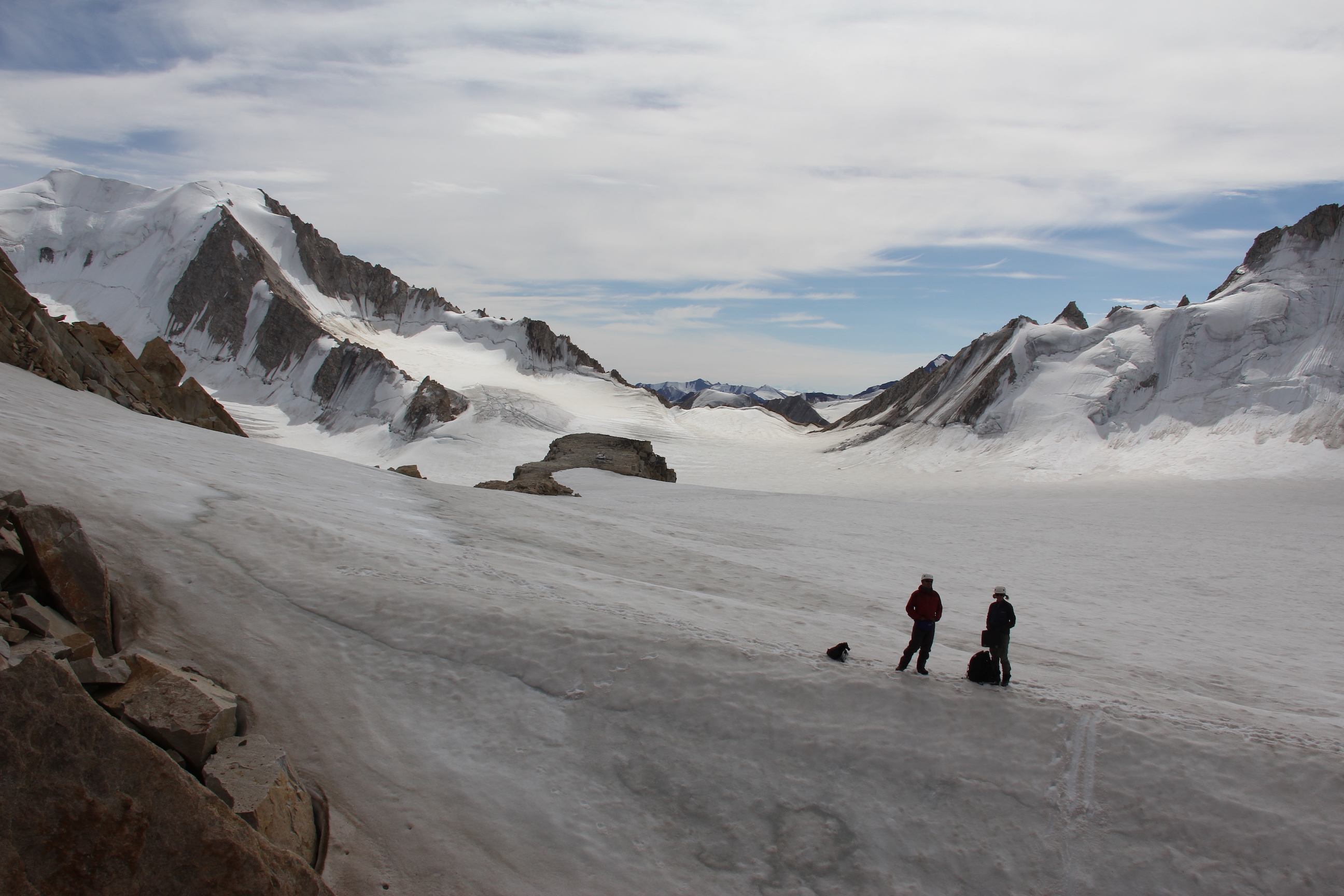
Glacier in St. Elias mountains in Kluane National Park and Reserve, Yukon.
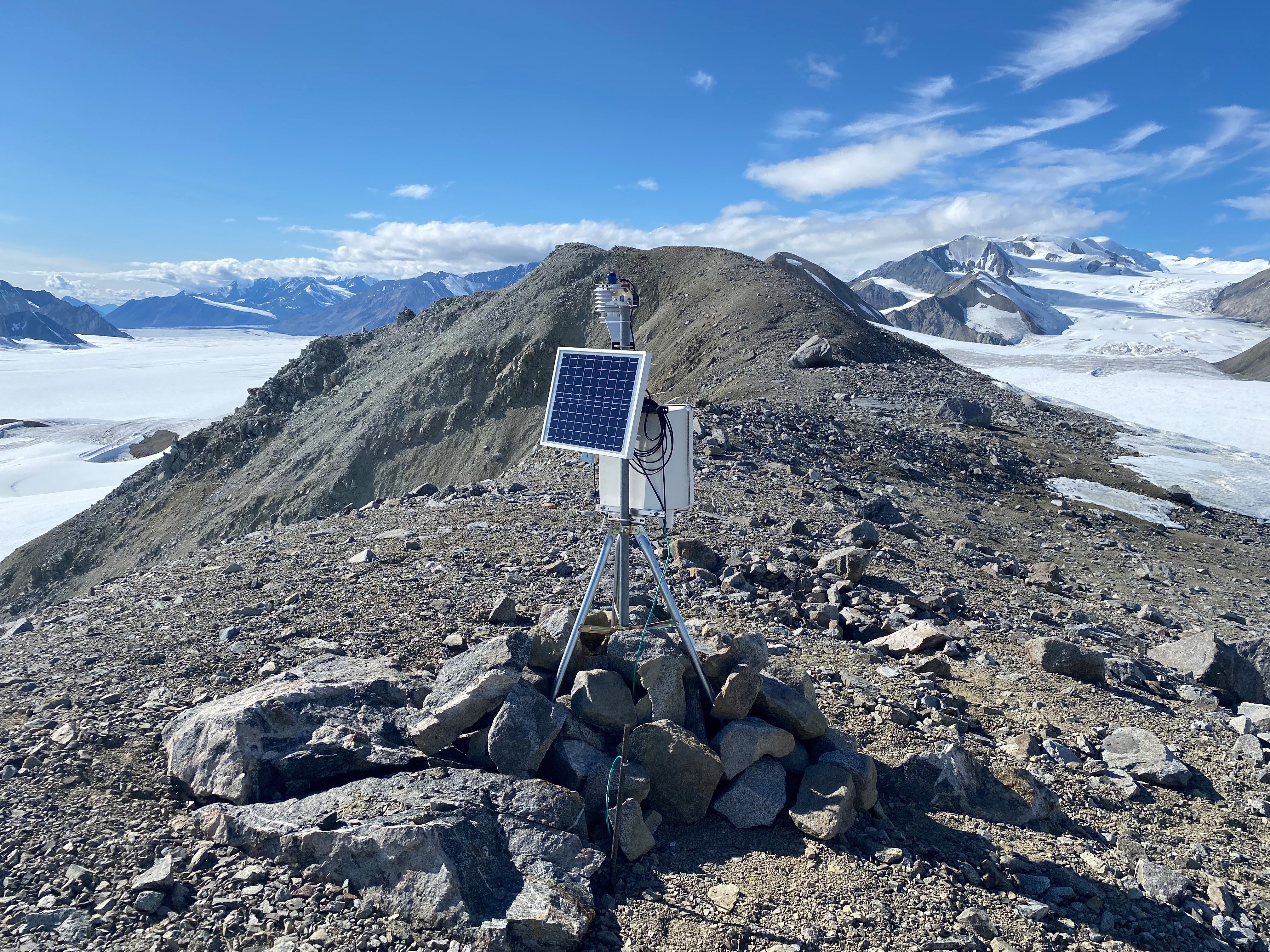
In August 2024, POLAR, in collaboration with the Kluane National Park Field Unit, installed a meteorological station at 2,643 metres on the ridge of Badham II in Kluane National Park. The station was installed to support an international effort to extract a 700-metre ice core from the nearby Eclipse icefield in 2026.
Barcoding invertebrates
Bryan Vandenbrink, M.Sc.
POLAR Research Scientist — Science and Technology Program Team
Research expertise: invertebrates
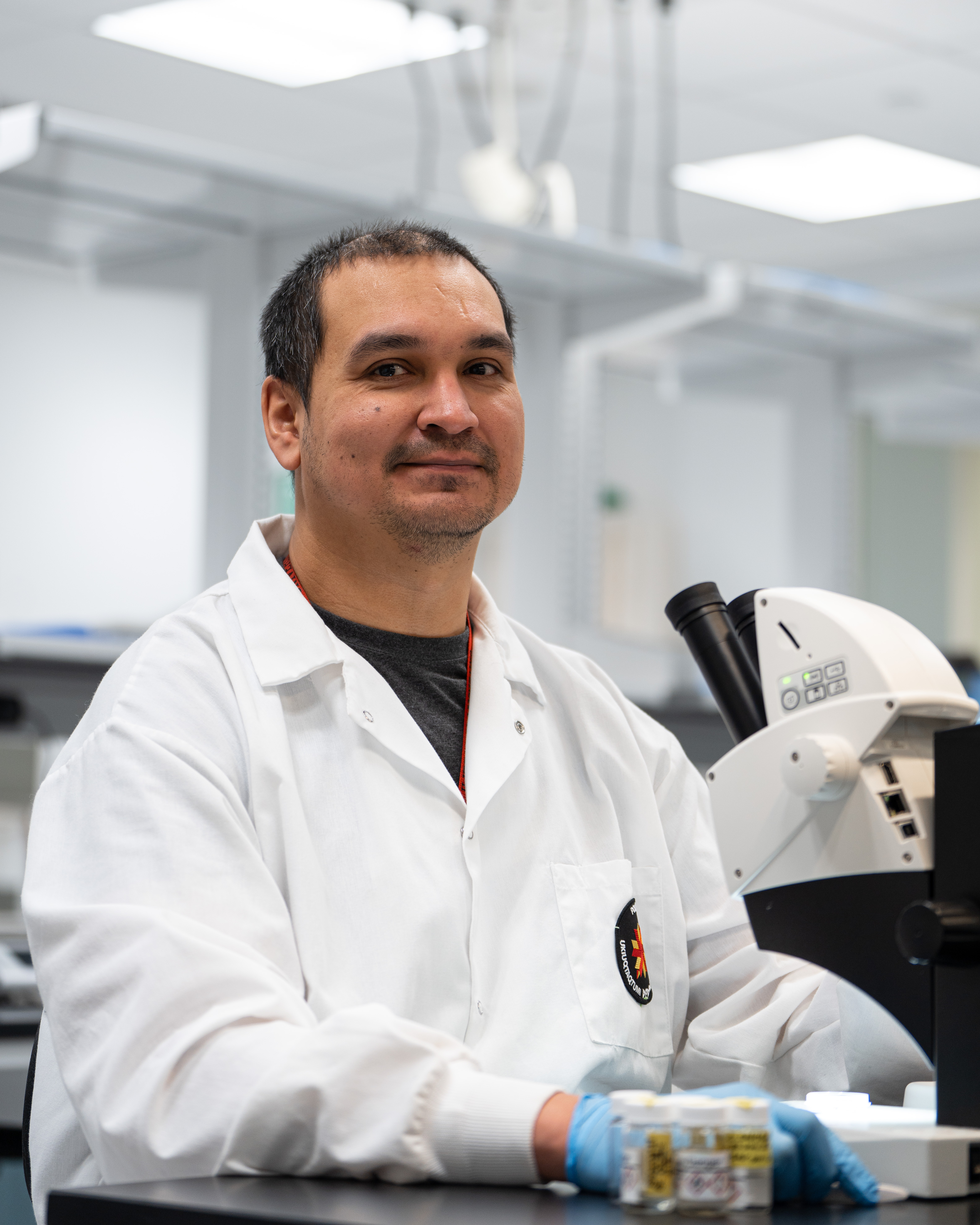
People are familiar with barcodes on store products, but the concept of barcoding insects is not widely known.
Since the 1700s, living organisms have been classified using biologist Carl Linnaeus’ system of assigning them a Latin genus and species name based on their physical features. This method is known as classical taxonomy.
“The cool part is now that we have the ability to barcode and individually identify species. We're basically complementing everything that Carl Linnaeus and the work that others have done,” says researcher Bryan Vandenbrink. “With genomics, we can differentiate between species based on their genetic data, rather than relying on their physical appearance alone or educated guesswork on how species might be related.”
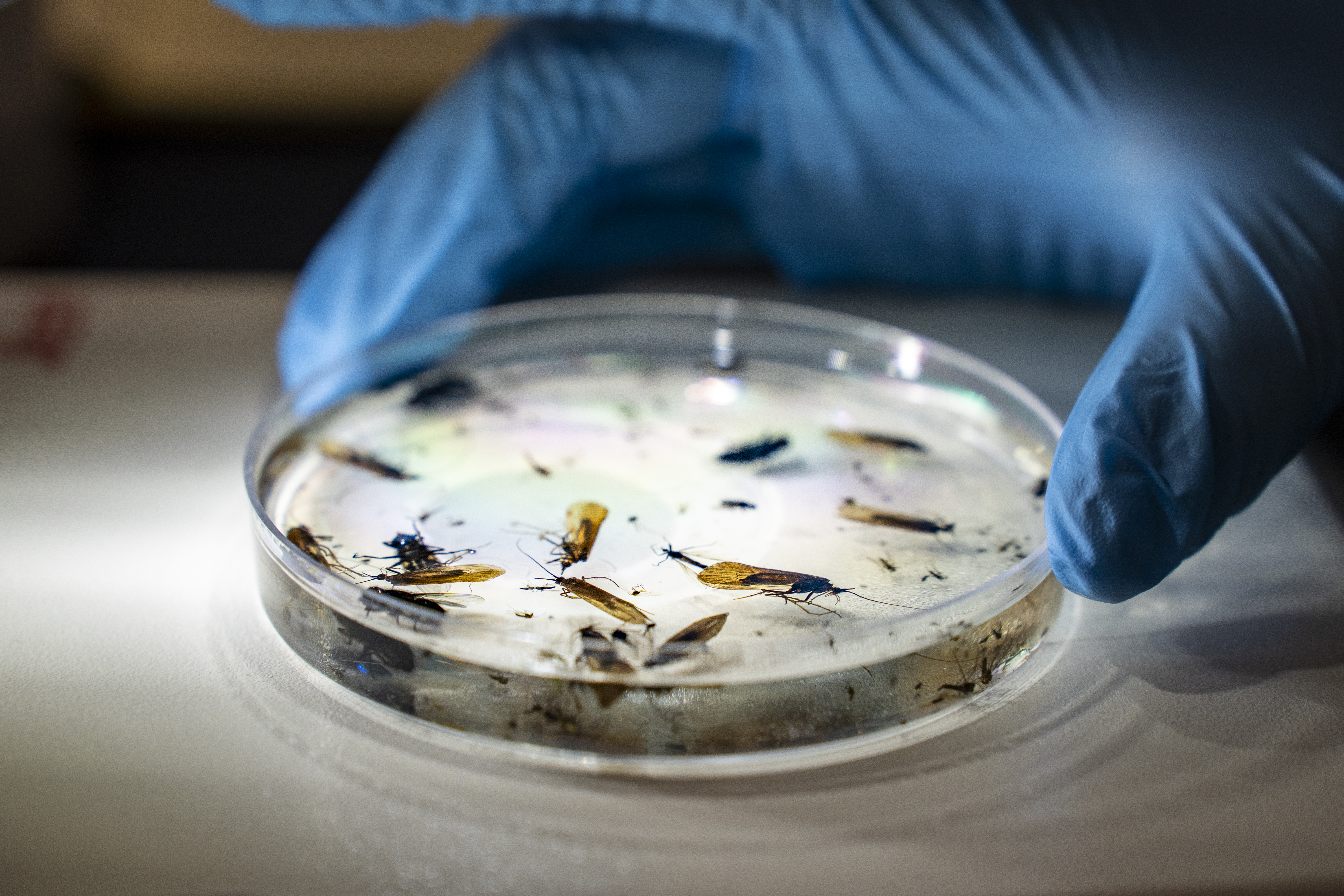
Bryan collects various insects in the Cambridge Bay area, on Victoria Island, using traps designed to catch anything from crawling to flying insects. These specimens are then sent to the University of Guelph’s Centre for Biodiversity Genomics where they are identified through genetic sequencing.
Bryan explains that insect barcodes do not consist of lines and numbers like those on store products but rather of the organism’s actual DNA. Each insect’s barcode is paired with a unique number called a barcode index number, which is linked to genetic data.
The DNA is first analyzed, then compared to an online DNA reference library to find its closest match.
The result is a list of DNA-barcoded insects, providing a baseline of the insects currently present in the Cambridge Bay area. This helps with monitoring when non-native species appear in the area. New insects can arrive inadvertently through people or incoming shipments. However, researchers, like Bryan, also predict that with a changing climate, insects from the south will migrate northward, expanding their range.
“Insects and the environment interact in really important ways,” says Bryan.
The potential concern with new species moving into the Arctic is the likelihood that they will interact with—or even displace —other species. This could lead to a decrease in food sources for native species, or the absence of predators for the new species.
He highlights another concern.
“It's a bad thing for southern Canada if you have a counter exchange of genes between closely related species, where a species migrates to the Arctic, picks up genes for surviving in cold environments, and then migrates back down to southern Canada.”
The impact of climate change on ecosystems, both in the Arctic and in southern Canada, remains uncertain. As Bryan says, “Climate change will have huge implications for everything that lives in the environment, which is both you and me—but also insects.”

This tiny, newly hatched specimen is a parasitoid wasp before it was barcoded. The parasitoid wasp lays eggs inside other insects where its larvae eats and grows. It then bursts out from inside the other insect when it is ready to hatch.
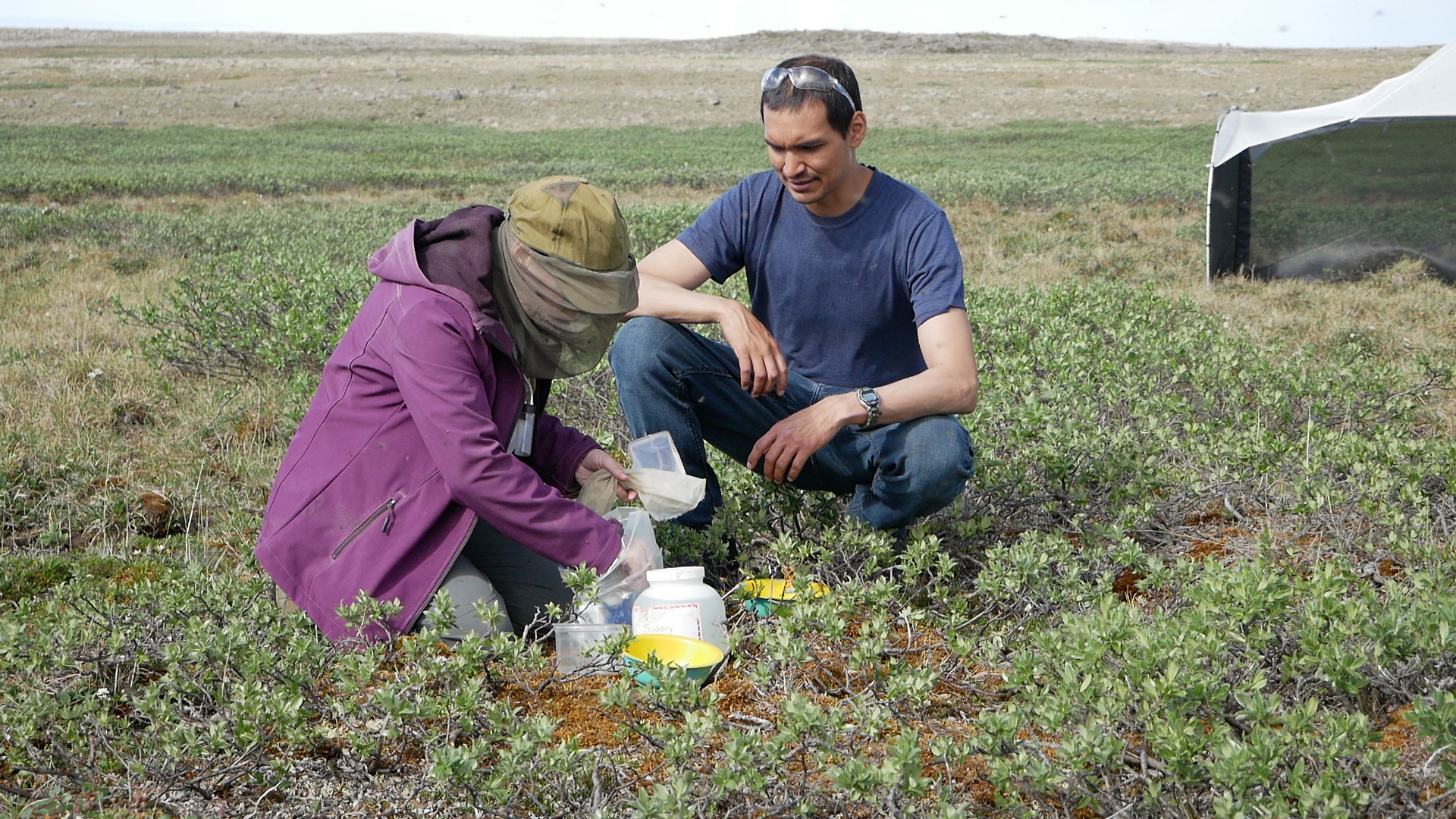
Bryan Vanderbrink and Crystal Soble checking insect traps near Cambridge Bay in 2017.
Incredible mosses
Erin Cox, M.Sc.
POLAR Research Scientist — Science and Technology Program Team
Research expertise: Bryophytes
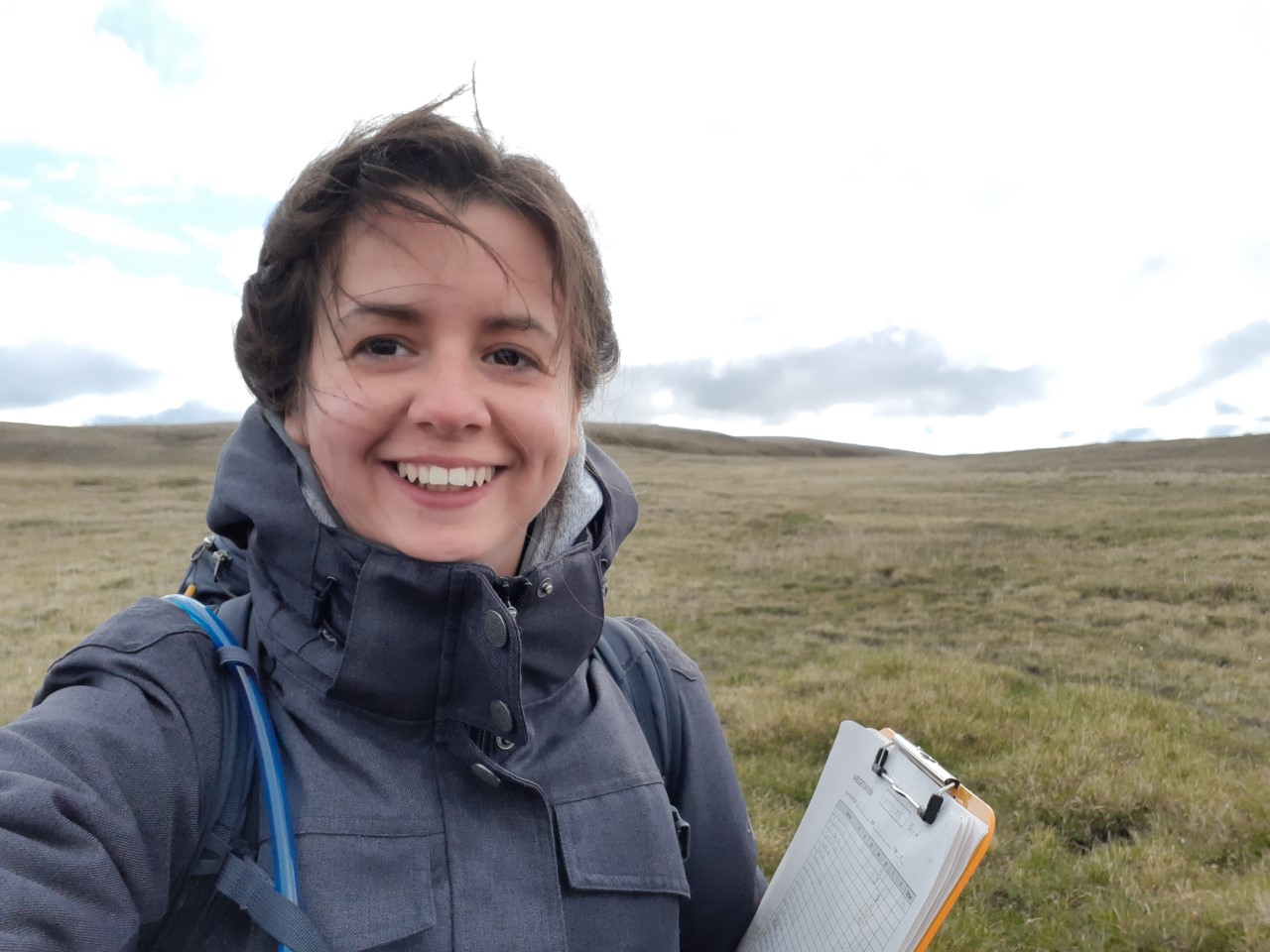
“Mosses are crucial, even though they're very nondescript and they might all look the same. They keep the ecosystem healthy,” says researcher Erin Cox.
Erin notes that Arctic mosses have not been studied as much as the showier vascular plants, which are larger and have flowers. However, they play an important role in Subarctic and Arctic environments.
“They insulate permafrost,” Erin says. “That moss layer is really important for that insulation. Plus, the mosses are one of the first things to inhabit barren ground or Arctic tundra. They hold onto moisture and contribute to soil development, which allows for the other plants to start growing.”
She notes that research is exploring how mosses are important for nitrogen fixation and how they relate to ecosystem health by hosting a huge microbial world.
While mosses have been studied on Ellesmere Island, research in the rest of the Canadian Archipelago is limited. Only two scientific publications mention moss and plants on Victoria Island. They are based on two expeditions: one from 1913 to 1918 and another from 1959. Together, they list a total of 57 bryophytes. From Erin’s research on Victoria Island, she has identified 71 species not yet recorded in scientific collections or publications. Erin believes there are many more species not yet collected.
Different moss species grow in a variety of environments—from dry to wet. Erin is looking for all the different habitats where they grow to show their diversity.
As Victoria Island is large and there are challenges of exploring over large distances during the summer, Erin visits sites with other researchers by helicopter. She searches for unique habitats at the sites and collects as many different mosses as possible. She puts each sample in a small brown paper lunch bag to bring back to the lab to study under a microscope and identify its characteristics.
Most plants cannot be revived once they have dried out, but mosses can be.
“What you can do with the dry moss is add water and it comes back to life. That's one of my favourite things about mosses,” says Erin.
She has looked at mosses from the 1800s and revived them with water. They no longer contain chlorophyll, so are not green or as colourful. “But,” says Erin, “the cells will fill up with water and it's like it's alive again.”
Erin adds the moss species she collects to the plant reference collection she is building at CHARS. These samples are dried and stored in packets as a reference for both the public and other researchers. The collection already includes flowering plants, lichens, fungi, and marine algae.
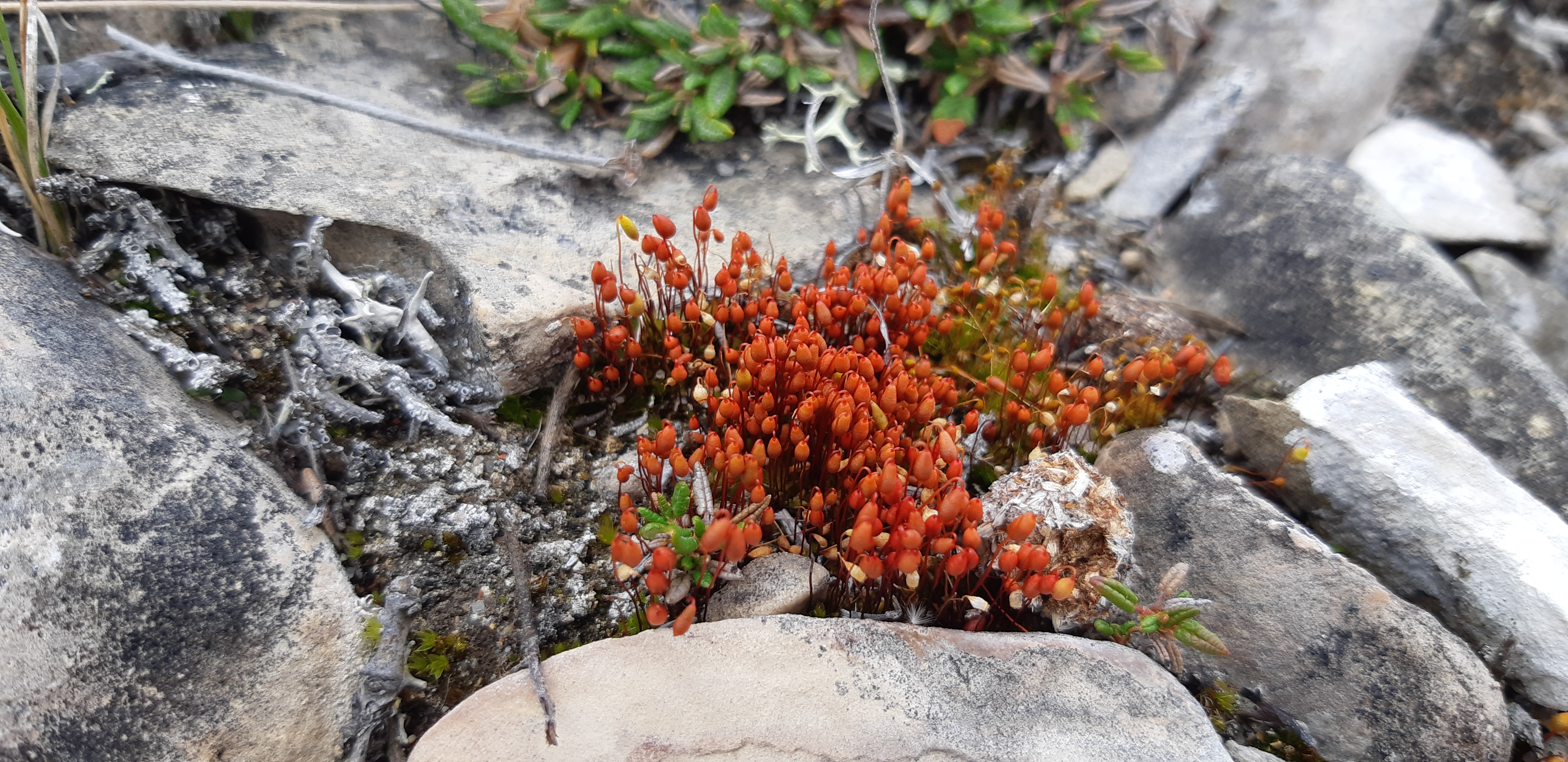
The Arctic moss, Ptychostomum wrightii is a species found in northern environments.
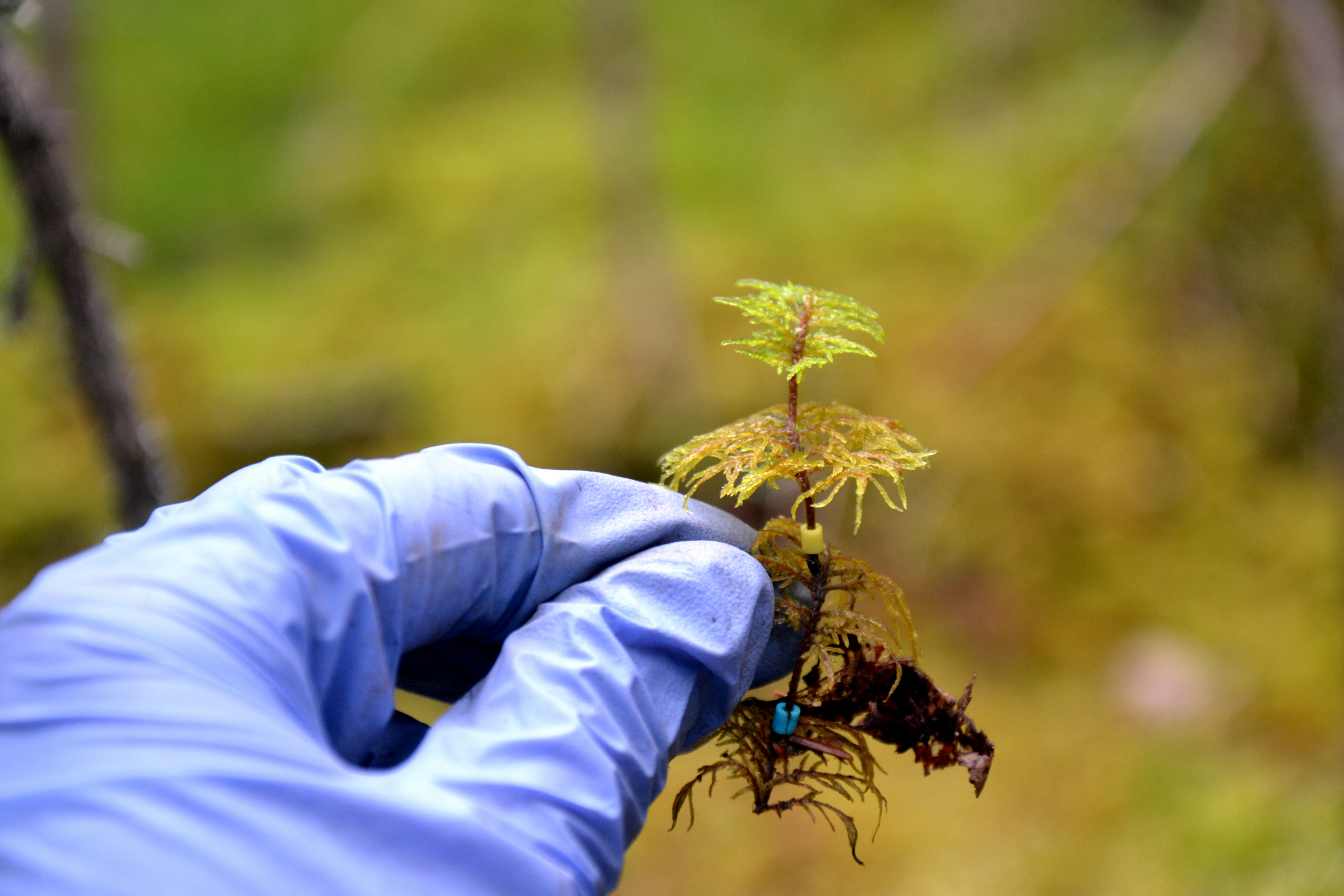
Hylocomium splendens, commonly known as stair step moss, is found in the forest understory in the boreal region.
In the POLAR collection
Local insects, flowering plants, mosses, lichens, fungi, marine algae are some of the specimens kept in the reference collections at CHARS. These are created by POLAR employees and the Museum of Nature.
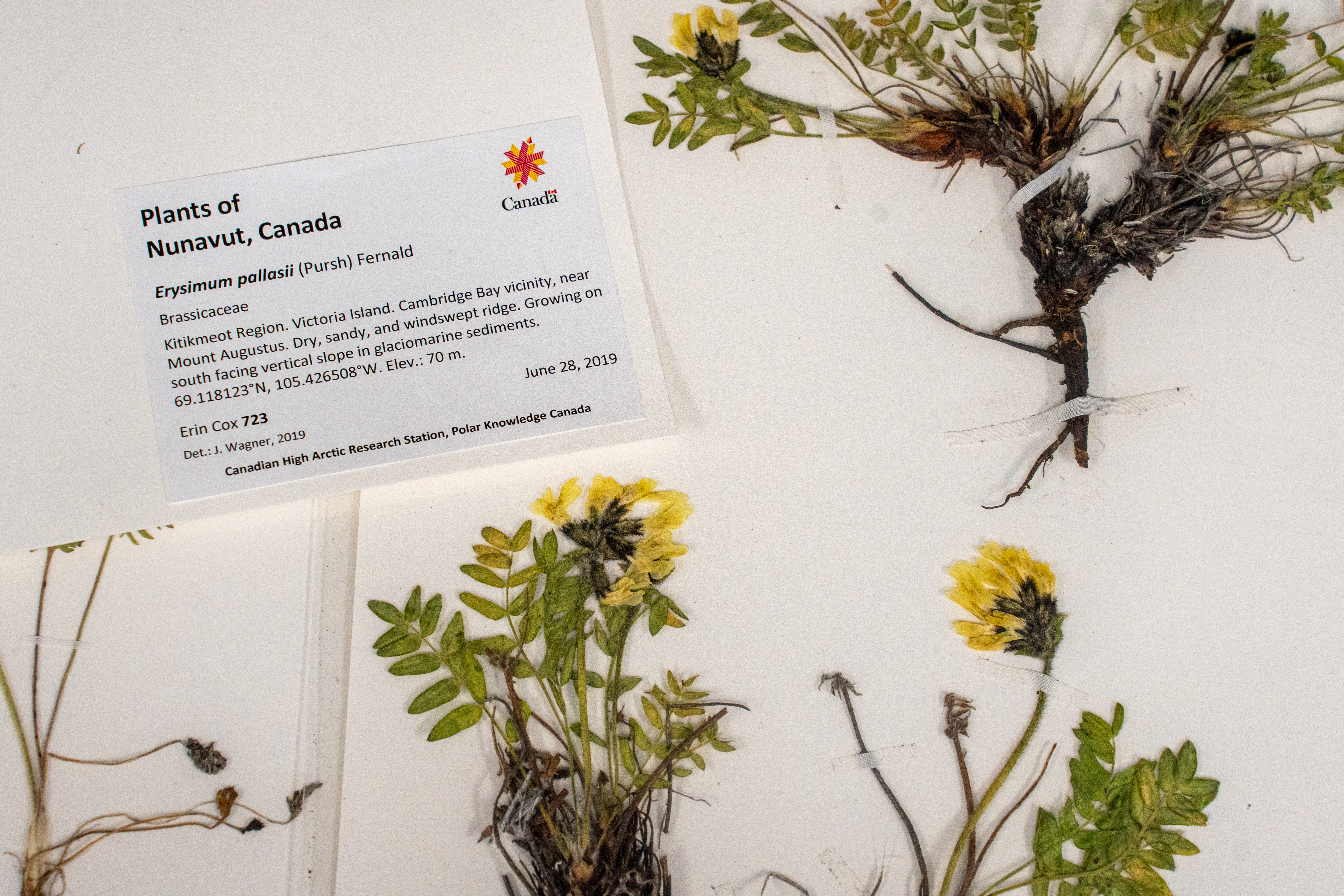
Erysimum pallasli is a common flower of the Canadian Arctic Archipelago, known in English as Arctic wallflower and Inuktitut as Nunaraapiit.
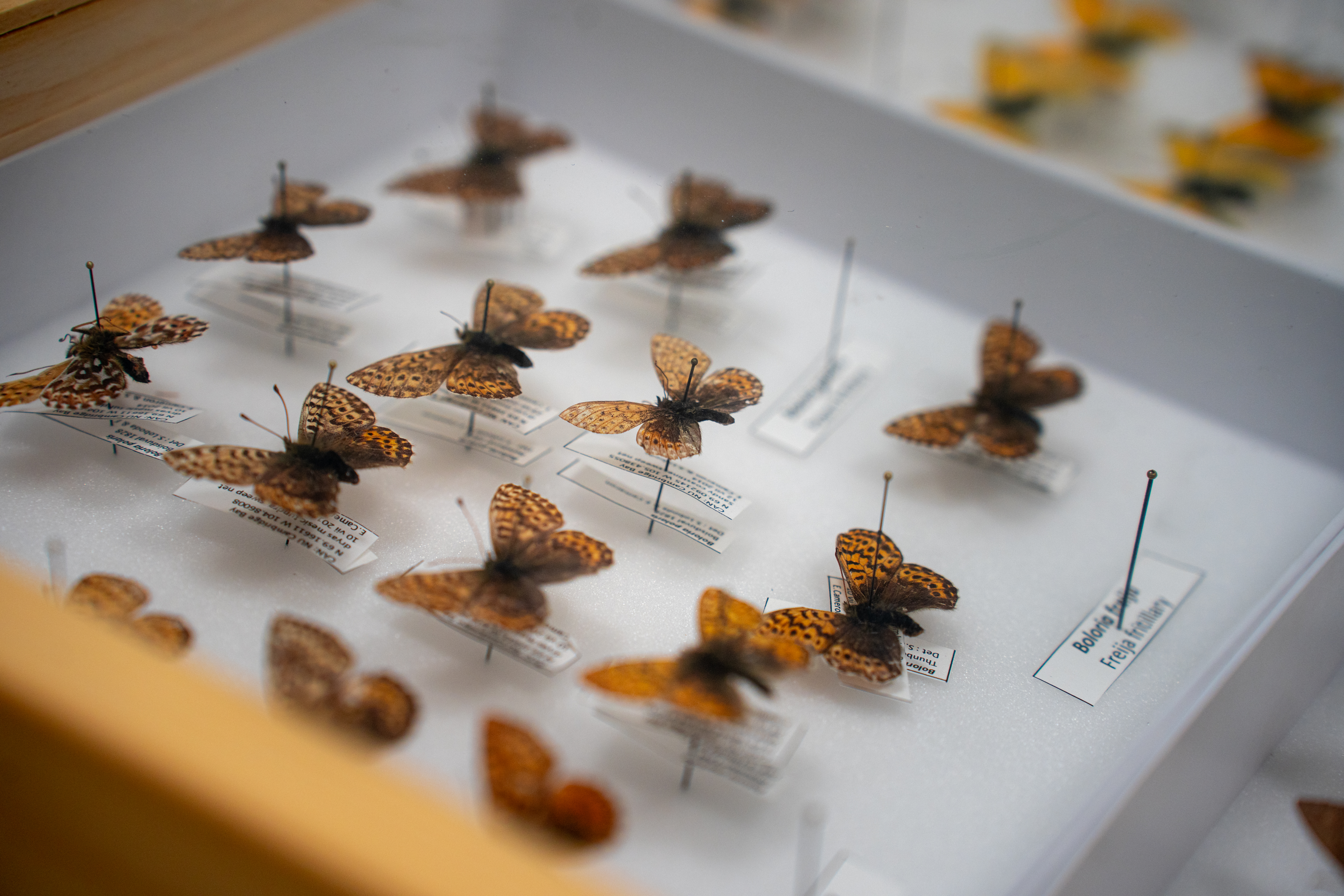
Boloria freija, the Freija fritillary butterfly inhabits bogs and tundra around the world, and is found in the Canadian Arctic, Northern Europe, Mongolia and Siberia.
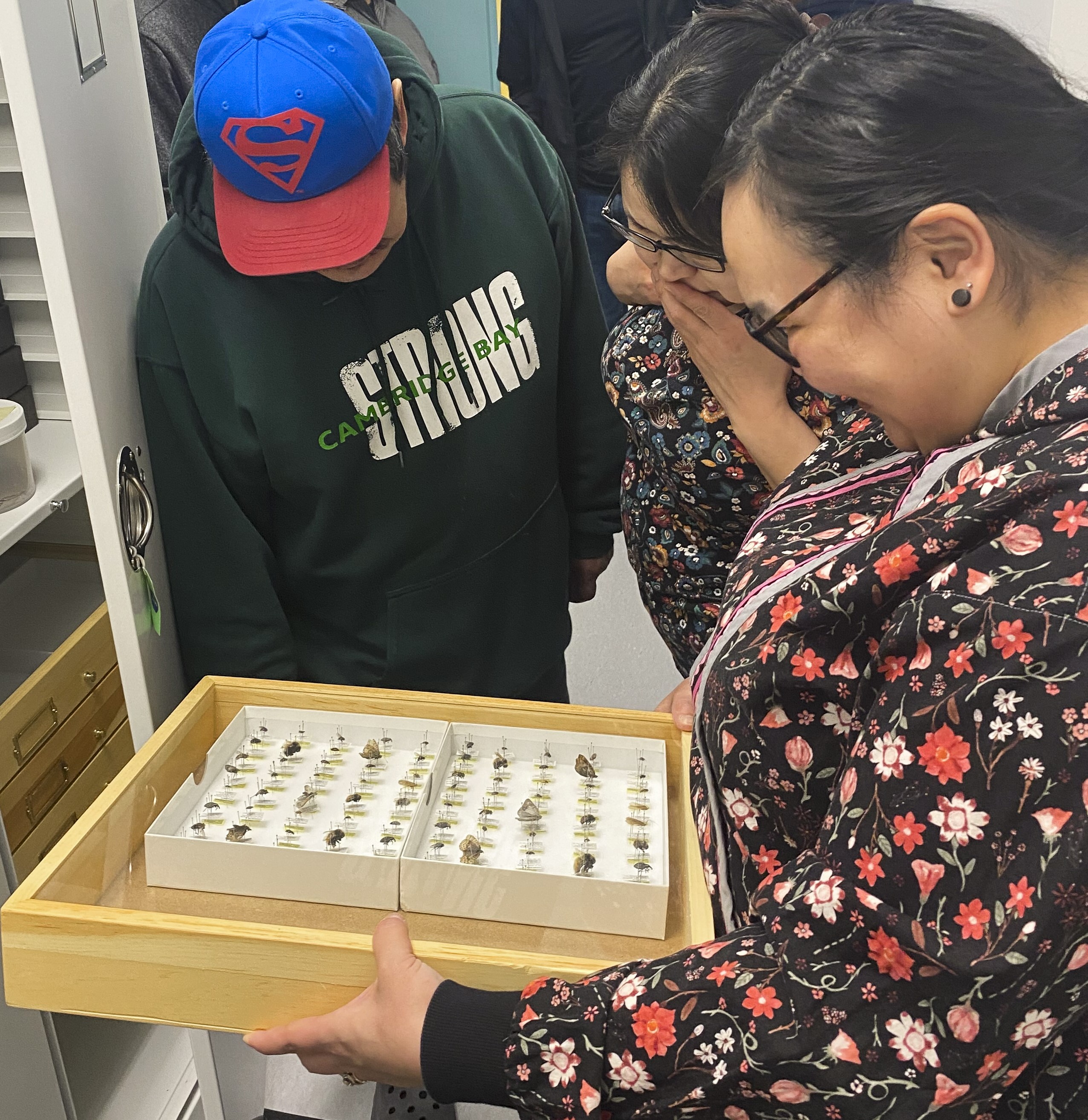
Visitors to CHARS look at the insect collection.
Seeking kelp in the Western Arctic
“Kelp are these charismatic, large, special brown seaweeds that create underwater forests. They're ecologically important because they’re a biodiversity hotspot,” says research scientist Amanda Savoie. “In the Canadian Arctic, we have really significant kelp forests.”
Amanda is a seaweed expert and head of botany at the Canadian Museum of Nature in Ottawa. The museum has an Arctic seaweed collection, dating back to the 1960s and 1970s, with some as old as the 1910s! Amanda was curious to investigate changes had taken place in the past 50 years due to climate change.
She is particularly interested in kelp and the important role it plays in the underwater ecosystem. Kelp provides a rich habitat for hundreds of marine life species, as well as sequestering carbon and producing oxygen. Yet, Amanda was unsure whether she would find kelp in the western Arctic Ocean.
More research has been conducted in the Eastern Arctic, especially in areas such as Frobisher Bay near Iqaluit, where dense forests of kelp up to 15-foot-tall are common. Frobisher Bay experiences strong currents and tides, unlike the waters around Victoria Island, which have minimal tidal movements.
“The Western Arctic is very different, as well, because there's not much rock. It's all soft sediment. That's not good for seaweed because there's nothing for them to attach to,” says Amanda. “If there are boulders or some rock, then there will be seaweed and benthic life.”
Amanda reached out to the local residents who are knowledgeable about the region’s wildlife. However, due to the area’s minimal tides, they didn't have much knowledge about the underwater plant life.
A local guide took Amanda and her research team to areas outside the bay known for currents. The team dropped a live-feed camera from the boat, which allowed them to observe the ocean floor in real time. Amanda was delighted when they found kelp and other seaweeds. The team noted the GPS coordinates where they were located, creating a map of the sea floor.
The team later returned to these areas to scuba dive and examine the kelp up close. Although the kelp grew up to 10 feet long, they noticed it did not stand upright like typical kelp forests; instead, it laid flat on the ocean floor.
Amanda believes that this is due to the lack of the strong currents in the region. She and her teammates are now analyzing the data they collected during their dives in Cambridge Bay to better understand how kelp and seaweed are thriving in the Western Arctic.
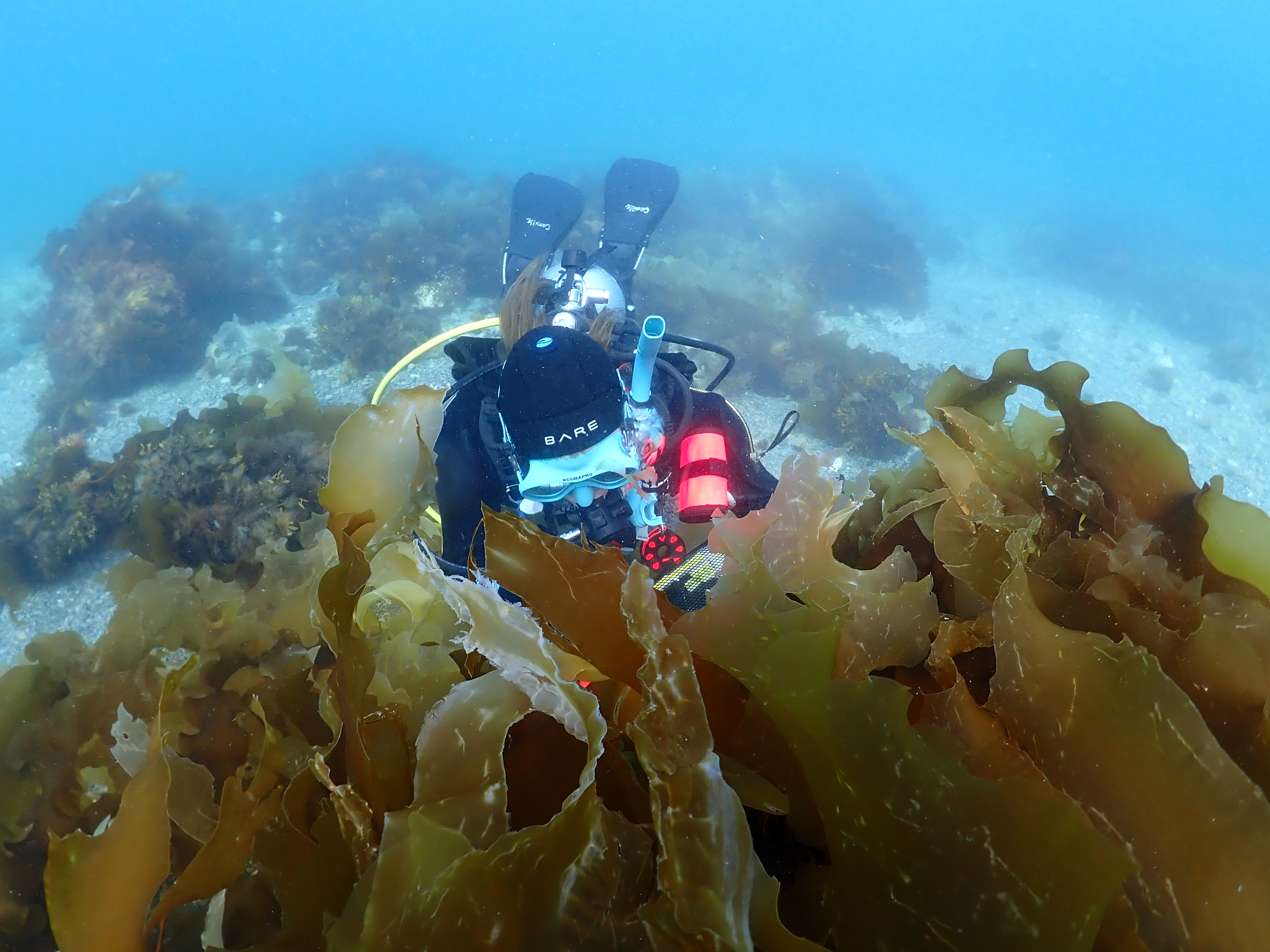
Amanda Savoie examines kelp growing on the ocean floor in Cambridge Bay.
Photo: Canadian Museum of Nature
X-raying snow
Studying snow to help predict climate change
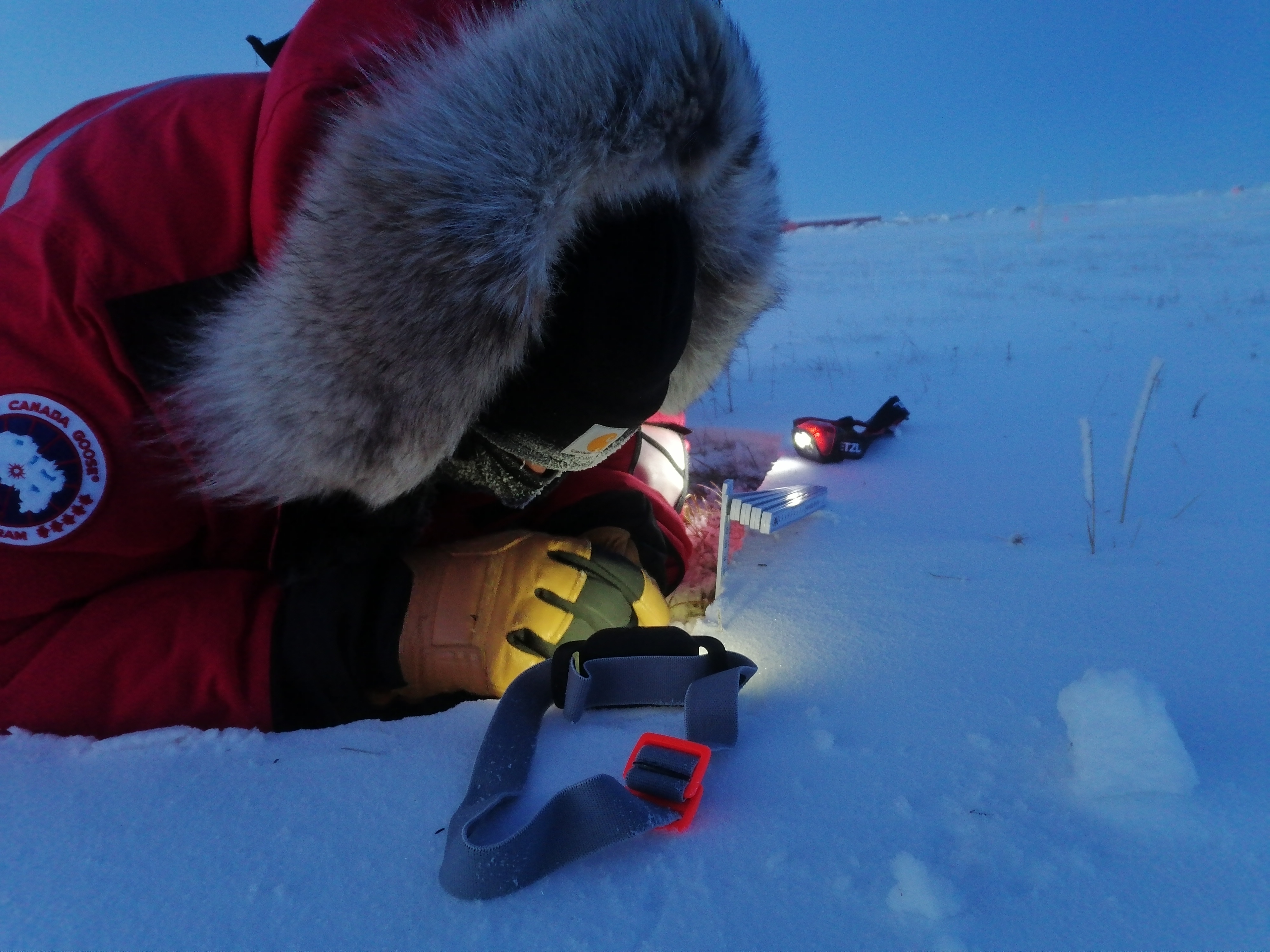
A researcher uses a magnifier to study the shape of the snow crystals using during the winter solstice.
photo: Kévin Fourteau
“Snow is very important for our climate. The white colour of snow reflects the sun’s rays back into the atmosphere and limits the warming of the Earth,” says Marie Dumont, snow scientist and researcher for the National Weather Service of France.
Marie works at a research station in the French Alps at an altitude of 1,300 metres. Since 1961, researchers at the station have been studying snow to collect data to help predict avalanches and forecast weather. However, they realized that snow at the poles has a far greater global impact than snow in the mountains.
“I would say the Arctic snowpack is something which is way more important for the Earth’s climate than alpine snow,” says Marie.
The importance of this really struck Marie the first time she flew to the Canadian High Arctic Research Station in 2022. The snow scientist stared in awe at the vastness of the snow beneath her. She was astounded and moved by the immense, white Arctic landscape.
“Snow is important because it's white. It's reflecting the solar light and so when you have snow over a very large area, it's super important, and it's balancing the climate.”
Marie notes that Arctic snow has been less studied compared to alpine snow; so its characteristics are less understood.
Snow structure
Studying snow involves analyzing the structure of the fallen snow. The French researchers achieved this through computed tomography, or CT scans. Hospitals use CT scanners to create detailed three-dimensional images of the body. The same technique is applied to scanning snow. The CT scanner produces high-resolution 3-D images of snow crystals. This reveals its physical properties and helps researchers understand how snow forms on the ground.
For them, bringing this technology to the Arctic was essential to studying polar snow.
“Our goal was to follow the evolution, at very high resolution, of the Arctic snowpack during one full season. So, from the snow onset to the complete melting of the snowpack,” says Marie.
The full season spans from October to May, which presented a few challenges. The researchers needed a place to live for eight months, and the massive, one-tonne CT scanner required storage in a cold room with a temperature between -10 and -20 degrees Celsius. Marie learned that CHARS in Cambridge Bay, in western Nunavut, could accommodate all their project needs.
“There aren’t many places that they can send a tomograph, have a place to put a weather station, and have all the amenities around. That, and the fact that CHARS is staffed year-round, were big advantages for them,” says Nicolas Nantel-Fortier, Laboratory Manager at CHARS.
The CT scanner, which uses an X-ray source, needed to meet safety and legal requirements before it could be shipped from France to Canada. Once the paperwork was completed, the tomography machine travelled by airplane to the Canadian Arctic in July 2023.
The scanner was installed in CHARS’ walk-in freezer. Since Marie’s team couldn’t be there, they connected via video conference to guide their colleagues from Université de Sherbrooke in setting up the machine. By the time the researchers arrived in October 2024, everything was ready to go.
Over the next eight months, pairs of researchers (15 people in total) worked at CHARS in six-week shifts that overlapped by two weeks. This allowed each pair to train with the team already on site in Cambridge Bay. One of the PhD students, Kévin Fournier, carried out research from December 15, 2023, to the end of January 2024.
Kévin explains that they took snow measurements one day and performed a CT scan of the snow the next. They recorded the snowpack’s temperature and weighed it to determine its density, which indicated how much ice was in the snow.
Snow has a microstructure that is a 3-D arrangement of air and ice. This structure affects its properties, such as how stable it is, how well it insulates the ground beneath, and how much water there is when it melts.
”Something that is quite important for us, in terms of the snow property, is the size of the crystal,” says Kévin. “The traditional way you do that is simply with a magnifying glass and look at the size.“
This method is not very precise, so the researchers in the field used a small portable machine that shines a light in the snow. From its reflective properties, the team could determine the size of the crystals.
Layers of Snow
Every second day, the team collected a core sample by inserting 20 cm-long plexiglass tubes vertically into the snow. These cores were then scanned with athe tomography machine.
“They were doing the same kind of measurement in the Alps. But then they had to move the cores a bit further to be scanned. The further you go with the cores, the more chances you have of destroying the structure of the snow,” says Nicolas. “When they were working outside here, they had about a minute walk from their sampling site to the inside of our freezer.”
Marie explains that the Arctic snowpack consists of two layers of snow.
“The top one is a very hard snow: small grains, very dense. So, it is wind-compacted snow,” says Marie. “The bottom part is something which is more fragile, less dense. The grains in the top layers are a bit rounded, but in the bottom part, it’s super airy and the crystals are kind of square and way bigger.”
Kévin notes how fragile the bottom layer is. It breaks apart when you touch it.
“It’s the type of avalanche snow that you can have in the mountains,” he says. “In CHARS, it’s not a problem because it’s a flat plain.”
During her stay in Cambridge Bay, Marie witnessed how crucial snow is to the community, impacting many aspects of their lives, such as hunting, transportation, water, and infrastructure.
“It changed a bit how I see what I’m doing, because there are people involved,” says Marie. “Their relation to snow and to the landscape is also very different from what we have here [in the Alps]. This is very enlightening and super moving.”
Over the course of the winter, the team recorded the full evolution of snow from first snowfall to its melt. They conducted 2,000 CT scans, which added up to a total of 37 metres, or about 121 feet, of snow.
Their research will contribute to a more accurate model to simulate how the snowpack evolves in response to climate change. Marie notes this model could provide northern communities with valuable insights to help them adapt to an evolving climate.
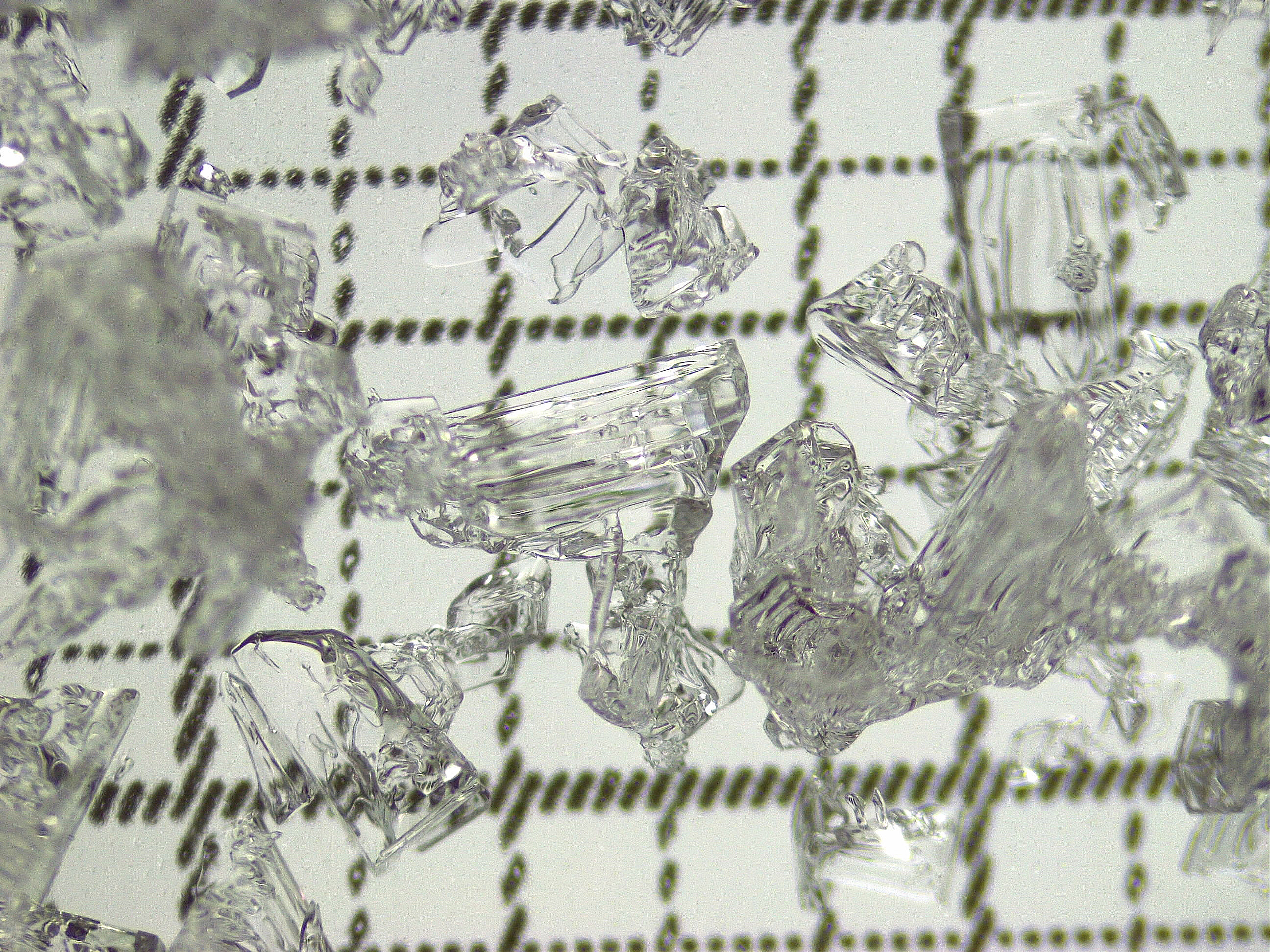
A binocular X-ray photograph of snow crystals. credit: Pascal Hagenmuller.

The Team took daily measurement of the Arctic snowpack.
photo: Kévin Fourteau
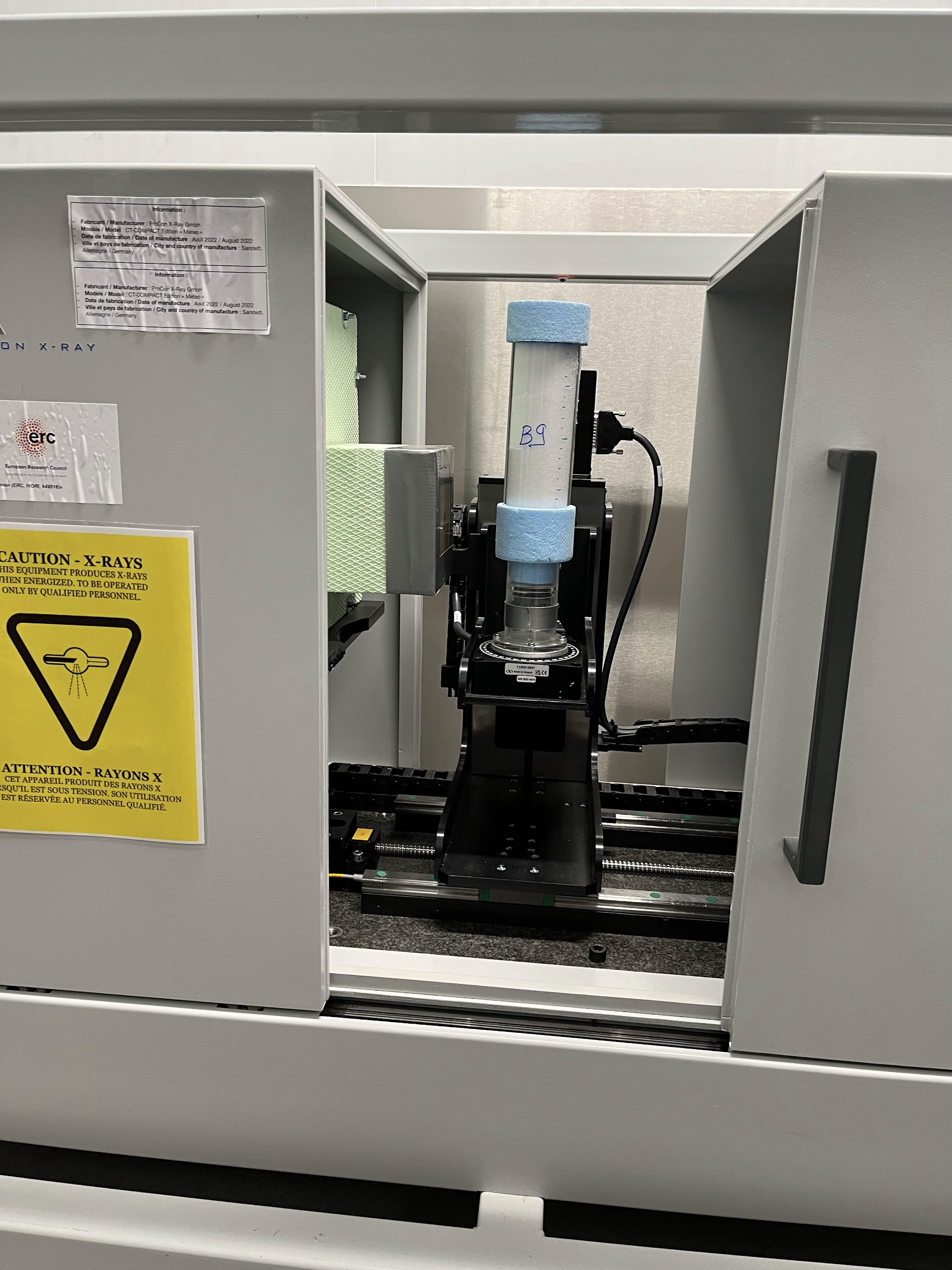
A snow sample in the X-ray scanner in Cambridge Bay.
photo: Pascal Hagenmuller
Importance of snow

“People would really pay attention to the quality of the snow before they went on the land,” says Emily Angulalik, Executive Director at the Kitikmeot Heritage Society in Cambridge Bay. The retired schoolteacher has been interviewing Elders to learn more about their knowledge of snow.
“The Elders often share their stories about how important the snow would be for them in terms of travelling, in terms of making snow block iglus, and in terms of hunting. So, the type of snow is quite important,” Emily says.
For example, snow used to build igloos comes from hard-packed apittaaq, or snowdrifts, which is denser and thicker than any other snow. Snow in the late spring, called mahaqtiqtuq is slushier, and not ideal for travel.
Elders have noticed changes in the snow.
“They find that because of climate change, the snow is much wetter damp, [and] moist, which makes it difficult to travel,” says Emily. “It really affects people, like hunters.”
She has also noticed changes in snow. Over the years, Emily and her students have looked at snow under microscopes.
“I find the snowflake today is a lot fluffier than it was back then. The snow today is a lot different.”
Since snow plays such a crucial role in the lives of Northerners’ there are specific words to describe the type, quality, and density of snow at different times of the year: fall, winter, and spring. Recently, an Inuinnaqtun dictionary app was launched to share Inuinnaqtun words. This includes the many different terms for snow, such as aqilluqqaq—fresh soft snow and auviq—snow block. This is one way to preserve snow-related words in an accessible format, especially for young people with cell phones.
Emily highlights how important it is to pass down Elders’ experience and knowledge of living off the land to the younger generation. “So, they can understand and know the dangers of the types of snow.”
Antarctica
Our southern polar work
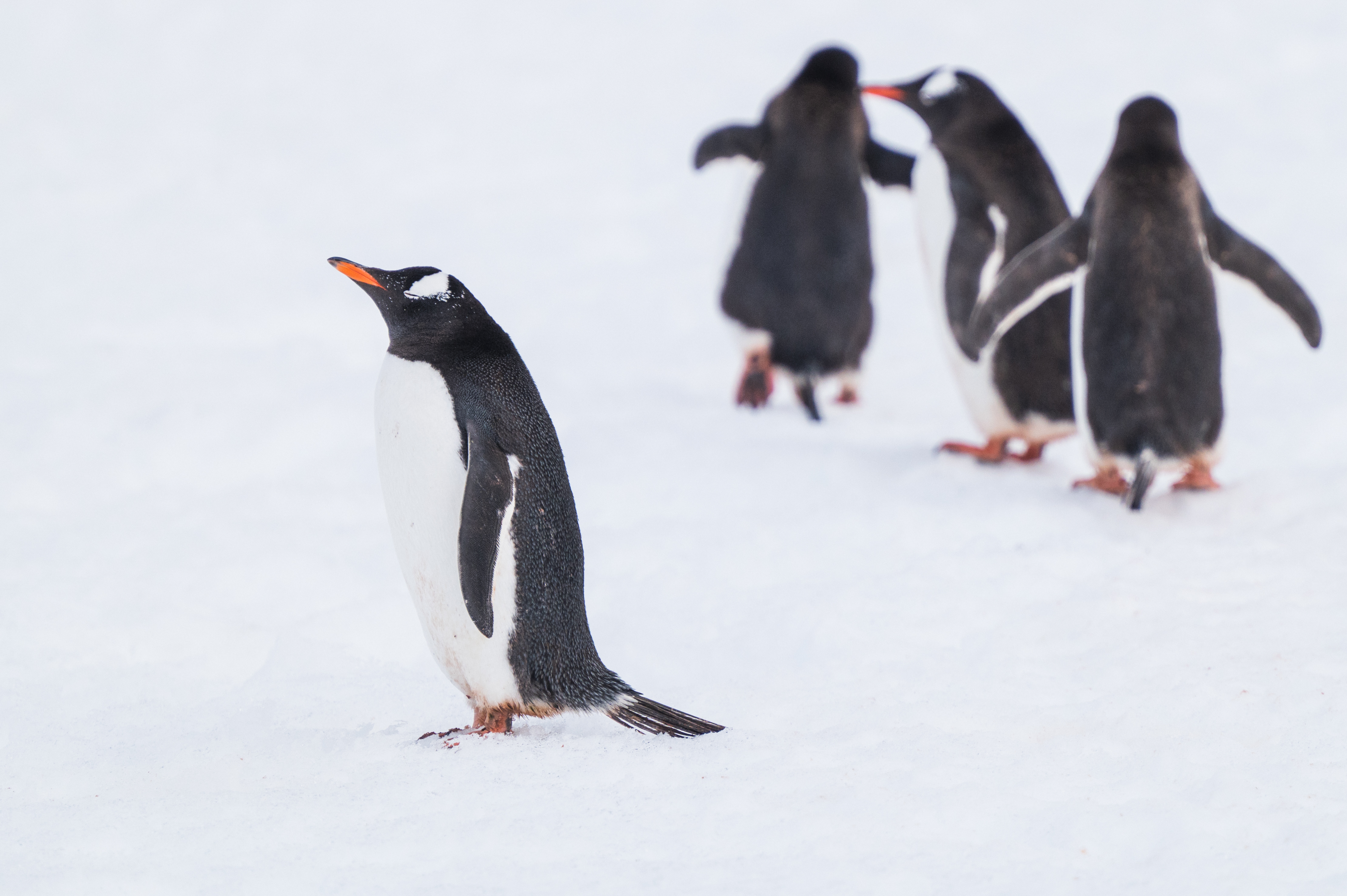
Antarctica's iconic gentoo penguins taking a stroll.
Polar Knowledge Canada’s name reflects the Agency’s commitment to advancing scientific research in both the Arctic and Antarctic regions. The term ‘polar’ captures the full scope of polar science, emphasizing the global importance of both poles in understanding climate change, ecosystems, and the Earth's natural systems. This name captures Canada's vital role as a key player in polar research, fostering scientific collaboration and addressing the unique challenges opposed by both the Arctic and Antarctic environments.
The Antarctic is a significant region that regulates global climate and ocean systems and is important for Canada and the world. Antarctic research can improve our understanding of a range of scientific areas, including Earth and biological systems, the weather, space, and the universe. It provides excellent conditions for understanding adaptations of plants, animals, and humans to extreme environments.
Our research and expertise as an Arctic nation enable us to provide key insights and experience in logistics, transportation, preparedness, and the regulation of environmentally sustainable tourism in both polar regions.
POLAR represents Canada on the Scientific Committee on Antarctic Research, the international body that provides scientific advice to the Antarctic Treaty nations. Additionally, the Canadian Committee on Antarctic Research was formed by Polar Knowledge Canada and advises the federal government on Canadian Antarctic science. POLAR is also Canada’s member organization on the Council of Managers of National Antarctic Programs.
Antarctic expedition 2025
POLAR supported the Canadian Antarctic Research expedition, a multidisciplinary expedition to Antarctica from February 23 to March 23, 2025.
Fifteen scientists from Natural Resources Canada, Environment and Climate Change Canada, Fisheries and Oceans Canada, the Marine Environmental Observation, Prediction and Response Network, and five universities boarded the Royal Canadian Navy’s vessel, HMCS Margaret Brooke, in Punta Arenas, Chile. The expedition then headed to the South Shetland Islands, a southern counterpart to the Canadian Arctic Archipelago, known for their harsh polar environment and similar geological features.
A range of scientific activities was planned for the mission. It had two main parts: an at-sea component, focused on oceanography and contaminants, and a coastal component, focused on three major bays of the South Shetland Islands, where the researchers carried out marine and terrestrial geology, coastal oceanography, and work on contaminants.
The Marine Environmental Observation, Prediction and Response Network assisted the mission by providing mobile oceanographic laboratories, designed specifically for use on ships, like HMCS Margaret Brooke.
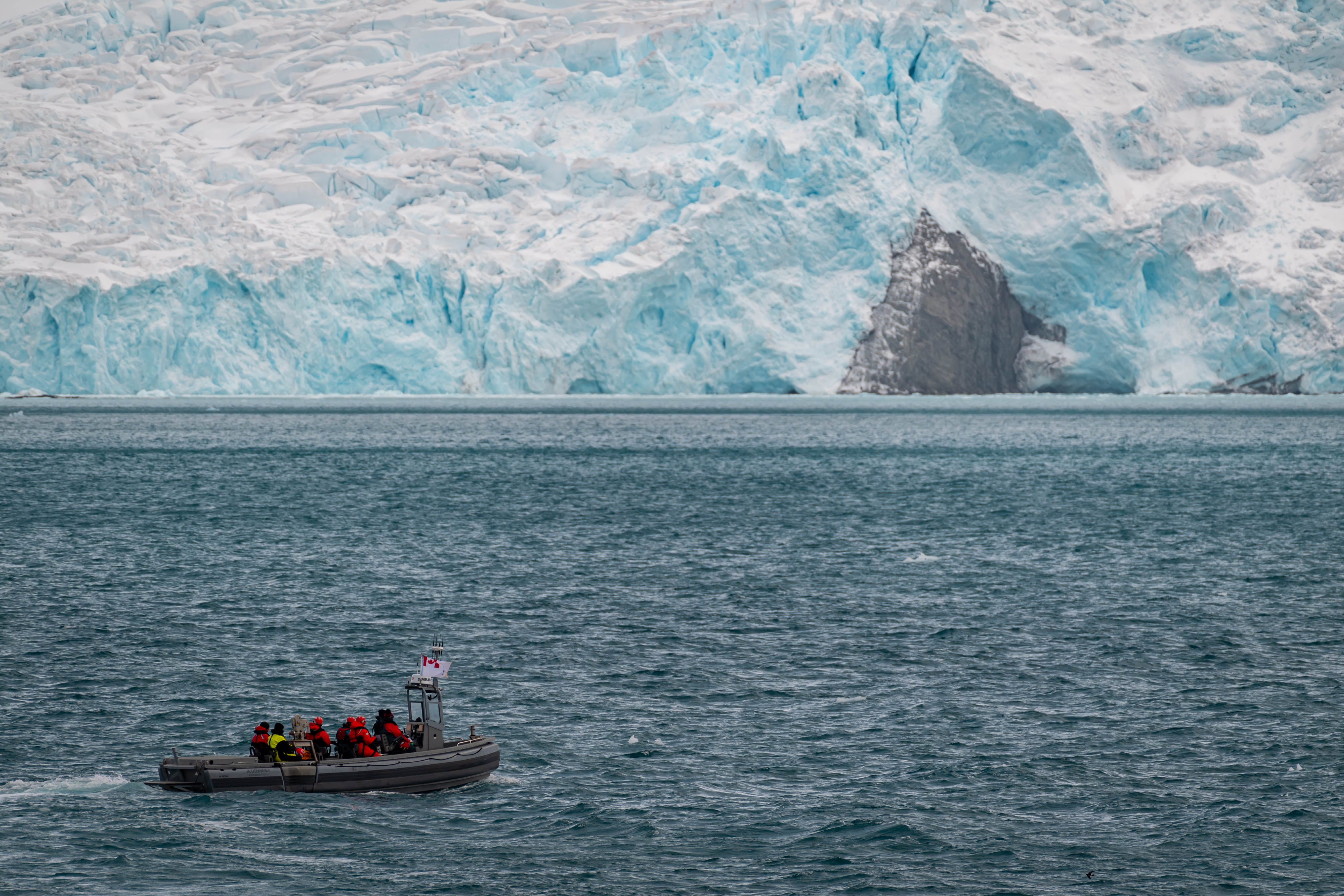
Members of the 2025 Antarctic expedition travel alongside a glacier in Antarctica.
Photos: Cpl. Connor Bennett
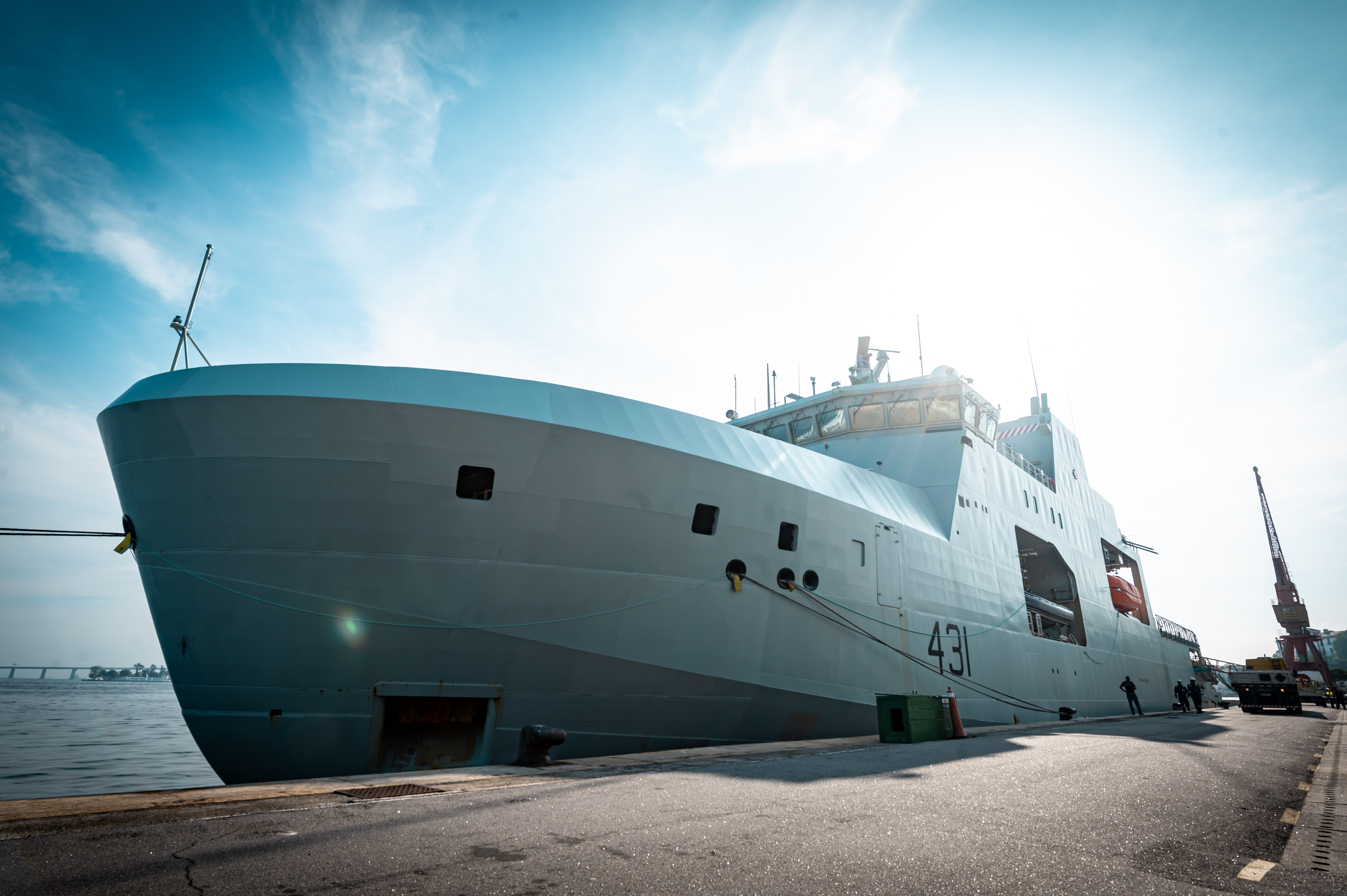
HMCS Margaret Brooke heading south to Punta Arenas where the researchers boarded.
Not polar opposites
Similarities and differences in Arctic and Antarctic research
Ian Hogg, PhD
Biologist
POLAR Research Scientist
Expertise: Terrestrial ecology and marine biology
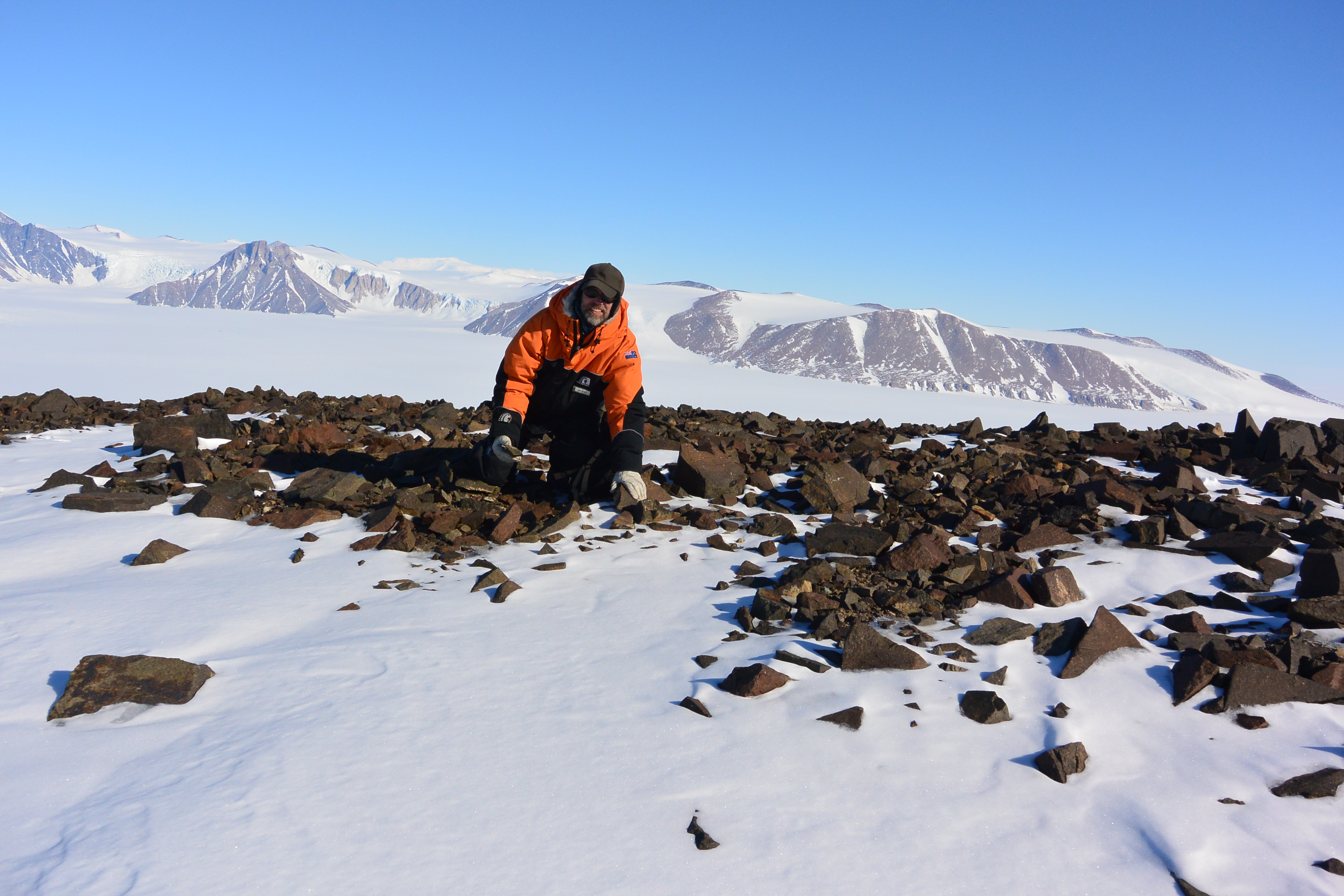
Ian Hogg, PhD, near the Shackleton Glacier in Antarctica at 85° S.
Photo: Byron Adams
Ian Hogg joined Polar Knowledge Canada in 2017 as a Senior Research Scientist and team lead for POLAR’s Arctic Ecosystem and Cryosphere Research Unit. A big part of his research focuses on Antarctica. There are similarities between the Antarctic and the Arctic that are important to understand for research in both polar regions.
“The Arctic and Antarctic are connected by the atmosphere, and there are things happening in the Arctic that influence the Antarctic, and vice versa,“ says Ian, noting that both have similar environmental conditions. “And there are biological processes that are similar in both. Life in these environments deals with quite extreme conditions.”
The regions have their obvious differences, though. The Arctic is an ocean surrounded by land, while the Antarctic is land surrounded by ocean. The landmass in Antarctica is 99% covered by huge ice sheets and has never supported a permanent human population. The Arctic, however, partially melts every year and has been home to people for thousands of years.
“Life on the Antarctic continent is quite simple, with the largest year-round land animals being small, insect-like Collembola (springtails) and mites, which are all less than one millimetre. Well-known penguins and seals are marine animals and visit the land only in summer,” says Ian. “This contrasts with the Arctic, which has quite a complex terrestrial environment that includes year-round apex predators, such as wolves and polar bears.”
Ian notes that both similarities and differences between the polar regions make them biologically interesting. Studying them will improve our understanding of global ecological processes.
“The big issue is the change occurring in these areas,” he says. “Temperatures and precipitation patterns in the polar regions are rapidly changing, particularly in the Arctic. Understanding how Earth’s ecosystems are responding to these changes is critical.”
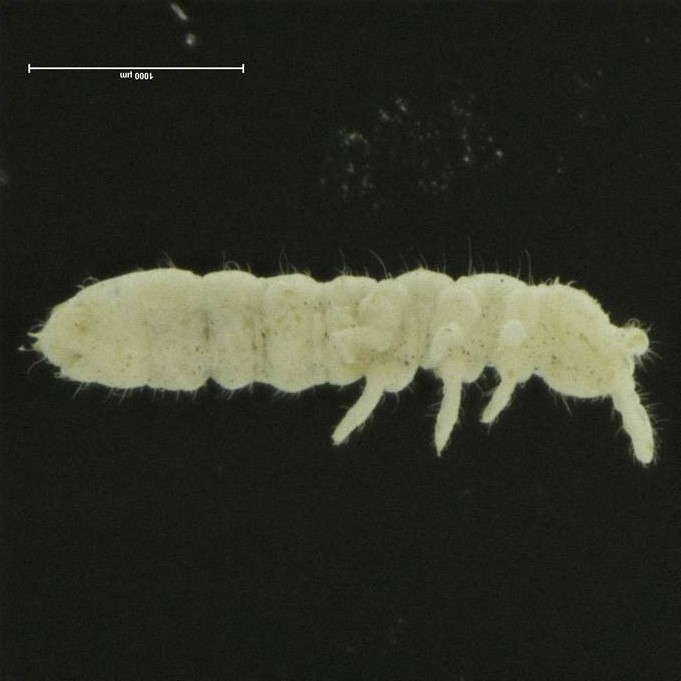
The invertebrate Collembola species that Ian and his colleagues are using in genetic analyses to reconstruct past landscapes and climates of Antarctica.
Photo: Gemma Collins
They’re alive! —Microbes in glacial ice
Brady O’Connor, PhD
McGill University
Microbiology
POLAR Antarctic Scholarship Recipient
“Historically, people would see a glacier and they’d just think, nothing lives there. There’s nothing going on there,” says Brady O’Connor, former PhD student at McGill University.
Brady says that to the naked eye, it seems that nothing is living in the ice. That’s because what researchers discovered in polar glaciers is so small, you need a microscope to see it—microbes.
“What I’m really interested in is are they alive?” he says. “If I go a metre into the top of an ice cap, will I find living microbes there?”
Brady took metre-long ice cores from White Glacier on Axel Heiberg Island in northeastern Nunavut, and from Johnsons Glacier on Livingston Island in Antarctica. What he found was that there were living microbes in both glaciers, but they were different. However, the microbes shared many similarities in how they functioned. This suggests that they may have common survival strategies for living in ice.
Understanding these microbes is important because, with global warming and climate change, the polar glaciers and ice sheets are melting. This means that these microbes will be flushed into other environments. Studying them will help us understand how they may affect their new habitats.
“We keep finding that the limits of microbial life are much greater than what we ever imagined,” says Brady. “Almost everywhere we’ve ever gone, no matter how extreme the environment, we still find living microbes there. And that now includes the middle of a glacier in pure ice in Antarctica.”
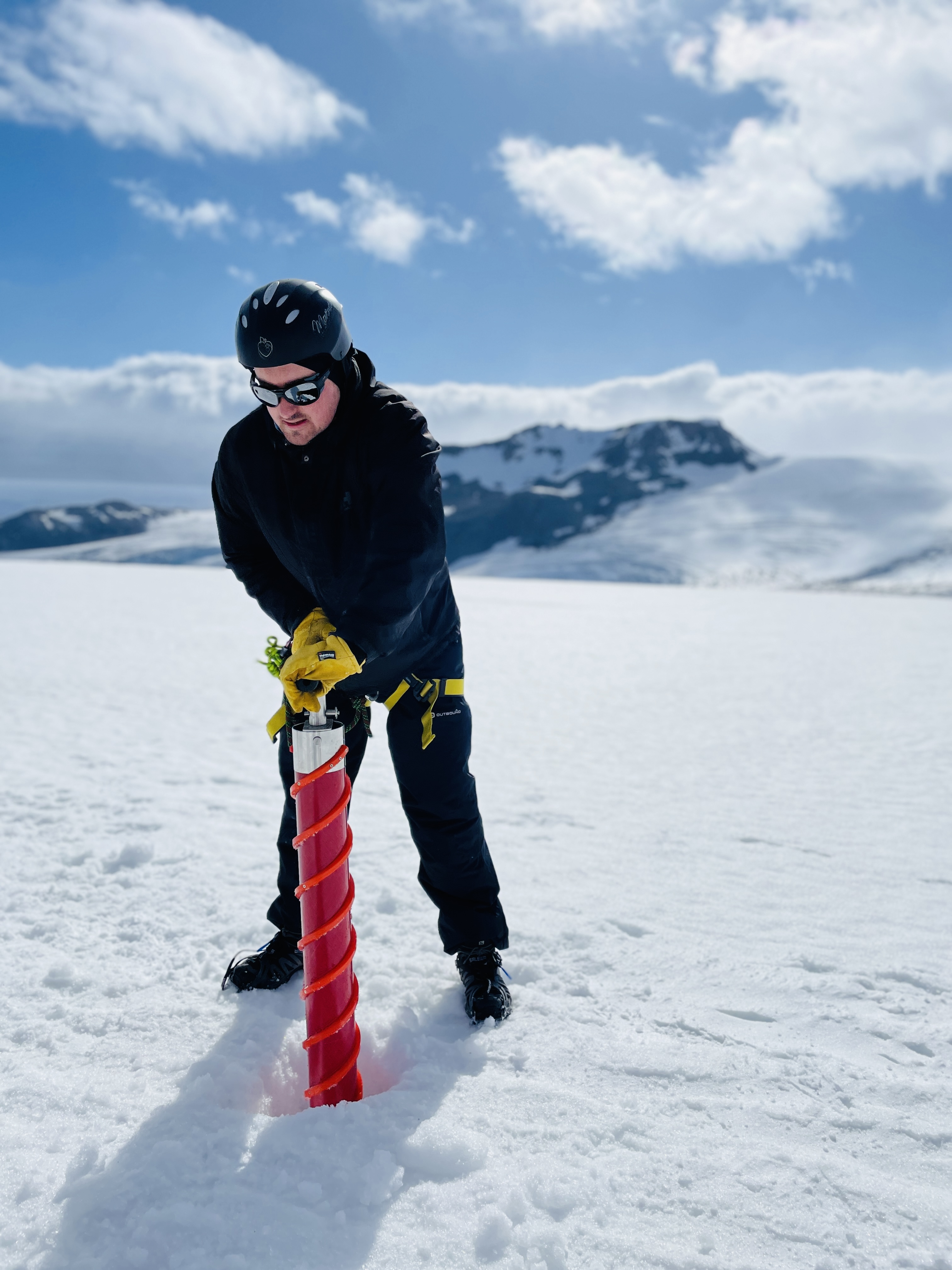
BradyOConnor removes an ice core from Johnsons Glacier in Antarctica to study the microbes in its ice.
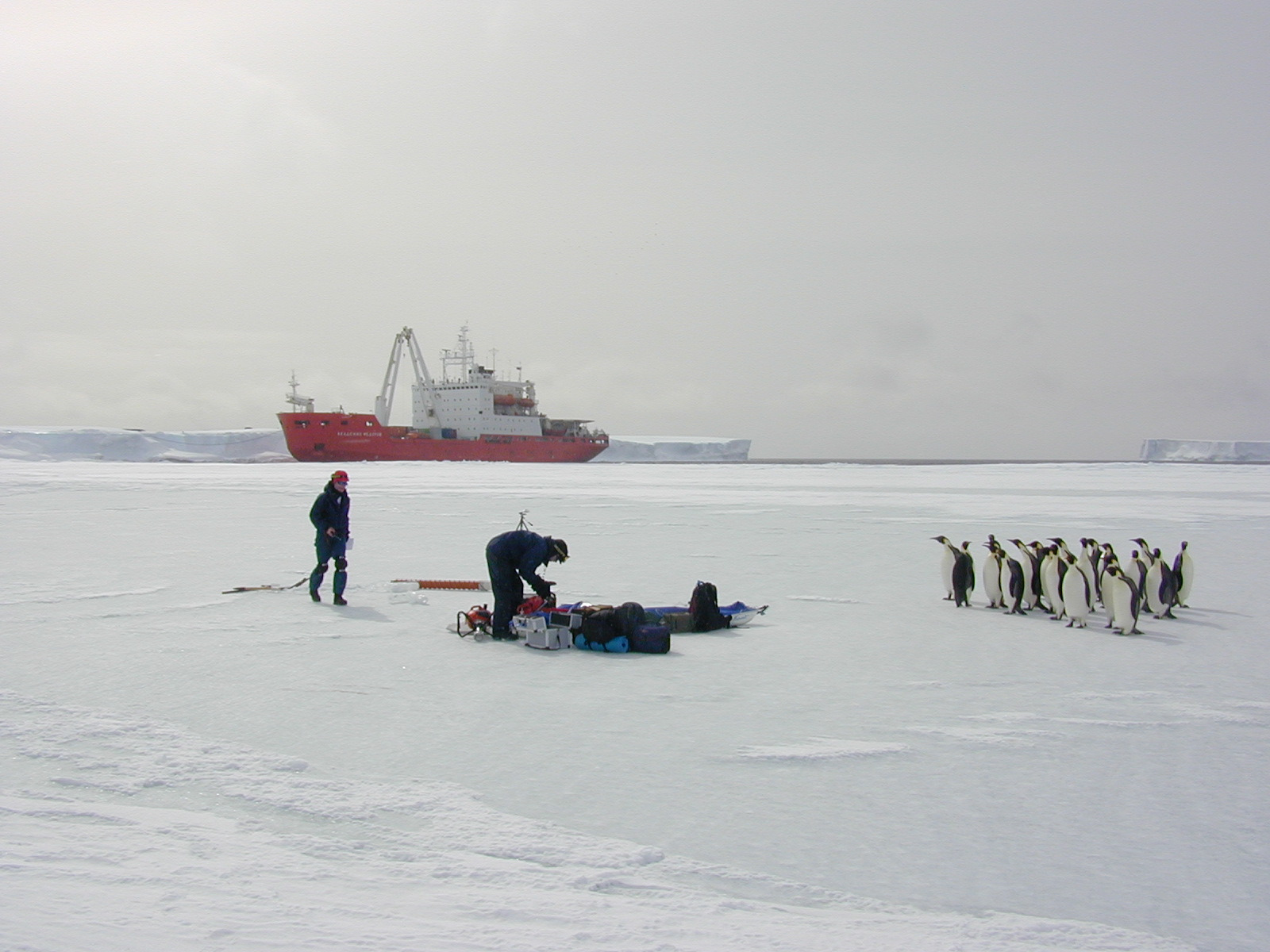
Canadians (and penguins) have been part of Antarctic research for more than a century.
Into the woods: studying changing muskox habits
Christine Dunbar, MSc Student
Wilfrid Laurier University
POLAR Northern Resident Scholarship Recipient
In recent years, muskox have moved into the forests of Thaidene Nëné Indigenous Protected Area in the Northwest Territories. Interestingly, muskox had not wandered into these forests for 100 years.
Christine Dunbar, a Master of Integrative Biology student at Wilfrid Laurier University, is investigating the reason behind their return.
“The late 19th century was the last time they were seen there,” Christine says. She adds that overhunting nearly wiped them out in in Canada. “When the population began to grow again, they were more on the tundra.”
In 2021, 307 camera traps were set up throughout the 26,000-square-kilometre protected area to take pictures of the wildlife roaming there. In one year, millions of photographs captured caribou, wolves, bears, birds—and muskox. Christine is studying the muskox photos to determine whether their move into the forests is driven by a search for food or an effort to avoid predators like gray wolves and grizzly bears.
However, the Yellowknife native has another theory. She thinks the muskox might be “thermoregulating,” or trying to maintain their body temperature.
“It's getting so hot in the North,” Christine says. She notes that recent summer temperatures in the tundra have reached 30 degrees Celsius. Muskox wool, called qiviut in Inuktitut, is very thick and eight times warmer than sheep’s wool.
Christine suggests that the cooler, shaded forests could be providing a respite from the heat of the tundra. She points out that moose in Minnesota have been observed seeking cooler forest environments to escape the heat and suggests that muskox in Thaidene Nëné might be doing the same.
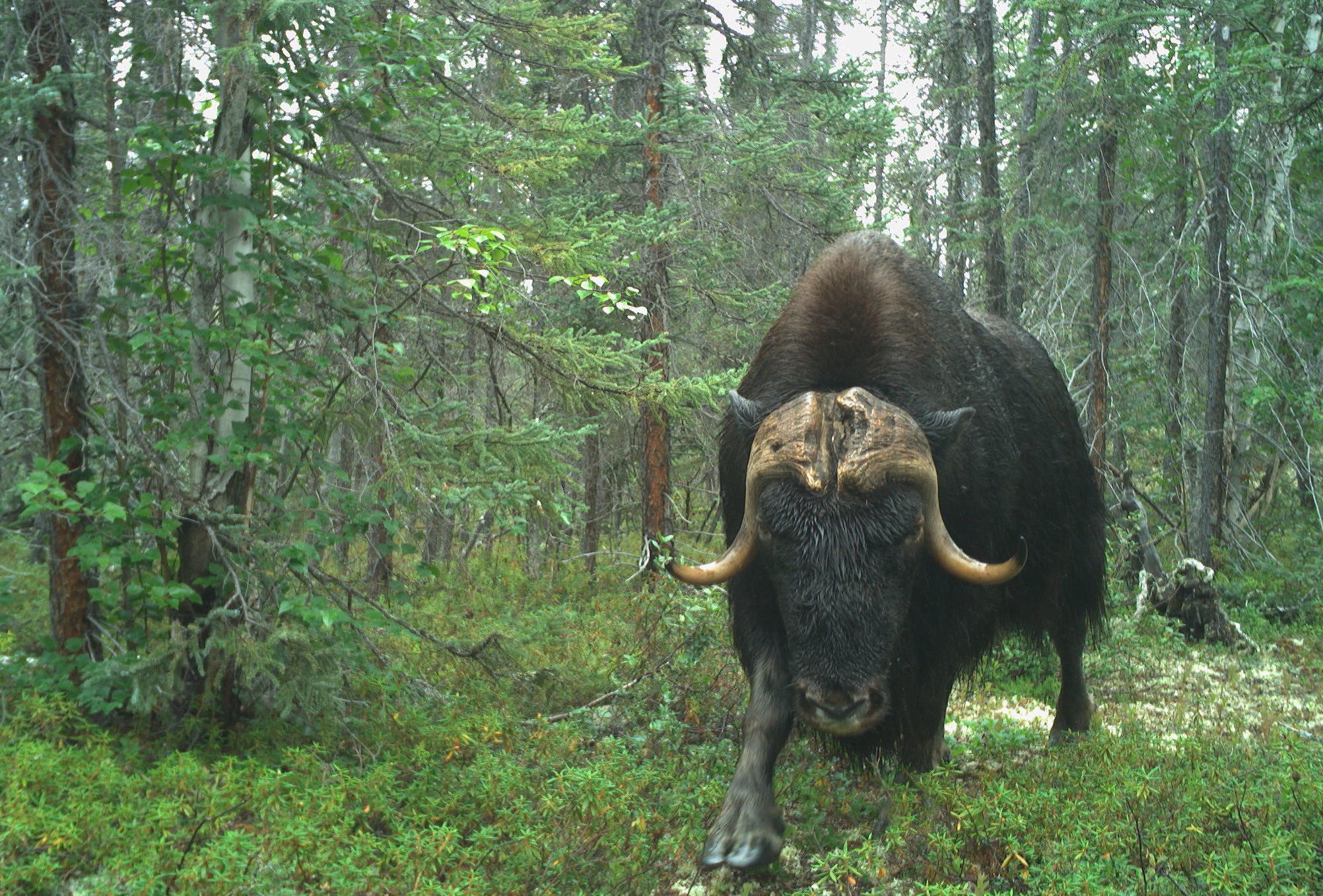
A trail camera captures a muskox in a forest of Thaidene Nëné Indigenous Protected Area.
Photo: Łutsel K’e Dene First Nation, Parks Canada, Government of the Northwest Territories
Country food
Amy Caughey, PhD
Registered dietitian
Research Associate at Nunavut Research Institute,
Research Associate and Adjunct Professor at University of Alberta’s School of Public Health,
POLAR Fellowship recipient
“One Health generally refers to the relationship between animals, humans, and the environment, and the health of all of these.” says Amy Caughey, whose research focuses on the human side. “These relationships are critical in Nunavut, where locally harvested country food is central to food security.”
Amy, based in Iqaluit, is concerned with food security and public health in Nunavut. Her research focuses on country food and its role in supporting food security. Country food comes from the land, sea, and sky, includes birds, fish, marine and land mammals, berries, and plants. It is vital to nutrition, to health, well-being, community life, and Inuit culture.
Amy notes that her research she is guided by Inuit women and other Knowledge Holders. One of these Knowledge Holders is Igah Sanguya from Clyde River, who works as a research associate on the project.
"Country food is our medicine. It is also our soul food,” says Igah.
Igah and Amy work closely with communities in the Qikiqtani (Baffin) region to share knowledge of country food preparation, preservation, and safety. This includes how to age, dry, and cook country food. They also discuss how country food supports healing and overall well-being.
Country food is highly nutritious, providing vitamins A, D, and C; iron; protein; calcium; and healthy fats— and is key to keeping people healthy.
“Community health representatives and other Inuit Knowledge Holders have clearly communicated that country food is fundamental to food security and food sovereignty,” Amy says. “It is crucial for boosting the immune system and preventing chronic disease and promoting good health.”

Amy Caughey and Igah Sanguya cooking seal meat on the land north of Clyde River, Nunavut.
Photo: Shondra Stadnyk, Niqivut Silalu Asijjipalliajuq Research Program
Gnawing away at a new problem: Beavers moving into tundra north of Inuvik

A beaver dam in Trail Valley Creek.
Photo: Dilshan Kariyawasam, CINUK project ‘BARIN’

The Laurier Trail Valley Creek Research Station, located 50 kilometres north of Inuvik, NWT, is home to one of the longest running researched watersheds in the Canadian Arctic.
“We never planned it as a 30-plus-year research site. It just sort of happened over time,” says hydrologist Philip Marsh, professor at Wilfrid Laurier University and Canada Research Chair in Cold Regions Hydrology.
A watershed is an area where all precipitation or snowmelt flows through a lake or river and its tributaries, into a downstream body of water, such as lake, sea, or ocean. In this case, the Trail Valley watershed drains eastward, crosses the Inuvik Tuktoyaktuk Highway and flows into the Husky Lakes.
In 1991, the 60-square-kilometre watershed was chosen as an ideal location to study hydrology—the movement of water—in the tundra ecosystem north of the tree line. Over the past three decades, research expanded beyond hydrology to encompass the full Arctic watershed ecosystem. This includes exploring changes in climate, snow, streamflow, vegetation, thawing permafrost, greenhouse gases, and... an invasion of beavers.
Canada’s largest rodent typically inhabits forested areas. However, until 2007, researchers did not see any beavers living near Trail Valley, located at the latitude of 68°N.
“There aren’t even trees in the vicinity of our research station,” says Alex Fogal, the research associate who coordinates the field research projects at the Trail Valley site. “There are no trees; they're building dams with shrubs.”
The lack of trees hasn’t stopped the beavers from moving in. As Alex explains, the beavers are resourceful in building their dams and lodges out of alder shrubs and dwarf birch, which are plentiful in the region. These shrubs were part of the landscape in the 1990s, long before the beavers appeared.
“Beavers are a big deal,” Phil says. “There's great concern about what beavers are going to do to this landscape, to the lakes, to the fish habitat, et cetera.”
Beavers are the focus of a large project by the Canada-Inuit Nunangat-United Kingdom (CINUK) Arctic Research Programme. The project is a partnership with the Inuvialuit Joint Secretariat and the Fisheries Joint Management Committee. The CINUK project aims to understand the number of beavers in the area and how they are impacting the lakes, ecology, hydrology, and permafrost.
“The changes in winter snow cover on lakes change the thickness of the lake ice. More water beneath the lake ice means the beaver habitat in the lakes might be better, but we don't really know,” says Phil.
Alex suggests that predators may have pushed the beavers into habitat farther north. “It's now warm enough that they can survive where they couldn't before.”
“Again, we really do not know yet,” adds Phil.
With three decades of data from Trail Valley, researchers can model and predict the impacts of climate change on the area. Phil says this helps provide insight into “what's happened over the last 30 years and what's going to happen in the next 50 to 100 years.”
However, no one anticipated the arrival of beavers
Beavers are just one of the numerous changes in the Arctic tundra that researchers at Trail Valley Creek are studying. Phil emphasizes that with a 34-year history, the site provides a unique Arctic record that is used by researchers in Canada and around the world.
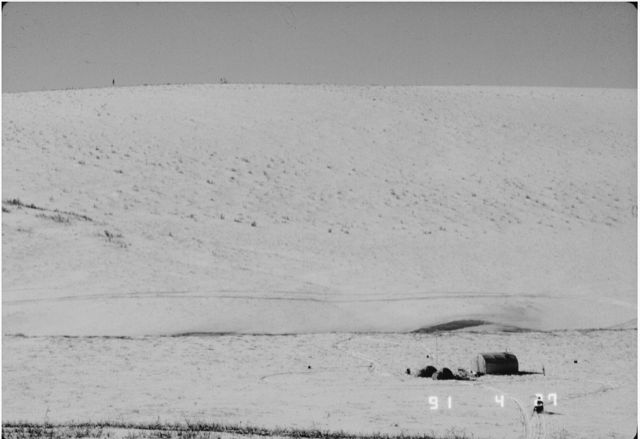
The first research camp set up at Trail Valley in 1991.
Photo: Philip Marsh
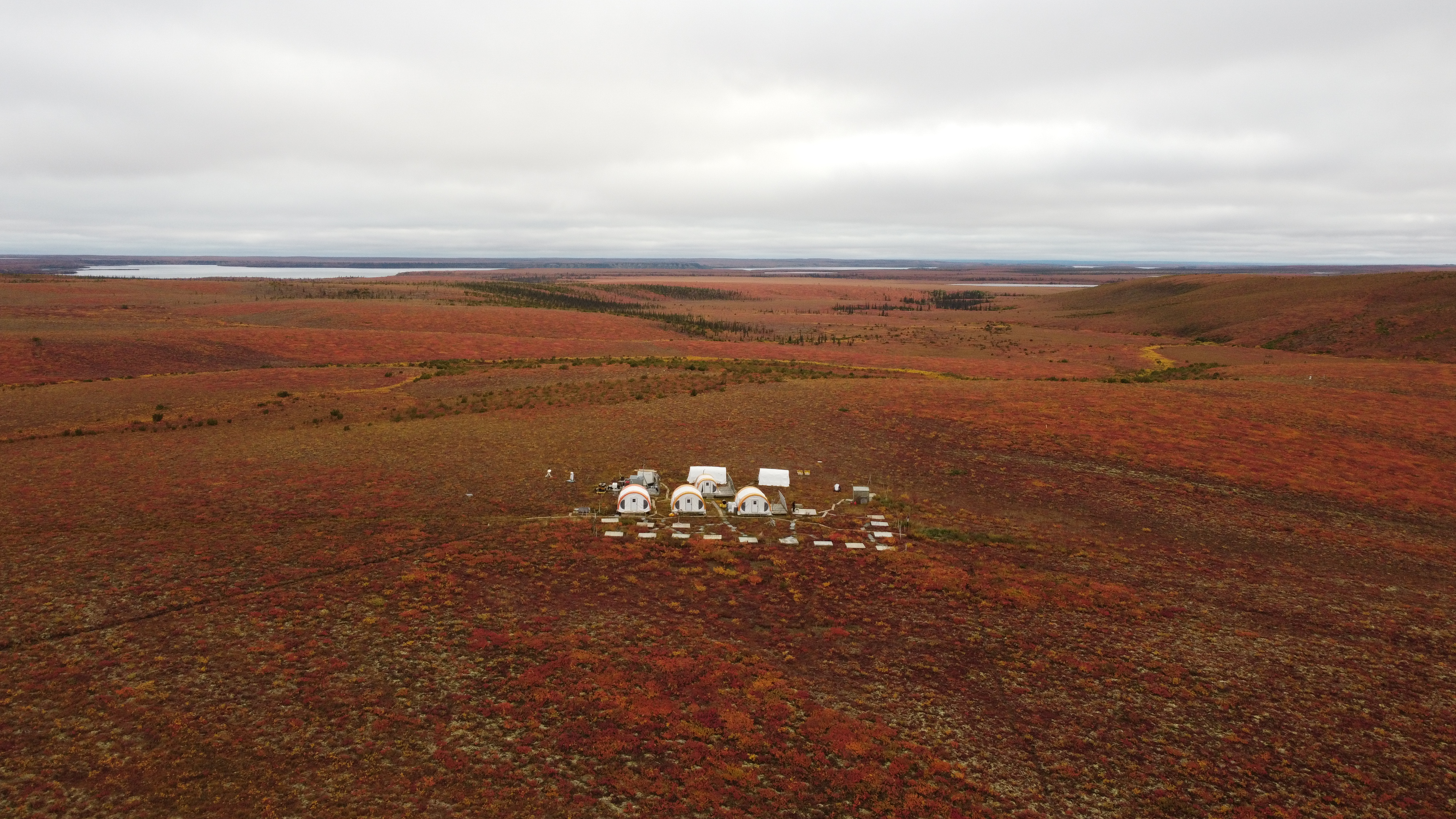
Drone view of the Laurier Trail Valley Creek Research Station’s camp, taken in the summer of 2024. The Husky Lakes can be seen in the far background.
Photo: Alex Fogal
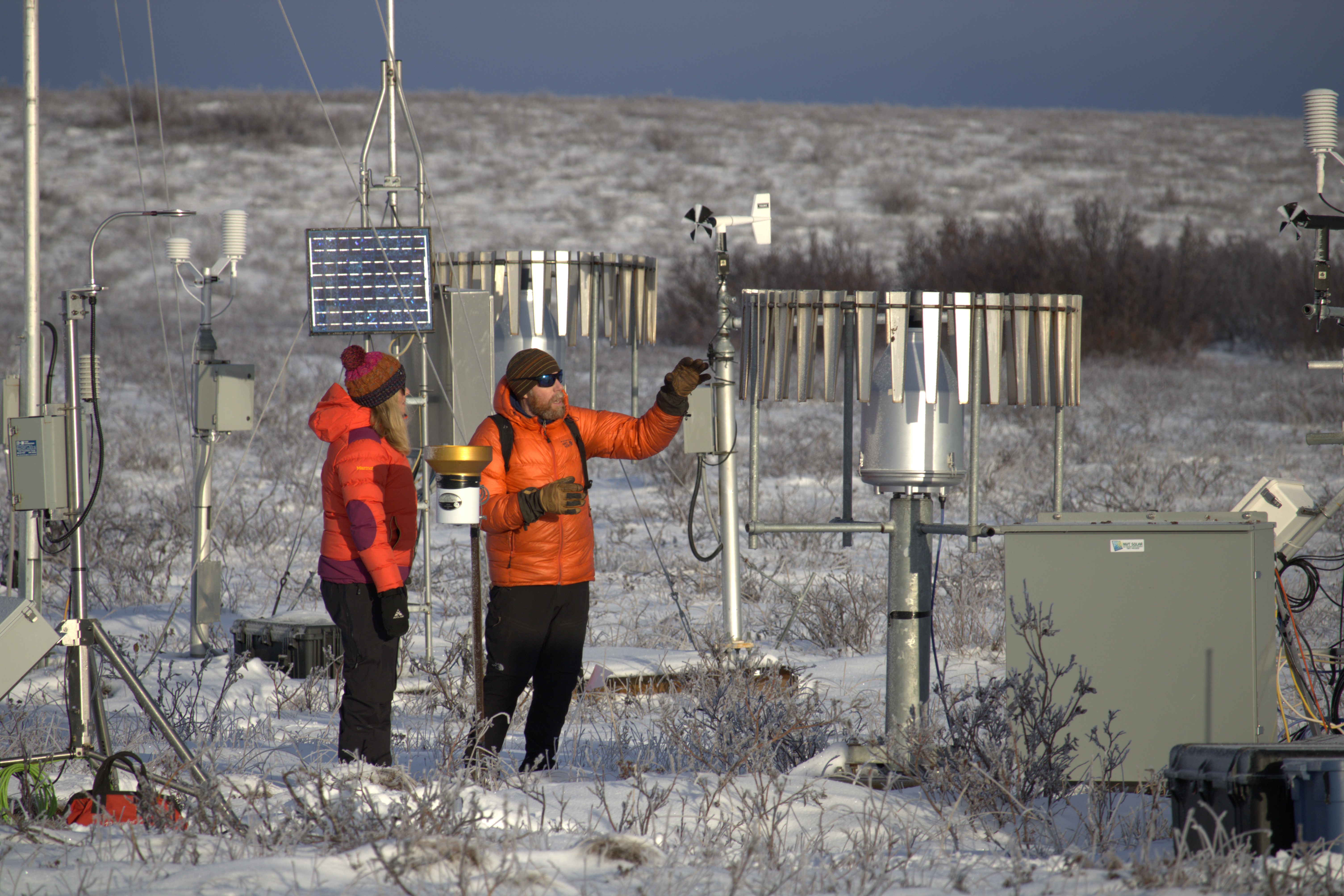
Researchers Elizabeth Priebe and Hadleigh Thompson discussing Université du Québec à Montréal’s meteorological setup at Trail Valley.
Exploring the role of community freezers in food security
Aimee Yurris, MSc student
University of Waterloo, School of Public Health Sciences
POLAR Northern Resident Scholarship Recipient
Country food is central to Inuvialuit well-being and identity, and sharing food has always been an important aspect of the Inuvialuit culture.
Across the North, community members who hunt, fish, or gather berries can safely store their country food in a freezer owned and shared by their hamlet, town, or community organization. Community freezers in the Inuvialuit Settlement Region range from traditional ice houses to modern walk-in freezers with solar panels. Each community organizes, manages, and uses their community freezer differently.
“Community freezers are vital for culture, way of life, and country food access in Northern communities, and this research can be valuable for communities to demonstrate this importance to funders and policymakers,” Aimee says.
Yellowknife resident Aimee Yurris’ research project looks at how freezers in Tuktoyaktuk, Paulatuk, and Inuvik are used by community members.
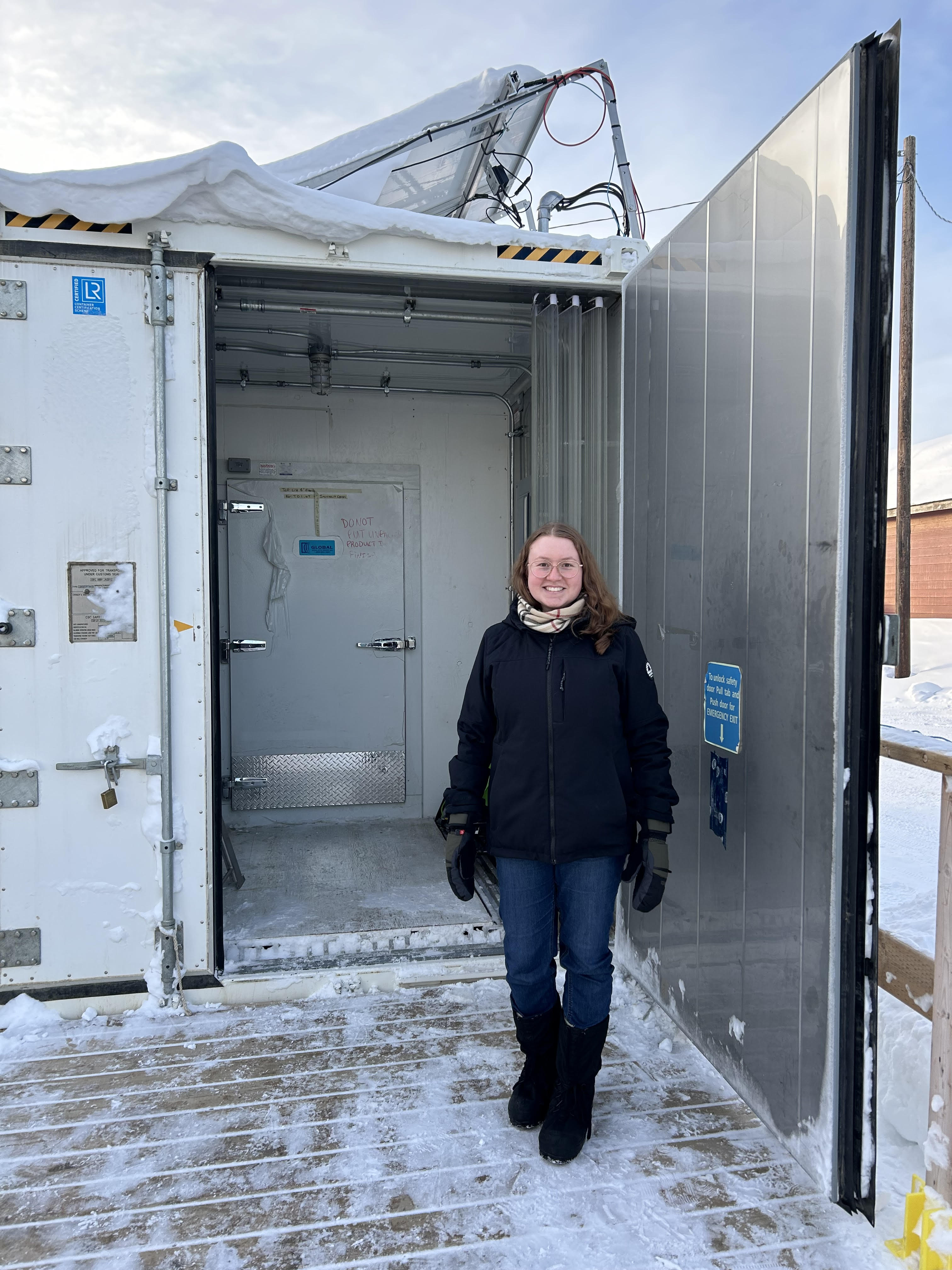
Aimee Yurris stands inside a community freezer in Inuvik.
Our Future Researchers
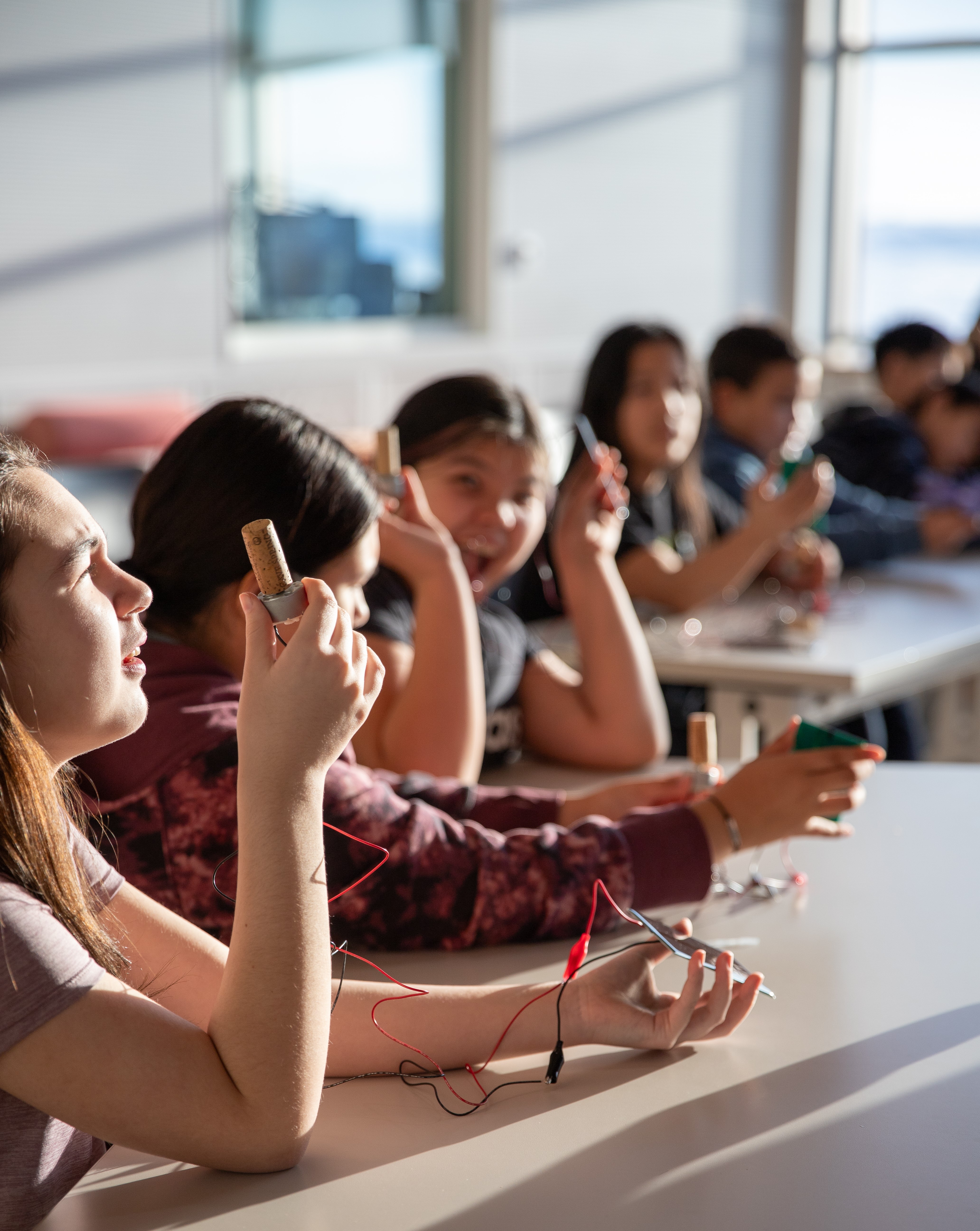
Grade 6 students hold tiny solar panels and watch how the sun operates the tiny fans attached to the panels.
Every year, POLAR sponsors science and knowledge programs for youth, called STEM (Science, Technology, Engineering, and Math) camps. These programs aim to spark passion in young people for learning about their world, and to inspire curiosity about scientific research and Indigenous Knowledge.
The third annual Makigiaqta STEAM Camp, held at CHARS in April 2024, was the first camp of the year. (The STEAM acronym includes Art, as the young people also worked on art projects.) For five days, 14 youth from Nunavut had the chance to step into the role of scientists and researchers.
“Being able to utilize the space at CHARS, where they can actually go into labs and do science experiments, is super cool for them,” says Crystal Qaumariaq, POLAR Policy Analyst. “The youth all got this firsthand experience of being a researcher, and they loved it.”
Crystal led the STEAM camp for POLAR, which was a partnership between POLAR, Nunavut Tunngavik Incorporated, the Canadian Space Agency, SHAD Canada, Actua, Nunavut Wildlife Management Board, and Pinnguaq.
The students participated in real-world science activities, including community-based monitoring of wildlife and logging the wildlife information using data mapping software. They also designed all-terrain vehicles suited for the Arctic.
Learning about Inuit culture was a key part of the camp. Elders shared stories about the history of Iqaluktuuttiaq (Cambridge Bay) and traditional outposts in the region. A special moment was when the youth had a chance to tend to a qulliq (traditional stone lamp). The youth also learned an Inuit number system created by Inupiaq middle school students in the 1990s.
The camp concluded with the youth, their chaperones, and program partners putting on a well-attended feast for the community.
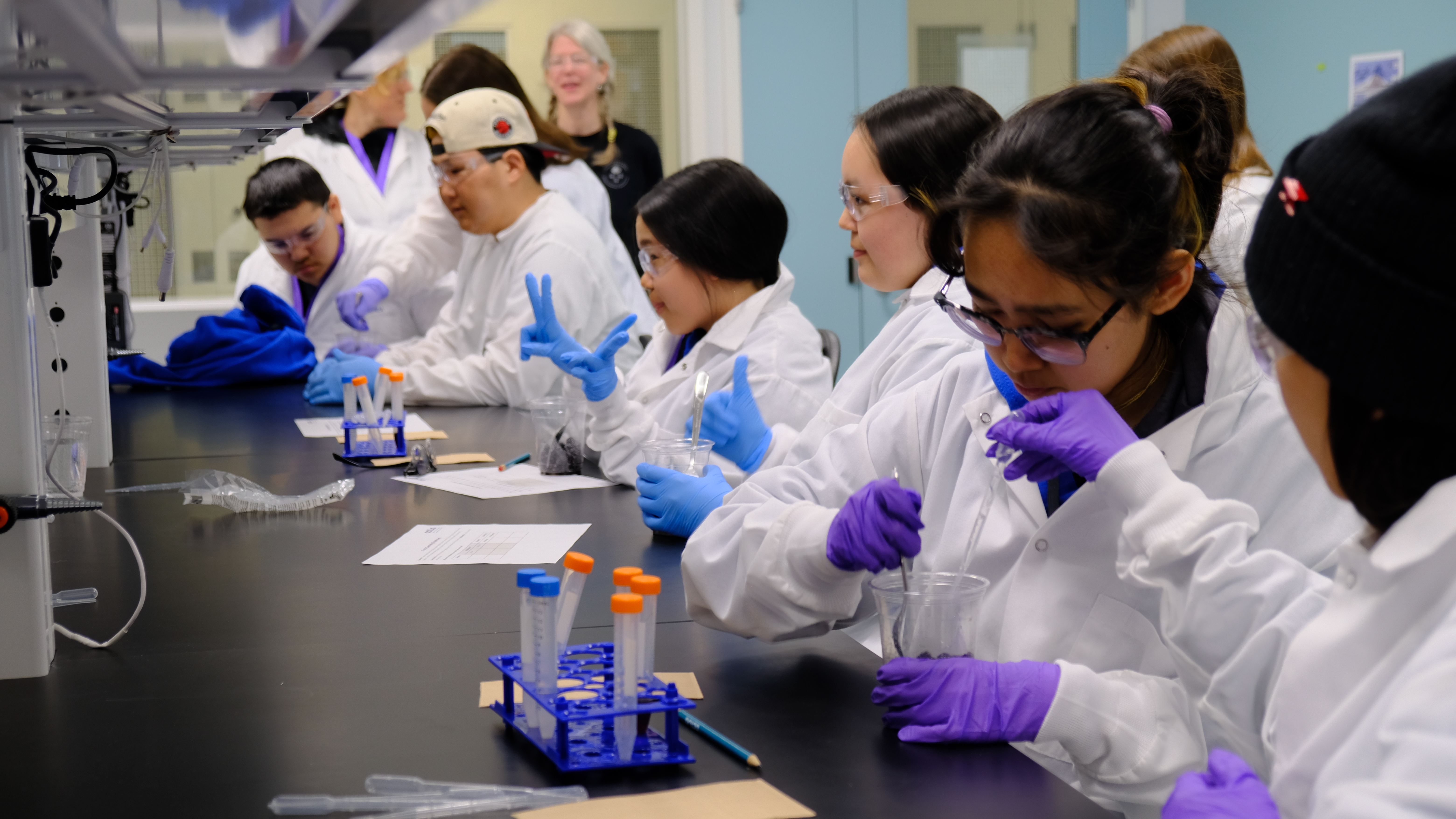
Participants of the Makigiaqta 2024 STEAM Camp in a lab at CHARS.
Photo: Makigiaqta Inuit Training Corporation
In addition to the STEM camps for the high school-aged youth, CHARS welcomed grades 2, 3, and 6 children from Kullik Ilihakvik Elementary School in Cambridge Bay. The children toured the labs and looked at familiar items under microscopes, such as rocks, dried plants, and insects.
The students also participated in a clean energy session where they learned about how wind and solar power work. They, then, created a map of Cambridge Bay and discussed the best locations to install solar and wind power equipment to help power the community.
The Students on STEAM camp ran for a full week in June. The camp was led by Dr. Shoshanah Jacobs, a professor at the University of Guelph, who introduced the youth to an outdoor classroom. The young people were glued, not to screens, but to the visiting researchers, the organizing team, co-teachers, and community members, who shared their knowledge on a wide range of topics. They learned about neighbouring plant life, birds, photography, hunting, fishing, canoeing, archery, scientific fieldwork, insects, and freshwater biology. With the involvement of local teachers and Elders, the camp blended science with local traditional knowledge.
In August 2024, CHARS hosted the FIRST Robotics Camp where Cambridge Bay kids participated in a multi-day robot-building summer camp. The camp offered a fun, educational experience while also encouraging teamwork and creativity among the young participants.

One of the engrossed participants of the Robotics camp.
Every summer, 15 high school students from the Northwest Territories participate in the Tundra Science and Culture Camp. Since 1995, the Government of the Northwest Territories has offered this 10-day outdoor educational program, which provides students with a high school credit. The camp takes place at the Tundra Ecosystem Research Station, located on Daring Lake, 300 kilometres northeast of Yellowknife in the Southern Arctic Ecozone.
“It’s sitting on a culturally important site —a water crossing for the caribou and a popular hunting spot for centuries. It’s a rich learning environment for students,” says Kumari Karunaratne, Director of the Northwest Territories Geological Survey, and one of the camp organizers.
At the camp, students work closely with Northern researchers, environmental educators, and Tłı̨chǫ Knowledge Holders to learn about the tundra landscapes, animals, plants, and human history. When the camp started, it was subject-based, but the camp has evolved into a program focused on hands-on, land-based learning. During hikes, the botanist, the geologist, and the cultural team join students, offering them their perspectives and insights as they explored the land.
“I find the science and culture camp a meaningful part of my job,” says co-organizer Karin Clark, a Manager in the Research and Management Wildlife Division, Environment and Climate Change with the Government of the Northwest Territories. “I get to talk about something I’m passionate about—the environment and caribou—to students who are at a time in their lives when the world is at their feet and they’re making decisions about where their life path is to go.”
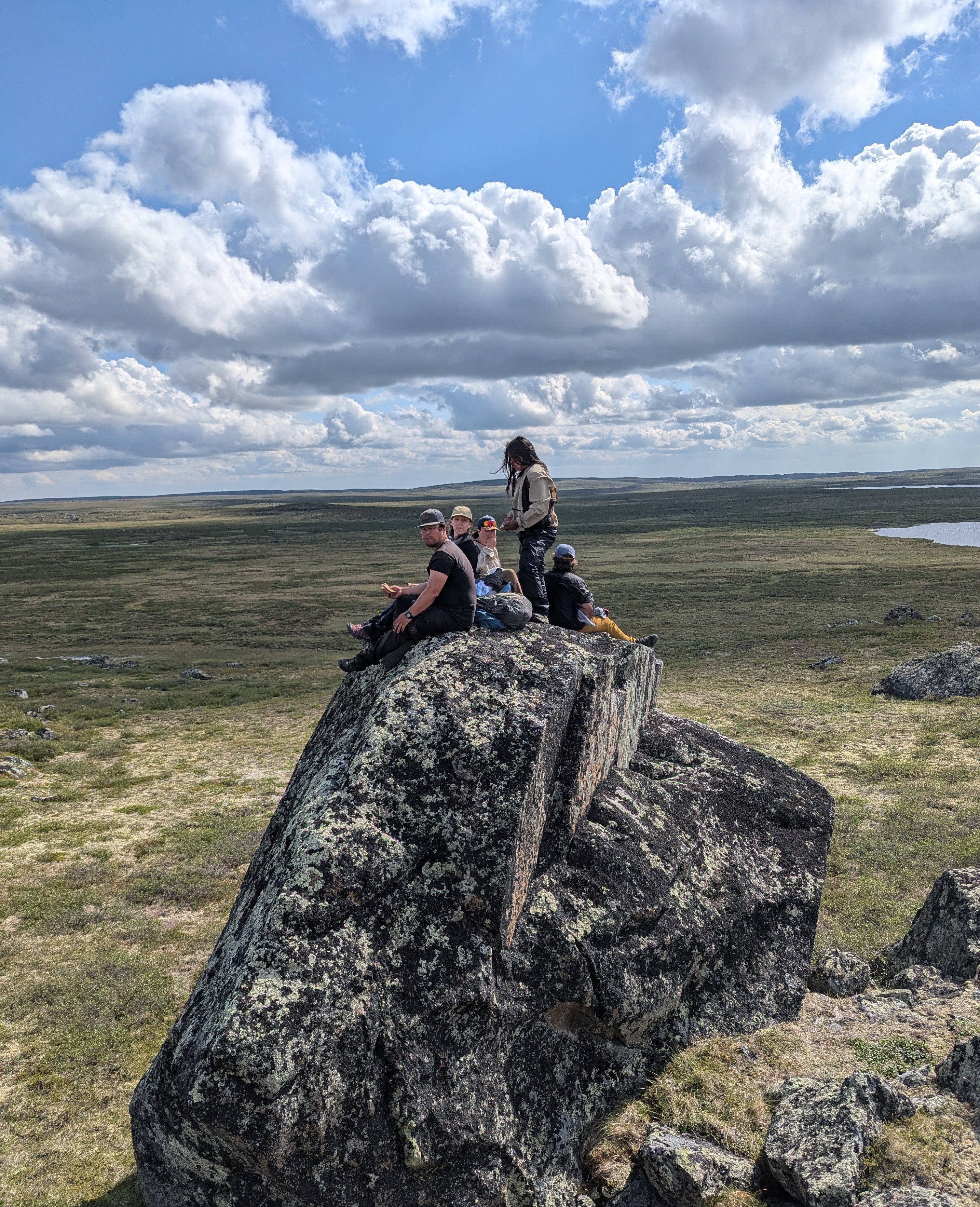
Participants take a break during the all-day tundra camp hike.
Photo: Government of the Northwest Territories
Nanuk Narratives
Documenting Inuit Knowledge integral to the management of polar bears in the Eastern Arctic
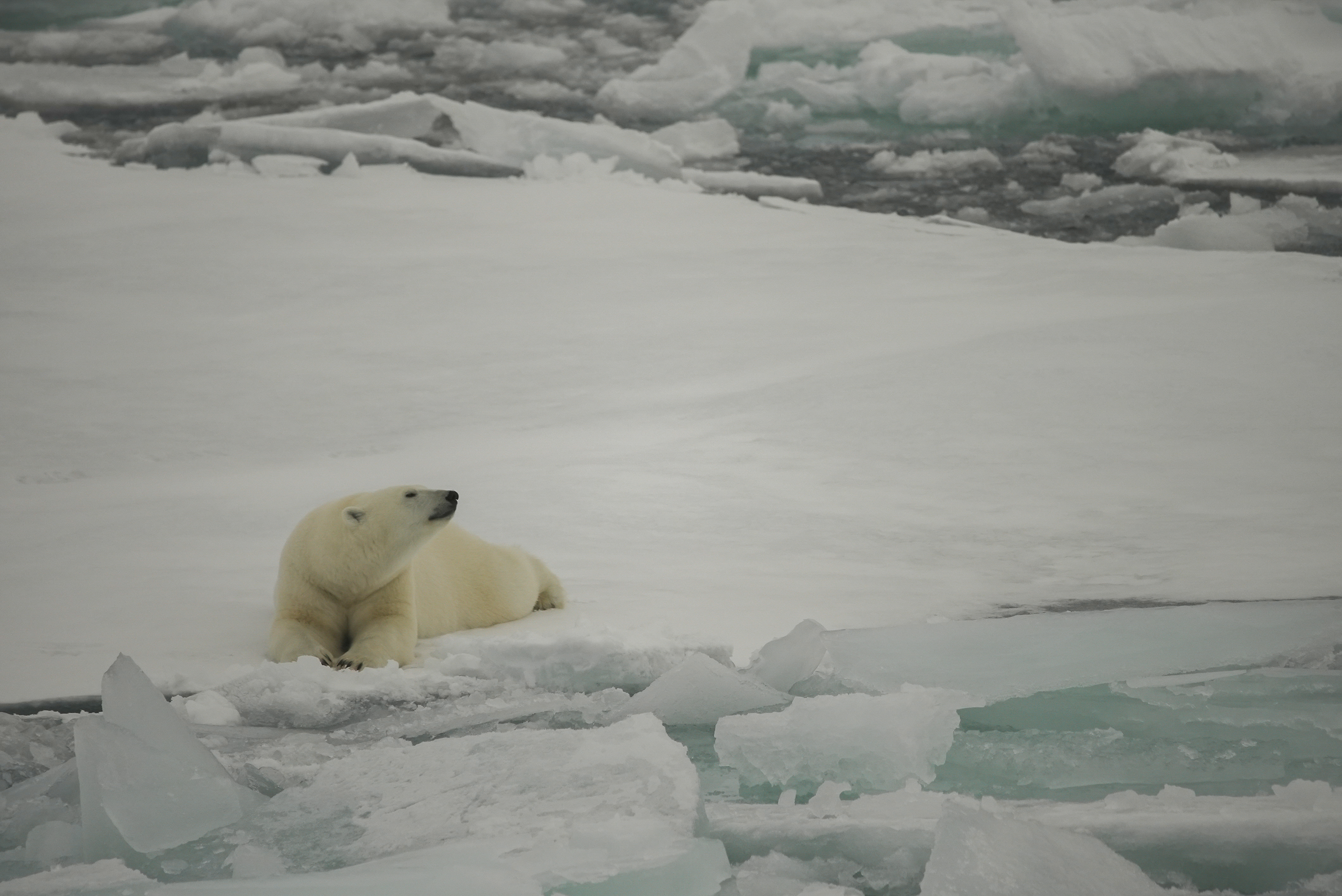
One of the polar bears from the Davis Strait subpopulation lying on an ice floe near Bathurst Island, Nunavut.
Photo: David Borish
Polar bears are symbols of the North with a deep-routed connection to Inuit culture. For centuries, the Inuit have had a close relationship with polar bears, integral to their food, clothing, spirituality, and art.
Inuit polar bear management practices predate the quotas and wildlife monitoring policies introduced in northern Canada over 50 years ago. Today, conservation efforts focus on bears’ biology, behaviour, and habitat. However, Inuit feel their voices have been left out of the decision-making process, despite their firsthand experience with bear population and health.
“As a hunter, I very strongly believe in good conservation practices,” says Derek Pottle, an Elder from Nunatsiavut. “I don’t believe in going out and killing everything just because it’s there. I have probably more of a role to play in protecting resources than what outside influences have.”
Integrating scientific and Indigenous Knowledge
Derek is one of many voices calling for a new conservation model that integrates scientific and Indigenous Knowledge. Recognizing the value of Inuit insights on polar bear populations could lead to sustainable conservation strategies.
Polar bears cover a vast territory, with the Davis Strait subpopulation roaming across Nunatsiavut, Nunavik, Eastern Nunavut, and western Greenland. This spans multiple political and cultural territories, complicating wildlife management efforts.
Inuit from various regions have different approaches to polar bear conservation, including different quotas and harvest strategies. However, they agree that sharing research and best practices is crucial to support both their communities and the Davis Strait polar bear populations.
In 2022, Nunatsiavut’s Torngat Wildlife, Plants and Fisheries Secretariat, the Nunavut Wildlife Management Board, and the Nunavik Marine Region Wildlife Board created an interdisciplinary working group. This group included Inuit Knowledge holders, co-management leaders, wildlife biologists, social scientists, public health experts, and lawyers. Their goal was to bring together diverse perspectives to tackle challenges related to polar bear management.
“The one area that we came to focus on was the idea of making Inuit Knowledge more accessible,” says David Borish, a social researcher and documentary filmmaker who was part of the working group. “This was in the context of a core gap being identified around Inuit voices not being heard as much as they can be relating to polar bears.”
The meeting led to the creation of Nanuk Narratives, a series of 20 short documentary films that capture Inuit perspectives on polar bears, including their cultural significance and the relationship Inuit have with these animals.
Documenting knowledge with film
“Documentary film is a way of gathering Inuit Knowledge, exploring it, analyzing it, and, most importantly, sharing it with specific audiences,” says David. He explains that the project’s team included five Inuit filmmakers across eight communities in Eastern Nunavut, Nunavik, Nunatsiavut, and Greenland.
The Nanuk series aims to engage a wide range of audiences, including government policymakers, involved in polar bear management.
“We're trying to share with them the importance of Inuit Knowledge being blended into polar bear conservation,” David says.
The films, available in both English and Inuktitut, can be found on YouTube and the Nanuk Narratives website (nanuknarratives.com). The videos highlight different aspects of Inuit Knowledge and experience of bears, such as bear observations, uses of bears, safety and encounters, Inuit stewardship, and co-management. Several of the films also address the changing behaviour of polar bears due to climate-related shifts in ice conditions.
David Poisey, a filmmaker from Pangnirtung, Nunavut, says, “Saying that in Nunavut, and in all the North, that polar bears are endangered, that’s a down-south view. From us up here, there seems to be more polar bears that are approaching the settlements. That didn’t used to happen before.”
To further promote understanding, a free online course is available on the Nanuk Narratives website. The course includes videos with discussion guides and questions to explore how Inuit Knowledge is essential for effective polar bear management. The films will also be broadcast on Uvagut TV, the Inuktitut television channel, which reaches more than 600,000 homes across Canada.
“Basically, what Nanuk Narratives is about is to communicate that we have such a deep and long relationship to the bear,” says Greenlandic filmmaker Ikimalik Pikilak, who created three videos for the series. “It has taught us how to hunt, how to raise our children, and how to survive in the Arctic. We learn so much about ourselves through our relationship to the bear.”
Unlike the other project’s filmmakers, Ikimalik did not interview Elders about their relationship with polar bears. She explains that three centuries of Danish colonialism have resulted in Greenlandic Elders losing that knowledge. Ikimalik is working to revitalize that traditional knowledge by revisiting Inuit practices and stories documented by the colonizers, missionaries, and whalers. The videos will help share that information with Greenlanders.
In Canada, Inuit hunters are advocating for a more significant role in polar bear management, and they have strong reasons for doing so.
“We try to promote, in the film, the utilization of all the animal and how it’s treated with respect,” says Derek. He says that speaking from experience and firsthand knowledge goes a long way in collaborative polar bear management.
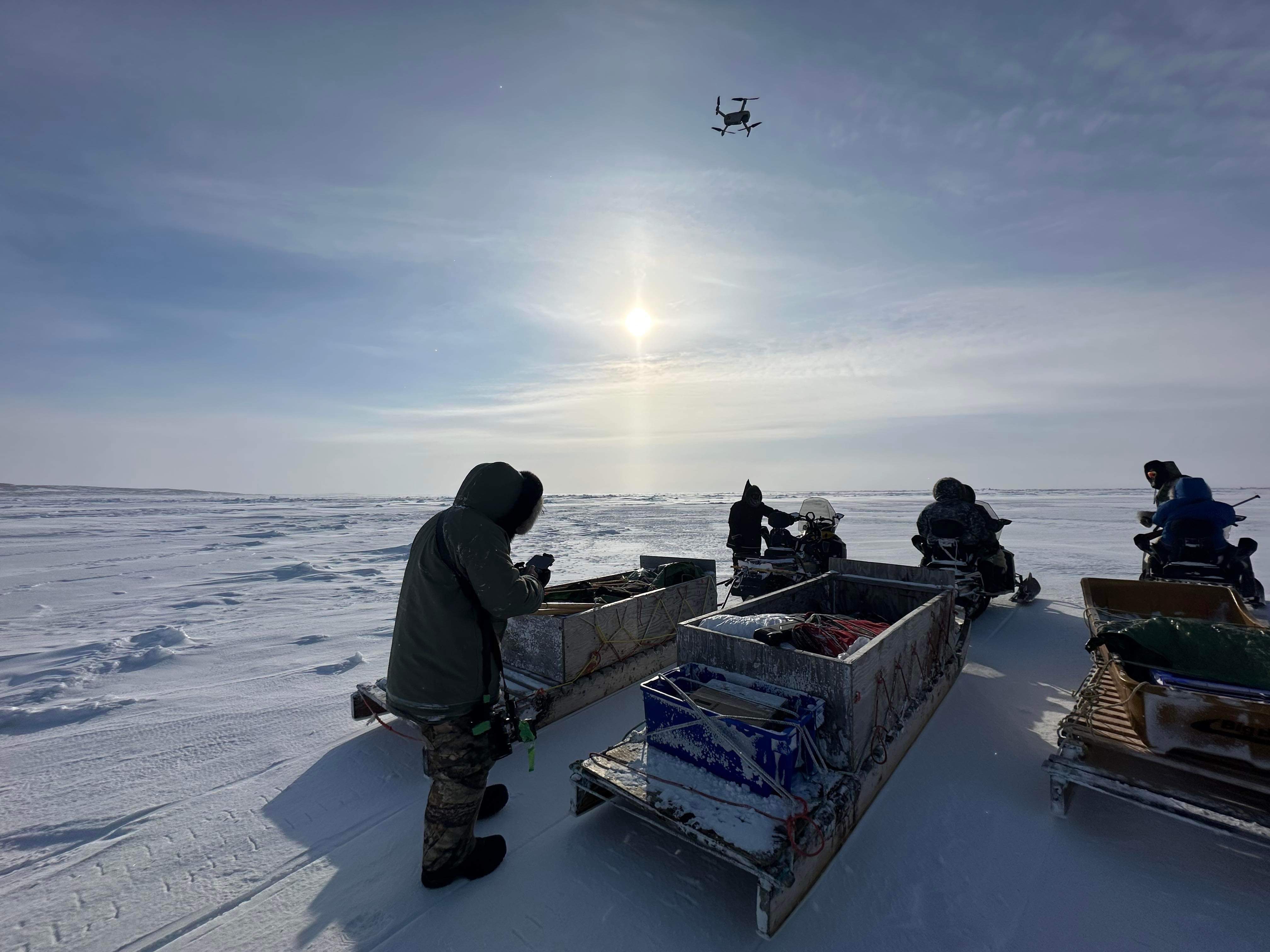
Filming ice outside Inukjuak.
Photo: Tommy Palliser

David Borish (carrying camera) and Karl Michelin filming caribou in Labrador.
Photo: Eldred Allen
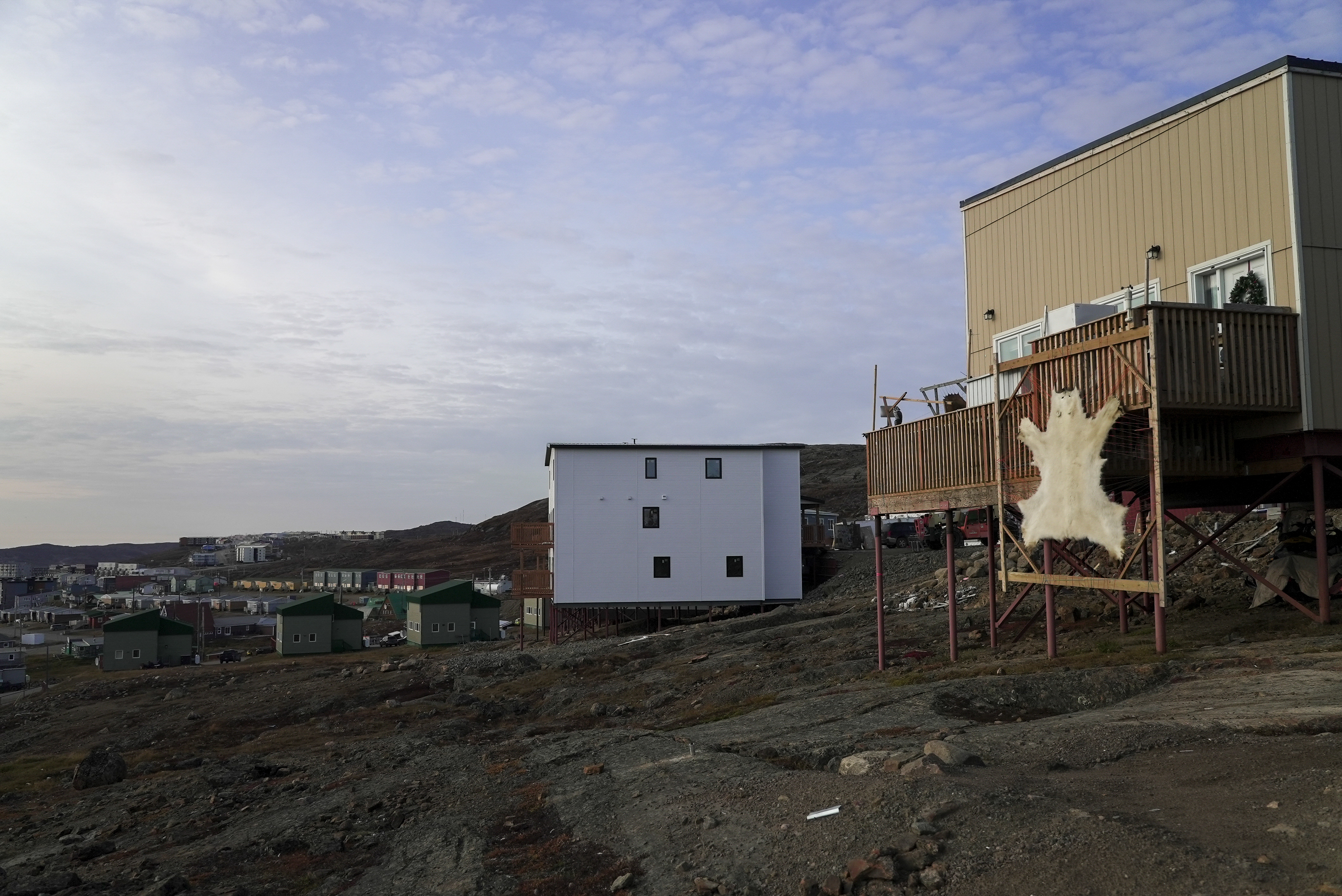
Polar bear skin in Iqaluit.
Photo: David Borish
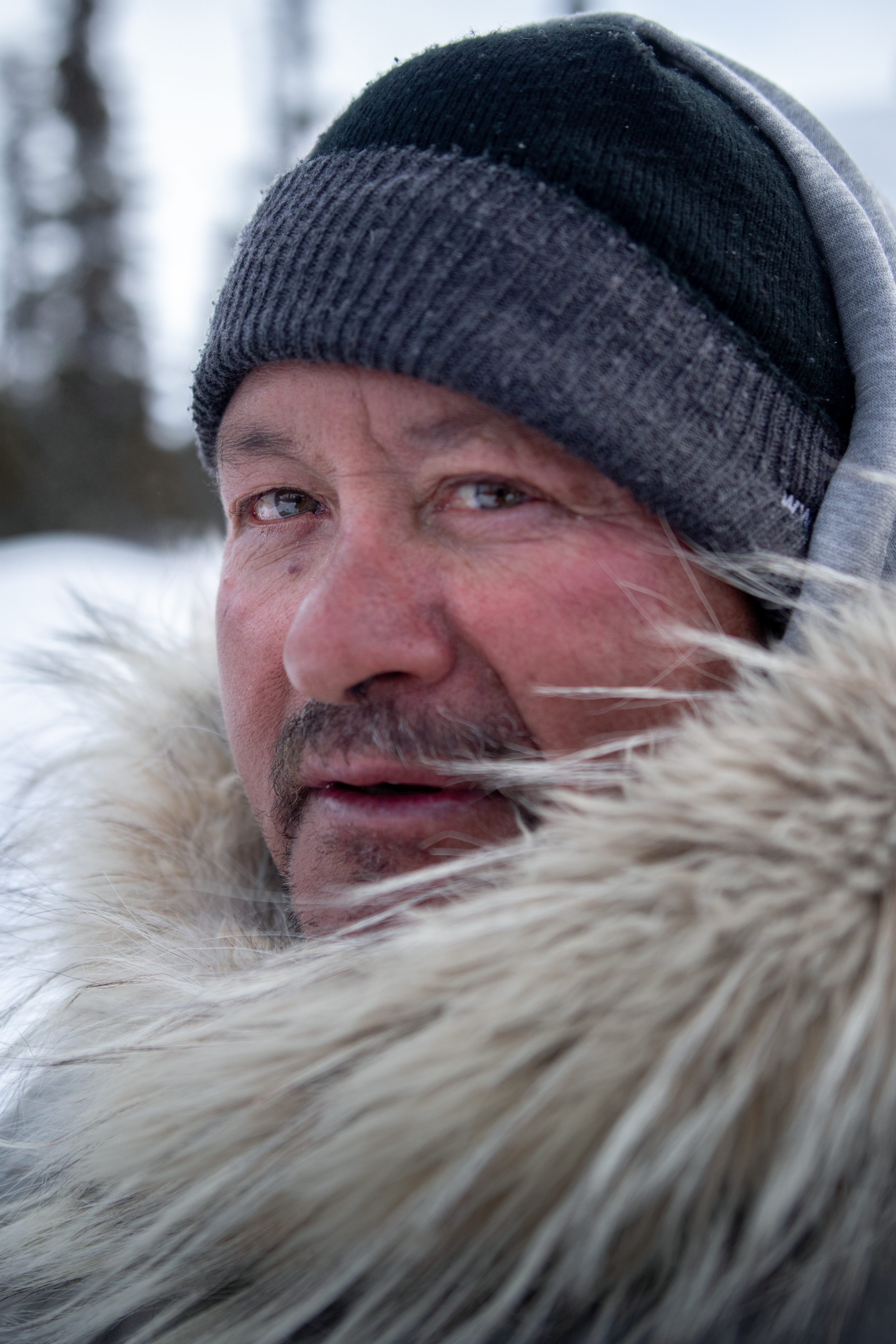
Elder Derek Pottle
Photo: David Borish
Tracking where birds come from
Imagine seeing a small Arctic tern in Cambridge Bay and discovering it had flown all the way from Antarctica, over 40,000 km away. In August 2024, an antenna was installed outside CHARS to do just that—track migratory birds.
Cambridge Bay is an important area for bird migration. It lies north of the Ahiak Migratory Bird Sanctuary, which is the only protected bird sanctuary in the Kitikmeot Region. This area is home to the largest variety of geese found in any North American nesting area, as well as many other migratory bird species. Given how close Cambridge Bay is to the sanctuary and the large bird population in the area, it was an ideal location to put the antenna.
Standing at 10-metres tall, the tower is part of the Motus Wildlife Tracking System, which has towers positioned around the world. Unlike satellite-based GPS, it uses radio telemetry to receive data from tiny tags placed on birds. The tags send a signal every few seconds that the tower picks up as the bird passes within range. The tower has three unidirectional antennas that can detect a bird flying within 20 kilometres.
Cléa Frapin, an Arctic wildlife biologist who recently joined Birds Canada as the northern habitat conservation planner, spearheaded and coordinated the antenna setup at CHARS. The project was a collaborative effort by the Canadian Wildlife Service Atlantic Region, University of Windsor, and Polar Knowledge Canada.
Although the installation team did not tag any birds themselves, Cléa says, “The goal for this Motus station is to be able to create those opportunities for tagging and also detecting birds that have been tagged elsewhere,”.
The tower at Cambridge Bay will gather data from early spring through late fall. Cléa emphasizes that anyone can access the data collected by the tower via the Motus website. The information about Cambridge Bay’s migratory birds is available for teachers, hunters and trappers organizations, researchers, governments, or interested community members.
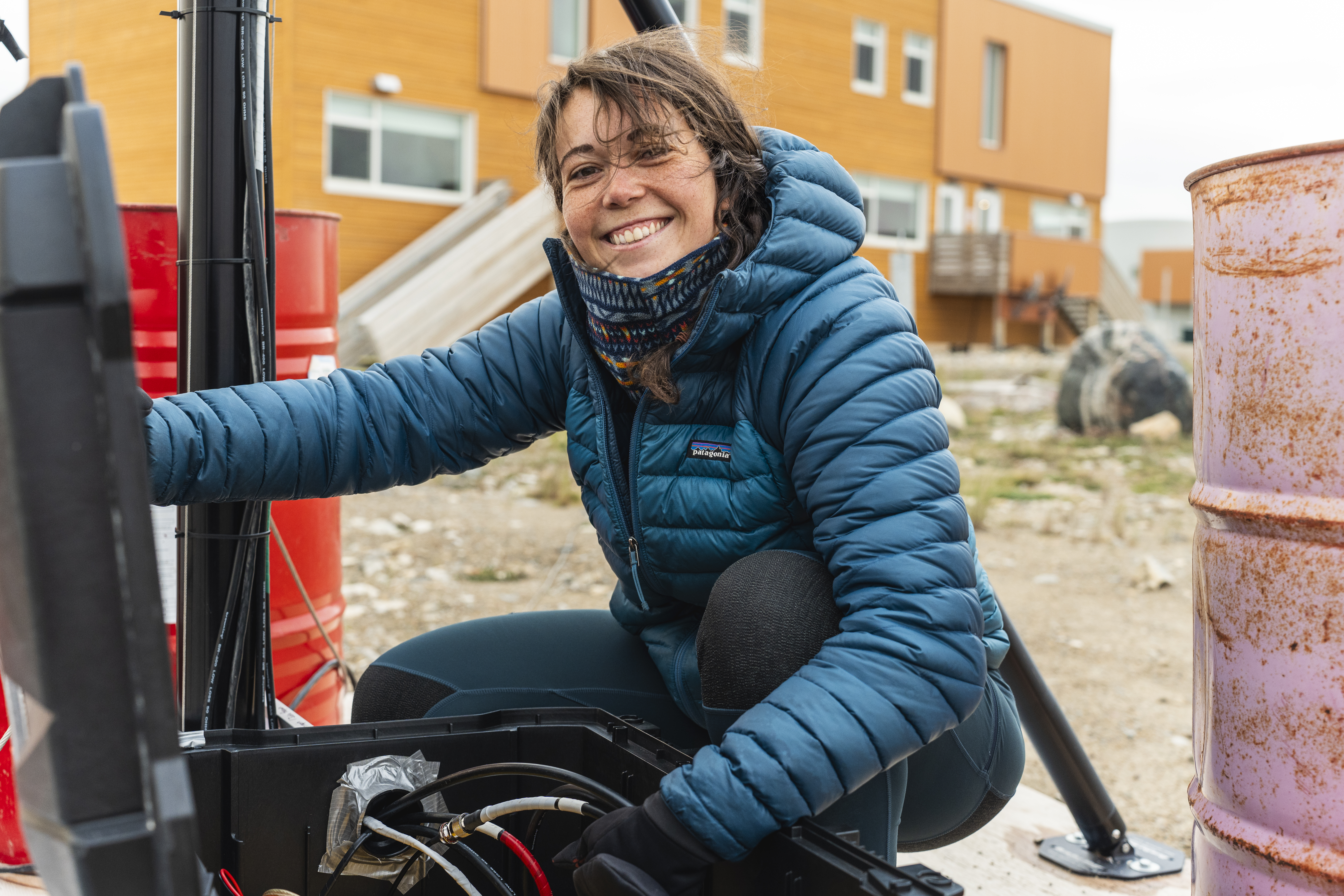
Cléa Frapin setting up the Motus tower antenna in August 2024.
.jpg)
The tower with Motus antennas attached, stands near the CHARS triplexes ready for tracking birds.
The sewage BEAST
Cambridge Bay, like other Arctic communities, has a sewage lagoon. Unlike in southern Canada, where sewage is transported by pipe to a treatment plant or flushed into a septic tank, the hamlet's wastewater is collected from each house by pumper trucks and then discharged into a lagoon.
While sewage lagoons are cost-effective and require minimal maintenance, they present challenges in the North. Because lagoons in the Arctic are frozen for much of the year, bacteria can’t break down organic matter effectively. To address this, the National Research Council of Canada, Elkan Engineering, and POLAR collaborated to develop a sewage treatment technology tailored to address the unique challenges of treating sewage in remote Arctic communities.
This innovation, known as the BEAST (Bio-Electrochemical Anaerobic Sewage Treatment) was created to improve sewage management.
Traditional wastewater treatment injects oxygen— a process called aeration— to accelerate the growth of bacteria that help break down organic matter. In contrast, the BEAST can be operated with little to no aeration. Instead, it uses a constant electrical voltage to enhance the digestion of organic matter. Although it wasn’t tested during this trial, when operated without aeration, the technology also has the potential to produce biogas that could be used as an energy source.
In 2020, a 30-litre pilot BEAST reactor was successfully tested at CHARS. In December 2023, POLAR’s Cold Climate Technology team began testing a larger 300-litre BEAST reactor. This reactor was installed in the mechanical room of one of CHARS’ triplex accommodation buildings until June 2024.
During this period, POLAR staff maintained and operated the reactor, collecting weekly samples to analyze how the system was able to break down organic matter. After six months of operation, the project concluded, and the BEAST system was decommissioned.
The results of the pilot are now being compiled, with plans to publish a technical paper based on the data collected. In the future, technologies like the BEAST could serve as a potential pre-treatment solution to reduce the sewage in Arctic lagoons.
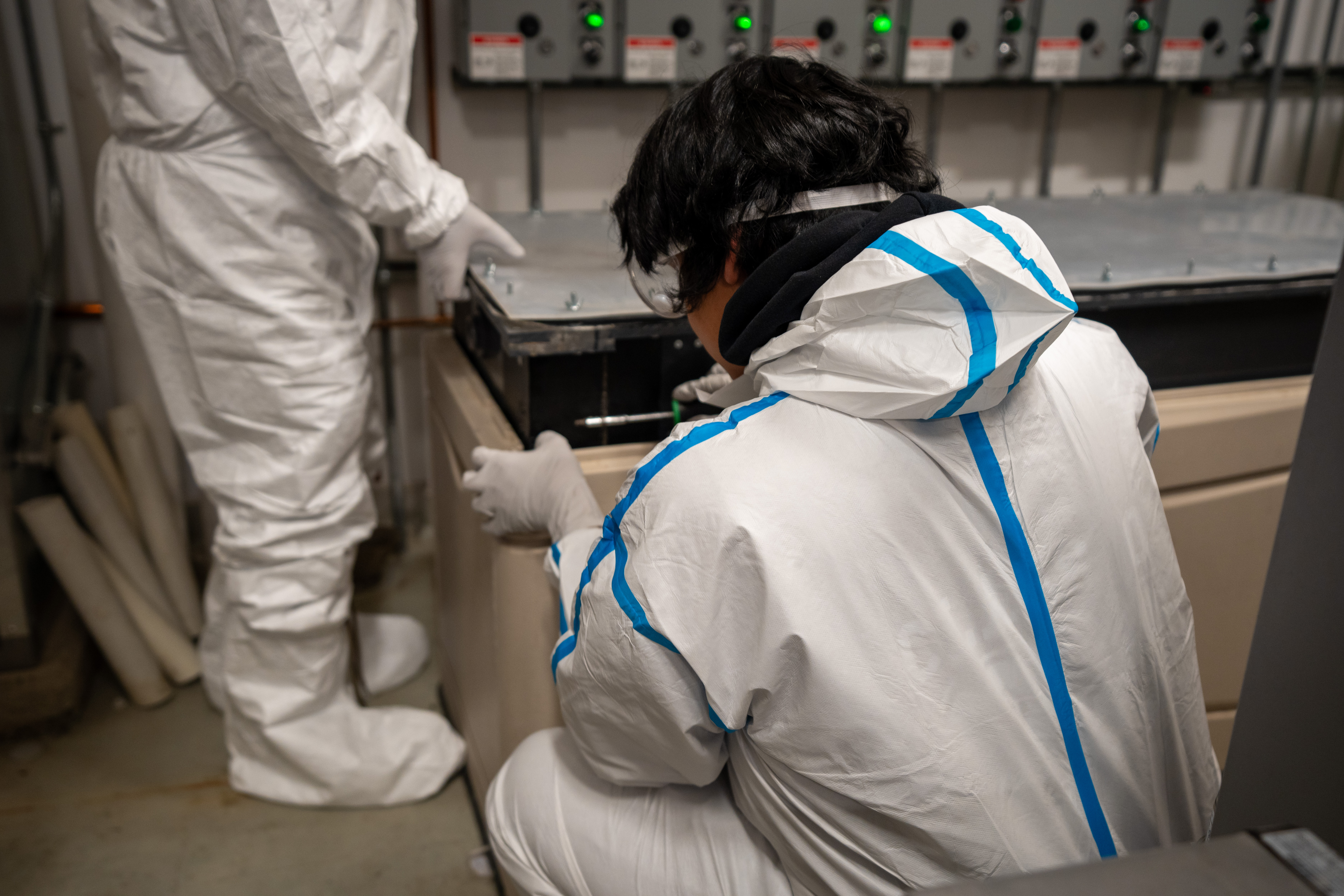
POLAR employees Wyatt Klengenberg and Jason Maas decommissioning the BEAST.
Indigenous Knowledge of berries in the Northwest Territories
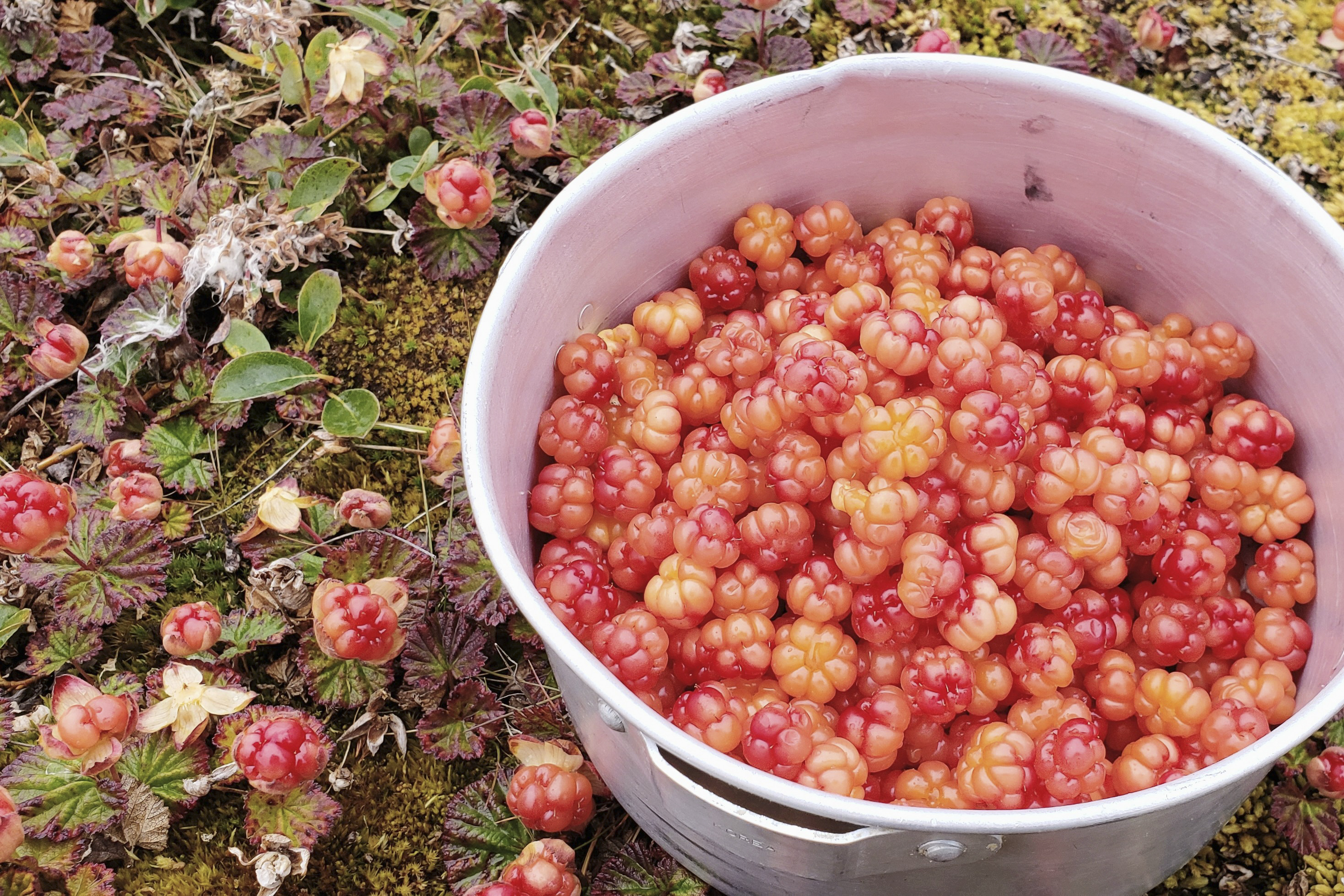
Freshly picked cloudberries.
A 2017 study of grizzly bears in the Northwest Territories (NWT) found that grizzlies eat a lot of berries, mainly Vaccinium vitis-idaea—cranberries.
“There were reports from some communities about declines in the berries. Not only declines in the crop yields, but also in the size of the berries. As well, there were changes to the condition of the berries. They were drier or mealier,” says Claire Singer, former wildlife biologist for the territorial government’s biodiversity program.
Given the long history of berry harvesting, the Species at Risk Committee, which reviewed the grizzly bear report, recommended research into berries based on Indigenous Knowledge systems, as these systems encompass extensive geographic areas and long period of time.
Claire, who led the Indigenous Knowledge of Berries in the Northwest Territories project, helped organize a research group of Knowledge Keepers from across the territory. Each member conducted interviews with experienced berry pickers—typically Elders— in their own communities to gather Traditional Knowledge about berries. Although, the pandemic delayed the project, a committee of 10 Knowledge Holders met in June 2022 to develop a research plan, finalize interview questions, obtain ethics clearances, and secure research licences. The research officially began in 2023.
Bea Lepine, a member of the research working group brings her life-long experience harvesting berries from Hay River. As a Cree womon, Bea shares her own knowledge while also gathering the knowledge from Elders in her community. She emphasizes that cranberries have always been a vital part of her people’s diet.
“It’s important for our physical health,” she says, “because there’s a high degree of minerals and vitamins, especially vitamin C.”
With the long summer day in the North, berries have higher antioxidant levels compared to those cultivated in southern Canada.
Bea highlights the importance of the study.
“It’s about food security. People need to recognize how important plants and berries are to our survival as a people, not just traditionally but in the future. Who knows what we are going to be faced with with climate change—at least we have knowledge out there,” she says.
To date, the co-researchers have completed interviews in 14 communities across the NWT. Their findings indicate that climate change poses risks to the environments where berries grow, affecting their survival. Extreme droughts and forest fires in recent years have had a significant impact on the berry crops in some regions.
The research group is now drafting a report on the current state of NWT berries. They are also preparing a field guide for communities, along with a calendar of fruiting times that reflects differences in regions across the territory. Transcripts of the interviews will be returned to the communities as valuable knowledge resource material.
Claire notes that natural resource management traditionally focuses on hunting, trapping and fishing.
“Also being able to look beyond megafauna [large animals] to the context in which they live, and the species on which they depend, is a key aspect of this project that we're really pleased about.”
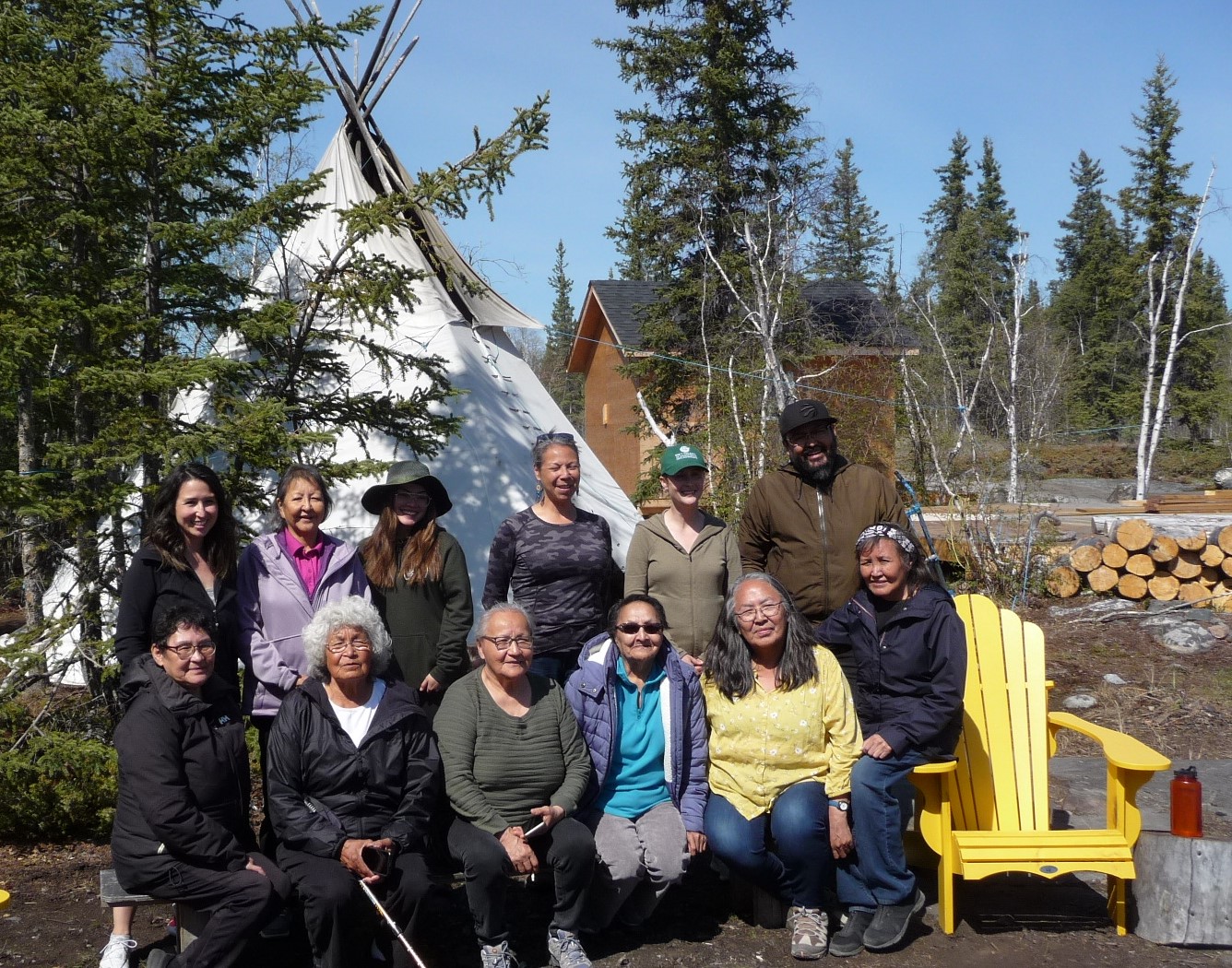
First meeting of the committee in June 2022 at B. Dene Camp in Dettah, NWT Back, left to right: Michele Grabke, Elaine Lamalice, Madison Menacho Melnyck, Lila Fraser Erasmus, Claire Singer, Dëneze Nakehk’o
Front, left to right: Anna Thrasher, Margaret Leishman, Margaret McDonald, Celine Proctor, Alestine Andre, Annie Buckle
Photo: Bobby Drygeese
The POLAR Northern Science Award

Every year since 2015, the Northern Science Award is presented at the ArcticNet conference to an individual or team who have made a significant contribution to advancing knowledge and understanding of the Canadian North. The annual award includes a $10,000 prize and the Centenary Medal.
2024: Aklavik Hunters & Trappers Committee
Community-based Knowledge Sharing and Wildlife Conservation
The committee has been a leader in environmental stewardship and knowledge sharing in the Canadian North for over 40 years. It collaborates with researchers across disciplines and borders, fostering partnerships with organizations and co-developing scientific projects that integrate Indigenous Knowledge.
2023: Trevor Bell, PhD, and SmartICE
Community-based Environmental Monitoring
Trevor Bell founded SmartICE, which combines Indigenous Knowledge with cutting-edge technologies to provide real-time information on ice conditions. Their work has been instrumental in supporting transformations in the way knowledge is produced and shared.
2022: Lucassie Aragutainaq
Indigenous Ecological Knowledge and Environmental Stewardship
For 30 years, Lucassie Aragutainaq, of Sanikiluaq, Nunavut, has documented Indigenous ecological knowledge and contributed to scientific studies of the changing environment of Hudson Bay.
2021: David Barber, PhD
Environment and Geography
David Barber’s research on climate change and its environmental and socioeconomic impacts helped shape territorial, provincial, national, and international policy. He integrated Indigenous perspectives into his work and mentored a generation of young scientists to respect and prioritize
the research needs and questions of Indigenous communities.
2020: Wayne Pollard, PhD
Geography
Over the course of his career, Wayne Pollard generated substantial new knowledge of the geomorphology and hydrology of permafrost. His work has also brought new understanding
of Antarctic environments, and of processes affecting permafrost influenced landforms on Mars.
2019: Julie Cruikshank, PhD
Anthropology
Julie Cruikshank has a long and distinguished record of documenting the oral histories and life stories of Athapaskan and Tlingit Elders, and exploring Yukon First Nations’ systems of narrative and knowledge.
2018: Nunavik Research Centre
Community-based Research
For 40 years, the Nunavik Research Centre, in Kuujjuaq, has conducted community-based science. The Centre has developed research methodologies that incorporate scientific and Indigenous Knowledge, such as environmental studies that help protect the health of people in Nunavik.
2017: John England, PhD
Arctic Environmental Change
John England has made a life-long study of the environmental and climatic history of Canada’s Arctic Islands. He is a passionate advocate for the protection of the northern environment and was instrumental in the creation of Canada’s northernmost national park, Quttinirpaaq, on Ellesmere Island.
2016: John Smol, PhD
Limnology
John Smol developed techniques that revolutionized the study of Arctic ecosystems. He demonstrated that microscopic algae preserved in lake and pond sediment are a powerful tool for
understanding environmental change, which is at the forefront of Arctic climate change research.
2015: Louis Fortier, PhD
Marine Biology
Through his leadership, Louis Fortier brought together international academics, Inuit partners, the private sector, and policy makers to document and synthesize the effects of climate change, which contributed to informed policy making for the benefit of the Inuit of Canada.
Polar Knowledge Canada Awards and Scholarships, 2023–2024
POLAR KNOWLEDGE CANADA FELLOWSHIP $50,000
Amy Caughey, PhD
Health and Social Sciences
Nunavut Research Institute
POLAR ANTARCTIC
SCHOLARSHIP
$10,000
Brady O’Connor, PhD
Biology
McGill University
POLAR SCHOLARSHIP
$10,000
Benoit Lauzon, PhD
Geography
University of Ottawa
Claudia Haas, PhD
Biology
Wilfrid Laurier University
POLAR NORTHERN RESIDENT SCHOLARSHIP $10,000
Amanda Buffalo, PhD
Geography
University of Toronto
Christine Dunbar, MSc
Integrative Biology
Wilfrid Laurier University
Lois Moorcroft, PhD
Social Justice Education
University of Toronto
Jessie Olson, MSc
Veterinary Medicine, Virology
University of Calgary
Devin Wittig, MSc
Environmental Science
University of Northern British Columbia
Aimee Yurris, MSc
Public Health Sciences
University of Waterloo
NORTHERN RESIDENT AWARD $5,000
Christina MacNeil, BSc
Northern Environmental and
Conservation Sciences
Yukon University
Sarah Newton, BSc
Biology
Yukon University
Moving forward
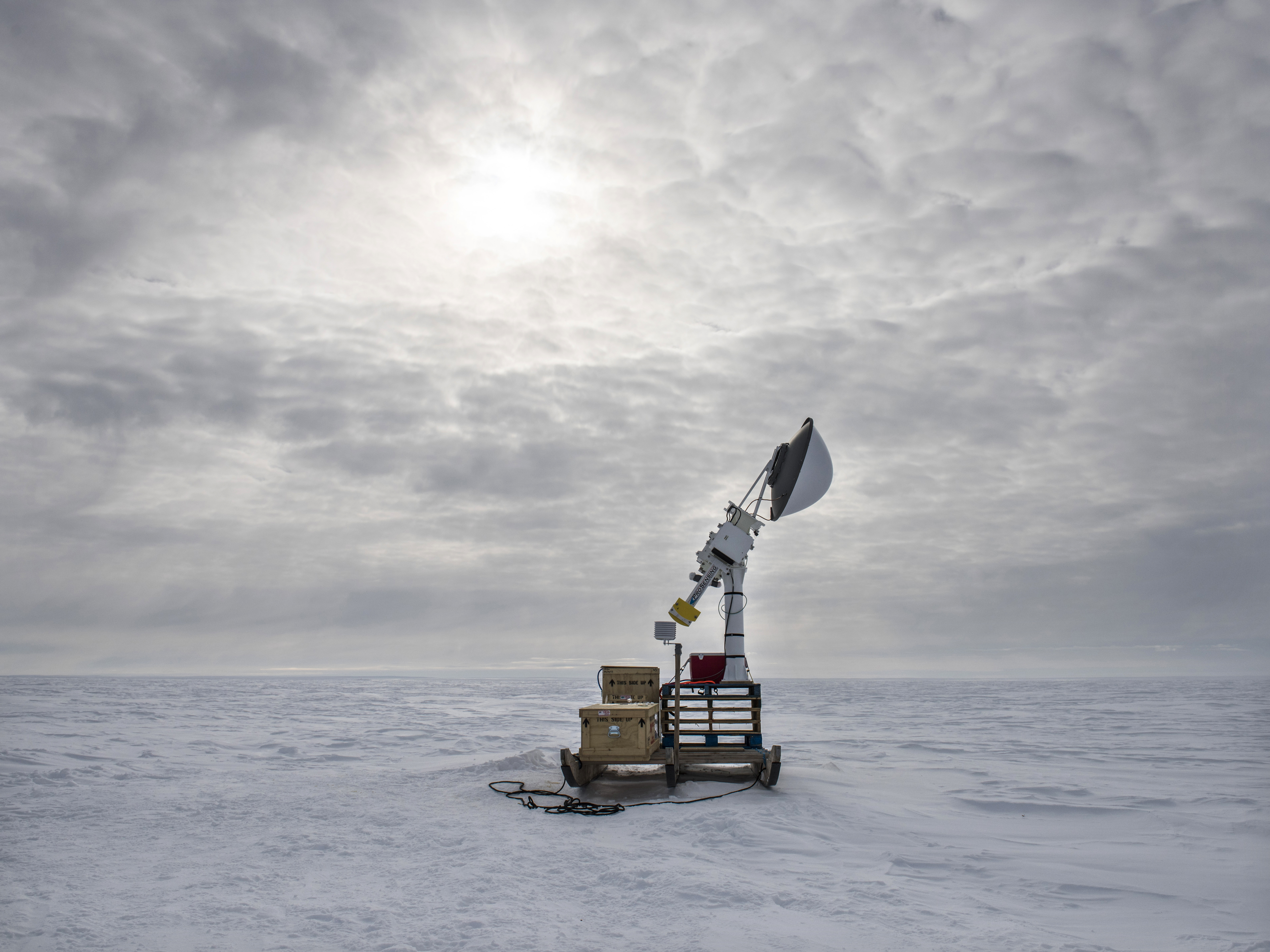
This photograph captures the essence of POLAR’s approach to research —melding modern and traditional technology to enhance our understanding of the polar regions.
As POLAR looks ahead to the next 10 years, it is focused on strengthening the connection between southern scientists and Northern Knowledge holders. The qamutik and the antenna symbolize our path forward.
Janet King, Chair of Polar Knowledge Canada’s Board of Directors, notes that Indigenous Knowledge is integral to the Agency’s mandate.
“Polar Knowledge Canada and CHARS, its facility, is a high functioning hub in a network of northern research and knowledge—and I mean both physical infrastructure and the flow of knowledge,” says Janet. “I also think science is learning to be more. There is more multidisciplinary science, more networks, and more knowledge sharing, which is all leading to better research. Science is learning to be nimble, fast, and multidisciplinary. And of course, this aligns well with how knowledge is generated and held in the North.”
The photo of the two qamutiks and antenna, taken in May 2018, documents a research project on ice in Cambridge Bay. The data collected is helping shape future studies about Arctic ice. The research POLAR supports today, in both the Arctic and Antarctic, is advancing knowledge about polar regions and beyond—just as past studies have influenced current research.
The International Polar Year (IPY) is a prime example of this progression. The first IPY, held between 1882 and 1883, was a co-ordinated, interdisciplinary, year-long study of the Arctic and Antarctic by international researchers. It provided invaluable scientific data that expanded our understanding of the polar regions. The IPY occurs every 25 years, with each building upon the knowledge from the previous one.
In seven years, POLAR will represent Canada, at the 2032–33 International Polar Year. The fifth IPY will focus on the unprecedented changes occurring in Arctic and Antarctic ecosystems due to climate warming. POLAR is excited to contribute to this international effort to find innovative solutions to help the planet address these challenges.
Since the last IPY in 2007–08, global attention has shifted toward the Arctic, spotlighting the rapid changes observed by both scientists and residents.
Jason Tologanak, POLAR’s Director of Knowledge Management and Engagement, stresses the importance of incorporating Northerners’ perspectives into research to better understand the future of the Arctic through its past.
“By ensuring that the local voices and the local knowledge, which have been passed down from generation to generation, orally from hundreds of years of living and observing these conditions in this environment, have the same strength and pull as somebody who has a PhD,” he says.
POLAR continues to play an important role between the International Polar Years by supporting various research projects across the Arctic and Antarctic, contributing invaluable insights into these regions’ ecosystems. POLAR is proud to be part of this ongoing effort.
“Northerners have adapted since they've been northerners,” says Andrew Applejohn, POLAR’s Executive Director of Programs. “But the ability to look forward and predict, I think that's the really critical piece and to look towards the future from a Northern perspective, not from a strictly southern perspective.”
Contact us
General inquiries and media requests: communications@polar-polaire.gc.ca
Website: canada.ca/en/polar-knowledge
Instagram: @polar.knowledge
Facebook: @PolarKnowledge
X: @POLARCanada
LinkedIn: Polar Knowledge Canada (POLAR)
Headquarters:
Canadian High Arctic Research Station
1 Uvajuq Road, P.O. Box 2150
Cambridge Bay, NU, X0B 0C0, Canada
Regional offices:
Ottawa
170 Laurier Avenue West
2nd Floor, Suite 200
Ottawa, ON, K1P 5V5, Canada
Whitehorse
Suite 305, 300 Main Street
Elijah Smith Building
Whitehorse, YT, Y1A 2B5, Canada
Download the report

Polar Knowledge Canada
For media inquiries, contact:
communications@polar-polaire.gc.ca