
Build Communities Strong Fund (BCSF) – Local Impact Stream in the Prairie provinces applicant guide
Table of contents
- Purpose of this guide
- BCSF objectives
- Preparation
- Elements of a strong proposal
- Access to Information Act and Privacy Act Statement
- How to complete the application
- After you apply
- Glossary
- All elements marked with an asterisk (*) are mandatory.
- Prairies Economic Development Canada (PrairiesCan) reserves the right to modify these guidelines at any time without notice.
Purpose of this guide
The purpose of this Applicant Guide is to provide information to assist you with the completion of your application for funding under the Build Communities Strong Fund (BCSF) – Local Impact Stream.
Program objectives
Through the BCSF Local Impact Stream, PrairiesCan makes targeted investments in not-for-profit organizations to support community infrastructure projects for public benefit that will strengthen resilience of communities and advance regional economic development.
Preparation
- Before beginning your application, carefully review the guidelines on the website for this program, to ensure your organization is eligible to apply for funding and your proposed activities meet the objective and criteria of the initiative.
- Review this help guide carefully as it contains details on how to answer specific fields exclusively for this program.
- This application will be used to determine whether your project will be funded by PrairiesCan under the Build Communities Strong Fund.
- Fields marked with an asterisk (*) are mandatory, and you will be unable to submit your application if such fields are left incomplete.
- Incomplete applications cannot be assessed and may be deemed ineligible.
- PrairiesCan will not assess saved applications that have not been submitted.
- Signing and submitting the application form does not constitute a commitment from PrairiesCan for financial assistance.
- Contact PrairiesCan should you have any questions or wish to discuss your proposed project or other relevant government programs that may be applicable to your project.
- For program specific guidelines, please see:
Elements of a strong proposal
The BCSF is a competitive process. Submitted applications undergo a due diligence process where we further assess them against the following criteria:
- demonstrate clear alignment with BCSF objectives and priorities:
- Shovel-ready project (those with all required permits secured, environmental assessments completed, detailed design and project execution plan, confirmed cost estimates and funding in place, etc.)
- Leverage greater funding from other sources of support (more than 50% of total project costs) that is confirmed with written proof*
- Are a priority as identified by local, provincial, Indigenous governments, or as identified within federal government strategies (e.g., strategic plans, council resolutions, letters of support from municipal associations)
- Contributes to the success of communities with major projects
- Generate economic benefits for the community, region, and/or Canada such as job creation and attracting investment or workers
- addresses a clear need, gap or opportunity in the community, region, and/or Canada
- describes the community impact and economic benefits
- a comprehensive project plan that demonstrates the viability of the project (e.g., management capability, financial capacity) (refer to the Documents section)
*Written proof, confirmed or conditional upon PrairiesCan’s funding, will be considered acceptable confirmation of non-PrairiesCan funding. Examples of written proof include current bank statements detailing existing cash balances or the unused portion of lines of credit. If third parties are included in project funding, letters of intent or funding agreements from third parties may be acceptable.
Only submissions demonstrating the highest merit and fit with BCSF objectives and priorities will be considered for funding. Many good projects will not receive support under BCSF.
Access to Information Act and Privacy Act statement
Prairies Economic Development Canada (PrairiesCan) is a government institution subject to the Access to Information Act and the Privacy Act. Applicants should be aware that information provided during the application process and throughout program participation is under the care and control of PrairiesCan and may be subject to Access to Information Act or Privacy Act requests. Please review the application attestation form and contribution agreement for statements regarding how PrairiesCan manages collection, use and disclosure of information.
How to complete the application
Tips
- Fields marked with an asterisk (*) are mandatory and you will be unable to submit your application if these fields are incomplete.
- Character count includes spaces.
- Remember to click Save after each section.
- A glossary of terms used in the guide/application can be found at the end of this document.
Organization information
- Legal name of applicant organization: *
-
The legal name as shown on the certificate of incorporation or registration.
- Operating name (if different than legal name):
-
Provide the name you are operating under if different from the full legal name.
- Mailing address (including suite, unit, apt #): *
-
The mailing address of your organization.
- Mailing address line 2:
-
Additional mailing address information.
- City: *
-
The city in which your organization resides.
- Province/Territory: *
-
The province in which your organization resides.
- Country: *
-
The country in which your organization resides.
- Mailing postal code: *
-
The mailing postal code of your organization.
- Telephone country code: *
-
The telephone country code of your organization.
- Telephone: *
-
The telephone number of your organization.
- Facsimile country code:
-
The facsimile country code of your organization.
- Facsimile:
-
The facsimile number of your organization.
- Website:
-
Your applicant organization’s website address (if available).
- Email address:
-
Include the general email address of your organization.
- Are you an Indigenous (First Nation, Métis or Inuit) majority owned or led organization or government? *
-
Select yes or no.
Majority owned or led is defined as individuals with long-term control and management of the organization and an active role in both strategic and day-to-day decision making.
- Corporate Status: *
-
Indicate if your organization is a for-profit or not-for-profit.
- Organization Type (select best fit): *
-
Select from the drop down menu that most accurately reflects your organization type.
- I have a CRA Business Number: *
-
Select yes or no.
- Provide your CRA Business number or GST number (first 9 digits only):
-
The unique business number or GST number assigned to your organization by the Canada Revenue Agency. A business number or GST number must be obtained through the Canada Revenue Agency. For information on obtaining a business number visit the website of the CRA.
- Incorporation number:
-
As shown on your certification of incorporation.
- Date of incorporation:
-
Indicate the date your organization was incorporated.
- Jurisdiction of Incorporation: *
-
Select from the drop down menu your organization’s jurisdiction of incorporation.
- In the province of:
-
Indicate in which province your organization was incorporated.
- Alternative number and Alternative number type:
-
Enter if you do not have a CRA Business Number or Incorporation Number, so your organization can be identified (such as band number, education number).
- Number of employees working for your organization (full time equivalents): *
-
Indicate the number of full-time equivalent employees (FTEs) working for your organization (and any affiliated companies if applicable). Part-time employees should be calculated based on their equivalent to an FTE (in other words, 1 part time employee working approximately 20 hours per week should be represented as 0.5 FTE).
-
Provide an overview of your organization. Include:
- the date it was established in Canada
- mandate and key priorities
- how it meets the eligibility criteria
Provide a brief description and summary of your organization (Maximum of 500 characters). *
Eligible Recipients
Eligible not-for-profit organizations include:
- Local or regional governments (e.g., municipalities, regional districts, incorporated rural communities, local service district)
- Organizations created by local or regional governments
- Incorporated not-for-profit organizations, including co-operatives and business improvement areas
- Indigenous organizations such as Indigenous-led not-for-profits and organizations which include but are not limited to First Nations as represented by their Chief and Council, Tribal Councils, Indigenous Representative Organizations, Inuit organizations, and Métis Settlements
- Approximately 10% of the BCSF program will support Indigenous projects.
Note: Individuals, businesses, and provincial or territorial governments are not eligible under the BCSF.
Note that commercial projects will not be supported under this program.
All eligible recipients must be legal entities capable of entering into legally binding agreements.
Click Save.
Project primary and secondary contacts
If you have an existing portal account, the project contact may be selected and sub-sections will be pre-filled.
- Project Primary Contact *
-
This person will be contacted for any follow-up on this application. Enter primary contact person information in the sub-sections (first name, last name, title, email address, cellular phone country code, cellular phone, telephone country code, telephone).
- Project Secondary Contact
-
This person will be contacted if the primary contact is unavailable. Enter secondary contact person information in the sub-sections (first name, last name, title, email address, secondary cellular phone country code, secondary cellular phone, secondary telephone country code, secondary telephone).
Project information
- Project title (maximum of 90 characters): *
-
Provide a project title that accurately reflects the activities and results of the project. Should your project be approved, this description may be disclosed on the Open Government Portal website as part of its proactive disclosure guidelines. A project title can be a maximum of 90 characters including spaces.
- Project address is the same as mailing address? *
-
Select “Yes” if the address at which the project will be undertaken is the same as the organization’s mailing address. If checked, the mailing address will be automatically entered.
- Project address / location (Including suite, unit, apt #): *
-
If the project address is different from the mailing address, enter the location at which the project will take place.
- Project address line 2:
-
If you would like to provide additional project address information, please fill out this section.
- Project city, province/territory, and postal code. *
-
The project location address.
-
The description should provide a high-level overview of the project and outline the main elements of the project. It should provide an understanding of why you are seeking financial assistance, how you will use the funds, and how the funds will support the objectives of your project. Do not use technical language in this section.
A suggested opening sentence could be: ABC organization will improve the XYZ community space that will enable … etc.
You will have an opportunity to provide a Full Project Description in the Timelines section.
Refer to the eligible project activities for more details.
Briefly describe your project activities in plain language. This is an important section as it will be used in summary documents to describe your project at various review stages (maximum of 1,000 characters including spaces). *
Eligible activities
Project activities can last up to 4 years and must be completed by March 31, 2030.
Projects activities will include:
- Creation of community infrastructure – includes newly established infrastructure that did not previously exist.
- Improvement of community infrastructure – includes the improvement of existing community infrastructure, such as expansion, renovation, retrofit, climate adaptation, or replacement.
Community infrastructure is defined as infrastructure that is accessible to the public (not primarily limited to paid membership) that provides economic, social, or environmental benefits to the broader community, region, or to Canada.
-
Provide an explanation on what economic outcomes (such as job creation, attracting investment or workers, etc.) your project will achieve, indicate the benefits for one or more communities, and highlight the impacts that will extend beyond the duration of the project (e.g., jobs to operate/maintain infrastructure, business spin-offs, investment attraction, greater public accessibility and/or benefit, etc.)
Identify and detail all assumptions to support the reasonableness of your economic outcomes. All projects will be screened for significance of outcomes and the likelihood of achieving them.
Briefly describe the economic benefits directly associated with this project. (1,000 characters including spaces) *
Describe the economic benefits associated with your project and provide numerical values measured year over year from the project start date typically to 1 year following the project completion date.
Anticipated outcomes include:
- Number of jobs created
- Number of community public spaces created, improved, or expanded
If your project supports the Government of Canada’s commitment to inclusive growth (under-represented groups) you may include this in your explanation. Note: recipients will be encouraged to track inclusiveness indicators.
You will be provided another opportunity to explain in the Benefits section. Refer to the expected benefits for more details.
- Which RDA priority does this project best support? *
-

- Explain how this project supports the indicated priority. (Maximum of 2,000 characters) *
-
The objective of the BCSF is to support community infrastructure projects for public benefit that will strengthen communities and advance regional economic development.
Explain in detail how the project’s objectives, activities and outcomes align with the BCSF objective, program priorities, as well as other PrairiesCan key priorities where applicable.
PrairiesCan prioritizes projects that clearly demonstrate the following:
- Are shovel-ready with all required permits secured, environmental assessments completed, detailed design and project execution plan, confirmed cost estimates and funding in place, etc. The project must be completed and available for public use and/or benefit by March 31, 2030.
- Leveraged greater funding from other sources of support (more than 50% of total project costs).
- Are a priority as identified by local, provincial, Indigenous governments, or as identified within federal government strategies.
- Contributes to the success of communities with major projects.
- Generate economic benefits for the community, region, and/or Canada such as job creation and attracting investment or workers.
During the first call for proposals, PrairiesCan will prioritize projects with significant eligible activities and costs starting in the 2026-27 construction season.
Applications involving Indigenous, rural and/or remote communities, or Official Language Minority Communities (OLMCs) may be given preference.
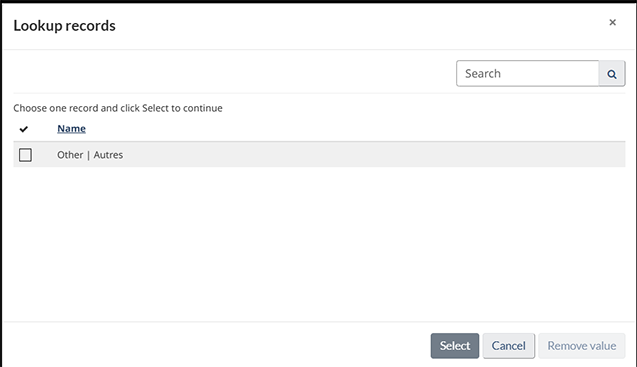
Select the “Other” priority.
To select “Other”, click on the magnifying glass icon and the “Lookup records” window will appear where you can then select the priority.
Otherwise, select 1 of the following priorities that best aligns with your project’s objectives, activities, and outcomes.
Project timelines
- Proposed start date: *
-
This is the proposed date the agreement between the Recipient and PrairiesCan comes into effect.
The start date must be on of after April 30, 2026.
- Costs may be eligible on a retroactive basis for a 12-month period prior to receipt of a funding application, but no earlier than April 30, 2026.
If the application is approved, eligible project costs incurred on or after the project start date may be reimbursed with proper documentation.
- Any costs incurred prior to the project start date are not eligible for reimbursement under the terms of the agreement and are outside of the scope of the project.
- Proposed end date: *
-
This is the anticipated date the project activity will cease. All project activities must be completed by March 31, 2030.
- Any costs incurred after this date are not eligible for reimbursement under the BCSF.
Click Save.
Funding
- Project costs *
-
PrairiesCan contributions for eligible not-for-profit organizations are non-repayable, ranging from a minimum of $250,000 up to $1,000,000 normally per project over a maximum of 4 years.
- Description of types of costs (not activities)
-
List the various cost items you anticipate incurring in the implementation of the project. Each cost item should have its own line (see instructions below).
Recipients must ensure all project cost items are clearly verifiable.
Project costs incurred by the applicant in the absence of a signed contribution agreement with PrairiesCan are incurred at the sole risk of the applicant.
Eligible project costs
Eligible project costs include all costs that are incremental, reasonable, and necessary for carrying out the projects, but are not limited to:
- Costs associated with the construction or improvement (i.e., expansion, renovation, retrofit, climate adaptation or replacement) of community infrastructure
- Direct materials and supplies related to the project
- Purchase of equipment or machinery directly related to or necessary for the project
- Incremental fees paid to professional, technical personnel, consultants and contractors for activities directly related to the project
- Incremental wages and benefits for individuals employed for the project
- Costs related to meeting legal, regulatory, or government requirements
- Design and planning costs (e.g., studies, assessments, design work, and other pre‑construction activities)
- Costs related to signage promoting the visibility of federal contributions
Project costs may be eligible on a retroactive basis up to 12 months prior to the receipt of a signed funding application, but no earlier than April 30, 2026.
PrairiesCan reserves the right to make the final determination on the value of contributions, the inclusion of any in-kind contribution, and to exclude expenditures deemed to be ineligible or outside the scope of the project.
Applicants are encouraged to consider Canadian materials and content, where such materials and content are competitive and available.
Projects must follow competitive, transparent procurement processes.
Ineligible project costs
Project costs that are deemed unreasonable, non-incremental or not directly related to project activities will be ineligible for reimbursement. These include, but are not be limited to:
- Acquisition or leasing of land, buildings, or other facilities
- Recurring operations and maintenance
- Motorized vehicles
- Amortization or depreciation of assets
- Refinancing of existing debt
- Goodwill, in-kind costs, and the purchase of any assets for more than fair market value
Costs incurred prior to the Project Proposed Start Date will not be eligible.
Project costs incurred by the applicant in the absence of a signed funding agreement with PrairiesCan are incurred at the sole risk of the applicant.
Note that commercial projects will not be supported under this program.
- Type
-
Indicate if the cost is capital (such as purchase of equipment and associated costs such as installation) or non-capital (such as salaries, professional fees).
- Amount
-
The anticipated amount of the cost item.
- Total project costs
-
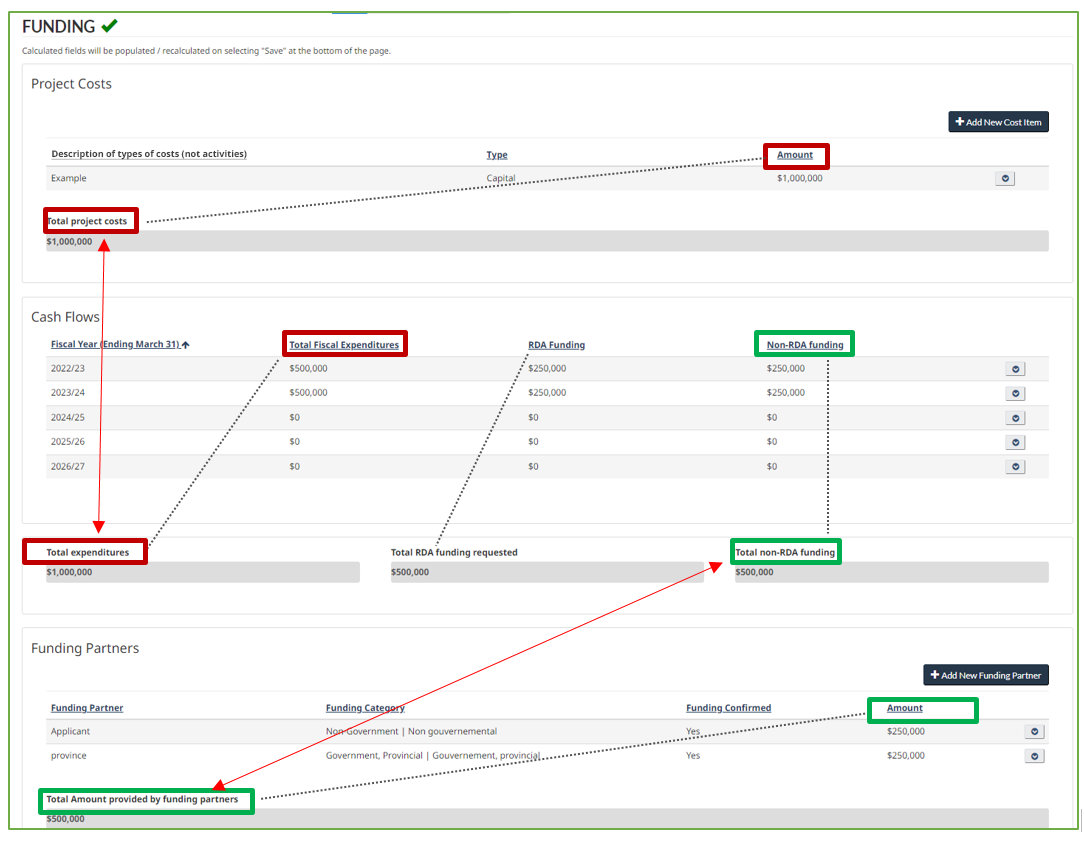
Automatically sums the cost items listed above. Note: This total must equal the total expenditures from the Cash Flows section below.
To add a project cost item, click on the
 Add New Cost Item button and the following window will appear for you to provide the information. Click the Submit button once complete. You will still have the ability to edit the project cost item after hitting this Submit button.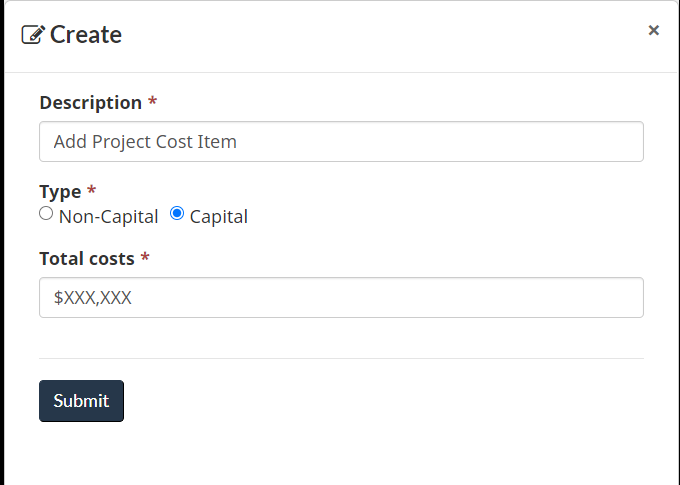
Cash flows *
Financial assistance
Applicants are normally limited to one BCSF project approval.
PrairiesCan contributions for eligible not-for-profit organizations are non-repayable, ranging normally from a minimum of $250,000 up to $1,000,000 per project.
Combined government funding (federal, provincial, municipal) can cover up to 100% of eligible project costs.
PrairiesCan will normally fund up to 50% of eligible project costs.
- The remaining 50% of eligible costs must be supported from a non-PrairiesCan source and must be confirmed at time of application and again prior to project approval.
- BCSF contribution funding for Indigenous recipients may cover up to 100% of eligible project costs.
PrairiesCan considers all other funding sources for the project and will prioritize projects that demonstrate greater leverage of funding from non-PrairiesCan sources and is confirmed at the time of application.
PrairiesCan provides contributions under BCSF, not grants.
- Fiscal year (ending March 31)
-
Select appropriate fiscal year for cash flows.
- Total fiscal expenditures
-
Anticipated total project costs incurred from each fiscal year.
- RDA funding
-
The amount of PrairiesCan funding being requested to support each FY expenses.
- Non-RDA funding
-
Automatically generated: the portion of project expenditures not covered by PrairiesCan funding.
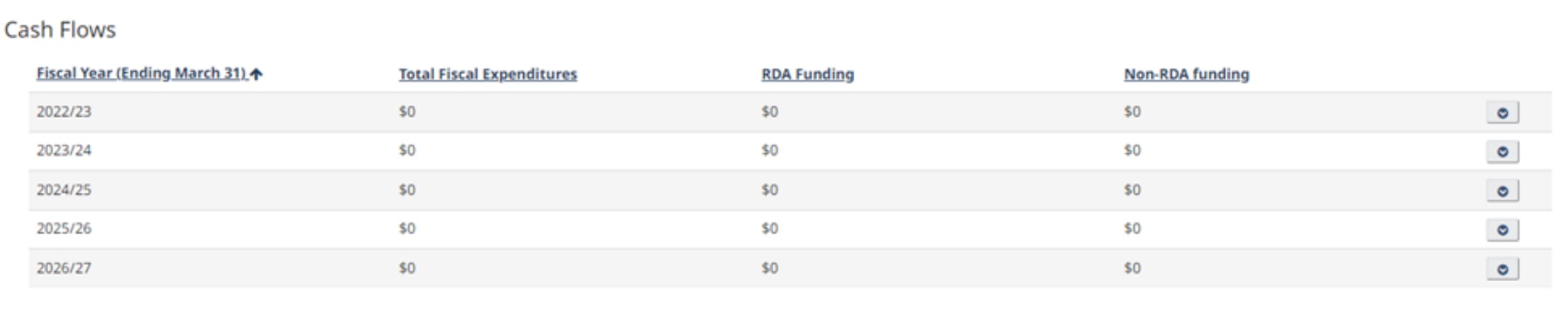
- To enter cash flow information, click the down arrow on the far right for the fiscal year you are interested in. Click the Edit option that appears. Note: the fiscal year shown below is for illustrative purposes only.
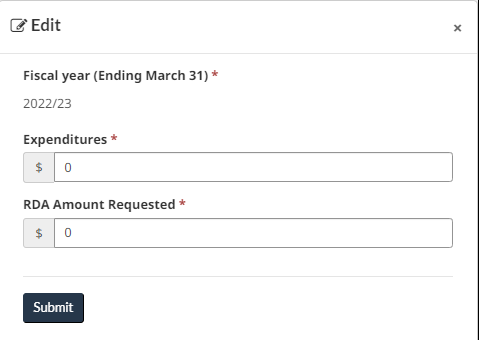
- Enter the Expenditures and RDA Amount Requested information and then hit Submit. You will still have the ability to edit the project cost item after hitting the Submit button. Note: the fiscal years shown below are for illustrative purposes only.
- Total expenditures, total RDA funding requested and total non-RDA funding
-
The system will automatically calculate total PrairiesCan funding requested, as well as Total Fiscal Expenditures. Note that this total must equal total projects costs from the project cost section.
- Total expenditures: *
-
This is the sum of the Total Fiscal Expenditures column in the Cash Flows section. It is automatically calculated.
Note: This total must equal the Total project costs from the Project Costs section above.
- RDA funding requested: *
-
This is the sum of the PrairiesCan Funding column in the Cash Flows section. It is automatically calculated.
- Total non-RDA funding: *
-
This is the sum of the Non-RDA funding column in the Cash Flows section. It is automatically calculated.
Note: This total must equal the Amount provided by funding partners from the Funding Partners section below.
- Funding Partners
-
The first line in the list of funding partners is reserved for the applicant organization. Please add other funding partners or contributors, if any, in subsequent rows. Identify all potential contributors that will provide a monetary contribution to the project.
Identify all potential project contributors including the applicant organization that will provide funding as a monetary contribution or in-kind contribution. Note: applicants must ensure all contributions are clearly verifiable.
- Funding Category
-
Select from the drop down menu the description that best reflects the funding source.
- Funding Confirmed
-
In the case where your organization (Applicant) is a source of funding, indicate yes if you have cash on hand. In the case of other funding sources, indicate yes if there is written documentation supporting the funding.
- Amount
-
The anticipated amount of funding this partner (Applicant or funding partner) will provide.
- To add a funding partner, click on the
 button and the following window will appear for you to input the information. Click the Submit button once complete. You will still have the ability to edit the project cost item after hitting this Submit button.
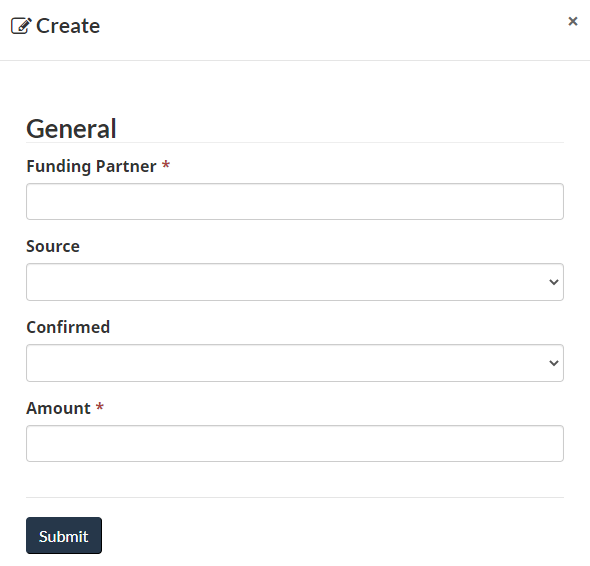
- To edit what your organization will be contributing towards this project, click the down arrow on the far right for the fiscal year you are interested in. Click the Edit option that appears and a similar pop-up window as shown above will appear.

- To add a funding partner, click on the
- Total amount provided by funding partners
-
Automatically sums the funding amounts listed above.
Note: This total must equal the Total non-RDA funding from the Cash Flows section above.
- Briefly describe any partnerships (non-financial and financial), including any costs covered (maximum of 1,200 characters, including spaces) *
-
Describe partnerships that would be important to the success of the proposed project. Include any costs covered by the partnerships.
Funding Partners *
Click Save.
Benefits
- Primary activity: *
-
Choose 1 primary activity that best aligns with your project’s objectives, activities, and outcomes. Your project may be compared to similar projects of a chosen primary activity. The primary activities for BCSF projects are:
- Creation of community infrastructure – includes newly established infrastructure that did not previously exist.
- Improvement of community infrastructure – includes the improvement of existing community infrastructure, such as expansion, renovation, retrofit, climate adaptation, or replacement.
- Indicator: *
-
Note that these should be measured from the project proposed start date until typically 1 year following the project completion. The most common indicators are below, although additional indicators pertaining to your project can be added. If your project does not have a value to report for a listed indicator, input a value of “0” (zero) and enter a target date.
Mandatory indicators
PrairiesCan supports BCSF projects that have a viable plan to produce strong economic outcomes. Applicants must quantify, substantiate, and later report on the following mandatory expected results:
- Total number of jobs created – a job created refers to a job that did not exist with the organization prior to the project, but which was created as a result of the project, and includes:
- Number of highly qualified personnel (HQP) including STEM jobs created in Canada*:
- the number of jobs created as a result of this project that are professional, science, and technology-related jobs – based on an OECD (Organization for Economic Co-operation and Development) definition of ‘science and technology-related jobs’. See definition of this in the glossary. Number of jobs created includes the number of HQP (highly qualified personnel, including STEM) jobs expanded as a result of project supported through PrairiesCan funding. Expanded refers to transitioning a seasonal or part-time employee to a year-round or full-time position, or similar increase in hours.
- One FTE job = 12 person months of employment. (In the case of seasonal or part time employment, person months of employment should be converted to FTE job).
- Inclusiveness sub-types include women, Indigenous Peoples and youth.
- the number of jobs created as a result of this project that are professional, science, and technology-related jobs – based on an OECD (Organization for Economic Co-operation and Development) definition of ‘science and technology-related jobs’. See definition of this in the glossary. Number of jobs created includes the number of HQP (highly qualified personnel, including STEM) jobs expanded as a result of project supported through PrairiesCan funding. Expanded refers to transitioning a seasonal or part-time employee to a year-round or full-time position, or similar increase in hours.
- Number of non-HQP jobs created in Canada
- the number of jobs created as a result of this project that are not considered highly qualified personnel (HQP) as per the definition above. Number of jobs created includes the number of non-HQP jobs expanded as a result of projects supported through PrairiesCan funding. Expanded refers to transitioning a seasonal or part-time employee to a year-round or full-time position, or similar increase in hours.
- One FTE job = 12 person months of employment. (In the case of seasonal or part time employment, person months of employment should be converted to FTE job).
- Inclusiveness sub-types include women, Indigenous Peoples and youth.
- the number of jobs created as a result of this project that are not considered highly qualified personnel (HQP) as per the definition above. Number of jobs created includes the number of non-HQP jobs expanded as a result of projects supported through PrairiesCan funding. Expanded refers to transitioning a seasonal or part-time employee to a year-round or full-time position, or similar increase in hours.
- Number of highly qualified personnel (HQP) including STEM jobs created in Canada*:
- Number of community public spaces created, improved, or expanded
- the total count of distinct community public spaces that will be newly created, significantly improved, or expanded as a direct result of the project. A space is counted if it meets at least one of the following criteria:
- Created: A new public space is built or established where none previously existed.
- Improved: An existing public space undergoes substantial upgrades that increase usability, accessibility, safety, capacity, or quality
- Expanded: An existing public space is physically enlarged or its functional capacity is significantly increased (e.g., added facilities, additional square footage, new amenities).
- the total count of distinct community public spaces that will be newly created, significantly improved, or expanded as a direct result of the project. A space is counted if it meets at least one of the following criteria:
If any of the mandatory indicators are not selected, then please explain why the indicator in question cannot be selected for your project.
PrairiesCan is working actively to improve the economic participation of Indigenous Peoples, women and youth. Note: recipients will be encouraged to establish and track inclusiveness indicators.
- Total number of jobs created – a job created refers to a job that did not exist with the organization prior to the project, but which was created as a result of the project, and includes:
- Provide details on how each of the above indicators will be achieved and tracked as well as any other economic benefits that may be achieved (maximum of 3,000 characters including spaces).*
- Provide a detailed explanation as to how the economic outcomes listed above will be achieved and list any applicable economic outcomes not listed above. Identify and detail how you will be collecting and tracking this information, and all assumptions required to support the reasonableness of your economic outcomes. All projects will be screened for significance of outcomes, proper collection and their likelihood of achievement. If none apply, simply write ‘not applicable’.
- Does your project have activities that will benefit Francophones? If your project includes activities that will directly benefit the Francophone community in Western Canada or if you are willing to modify your project to extend its benefits to the Francophone community, choose yes.*
Select Yes or No.
- If yes, describe how the project activities will benefit Francophones (maximum of 1,500 characters including spaces). *
-
Explain how this project will or could benefit the Francophone community in the Prairie Provinces and what specific activity(ies) will or could include. If Francophones will not benefit from the project, simply write ‘not applicable'.
For example:- The project will hire bilingual staff.
- The project will ensure that any communication tools are produced in French (final report, exhibit, video, etc.)
- Clearly outline the alignment of the project with other Government of Canada priorities, provincial government priorities, industry needs, and your organization's long-term research, capital, and/or strategic plans, if applicable (maximum of 1,500 characters including spaces).
-
Clearly outline if the project aligns with other Government of Canada priorities; municipal or provincial government priorities; and your organization’s capital, and/or strategic plans. This is not a mandatory field. If none apply, simply write ‘not applicable’.
For example:
- The project will advance the Government of Canada’s priority of … by …
Official languages
Under the Official Languages Act, the Government of Canada is committed to supporting the development of official language minority communities (English-speaking communities in Quebec and French-speaking communities in the rest of Canada). More than 2 million Canadians belong to an official language minority community. The intention is to enable these communities to thrive and to enjoy the same benefits as the rest of the population.
Applicants seeking funding under not-for-profit programming may assist PrairiesCan in fulfilling its obligations under the Official Languages Act by identifying aspects of the proposed project that may benefit Francophone communities in Western Canada or by being willing to modify the proposed project to extend its benefits to the Francophone community. This may be as simple as including a French-speaking service provider who is able to offer business services in French as part of the project or offering the final product resulting from the project in French.
Please follow up with your PrairiesCan project officer to explore how you might modify your proposed project to assist the department in extending benefits to the Francophone community.
Click Save.
Project timelines
- Full project description (maximum of 3,000 characters, including spaces).
-
This description should provide clear understanding of the following:
- objectives of the project
- key activities of the project and how these activities will achieve the intended objectives of the project
- outline the plan to achieve the objectives and key activities;
- describe the engagement and/or commitment from other partners (such as industry, other levels of government)
- clearly address any project risks and mitigation measures to address these risks (e.g., project delays, staff turnover, other challenges)
Note that detailed information can be addressed in the required Project plan (refer to the Documents section).
- Project timeline – milestone (project activities) *
-
A milestone is a project activity that can be clearly defined and measured. Provide a list of significant activities or project milestones that can be measured and tracked to ensure the project is proceeding as planned. These should be significant milestones that will be used to ensure your project’s performance over the course of the project, up to the stated completion date of the project.
Select ‘+Add New Project Timeline’ to enter information.
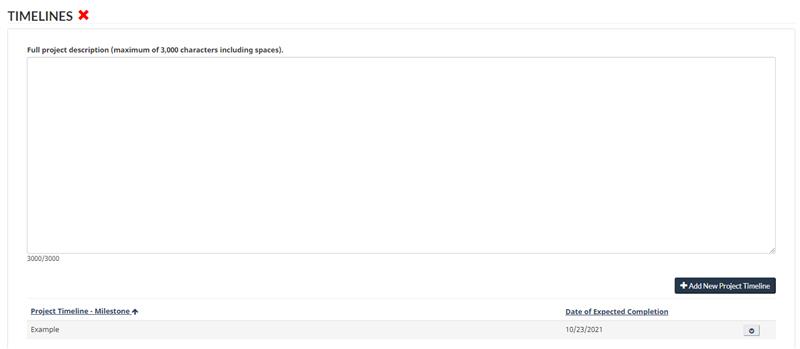
- Date of Expected Completion *
-
This is the date that the milestone should be completed by.
- Timeline Comments (including milestone tracking) (maximum of 1,000 characters including spaces). *
-
Add any information necessary to provide additional clarity regarding the milestones.
Click Save.
Additional details
- Does your organization own the community infrastructure which you are planning to rehabilitate or is a long-term lease and permission to undertake the renovations in place? If you select, “Lease with permissions” it is mandatory to attach the lease to the documents section of this form.
-
Select the option that best describes your organization’s relationship with the infrastructure involved in this project. If this is a lease with permissions, please attach the lease to the Documents section.
- Are plans and specifications for the project prepared?*
-
Select yes or no.
- Have all necessary construction permits and environmental approvals been secured?*
-
Select yes or no.
- If yes, please explain (maximum of 500 characters including spaces)
-
Indicate what permits were necessary, and when the permits were issued. Further, indicate if the permit requires work to be completed by a specific date. If the project is subject to the Impact Assessment Act, indicate at what stage the approval process is at, and if there are any restrictions or conditions that need to be met.
- Will your project have a significant impact on Indigenous communities?
-
Select yes or no.
Click Save.
Documents
- Upload here the supporting documents to be provided with your application.
-
Upload the following mandatory documents marked with an asterisk (*) and other supporting documents:
- Confirmed funding*
- Funding will only be considered confirmed if written proof is provided
- Evidence of confirmation of all other (non-PrairiesCan) sources of project funding*
- for funding to be provided by the applicant organization – current bank statements detailing existing cash balances or unused portion of lines of credit
- for third-party funding sources – official letters of intent (on letterhead, signed) and/or funding agreements, signed term sheet
- PrairiesCan does not consider the following as proof of confirmed funding:
- forecasted revenues from future activities
- accounts receivables
- commitments to obtain future bank financing
- Copy of ownership/lease agreement *
- Describe your organization’s legal relationship to the community infrastructure included in the proposed project. Is it owned by the applicant organization or is it leased with permissions?
- If owned, upload proof of ownership (e.g., certificate of title).
- If leased with permissions, you must upload a copy of the lease agreement. The lease must confirm the applicant organization has permission to undertake the proposed rehabilitation work and describe the relationship between the applicant organization and the owner of the infrastructure.
- Describe your organization’s legal relationship to the community infrastructure included in the proposed project. Is it owned by the applicant organization or is it leased with permissions?
- Financial statements over the past 2 years *
- financial statements for the past 2 years*.
- the financial statements should be prepared by an external accountant. If externally prepared statements are not available, please provide a rationale as to why they are not available.
- Letters of support for the proposed project resulting from community engagement
- Project plan/gantt chart * consisting of:
- Project overview – basic project information including name, location, a description outlining the project’s management oversight and governance (e.g., roles and responsibilities), what will be built or improved, and alignment with BCSF objectives and priorities.
- Project rationale – evidence‑based explanation of why the project is needed (e.g., infrastructure needs assessment) and how it responds to community or government priorities.
- Project scope and description – clear description of the asset, key features, and what is included or excluded.
- Project delivery approach – overview of project phases from design and approvals (e.g., regulatory approvals, resolutions to proceed) through to construction (e.g., procurement schedule, documentation acknowledging construction readiness, compliance with relevant standards), commissioning, and operations
- Environmental considerations – environmental assessments.
- Indigenous consultation (if applicable) – summary of engagement activities and how feedback was addressed.
- Community engagement and benefits – description of community support, accessibility improvements, and social or cultural benefits.
- Financial plan and budget – defined how the project will be funded and financially managed including detailed cost estimates, funding partners, contingency rationale.
- Risk management – key risks (financial, regulatory, construction, governance) and mitigation strategies.
- Project timeline and readiness – major milestones, start and end dates, and procurement schedule.
- Performance measurement – indicators and methods to track outcomes and report on results.
- Operations and sustainability – long‑term operating model, maintenance approach, and financial sustainability.
- Proof of permissions to undertake renovations * (if applicable)
- Supporting documents
- incorporation documents for your organization and proof of signing authority (e.g. bylaws, articles of incorporation, board minutes or record of decision) *
- proof of shovel readiness such as required permits, regulatory approvals and resolutions. *
- a detailed budget should demonstrate the names and amounts of costs associated with the project as well as a forecast of cash flows for the duration of the project.
- A template can be shared if you do not have a detailed budget.
- other supporting documentation that you feel support for your project, if applicable.
Click Save.
Signing authority
The application form must be submitted by a member of your organization with signing power/authority to enter into a legal agreement with PrairiesCan.
Note: the fields marked with an asterisk (*) need to be completed in order to submit this form.
- First name: *
-
Provide the first name of the member of the organization with signing power/the authority to enter into an agreement. This person should be either the primary or the secondary contact.
- Last name:
-
Provide the family name of the contact.
- Title:
-
Provide the contact person’s job title (such as president, executive director).
- Email address:
-
Provide a valid e-mail address.
- Telephone country code:
-
The telephone country code of where the contact person can be reached.
- Telephone:
-
Provide a phone number where the contact person can be reached.
- Cellular country code:
-
The cellular country code of your organization.
- Cellular phone:
-
The cellular number of your organization.
Click Save.
Diversity and inclusion
The Government of Canada is committed to diversity and inclusion so that all Canadians have the opportunity to participate in and contribute to the growth of the economy. Gender and diversity data collected may be used for research, statistics, program and policy evaluation, risk management, strategy development, reporting, and gender-based analysis (including GBA+). This information can help the Government of Canada monitor progress on inclusive access to federal support programs and services; to identify and remove barriers; and, to make changes to improve inclusive access. The Government of Canada understands that participation of underrepresented groups is an integral part of building strong and inclusive communities and economy.
No personal identifying information will be shared. Aggregate and anonymous data may be shared with other federal organizations and/or published for reporting and monitoring purposes.
Unless otherwise directed by the program, the following gender and diversity data will not be used to assess the application. It is being collected for statistical purposes and may feed into future programming.
- Is your organization majority (in other words, over 50%) owned or led by individuals who self identify as:
-
The purpose of this question is to gather information related to the ownership/leadership of the organization to see which diverse groups PrairiesCan funds. Answer related sub-questions below. Please refer to the glossary for definition on “majority-owned” and any of the diverse groups.
- Will your project directly support any of the following diverse groups?
-
This question is regarding the people that will benefit from this project. Will your project directly support any of the groups listed? If so, please answer ‘yes’. If you do not know if your project will directly support a particular group, or prefer not to answer, just leave the field blank. This information may be considered in assessing your project. Refer to the glossary for definition on “majority-owned” and any of the diverse groups.
- If yes is selected for any of the following diverse groups, then specify (maximum of 1,500 characters).
-
Provide an explanation on how your project will directly support the diverse group selected.
Click Save.
Validation
For this step, any errors or omissions in the form will be brought to your attention, and you will be given the opportunity to review them, and make any necessary corrections.
Attestation
Before you can complete and submit your application, it is necessary in this final step for you to affirm that you are aware of certain statutory obligations, that your organization meets the eligibility requirements for the program, and that the collected information may also be used for consideration under other government programs.
Please ensure the attestation is completed by the primary contact, who is also the member of your organization with signing power/authority to enter into a legal agreement with PrairiesCan.
Click off the check box to indicate you have read and agree with the acknowledgements.
Authorized official of the applicant organization acknowledgements
The application form must be submitted by a member of your organization with signing power/authority to enter into a legal agreement.
On behalf of the Applicant Organization, I hereby acknowledge and agree that:
- This application does not constitute a commitment from Prairies Economic Development Canada (PrairiesCan) for financial assistance.
- I have read and understand the application process, including the mandatory eligibility criteria located on PrairiesCan’s public website.
- Project costs incurred by the Applicant Organization in the absence of a signed funding agreement with PrairiesCan are incurred at the sole risk of the Applicant Organization and that any such costs may not be considered eligible for PrairiesCan assistance.
- Any person who has been lobbying on behalf of the Applicant Organization to obtain a contribution as a result of this application is registered pursuant to the Lobbying Act and was registered pursuant to that Act at the time the lobbying occurred.
- The Applicant Organization is under no obligation or prohibition, nor is it subject to, or threatened by any actions, suits or proceedings, which could or would affect its ability to implement this proposed project.
- The Applicant Organization has not, nor has any other person, corporation or organization, directly or indirectly paid or agreed to pay any person to solicit a contribution arising as a result of this application for a commission, contingency fee or any other consideration dependent on the execution of an Agreement or the payment of any contribution arising as a result of this application.
- Prairies Economic Development Canada (PrairiesCan) and Pacific Economic Development Canada (PacifiCan) are government institutions as defined under the Access to Information (ATI) Act. Records in the custody and care of the institution are subject to disclosures under Part 1 and Part 2 of the ATI Act with limited exceptions and exclusions.
- Personal information collected by PrairiesCan is collected in accordance with section 4 of the Privacy Act (R.S.C., 1985, c. P-21). This information will be used to determine eligibility, administer grants and contributions, and evaluate program effectiveness. Personal information collected is described in the Personal Information Bank entitled “Grants and Contributions”, number PrairiesCan-PPU-055. Questions regarding the collection and use of your personal information may be directed to the ATIP Coordinator, PrairiesCan, Canada Place, 1500-9700 Jasper Avenue NW, Edmonton, Alberta T5J 4H7, by telephone at 780-495-4164, or by email to atip-aiprp@prairiescan.gc.ca.
If you choose not to provide the personal information, your application may not be processed.
You have a right under section 12 of the Privacy Act to access to your personal information under the control of PrairiesCan as well as a right to request correction of personal information where there is an error or omission. You have the right to make a complaint to the Office of the Privacy Commissioner under section 29(1) of the Privacy Act regarding PrairiesCan’s collection, use, and disclosure of your personal information, processing of your request for correction of personal information or processing of your access to personal information request.
I authorize PrairiesCan, its officials, employees, agents and contractors to make credit checks and enquiries of such persons, firms, corporations, federal, provincial and municipal government departments/agencies, and non-profit, economic development or other organizations as may be appropriate, and to collect and share information with them, as PrairiesCan deems necessary in order to assess this application, to administer and monitor the implementation of the subject project, and to evaluate the results of the project and related Programs.
I have read and agree with the above acknowledgements and certify that all statements and information furnished in this application are true, complete and correct to the best of my knowledge. *
Environmental assessment compliance
Projects involving physical works may be subject to the Impact Assessment Act (2019). Recipients of PrairiesCan funding will be responsible for obtaining all certificates, consents, permits and approvals required for compliance with applicable legislation and for complying with the requirements of such legislation. Should an environmental assessment be required, it will be necessary to plan several months before the project Proposed Start Date to allow sufficient time for the completion of the assessment.
Reporting requirements
All contribution agreements jointly signed between PrairiesCan and a successful applicant include a requirement for periodic reports in order to demonstrate progress in implementing the project and achieving the economic results. These progress reports are required at least twice a year to support claims for reimbursement of project costs. Recipients are also required to provide financial statements to PrairiesCan throughout project implementation.
Glossary
Below is a short glossary of terms used in this guide:
- Assessment
-
Thorough review and analysis of all aspects of an application prior to entering into a contribution agreement. This includes scoping of the project to meet program and department objectives as well as Government of Canada guidelines for funding contributions.
- Black community(ies)
-
This term is a designation used for people of full or partial descent from over 200 ethnic or cultural origins, including sub-Saharan African descent, who are citizens or permanent residents of Canada. The majority of “Black” Canadians are of Caribbean origin, though the population also consists of African-American immigrants and their descendants (including Black Nova Scotians), as well as many native African immigrants.
- Community infrastructure (for public use)
-
Infrastructure that is accessible to the public (i.e., access is not primarily limited to paid membership) that provides economic, social, or environmental benefits for the broader community, region, or Canada.
- Commercial project
-
Project activity where forecasted revenue generation is beyond cost recovery, and is material and profit driven.
- Contribution
-
A monetary payment to a successful Recipient that does not result in the acquisition by the Government of Canada of any goods, services, or assets. The payment(s) will be for assisted costs as identified in the Contribution Agreement with PrairiesCan. The successful Recipient must first pay the cost of the service or good and then submit a claim, which provides proof that the cost has been incurred and paid for by the Recipient. PrairiesCan then reimburses such costs on the percentage basis specified in the Contribution Agreement.
Contributions are subject to performance conditions specified in a Contribution Agreement and therefore a Recipient is required to report to PrairiesCan on results achieved. A contribution is to be accounted for, is subject to audit and, where profit is generated by the project, it may be subject to repayment conditions also specified in the contribution agreement.
- Diverse groups
-
Includes, but is not limited to people living with disabilities, Indigenous persons, youth, immigrants, persons from racialized communities and people from official language minority communities (OLMCs).
- Full-time equivalent
-
The number of full-time employees working for the organization.
- Gender
-
This refers to the socially constructed roles, behaviours, expressions and identities of girls, women, boys, men, and gender diverse people. It influences how people perceive themselves and each other, how they act and interact and the distribution of power and resources in society. Gender is usually conceptualized as a binary (girl/women and boy/man), yet there is considerable diversity in how individuals and groups understand, experience, and express it. Self-identifying gender is an expression of what a person internally feels and/or the gender a person publicly expresses in their daily life. A person’s current gender may differ from the sex a person was assigned at birth (male, female, or intersex) and may differ from what is indicated on their current legal documents. A person’s gender may change over time.
- Government assistance
-
Funding from any level of government (federal, provincial or municipal). Also includes funding from any organization that is fully funded by government, and does not make investment decisions independent from government or on a commercial basis.
- Highly qualified personnel (HQP)
-
Canada’s Highly Qualified personnel (HQP) are defined as individuals with university degrees at the bachelor’s level and above.
- Incremental
-
Activities to be undertaken that are additional to the applicant’s current operations or activities.
- Indigenous Peoples
-
Refers to those persons who identify with at least 1 Indigenous group, that is First Nations, Métis or Inuit. Aboriginal peoples of Canada (referred to here as Indigenous peoples) are defined in the Constitution Act, 1982, Section 35 (2) as including the Indian, Inuit and Métis peoples of Canada.
- In-kind costs/contributions
-
Contributions toward project costs that do not involve a cost incurred or paid for by the recipient. These types of contributions should be demonstrated in the application at fair market value.
- 2SLGBTQI+
-
Refers to those persons who identify as lesbian, gay, bisexual, transgender, intersex, queer, 2-spirit, non-binary or gender queer, questioning, asexual, pansexual, agender, bigender, gender variant, and pangender.
- Majority-owned/led
-
Majority owned or led is defined as an enterprise where 1 or more of the diverse groups has long-term control and management of the organization and an active role in both strategic and day to day decision making. In for-profit enterprises, this may include an equity stake.
- Long-term control and management of the organization – have been engaged in the operation, management and ownership of the organization for at least 2 years
- Active role in strategic decision making – involved in elements related to the establishment of priorities, objective and goals for the organization; overall operations of the organization
- Day to day decision making – involved in elements related to the financial management, human resources, supply management, logistics or customer services (for example)
- Equity stake – demonstrates an ownership in the company
Majority-owned is where an individual(s) owns more than 50% of the company.
- Newcomer to Canada or immigrant
-
Person(s) who have landed in Canada within in the last 10 years.
- Official language minority communities (OLMCs)
-
English-speaking communities in Quebec and French-speaking communities in provinces and territories other than Quebec.
- Person with a disability
-
A person with long-term or recurring disabilities related to hearing, vision, mobility, flexibility, dexterity, pain, learning, mental health, memory, and developmental impairment or functional limitation and who consider themselves to be disadvantaged by reason of that impairment.
- Project
-
The group of activities and actions, which are cost-shared, that occurs in the period between the RDA Project Start Date and the Project End Date.
- Proposed start date
-
This is the date an agreement between a Recipient and the department comes into effect. Any costs incurred prior to this date are not eligible for reimbursement under the terms of the agreement and are outside of the scope of the project. It can be thought of as the start date for the project as defined by the contribution agreement.
- Proposed end date
-
The date it is anticipated that project activity will cease.
- Racialized communities
-
Groups that have been socially constructed as races, other than Indigenous peoples, persons from Black communities, or persons who are Caucasian in race or white in colour, based on characteristics such as ethnicity, language, economics, religion, culture, and/or politics. For example, Chinese, Japanese, Korean, South Asian/East Indian, Southern Asian, non-white West Asian, North African or Arab, non-white Latin American, persons of mixed origin (with 1 parent in 1 of the visible minority or racialized groups in this list), or other racialized or visible minority group.
- Regional Development Agency (RDA)
-
Canada’s regional development agencies (RDA) work closely with businesses and innovators in their regions to fuel economic growth that creates more well-paying middle-class jobs for Canadians.
They are a key part of the Government of Canada’s Innovation and Skills Plan, advancing and diversifying our regional economies and helping communities thrive. There are 7 RDAs across Canada including Prairies Economic Development Canada (PrairiesCan) and Pacific Economic Development Canada (PacifiCan).
- Women
-
The use of the word “women” is inclusive of cisgender and trans individuals.
- Youth
-
Person(s) who are between the ages of 15 and 34.