
Quarterly Financial Report - Statement outlining results, risks and significant changes in operations, personnel and programs - For the quarter ended June 30, 2026
1. Introduction
This quarterly report has been prepared by management as required by section 65.1 of the Financial Administration Act and in the form and manner prescribed by the Directive on Accounting Standards, GC 4400 Departmental Quarterly Financial Report. This quarterly financial report should be read in conjunction with the Main Estimates, Supplementary Estimates, and previous Quarterly Financial Reports. For more information on Privy Council Office (PCO), please visit PCO's website.
This quarterly report has not been subject to an external audit or review but has been shared with and reviewed by the PCO Departmental Audit Committee.
1.1 Mandate
PCO supports the development and implementation of the Government of Canada's policy and legislative agendas, coordinates responses to issues facing the Government and the country and supports the effective operation of Cabinet. PCO is led by the Clerk of the Privy Council, who also serves as Secretary to the Cabinet and the Head of the Public Service.
PCO’s key priorities are to:
- Provide non-partisan advice to the Prime Minister, PCO’s portfolio ministers, Cabinet, and Cabinet committees on matters of national and international importance;
- Support the smooth functioning of the Cabinet decision-making process to help implement the Government’s agenda;
- Ensure Canada is safe and secure, and promote a fair, transparent, and democratic government; and
- Foster an effective, diverse, inclusive, and innovative public service.
1.2 Basis of presentation
This quarterly report has been prepared by management using an expenditure basis of accounting. The accompanying Statement of Authorities includes PCO’s spending authorities granted by Parliament and those used by the department, consistent with the 2026-27 Main Estimates and Supplementary Estimates (A). This quarterly report has been prepared using a special purpose financial reporting framework (expenditure basis) designed to meet financial information needs with respect to the use of spending authorities.
The authority of Parliament is required before money can be spent by the Government. Approvals are given in the form of annually approved limits through appropriation acts or through legislation in the form of statutory spending authority for specific purposes.
PCO uses the full accrual method of accounting to prepare and present its annual departmental financial statements1 that are part of the departmental results reporting process. The spending authorities voted by Parliament remain on an expenditure basis.
2. Highlights of fiscal quarter results
This section highlights the significant items that contributed to the net increase or decrease in authorities available for the year and actual expenditures for the quarter ended June 30, 2026.
PCO spent approximately 21% of its authorities available for use at the end of the first quarter of 2026-27, compared to 20% at the end of the same quarter of 2025-26 (see graph 1 below).
Graph 1: Comparison of total authorities available for use and total net budgetary expenditures as of Q1 2026-27 and 2025-26
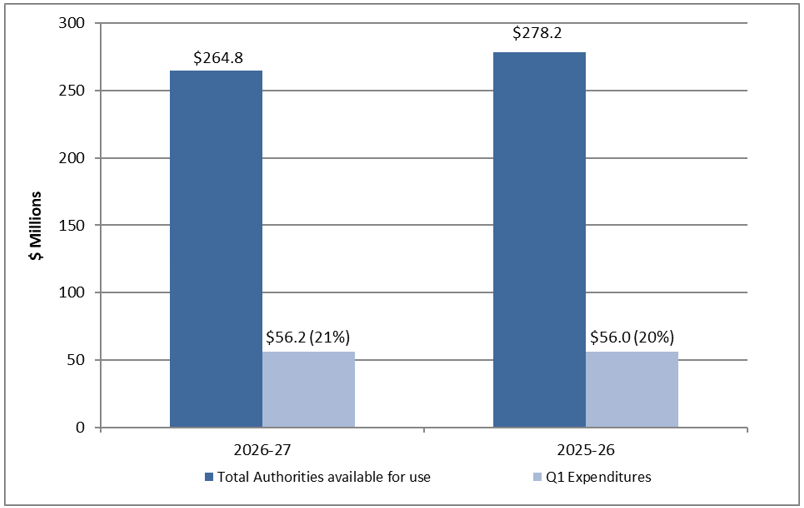
Text version - Graph 1
| 2026-27 | 2025-26 | |
|---|---|---|
| Total authorities available for use | 264.8 | 278.2 |
| Q1 expenditures | 56.2 (21%) | 56.0 (20%) |
2.1 Significant changes to authorities
Further to graph 2 below and Annex A, presented at the end of this document, as of June 30, 2026, PCO has authorities available for use of $264.8 million in 2026-27 compared to $278.2 million as of June 30, 2025, for a net decrease of $13.4 million or 5%. The net decrease in authorities is mainly explained by the conclusion of funding provided in 2025-26 for the Candidate Security Program of the 45th General Election and election or post-election related costs, as well as spending reductions announced in Budget 2025 and Budget 2023. These decreases are partially offset by an increase in funding for the Major Projects Office, advertising initiatives, and construction activities to enhance PCO’s security posture in 2026-27.
Graph 2: Variance in authorities as of June 30, 2026
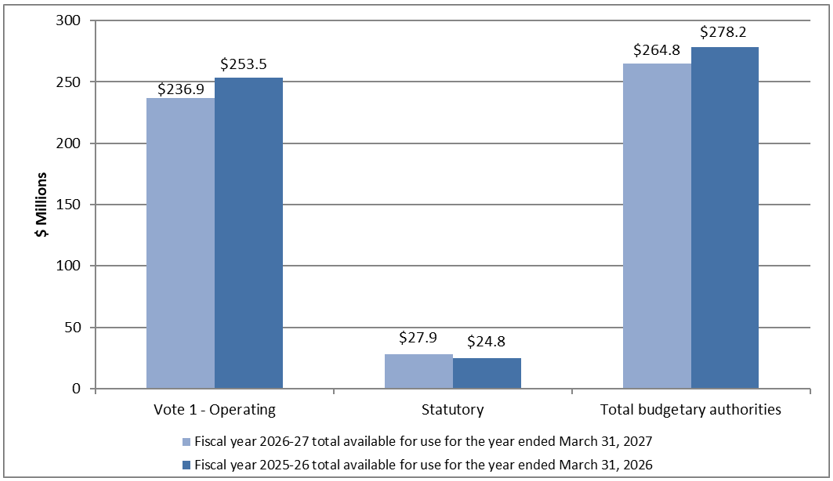
Text version - Graph 2
| Vote 1 - Operating | Statutory | Total budgetary authorities | |
|---|---|---|---|
| Fiscal year 2026-27 total available for use for the year ended March 31, 2027 | 236.9 | 27.9 | 264.8 |
| Fiscal year 2025-26 total available for use for the year ended March 31, 2026 | 253.5 | 24.8 | 278.2 |
2.2 Significant changes to quarter expenditures
The first quarter expenditures totaled $56.2 million for a net increase of $0.2 million (0%) when compared to $56.0 million spent during the same period in 2025-26. Table 1 below presents budgetary expenditures by standard object.
Table 1
| Material Variances to Expenditures by Standard Object | Fiscal year 2026-27 Expended during the quarter ended June 30, 2026 |
Fiscal year 2025-26 Expended during the quarter ended June 30, 2025 |
Variance $ | Variance % |
|---|---|---|---|---|
| Personnel | 48,575 | 48,520 | 55 | 0% |
| Transportation and communications | 1,923 | 1,464 | 459 | 31% |
| Information | 739 | 398 | 341 | 86% |
| Professional and special services | 1,772 | 3,059 | (1,287) | (42%) |
| Rentals | 910 | 1,070 | (160) | (15%) |
| Repair and maintenance | 82 | 155 | (73) | (47%) |
| Utilities, materials and supplies | 113 | 72 | 41 | 57% |
| Acquisition of machinery and equipment | 1,519 | 904 | 615 | 68% |
| Other subsidies and payments | 605 | 374 | 231 | 62% |
| Total gross budgetary expenditures | 56,238 | 56,018 | 220 | 0% |
| Less revenues netted against expenditures | 0 | 0 | 0 | 0% |
| Total net budgetary expenditures* | 56,238 | 56,018 | 220 | 0% |
| * Details may not add to totals due to rounding | ||||
Information
The increase of $0.3 million in information is mainly due to increased spending on public opinion research in the first quarter of 2026-27.
Professional and special services
The decrease of $1.3 million in professional and special services is mainly due to lower spending on protection services in the first quarter of 2026-27 following the conclusion of the Candidate Security Program of the 45th General Election, as well as the timing of invoicing for other protection services.
Acquisition of machinery and equipment
The increase of $0.6 million in acquisition of machinery and equipment is mainly due to increased spending on computer equipment and application software in the first quarter of 2026-27.
Other subsidies and payments
The increase of $0.2 million in other subsidies and payments is mainly due to higher temporary advances related to media travel costs, which will be recovered in subsequent quarters.
3. Risks and uncertainties
The principal financial risks to PCO lie in the need to find financial solutions to issues that may emerge unexpectedly. As part of its coordinating role, PCO must be able to address emerging issues on short notice, and either manage the necessary expenditures within its own spending authorities, or cash manage until increased spending authorities or other sources of funds are approved.
PCO is monitoring evolving risks related to security (IT/cybersecurity/insider/physical), information management, increasing horizontality across government, and organizational capacity. Limited data and performance indicators may affect the department's ability to track progress and demonstrate results, while increasing horizontality may lead to duplication of effort or inconsistent advice, requiring additional resources to support coordination. The growing complexity and scope of work, combined with resource constraints and sustained workload pressures, may also create pressures on service delivery, staffing, and salary budgets.
The department will continue to effectively manage its existing and emerging risks through cooperation, engagement and sharing of expertise and best practices with other federal departments and agencies, provincial and territorial governments, as well as community partners, the private sector, international counterparts, and its Department Audit Committee.
4. Significant changes in relation to operations, personnel and programs
Effective June 27, 2026, Isabelle Mondou, Deputy Clerk of the Privy Council, assumed responsibility for the Governance Branch following the announced retirement of Mala Khanna, former Deputy Secretary to the Cabinet (Governance).
5. Approval by senior officials
Michael Sabia
Clerk of the Privy Council and
Secretary to the Cabinet
Connie Rivet
Acting Assistant Secretary to the Cabinet
Ministerial Services and Corporate Affairs and Chief Financial Officer
Ottawa, Canada
Friday August 28, 2026
6. Annexes A & B
Annex A
Privy Council Office
Quarterly Financial Report
For the quarter ended June 30, 2026
Statement of authorities (unaudited) (note 2)
| Expenditures/Authorities | Fiscal year 2026-2027 | Fiscal year 2025-2026 | ||||
|---|---|---|---|---|---|---|
| Total available for use for the year ending March 31, 2027 (note 1) |
Used during the quarter ended June 30, 2026 |
Year-to-date used at quarter–end | Total available for use for the year ending March 31, 2026 (note 1) |
Used during the quarter ended June 30, 2025 |
Year-to-date used at quarter–end | |
| Vote 1 - Net operating expenditures | 236,857 | 49,259 | 49,259 | 253,455 | 49,841 | 49,841 |
| Budgetary statutory authorities | ||||||
| Contributions to employee benefits plans | 27,589 | 6,897 | 6,897 | 24,329 | 6,082 | 6,082 |
| Prime Minister - Salary and motor car allowance | 221 | 55 | 55 | 213 | 35 | 35 |
| Leader of the Government in the House of Commons - Salary and motor car allowance | - | - | - | 94 | 8 | 8 |
| Leader of the Government in the House of Commons and Minister of Democratic Institutions - Salary and motor car allowance | - | - | - | 8 | 8 | 8 |
| President of the King's Privy Council for Canada and Minister responsible for Canada-U.S. Trade, Intergovernmental Affairs and One Canadian Economy - Salary and motor car allowance | 106 | 26 | 26 | 91 | 14 | 14 |
| Minister of International Trade and Intergovernmental Affairs and President of the King’s Privy Council for Canada - Salary and motor car allowance | - | - | - | 12 | 12 | 12 |
| Chief Government Whip - Salary and motor car allowance | - | - | - | 17 | 17 | 17 |
| Total budgetary authorities | 264,773 | 56,238 | 56,238 | 278,218 | 56,018 | 56,018 |
| Total authorities | 264,773 | 56,238 | 56,238 | 278,218 | 56,018 | 56,018 |
| Note 1: Includes only authorities available for use and granted by Parliament at quarter-end for each respective fiscal year (Including Frozen Allotments). Note 2: Details may not add to totals due to rounding. |
||||||
Annex B
Privy Council Office
Quarterly Financial Report
For the quarter ended June 30, 2026
Departmental budgetary expenditures by Standard Object (unaudited) (note 2)
| Departmental budgetary expenditures | Fiscal year 2026-2027 | Fiscal year 2025-2026 | ||||
|---|---|---|---|---|---|---|
| Planned expenditures for the year ending March 31, 2027 (note 1) |
Expended during the quarter ended June 30, 2026 |
Year-to-date used at quarter–end | Planned expenditures for the year ending March 31, 2026 (note 1) |
Expended during the quarter ended June 30, 2025 |
Year-to-date used at quarter–end | |
| Budgetary expenditures | ||||||
| Personnel | 203,648 | 48,575 | 48,575 | 183,777 | 48,520 | 48,520 |
| Transportation and communications | 7,518 | 1,923 | 1,923 | 5,970 | 1,464 | 1,464 |
| Information | 9,049 | 739 | 739 | 3,782 | 398 | 398 |
| Professional and special services | 30,506 | 1,772 | 1,772 | 77,812 | 3,059 | 3,059 |
| Rentals | 5,265 | 910 | 910 | 6,613 | 1,070 | 1,070 |
| Repair and maintenance | 2,817 | 82 | 82 | 1,692 | 155 | 155 |
| Utilities, materials and supplies | 669 | 113 | 113 | 981 | 72 | 72 |
| Acquisition of land, buildings and works | 4,600 | - | - | - | - | - |
| Acquisition of machinery and equipment | 8,893 | 1,519 | 1,519 | 5,540 | 904 | 904 |
| Other subsidies and payments | - | 605 | 605 | - | 374 | 374 |
| Total gross budgetary expenditures | 272,964 | 56,238 | 56,238 | 286,166 | 56,018 | 56,018 |
| Less revenues netted against expenditures Revenues (note 3) |
(8,192) | - | - | (7,947) | - | - |
| Total revenues netted against expenditures | (8,192) | - | - | (7,947) | - | - |
| Total net budgetary expenditures | 264,773 | 56,238 | 56,238 | 278,218 | 56,018 | 56,018 |
| Note 1: Includes only authorities available for use and granted by Parliament at quarter-end for each respective fiscal year (Including Frozen Allotments). Note 2: Details may not add to totals due to rounding. Note 3: PCO's revenues are sourced from the provision of intelligence analysis training and the provision of internal support services to other departments. |
||||||