
Evaluation of the Public Service Commission of Canada’s Support Activities: Phase 1
Table of contents
Executive summary
This report presents the results of Phase 1 of the evaluation of the Public Service Commission of Canada (PSC)’s support activities. The PSC’s support activities are provided by the Policy and Communications Sector, the Oversight and Investigations Sector and the Services and Business Development Sector to federal departments and agencies. Phase 1 used PSC data to assess the complementarity, potential synergies and agility of the PSC’s support activities in adapting to evolving recruitment, staffing and non-partisanship needs.
Key findings
- Complementarity and overlap: The PSC’s support activities are complementary, enabling wide reach, customized support and training and enhanced learning opportunities. However, distinct services provided through similar delivery channels can create challenges in communication and coordination. Nearly half of respondents identified areas where there may be risks of overlap.
- Synergies: Interviews and a document review revealed that the Policy and Communications Sector, the Oversight and Investigations Sector and the Services and Business Development Sector collaborate effectively, each contributing distinct strengths to deliver comprehensive support. However, greater collaboration, clarity and agreement on role expectations could enhance the impact of their activities.
- Agility: The PSC’s support activities are agile in their ability to pivot, continuously improve information sharing. However, barriers to adapting to evolving needs were noted for the Policy and Communications Sector and the National Recruitment Directorate. Opportunities for improvement include enhanced outreach and engagement, unified learning opportunities and strategic expertise and advice.
Recommendations
To improve the effectiveness and efficiency of the PSC support activities, the PSC should do the following:
Recommendation 1
Improve the governance of the PSC’s support activities by:
- integrating planning and monitoring of the outreach activities within the revised governance structure of the PSC for greater organizational awareness, by:
- establishing a standing agenda item at the Policy and Program Committee for programs to regularly share their outreach planning cycles
- at the meetings, ensure that the appropriate sectors are represented to discuss outreach activities
- establishing a standing agenda item at the Policy and Program Committee for programs to regularly share their outreach planning cycles
- documenting roles, responsibilities, purpose and target audiences of outreach, including identifying when coordination between sectors is required
- this document should be reviewed and updated annually through the Policy and Program Committee
Rationale
Persistent ambiguity around roles, particularly in outreach and engagement, has led to confusion about who represents the PSC’s voice, both internally and externally (as reported by internal interviewees). Nearly half of internal respondents identified risks of overlap or duplication, especially when different sectors present similar information to the same audiences. This lack of clarity may reduce coordination stakeholder confidence and limits the strategic impact of support activities.
To address this, the PSC could integrate support activities into its revised governance. Establishing a standing agenda item at the Policy and Program Committee for programs to regularly share their outreach planning cycles would allow for better coordination of support activities.
Planning cycles for outreach activities could be shared with this committee, ensuring all sectors involved are represented at the meetings. These cycles would enable sectors to align their outreach efforts, reduce duplication and identify opportunities for collaboration. This approach supports more coherent messaging and maximizes the impact of limited resources.
A governance charter could formalize roles, responsibilities, target audiences and coordination protocols, ensuring consistent alignment with organizational priorities and enabling co-delivery or consolidation where appropriate.
Recommendation 2
Improve tools and information sharing by:
- adopting shared systems (for example, customer relationship management system, shared calendar, coordination or project management platform)
- recording relevant outreach sessions
Rationale
Outdated tools and fragmented communication systems are major barriers to the PSC’s effectiveness. Internal respondents highlighted the limitations of current technologies like Excel and GCdocs, which hinder information sharing and increase administrative burden. A shared system, such as a customer relationship management system would constitute a centralized repository of client interactions, improve internal coordination and support more strategic decision-making. Alternatively, the PSC’s support activities could be mapped on a shared calendar to identify overlaps, gaps and opportunities for co-delivery, with coordination or project management platform. These tools would also enhance transparency, reduce duplication and inconsistencies in the PSC’s response and enable more responsive and client-focused service delivery. Ongoing pilot initiatives, such as the customer relationship management system with the National Recruitment Directorate, demonstrate readiness for broader implementation. Recording some of the relevant outreach sessions will result in cost savings and allow flexibility in delivering the sessions.
Introduction
The evaluation of the Public Service Commission of Canada (PSC)’s support activities aims to answer the overarching question, “Should the PSC redefine its role in providing support and optimizing its delivery? If so, how?” The evaluation covers a period of 5 years from October 1, 2019, to December 31, 2024, and is being conducted in 3 phases. This evaluation focuses on the activities provided to federal departments and agencies that involve strategic aspects of recruitment, staffing and non-partisanship support.
This report relates to the first of 3 planned phases and covers the internal structure and aspects of support activities at the PSC. The results presented in this report will inform decision-making and guide the evaluation process. For more details about the definitions, evaluation scope and evaluation questions, see Appendix A.
Support activities: a description
For the purposes of this evaluation, the PSC’s support activities include roles and activities that provide external advice, guidance and outreach to federal departments and agencies under the Public Service Employment Act and to federal functional communities. Support activities reinforce inclusive recruitment, staffing processes that are based on merit and the PSC’s ability to safeguard the political impartiality of the public service.
Included support activities
Support activities are delivered by the following programs, directorates and divisions:
- within the Policy and Communications Sector: the Priority Entitlements Program and the Policy and Strategic Directions Directorate, the Staffing Support Division and Political Activities and Non-Partisanship Division
- within the Oversight and Investigations Sector: employees from the Investigations Directorate who conduct outreach activities within the Services and Business Development Sector’s National Recruitment Directorate and the Personnel Psychology Centre
While a summary of support activities is included in the report, Appendix C provides more detail on the distribution of PSC support activities across the Policy and Communications Sector, the Oversight and Investigations Sector and the Services and Business Development Sector.
Excluded support activities
This evaluation focuses on support activities that are provided to federal departments and agencies and that involve strategic, non-technical aspects of recruitment, staffing and non-partisanship support. For this reason, the support activities listed below were excluded from the scope of this evaluation.
Within the Services and Business Development Sector:
- most of the Personnel Psychology Centre’s activities, including test services, assessment and counselling services and research and development
- National Recruitment Directorate services that are provided to stakeholders outside of the Government of Canada, such as universities, community organizations and external applicants/job seekers
- National Recruitment Directorate services provided to the PSC only, such as some aspects of the centres of expertise
- the Business Development and Systems Directorate, which is responsible for providing Public Service Resourcing System user support, improvements and GC Jobs transformations
Within the Corporate Affairs Sector:
- the Information Technology Services Directorate, which provides technical support to other government departments and agencies for tools managed by the PSC
Within Oversight and Investigations Sector:
- the Data Services and Analysis Division, which provides data to federal departments and agencies, the Staffing and Non-Partisanship Survey and the Open Government initiative
Methodology
The Evaluation Team conducted key informant interviews with a diverse group of employees from the relevant areas and engaged a working group composed of senior management from the Policy and Communications Sector, the Oversight and Investigations Sector and the Services and Business Development Sector. Evaluators also reviewed documentation related to support activities and used administrative data to support their analysis. Additional information on the methodology can be found in Appendix B.
Evaluation question 1.1
To what extent do the PSC’s support activities complement, overlap, or duplicate efforts to achieve outcomes?
The support activities delivered by the Policy and Communications Sector, the Oversight and Investigations Sector and the Services and Business Development Sector are complementary and not duplicative, reflecting a shared commitment to providing cohesive and well-aligned services. However, almost half of internal respondents identified certain areas where there may be risks of overlap.
Summary of the PSC’s support activities
The PSC provides a broad range of support services to uphold its mandate and improve staffing across the federal public service. Footnote 1 The Policy and Communications Sector offers expert advice on staffing frameworks, interprets legislative changes and responds to inquiries through guidance products. It also coordinates outreach with key councils (the Human Resources Council, the National Joint Council and the Joint Employment Equity Council), supports the PSC Joint Advisory Council and the National Staffing Council, and participates in working groups to ensure legislative alignment.
The Policy and Communications Sector leads outreach that prepares human resources (HR) professionals to support managers in meeting staffing legislation, including sessions on priority entitlements and outreach under Part 7 of the Public Service Employment Act. It also advises on innovative staffing approaches and gathers system-wide insights on trends and risks. The Policy and Communications Sector’s Staffing Support Division ensures that organizational context, challenges and operational realities are considered when determining how to roll out new guidance or implement legislative changes. This helps ensure that support is not only compliant, but also practical and responsive to real-world needs.
The Oversight and Investigations Sector enhances compliance by offering sessions on integrity issues like cheating and favouritism, updating committees and supporting investigations through bilateral communications.
The Services and Business Development Sector designs and leads recruitment initiatives, promotes student hiring and conducts outreach to foster inclusive practices. It provides expert assessment advice, guidance, tools and services. It engages regional stakeholders, provides strategic hiring advice and gathers intelligence on recruitment trends to inform PSC tools and services.
These efforts target hiring managers, HR professionals, interdepartmental committees and networks like the Federal Youth Network and GC Students, aligning with the PSC’s goals of compliance, legislative awareness and effective collaboration.
Alignment with PSC mandate
Support activities are strategically aligned with the PSC’s mandate to enhance staffing processes across the federal public service. These efforts focus on:
- outreach and engagement: ensuring consistent and comprehensive outreach through information sessions, customized engagements and internal stakeholder collaboration to promote PSC recruitment-related programs, tools and services
- communication and collaboration: facilitating effective communication across regions to support recruitment efforts and build strong relationships
- recruitment initiatives: delivering mandated recruitment programs and initiatives that support government-wide priorities and emerging workforce needs
- capacity building: conducting training sessions and workshops for HR professionals, hiring managers and stakeholders to improve understanding of PSC policies, best practices and staffing processes
- program-specific support: tailoring support for initiatives such as the Federal Internship Program for Canadians with Disabilities and the Priority Entitlement Program, including onboarding, mentoring and resource provision
- monitoring and reporting: tracking activities and metrics to ensure alignment with PSC objectives, enabling continuous improvement through feedback and strategic adjustments
- policy compliance and inclusivity: promoting adherence to staffing policies and regulations while fostering inclusive hiring practices and operational efficiency
- sharing expertise to promote inclusive assessment, contributing to merit-based hiring and a representative workforce
Supporting the regions
In addition to their work within the National Capital Region, the Policy and Communications Sector, the Oversight and Investigations Sector and the Services and Business Development Sector maintain a presence, often virtual, across regions through their activities. The dual regional presence of the National Recruitment Directorate and the Policy and Communications Sector ensures that their support activities reach a broad audience, contributing to the achievement of the PSC’s goals. The National Recruitment Directorate is the official PSC representative at regional HR councils, providing region-specific high-level insights into staffing health and departmental needs in the regional landscape, although the Policy and Communications Sector participates as well. This directorate regularly participates in regional federal councils, where the Staffing Support Division (within the Policy and Communications Sector) is sometimes invited to participate.
During the timeframe covered by this evaluation, challenges in regional service delivery included:
- difficulties in making regional visits (including those caused by the pandemic and the wide geographical distribution of the regions)
- insufficient regional considerations in portfolio distribution, specifically for the Policy and Communications Sector
- the need for improved communication and feedback mechanisms
Policy and Communications Sector
The Policy and Communications Sector conducts virtual outreach sessions, and when required, attends in-person regional events to increase the understanding of PSC initiatives and staffing legislation, regulations, policy and frameworks. It also virtually attends and presents at all regional interdepartmental HR committee meetings to ensure understanding of, and compliance with, staffing legislative and regulatory frameworks.
Oversight and Investigations Sector
The Oversight and Investigations Sector hosts outreach sessions and presentations for various committees and stakeholders. This includes workshops on staffing irregularities for union representatives, managers, HR and corporate staffing. It also offers a workshop for investigation liaisons on examining investigation requests. These activities are mostly virtual and conducted across regions.
Services and Business Development Sector
The Services and Business Development Sector organizes, attends and collaborates on events across Canada to increase awareness and understanding of recruitment and assessment practices as well as delivers and promotes programs, services and tools. Using a hybrid approach, the National Recruitment Directorate also attends most of the regional interdepartmental committees and promotes the PSC’s recruitment programs and services to support client hiring initiatives. The National Recruitment Directorate also provides tailored guidance, training and outreach activities to address the unique support needs of regions and communities.
Complementarity and overlap of support activities
Complementarity refers to a relationship between elements, such as tasks, roles or pieces of information, where each contributes uniquely to a shared objective. Rather than repeating or conflicting, complementary components enhance one another by addressing different needs, perspectives or functions. Their value lies in their interdependence and mutual reinforcement, resulting in a more complete, coherent and effective whole.
Overlap refers to the situation where 2 or more tasks, processes or pieces of information share common elements or areas of responsibility. This can lead to ambiguity, redundancy and potential conflicts, as different entities may assume responsibility for the same aspects, leading to a lack of clarity and agreement on roles.
Duplication refers to the occurrence of the same task, process, or piece of information being repeated unnecessarily within a system or organization. This can lead to inefficiencies, wasted resources and potential confusion, as multiple instances of the same item exist without adding value.
Complementarity
Overall, the support activities delivered by the Policy and Communications Sector, the Oversight and Investigations Sector and the Services and Business Development Sector are complementary. The support activities enable wider reach, customized support and training and enhanced learning opportunities (see appendix D). While their needs and audiences may vary, all efforts align with diversity, equity and inclusion objectives.
The Policy and Communications Sector focuses on staffing legislation, regulation, policies, culture change and the Appointment Framework, political activities and priority entitlements, as well as PSC and government priorities. The Political Activities and Non-Partisanship Division offers outreach activities on improper political activities. Staffing support advisors provide customized support and training to clients in departments and agencies. This hands-on relationship with clients complements the more specific support provided by other directorates (for example, support for priority entitlements, departmental outreach or policy interpretation).
The Oversight and Investigations Sector addresses issues related to staffing irregularities (for example, fraud and favouritism in the appointment process).
The Services and Business Development Sector, including both the National Recruitment Directorate and the Personnel Psychology Centre, provides strategic and tailored support to departments and stakeholders across the public service to:
- promote inclusive assessment and recruitment and hiring programs
- enhance student recruitment
- strengthen regional engagement
- align outreach efforts with current and future workforce needs
Potential areas of overlap
The Policy and Communications Sector, the Oversight and Investigations Sector and the Services and Business Development Sector provide distinct services through similar delivery channels, which can sometimes create challenges in communication and coordination. Although overlapping responsibilities may require deliberate management, they also offer opportunities to amplify key messages and enhance participant learning through complementary approaches. When effectively aligned, these efforts can improve the overall consistency and impact of PSC support activities.
Nearly half (46%) of internal respondents identified areas where there may be risks of overlap.
Regional support
The Policy and Communications Sector provides staffing councils and departments and agencies with PSC updates (legislation, policy changes, trends, PSC initiatives, official languages). The Services and Business Development Sector provides regional councils, departments and agencies and HR advisors with program updates (for example, on student recruitment and the Federal Internship Program for Canadians with Disabilities). The National Recruitment Directorate, part of the Services and Business Development Sector, also fosters opportunities for regional partnerships between departments and the PSC. Although the information given is not the same, PSC information is presented by 2 different people at the same regional table, which duplicates the voice of the PSC at the table.
GC engagement
All 3 sectors engage in outreach on the Government of Canada scale, although each with different audiences. This engagement can lead to overlapping efforts in gathering information, meaning that multiple sectors may collect the same information from clients internal to the government, without sharing it within the PSC. The audiences of the Staffing Support Division, Political Activities and Non-Partisanship Division and Priority Entitlement Program are largely corporate, operations and departmental HR staff with a minimal focus on hiring managers, whereas the National Recruitment Directorate largely focuses on HR involved in talent acquisition and hiring managers.
Outreach delivery
At the PSC, multiple teams deliver outreach sessions, raising concerns among internal respondents of the potential for duplication, though a document review found no evidence of this. The Policy and Communications Sector covers staffing frameworks and emerging issues, the Oversight and Investigations Sector addresses staffing irregularities and the Services and Business Development Sector focuses on recruitment and hiring tools and assessment strategies, tools and services. Learning opportunities delivered by the Policy and Communications Sector, the Oversight and Investigations Sector and the Services and Business Development Sector contribute to a comprehensive understanding of various topics. The full coverage of customized sessions and expert advice promotes collaboration across sectors, leading to innovative solutions and the sharing of best practices.
Despite distinct mandates, about 20% of internal respondents perceived confusion among stakeholders due to overlapping activities.
An examination of this perception is beyond the scope of this evaluation phase. Further investigation is needed to better understand any potential causes of stakeholder confusion. The analysis of the PSC’s support activities reveals that while the Policy and Communications Sector, the Oversight and Investigations Sector and the Services and Business Development Sector are largely aligned in their mandates and complementary in their delivery, the presence of perceived overlaps, particularly in regional outreach and GC-wide engagement, raises important considerations for operational efficiency and stakeholder clarity. These overlaps, though sometimes beneficial in reinforcing key messages and fostering collaboration, also risk creating confusion and inefficiencies if not well coordinated. The findings underscore the need for a clearer delineation of roles, improved information sharing mechanisms and strategic coordination across sectors to ensure that support activities remain streamlined, responsive and impactful.
Evaluation question 1.2
What potential synergies exist between the PSC’s support activities?
The Policy and Communications Sector, the Oversight and Investigations Sector and the Services and Business Development Sector work collaboratively, each bringing their own unique strengths. By combining the expertise of these three sectors, the PSC can offer more comprehensive support to departments and agencies.
Specialized functions of the Policy and Communications Sector
Proactive interaction
The Policy and Communications Sector (Policy and Strategic Direction Directorate, Political Activities and Non-Partisanship Division and Priority Entitlement Program) proactively interacts with deputy heads, HR, hiring managers and communities of practice to support departments and agencies in innovating and leveraging the PSC’s services and tools. The sector understands the business needs of departments and agencies, drawing on this knowledge to proactively engage with clients and tailor its support services to address clients’ needs. In their interactions and updates, the sector includes information provided by other sectors.
Policy direction and guidance
The Policy Team, part of Policy and Strategic Directions Directorate, plays a central role in supporting compliance with staffing policy and legislation by offering various forms of guidance. It handles complex interpretation requests from departments, about 300 annually, Footnote 2 often requiring legal input or coordination from the Office of the Chief Human Resources Officer, and shares broadly applicable interpretations through its online centre. The team also develops transition guidance during legislative changes (for example, Public Service Employment Regulations amendments), targeted guidance in response to community needs, audits or government initiatives (equity hiring, AI use), and contributes to Canada School of Public Service training content to support HR advisors and delegated managers. These efforts are communicated through multiple channels including staffing support advisor presentations, committee briefings and direct outreach to HR leaders.
Customized learning
The Policy and Communications Sector provides specialized advice and guidance to departments and agencies by developing outreach and customized learning on staffing legislation, regulations and policy, as well as on specific topics (priorities, political activities and candidacy) in collaboration with internal and external partners. For example, between April 1, 2021, and March 31, 2023, the Staffing Support Division delivered 603 internal outreach events to close to 22 000 participants. Footnote 3
Specialized functions of the Oversight and Investigations Sector
Targeted workshops
The Oversight and Investigations Sector conducts workshops to address staffing irregularities. It also offers both specialized sessions for investigation contact persons, and general workshops open to HR advisors, managers and union representatives. The sessions are on recurring themes such as cheating, favouritism, fraud and preventing, detecting and addressing irregularities in staffing. They proactively identify trends, knowledge gaps, compliance issues and evolving needs by analyzing investigation themes and workshop feedback. They then develop and deliver awareness activities, such as workshops, to address these needs.
Between April 2020 and March 31, 2024, the Oversight and Investigations Sector conducted 117 outreach sessions with a total of 5 219 participants. These outreach sessions had very high overall satisfaction ratings. Footnote 4 In October 2023, the Oversight and Investigations Sector also began hosting a monthly discussion forum with the investigation contact persons on subjects related to investigations.
Data-driven approach
In planning their outreach activities, the Investigations Directorate contacted the Data Services and Analysis Division to obtain information about which departments may benefit the most from the information sessions. As more individuals could benefit from these sessions, the sector began offering general workshops and specialized sessions to investigation contact persons.
Specialized functions of the Services and Business Development Sector
Inclusive recruitment practices
The Services and Business Development Sector:
- provides strategic expertise on recruitment and assessment practices to hiring managers, HR professionals, regional interdepartmental committees, national and regional networks, as well as functional communities
- these efforts support departments and agencies in recruiting individuals with current and future in-demand skills, while ensuring merit-based and inclusive hiring
- delivers mandated recruitment programs and initiatives, expert and inclusive assessment as well as recruitment initiatives to support the government’s key priorities
- develops and promotes tools and resources for managers and HR professionals, such as:
- the Inclusive Recruitment Toolkit, Indigenous Recruitment Toolbox, Persons with Disabilities Recruitment Toolbox, the Guide for Assessing Persons with Disabilities, a guide and tool for mitigating biases and barriers in assessment, various workshops and seminars related to assessment practices and tools
Representing the PSC
The Services and Business Development Sector facilitates effective outreach and engagement by conducting recruitment outreach activities and consistently providing comprehensive support to departments, regional councils and interdepartmental committees. It also represents the PSC at GC learning events and conferences.
It delivers tailored presentations to departments and stakeholder groups to increase awareness of PSC recruitment resources, tools, programs and services. For instance, it is regularly invited to conduct career transition information sessions at learning events hosted by the Canadian Armed Forces and Veterans Affairs Canada. Between April 1, 2021, and March 30, 2023, the National Recruitment Directorate provided 506 internal outreach events, with approximately 34 000 participants. Footnote 5 By building and maintaining relationships with key partners, the Services and Business Development Sector addresses hiring needs and promotes National Recruitment Directorate products and services to departments, managers and HR professionals.
Responding to various requests
The Services and Business Development Sector supports the PSC in responding to various recruitment and assessment-related requests received from departments and agencies. For example, between October 1 2019 and December 31, 2024, the National Recruitment Directorate processed more than 41 000 Federal Student Work Experience Program requests in support of student hiring across the federal public service. Footnote 6
Collaboration
Evidence from interviews and document review showed that the Policy and Communications Sector, the Oversight and Investigations Sector and the Services and Business Development Sector work well together. Collaboration across sectors is mostly formalized, with established communication mechanisms.
The Services and Business Development Sector, the Oversight and Investigations Sector and the Policy and Communications Sector collaborate on initiatives related to outreach, employment equity and diversity and inclusion. Internal respondents highlighted various joint projects and described sharing information and attending meetings to promote initiatives and address questions.
Information sharing
The Staffing Support Division and the National Recruitment Directorate collaborate to provide a platform for exchanging information, finding solutions to the staffing needs of departments and agencies while supporting diverse hiring and coordinating joint efforts. This division also collaborates with the National Recruitment Directorate to deliver presentations to federal regional councils and committees. Many internal respondents expressed a desire for more involvement in interdepartmental committees and councils to share information and collaborate on common goals.
The Policy and Communications Sector also conducts consultations with internal stakeholders to gather information on key activities, challenges and priorities.
Governance
At the time of the evaluation, there was a Director General (DG) level external outreach committee that shared information among all PSC stakeholders about the outreach activities being conducted or planned; there was also a DG-level oversight collaboration group that connects directors general from the three sectors involved. Footnote 7 Information was also shared through sector updates such as National Recruitment Directorate updates, Staffing Support Division reports and dashboards, which may create information overload. Although there is DG-level and sector-level communication, many internal respondents saw a need for more regular and structured communication between teams to share information and updates. Most internal respondents saw a need for a centralized source to share information and tools across teams, despite the existence of the National Recruitment Directorate outreach and engagement updates, to avoid duplication of information.
Collaboration on workshops and information sessions
The Staffing Support Division collaborates with the Personnel Psychology Centre to provide information sessions on the new requirements related to 36(2) of the Public Service Employment Act. For instance, the centre created a workshop on evaluating biases and barriers in assessment, which they delivered with staffing support advisors to departments and agencies. The centre still delivers them to this day, in collaboration with the Staffing Support Division when needed. Similarly, the Priority Entitlement Program collaborated with the National Recruitment Directorate on the November 2024 National Managers’ Community’s Managers Connect Event in the National Capital Region. Collaborative efforts also include the Indigenous Recruitment Toolkit and the development of a one-pager on anti-racism. These projects involve various teams working together to ensure a unified approach and effective implementation. The Policy and Strategic Directions Directorate collaborates with the Personnel Psychology Centre to provide updates and discuss common issues at regular meetings with various Office of the Chief Human Resources Officer employees.
The Oversight and Investigations Sector regularly collaborates with the Staffing Support Division. When the sector conducts targeted outreach sessions in a given department or agency, the staffing support advisor responsible for that department is invited to participate in facilitating any actions that could be required. A staffing support advisor is also invited to participate in the monthly discussion forum with investigation liaisons. Workshops focused on emerging issues are developed and delivered in collaboration with the staffing support advisor, and the Policy and Strategic Directions Directorate is consulted during the workshop development process.
The Staffing Support Division participates in working groups for Public Service Recruitment System super users, second language evaluation, the monthly forum for investigations liaisons and the Priority Entitlement Program. Staff from the division collaborate with the Human Resources Council and the Personnel Psychology Centre to deliver workshops specifically designed to support HR specialists in preparation for the new requirements of the Public Service Employment Act. For example, on May 28, 2023, staffing support advisors delivered a smartshop focused on evaluating biases and barriers in assessments that was attended by over 1 000 participants. Footnote 8
The synergies between the Policy and Communications Sector, the Oversight and Investigations Sector and the Services and Business Development Sector represent a strategic advantage for the PSC. They allow the PSC to deliver more cohesive, responsive and impactful support across the federal public service. Each sector brings specialized expertise, whether in policy guidance, investigative oversight, assessment or recruitment, and their collaborative efforts amplify the reach and effectiveness of PSC initiatives. Joint workshops, shared outreach platforms and coordinated responses to departmental needs demonstrate how cross-sector collaboration can reduce duplication, enhance learning and promote innovation. However, the findings also highlight opportunities to strengthen these synergies through more structured communication, centralized information-sharing tools and broader participation in interdepartmental forums.
Evaluation question 1.3
To what extent are the PSC’s support activities agile and able to adapt to different and evolving recruitment, staffing and non-partisanship needs?
The PSC’s support activities are agile and able to adapt to different and evolving recruitment, staffing and non-partisanship needs.
Agility
The Agile method is a structured yet flexible approach to decision-making that supports departments and agencies in managing uncertainty. Also known as adaptive project management, it enables teams, and departments and agencies, to adjust plans and actions based on new information or changing circumstances. This approach strengthens the PSC’s ability to remain responsive and effective in dynamic environments.
Ability to pivot
Internal respondents expressed that the PSC has demonstrated the ability to pivot and adapt quickly in response to urgent needs, such as policy changes during the pandemic, or responding to the Veterans Hiring Act data transfer issue.
Continuous improvement
The PSC has developed a continuous improvement model that includes proactive planning and tools like the National Recruitment Directorate’s Engagement Hub and outreach tracker to measure outreach effectiveness. This model ensures adaptability to evolving staffing needs. The Staffing Support Division creates new scenarios that address emerging issues, gaps in knowledge and information identified by departments, new requirements or legislative changes. It also updates its tracker for learning events and initiatives, and has a staffing log to track staffing-related questions. Efforts to improve services and support include fostering partnerships and soliciting feedback, outreach programs and continuous improvement processes, demonstrating a commitment to enhancing agility and responsiveness. The Oversight and Investigations Sector continuously updates their outreach session material to respond to emergent trends or to address recurring themes.
Enhanced information sharing
The Services and Business Development Sector increased internal engagement with recruitment colleagues to build a stronger national and regional network of departmental partners for outreach events and promotion of PSC services to hiring managers. Through the Ambassador Network for Inclusive Assessment, the Services and Business Development Sector shares information, best practices and lessons learned to improve fair assessment practices across the public service. This enhanced information sharing facilitates efficient responses to changes in recruitment and staffing needs.
Adapting to different and evolving recruitment, staffing and non-partisanship needs
This section explores how the PSC can remain resilient and effective by continuously aligning its approaches with emerging challenges and opportunities.
Customized sessions
The Staffing Support Division offers customized sessions to HR representatives, employees, hiring managers and senior management in departments and agencies to discuss staffing priorities, challenges and innovative approaches, and how best to support them. This adaptability ensures that the PSC can address the specific needs and challenges of each department and agency. The Staffing Support Division also created specialized presentations on how to implement and apply the changes in the Public Service Employment Act legislation. This demonstrates the PSC’s ability to adapt to new legal requirements. In addition, the Staffing Support Division created and delivered specialized information sessions on recent Public Service Employment Regulations changes.
The Personnel Psychology Centre created specialized outreach presentations on assessments and mitigation of biases and barriers of staffing tools, related to the amendments of the Public Service Employment Act, which the Staffing Support Division presented to various stakeholders. This collaborative effort further demonstrates the PSC’s ability to adapt to changing legislation.
The Oversight and Investigations Sector is focused on ensuring the health of the public service staffing system,Footnote 9 and it conducts outreach to increase employee knowledge and address trends in staffing irregularities. While planning its information sessions, this sector consulted internally with various divisions and departments to better target departments who may benefit from outreach sessions.
The National Recruitment Directorate tailors outreach, programs, initiatives and tools to their audience’s needs. For example, it collaborates with the Federal Youth Network, providing information sessions at in-person learning days attended by young professionals and students working in the federal public service. The information sessions presented by the National Recruitment Directorate are geared towards the network’s demographic, and may speak to items such as student bridging, student programs and the importance of networking.
Specialized inventories
To adapt to clients’ recruitment needs, the National Recruitment Directorate posted and managed 23 specialized inventories for the Federal Student Work Experience Program between April 2023 and December 2024. This included inventories for student-guide interpreters at Rideau Hall, Young Women in Public Safety, Global Affairs Canada’s G7 Summit 2025 and the Student Guide Program in France.Footnote 10
Challenges/barriers preventing the PSC’s support activities from being more agile in response to evolving needs
Challenges include slow bureaucratic processes, inadequate technological support and the need for a more client-centric approach to better understand and respond to client needs.
Bureaucratic processes
Many internal interviewees commented on the slow-moving and bureaucratic nature of the PSC’s processes, which can hinder agility and responsiveness. Examples include lengthy approval processes and changes in project direction based on hierarchical decisions.
Technological support
Many internal respondents mentioned that the available technologies do not allow them to keep up with evolving needs (for example, the Priority Information Management System, GCdocs, Excel). Internal respondents generally do not feel supported by technology. The reliance on manual processes and tools like Excel for tracking and reporting leads to inefficiencies and increased administrative workload. Respondents indicated that IT does not support some tools that could improve the efficiency of information sessions delivery which impacts the overall support provided to clients and the ability to respond quickly to their needs. This can be attributed to strict IT security protocols and information management requirements that inform their selection of programs approved for use. Increasing awareness of IT security considerations such as geographical server location, as well as operational considerations such as storage costs and information management, may be beneficial to stakeholders.
Most internal respondents expressed a strong desire for modern technology to improve support services. They mentioned that using tools like a customer relationship management system, adding AI, and having easier-to-use platforms are important for working more efficiently and enhancing client satisfaction. IT projects are determined and prioritized through the Executive Management Committee and Information management/Information Technology Committee governance and imposed by external partners such as Shared Services Canada and the Treasury Board of Canada Secretariat. For this reason, such tools and projects would require senior management support, appropriate resourcing and an enterprise-wide collaborative approach. Sectors would engage in defining the tools’ requirements and objectives, support IT throughout the creation and implementation of the new tool and allocate resources towards ongoing system support and maintenance.
According to internal respondents, a customer relationship management systemFootnote 11 would:
- enhance information sharing across different teams and sectors, ensuring that feedback and client information are consistently communicated and accessible
- provide a centralized platform for managing client interactions, tracking requests and maintaining records, leading to better client service and a more efficient handling of inquiries
- allow for clearer and more consistent communication both internally and externally; this would help disseminate messages effectively and ensure that all stakeholders are on the same page
- assist in identifying gaps and overlaps in service delivery, allowing for more strategic allocation of resources and improving overall efficiency
- enhance the PSC’s credibility and visibility by providing a more professional and organized approach to client management and service delivery
The implementation of new technology systems creates its own challenges such as budget constraints, approval processes, reliance on partners such as Shared Services Canada, Treasury Board of Canada Secretariat compliance, resistance to change and willingness to learn. These obstacles slow down the adoption of modern tools and may affect the quality of support provided.
Despite the challenges, there are ongoing efforts to improve technology, such as pilot initiatives with AI and customer relationship management as well as a Priority Information Management System enhancement project. These initiatives are focused on finding solutions that can enhance support services and meet the evolving needs of clients.
Perception of fulfillment of clients’ needs
Most internal respondents expressed a desire for a more client-centric approach to better understand and respond to client needs. Some internal respondents feel that at times the PSC tends to prioritize internal organizational requirements over client needs.
The PSC’s demonstrated agility in adapting its support activities to evolving recruitment, staffing and non-partisanship needs is a critical strength that enhances its relevance and responsiveness across the federal public service. Through proactive planning, customized outreach and continuous improvement mechanisms, the PSC has shown it can pivot quickly in response to legislative changes, emerging priorities and client-specific challenges. However, this adaptability is constrained by systemic barriers such as outdated technology, bureaucratic processes and limited resources. These challenges hinder the PSC’s ability to fully realize a client-centric approach and deliver timely, efficient support.
Recommendations
To improve the effectiveness and efficiency of the PSC support activities, the PSC should do the following:
Recommendation 1
Improve the governance of the PSC’s support activities by:
- integrating planning and monitoring of the outreach activities within the revised governance structure of the PSC for greater organizational awareness, by:
- establishing a standing agenda item at the Policy and Program Committee for programs to regularly share their outreach planning cycles
- at the meetings, ensure that the appropriate sectors are represented to discuss outreach activities
- establishing a standing agenda item at the Policy and Program Committee for programs to regularly share their outreach planning cycles
- documenting roles, responsibilities, purpose and target audiences of outreach, including identifying when coordination between sectors is required
- this document should be reviewed and updated annually through the Policy and Program Committee
Rationale
Persistent ambiguity around roles, particularly in outreach and engagement, has led to confusion about who represents the PSC’s voice, both internally and externally (as reported by internal interviewees). Nearly half of internal respondents identified risks of overlap or duplication, especially when different sectors present similar information to the same audiences. This lack of clarity may reduce coordination stakeholder confidence and limits the strategic impact of support activities.
To address this, the PSC could integrate support activities into its revised governance. Establishing a standing agenda item at the Policy and Program Committee for programs to regularly share their outreach planning cycles would allow for better coordination of support activities.
Planning cycles for outreach activities could be shared with this committee, ensuring all sectors involved are represented at the meetings. These cycles would enable sectors to align their outreach efforts, reduce duplication and identify opportunities for collaboration. This approach supports more coherent messaging and maximizes the impact of limited resources.
A governance charter could formalize roles, responsibilities, target audiences and coordination protocols, ensuring consistent alignment with organizational priorities and enabling co-delivery or consolidation where appropriate.
Recommendation 2
Improve tools and information sharing by:
- adopting shared systems (for example, customer relationship management system, shared calendar, coordination or project management platform)
- recording relevant outreach sessions
Rationale
Outdated tools and fragmented communication systems are major barriers to the PSC’s effectiveness. Internal respondents highlighted the limitations of current technologies like Excel and GCdocs, which hinder information sharing and increase administrative burden. A shared system, such as a customer relationship management system would constitute a centralized repository of client interactions, improve internal coordination and support more strategic decision-making. Alternatively, the PSC’s support activities could be mapped on a shared calendar to identify overlaps, gaps and opportunities for co-delivery, with coordination or project management platform. These tools would also enhance transparency, reduce duplication and inconsistencies in the PSC’s response and enable more responsive and client-focused service delivery. Ongoing pilot initiatives, such as the customer relationship management system with the National Recruitment Directorate, demonstrate readiness for broader implementation. Recording some of the relevant outreach sessions will result in cost savings and allow flexibility in delivering the sessions.
Recommendation |
Response and planned actions |
Timelines |
Proposed persons responsible |
Measures of achievement |
|---|---|---|---|---|
|
1a: Standing agenda item at the Policy and Program Committee To support information sharing, the Policy and Program Committee will provide all members with a template outlining the preferred planning and reporting format for consolidating information and updates (both PSC-driven and externally requested outreach). Where possible, sectors may leverage their existing planning and reporting mechanisms to feed into this joint template, thereby creating a consolidated snapshot of PSC-wide outreach and engagement activities within and outside the public service. Links to existing sectoral tracking documents may also be provided for more detail. Monthly updates will be requested from each sector. |
1a: 2025, Q3 |
1a lead: PSC Secretariat Corporate Affairs Sector (Office of Primary Interest [OPI]: All support activities divisions in the evaluation provide updates as required.) |
Regular presentation of Outreach and Engagement activities |
|
1b: Roles and responsibilities across sectors The Internal Audit and Evaluation Directorate evaluation report on PSC support activities, along with other existing documentation, will be used to develop a reference document detailing roles, responsibilities, purpose and target audiences for outreach and engagement activities across sectors. This document will also describe current information-sharing and collaboration mechanisms between sectors engaged in outreach and engagement. Prepared jointly by Policy and Communications Sector (PCS) and Services and Business Development Sector, this reference document can be annexed to the Policy and Program Committee’s terms of reference. Its annual review and update cycle would be aligned with the committee’s schedule and reporting requirements. |
1b: 2025, Q3 |
1b co-leads: Policy and Communications Sector (PCS)- Staffing Support, Priorities and Political Activities Directorate (SSPPAD): Lily Klassen PCS-Policy Division (PD): Michael Morin Services and Business Development Sector (SBDS)-National Recruitment Directorate: Michael Stewart (OPI: All support activities divisions in the evaluation provide updates as required.) |
|
|
2a. Customer relationship management (CRM) system The adoption of a CRM tool is already underway. The Information and Technology Services Directorate is leading the work with the National Recruitment Directorate and other directorates as business experts, including SSPPAD, to complete the configuration and implementation of a PSC CRM solution leveraging an memorandum of understanding with Public Services and Procurement Canada and their GC Nova solution. The solution will track outreach and stakeholder engagement activities, as well as gather intelligence to ensure alignment with PSC priorities. The CRM solution will be configured and enhanced in an iterative fashion. |
2a: 2026, Q4 |
2a lead: Corporate Affairs Sector (CAS)-Information and Technology Services Directorate (ITSD), Jean-François Filion Primary OPI at this time: National Recruitment Directorate. (Other divisions to be included as appropriate) |
PCS-SSPPAD already regularly records key relevant outreach sessions by leveraging Human Resources Council and Canada School of Public Service depending on the target audience required for the information to be provided |
2b. Calendar
|
2b: 2026, Q4 |
2b lead: CAS-ITSD |
Proposed measures: click-throughs/number of views |
|
c. Recording of events
|
2c: 2025, Q4 (criteria and procedures developed) 2c3: Ongoing for the recording |
2c1-c3 co-lead: Communications and Parliamentary Affairs Directorate for internally developed projects (OPI sector lead) 2c1 co-lead: PCS- SSPPAD, Lily Klassen (OPI All support activities divisions in the evaluation recording as required.) 2c3: All support activities divisions in the evaluation. Each sector for the ongoing implementation |
Appendix A: Program background
Support activities: a description
For the purposes of this evaluation, the PSC’s support activities include roles and activities that provide external advice, Footnote 12 guidance and outreach to federal departments and agencies under the Public Service Employment Act and to federal functional communities. Support activities reinforce inclusive recruitment, staffing processes that are based on merit and the PSC’s ability to safeguard the political impartiality of the public service
Objective and scope
Evaluators will conduct a thematic evaluation in 3 phases to provide timely and efficient information that is useful for decision making:
- Phase 1: The evaluation will focus on how the PSC is organized internally to deliver support services to federal departments and agencies under the Public Service Employment Act
- Phase 2: The evaluation will expand to the external outcomes of these support services.
- Phase 3: The evaluation will integrate the findings of the first 2 phases to provide an overview of the PSC’s support function and answer the overarching question:
Should the PSC redefine its role in providing support and optimizing its delivery? If so, how?
The evaluation:
- aims to provide a comprehensive analysis of the PSC’s roles and activities that provide external advice, guidance and outreach to federal departments and agencies under the Public Service Employment Act
- encompasses aspects of the Policy and Communications Sector, Services and Business Development Sector and Oversight and Investigations Sector, while considering the different operational needs of stakeholders in the National Capital Region and the regions
- focuses on examining current activities, outputs and outcomes of support activities, identifying capacity-building and streamlining opportunities, overlaps and ensuring alignment with stakeholders needs
- will focus on non-technical external-facing support activities that occurred between October 2019 and December 2024
Evaluation questions
The first phase of the evaluation seeks to address the following evaluation questions:
1.1 To what extent do the PSC’s support activities complement, overlap or duplicate efforts to achieve outcomes?
1.2 What potential synergies exist between the PSC’s support activities?
1.3 To what extent are the PSC’s support activities agile and able to adapt to different and evolving recruitment, staffing, and non-partisanship needs?
Appendix B: Methodology
Sampling
Interviews
The first phase of the evaluation examines the internal operations of the support function through key informant interviews (n=37), document review and data analysis. In accordance with the scope, we identified a pool of employees (N=119) from the Services and Business Development Sector, Policy and Communications Sector and Oversight and Investigations Sector using current organizational charts. The working group, which consisted of senior management from the 3 sectors, verified the reporting structure of employees and indicated (Yes/No) if their employees engage in the support function as defined in the evaluation scope. The working group provided us with a pool of:
- 5 employees from the investigation directorate within the Oversight and Investigations Sector who conduct outreach activities
- 66 Policy and Communications Sector employees across the teams of the Priority Entitlement Program and the divisions of policy, strategic directions, staffing support and political activities and non-partisanship
- 48 employees from the Services and Business Development Sector including 41 employees from the National Recruitment Directorate and 7 employees from the Personnel Psychology Centre who crafted support related to the bias and barriers amendments of the Public Service Employment Act
Using a Gender-based Analysis Plus (GBA+) lens, we selected a representative sample (n=37) of internal respondents. At least 2 employees were interviewed from each team across sectors and regions (National Capital Region employee vs regional employee). We also took care to select internal respondents from a range of classifications and levels to ensure a diversity of perspectives. The pie chart below illustrates the distribution of internal respondents per region.
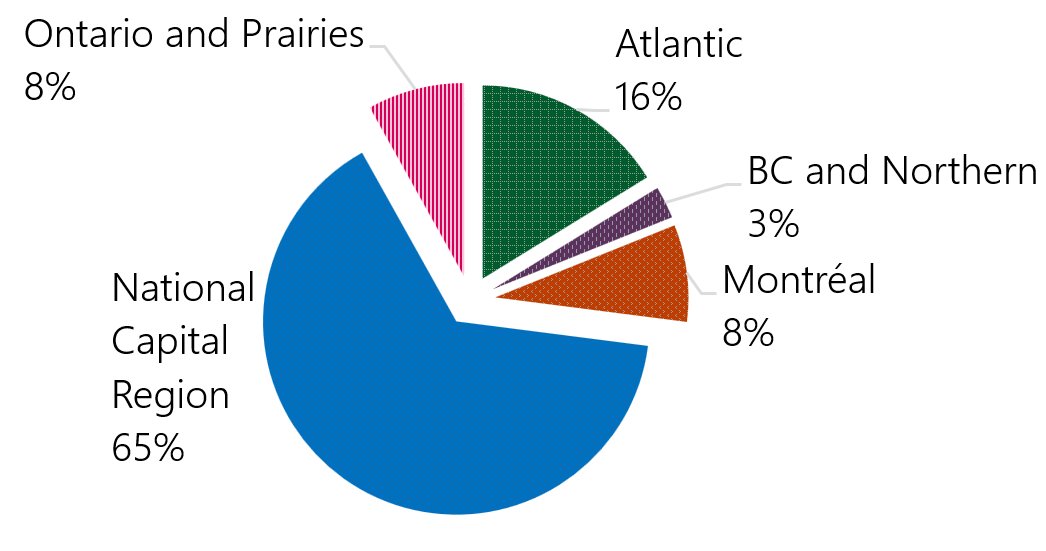
Internal respondents per region - Alternative text
Regions |
Percentage of internal respondents |
|---|---|
National Capital Region |
65% |
Ontario and Prairies |
8% |
BC and Northern |
3% |
Montréal |
8% |
Atlantic |
16% |
Document review
The sectors provided more than 1 000 documents to the evaluation team. We rated the documents on perceived relevance to the evaluation questions and reviewed 148 of the most pertinent documents.
Administrative data
We reviewed the nearly 100 administrative data sources that the sectors also provided as part of the evaluation.
Analysis and reporting
Interviews and document review
We performed interview analysis and a document review using Copilot 365 (an AI tool). All data were fully anonymized before being entered into either an interview or document Excel matrix. The matrices matched interview answers or data extracted from documents to evaluation questions. To ensure the accuracy of Copilot 365’s analysis, we conducted a sample analysis of 2 questions from the interview matrix and the document review matrix. We compared their analyses to the AI generated output. The results were remarkably similar, so we used Copilot 365 to analyze the remaining data. An evaluator who was very familiar with the interview transcripts and the documents being reviewed oversaw the Copilot 365 analyses and was able to detect any potential errors.
We prompted Copilot 365 with a series of thoughtfully designed and unbiased prompts to generate thematic analyses and dig deeper on certain topics. This technical report was co-written and edited by Copilot 365 and the evaluation team, using findings from the thematic analysis of the interviews and document review.
Administrative data
We examined the administrative data to describe trends, and the frequency of activities completed in support of internal audiences (for example: hiring managers, corporate HR employees and functional communities).
Limitations
Interviews
Respondent bias: Internal respondents may provide socially desirable answers or withhold their true opinions, especially if they fear repercussions. We established a rapport and explained that discussions are confidential to help mitigate respondent bias.
Recall bias: Internal respondents may not accurately remember past events or details, leading to inaccurate or incomplete information. This is particularly relevant as the evaluation covers a period of 5 years.
Subjectivity: Interviews rely on subjective perceptions and experiences, which can vary widely across individuals. This is especially relevant for the questions asking for a respondent’s perception of another person’s opinion (stakeholders’ perception of PSC support activities).
Interviewer bias: Everyone has their own values, experience and knowledge, which can influence how we interpret information. However, the evaluation team has several members, and we all use standardized evaluation measures to help mitigate any potential bias. We also take great care to examine our own unconscious biases to ensure that information is being examined in an impartial and fair manner.
Administrative data
Sectors track and present administrative data using the tools at their disposal, such as Word, Excel and PowerPoint. These tools are not inherently designed to house large datasets. The sectors provided nearly 100 sources of unstructured administrative data for review. Some sources didn’t distinguish between support activities designed for federal departments and agencies, as well as functional communities, which fall within the evaluation scope and those aimed at external audiences. Trackers are continuously updated, and small discrepancies may be due to a variety of factors, including different reporting requirements, data pull dates, formats or validation techniques. We primarily used administrative data to support broad statements about support activities, and specific examples were provided only when supported by data free of discrepancies.
Appendix C: Distribution of support activities
Policy and Communications Sector
Support activities
Policy updates and interpretation
- Providing updates, policy interpretation and expert advice on staffing frameworks including legislative changes to corporate HR
- Managing GC engagements by coordinating outreach activities (Human Resources Council, National Joint Council and Joint Employment Equity Council) and providing secretariat functions (Public Service Commission Joint Advisory Council, National Staffing Council)
- Representing the PSC at working groups to ensure alignment with overall legislation and policies and awareness of PSC policy changes and initiatives
- Answering questions and developing guidance products related to policies
- Prioritizing guidance based on emerging needs, legislative changes and audit feedback, and related corrective measures
Outreach and engagement
- Preparing HR experts in federal departments and agencies to support managers in staffing legislative and policy compliance by developing and delivering specialized staffing information sessions across Canada, in collaboration with internal and external partners
- Giving orientation sessions about priority entitlements
- Political Activities and Non-Partisanship Division provides outreach to departments and agencies falling under part 7 of the Public Service Employment Act and gives information and candidacy sessions
- Offering expert advice on experimenting and innovating in staffing approaches
Collaboration and intelligence gathering
- Collaborating with federal departments and agencies (whether or not they are subject to the Public Service Employment Act), particularly where staff continuity provisions apply, to ensure alignment with the legislative staffing framework
- Gathering system-wide staffing insights to identify trends, risks, opportunities for outreach and areas of improvement, and flagging the need for new or revised PSC tools, products and services
Alignment with PSC objectives
- Ensuring compliance with staffing frameworks
- Enhancing understanding of legislative changes
- Providing tailored support to improve staffing processes
- Conducting various training sessions and workshops to ensure staffing legislative and regulatory policy is adhered to; these sessions seek to ensure merit is respected and requirements are met, as well as raising awareness
Oversight and Investigations Sector
Support activities
- Offering sessions on recurring themes such as cheating, favouritism and fraud
- Providing verbal updates or presentations to various committees
- Establishing a bilateral communication channel for investigation-related matters
Alignment with PSC objectives
- Improving compliance and reducing irregularities in staffing processes
- Enhancing awareness and understanding of investigation procedures
Services and Business Development Sector
Support activities
Advice and guidance
- Providing expert advice and guidance on assessment in the context of staffing and development
- Developing authoritative guidance documents available on the PSC website, such as Testing in the Public Service of Canada, Guide for Assessing Persons with Disabilities, as well as a guide and a tool for mitigating biases and barriers
- Providing consultation services on valid and inclusive assessment, as well as workshops and seminars on assessment
Outreach and engagement
- Maintaining engagement with regional stakeholders to enhance the PSC’s reputation as a trusted internal partner and subject-matter expert on GC jobs and recruitment programs
- Conducting outreach with internal departmental partners to promote valid and inclusive assessment practices through expertise sharing and services
- Collaborating with external stakeholders (for example, universities, professional associations, other governments) to share best practices that develop its expertise and advance research and collective knowledge in inclusive assessment
Recruitment program promotion
- Promoting the value of student hiring and the benefits of using PSC recruitment programs, tools and services
- Providing strategic expertise on talent sourcing, including developing inclusive and barrier-free recruitment processes
- Offering tailored support for promoting specific job opportunities aligned with current and anticipated GC hiring needs
Collaboration and intelligence gathering
- Gathering intelligence on current GC recruitment and hiring trends, as well as departmental hiring needs and initiatives
Support activities audience
- Providing support activities to hiring managers, HR professionals, regional interdepartmental committees (Regional Federal Councils, HR and management committees), national and regional networks (for example, Federal Youth Network, GC Students, National Managers Community, employment equity networks) and functional communities
Alignment with PSC objectives
- Ensuring consistent and comprehensive outreach and engagement
- Facilitating effective communication and collaboration across regions
- Delivering mandated recruitment programs and initiatives, as well as recruitment initiatives, to support the government’s key priorities
- Enhancing understanding of the public service staffing process
- Supporting government-wide staffing-related activities that address emerging workforce needs and priorities
Appendix D: Unique strengths and implications of potential overlap by sector
Key support activities |
Unique strengths |
Alignment with sector’s mandate |
Areas of potential overlaps and implications for the PSC |
Examples of potential overlaps |
|---|---|---|---|---|
Policy guidance, legislative interpretation, proactive outreach |
Strategic expertise |
High. The Policy and Communications Sector provides guidance to organizations on hiring practices, policy and improper political activities |
Possible overlaps with the Services and Business Development Sector in regional engagement, stakeholder confusion, due to similar delivery channels |
Both the Staffing Support Division and the National Recruitment Directorate attend some of the same regional committees |
Key support activities |
Unique strengths |
Alignment with sector’s mandate |
Areas of potential overlaps and implications for the PSC |
Examples of potential overlaps |
|---|---|---|---|---|
Compliance, investigations, targeted workshops |
Investigative expertise |
High. The Oversight and Investigations Sector raises awareness on staffing irregularities |
Possible overlaps with the Policy and Communications Sector in outreach activities; stakeholder confusion due to similar delivery channels |
Both the Oversight and Investigations Sector and the Policy and Communications Sector conduct outreach to HR professionals |
Key support activities |
Unique strengths |
Alignment with sector’s mandate |
Areas of potential overlaps and implications for the PSC |
Examples of potential overlaps |
|---|---|---|---|---|
Recruitment, assessment, regional engagement, program promotion |
Regional and assessment expertise, program promotion, recruitment initiatives |
High. The Services and Business Development Sector promotes recruitment programs and answers hiring organizations’ needs |
Possible overlaps between the National Recruitment Directorate and the Policy and Communications Sector in outreach; possible duplicated efforts between Personnel Psychology Centre and Policy and Communications Sector regarding guidance on prejudices and barriers, coordination challenges |
Both the Staffing Support Division and the National Recruitment Directorate attend some of the same regional committees |
Table transcript: Unique strengths and implications of potential overlap by sector
*Overlap refers to the situation where two or more tasks, processes, or pieces of information share common elements or areas of responsibility. This can lead to ambiguity, redundancy, and potential conflicts as different entities may assume responsibility for the same aspects, leading to a lack of clarity and agreement on roles.
Policy and Communications Sector (PCS)
- Key support activities: Policy guidance, legislative interpretation, proactive outreach
- Unique strengths: Strategic expertise
- Alignment with sector’s mandate: High. PCS provides guidance to organizations on hiring practices, policy and improper political activities.
- Areas of potential overlaps* and implications for the PSC: Possible overlaps with SBDS in regional engagement, stakeholder confusion due to similar delivery channels.
- Examples of potential overlaps: Both SSD and NRD attend some of the same regional committees.
Oversight and Investigations Sector (OIS)
- Key support activities: Compliance, investigations, targeted workshops
- Unique strengths: Investigative expertise
- Alignment with sector’s mandate: High. OIS raises awareness on staffing irregularities
- Areas of potential overlaps* and implications for the PSC: Possible overlaps with PCS in outreach activities; stakeholder confusion due to similar delivery channels.
- Examples of potential overlaps: Both OIS and PCS conduct outreach to HR professionals.
Services and Business Development Sector (SBDS)
- Key support activities: Recruitment, assessment, regional engagement, program promotion
- Unique strengths: Regional and assessment expertise, program promotion recruitment initiatives
- Alignment with sector’s mandate: High. SBDS promotes recruitment programs and answers hiring organizations’ needs
- Areas of potential overlaps* and implications for the PSC: Possible overlaps between NRD and PCS in outreach; possible duplicated efforts between PPC and PCS regarding guidance on prejudices and barriers, coordination challenges
- Examples of potential overlaps: Both SSD and NRD attend some of the same regional committees