
Apprenticeship program for Indigenous Peoples
Over the past few years, Public Services and Procurement Canada (PSPC) has faced challenges in recruiting talent in the information technology (IT) field. PSPC's Digital Services Branch (DSB) seized the opportunity to access much-needed IT talent through the Government of Canada's Information Technology Apprenticeship Program for Indigenous Peoples. The program, which was promoted by PSPC's Indigenous Circle of Employees network, aims at connecting IT managers within the federal government with people from First Nations, Inuit and Métis communities who are passionate about IT. "We decided to change our approach for recruitment by focusing on leveraging diversity networks," explains Melvin Veloso, a director within DSB. "We particularly wanted to participate in this program."
The apprenticeship program, managed by Employment and Social Development Canada, helps Indigenous Peoples gain entry into the digital services field in the federal public service. The program was developed by, with and for Indigenous Peoples across Canada by taking into account their preferences and needs. Recruitment initiatives deliver better outcomes when they are designed by a team that represents the people, programs, tools and services they aim to serve.
"PSPC was eager to take advantage of this unique program. With this apprenticeship program, time is invested in on-the-job training and mentoring, and even then, the amount of time is negligible when compared to the time invested in other recruitment activities," mentions Veloso.
Seizing the opportunity
DSB recruited 2 Indigenous learners under the program: Samantha (Samm) Hill, who is Métis and lives in the Tyendinaga Mohawk Territory in Ontario, and McKenzie Grant, who is Teme-Augama Anishnabai and lives in Whitehorse, Yukon. "Samm and McKenzie were eager to learn and got engaged with the team right away. We now have 2 valuable people on our IT security team. The duration of the program is 2 years, but we hope that they can continue working with us after," says Veloso.

Knowing how much the IT sector is growing, Samm says, "The apprenticeship program seemed like too good an opportunity to pass up. This is a sector that seems limitless and is growing and in high demand," she observes.
She notes that she has always had an interest in IT. Without the opportunity offered by the apprenticeship program, she doesn't believe that she would have had the chance to broaden her understanding of the IT field. This avenue helped her confirm that she's on the right career path.
Beyond her interest in the field, advancing her knowledge and increasing her skills are very important to Samm. "I applied to the program because I saw great potential in the opportunity, and I wanted to get a foothold in a career where I wouldn't feel stuck," she says.
She strongly encourages any Indigenous youth who is considering enrolling in the apprenticeship program not to hesitate. "Not only does it open a door into the federal government, which has its advantages, but you also have the opportunity to grow and learn about the ever-evolving IT field."
Humanizing information technology
McKenzie has always liked solving problems, especially in computer science. "I like working where IT meets the user. That means exploring ideas to understand how some piece of IT might be useful to someone and how to present it as a solution."
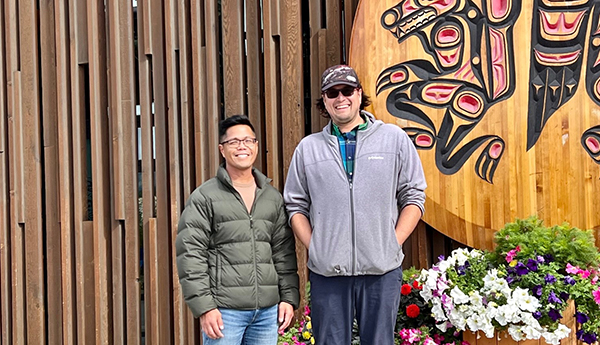
Moreover, what he appreciates most about the apprenticeship program is the opportunity to connect with others. "I like the sharing circle and the apprentice chat group. Their support is just so amazing." He was a little apprehensive about his internship, but knowing that there are people to support him in his development makes a great difference. "Having a place to go for help is essential."
According to McKenzie, the apprenticeship program is one piece of the career puzzle, but a very critical one. The program has made him realize that he wants to pursue a formal education in the field, which will help him grow and develop his self-assurance. "I think the confidence in our abilities that comes from working, training, certifications and courses is necessary, at least for me."
Veloso and his team believe in the effectiveness of this innovative recruitment strategy, but collaboration is critical, so they work hand in hand with the 2 recruits to make it a success.
The partnerships built through this program benefit all those involved. "The Indigenous apprentices gain experience and mentorship, and PSPC is able to hire skilled IT resources. As well, the products and services become more inclusive and innovative through the introduction of diverse views," concludes Veloso.
For more stories about PSPC people, projects and initiatives, don't forget to add Our stories to your favourites.