
Transforming Coast Guard cadet training
“It’s hard to believe this incredible project came to life with a rough diagram in my office,” says Joan Muise, a Senior Project Manager with Public Services and Procurement Canada (PSPC).
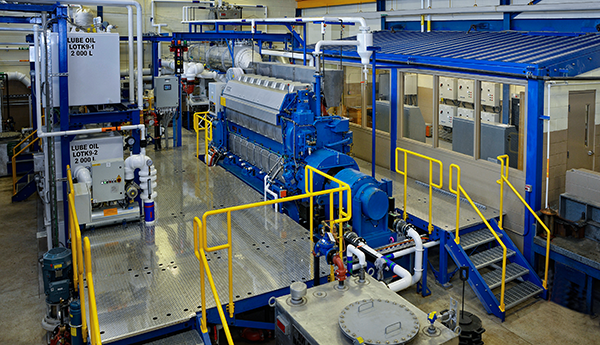
“I was in a meeting with colleagues from the Canadian Coast Guard, and we developed an ambitious plan to install a fully functioning ship engine inside a building, to take marine training to the next level. It required significant innovation, but we achieved that goal.”
Thanks to these efforts, the Canadian Coast Guard College in Sydney, Nova Scotia, now has an operational diesel training engine from the Wärtsilä company that replicates what cadets find on vessels. It’s the only training aid of its kind in Canada and one of just 6 in the world.
There are many benefits to this state-of-the-art training aid. The Wärtsilä engine at the college functions just as it does on a real ship and features the same engine room, equipment and controls. That’s a big improvement over the older, inactive engine replicas previously used by cadets, who didn’t encounter an operational engine until the seagoing part of their training. Now, they can do dry runs on the Wärtsilä engine and, as a result, board their vessels better prepared than ever to work safely and efficiently on the water.
Muise and other PSPC team members, including mechanical and electrical engineers, helped the college with the design, contracting and installation services to put the training engine in place.
Turning a building into a boat
The project team was initially daunted by the situation. “It was new for us, and the college isn’t a shipyard, nor are we shipbuilders. But we were determined to learn and find solutions,” says Muise.
Following a competitive procurement process, PSPC awarded a contract to a consultant to assist with one of the most complicated elements of the project: preparing a design. “First of all, we had to ensure that the engine installation met Canadian building codes,” Muise explains. “The college instructors also wanted to run live simulations and created a detailed plan to reflect the ship experience, and there was a whole binder of specifications and requirements from Wärtsilä.”
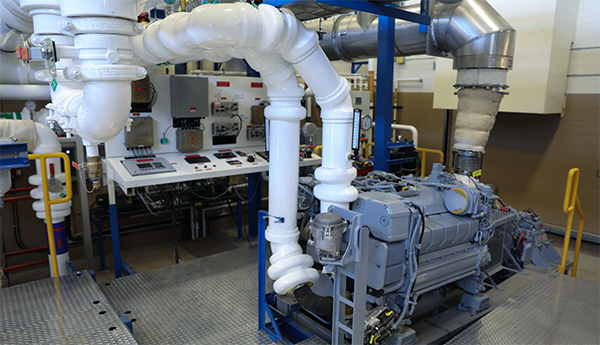
Coordinating components was another challenge. There are 14 tanks, containing substances like diesel and coolants, to support the engine. Each tank has its own piping. “So we couldn’t install a single pipe without knowing exactly where the others, and even the legs of the structural deck, would go,” says Muise. “It was all laid out in 3D drawings.” Meanwhile, an environmental expert from PSPC provided guidance on minimizing the risk of spills or their impact if they were to occur.
With the design in hand, PSPC awarded the construction contract in July of 2021. It included a requirement not just for installation services but to procure additional parts. “The engine arrived here from Finland with fittings for ship installations, which weren’t always suited for our purpose.”
When it came time to put the immense engine in place, a crane was brought in to move it around the building. According to Muise, this stage of the work required tremendous care and precision, “particularly because we had to place the engine correctly on perfectly level plates within specific tolerances that Wärtsilä provided.” The project also involved setting up a complex exhaust system and having experts from Wärtsilä test and sign off on the use of the engine equipment at the site.
Ready for the future
Up and running since the spring of 2022, the training engine has been helping both cadets and Canadian Coast Guard fleet personnel explore various operational and maintenance scenarios.
“I’m very proud of our contribution to this unique and impressive project, completed in collaboration with the Canadian Coast Guard, and the long-term benefits it will provide for the students of the college,” says Glen Hynes, Director General of PSPC’s Atlantic Region.
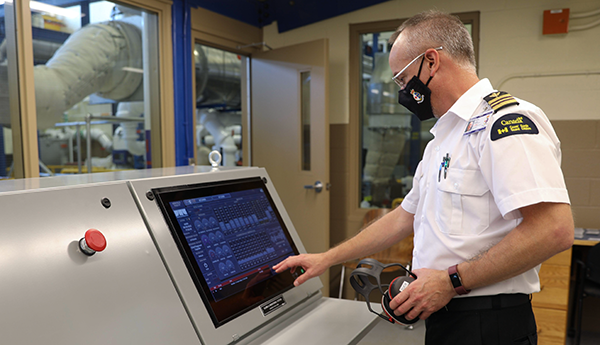
Dena Richardson, Executive Director of the college, adds: “The installation of the fully operational Wärtsilä training engine and control systems demonstrates our commitment to marine training excellence as well as the expertise of our marine engineering training group at the college, which worked alongside PSPC at every stage of the project.” Home to several world-class simulators, the college is getting another Wärtsilä engine, which PSPC will also install. This new engine will not be functional, so it can be taken apart and reassembled to provide additional learning opportunities.
With these exceptional training facilities, the Canadian Coast Guard is preparing our next generation of maritime personnel and securing its position as a world-class marine safety and response agency.
Have a look at a video of the Canadian Coast Guard training engine at the college to learn more about this project. For other interesting articles about PSPC people and services, visit Our stories.