
Collective compassion: City and government unite to fight homelessness
The cold winds of November were already blowing through Ottawa when Sophie Frenette, a leasing expert with Public Services and Procurement Canada (PSPC), received a request from the City.
The Government of Canada has several former office buildings in downtown Ottawa which are managed by PSPC and slated for disposal. City officials asked if any of them could be used to set up a temporary emergency overnight centre for residents seeking shelter from the elements from January to late March.
"We've never hosted a centre like this in the national capital before. There was a learning curve for my team, and the timelines were tight, but we were determined to help the community, and we had the support of our management," says Frenette.
City officials were unsure what it would be like to work with the federal government. "We thought there might be policies and procedures that could pose challenges, and we were in great need of the space, knowing that colder weather was coming and our shelter system is at full capacity. But once we all got together, it moved forward quickly," says Rachel Ladouceur, Program Manager at the City of Ottawa. "The thought of people suffering brought everyone to the table to work collaboratively and make it happen."
From office to overnight centre
The plan was for the City of Ottawa to select a suitable building from PSPC's list of surplus real property and for the 2 parties to negotiate a temporary occupancy license. The federal building at 250 Lanark Avenue was identified as the best option. "The location was ideal," notes Ladouceur. "It's near transit and not in a densely populated residential area, and the amenities offered, including showers, were exactly what we needed."
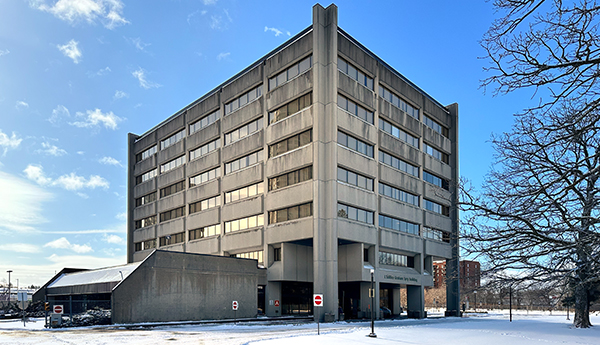
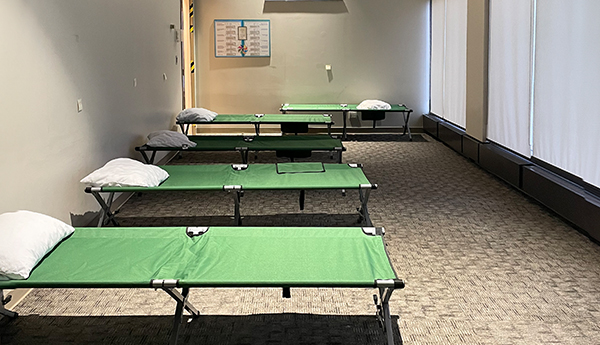
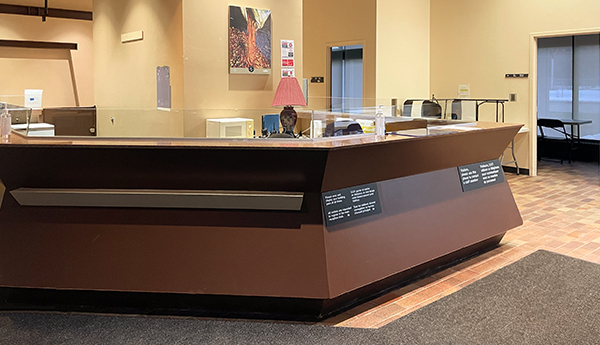
PSPC arranged a site visit with City of Ottawa officials, and the space turned out to be very appropriate for the centre. "There's an open layout, which City staff can easily monitor, as well as storage areas, smaller rooms for resident support activities, and a central site for a reception desk," Ladouceur explains. The City was ready to seize the opportunity, and Frenette's team worked on developing an agreement for the novel use of this former federal workplace. "We held more discussions and further site visits to help my team understand how the City planned to operate the centre," says Frenette.
Frenette notes that her team also consulted PSPC colleagues in other regions and key stakeholders at neighbouring properties to cover all the bases. Another factor they considered was how to ensure the building would be protected and well-maintained, as PSPC is continuing the disposal process.
Thanks to the teamwork and spirit of partnership between PSPC and the City of Ottawa, the details were worked out promptly. The next step was to prepare the 715 square metres of ground floor space for its new function. "For safety and security reasons, we removed some doors, deactivated the elevators, limited access to parts of the building and conducted water potability tests," Frenette explains. For its part, the City installed additional carbon monoxide detectors and fire alarms. "We consulted with fire services and took steps to ensure the building is safe for the intended use and occupants," says Ladouceur. "Then we brought our equipment, including cots, tables and chairs, and started welcoming people on January 20, 2024."
A good deed with good results
The building served the community well. "It was a timely solution that helped us meet increased demand," Ladouceur says. "The centre also diversified the homelessness system, providing people with another choice to get a reprieve from the elements, access the supports they need and avoid the potentially dire consequences of hard living in our frigid climate. For the City, this was a very positive experience," she adds. "From walking into the building and seeing every one of our boxes ticked, to the willingness of PSPC staff to support us, to the smoothness of the whole process."
It was an equally rewarding project for Frenette and her team. "It gave PSPC a chance to be a good neighbour, put our surplus real estate to use during the disposal process and help people in need. We often say that, in our work with federal leases, we're not saving lives, but in this case, we may have."
See how we're optimizing our real property portfolio or read more articles about PSPC on Our stories.