
Innovation to the rescue

Innovation, Science and Economic Development Canada, through the Innovative Solutions Canada (ISC) program, supports small and medium businesses across the country by providing funding of up to $140 million per year to conduct research and development and test prototypes in real-life settings. There are 21 federal departments participating in the program. Government projects approved for inclusion in the program must be innovative, meaning that no commercial solution currently exists in the Canadian marketplace to meet the needs of the department.
Recently, a challenge by Public Services and Procurement Canada (PSPC) was approved under ISC. Named the Canadian Coastal Zone Information System, the project involves designing a new product to help the Government of Canada model and predict climate change impacts on shorelines and related infrastructure.
The thought behind the innovation
The idea was the brainchild of Azharul Hoque, Manager of Civil Engineering for PSPC's Atlantic Region office. Hoque specializes in coastal engineering, and his job is to support and advise other federal departments on projects in coastal and marine environments. "When we work on coastal and marine infrastructure projects, we need to consider the impacts of multiple factors, such as wind, wave action, storm intensity, storm frequency, erosion, currents, tides, sea level rise and climate change effects, in our analysis and design," says Hoque. "The information is out there; however, it is spread across different sources. We need to develop a system to consolidate the information in one easy-to-access platform to be used for designing sustainable and cost-effective infrastructure. Also, we feel that the system will be useful to different users, including the public."
Recognizing what was needed to address the problem, Hoque went to his supervisor, Jody Isenor, Regional Manager of Architecture and Engineering Services for the Atlantic Region, with a proposal that Isenor immediately supported. As Isenor recounts: "It was about pulling together all the information on a web-accessible platform, which could be kept up to date, to address construction and design challenges in real time. Combining data sources can help us plan for and address climate change impacts in coastal zones."
Challenge and testing
The best way to move forward was to pursue the concept with the help of the ISC program. All ISC-funded projects are posted on CanadaBuys and involve 3 phases of delivery. The first 2 phases are open to bids from any small- or medium-sized firm in Canada. The third phase is the pathway to commercialization.
In the first phase, the applying organization finds out if there are businesses that can propose solutions for their challenge. Each business can be paid up to $150,000 to develop a feasibility report for a potential solution. "In our case," says Hoque, "there were 3 companies funded." One of the companies was selected and awarded up to $2,000,000 to develop a prototype in phase 2. Hoque and his team will now take the time to rigorously test the prototype. If it works, the company can begin the pathway to commercialization.
Benefits for all
What makes this program unique are the benefits for the Government of Canada, participating businesses and, by extension, the Canadian economy. While the Canadian Coastal Zone Information System could help PSPC perform coastal effects modelling that incorporates climate change scenarios, once the tool is developed, the company will own the rights to it. This means that the government has been able to solve a key problem while generating an innovative product to support a company within the private sector.
"In the case of the PSPC project," explains Hoque, "if the prototype works, the business can go on to offer the web-accessible platform to many federal departments and other levels of government. They can also expand and market it to others who work in coastal environments worldwide. This provides the business with valuable avenues for growth on a global scale, and it gives Canada the opportunity to show leadership in this field."
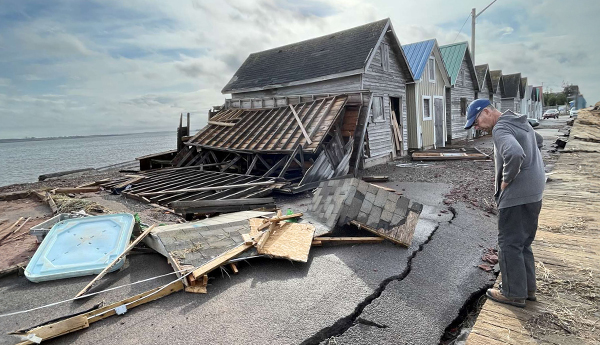
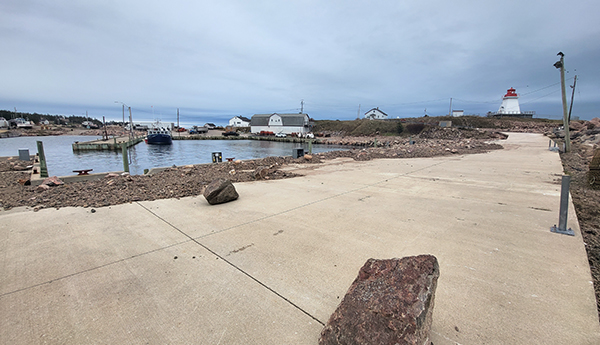
Canadians who live on or near a body of water could have the chance to benefit from the platform as well. If the prototype leads to a product on the market, someday you may be able to check your device before a storm to find out if your property is at risk of flooding or erosion. Being able to anticipate risks from future climate change and weather extremes could also be used to adapt coastal infrastructure down the road.
PSPC is proud to work with ISC on the innovative Canadian Coastal Zone Information System.
If you are a small or medium business owner in Canada and want to get involved in an initiative of this kind, visit Innovative Solutions Canada. You may have the solution of the future!
You can also check out Our stories for other articles about interesting PSPC people and projects.