
Public Services and Procurement Canada
Addressing misconduct and wrongdoing: Fiscal year 2025 to 2026
On this page
- Message from the Deputy Ministers
- Executive summary
- Introduction
- Understanding expected behaviours
- How to report misconduct and wrongdoing
- Responding to supplier misconduct and wrongdoing
- Responding to employee misconduct and wrongdoing
- Conclusion
Message from the Deputy Ministers
Public Services and Procurement Canada (PSPC) plays a key role in supporting the daily operations of the Government of Canada. The department operates as the government’s central purchasing agent, real property manager, linguistic authority, treasurer, accountant, pay and pension administrator, and common service provider. Maintaining high ethical standards is central to what we do.
Recognizing that integrity is a shared responsibility, this second annual report on actions to address misconduct and wrongdoing takes an integrated approach by examining both the conduct of suppliers to the federal government, as well as departmental employees. It outlines how we analyze and document misconduct, identify trends and root causes, and take meaningful action.
Throughout the year, PSPC’s Office of Supplier Integrity and Compliance strengthened its capacity to address supplier misconduct including through conducting assessments and taking administrative actions and debarring suppliers of concern from federal contracts and real property agreements. Moreover, the department continued to work to reinforce accountability and sustain public trust within its operations. It also pursued various preventive initiatives, as well as engagement with federal partners, suppliers, and international counterparts.
The department has improved its fraud risk management strategy, data analytics, and the use of coordinated investigations, which have further reinforced deterrence across the federal procurement system. Since March 2024, PSPC has identified a number of fraudulent overbilling schemes and has made measurable progress in recovering public funds associated with these illegitimate payments.
With respect to employee misconduct, PSPC continued to focus on prevention, having modernized its departmental Code of Conduct, improved guidance on conflicts of interest and post‑employment obligations and expanded values and ethics training.
The department continued to make use of labour relations, disclosure, and investigative frameworks to make sure that allegations of employee misconduct were addressed fairly and promptly. We also further promoted ways for those reporting wrongdoing to come forward safely and in confidence.
Thank you to all who work to strengthen our policies, tools, and culture and prevent misconduct and wrongdoing.
Arianne Reza
Deputy Minister
Francis Trudel
Associate Deputy Minister
Executive summary
Public Services and Procurement Canada (PSPC) plays a critical role in delivering government programs and stewarding public resources. These responsibilities require strong controls to prevent and mitigate operational, financial, and integrity risks. As the Government of Canada’s central purchasing agent and real property manager, PSPC must maintain high standards of ethical conduct across both its internal operations and the federal supplier community to preserve public trust.
This is PSPC’s second annual report of actions taken to prevent, detect, and respond to misconduct and wrongdoing, and it covers the 2025 to 2026 fiscal year. Reflecting PSPC’s unique mandate, the report takes an integrated approach, examining both supplier and employee misconduct and wrongdoing to provide a comprehensive view of integrity risks and departmental responses. Building on the foundation established in 2024 to 2025, PSPC has continued to strengthen its ability to identify trends and take proportionate and timely action.
With respect to supplier misconduct, PSPC enhanced its ability to identify risks and respond decisively. In 2025 to 2026, under PSPC’s Vendor Performance Corrective Measures Policy, officials completed 11 assessments, resulting in 4 performance-based debarments, compared to 3 in 2024 to 2025. In addition, to address government-wide integrity risks, the Registrar of Ineligibility and Suspension pursued 17 administrative actions under the Ineligibility and Suspension Policy, up from 7 in the previous fiscal year. This increase reflects the use of broader authorities accorded to the Registrar in 2024, including new flexible triggers as grounds for exclusion. Engagement with federal partners and suppliers further supported consistent application of integrity-related expectations across government.
In parallel, PSPC continued to enhance its approach to fraud risk management and detection. Focused efforts, including the use of data analytics and coordinated investigations, supported the identification of overbilling schemes while reinforcing deterrence across the federal procurement system. This includes four additional referrals to law enforcement, for a total of nine, and the recovery of $4.8 million in public funds since March 2024.
Within the department, PSPC continued to build on preventive measures aimed at reinforcing expected employee behaviours. PSPC took key actions, including the modernization of the departmental Code of Conduct, enhancing guidance on conflicts of interest and post‑employment obligations, expanding values and ethics training, and introducing strengthened performance expectations for managers. These measures were supported by sustained senior management oversight and aligned with government‑wide risk and compliance initiatives.
PSPC also applied established labour relations, disclosure, and investigative frameworks to address employee misconduct and wrongdoing in a fair, timely, and procedurally sound manner. In 2025 to 2026, the department completed or closed 145 investigations, up from 111 in 2024 to 2025. These resulted in the application of appropriate disciplinary and administrative measures, consistent with Treasury Board guidance, collective agreements, and principles of natural justice. The department continued to promote safe and confidential reporting channels, including internal disclosures under the Public Servants Disclosure Protection Act, harassment and violence prevention mechanisms, and security screening processes.
Overall, the 2025 to 2026 reporting period reflects PSPC’s continued commitment to integrity, accountability, and transparency. By strengthening prevention, enhancing detection capabilities, and taking decisive action when misconduct or wrongdoing is identified, PSPC reinforces confidence in federal procurement, safeguards public resources, and supports a respectful and ethical workplace. The department remains committed to continuous improvement and to further bolstering its approach to addressing misconduct and wrongdoing in the years ahead.
Introduction
PSPC is committed to upholding a culture of ethical and professional conduct across all its operations. To support this commitment, PSPC reports on both supplier and employee wrongdoing and misconduct. Reporting on both internal and external misconduct provides a comprehensive view that reflects the department’s unique mandate, responsibilities, and efforts to uphold integrity, accountability, transparency, and public trust.
This second annual report on addressing misconduct and wrongdoing aims to:
- increase awareness and transparency regarding PSPC's tools to prevent, detect and respond to supplier and employee misconduct and wrongdoing
- provide an overview of measures taken during the reporting period for fiscal year 2025 to 2026 (April 1, 2025, to March 31, 2026)
- share information about programs and mechanisms to report misconduct and wrongdoing within the department
Departmental context
PSPC plays an important role in the daily operations of the Government of Canada. Its mission is to deliver high-quality, centralized programs and services that ensure sound stewardship of public resources on behalf of Canadians, and to meet the operational needs of federal institutions, supporting them in achieving their mandates and objectives.
As the government’s central purchasing agent, real property manager, pay and pension administrator, and linguistic authority, PSPC plays a central role in keeping government running effectively and efficiently. Decisions made within the department shape not only how government functions, but how public investment strengthens Canadian industry, supports workers, and reinforces national resilience.
Although all areas of the department contribute to maintaining the integrity of their operations, a number of branches play a more foundational role in supporting and advancing these efforts, including the Departmental Oversight Branch (DOB), Procurement Branch (PB), and Human Resources Branch (HRB).
DOB provides services that ensure departmental operations are secure, fair, and transparent. Its responsibilities include overseeing security and emergency management, as well as investigating and responding to potential misconduct on the part of both suppliers and employees.
PB establishes expectations for all suppliers to the Government of Canada through the Code of Conduct for Procurement. It also administers PSPC’s Vendor Performance Corrective Measure (VPCM) Policy, which is designed to mitigate performance risks in future contracts when other performance management mechanisms, such as contract performance action and/or remedial plans, have not achieved sufficient corrective action.
HRB supports the department and employees with essential services, policies, and programs that foster a supportive and dynamic workplace, including measures pertaining to workplace well-being, values and ethics, and the prevention of conflict, harassment, and violence. DOB and HRB work closely together to investigate and respond to potential employee wrongdoing.
Defining misconduct and wrongdoing
Supplier misconduct and wrongdoing is generally understood to include fraudulent, corrupt, collusive, coercive, and obstructive practices that pose a risk to the federal procurement and real property systems. As an example, the Ineligibility and Suspension Policy, which is administered by PSPC’s Office of Supplier Integrity and Compliance (OSIC), contains a list of offences and other material events that could render a supplier ineligible to do business with the Government of Canada.
Misconduct in the context of PSPC’s work environment is defined as any action whereby an employee willfully contravenes an act, a regulation, a rule, a departmental or Treasury Board policy instrument, an approved procedure, a departmental Code of Conduct, a reasonable and lawful management request, and/or the Values and Ethics Code for the Public Sector. In short, when an employee breaches any of the obligations they agree to abide by when becoming an employee of the department.
Wrongdoing, as defined in the Public Servants Disclosure Protection Act (PSDPA), may include:
- a violation of any federal or provincial law or regulation
- a misuse of public funds or a public asset
- a gross mismanagement in the public sector
- an act or omission that creates a significant and specific danger to the life, health, or safety of people or the environment
- a serious breach of a code of conduct established under the act
- knowingly directing or counselling someone to commit a wrongdoing
Understanding expected behaviours
Supplier compliance with the Code of Conduct for Procurement
The Code of Conduct for Procurement sets out the expectations and obligations for suppliers and their subcontractors who respond to bid solicitations or provide goods and services to the Government of Canada. In addition to complying with contractual terms and all applicable laws and regulations, suppliers are expected to apply the principles of the Code to their main operations and in their domestic and international supply chains. These principles relate to:
- ethics and professionalism
- conflict of interest
- environmental protection
- abuse and harassment
- human rights and labour standards
- Indigenous rights
- human trafficking, forced labour and child labour
Suppliers are expected to follow the principles in good faith. Where potential non-compliance is identified, Canada may engage with suppliers to clarify expectations and address issues as appropriate. Where a supplier is unable or unwilling to comply with the Code, Canada reserves the right to investigate, deem a bid non-responsive, or terminate a contract. Founded breaches of the Code may also result in action under the Ineligibility and Suspension Policy.
New departmental Code of Conduct in plain language
PSPC advanced several initiatives to strengthen ethical conduct and reinforce a values-based culture across the department. The Code of Conduct was updated to clarify and modernize expectations in plain language, improving accessibility and strengthening the department’s ability to address ethical issues. It sets out expected behaviours for employees and managers and reinforces that a strong values and ethics foundation supports employees in identifying and navigating situations that could give rise to misconduct.
To support a consistent understanding of these expectations, PSPC implemented department-wide communications, internal guidance resources, and presentations for employees at all levels. These efforts are complemented by enhanced conflict of interest and post-employment guidance, including a review of the Post-Employment Guidelines to clarify obligations when leaving the public service, and a modernized digital Conflict of Interest Form with clearer definitions and practical guidance.
Employee training
PSPC offers a comprehensive values and ethics learning path for employees, consisting of 18 courses that cover key topics such as the Department’s core values, the prevention of conflicts of interest, fraud and wrongdoing, and ethical procurement practices. PSPC requires that all employees complete a minimum of three hours of values and ethics training each year. This includes the new mandatory course on the updated departmental Code of Conduct.
Performance objectives for managers on values and ethics
PSPC introduced a dedicated performance objective requiring managers to take steps to foster a values-based organizational culture by upholding the highest ethical standards in the workplace. Managers are expected to demonstrate this through concrete, measurable actions, including proactively promoting ethical practices and effectively managing conflicts of interest, thereby reinforcing their role in helping prevent misconduct and wrongdoing within the department.
How to report misconduct and wrongdoing
There are a number of channels available internally and externally to report suspected misconduct and wrongdoing.
Supplier misconduct and wrongdoing
Government of Canada employees, suppliers, and members of the public may flag suspicious activity in federal contracting, either on a named or anonymous basis via the Federal Contracting Fraud Tip Line, which is jointly operated by PSPC, the Competition Bureau and the Royal Canadian Mounted Police (RCMP). Examples of suspicious activity include, but are not limited to, suspected bid-rigging, price-fixing, inflated invoices, time theft, supplying inferior products, bribery, kickback schemes, and conflicts of interest.
Tips can be submitted anonymously online or by calling 1-844-365-1616.
Public servants have an obligation to refer any information that may be related to criminality to law enforcement. For example, Contracting Officers are required to notify their immediate supervisor whenever there is an indication of possible bid-rigging activities, collusion, or fraud in the context of a procurement or real property agreement. PSPC's Legal Services Unit works closely with the Competition Bureau Canada, an independent federal law enforcement agency responsible for investigating allegations of bid-rigging and collusion under the Competition Act. Allegations of fraud are referred to the RCMP for investigation under the Criminal Code.
Officials across the Government of Canada must refer cases of founded misconduct to the Office of Supplier Integrity and Compliance via email at tpsgc.o.integrite-integrity.o.pwgsc@tpsgc-pwgsc.gc.ca or by contacting the Office of Supplier Integrity and Compliance. OSIC will assess the misconduct to determine whether action under the Ineligibility and Suspension Policy is warranted.
Workplace misconduct and wrongdoing
HRB provides resources to guide employees in discussing workplace misconduct and wrongdoing with their manager. HRB also provides employees with confidential tools to report workplace misconduct and wrongdoing. This includes the Prevention of Harassment and Violence (PHV) program, which supports employees who experience, witness, or manage situations involving harassment or violence at Public Services and Procurement Canada. PHV is the department's Designated Recipient for Notices of Occurrence of harassment and violence.
Internal disclosures of wrongdoing
PSPC employees can make an internal disclosure of wrongdoing, as defined by the Public Servants Disclosure Protection Act, by:
- contacting the Department's Senior Official for Internal Disclosure, via the Special Investigations and Internal Disclosure (SIID) Directorate, either by calling the confidential line at 1-855-570-8338, or by sending an encrypted email to: spac.dgsdivulgationinterne-dobinternaldisclosure.pspc@tpsgc-pwgsc.gc.ca
- raising an issue with their supervisor
- submitting a disclosure of wrongdoing to the Office of the Public Service Integrity Commissioner
The PSDPA includes provisions to protect the identity of individuals who make disclosures, as well as protections against reprisals. While anonymous disclosures are possible, PSPC employees are encouraged to provide their contact information to ensure a thorough assessment of the matter. Employees who are considering making a disclosure or who wish to discuss workplace concerns can also access the confidential, impartial, and informal services provided by PSPC’s Ombuds Office.
Security incidents or breaches
PSPC employees are required to identify and report suspected security incidents and breaches in the context of their work. Examples include, but are not limited to:
- damage to property
- criminal activity
- information technology-related issues
- lost assets
- changes to personal circumstances that are criminal or financial in nature
- changes in behaviour and security concerns
Employees may report security incidents or breaches in the following ways:
- submit a Security Incident Report
- follow PSPC's Cabinet Confidence Breach Protocol in accordance with the Standard on the security of Cabinet Confidences
- follow the handling and reporting protocol and report phishing, spam or suspicious emails
- follow PSPC's privacy breach protocol
Responding to supplier misconduct and wrongdoing
Office of Supplier Integrity and Compliance
Launched in May 2024, the Office of Supplier Integrity and Compliance (OSIC) is now in its second year of implementation. In administering the updated Ineligibility and Suspension Policy (the Policy), OSIC continues to strengthen the Government of Canada’s ability to identify, assess, and respond to integrity-related risks among suppliers.
The Policy sets out when and how a supplier may be suspended or declared ineligible from doing business with the federal government or be required to enter into an administrative agreement to continue doing business with Canada. Decision-making under the Policy has been delegated from the Minister of Government Transformation, Public Works and Procurement to the Registrar of Ineligibility and Suspension, an Assistant Deputy Minister-level position.
While the Policy is administered by OSIC, its application across the Government of Canada is governed by memoranda of understanding (MOUs) with other federal entities. All departments and agencies are required to apply the Policy and some other federal entities, such as Crown corporations, have voluntarily adopted it.
In fiscal year 2025 to 2026, OSIC built on the momentum of its first year by processing a high volume of integrity verifications, exercising its broadened authorities to take action against more suppliers of concern, and deepening engagement with stakeholders.
Integrity verifications

32,215 integrity verification requests received

667,075 individual names verified

99.5% of integrity verification requests completed within the 4-hour service standard

1,119 expedited integrity verification requests processed
Before awarding a contract or real property agreement subject to the Ineligibility and Suspension Policy, contracting and real property officers are required to submit an integrity verification request to OSIC, which is then processed by OSIC’s Integrity Verification Services team. This important step confirms whether or not the supplier faces restrictions to doing business with Canada under the Policy and informs the contracting or real property authorities whether a procurement or real property process can proceed.
Verification requests submitted to OSIC are typically processed within four hours, or within two hours for urgent cases.
During fiscal year 2025 to 2026:
- OSIC received 32,215 requests, representing verifications of 667,075 individual names
- On average, 2,685 requests were processed each month, with the highest volume in February 2026 (3,385 requests)
- 99.5% of verifications were completed within the 4-hour service standard
- 1,119 expedited verifications were conducted on potential suppliers
Administrative actions

5 suspension-related activities

12 determinations of ineligibility
The Registrar of Ineligibility and Suspension is the designated authority for suspending suppliers, declaring them ineligible, and determining periods of ineligibility. The Registrar may also enter into an administrative agreement with a supplier to mitigate risk as an alternative to suspension or ineligibility.
Amendments to the Ineligibility and Suspension Policy introduced in May 2024 expanded the Registrar’s authority to address a broader range of misconduct, including emerging risks in the marketplace. Action may now be taken in the absence of criminal charges or convictions where it is determined that a supplier poses a risk to the federal procurement or real property systems. The amendments also provide flexibility to respond more proportionately, including the ability to set ineligibility periods based on an assessment of aggravating and mitigating factors, up to a maximum of 10 years.
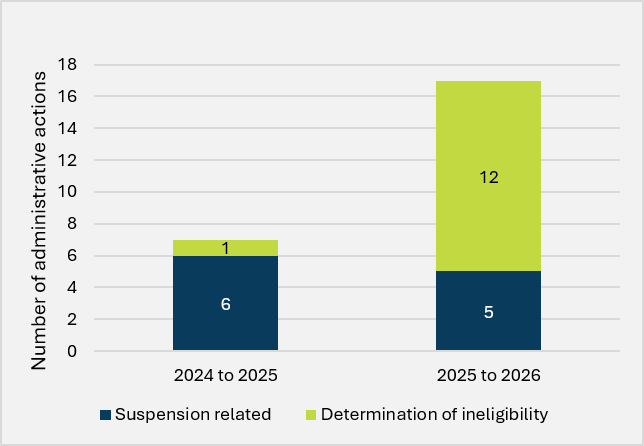
In 2025 to 2026, the Registrar pursued 17 administrative actions. Of these, 5 were suspension-related (compared to 6 in 2024 to 2025) and 12 were determinations of ineligibility (compared to 1 in 2024 to 2025).
Figure 1: Comparison of administrative actions taken by the Registrar between 2024 to 2025 and 2025 to 2026
Text version of Figure 1
| Category | 2024 to 2025 | 2025 to 2026 |
|---|---|---|
| Suspension related actions | 6 | 5 |
| Determination of ineligibility | 1 | 12 |
No new administrative agreements were initiated in 2025 to 2026; however, three existing agreements carried over into the reporting year. Two of these previously-entered agreements were concluded in 2025 to 2026 after the Registrar determined that all of their respective terms and conditions had been met. For the one administrative agreement that remains in place as of March 31, 2026, the Registrar continues to ensure the supplier’s compliance.
Engagement

10 meetings held between senior PSPC officials and counterparts in other government departments and agencies

86 renewed Memoranda of Understanding signed

1,000+ participants in OSIC engagement activities
Regular engagements with stakeholders within PSPC, across other federal departments and agencies and externally with suppliers, industry, and civil society organizations support a shared understanding of integrity expectations in federal procurement and real property transactions. Through such activities, OSIC promotes consistent compliance with policy requirements and supports more timely identification and management of integrity risks.
In 2025 to 2026, senior PSPC officials met with counterparts in 10 departments and agencies, prioritizing those with significant contracting activity, to raise awareness around the Registrar’s expanded authorities, introduce a formalized case referral process for founded supplier misconduct, and encourage partners to refer such cases to OSIC for assessment.
Additional engagement reached more than 1,000 participants, including through PSPC’s Client Advisory Board, national procurement community events and forums, and international engagement with officials from like-minded countries and multilateral organizations.
The year also saw the rollout of renewed Memoranda of Understanding (MOUs) between OSIC and federal departments and agencies that are subject to the Ineligibility and Suspension Policy. Out of 94 entities engaged, 86 had signed updated MOUs as of March 31, 2026. Efforts to finalize MOUs with the remaining 8 entities are ongoing, and OSIC remains open to onboarding other organizations that may wish to voluntarily adopt the Policy (e.g., Crown corporations).
Looking ahead, OSIC has prepared a training strategy and materials that will be launched in 2026 to help the Government of Canada’s procurement and real property community better understand their roles and responsibilities related to the Ineligibility and Suspension Policy, including the case referral process. The Office will also continue to refine the application of the Policy to further improve the Government of Canada’s ability to mitigate risks to the federal procurement and real property systems and engage with other jurisdictions to share best practices and emerging risks.
Fraud risk management

Published the PSPC Guide to Fraud Risk Management

Completed 2 fraud awareness campaigns

Distributed 3 procurement fraud awareness packages to federal departments and agencies
Fraud represents an inherent and persistent risk in public procurement, one that continuously evolves in complexity and scope. To ensure the integrity of PSPC’s operations, the department has numerous internal controls in place to prevent, detect, and respond to fraud. Central oversight and coordination of those controls is achieved through PSPC’s fraud risk management framework, which is managed by a dedicated team of antifraud experts. This approach promotes shared awareness of present and emerging fraud risks across the organization, and ensures they are tackled in an effective, efficient, and consistent manner.
PSPC is enhancing stewardship of public funds, fortifying procurement oversight mechanisms, and continuing to leverage the power of data analytics and artificial intelligence to detect and prevent internal and external forms of fraud and wrongdoing.
In 2025 to 2026, the department continued to mature and strengthen its approach to fraud risk management, including by:
- Publishing and promoting the PSPC Guide to Fraud Risk Management, which outlines how PSPC is safeguarding against fraud, the specific roles and responsibilities of the entities dedicated to fraud mitigation, and the role of all employees
- Conducting two fraud awareness campaigns (a week-long campaign in November 2025 and a month-long campaign in March 2026), focused on fraud prevention, supplier integrity, roles and responsibilities, and bid-rigging awareness. Both campaigns used a variety of social media, extensive internal and external web-based materials, as well as targeted internal messaging to promote fraud awareness to employees and the public. These awareness campaigns are carried out on an annual basis. Strengthening employees’ and the public’s ability to identify and report fraud remains one of the most effective tools for preventing and disrupting this behaviour
- PSPC also plays a lead role in procurement fraud awareness for the Government of Canada. In this context, the department developed and delivered procurement fraud awareness packages to more than 30 federal departments and 90 Procurement Heads to broaden awareness of this serious and evolving risk
Overbilling schemes and recovery efforts

4 overbilling investigations were completed between April 1, 2025 and March 31, 2026


$4.8 million + recovered from fraudulent billing cases since March 2024
In 2025 to 2026, PSPC’s Special Investigations and Internal Disclosure (SIID) Directorate and Restitution Unit continued to focus on pursuing allegations that the Government of Canada was overbilled or defrauded through overbilling schemes. As overbilling is a government-wide vulnerability, PSPC is playing a centralized role and supporting impacted departments and agencies across the Government of Canada by recovering funds from identified overbilling schemes.
The following results were achieved in this area:
- SIID finalized four overbilling-related investigations between April 1, 2025 and March 31, 2026. SIID also provided support for ongoing restitution processes
- A total of nine completed investigations involving fraudulent billing have been referred to the RCMP for criminal investigation between April 2022 and March 31, 2026
- With the exception of one caseFootnote 1, each founded instance of supplier overbilling since March 2024 has been referred to PSPC's Restitution Unit so that improperly billed public funds can be recovered from responsible suppliers
- For the cases referred to PSPC’s Restitution Unit, as of March 31, 2026, $5.5 million in improper billing was initially estimated, with $4.8 million recovered. Assessments of outstanding amounts owing to Canada are ongoing
Vendor Performance Corrective Measure Policy

11 assessments completed

4 debarments
PSPC uses complementary tools to address different kinds of supplier risks. For instance, while the Ineligibility and Suspension Policy addresses government-wide supplier integrity risks, PSPC’s Vendor Performance Corrective Measure (VPCM) Policy is designed to mitigate performance risks under PSPC contracts. Corrective measures may be applied when other performance management mechanisms (e.g., contract performance action and/or remedial plans) have not achieved sufficient corrective action.
More specifically, a VPCM may be applied when there is evidence that continuing to do business with a supplier poses an unacceptable risk to Canada. This can occur when there is a major instance of poor performance, such as a termination for default or a conditional amendment, or a cumulative record of such incidents.
Under this policy, the Contracting Authority, supported by the Technical Authority, conducts a VPCM assessment to examine the performance concerns, ensure decisions are evidence-based, and determine whether a corrective measure is warranted based on the severity of the issues identified.
To support assessments, performance impacts are rated as Minor, Medium, or Major, based on the extent to which poor performance affected government operations.
- A Minor impact results when poor vendor performance causes only minor inconvenience and affects non-critical requirements with limited or short-term operational consequences
- A Medium impact occurs when poor performance creates significant operational challenges or reduced efficiency, while still allowing core activities to continue
- A Major impact results when poor performance substantially disrupts or jeopardizes critical or time-sensitive activities, posing a risk to essential outcomes
In addition, serious, repetitive, or egregious violations of the VPCM can result in government-wide action under the Ineligibility and Suspension Policy.
An assessment does not automatically result in a corrective measure. When the impact is less severe, a Minor or Medium impact rating will result in a note to file rather than the application of a VPCM. Assessment results are recorded and maintained on a supplier’s record for a period of 6 years and can be used as consideration in any future assessments when determining the need for a VPCM.
For fiscal year 2025 to 2026, a total of 11 assessments were completed under the VPCM Policy. Of these, 2 resulted in minor impacts, 5 in medium impacts, and 4 in major impacts. The major impacts led to the application of 4 debarments.
Responding to employee misconduct and wrongdoing
Labour relations procedures and mechanisms
To foster an effective and healthy workplace culture, it is essential that the employer addresses misconduct in a fair and timely manner. Incidents of alleged misconduct may come to management's attention by direct observation or from various sources, including reports from other employees, managers, or members of the public. At PSPC, labour relations advisors support management in addressing alleged misconduct in accordance with applicable policy instruments, collective agreements, and terms and conditions of employment.
PSPC applies the general guidance provided by the Treasury Board of Canada Secretariat (TBS) for investigations into misconduct and disciplinary measures, as outlined in the Guidelines for Discipline. While respecting general principles common to all cases, the specific steps of the process required for each disciplinary investigation will vary depending on the nature and seriousness of the alleged misconduct. In all cases, investigations must follow common principles of procedural fairness and natural justice.
Under the departmental Investigation Management Framework between DOB and HRB, cases involving issues such as security breaches, fraud, theft, conflict of interest, or illegal activities are initially investigated by DOB. HRB's Corporate Staffing Oversight may also be involved when allegations relate to staffing policy or the Public Service Employment Act. In cases of harassment or violence reported to the department’s Designated Recipient, the Workplace Wellness and Risk Prevention Directorate will conduct and coordinate a separate process in accordance with the Workplace Harassment and Violence Prevention Regulations.
Once an investigation is completed, a report is provided to management to determine whether any disciplinary measures are required in line with the departmental Instrument of Human Resources Delegation. If misconduct is confirmed, appropriate disciplinary action is pursued, taking into account mitigating and aggravating factors. These measures aim to correct behaviour and may include reprimands, suspension without pay, financial penalties, demotion, or termination. Employees may grieve any disciplinary action, but only severe measures (suspension, financial penalty, demotion, or termination) are subject to adjudication by the Federal Public Service Labour Relations and Employment Board.
Overview of disciplinary measures
In fiscal year 2025 to 2026, the department completed or closed 150 investigations, including both new cases and those carried forward from previous fiscal years.
| Fiscal year / Change | Investigations completed or closed | Cases founded | Cases determined to be unfounded |
|---|---|---|---|
| 2025 to 2026 | 145 | 120 | 25 |
| 2024 to 2025 | 111 | 84 | 27 |
| Difference | ↑ 34 (31%) | ↑ 36 (43%) | ↓ 2 (7%) |
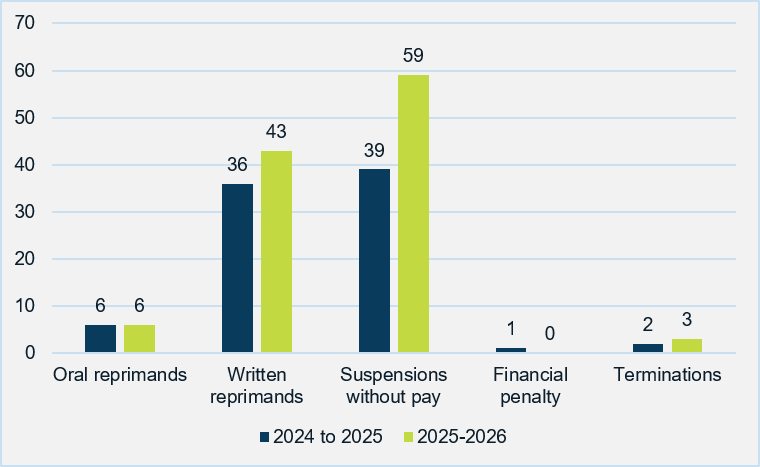
Of the 145 investigations completed in 2025 to 2026, misconduct was determined to be founded, and disciplinary measures were pursued in 120 cases (83%). With respect to these instances, the following disciplinary measures were applied:
- 6 oral reprimands
- 43 written reprimands
- 59 suspensions without pay
- 3 terminations
Nine cases of alleged misconduct were addressed without the imposition of disciplinary measures. Of these, 2 cases involved founded misconduct and were managed through the application of administrative measures, while the remaining 7 cases were administratively closed without reaching a conclusion on misconduct.
Finally, 25 cases were determined to be unfounded.
Figure 2: Comparison of disciplinary measures applied in founded cases by category
Text version of Figure 2
| Category | 2024 to 2025 | 2025 to 2026 |
|---|---|---|
| Oral reprimands | 6 | 6 |
| Written reprimands | 36 | 43 |
| Suspensions with pay | 39 | 59 |
| Financial penalty | 1 | 0 |
| Terminations | 2 | 3 |
For the purpose of this report, employee misconduct and wrongdoing cases resulting in disciplinary measures have been organized into the following categories:
- administrative misconduct
- breach of values and ethics
- harassment and violence
- fraud and theft
- misuse of employer networks and property
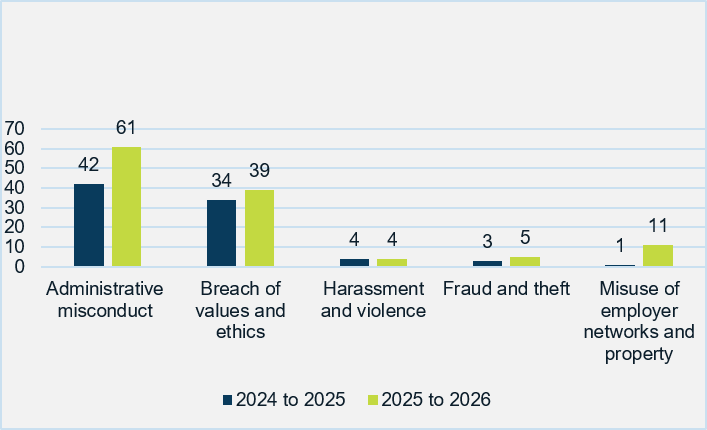
Results by category of misconduct and wrongdoing are as follows.
Figure 3: Comparison of founded cases by category
Text version of Figure 3
| Category | 2024 to 2025 | 2025 to 2026 |
|---|---|---|
| Administrative misconduct | 42 | 61 |
| Breach of values and ethics | 34 | 39 |
| Harassment and violence | 4 | 4 |
| Fraud and theft | 3 | 5 |
| Misuse of employer networks and property | 1 | 11 |
Administrative misconduct
Administrative misconduct includes misconduct related to unauthorized absences, lateness, fraudulent submission of leave or overtime, and misuse of employer time. This category also includes insubordination, which typically involves a refusal to follow clear direction from a management authority and may also encompass incidents of disrespect towards management's authority that are disruptive in the workplace.
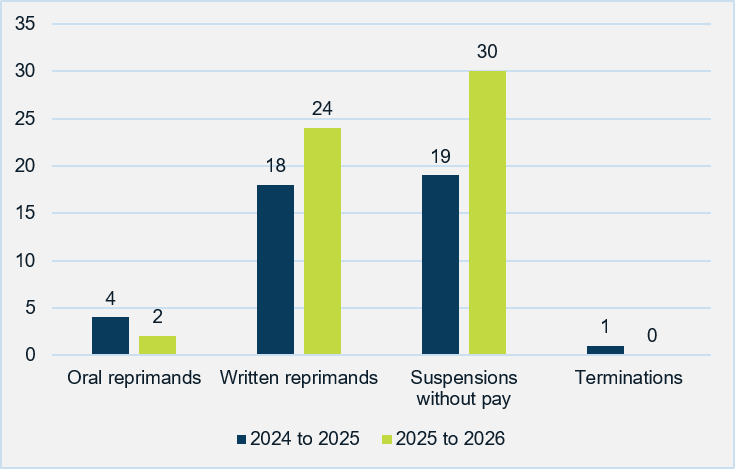
During the 2025 to 2026 fiscal year, there were a total of 61 founded cases related to administrative misconduct, resulting in:
- 5 cases where no disciplinary action was pursued
- 2 oral reprimands
- 24 written reprimands
- 30 suspensions without pay
Figure 4: Comparison of disciplinary measures for founded cases of administrative misconduct
Text version of Figure 4
| Category | 2024 to 2025 | 2025 to 2026 |
|---|---|---|
| Oral reprimands | 4 | 2 |
| Written reprimands | 18 | 24 |
| Suspensions without pay | 19 | 30 |
| Terminations | 1 | 0 |
Breach of values and ethics
PSPC's Departmental Code of Conduct sets out standards for employee behaviours in keeping with the Values and Ethics Code for the Public Sector and the department's values and people management philosophy. Misconduct in this category encompasses behaviours that breach the employer's values and ethics and established standards of conduct. For example, this may include showing disrespectful or inappropriate behaviour toward colleagues or clients, misusing one’s position or authority, or acting in a manner that undermines trust, integrity, or the impartiality expected of public servants.
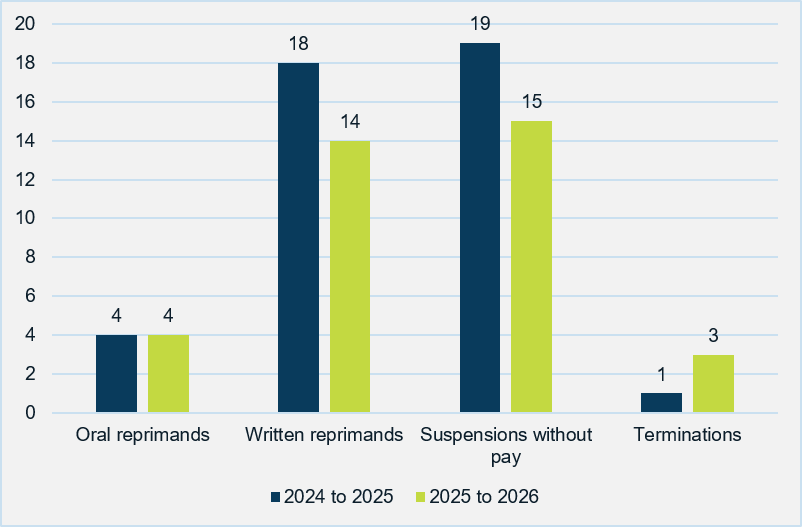
During the 2025 to 2026 fiscal year, there were a total of 39 founded cases related to breaches of the Code, resulting in:
- 3 cases where no disciplinary action was pursued
- 4 oral reprimands
- 14 written reprimands
- 15 suspensions without pay
- 3 terminations
Figure 5: Comparison of disciplinary measures for founded cases of breaches of values and ethics
Text version of Figure 5
| Category | 2024 to 2025 | 2025 to 2026 |
|---|---|---|
| Oral reprimands | 4 | 4 |
| Written reprimands | 18 | 14 |
| Suspensions without pay | 19 | 15 |
| Terminations | 1 | 3 |
Harassment and violence
Misconduct related to harassment and violence in the workplace includes any action, conduct or comment, including of a sexual nature, that can reasonably be expected to cause offence, humiliation or other physical or psychological injury or illness to an employee, including any prescribed action, conduct or comment.
Under the Work Place Harassment and Violence Prevention Regulations, investigations focus on preventing recurrence in the workplace and do not lead to individual administrative or disciplinary measures. However, the delegated manager, in consultation with Labour Relations, can initiate a separate disciplinary process to investigate the allegations and determine if administrative and/or disciplinary measures are warranted.
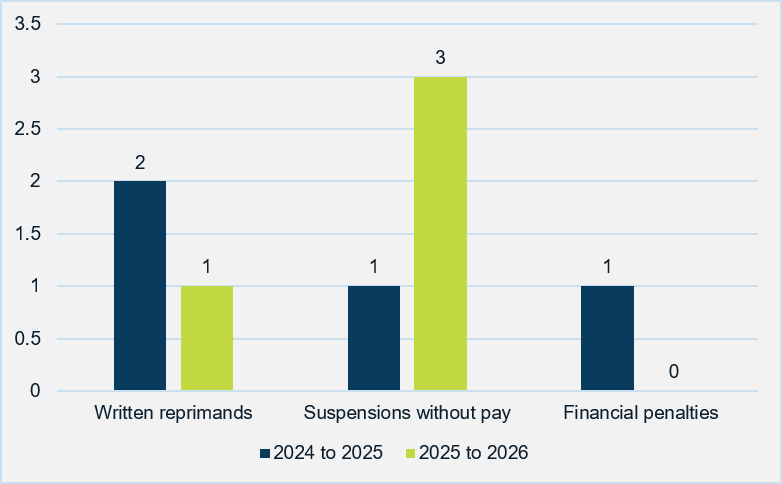
During the 2025 to 2026 fiscal year, there were a total of 4 founded disciplinary cases related to harassment and violence, resulting in:
- 1 written reprimand
- 3 suspensions without pay
Figure 6: Comparison of disciplinary measures for founded cases of harassment and violence
Text version of Figure 6
| Category | 2024 to 2025 | 2025 to 2026 |
|---|---|---|
| Written reprimands | 2 | 1 |
| Suspensions without pay | 1 | 3 |
| Financial penalties | 1 | 0 |
Fraud and theft
Incidents of employees committing fraud and theft include actions or omissions that deceive others or misrepresent information to obtain an improper personal or financial benefit, or to cause loss to the organization. For example, this may include falsifying claims or records for personal gain, stealing departmental assets, submitting dishonest information to obtain money, goods, or other advantages to which the employee is not entitled, or improperly using referral material in a staffing process to gain an unfair advantage.
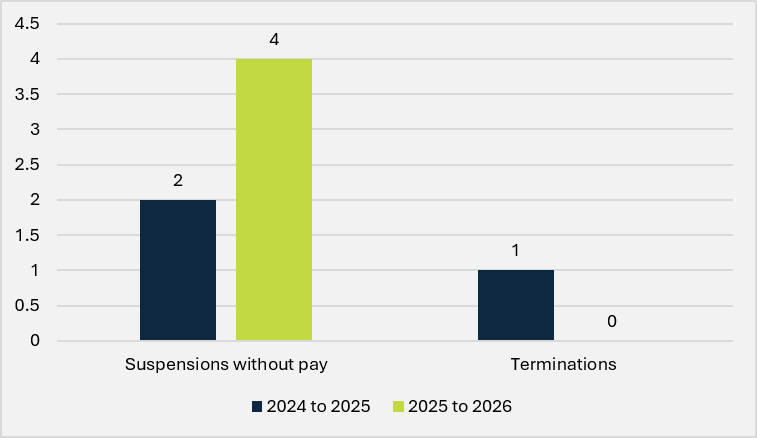
During the 2025 to 2026 fiscal year, there were a total of 5 founded cases related to employee fraud and theft, resulting in:
- 1 case where no action was pursued as the employee left the department
- 4 suspensions without pay
Figure 7: Comparison of disciplinary measures for founded cases of fraud and theft
Text version of Figure 7
| Category | 2024 to 2025 | 2025 to 2026 |
|---|---|---|
| Suspensions without pay | 2 | 4 |
| Terminations | 1 | 0 |
Misuse of employer networks and property
This category of misconduct includes failure to adhere to PSPC or Government of Canada policies, procedures, and directives regarding the appropriate and acceptable use of employer electronic networks, intellectual property, and any physical assets. For example, this may include using government networks or devices for unauthorized purposes, accessing, or sharing information without authorization, or misusing departmental equipment or other employer property.
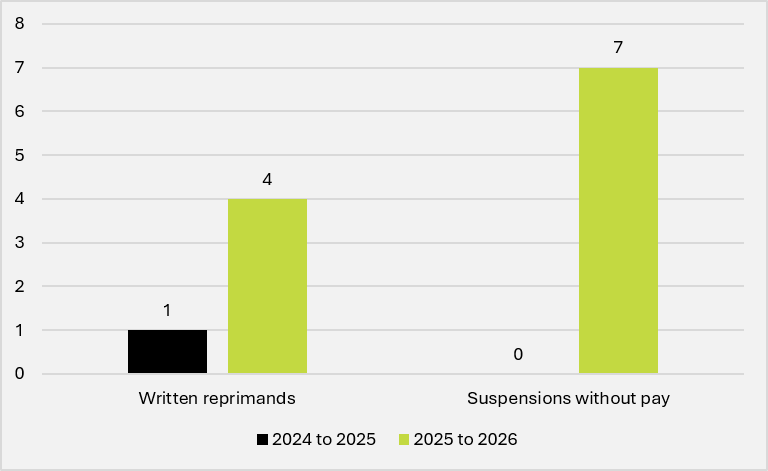
During the 2025 to 2026 fiscal year, there were a total of 11 founded cases related to the misuse of employer networks and property, resulting in:
- 4 written reprimands
- 7 suspensions without pay
Figure 8: Comparison of disciplinary measures for founded cases of misuse of employer networks and property
Text version of Figure 8
| Category | 2024 to 2025 | 2025 to 2026 |
|---|---|---|
| Written reprimands | 1 | 4 |
| Suspensions without pay | 0 | 7 |
Public Servants Disclosure Protection Act disclosures
Under the PSDPA, federal public sector employees are encouraged to come forward if they have reason to believe that a wrongdoing in the workplace has taken place or is about to take place. The PSDPA protects against reprisals and provides a fair and objective process for those against whom allegations of wrongdoing are made.
PSPC's SIID Directorate receives and manages protected internal disclosures of allegations of wrongdoing as defined in the PSDPA. Once a disclosure is received, the SIID Directorate will:
- Assess if the disclosure falls within the definition of wrongdoing outlined in the PSDPA and if there are sufficient grounds to proceed to a full investigation
- If a preliminary investigation identifies sufficient grounds, proceed with a full investigation
- Publish information as part of PSPC's proactive disclosure if a wrongdoing was found to have been committed
In 2025 to 2026, the following results were achieved in relation to PSDPA disclosures:
- 7 new disclosures of wrongdoing were received by PSPC, each of which was moved into a preliminary investigation. Following receipt:
- 1 disclosure was moved into a full investigation and subsequently closed with no finding of wrongdoing
- 3 disclosures were closed during the preliminary review stage
- 3 disclosures remain under review
- Of the 7 disclosures received, 1 alleged a misuse of public funds, 2 alleged a gross mismanagement in the public sector, 1 alleged an act or omission that created a danger to the health and safety of persons, and 3 alleged serious breaches of a Code of Conduct
- All founded cases of wrongdoing under the PSDPA are published on the open government portal available under Acts of Founded Wrongdoing
Security screening investigations
Review for Cause (RFC) investigations are conducted under PSPC's Chief Security Officer when information may call into question an employee's reliability and/or loyalty to Canada. This may result in the suspension or revocation of the employee's security status or clearance. RFCs are conducted according to the Treasury Board Directive on Security Screening and the Policy on Government Security.
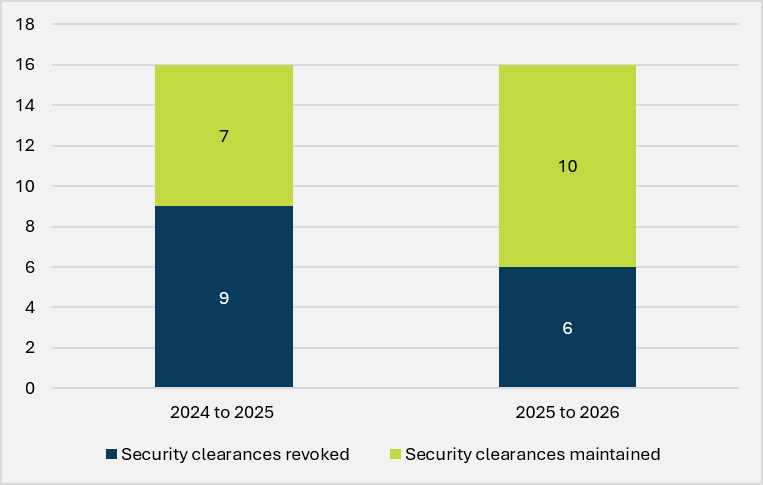
In 2025 to 2026, a total of 16 personnel security screening cases were investigated. Six RFC investigations led to revocations of Reliability Status and, as a result, termination of employment, as this status is a condition of employment for all federal public service positions. Specifically:
- An employee exhibited inappropriate behaviours towards a public servant and was criminally charged
- An employee fraudulently claimed Canada Emergency Response Benefit (CERB) while being fully employed by the Public Service
- An employee was routinely using illicit, illegal substances
- An employee accessed and shared protected information, without authorization, with individuals who did not have the need to know
- An employee was withholding disclosure about criminal charges and was found to be untrustworthy
- An employee was stealing departmental assets
Figure 9: Comparison of outcomes of security screening investigations
Text version of Figure 9
| Category | 2024 to 2025 | 2025 to 2026 |
|---|---|---|
| Security clearances revoked | 9 | 6 |
| Security clearances maintained | 7 | 10 |
Complaints under the Canadian Human Rights Act to the Canadian Human Rights Commission
Under the Canadian Human Rights Act (CHRA), anyone in Canada has the right to file a complaint if they believe they have experienced discrimination in a matter under federal jurisdiction. This includes complaints involving federally regulated employers, such as federal government departments, Crown corporations, and agencies. Discrimination is an action, behaviour, decision, or omission that treats a person or group of people unfairly and badly for reasons linked to prohibited grounds which are protected under the CHRA.
The Canadian Human Rights Commission (CHRC) receives and reviews these discrimination complaints and determines whether a complaint will be sent to the Canadian Human Rights Tribunal (CHRT) to determine if there has been discrimination. Further information is available on the CHRC website.
During the 2025 to 2026 fiscal year, 11 new CHRC complaints were received against PSPC. Out of 5 cases that were closed and of which were carried over from a previous year, 3 reached a settlement prior to a CHRT decision during the 2025 to 2026 fiscal year, 1 was referred to the grievance process, and 1 was dismissed by the CHRC.
Staffing investigations
PSPC has the authority to investigate internal appointment processes to determine whether an error, an omission, or improper conduct affected the selection of a person for appointment.
For its part, the Public Service Commissions (PSC) has the authority, under its mandate to oversee the integrity of the federal public service staffing system, to investigate external appointment processes when an appointment, or proposed appointment, may not have been based on merit, or when an error, omission, or improper conduct may have affected the selection of the person appointed or proposed for appointment. The PSC also has the authority to investigate both external and internal appointment processes when there are reasons to believe that fraud may have occurred or that an appointment, or proposed appointment, may not have been free from political influence.
Depending on the authority conducting the investigation, when an investigation concludes that the matter is founded, PSPC or the PSC may order any corrective action deemed appropriate to address the irregularities identified or to prevent their recurrence. Such measures may include the revocation of an appointment. During the 2025 to 2026 fiscal year, PSPC did not conduct any investigations. However, the PSC had 18 investigations underway involving PSPC appointment processes, all of which originated from previous years.
Of these, ten were closed: seven were founded, two were unfounded, and one was discontinued. The seven founded investigations resulted in various corrective actions, including the withdrawal of sub-delegation, revocation of appointment, training followed by discussions with management, as well as the requirement to notify the PSC before accepting employment within the public service. The remaining eight investigations are still ongoing.
Conclusion
The 2025 to 2026 Annual Report on Addressing Misconduct and Wrongdoing at PSPC is the second iteration of this publication. Building on the inaugural report, PSPC expanded the scope and scale of its reporting. The department remains committed to further improvements in future reporting cycles.
By outlining available resources and services, the report serves to support PSPC employees in maintaining a respectful, healthy, and inclusive workplace. By outlining avenues and mechanisms for reporting conduct of concern, both on the part of departmental employees and suppliers with whom we do business, the report serves to raise awareness of how misconduct and wrongdoing can be reported, assessed, and meaningfully addressed so that PSPC can continue to uphold high ethical standards in its operations and in the federal procurement and real property systems more broadly.
Integrity is a shared responsibility. Public servants and suppliers alike have roles to play in contributing to a culture of ethical and professional conduct. PSPC encourages individuals to use established reporting channels, including internal disclosure processes, workplace wellness mechanisms, and the Federal Contracting Fraud Tip Line, knowing that protections and safeguards are in place to support those who come forward in good faith.
Through prevention initiatives, training and awareness activities, and fair and timely response mechanisms, PSPC continues to reinforce accountability and sustain public trust. The department expects employees to carry out their work in adherence to the Values and Ethics Code for the Public Sector and the department’s new and strengthened Code of Conduct.
PSPC is similarly committed to holding the suppliers with whom we do business to high integrity and performance standards, as set out in the Code of Conduct for Procurement.
Through continuous improvement to our policies, standards, and programs, PSPC will remain steadfast in our efforts to prevent, detect, and respond to misconduct and wrongdoing.
© His Majesty the King in Right of Canada, as represented by the Minister of Public Services and Procurement Canada, 2026
ISSN 2819-4721