
Targeted Advice and Support on Human Resources and Pay Governance: Final Report
Date: April 30, 2026
Internal Audit
Public Services and Procurement Canada and
Treasury Board of Canada Secretariat
On this page
- Executive summary
- Background
- Objective and scope
- Methodology
- Interviews and workshops
- Governance evolution
- Observations
- Appendix A: Glossary
- Appendix B: Committees in scope
- Appendix C: Terms of reference
- Appendix D: Committee secretariats
- Appendix E: Sources and reference material
- Appendix F: Agenda item types
- Appendix G: Deputy Minister Sponsoring Group secretariat services providers
Copyright information
© His Majesty the King in Right of Canada, as represented by the Minister of Public Services and Procurement Canada, 2026
P4-190/2026E-PDF
ISBN: 978-1-100-00129-6
Executive summary
The Human Resources (HR) and Pay Portfolio continues to advance a complex, multi‑departmental transformation that requires strong, clear, and disciplined governance to support oversight, and inform decision‑making. Since 2023, HR and Pay governance was refined to strengthen oversight and improve operational efficiency. Adjustments to committee structures, protocols, meeting cadences, and inter-committee relationships have contributed to a more coherent and effective governance model.
The objective of Targeted Advice and Support on HR and Pay Governance was to support management by providing insights on the value, objectives, risks, and controls for an effective governance regime. Furthermore, the engagement assessed the current HR and Pay governance relative to leading governance practices. This engagement was largely based on a series of collaborative, diagnostic workshops, or interviews with a sample of committee participants and the secretariats and supplemented with analysis. Key observations and related advice are as follows.
Committee structures, mandates, roles, responsibilities and authorities
The revised terms of references (ToRs) are now clearer with committee structures being generally appropriate and mandates well-aligned. Despite these improvements, the purpose and value of committees along with their associated roles, responsibilities, and authorities are not widely understood. Committees are often used for one-way information sharing rather than for active deliberation. Additionally, governance practices reflect traditional project management approaches that constrain agility.
Advice
- Strengthen communication and ongoing engagement by providing more detailed guidance to reinforce participants’ understanding
- Include a summary of stakeholder consultations, key factors considered and an assessment of risk in committee presentations to better inform participants in providing advice, endorsement, and decisions
- Incorporate more agile governance practices, such as targeting presentations to specific committees rather than sequentially, to reduce administrative burden, and enhance flexibility
Information management practices
Committee information is generally of good quality. However, gaps in topic prioritization combined with the untimely delivery and excessive volume of materials limits meaningful consultations, reduces the quality of deliberations, and weakens oversight. Also, ineffective information channels across governance further reduces participant engagement and diminishes clarity on decisions and next steps.
Advice
- Improve agenda planning, including topic prioritization
- Shift one-way information updates to non governance channels to keep governance time focused on strategic and decision-oriented matters
- Improve vertical information flow from lower level to high-level committees and back down
Culture
Governance leaders foster a tone that encourages open dialogue, diverse perspectives, transparency, and constructive dissent. Participants also demonstrate behaviours aligned with government values and ethics. However, despite these positive conditions, participants are not yet fully taking advantage of opportunities for openness and constructive dissent.
Advice
- Introduce deliberate mechanisms, such as establishing explicit norms for surfacing alternative viewpoints, to reduce cultural barriers, enhance strategic discussion, and improve the rigour of decisions
Secretariat support services
While governance secretariats generally provide common support services across committees to enable committees to discharge their duties, coordination among the providers is inefficient, and operations are not supported by standardized operational procedures.
Advice
- Streamline secretariat functions and assign clear responsibilities, including coordination activities
- Establish standardized operating procedures for committee operations, such as timelines for distribution of materials in advance of meetings
Background
The Human Resources (HR) and Pay Portfolio’s mandate is to design, lead, coordinate, and implement the development and deployment of an Integrated Enterprise Strategy on Human Resources and Pay (the Strategy). An integrated team was established with Public Services and Procurement Canada (PSPC) designated as the Solution Delivery Lead and the Office of the Chief Human Resources Officer (OCHRO) at the Treasury Board of Canada Secretariat (TBS) as the Business Owner.
To support the Strategy and to respond to evolving needs, a governance structure was put in place, bringing together stakeholders from various departments to facilitate rapid decision-making and execution.
As a critical enabler of large, complex initiatives, like the HR and Pay portfolio, effective governance is needed so that all parties remain aligned in the achievement of common and desired outcomes. It supports the timely and meaningful oversight of risks, insights into performance, and foresight related to opportunities. Ultimately, it enables parties to effectively fulfill their respective and collective fiduciary duties; that is, to act in the best long-term interest of the departments as well as their partners and stakeholders involved in the strategy’s design and execution.
Objective and scope
The objective of this engagement was to support management by providing insights on the value, objectives, risks, and controls for an effective governance regime. Furthermore, the engagement assessed the current HR and Pay governance relative to leading governance practices.
Given the ongoing evolution of the HR and Pay governance ecosystem, the scope of this engagement included selected committees that were active at any time during the engagement’s period from January 2025 to January 2026 (refer to Appendix C: Terms of Reference for a list of these bodies). Two committees, namely the Feasibility Analysis Project – Delivery Status Committee (FAP-DSC) and the Director General (DG) Enterprise Change and Release Management Committee (ECARM), were dissolved during this engagement. These committees were nonetheless retained within the scope so that lessons learned could be applied to the broader governance ecosystem.
This engagement was conducted in accordance with the 2024 Global Internal Audit Standards.
Methodology
- Documentation reviews of governance materials, such as decks and meeting minutes
- Analysis of selected governance committees’ terms of reference (ToR). Refer to Appendix C: Terms of Reference for a listing of ToRs and their status
- Develop and present a framework that includes the values, objectives, risks, and controls of an effective governance regime
- Facilitate a series of collaborative, diagnostic workshops or interviews with a sample of members and observers of the selected governance committees and the secretariats that support these bodies (refer to Appendix D: Committee secretariats)
Internal audit drew on established frameworks, policies, and leading practices for governance to assess the elements listed above (refer to Appendix E: Sources and reference material)
Interviews and workshops
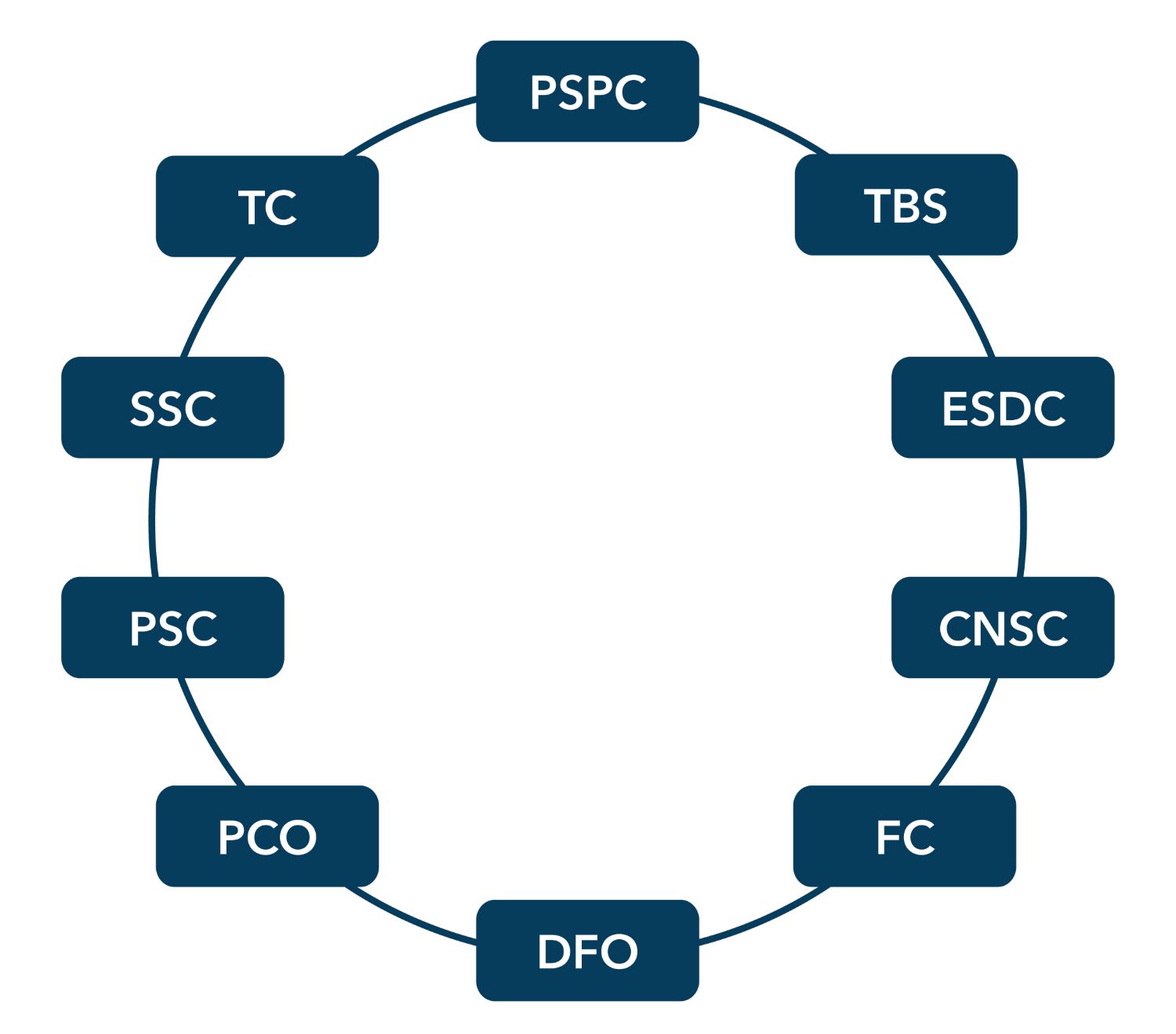
Individuals from 10 departments participated in interviews and workshops (refer to Figure 1: Departments participating in interview and workshops).
Specifically, a total of 13 interviews were conducted, as follows:
- 8 interviews involving 11 HR and Pay Deputy Minister Sponsoring Group (DMSG) participants
- 2 interviews with the secretariat in the Human Capital Management (HCM) Strategy and Integration Branch (SIB), PSPC
- 2 interviews with the secretariat in the Transformation Management Office (TMO), HCM Solutions Branch (SB), PSPC
- 1 interviewFootnote 11 with the Office of the Deputy Clerk of the Privy Council and the Associate Secretary to the Cabinet (Deputy Clerk’s office) and the Operations Secretariat at the Privy Council Office (PCO)
Figure 1: Departments participating in interviews and workshops
Text version of Figure 1
Figure 1 is a simple circular diagram listing the 10 government departments that participated in interviews and workshops as labeled boxes arranged around a circle. The labels are: PSPC, TBS, ESDC, CNSC, FC, DFO, PCO, PSC, SSC, and TC.
Also, a total of 7 workshops were conducted, as follows:
- 2 Assistant Deputy Minister (ADM)-level workshops comprised of 9 participants
- 5 DG level-workshops comprised of 26 participants
In addition, a combination of interviews and workshops were conducted with senior management below.
- 1 interview with the Associate Deputy Minister (DMA), PSPC, as Project Sponsor
- 1 interview with the Associate Chief Human Resources Officer, TBS, as Business Owner
- 1 ADM-level workshop comprised of 4 participants representing HCM and TBS-OCHRO
The governance framework developed by Internal Audit as part of its methodology was shared with all participants in advance of their respective workshops and served as the foundational tool for guiding the discussions. These workshops were intentionally designed to be dynamic and exploratory in nature, fostering open, candid dialogue among participants. As such, this report synthesizes and presents the overarching themes that consistently emerged across the sessions, rather than providing a detailed tabulation of individual participant responses.
Governance evolution
Since 2023, HR and Pay governance was refined to strengthen oversight and improve operational efficiency. Adjustments to committee structures, protocols, meeting cadences, and inter-committee relationships have contributed to a more coherent and effective governance model.
In late summer/early Fall 2023, the following governance bodies were established:
- DMSG as an oversight committee at the Deputy Minister (DM) level
- Program Management Committee (PMC) as an oversight committee at the DMA and ADM levels
- 4 pillar steering committees representing HR, Pay, Data, and Management
Since then, refinements were implemented as follows:
-
as part of a governance refresh in Summer 2024, the 4 pillar steering committees were replaced with committees aligned to the
HR and Pay Portfolio’s “run” and “transform” categories (Appendix A: Glossery) to streamline governance. New committees included:
- the HCM-Run Steering Committee (RSC) to oversee progress of “run” deliverables
- the FAP-DSC to oversee the successful delivery of the Feasibility Project
- the DMA and DG ECARM committees for prioritization and deconfliction
- the Spring 2025 governance refresh clarified the committee mandates, authorities, key functions, and membership, including roles, except for the 2 ECARM committees
- in April 2025, the FAP-DSC was dissolved as the Feasibility Project ended
- in Summer 2025, the HCM ADM Transform Steering Committee (ADM Transform) and the DG Steering Committee - HR and Pay Transformation (DG Transform) were established to oversee “transform” deliverables
- in September 2025, the DG ECARM was dissolved and replaced with the Executive ECARM with combined ADM and DG membership and ADM-only voting rights
Additional adjustments were made to optimize committee operations:
- meeting cadence was refined to reduce governance burden and/or operational pace. For example, PMC meetings shifted from weekly to bi-weekly and DMSG meetings increased from every 2 months to bi-weekly to match demands
- meeting attendance was reduced to foster engagement. When the PMC was initially established, extra guests were allowed to attend meetings to promote transparency, but it limited engagement. Since January 2025, PMC attendance was reduced from over 100 attendees to below 50 people to align its attendance more closely with membership size
Observations
Internal audit observations gathered during this engagement have been grouped into 5 key areas. Some observations may span multiple areas or have compounding effects.
Structures and mandates
While committee structures are generally appropriate and mandates well-aligned, their unique purpose and value are not widely understood. Committees are often used for one-way information sharing rather than for active deliberation needed to inform decisions and to support oversight. Also, governance practices reflect traditional project management approaches that constrain agility.
Observation 1: Internal Audit found that the mandates in the approved and draft ToRs are documented, aligned across committees, and describe the reporting structures and interrelationships. However, the PMC ToR would benefit from greater clarity regarding its reporting relationship to the DMSG beyond its advisory role in the escalation process.
Observation 2: Respondents in 4 of 7 workshops did not fully understand the unique purpose and value of each committee within the governance ecosystem, either individually or in relation to one another. They noted that this lack of understanding has led to uncertainty about which committee is most appropriate for presenting, deliberating, or endorsing topics. It also contributes to topics being revisited multiple times across several governance committees. This diminishes participants’ engagement and weakens their commitment to governance.
Observation 3: Senior management noted that ADM-level committees lack strategic focus. ADMs participate in a large number of committees, including pre-brief or debrief meetings, and frequently address unresolved operational matters that should be resolved at lower-level committees. As a result, senior‑level committees are being used to resolve matters that fall within the purview of operational committees or individual decision‑makers, rather than focusing on their strategic governance role. This diversion leads to inefficiency, poor use of senior executive time, and key strategic governance responsibilities not being appropriately discharged. It also has the potential to diminish the effectiveness of deliberations at more senior‑level committees, as well as to inform decision-making and support oversight.
Observation 4: Respondents in 4 of 5 DG workshops reported participating in numerous committees, including working groups and other bodies outside the scope of the engagement (for example, Human Resources Council and Architecture Review Board). They also noted that some in-scope committees had overlapping mandates. According to respondents, this limited their ability to prepare and contribute effectively to meetings.
However, further inquiry from 13 workshop respondents revealed that, of the 10 individuals who responded, 7 indicated that this issue has largely diminished due to recent governance adjustments (refer to Governance evolution for further details). Additionally, Internal Audit’s review of the approved and draft ToRs found no significant overlap or duplication of committee mandates (refer to first bullet in this section).
Observation 5: Internal Audit found that current governance practices rely heavily on a traditional waterfall project management approach. While compliant with policy and aligned with PSPC’s Project Navigator Framework, this approach limits agility. Specifically, governance functions in a hierarchical, sequential manner that requires multiple committee reviews and endorsements before accountable executives can make decisions. Combined with a risk-averse culture (refer to 5.4Culture), this structure can lead to unnecessary layers of review and oversight, regardless of the risk level or materiality of the issue.
Observation 6: Committees below the DM level are largely not behaving as governance bodies. Instead of focusing on the core governance responsibilities of informing decision-making and exercising oversight, they are often used for one-way information sharing. Respondents in all 5 DG workshops confirmed this observation. Internal Audit’s analysisFootnote 2 of committee agendas between January 2025 and December 2025 showed that on average 64% of agenda items were classified as informational with the PMC having the highest proportion at 83% (refer to Appendix F: Agenda item types for further details).
While information sharing serves an important purpose, particularly for change management, it:
- shifts attention away from strategic priorities and areas of greatest importance
- reduces overall efficiency and the value of committee time
- blurs the distinction between governance and management roles
- overloads participants with information, limiting focus on high-priority matters
Observation 7: Based on review, Internal Audit found that membership size and composition across committees were suitable for their respective mandate, with an appropriate mix of key stakeholders, vendors and/or representatives from other government departments and agencies. ADM workshop respondents generally agreed with this observation but noted greater representation from departmental compensation/pay experts would be beneficial. Senior management noted the inclusion of the Heads of HR at the PMC since June 2025, as a positive enhancement.
In 3 of 5 DG workshops, respondents expressed concern about overlapping membership, especially between “run” and “transform” committees (Appendix A: Glossery). Internal Audit’s analysis found that of the HCM-RSC membership compared with both Transform committees shows about 27% of committee participants, specifically, HCM ADMs and DGs, serve on both. The overlap in committee membership is considered minimal and therefore does not materially affect efficiency. Furthermore, these participants are necessary given the mandate of the respective committees.
Advice
- Document in the ToR the PMC’s reporting relationship with the DMSG beyond its advisory role
- Communicate committee mandates, reporting structures, and inter‑relationships to reinforce the unique value each committee brings and to strengthen participant understanding of their role in achieving broader portfolio outcomes
- Require that lower‑level committees or accountable leaders make a concerted effort to resolve operational matters before escalation and tighten agenda management so that only strategic items advance
-
Incorporate more agile governance practices to reduce administrative burden, enhance flexibility, and broaden delegated authority by:
- empowering individual decision‑makers and refocusing committees on advising only on matters of significant risk, impact, or strategic importance, rather than acting as mandatory checkpoints for routine decisions
- expanding delegated authority across all levels, reducing reliance on more senior decision-makers, and enabling timely decisions to be made closer to delivery and operational realities
- Shift routine updates to non‑governance channels, such as information sessions, newsletters, intranet updates, to keep governance agendas focused on strategic and decision‑oriented matters
Roles, responsibilities, and authorities
Although the revised ToRs are now clearer, understanding of committee roles, responsibilities, and authorities remains inconsistent across participants, reduces the effectiveness of committee deliberations and hinders the consistent and efficient operationalization of the committee mandates.
Observation 1: Internal Audit’s review found that the revised ToRs (both approved and draft) provide greater clarity on the roles, responsibilities, and authorities of the committees.
- The approved ToRs for the DMSG and the PMC explicitly state that these committees no longer hold decision-making authority as it now rests with the Project Sponsor and Business Owner
- The draft ToR for the Executive ECARM specifies that this committee does not posses decision-making authority, which resides with the with the Project Sponsor and Business Owner as the DMA ECARM co-chairs
- For all the remaining committees still in operationFootnote 3, their ToRs outline respective decision-making authorities, even where ToRs remain in draft (HCM-RSC and DMA ECARM)
Observation 2: Despite improvements in documentation, interview and workshop feedback indicated that understanding of roles and responsibilities varies significantly among participants.
- DMSG interviewees largely demonstrated a sound understanding of their role and shared accountabilities, even before these were fully documented in the ToR
- DMSG interviewees (3 of 11) indicated that they expected individuals with specialized expertise, such as information technology, to play a specific role. These experts sometimes held differing views about their contributions, which may lead to misalignment on expected contributions during discussions
- Respondents from other committees showed a less consistent understanding, which was compounded by the broader uncertainty around the purpose and value of each committee within the governance ecosystem (refer to Structures and mandates). The inconsistent understanding of roles and responsibilities among committee participants may lead to misunderstandings about their expectations and duties, reducing the effectiveness of committee deliberations and oversight
Observation 3: In 5 of 7 workshops, respondents noted a lack of clarity regarding accountability, including decision-making authority. Specifically, they expressed confusion as to whether decision-making resides with a committee, a chair, or another individual.
Observation 4: Concerns were raised by respondents in 3 of 7 workshops about the adequacy of the information that is used to provide advice, offer endorsement and inform decisions. They raised questions regarding the extent and nature of the consultations with stakeholders, the factors considered (for example, legal, policy and financial management), and the assessment of risk. Unclear accountability and decision‑making processes can lead to delays, inconsistent or suboptimal outcomes, and reduced confidence in governance.
Advice
- Although the committee roles, responsibilities, and authorities are documented in the ToRs, ongoing communication, and deeper engagement, supported by more detailed guidance outlining the specific authorities of committees, chairs, or individual decision‑makers, are needed to enhance understanding by committee participants
- Include, as an annex to each presentation, a summary of stakeholder consultations, key factors considered and an assessment of risk to better inform participants in providing advice, endorsement, and decisions
Reporting and information
Committee information is generally of good quality. However, gaps in topic prioritization, combined with the untimely delivery and excessive volume of materials limits meaningful consultations, reduces the quality of deliberations, and weakens oversight. Also, ineffective information channels across governance further reduces participant engagement and diminishes clarity on decisions and next steps.
Observation 1: DMSG interviewees and workshop respondents reported that overall, committee information, including agendas, materials, and records of discussion (RoDs), are generally of good quality. They also identified several challenges below that hinder robust discussions and limit the effectiveness of oversight.
Agenda
Observation 2: Respondents in 4 of 7 workshops raised concerns regarding agenda setting or the forward agenda process. In particular, they noted topics do not always reflect the risk level or materiality of the issue at hand.
Similar concerns were echoed by 5 of 11 DMSG interviewees. Furthermore, 4 of 11 DMSG interviewees highlighted an imbalance between the presentation of “run” and “transform” items (Appendix A: Glossery). They noted that these challenges are further compounded by the absence of an overarching portfolio or project plan. As such, they perceive that information is being tabled in an ad hoc manner and reduces confidence in planning rigor, making it harder to understand priorities.
Although a forward agenda process exists, it does not consistently support bringing forward the most relevant priorities, limiting the committee’s ability to make fully informed decisions, and increasing the risk of gaps in governance and prioritization.
Observation 3: In 4 of 7 workshops, respondents noted that agendas often lack clarity, especially in terms of the intended outcome (information, consultation, or endorsement) and/or were too dense. They noted that this ambiguity has led to confusion as to the role that some participants feel they are expected to play in supporting the committee’s mandate and the density of the agenda does not always allow for meaningful discussions.
Materials
Observation 4: DMSG interviewees had mixed views on the timeliness of material distribution in advance of meetings. For the remaining committees, respondents in all 7 workshops reported that materials are often provided late and are too voluminous to be effectively reviewed within the available timeframe. They also noted that this limits the extent and depth of consultations, reduces the quality of meeting deliberations, and raises concerns as to the adequacy of oversight relative to the risk and importance of topics to be discussed.
Observation 5: For the DMSG, 3 of 11 interviewees indicated that information is presented differently for certain repeatable deliverables, which makes comparison difficult. This variability can also lead to inefficiencies, as participants spend additional time reconciling or interpreting differing formats and content.
Observation 6: DMSG interviewees (3 of 11) and respondents in 5 of 7 workshops noted that information is not always tailored to the audience in a clear and concise manner. In particular, 5 of the 11 DMSG interviewees specifically noted that technical information is presented at an appropriate level to facilitate understanding among participants whereas respondents in 3 of 7 workshops expressed difficultly in understanding technical content.
Observation 7: In 4 of 7 workshops, respondents emphasized the value of having subject-matter experts participate in meetings as presenters or observers to provide additional details. Respondents also shared that having the individual(s) responsible for executing the decision attend the meetings would also be advantageous.
Records of discussion
Observation 8: Respondents in 4 of 7 workshops indicated RoDs are often ambiguous, lack sufficient context and clear actions, including assigned accountability and timelines. This underscores the importance of enhancing transparent and comprehensive committee documentation so that there is a clear and shared understanding amongst participants, and to enable clear accountability and the timely execution of actions.
Information flows
Observation 9: In 5 of 7 workshops, respondents noted that information channels intended to support governance are not functioning effectively. In particular, they indicated the following:
- when advice or input is provided on deliverables at lower governance levels, it is unclear how this information is incorporated into materials presented at higher levels. Furthermore, the current meeting cadence between committees does not allow sufficient time for integrating feedback or updates
- decisions and their underlying rationales from senior governance levels or individual decision-makers are not consistently communicated back to lower levels
This is contributing to disengagement.
Advice
- Enhance the agenda setting process by conducting regular consultations with committee participants to confirm emerging priorities and validate the forward agenda, including ensuring balanced representation of “run” and “transform” topics (Appendix A: Glossery)
- Strengthen the agenda-setting process by implementing measures so that each agenda item clearly and accurately reflects its purpose and expected outcome
- Provide tailored and contextualised information that is critical, highly significant, and directly relevant to participants in relation to their committee’s mandate. This includes standardizing information related to recurring deliverables, and when changes are made, provide restated figures for previous periods and accompanying explanations
- Strengthen committee documentation practices by requiring RoDs to clearly articulate context, specific actions, assigned accountabilities, and completion timelines
- Establish and enforce a minimum materials lead time and require that late submissions be removed as an agenda item and be deferred unless the Chair grants an exception
-
Consider including subject‑matter experts and the individuals responsible for implementing decisions, irrespective of level, to strengthen
clarity and execution
- this will also improve decision quality and accountability
- Improve governance information flow by clarifying integration of lower-level input, adjusting meeting cadence for feedback, and sharing decisions and underlying rationales across levels
Culture
Governance leaders foster a tone that encourages open dialogue, diverse perspectives, transparency, and constructive dissent. Participants also demonstrate behaviours aligned with government values and ethics. However, despite these positive conditions, participants are not yet fully taking advantage of opportunities for openness and constructive dissent.
Observation 1: DM interviewees and ADM workshop respondents consistently indicated that the DMSG and the PMC co-chairs set a positive tone that encourages open dialogue, diverse perspectives, transparency, and constructive dissent. Respondents also noted that participants largely demonstrate behaviours aligned with government values and ethics, engaging in ways that were inclusive, collaborative, and respectful.
Observation 2: For the DMSG, 7 of 11 interviewees reported strong engagement from committee participants reflected in high attendance and active participation. Additionally, 4 of 11 DMSG interviewees suggested that having the PCO and the TBS co-chair the committee reinforces its importance and that the early morning time slot helps participants avoid conflicting priorities. A few interviewees highlighted that the recent retirement of an experienced DM created a gap in knowledge and reduced the committee’s ability to provide a robust challenge function.
Observation 3: Senior management has observed that, aside from the DMSG, participation in governance meetings tends to be concentrated among the same few individuals. Respondents suggested that the limited participation may stem from consultations that often occur outside formal governance structures and groupthink.
Additionally, in 3 of 7 workshops, respondents noted an absence of a substantive challenge function in meetings, which is essential for fostering healthy deliberation and robust discussion. Respondents and senior management mentioned that they feel openness and constructive dissent remain underutilized, citing several contributing factors:
- risk aversion, which is deeply rooted in the Government of Canada culture, particularly in a post-Phoenix environment
- an implicit priority on moving items quickly through the governance chain to keep pace with portfolio or project demands, often taking precedence over having deeper discussions
- a lack of understanding of the technical information
- seeking perfection in meeting materials, which can hinder timely and meaningful deliberation. Topics are frequently fully developed before presentation, leaving limited space for strategic engagement or ideation. Conversely, participants may be uncomfortable with open-ended discussions when information is incomplete or context is ambiguous
These dynamics reduces the effectiveness of independent challenge and increases the risk of groupthink. As a result, requirements, risks, and control gaps may be identified late in the process, leading to weaker decisions, reduced strategic foresight, and potential delays or rework. It may also reduce organizational learning and impede continuous improvement across governance processes.
Advice
Continue reinforcing a culture of open dialogue, diverse perspectives, transparency, and constructive dissent by identifying and addressing practices that may inhibit these behaviours, such as offering technical briefings to ADMs and DGs. This includes considering formalizing expectations for inclusive and balanced deliberation, such as introducing rotating challenge roles or meeting norms that explicitly encourage alternative viewpoints.
Governance secretariat and processes
While secretariats generally provide common support services across committees, the provision of services by 4 providers for 1 committee is operationally inefficient. Coordination among providers is also inefficient and operations are not supported by standardized operational procedures.
Observation 1: Based on interviews and analysis, Internal Audit found that:
- all governance committees receive common secretariat support services. Although the DMSG ToR states that the Office of the Deputy Clerk’s office is responsible for “invitations, meeting deliberations, along with the coordination and retention of other relevant documentation,” these services are, in practice, disbursed across 4 different secretariats or offices (providers) (refer to Appendix G: Deputy Minister Sponsoring Group secretariat services providers for further details). This segmentation creates operational inefficiencies, increases the administration and coordination burden, and diffuses responsibility for the provision of services
- coordination is limited among the 4 providers, leading to fragmented visibility across the HR and Pay governance ecosystem. This has resulted in gaps, such as the lack of insights on the forward agenda and instances of duplicated effort
- standard operating procedures governing committee operations are limited and applied inconsistently. Specifically, there are no documented processes for activities such as establishing committees or onboarding meeting participants. Also, timelines for the distribution of meeting materials vary across ToRs with some specifying clear deadlines and others providing vague guidance (for example, “prior to the meeting”). Additionally, although the approved and draft ToRs now include guidance on dispute resolution and escalation, this information is still absent for the 2 Transform committees. These gaps and inconsistencies may hinder the effectiveness of committee deliberations and weaken fairness and transparency in decision‑making
Observation 2: Internal Audit’s review found that approved ToRs were communicated to committee participants. Notably, the ToRs for the DMSG as well as ADM and DG Transform were also discussed at respective committee meetings. However, the DMA and Executive ECARM ToRs remain unapproved despite the committees operating since Summer 2024 and Summer 2025, respectively. Also, the HCM-RSC ToR has been in draft form since the Spring 2025 governance refresh. Without being documented and properly constituted, it creates ambiguity regarding committee objectives, roles, and operating practices, increasing the risk of misaligned oversight and inconsistent decision‑making.
Observation 3: Internal Audit observed, as well as a few respondents and other stakeholders have reported, that the “no delegates” protocol, introduced at the PMC in June 2025 to encourage member attendance, has unintentionally resulted in gaps in subject matter expertise and departmental representation. Furthermore, the application of this protocol is inconsistent, with greater flexibility appearing to be provided to PSPC participants.
Advice
- Streamline the number of committee service providers and assign clear responsibilities to improve efficiency and reduce burden
- Common, coordinated, and consistent support services should be provided across committees, supported by operating procedures to enable standardized, reliable, and efficient committee operations
- The initial and subsequent changes to the ToRs should be reviewed and approved in a timely manner to eliminate ambiguity and reduce the risk of misaligned oversight and decision making
- Re-assess the “no delegates” protocol and consider complementary options to maintain expertise and representation. If the protocol is retained, apply it consistently across all participants
Appendix A: Glossary
Appendix B: Committees in scope
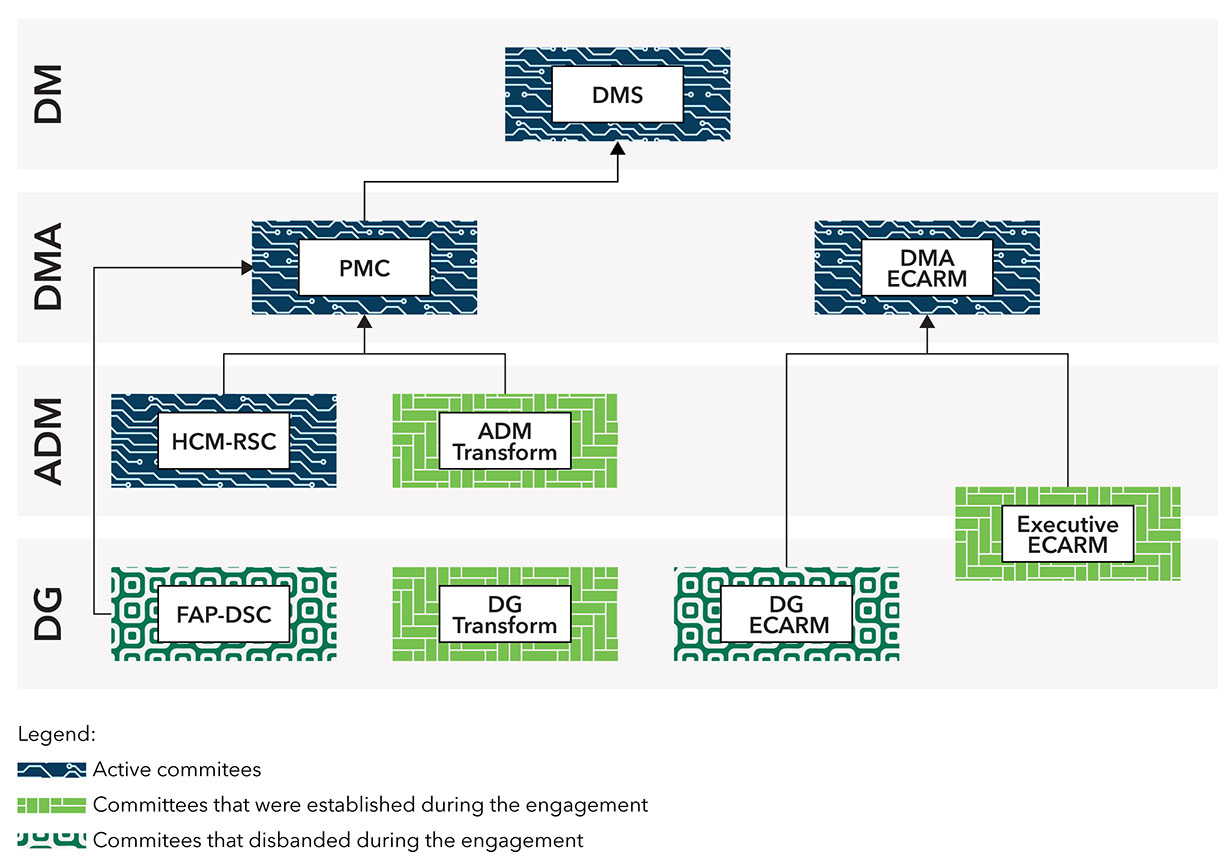
Appendix B - Text version
Committees in scope is a hierarchical diagram that visually shows the selected committees that were active at any time during the engagement period and how they are related.
Committees are arranged in 4 horizontal levels labeled, from bottom to top: DG, ADM, DMA and DM, with arrows indicating their relationship. Each committee has a colour status depicting their status during the engagement, which is outlined in a legend:
- dark blue boxes represent active committees
- green boxes represent committees established during the engagement
- red boxes represent committees that were disbanded during the engagement
At the DG level:
- FAP‑FSC reports directly to the PMC and is a red box
- DG Transform reports to the ADM Transform and is a green box
- DG ECARM reports to the DMA ECARM and is a red box
Between the DG and ADM levels, the Executive ECARM reports to the DMA ECARM and is a green box.
At the ADM level:
- HCM-RSC reports directly to PMC and is a blue box
- ADM Transform reports directly to the PMC and is a green box
At the DMA level:
- PMC reports to the DMSG and is a blue box
- DMA ECARM reports to the DMSG and is a blue box
At the DM level, the DMSG is a blue box.
Appendix C: Terms of reference
| Committee | Initial ToR Review June 2025 | Updated ToR Review January 2026 |
|---|---|---|
| DMSG | November 14, 2024 Approved | September 4, 2025 Approved |
| PMC | November 22, 2024 Approved | June 9, 2025 Approved |
| DMA ECARM | September 6, 2024 Draft | October 22, 2025 Draft |
| HCM-RSC | November 13, 2024 Approved | January 6, 2026 Draft |
| ADM Transform | N/A – Committee not established | June 27, 2025 ApprovedFootnote 4 |
| DG Transform | N/A – Committee not established | June 25, 2025 Approved |
| Executive ECARM | N/A – Committee not established | October 24, 2025 Draft |
| DG ECARM | September 6, 2024 Draft | N/A – Committee dissolved |
| FAP-DSC | October 1, 2024 Approved | N/A – Committee dissolved |
Appendix D: Committee secretariats
Human Capital Management Strategy and Integration Branch, Public Services and Procurement Canada
- PMC
- DMA ECARM
- HCM-RSC
- Executive ECARM
- DG ECARM
Transformation Management Office, Public Services and Procurement Canada
- ADM Transform
- DG Transform
- FAP-DSC
Deputy Clerk’s office, Privy Council Office
- DMSG
Appendix E: Sources and reference material
Treasury Board policy
- Policy on the Planning and Management of Investments
- Directive on the Management of Projects and Programmes
- Policy on Service and Digital
- Directive on Service and Digital
- Policy on Government Security
- Directive on Security Management
Public Services and Procurement Canada policy
Other
- The Three Lines of Defense in Effective Risk Management and Control – January 2013 (PDF)
- Lessons Learned from the Transformation of Pay Administration Initiative
- The Phoenix pay problem: Working toward a solution (PDF)
- The Directors College: Global Case Studies in Innovation GovernanceFootnote 5
- The Directors College: Governing Innovation
- Institute of Corporate Directors: The Culture Imperative (PDF)
- Institute of Corporate Directors: The Trust Matters Toolkit
Appendix F: Agenda item typesFootnote 6
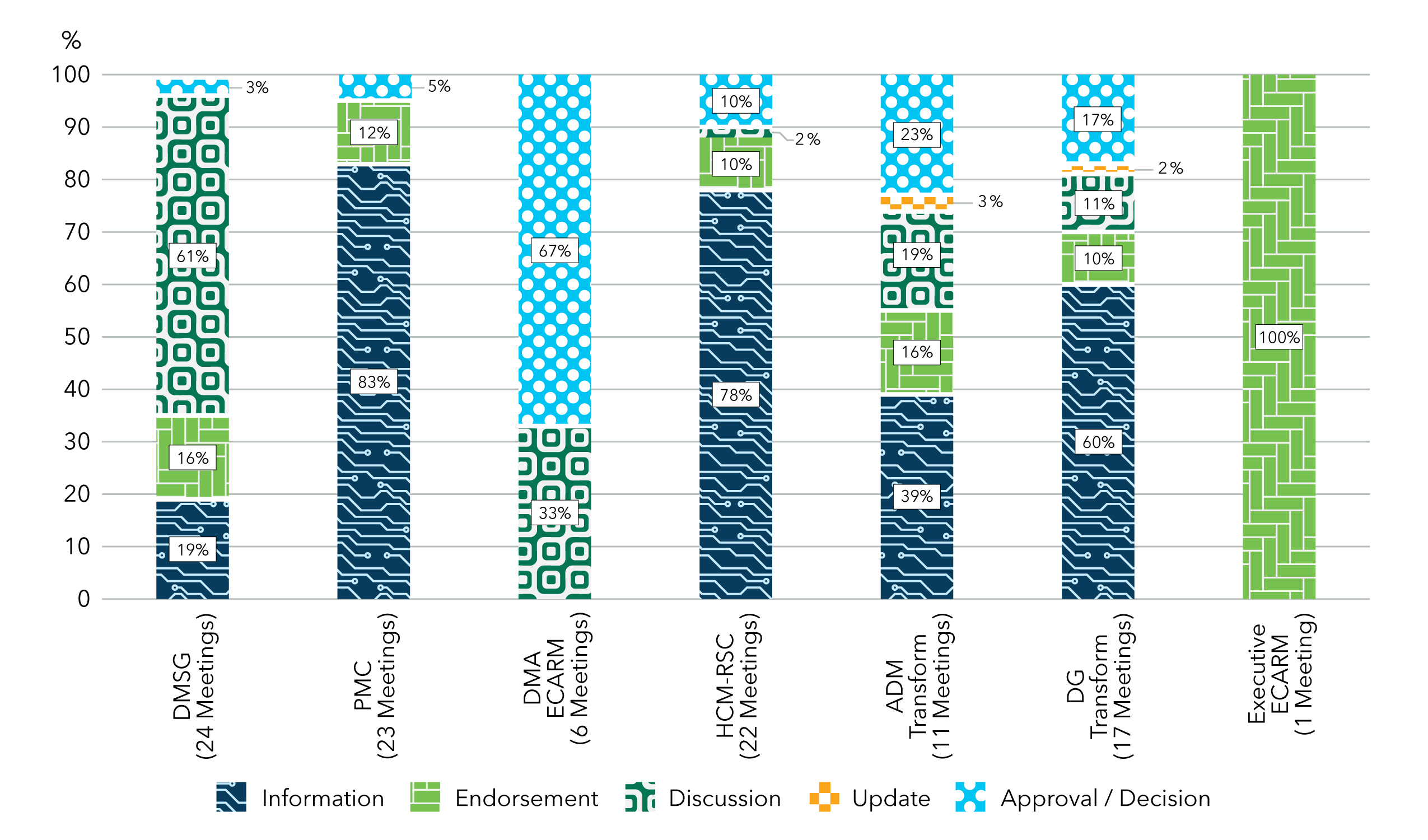
Appendix F: Text version
| Committee | Meetings Reviewed | Information | Endorsement | Discussion | Update | Approval/Decision |
|---|---|---|---|---|---|---|
| DMSG | 24 | 19% | 16% | 61% | 0% | 3% |
| PMC | 23 | 83% | 12% | 0% | 0% | 5% |
| DMA ECARM | 6 | 0% | 0% | 33% | 0% | 67% |
| HCM-RSC | 22 | 78% | 10% | 2% | 0% | 10% |
| ADM Transform | 11 | 39% | 16% | 19% | 3% | 23% |
| DG Transform | 17 | 60% | 10% | 11% | 2% | 17% |
| Executive ECARM | 1 | 0% | 100% | 0% | 0% | 0% |
Appendix G: Deputy Minister Sponsoring Group secretariat services providers
| Common committee secretariat services | Deputy Clerk’s office PCO | Operations Secretariat PCO | Office of the DMA PSPC | HCM-SIB PSPC |
|---|---|---|---|---|
| Meeting organization - Plan, schedule, and coordinate committee meetings, including maintaining the committee calendar and invitations | Responsible for meeting organization | n/a | n/a | n/a |
| Agenda preparation – Collaborate with the committee chair and key stakeholders to develop, review, and circulate agendas and supporting documents in advance of each meeting | Responsible for agenda and pre-brief coordination | n/a | Responsible for forward agenda planning | Responsible for forward agenda planning |
| Meeting materials – Collect, distribute, and securely store all committee meeting materials, such as agendas, presentations, and RoDs | Responsible for distribution | Responsible for distribution support | Responsible for collection of materials | Responsible for storage of materials |
| RoD creation – Draft a summary of the committee meeting discussions, decisions, and action items, gather feedback from the chair, members, and presenters, then finalize accordingly | n/a | n/a | n/a | Responsible for RoD creation |
| Action item tracking and follow-up – Monitor, document, and follow up on action items | n/a | n/a | Responsible for follow up with DMs/DMAs | Responsible for tracking and follow-up with ADMs |
| ToR management – Work with the committee chair to draft, update, distribute, and maintain the committee’s ToR, including mandate, scope, authority, roles, and responsibilities | Responsible for distribution | Responsible for distribution support | Responsible for collection | Responsible for updating and maintaining |
| Procedural guidance – Ensure the committee operates within its approved governance framework, confirm quorum and meeting requirements, and provide procedural advice and guidance to the chair and members | n/a | Responsible for in meeting adherence and guidance | n/a | Responsible for general guidance |