
Amendment to the CSIS Act: New Confirmation of Service Demand Authority
The proposed amendment to the Canadian Security Intelligence Service Act (CSIS Act) would ensure that the Canadian Security Intelligence Service (CSIS) can continue to collect the information it requires to advance investigations and ensure the safety, security and prosperity of Canada and all Canadians. The amendment would not change the type of information that CSIS can collect without a warrant, nor would it expand CSIS’ mandate.
The amendment was carefully crafted and scoped to protect Charter rights. CSIS would continue to require Federal Court authorizations for any collection activity that is more than minimally intrusive of Charter-protected privacy interests. CSIS continues to have robust mechanisms in place to ensure the privacy rights of individuals, as defined in the CSIS Act.
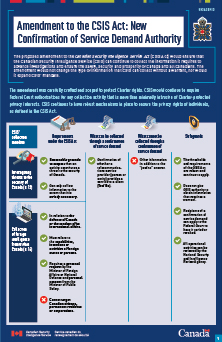
| CSIS’ collection mandate | Requirements under the CSIS Act | What can be collected through a confirmation of service demand | What cannot be collected through a confirmation of service demand | Safeguards |
|---|---|---|---|---|
| Investigating threats to the security of Canada (s.12) |
|
|
|
|
| Collection of foreign intelligence from within Canada (s.16) |
|
Gaps Filled
- Precursor information required to obtain a production order: CSIS cannot seek a production order from the Federal Court without first determining which telecommunications service provider has the information that would be the subject of the production order. The amendment would provide a means to compel the information that is required for this purpose.
- Parity with the Criminal Code: if the Criminal Code is amended, telecommunications service providers may increasingly refuse to provide this information to CSIS if it is not provided with the same confirmation of service demand authority as law enforcement.
Impact of amendments
- Enable CSIS to compel the provision of information needed to advance investigations.
- Service providers can challenge the demand in Federal Court, and privileged information can be withheld.
Example:
A CSIS subject of investigation is planning to travel to an ideologically motived violent extremism-related para-military training event. CSIS is aware that the threat actor uses a social media account associated with a Canadian phone number to share the agenda and other information related to the event. CSIS plans to seek a production order from the Federal Court to advance the investigation and intercept the subject of investigation’s communications, but to do so CSIS must establish which provider has this information. The proposed amendment would allow CSIS to require a telecommunications service provider to confirm service and enable CSIS to seek judicial authorization to proceed with the investigation.
CSIS is accountable to Parliament and all Canadians to ensure respect for the rights and freedoms of all Canadians and people in Canada.
- Attorney General of Canada
- Federal Court
- Minister of Public Safety
- Canadian public
- Auditor General
- Intelligence Commissioner
- Privacy Commissioner
- Information Commissioner
- Commissioner of Official Languages
- National Security and Intelligence Review Agency
- National Security and Intelligence Committee of Parliamentarians