
A Force of Nature: Canada's Strategy to Protect Nature
Download the alternative format
(PDF format, 8006 KB, 15 pages)
Canada's Natural Ambition
Nature is foundational to Canadian identity. Canada's forests, lakes, rivers, prairies, mountains, tundra, and oceans are part of who we are, strengthen sovereignty, support the economy and sustain life. The natural world energizes and grounds us, and spending time in nature strengthens well‑being, deepens our connection to place, and reinforces a shared sense of belonging. Canada is one of the most nature-rich countries on earth, with 20 per cent of the world's fresh water, 25 per cent of global wetlands, nearly a quarter of the boreal forest, the world's longest coastline, and habitat for approximately 80,000 species.
Canada's economy relies heavily on its natural resources. Nature based sectors such as agriculture, forestry, mining and fisheries generate roughly 7 per cent of our GDP.
Nature also provides essential defences. Wetlands absorb carbon and excess rainfall, forests prevent erosion, and healthy ecosystems reduce the impacts of severe weather. Protecting nature supports jobs, food security and Canada's long-term competitiveness on the world stage.
But nature is under threat, and with it, so are the benefits it provides. Protecting Canada's lands and waters is essential to secure and sustain the resiliency of healthy ecosystems and the natural defenses offered by Canada's environment.
The New Government's Vision
We envision a Canada that protects, restores, and values nature as a foundation of our economy, sovereignty, and well-being, leading at home and globally, to ensure healthy ecosystems, resilient communities, and prosperity for present and future generations.
Delivering our Plan
Canada has the second largest land mass and the longest coastline in the world. This means our actions at home have impacts on a global scale, and our commitment to protect 30 per cent of lands and waters by 2030 (30x30) matters well beyond our borders. The scale of our forests, wetlands, grasslands, tundra, coastline and oceans means that when Canada protects nature, we help protect a meaningful share of the planet's remaining intact ecosystems. This is where Canada can play an outsized role: to bridge divides and mobilize others, not only by delivering ambitious conservation outcomes at home, but by helping set the pace internationally—showing that pragmatic, partnership-based action can match the urgency of the moment.
Canada's size brings responsibility and opportunity. Countries from around the world agreed on the Kunming-Montreal Global Biodiversity Framework (KMGBF) to help guide global efforts to halt and reverse biodiversity loss by protecting nature and using it wisely.
Canada has a unique opportunity to convene Indigenous Peoples, governments, investors, philanthropies, and communities coast-to-coast-to-coast to deliver the KMGBF, including protecting 30 per cent of Canada's lands and waters by 2030 (30x30). In a world that is fragmented, Canada can demonstrate how partnerships across geography, jurisdictions, and sectors can accelerate investment and align nature protection with economic prosperity, both at home and abroad.
Here in Canada, governments, Indigenous Peoples and stakeholders have worked together to develop a roadmap: Canada's 2030 Nature Strategy. We know what works: we already have proven models that pair Indigenous leadership with long-term financing. But achieving our vision requires accelerated action by governments, businesses, and individuals.
How We Will Get There: The Three Pillars
A Force of Nature: Canada's Strategy to Protect Nature outlines a plan for how the Government of Canada will deliver Canada's 2030 Nature Strategy.
Our plan to achieve results for Canadians is built on three pillars:
- Pillar 1 – Protecting Nature in Canada: By protecting and conserving more lands and waters and connecting habitats so species can move more safely.
- Pillar 2 – Building Canada Well: By designing infrastructure projects that work with nature rather than against it.
- Pillar 3 – Valuing Nature and Mobilizing Capital: By using finance tools to fund conservation in a sustainable, long-term way.
We are investing over $3.8 billion to protect nature—focused on measurable outcomes and delivery through 2030. This includes the creation of two new national protected areas and expanding our conservation actions to protect more nature with more partners across the country. And, core to our values, we are protecting nature while we build responsibly. We will prioritize quality and areas of high ecological value, mobilize capital and partners, and develop transformative solutions to achieve results.
To deliver we will deepen our partnerships with Indigenous Peoples, provincial, territorial, municipal governments, non-government organizations, industry, landowners, and Canadians.
Indigenous Leadership
Indigenous Peoples have stewarded the lands, waters and ice across Canada since time immemorial. Across the country, Indigenous-led conservation is achieving results for nature, contributing some of the largest conservation gains. We are continuing to support and advance Indigenous-led stewardship through our new investments in nature, including enhancing Indigenous Guardians Programs and establishing a new Arctic Indigenous Guardians Program. There is no path to 30X30 without Indigenous leadership and the Government of Canada is committed to working alongside Indigenous Peoples. Indigenous-led conservation is and will continue to be foundational to our collective effort to protect and conserve nature.
The Qikiqtait and Sarvarjuaq Marine Protected Areas are the first new protected areas announced under the SINAA Agreement, formerly known as the Qikiqtani Project Finance for Permanence (PFP), and have been advanced in partnership with the Government of Nunavut. Together, they contribute two per cent to Canada's marine conservation targets, bringing Canada's total protected marine area to over 17 per cent, and reflect Canada's commitment to Inuit-led conservation and stewardship in the Canadian Arctic. This progress was made possible by the important partnership with the Qikiqtani Inuit Association and our shared commitment to protecting marine ecosystems in ways that respect Inuit rights, knowledge, and leadership.
NWT: Our Land for the Future PFP is an Indigenous-led initiative in the Northwest Territories (NWT) that supports conservation and stewardship of lands and inland waters. It is one of the largest Indigenous-led land conservation initiatives in the world. Signed in July 2025, this historic grant agreement brings together 21 Indigenous governments and organizations, the Government of Canada, the Government of the Northwest Territories, and philanthropic partners. With total investments of $375 million, including $300 million from Canada and $75 million from philanthropic partners, NWT: Our Land for the Future supports Indigenous-led stewardship and conservation across some of the world's most intact boreal and tundra ecosystems while creating hundreds of good, culturally meaningful jobs across the territory. NWT: Our Land for the Future aims to conserve at least 2 per cent towards Canada's terrestrial conservation targets, working towards up to three per cent (380,000 km2).
Pillar 1: Protecting Nature in Canada
Nature is part of our daily lives, whether it's breathing fresh air, hiking on trails, skating in the winter or canoeing in Canada's many lakes and rivers. It also forms the basis of Canada's economy through timber, minerals, fish and farmland. It is estimated that, in Canada, nature's ecosystem services amount to at least $3.6 trillion per year (or more than double our 2018 GDP)Footnote 1. Ecosystem services are the direct and indirect contributions of nature to human well-being, supporting survival and quality of life. Protecting nature and sustaining these services requires collective environmental stewardship, a shared responsibility and value.
The first pillar of the Government's vision is to protect more nature than ever before—moving terrestrial conservation from 14 per cent to 30 per cent by 2030 and marine conservation from 15.55 per cent to 28 per cent on the way to 30 per cent by 2030. This will mean protecting and conserving at least1.6 million km² of Canada's lands and 715,857 km² of Canada's oceans over the next 4 years. Put in perspective, that is a land area 1.7 times the size of British Columbia and a marine area almost the size of Alberta.
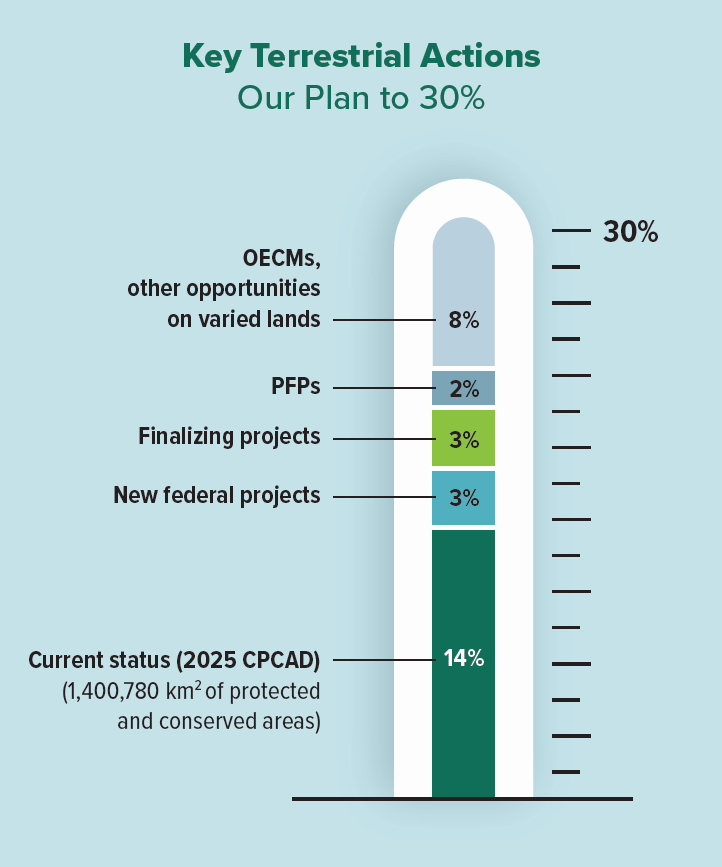
Key Terrestrial Actions
Our plan to 30%
- Add up to 3% (299,540 km2) in new federal protected areas, including:
- Up to 10 new national parks,
- 15 new national urban parks, and
- 4 National Wildlife Areas;
- Add at least 3% (299,540 km2) by working with partners to finalize projects that previously received Government of Canada funding and encourage reporting into the Canadian Protected and Conserved Areas Database (CPCAD);
- Add at least 2% (199,693 km2) through the Project Finance for Permanence (PFP) initiatives with Indigenous partners; and
- Add at least 8% (798,744 km2) by expanding partnerships and using innovative tools to protect and conserve across all landscapes, including using Other Effective Area Based Conservation Measures (OECMs), exploring other opportunities on varied lands.
Long description
| Actions | Contributions to 30% Target |
|---|---|
| Current status (2025 CPCAD) – (1,400,780 km² of protected and conserved areas) | 14% |
| New federal projects | 3% |
| Finalizing projects | 3% |
| PFPs | 2% |
| OECMs, other opportunities on varied lands | 8% |
| Total target | 30% |
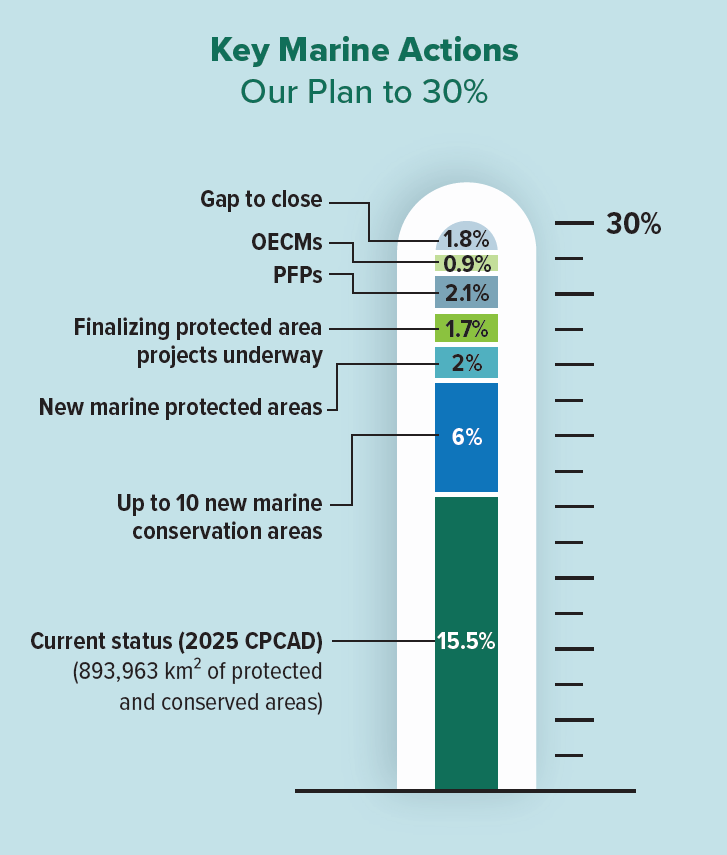
Key Marine Actions
Our plan to 30%
- Add up to 6% (326,658 km2) by establishing up to 10 new national marine conservation areas;
- Establish up to 14 new marine protected and conserved areas across Canada's three oceans, equivalent to approximately 389,217 km², an area five times the size of the province of New Brunswick;
- Add up to 2% (115,000 km²) in new federal marine protected areas;
- Add up to 1.7% (97,750 km2) by working with partners to finalize protected areas that previously received Government of Canada funding;
- Add up to 2.1% (120,750 km2) through implementation of Project Finance for Permanence (PFP) initiatives with Indigenous partners;
- Add up to 0.9% (51,750 km2) by expanding partnerships and using innovative tools to protect and conserve marine areas using Other Effective Area Based Conservation Measures (OECMs).
Long description
| Actions | Contributions to 30% Target |
|---|---|
| Current status (2025 CPCAD) – (893,963 km² of protected and conserved areas) | 15.5% |
| Up to 10 new marine conservation areas | 6% |
| New marine protected areas | 2% |
| Finalizing protected area projects underway | 1.7% |
| PFPs | 2.1% |
| OECMs | 0.9% |
| Gap to close | 1.8% |
| Total target | 30% |
Protecting 30 per cent of Canada's lands and waters by 2030 is ambitious because of our country's vast size. To achieve this, we have made generational investments in nature that will deliver against clear, measurable targets. We will expand the network of protected and conserved areas in partnership with Indigenous communities, provinces, territories, non-profit organizations, industry and private landowners. These partnerships are also key to addressing threats to nature and ensuring its protection. The federal government owns only 6 per cent of Canada's land, of which 4.7 per cent is already protected, so strong partnerships are essential to recognize highly biodiverse areas. This new approach will combine flexible agreements, incentives for stewardship, and recognition of existing and new actions, and will deliver results for Canadians and safeguard nature for future generations.
The Government of Canada will achieve the 30x30 conservation target using traditional methods of conservation, such as National Parks and protected areas. At the same time, we will integrate these with innovative approaches, such as Other Effective Area-Based Conservation Measures (OECMs), and explore how to include Canada's intact wilderness areas as a conservation pathway. We will also continue to support Indigenous-led stewardship initiatives, including Indigenous Protected and Conserved Areas (IPCAs).
Focus on Indigenous Protected and Conserved Areas: Seal River National Park Reserve in Manitoba and the Wiinipaakw National Marine Conservation Area in Eastern James Bay
The Seal River Watershed is one of the largest intact watersheds in the world. It is home to wolverines, polar bears, grizzly bears and caribou and includes large wetlands that serve as carbon sinks, helping mitigate climate change. Parks Canada is working in collaboration with the Seal River Watershed Alliance—formed of four Dene and Cree First Nations—and the Government of Manitoba to conserve the watershed while fostering opportunities for Canadians to experience this incredible landscape.
The Wiinipaakw Indigenous Protected Area and National Marine Conservation Area in Eastern James Bay is being co-developed with the Cree Nation and will help protect this area rich in biodiversity and culture. Many rivers flow out into Wiinipaakw (James Bay) bringing large amounts of freshwater to the Bay. This creates a special marine environment that provides important habitat for migrating birds, polar bears, and other marine mammals. This protected area is intended to ensure the conservation of these species and their habitats while supporting sustainable use of the marine environment, for activities such as eco-tourism.
The Canada Strong Pass is here for summer 2026, delivering free access to national historic sites, national parks, national marine conservation areas and a national urban park–plus discounted camping and accommodations. This is just one way the Government is making Canada's natural and cultural treasures more accessible to all Canadians.
Did you know?
In 2025, the Canada Strong Pass helped enable a 13 per cent increase in visits to Parks Canada places, meaning thousands more Canadians experienced the benefits of access to nature.
Parks Canada has a vast network of national protected areas that is nearly twice the size of the United Kingdom. This includes 48 national parks, five national marine conservation areas, one national urban park, 171 national historic sites, and nine heritage canals. Natural landscapes provide clean air, fresh drinking water, biodiversity, and climate resilience. The estimated annual value of these ecosystem services managed in National Parks is $372 billion – of which $44 billion is attributed to ecosystem services that provide fresh water. We will advance the establishment of at least 10 new national parks and national marine conservation areas and 15 new national urban parks. In addition to contributing to Canada's 30x30 targets, these will offer strong, long-lasting ecological protection for Canadians, along with substantial economic benefits.
Mitigating Threats to Marine Biodiversity
Canada must act early to mitigate threats to marine biodiversity. One way the Government is protecting Canada's iconic whales is by cleaning up lost or abandoned fishing gear, known as ghost gear, removing approximately 600 tonnes of gear and 315km of rope from Canadian waters. This builds on the significant work that Canada has already achieved since work began in 2020, which includes removing 2,546 tonnes of abandoned, lost, or otherwise discarded fishing gear from Canada's waters.
Biodiversity is not constrained by borders, and we are looking beyond Canada's frontier to protect nature. Internationally, 8.4 per cent of the world's ocean is currently protected (according to the United Nations) and just 46 per cent of marine key biodiversity areas have some form of protection. Canada will advance the international commitment to protect 30 per cent of the high seas and help conserve almost 70 million km2 of the ocean by ratifying the High Seas Treaty. This commitment aligns with our wider efforts to combat illegal, unreported, and unregulated fishing through joint action, like Operation North Pacific Guard.
Partnership in Action
The Canada Nature Protection Fund will drive innovation and strengthen our national conservation efforts. Through this Fund, we will reinforce strong partnerships, engage non-traditional sectors, and leverage greater investments across society to accelerate meaningful action. This funding will restore old-growth forests, safeguard carbon-rich peatlands, and revive our ecosystems.
We will focus on projects that maximize co-benefits for land securement, species recovery, and greenhouse gas reduction—supporting the Government of Canada's biodiversity and climate action commitments.
To drive success, we are increasing flexibility and consolidating conservation funding programs to encourage partners to pursue multiple goals, such as protecting species at risk, restoring degraded ecosystems, and sequestering carbon. By reducing administrative burden, we are enabling our partners to spend less time on paperwork, and more time on meaningful conservation actions. Our approach to conservation is founded on collaboration.
Since 2007, the Government of Canada has invested $505 million, matched by over $1.150 billion from partners that protected 8,648 km² of ecologically sensitive lands, an area almost twice the size of Prince Edward Island. These grasslands, forests, lakes, and wetlands act as habitat for more than 250 species listed under the Species at Risk Act.
Working landscapes throughout Canada
OECMs are working landscapes across Canada that often have similar conservation and biodiversity results, while meeting other primary objectives. There are over 240 land based OECMs and 61 marine OECMs across Canada. OECMs can take various forms, for example:
Salt Spring Island Natural Cemetery is Canada's first entirely green burial cemetery that offers services to the public. It is an important Coastal Douglas fir ecosystem.
Canadian Forces Base Shilo is an Operations and Training Base in south-central Manitoba. The base has more than 211 km² of natural landscape that supports diverse plant and wildlife communities.
The Queen's University Biological Station is a globally unique research and teaching facility located in southeastern Ontario. The station occupies more than 34 km² and is home to a wide variety of habitats and supports over 30 species at risk. The efforts to support education and research programs ensure that the property is managed in ways consistent with biodiversity conservation.
The Gwa̲xdlala/Nala̲xdlala (Lull/Hoeya) Marine Refuge, located on the west coast, spans 21.4 km² and protects a rare shallow sill ecosystem featuring unique coral and sponge gardens, eelgrass beds, and kelp forests that support diverse species including rockfish, salmon, crab, and prawns.
Pillar 2: Building Canada Well
Nature underpins much of our economic prosperity and climate action. It is essential to Canada's growth, security, and nation-building. When conservation and economic activities are seen as competing priorities this risks weaker conservation outcomes and project delays. However, these goals need not be at odds.
As part of our second pillar, Canada will integrate its nature and economic agendas to support timely development decisions while protecting nature. This work will be informed by science and proven tools like the mitigation hierarchy, which is a structured approach to avoiding, minimizing, mitigating, and then offsetting the environmental impacts of development. Nature-based solutions are one tool that can help us meet our goals, by protecting and restoring nature in ways that also strengthen climate adaptation and mitigation.
By mapping nature in Canada we will enable integrated conservation, carbon accounting, and project planning. Harnessing data, mapping, and artificial intelligence (AI) will help us to identify Key Biodiversity Areas and will accelerate permitting, by giving investors and project proponents better data to strengthen decision-making. Programs like the Fish and Fish Habitat Protection Program at Fisheries and Oceans Canada will continue working with industry to ensure that bridges, ports, and highways have smaller footprints and better environmental outcomes.
Protecting high-biodiversity areas helps maintain ecosystem services, which in turn protect investments. When permitting is guided by sound science, regulators can help proponents adjust project designs to avoid or minimize environmental impacts—leading to fewer delays, better results, and responsible development. The Government will encourage work by project proponents on nature positive outcomes and will clarify how nature positive investments by proponents will be recognized.
We will use regional assessments under the Impact Assessment Act to examine the effects of development within specific regions. This will allow us to proactively identify measures to address effects, including cumulative effects, in advance of project assessments and permitting, for more effective and efficient decision-making. We will also continue our work to strengthen the protection and recovery of species at risk across Canada.
Finally, biodiverse and freshwater ecosystems provide healthy habitats, clean drinking water and support our economy and many industrial activities. The Canada Water Agency will collaborate with Indigenous, provincial and territorial partners and stakeholders to develop Canada's first National Water Security Strategy to protect one of nature's vital and strategic resources to meet our long-term environmental, social, and economic needs.
Did you know?
Nature keeps us safe and secure. It is one of Canada's most effective flood-protection systems. Forests and wetlands protect 3.7 million people in 358 Canadian cities and towns and another 20.1 million people and businesses indirectly benefit, from nature-based flood protection. Mapping and understanding the power of nature ensures sound decision-making.
Pillar 3: Valuing Nature and Mobilizing Capital
Canada's natural assets underpin our economic prosperity, yet the current level of investment in protecting these assets is insufficient. It is estimated that the annual funding gap globally, from all sources, to meet the commitments in the KMGBF has grown to over $1 trillion USD. Existing funding amounts to approximately $313 billion USD annuallyFootnote 2, of which over 80 per cent comes from public sources, which is not sustainable. To close the gap, public and private sector capital will be needed. Public funds alone will not suffice.
Under pillar 3, we will work with partners to drive private investment in nature positive outcomes and sustain the benefits of nature for current and future generations. Innovative nature financing models are emerging in Canada and globally, to help bridge the financing gap. Canada will build on past successes – such as those that support Indigenous-led conservation while leveraging government and private funding to support large-scale, long-term conservation.
The Government will launch an Expert Taskforce on Natural Capital Accounting and Nature Financing in spring 2026 to develop recommendations aimed at mobilizing private capital for nature positive outcomes. The Expert Taskforce will explore opportunities to improve the way we account for the value of nature, and how to integrate that value into decision making. It will also provide recommendations to attract private capital toward conservation and promote more public-private partnerships.
Did you know?
Canada's carbon-rich ecosystems — including peatlands, wetlands, grasslands, permafrost, and coastal zones — play an important role in climate regulation, biodiversity conservation, and ecosystem services. It is estimated that Canada's wetlands provide ~$225 billion per year in ecosystem services related to water quality and climate,Footnote 3 and that Canada's boreal forests contribute ~$703 billion per year in ecosystem services (i.e., carbon storage, flood and pest control).
Annex : Summary of Federal Actions
Federal Actions to Protect Nature
- $1.63 billion over five years to advance conservation, support Indigenous-led stewardship, and foster partnerships nationwide; and pair new conserved areas with the data and tools needed to deliver timely decisions and enable responsible development. This will include investments to launch the Canada Nature Protection Fund, driving further private sector investment in nature.
- $444.3 million over five years to expand marine protected and conserved areas, including establishing new sites and advancing agreements with Indigenous partners to support conservation and reconciliation.
- $266.7 million over 11 years to advance the establishment of two new national protected areas under Parks Canada legislation - Wiinipaawk Indigenous Protected Area and National Marine Conservation Area in the waters of Eastern James Bay and Seal River Watershed Indigenous Protected and Conserved Area and National Park Reserve.
- $231 million over five years to enhance the Indigenous Guardians Programs, including establishing a new Arctic Indigenous Guardians Program.
- $24.4 million over five years, and $1.8 million on-going to ratify the High Seas Treaty and advance the international commitment to protect 30 per cent of the world's oceans.
- $15 million over three years to modernize the location, retrieval and disposal of Ghost Gear.
- $90 million over five years for the Wood Buffalo National Park World Heritage Site Action Plan and the recovery of two Wood Bison populations along the Alberta-Northwest Territories border.
- Canada will join the Ocean Panel, a coalition of serving world leaders working to protect, manage, and use the ocean in ways that support both people and the planet. Canada will work with reliable international partners to reshape the way the world uses our global oceans by advancing transformative actions that increase ocean health, wealth, equity, knowledge, and innovative finance.
Federal Actions to Build Canada Well
- A portion of the funding will support work to map Canada's landscapes, including ocean coastlines, peatlands and permafrost areas, providing biodiversity and carbon sequestration data that can be used for project investment decisions and lead to predictable pathways to approval while encouraging proactive investments in conservation.
- $326.6 million over five years and $65.3 million on-going to protect fish and fish habitat and ensure that development in or near water is done responsibly. This funding will support timely and efficient reviews for a wide range of industrial and infrastructure projects, including energy, transportation, electrical, critical minerals, and forestry. These project reviews are done in consultation with Indigenous Peoples, and support sustainable development.
- $283 million over five years and $46.1 million on-going to strengthen the protection and recovery of species at risk across Canada. This funding will ensure that federally listed species at risk, which have increased from 233 in 2003 to 671 in 2025 (188% increase) will be managed responsibly for the conservation of wildlife.
- $412.9 million over five years to restore vulnerable Pacific Salmon populations and their habitat, support sustainable fishing opportunities, combat illegal fishing on the high seas, and reduce pressures on at risk stocks. These ecosystem wide efforts will build on the more than 12.5 million square meters of salmon habitat already restored through the Pacific Salmon Strategy Initiative, and deepen collaborative efforts with communities in British Columbia and the Yukon, including Indigenous partners. This work will help improve prey availability for Southern Resident Killer Whales and support the recovery of culturally and economically important Chinook Salmon.
- $81.7 million over five years to stabilize and rebuild wild Atlantic Salmon populations through targeted restoration of up to 10,000,000 m2 of Atlantic Salmon habitat and monitoring in approximately 50 rivers, and partnerships with Indigenous communities and stewardship organizations.
- The Canada Water Agency will collaborate with Indigenous, provincial and territorial partners and stakeholders to develop Canada's first National Water Security Strategy to protect one of nature's essential resources and ensure we are managing this vital and strategic resource in the future to meet our long-term environmental, social, and economic needs.
Federal Actions to Value Nature and Mobilize Capital
- Launch an Expert Taskforce on Natural Capital Accounting and Nature Financing in Spring 2026.