
Shared Services Canada’s Departmental Evaluation Plan from fiscal year 2026-27 to fiscal year 2030-31
Permission to Reproduce
Except as otherwise specifically noted, the information in this publication may be reproduced, in part or in whole and by any means, without charge or further permission from Shared Services Canada, provided that due diligence is exercised to ensure the accuracy of the information reproduced is maintained; that the complete title of the publication is produced; that Shared Services Canada is identified as the source institution; and that the reproduction is not represented as an official version of the information reproduced, nor as having been made in affiliation with, or with the endorsement of the Government of Canada.
Commercial reproduction and distribution are prohibited except with written permission from Shared Services Canada. For more information, please contact Shared Services Canada at publication-publication@ssc-spc.gc.ca.
© His Majesty the King in Right of Canada, as represented by the Minister responsible for Shared Services Canada, 2026.
Shared Services Canada’s Departmental Evaluation Plan from Fiscal Year 2026-27 to Fiscal Year 2030-31
Cat. No. P115-15E-PDF
ISSN 2818-338X
Publié aussi en français sous le titre :
Plan d’évaluation ministériel de Services partagés Canada de 2026-2027 à 2030-2031
No. de catalogue P115-15F-PDF
ISSN 2818-3398
Office of Audit and Evaluation
June 2026
1.0 Context and background
1.1 Purpose and government priorities
This document presents Shared Services Canada’s (SSC) Departmental Evaluation Plan. In the government of Canada, evaluation is the systematic and neutral collection and analysis of evidence to judge merit, worth or value. Evaluation informs decision making, improvements, innovation and accountability.
The evaluation plan is an information and management tool that reflects the results of SSC’s annual evaluation planning exercise. It identifies the planned evaluations along with the resourcing requirements of the evaluation function for the next 5 years.
The scope and content of this plan are consistent with the requirements of the Treasury Board Policy on Results.
1.2 Government of Canada context
Evaluation supports departments in delivering on the Government of Canada (GC) priorities. Specifically, the May 2025 mandate letters stressed the need for the GC to become more productive by focusing on results over spending. Similarly, the 2025 budget introduced measures to build a more efficient and effective government.
In his message to the public service in July 2025, the Clerk of the Privy Council spoke of the need to focus on governmental priorities and to simplify business processes. With its mandate to assess programs and services through the lens of relevance, effectiveness and efficiency, Evaluation is well placed to support these efforts.
Under the revised Treasury Board Policy on Results (2026), deputy heads will be responsible for championing a results culture that values evidence-informed decision-making. This is defined as an environment where organizational and employee performance is aligned with achieving clear, measurable results with a focus on accountability, learning, and increasing trust in institutions. Going forward, there will be a greater emphasis on program officials (SSC Assistant Deputy Ministers) to assess the effectiveness, efficiency, value for money, and overall impact of their programs and services.
1.3 Departmental priorities
Delivering Digital Solutions Together for Canada (Digital Together) is a strategic approach to ensure government departments are equipped with the modern, standardized tools needed to effectively collaborate across departments and continue to better serve Canadians. Digital Together includes 4 high-level roadmaps that provide an overview of SSC initiatives, services and technologies.
These roadmaps present SSC goals and objectives for:
- connectivity services
- hosting services
- digital services
- cyber security services
The roadmaps also outline the current and future activities intended to help SSC achieve these goals and objectives.
OneSSC is an internal SSC strategy to help deliver on the goals and objectives outlined in Digital Together. It recognizes that SSC must work as an integrated, customer-centric service delivery organization to achieve its long-term goals. To deliver on SSC’s mandate, the OneSSC vision focuses on:
- empowering people
- optimizing processes
- leveraging technology
Evaluations are powerful tools to support delivery on Digital Together roadmaps. They can provide valuable insights into SSC’s people, processes and technology to help inform the OneSSC vision and demonstrate the value that SSC provides to the GC.
1.4 Requirements of the Policy on Results
The Policy on Results requires that deputy heads annually approve a 5‑year evaluation plan and provide this plan to the Treasury Board of Canada Secretariat (TBS). The plan should include:
- a detailed schedule of planned evaluations
- the extent of evaluation coverage of the Program Inventory, by amount of organizational spending and by program
- the extent of organizational spending and programs that will not be evaluated in the planning period, and justification (i.e., what has been excluded from the 5‑year schedule and why)
- advice to the deputy heads on the adequacy of resources for evaluation
Under the revised policy, departments will now be expected to prioritize evaluations of effectiveness (outcomes) and value-for-money (i.e., the balance of results and outcomes delivered versus the resources used).
1.5 Gender-based analysis plus (GBA+) and accessibility
GBA+ is an analytical process that provides a rigorous method for assessing systemic inequalities and the ways diverse groups of women, men and gender-diverse people may experience policies, programs and initiatives.
Evaluation provides an opportunity to consider gender and other intersecting identity factors. SSC is committed to better integrating GBA+ and accessibility considerations into its evaluation processes.
1.6 Governance
The Policy on Results calls for deputy heads to establish and chair a Performance Measurement and Evaluation Committee (PMEC) comprising senior officials. At SSC, the Executive Committee (EXCOM) carries out PMEC responsibilities. EXCOM is SSC’s most senior executive governance body and is chaired by the SSC President, with ADM representation from all branches. It is responsible for:
- setting strategic direction and departmental priorities
- overseeing SSC’s performance measurement and evaluation functions
- aligning horizontal and enterprise strategies with operational activities
In its PMEC role, EXCOM aims to strengthen the planning, coordination and use of performance measurement and evaluation within the department, and to ensure the appropriate resourcing of these functions. See Appendix E for the PMEC membership.
The Policy on Results requires PMEC to:
- review and advise the deputy head on establishing, implementing, and maintaining the Departmental Results Framework, Program Inventory and Performance Information Profiles (PIPs)
- review and advise the deputy head on the availability, quality, utility and use of performance information, including evaluation
- review and advise the deputy head on departmental evaluation planning, resources and activities, including recommending the approval of the Departmental Evaluation Plan
- review evaluation reports, including management responses and action plans, and recommend their approval to the deputy head
- monitor follow-up on evaluation recommendations and action plans and advise the deputy head of any issues
1.7 The evaluation function at SSC
The Office of Audit and Evaluation (OAE) plays a key role in providing reasonable assurance and advice on departmental governance and operations to the SSC President.
Reporting directly to the President, the Chief Audit and Evaluation Executive (CAEE) makes recommendations on the relevance and performance of departmental programs, policies and initiatives through the OAE evaluation function. The CAEE is also the designated Head of Evaluation and represents the departmental link to TBS for evaluation.
OAE, under the CAEE, provides services as noted in the following figure.

The Evaluation Function at SSC - Text version
The Chief Audit and Evaluation Executive reports directly to the President and is:
- Head of Internal Audit
- Head of Evaluation
- Senior Officer for Internal Disclosure
The Office of Audit and Evaluation contains:
- Internal Audit Operations
- Evaluation
- Professional Practices
Professional Practices contains:
- Management Action Plan Follow-Up
- Internal and External Liaison
- Coordination for the Departmental Audit Committee
- Quality Assurance Improvement program
- Ethics and Disclosure
For fiscal year 2026 to 2027, SSC’s OAE evaluation function is resourced for 13 full-time equivalent positions with an overall budget of $1.62 million. At this capacity, the function can conduct 2 engagements at the same time, and deliver 1 to 2 evaluations reports every year.
The Operations and Maintenance budget has been reduced by 37% since 2024-2025 from $281,385 to the current value of $177,327.
| Salary | Operations and Maintenance | Total |
|---|---|---|
| $1.44M | $0.18M | $1.62M |
| EX-01 | AS-01 | EC-07 | EC-06 | EC-05 | EC-04 | Total | |
|---|---|---|---|---|---|---|---|
| Established | 1 | 1 | 2 | 4 | 4 | 4 | 16 |
| Funded in fiscal year 2026 to 2027 | 1 | 0.66 | 2 | 3 | 3 | 3 | 12.66 |
| Planned in fiscal year 2026-2027 | 1 | 0.66 | 2 | 3 | 3 | 3 | 12.66 |
2.0 Fiscal year 2025-26 accomplishments
2.1 Completed evaluation work
In fiscal year 2025-26, OAE completed one evaluation and two advisory engagements. The evaluation assessed the responsiveness, effectiveness and efficiency of SSC’s GC Wi-Fi services. It generated recommendations to improve coordination for deployments, transparency for planning and prioritization, internal and external communications, service expectations and incident handling, cost transparency and invoice accuracy, and performance measurement. This was the first evaluation of the Network program in the history of the department.
An advisory engagement arose from the planning phase of the Client Service and Delivery Management (CSDM) evaluation. Specifically, early findings were shared to provide timely independent and neutral advice to the Senior Assistant Deputy Minister that could inform restructuring efforts. These findings included identifying areas that were working well and also areas for improvement and transformation. In addition, the analysis identified areas for further examination when the broader CSDM evaluation resumes.
The second advisory engagement provided a systematic and neutral assessment of the Accessibility, Accommodation, and Adaptive Computer Technology (AAACT) program. The review assessed the range of services currently provided by the program against its mandate as defined in foundational documents.
2.2 Other accomplishments
In fiscal year 2025-26, the evaluation team:
Conducted, reported on and communicated program evaluations and reviews
- published the evaluation of Modernization of Hosting Services (Linux/Unix)
- completed the planning phase for the evaluation of Client Service and Delivery Management
- launched an advisory engagement of the National Fleet Management Program
Strengthened the evaluation function
- presented the annual update on evaluation management action plans
- presented the annual state of performance measurement in support of evaluation
Provided advisory services to the department and branches
- provided an independent review within the Comprehensive Expenditure Review process to verify that all credible evidence at the department’s disposal had been given due consideration in the proposals and that this evidence was being presented accurately prior to their submission to TBS
- supported branches and the departmental performance measurement team during the review process of SSC’s Performance Information Profiles (PIPs)
- participated in meetings with branches and PIP users to provide advice on how to enhance the PIPs and increase their use within branches
Strengthened relationships and shared knowledge
- strengthened relationships with international public sector peers including Denmark, Estonia, Germany, Italy, New Zealand, Singapore, the United Kingdom, and the United States of America at the federal and state levels. These collaborations are between the SSC Evaluation team and the IT departments in other jurisdictions with equivalent programs. They provide international comparisons on what is working well and what are some of the challenges for delivering these IT infrastructure services to their governments
- established a new relationship with the State of Delaware
- strengthened relationships with Ontario provincial public sector peers
- documented and shared industry best practices for mapping and evaluating business processes
- promoted SSC at a student recruitment event at Memorial University in St. John’s, Newfoundland
- presented to the graduate program in Public Policy and Program Evaluation at Carleton University’s course on Evaluation Design
- actively engaged at the TBS Federal Evaluation Directors Council (FEDC)
- presented to TBS and FEDC on approaches to assessing efficiency in evaluations and ways to build team capacity
- presented to TBS and FEDC on lessons learned for effective management action plans for evaluations
Provided leadership with the GC evaluation community for the application of generative Artificial Intelligence (AI) to evaluations
- participated in the Heads of Evaluation Working Group on Emerging Technologies convened by TBS for the implementation of the Policy on Results
- developed a guidance paper for TBS and heads of evaluation on the use of generative AI in GC evaluations
- actively engaged in the FEDC AI Working Group
- presented practical applications for using generative AI in evaluations to the Canadian Food Inspection Agency and to Public Services and Procurement Canada
- researched and shared best practices for using ChatGPT and other generative AI tools for to assess gender inclusivity and intersectionality in evaluations
- presented to the Generative AI Share and Learn for GC Evaluators on GBA+ prompts for evaluations
- documented and shared best practices for using Deep Research and other generative AI tools for literature reviews and environment scans
- actively participated in the SSC MS Copilot pilot program
3.0 Evaluations in progress
In January 2026, OAE launched the Fleet Management advisory engagement. This evaluative review will provide a neutral and independent assessment of the efficiency and value-for-money of the National Fleet Management Program (NFMP). The review will inform the presentation of the NFMP annual plan to the Finance and Investment Management Board in October 2026.
The follow-up planning for the Personnel Security Clearance evaluation has begun. This evaluation will assess efficiency, effectiveness, and whether SSC security processes meet established service standards for quality and timeliness.
| Name of evaluations in progress | Target completion date |
|---|---|
| Fleet Management (Advisory Engagement) | September 2026 |
| Personnel Security Clearance | June 2027 |
4.0 Evaluation planning
4.1 Key planning considerations
Delivering Digital Solutions Together key service areas
- Connectivity services
- Hosting services
- Digital services
- Cyber Security services
Selecting and sequencing evaluations in this plan were driven by:
- the need to address all policy requirements and conduct an evaluation of programs identified in the Program Inventory
- the need to review significant spending that has yet to be evaluated
- the identification of programs with key initiatives in SSC’s strategy for delivering enterprise services, outlined in Delivering Digital Solutions Together
- a focus on systemic issues that the Department is facing that are likely to persist in 2-4 years
- the maturity of programs
- the prioritization of evaluations to inform decision-making on stewardship and progress towards an enterprise approach
- the Customer Satisfaction Feedback Initiative scores (where available)
- the prioritization of evaluations to inform decision-making on funding renewals
- requests from branches to conduct advisory engagements
4.2 Consultation and coordination
The Departmental Evaluation Plan (DEP) is based on analysis and consultations conducted in fall 2025 and winter 2026. This included:
- document review: various sources of information, including Mandate Letters, the previous Departmental Evaluation Plan, the Departmental Plan, PIPs, service reviews, Customer Satisfaction Feedback Initiative results (where available), Delivering Digital Solutions Together, and Treasury Board submissions were reviewed to identify any mandatory evaluation requirements and to assess Program Inventory coverage
- consultations with branches: all SSC branches were consulted to review the proposed evaluations, and to confirm the value and usefulness of the evaluations
- coordination with Internal Audit: the scheduling of evaluations in this plan has been coordinated with the development of the Risk-Based Audit Plan for Internal Audit engagements to reduce the potential burden of management oversight activities on branches
- consideration of external audits: the plan has taken into consideration external audits conducted and planned by the Office of the Auditor General and the Office of the Comptroller General
- consultation with the Service Review team: the plan has taken into consideration completed and planned service reviews
- consultation with TBS: in accordance with the Policy on Results, the Head of Evaluation has consulted TBS on this plan
4.3 SSC program inventory and components
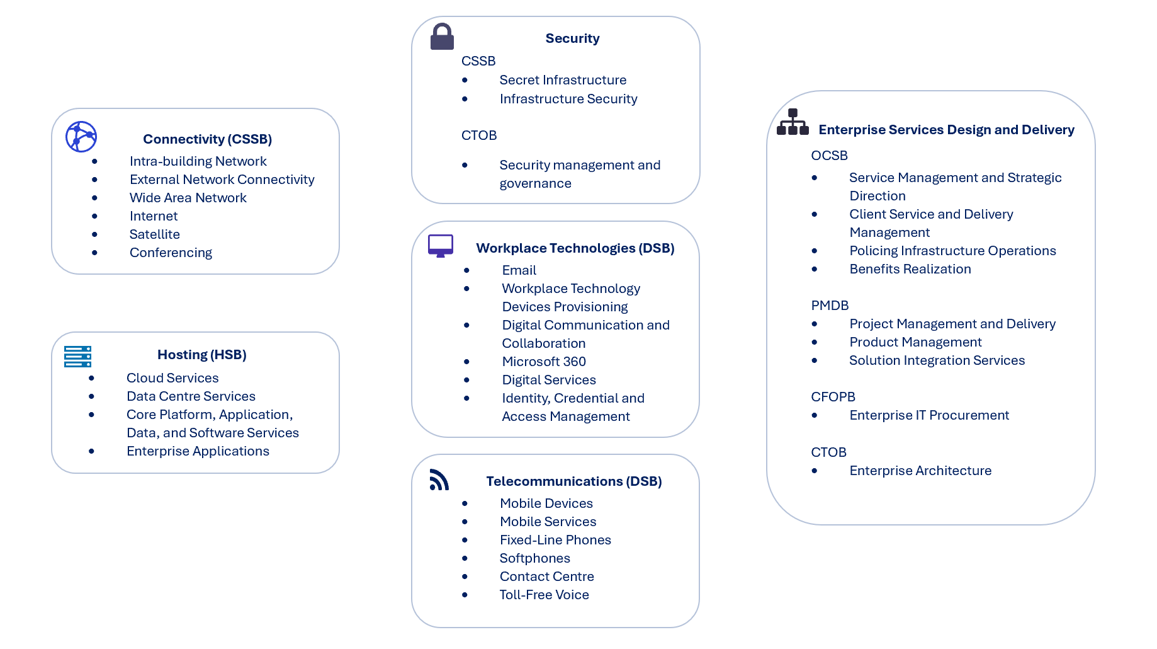
SSC program inventory and components - Text version
There are 6 programs in SSC’s program inventory. Each program contains a number of components.
The Connectivity program is delivered by the Connectivity and Security Services Branch and contains 6 components, including:
- Intra-building Network
- External Network Connectivity
- Wide Area Network
- internet
- Satellite
- Conferencing
The Security program contains 3 components. Security Management and Governance is delivered by the Chief Technology Officer Branch. The other 2, Infrastructure Security and Secret Infrastructure, are delivered by the Connectivity and Security Services Branch.
The Hosting program is delivered by the Hosting Services Branch and contains 4 components, including:
- Cloud Services
- Data Centre Services
- Core Platform, Application, Data, and Software Services
- Enterprise Applications
The Workplace Technologies program is delivered by the Digital Services Branch and contains 6 components, including:
- Workplace technology Devices Provisioning
- Digital Communication and Collaboration
- Microsoft 360
- Digital Services
- Identity, Credential and Access Management
The Telecommunications program is delivered by the Digital Services Branch and contains 6 components:
- Mobile Devices
- Mobile Services
- Fixed-Line Phones
- Softphones
- Contact Centre
- Toll-Free Voice
The Enterprise Services Design and Delivery program consists of 9 components delivered by 4 branches.
The Operations and Client Services Branch delivers 4 components:
- Service Management and Strategic Direction
- Client Service and Delivery Management
- Policing Infrastructure Operations
- Benefits Realization
The Project Management and Delivery Branch delivers 3 components:
- Project Management Delivery
- Product Management
- Solution Integration Services
The Chief Financial Officer and Procurement Branch delivers 1 component:
- Enterprise IT Procurement
The Chief Technology Officer Branch delivers 1 component:
- Enterprise Architecture
5.0 Evaluation coverage over the next 5 years
5.1 Planned coverage
The Policy on Results includes the requirement for a Program Inventory, which contains the entire list of programs in the Department. The Program Inventory helps demonstrate how the Department delivers on its mandate, supports the authorization of expenditures through Cabinet and supports performance reporting.
The Program Inventory represents the entire evaluation portfolio. The Policy on Results requires all programs and planned spending in the Program Inventory (except for internal services) to be evaluated periodically. At the end of 2025-26, there were 3 remaining programs that have yet to be evaluated since SSC was created. They are: Security, Workplace Technologies, and Enterprise Services Design and Delivery.
Assuming planned funding, OAE will deliver 6 evaluations and 2 advisory engagement over the next 5 years. This will also ensure departmental compliance with the Treasury Board Policy on Results for the first time with completed evaluations for all programs that appear in the SSC Program Inventory.
5.2 Internal services
The evaluation team is conducting an advisory review for one internal service and will launch an evaluation for a second internal service. The National Fleet Management Program is located within Corporate Services Branch. The planned evaluation of the SSC Financial Model will cover activities that fall within Chief Financial Officer and Procurement Branch.
5.3 Programs excluded from the planned coverage
There are two excluded operational programs that appear in the Program Inventory, the Telecommunications program, evaluated in 2023-2024, and the Connectivity program, evaluated in 2025-2026.
Some SSC programs are significant in size and will require more than one evaluation.
As a result, the plan reflects a calibrated approach based on value for decision-making. This means that some of the planned spending associated with specific components within the programs may be evaluated in future years.
Program size based on planned spending ($M) in fiscal year 2026 to 2027

Program size based on planned spending in fiscal year 2026 to 2027 - Text version
The figure presents a bar graph that arranges SSC’s 6 programs in descending order of their planned spending for fiscal year 2026 to 2027.
| Program | 2026 to 2027 Planned Spending ($M) |
|---|---|
| Hosting Services | 802.0 |
| Telecommunications | 354.1 |
| Enterprise Services Design and Delivery | 264.7 |
| Workplace technologies | 254.9 |
| Security | 221.1 |
| Connectivity | 207.1 |
Appendix A: 5-year evaluation delivery schedule

5‑year evaluation delivery schedule - Text version
The figure presents a timeline that shows the completion dates of the evaluations scheduled for the next 5 fiscal years:
- The Fleet Management Advisory Engagement is scheduled to be completed in September 2026
- The SSC Financial Model evaluation is scheduled to be completed in June 2027
- The Personnel Security Clearances evaluation is scheduled to be completed in August 2027
- The Enterprise Desktop evaluation is scheduled to be completed in December 2028
- The Cybersecurity evaluation is scheduled to be completed in January 2029
- The Product Management Advisory Engagement is scheduled to be completed in September 2029
- The Client Service and Delivery Management evaluation is scheduled to be completed in June 2030
- The Hosting: Mainframe & Science Departments evaluation is scheduled to be completed in February 2031
Appendix B: 5‑year evaluation schedule
| YearNote 1 | Evaluation Name | Link to Program Inventory | Branch | StrategyNote 2 to EXCOM (PMEC) | President Approval |
|---|---|---|---|---|---|
| 2026-27 | Fleet Management (Advisory Engagement) |
Internal Service | CSB | N/A | Sept 2026 |
| 2027-28 | SSC Financial Model | Internal Services | CFOPB | Nov 2026 | Jun 2027 |
| Personnel Security Clearances | Internal Services | CSB | Sept 2026 | Aug 2027 | |
| 2028-29 | Enterprise Desktop | Workplace technologies | DSB | Nov 2027 | Dec 2028 |
| Cybersecurity | Security |
CCSB CTOB |
Dec 2027 | Jan 2029 | |
| 2029-30 | Product Management (Advisory Engagement) |
Enterprise Services Design and Delivery | PMDB | N/A | Sept 2029 |
| 2030-31 | Client Service and Delivery Management | Enterprise Services Design and Delivery | OCSB | May 2029 | June 2030 |
| Hosting: Mainframe and Science Departments | Hosting | HSB | Jan 2030 | Feb 2031 |
Appendix C: High-level summaries of planned evaluations and advisory engagements
Fleet Management (Advisory Engagement)
| Anticipated start | January 2026 |
|---|---|
| Anticipated completion | September 2026 |
| Link to Program Inventory | Internal Services |
| Office of primary interest | Corporate Services Branch |
Rationale and preliminary scope
The National Fleet Management Program (NFMP) oversees all aspects of owning and operating fleet vehicles on behalf of SSC since its creation on April 1, 2019. Vehicles are purchased for, and assigned to, various service lines who require them to provide support nationwide as part of the department’s mandate. The Capital and Operations and Maintenance funding for fleet vehicles comes out of the Security, Real Property division's (SRPD) cost centre.
During consultations on the Department Evaluation Plan, the Corporate Services Branch (CSB) requested a neutral assessment of the efficiency of the NFMP. It was determined that an advisory engagement would be best suited due to the focused nature of the work and the shorter assessment period available to inform decision making. This work will contribute to the Government of Canada’s priority of costing savings as outlined in Budget 2025.
The review will primarily assess efficiency. It will also inform the NFMP’s annual plan which will be presented at the Finance and Investment Management Board (FIMB) in October 2026.
SSC Financial Model
| Anticipated start | November 2026 |
|---|---|
| Anticipated completion | June 2027 |
| Link to Program Inventory | Internal Services |
| Office of primary interest | Chief Financial Officer and Procurement Branch |
Rationale and preliminary scope
An independent review of the SSC financial model will support the long-term sustainability of SSC operations as GC demands evolve. Currently, SSC must adapt its services to meet the needs of partners and funding to SSC is disconnected from operational changes and growth for partners.
This evaluation will assess the coherence of SSC’s financial model, viability and sustainability issues, and identify any gaps in the current model. The evaluation will take a close look at the potential drivers of consumption costs such as the number of buildings, building configurations, and the number of public servants. It may also explore alternative funding mechanisms, cost containment measures, and cost recovery strategies that SSC could adopt to effectively scale its services without compromising quality or financial sustainability. This evaluation could also examine the incentives facing partners when consuming SSC-funded services.
Personnel Security Clearances
| Anticipated start | September 2026 |
|---|---|
| Anticipated completion | August 2027 |
| Link to Program Inventory | Internal Service |
| Office of primary interest | Corporate Services Branch |
Rationale and preliminary scope
Persons employed by SSC are required to undergo security screening to ensure they can be trusted to safeguard government information, assets and facilities, as well as to reliably fulfill their duties. A valid security status or security clearance is a condition of employment. Security screening timelines vary depending on security screening level required and complexity of the file. Delays in processing security screening can negatively impact operations.
It is anticipated that the number of SSC employees requiring Secret, Top Secret and Enhanced Top Secret clearances will increase. This evaluation will assess efficiency, effectiveness, and whether SSC security processes meet established service standards for quality and timeliness.
Enterprise Desktop
| Anticipated start | November 2027 |
|---|---|
| Anticipated completion | December 2028 |
| Link to Program Inventory | Workplace Technologies |
| Office of primary interest | Digital Services Branch (DSB) |
Rationale and preliminary scope
SSC is rolling out the Enterprise Desktop Solution (EDS), which will provide a secure and standardized digital workspace across the whole of government. At present, every partner and client department manages its own desktop. This leads to inconsistent user experiences, disconnected systems, inefficiencies and increased security risks. The vision for this SSC initiative is to onboard public servants on through enterprise approach. It is anticipated that this will streamline IT operations and enhance user experience.
This evaluation will assess whether the EDS initiative has been meeting its objectives of offering a scalable service and operating model that supports desktop engineering, information technology service management (ITSM), IT asset management and distribution chain management. The evaluation will also assess whether the initiative has generated positive outcomes for partners and clients in terms of improved effectiveness and efficiency.
Cybersecurity
| Anticipated start | December 2027 |
|---|---|
| Anticipated completion | January 2029 |
| Link to Program Inventory | Security |
| Offices of primary interest | Connectivity and Security Services Branch (CSSB) and Chief Technology Officer Branch (CTOB) |
Rationale and preliminary scope
Under the Policy on Results, all programs in the Program Inventory must be evaluated periodically. The Security program has never been evaluated. The cybersecurity evaluation will help SSC comply with Treasury Board Policy.
Cyber threat actors are increasingly seeking to exploit GC IT security gaps and rapid technological developments, such as artificial intelligence, means that these threats will likely increase in capability and sophistication. These attacks could disrupt the IT infrastructure on which Canadians depend for essential services. Canadians expect their government to offer digital services that are accessible and secure, therefore SSC must remain vigilant and resilient in the face of evolving cyber threats in order to continue the trusted delivery of programs and services.
As 2030-2031 approaches, an evaluation will support funding renewal and a transition from initial, time-limited financing to ongoing funding. The timing of this evaluation has been scheduled at the right juncture to support decision-making.
The scope of the evaluation will be calibrated to avoid duplicating work in recent Office of the Auditor General performance audits and OAE internal audits. It is anticipated that this evaluation will assess progress towards objectives, alignment with government priorities, responsiveness to the changing context, and efficiency.
Product Management (Advisory Engagement)
| Anticipated start | February 2029 |
|---|---|
| Anticipated completion | September 2029 |
| Link to Program Inventory | Enterprise Services Design and Delivery |
| Office of primary interest | Project Management and Delivery Branch (PMDB) |
Rationale and preliminary scope
The new Product Management initiative aims to build a foundational capability across the department. The goal is for branches to be able to identify and describe their products and services using a shared SSC definition and have a clear understanding of their roles and delivery expectations. The initiative also aims at improving performance measurement by identifying outcomes and using internal and external feedback. This advisory engagement will assess whether the new initiative had a positive impact in improving the effectiveness and efficiency of operations.
Client Service and Delivery Management
| Anticipated start | May 2029 |
|---|---|
| Anticipated completion | June 2030 |
| Link to Program Inventory | Enterprise Services Design and Delivery |
| Office of primary interest | Operations and Client Services Branch (OCSB) |
Rationale and preliminary scope
Under the Policy on Results, all programs in the Program Inventory must be evaluated periodically. Client Services and Delivery Management falls within the Enterprise Service Delivery and Design program which has yet to be evaluated.
It is anticipated that an evaluation of Client Service Delivery and Management (CSDM) will assess the effectiveness and efficiency of the new client executive model. It will examine key business processes and tools involving client executives and partner engagement. The evaluation will examine the definition of success from a partner perspective and a GC stewardship perspective. This will include assessing whether the CSDM function is meeting the needs of partners and clients as their IT demands increase and SSC services evolve. The evaluation will likely examine the interface between the CSDM and service lines to identify potential gaps, risks, and opportunities for improvement.
Hosting: Mainframe and Science Departments
| Anticipated start | January 2030 |
|---|---|
| Anticipated completion | February 2031 |
| Link to Program Inventory | Hosting |
| Office of primary interest | Hosting Services Branch (HSB) |
Rationale and preliminary scope
Under the Policy on Results, all programs listed in the Program Inventory must be evaluated periodically. The Hosting program was last evaluated in 2024-25 with the evaluation of the modernization of hosting services.
SSC has created the Science Program to support government priorities, to modernize and to secure research in Canada. This includes equipping scientists with the necessary digital tools for their work. SSC collaborates closely with science-based departments and agencies, as well as Laboratories Canada and Public Services and Procurement Canada (PSPC), to deliver new and enhanced IT solutions and services that support science-based facilities and optimization objectives. SSC also actively supports the Open Science Roadmap, promoting the sharing of data, information, tools, and research results to eliminate barriers to collaboration.
Given that science-based departments and agencies often require computing capacity for large data sets and high-performance computing, they are disproportionate uses of mainframe services.
The precise scope that would be helpful to inform decision-making will be determined through consultations with branches related to future Departmental Evaluation Plans. It is anticipated that this evaluation will assess the effectiveness and efficiency of the support that SSC provides to science-based departments and agencies. It will likely look at SSC’s ability to support and maintain mainframe operational environments. This could include short- and long-term strategic planning for both mainframe services.
Appendix D: Examples of program evaluation questions
SSC evaluations will incorporate recent international trends in evaluation and best practices.
Relevance and responsiveness are the extent to which a program continues to address a demonstrable need and is responsive to changing needs as circumstances evolve.
- How well were changing partner and client needs addressed over time?
Effectiveness examines the progress towards expected results and outcomes with reference to performance targets, program reach and program design.
- What has been the impacts of poor and excellent SSC performance for partners and clients?
- What is the value that SSC provides to the Government of Canada and to Canadians?
- What has been the progress to date towards achieving enterprise outcomes?
Efficiency is the assessment of resource utilization in relation to the production of outputs and progress towards expected outcomes.
- What are the opportunities to improve efficiency?
Some engagements may include support from Internal Audit Operations for lines of evidence that focus on risk, for example:
- Is there a good alignment and understanding of the enterprise risks in the SSC program?
- What progress has SSC made in reducing the risks associated with the program?
Appendix E: PMEC membership
PMEC membership
- President (Chair)
- Executive Vice-President (Co-chair)
- Assistant Deputy Minister (ADM) and Chief Financial Officer, Chief Financial Officer and Procurement Branch
- Chief Technology Officer and Chief Information Security Officer Branch
- ADM Corporate Services Branch
- Senior ADM Connectivity and Security Services Branch
- ADM Digital Comptrollership Enterprise Service Branch
- ADM Digital Services Branch
- ADM Enterprise Platform Services Branch
- Senior ADM Hosting Services Branch
- ADM Hosting Services Branch
- ADM Project Management and Delivery Branch
- Senior ADM Operations and Client Services Branch
- ADM Strategy and Engagement Branch
Observers
- Chief Audit and Evaluation Executive
- Deputy Executive Director and General Counsel, Legal Services
- Ombuds
- Chief of Staff to the President
- Director General Corporate Secretariat
Appendix F: List of acronyms
| Acronym | Description |
|---|---|
| AAACT | Accessibility, Accommodation and Adaptive Computer Technology |
| ADM | Assistant Deputy Minister |
| AI | Artificial Intelligence |
| CAEE | Chief Audit and Evaluation Executive |
| CER | Comprehensive Expenditure Review |
| CFOPB | Chief Financial Officer and Procurement Branch |
| CSB | Corporate Services Branch |
| CSDMB | Client Service Delivery and Management Branch |
| CSDM | Client Service Delivery and Management |
| CSSB | Connectivity and Security Services Branch |
| CTOB | Chief Technology Officer Branch |
| DEP | Departmental Evaluation Plan |
| DSB | Digital Services Branch |
| EXCOM | Executive Committee |
| FEDC | Federal Evaluation Directors Council |
| FIMB | Finance and Investment Management Board (FIMB) |
| GBA+ | Gender-Based Analysis plus |
| GC | Government of Canada |
| HSB | Hosting Services Branch |
| IT | Information Technology |
| NFMP | National Fleet Management Program |
| OAE | Office of Audit and Evaluation |
| OCSB | Operations and Client Services Branch |
| OSD | Operational Support Directorate |
| PIP | Performance Information Profile |
| PMDB | Project Management and Delivery Branch |
| PMEC | Performance Measurement and Evaluation Committee |
| SADM | Senior Assistant Deputy Minister |
| SRPD | Security, Real Property Division |
| SSC | Shared Services Canada |
| TBS | Treasury Board of Canada Secretariat |