
GC Legacy Cloud Consolidation Strategy
Purpose
This document outlines Shared Services Canada’s (SSC’s) approach to transition the Government of Canada’s (GC) cloud landscape to the enterprise model, GC Cloud One, in alignment with the direction set by the Application Hosting Strategy.
Supporting the GC’s digital transformation objectives, this approach addresses technical, business and financial challenges, offering a framework for cloud consolidation informed by interdepartmental collaboration and data-driven decision making.
This approach is further shaped by the findings of the Office of the Auditor General of Canada’s report, Cybersecurity of Personal Information in the Cloud, and reflects the strategic direction of the GC’s Policy on Service and Digital.
Audience and scope
While SSC remains committed to continuing to support all organizations within the scope of the Application Hosting Strategy, which sets a unified direction for all federal institutions subject to the Policy on Service and Digital, the approach outlined in this document concentrates specifically on the 45 partner departments under SSC’s mandate.
This targeted scope will enable SSC to tailor its support, streamline implementation, and address department-specific needs more effectively within the broader strategic direction of the Application Hosting Strategy.
Background and context
Overview
In January 2024, the Office of the Chief Information Officer (OCIO) at the Treasury Board of Canada Secretariat (TBS) published the Application Hosting Strategy to respond to the GC’s evolving hosting needs. Under the strategy, SSC is responsible for overseeing all hosting services, including cloud and data centres, across the GC. This marked a shift in SSC’s role from a light-touch cloud broker to a centralized cloud steward and operator.
To address the persistent challenges of cloud environments operating outside the enterprise model, known as legacy cloud, the Application Hosting Strategy assigned SSC accountability to work with departments to consolidate cloud environments under SSC’s enterprise model, GC Cloud One.
Guided by a client-centric engagement plan, SSC promptly initiated structured dialogue with departments to foster accountability and alignment, positioning SSC to lead a unified, efficient, and future-ready GC cloud ecosystem.
Obtaining alignment: GC cloud leadership expo
A landmark event for the GC, the Cloud Leadership Expo brought together Assistant Deputy Ministers, Chief Information Officers, and Cloud Leaders from across the organization, for a best-in-class cloud leadership series. Through shared insights, open dialogue, and expression of key concerns, the series enabled SSC to validate its proposed approach, reaffirm its commitments to the community and, most notably, further refine and strengthen its modern cloud vision.
Facilitating discovery: GC cloud data campaign
To build off the information gathered from the Cloud Leadership Expo, SSC launched a GC Cloud Data Campaign in November 2024, facilitating one-on-one workshop sessions with representatives from each of the 45 partner departments. The campaign fostered collaboration and strategic partnership, enabling SSC to gain critical insights to inform implementation planning.
Harnessing insights: preliminary findings report
In late 2024, SSC completed a government-wide analysis that provided deeper insights into the current GC cloud landscape and reinforced the need for a modernized cloud approach. In alignment to the approach presented at the GC Cloud Leadership Expo, preliminary findings further strengthen SSC’s layered methodology to implementation planning by highlighting where key indicators for successful cloud consolidation were present within the GC cloud landscape.
Strengthening collaboration: consolidation pathfinders
Since early 2024, SSC has been strengthening its approach through ongoing collaboration with pathfinder departments. This work has enabled the validation and refinement of the enterprise model in real-world settings, generating lessons learned and establishing a strong foundation that continues to shape both strategic direction and stakeholder engagement.
Fostering consultation: GC-wide engagement
Sustained, government-wide engagement and consultation continue to yield critical insights, early achievements, and valuable lessons. These contributions are instrumental in shaping SSC’s strategic approach and informing the ongoing development of the path forward.
Challenges
The current GC cloud landscape reflects over a decade of challenges stemming from the absence of a government-wide enterprise cloud operating model and a sustainable funding framework. These long-standing gaps have led to decentralized growth, with departments adopting cloud solutions independently, often without alignment to a unified hosting strategy.
Compounding these challenges are legacy applications, outdated organizational structures and processes, and traditional financial models. As a result, cloud investments have become fragmented and siloed, limiting the GC’s ability to fully leverage the value of cloud technologies.
Challenge 1: cost volatility
High costs driven by vendor lock-in, inefficient practices, and duplicated efforts to maintain, secure, and integrate systems.
Challenge 2: security risks
Lack of standardization increases exposure to security threats, unplanned outages, and potential data loss.
Challenge 3: limited capacity
Dependence on a shrinking pool of internal expertise makes legacy environments increasingly difficult and costly to support.
Challenge 4: reduced support
Greater reliance on third-party vendors leads to slower performance and longer issue resolution times.
Challenge 5: low value
Legacy environments increasingly hinder reliable service delivery and struggle to meet the GC’s digital service expectations.
Lessons learned
Early collaboration with pathfinder departments has provided valuable insights that continue to shape both the strategic direction and stakeholder engagement. One of the most impactful takeaways was the adoption of shared core values across pathfinder projects, which offered a consistent foundation for coordinated planning and effective issue resolution.
For example, the values guiding the Statistics Cananda (StatCan) pathfinder emphasized prioritizing internal resources, maintaining operational stability, ensuring transparency and agility, and fostering innovation.
Additional lessons from project delivery have also been documented, forming a strong basis for future collaboration.
Lesson 1: accelerating delivery through standardization and automation
Cloud consolidation projects progress has slowed due to manual and inconsistent processes. Acceleration requires greater automation, self-service capabilities, and identification of patterns across similar environments to streamline delivery.
Lesson 2: structuring governance and decision-making
Establishing a governance framework with clearly defined success measures enables consistent planning and outcome tracking. Effective governance must also support timely decision-making to maintain project momentum and responsiveness.
Lesson 3: managing organizational change
Supporting people, processes, and technologies during transitions is critical. This includes ensuring a positive experience for all employees, whether transitioning to SSC or not, and equipping teams to manage new responsibilities and workloads.
Lesson 4: integrating IT service management and business processes
Seamless integration of agile, cloud IT Service Management (ITSM) and business processes is essential. This includes mapping workflows such as business request approvals and ensuring alignment with SSC’s operational models.
Lesson 5: strengthening reporting and transparency
Joint and integrated reporting mechanisms are vital to maintaining transparency and alignment between SSC and partner departments. Clear reporting reduces the risk of delays and miscommunication, especially in high-impact initiatives.
Lesson 6: clarifying administrative access and cloud controls
Administrative rights, particularly within Azure environments managed via M365 by departments, present complexity that requires careful consideration in the enterprise model to ensure secure and efficient access management.
Future state
Vision
This approach guides the GC toward a secure, consolidated, and user-centric multi-cloud ecosystem, anchored by SSC’s GC Cloud One. This future state replaces the current decentralized and unevenly matured cloud landscape with a scalable, secure architecture that enhances service delivery through shared infrastructure, consistent guardrails, and innovation.
SSC will deliver standardized platforms while enabling seamless interoperability with modern hosting solutions, serving as both integrator and innovator to drive modernization, efficiency, and cohesion across the enterprise.
Our vision
“A modern GC cloud landscape that empowers departments and agencies to deliver agile, secure, and reliable digital services with confidence. Positioned at the center of standardized platforms and enterprise hosting, SSC will see the GC overcome fragmentation and complexity, enabling greater interoperability, improved service outcomes, and consistent alignment with Canada’s priorities.”
This vision reflects SSC’s commitment to collaboration, innovation, and long-term sustainability for Canada’s public sector.
Key drivers
Since 2019, cloud adoption across the GC has accelerated rapidly to meet growing demands for agility, security, and reliable IT service delivery. With annual cloud spending steadily increasing, and total investment projected to soon exceed $1 billion, there is an ongoing need to continually evaluate and enhance the GC’s cloud approach to ensure best value.
To achieve a future in which Canadians continue to receive high-quality digital services while optimizing costs and reducing risks to the GC, it became clear that the current decentralized model was unsustainable.
Once fully implemented, the enterprise model will help ensure that the GC uses cloud efficiently while enhancing scalability, optimizing performance, reducing security risks and adapting to new technologies.
Driver 1: maximizing cloud velocity and flexibility
The emergence of cloud services has provided the GC with greater velocity and flexibility to deploy applications that deliver critical programs and services to Canadians. The enterprise model will see the GC’s elite cloud expertise unified at the core of service delivery, enhancing the GC cloud security posture and empowering departments to focus on application delivery.
Driver 2: addressing growing cloud consumption and costs
With GC cloud consumption and related costs growing, cloud contracts are rapidly reaching maximum procurement thresholds. By centralizing cloud operations under the enterprise model and leveraging strategic procurements that harness the collective buying power, the GC will streamline delivery, reduce duplication and horizontally optimize cloud costs.
Driver 3: improving cost predictability and governance
The absence of a consistent costing methodology limits the GC’s ability to obtain clear insights into cloud spending. Through standardization and integration of FinOps practices, the enterprise model will enable transparent costing, equipping the GC to make informed decisions about application architecture that bring the greatest value to Canadians.
Driver 4: rationalizing and optimizing efficiencies
As the GC shifts towards a whole-of-government approach, there is an emphasis on how services are designed and delivered to better align outcomes. By rationalizing and optimizing cloud infrastructure and spend, through an enterprise model, the GC will achieve the necessary efficiencies and drive further transformation of its digital services.
Expected outcomes
Since 2019, the GC has leveraged cloud technology to modernize hosting infrastructure, enabling departments and agencies to meet critical deadlines and deliver services more effectively. Aligned with the Application Hosting Strategy, this approach focuses on driving meaningful outcomes for the GC and Canadians.
By transitioning the GC cloud landscape to the enterprise model, this approach aims to position the GC to deliver modern services, maximize value through cost savings, improved security, and support long-term sustainability with strong oversight and financial stewardship. These expected outcomes are key to modernizing government IT and enabling a flexible, hybrid hosting ecosystem that meets the evolving needs of Canadians.
Outcome 1: enterprise cloud operating model
Establishes standardized cloud environments and unified service delivery, enhancing the GC security posture and, promoting consistency, scalability, and operational efficiency.
Outcome 2: transparent costing
Improves financial predictability, enables enterprise-wide discounts, and drives savings through optimized cloud spending practices (e.g., FinOps).
Outcome 3: automation and self-service
Embeds automation into service design, allowing departments to quickly provision and manage cloud services using multi-cloud and cloud-agnostic principles, accelerating delivery and value.
Outcome 4: standardized service delivery
Reduces departmental burden and shortens time-to-service for critical enablers (e.g., faster Authority to Operate) through streamlined, consistent processes.
Consolidation approach
Guiding principles
The approach is grounded in five guiding principles designed to ensure the successful delivery of consolidated, secure, reliable, and user-centric modern cloud services.
Principle 1: user-centric design and service excellence
Cloud consolidation must prioritize users, ensuring processes are intuitive, reliable, and aligned with departmental requirements. Standardization led by GC Cloud One will provide common interfaces, robust self-service tools, and transparent costing, with continuous user feedback guiding improvements and reducing operational overhead.
Principle 2: security, governance and accountability
Cloud consolidation must enhance security by design, aligning to GC security guidance and supported by clear governance that promotes transparency, collaboration, and compliance. Establishing clearly defined roles and escalation paths, enforcing compliance and leveraging robust monitoring will ensure consistent adherence and informed decision-making.
Principle 3: operational efficiency and automation
Effective cloud consolidation requires standardized, automated processes to reduce operational burden and improve overall efficiency while minimizing disruption to critical operations and services. This includes assessing workload readiness and leveraging best-in-class Infrastructure-as-Code templates, platform standards, and a shared responsibility model.
Principle 4: cost optimization and strategic investment
Cloud consolidation should maximize value of cloud investments through economies of scale, centralized tools, and strategic procurement. By identifying early migration opportunities, decommissioning underutilized environments, strengthening FinOps practices and adoption of common standards, the GC can reduce duplicative spending and enhance oversight.
Principle 5: innovation and future-readiness
Cloud consolidation should be a catalyst for modernization, ensuring applications, processes, and delivery models meet evolving digital demands. By integrating best-in-class solutions, adopting cloud-native technologies, and building capacity in modern architecture, the GC can transform delivery models, foster cloud expertise and stay ahead.
These principles support GC modernization and standardization efforts while balancing operational efficiency, business continuity, and alignment with broader organizational priorities, including strengthening security, sustainability, service excellence, and cost-effective operations.
Inventory of legacy cloud
The government-wide analysis, initially completed in late 2024 and refreshed in June 2025, established the foundation for a comprehensive legacy cloud inventory across all 45 partner departments. While preliminary findings informed this approach, SSC is committed to maintaining a holistic view of the GC cloud landscape across four quadrants.
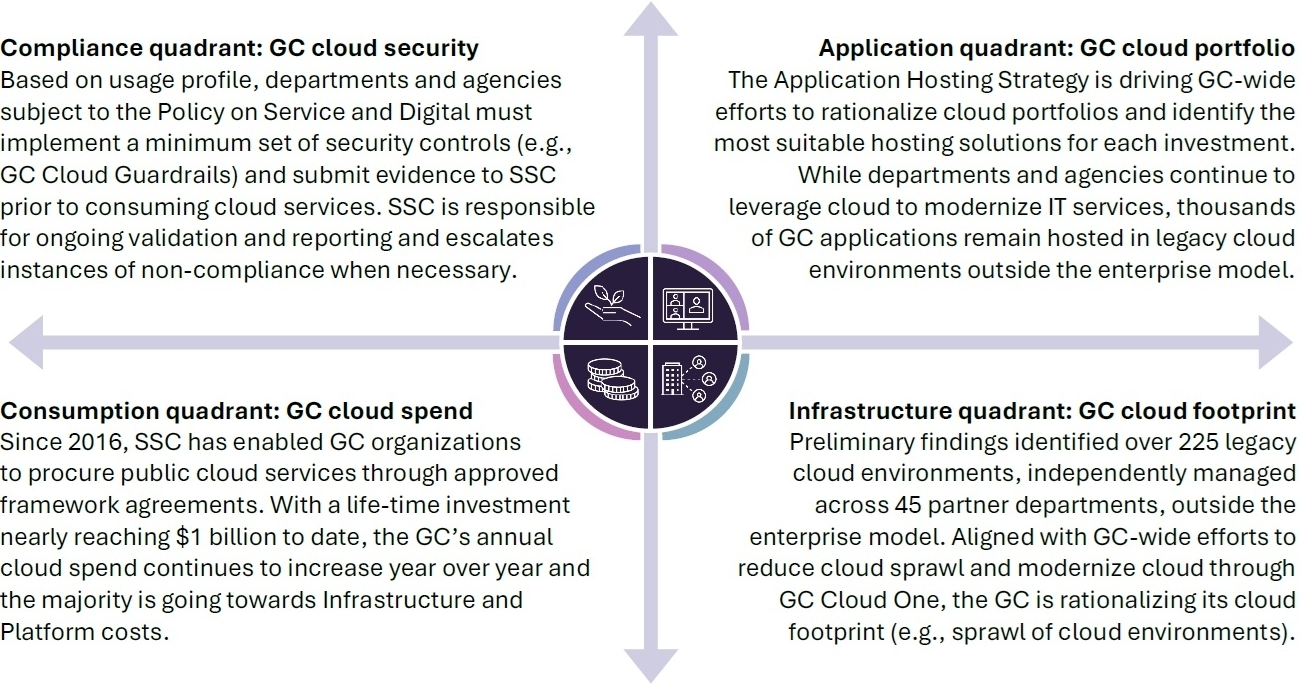
Consolidation models
To support departments at varying stages of cloud maturity and environment complexity, the approach offers four distinct consolidation models. While distinct in approach, real-world implementations often involve a hybrid methodology, combining multiple models to reflect the unique characteristics of a departments cloud landscape.
Adoption model: standardized onboarding
By default for all new cloud business requests and recommended as the preferred model for consolidation, departments onboard workloads directly into GC Cloud One using standard business intake and onboarding processes.
Migration model: facilitated workload transition
As required, SSC establishes a target environment and works with departments to plan and execute the migration of existing cloud workloads into GC Cloud One. This may occur in waves as complexity varies and often requires customizations. This model may include the transfer of some or all resources supporting the environment.
Transfer model: operational ownership shift
By exception, departments transfer operational control of cloud environments to SSC “as-is.” These are initially maintained as distinct environments, with integration and optimization over time. This may occur in waves as complexity varies and often requires customizations. This model may include the transfer of some or all resources supporting the environment.
Federated model: distributed standardization
By exception, departments with mature/complex cloud capabilities retain operational control while adopting GC Cloud One standards and a shared governance framework. Known as “Federated Partners”, these departments accelerate development through targeted investments and reusable capabilities. Over time, these may be integrated with SSC-managed services.
Consolidation framework
The approach provides a flexible framework to ensure effective, scalable, and secure cloud consolidation while maintaining operational continuity and maximizing value across the enterprise. Providing guidance for both the selection of appropriate consolidation models, and the prioritization of future consolidation activities.
Categorization: determining the appropriate consolidation model
At the onset of each departmental consolidation project, SSC will assess each partner’s cloud profile and recommend a consolidation model based on several factors, including a department’s cloud maturity, consumption, complexity, and alignment with GC Cloud One standards.
Though final model selection will be approved through established governance, generally most departments will align to a hybrid approach comprised of the following:
- Adoption model: Best suited for smaller departments or departments early in their cloud journey.
- Migration model: Ideal for departments with some cloud experience but lack reusable environments.
By exception, SSC may identify departments that more closely align to the following:
- Transfer model: Designed for departments with highly mature cloud operations and reusable environments.
- Federated model: Reserved for select departments with extremely advanced cloud operations and capabilities.
Roadmap: prioritizing GC-wide consolidation activities
SSC will maintain visibility of the GC cloud landscape across the four quadrants and prioritize staggered consolidation efforts based on departmental readiness, strategic alignment, and urgency. In the event that a security, procurement, or financial risk emerges, SSC will act immediately to accelerate consolidation to mitigate potential impacts to the GC.
To maintain alignment with broader organizational objectives and priorities, SSC’s iterative roadmap will strike a balance across consolidation, modernization, and innovation, ensuring efforts are focused where SSC can deliver the greatest impact and highest value.
By emphasizing strategic and integrated planning, this approach drives consolidation forward, accounting for external factors like procurement outcomes, funding availability, and security requirements, while preserving the flexibility and adaptability needed to respond to evolving priorities.
Project implementation
Consolidation project phases
The approach establishes a structured and repeatable framework for executing cloud consolidation projects in a consistent and collaborative manner. Each project follows six distinct phases, ensuring that strategic objectives are clearly articulated; stakeholder alignment is secured; and technical, operational, and financial readiness is systematically addressed to enable successful implementation.
Phase 0: engagement
This initial phase establishes the foundation for successful collaboration by confirming intent, fostering a trusted working relationship, and defining desired outcomes. Key business owners and technical leads are engaged, and a strategic consolidation readiness assessment is completed to inform next steps.
Phase 1: alignment
This phase formalizes the partnership and establishes a clear project structure. Core team members are identified, roles and responsibilities are defined, and scope boundaries are agreed upon. Key constraints and dependencies are assessed, migration complexity is categorized, and a preliminary project schedule is developed to guide towards execution.
Phase 2: discovery
This phase involves a detailed assessment of people, financials, and technology to inform migration planning. Targeted cloud workloads are mapped to GC Cloud One components, the project schedule is refined, platform enhancement requirements are identified, and the consolidation model recommendation is documented.
Phase 3: planning
This phase initiates change management and formalizes interdepartmental collaboration through a signed agreement. It also is when approvals are obtained for the project schedule, consolidation model recommendation, and the design of operational and financial models. Security assessments and foundational planning activities are also conducted.
Phase 4: execution
This phase focuses on implementing the approved consolidation model (e.g., workload migration, operational ownership transfer, etc.) and establishing service level agreements. Change management intensifies across people, processes, and technologies. Platform enhancements are deployed, and client documentation and security frameworks are updated.
Phase 5: stabilization
This phase ensures post-consolidation performance is monitored, decommissioning activities are completed, and final implementations of support and financial models are confirmed. Long-term optimization planning activities may also begin, preparing for future service enhancements and integration opportunities.
Governance and oversight
Roles and responsibilities
The approach reflects a shared responsibility model between SSC, departments, and cloud service providers to foster a culture of trust and transparency, clearly defining roles and encouraging open collaboration. This collective approach not only strengthens accountability but also promotes innovation, continuous improvement, and greater return on cloud investments.
Shared Services Canada (SSC)
SSC is accountable for delivering the GC Cloud Consolidation Strategy, including consolidation decisions and the enterprise model. SSC is responsible for driving government-wide efficiencies and ensuring effective execution.
Partner departments
Departments are responsible for actively participating in cloud consolidation, completing pre-project requirements, providing accurate cloud inventory data, and decommissioning unused applications and environments to support efficient migration.
GC director general operational cloud committee
This committee serves as a collaborative forum for presenting the Cloud Consolidation Strategy and engaging departments for input on all aspects of its delivery.
GC enterprise architectural review board (GC EARB)
This board functions as the formal escalation and arbitration forum, providing departments with a structured process to challenge or seek clarification on SSC decisions related to cloud consolidation.
Performance monitoring
To effectively measure the performance and success of Cloud Consolidation, a set of key performance indicators (KPIs) have been established. These KPIs provide clear, data-driven insights into progress, impact, and areas for continuous improvement across operational, financial, and strategic divisions.
KPI 1: cloud footprint consolidation
Tracks the number of cloud environments consolidated under the enterprise model, reduced and outstanding as legacy.
KPI 2: cloud portfolio rationalization
Measures the number of applications hosted under the enterprise model, reduced and remaining in legacy clouds.
KPI 3: annual cloud spend optimization
Monitors annual cloud expenditures, with analysis of increases or decreases as consolidation and optimizations occur.
KPI 4: cloud FinOps integration
Monitors observable FinOps practices across cloud environments, increased cost optimization and financial transparency.
KPI 5: GC Cloud One platform automation
Tracks the number of environments that are fully self-service enabled through the GC Cloud One platform.
Risk management framework
Risk analysis and mitigation
GC cloud consolidations must be guided by a structured risk management framework to ensure that all technical, business, financial, compliance, and change risks are proactively identified and addressed before consolidation begins.
-
Risk type 1: technical risks
Includes platform retirement timelines, interoperability challenges, and migration complexity.
Mitigations: Early technical assessments, phased migration strategies, and fallback environments.
-
Risk type 2: business risks
Encompasses potential service disruptions, application downtime, and loss of institutional knowledge.
Mitigations: Robust transition planning, knowledge transfer protocols, and service continuity safeguards.
-
Risk type 3: procurement risks
Covers contract termination penalties, overlapping vendor agreements, and dual-run operational costs.
Mitigations: Coordinated, strategic procurement planning, cost-benefit analysis, and procurement oversight.
-
Risk type 4: financial risks
Covers lack of long-term financial support, limited sustainable funding availability, and lack of financial stability.
Mitigations: Structured financial planning, strategic resource allocation, and financial oversight.
-
Risk type 5: compliance risks
Involves gaps in security controls, incomplete security documentation, and unclear responsibilities.
Mitigations: Rigorous security assessments, governance checkpoints, and clear delineation of roles.
-
Risk type 6: change impacts
Includes stakeholder resistance, resource constraints, and delays due to external consultations.
Mitigations: Proactive engagement, transparent communication, and structured change enablement plans.
Mitigation measures are embedded throughout the project lifecycle and reinforced by governance gates that require validated funding, staffing, and security evidence before proceeding. This disciplined approach ensures that risks are managed systematically, enabling secure, efficient, and sustainable cloud consolidation across the enterprise.
By supporting informed decision-making, safeguarding operational continuity, and reinforcing shared accountability among stakeholders, this framework strengthens the overall integrity and success of the Cloud Consolidation Strategy.
Financial overview
Cloud funding model
Sustainable funding remains a critical barrier to advancing cloud modernization across the GC. Departments and agencies continue to operate under tight resource constraints, often relying on temporary or non-recurring sources to support cloud investments rather than integrating them into core budgets.
Although the Application Hosting Strategy announced plans to establish a centralized GC Cloud Funding Model, the model has not been finalized. This uncertainty around long-term financial support has added complexity to ongoing projects and slowed momentum for cloud consolidation.
To maintain progress despite the absence of a finalized funding model, the Cloud Consolidation Program is leveraging interim funding mechanisms, such as time-limited allocations and reprofiled resources, to support departmental onboarding and sustain delivery until a long-term, centralized solution is established.
Acceleration and optimization
Acceleration opportunities
While cloud consolidation progresses amid economic, geopolitical, and digital transformation challenges, SSC remains committed to a whole-of-government approach. Drawing on lessons from early adopters and insights from interdepartmental collaboration, SSC continues to assess the GC legacy cloud inventory, identifying opportunities to accelerate consolidation and deliver immediate value to the GC.
Opportunity 1: enterprise first for new cloud demand
Prioritizes the enterprise model as the default hosting platform for new cloud requests, accelerating GC-wide adoption of modern hosting solutions, reducing the risk of ongoing cloud sprawl, and ensuring sustainable, scalable cloud investments.
Opportunity 2: sandbox / experimentation as a managed service
Prioritizes the consolidation of cloud sandbox and/or experimentation environments (e.g., Profile 1) into a centrally managed GC Cloud One service offering, reducing duplication of costs and providing a consistent, scalable solution for innovation.
Opportunity 3: federated practices as an enterprise standard
Prioritizes the propagation of enterprise standards, providing departments with the necessary practices, tools and frameworks to enhance visibility, security, and align legacy cloud environments to GC Cloud One standards ahead of consolidation.
Opportunity 4: cloud migration tools and templates
Prioritizes the establishment of standardized cloud migration tools and templates, leveraging cloud-native solutions where possible, to help standardize cloud consolidations through effective and consistent cloud migration planning.
These measures are expected to deliver measurable cost savings while also strengthening the security, efficiency, and long-term sustainability of the GC’s cloud landscape. By advancing opportunities for acceleration that align with organizational priorities, such as cost transparency, operational consistency, and modernization through innovation, these efforts directly contribute to the realization of a more resilient and future-ready digital infrastructure.
Continuous improvement
Cloud consolidation is not a one-time event but an iterative process that evolves through each cloud consolidation. This approach embeds key elements of continuous improvement, ensuring that every consolidation strengthens the overall approach and delivers greater alignment with departmental needs and priorities.
Element 1: department-level learning
Capture and analyze insights from each engagement to refine methodologies, resolve challenges, and enhance collaboration.
Element 2: incremental adjustments
Apply lessons learned to future consolidation waves, reducing friction, increasing predictability, and accelerating timelines.
Element 3: ongoing optimization
Implement FinOps practices, automation, and security enhancements to improve performance, transparency, and efficiency.
Element 4: governance refinement
Evolve standards, guardrails, and operational playbooks based on real-world outcomes to ensure relevance and effectiveness.
Element 5: shared improvements
Share common patterns, updated guidance, and best practices to enable GC-wide benefit from collective learning.
This approach ensures that cloud consolidation remains responsive, scalable, and value-driven, improving outcomes with each successful consolidation while maintaining a strong focus on security, efficiency, and service excellence.
Strategy refresh and alignment
The Cloud Consolidation Strategy will remain an iterative framework, continuously informed by lessons learned, evolving departmental needs, and advancements in technology. To ensure it remains relevant and effective, a regular review will assess alignment with expected outcomes, realized benefits, and GC priorities, allowing for timely adjustments that sustain momentum, improve impact, and support long-term goals.