
Canada’s journey towards gender equality
Building on more than 50 years of federal action

Not that long ago, Canada looked very different...
Women needed a husband’s or father’s signature to open a bank account. Few women worked outside the home, and even fewer had decision-making roles in business or politics. Contraception was illegal, and women could lose their jobs if they became pregnant.
Same-sex marriage was illegal, so not everyone could marry the person they loved. Canada’s Criminal Code criminalized 2SLGBTQI+ identities in Canada, which led to arrests, convictions and discriminationFootnote 1 . 2SLGBTQI+ members of the military, RCMP, and federal public service were harassed, interrogated, and in many cases fired, just for being themselvesFootnote 2 .
Fast forward to today, and the picture looks much different, thanks to decades of work by all levels of government, civil society organizations, advocates, activists, and people across the country pushing for change and equality.
Still, the journey toward true gender equality is far from over.
As Women and Gender Equality Canada (WAGE) marks more than 50 years of federal action to advance gender equality in Canada, we look back at the significant progress made and reflect on the work that remains to achieve equality, where everyone can achieve their full potential.
Building on progress
The push for equality goes back well before the creation of Status of Women Canada in 1976.
Women won the right to vote federally in 1918, but this milestone left many out. Asian women were barred from voting until 1948, and First Nations women until 1960Footnote 3 .
Women in Canada weren’t even legally considered “persons” until 1929, when the Famous Five successfully campaigned to change the definition under the British North America ActFootnote 4 . This landmark decision allowed women to serve in the Senate of Canada and paved the way to participate more fully in public and political life.
Throughout history, barriers were even greater for underrepresented women, including Indigenous women, racialized women, women with disabilities, newcomers, migrant women, and women from 2SLGBTQI+ communities.
A call for action
In the 1960s, as the women’s liberation movement grew worldwide, Canadians demanded action against inequality and pushed for a more inclusive society.
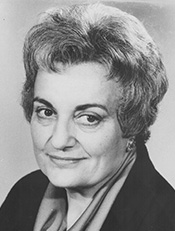
Photo credit: Doug Griffin

Photo credit: House of Commons 1966
In 1966, Laura Sabia rallied 32 women’s groups to urge federal action on women’s rights, going so far as to promise a march of 2 million women on Parliament Hill. Their pressure, supported by Cabinet Minister Judy LaMarsh, led to the creation of the Royal Commission on the Status of Women in 1967. It was the first time the federal government examined, in a coordinated way, the barriers facing women across the country.
When the Royal Commission released its landmark report in 1970, it included 167 recommendations for federal action on everything from the economy and education to childcare and immigration, though it did not address gender-based violence (GBV) or 2SLGBTQI+ rights. This report set the foundation for major changes in Canada’s laws and progress for gender equality.
One of the recommendations called for the creation of a federal body to oversee and promote gender equality. This led to the establishment of Status of Women Canada in 1976, the first federal agency dedicated to advancing equality for women.
In 2018, Status of Women Canada became Women and Gender Equality Canada, the country’s first stand-alone department focused on equality. As a department, WAGE serves as the central coordinating body for federal gender equality efforts in Canada, supporting new programs, investing more resources, and advancing inclusive policies for all Canadians.
Some of the recommendations from the Royal Commission Report are still being addressed today. For example, the Report’s recommendation for federal support for a national daycare programFootnote 5 became reality in 2024 with Bill C-35, the Canada Early Learning and Child Care Act.
Steady progress for gender equality
The last five decades have seen major steps forward for gender equality in Canada supported by Status of Women Canada (later the Department for Women and Gender Equality Canada) and other federal departments.
A milestone came in the 1980s, when the Canadian Charter of Rights and Freedoms guaranteed equality and rights for women in the Constitution. This required governments to treat women and men equally and protect people from discrimination, making women’s rights stronger and enforceable under the law.
Progress wasn't always smooth. In 1982, when “wife battering” was raised in Parliament for the first time by MP Margaret Mitchell, Members of Parliament laughed at the idea that the government should act. Today, WAGE leads the It’s Time: Canada’s Strategy to Prevent and Address Gender-based Violence and coordinates all federal initiatives to prevent and address GBV. The National Action Plan to End Gender-Based Violence, also led by WAGE, brings together every province and territory in Canada to work together towards a shared goal: a Canada free of gender-based violence.

2SLGBTQI + communities have led change through activism and legal action. In 2005, Canada legalized same-sex marriage nationwide, and in 2017, the Human Rights Act was amended to protect gender identity and expression. In 2016, a Special Advisor on LGBTQ2 issues was appointed, and, shortly thereafter, a 2SLGBTQI+ Secretariat was created to help inform the federal government on issues and potential solutions by working directly with 2SLGBTQI+ groups across the country. Now, a Federal 2SLGBTQI+ Action Plan led by WAGE is working to advance rights and equality for all 2SLGBTQI+ people in Canada.
50 years on...
Today, women are joining the workforce in record numbersFootnote 6 , nearly matching men, and their earnings have climbed from just 60 cents for every dollar earned by men in the 1970s to about 87 cents todayFootnote 7 . Women’s voices are being heard more often in boardrooms and management, with twice as many women leading in these roles as there were five decades agoFootnote 8 . Women are more involved in political life, and in 2015, an equal number of men and women were appointed to federal Cabinet for the first timeFootnote 9 .
Education has been a game-changer too: back in the 1970s, fewer than a third of women had post-secondary educationFootnote 10 . Now, most working-age women have college or university credentials, even outpacing men, and helping make Canada one of the most educated countries in the worldFootnote 11 .
While these changes are worth celebrating, true equality is still a work in progress. Women in Canada still face a gender pay gap that is the second highest in the G7Footnote 12 and we rank 69th in the world for the percentage of women in national parliamentsFootnote 13 . Women continue to be under-represented in high-paying fields like STEM (science, technology, engineering and mathematics) and over-represented in lower-paying fields like the service, health, and care sectorsFootnote 14 .
Fair workplaces, equitable policies, and thriving communities don’t happen overnight; they’re built through consistent, coordinated effort over time. Women and Gender Equality Canada continues this important work alongside all levels of government, partners, Indigenous groups, advocates and organizations from coast to coast to coast. WAGE is building a more equal and inclusive society by:
- Funding women’s and civil society organizations that are creating change in their communities.
- Taking action to end gender-based violence by investing in prevention, supporting victims and survivors, and strengthening community solutions, including by engaging men and boys.
- Advising on laws and policies here in Canada and around the world, including with multilateral organizations like the United Nations and the G7.
- Leading and supporting the use of Gender-based Analysis Plus (GBA Plus) across the federal government to ensure that policies, programs, and decision‑making reflect the realities of women, 2SLGBTQI+ people, and people of all backgrounds.
- Supporting and conducting research to better understand the challenges to gender equality and guide government actions.
- Growing an economy that works for everyone where all women and 2SLGBTQI+ people have fair access to good jobs, leadership roles, entrepreneurship, and financial security.
We’re in this for the long haul, creating change that lasts for generations.
Together, we’re building a more equal and inclusive Canada where everyone can thrive, feel free to be themselves, and reach their full potential. Guided by our Canadian values of inclusion, fairness, and ambition, we are creating a future that leaves no one behind.