
CA Vision, Foundation, and Priorities
Text version
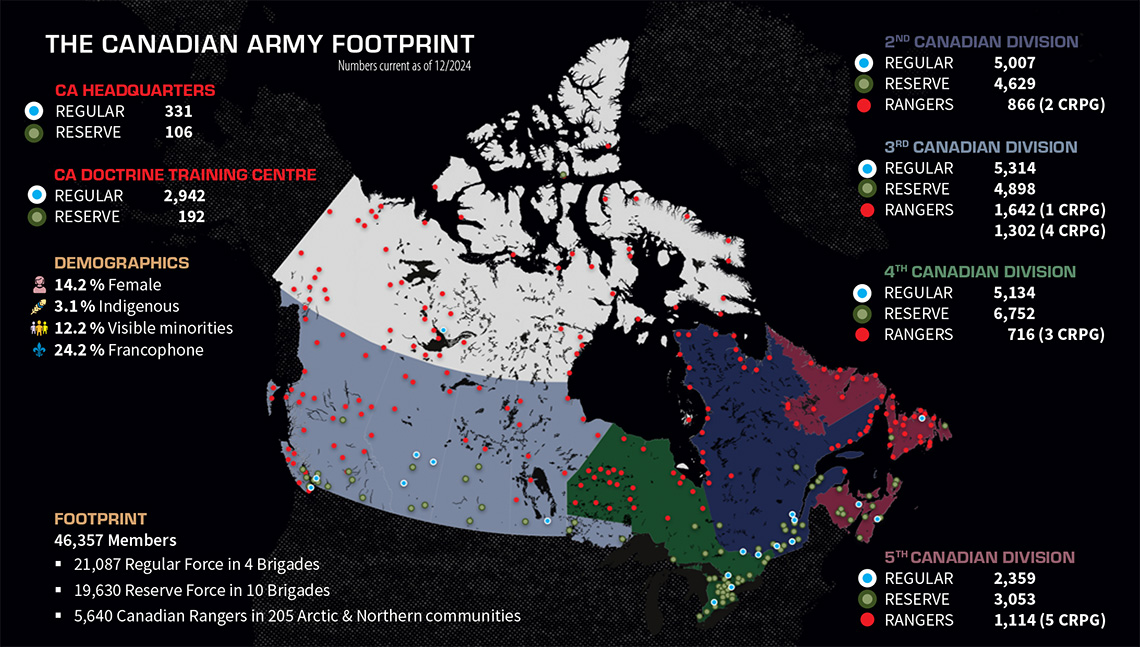
The Canadian Army Footprint (Numbers current as of 12/2024)
Canadian Army Headquarters has 331 Regular Force members and 106 Reserve Force members. The Canadian Army Doctrine Training Centre has 2,942 Regular Force members and 192 Reserve Force members.
2nd Canadian Division in Quebec has 5,007 Regular Force members, 4,629 Reserve Force members and 866 Canadian Rangers belonging to the 2nd Canadian Ranger Patrol Group. There are 30 Canadian Ranger patrols, 15 Reserve Force units and 6 Regular Force units.
3rd Canadian Division in Western Canada and Canada’s North has 5,314 Regular Force members, 4,898 Reserve Force members and 1,642 Canadian Rangers belonging to 1st Canadian Ranger Patrol Group and 1,302 Canadian Rangers belonging to 4th Canadian Ranger Patrol Group. There are 102 Canadian Ranger patrols, 20 Reserve Force units and 7 Regular Force units.
4th Canadian Division in Ontario has 5,134 Regular Force members, 6,752 Reserve Force members and 716 Canadian Rangers belonging to 3rd Canadian Ranger Patrol Group. There are 23 Canadian Ranger patrols, 28 Reserve Force units and 5 Regular Force units.
5th Canadian Division in Atlantic Canada has 2,359 Regular Force members, 3,053 Reserve Force members and 1,114 Canadian Rangers belonging to 5th Canadian Ranger Patrol Group. There are 33 Canadian Ranger patrols, 14 Reserve Force units and 3 Regular Force units.
The Canadian Army has a total strength of 46,357: 21,087 divided among the four Regular Force brigades; 19,630 Reservists in 10 brigades; and 5,640 Canadian Rangers across 205 Arctic and northern communities.
Demographics:
- 14.2% Female
- 3.1% Indigenous
- 12.2% Visible minorities
- 24.2% Francophone
The Canadian Army Footprint
(Numbers current as of 12/2024)

CA Vision, Foundation, and Priorities
[PDF 1.3 Mb]
The Canadian Army Vision and Priorities
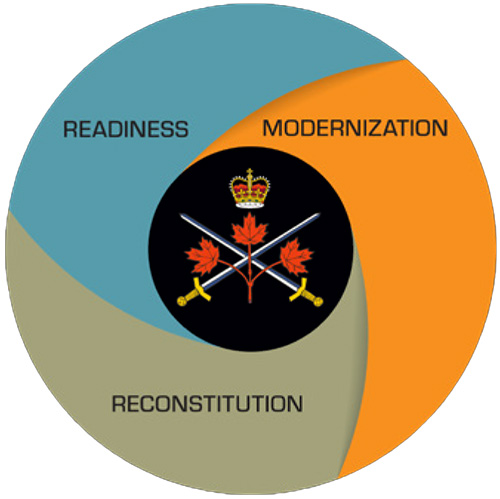
By 2030 the Canadian Army will be a modern, interoperable, relevant, and digitally transformed force capable of providing the Government of Canada with agile and scalable options for use in Canada and around the world in competition, crisis, or conflict. To achieve this vision, the Army is prioritizing three key areas: Modernization, Reconstitution, and Readiness.
These priorities are purposely in that order: Modernization will be the foundation, driving critical changes that enable the Army to rebuild and re-equip (Reconstitution) in order to ensure Readiness for future challenges.
Image text version
The Canadian Army Vision and Priorities
The Canadian Army Vision and Priorities are:
- Readiness
- Modernization
- Reconstitution
The Canadian Army’s Foundation
Purpose: Defend Canada, contribute to strategic deterrence, and ensure collective defence alongside our allies.
Mission: Generate combat effective, multipurpose land forces capable of executing
Key Principles
Interoperable: Across the Canadian Armed Forces and with the Five Eyes, NORAD, NATO, and emerging partnerships.
Agile: Resilient, adaptable, innovative, and risk-tolerant in order to provide rapid response at home and around the world.
Scalable: Providing options for force employment across the full spectrum of operations, enhancing our relevance to Canada and our allies.
Lethal: Maintaining the readiness and capabilities to conduct combat operations against a peer enemy.
Digital Transformation: Leverage advanced technologies to integrate command and control systems and enhance decision-making.
Culture: Continually evolving our culture to enhance the fighting spirit and operational effectiveness of the One Army Team.
The Canadian Army’s Global Focus Areas
Text version
The Canadian Army’s Global Focus Areas
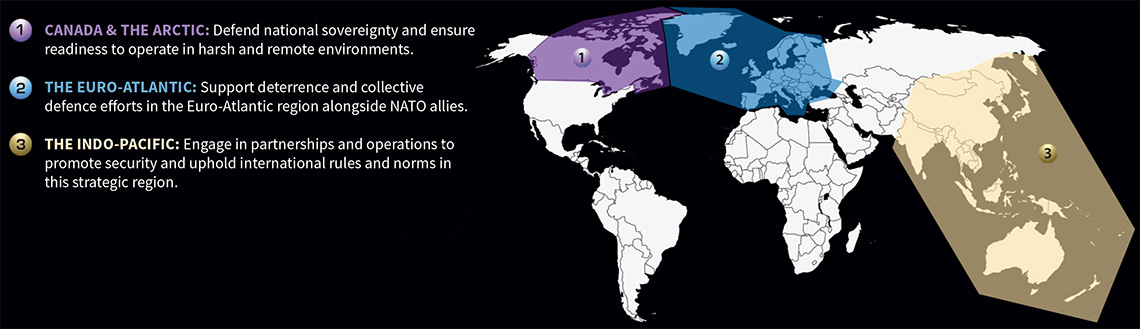
A map of the world identifying the three priority intervention zones of the Canadian Army.
- Priority 1: Canada and the Arctic: Defend national sovereignty and ensure readiness to operate in harsh and remote environments.
- Priority 2: The Euro-Atlantic: Support deterrence and collective defence efforts in the Euro-Atlantic region alongside NATO allies.
- Priority 3: The Indo-Pacific: Engage in partnerships and operations to promote security and uphold international rules and norms in this strategic region.
Canadian Army Modernization Priorites
Text version
Structure
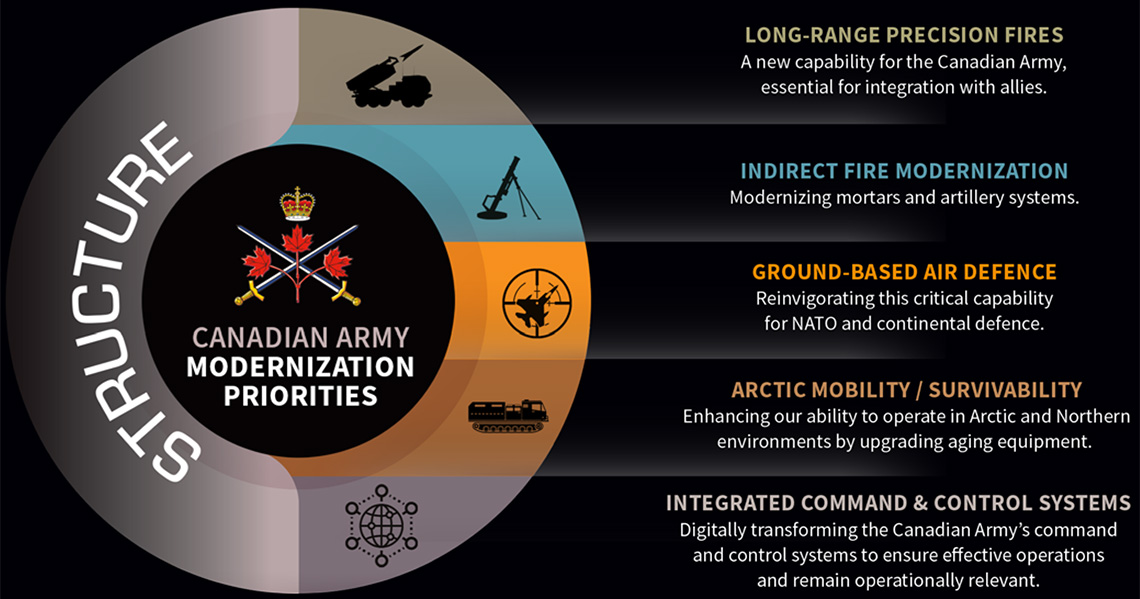
- Long-Range Precision Fires : A new capability for the Canadian Army, essential for integration with allies.
- Indirect Fire Modernization: Modernizing mortars and artillery systems.
- Ground-Based Air Defence: Reinvigorating this critical capability for NATO and continental defence.
- Artic Mobility / Survivability: Enhancing our ability to operate in Arctic and Northern environments by upgrading aging equipment.
- Integrated Command & Control Systems: Digitally transforming the Canadian Army’s command and control systems to ensure effective operations and remain operationally relevant.