

Operation REASSURANCE 20-01: Deter or Fight!
October 15, 2021 - Lieutenant Colonel Eric Angell
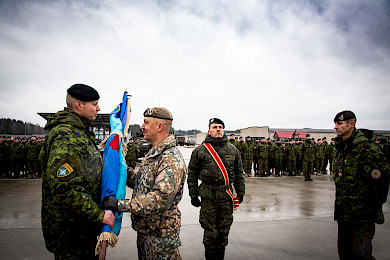
Caption
Op REASSURANCE ROTO 13 Handover
I had the distinct honour of being the commander of Operation REASSURANCE 20-01 from 15 January to 15 July 2020. Our mission statement was:
“The enhanced Forward Presence Battle Group (eFP BG) Latvia will OPERATE in Latvia to DETER and, if necessary, DEFEND Latvia’s population and territory against any aggression.”
This short piece will focus on the ‘Command’ Operational Function and below I share some of the philosophy and thought process that went into the estimate and my approach to command of the eFP BG. I first wish to acknowledge the excellent BG commanders that went before me because much of my approach was based on their hard work and advice. The eFP BG is a robust, integrated warfighting organization and each rotation gets progressively more capable and interoperable, building on the success of previous teams.
The ‘Defend’ task of the mission was relatively easy to conceptualize and plan for, though no doubt difficult to execute. The eFP BG is well equipped, sustained and prepared for the worst-case scenario that we all hope never comes to pass. In addition to 341 Canadian soldiers, there were roughly 700-plus soldiers in the BG from eight different countries including Albania, Czech Republic, Italy, Montenegro, Poland, Slovakia, Slovenia and Spain. The Canadian infantry company even had a British exchange officer attached, a truly multinational team! All of these different nations brought a significant amount of combat power to the mission, including tanks, artillery and infantry and supported by enablers. As a BG, we worked very closely with the Latvian Mechanized Infantry Brigade (MIB) and conducted continuous rehearsals and snap exercises in addition to integration activities aimed at readiness to respond to any potential threat. We also conducted training in several different geographic areas of Latvia to demonstrate our ability to rapidly project combat power throughout the country, coupled with the additional benefit of a “change of scenery.”
The execution of ‘Deterrence’ is more nuanced and requires careful consideration of measures of effectiveness (MoE) that transcend the tactical level. From its inception, the mission adopted a very robust strategic engagement and community relations posture, informing as many audiences as possible about the amazing work being done by the BG. This effort was extremely active in previous rotations, but COVID-19 force protection measures effectively curtailed “face to face” strategic engagement and community outreach at the BG level. To note “no adversary invaded Latvia” during 20-01 as the true MoE is overly simplistic. I offer that the true effect of the eFP BG can be gauged by how credible, integrated, capable and committed the contributing nations are. Our Allies do their part and the deployed officers and soldiers of each nation were of the highest quality. They most definitely send their “A-Team” in both personnel and equipment to the mission, clearly demonstrating commitment.
I approached the mission using the three guiding concepts outlined below in order to translate strategic intent into tactical execution. As previously stated, none of these are transformational but based on the best practices of my predecessors:
Deterrence = Presence + Credibility.
Credibility achieved through Rehearsal and Demonstration.
Based on that approach, coupled with the orders I received, I developed several key tenets as part of my Direction and Guidance (D&G). They are intentionally simplistic in order to be translated into the multitude of languages of the BG and to be communicated and understood all the way to the private soldier level. Points are as follows:
Integration: Two Flags! I ordered my team to always include at least one other nation in their planning, no matter the activity. This manifested in very simple ways such as a ball hockey tournament where team players were from different countries, to forming ad-hoc Combat Teams as part of tactical rehearsals. This integration was only forced at the beginning and it quickly became natural and widely (often enthusiastically) adopted.
Interoperability = SOPs. We focussed on interoperability through SOP socialization and shared understanding early in the rotation. The BG SOPs are a combination of tactical procedures from each of the contributing nations with NATO doctrine as the overriding reference. As an example, it only made sense that because the Spanish contingent provided the Sappers that we adopt Spanish procedures for obstacle breaching, and so forth. The SOPs grow, adapt and improve with each subsequent rotation.
Readiness: Fight Tonight, And Tomorrow! From the first day, we focused on quickly and effectively building teams, training that paid huge dividends, especially during a short six-month tour. Readiness was built and demonstrated through constant rehearsals and snap-exercises, always focussed on doing things more effectively and more quickly. We also worked hard to improve our combat service support (CSS) procedures and to improve the reaction times of sustainment and increase the overall time period during which the BG could be sustained in combat. Readiness was prioritized throughout our rotation, especially during the Transfer of Command Authority (TOCA), which is a period of vulnerability as the new team learns to work together. To offset this, the TOCA occurs over a period of almost two months, ensuring there is always an experienced “foot on the ground”.
Relationships are Key. The old adage that “we are in a people business” stands true in this mission. With nine contributing nations, plus the Latvian Armed Forces, coordination, communication and liaison are critical activities that transcend all others at the command level. While this may seem cumbersome at first glance, I actually found it to be one of the facets of my role that I enjoyed the most. With no small amount of pride, I believe that Canadians, due to our culture, are extremely well suited to the command of multi-national BGs. We are predominately, by nature, friendly, accommodating and able to find middle ground.
Communication. It always needed to be clear, explicit, concise, constant and simple. English was the second (or third) language for everyone, less the Canadian contingent. This method of communication was neither onerous nor unexpected; it simply took the time and energy it demanded. Orders and direction took longer to deliver, but it is always more time effective to say something once slowly and clearly than to have to say it twice and risk it being misunderstood. It also forced us to truly concentrate on priorities and ensure plans were not overly complicated (i.e. simple).
Honour, Humility and Respect. I demanded that these three guiding principles govern all interactions between soldiers inside the BG and “up and out” to the Latvian MIB and citizens of Latvia. As stated, our credibility was “vital ground” and we could not provide any “fodder” for the ongoing disinformation campaign being waged against us by our adversaries. This was ruthlessly enforced and communicated at all levels. There were only a few minor incidents that breached these principles, and they were quickly addressed. Alliances, even at the tactical level, work best when they are based first on respect for each other.
Flexibility. While flexibility is paramount in all operations, it is even more critical in a multinational BG. Inevitable frictions arose due to slightly different tactical approaches, leadership styles and equipment. Everyone’s flexible approach ensured that frictions were quickly identified and either addressed or mitigated with minimal impact.
Refine not Reinvent: Test and Adjust. The eFP BG is an ongoing successful experiment and is intended to be so. The BG is always experimenting with new capabilities and better ways to integrate. Contributing nations add and adjust equipment to ensure their armed forces get experience across capabilities. This is a good thing! From a Canadian perspective, as commander I tried to determine when it was best to “refine” and when it was best to “adjust”. Using Battle Procedure as an example, we settled on using the “tried and tested” Combat Estimate, modified slightly to adapt to “on the ground” necessities. My predecessor used this method and to minimize the differing approaches units from different parts of Canada have taken (some used the Operational Planning Process, others “7 Questions”), we adopted it as well. The Latvian MIB was especially pleased to know that we were continuing with the approach of the previous rotation, not changing again. Throughout it was my intent to simply do what we could to improve process, instead of trying to start from zero.
Information Operations: Demonstrate our “Strength in Unity”. We adopted the motto of the Latvian MIB “Vienotiba Speks” which translates to “Strength in Unity”. We leveraged our strategic communications assets, specifically the Public Affairs Officer and photographer to capture the activities and spirit of the BG and to push it to as many audiences as possible. To be fair, the photographer was one of the busiest soldiers in the BG! The Two Flags! tenet was leveraged here as well. This went beyond simple communications and we conducted force projection rehearsals thorough Latvia in order to demonstrate our ability to exercise freedom of movement and to showcase our capability to those adversaries who were invariably watching.
Seek Opportunity. As the commander cannot be everywhere at all times, I empowered my sub-unit commanders, through mission command, to identify opportunities at their level to work toward these listed tenets. This approach was quickly implemented and provided much excellent training for soldiers while working toward the overall mission. By the end of my rotation, I actually had to actively prioritize what we could accomplish with allotted resources (the most precious being time!) as there was a plethora of amazing and creative ideas presented. Some of our Allies follow a far more directive approach to leadership, basically having all training dictated by higher levels. Once they were familiar with the freedom I afforded them, they enthusiastically leveraged it.
Patience and Positivity. Working with Allies requires patience on all sides. Coupled with positivity, the right attitude sets the tone and is a force multiplier in more ways than one. I expected it from my entire team. I always expected the truth and not to have details “sugar coated,” but I also sought to ensure everyone focused on what was right and good and to find solutions to inevitable frictions.
Learn from each other. This was a great opportunity to learn from our Allies and to adopt what they do better than us. I have worked with US and UK forces before, but never Spanish, Italian, etc. and that fact of my service experience was very similar to most Canadians. We seized every opportunity to share “best practices” and to become familiar with each other’s weapons and equipment, which would pay dividends during combat and for the remainder of soldiers’ careers. I also gained a new appreciation for NATO SOPs. Our European Allies understand and use them much better than us.
In closing, above I shared some of my approach to command of the eFP BG. Working with some of our “non-traditional” Allies was an extremely rewarding experience. As stated above, I have trained and conducted operations with the American and British militaries many times, but had never worked with the Latvians, Spanish, Italians, etc. Much of the mission focus was developing methods to work together and to ensure and demonstrate that we could communicate and conduct planning together with the ultimate goal of being able to fight side-by-side if the situation demanded. There were also many amazing expressions of culture and always a national celebration to attend with new food to try! Vienotiba Speks!