
Campus Antisemitism and Student Experiences (CASE)
On this page
- Authors of the report
- Background
- Executive Summary
- Terminology
- 1. Antisemitism is a Campus-Climate Issue
- 2. The Lived Experience of Jewish Students
- 3. Institutional Betrayal
- Conclusion
- Appendix A | Methodology and interpretation notes
- Appendix B | Why this should be understood as a Canada problem, not only a Jewish problem.
- Appendix C | Additional student comments
- Appendix D | Broader Campus survey provides critical insights into antisemitism
- Appendix E | Survey Instrument
A national report on the state of antisemitism at Canadian postsecondary institutions
Commissioned by the Government of Canada, this report was produced by the Association for Canadian Studies and the Metropolis Institute, August 2026
Authors of the report
Campus Antisemitism and Student Experience (CASE)
The Case Report was prepared by:
- Dr. Jack Jedwab
- President & CEO, Association for Canadian Studies & Metropolis Institute
- Dr. Paul Holley
- Research & Evaluation Director, Association for Canadian Studies & Metropolis Institute
| Name | Title, Affiliation |
|---|---|
| Dr. Jean-Philippe Warren | Professor, Fellow Royal Society of Canada, Department of Sociology & Anthropology, Concordia University |
| Dr. Howard Ramos | Professor, Western University |
| Dr. Jason Brown | Professor, Department of Mathematics and Statistics, Dalhousie University |
| Robert Levy | President, BrandSpark International |
| Dr. Jonathan Calof | Professor Emiratus, Special Advisor on Antisemitism, University of Ottawa |
| Dr. Matthew Flisfeder | Professor of Rhetoric and Communications, University of Winnipeg |
| Dr. Barbary Perry | Professor and Director, Centre on Hate, Bias and Extremism, Ontario Tech University |
| Naomi Rosenfeld | Healthcare Entrepreneur | Former Non-Profit Executive |
| Dr. Seth Goren | Chief Executive Officer, Hillel Ontario |
| Dr. Michael Geist | Canada Research Chair in Internet and e-Commerce Law, University of Ottawa |
| Dr. Jacob A. Burack | Professor, McGill University Faculty of Education |
| Maxyne Finkelstein | President, Morris and Rosalind Goodman Family Foundation |
| Dr. Morton Weinfeld | Emeritus Professor of Sociology, McGill University |
| Dr. Cary Kogan | Professor, School of Psychology, University of Ottawa |
| Dr. Eran Shor | Professor, Department of Sociology, McGill University |
| Dr. Robert Brym | Professor Emeritus, University of Toronto |
| Dr. Yolande Cohen | Full Professor, UQAM, Fellow of the Royal Society of Canada, Knight of the Legion of Honour, Knight of the National Order of Quebec |
| Dr. Ron Levi | Professor, University of Toronto |
Background
Over the past few years, Canada has seen a dramatic rise in antisemitism. Despite only being 1% of the Canadian population, Jewish Canadians made up 68% of reported religiously motivated hate crimes and 18.8% of overall reported hate crimes in 2024—the largest in either category.Footnote 1 The Government response has included the House of Commons Standing Committee on Justice and Human Rights report on Heightened Antisemitism in Canada and How to Confront It (House of Commons report) tabled on December 10, 2024 and the Standing Senate committee on Human Rights report titled Standing United Against Antisemitism: Protecting Communities and Strengthening Canadian Democracy [PDF document] tabled on April 21, 2026 (Senate report). Both reports included recommendations for combatting antisemitism with the Justice Committee report specifically highlighting recommendations for combatting antisemitism on campuses.Footnote 2 The Department of Canadian Heritage, which housed the former Special Envoy on Preserving Holocaust Remembrance and Combatting Antisemitism, has a mandate to foster and promote Canadian identity and values, cultural development, and heritage. To achieve this, it works with a range of partners that serves Canadians to enrich cultural experiences, promote multiculturalism and strengthen identity. The rise of antisemitism on postsecondary campuses stands in direct opposition to Canada-wide efforts to protect the human rights, security and dignity of everyone, including racialized and ethnoreligious minority communities.” Along with 45 countries and numerous jurisdictions, the Government of Canada adopted the International Holocaust Remembrance Alliance (IHRA) working definition including the illustrative examples in 2019 through Canada’s Anti-Racism Strategy. This defines antisemitism as “a certain perception of Jews, which may be expressed as hatred towards Jews, the rhetorical and physical manifestations of which are directed toward Jewish or non-Jewish individuals and/or their property, toward Jewish community institutions and religious facilities.”Footnote 3 Addressing antisemitism in this context is therefore not a niche issue, but a core test of Canada’s broader anti-racism commitments. Ultimately, if Jewish students are not safe on campus, it signals a broader failure of institutional safeguards, because a campus that is unsafe for one group is unsafe for all.
To respond to the growing crisis and the recommendations of the two committees, the former Special Envoy commissioned the Association for Canadian Studies to survey Jewish students on their lived experiences of antisemitism on campus, as well as to survey the broader student population on attitudes toward Jews and antisemitism. The resulting CASE project, which comprises this report and a future report of the general student population’s views on antisemitism, specifically support Recommendation 3 of the House of Commons report, which called for expanded quantitative and qualitative data collection on Jewish experiences on university campuses. Additionally, they support Recommendation 6 of the Senate report, which calls for the Government of Canada to support improved research and disaggregated data collection relating to hate, bias, and antisemitism in Canada. This includes the monitoring of trends across sectors such as education, workplaces, and digital platforms.Footnote 4
Executive Summary
“My friend was walking through [REDACTED] Hall. He also wears a kippah, and a group of students shouted, ‘there’s a Jew…let’s get him.’ They then chased him out of the building.”
This report presents the findings of a comprehensive Canada-wide survey of Jewish postsecondary students on their experiences of all forms of antisemitism. A separate report will be released with the findings from the survey of the general higher education student population.
In response to increasing accounts of antisemitism on Canadian campuses, the former Special Envoy on Preserving Holocaust Remembrance and Combatting Antisemitism commissioned the Association for Canadian Studies to survey Jewish students on their lived experiences of antisemitism on campus, as well as to survey the broader student population on attitudes toward Jews and antisemitism.Footnote 5 The resulting Campus Antisemitism and Student Experiences (CASE) project provides the most comprehensive national evidence to date on antisemitism in Canadian postsecondary institutions. Drawing on parallel surveys of approximately 900 Jewish students and 755 students from the broader campus population, the findings point to a troubling and urgent conclusion: antisemitism on Canadian campuses is not episodic or peripheral—it is persistent and proliferating, and on some campuses has become a normalized and systemic feature of campus life.
By documenting the experiences of Jewish students on Canadian campuses, the CASE project responds directly to recent calls for stronger Canadian evidence on campus antisemitism. In December 2024, for example, the House of Commons Standing Committee on Justice and Human Rights released an important report on Heightened Antisemitism in Canada and How to Confront It.Footnote 6 The findings reported in this report should be used immediately by leadership in higher education institutions to examine their policies and practices and determine how best to restore a truly inclusive campus climate.
The results of this survey reveal an alarming prevalence of campus antisemitism, along with a troubling institutional failure to respond to serious concerns about campus climate and student safety. The findings indicate that many Jewish students experience widespread and persistent antisemitism on Canadian campuses as a defining feature of postsecondary life that shapes their behaviour, their ability to fully participate in campus life, their safety, and their wellbeing.
Key findings of the CASE survey of Jewish students include the following:
- 84% of Jewish respondents said antisemitism is a serious problem on campus.
- 95.7% said they had experienced or witnessed at least one instance of antisemitism over the previous 12 months
- 70% said their university does not take antisemitism seriously, and 68% said their campus is not a safe and inclusive place for Jewish students.
- 72% limit what they say in class about being Jewish, and 57% avoid wearing or displaying Jewish symbols because of safety concerns.
- 18% of incidents cited faculty members, 7% involved teaching assistants, and 7% involved administrators or staff.
- 36% encountered course content or classroom discussion they experienced as antisemitic or biased, while 34% said a professor introduced Jews, Judaism, Israel, or Zionism when unrelated to the course subject.
- 45% encountered Holocaust denial or distortion often or sometimes, and 65% encountered it “at least rarely.”
- 81% reported hateful or discriminatory treatment of Zionists on campus often or occasionally; 71% reported antisemitic vandalism; 54% reported intimidation or threats directed at Jews; and 22% reported physical violence directed at Jews.
- 34% identified online or social media spaces as a location where incidents occurred, 33% identified student organizations or campus events, 25% classrooms or lecture halls, 23% nearby off-campus spaces, and 9% in student residences and housing.
- 33% reported the incident they described. Among those who reported, 63% were dissatisfied with how it was handled, and 52% of non-reporters said they did not think reporting would help.
Source: CASE Jewish student survey. See Part II and Appendix A for exact item wording, bases, and methodology.
In addition to the structured data, participants provided over 1200 accounts of antisemitic incidents through open ended questions. A select few, representative of broad themes, are highlighted in the “student voice”. These accounts reveal a university culture that is both not welcoming to Jewish students and actively and systematically trying to exclude and vilify them. The most prevalent themes of antisemitic incidents cited by Jewish students can be grouped into the following themes: holocaust denial and distortion; harassment and threats; normalization of antisemitic climate; pressure to disclose political views; academic/classroom bias; social exclusion; fear and emotional trauma; and a lack of institutional response.Footnote 7
“Have been spat on and had someone rev car engine at me in crosswalk while wearing kippah. Have seen a Jewish student punched, have heard a Jewish friend … called a Zionist whore and spat on for having a Magen David [Star of David] visible. Have seen antisemitic graffiti in bathroom stalls and all over campus.”
Terminology
“Professor wrote that we should kill all Zionists, that she’s worked with them and sees how evil they are.”
Antisemitism: This report uses the IHRA’s working definition of antisemitism including its illustrative examples, which was adopted by the Government of Canada in 2019:
Antisemitism is a certain perception of Jews, which may be expressed as hatred towards Jews, the rhetorical and physical manifestations of which are directed toward Jewish or non-Jewish individuals and/or their property, toward Jewish community institutions and religious facilities.Footnote 8
Zionism: Zionism refers to the belief that Jewish people have the right to self-determination in part of their ancestral homeland.Footnote 9
Antizionism: Antizionism refers to a movement that calls for the erasure of Israel and denies the Jewish people the right to self-determination in part of their ancestral homeland.
Scholarship defines antizionism as relying on “libel and distortion to claim that the Jewish collective, Israel, rather than the individual Jew, is uniquely evil. It further asserts that Jews, who have thousands of years of history in this place, are fabricating a legitimate claim to their ancestral homeland. ... Antizionism claims that Israel, exceptionally, is the one state that must be eradicated." Footnote 10
“I heard a professor say that “Hitler was a hero”
1. Antisemitism is a Campus-Climate Issue
When it comes to the rise of antisemitism on university campuses, the Canadian evidence base remains underdeveloped relative to that of the United States, the United Kingdom, and Australia. It continues to rely heavily on institutional reviews, parliamentary deliberations, community reporting, journalism, and adjacent educational research, rather than on national, comparative survey research. This gap is especially notable given related Canadian findings at the primary and secondary school levels, including Robert Brym’s Antisemitism in Ontario’s K-12 Schools,Footnote 11 which was commissioned by the former Special Envoy and points to antisemitism as a broader educational and societal issue rather than one confined to universities alone. The CASE design—a Canada-wide survey of Jewish students paired with a comparison survey of the general student population, and with a combination of fixed-response and open-ended questions—therefore responds directly to a clear gap in the documentation and to recent calls for stronger Canadian evidence on campus antisemitism.
In the CASE survey of Jewish students, antisemitism appears across much of campus life, with faculty, peer interactions, and online spaces playing a central role in its spread. Jewish students report a range of incidents, from Holocaust denial to swastikas graffitied on bathroom walls to physical threats or intimidation. They also describe numerous classroom incidents, with Jewish students singled out for their opinions about Israel and professors assigning blatantly biased and antisemitic or antizionist literature while omitting any scholarship that reflects the Jewish connection to their ancestral homeland. The accounts of classroom incidents are an especially troubling indicator of the pervasiveness of antisemitism on Canadian campuses, where even the classroom is not a safe space.
The evidence points to a reframing of campus antisemitism. It cannot be understood as a matter of discrete acts or individual prejudice, but must be seen as a broader campus-climate issue with systemic characteristics in certain contexts. The data makes it clear that its impact is cumulative and pervasive, shaping whether Jewish students feel able to participate fully in academic and social life and express their identity. Treating antisemitism as isolated and episodic obscures its broader effects and allows harmful conditions to persist. The deeper point is that antisemitism on campus is not a private problem for Jewish students to manage on their own. It is a campus-governance problem, a classroom-culture problem, and a Canadian problem that is especially virulent across postsecondary campuses.
Terminology note: Zionism
Zionism refers to the belief that Jewish people have the right to self-determination in part of their ancestral homeland.
2. The Lived Experience of Jewish Students
“Residents at my on-campus residence started rumors about me that I am a child killer, white supremacist, racist, and Zionist all because these people found out that I was Jewish.”
84%
said antisemitism is a serious problem on campus
71%
reported antisemitic vandalism
96%
said they had experienced at least one instance of antisemitism over the previous 12 months
68%
said their campus is not a safe and inclusive place for Jewish students
72%
limit what they say in class about being Jewish
70%
said their university does not take antisemitism seriously
18%
of antisemitic incidents cited faculty members
57%
avoid displaying Jewish symbols because of safety concerns
The CASE survey documents a campus climate that many Jewish students experience as exclusionary, coercive, and unsafe. Moreover, the survey’s open-ended responses show what sits behind the topline numbers: fear, humiliation, coercion, isolation, and in some cases withdrawal from campus life altogether. “After openly mentioning I was Jewish within my program,” reported one student, “nobody wanted to work with me for group projects and ignored me any way they could.” Another student dropped out of a sociology programme “because of the level of hatred against Jews” in the department. Such responses underscore the human impact of a toxic campus environment.
“I dropped out. My anxiety level was too high and no one at school seemed to care. It is open season on Jewish students.”
2.1 Hostile Campus Climate
“Working in my labs, I have had people refuse to work with me due to my Jewish identity, and purposely try to mess up my data.”
The campus climate is widely experienced as hostile to Jewish students. It should be emphasized that Jewish students are not describing ordinary and expected discomfort at the introduction of challenging ideas or a few isolated bad incidents. Rather, they are describing a toxic environment in which antisemitism is not only tolerated but perpetuated by people in positions of authority. They do not trust their institutions, do not feel safe in their dorm rooms and their classrooms, and do not believe that standards of fairness and impartiality will protect them.
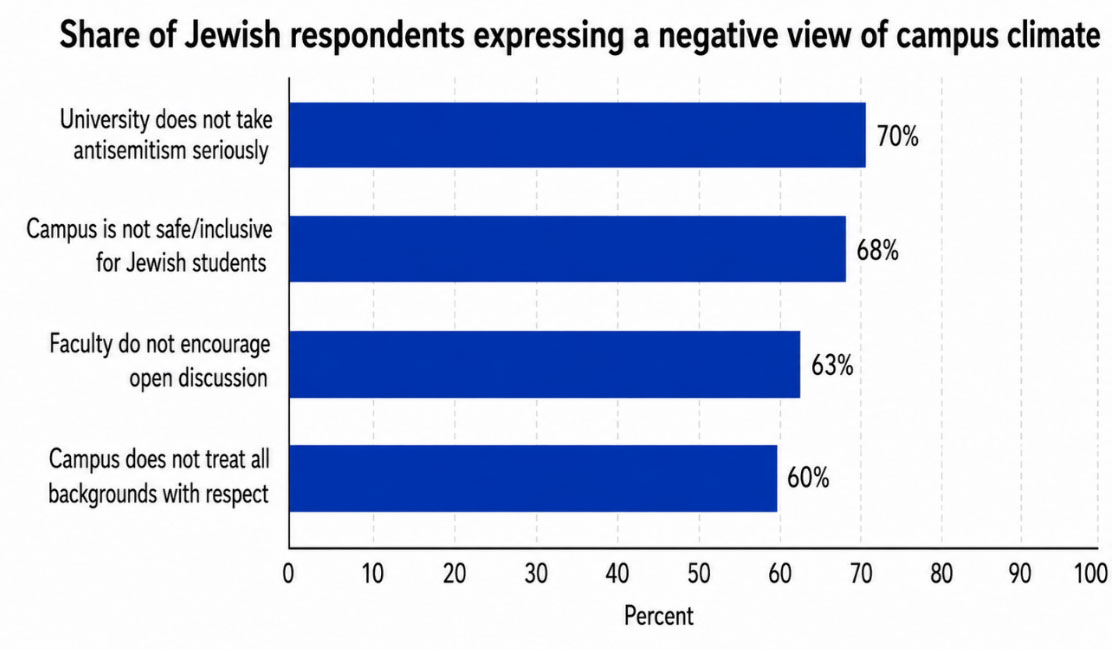
Share of Jewish Respondents expressing a negative view of campus climate — alternative text
- University does not take antisemitism seriously - 70%
- Campus is not safe/inclusive for Jewish students - 68%
- Faculty do not encourage open discussion - 63%
- Campus does not treat all backgrounds with respect - 60%
This hostile climate changes how students speak, study, and move through campus. Jewish students report changing what they say, where they go, what they wear, and whether they remain engaged in academic and campus life at all. More than 70% limit what they say in class about being Jewish, two-thirds limit what they say online, and more than 60% say they have lost friendships because of antisemitism. 40% report academic harm, and roughly 25% have considered leaving their university because of antisemitism.
2.2 Toxic Classroom Dynamics
“I was told by a professor, in class in the middle of the lecture, that Jews belong in Poland and need to go back.”Footnote 12
The classroom is not insulated from the overall campus climate. In the CASE findings, it is one of the places where students most clearly describe coercion, power imbalance, and fear of academic penalty.
The pattern is cumulative. 36% reported encountering course content or classroom discussions that portrayed Jews, Judaism, Israel, or Zionism in an antisemitic or biased way. 34% said a professor introduced those topics in ways unrelated to the course. Nearly half felt pressured to share their opinions about Israel with other students, more than one-third felt pressure to conform to a professor’s views on Israel, and about one in five felt pressured to join an anti-Israel protest.
36%
reported encountering course content or classroom discussions that portrayed Jews, Judaism, Israel, or Zionism in an antisemitic or biased way
47%
felt pressured to share their opinions about Israel with other students
20%
felt pressured to join an anti-Israel protest
34%
reported a professor introducing Jews, Judaism, Israel or Zionism in ways unrelated to the course
36%
felt pressured to conform to a professor’s views on Israel
25%
of antisemitic incidents on campus were witnessed in the classroom or lecture hall
“Professors sharing links to Holocaust denial websites as mandatory reading material”
“Professor assigned us to listen to a podcast that discussed how Zionism was similar to Nazism, which was unrelated to the course”
In the open-ended responses, students report numerous instances of the demonization, delegitimization and disinformation regarding Israel.Footnote 13 They also recount many examples of professors introducing the topic of Israel and the Israel-Hamas war in courses that have nothing to do with the conflict in the Middle East – including courses on Canadian constitutional law, on the technical aspects of film, and on statistical methods in health research. “A professor last year gave readings on Palestinian liberation,” reported one student, “for a course completely unrelated to the conflict.” The students’ comments also evince considerable anxiety over the pressure to conform to a professor’s anti-Israel views. One professor of medicine reportedly told students that “if we support Israel and don't denounce the genocideFootnote 14, we would not be good doctors/don’t belong.” These examples of classroom politicization for the purposes of antizionist indoctrination are among the most worrying of the CASE findings.
Terminology note: Antizionism
Antizionism refers to a movement that calls for the annihilation of Israel and denies the Jewish people right to self-determination in part of their ancestral homeland.12
As the CASE survey results make clear, the problem is not only peer-to-peer: authority figures also appear in the data. Whereas fellow students are the most frequently identified actors, they are not the only ones. Faculty, teaching assistants, administrators, and staff all appear as perpetrators in students’ descriptions of campus antisemitism.
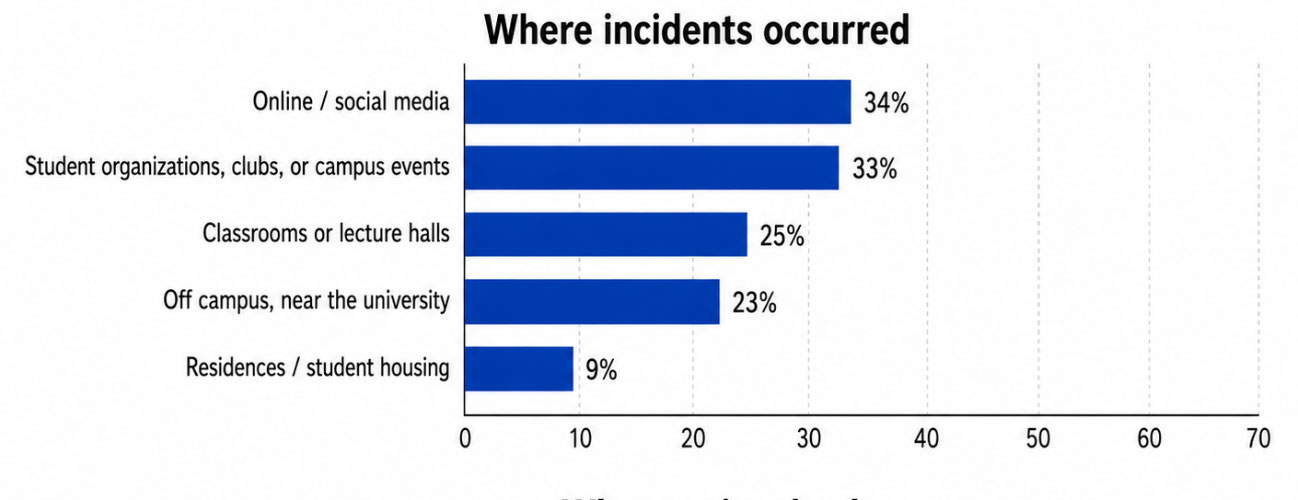
Where incidents occurred — alternative text
- Online / social media - 34%
- Student organizations, clubs, or campus events - 33%
- Classrooms or lecture halls - 25%
- Off campus, near the university - 23%
- Residences / student housing - 9%
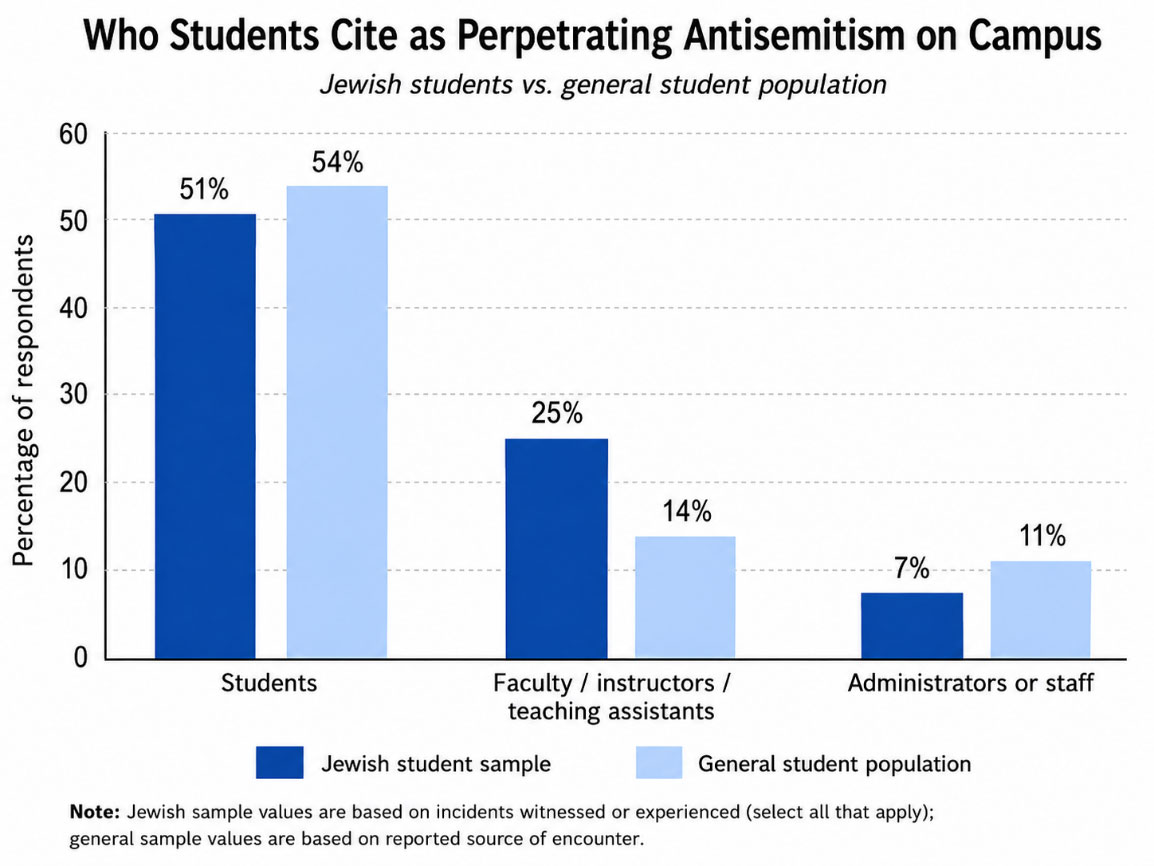
Who students cite as perpetrating antisemitism on campus — alternative text
| Jewish Student Sample | General student population | |
|---|---|---|
| Students | 51% | 54% |
| Faculty / instructors / teaching assistants | 25%Footnote 16 | 14% |
| Administrators or staff | 7% | 11% |
Note: Jewish sample values are based on incidents witnessed or experienced (select all that apply); general sample values are based on reported source of encounter.
Among the incidents students described, 51% involved fellow students, 18% involved faculty members, 7% involved teaching assistants, and 7% involved administrators or staff. These categories are derived from multiple-response questions and should not be added together, but they clearly show that authority-linked conduct is not anecdotal or negligible. Significantly, the survey of the general student population, which will appear in a second report, confirms the perceptions of Jewish students by locating the problem in the same places Jewish students do. Among those in the general student population who encountered incidents, 54% pointed to other students, 44% to social media or online platforms linked to campus, 38% to campus protests or demonstrations, 19% to the classroom or lectures, 14% to professors, instructors, or teaching assistants, and 11% to administrators or staff. These statistics mirror the results found in Robert Brym’s report, Antisemitism in Ontario’s K-12 Schools, which demonstrates the rise of antisemitism from Kindergarten through Grade 12 across Ontario educational institutions. In this report nearly one out of six incidents were initiated or approved by a teacher or involved a school sanctioned activity.Footnote 17
“In an international law class, my professor asked the Jewish students to raise their hands, and I felt very uncomfortable as no one raised, so I chose not to.”
Respondents describe numerous instances of faculty bias, abuse of podium, and inappropriate politicization, with professors offering one-sided accounts of complex issues and treating highly contentious claims as matters of settled fact. In one especially concerning example of classroom politicization, a student recounts how his or her professor forced students to find positive connections between the Black Lives Matter movement and Hamas.”Footnote 18 Students also report pressure by those responsible for their learning and for grading their work to sign petitions and to attend pro-Palestinian demonstrations. This politicization of the classroom represents a serious betrayal of academic norms of fairness, integrity, and responsibility.Footnote 19
Academic leadership must take greater responsibility for classroom environments. The CASE survey underscores the need for clearer guidance, standards, and accountability to ensure that course content is relevant, that contentious issues are handled with rigor and care, and that discussions do not reproduce exclusionary or discriminatory dynamics. Academic freedom protects rigorous inquiry, not harassment, coercion, or discriminatory misuse of classroom authority. Moreover, while academic freedom protects the right of faculty to express strong, even controversial, views, students must retain freedom to question, dissent, or remain silent without academic penalty. Universities have a duty to provide learning environments free from identity-based discrimination or harassment. Pressuring students to articulate political positions because they are Jewish may constitute unequal treatment and undermine both religious accommodation principles and academic freedom norms.
“A Women and Gender Studies professor graded me 0% on an assignment because I spoke about sexual assault on October 7, 2023. He suggested I focus instead on the Israeli Police’s role in sexual assaults.”
2.3 Prevalence and Severity of Campus Antisemitism
“I was told to go die when I said I was a Jew from Israel”
While the classroom is a major site of concern, antisemitism is not confined to one space, one channel, or one type of actor. Students encounter it online, in residences, in student life, in classrooms, and near campus. Particularly worrying is the normalized physical violence towards Jews. 22% of Jewish respondents (i.e., 198 students) reported that they had often or occasionally experienced or witnessed physical violence directed at Jews on their campus. Confirmation of this phenomenon comes from the general student survey wherein 20% of non-Jewish students reported having observed intimidation, bullying, or physical violence directed at Jews.
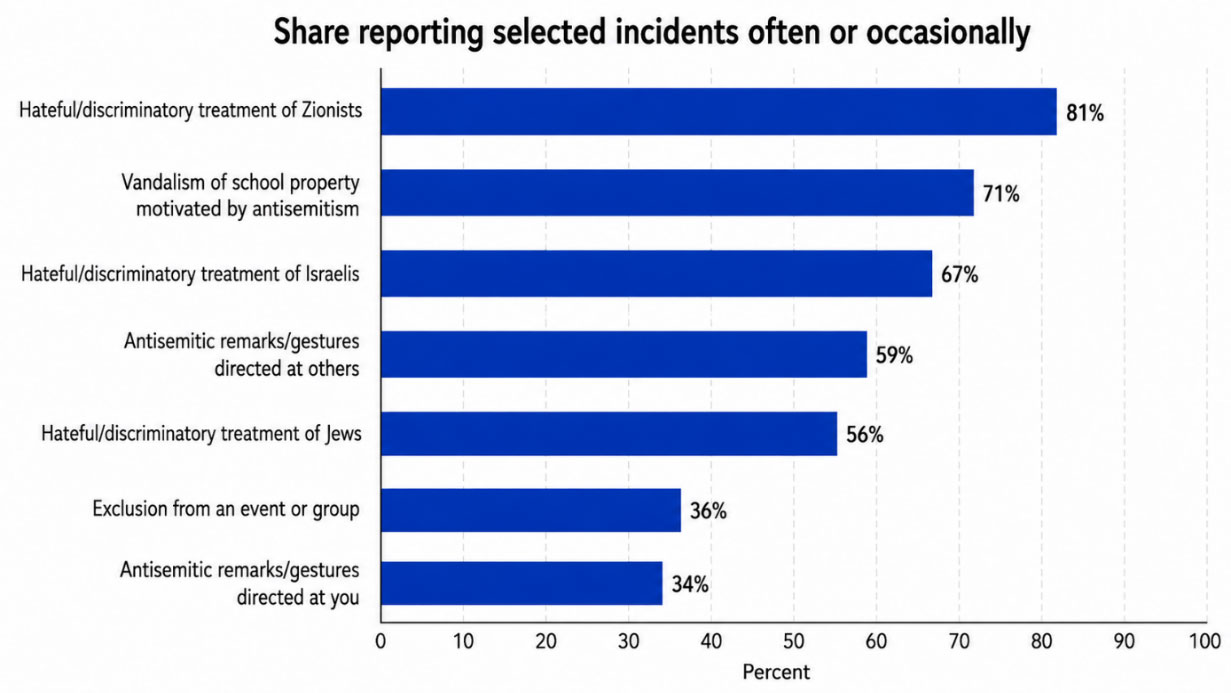
Share reporting selected incidents often or occasionally — alternative text
- Hateful/discriminatory treatment of Zionists - 81%
- Vandalism of school property motivated by antisemitism - 71%
- Hateful/discriminatory treatment of Israelis 67%
- Antisemitic remarks/gestures directed at others 59%
- Hateful/discriminatory treatment of Jews 56%
- Exclusion from an event or group 36%
- Antisemitic remarks/gestures directed at you 34%
Separating intimidation, threats, and physical violence from the broader set of reported incidents makes clear that campus antisemitism is experienced not only as discrimination or hostile expression, but also as a direct safety issue. Although exclusion, hateful treatment, vandalism, and antisemitic remarks remain prominent across the wider incident profile, a substantial share of respondents also report intimidation or threats directed at Jews often or occasionally (54%), and more than one in five report physical violence (22%). These findings suggest that the problem extends beyond a hostile climate alone and, for many students, includes fear, vulnerability, and concern for personal security.
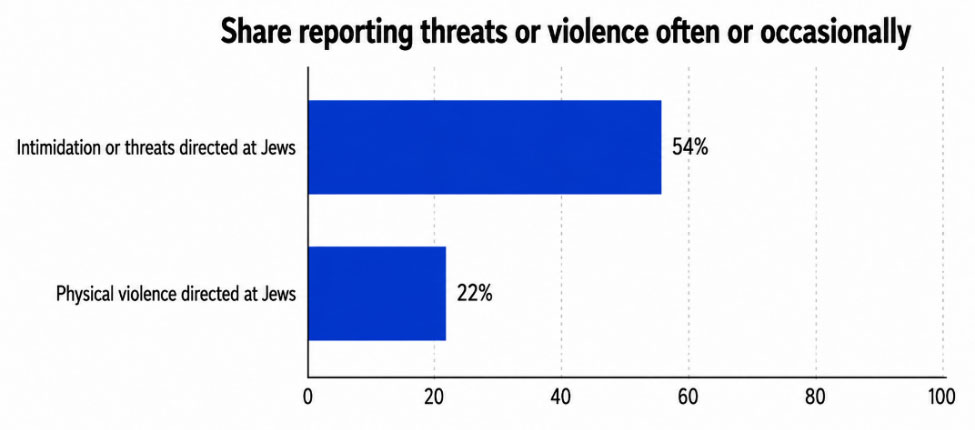
Source: CASE Jewish student survey. Percentages show the share selecting often or occasionally.
Share reporting threats or violence often or occasionally – text version
- Intimidation or threats directed at Jews - 54%
- Physical violence directed at Jews - 22%
“One of my friends was wearing her Magen David [Star of David] and was spat on by someone. She has been afraid to wear her necklace since.”
2.4 Online Platforms Amplify Antisemitism
The CASE data show that digital spaces are central to how antisemitism is experienced, amplified, and normalized. Institutions can no longer treat online environments as external or secondary. Policies, monitoring, and response mechanisms must reflect the reality that online and offline campus life are deeply interconnected.
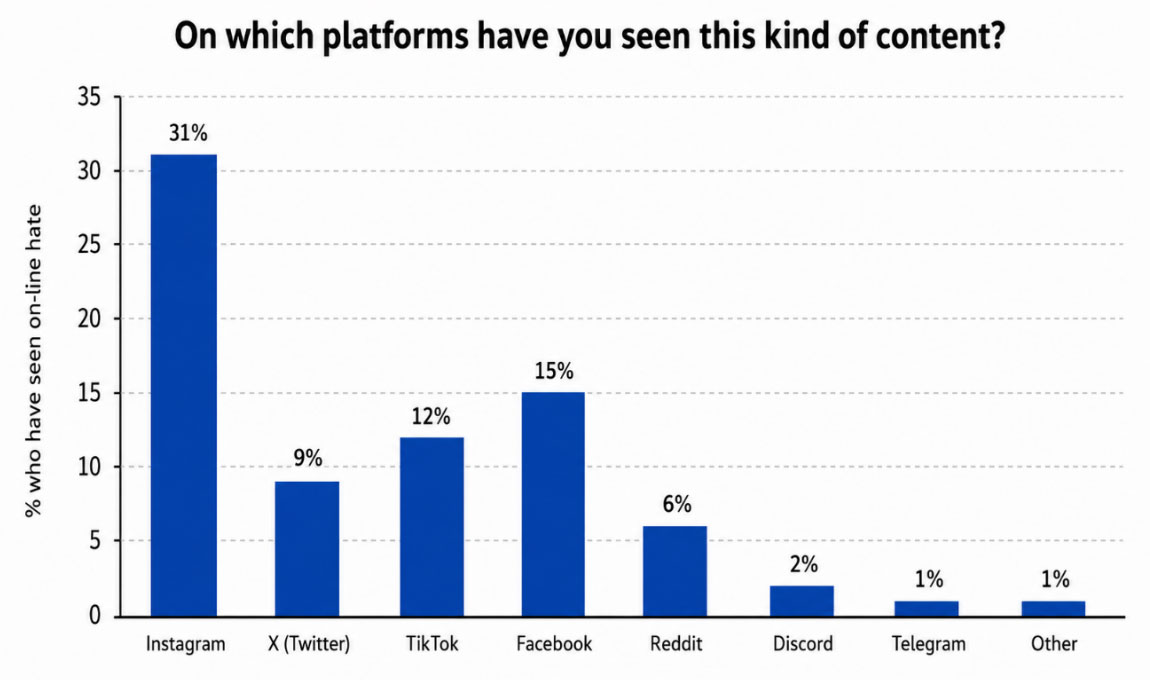
On which platforms have you seen this kind of content? — alternative text
- Instagram - 31%
- X (Twitter) - 9%
- TikTok - 12%
- Facebook - 15%
- Reddit - 6%
- Discord - 2%
- Telegram - 1%
- Other - 1%
“I was harassed online … She went as far as spamming my art page for 5 days straight sending me radical reels, calling my elderly family ‘killers’.”
2.5 The Harms of Antisemitism to Jewish Students
Jewish students remain connected to community and identity even in a hostile campus environment. Approximately half of Jewish student’s surveyed continue to be engaged regularly in Jewish activity on and off campus. However, Antisemitism on campus is affecting the way Jewish students are moving through and experiencing their academic journey.
The CASE data suggest that visibility and attachment can increase exposure to hostility. Students who are visibly Jewish risk experiencing more direct hostility, intimidation and exclusion than those who do not display visible symbols.
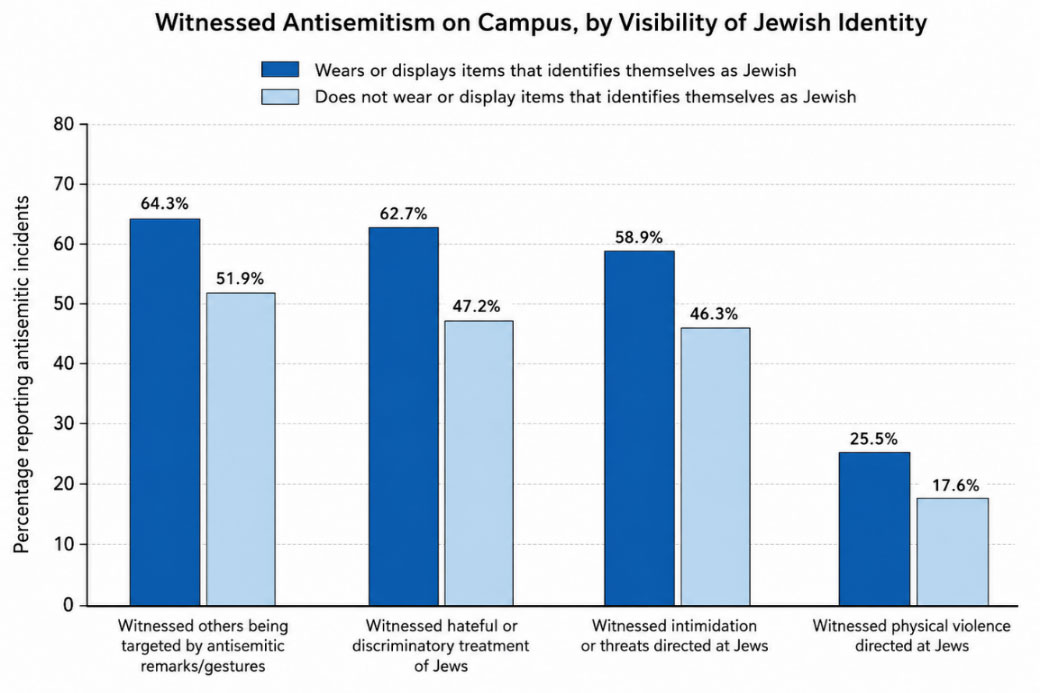
Witness Antisemitism on Camous, by Visibility of Jewish Identity — alternative text
| Wears of displays items that identifies themselves as Jewish | Does not wear or display items that identifies themselves as Jewish | |
|---|---|---|
| Witnessed others being targeted by antisemitic remarks/gestures | 64.3% | 51.9% |
| Witnessed hateful or discriminatory treatment of Jews | 62.7% | 47.2% |
| Witnessed intimidation or threats directed at Jews | 58.9% | 46.3% |
| Witnessed physical violence directed at Jews | 25.5% | 17.6% |
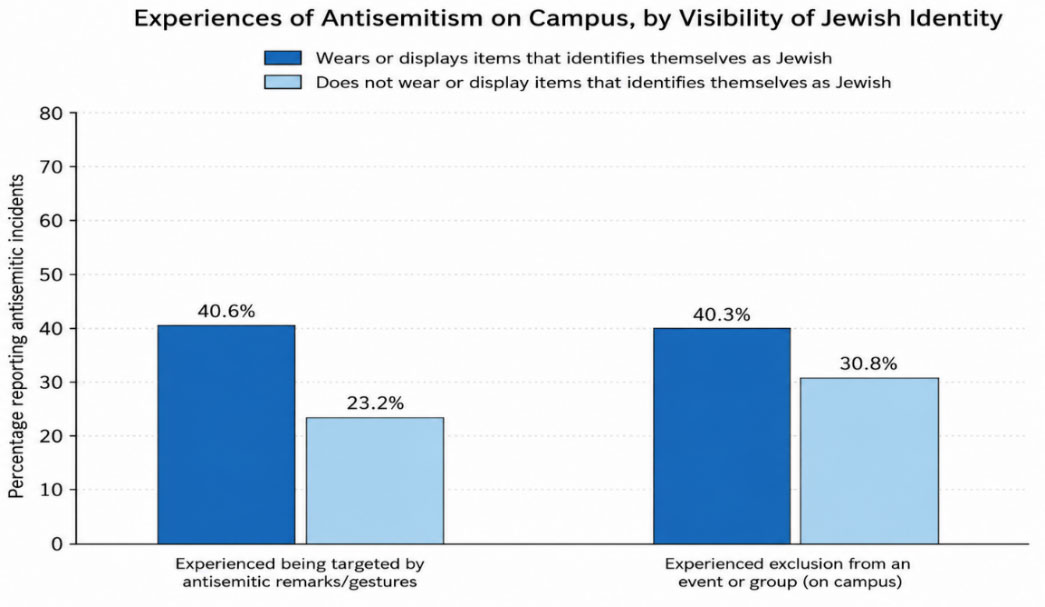
Experiences of Antisemitism on Campus, by Visibility of Jewish Identity — alternative text
| Wears of displays items that identifies themselves as Jewish | Does not wear or display items that identifies themselves as Jewish | |
|---|---|---|
| Experienced being targeted by antisemitic remarks/gestures | 40.6% | 23.2% |
| Experienced exclusion from an event or group (on campus) | 40.3% | 30.8% |
This, together with the climate of systemic antisemitism, is having a profound impact on Jewish student’s mental health, career choices and contribution to campus dialogue and life. Jewish students are changing their behaviors and choices to minimize their exposure to these hostilities. In a society that prides itself on equity and inclusion, 56% of Jewish students avoid wearing Jewish symbols, 71% limit what they say in class and 32% have considered dropping a course or a program due to the professor’s antisemitic views.
“I was dropped from research projects for saying I wished for safety and security of both Palestinians and Israelis. I faced extreme pressure from other student organizations to release a statement against Zionism in my position as president of the [REDACTED] student union, and had my name placed on a list circulating on and off campus as a "known Zionist"
Social and Mental Health Impacts
72% of Jewish students report that antisemitism on campus has affected their mental health. Furthermore, 60% have lost friends due to antisemitism. The result is that Jewish students are removing themselves from certain parts of civil society, which is isolating them from public life and undermines the democratic principals that protect safety, dignity and equality of all people.
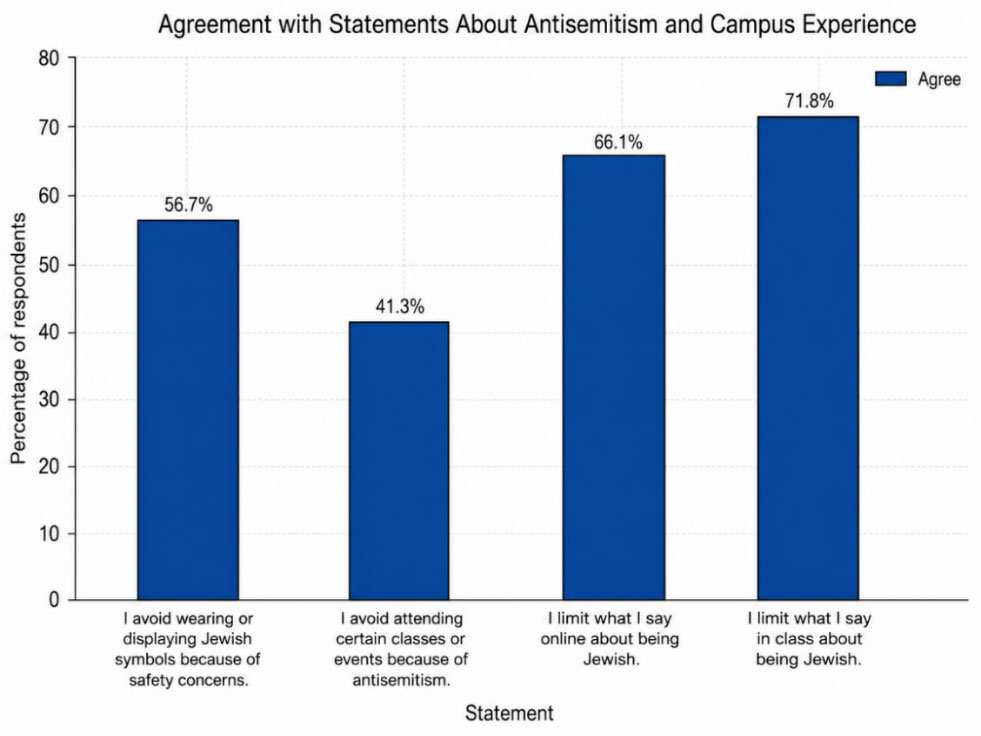
Agreement with Statements About Antisemitism and Campus Experience — alternative text
- I avoid wearing or displaying Jewish symbols because of safety concerns - 56.7%
- I avoid attending certain classes or events because of antisemitism - 41.3%
- I limit what I say online about being Jewish - 66.1%
- I limit what I say in class about being Jewish - 71.8%
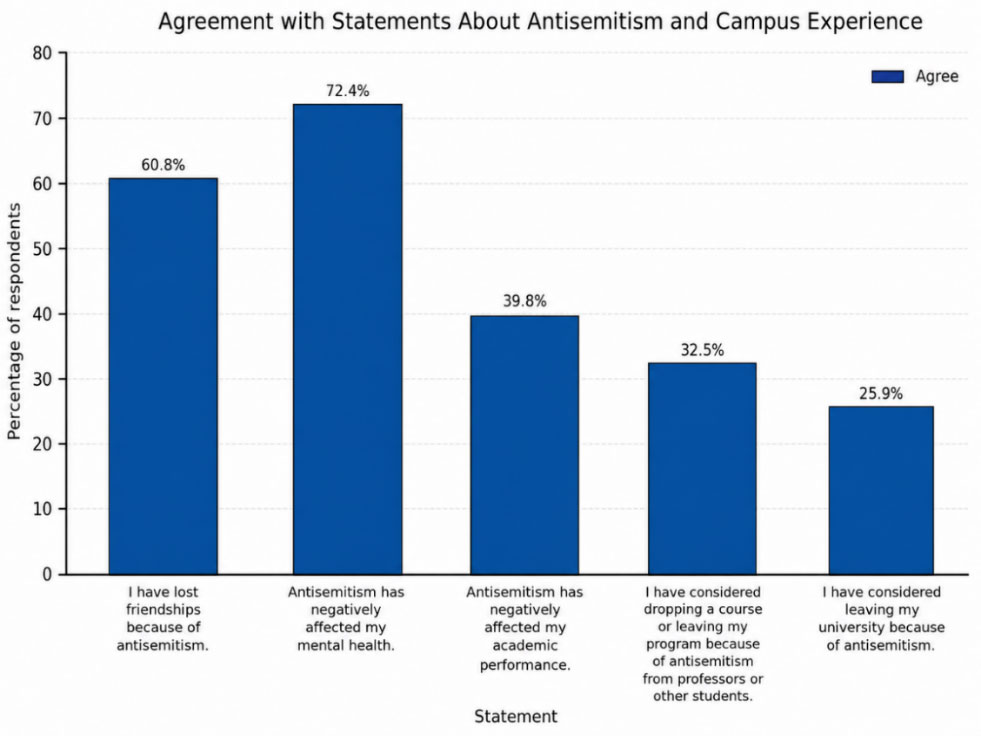
Agreement with Statements About Antisemitism and Campus Experience — alternative text
- I have lost friendships because of antisemitism - 60.8%
- Antisemitism has negatively affected my mental health - 72.4%
- Antisemitism has negatively affected my academic performance - 39.8%
- I have considered dropping a course or leaving my program because of antisemitism from professors or other students - 32.5%
- I have considered leaving my university because of antisemitism - 25.9%
“Students have asked me to take off my chai necklace because it is too Jewish”
3. Institutional Betrayal
“Previously discussing issues with administration did not help; I was warned by administration against making public complaints.”
In addressing the problem of campus antisemitism, the issue is not only whether incidents occur, there is also the question of institutional response. CASE findings suggest a reluctance on the part of campus authorities to address the issue of antisemitism with the urgency that the problem requires, and a failure to apply the same standards that are ensured to other minoritized groups. Ultimately, this study demonstrates an unwillingness by postsecondary institutions to apply their own policies and standards to combat systemic antisemitism.
3.1 Incident Reporting
Only 33% of respondents reported the incident they described. Among those who reported an incident, 63% were dissatisfied with how the matter was handled and just 37% were satisfied. The most common reason for not reporting was a belief that it would not help (52%), followed by the view that the incident was too minor (38%), uncertainty about reporting routes (25%), and fear of retaliation (16%). The gap between reporting and satisfactory outcomes is not a marginal issue—it is a central failure point that undermines trust and fuels underreporting.Footnote 20
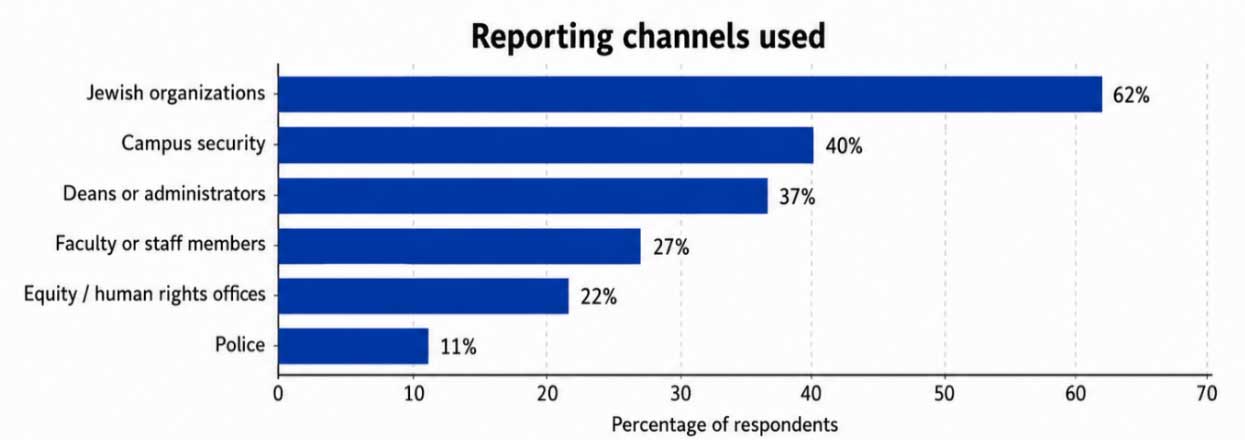
Reporting channels used — alternative text
- Jewish organizations - 62%
- Campus security - 40%
- Deans or administrators - 37%
- Faculty or staff members - 27%
- Equity / human rights offices - 22%
- Police - 11%
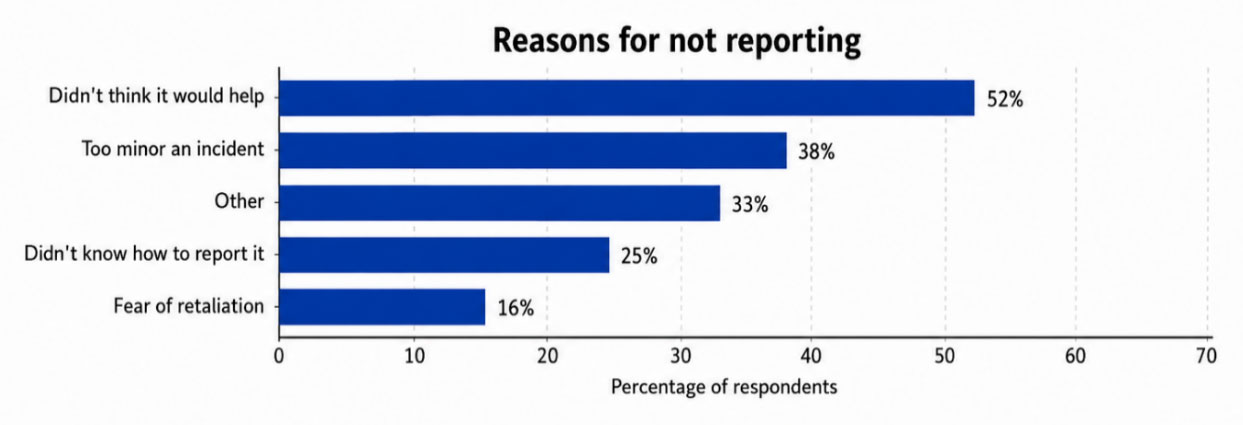
Source: CASE Jewish student survey. Reporting-channel and non-reporting items are multiple response.
Reasons for not reporting — alternative text
- Didn’t think it would help - 52%
- Too minor an incident - 38%
- Other - 33%
- Didn’t know how to report it - 25%
- Fear of retaliation - 16%
Low reporting should not be read as evidence of a low incident rate. The CASE data demonstrates that many students do not believe institutional channels will help them. “I have reported things to the university and human rights office in my first year,” reports one student, “but it never was taken seriously.” Another attributed the decision to not report an incident to the belief that “the school will most likely not care or even side with the aggressors.” Student responses indicate that reporting rates are low because institutional trust is low.
“After reporting the projection of a documentary glorifying Hamas on campus, the university involved diversity and inclusion and did absolutely nothing. So why bother reporting any other incident?”
3.2 Double Standards
Having students go on ‘strike’ and bar others from attending their lectures or accessing their studies goes against the contract that students have with their universities when they pay tuition.”
In its report on heightened antisemitism in Canada, the House of Commons Standing Committee on Justice and Human Rights found that “universities are failing to enforce their own policies to protect Jewish students on campus.”Footnote 21 The CASE survey of Jewish students supports the findings of the Standing Committee. The double standard is what has been painful for many Jewish students. They watch as Equity, Diversity, and Inclusion (EDI) offices implement policies and practices that raise awareness about racism and other forms of identity-based hate, for example, while remaining silent on antisemitism. Without visible and credible enforcement of campus codes of conduct, reporting systems risk becoming merely symbolic when it comes to the concerns of Jewish students.Footnote 22
“My classmates demanded I share my views on Israel as a condition for joining a student-led EDI initiative that should have been open to all graduate students from my department.”
Conclusion
“The only reason I have not realistically considered switching schools is because I do not believe other schools are necessarily better.”
Since October 7, 2023, rates of antisemitism have surged around the world, shattering the sense of peace and security for Jewish communities globally. In Canada, university campuses have become a microcosm of a national crisis. Read alongside the widely documented global rise in anti-Jewish hate, including in Canada, the evidence presented here points to serious concerns about campus climate, student safety, and confidence in institutional response.
For Jewish students, the burden described in this report is cumulative. Students are not only reporting insults, threats, graffiti, classroom hostility, exclusion, and online abuse; they are also reporting the constant calculation that follows from those experiences. These include whether to speak in class, whether to display visible Jewish identity, whether to file a complaint, whether a professor or classmate can be trusted, and whether remaining on campus is worth the cost. The data reported here point clearly to the conclusion that campus antisemitism is a climate problem rather than as a collection of isolated incidents.
Nearly one in five Jewish students report that their professors are the source of antisemitic incidents.Footnote 23 This raises serious concerns about our higher education system. Whereas grappling with new and uncomfortable ideas is an important part of higher education, faculty are also entrusted with ensuring a safe learning environment that balances academic freedom with academic integrity and responsibility. This becomes even more pertinent when the upcoming survey on the broader student population shows that the majority do not consider several forms of anti-Jewish targeting as antisemitic, including boycotting Jewish-owned businesses because of their perceived Israel tie (54%) and protesting outside Jewish houses of worship (54%). Additionally, more than half (55%) did not identify the statement that Jews have too much influence on the economy as antisemitic. If this concerning trend continues, these beliefs risk being carried into the workplace and all sectors of society.
In the CASE survey, 95.7% of Jewish students experienced or witnessed at least one antisemitic incident in the last year, with 89.1% reporting that they experienced antisemitism on campus often or occasionally. Placed beside the wider Canadian context of sharply elevated anti-Jewish hate,Footnote 24 the evidence also underscores a broader point— campuses are not sealed environments. They concentrate and reproduce pressures that are visible across the country, but they do so in settings that directly shape students’ safety, learning, belonging, and future opportunities. Universities are therefore not merely observing a social problem from the outside. They are one of the institutions in which that problem is now being experienced, contested, and judged most directly. Most concerningly, they risk becoming the breeding ground for anti-Jewish hate to spread across generations and communities. History has shown that rising antisemitism is a “canary in the coal mine” for the spread of hatred and bigotry towards other groups. Ultimately, it is the responsibility of decision-makers to use these findings to change our current trajectory and ensure that all Canadians can learn in safety and dignity, regardless of their identity.
“I dropped out. My anxiety level was too high and no one at school seemed to care. It is open season on Jewish students.”
Appendix A | Methodology and interpretation notes
Jewish student survey
- Fielded November 17 to December 19, 2025.
- 1,038 responses received; 900 retained after screening and data-quality review.
- Recruited through Jewish student organizations, community networks, and related channels.
- Comprehensive, spanning the broad variation in demographic variables expected from the Canadian Jewish population
- Reported descriptively as valid percentages by item; not weighted.
The CASE Jewish student survey comprised 38 questions covering eligibility, background characteristics, Jewish identity, belonging and engagement, campus climate, experiences of antisemitism, incident reporting, online antisemitism, impacts, and optional gift-card draw entry. The instrument used a combination of response formats, including Likert-type agreement and frequency scales, single-response items, “select all that apply” questions, and open-ended free-text boxes. The open-ended responses were examined for common recurring themes, and illustrative examples were included throughout the report to contextualize and highlight the findings from the quantitative survey items.
Survey architecture and scope
The Jewish student survey was built to capture the lived experiences of Jewish Canadian students, whether and how they are exposed to antisemitism, whether their institutions took action and whether they believe that authorities would hold perpetrators to account, as well as the downstream impacts on their safety, mental health, and wellbeing. Many of the incident questions asked respondents to reflect on their experience in the previous 12 months, which allows the report to reflect the current campus climate.
Respondent universe and terminology
CASE includes students and recent graduates across Canadian postsecondary pathways, including university, college, CEGEP, and other professional or training streams where relevant. For that reason, the report uses “postsecondary” or “campus” as the default framing, unless a finding is specific to a narrower setting.
Fielding, recruitment, and screening
The Jewish survey was fielded from November 17 to December 19, 2025. Recruitment was facilitated by Jewish student organizations on campus, Jewish community networks, and related dissemination channels. This resulted in the reception of a wide range of views from across the Jewish community. The survey received 1,038 responses; 900 of whom were retained after eligibility checks and data-quality screening. An anomalous surge of identical responses occurred on December 10, 2025, after the survey link was publicly shared on social media. As a result, the original link was closed, a new secure link was issued for controlled dissemination, and flagged cases were purged from the final analytic dataset.
Weighting and valid percentages
The Jewish survey is not weighted. This is a deliberate methodological choice rather than an omission. Due to the uneven mobilization of the survey across student and community networks, provinces, institutions, and program types, post-stratification weights were not applied. They would have generated a level of representativeness not supported by survey participation. The Jewish-sample results are therefore reported as valid percentages among respondents who answered each item and are interpreted descriptively rather than as precise population estimates. Nonetheless, the demographic characteristics of the respondents is largely consistent with those observed in representative studies of the Canadian Jewish population of Canada.Footnote 25
Development and interpretation
Survey development was informed by a review of recent survey instruments, methodology notes, and campus-climate studies examining Jewish student experiences, antisemitism, safety, belonging, reporting, and institutional response. These included the Brandeis University Cohen Center’s In the Shadow of War survey of Jewish undergraduates at 51 U.S. colleges and universities; the Social Research Centre’s Australian Jewish University Experience Survey; the Australian Academic Alliance Against Antisemitism’s post–October 7 mixed-methods survey of Jewish students and staff, Antisemitism in Australian Universities Post 7 October ; Columbia University/NORC’s Student Belonging and Exclusion Survey; the Ipsos/Jewish on Campus poll on antisemitism at U.S. colleges and universities, Jewish on Campus Poll: Antisemitism at Colleges and Universities; and the ADL/Jewish Federations of North America survey report on antisemitic experiences in the United States, Portrait of Antisemitic Experiences in the U.S., 2024-2025. The CASE survey also drew on Canadian research provided by Robert Brym’s report, Antisemitism in Ontario’s K-12 Schools, including both the Government of Canada–commissioned report and the related brief submitted to the House of Commons Standing Committee on Justice and Human Rights, which documents a parent-reported survey of 599 Jewish parents and 781 antisemitic incidents in Ontario schools.Footnote 26 Together, these sources helped inform question wording, response categories, attention to both closed- and open-ended items, treatment of reporting barriers, and the interpretation of findings as descriptive evidence of campus climate rather than as population-level prevalence estimates.
Survey development and promotion were informed by an Expert Advisory Committee composed of academics, researchers, and practitioners, including observers from the Department of Canadian Heritage. This process strengthened question wording, recruitment strategy, and the interpretive framing of the final report. Open-ended responses allowed the study to contextualize the quantitative results in students’ own language while preserving anonymity in the reporting of quotations.
Percentages
For readability, the report rounds percentages to whole numbers. Small differences of one point between a figure label, a narrative sentence, and a background table can therefore be the result of rounding rather than contradictory source data.
Frequency measures should likewise be read carefully. “Often or occasionally” and “Often or sometimes” (which have been used depending on the question) capture more concentrated exposure. “At least rarely” combines often, occasionally, and rarely. Several of the most important figures are reported in these combined forms so that readers can distinguish between intensity, breadth, and overall direction.
Where questions allowed multiple selections—such as locations, actors, or reporting channels—percentages will add up to more than 100 percent. Open-ended quotations are included to allow respondents to describe their experiences in their own words. These responses are lightly edited for punctuation, spelling, length, and anonymity where needed, but they are not treated as stand-alone prevalence estimates.
Figure 13: Case Survey Sample Characteristics
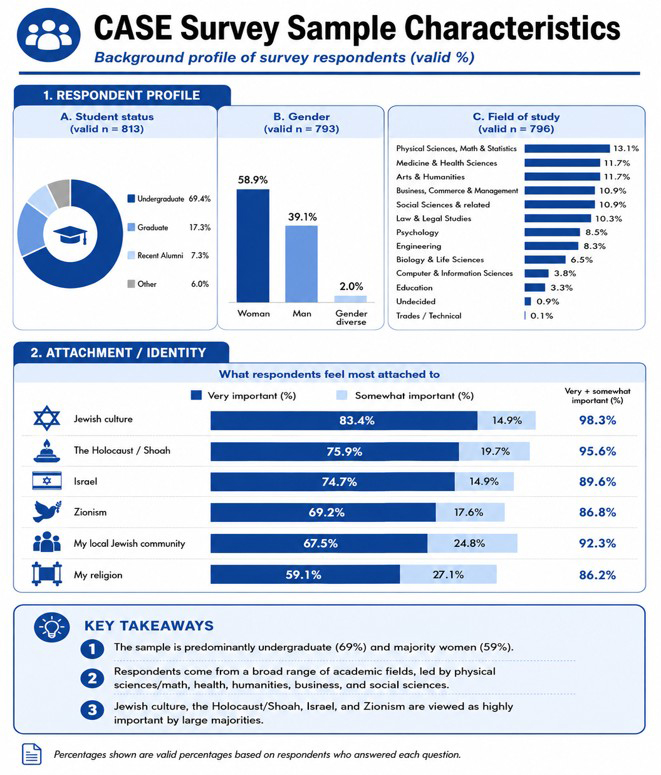
Case Survey Sample Characteristics – Background profile of survey respondents (valid %)
1. Respondent Profile
A. Student status (valid n = 813)
- Undergraduate - 69.4%
- Graduate - 17.3%
- Recent Alumni - 7.3%
- Other - 6.0%
B. Gender (valid n = 793)
- Woman - 58.9%
- Man - 39.1%
- Gender diverse - 2.0%
C. Field of study (valid n = 796)
- Physical sciences, math and statistics - 13.1%
- Medicine and health sciences - 11.7%
- Arts and Humanities - 11.7%
- Business, commerce and management - 10.9%
- Social sciences and related - 10.9%
- Law and legal studies - 10.3%
- Psychology - 8.5%
- Engineering - 8.3%
- Biology and life sciences - 6.5%
- Computer and information sciences - 3.8%
- Education - 3.3%
- Undecided - 0.9%
- Trades / technical - 0.1%
2. Attachment / Identity
| Very important (%) | Somewhat important (%) | Very important + Somewhat important (%) | |
|---|---|---|---|
| Jewish culture | 83.4% | 14.9% | 98.3% |
| The Holocaust / Shoah | 75.9% | 19.7% | 95.6% |
| Israel | 74.7% | 14.9% | 89.6% |
| Zionism | 69.2% | 17.6% | 86.8% |
| My local Jewish community | 67.5% | 24.8% | 92.3% |
| My religion | 59.1% | 27.1% | 86.2% |
Key Takeaways
- The sample is predominantly undergraduate (69%) and majority women (59%)
- Respondents come from a broad range of academic fields, led by physical sciences/math, health, humanities, business, and social sciences
- Jewish culture, the Holocaust/Shoah, Israel, and Zionism are viewed as highly important by large majorities
Table A1: Number of Responses by Province and School
| Totals by province and schools | Respondents |
|---|---|
| Ontario | 418 |
| Quebec | 243 |
| British Columbia | 55 |
| Nova Scotia | 41 |
| Manitoba | 22 |
| Alberta | 14 |
| New Brunswick | 2 |
| Saskatchewan | 1 |
| Unknown/Other | 3 |
| Ontario | |
| Queen’s University | 65 |
| University of Toronto | 62 |
| University of Guelph | 50 |
| University of Ottawa | 37 |
| Toronto Metropolitan University | 32 |
| McMaster University | 31 |
| York University | 26 |
| Western University | 23 |
| University of Waterloo | 21 |
| Wilfrid Laurier University | 17 |
| Carleton University | 16 |
| Osgoode Hall Law School | 13 |
| University of Windsor | 8 |
| Other | 17 |
| Quebec | |
| McGill University | 135 |
| Concordia University | 43 |
| Dawson College | 19 |
| Université de Montréal / University of Montreal | 11 |
| Vanier College | 11 |
| John Abbott College | 8 |
| Other | 16 |
| British Columbia | |
| University of Victoria | 25 |
| University of British Columbia (UBC/UBC Vancouver/Allard Law) | 17 |
| Simon Fraser University | 9 |
| Other | 4 |
| Alberta | |
| University of Calgary | 9 |
| Other | 5 |
| Manitoba | |
| University of Manitoba | 11 |
| University of Winnipeg | 11 |
| Nova Scotia | |
| Dalhousie University | 28 |
| Other | 13 |
| Unknown/Other | |
| Unspecified “University/College” / “University” / miscellaneous placeholders | 6 |
Appendix B | Why this should be understood as a Canada problem, not only a Jewish problem.
Antisemitism on campus should not be understood as an isolated Jewish concern, but as part of a broader Canadian problem. The House of Commons Standing Committee on Justice and Human Rights heard evidence in 2024 that Jewish students and faculty were experiencing a “toxic culture of antisemitism on campus,” marked by fear, exclusion, and weak institutional response. The same pattern extends beyond universities. A 2025 Government of Canada–commissioned study— Antisemitism in Ontario’s K-12 Schools, by Robert Brym documented widespread incidents, inadequate school responses, and serious consequences for students’ well-being and sense of belonging. Read together with Statistics Canada’s hate crime data, these findings indicate that antisemitism is not only a problem for Jewish communities; it is a Canadian problem that touches education, public safety, and social cohesion.Footnote 27
The persistence of antisemitism is sustained by normalization and inaction. Its proliferation is enabled by gaps in understanding, and its impact is amplified by institutional shortcomings. The consequences have manifested across the country as Jews are more likely than any community be victims of hate crimes in Canada. Despite only representing 1% of the population, 18.8% of all reported hate crimes were motivated by antisemitism in 2024. 68% of all religiously motivated hate crimes targeted Jews. The Jewish community was the largest in either category, according to StatsCan. What is happening on postsecondary campuses cannot be separated from what is happening across the country. Rather, they are continuums of each other.
959
police-reported hate crimes targeting Jewish people in Canada in 2023Footnote 28
70%
of religiously motivated police-reported hate crimes targeted Jewish people in Canada in 2023Footnote 29
19%
of police-reported hate crimes targeted Jewish people in Canada in 2023Footnote 30
10%
of Jewish school-age children are estimated to have directly experienced antisemitismFootnote 31
920
police-reported hate crimes targeting Jewish people in Canada in 2024Footnote 32
68%
of religiously motivated police-reported hate crimes targeted Jewish people in Canada in 2024Footnote 33
19%
of police-reported hate crimes targeted Jewish people in Canada in 2024Footnote 34
49%
is the share of reported K–12 incidents that parents said were not investigated by schoolsFootnote 35
Appendix C | Additional student comments
Appendix C presents a selected sample of the more than 1,200 open-ended comments submitted by Jewish student survey respondents. These comments were reviewed thematically and grouped into recurring categories that reflected common patterns across responses, while recognizing that many comments touched on more than one theme. The most prominent themes included harassment and threats; Holocaust denial, distortion, and Nazi references; hostile classroom or academic environments; social exclusion and pressure to conceal Jewish identity; antizionist or Israel-related targeting experienced as antisemitic; fear, anxiety, and withdrawal from campus life; and perceived institutional inaction or inadequate response. These comments demonstrate the public nature of what Jewish students are experiencing, whether it be in a washroom or a classroom, from their peers or educators. Simultaneously, they reflect the social exclusion, withdrawal, and fear of institutional inaction experienced by Jewish students. The comments are not intended to replace the quantitative findings or function as prevalence estimates; rather, they provide qualitative context for understanding how the survey findings were experienced by students in their own words.
Student voices: Harassment and threats
Someone wrote on the walls of a bathroom at [UNIVERSITY REDACTED]: “All Jews must die,” with swastikas.
I was told that it was a shame Hitler did not finish the job.
I was told “Hitler should have finished you off” when people found out that I was Jewish.
I went to the bathroom; someone saw my [Star of David] and said welcome to your gas chamber while people were vaping.
Various [protesters] shouted antisemitic slurs at visibly Jewish students on campus, including phrases such as “Hitler should have killed all of you.”
I saw graffiti saying “Zionism is a death cult,” “Zionists invent false allegations of sexual assault,” “Death to Zionism,” and “Death to Israel.” People at a campus protest shouted “go back to Poland” at students who looked Jewish. I was yelled at when entering Hillel and followed after leaving Hillel.
A professor wrote that we need to kill all Zionists, that she had worked with them and saw how evil they were.
I was told to go die when I said I was a Jew from Israel.
Someone called me a “Jewish Nazi” because I was wearing my chai while walking past a protest, without even participating in it.
I and many other members of a Jewish organization unrelated to Israel received phone calls containing death threats after October 7.
A classmate of my wife approached her and said, “I thought you were a bad person because you are Jewish, but you are actually quite nice.”
My brother was wearing a kippah and a random person started yelling at him that he was a baby killer, that he was evil, and so on, and threatened to follow him home and attack him.
My friend was walking through the [REDACTED] building. He also wears a kippah, and a group of students shouted: “there is a Jew... let’s get him.” They then chased him out of the building.
When I was at the campus gym, while wearing a kippah that made me visibly Jewish, a student came up to me and said he wished all Israelis would die because we are “a bunch of colonizers from Europe.”
I was locked in a room, a water bottle was thrown at my friend, people gave the Nazi salute, there were chants of “Jews, Jews, you cannot hide,” on the bathroom wall “kill all Jews allahu akbar,” a teacher posted “kill them all,” windows were broken, there were bullet holes in the building, I was spat on, yelled at, and doxxed.
In first year, several mezuzot were torn from the doors of my residence. They never caught the people who did it, which made us wonder who was behind it and also made us look over our shoulders a little more often.
One of my friends was wearing her Magen David and someone spat on her. Since then, she has been afraid to wear her necklace.
I saw posters and heard discussions about the number of countries that have historically expelled Jews, implying that we must be the problem.
Several of my classmates cornered and surrounded me to ask where my family was from, where they were born, and where my grandparents were born.
I was in the library and saw written on a desk: “just because Hitler killed 6 million Jews does not mean he is a bad person #love #peace #tolerance.”
I was spat on and someone revved their car engine toward me in a crosswalk while I was wearing a kippah. I saw a Jewish student get punched; I heard a Jewish friend being called a Zionist whore and spat on because she was wearing a visible Magen David [Star of David]. I saw antisemitic graffiti in bathroom stalls and all over campus.
Student voices: Pressure to disclose political views
When people find out that I am Jewish, they always ask me what I think about Israel, and if they do not like the answer, they call me a horrible person.
When people discover that I am Jewish, there have been a few situations where they say something like “oh, but you are probably one of the good Jews who is anti-Israel.”
Teachers pressured me to take a position or give my opinion [on the Middle East conflict] because I am openly Jewish.
My classmates required me to share my opinions on Israel as a condition for joining a student-led EDI initiative that should have been open to all graduate students in my department.
I have always been asked the question “are you a good Jew or a bad Jew,” which means “do you support Jews having a country.” They always expect me to give my political opinion before they “respect” me as a Jew.
Students often ask me where I am from and then expect me to pass an ideological test. In addition, as soon as students find out that I am Jewish, they ask me what I think about Gaza, genocide, the Israeli government, etc. They ask these questions very aggressively. Professors and students have told me that I am not a real Jew because I am a Zionist.
Student voices: Lack of institutional response
On Instagram or TikTok, the university did not monitor students from [UNIVERSITY REDACTED] who were creating forums to joke about the Holocaust and deny its scale and severity.
We were excluded from our EDI community when it held a “pro-Palestinian” support meeting and said it was not offering a support group for Jewish/Israeli students. So we created our own support group.
After reporting the screening on campus of a documentary glorifying Hamas, the university brought in diversity and inclusion and did absolutely nothing. So why report another incident?
Discussing problems with the administration in the past did not help; the administration warned me not to make public complaints.
A member of my anti-racism research lab at the university minimized the impact of the Holocaust while the other lab members remained silent. For example, she said: “the Holocaust was not the first time gas chambers were used. They were first used against Indigenous peoples in Canada.” When I raised this with my research supervisor, now tenured, her reaction was to protect the student responsible. For example, she said: “what happens in the lab stays in the lab.”
A group of Jewish students, including me, was eating outside where the encampment was located when it was in place, and a girl came up to us shouting: “Hitler was right.” One of the Jewish students with us jumped up and followed her when she left. She entered a classroom and he went up to her, on video, and asked: “Did you really say that you wish Hitler were still alive?” She answered “Yes,” and then the professor removed the Jewish student.
Student Voices: Social exclusion
Students asked me to remove my chai necklace because it was too Jewish.
I was told to leave a public space because I was wearing a kippah.
One of my friends asked me what I was doing for Christmas, and I answered that I do not celebrate it because I am Jewish. She immediately asked whether I was Zionist. I answered yes, and she began excluding me from activities and making hateful remarks when she saw me on campus.
Please keep my statement anonymous for my safety: A faculty member with whom I had volunteered for years raised Gaza in front of other students and asked me to justify Israel’s position on more than one occasion. He did this even though he knew I had never lived in Israel and only because he knows I am Jewish. He made the situation uncomfortable enough that I felt unsafe and stopped volunteering, which cut me off from a community that had been important to me for many years.
A member of my group project heard me speaking Hebrew and asked out loud whether I was Israeli. After I answered yes, my group and several other people in my class stopped acknowledging me and excluded me from the group project, then gave me the longest and most difficult section while they worked together.
I was removed from research projects for saying that I wanted safety for Palestinians and Israelis. I faced extreme pressure from other student organizations to publish a statement against Zionism in my role as president of the [REDACTED] student union, and my name was placed on a list circulating on and off campus as a “known Zionist.”
I made no friends in a cohort of 17 students at [UNIVERSITY REDACTED] because I openly identified as Jewish and Israeli; my peers therefore distanced themselves from me.
Residents in my campus residence spread rumours that I am a child killer, a white supremacist, a racist, and a Zionist, simply because they discovered that I was Jewish.
Student Voices: Normalization of an antisemitic climate
Several faculty members in my program minimized the Holocaust or used it to condemn the Israeli response immediately after October 7.
Several students and faculty members in my courses frequently minimized or trivialized the Holocaust.
The campus is a hotbed of hate. Jewish students have to use back entrances to attend events in order to avoid hateful crowds of protesters, who often include professors. Hillel tables during welcome week were harassed by students and professors with megaphones.
In the anti-racist module of my psychology course, students had an image of a Jew who looked angry and scary, while the images representing people of other religions looked happy and friendly.
Shortly after October 7, I told my PhD supervisor that I did not feel safe on campus and she replied: “well, you should see the other side.”
Jews were described as greedy for money in a lecture.
When discussing characters in a book, my professor described one character by saying that “based on his last name, he is clearly Jewish and probably has a hooked nose.”
In an international law class, my professor asked the Jewish students to raise their hands, and I felt very uncomfortable because no one raised their hand, so I chose not to do so.
During class, a professor told me that Jews belong in Poland and should go back there.
I heard a professor say that Hitler was a hero.
Jews face double standards that no other group experiences on campus. The fact that students “strike” and prevent other people from attending their classes or accessing their education goes against the contract students have with their universities when they pay tuition.
Student Voices: Classroom bias
In a course that had nothing to do with Israel, my professor spent three weeks talking about Gaza and the creation of the State of Israel. He never mentioned the Holocaust as a precursor to its founding, repeatedly calling the state a “Zionist political project.”
In a course titled CANADIAN Law and Violence, the professor spent the entire semester discussing Israel’s occupation of Palestine, while encouraging students to miss class to attend protests, showing Al Jazeera videos, and wearing pro-Palestine shirts and earrings every week.
My class was forced to answer exam questions according to my professor’s biases. We were forced to draw positive connections between BLM and Hamas.
I wrote my final exam on Israel’s health care system because the assignment was about the health care system of a country. I failed the assignment, and I believe one comment said: “Israel is not a country.”
A professor cancelled class on October 7 so that students could attend anti-Israel protests.
We were evaluated on the situation in Gaza and Israel even though our course syllabus had absolutely nothing to do with it.
My professor, who openly participated in the Free Palestine movement, made comments in class such as “those fucking Israelis.”
My professor said that Zionism is an evil ideology.
My professor gave a lecture saying that if we supported Israel and did not denounce the genocide, we would not be good doctors or did not belong.
My geography course presented Hamas as a community organization with a high approval rating in Palestine.
Three minutes after the start of our presentation on breast cancer, my professor interrupted us to slander Israel, saying it was a sea of savages and barbarians and that, every second, three babies in Gaza were being killed.
A professor removed course content because it had been developed by a Jewish Israeli doctoral student.
During a class on an unrelated subject, my professor talked about Israel and forced the class to participate in a discussion about why protests and encampments were good.
A professor of women’s and gender studies gave me 0% on an assignment because I had discussed sexual assault on October 7, 2023. He suggested that I instead focus on the role of Israeli police in sexual assaults.
My Canadian criminal law professor left to join the Sumud flotilla, sending the class messages thanking us for our “solidarity.” She gave an emotional speech before leaving, in tears, and told us to contact her through her personal email, add her on Signal, and expect our communications with her to be intercepted by the ISG. Upon her return, she devoted an hour of instructional time to a presentation on the flotilla, referring to the IDF as the “IOF.” She had structured the course so that grading was not anonymous, which made it impossible to express disagreement. I felt completely violated and demoralized in her class.
My professor had us act out scenes from a film about a Palestinian woman accepting her sexuality and began the class by saying: “it looks like there are no Jews here either, so we will do this one.” He then described survivors who immigrated in 1945 as a repressive military regime, saying “they stole everything.” He clearly meant Jews.
During class, a professor shared a social media post describing an off-campus pro-Palestinian protest and encouraged students to attend. Another professor assigned us a podcast that explained that Zionism was similar to Nazism, which was unrelated to the course.
In laboratories, people refused to work with me because of my Jewish identity and deliberately tried to sabotage my data.
Student Voices: Fear and emotional impacts
I have been harassed, insulted, and antagonized both publicly and privately in attempts to make me say “politically incorrect” things about my nationality. My professors cancel classes in solidarity with the protests, so I do not feel comfortable asking them for help.
I was waiting for a music exam, to play a solo before a jury, when a large group of students wearing green Hamas headbands marched through the hallway of the education building with Palestinian flags. I hid my Star of David while they passed noisily with megaphones. It made me anxious and shaken during my exam and affected my performance.
I have only one semester left in my four-year bachelor’s degree and I am seriously considering dropping out because of the stress caused by my experiences of antisemitism.
I had to drop my archival cinema course last year because the instructor was very antisemitic and constantly talked about how our projects had to be very political, mainly using anti-Zionism in his examples.
I dropped out. My anxiety level was too high and no one at the school seemed to care. It is open season on Jewish students.
The only reason I have not seriously considered changing institutions is that I do not believe other institutions are necessarily better.
I dropped out. My anxiety level was too high and no one at the school seemed to care. It is open season on Jewish students. The fact that anyone can mask their face on campus, destroy property, etc., with no consequences is terrifying. I never felt safe.
I cannot speak Hebrew with my parents on the phone on campus, I have stopped wearing Jewish symbols, I cannot talk about my holiday plans because they are Jewish; I have to hide who I am and where I come from.
Antisemitism contributed to making me lose interest in academia.
There are often campaigns on campus inviting students to participate in walkouts, which creates significant anxiety among Jewish students who fear being identified as “Zionists” if they do not participate.
Student Voices: Holocaust denial and distortion
Behind me in the study room, a group of students were talking about Hitler, the Holocaust, how it was supposedly false, how Hitler would never have killed Jews, and how the Holocaust was simply invented by Jews to obtain more money and remorse.
At a school event, students ranked the Holocaust as “less serious” than other more recent genocides. Students and staff compared the Holocaust to the destruction of Indigenous peoples in Canada; they compared the Israel-Hamas war to the Holocaust and said the former was “worse.” Staff members specifically compared Israeli Jews to Nazis.
Teachers say they do not believe the Holocaust happened or that it was greatly exaggerated.
Someone waiting in line in front of me said: “the Holocaust did not really happen. But if it did, Hitler was right.”
People, especially those active in the pro-Palestine movement, very loudly and publicly sympathize with Hitler, saying he should have finished the job, that not enough Jews were killed, that what he did was right, and that he should be brought back, while also flatly claiming that it did not happen, that it was not as bad as Jews say, and that Jews invented the Holocaust to manipulate the West.
Professors describe Holocaust survivors who moved to Israel in 1945 as members of an oppressive military regime. Many students minimize the Holocaust and Jewish trauma, say that Gaza is the modern Auschwitz, and accuse Jews of “becoming what you swore to destroy.”
One of my current professors has already claimed that Jews exaggerate the Holocaust to make Israel more legitimate.
The professor spoke about the experiments at Auschwitz as “mere research conducted unethically during the Second World War.”
A notable case occurred when the student-faculty group “Solidarity for Palestine” at [UNIVERSITY REDACTED] invited a person who falsely claimed to be a Holocaust survivor. During the event, this person made historically inaccurate statements about the Holocaust and minimized well-documented facts.
There was one moment where people came up to me to engage in dialogue but claimed that the Holocaust was not a horrific event, but rather a plan Jewish people made to have an excuse to steal the land of Israel.
My law professor compared the Holocaust to the war in Israel and Gaza. He said Israelis are the modern Nazis.
The Holocaust was omitted from a lesson on the history of the Second World War.
Speakers distort the history of the Holocaust to adapt it to current struggles, such as BLM, EDI programs, or reconciliation. Professors share links to Holocaust-denial sites as required reading material.
In my ethics course, we were shown a photo of Joseph Mengele and told that he was a product of his society, then we quickly moved on, as if he had done nothing abominably evil.
I heard students compare Holocaust deaths to medically necessary abortions. It is a controversial topic, but hearing a student compare a medically performed procedure, done with consent, to genocide was shocking.
Appendix D | Broader Campus survey provides critical insights into antisemitism
Gaps in awareness and recognition within the broader student population are creating a postsecondary environment that allows for concerns about antisemitism to be minimized, misunderstood, and ignored. The broader Canada-wide campus survey, which will be the focus of the ensuing report of the general student population, will expose why an overwhelming majority of Jewish students feel that their experiences are being denied, reframed, and downplayed by professors, administrators, and their fellow students. As it stands, majorities did not consider several forms of anti-Jewish targeting antisemitic, including boycotting Jewish-owned businesses because of their perceived Israel tie (54%) and protesting outside Jewish houses of worship (54%). More than half (55%) did not identify the statement that Jews have too much influence on the economy as antisemitic. It will expose a campus environment in which recognition of blatant antisemitism is inconsistent, Holocaust literacy is limited, and political framing obscures plainly anti-Jewish conduct.
What Jewish students experience as repeated, visible, and routine antisemitism is still misinterpreted or misunderstood by much of the general student population as ambiguous, politicized, or peripheral. This asymmetry, which will be explored by the broader campus survey, will help unpack why institutional responses are experienced as slow, equivocal, or incomplete by Jewish students. It is evident that the surrounding campus environment does not register the same conduct with the same seriousness.
This pillar of CASE will therefore broaden rather than soften the Jewish student survey report’s central argument. The problem is not only that Jewish students are being harmed. It is that too many people around them do not reliably recognize contemporary antisemitism, and a substantial minority worry they will be judged or excluded if they speak up. As a result, it is imperatives to expand the focus beyond perpetrators and targets and explore how bystanders, interpretive norms, and administrative cultures can also reinforce how antisemitism thrives on Canadian postsecondary campuses.
Appendix E | Survey Instrument
The final survey instrument is included below in its original English form.
Preamble
This survey aims to better understand how Jewish university students across Canada have experienced campus life over the past 12 months, with particular attention to antisemitism, belonging, campus engagement, feelings of safety and inclusion, among other key themes.
The study has been commissioned by the former Office of the Special Envoy on Preserving Holocaust Remembrance and Combating Antisemitism and is being conducted by the Association for Canadian Studies (ACS).
Participation in the survey is voluntary, and all responses are anonymous and will be analyzed only in aggregate form. No identifying information will be shared or published. The survey takes approximately 12-15 minutes to complete.
As a token of appreciation for your time, students who complete the entire survey and provide their e-mail will be entered into a draw to win one of fifteen (15) $100 Visa gift cards.
Findings from this study will help universities and policymakers strengthen efforts to address antisemitism and promote inclusion across Canadian campuses.
Eligibility to participate in this survey is limited to individuals who self-identify as Jewish and are enrolled in a Canadian post-secondary institution. The following questions will be used to confirm eligibility.
1. Are you currently enrolled in a Canadian post-secondary institution (e.g., university, college, or CEGEP) or did you graduate within the past two years?
- Yes
- No
Jewish Identity
2. Do you identify as Jewish (religiously, culturally, or ethnically)?
- Yes
- No
Jewish Denomination
3. What is your religious denomination?
- Traditional
- Orthodox
- Conservative
- Reform
- No denomination
- Other (please specify):
Background Information
4. What post-secondary institution are you currently attending?
(answer)
5. What is your current student status?
- Undergraduate
- Graduate
- Recent Alumni (graduated in past 2 years)
- Other (please specify)
6. What is your primary field of study?
(answer)
7. How long have you been enrolled at this institution?
- Less than 1 year
- 1-2 years
- 3-4 years
- 5+ years
8. Are you an in-province, out-of-province or international student?
- In-province
- Out-of-province
- International
9. Which of the following best describes your current living situation?
- On campus (e.g., residence, dormitory, student housing)
- Off campus — living alone
- Off campus — with roommates or friends
- Off campus — with family
- Other (please specify)
10. What is your gender?
(answer)
11. What is your primary language?
- English
- French
- Other (please specify)
12. Were you born in Canada?
- Yes
- No
13. If you were born outside of Canada, in what country were you born?
(answer)
Belonging and Engagement
14. How many of your friends are Jewish?
- All
- Most
- Some
- A few
- None
15. Do you wear or display items that identify you as Jewish on or around campus? (e.g., Kippah, Star of David)
- Yes
- No
16. Are you currently involved with Hillel, Chabad, or another Jewish student organization?
- Yes
- No
17. How involved are you in the following activities?
(Scale: Very involved / Somewhat involved / Not very involved / Not at all involved)
- Jewish activities on-campus (e.g., Hillel, Chabad, Jewish fraternity or sorority, student-led Jewish group)
- Jewish activities off-campus (e.g., synagogue, community or cultural organization, volunteer program)
18. How important are each of the following to your identity?
(Scale: Very important / Somewhat important / Not very important / Not important at all)
- My religion
- My local Jewish community
- Jewish culture
- The Holocaust / Shoah
- Zionism
- Israel
19. Have you personally seen or encountered examples of Holocaust denial or distortion on-campus (e.g., claims that the Holocaust was exaggerated, fabricated, or justified)?
- Often
- Sometimes
- Rarely
- Never
20. If you have seen or encountered Holocaust denial or distortion on-campus, please briefly describe an instance that stands out most to you.
(Open response)
Campus Climate and Discourse
21. Please indicate how much you agree or disagree with each of the following statements.
(Scale: Strongly agree / Somewhat agree / Somewhat disagree / Strongly disagree)
- My university fosters a campus environment where people of all backgrounds are treated with respect.
- Faculty encourage open and respectful discussion about sensitive issues.
- My university takes antisemitism seriously.
- My campus is a safe and inclusive place for Jewish students.
22. Please indicate how much you agree or disagree with each of the following statements.
(Scale: Strongly agree / Somewhat agree / Somewhat disagree / Strongly disagree)
- I have felt pressured to share my opinion(s) about Israel with other students.
- I have felt pressured to conform to views on Israel expressed by my professor.
- I have felt pressured to join an anti-Israel protest on or near campus.
23. If you have felt pressured by any of the above situations, please briefly describe what happened.
(Open response)
24. Thinking about your courses over the past 12 months, have you encountered any of the following in your classes?
(Scale: Yes / No / Not sure)
- Course content or classroom discussions that, in your view, portrayed Jews, Judaism, Israel, or Zionism in an antisemitic or biased way?
- Course content or classroom discussions in which a professor or instructor brought up Jews, Judaism, Israel, or Zionism in a way that felt unrelated to the course topic or discussion?
25. If yes, please describe briefly what concerned you.
(Open response)
Experiences with Antisemitism
26. Over the past 12 months, how often have you experienced or witnessed the following on your campus?
(Scale: Often / Occasionally / Rarely / Never)
- Antisemitic remarks/gestures directed at you.
- Antisemitic remarks/gestures directed at others.
- Hateful or discriminatory treatment of Jews.
- Hateful or discriminatory treatment of Zionists.
- Hateful or discriminatory treatment of Israelis.
- Exclusion from an event or group (on campus).
- Vandalism of school property motivated by antisemitism.
- Intimidation or threats directed at Jews.
- Physical violence directed at Jews.
27. If you experienced or witnessed any of the situations listed above, please briefly describe one or two instances that stand out most to you. What happened?
(Open response)
28. Where did the incident(s) you just described occur? (Select all that apply)
- Classroom or lecture hall
- Student organization, club, or campus event
- Residence, dormitory, or student housing
- Online or on social media
- Off campus, near the university
- Other location (please specify)
29. Who was involved in the incident you witnessed or experienced? (Select all that apply)
- Fellow student(s)
- Faculty member
- Teaching assistant
- Administrator or other staff
- Individual(s) not affiliated with the university
- Unknown individual(s)
- Other (please specify)
30. Did you report the incident?
- Yes
- No
Documenting Antisemitism (reported incident)
31. To whom did you report it? (Select all that apply)
- Campus security
- Equity or human rights office
- Dean or administrator
- Faculty/staff member
- Police
- Jewish organization
- Other (please specify)
32. How satisfied were you with how the report was handled?
- Very satisfied
- Somewhat satisfied
- Somewhat dissatisfied
- Very dissatisfied
Documenting Antisemitism (did not report incident)
33. If you did not report the incident, why not? (Select up to two)
- Didn't think it would help
- Didn't know how to report it
- Fear of retaliation
- Too minor of an incident
- Other (please specify)
Antisemitism Online
34. In the past 12 months, have you seen or experienced hateful or discriminatory content about Jewish people on university-affiliated social media or other online platforms?
- Yes, frequently
- Yes, occasionally
- Rarely
- No, never
35. If yes, on which platforms have you seen this kind of content? (Select all that apply)
- X (Twitter)
- TikTok
- Discord
- Telegram
- Other (please specify)
Impacts and Responses
36. Please indicate how much you agree or disagree with each of the following statements.
(Scale: Strongly agree / Somewhat agree / Somewhat disagree / Strongly disagree)
- Antisemitism is a serious problem in Canada.
- Antisemitism is a serious problem on my university campus.
- I avoid wearing or displaying Jewish symbols because of safety concerns.
- I avoid attending certain classes or events because of antisemitism.
- I limit what I say online about being Jewish.
- I limit what I say in class about being Jewish.
- I have lost friendships because of antisemitism.
- Antisemitism has negatively affected my mental health.
- Antisemitism has negatively affected my academic performance.
- I have considered dropping a course or leaving my program because of antisemitic views from professors or other students.
- I have considered leaving my university because of antisemitism.
37. Is there anything else you would like to share about your experiences or perspectives related to antisemitism on campus that was not covered in this survey?
(Open response)
Gift Card Draw Entry (Optional)
38. To thank you for your participation, you may choose to enter a draw to win one of fifteen (15) $100 gift cards.
Participation in the draw is optional, and your email address will be stored separately from your survey responses to ensure anonymity.
If you wish to enter, please provide your email address below.