
Correctional Service of Canada Commissioner transition binder: March 17, 2026
List of acronyms
- ACFO
- Association of Canada Financial Officers
- ADCCO
- Assistant Deputy Commissioner, Correctional Operations
- AGIDS
- Air and Ground Intrusion Detection System
- ATIP
- Access to Information and Privacy
- CAPE
- Canadian Association of Professional Employees
- CBJS
- Canada’s Black Justice Strategy
- CCRA
- Corrections and Conditional Release Act
- CLC
- Canada Lands Company
- CMS
- Contracting and Materiel Services
- CMSD
- Correctional Managers for Scheduling and Deployment
- COP
- Correctional Operations and Programs
- CPIC
- Canadian Police Information Centre
- CRF
- Community Reintegration Fund
- CSC
- Correctional Service of Canada
- CS
- Corporate Services
- CVBR
- Canadian Victims Bill of Rights
- CX
- Correctional Officer (classification group)
- DCIC
- Deputy Commissioner for Indigenous Corrections
- DDP
- Detector Dog Program
- DDT
- Detector Dog Team
- DEP
- Digital Education Project
- DRF
- Departmental Results Framework
- DSS
- Digital Services Sector
- EEDC
- Employment Equity, Diversity and Inclusion
- ESDC
- Employment and Social Development Canada
- EXCOM
- Executive Committee
- FPSLREB
- Federal Public Sector Labour Relations and Employment Board
- FTE
- Full-Time Employee
- HCoE
- Health Centre of Excellence
- HCV
- Hepatitis C Virus
- HIV
- Human Immunodeficiency Virus
- HRM
- Human Resource Management
- HS
- Health Services
- IAWG
- Inmate Accountability Working Group
- IBEW
- International Brotherhood of Electrical Workers
- IEDM
- Independent External Decision Maker
- IODL
- Injury on Duty Leave
- IIS
- Indigenous Initiatives Sector
- ISH
- Indigenous Social History
- ISC
- Institutional Scheduling Committee
- JUST
- Standing Committee on Justice and Human Rights
- KPI
- Key Performance Indicator
- KP
- Kingston Penitentiary
- LMB
- Litigation Management Branch
- LMS
- Learning Management System
- LSU
- Legal Services Unit
- MOA
- Memorandum of Agreement
- MOU
- Memorandum of Understanding
- NLMCC
- National Labour-Management Consultation Committee
- NSC
- National Scheduling Committee
- NSD
- National Service Desk
- NHQ
- National Headquarters
- O&M
- Operations and Maintenance
- OAT
- Opioid Agonist Treatment
- ODE
- Online Digital Education
- OHL
- Ochi-Chak-Ko-Sipi Healing Lodge
- OHS
- Occupational Health and Safety
- OMS
- Offender Management System
- OMSM / OMS-M
- Offender Management System Modernization
- OPS
- Overdose Prevention Service
- PACE
- Public Affairs, Culture and Engagement
- PBC
- Parole Board of Canada
- PCDAG
- Preventing Contraband Detection – Air and Ground
- PIC
- Public Interest Commission
- PIPSC
- Professional Institute of the Public Service of Canada
- PNEP
- Prison Needle Exchange Program
- PRU
- Parliamentary Relations Unit
- PSAC
- Public Service Alliance of Canada
- PSPC
- Public Services and Procurement Canada
- PW
- Primary Worker (contextual role)
- RDC
- Regional Deputy Commissioner
- RF
- Radio Frequency
- RFQ
- Request for Qualifications
- RFP
- Request for Proposals
- RN
- Registered Nurse
- RPC
- Regional Psychiatric Centre
- RTC
- Regional Treatment Centre
- SDC
- Senior Deputy Commissioner
- SDS
- Scheduling and Deployment System
- SEM
- Senior Executive Management
- SHU
- Special Handling Unit
- SIU
- Structured Intervention Unit
- SUTU
- Substance Use Treatment Unit
- TBS
- Treasury Board Secretariat
- TRA
- Threat and Risk Assessment
- UAS
- Unmanned Aircraft System
- UAV
- Unmanned Aerial Vehicle
- UCCO-SACC-CSN
- Union of Canadian Correctional Officers
- USJE
- Union of Safety and Justice Employees
- WCB
- Workers’ Compensation Board
- WOS
- Women Offender Sector
List of figures
- Figure 1: EXCOM organizational structure
- Figure 2: Vote 1 – Operating (excluding Special Purpose Allotment (SPA)).”
- Figure 3: Vote 5 – Capital.”
- Figure 4: Overtime expenditures
- Figure 5: Operating surplus/deficit ($Million)
- Figure 6: Our Workforce: More Than 21,139 Employees
- Figure 7: Offender population profile
- Figure 8: OMS M Project Delivery Approach
1. CSC Sectors and Regions
National Headquarters
The Correctional Service of Canada’s (CSC) national headquarters is located in Ottawa. It is responsible for administering the operations of correctional institutions and the supervision of offenders within five regions.
Sectors
Executive Secretariat
The Executive Secretariat is responsible for supporting the Commissioner in all aspects of his role and responsibilities as the Deputy Head of CSC. The Executive Secretariat manages the relations of CSC’s senior management and CSC’s relations with outside agencies. They work with the Commissioner’s direct reports to ensure follow up, help resolve problems and facilitate effective decision-making. The Executive Secretariat also serves as the liaison with the Minister’s Office.
Senior Deputy Commissioner Sector
The Senior Deputy Commissioner (SDC) is a sector head responsible for managing a range of specific files, including placements to and transfer from the Special Handling Unit (SHU), decisions related to Structured Intervention Units (SHU) and Commissioner’s detention referrals. The SDC also oversees two branches, namely the Incident Investigations Branch and the Litigation Management Branch.
Corporate Services Sector
The Corporate Services (CS) Sector is responsible for financial resource management, including budgeting, planning, and financial monitoring, as well as comptrollership functions such as contracting and materiel management. The Sector also oversees technical services and facilities management functions in support of CSC operations.
Correctional Operations and Programs Sector
The Correctional Operations and Programs (COP) Sector is responsible for the integrity of institutional and community operations across the Correctional Service of Canada. The Sector plays a key role in advancing the delivery of safe, secure, and effective corrections and oversees a significant portion of CSC’s case management and offender programming activities.
Digital Services Sector
The Digital Services Sector (DSS) is responsible for leading digital transformation and modernization across the Correctional Service of Canada.
In addition to fulfilling traditional Chief Information Officer responsibilities, the Sector focuses on enhancing the delivery of programs and services in an increasingly digital environment. The DSS is led by the Chief Digital Services Officer.
Health Services Sector
The Health Services (HS) Sector is responsible for ensuring the quality and integrity of health services provided to federally incarcerated individuals. This includes the delivery of comprehensive health care services such as assessment, diagnosis, treatment, health education, disease prevention, harm reduction, monitoring, surveillance, and follow up care. The Sector also develops and implements health policies and programs that support offender rehabilitation and contribute to successful reintegration into the community.
Human Resource Management Sector
The Human Resource Management (HRM) Sector serves as the focal point for the resolution of administrative and human resource matters across the organization. The Sector provides interpretation of human resources policies, directives, and guidelines, and offers strategic advice and support on all labour relations matters.
Indigenous Initiatives Sector
The Indigenous Initiatives Sector (IIS) champions Indigenous perspectives and approaches within federal corrections. The Sector provides leadership, support, and oversight to advance effective, culturally responsive interventions for Indigenous individuals in custody. This work is carried out through the development of partnerships, and the implementation of strategic plans and priorities that support safe reintegration into the community.
Internal Audit and Evaluation Sector
This Sector is a key provider of independent assurance and advice on departmental practices and activities. Reporting directly to the Commissioner, it delivers objective assessments and recommendations to strengthen governance, internal controls, risk management, performance, efficiency, and the overall effectiveness of CSC’s operations.
Legal Services
The CSC Legal Services Unit (LSU) is comprised of Department of Justice lawyers and CSC staff, including paralegals. The Unit provides legal advice and support across all aspects of CSC’s mandate, helping to ensure that departmental activities are conducted in accordance with applicable laws and legal obligations.
Ombuds for Workplace Well-being
The Ombuds Office provides a confidential service to support all CSC employees and offers informal approaches to help prevent and resolve workplace issues. Given the independent and sensitive nature of its mandate, the Ombuds reports directly to the Commissioner.
Policy Sector
The Policy Sector is responsible for strategic planning, policy development, and applied correctional research in support of the Correctional Service of Canada’s mandate and corporate priorities. The Sector also manages responses to offender redress and human rights matters, requests under access to information and privacy legislation, and issues raised by the Office of the Correctional Investigator.
Public Affairs, Culture and Engagement Sector
The Public Affairs, Culture and Engagement (PACE) Sector is responsible for public affairs, including the full range of communications services and parliamentary relations. The Sector oversees CSC’s engagement with victims, stakeholders, volunteers, and federal, provincial, and territorial partners. It also leads intergovernmental relations with international partners and other jurisdictions.
Women Offender Sector
The Women Offenders Sector (WOS) is responsible for the development and implementation of CSC’s policies and frameworks for women’s corrections. The Sector is guided by principles of empowerment, meaningful and responsible choices, respect and dignity, supportive environments, and shared responsibility, with the goal of meeting the distinct needs of women in custody and supporting their successful reintegration.
Regions
Atlantic Region
The Atlantic Region encompasses four provinces: Nova Scotia, New Brunswick, Prince Edward Island, and Newfoundland and Labrador. The Region operates five federal institutions, including four men’s institutions and one women’s institution. The new Health Centre of Excellence will also be located within that region.
Quebec Region
The Quebec Region operates nine federal institutions, including eight men’s institutions and one women’s institution. The Region is also home to the Special Handling Unit (SHU).
Ontario and Nunavut Region
The Ontario and Nunavut Region is responsible for eight federal institutions, including seven men’s institutions and one women’s institution. With the exception of Beaver Creek Institution (Gravenhurst), Warkworth Institution (Campbellford), and Grand Valley Institution for Women (Kitchener), all institutions are located in the Kingston area. The Region is also responsible for the Nunavut Parole Office.
Prairie Region
The Prairie Region encompasses the provinces of Manitoba, Saskatchewan, and Alberta, as well as Northwestern Ontario and the Northwest Territories. The Region operates twelve federal institutions, including ten men’s institutions and two women’s institutions.
Pacific Region
The Pacific Region encompasses the province of British Columbia and the Yukon Territory. The Region operates eight federal institutions, including seven men’s institutions and one women’s institution.

Long description
Organizational chart showing reporting structure. At the top is the Commissioner, Talal Dakalbab. A dotted line connects to Sonia Virc, Executive Director and Senior General Counsel, Legal Services Unit, who reports to Justice Canada.
Reporting to the Commissioner are:
- Natasha Levesque Hill, Director General, Executive Secretariat and Chief of Staff (EX 02)
- Marie Doyle, Associate Senior Deputy Commissioner (EX 05)
- Gloria Hache, Assistant Commissioner, Policy (EX 04)
- Guy Morissette, Assistant Commissioner, Human Resource Management (EX 04)
- Kirstan Gagnon, Assistant Commissioner, Public Affairs, Culture and Engagement (EX 04)
- Louis Dumulon, Assistant Commissioner, Health Services (EX 04)
- Jay Pyke, Assistant Commissioner, Correctional Operations and Programs (EX 04)
- Tony Matson, Assistant Commissioner, CS and Chief Financial Officer (EX 04)
- Stéphane Blanchard, Chief Digital Service Officer (EX 04); Kathy Neil, Deputy Commissioner for Indigenous Corrections (EX 03)
- Amy Jarrette, Deputy Commissioner for Women (EX 03); Daniel Giroux, Chief Audit and Evaluation Executive (EX 03); and
Regional Deputy Commissioners:
- Johanne Charest (Atlantic)
- Anne Marie Labalette (Quebec)
- Kevin Snedden (Ontario and Nunavut)
- Jason Hope (Prairie), and
- Brooke Kassen, Acting (Pacific) (EX 04)
2. Financial overview
Fiscal year 2025–2026 Operating
CSC is projecting an operating funding surplus of $178.7 million. This surplus is primarily attributable to one year program integrity funding approved on January 28, 2026, a surplus related to Workers’ Compensation Board expenditures, and cost impacts across sectors resulting from the staffing freeze and reduced operations and maintenance (O&M) spending.
Fiscal year 2025–2026 Capital
CSC is forecasting an operating surplus of $87.9 million, excluding the Health Centre of Excellence (HCoE), representing 26.3% of anticipated authorities. The HCoE is forecasting a surplus of $34.2 million, representing 9.1% of anticipated authorities. These surpluses are largely attributable to in year surpluses from delivery organizations and challenges in fully utilizing Budget 2022 funding within the current fiscal year.
Fiscal year 2026–2027
The preliminary 2026–2027 Resource Allocation identifies $2,876.8 million in operating funding, resulting in a projected shortfall of $249.8 million, representing 8.7% of anticipated authorities, including the expected carry forward. CSC will be required to manage this variance internally. It should be noted that the majority of this shortfall is attributable to sunsetting funding related to Workers’ Compensation Benefits, which is scheduled to end in 2025–2026. Confirmation is expected shortly on whether this funding will be renewed.
For capital, the 2026–2027 Resource Allocation totals $382.6 million, and a balanced budget is anticipated.
Next steps
To ensure a thorough analysis of the financial situation in the coming years, monitoring and updates will continue to be provided to EXCOM.
CS to update EXCOM on:
- The availability of funds via the Financial Situation Report process
- Emphasis on stronger financial reporting; overtime trends, forecast accuracy and internal management of budget adherence
- Monitoring the Refocusing Government Spending and the Comprehensive Expenditure Review
- Continued engagement with central agencies to address fiscal pressures, including fund reprofiling, monitoring sunsetting funding, and meeting program integrity requirements in future years
- Ongoing responsible budget management in the context of rising costs and operational challenges
2025–2026 Financial Situation Report
Operating
The surplus is primarily attributable to one year program integrity funding approved on January 28, 2026, a surplus related to Workers’ Compensation Board expenditures, and underspending across sectors resulting from the staffing freeze and reduced operations and maintenance (O&M) expenditures. The latter is largely driven by delays in contracts and projects, as well as cost savings realized in various areas.

Long description
This graph shows that 23% of offenders completed a correctional program by their day parole eligibility date (DPED) and 44% completed one by their full parole eligibility date (FPED). The FPED is typically 6 months later than the DPED, but can vary based on the sentence.
Capital
The surplus is due to the Health Centre of Excellence surplus of $34.2M, in-year surpluses from delivery organizations, and challenges in fully utilizing Budget 2022 funds.

Long description
Summary table titled “Vote 5 – Capital.”
- Authorities total $374.4 million
- Expenditures are $252.3 million
The resulting surplus is $122.1 million, representing 32.6%.
Capital
The surplus is due to the Health Centre of Excellence surplus of $34.2M, in-year surpluses from delivery organizations, and challenges in fully utilizing Budget 2022 funds.
Figure 3: “Vote 5 – Capital.”
Text version
Summary table titled “Vote 5 – Capital.”
- Authorities total $374.4 million
- Expenditures are $252.3 million
The resulting surplus is $122.1 million, representing 32.6 percent.
Factors affecting the financial position in 2025–2026
Anticipated source of funds
- Supplementary Estimates (C) were tabled on February 12, 2026, including program integrity funding, following a late decision received on January 28, 2026. This decision provides funding for one year
Variance explanation
- Operating: A variance of $154.6M in the overall financial situation is mainly due to a decision made on January 28, 2026 to provide funding for operating requirements of $138.3M as well as reductions in the forecasts for: Sectors ($6.6M), Regions ($4.7M) and the Workers’ Compensation Board ($1.7M)
- Capital: A variance of $17.6M in the overall financial situation is mainly due to reduced forecasts in A-Base projects by $8.0M (mainly OMS-M and construction projects) and in Budget 2022 initiatives by $9.0M (mainly rehabilitation of CSC's facilities and suspension points projects)
Highlights
Shortfall |
Surplus |
|---|---|
Operating: Ontario and Nunavut Region ($9.2M), Prairie Region ($2.6M) |
Operating: Atlantic Region $0.3M, Quebec Region $2.5M, Pacific Region $0.1M and all sectors $15.9M |
Capital: No shortfalls in Capital at P10 |
Capital: All Regions and Sectors $61.3M (this includes CS $42.1M) |
Overtime and Full-Time Employee (FTE) burn rate
The overtime trend has increased by $0.9M compared to P8 forecasts, however, the overall forecast decreased to $86.2M compared to $94.3M in 2024–2025.
Various strategies were implemented by regions to reduce overtime by 107,804 hours compared to P10 2024–2025; 58,989 hours in the Ontario and Nunavut Region, 34,423 hours in the Pacific Region and 23,387 hours in the Atlantic Region.
CSC continues to adapt the resources according to operational needs and budget constraints.

Long description
Bar chart titled “OT Expenditures,” showing overtime spending in millions by fiscal year. Actual expenditures are:
- $83.0 million in 2019–2020
- $104.6 million in 2020–2021
- $102.4 million in 2021–2022
- $96.3 million in 2022–2023
- $94.1 million in 2023–2024, and $94.3 million in 2024–2025
For 2025–2026, projected expenditures (P10 forecast) total $86.2 million. Blue bars represent actuals and an orange segment represents the forecast.
Multi-Year planning
Operating
- CSC anticipates that future year deficits will continue to increase
- Temporary sources of funds are challenging for the organization
- This includes impacts of the Comprehensive Expenditure Review
Capital
- Prioritization of demand to match supply
- Defining/Confirming strategies and priorities for future years

Long description
Bar chart titled “Operating Surplus / Deficit ($Million)” showing results by fiscal year.
Surpluses are shown in blue for:
- 2022–2023 (about $90 million)
- 2023–2024 (about $75 million)
- 2024–2025 (about $45 million), and
- 2025–2026 (about $175 million)
Deficits are shown in red for:
- 2026–2027 (about –$250 million)
- 2027–2028 (about –$450 million), and
- 2028–2029 (about –$520 million), indicating increasing deficits in future years
Next steps
- Identify potential investment opportunities prior to March 31st
- Engage with TBS and the Department of Finance to explore opportunities for reprofiling surplus funds
- Monitor sunsetting funding and program integrity requirements for future years
- Continue working on forecasting accuracy and the monitoring of expenditure trends
- Confirm the planned staffing forecast
3. Comprehensive Expenditure Review
The 2025 federal budget announced a $132.2 million reduction for the CSC by 2028-2029. CSC’s plans are centered around three main pillars: optimizing internal services; modernizing operations and health services; and refocusing interventions. They are described below.
3.1 Optimizing internal services
Overview
CSC will achieve savings by strategically realigning and modernizing its internal services. These changes will simplify how we work, reduce layers of management, and help us become more efficient, flexible, and focused on our core responsibilities.
We are transforming the organization to improve service delivery by using modern technologies. By expanding digital tools, we will reduce costs, work more efficiently, attract new employees, and provide staff with better tools to meet evolving needs. Once in place, Atlas—our new offender management system—will speed up inmate intake, improve access to health services and programs, and allow us to share information more effectively. This will help offenders begin education, employment, and intervention programs sooner.
Some internal services teams will be restructured to improve workflow and eliminate duplication. This includes centralizing certain corporate functions—such as financial operations, Phoenix-related work, contracting and material management, victim services, and communications.
As outlined in Budget 2025, we are realigning several areas to reduce overlap between the regions and NHQ. This will make work processes more consistent, simplify decision-making, and support faster, more responsive service delivery. These changes reflect feedback from the Culture Audit, including the need to empower employees and share accountability, which will help improve morale and strengthen our organizational culture.
The main initiatives being rolled out are described below. Updates will be provided to staff by the relevant sector at key milestones.
Centralizations
While some functions are being centralized, regional employees will not be required to relocate. These changes will bring related work together under the the functional authorities responsible for these programs. This will create stronger, more unified communities of practice, provide better opportunies for collaboration, and expand employees’ opportunities for learning and career advancement.
Centralizing financial operations and Phoenix-related finance functions
What we are doing: We will be centralizing financial operations (resources related to accounts payable, relocation, travel and hospitality) from the regions into the Corporate Services (CS) Sector at NHQ. In addition, all Phoenix-related finance staff will be brought together into one unit within CS to streamline pay accounting. This new structure will increase efficiency, strengthen oversight, and reduce unnecessary administrative work and duplication. Several process improvements will also be introduced to make better use of technology and automate manual tasks, allowing staff to focus more on strategic financial oversight.
Centralizing Contracting and Materiel Services
What we are doing: We are centralizing Contracting and Materiel Services (CMS) operations from the regions into the CS Sector at NHQ. Moving to a national model will make procurement more consistent and efficient by streamlining processes, eliminating duplication, and strengthening oversight.
By coordinating procurement across all regions, CSC will be able to use bulk purchasing to achieve better value for money. Contracts and procedures will be standardized nationally, and administrative overhead will be reduced. We will also realign the management of Government Acquisition Cards to improve oversight, consistency, and accountability.
Centralizing Victim Services
What we are doing: We are centralizing Victim Services from the regions to NHQ. These resources will now fall under the Public Affairs, Culture and Engagement (PACE) Sector, which is responsible for the program. Centralizing this work will help us balance workloads more effectively across the country by drawing on a larger, national team. As part of this transition, NHQ’s structure will be updated to include victim services operations, policy responsibillities, and management of the restorative justice program.
Centralizing communications
What we are doing: We are examining the potential centralization of certain communication functions from the regions to NHQ. Under a new model, employees engaged in external communications would report under the Head of Communications in the PACE sector. Regions would retain a resource to perform tasks such as internal communications. Work in underway to finalize a proposed new model.
Reorganizations
Consolidating Official Languages into a centre of expertise
What we are doing: The Human Resource Management (HRM) Sector will consolidate its official languages program and operational functions into a single centre of expertise within the Planning, Official Languages and Employment Equity Division. Centralizing these functions will support stronger strategic alignment, faster and more consistent decision-making, and better harmonization of programs and services. It will also enhance the overall client experience by offering more coordinated and reliable support. The HRM Sector will continue to ensure CSC meets its obligations under the Official Languages Act.
Realigning the Culture and Anti-racism, Diversity, Equity and Inclusion teams
What we are doing: Culture change—including anti-racism efforts—remains a core commitment for CSC. To continue to support this work, we are streamlining and realigning functions across the organization. The Culture and Employment Equity, Diversity and Inclusion (EEDC) functions will move from the PACE Sector to the HRM Sector. Bringing these functions together under the sector responsible for people management will provide coordination and alignment.
Integrating all culture and EEDC-related work - including implementation of the culture audit action plan, support for employee networks, and management of diversity-related awards will also support better alignment with psychological health priorities and ensure that CSC makes the best use of diversity resources. CSC will continue to have a National EEDC Committee, made up of National and Regional Chairs, and dedicated funding for EEDC initiatives.
In addition, employees working on the Black Offender Strategy will move from the PACE Sector to the Correctional Operations and Programs (COP) Sector. This change is aligned with COP’s policy responsibilities and will help maintain strong focus on implementing CSC’s Black Offender Strategy—an important component of Canada’s Black Justice Strategy. The COP Sector will also assume responsibility for overseeing the annual ethnocultural funding provided to regions to support ethnocultural offenders.
Realigning litigation management
What we are doing: To better manage litigation in a coordinated and effective way, CSC created the Litigation Management Branch (LMB) in 2023. This reflects our commitment to proactively address litigation risks and tackle their root causes. To bring all litigation-related work under one structure, offender complaints under the Canadian Human Rights Act will move from the Policy Sector to LMB, under the Senior Deputy Commissioner.
This change will help CSC manage offender human rights complaints in a more holistic way, particularly those involving systemic issues. By bringing together existing expertise and resources from both sectors, we will streamline processes and make this work more efficient.
Reducing Intergovernmental Relations functions
What we are doing: To better focus on our core mandate, we are making changes to the Intergovernmental Relations functions within the PACE Sector. CSC will concentrate on key responsibilities, such as managing Heads of Corrections relationships across Canada and maintaining select international partnerships and obligations. Other responsibilities—such as certain Exchange of Service Agreements and Memoranda of Understanding with provinces and territories—will be transferred to the appropriate sectors and regions.
Realigning security functions
What we are doing: The Departmental Security Division will move from the COP sector to the Digital Services sector. This change brings physical, IT, and cyber security together under one sector led by the Chief Digital Service Officer.
In the COP Sector, the Security Branch and the Preventive Security Intelligence branch will be merged into a single branch. These changes will improve efficiency, strengthen investigative capabilities, and better align CSC’s security operations with practices across the federal government.
Realigning Ombuds for workplace wellbeing functions
What we are doing: We are reorganizing the functions related to Values and Ethics (V&E) and the Office of Integrity Risk, which includes Internal Disclosure.
The V&E team will move from the Office of the Ombuds to the Labour Relations and Workplace Management Branch in the HRM sector, reflecting HRM’s accountability for people management and related terms and conditions of employment.
Internal Disclosure will move to the Internal Audit and Evaluation Sector, which better aligns with its mandate to assess organizational risk, compliance, and integrity-related issues. These changes will strengthen alignment, clarify responsibilities, reduce duplication, and reinforce the independence and integrity of the Ombuds function.
Restructuring and optimizing the Digital Services Sector
What are we doing: The Digital Services Sector is reorganizing to make service delivery simpler, more consistent, and easier for staff to access. This includes using the National Service Desk (NSD) as the single point of contact for all users, harmonizing regional support teams, reducing some project support services, and retiring older OMS applications once the OMS-M Project is complete.
We are also centralizing external network connectivity and administrative support from the regions to National Headquarters under a streamlined and more flexible structure. This will improve consistency, strengthen coordination, and help us deliver modern, reliable digital services across the organization.
Reorganizing Labour Relations and Workplace Management
What are we doing: The HRM Sector is realigning the functions of its Labour Relations and Workplace Management Branch to improve integration and continuity of advice and streamline points of contact for clients. The integration of service points will reduce silos and facilitate holistic case management advice and guidance to the client. Additional efficiencies are being realized by eliminating duplicative processes and implementing the use of technology to improve data integrity and reporting.
Modernizing the Access to Information and Privacy division
What we are doing: Access to Information and Privacy (ATIP) operations will begin using automated tools to help with redactions, resulting in some functions at NHQ being streamlined. These changes will help the ATIP division handle more requests, reduce the backlog, and improve service timelines.
Modernizing training programs and delivery
What are we doing: The HRM Sector is updating how it delivers training and learning services to ensure programs meet current needs and can adapt as those needs change. The focus is on providing essential, high-priority training and using virtual tools and modern learning methods.
As part of this work, the HRM Sector is reviewing major training programs to make sure all mandatory and recommended courses remain relevant, effective, and efficient.
The Sector is also introducing a new Learning Management System (LMS) that will make training easier to access and use resources more effectively. The new LMS will have a more user-friendly design, automate scheduling and email reminders, and reduce the amount of manual work required from Staff Training Coordinators. This will streamline administrative tasks across the organization.
Adjusting frontline planning and recruitment activities
What are we doing: The HRM Sector is updating the role of the frontline planning and recruitment team. It will place greater focus on proactive recruitment through social media, websites, and other advertising platforms. The Sector will also review current recruitment and assessment practices to identify opportunities to simplify and streamline processes, while continuing to meet all organizational and job-specific requirements efficiently.
Refocusing human resources planning
What are we doing: Department-wide human resources planning efforts will be centralized. Sectors and Regions will no longer be required to create their own people management plans, but will continue analyzing their workforce data to support recruitment, employee development, and retention activities.
Realigning the Environmental Protection and Sustainable Development functions
What we are doing: We are realigning the responsibilities of the Environmental Protection and Sustainable Development Division to focus on core functions. In the regions, the Division will focus its efforts providing scientific and expert advice on environmental compliance, implementing the Departmental Sustainable Development Strategy, and supporting Institutional Environmental Management Committees. At the national level, we will continue to advance the Waste Reduction Program and the Climate Resilience Portfolio Plan.
3.2 Modernizing operations and health services
Overview
CSC is streamlining operations and services, modernizing practices, and aligning resources with core institutional needs while maintaining high safety and security standards. This includes aligning CX/PW schedules with the collective agreement and reviewing how staff are used as functions evolve.
CSC is also changing how Detector Dog Teams (DDTs) are deployed. A regional model will expand across the organization to improve deployment and coordination.
Growth in the women’s offender population is prompting CSC to repurpose existing space in the Prairie Region to add more beds for women.
Health services are being realigned nationwide. CSC is streamlining management structures and aligning clinical responsibilities with professional scopes of practice so offenders receive appropriate, timely care. CSC is also repurposing beds in regional treatment centres (RTCs), relocating certain populations to more appropriate settings, and increasing support for inmates with intermediate mental health needs.
These initiatives aim to streamline processes, optimize resources, and strengthen operations and administration.
Correctional operations
Reviewing deployment standards and ensuring role alignment
What we are doing: With new technologies being introduced, CSC will review its deployment standards to ensure they reflect today’s operational realities. We will also look at how CX/PW resources are assigned to ensure their specialized skills are used in the most effective way. This includes reviewing institutional roles to ensure they align with operational needs and match current work descriptions.
CSC will also adopt a one-workforce CX model for clustered sites. Under this approach, CX staff will be able to work across different security levels within the cluster, and the entire site will function as a single institution.
Public attention
The Union of Canadian Correctional Officers has spoken out against some of these measures, including media interviews on the reductions to mobile patrols.
Additional context
While such posts will remain an important component of security, improvements in contraband strategies and technology have been made to support an effective response to threats even with lower mobile patrol deployment levels. Currently, our model allows for different levels of mobile patrols based on the movement of inmates throughout a site, level of supervision required for inmate activities, and overall staff presence required.
Adopting a more targeted approach on contraband
What we are doing: We will continue to focus our resources where they are most needed to prevent contraband from entering our institutions. Building on the strong results achieved by regionally centralized detector dog teams (DDTs) within the program, this model will now be expanded to all DDTs. Under this approach, DDTs will be organized into regional teams and report directly to Regional Headquarters.
They will be deployed to different sites as required, based on risk, intelligence, and operational needs. Importantly, DDTs will continue to be based out of institutions, maintaining a strong on-site presence.
CSC will also keep investing in intelligence to disrupt drone networks and reduce contraband entering our facilities. We will continue to expand our use of drone detection systems, body scanners, and other digital technologies to strengthen institutional safety and support our staff in maintaining secure environments.
Public attention
These changes have also been raised by UCCO and have resulted in media coverage, including a recent article in the Globe and Mail.
Additional context
The CX-02 Detector Dog Handler/Search Specialist job description will be updated to ensure it reflects the new regional supervisory model, requirement to work at multiple institutions of varying security levels, and ensure that the DDT can be assigned other search-related tasks when not searching with their assigned detector dog. Updates to CD 566-13, GL 566-13-1 and the Detector Dog Program Manual will also be required to reflect the new program model, establish new deployment standards, and provide direction on new processes.
Realigning the Structured Intervention Unit (SHU) model
What we are doing: SHUs are intended to be a temporary measure for inmates who cannot be safely managed in the mainstream population. Our goal is to provide targeted interventions that help them manage their behaviour so they can return to the mainstream population as soon as possible. Based on audit results, research, and what we have learned over the past six years, we will be realigning the SHU model. This will include some changes to the current structure and the deployment of SHU correctional officers in order to place the focus on behavioural skills coaching and social programming to better support the behavioural changes needed for reintegration into the mainstream population. In addition, we are reviewing the SHU policy and procedural framework for Parole Officers. The goal is to find efficiencies that will allow Parole Officers to spend more time directly working with inmates.
Expanding women offender infrastructure
What we are doing: Given the in-custody women offender population has doubled over the last 20 years, CSC will be converting Grierson Institution—currently a minimum-security institution for men in Edmonton, Alberta—into a minimum-security institution for women. As part of this transition, the Stan Daniels Healing Centre, a healing lodge for men located on the same site, will switch locations with Buffalo Sage Wellness House, a healing lodge for women. This will allow the entire Grierson Complex to be dedicated to women. Inmates currently housed at Grierson Institution will be moved to other institutions.
By moving minimum-security women to the new Grierson site, Edmonton Institution for Women (EIFW) will be able to use more of its beds for medium-security inmates. The current minimum-security unit at EIFW will be converted into a multi-level unit (minimum and medium security), and the perimeter fence with electronic security will be extended around this entire area.
New cleaning model
Cleanliness remains an essential component of institutional health and safety. During the pandemic, CSC implemented an enhanced cleaning model and gained valuable experience in infection prevention and control.
With the pandemic behind us, we are transitioning to a new institutional cleaning model that provides a more balanced and sustainable approach, while ensuring a more effective standard than what existed before the pandemic.
Health services
Streamlining health governance
What we are doing: We will streamline health governance to reduce duplication and improve efficiency across both internal services and the health management structure at NHQ and in all regions. Key changes include merging national and regional professional practice management and realigning national resources that support corporate functions. We are also reducing management layers at the national, regional, and site levels, and clarifying roles and responsibilities across all levels of health management to ensure a more efficient and consistent structure.
Realigning health services
What we are doing: We are strengthening the delivery of health services for inmates by aligning our care models with the changing needs of the offender population and making better use of care teams across the system. To support this, we are centralizing acute mental health beds in the Ontario and Nunavut Region by moving beds from Millhaven Institution to a single location at Bath Institution. We will also relocate aging inmates who do not require acute mental health care from treatment centres to new assisted living units being created in all regions. This includes repurposing most acute care beds at RTC Pacific and increasing the assisted living beds to better meet current population needs.
Consistent with provincial health systems, we will also adopt the full scope of practice for Registered Nurses (RNs), enabling them to provide a broader range of care that is consistent with their training and professional standards. Personal Support Workers, Licensed Practical Nurses, and addiction counsellors will be more fully integrated into care teams, allowing RNs to focus on more complex health needs. This will also enable us to offer intensive substance-use services at selected sites.
Together, these changes will help ensure that inmates receive care from the right professional, at the right time.
3.3 Refocusing interventions
Overview
CSC manages a diverse offender population in the community and in its 43 institutions. We are putting in place a series of measures to modernize correctional practices, improve reintegration outcomes, and generate savings.
We are reviewing our policy requirements for correctional programming to increase efficiency, reduce unnecessary administrative steps, and take a closer look at how resources are used. We are also examining the interventions model in maximum security institutions to ensure it meets the needs of a complex and changing offender population.
Below are the main initiatives being implemented. Most of these changes will be achieved through savings created by optimizing resources, streamlining processes, and improving operational and administrative efficiency.
Interventions and inmate supports
Focusing on behavioural interventions in maximum security institutions
What we are doing: Since the introduction of Structured Intervention Units (SHUs) in 2019, we have gained valuable insight into how targeted behavioural interventions can help address the short-term needs of inmates. Building on the lessons learned over the past several years, we want to place a stronger emphasis on behavioural interventions within maximum-security institutions.
Our objective is to support inmates in developing the tools and skills they need to change behaviours that may be limiting their progress. By addressing these behaviours early and effectively, inmates will be better positioned to advance in their correctional plans, including being able to move to a lower-security environment where they can access greater programming and other interventions not available in maximum security.
To enable this shift, CSC plans to modernize interventions and case management practices in maximum-security settings. This will help us better meet the needs of the inmates and create a more integrated, consistent, and focused intervention model. We are taking a phased approach that allows time to identify the most effective model, informed by the results of the ongoing audit and by the insights of staff working in these environments every day.
Discontinuing the Community Employment Coordinators
What we are doing: We are discontinuing the Community Employment Coordinator position and making full use of similar employment services already offered by Employment and Social Development Canada, other levels of government, and various non-governmental organizations.
Integrating education and vocational training
What we are doing: As we continue to expand digital education and online resources in our institutions, inmates now have greater access to information and learning opportunities. This provides us with an opportunity to reduce duplication and strengthen the links between education and employment services as they are closely connected. Both should focus on improving reintegration outcomes and helping offenders gain meaningful work upon their release into the community.
CSC will continue to focus on the educational components required by legislation, as well as training that is aligned with labour-market needs and employment outcomes. As resources are rebalanced across institutions, some sites may see changes to the number of teaching positions or contracts. In addition, the post-secondary learning contract with CEGEP in the Quebec Region will not be renewed, in keeping with our focus on legislated responsibilities and core correctional priorities.
As we modernize how inmates access information, CSC will also phase out the remaining librarian positions. Many sites already operate a modern library model without a dedicated librarian, and we will adopt this model nationally to ensure consistency. Libraries will remain fully open and accessible to inmates, and CSC will continue to invest in maintaining modern, up-to-date book collections.
Institutions will also build stronger partnerships with local public libraries to expand inmate access to information and library resources.
Additional context
Cégep Marie-Victorin
CSC does not receive dedicated funding for post-secondary education. Inmates are responsible for paying their own post-secondary tuition.
Under a long-standing regional arrangement, CSC had a contract with Cégep Marie Victorin, which provided services in two institutions in Quebec. While the contract will not be renewed, funding will be maintained until June 30 to ensure a respectful transition, centered on the needs of students and aligned with their correctional plans.
To support the modernization of correctional practices and improve reintegration outcomes, CSC will be transforming the post secondary education model currently offered in the Quebec Region. The objective is to broaden access to college level programs for a greater number of inmates and to facilitate access to these services.
A meeting was held on February 23 between representatives of Cégep Marie Victorin’s management and the CSC regional team responsible for education services. This discussion provided an opportunity to outline CSC’s intention to transform the post secondary education offering in the Quebec Region, as well as to explore Cégep Marie Victorin’s openness to alternative delivery models and external funding sources outside of CSC.
Although CSC does not fund post-secondary studies, a range of no cost opportunities remain available through partnerships with external organizations and educational institutions.
CSC will continue to focus its efforts on the core educational needs of offenders and provide them with training that meets labour market needs and supports employment.
Librarians
As of April 1, 2026, CSC will be phasing out the remainder of librarian positions, while ensuring that inmates continue to have full access to libraries. The cost-savings for this measure is approximately $2.4M.
In January 2026, 18 librarians received letters saying that their position may be affected due to the Comprehensive Expenditure Review.
Public attention
The phased elimination of librarian positions and the decision to end the Memorandum of Understanding (MOU) with Cégep Marie Victorin in Quebec have drawn attention from both media and stakeholders. CSC has received multiple media inquiries on these issues, and several articles have been published. In addition, stakeholders have submitted correspondence to the Minister expressing concern.
The changes related to librarian positions, in particular, have generated interest among stakeholder organizations, including the John Howard Society of Canada and Book Clubs for Inmates.
Refocusing correctional programming
What we are doing: As CSC reduces red tape in its operational procedures and policies, program management will become more efficient and less administratively burdensome. Streamlining these processes will allow program staff to focus more of their time and professional expertise what they do best: delivering high-quality, evidence-based interventions.
In addition, CSC will undertake a review of readiness programs to identify opportunities for greater efficiency and effectiveness. CSC will also review its correctional program guidelines to ensure that resources are being used as effectively and efficiently as possible. The goal is to ensure programs are delivered at the right time, in the right sequence, and in a way that best supports offenders’ progress on their correctional plans.
Finally, CSC will examine the certification process for Correctional Program Officers to streamline and ensure the process is as efficient as possible. Ensuring an efficient and responsive certification process will help stabilize staffing, strengthen program capacity across institutions, and support consistent delivery of core correctional programs nationwide.
4. Human resources fact sheet
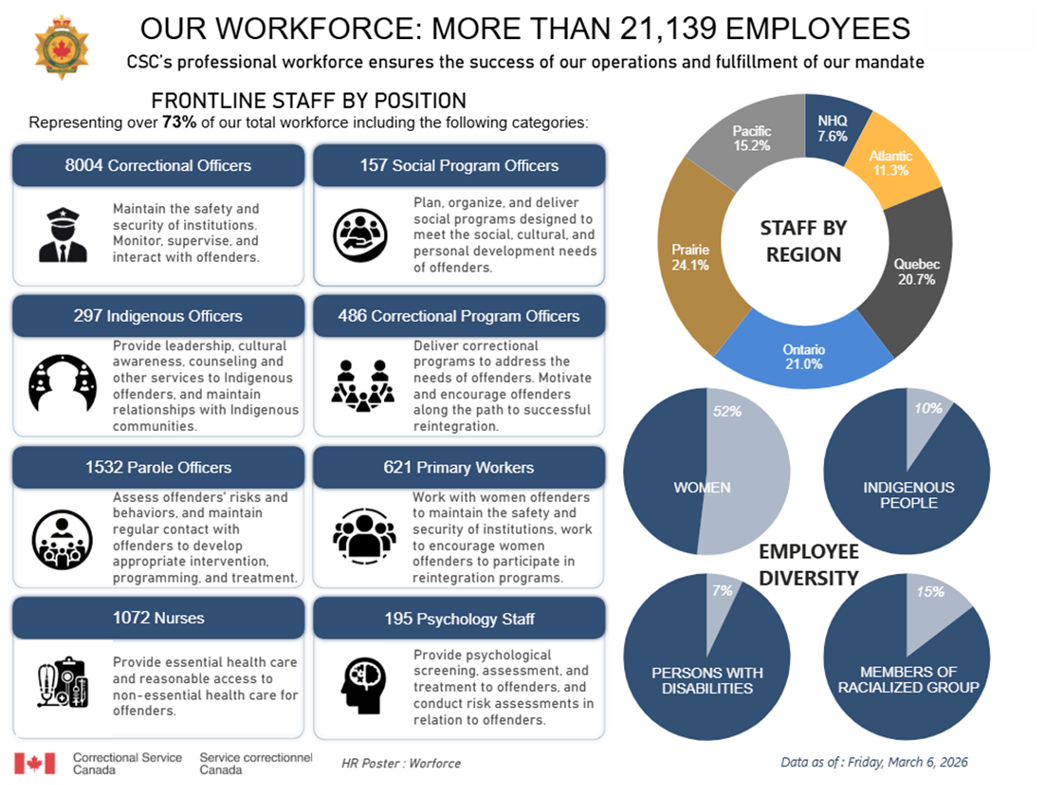
Long description
Infographic titled “Our Workforce: More Than 21,139 Employees.” Subtitle reads: “CSC’s professional workforce ensures the success of our operations and fulfillment of our mandate.” A button labeled “Français” appears in the top right corner. The Correctional Service Canada crest appears at the top left.
A heading reads “Frontline Staff by Position,” followed by the statement: “Representing over 73% of our total workforce including the following categories:”
Eight role panels are shown with icons, job counts, and descriptions:
- 8,004 Correctional Officers: Maintain the safety and security of institutions. Monitor, supervise, and interact with offenders
- 157 Social Program Officers: Plan, organize, and deliver social programs designed to meet the social, cultural, and personal development needs of offenders
- 297 Indigenous Officers: Provide leadership, cultural awareness, counseling and other services to Indigenous offenders, and maintain relationships with Indigenous communities
- 486 Correctional Program Officers: Deliver correctional programs to address the needs of offenders. Motivate and encourage offenders along the path to successful reintegration
- 1,532 Parole Officers: Assess offenders’ risks and behaviours, and maintain regular contact with offenders to develop appropriate intervention, programming, and treatment
- 621 Primary Workers: Work with women offenders to maintain the safety and security of institutions, work to encourage women offenders to participate in reintegration programs
- 1,072 Nurses: Provide essential health care and reasonable access to non essential health care for offenders
- 195 Psychology Staff: Provide psychological screening, assessment, and treatment to offenders, and conduct risk assessments in relation to offenders
On the right side, a donut chart titled “Staff by Region” shows the following percentages: Prairie 24.1%, Ontario 21.0%, Quebec 20.7%, Pacific 15.2%, Atlantic 11.3%, and National Headquarters 7.6%.
Below, a section titled “Employee Diversity” contains four circular charts showing workforce representation: Women 52%; Indigenous People 10%; Persons with Disabilities 7%; Members of a Racialized Group 15%.
At the bottom left are the logos and bilingual text “Correctional Service Canada” and “Service correctionnel Canada.” At the bottom center is the label “HR Poster: Workforce.” At the bottom right, text reads: “Data as of: Friday, March 6, 2026.
5. Offender population profile

Long description
Dashboard titled “Offenders Under CSC Jurisdiction (24,729).” Data is for the period ending March 1, 2026. The Correctional Service Canada crest appears at the top left.
Offenders by security level are shown by sex.
For males:
- minimum security 2,845
- medium security 8,866
- maximum security 1,798
- no data 1,333
For females:
- minimum security 242
- medium security 443
- maximum security 78
- no data 121
Offender diversity is shown for offenders in custody and in the community, with categories Indigenous, Caucasian, visible minority, and other. In custody: 32% Indigenous, 45% Caucasian, 21% visible minority, and the remainder other. In the community: 23% Indigenous, 58% Caucasian, 19% visible minority, and the remainder other.
Supervision type in the community is shown by sex.
For males:
- day parole 1,506
- full parole 3,864
- statutory release 2,480
- long term supervision 463
For females:
- day parole 184
- full parole 354
- statutory release 145
- long term supervision 7
Sentence length is shown for offenders in custody and in the community. Less than four years: 5,116 in custody and 3,309 in the community. Four years to less than ten years: 5,561 in custody and 2,933 in the community. Ten years or more: 1,264 in custody. Indeterminate sentences: 3,785 in custody and 2,312 in the community.
Please note that this information was pulled on March 6, 2026, which includes a snapshot of data made available as of March 1, 2026.
Offender population tracker
Please note that these highlights are based on a comparison between the fiscal year 2024-2025 and ten months of fiscal year 2025-2026. Therefore, they may not accurately reflect the year-end statistics for fiscal year 2025-2026.
Admissions
- Admissions projected to increase 6.6% year‑over‑year, reaching an estimated 8,062 by year‑end
- Male admissions up 6.7%, driven by All Others +10.7% (+427) and Black +9.0% (+60)
- Female admissions up 5.3%, with Black females +20.0% (+4) and All Others +3.5% (+10)
In-custody population
- In‑custody population increased 5.4%, adding 798 offenders since FY 2024‑2025 year‑end and reaching 15,635
- Female custody increased 9.9%, compared to male +5.1%
- Black offenders saw the largest proportional increase (+10.9%), followed by All Others (+5.2%) and Indigenous (+3.9%)
Regional trends
- Pacific recorded the highest growth in custody (+13.7%, +255; *includes transfers from Ontario and Nunavut); Prairie had the smallest (+1.2%, +51)
- Community supervision increased 2.6% (+231), led by Quebec +4.3% (+92) and Ontario and Nunavut +3.2% (+82); Pacific −1.0% (−12)
Releases
- Releases projected to increase 5.7%, reaching 7,212 by year‑end
- Male releases +6.2%, driven by Black +24.4% (+121) and All Others +3.9% (+143)
- Female releases −0.1%, with Female Black −64.4%, Female Indigenous −2.5%, and Female All Others +9.9%
Transfer warrants
- Transfer warrants reached 390 YTD (to Jan 31, 2026). Significantly elevated and close to last year's total of 431
Indeterminate sentences
- Indeterminate sentences in custody increased to 3,777, up +91 from FY 2024‑2025
- Community supervision increased to 2,318, up +24 over the same period
- Security‑level changes (custody): Medium +97, Maximum +10, Minimum −12, and Not Yet Rated −4
6. Issues, programs, and initiatives
6.1 Overrepresentation of Indigenous Offenders
Background
Indigenous Peoples continue to be overrepresented in the federal correctional system. According to the 2021 Census, Indigenous Peoples represent 5% of the Canadian population. However, at the end of the 2024-2025 fiscal year, 29% of offenders under CSC’s jurisdiction were Indigenous. Broken down further, Indigenous peoples accounted for 46.2% of the in custody women offender population and 31.8% of men.
Current status
CSC has taken actions to address factors that have contributed to the disproportion, which include:
- Appointing a Deputy Commissioner for Indigenous Corrections (DCIC) in May 2023 to oversee and prioritize Indigenous initiatives
- Creating of Indigenous Interventions Centres to provide streamlined support to Indigenous offenders, from the commencement of their sentence
- Increasing access to culturally-relevant interventions and programs for Indigenous offenders
- Strengthening the Pathways Initiative for offenders who are committed to following an intensive traditional path of healing which includes the active involvement of Elders
- Streamlining the Section 84 release planning process to remove barriers to Indigenous community engagement, ensuring the safe and successful release of Indigenous offenders. Section 84 policy direction has been updated and improved (anticipated to be promulgated in Spring 2026). Public facing information packages (release planning kit and national pamphlet) have been created and will be promulgated with the policy update
- Making efforts to eliminate barriers to full bed utilization of existing Section 81 agreements, while collaborating with Indigenous communities to expand partnership opportunities
- Fully utilizing the Community Reintegration Fund (CRF) - CSC received funding to strengthen its reintegration support for Indigenous offenders as they transition from the institution to life in the community. The CRF is currently serving more than 40 communities to help offenders overcome the challenges of reintegrating into their communities or urban society. Organizations such as BUILD, Inc. provide job training and cultural support, while others, like STR8 UP, focus on gang exit strategies. Additionally, funding is also provided to address trauma, addiction, and life skills development to aid successful reintegration. This initiative is rooted in Section 84 of the CCRA, which allows communities to play a central role in reintegration planning
- Expanding the Indigenous Offender Employment Initiative to seven locations in the Prairie, Ontario and Nunavut, Atlantic and Pacific regions to provide transitional employment opportunities to newly released offenders
- Collaborating with criminal justice partners, agencies, organizations and community stakeholders, including Indigenous communities, Elders, and Indigenous advisory boards, to support the healing and rehabilitation, and enhance safe reintegration of Indigenous offenders into the community
- Working with independent external partners, in relation to the development of evidence-informed and culturally responsive approaches to strengthen and enhance the assessment and classification process for federally sentenced Indigenous Peoples
Current Section 81 agreements
(Layout changes to Web content made for accessibility)
Stan Daniels Healing Centre (Native Counselling Services Alberta)
Location: Edmonton, Alberta
Bed Capacity: 73
Residents: Male
Buffalo Sage Wellness House (Native Counselling Services Alberta)
Location: Edmonton, Alberta
Bed Capacity: 28
Residents: Female
Ochi-Chak-Ko-Sipi Healing Lodge
Location: Crane River, Manitoba
Bed Capacity: 28
Residents: Male
Prince Albert Grand Council Spiritual Lodge
Location: Prince Albert, Saskatchewan
Bed Capacity: 24
Residents: Male
Waseskun Healing Centre
Location: St. Alphonse-de-Roderiquez, Quebec
Bed Capacity: 27
Residents: Male
Eagle Women’s Lodge
Location: Winnipeg, Manitoba
Bed Capacity: 30
Residents: Female
Results
Overall, over the past decade, CSC has seen a steady and significant improvement in outcomes for federal offenders, as measured by the percentage who do not return to federal custody within five years of sentence expiration. For Indigenous offenders, this rate increased from 76.9% in 2015–2016 to 83.9% in 2024–2025.
Positive trends are also evident across key correctional indicators for Indigenous offenders. The proportion of discretionary releases increased from 35.9% in 2021–2022 to 42.3% in 2024–2025. In addition, there was a 12% increase in successful transfers to lower security levels, rising from 463 in 2023–2024 to 517 in 2024–2025.
In 2024–2025, CSC also recorded a 5% increase in the total number of successful transfers of Indigenous offenders to Section 81 and CSC Healing Lodge facilities compared to the previous fiscal year, increasing from 344 in 2023–2024 to 362 in 2024–2025.
Looking ahead
CSC recognizes that further progress is required and will continue to work collaboratively with partners to support the rehabilitation and successful reintegration of Indigenous offenders. This includes a renewed commitment to expanding and strengthening Section 81 and Section 84 partnerships, improving Elder recruitment and retention, and deepening engagement with Indigenous partners to enhance reintegration services.
CSC will also ensure that the legislative framework governing these provisions fully achieves its intended purpose. This work will involve detailed analysis and meaningful consultation and may result in co developed policy or legislative changes.
In addition, CSC will strengthen community led agreements and approaches, particularly those supporting Indigenous women, who remain disproportionately represented in federal custody. Efforts will also focus on increasing access to culturally responsive, trauma informed, and land based alternatives to incarceration. These ongoing improvements and investments in Indigenous governed pathways are essential to reducing overrepresentation and supporting long term, sustainable reintegration outcomes.
CSC will continue to build community capacity through the Community Reintegration Fund, which enhances access to culturally responsive services, urban transition supports, home community reintegration supports, and Section 84 release planning. The organization will continue to improve the Fund and may explore opportunities for expansion.
CSC will also enhance its internal capacity by strengthening the Indigenous Initiatives organizational structure within the Prairie Region.
These enhancements—combined with strengthened partnerships, community led approaches, and culturally informed practices—will directly support efforts to address concerns raised by the Canadian Human Rights Commission.
Finally, CSC will continue to advance the development of a culturally responsive, Indigenous informed security classification process to ensure more appropriate and equitable initial security placements.
Ongoing and planned strategic engagements
- Meeting with Ochi-Chak-Ko-Sipi Healing Lodge (OHL) on March 10, 2026 – DCIC and RDC Prairie met with leadership of OHL to discuss ongoing collaboration and to facilitate the signing of the new Section 81 agreement
- Section 81 Coalition Meeting on March 26-27, 2026 - DCIC, DR IIS and Regional leadership will meet with all of the Section 81 Directors to discuss current approach to Section 81 agreements, opportunities to strengthen both the partnership relationships as well as enhance Section 81 authorities and autonomy
- Ongoing meetings with Circle of Eagles Lodge Society – Pacific Region and NHQ IIS continue ongoing collaborative discussions to finalize a Section 81 agreement to support 10 Section 81 beds for Indigenous Women
- Continued negotiations with Thunder Woman’s Healing Lodge (Toronto, ON) - ONT Region continues to support the creation of a Section 81 for Indigenous Women (6 beds) in Toronto, On. Currently planned to open as a CRF with expected conversion to a Section 81 in the next 12-18 months (depending on TWHL’s capacity to transition)
- Continued negotiations with Millbrook First Nation - a revised proposal for a 20 bed women’s facility is being finalized with Millbrook First Nation. The regional team are working to address outstanding concerns from Chief and Council, pursue provincial housing related funding, and establish a formalized partnership framework between Elders, CSC staff, and community partners. Upon confirmation of funding, community consultations will be initiated to support the advancement and long term sustainability of culturally informed healing lodge services
- Strategic Discussions with Southern Chiefs (Manitoba) – ongoing discussions with the Southern Chiefs and provincial authorities in Portage / La Prairie Manitoba regarding the potential acquisition of a facility (up to 200 beds) to be managed as a Section 81 for Indigenous Women
6.2 Black Offender Strategy
Background
Between fiscal years 2020–2021 and 2024–2025, the total federal offender population increased by nearly 9%, rising from 21,512 to 23,554. Black men, in particular, remain overrepresented, accounting for 9.5% of the federal offender population, compared to 4.3% of the general Canadian population.
Current status
To address this overrepresentation, CSC committed to the development of a Black Offender Strategy through a phased approach. The first phase of the Strategy has been completed and focused on identifying existing initiatives across the country, as well as scaling up the most effective pilots and embedding them into national policy and operational practices.
In January 2025, the draft Strategy was shared with Black offenders to seek feedback and input. Overall responses (n=428) demonstrated strong support for the proposed initiatives. CSC continues to engage with Black led community organizations to inform future initiatives, seek advice, and integrate relevant recommendations emerging from Canada’s Black Justice Strategy (CBJS).
Beginning in 2025–2026, a total of $7.9 million over two years was allocated to support the implementation of CSC’s Black Offender Strategy and the delivery of culturally responsive rehabilitation during incarceration. CSC is currently implementing initiatives supported by this funding and is leveraging this investment to evaluate and research outcomes, with a view to strengthening evidence based approaches and improving results for Black offenders.
Results
Annually, CSC’s five regions receive funding to provide supports and services to all ethnocultural offenders with community organizations, groups or individuals, including Black offenders. Additional funding from CBJS is being used to contract services for Black offenders from Black-led organizations and Black experts. This funding has been distributed to regions for 2025-2026 fiscal year and will further support services and initiatives for Black offenders in 2026-2027 fiscal year.
An evaluation of CSC’s Black Offender Strategy is underway. Phase II of the evaluation is specifically looking at the pilots of the reintegration officers that have working with Black offenders in different regions since 2021. We are currently finalizing the indicator framework to enable CSC to monitor results of the Strategy.
Justice Canada has engaged two external academic researchers to look at the community-led services, to identify Black offender needs and provide future direction on a national approach, and to examine the Black Institutional Liaison Officer position and possible future models.
CSC is also supporting research initiatives that will enable CSC to continue expanding Black Social History initiative and implementing the Lifer Strategy, among others.
Looking ahead
CSC is currently implementing initiatives using the new funding and will also work to develop a long-term sustainable approach with evidence-based activities grounded in research and evaluation. A third phase of the strategy may be required to account for ongoing input from Black offenders and community partners, as well as implementing long-term recommendations from the CBJS Steering Group.
CSC is also undertaking additional community consultation to gather input from Black-led organisations and experts, including individuals with lived experience, on the Black Offender Strategy. On February 27, 2026, the Black Offender Strategy was presented to a group of 47 such individuals and a copy of the draft strategy will be shared with them.
Many of these initiatives align directly with the recommendations of Canada’s Black Justice Strategy, put forward by an external Steering Group, and those of the Correctional Investigator. The Strategy will contribute to whole-of-government efforts to combat systemic racism for Black communities, including the United Nations Decade of Peoples of African Descent.
There is an opportunity to leverage the evaluation of our initiatives to seek additional funding in the future to sustain these efforts.
6.3 Health Centre of Excellence
Background
In December 2024, CSC received Project Approval from the Treasury Board for the construction of a new Health Centre of Excellence (HCoE). The facility will be located in CSC’s Atlantic Region on existing CSC property in Dorchester, New Brunswick. The project is expected to take place over an eight-year period, from fiscal year 2024-2025 to 2032.
The HCoE is intended to strengthen CSC’s capacity to meet the physical, complex clinical, and mental health needs of federally incarcerated individuals from across Canada. The facility will have a capacity of 155 beds and will replace the existing Shepody Healing Centre, which is no longer fit for purpose due to its deteriorating condition. As CSC’s only bilingual, treatment first facility, the HCoE will increase the availability of in patient beds and will be purpose built to provide care for both men and women requiring enhanced physical and mental health services.
Current status
CSC is working closely with Public Services and Procurement Canada (PSPC), who is leading the procurement, design, and delivery of the new facility. To date, the project has completed pre-design phases including the identification of project requirements, options analyses, cost estimates, functional planning of the spaces, early design elements for the facility, and schematic design.
In parallel, CSC’s Health Services Sector is undertaking a comprehensive review of Regional Treatment Centres (RTCs). This review will provide the clinical and operational foundation required to inform and guide the design and construction of the new Health Centre of Excellence planned for 2032.
The RTC review has examined bed utilization, patient profiles, programs and services, and admission and discharge processes, with a focus on improving the efficiency and quality of both mental and physical health services. Particular attention has been given to culturally responsive care for Indigenous offenders, older persons, women, and individuals with complex needs. This evidence based assessment will ensure that the future HCoE’s physical and clinical design is aligned with modern psychiatric best practices and emerging trends in correctional health care.
Results
As of December 2024, the Government of Canada announced the completion of the Request for Qualifications (RFQ) stage of the procurement process, with three proponents successfully qualifying. Work is currently underway to complete the requirements for the Request for Proposals (RFP) phase, with contract award anticipated in October 2026.
Looking ahead
The Health Centre of Excellence (HCoE) is intended to serve as a model for future enhancements to other CSC health care units, including Regional Treatment Centres, in the years ahead. The delivery of health services and programming within CSC will be significantly modernized, incorporating technological advancements and increased access to digital tools, while supporting a model of care that is holistic, interdisciplinary, and integrated. This approach will also embed cultural, gender responsive, and trauma informed considerations throughout service delivery.
The new facility will align with Government of Canada horizontal priorities, including accessibility, sustainability in support of the Greening Government Strategy, gender diversity, Indigenous reconciliation, official languages, and digital modernization initiatives.
6.4 Substance use and harm reduction
Background
At the time of admission to federal institutions, the lifetime prevalence of problematic alcohol and substance use is assessed at 61.0% for men and 61.6% for women. Rates are significantly higher among Indigenous individuals, with prevalence reaching 85.2% for Indigenous men and 85.7% for Indigenous women. CSC research further indicates that approximately half (49.6%) of incoming male offenders report a current substance use problem at the time of assessment, and the majority (55.5%) present with a concurrent mental health disorder.
In addition, approximately 20–22% of men and 27–29% of women report a lifetime history of injection drug use. Previous research has shown that individuals who inject drugs are ten times more likely to acquire Hepatitis C (HCV) while in custody, with injection drug use accounting for 47% of all new HCV infections.
Current status
CSC’s approach to substance use is shifting from a primarily stabilization and risk reduction focused model toward a more comprehensive, health centred approach. This evolution strengthens prevention, harm reduction, treatment, and continuity of care services across the correctional continuum. The approach emphasizes earlier identification of substance use needs, expanded harm reduction supports to address a broader range of substances, increased access to addictions counselling and dedicated treatment programming, and enhanced release planning and community partnerships. Together, these efforts are intended to support sustained recovery and reduce the risks of overdose, relapse, and reoffending.
Treatment
CSC is strengthening in custody treatment and counselling to support stabilization, build practical recovery skills, and reduce relapse and reoffending. This includes expanded access to addictions counsellors for one on one interventions, group programming, and day programs; enhanced withdrawal management services within institutions; and integrated care planning that links substance use treatment with case management and mental health services.
A key component of this approach is the rollout of Substance Use Treatment Units (SUTUs)—dedicated residential units that consolidate structured programming, counselling, and recovery supports within a single therapeutic environment. The first SUTU is planned to launch at Drumheller Institution (Alberta) in June 2026, with two additional sites—one in the Atlantic Region and one in Alberta—under consideration for implementation in 2026–2027. CSC is also drawing on lessons learned from British Columbia’s Guthrie House at Nanaimo Correctional Centre through resource sharing, targeted training, and short term staff exchanges to support timely and effective implementation.
To strengthen continuity of care upon release, CSC is advancing discussions with the Province of Alberta on a potential memorandum of understanding (MOU) to improve access to provincially funded withdrawal management, treatment, and recovery services for individuals transitioning back to the community. This would establish clearer referral pathways and help reduce service gaps during the highest risk period post release.
In addition, CSC is in early discussions with Alberta First Nation groups to explore partnerships that would enhance continuity of care and access to culturally based services for Indigenous offenders. Similar collaboration opportunities will be pursued with other provinces and Indigenous partners as the SUTU model is expanded nationally.
Opioid Agonist Treatment
Opioid Agonist Treatment (OAT) is available in institutions for individuals diagnosed with an opioid use disorder. This includes the provision of medication—such as methadone, buprenorphine naloxone, and extended release buprenorphine—prescribed by a physician or nurse practitioner, along with support from an interdisciplinary health care team to address the individual’s clinical needs.
CSC is also modernizing its national formulary to promote safer, evidence based prescribing practices and to reduce the risk of misuse and diversion of high risk medications. Effective October 1, 2025, CSC adopted long acting injectable buprenorphine (Sublocade) as the first line treatment for opioid use disorder, designated methadone as a second line open benefit, and transitioned daily buprenorphine naloxone (Suboxone) to non formulary status following a six month phase out period.
As of March 1, 2026, a total of 2,458 individuals in CSC custody were receiving OAT, representing a significant increase from 920 in 2016. These evidence informed changes strengthen the quality, safety, and consistency of opioid agonist treatment across institutions. Planned formulary updates in 2026 will apply this same approach to other medications with a high potential for misuse or diversion.
The Prison Needle Exchange Program
The Prison Needle Exchange Program (PNEP) provides individuals in custody with access to sterile injection equipment to reduce the transmission of infectious diseases, including HIV and hepatitis C (HCV). Participation is determined through a Threat and Risk Assessment (TRA) model, similar to the approach currently used for EpiPens and insulin needles, to assess individual eligibility and ensure institutional safety.
The objectives of the PNEP are to:
- prevent overdose deaths
- facilitate referrals to available substance use treatment programs, including mental health services and Opioid Agonist Treatment (OAT)
- reduce the sharing of needles
- decrease the transmission of blood borne infections, including HIV and HCV; and
- reduce the incidence of injection related skin infections and associated health care interventions, such as treatment for injection site abscesses
As of February 2026, the PNEP has been implemented in 13 federal institutions across Canada.
The Overdose Prevention Service
First implemented in 2019, the Overdose Prevention Service (OPS) provides a designated, supervised space within the health care area of an institution where individuals may use sterile equipment during substance consumption. During OPS use, health care staff are present to provide health education, counselling, and to respond to medical emergencies, including overdoses.
The primary objective of OPS is to prevent overdose deaths by ensuring the presence of qualified health care professionals who can provide immediate medical intervention when required. Individuals are permitted to bring a personal quantity of an illicit substance to the site for consumption under the supervision of health care staff.
As of February 2026, OPS is available at five federal institutions across Canada: Drumheller Institution, Springhill Institution, Collins Bay Institution, Drummond Institution, and Warkworth Institution.
Results
Since the implementation of the Overdose Prevention Service (OPS), there have been no fatal overdoses among individuals who have accessed the service. In addition, there have been no reported assaults involving staff or inmates associated with the Prison Needle Exchange Program (PNEP).
Looking ahead
Consistent with these efforts, CSC is modernizing its national formulary to promote safer, evidence based prescribing and to reduce the risk of misuse and diversion of high risk medications. These evidence driven changes strengthen the quality, safety, and consistency of opioid agonist treatment across institutions. Planned formulary updates in 2026 will extend this approach to other medications with a known potential for misuse or diversion.
6.5 Regional Treatment Centres
Background
The provision of health services to individuals in federal custody is a core responsibility of the Correctional Service of Canada (CSC) and is explicitly reflected in its legislative mandate.
CSC delivers health care through a continuum of services. Primary health care is provided to individuals with physical and mental health needs that can be safely managed within mainstream CSC institutions and healing lodges, including services such as vaccinations, counselling, and chronic disease management. Secondary health care is delivered to individuals with more specialized needs through intermediate health care units at select locations. Tertiary care is provided to individuals with acute or complex mental health needs at Regional Treatment Centres (RTCs), as well as through external community hospitals for specialized services such as surgery or cancer treatment.
CSC operates five RTCs across Canada, with one located in each of CSC’s regions. RTCs represent the most intensive level of care within CSC’s health services continuum and, with the exception of Quebec, are designated psychiatric hospitals under applicable provincial mental health legislation.
RTCs provide comprehensive, interdisciplinary in patient assessment and treatment services, with 24 hour health care coverage, for individuals with complex health needs or those requiring specialized assessment and intervention. Each region also operates a small Regional Hospital that provides care for individuals with complex physical health conditions and for those requiring end of life care. The Regional Psychiatric Centre (RPC) in the Prairie Region is the only RTC with in patient capacity for women, offering a dedicated 20 bed unit for those who meet RTC admission criteria.
All CSC health services, including RTCs, are accredited by Accreditation Canada—the same independent body that accredits hospitals and other health care organizations across the country—ensuring that care is delivered in accordance with nationally recognized standards of quality and safety.
Current status
In Spring 2024, CSC’s Health Services Sector initiated a comprehensive review of Regional Treatment Centres (RTCs) to support nationally consistent service delivery, optimize the use of health care resources, and ensure that RTC care is aligned with changes across other levels of CSC’s health care continuum and the vision for the future Health Centre of Excellence (HCoE).
The review also reflects CSC’s commitment to better meeting the evolving health needs of individuals in custody, particularly older persons, individuals with substance use needs, and Indigenous inmates requiring culturally appropriate and responsive supports.
Key drivers for the review included concerns and recommendations identified by the Office of the Correctional Investigator, as well as findings from Coroner’s Inquests, Boards of Investigation, and Quality of Care Reviews.
Results
The Review’s findings identify several opportunities for meaningful change within CSC’s Health Services to ensure that individuals in custody receive the right care, at the right time, in the right setting, and from the appropriate health care professional.
Key findings include the following:
- The level of health need of a significant number of individuals admitted to Regional Treatment Centres (RTCs) does not warrant that level of specialized care and could be more appropriately managed at lower levels of care, including within mainstream institutions or specialized services for older persons
- The current RTC management model does not align with community standards and is disproportionately large relative to the number of staff, patient volumes, and average length of stay
- Admission and discharge practices vary across regions and are not applied consistently, creating challenges in effectively planning, managing, and optimizing RTC bed capacity
- Despite the high prevalence of substance use issues among incoming individuals, there are no fully integrated treatment programs for those experiencing concurrent severe mental health conditions and substance use disorders
- Although the national RTC population includes a higher proportion of Indigenous individuals, access to traditional healing staff and culturally appropriate services within RTC programs remains limited and inconsistent
Looking ahead
Planned improvements will be implemented over the next two years to support more efficient, effective, and nationally consistent health care delivery within Regional Treatment Centres (RTCs), while also strengthening health services across CSC’s broader continuum of care.
Key improvements include:
- Repurposing the existing 96 bed unit at the Pacific RTC as an Assisted Living Unit, to be utilized as a national resource for accommodating older offenders from across the country
- Establishing Enhanced Care Units at the Pacific, Prairie, and Quebec RTCs to better support older individuals with more complex health needs
- Addressing service gaps for individuals with substance use disorders through the implementation of a prototype Withdrawal Management and Substance Use Treatment Unit at Drumheller Institution in Spring 2026. Individuals with concurrent substance use disorders and more severe mental health needs will receive in patient services at treatment units within the Prairie and Quebec RTCs
- Establishing Integrated Indigenous Health Interventions at the Prairie and Quebec RTCs to improve access to culturally appropriate and responsive care
- Relocating the Ontario RTC from Millhaven Institution to Bath Institution to support a more therapeutic environment and address long standing concerns raised by external stakeholders regarding the Millhaven RTC
- Implementing a renewed leadership and staffing model, informed by the vision of the Health Centre of Excellence (HCoE), to support a health first treatment environment while maintaining safety and security
- Standardizing a suite of evidence based programs and services across all RTCs to ensure consistency in care delivery
- Improving admission and discharge processes within RTCs and across the continuum of care through the use of validated tools to support consistent, informed decision making
- Standardizing unit based and ambulatory intermediate mental health care in mainstream institutions, while leveraging strengthened primary health care supports
Collectively, these changes will better align services with population needs and clinical profiles, ensuring that health care resources are deployed in a manner that supports both treatment effectiveness and operational efficiency.
The report stemming from the National Review of RTCs is currently being finalized. Concurrently, CSC is engaging stakeholders to support readiness and inform the phased implementation of these improvements.
6.6 Structured Intervention Units
Background
Bill C 83 received Royal Assent on June 21, 2019, and came into force on November 30, 2019. The legislation introduced significant reforms to federal corrections, including the elimination of administrative segregation and the creation of Structured Intervention Units (SHUs), with prescribed opportunities for independent external oversight. Bill C 83 also made changes to the governance structure of health care within CSC to strengthen the professional autonomy and independence of health care practitioners. In addition, it set out specific factors to be considered in decision making affecting Indigenous inmates.
Current status
All five women’s institutions and nine men’s institutions currently operate a Structured Intervention Unit (SHU). SHUs may be established at additional institutions where operational requirements warrant.
SHUs support CSC’s mission to help individuals become law abiding citizens while exercising safe, reasonable, secure, and humane control. They are designed to respond to institutional security risks while ensuring that individuals continue to engage in their Correctional Plan and address the behaviours or factors that led to their placement in an SHU.
Individuals housed in Structured Intervention Units (SHUs) are provided opportunities to be outside their cell for a minimum of four hours per day, including at least two hours of meaningful human interaction. These interactions may include contact with parole officers, health care professionals, correctional officers, primary workers, Elders, Chaplains, other inmates, and visitors.
The SHU model is supported by a continuous review and decision making framework that includes internal reviews and decisions at multiple levels within CSC, as well as external oversight by Independent External Decision Makers (IEDMs). The IEDMs’ mandate includes reviewing correctional decisions, assessing conditions of confinement, and issuing determinations or recommendations to ensure compliance with legislative requirements. Where compliance obligations are not met, IEDMs have the authority to direct CSC to remove an individual from an SHU.
Results
At the end of fiscal year 2024–2025:
- 1% of individuals transferred to a Structured Intervention Unit (SHU) were successfully reintegrated into the mainstream inmate population, an increase from 59.9% in 2023–2024
- The median length of stay in an SHU decreased to 15 days in 2024–2025, compared to 26 days in 2021–2022
- A total of 215 individuals were housed in SHUs, representing 1.4% of the total in custody population (14,837), while 14 individuals were subject to Restricted Movement, representing 0.1% of the in custody population
Looking ahead
CSC is working with external partners to implement innovative approaches that increase access to interventions and expand opportunities for time out of cell and meaningful interaction. These partnerships support the objectives of Structured Intervention Units (SHUs) by enhancing engagement and contributing to safer and more rehabilitative environments.
One example is the Dad HERO program, delivered by the Canadian Families and Corrections Network at several correctional institutions, including most SHU sites. This eight week parenting program is designed to support fathers by strengthening parenting skills, promoting healthy child development, and reinforcing the important role fathers play in their children’s lives.
CSC has collected best practices from participating sites and shared this information across regions to assess the feasibility of implementing similar initiatives at additional locations.
To further strengthen accountability and performance measurement, CSC has revised its Departmental Results Framework (DRF) and Program Inventory performance indicators for fiscal years 2026–2027 to 2028–2029, which are articulated in the Departmental Plan 2026–2027. CSC has also established key performance indicators (KPIs) and associated targets for the upcoming 3 year cycle beginning April 1, 2026.
To enhance transparency and ensure consistent national reporting on SHUs, CSC will publicly report on the following indicators:
- Percentage of successful transfers out of an SHU
- Percentage of individuals with four or more transfers to an SHU within a 180 day period; and
- Percentage of transfers to an SHU for which a decision not to remain in the SHU was made within five working days
6.7 Inmate accountability
Background
CSC has established a labour management Inmate Accountability Working Group (IAWG) to explore opportunities to strengthen inmate accountability throughout the correctional system. The IAWG is examining ways to enhance inmates’ sense of responsibility and understanding of behavioural expectations as they progress through their correctional journey.
The Working Group is reviewing and analyzing existing policies, outcomes, and practices, while also considering internationally recognized best practices to inform innovative approaches and potential improvements within CSC.
Membership of the IAWG includes representatives from Security Operations, Preventive Security and Intelligence, the Reintegration Operations Division, the Ontario and Nunavut Region, and the Pacific Region, and now includes representation from both the Union of Safety and Justice Employees (USJE) and UCCO SACC CSN.
National Headquarters (NHQ) provides the overarching framework for inmate accountability, along with oversight and strategic direction. Regions and sites are responsible for operationalizing inmate accountability through engagement with staff and inmates at the local level.
The proposed framework for inmate accountability is structured around four core pillars:
- Behavioural Expectations and Role Modelling
- Discipline and Incentives
- Interventions and Engagement with the Correctional Plan
- Relationship Building and Interactions
Current status
- The Inmate Handbook template has been updated to reinforce accountability expectations, emphasizing that individuals are responsible for their daily choices, behaviour, and progress throughout the correctional system
- Actions under the Discipline and Incentives pillar have been completed, supported by the development and dissemination of multiple communication products, including site level guidance to assist staff in reinforcing inmate accountability
- Similarly, actions under the Interventions and Engagement with the Correctional Plan pillar have been completed, with the rollout of communication products and a site level guide designed to support consistent application of accountability principles and active inmate engagement in their correctional plans
Looking ahead
The IAWG is initiating discussions regarding the third pillar - Behavioural Expectations and Role Modeling in Spring 2026.
6.8 The national Offender Digital Education (ODE) initiative
Background
CSC has made significant progress in modernizing its education programs and expanding access to digital education and computer based learning for individuals in custody. In 2020, CSC launched the Digital Education Project (DEP) pilot in the Ontario and Nunavut Region, enabling participants to develop foundational computer skills while upgrading their education and improving literacy.
As of October 6, 2024, a total of 2,135 individuals had completed at least one course through the DEP pilot across the Atlantic, Ontario and Nunavut, and Pacific Regions, representing 19,898 course completions since implementation. Given the demonstrated success of the pilot, CSC transitioned from DEP to the Online Digital Education (ODE) initiative to support national implementation. The ODE officially launched in February 2025, marking a key milestone in the modernization of education delivery across CSC.
Current status
The ODE initiative has expanded and is now implemented across multiple federal institutions in every CSC region. Educational content is delivered and managed through a secure digital Learning Management System (LMS), which enables individuals in custody to complete coursework through restricted and controlled internet access.
Through the ODE initiative, participants can complete courses toward their high school diploma, including offerings focused on Indigenous languages and culture. The initiative also provides access to courses that support the attainment of workplace certifications and select post secondary credentials, thereby strengthening employability skills and supporting successful reintegration.
Results
Partnerships with post secondary institutions and community organizations have enabled CSC to significantly expand access to post secondary education opportunities for individuals in custody.
Currently, more than 150 courses are available through CSC’s digital learning platform, with new courses and content continuously developed through partnerships with organizations such as St. Lawrence College, Good Learning Anywhere, United for Literacy, and Loyalist College. Of these offerings, over 100 courses are delivered through a micro credential model, supporting the development of practical, job ready skills.
To support participation in the Online Digital Education (ODE) initiative, CSC has acquired approximately 5,000 licenses for individuals enrolled in digital learning programs.
In addition, CSC has partnered with Good Learning Anywhere to provide culturally relevant course content specifically designed for Indigenous adult learners.
These courses support the development of vocational and life skills and help prepare participants for further post secondary education.
Looking ahead
CSC will continue to leverage the ODE initiative’s blended learning model, which integrates traditional classroom instruction with modern technology and independent learning. This approach enables teachers to tailor educational content to address cultural considerations, cognitive needs, and other learning challenges, making learning more relevant, accessible, and engaging for individuals in custody. CSC is also exploring opportunities to further expand the ODE initiative to additional sites within the current fiscal year.
6.9 Layered approach to security
Background
CSC continues to address the threats posed by the use of drones and other technologies to introduce illicit substances, cell phones, and weapons into correctional institutions. These contraband introduction attempts undermine institutional safety and security and negatively impact offender rehabilitation efforts.
Current status
CSC addresses the threat posed by drones and the introduction of contraband through a layered security approach. This approach combines dynamic security practices, technological solutions, intelligence led activities, partnerships with police and Crown prosecutors, and targeted infrastructure enhancements. Together, these measures are intended to prevent, detect, and respond to contraband introduction attempts that compromise institutional safety, security, and rehabilitation efforts.
The following technological measures form a key component of this layered approach:
- Air and Ground Intrusion Detection System (AGIDS): Developed specifically for correctional environments following collaboration with the National Research Council, AGIDS supports the detection of air and ground based intrusions, including drone activity
- Preventing Contraband Detection – Air and Ground (PCDAG): Developed through an Innovation Solutions Canada challenge initiated in fiscal year 2018–2019, [Redacted]
- Radio Frequency (RF) Detection: In early 2023, CSC piloted enhanced RF detection technology through a regional contract. In January 2024, CSC awarded a national standing offer to lease RF drone detection systems capable of detecting, identifying, and tracking drones and their remote controller locations
- Ferromagnetic Detectors: These non intrusive detection tools are used to identify cellular phones and other items containing ferrous metals. Ferromagnetic detectors are deployed at institutions across all regions
- Jamming Technology: [Redacted]
- Ion Scanners: CSC uses ion scanners to strengthen drug detection capabilities and to counter the introduction of illicit substances into institutions
- Drug Identification Devices: Drug detector devices are deployed nationally and have proven effective in identifying unknown substances suspected to be intoxicants
- Body Scanners: In July 2022, CSC introduced body scanners through a pilot project at two institutions. Regulations governing their use came into force in October 2024. As of December 1, 2025, six body scanners were operational nationally, with an additional five scheduled for installation by the end of fiscal year 2025–2026. Looking ahead, CSC plans to deploy between nine and fifteen additional scanners in fiscal year 2026–2027, with the objective of equipping all institutions with body scanners by the end of fiscal year 2029–2030
The following non technological security layers form an integral part of CSC’s response to contraband, including threats posed by the use of drones:
- Dynamic Security: Regular and consistent interactions with inmates; timely analysis and sharing of information through observations and communication; and proactive practices that help mitigate security incidents, including early identification and response to drone related activity
- Detector Dog Program (DDP): CSC’s Detector Dog Program is a key component of its contraband detection strategy. Detector Dog Teams (DDTs), consisting of a specially trained dog and handler, are deployed at federal institutions across Canada and are responsible for hundreds of contraband seizures annually. DDTs support frontline staff in detecting illicit drugs and firearms
- Electronic Storage Device Detector Dogs: These specially trained detector dogs are capable of detecting and locating electronic storage devices, including cellular phones. They have proven effective in identifying and seizing concealed devices within CSC facilities [Redacted]
- Infrastructure Enhancements: [Redacted]
- Police Partnerships: In early 2025, CSC finalized a Memorandum of Understanding with the Kingston Police Service to establish a dedicated Unmanned Aerial Vehicle (UAV) task force. This partnership—the first of its kind in Canada—was renewed in 2026 and strengthens joint efforts to disrupt drone enabled contraband introduction
- Crown Partnerships: CSC has worked closely with Crown prosecutors in Ontario to support the laying of charges for Mischief Endangering Life, an offence that carries a maximum sentence of life imprisonment. This approach reflects the serious risks and harms associated with contraband introduced via drones
Results
The number of contraband cellular phones seized by CSC decreased in the most recent fiscal year. In 2023–2024, CSC recorded a total of 2,812 seizures involving cellular phones and related items. In 2024–2025, this number declined to 2,093 seizures, including cellular phones and associated components such as batteries for unauthorized devices, calling cards, and phone chargers.
Looking ahead
CSC has established a plan to deploy full body scanners at all institutions by the end of fiscal year 2029–2030.
In parallel, CSC is preparing to deploy Unmanned Aircraft System (UAS) jamming capabilities at two institutions in 2026 to evaluate the effectiveness of this mitigation technology as part of its broader contraband prevention strategy.
6.10 Security classifications and transfers
Security classification
All individuals entering federal custody undergo a comprehensive assessment and referral process to identify their program and security needs. This process may include assessments related to health care, correctional programming, employment readiness, and educational requirements.
Initial security classification, as well as subsequent security reclassifications, are informed by the use of validated, evidence based assessment instruments, complemented by the professional judgment of specialized staff and, where appropriate, psychological assessments.
The following factors are considered in assigning a security classification to each inmate:
- the seriousness of the offence committed by the inmate
- any outstanding charges against the inmate
- the inmate’s performance and behaviour while under sentence
- the inmate’s social, criminal and, if available, young-offender history and any dangerous offender designation under the Criminal Code
- any physical or mental illness or disorder suffered by the inmate
- the inmate’s potential for violent behaviour; and
- the inmate’s continued involvement in criminal activities
This process assesses the level and type of custody and control required to ensure the safety of staff, the public, and correctional institutions. Consideration is also given to an individual’s access to family and other support networks, the availability of appropriate programs and services—including cultural interventions—and the individual’s willingness to participate in those programs.
In accordance with policy, CSC is required to review the security classification of individuals classified as medium or maximum security at least every two years. Security classification reviews are also conducted following significant events, such as serious incidents or escapes. For Indigenous individuals, the security classification process incorporates consideration of Indigenous Social History (ISH), in keeping with CSC policy and legislative requirements.
Transfers
Transfers of individuals from one institution to another may occur for a variety of reasons, including as a result of a security classification review. Transfers to lower levels of security are undertaken only after CSC has carefully assessed factors such as public safety, the required level of custody and supervision, and the risk of escape.
As individuals progress through the correctional system to lower security levels and are afforded greater freedom of movement within the institution, programs and activities are increasingly tailored to reflect the conditions they are likely to encounter upon release into the community. A transfer to minimum security provides greater autonomy and supports preparation for safe and successful reintegration.
6.11 High Profile Victim notification process
Background
Following the transfer of a High Profile Offender, a Ministerial Directive was issued on July 20, 2023, requiring that the Minister of Public Safety be informed of transfers involving High Profile Offenders (HPOs).
Current status
In accordance with the Ministerial Directive, the Minister’s Office is informed in writing whenever a High Profile Offender (HPO) is being transferred to a lower security level. Typically, CSC’s Parliamentary Relations Unit (PRU) maintains a list of particularly high profile or notorious offenders, identified based on the anticipated level of victim, parliamentary, and media interest.
looking ahead
CSC will continue to flag upcoming transfers of HPOs to lower security classifications to the Minister’s Office as early as possible prior to their implementation. This approach is intended to provide the Minister’s Office with sufficient time to request additional information and to enable CSC to develop and coordinate an appropriate communications strategy.
6.12 Victim services and notifications
Background
The Corrections and Conditional Release Act (CCRA) recognizes that victims of crime have an important role to play in the criminal justice system. It provides victims with an opportunity to receive information about the offender that harmed them and participate in the federal corrections and conditional release process. This, in turn, allows victims to exercise their rights enshrined in the Canadian Victims Bill of Rights (CVBR), including the rights to information, participation and protection.
Current status
Under the CCRA, victims who meet the definition are entitled to receive, upon request, offender-specific protected information otherwise not available to the public, including the offender’s name, the offence(s) of which the offender was convicted, the court that convicted the offender, the start date and length of the sentence the offender is serving and the offender’s eligibility dates and review dates for temporary absences or parole.
Further discretionary information, such as the name and location of the correctional institution where the offender is being held, may be disclosed to a victim when the Commissioner of CSC determines that the victim’s interest in receiving the information outweighs the potential invasion of the offender’s privacy. Victims may also ask to receive ongoing notifications of changes, such as when federal offenders are transferred to other federal or provincial facilities, including advance notification of a transfer to a minimum-security institution or to a healing lodge.
Victims may ask to receive ongoing information about the offender as it relates to their progress in meeting the objectives of their Correctional Plan. Victims also have the right to receive ongoing notifications of changes, such as when federal offenders are transferred to other federal or provincial facilities, including advance notification of a transfer to a minimum-security institution or a healing lodge. With consideration to public safety, CSC also provides victims with certain types of information at the time of certain releases, such as the offender’s release date, destination (and whether the offender will be in the vicinity of the victims while travelling to that destination), any conditions of release and a current photograph of the offender. To receive information about the offender who harmed them, victims are asked to register with either CSC or the PBC.
Results
In 2024 to 2025, CSC provided services to over 9,000 registered victims. During this period, CSC’s Victim Services Officers reached out to victims more than 50,000 times to share information about the offender that harmed them. This is done based on victims' preferences either verbally over the phone, in writing or through CSC's secure on-line Victims Portal.
Looking ahead
Bill C 16, which is currently at second reading in the House of Commons and has been referred to the Standing Committee on Justice and Human Rights (JUST), proposes significant amendments to the Canadian Victims Bill of Rights (CVBR) and the Corrections and Conditional Release Act (CCRA). These amendments would introduce new rights related to respect and timely access to justice and strengthen victims’ participation and access to information within the correctional system.
Notably, new provisions under section 23 would require CSC to seek Victim Statements for custodial decisions, including penitentiary placements and transfers. Amendments to section 26 would further strengthen victims’ right to information, including access to details regarding an offender’s security level, how sentences are calculated, and advance notification of all transfers, not solely transfers to minimum security. In addition, a new criterion under section 28 would enhance victims’ right to participation by requiring case management teams to consider victims’ concerns related to the location of the penitentiary in which the sentence is being served.
While many of these practices are already reflected in CSC policy, enshrining them in legislation will enhance transparency and clarity for victims regarding how their rights may be exercised throughout the corrections and conditional release process. Once Bill C 16 receives Royal Assent, CSC will be required to implement these changes immediately. In anticipation, the Program is actively preparing to promulgate Commissioner’s Directive 784 – Victim Services to ensure timely compliance.
In addition, former Bill S 12, which received Royal Assent in October 2023, requires courts to inquire whether victims wish to receive information about an offender and their progress throughout the sentence. The legislation also requires courts to forward the name and contact information of victims who consent to receiving such information. Once these provisions are fully in force, CSC will begin proactively contacting victims to explain their rights and offer available services. To support implementation, CSC is currently working with all provinces and territories to establish secure information sharing arrangements.
Finally, the National Victim Services Program will undergo significant organizational changes in the coming months, with regional victim services units transitioning to report directly to National Headquarters (NHQ). This realignment is expected to improve efficiency and consistency by enabling NHQ to better balance workloads across the 39 program staff nationally. As part of this approach, Victim Services Officer caseloads will be rebalanced across regions and stabilized at approximately 300 victims per officer.
6.13 Mitigation measures to manage workers compensation costs
Background
CSC has experienced substantial growth in Workers’ Compensation Board (WCB) costs, driven by the introduction of presumptive legislation, changes to adjudication processes, and the expanded recognition of psychological injuries.
Since 2015, CSC’s WCB expenditures have increased by approximately 490%, rising from $22 million in 2015–2016 to $130 million in 2024–2025, with projections reaching $238 million by 2027–2028. Correctional work environments continue to expose staff to elevated levels of violence, traumatic incidents, and sustained operational pressures. As a result, psychological injuries have become one of the fastest growing and most costly categories of claims—costing approximately three times more to insure than physical injury claims, with longer recovery periods and lower likelihood of return to work.
These trends have created significant financial and operational pressures and underscore the need for enhanced prevention, early intervention, and modernized disability management systems. WCB related expenditures have consistently exceeded CSC’s annual funded levels. While temporary funding was secured through Budget 2024 (ending in fiscal year 2025–2026), current financial forecasts indicate that this funding will be insufficient to meet projected WCB costs for 2025–2026.
In response, the Treasury Board of Canada Secretariat (TBS) has directed CSC to submit a report by Spring 2026 outlining new measures that will be implemented to better manage WCB costs going forward.
Current status
CSC is actively implementing a broad range of initiatives to reduce workplace injuries, strengthen partnerships with Workers’ Compensation Boards (WCBs), and better integrate psychological health and safety into organizational policies and practices.
Current efforts include strengthening relationships with provincial WCBs; participating in federal level discussions led by Labour Canada and the Treasury Board Secretariat (TBS) on premium based funding models; modernizing disability management and accommodation systems; and improving data integrity to support evidence based decision making. CSC has also launched an internal audit of Injury on Duty Leave (IODL), with results expected in June 2026. In parallel, CSC has refreshed its mental health strategies, expanded leadership engagement, and increased collaboration with unions, public safety partners, and research institutions. Collectively, these actions support a more proactive, risk focused approach to employee wellness, injury prevention, and return to work outcomes.
In addition, CSC has developed several internal options for senior management consideration, informed by an environmental scan of best practices across federal public safety organizations and other jurisdictions. These options are structured around the pillars of Prevention, Response, and Recovery and include initiatives such as the development of a comprehensive organizational Psychological Health and Safety Management System, the adoption of internal clinical resources and a structured reintegration program, and the expansion of trauma resiliency training. These options were scheduled for presentation to the Executive Committee (EXCOM) on March 3, 2026, and to the Departmental Audit Committee (DAC) on March 25, 2026; however, both discussions have been postponed.
To further strengthen the evidence base for decision making, CSC has drafted a Request for Proposals (RFP) to engage an external firm to review WCB cost drivers and identify actionable recommendations to reduce WCB expenditures while maintaining legal compliance and supporting employee health and recovery. This work would include benchmarking against comparable federal departments and large public sector employers, analysis of cross jurisdictional WCB policies, and the identification of options to strengthen prevention, case management, accommodation practices, and return to work optimization. TBS has indicated an expectation that an external review be undertaken. Given procurement timelines and the scope of work, the external review is anticipated to take several months, which may impact timelines for CSC’s forthcoming report to TBS.
Looking ahead
The findings of CSC’s internal audit on Injury on Duty Leave (IODL), together with the results of a potential external review, will inform the forthcoming report to the Treasury Board Secretariat (TBS). In light of the complexities outlined above, CSC is working with TBS to seek an extension to the Spring 2026 reporting timeline.
CSC will also seek senior management endorsement of the internally developed options in April 2026 to determine which specific measures can be further scoped and advanced in the interim.
Engagements with the Departmental Audit Committee (DAC), the Employment and Social Development Canada (ESDC) Workers’ Compensation Board Assistant Deputy Minister Working Group, and the CSC Union Management Mental Health Injuries Steering Committee are anticipated to take place between April and May 2026.
6.14 CX Schedules
Background
Following the signing of the CX Collective Agreement in February 2025, the Employer and the Union worked collaboratively to develop an updated scheduling bulletin and revised scheduling guidelines. These were published on October 2, 2025, with direction to regional and site leadership to engage meaningfully with union counterparts in the development of new schedules.
The primary changes include reducing the overlap for eight hour correctional activities from nine hours to 8.5 hours, and for twelve hour correctional activities from 12.75 hours to 12.5 hours. These adjustments are projected to generate significant overtime cost savings for CSC.
CSC continues to advance the schedule development and implementation process across institutions. This work includes site level and national consultations with the Union, as well as the completion of various administrative steps required for implementation. While all sites are actively engaged, progress varies due to local operational challenges, differing levels of union engagement, and the complexity of site specific scheduling arrangements.
The National Scheduling Committee (NSC) continues to work closely with regions to support alignment with the Principles of Effective Scheduling and to facilitate consistent, sustainable implementation across the organization.
Current status
- All Institutional Scheduling Committees (ISCs) have convened; many continue to meet regularly. Engagement between NHQ and regional teams remains strong. Several sites are expected to progress through implementation milestones into March 2026.
Ongoing program pressures
Human resources and expertise
- Scheduling Program Delivery is an unfunded responsibility within the organization and there are no dedicated resources to provide direction, support and oversee progress and alignment by the regions
- Lacking capacity in program delivery introduces risks, including:
- Limited change management materials and regional support following the 2025 Schduling Bulletin and Guidelines
- Insufficient oversight and support for regional and site-level schedule development
- Abolition of two-day training for Correctional Managers for Scheduling and Deployment (CMSD), focused on the development of schedules to meet operational needs and deployment standards
System integrity and modernization
- SDS is an aging system designed in-house, relying on few key resources for daily operations
- The Dayforce Human Resources and Pay system does not meet CSC’s business needs in scheduling, and PSPC has indicated that integration with custom departmental systems will be limited, if at all permissible
- CSC has engaged PSPC Human Resources and Pay Transformation team to discuss options for operational needs in scheduling, including procurement options
- Specialized resources are needed to ensure alignment between legislation, policy, directives, and future system design, alongside change management needs within CSC to modernize how its workforce utilizes technology for operational workforce management
Results
- The modernization of schedules which have languished for several years has progressed well despite various challenges and impasses at several sites, the overall schedule implementation process is advancing
- ISC engagement continues across all sites without completed and certified schedules, with messaging from regional leadership that finalized schedules are nearing completion
- Key barriers include complex union discussions, intricate schedule designs, and challenge‑function reviews. April 1, 2026 is also the deadline to submit summer vacation; having a confirmed schedule in place provides greater certainty for staff to submit requested summer leave, however the union proposes that implementation of schedules should be paused until September 2026
- 50 schedules expected for 43 sites (some sites have distinct schedules for med/max and min):
- 12 Site Schedules Certified by Employer and Union (Implementation Dates Confirmed)
- 2 Site Schedules Certified by Employer National Scheduling Committee (NSC) – Awaiting Union Response
- 9 Site Schedules Requiring Further Discussion (ADCCO/RDC Review)
- 6 Site Schedules declared an impasse
- 2 sites approved prior to 2025 collective agreement, to be reviewed through annual review in 2026
Looking ahead
- Additional support will be provided to address scheduling impasses at the national level, including targeted policy discussions to support the Assistant Deputy Commissioner, Correctional Operations (ADCCO) and Regional Deputy Commissioners (RDCs) in navigating complex proposed schedules. In parallel, a validation exercise is underway involving each region, the Correctional Operations and Programs (COP) Sector, Human Resource Management (HRM), and Finance to assess the current status in each region and identify options to support schedule endorsement where feasible
- Further resources will be required to develop and deliver training, strengthen and sustain oversight mechanisms, and design and implement effective change management activities to support consistent and durable scheduling practices across the organization
- Preparations for system modernization will also intensify, including alignment with Dayforce planning and proactive mitigation of risks associated with the continued maintenance of legacy systems
- Finally, addressing current program risks—including resource constraints, governance gaps, and compliance challenges—will be critical to maintaining schedule integrity and advancing national implementation
6.15 Salary and working conditions – negotiations for CX-4 staff
Background
CX 04 positions are excluded Correctional Managers (CM) whose terms and conditions of employment are governed by the Treasury Board Secretariat’s Directive on Terms and Conditions of Employment for Certain Excluded and Unrepresented Groups and Levels. While CX 04s are not represented by UCCO SACC CSN, they remain subject to the provisions of the CX collective agreement except where explicitly excluded.
Current status
Upon the signing of the latest CX collective agreement, CX-01s and CX-02s receive an $6,350 allowance annually in recognition of the working conditions in an institution. CX-04s did receive the applicable salary increases as well as a lump‑sum payment of $2,500 upon implementation of the recent CX collective agreement.
However, CX-04s believe the correctional allowance should also be extended to them as they face similar working conditions. CSC has been advocating with TBS for this allowance to be extended to the Correctional Managers as well.
The authority to determine terms and conditions of employment, including premiums and allowances, is the sole authority of the Treasury Board Secretariat. CSC has been working diligently with TBS to review CSC’s request to extend an allowance afforded to the CX-01 and CX-02s during the last CX negotiations to the CX-04 Correctional Manager community. CSC has remained in regular contact with the CM community over the last year, providing updates on progress.
On February 2, 2026, the former Commissioner received correspondence from the Chief Human Resources Officer of TBS expressing the inability to extend the allowance at this time, while confirming their commitment to reviewing the request in light of the upcoming round of collective bargaining for 2026. CSC continues to engage with TBS to reinforce the importance of this allowance for the CM community. Regional meetings are scheduled with correctional managers to brief them on the progress of the file.
6.16 Culture change at CSC
Advancing culture change
In 2024, CSC released an audit of organizational culture based on public opinion research conducted with more than 3,200 employees. The audit identified several areas of concern, including challenges related to governance, internal communications, middle manager and leadership development, and issues of harassment and incivility. The findings also indicated that perceptions were increasingly negative closer to the front line. These results, combined with media reporting on employee misconduct and mental health challenges, have heightened attention on the need to continue evolving and strengthening CSC’s organizational culture.
To support culture change, a small team was established at National Headquarters in June 2024 to provide guidance and coordination. As part of the Comprehensive Expenditure Review, this team is now being reduced and its functions transferred to the Human Resource Management (HRM) Sector to integrate culture change efforts more directly into core people management responsibilities.
In response to the audit findings, a Management Action Plan was developed and approved by the Departmental Audit Committee in 2025. The plan focuses on short term actions across multiple sectors to address identified issues and lay the groundwork for longer term improvements in organizational culture, leadership, and employee well being.
Key progress since the audit’s release
The CSC Culture Community of Practice was established as a voluntary, monthly virtual forum to support discussion, learning, and knowledge sharing on culture related issues. The community includes more than 100 employees from across all regions, sectors, and levels, providing a broad and diverse platform for engagement and collaboration.
To support alignment and accountability, a Culture Logic Model was developed to guide CSC’s culture work and track progress across four key themes: governance and accountability; leadership and training; health and well being; and anti racism, diversity, equity, and inclusion.
CSC’s complex operational environment encompasses multiple subcultures with distinct realities and needs. Early efforts have therefore focused on identifying short term, “small but meaningful” actions across various areas to build credibility and momentum for longer term change. These actions include expanding access to Trauma Resiliency Training through Wounded Warriors Canada, strengthening mentorship and onboarding practices at maximum security institutions, exploring training on active bystandership to empower employees to intervene early when negative behaviours arise, and resetting the approach to incident investigations to emphasize fact finding rather than fault finding.
Employee engagement on culture related initiatives has increased expectations for tangible and sustained change. Going forward, culture change efforts can be further advanced through the implementation of CSC’s Mental Health Strategy for Workplace Wellness and Employee Well Being, providing a structured and integrated foundation to support long term cultural improvement.
6.17 Kingston Penitentiary
Background
Kingston Penitentiary (KP), which operated from 1835 until its closure in 2013, remains one of Canada’s most historically significant correctional institutions. Following its decommissioning in 2014, the Correctional Service of Canada (CSC) retains custodianship of the site and continues to bear the full costs associated with its maintenance, including utilities, property taxes, and basic upkeep.
In 2015, KP was declared surplus. As a result, CSC proceeded with the disposal of the property in accordance with Treasury Board Directive on the Managemet of Real Propery. The transfer of KP to the Canada Lands Company (CLC) is scheduled for completion by Fall 2026. Under its mandate, CLC will manage the disposal process, which may include a public solicitation ot tender process.
Since 2021, CSC has leased KP to the City of Kingston during the tour season on a cost recovery basis. Under this arrangement, the City partners with the St. Lawrence Parks Commission to deliver guided tours and collaborates with the Kingston Film Office to support film and television productions. These activities have helped keep the site active and accessible while broader federal disposal processes continue to advance.
Current status
For 2026, CSC and the City of Kingston have renewed the seasonal lease for KP at a monthly payment in lieu of taxes of $32,750, with a 30 day termination clause to allow flexibility should disposal activities advance. CSC continues to work closely with Public Services and Procurement Canada (PSPC) and the Federal Heritage Buildings Review Office to complete the required heritage assessments and due diligence activities as part of the disposal process.
Canada Lands Company, the federal government’s strategic disposal agent, remains engaged and is preparing for a handover of the site. In parallel, the City of Kingston has developed a business plan and continues to express strong interest in acquiring Kingston Penitentiary, potentially through a nominal value sale (e.g., $1.00), subject to a Treasury Board variance.
Results
Continued public access through tours and film production has helped slow the structural deterioration typically associated with vacant heritage assets. CSC’s partnership with the City of Kingston, the St. Lawrence Parks Commission, and the Kingston Film Office has generated positive community visibility and contributed to local economic activity. Stakeholders have consistently noted CSC’s collaborative approach and responsiveness, strengthening relationships that will be critical to any future redevelopment.
These interim uses have ensured that Kingston Penitentiary remains publicly accessible and operationally stable while long term disposition options continue to be assessed.
Looking ahead
Over the coming year, CSC will complete the remaining due diligence requirements as part of the disposal process.
6.18 Abattoir
Background
Beginning in the early to mid 1990s, CSC entered into an agreement with Wallace Beef, initially to supply Joyceville Institution with meat for both staff and inmates. Over time, the operation evolved to function independently as an abattoir, while continuing to employ CSC offenders as part of a skills training and employability program. The lease agreement expired on September 30, 2022.
Current status
In light of the private industry operator’s decision not to seek an extension or renewal of the lease, CSC has been reviewing options for the future use of the building at Joyceville Institution. A key consideration in this review is that any future use must incorporate meaningful training opportunities for inmates. While the facility previously operated as an abattoir and retains equipment capable of supporting similar operations, CSC has invited expressions of interest from private sector partners for alternative uses of the building, provided that any proposal includes an inmate training and employability component.
Results
On August 22, 2024, CSC issued an Expression of Interest that included the building at Joyceville Institution formerly used as an abattoir. The objective was to explore opportunities to re establish an offender training and employability program through a partnership with the private sector that would make productive use of the facility.
Interested parties were invited to submit responses by October 15, 2024. A total of three expressions of interest were received, of which one appeared, at an initial stage, to meet the required parameters. However, further analysis identified that a building condition survey had highlighted significant capital investments that would be required by the Crown to make the facility suitable for leasing. In light of these required investments, combined with broader budgetary constraints and fiscal uncertainty, it was determined that CSC was not in a position to proceed with this initiative at this time.
Looking ahead
Should this situation change we remain ready to reexamine the viability and community interest in reestablishing the program.
6.19 Offender Management System modernization – Atlas
Background
The Offender Management System (OMS) is CSC’s primary system for managing information related to individuals under its care and custody and is used daily by staff at all levels of the organization. OMS also supports the Parole Board of Canada (PBC) and enables the electronic sharing of offender information with key partners, including the Canadian Police Information Centre (CPIC), Passport Canada, and international partners such as Interpol. In addition, information is shared with non governmental organizations and service providers that support community based residential facilities, community supervision, and employment services.
Due to the limitations of the current OMS, the OMS Modernization (OMS M) project aims to replace it with a modern software platform. This transition presents an opportunity for CSC to advance and modernize correctional operations by leveraging contemporary information technology capabilities that the existing system is unable to support.
A modernized OMS will enhance case management practices by enabling improved collaboration and data sharing among staff, supporting more timely and informed risk assessments, and facilitating more effective information updates throughout an individual’s sentence. Ultimately, the new platform will provide a consistent, integrated view of an offender’s case file across institutions and throughout the correctional continuum.
Current status
Following the successful completion of a prototype contract awarded in September 2022, Public Services and Procurement Canada (PSPC), on behalf of CSC, exercised a five year contract option with Abilis Solutions for the implementation of a modernized Offender Management System (OMS).
The OMS Modernization project has now entered the Execution phase and is currently completing its first internal implementation trial. This trial is focused on demonstrating key data management and interoperability capabilities between the legacy OMS and the new ATLAS system.
Project activities are scheduled to be completed by March 31, 2028.
Results
CSC is targeting the following three outcomes through OMS-M:
- Improved efficiency in the delivery of offender management services, such as ensuring that offenders and processes are suitably aligned based on offender assessments and interventions
- Improved effectiveness, or enabling the effective management of offenders based on modern and flexible processes that better consider factors such as risk, which will contribute positively to public safety results; and
- Enhanced flexibility, enabling responsiveness to legislative and policy changes and shifting stakeholder demands
- CSC is currently constrained by a mission critical system that was originally developed more than 20 years ago. As a result, the system and its associated business processes do not reflect a modern, technology enabled environment capable of supporting staff and stakeholders effectively. Replacing this system will have a significant and positive impact across all aspects of CSC’s operations, including service and program delivery, research, performance measurement and reporting, and compliance with legal and policy requirements
Looking ahead

Long description
Timeline titled “OMS M Project Delivery Approach” with ATLAS branding and the tagline “Guiding a Better Future.” The timeline spans 2025 to 2028 and outlines phases of the project.
In 2025, “Awareness Building and Planning” focuses on change awareness across CSC and planning engagement activities. User Engagement (UE) sessions are held for select staff, focusing on:
- Offender Profile (OP) and
- Complaints and Grievances (C&G)
helping staff understand new policies, processes, and system use through demos and hands on learning.
In 2026–2027, the “Complaints and Grievances (C&G) Roll Out” marks the first release of Atlas to staff, with training for approximately 2,000 impacted staff. User support is introduced post rollout, and additional UE sessions are provided for required users. User support ensures access to resources and tools to support new ways of working.
In 2028, the “Full Atlas Roll Out” delivers the new system and ways of working to all staff, moving CSC processes to Atlas. Training is provided to all staff required to use Atlas, with ongoing user support post rollout.
The final milestone is “OMS M Project Close Out,” indicating the project is fully integrated into CSC. A note at the bottom states ongoing communications will continue on upcoming changes and engagement opportunities.
7. Community partners and stakeholders
Background
Community engagement is a core corporate priority for the Correctional Service of Canada (CSC). Guided by legislation, policy, and its mission and mandate, CSC works collaboratively with a broad range of external partners to inform decision making, gain diverse perspectives, and support effective operations. These partners include volunteers, advisory committees, faith based organizations, Indigenous, Black, and other racialized communities, official language minority communities, non governmental organizations, contractors, police services, other federal departments, and provincial and territorial governments.
(layout changes to the following content were made for accessibility)
Head of Corrections
(Layout changes to Web content made for accessibility)
Type: FPT Committee
Authority: Terms of Reference (currently being revised. The committee is presently seeking to reinstate its connection to the FPT Deputy Ministers Responsible for Justice and Public Safety, as the relationship has eroded over time.)
Meeting Frequency: Meetings are held in person twice per year, one meeting hosted by a PT jurisdiction and the other by CSC. Ongoing dialogue on trends and issue is continued throughout the year by monthly virtual meetings and supported by several sub-comittees
CSC’s Commissioner is permanent co-chair of the Federal/Provincial/Territorial (FPT) Heads of Corrections committee, which is co-chaired with a 2 PT members (presently Manitoba and Newfoundland and Labrador)
Latest Engagement: FPT Heads of Corrections have shared concerns over bail reform, which helps to guide policy and legislation at the federal level. Sharing information between jurisdiction has led to numerous collaborations on specific issues like drone detection.
National Indigenous Advisory Committee
(Layout changes to Web content made for accessibility)
Type: Stakeholder Group
Authority: Section 82 of the CCRA
Meeting Frequency: Minimum of twice a year
The National Indigenous Advisory Committee (NIAC) provides advice and recommendations to the Commissioner on the provision of correctional services to Indigenous offenders, including Indigenous-research priorities, national policies for Indigenous corrections, Indigenous interventions and human rights standards for the treatment of Indigenous offenders. The committee is chaired by the Commissioner and is composed of Indigenous leaders who provide a diverse perspective reflecting the needs of First Nations, Métis, and Inuit communities.
Latest Engagement: The NIAC held a virtual meeting February 11–12, 2026. The NIAC provided valuable insights on crucial topics including the Community Reintegration Fund, the Security Threat Group Strategy Working Group and was provided an overview of CSC Indigenous programming and a presentation from STR8UP Saskatoon Organization on gang disaffiliation.
Interfaith Committee on Chaplaincy
(Layout changes to Web content made for accessibility)
Type: Stakeholder Group
Authority: MOU between CSC and the Interfaith Committee on Chaplaincy (IFC)
Meeting Frequency: The committee meets quarterly. The Commissioner attends one quarterly meeting per year
CSC’s IFC provides advice to CSC on matters related to the spiritual care and religious services provided to offenders. The IFC is an advisory committee reporting to the Commissioner of Corrections and the Assistant Commissioner, Correctional Operations and Programs. They also contribute to evaluation and facilitate the engagement of Canada’s faith communities.
Latest Engagement: The last meeting was the IFC Board meeting in Ottawa on November 18 and 19, 2025. As a result of the meeting, the latest Commissioner Message to Stakeholders was shared with the IFC. The IFC continues to be regularly consulted on issues related to spiritual and religious needs of offenders, as per the 2024 MOU. The IFC Chair attended the recent CER presentation to stakeholders.
Regional Victim Advisory Committees
(Layout changes to Web content made for accessibility)
Type: Stakeholder Group
Authority: Currently operate through Terms of Reference regionally; will be added to revised Commissioner’s Directive 784, which will be promulgated following the Royal Assent of Bill C-16.
Meeting Frequency: Most Regional Victim Advisory Committees’s (RVAC) meet 3-4 times per year, either virtually or in person. They are also consulted secretarially by email.
The RVAC are made up of victims and survivors of crime who volunteer their time to provide input and advice to corrections and parole authorities on current and existing service delivery, policy, communications and emerging issues for victims. The RVAC are engaged regularly on information products for victims, as well as policy, and provide a unique victim perspective.
Latest Engagement: Recently the committees were asked to review the consent and information form that will be provided to victims in court when the change to the Criminal Code comes into force from former Bill S-12.
National and Regional Ethnocultural Advisory Committees (NEAC/REAC)
(Layout changes to Web content made for accessibility)
Type: Stakeholder Group
Authority: Commissioner’s Directive 767 – Ethnocultural Offedners Services and Intervention / Terms of Referene will be adopted in 2026, replacing the current Charter of Mutual Commitments
Meeting Frequency: The NEAC meets in person annually with the Commissioner and other members of CSC’s Executive Committeel. Virtual meetings are organized on a quartrtly basis or as needed. REAC’s meet generally on a quarterly basis with Regional Deputy Commissioners on their teams, in person or virtually
Since 2001, CSC has had a NEAC and REACs. Made up of influential community members with ethnocultural backgrounds or multiculturalism expertise, members volunteer their time to provide advice, help staff understand ethnocultural offenders’ needs, build community relationships, and raise awareness on issues such as employment equity and workplace discrimination.
Latest Engagement: The last NEAC meeting took place on February 24 and 25, 2026. The committee discussed the Comprehensive Expenditure Review, the Black Offender Strategy, the Black Health Strategy, and the Security Threat Group Strategy. Members also reviewed and provided input on the committee’s Terms of Reference.
Citizen Advisory Committees
(Layout changes to Web content made for accessibility)
Type: Advisory Committee
Authority: Corrections and Conditional Release Regulations, section 7, and Commissioner’s Directive 23 – Citizen Advisory Committees
Meeting Frequency: The CAC National Executive Committee meets on a monthly basis except in July and August Local and regional meetings also occur on a monthly basis
CACs provide a public presence in federal corrections. They help uphold the Corrections and Conditional Release Act (CCRA) principle of involving citizens in CSC operations and build trust, transparency and accountability with the public. Created in 1965, they strengthen links between CSC, offenders, and communities by offering a community perspective to CSC. About 300 volunteers serve on committees attached to all institutions and parole offices, acting as impartial observers of daily operations, liaising with CSC and communities to increase understanding of corrections, and providing independent advice on correctional facilities, policies, and programs.
Latest Engagement: CAC members do ride-alongs with Parole Officers during community supervision routes, providing real-time insights into supervision practices and reintegration challenges. The CAC Committee on Women’s Corrections provided community-based input into the recent review of CSC’s Mother-Child Program.
National Associations Active in Criminal Justice
(Layout changes to Web content made for accessibility)
Type: Stakeholder Group
Authority: Existing Terms of Reference
Meeting Frequency: Ad hoc
The National Associations Active in Criminal Justice NAACJ is comprised of approximately 20 member organizations that operate locally, regionally and nationally. NAACJ is an umbrella organization representing members such as the John Howard Society of Canada, the Canadian Association of Elizabeth Fry Societies, the St. Leonard’s Society of Canada, Book Club For Inmates, and the Canadian Families and Corrections Network. While collectively they advocate for a more humane, fair, equitable and effective justice system, many are contracted by CSC for specific services. Volunteers of the member organizations are also CSC’s volunteers.
Latest Engagement: On February 27, 2026, the Acting Senior Deputy Commissioner met with the NAACJ to provide an overview of the measures announced as a result of the Comprehensive Expenditure Review.
8. Bargaining agents and labour relations overview
UCCO-SACC-CSN (Union of Canadian Correctional Officers)
Representing CX classification – 8,652 employees)
President: Frederick Lebeau
Biography: After serving several years as Regional Vice President of the Quebec Region, in 2023 he became the National Vice President and was elected National President in 2025.
Substantive CSC Position: CX-02 Correctional Officer II (Archambault Institution). Started his career at CSC in 2010.
USJE (Union of Safety and Justice Employees, a component of the Public Service Alliance of Canada)
Representing AS, CR, DA, ED, EG, GL, GS, GT, HP, HS, IS, LS, OE, PR, PM, ST, TI and WP classifications – 10,208 CSC employees)
President: David Neufeld
Biography: Elected as National President in 2021, having previously severed multiple terms as a Regional Vice-President.
Substantive CSC Position: WP-05 Parole Officer Supervisor (Winnipeg PO). Started his career at CSC in 2001.
PIPSC (Professional Institute of the Public Services of Canada)
Representing CP, IT, NR (i.e. at CSC: AR, EN), SH (i.e. at CSC: NU, ND, OP, PH, PS, SW), SP (at CSC: PC). and RE Classifications) – 2406 CSC employees)
President: Sean O’Reilly (not a CSC employee)
Biography: The President assumed their position in May of 2025, having previously served as a fill-time Vice-President at Shared Services Canada.
Correctional Service of Canada PIPSC Consultation President (Lead for PIPSC’s NLMCC and union-management engagements): Gary Desbiens
Substantive CSC Position: NU-HOS-03 Nurse (Millhaven Institution). Started his career at CSC in 2008.
ACFO (Association of Canada Financial Officers)
Representing CT Classifications) – 273 CSC employees
President: Rob Hawkins
Biography: Rob Hawkins has served the CT Community for nearly two decades. He started as a volunteer ambassador with ACFO-ACAF before joining the Board of Directors in 2011 and being elected President in October 2024.
Substantive CSC Position: CT-FIN-02 Financial Analyst (Joyceville Institution). Started his career at CSC in 1992.
Other Unions:
- CAPE (Representing EC and TR Classifications, 112 CSC employees)
- IBEW (Representing EL, 21 CSC employees)
Labour Relations update
Bargaining Update
CSC has management representatives participating on the bargaining teams for the EB, PA, and SV tables with the Public Service Alliance of Canada (PSAC). PSAC is currently engaged in collective bargaining across its various bargaining units; however, it has recently declared an impasse, resulting in the suspension of all bargaining sessions except for the SV table. The Treasury Board Secretariat (TBS) and PSAC will now engage with the Federal Public Sector Labour Relations and Employment Board (FPSLREB) to determine whether the parties should return to the bargaining table or proceed with the establishment of a Public Interest Commission (PIC).
UCCO SACC CSN signed its most recent collective agreement in February 2025. Under the terms of the agreement, the Union may serve notice to bargain at any time up to the agreement’s expiry on May 31, 2026. In preparation, CSC has solicited bargaining proposals from excluded and unrepresented management across all sectors and regions. Subject to approval by the Commissioner, these proposals will be submitted to TBS for review and approval, as TBS is responsible for establishing the Employer’s bargaining mandate.
With respect to the Professional Institute of the Public Service of Canada (PIPSC), several of its collective agreements are set to expire in September 2026. In anticipation of these negotiations, CSC will conduct a national solicitation of bargaining proposals for Commissioner approval, following which the proposals will be shared with TBS. CSC will also identify management representatives for participation on the HS (Health Services) bargaining table.
CX Global Agreement
The Global Agreement is a separate, supplementary arrangement jointly developed by CSC and UCCO SACC CSN outside of the Treasury Board–negotiated CX collective agreement, during the tenure of former Commissioner Don Head. It establishes additional operational rules that do not form part of the formal collective agreement and is governed by its own dispute resolution mechanism, rather than the grievance process.
The Global Agreement sets out detailed commitments related to leave scheduling and vacation allocation, staffing and deployment practices, training requirements, health and safety protocols, inmate escorts, overtime processes, and disciplinary procedures. Its purpose is to clarify and standardize the application of key provisions within correctional institutions and to support consistent and predictable operational practices.
The terms of the Global Agreement are negotiated directly with UCCO SACC CSN by the Commissioner and CSC senior management, in parallel with—but separate from—the CX collective bargaining process.
MOA – Leave for Union Business
During the tenure of former Commissioner Don Head, CSC developed a number of arrangements to compensate Full Time Union Executives as though they continued to perform their regular duties. Over time, these arrangements have given rise to concerns related to cost, consistency, and operational efficiency. In parallel, provisions governing leave for union business within collective agreements have expanded and evolved, providing clearer, more structured, and robust mechanisms to support union activities.
In keeping with the need to exercise responsible stewardship of public funds—and consistent with actions taken by other public safety organizations, including the Department of National Defence, the Royal Canadian Mounted Police, and the Canada Border Services Agency, which have recently ended similar arrangements—CSC has informed the unions that these agreements and related enhancements will conclude effective April 1, 2026. Going forward, leave for union business will be administered in accordance with the applicable collective agreements.
National Labour Management Consultation Committees
The Commissioner chairs all National Labour Management Consultation Committees (NLMCCs), which bring together CSC senior executives and union leadership to discuss strategic labour relations and operational issues. Each union establishes its own meeting frequency, and most are complemented by Senior Executive Management (SEM) meetings that include regional representation from both CSC and the unions, as well as an annual, full day multi union meeting. Secretariat support for the NLMCCs is provided by the Human Resource Management Sector’s Labour Relations and Workplace Management Branch.
- ACFO meets annually;
- UCCO‑SAC‑CSN meets seven times per year with one SEM
- PIPSC meets three times per year with two SEMs; and
- USJE meets seven times per year with two SEMs
Together, these engagements form CSC’s primary national labour‑relations governance structure and are central to proactive, collaborative Labour-Management relations.
Occupational Health and Safety
CSC maintains a comprehensive Occupational Health and Safety (OHS) framework supported by a multi tiered committee structure, including a National Health and Safety Policy Committee that meets six times per year, Regional Policy Committees that meet quarterly, and Local Workplace Health and Safety Committees that meet monthly at CSC worksites.
OHS remains a critical priority for CSC, given its frequent intersection with operational policies, practices, and procedures, and its role as a recurrent focus of labour relations challenges.
In fiscal year 2024–2025, CSC received 129 complaints under section 127.1 of the Canada Labour Code and 19 work refusals under section 128. In 2025–2026, CSC received 64 section 127.1 complaints and 17 section 128 work refusals. Work refusals often have immediate operational impacts, as the duties in question generally cannot be reassigned to another employee pending the investigation and resolution of the alleged danger.
As a result, OHS continues to be a central and resource intensive area of responsibility within CSC’s labour relations and operational environment, requiring sustained management attention, coordination, and oversight.
9. Current Bills of Interest
Bill |
Progress |
Information |
|---|---|---|
Bill C-15, An Act to implement certain provisions of the budget tabled in Parliament on November 4, 2025 |
At Second Reading in the Senate. |
The Bill contains various measures relating to the implementation of the Budget, including the Early Retirement Incentive. Government position: Support |
At the committee stage in the House of Commons. |
Government position: Support |
|
Bill S-205, An Act to Amend the Corrections and Conditional Release Act |
At the committee stage in the Senate. |
This enactment amends the CCRA to require that if an inmate has disabling mental health issues, they be transferred to a hospital; that a court order is required for transfers to SHUs longer than 48 hours, to allow for the provision of correctional services and plans for release and reintegration into the community to persons from disadvantaged or minority populations by community groups and other similar support services; and allow for persons who are sentenced to a period of incarceration or parole ineligibility to apply to the court that imposed that sentence for a reduction if there has been unfairness in the administration of their sentence. |
Bill C-221, An Act to amend the Corrections and Conditional Release Act (disclosure of information to victims) |
Has been referred to SECU. |
This enactment amends the CCRA to provide that information that is disclosed to the victim of an offence regarding eligibility dates and review dates applicable to the offender in respect of temporary absences, releases or parole must include an explanation of how the dates were determined. Government position: Support. There is overlap between this PMB and the Government of Canada’s Bill C-16 |
Bill C-232 An Act to amend the Corrections and Conditional Release Act (maximum security offenders) |
Was introduced at First Reading in the House of Commons. |
This enactment amends the CCRA to require that inmates who have been found to be dangerous offenders or convicted of more than one first degree murder be assigned a security classification of maximum and confined in a maximum-security penitentiary or area in a penitentiary. Government position: Oppose |
Bill C-235 An Act to amend the Criminal Code (increasing parole ineligibility) |
Has been debated at Second Reading in the House of Commons. |
This enactment amends the Criminal Code to provide that a person convicted of the abduction, sexual assault and murder of the same victim in respect of the same event or series of events is to be sentenced to imprisonment for life without eligibility for parole until the person has served a sentence of between twenty-five and forty years, as determined by the presiding judge after considering the recommendation, if any, of the jury. |
Was introduced at First Reading in the House of Commons. |
This enactment amends the Criminal Code to add as an aggravating factor for sentencing purposes and as a reason to delay parole the fact that a person who is convicted of certain offences refuses to provide persons in authority with information respecting the location of bodies or remains. It also amends the CCRA and the Prisons and Reformatories Act to add that fact as a consideration in the making of certain decisions under those Acts. |
|
Was introduced at First Reading in the House of Commons. |
This enactment amends the Criminal Code to provide that a court may, by order, in addition to any term of imprisonment imposed on an offender for the commission of an offence, prescribe measures that the offender is to take during the custodial period of their sentence, which may include participation in educational, training or treatment programs. It also makes related amendments to the CCRA to, among other things, provide that objectives with regard to programs that the offender may be required to complete during the custodial period of their sentence are to be included in the correctional plan developed by the head of the facility in which the offender is held and to provide that the assessments that parole boards take into consideration when making a determination regarding the granting of parole are to include information on the progress made by an offender with regard to any prescribed measures that the offender was required to take. Finally, the enactment amends the Controlled Drugs and Substances Act to provide that a court imposing a sentence on a person convicted of trafficking in fentanyl must consider as an aggravating factor the fact that the person trafficked it in quantities that indicate trafficking on a large scale. |
|
Bill C-243 An Act to amend the Corrections and Conditional Release Act (parole review) |
Has been debated at Second Reading in the House of Commons. |
This enactment amends the CCRA to provide that, in the case of an offender who is serving a sentence for first degree murder or second degree murder, parole is reviewed in accordance with the statutory time frames — not on application by the offender — once the Board has decided not to grant day or full parole to the offender or to cancel or terminate the offender’s parole. |
Bill C-246 An Act to amend the Criminal Code (consecutive sentences for sexual offences) |
Currently awaiting introduction at First Reading. |
This enactment amends the Criminal Code to require that sentences for sexual offences be served consecutively. |