
Restorative justice in the land of a thousand hills: How a single letter became a catalyst for forgiveness in Rwanda
Content warning: This article contains a graphic account of a real-life emergency situation involving physical danger and trauma. Reader discretion is advised.
Some stories seem to transcend language.
Stories where grief is so profound and forgiveness so unimaginable that even those who have spent their lives inside prisons struggle to believe what they are witnessing.
For the Reverend Dr. Pierre Allard, former head of chaplaincy at CSC, one such story began with a single letter.
After retiring in 2006, Pierre travelled to Rwanda at the invitation of prison chaplains searching for a way to help heal a nation still carrying the wounds of the 1994 genocide against the Tutsi. In just 100 days, nearly one million people—mostly Tutsi men, women and children—were systematically murdered by Hutu extremists, leaving survivors and perpetrators to rebuild their lives side by side long after the violence had ended.
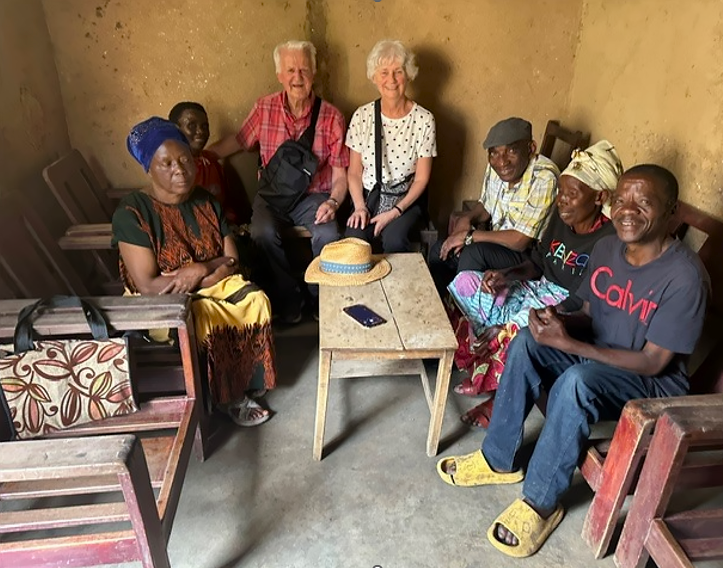
Drawing on the principles he had spent decades pioneering in Canadian corrections, Pierre and his wife, Judy, began training prison chaplains, correctional leaders and community members in a different way of thinking—the belief that justice should not stop at punishment but seek to repair the harm caused by crime whenever possible.
The response surprised everyone: More than 400 imprisoned genocide perpetrators voluntarily wrote letters asking survivors for forgiveness.
But then came an even harder question. What do you do with 400 letters addressed to people whose lives had been completely shattered more than a decade earlier?
Under Pierre’s guidance, along with Judy, five prison chaplains were trained to deliver them. They travelled village by village across Rwanda’s land of a thousand hills, searching for survivors one name at a time.
Their instructions were simple: offer the letter but never pressure anyone to accept it. If the recipient refused, the chaplain was to quietly slip the letter back into their pocket and walk away. Forgiveness, Pierre believed, could never be demanded.
The very first letter they delivered changed everything.
It was addressed to a woman named Solange. Fifteen years earlier, the man who wrote it had murdered her parents and her three children. Now, from inside a prison cell, he was asking for her forgiveness.
To deliver it, two chaplains boarded a bus, transferred to a motorcycle taxi and walked for two hours through Rwanda’s rolling hills before reaching a fork in a forest path. As they stood wondering which path to take, they noticed a lone woman walking toward them.
“We’re looking for a woman named Solange,” they said.
“That’s me,” she replied.
The chaplains explained they were carrying a letter from one of the men imprisoned for the genocide. Did she want to read it?
“If you had come two weeks ago, I would have refused,” she said.
But only days earlier she had attended a seminar on the importance of forgiveness.
“So yes,” she said. “I’ll read it.”
She stood quietly as she unfolded the pages.
When she finished reading, she looked up.
“The letter is good,” she said. “But I still have questions. Can I meet him?”
It was a request Pierre, Judy and their colleagues had never anticipated.
Until then, they had been focused solely on delivering the letters. They had never even considered bringing survivors into prison to meet the people who had written them.
Months later, after they had secured permission from the Rwandan government, Solange entered the prison and sat in a room across a table from the man who had destroyed her family.
“You killed my father and my mother,” she began. “Who died first? Was it my father?”
“Yes,” he replied.
“Did my mother have to watch it happen?”
“Yes.”
She then asked about each of her three children by name and age.
Did they ask for their mother when you were killing them?
“Yes, they did,” he replied.
In what order did you kill them?
Question after question, he answered.
Finally, she fell silent.
“Thank you,” she said softly. “Now I can put the pieces of the puzzle together, and I don’t have to wonder anymore.”
Then came the words most people would never expect to hear.
“You are asking for forgiveness. God has forgiven me in my life for the things I have done, and I have experienced the love of God. I want you to have that too.”
She stood up. Without another word, she walked around the table.
Then she embraced the man who had murdered the people she loved most.
What began as one survivor seeking answers became the blueprint for something extraordinary. Over the following years, Pierre and Judy and the Canadian charity they founded – Just Equipping – helped facilitate over 500 face-to-face meetings between genocide survivors and those responsible for it. In 99 per cent of those encounters, survivors ultimately chose to offer forgiveness, he says.
For Pierre, now 86, that first meeting remains one of the greatest privileges of a career devoted to corrections, chaplaincy and restorative justice.
Ironically, his own journey toward restorative justice began with violence. In 1980, while serving as a prison chaplain at Dorchester Penitentiary, his brother, André was murdered.
“I didn’t know if I could continue working the way I always had,” Pierre recalls. “I had to discover a bigger vision.”
He found it in restorative justice. It became the guiding principle of the remainder of his 34-year career with CSC, during which time he led the national chaplaincy program and acted as the Assistant Commissioner responsible for community engagement.

Over the following decades, he helped pioneer restorative justice within Canadian corrections, developed one of the country’s first university programs on correctional ministry and restorative justice at Queen’s University, helped establish Restorative Justice Week, and championed victim-offender dialogue programs long before they became widely recognized.
“There is nothing more powerful than having the actual victim help the offender understand what he has done,” Pierre says. “When you’re sitting across from the person you’ve hurt and you see the damage your actions caused, it changes something.”
After retiring in 2006, Pierre expected his work inside prisons had largely come to an end.
Instead, it was about to begin again, only half a world away.
Invited by prison chaplains in Rwanda, Pierre, Judy and colleague Eileen Henderson returned year after year, eventually making 26 missions between 2007 and 2026 and watching reconciliation take root in places where hatred had once seemed permanent.
Today, more than 30 years later, many of the genocide perpetrators have completed their prison sentences.
Who is there to welcome them when they return home? Often the very survivors who once sat across from them asking impossible questions.
Just Equipping now supports reconciliation groups in several villages where former prisoners and genocide survivors farm together, plant coffee, cabbage and corn, share meals, pray and slowly rebuild trust in communities shattered by unimaginable violence.
“It isn’t easy,” Pierre says.
“Many survivors wake up every morning with permanent machete scars across their necks. The pain is still there. The nightmares are still there. Forgiveness isn’t something you do once. It’s something you continue choosing.”
Sometimes the signs of healing emerge in extraordinary ways. One survivor recently told Pierre her daughter had married the son of a former genocide perpetrator.
“For me,” he says, “that is proof reconciliation is building community.”
At an age when most people have long since slowed down, Pierre and Judy continue returning to Rwanda. They were there again this past March and plan another visit in early 2027, spending much of their time encouraging prison chaplains and supporting the reconciliation groups that continue to grow.
Despite everything he has witnessed, Pierre remains convinced that prisons reveal something profoundly hopeful about humanity.
“Working with prisoners is entering a world that is deeply human,” he reflects. “It’s a world full of evil and goodness, where your black-and-white understanding of people quickly becomes a thousand shades of grey.”
That humanity was evident once again earlier this year, when a familiar face from CSC arrived in Kigali carrying two oversized suitcases.
Lisa Quirion, Deputy Director of CSC’s National Monitoring Centre, travelled to Rwanda as part of a long-awaited retirement trip after decades of service that included United Nations peacekeeping missions in Burundi and Haiti. Having witnessed the harsh realities of prisons in some of the world’s most vulnerable countries, she knew how desperately basic necessities were needed.
She also knew Pierre.
“He was my boss’s boss years ago, and he’s someone I’ve always had tremendous respect for,” she says. “One of the kindest, most generous and most humane people I’ve ever worked with.”

Before leaving Canada, Lisa rallied colleagues at the National Monitoring Centre—a 24-hour operations centre responsible for community safety across the country—to support a cause close to her heart.
Her team of 43 employees raised money to purchase approximately $600 worth of essentials, including clothing, toothbrushes, toothpaste, hygiene products and supplies for men, women and even young children living in prison with their mothers, which she then handed over to Pierre.
“It was just something I wanted to do,” she says. “Many of us are fortunate enough never to have seen the conditions that exist in some prisons around the world. I wanted our staff to understand that even small acts of generosity can make a real difference.”
For Pierre, those gifts are another reminder that the values he spent decades nurturing within Canadian corrections continue to ripple outward through the people he works alongside a continent away.
“If you live out of hatred,” he says, “you build yourself a prison that’s worse than the one we keep offenders in.”
Forgiveness, he believes, does not erase the past.
It simply refuses to let the past become the final chapter.