
Explanatory Notes to Legislative Proposals Relating to the Income Tax Act and Regulations

Preface
These explanatory notes describe proposed amendments to the Income Tax Act and Income Tax Regulations. These explanatory notes describe these proposed amendments, clause by clause, for the assistance of Members of Parliament, taxpayers and their professional advisors.
The Honourable François-Philippe Champagne, P.C., M.P.
Minister of Finance and National Revenue
These notes are intended for information purposes only and should not be construed as an official interpretation of the provisions they describe.
Table of Contents
| Clause in Legislative Proposals | Section Amended | Topic |
|---|---|---|
| Legislative Proposals Relating to Income Tax | ||
1 |
6 | Amounts to be included as income from office or employment |
2 |
12 | Income inclusions |
3 |
15 | Benefit conferred on shareholder |
4 |
18.2 | Definitions |
5 |
18.21 | Group ratio – definitions |
6 |
20 | Deductions permitted in computing income from business or property |
7 |
28 | Farming or fishing business |
8 |
66 | Exploration and development expenses of principal-business corporations |
9 |
80.3 | Income deferrals - livestock |
10 |
80.4 | Loans |
11 |
93.1 | Shares held by partnership |
12 |
95 | Definitions for this Subdivision |
13 |
104 | Reference to trust or estate |
14 |
116 | Disposition by non-resident person of certain property |
15 |
125.4 | Canadian film or video production tax credit |
16 |
125.5 | Film or video production services tax credit |
17 |
138.1 | Rules relating to segregated funds |
18 |
146.6 | First home savings account |
19 |
147.1 | Registered pension plan |
20 |
148 | Amounts included in computing policyholder's income |
21 |
183.3 | Definitions |
22 |
189 | Tax regarding non-qualified investment |
23 |
207.5 | Tax in respect of retirement compensation arrangement |
24 |
207.71 | Tax in respect of retirement compensation arrangement |
25 |
217 | Alternative re Canadian benefits |
26 |
219 | Additional tax |
27 |
241 | Provision of information |
28 |
248 | Definitions |
29 |
213.1 | Pooled registered pension plans |
30 |
600 | Elections |
31 |
1100 | Immediate expensing |
32 |
4802 | Status of corporations and trusts |
33 |
5600 | Prescribed distributions |
34 |
8303 | Past service pension adjustment |
35 |
8502 | Conditions applicable to registered plans |
36 |
8503 | Defined benefit provision |
37 |
9000 | Prescribed person not a financial institution |
Income Tax Act
Clause 1
Automobile benefit
Income Tax Act (the Act or ITA)
6(1) and (2)
Where a person makes an automobile available to a taxpayer in the course of or because of the taxpayer's office or employment and the taxpayer uses the automobile for personal purposes, a standby charge must be included in the taxpayer's income. An operating expense benefit must also be included in the taxpayer's income if any operating costs in respect of the automobile used for personal purposes are paid by the person making the automobile available.
Paragraphs 6(1)(k), 6(1)(l) and subsection 6(2) of the Act are amended to apply to benefits provided to a person who does not deal at arm's length with the taxpayer. These amendments are consistent with the scope of paragraphs 6(1)(a) and (e) which apply where an employment benefit is provided to a person who doesn't deal at arm's length with the employee.
These amendments apply to the 2026 and subsequent taxation years.
Clause 2
Automobile benefit
ITA
12(1)(y)
Paragraph 12(1)(y) of the Act provides for the inclusion in the income of a taxpayer the value of benefits received from the use by a member of a partnership or an employee of a member of a partnership of an automobile made available by the partnership (such benefit is referred to as a "standby charge").
Paragraph 12(1)(y) is amended to apply to benefits provided to a person who does not deal at arm's length with the taxpayer. These amendments are consistent with the scope of paragraphs 6(1)(a) and (e) which apply where an employment benefit is provided to a person who doesn't deal at arm's length with the employee.
The paragraph is also amended to remove the reference to an employee of a member of a partnership. A standby charge will continue to be required to be included in the income of an employee of a member of a partnership who is provided an automobile for personal use by the partnership under paragraph 6(1)(e).
This amendment applies to the 2026 and subsequent taxation years.
Clause 3
Shareholder debt
ITA
15(2)
Subsection 15(2) requires that certain indebtedness be included in the income of the debtor in the year in which the indebtedness arose. This subsection is intended to prevent a debtor, that is directly or indirectly a shareholder of a particular corporation or that is connected with a shareholder of the particular corporation, from avoiding tax by receiving property from the corporation through an otherwise non-taxable loan, rather than as a dividend or other taxable amount.
Certain debtors are excluded from the application of subsection 15(2), including a corporation resident in Canada (CRIC) and a partnership, each member of which is a CRIC. Subsection 15(2) is amended to relocate these exclusions to new subsection 15(2.01) following the addition of a new exception for tiered partnerships in new paragraph 15(2.01)(b). See the commentary to subsection 15(2.01) for more information.
This amendment applies to loans received and indebtedness incurred after October 31, 2011.
Excluded persons and partnerships
ITA
15(2.01)
Subsection 15(2) requires that certain indebtedness be included in the income of the debtor in the year in which the indebtedness arose. Certain debtors are currently excluded from the application of subsection 15(2), including a corporation resident in Canada (CRIC) and a partnership, each member of which is a CRIC. Subsection 15(2) is not intended to apply to loans received by a partnership, that is held directly or indirectly, solely by CRICs.
New subsection 15(2.01) is introduced to provide a list of debtors to which subsection 15(2) does not apply. These debtors are:
- CRICs; and
- partnerships, each member of which is either a CRIC, or another partnership described here (to accommodate tiered-partnership structures).
Consequently, subsection 15(2) will not apply to a partnership if all the members are, directly or indirectly (through one or more other partnerships), CRICs.
Example – tiered-partnership structure
Relevant facts:
- two CRICs (Canco1 and Canco2) are the only members of a foreign partnership (Foreign LP1);
- Canco1 and Foreign LP1 are the only members of another foreign partnership (Foreign LP2);
- Foreign LP2 wholly owns a foreign corporation (FA); and
- Canco2 makes a loan to Foreign LP2 in the year.
Tiered-partnership structure
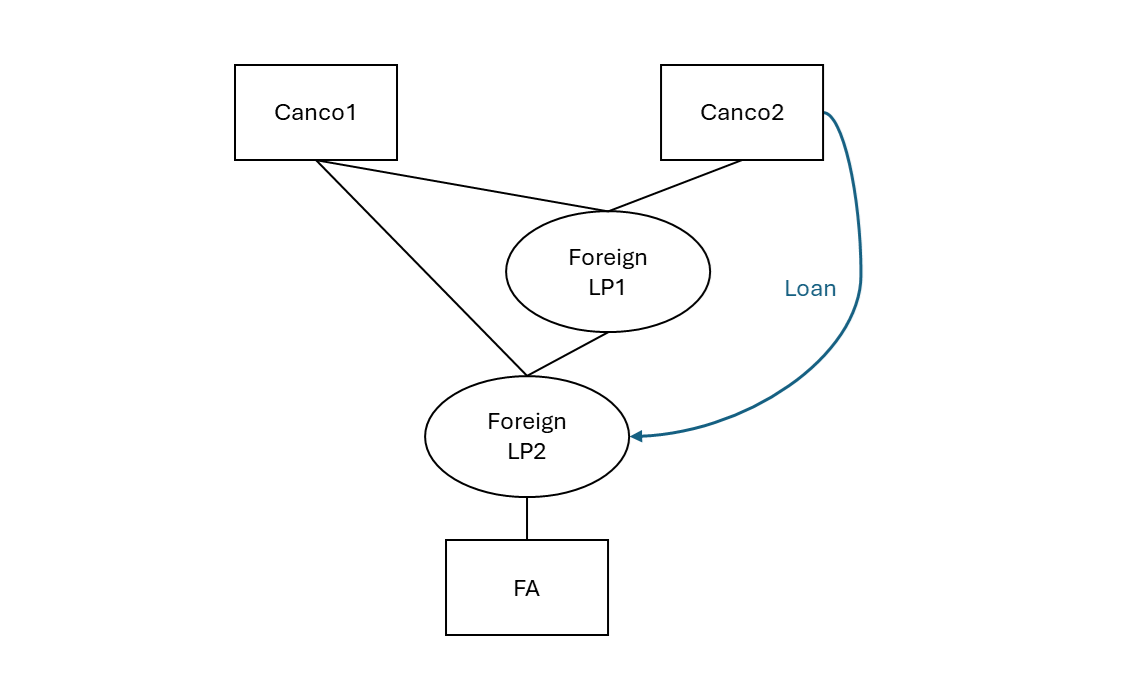
While Foreign LP2 is a shareholder of a particular corporation (FA) and Foreign LP2 has received a loan from a corporation related to FA (Canco2), subsection 15(2) does not apply to include the amount of the loan in computing the income of Foreign LP2 for the year, pursuant to new subparagraph 15(2.01)(b), because each member of the partnership is a CRIC (Canco1) or another partnership described in paragraph (b) (Foreign LP1) (Foreign LP1 is a partnership described in that paragraph because each of its members is a CRIC).
Subsection 15(2.1) was previously amended (with effect as of October 31, 2011) to clarify that a partnership can be connected with a shareholder of a particular corporation if that partnership does not deal at arm's length with, or is affiliated with, the shareholder. Consequently, this amendment applies to loans received and indebtedness incurred after October 31, 2011 to likewise clarify that subsection 15(2) does not apply to a partnership, all of whose members are CRICs or other partnerships described in new paragraph 15(2.01)(b).
Additionally, subsection 15(2) may unintentionally impact certain debtors belonging to the same foreign affiliate group as the particular corporation (referred to in subsection 15(2)). To address this concern, paragraph 15(2.01)(a) is amended (applicable to loans received or indebtedness incurred after August 12, 2024) to exclude from the application of subsection 15(2), a debtor that is
- a foreign affiliate of the particular corporation; or
- a foreign affiliate of a person resident in Canada with which the particular corporation does not deal at arm's length.
As a consequence of these amendments, subsection 15(2) will not apply to loans made to partnerships provided that all of their members are the above-described foreign affiliates, CRICs, or other partnerships described in paragraph 15(2.01)(b).
Example – tiered-foreign affiliate structure
Relevant facts:
- a CRIC (Canco) wholly owns a foreign corporation (FA1);
- FA1 wholly owns another foreign corporation (FA2); and
- Canco makes a loan to FA1 in the year.
Tiered-foreign affiliate structure

While FA1 is a shareholder of a particular corporation (FA2) and FA1 has received a loan from a corporation related to FA2 (Canco), new subparagraph 15(2.01)(a)(iii) provides that, because FA1 is a foreign affiliate of a person resident in Canada (Canco) with which FA2 does not deal at arm's length, subsection 15(2) does not apply to include the amount of the loan in computing the income of FA1 for the year.
Example – partnership loan with foreign affiliate member
Relevant facts:
- a CRIC (Canco) wholly owns two foreign corporations (FA1 and FA2);
- FA1 and FA2 are the only members of a foreign partnership (Foreign LP); and
- Canco makes a loan to Foreign LP in the year.
Partnership loan with foreign affiliate member

Pursuant to subsection 15(2.1), Foreign LP is connected, in respect of a particular corporation (FA1), with a shareholder of FA1 (Canco) because Foreign LP is affiliated with Canco.
However, while Foreign LP is connected with a shareholder of FA1 (Canco) and Foreign LP has received a loan from a corporation related to FA1 (Canco), subsection 15(2) does not apply to include the amount of the loan in computing the income of Foreign LP for the year, pursuant to new subparagraph 15(2.01)(a)(iii) and paragraph 15(2.01)(b), as each member of the partnership (FA1 and FA2) is a foreign affiliate of a person resident in Canada (Canco) with which FA1 does not deal at arm's length. (Similar results would apply if FA2 were the particular corporation in this example.)
This amendment applies to loans received and indebtedness incurred after August 12, 2024.
Meaning of connected
ITA
15(2.1)
Subsection 15(2) requires that certain indebtedness be included in the income of the debtor in the year in which the indebtedness arose. Paragraphs 15(2)(a) to (c) describe the debtors to which this rule applies in terms of their relationship with a particular corporation. In particular, paragraph 15(2)(b) provides that subsection 15(2) may apply to a debtor that is connected with a shareholder of the particular corporation.
Subsection 15(2.1) specifies that a debtor is connected with the shareholder if the debtor does not deal at arm's length with or is affiliated with the shareholder, unless the debtor is
- a foreign affiliate of the particular corporation, or
- a foreign affiliate of a person resident in Canada with which the particular corporation does not deal at arm's length.
Subsection 15(2.1) is amended to remove its paragraphs (a) and (b) as a consequence to the inclusion of these exceptions and other new exceptions to subsection 15(2) in amended subsection 15(2.01). Consequently, the exception to subsection 15(2) for persons described in paragraphs 15(2.1)(a) and (b) is no longer restricted to the connected test described in subsection 15(2.1). See the commentary to subsection 15(2.01) for more information.
This amendment applies to loans received and indebtedness incurred after August 12, 2024.
Automobile benefit
ITA
15(5)
Subsection 15(5) of the Act provides rules relating to shareholder benefits from the use by a shareholder of a corporation's automobile.
Subsection 15(5) is amended to apply to benefits provided to a person who does not deal at arm's length with the shareholder. These amendments are consistent with the scope of paragraphs 6(1)(a) and (e) which apply where an employment benefit is provided to a person who doesn't deal at arm's length with the employee.
This amendment applies to the 2026 and subsequent taxation years.
Clause 4
Definitions
ITA
18.2(1)
Subsection 18.2(1) defines a number of terms that apply for the purposes of sections 18.2 and 18.21 in determining the application of the excessive interest and financing expenses limitation ("EIFEL").
"interest and financing revenues"
Paragraph (a) of variable B of the definition "interest and financing revenues" ensures that the interest and financing revenues of a taxpayer for a taxation year are reduced by amounts paid or payable, or a loss or capital loss, under or as a result of an agreement or arrangement entered into as or in relation to a loan or other financing owing to or provided by the taxpayer, or a person or partnership that does not deal at arm's length with the taxpayer.
Clause (a)(ii)(B), which describes agreements or arrangements that are ancillary to a loan or other financing, is amended in two ways. First, the reference to "cost of funding or the borrowing" is replaced by "loan". Second, it is clarified that, in such cases, the agreement or arrangement must be entered into to hedge either the loan or other financing itself or the return in respect of the loan or other financing.
Consistent with the broader EIFEL rules, this amendment applies to taxation years that begin on or after October 1, 2023.
Clause 5
Allocated group ratio amount
ITA
18.21(2)
Subsection 18.21(2) is the operative provision of the group ratio rule in section 18.21 and determines the "allocated group ratio amount" that may be used as an alternative to the fixed ratio's interest deduction capacity under subsection 18.2(2). In particular, if all conditions in subsection 18.21(2) are satisfied, corporations and trusts that are "eligible group entities" (as defined in subsection 18.2(1)) in respect of each other and that are members of the same "consolidated group" (as defined in subsection 18.21(1)) may elect to allocate amounts among Canadian group members.
In order to be allocated an amount from another entity of a consolidated group, subsection 18.21(2) requires the recipient to be a member of the consolidated group throughout the relevant period for which audited consolidated financial statements are prepared and to have a taxation year ending within that period.
To accommodate changes in group composition during a relevant period (e.g., as a result of a corporate acquisition or disposition), subsection 18.21(2) is amended to replace "throughout the relevant period" with "in the relevant period". This amendment allows for a Canadian group member to receive an allocation if they are an eligible group entity of a consolidated group any point in time in the relevant period instead of at all times in the relevant period. As a result, the amendment better aligns the availability of a group ratio allocation to the period during which an entity's activities are relevant to the calculation of group net interest expense and group adjusted net book income. Note that subsection 18.2(9) applies to deem a taxpayer not to be, to have become, or to remain, as the case may be, an eligible group entity if it is reasonable to consider that one of the main purposes of the taxpayer being, becoming or ceasing to be an eligible group entity is to obtain a tax benefit (which could result from an amount being allocated under 18.21(2)).
This amendment applies to taxation years beginning on or after January 1, 2026.
Clause 6
Life insurance policy
ITA
20(20)(b)
Subsection 20(20) provides a deduction in respect of income accrued but not received under certain life insurance policies and annuities at the time disposed of by the policyholder.
Paragraph 20(20)(b) of the French version of the Act is amended to better align the English and French versions by referring to "produit de la disposition" and to ensure consistency with the terminology used in section 148 in the context of a disposition of a life insurance policy.
Clause 7
Farming or fishing business
ITA
28(1)
Consequential on the introduction of new subsection 80.3(3.2), paragraph 28(1)(d) is amended to add a reference to subsection 80.3(3.2), to ensure that amounts included in income under that subsection are taken into account for a farmer who computes income from farming using cash-basis accounting.
This amendment applies to the 2025 and subsequent taxation years.
Clause 8
Short taxation year
ITA
66(13.1)
Subsection 66(13.1) limits the amount of certain resource expenses that a taxpayer may deduct in computing income for a taxation year where the amount is based on a percentage of the unclaimed balance and the taxation year is less than 51 weeks. In these cases, the amount that may be deducted by the taxpayer cannot exceed that portion of the amount otherwise determined that the number of days in the taxation year is of 365.
Subsection 66(13.1) is amended by adding references to paragraphs 66.2(2)(e) and 66.4(2)(d). This ensures that this short taxation year rule applies in determining the amount of a taxpayer's reaccelerated Canadian development expense and reaccelerated Canadian oil and gas property expense.
This amendment is deemed to have come into force on January 1, 2025.
Clause 9
Inclusion of deferred amount
ITA
80.3(3)
Subsections 80.3(2) and (3) currently provide a one-year deferral for amounts included in a taxpayer's income due to the forced destruction of livestock under statutory authority.
Subsection (3) is amended to allow, if the taxpayer elects under new subsection (3.2), certain amounts deducted under subsection (2) to be included in computing the taxpayer's income in a taxation year or years later than the year in which such amounts would have otherwise been required to be included in computing the taxpayer's income under subsection (3). Those amounts and taxation years must be designated by the Minister of Finance under new subsection 80.3(3.1) for subsection (3.2) to apply.
This amendment applies to the 2025 and subsequent taxation years.
Designated income deferral from the destruction of livestock
ITA
80.3(3.1)
New subsection (3.1) provides relief for farmers with respect to compensation received under statutory authority due to the forced destruction of livestock by allowing the Minister of Finance to, in consultation with the Minister of Agriculture and Agri-Food, designate that an amount deducted under subsection (2) in computing the income of a taxpayer from a farming business may be included in computing the taxpayer's income in a taxation year or years later than the year in which such amounts would have otherwise been required to be included in computing the taxpayer's income under subsection (3). The Minister may also specify the designated minimum portion in respect of the amount deducted under subsection (2) that must be included in computing the taxpayer's income for each later taxation year.
This amendment applies to the 2025 and subsequent taxation years.
Inclusion of designated minimum portion
ITA
80.3(3.2)
New subsection (3.2) applies if the Minister of Finance has designated under subsection (3.1), for each relevant taxation year, a designated minimum portion for a taxpayer's taxation year in respect of an amount deducted under subsection (2). Subsection (3.2) sets out the time at which the designated minimum portion in respect of the amount deducted under subsection (2) must be included in computing the taxpayer's income. If the taxpayer elects, then the designated minimum portion of the amount deducted under subsection (2) shall be deemed to be income of the taxpayer at the earliest of the following:
- the relevant year, in respect of each designated minimum portion specified under subsection (3.1);
- the year in which the taxpayer dies; and
- the first year after the year in which the taxpayer is a non-resident and is not carrying on business through a fixed place of business in Canada.
For greater certainty, the taxpayer may include in computing their income from the business amounts deducted under (2) at an earlier time than that which is required under subsection (3.2). Further, amounts deducted in computing a taxpayer's income in a particular taxation year under subsection (2) will only be included in the taxpayer's income at the time determined by subsection (3.2) to the extent that that amount has not already been included in computing the taxpayer's income for a preceding taxation year.
If the taxpayer chooses not to make an election under subsection (3.2), then the default income inclusion rule in subsection (3) will apply, such that any amount deducted under subsection (2) in a particular year will be deemed to be income of the taxpayer from the business in the taxation year immediately following the particular year.
This amendment applies to the 2025 and subsequent taxation years.
Clause 10
Idem
ITA
80.4(2)
Subsection 80.4(2) deems a debtor to have received a benefit in respect of certain low-interest or non-interest-bearing indebtedness extended by a corporation in certain circumstances. In particular, the rule applies if the debtor received the loan by reason of their being a shareholder of the corporation, a connected person or partnership or a member of a partnership or a beneficiary of a trust that is a shareholder of the corporation.
Certain debtors are excluded from the application of subsection 80.4(2), including a corporation resident in Canada (CRIC) and a partnership, each member of which is a CRIC. Subsection 80.4(2) is amended to relocate these exclusions to new subsection 80.4(2.01). See the commentary to subsection 80.4(2.01) for more information.
This amendment applies to loans received and indebtedness incurred after Announcement Date.
Excluded persons and partnerships
ITA
80.4(2.01)
Subsection 80.4(2) generally deems a debtor to have received a benefit in respect of certain low-interest or non-interest-bearing indebtedness extended by a corporation. Certain debtors are currently excluded from the application of subsection 80.4(2), including a corporation resident in Canada (CRIC) and a partnership, each member of which is a CRIC.
New subsection 80.4(2.01) is introduced to provide a list of debtors excluded from the application of subsection 80.4(2) (similar to the exclusion of debtors listed under new subsection 15(2.01) from the application of subsection 15(2)).
This amendment applies to loans received and indebtedness incurred after Announcement Date.
Meaning of connected
ITA
80.4(8)
Subsection 80.4(8) describes the circumstances under which a debtor is connected with a shareholder of a corporation for the purposes of subsection 80.4(2). This subsection is amended, on a similar basis to the amendment to subsection 15(2.1), consequential to the amendment to subsection 80.4(2) and the introduction of the list of excluded debtors in new subsection 80.4(2.01). For more information, see the commentary to subsections 15(2.1) and 80.4(2) and (2.01).
This amendment applies to loans received and indebtedness incurred after Announcement Date.
Clause 11
Specified provisions for subsection (1)
ITA
93.1(1.1)
Subsection 93.1(1) applies to determine whether a non-resident corporation is a foreign affiliate of a Canadian-resident corporation for the purposes of certain provisions of the Act and Regulations in situations where shares of the non-resident corporation are held by the Canadian-resident corporation through a partnership. In those circumstances, subsection 93.1(1) provides a look-through rule that deems the Canadian-resident corporation to own its proportionate number of the non-resident corporation's shares based on the relative fair market value of its interest in the partnership. The rule also applies where a foreign affiliate of the Canadian-resident corporation owns shares of another non-resident corporation through a partnership.
Subsection 93.1(1.1) lists the purposes for which the rule in subsection 93.1(1) applies.
Paragraph 93.1(1.1)(a) is amended by adding a reference to new subsections 15(2.01) and 80.4(2.01) to ensure that foreign affiliate status can flow through a partnership for the purposes of applying those subsections. For more information, see the commentary on those subsections.
This amendment applies to loans received and indebtedness incurred after Announcement Date.
Clause 12
ITA
95(2)(b)(i)
Subparagraph 95(2)(b)(i) deems the provision of services (or an undertaking to provide services) by a foreign affiliate (the payee affiliate) of a taxpayer to be a separate business, other than an active business, carried on by the payee affiliate – and any income from that business, or that pertains to or is incident to that business, to be income from a business other than an active business – to the extent that the amounts paid or payable in consideration for those services or that undertaking are deductible, or can reasonably be considered to relate to amounts that are deductible, in computing:
- the income from a business carried on in Canada by a taxpayer referred to in subclause 95(2)(b)(i)(A)(I) or (II); or
- the foreign accrual property income (FAPI) of a foreign affiliate (the payer affiliate) of a taxpayer referred to in subclause 95(2)(b)(i)(B)(I) or (II).
Such income is therefore included in computing the payee affiliate's FAPI.
Clause 95(2)(b)(i)(B) effectively ensures that income that would otherwise be FAPI of the payer affiliate cannot be converted to active business income by the payment of consideration to the payee affiliate for services rendered to the payer affiliate. Where clause 95(2)(b)(i)(B) applies, all of the payee affiliate's income from the provision of the services (or the undertaking) is included in its FAPI.
Clause 95(2)(b)(i)(B) is amended to ensure that the services income is included in the payee affiliate's FAPI only in proportion to the aggregate interests, of taxpayers of which the payer affiliate is a foreign affiliate, in the payer affiliate's income. Specifically, the amount to be included in the payee affiliate's FAPI is determined by the formula A × B, where:
- A is the amounts paid or payable in consideration for the services (or the undertaking) that are deductible, or can reasonably be considered to relate to an amount that is deductible, in computing the payer affiliate's FAPI for a taxation year; and
- B is, in very general terms, the total of all amounts, each of which is the participating percentage (determined on a modified basis, as set out further below), in respect of the payer affiliate, of a share that is owned by any taxpayer of which the payer affiliate is a foreign affiliate, but with adjustments to scale that percentage where interests in the payer affiliate are held through a partnership.
Under the modifications set out in variable B, the participating percentages are to be determined:
- at the end of the taxation year of the payer affiliate in which the amounts paid or payable are deductible;
- as if there were no ($5,000) de minimis rule in the definition "participating percentage"; and
- as if the references to "controlled foreign affiliate" in the definition "participating percentage" and section 5904 of the Regulations were references to "foreign affiliate", thus ensuring, among other things, that amounts can be included under variable B in respect of foreign affiliates that are not controlled foreign affiliates.
Further, variable B is computed by aggregating each amount determined under the formula C × D, such that the computation aggregates the interests in the particular affiliate on an iterative basis. Variable D in the formula C × D depends on how the shares of the particular affiliate are held, as discussed below:
- Where none of the shares of the particular affiliate are held by a partnership, the amount determined for B is the total of the amounts determined by the formula C × 1, because of the application of subclause (II) of variable D. Thus, B is the aggregate of the participating percentages (determined on the same modified basis described above) of each share in the particular affiliate held by any taxpayer of which the particular affiliate is a foreign affiliate and no further adjustments are required.
- Where a taxpayer holds the sharesin the particular affiliate through a partnership, subclause (I) of variable D scales down the participating percentage determined in variable C, limiting it based on the taxpayer's share of the partnership income, for a fiscal period in which the taxation year of the particular affiliate ends, from a source (or sources in a particular place) that includes the income or loss from the shares of the particular affiliate, as follows:
- if the shares of the particular affiliate are held by a partnership of which a taxpayer resident in Canada is a member, variable D is the taxpayer's "specified proportion" for the fiscal period, which is essentially the proportion that the taxpayer's share of the total income or loss from the source (or the source in a particular place) of the partnership for the fiscal period is of the partnership's total income or loss for that period; or
- if the shares of the particular affiliate are held by a partnership in which a foreign affiliate is a member (referred to as the "member affiliate"), variable D is equal to E × F, where E is the member affiliate's specified proportion for the fiscal period (which is essentially the proportion that the member affiliate's share of the total income or loss from the source (or the source in a particular place) of the partnership for the fiscal period is of the partnership's total income or loss for that period), and F is the aggregate of the participating percentages (determined on the same modified basis described above) of the shares in the member affiliate held by any taxpayers of which the member affiliate is a foreign affiliate.
Consequential on the amendment to clause 95(2)(b)(i)(B), structural changes are made to the preamble of subparagraph 95(2)(b)(i) and to clause 95(2)(b)(i)(A). These changes are not intended to have any substantive effect.
These amendments apply in respect of taxation years of a foreign affiliate of a taxpayer that begin after 2015.
Clause 13
RPAA trusts – deeming rule
ITA
104(32)
New subsections 104(32) and (33) operate together to address the unintended tax consequences that would otherwise result from the requirement for payment service providers to hold end user funds in trust pursuant to the Retail Payment Activities Act (RPAA).
Prior to the enactment of the RPAA, payment service providers would hold end-user funds directly and treat those amounts as debts owing from the payment service providers to the end-users. In order to comply with the RPAA, as of September 8, 2025, end-users' funds instead need to be transferred to a trust arrangement that is established by the payment service provider or an entity that the payment service provider contracts with to establish the trust. Holding funds in trust can have income tax implications, both for the trust itself and the end users of the payment services.
New subsection 104(32) provides that, for the purposes of the Income Tax Act, if a trust is an RPAA trust (as defined in new subsection 104(33)) at all times in a taxation year in which the trust exists, then for that taxation year:
- the trust is deemed to not be a trust; and
- all funds deposited into the RPAA trust are deemed to be loans by an end-user as defined in the Retail Payment Activities Act to the payment service provider as defined in the Retail Payment Activities Act that established and operates the RPAA trust, or on behalf of which the RPAA trust has been established and is operated by another entity on behalf of the payment service provider.
This amendment comes into force on September 8, 2025.
RPAA trust
ITA
104(33)
New subsection 104(33) sets out the definition of an RPAA trust for new subsection 104(32). The definition of RPAA trust, together with the deeming rule in new subsection 104(32), provide tax consequences for payment service providers that hold end user funds in trust pursuant to the Retail Payment Activities Act (RPAA). A trust is an RPAA trust at any particular time if the conditions in paragraphs (a) to (c) are satisfied at that time.
- Paragraph (a) requires that the trust was either established by, and operated by, a payment service provider as defined in the Retail Payment Activities Act, or established by, and operated by an entity on behalf of a payment service provider as defined in the Retail Payment Activities Act. Allowing an entity to operate a trust on behalf of a payment service provider addresses circumstances where payment service providers choose to have a third party establish and operate their required trust accounts.
- Paragraph (b) requires that the payment service provider is registered with the Bank of Canada, or has applied for registration with the Bank of Canada and not had its application rejected or withdrawn. This allows a trust to qualify as an RPAA trust during the time between the payment service provider's application for registration and actual registration with the Bank of Canada.
- Paragraph (c) requires that the trust satisfy paragraph 20(1)(a) of the Retail Payment Activities Act, which provides that a payment service provider must hold end-user funds in trust in a trust account that is not used for any other purpose.
This amendment comes into force on September 8, 2025.
Clause 14
Presumption
ITA
116(5.4)
Subsection 116(5.4) treats the insurer under a Canadian life insurance policy as having acquired the property for purposes of subsections 116(5.2) and (5.3) when the disposition arises from a payment by the insurer.
Subsection 116(5.4) is amended to refer to "proceeds of the disposition", consistent with the terminology used in section 148 in the context of a disposition of a life insurance policy.
Clause 15
Definitions
ITA
125.4(1)
"Canadian film or video production certificate"
A qualified corporation must file a Canadian film or video production certificate with its tax return for a taxation year in which it claims a Canadian Film or Video Production Tax Credit in respect of the production. A "Canadian film or video production certificate", as defined in subsection 125.4(1) of the Act, is issued by the Minister of Canadian Heritage. The definition currently allows that Minister to issue a certificate where the production meets the qualifications for a Canadian film or video production as specified in section1106 of the Income Tax Regulations, and where that Minister is satisfied that an acceptable share of revenues from the exploitation of the production in non-Canadian markets is retained by specified persons(for example, a qualified corporation that owns an interest in the production).
The definition is amended in two ways. First, the current conditions for the issuance of the certificate, as described above, are moved to paragraph (a) of the definition, with current paragraphs (a) to (c) renumbered as new subparagraphs (a)(i) to (iii). Second, new paragraph (b) is added to introduce a new condition that the Minister of Canadian Heritage is satisfied that the financial information provided by an applicant in respect of the production is sufficient to make a determination under paragraph (a) and to include in the certificate an estimate of the amounts relevant for the purpose of determining the amount of the Canadian Film or Video Production Tax Credit referred to in subsection (2.1) (regardless of whether that Minister exercises his discretion under subsection (2.1) to include in the certificate such estimate). A certificate will be denied where the Minister of Canadian Heritage is not satisfied that the financial information provided by an applicant in respect of a production is sufficient for the purposes described in subparagraphs (b)(i) and (ii).
This amendment comes into force on Royal Assent.
"labour expenditure"
The definition "labour expenditure" describes the underlying expenditures of a qualified corporation in respect of a film or video production that will be eligible for the Canadian Film or Video Production Tax Credit. In the case of a corporation that is a qualified corporation for a taxation year, the corporation's labour expenditure for the taxation year in respect of a Canadian film or video production is, subject to subsection 125.4(2), the total of three amounts (paragraphs (a) to (c) of that definition) to the extent that they are reasonable in the circumstances and are included in the cost or capital cost of the production.
Paragraph (a) is the total salary or wages directly attributable to the production that are incurred by a corporation after 1994 in the taxation year, or the preceding year, of the corporation and, generally, paid by it in the year (or within 60 days after the end of the year) in respect of certain stages of the production.
Paragraph (a) is being amended in two ways. First, the current reference to salary and wages is moved to new subparagraph (a)(i). Second, a new subparagraph (a)(ii) is added to include an employer's contributions to a registered pension plan, so long as these contributions satisfy the other definitional requirements.
This amendment comes into force on January 1, 2027.
Authority to provide an estimate
ITA
125.4(2.1)
New subsection 125.4(2.1) provides that if the Minister of Canadian Heritage issues a Canadian film or video production certificate, that Minister may include in the certificate an estimate of the amounts relevant for the purpose of determining the amount of the tax credit deemed to have been paid under subsection (3) in respect of the production. For greater certainty, the Minister of Canadian Heritage has the discretion not to include such an estimate in a Canadian film or video production certificate.
This amendment comes into force on Royal Assent.
Clause 16
Definitions
ITA
125.5(1)
"Canadian labour expenditure"
The definition "Canadian labour expenditure" describes the underlying expenditures of a corporation in respect of a film or video production that will be eligible for the film or video production services tax credit. In the case of a corporation that is an eligible production corporation for a taxation year, the corporation's Canadian labour expenditure for the taxation year in respect of an accredited production is, subject to subsection 125.5(2), the total of three amounts (paragraphs (a) to (c) of that definition), to the extent that they are reasonable in the circumstances.
Paragraph (a) of the definition "Canadian labour expenditure" is the total salary or wages directly attributable to the production that are incurred by the eligible production corporation after October 1997, in the taxation year of the corporation and paid by it in the year (or within 60 days after the end of the year) in respect of certain stages of the production.
Paragraph (a) is being amended in two ways. First, the current reference to salary and wages is moved to new subparagraph (a)(i). Second, a new subparagraph (a)(ii) is added to include an employer's contributions to a registered pension plan, so long as these contributions satisfy the other definitional requirements.
This amendment comes into force on January 1, 2027.
Clause 17
Rules relating to segregated funds
ITA
138.1(1)(g)(i)
Section 138.1 provides rules governing the operation of segregated fund trusts established by insurance companies.
Subparagraph 138.1(1)(g)(i) is amended to refer to "proceeds of the disposition", consistent with the terminology used in section 148 in the context of a disposition of a life insurance policy.
Adjusted cost base of property in related segregated fund trust
ITA
138.1(5)
Subsection 138.1(5) effectively reduces the adjusted cost base of each capital property of a segregated fund trust, pro rata based on their respective fair market value, to the extent that losses realized by a policyholder redeeming their interest in the trust exceed the losses allocated to that policyholder by the trust.
Subparagraph 138.1(5)(b)(ii) of the English version of the Act is amended to better align the English and French versions by referring to "proceeds of disposition" of the interest in the trust.
Clause 18
Definitions
ITA
146.6(1)
"qualifying individual"
A "qualifying individual" means an individual who is at least 18 years old, resident in Canada and is a first-time home buyer. An individual is considered to be a first-time home buyer if at any time in the part of the calendar year before the account is opened or at any time in the preceding four calendar years they did not live in a qualifying home that they owned or their spouse or common-law partner owned (if they have a spouse or common-law partner at the time the account is opened).
The definition "qualifying individual" is amended in two ways. First, paragraphs (a) to (c) are reorganized to become subparagraphs (a)(i) to (iii). Second, new paragraph (b) is added to apply to individuals who previously opened an FHSA but subsequently become disqualified under paragraph (a), for example, because they are now residing in a home owned by a spouse or common-law partner. In that case, though the individual cannot open a new FHSA account for new contributions, they are not prohibited from transferring the existing account to a different financial institution. In short, the individual is a qualifying individual solely for the purpose of the transfer of their FHSA to another financial institution.
This amendment comes into force on April 1, 2023.
Clause 19
Definitions
ITA
147.1(1)
Subsection 147.1(1) defines those terms that are relevant for the purposes of the provisions of the Act in sections 147.1 to 147.3 relating to registered pension plans.
Subsection 147.1(1) is amended to extend its definitions to also apply for the purposes of section 147.4 which provides rules regarding buy-out annuities. This amendment is relevant for subsections 147.4(4) and (5) which refer to terms defined in subsection 147.1(1).
This amendment comes into force on January 1, 2018.
Clause 20
Amounts included in computing policyholder's income
ITA
148(1)
Subsection 148(1) requires the inclusion in income of certain amounts from the disposition of a life insurance policy.
The closing words of subsection 148(1) of the French version of the Act are amended to better align the English and French versions by referring to "produit de la disposition".
Deemed proceeds of the disposition
ITA
148(2)
Subsection 148(2) treats, in certain situations, a life insurance policy as having been disposed of.
Subsection 148(2) is amended in three respects.
- First, subparagraph 148(2)(a)(ii) of the French version of the Act is amended to better align the English and French versions by referring to "produit de la disposition".
- Second, paragraph 148(2)(d) is amended to refer to "proceeds of the disposition", consistent with terminology used in section 148 in the context of a disposition of a life insurance policy.
- Third, paragraph 148(2)(e) of the French version of the Act is amended to better align the English and French versions by referring to "produit de la disposition".
Special rules for certain policies
ITA
148(3)(b)
Subsection 148(3) applies for the purposes of section 148 in situations where all or part of an insurer's reserves for a life insurance policy vary in amount depending on the fair market value of a specified group of properties (referred to in this subsection as a "segregated fund").
Paragraph 148(3)(b) of the French version of the Act is amended to better align the English and French versions by referring to "produit de la disposition".
Partial surrender – ACB prorated
ITA
148(4)
Subsection 148(4) applies to prorate the adjusted cost basis of a taxpayer's interest in a life insurance policy upon its partial disposition (other than a disposition involving a policy dividend or a policy loan).
Variable B in subsection 148(4) of the French version of the Act is amended to better align the English and the French versions by referring to "produit de la disposition".
Repayment of policy loan on partial surrender
ITA
148(4.01)
Subsection 148(4.01) applies under certain circumstances to deem a repayment of a policy loan in respect of a life insurance policy to be made by a taxpayer for the purposes of paragraph 60(s) and the definition "adjusted cost basis" in subsection 148(9).
Paragraph 148(4.01)(c) and subparagraph 148(4.01)(d)(ii) of the French version of the Act are amended to better align the English and the French versions by referring to "produit de la disposition".
Proceeds receivable as annuity
ITA
148(6)(c)
Subsection 148(6) provides a tax-free "rollover" on the conversion of a life insurance policy, acquired before December 2, 1982, into an annuity contract.
Paragraph 148(6)(c) of the French version of the Act is amended to better align the English and the French versions by referring to "produit de la disposition".
Disposition at non-arm's length and similar cases
ITA
148(7)(a)
Subsection 148(7) applies to certain dispositions of an interest in a life insurance policy, including a disposition by way of certain non-arm's length and other transfers.
Paragraph 148(7)(a) of the French version of the Act is amended to better align the English and the French versions by referring to "produit de la disposition".
Idem
ITA
148(8)
Subsection 148(8) permits the transfer of a life insurance policy to the policyholder's spouse or child in certain circumstances.
Subsection 148(8) of the French version of the Act is amended to better align the English and the French versions by referring to "produit de la disposition".
Inter vivos transfer to spouse
ITA
148(8.1)
Subsection 148(8.1) allows an inter vivos transfer of a life insurance policy to be treated as a disposition for proceeds equal to the adjusted cost basis of the policy, where the transfer is made to a spouse or former spouse.
Subsection 148(8.1) of the French version of the Act is amended to better align the English and the French versions by referring to "produit de la disposition".
Transfer to spouse at death
ITA
148(8.2)
Subsection 148(8.2) provides "rollover" treatment with respect to dispositions of a life insurance policy to a spouse as a consequence of death, unless an election is made in the return of income of the deceased spouse for the year of death not to have the provisions of the subsection apply.
Subsection 148(8.2) of the French version of the Act is amended to better align the English and the French versions by referring to "produit de la disposition".
Definitions
ITA
148(9)
"adjusted cost basis"
The adjusted cost basis (ACB) of a taxpayer's interest in a life insurance policy is relevant in determining income inclusions under section 12.2 and subsection 148(1) and (1.1). An interest's ACB is also relevant to determining the proceeds of the life insurance policy received by a private corporation as a consequence of the death of an insured under the policy that may be added to the corporation's capital dividend account.
Variables B, E.1, and H in the definition "coût de base rajusté" in subsection 148(9) of the French version of the Act are amended to better align the English and the French versions by referring to "produit de la disposition".
"proceeds of the disposition"
The definition "proceeds of the disposition" of an interest in a life insurance policy applies in determining the amount, if any, that the interest holder is required to include in income on a disposition of the interest.
The definition "produit de disposition" in subsection 148(9) of the French version of the Act is amended to better align the English and French versions by referring to "produit de la disposition".
Clause 21
Definitions
ITA
183.3(1)
"covered entity"
The term "covered entity" in subsection 183.3(1) of the Act specifies the entities subject to Part II.2 tax in a taxation year. An entity is a covered entity if, among other requirements, its equity (as defined in this subsection) is listed on a designated stock exchange.
Redemptions, acquisitions, or cancellations of equity that is "substantive debt" (as defined in this subsection) are generally excluded from Part II.2 tax. However, an entity whose only equity listed on a designated stock exchange is substantive debt is nonetheless a covered entity. As a result, Part II.2 tax may be payable in respect of redemptions, acquisitions, or cancellations of the entity's non-listed equity despite the tax generally not applying to transactions involving substantive debt or to entities whose equity is not listed on a designated stock exchange.
Paragraph (a) of the definition "covered entity" is amended to exclude entities whose only equity listed on a designated stock exchange is substantive debt.
This amendment is deemed to have come into force on January 1, 2024.
"substantive debt"
"Substantive debt" of a covered entity is equity that possesses debt-like characteristics. Consequential on the amendment to the definition "covered entity" in this subsection, the definition "substantive debt" is amended to replace the reference to "a covered entity" in its opening words with a reference to "an entity". This amendment is relevant in determining whether an entity that has its equity (that is substantive debt) listed on a designated stock exchange is a "covered entity". For more information, see the commentary to the definition "covered entity".
This amendment is deemed to have come into force on January 1, 2024.
Tax payable
ITA
183.3(2)
Part II.2 of the Act imposes a tax on the net value of equity repurchases by certain publicly listed entities equal to 2% of the covered entity's net value of equity repurchases during the year. Subsection 183.3(2) contains the "netting rule" to determine the Part II.2 tax liability for a taxation year of a covered entity.
Variable A of the netting rule includes any equity (other than substantive debt) that is redeemed, acquired or cancelled in the taxation year by the covered entity (as defined in subsection 183.3(1)) when calculating the tax liability of a covered entity. Variable C of the netting rule reduces the covered entity's tax liability and includes any equity (other than substantive debt) of the covered entity that was either issued in a qualifying issuance or disposed of by a specified affiliate if that equity was previously included under variable A. The netting rule does not explicitly contemplate how it applies to securities lending arrangements.
However, subsection 260(2) of the Act generally provides that, for purposes of the Act, the transfer or loan of a security (including equity) under a securities lending arrangement is deemed not to be a disposition of the security by the lender, in recognition that the lender continues to assume the capital risk associated with the security.
To clarify the application of the netting rule to a transfer or loan of equity under a securities lending arrangement, the description of A in the formula in subsection 183.3(2) is amended to not apply to equity acquired under a "securities lending arrangement" (as defined in subsection 260(1)). (This amendment also ensures that, for purposes of the netting rule, equity is deemed not to be acquired by a covered entity under subsection 183.3(5) where the equity is acquired under a securities lending arrangement entered into by a "specified affiliate" (as defined in subsection 183.3(1)) of the covered entity). A transfer or loan of equity under a securities lending arrangement is generally not included under variable C of the netting rule pursuant to subsection 260(2) which generally deems a transfer or loan of equity under a securities lending arrangement not to be a disposition of the equity. In short, this amendment clarifies that a transfer or loan of equity under a securities lending arrangement is generally disregarded under the netting rule to determine the Part II.2 tax liability for a taxation year of a covered entity.
However, the amendment to variable A is subject to the anti-avoidance rule in subsection 183.3(3). For instance, if it is reasonable to consider that the primary purpose of a securities lending arrangement entered into by a covered entity (or a specified affiliate of a covered entity) is to decrease the amount referred to in the description of variable A in the formula of the netting rule under subsection 183.3(2), the equity redeemed, acquired or cancelled under the securities lending arrangement will be included in variable A of the netting rule.
This amendment is deemed to come into force on January 1, 2024.
Clause 22
Reduction of liability for penalties
ITA
189(6.3)
Subsection 189(6.3) applies to a person on which the Minister of National Revenue has assessed penalties under section 188.1 of the Act if those penalties for a taxation year of the person exceed $1,000. In such a case, subsection 189(6.3) allows the person to reduce the liability by the amount by which the value of property transferred to an "eligible donee" described in paragraph 188(1.3)(a) within one year following the assessment date, exceeds any consideration given to the person for the property transferred.
Subsection 189(6.3) is amended to add a reference to subsection 188(1.4) to allow a transfer of property from a person that is a particular Canadian amateur athletic association to another registered Canadian amateur athletic association to reduce the person's liability for a penalty assessed under section 188.1 of the Act.
This amendment comes into force on Royal Assent.
Clause 23
Definitions
ITA
207.5(1)
"refundable tax"
Subsection 207.5(1) contains the definitions that apply for the purposes of Part XI.3 tax applicable to retirement compensation arrangements (RCAs). Very generally, the definition "refundable tax" is determined at the end of a taxation year of an RCA trust as the amount by which 50% of all contributions made to the trust in the taxation year and all prior years plus 50% of all income and gains of the trust for the taxation year and all prior years exceed 50% of all benefits paid by the trust in the taxation year and all preceding years.
Subparagraph (b)(i) (income and gains) is amended by reorganizing it into two clauses and adding a new requirement in clause (B) to include the portion of a distribution received after December 31, 2026, from another trust in respect of capital gains of that other trust that are not otherwise included in the income of the RCA trust under clause (A). This change ensures that the refundable tax applies to 100% of a capital gain distributed to an RCA trust from another trust and not merely the taxable portion of the capital gain.
This amendment comes into force on January 1, 2027.
Clause 24
Interest on refunds
ITA
207.71(5)
Subsection 207.71 provides for a refund mechanism of a retirement compensation arrangement's refundable tax that was paid with respect to excluded contributions made prior to March 28, 2023, provided certain conditions are met. Amounts would generally be refunded at a rate of 50% of the retirement benefits paid after 2023 directly by an eligible employer (as defined in subsection (1)) to beneficiaries whose retirement benefits were secured under a specified arrangement with a letter of credit or surety bond issued by a financial institution.
New subsection 207.71(5) applies where an eligible employer has filed an election with the Minister of National Revenue under subsection 207.71(2) and receives a refund under subsection (3). In that case, any interest (calculated under subsections 164(3) and (3.2)) owed on the refund will also be paid to the employer and not to the custodian of the RCA.
This amendment comes into force on Announcement Date.
Clause 25
Part I return
ITA
217(2)
Subsection 217(2) provides that a non-resident who elects, for a taxation year, to have section 217 apply is not liable to tax under Part XIII on their Canadian-source benefits for the year. Instead, those amounts—primarily certain pensions, retirement income and similar payments—are included in computing the non-resident's taxable income and are taxed under Part I at graduated rates, rather than at the flat 25% withholding rate (subject to treaty reduction) imposed under Part XIII.
Paragraphs (a) and (b) of the subsection are amended to allow the subsection to apply to a taxation year of a taxpayer that files a return of income for the year under Part I of the Act and an election in prescribed form and manner, within 6 months after the end of the year, to have section 217 apply for the year. Concurrently, to allow the Minister of National Revenue to extend the time for making such election or to grant permission to amend or revoke such election, paragraph 600(c) of the Regulations is amended to add a reference to paragraph 217(2)(b).
These amendments come into force on Announcement Date.
Clause 26
Excluded gains
ITA
219(1.1)
Subsection 219(1.1) is amended consequential to the amendments made to the definition "taxable Canadian property" in subsection 248(1) and the introduction of new subsection 248(1.2). For more information, see the commentary to the definition "taxable Canadian property" in subsection 248(1) and subsection 248(1.2).
This amendment comes into force on Royal Assent.
Clause 27
Provision of information
ITA
241(1)(c)
Paragraph 241(1)(c) prohibits the unauthorized use or communication of taxpayer information by an official otherwise than in the course of the administration or enforcement of the Income Tax Act, the Canada Pension Plan, or the Employment Insurance Act, or for a specifically authorized purpose under section 241.
Paragraph 241(1)(c) is amended to add a reference to the administration or enforcement of the Department of Employment and Social Development Act.
This amendment comes into force on Royal Assent.
Clause 28
Definitions
ITA
248(1)
"taxable Canadian property"
The definition "taxable Canadian property" (TCP) in subsection 248(1) is relevant primarily in relation to the taxation of non-residents.
Paragraph (d) of the definition provides that TCP includes a share of a corporation (other than a mutual fund corporation) that is not listed on a designated stock exchange, an interest in a trust (other than a unit of a mutual fund trust or an income interest in a trust resident in Canada) or an interest in a partnership if, at any time during the 60-month period that ends at the time, more than 50% of the fair market value (FMV) of the share or interest derives its value from certain enumerated properties, directly or indirectly, other than through a corporation, partnership, or trust the shares or interests in which are not themselves TCP (referred to herein as the "look‑through" rule).
Paragraph (d) is amended in two ways. First, it is amended to exclude an interest in a partnership that is a unit listed on a designated stock exchange. Such listed partnership units will instead be considered TCP if the conditions in paragraph (e) are met, as described further below.
Second, it is amended to ensure that a share or interest can derive its value indirectly from the enumerated properties through any corporation, trust or partnership, other than a corporation or partnership the shares or units of which are listed on a designated stock exchange, a mutual fund corporation or a mutual fund trust. This amendment to the look-through rule broadens the range of entities through which a share or interest can derive its value indirectly from the enumerated properties. For example, under amended paragraph (d), a share of a corporation could be TCP if it indirectly derives most of its value from the enumerated properties through multiple wholly-owned subsidiaries even if the shares in one of them are not themselves TCP, as illustrated in the example below:
Facts
- A non-resident taxpayer holds all the shares of a corporation (Holdco), which have an FMV of $310,000.
- Holdco owns all the shares of two corporations that are not listed on a designated stock exchange ("Subco 1" and "Subco 2").
- Subco 1 owns property with total FMV of $150,000, including properties described in subparagraphs (d)(i) to (iii) of the definition with an FMV of $100,000.
- Subco 2 owns property with total FMV of $160,000, including properties described in subparagraphs (d)(i) to (iii) of the definition with an FMV of $60,000.
- Assume there is no change to the FMV of the properties over the 60-month period.
Analysis
Under the current definition, the look-through rule does not permit tracing through Subco 2 because its shares are not themselves TCP. As a result, only the TCP property held by Subco 1 ($100,000) is taken into account in determining whether the value of the Holdco shares is primarily derived from TCP. Since this represents approximately 32% of Holdco's total value, the "more than 50%" threshold is not met and the taxpayer's shares in Holdco are not TCP.
With the amendments to paragraph (d), the restriction in the look-through rule is removed, such that the underlying properties of both Subco 1 and Subco 2 are taken into account. Accordingly, the properties described in subparagraphs (d)(i) to (iii) held by Subco 1 ($100,000) and Subco 2 ($60,000) are included. As this represents approximately 52% of Holdco's total value, the "more than 50%" threshold is met and the taxpayer's shares in Holdco are TCP.
Paragraph (e) of the definition provides that TCP includes a share of the capital stock of a corporation that is listed on a designated stock exchange, a share of a mutual fund corporation or a unit of a mutual fund trust that, at any time during the 60-month period that ends at the time, satisfies the 25% or more ownership test and more than 50% FMV test (as set out in subparagraphs (e)(i) and (ii)). Concurrent with the amendment to paragraph (d) to remove its reference to partnership units listed on a designated stock exchange, paragraph (e) is amended to include such units to align their treatment with that of listed shares of a corporation. With the amendments to paragraphs (d) and (e), the TCP status of partnership units will depend on their listing status: unlisted units will be assessed under paragraph (d) and subject only to the more than 50% FMV test, while listed units will be determined under paragraph (e) and subject to both the 25% or more ownership test and the more than 50% FMV test set out in subparagraphs (e)(i) and (ii).
Finally, consequential to the introduction of new subsection 248(1.2), subparagraph (d)(iv) and paragraph (f) of the definition are repealed. Further, the reference to subparagraphs (d)(i) to (iv) in subparagraph (e)(ii) is modified to account for the repeal of subparagraph (d)(iv) while the reference in subsection 219(1.1) to paragraph (f) is replaced by a reference to subsection 248(1.2). For more information, see the commentary to that subsection.
These amendments come into force on Royal Assent.
Taxable Canadian property – option or interest
ITA
248(1.2)
New subsection 248(1.2) provides that, for the purposes of the definition "taxable Canadian property" (TCP) in subsection 248(1), a property described in any of paragraphs (a) to (e) of that definition is deemed to include an option in respect of, or an interest in, or for civil law a right in the property, whether or not the property exists.
This new subsection effectively reinstates the deeming rule that previously applied in determining whether property is TCP when the definition and its auxiliary rules were contained in former subsections 115(1) and (3).
This deeming provision is broader in its application than subparagraph (d)(iv) and paragraph (f) of the definition (which are consequently being repealed) as it ensures that options and interests themselves can qualify as TCP while also applying for the purposes of the definition "taxable Canadian property" as a whole. For example, a taxpayer who owns 24% of the shares of a corporation and holds an option to acquire an additional 1% of its shares meets the 25% or more ownership test under subparagraph (e)(i) of the definition due to the application of this new deeming provision; consequently, both the taxpayer's shares and the option to acquire additional shares would be TCP, provided the condition in subparagraph (e)(ii) of the definition is also met.
This amendment comes into force on Royal Assent.
Non-application of subsection (35)
ITA
248(37)(g)
Subsection 248(37) provides exceptions to the application of subsection 248(35). In general, subsection 248(35) deems the fair market value of certain donated property to be the lesser of the actual fair market value of the property and its cost to the donor. This is relevant in, among other things, determining the eligible amount of a charitable gift. Paragraph 248(37)(g) specifically exempts property acquired on a tax-deferred "rollover" basis under subsections 70(6) or (9) or 73(1), (3) or (4). However, this exception is unavailable for certain non-arm's length transfers where subsection 248(36)—and by extension subsection 248(35)—would have otherwise applied in respect of the transferred property. For example, if a donor acquires property from their living spouse who held it within the 3-year or 10-year periods described in 248(35)(b), this exception cannot be relied upon to avoid the fair market value deeming rule.
Paragraph (g) is amended to extend the exception to subsection (35) for spousal transfers of life insurance policies by adding references to subsections 148(8.1) and (8.2), paralleling the existing references to subsections 70(6) and 73(1) in respect of other property transfers between spouses or common-law partners.
This amendment comes into force on royal assent.
Income Tax Regulations
Clause 29
Pooled Registered Pension Plans
Income Tax Regulations (the Regulations or ITR)
213.1
New section 213.1 requires an administrator of a PRPP to prepare and file on or before May 1 of each year an annual return (i.e., a contribution receipt) for each account of a member under the PRPP that has been credited with contributions made (i) by an employer in the preceding taxation year of the member and (ii) by the member in the preceding contribution year (March 1 to February 28).
This section was formerly section 214.2 but is relocated from the RRSP section (beginning with section 214) to the PRPP section (beginning with section 213). A reference to subsection 146.3(14.1) is added to subsection 213.1(2), to provide greater certainty that amounts contributed to the member's account do not include amounts transferred to the account from a RRIF, in the same manner that transfers from other registered vehicles are not a contribution (and do not reduce RRSP room).
This amendment comes into force on Royal Assent.
Clause 30
Elections
ITR
600
Section 600 prescribes provisions of the Act for the purposes of obtaining permission to amend, revoke or extend the time to file an election, for which ministerial discretion may be exercised under paragraphs 220(3.2)(a) and (b) of the Act.
Paragraph 600(c) is amended to add a reference to paragraph 217(2)(b) of the Act. For more information, see the commentary to that paragraph.
This amendment comes into force on Announcement Date.
Clause 31
Property acquired in the year
ITR
1100(2)
Subsection 1100(2) provides rules for computing the capital cost allowance (CCA) deduction in respect of a property for the year in which the property first becomes available for use.
Subsection 1100(2) has three main parts:
- The first part, as expressed by elements A and B, relates to the enhanced first-year CCA in respect of "accelerated investment incentive property" (AIIP) of a taxpayer, as defined in subsection 1104(4), and property acquired before 2025 that is included in Classes 54 to 56;
- The second part, as expressed by elements A.1 and B.1, relates to the enhanced first-year CCA in respect of "reaccelerated investment incentive property" (RIIP) of a taxpayer, as defined in subsection 1104(4.01), and property acquired after 2024 that is included in Classes 54 to 56; and
- The third part, as expressed by element C, is the "half-year rule", which applies to any other depreciable property and limits a taxpayer's CCA claim to one-half of the otherwise applicable amount, for the year in which the property first becomes available for use.
Element B.1 is common to all RIIP and zero-emission vehicle properties acquired after 2024 and, in general terms, computes the net capital cost additions to the relevant class, expressed as the formula D.1 - E.1. Element D.1 is generally the amount added to the undepreciated capital cost of the relevant class in respect of RIIP or zero-emission vehicle properties that become available for use in the year. Element E.1 is computed as the amount by which the amount determined for G exceeds the amount determined for F. It, together with the formula F – G in the description of element C (i.e., the half-year rule), generally provides that where the undepreciated capital cost of a class is increased in a year by both the cost of RIIP and non-RIIP and an amount (e.g., a disposition) reduces the undepreciated capital cost of the class, the reduction first offsets non-RIIP before reducing the amount available for the enhanced CCA deduction. In the case of Classes 54 and 55 in respect of zero-emission vehicles, the amount determined for F will always be nil as those properties are never subject to the half-year rule.
Element E.1 is amended to provide an ordering rule – and prevent double-counting – in cases where AIIP and RIIP of the same class become available for use in a year. In these cases, the amended formula will ensure that an amount that reduces the undepreciated capital cost of the class will be applied to non-eligible amounts first, amounts eligible for the enhanced CCA deduction under the accelerated investment incentive second, and amounts eligible for the enhanced CCA deduction under the reaccelerated investment incentive third.
This amendment is deemed to have come into force on January 1, 2025.
Clause 32
Master trust
ITR
4802(1.1)
Subsection 4802(1.1) sets out the conditions to prescribe a trust as a "master trust" for the purposes of paragraph 149(1)(o.4) of the Act. Among other things, a master trust holds investments exclusively for beneficiaries that are registered pension plans or deferred profit sharing plans.
Paragraph 4802(1.1)(c) is amended so that borrowing by a master trust to purchase income producing real property does not reduce the borrowing limits under paragraph 8502(i.2) of the underlying pension funds, in the same manner direct borrowing by a pension fund (that is not a beneficiary of a master trust) is excluded from the paragraph 8502(i.2) limits.
This amendment comes into force on Announcement Date.
Clause 33
Prescribed Distributions
ITR
5600(o)
Section 5600 prescribes foreign spin-off distributions for the purposes of the foreign spin-off tax-deferred distribution rule in section 86.1 of the Act. Section 86.1 requires that various conditions be met before a distribution is considered to be an "eligible distribution". The various conditions ensure, among other things, that Canadian shareholders of a foreign corporation are not treated more favourably with respect to a foreign distribution than Canadian shareholders receiving similar distributions from a Canadian corporation.
Certain distributions under the U.S. Internal Revenue Code are considered acceptable without the need for prescription. Because there is not the same familiarity with the way in which other countries approach the taxation of spin-off transactions, there is the additional requirement that a non-U.S. foreign spin-off be prescribed.
Section 5600 is amended to prescribe the distribution by Holcim AG, to its common shareholders, of common shares of Amrize AG on June 23, 2025.
Clause 34
Qualifying transfers
ITR
8303(6)(a)(i)
Subsection 8303(6) defines, for the purposes of calculating provisional past service pension adjustments (PSPAs) under subsections 8303(3) and 8304(5), the amount of an individual's qualifying transfers made in connection with a past service event to offset the provisional PSPA associated with the crediting of the past service benefits.
Subsection 8303(6) is amended, consequential to the new transfer rules for buyout annuities in subsections 147.4(4) and (5) of the Act, to include in a qualifying transfer any amounts transferred from the commuted annuity contract to the registered pension plan as part of the past service event.
This amendment comes into force on January 1, 2025.
Clause 35
Permissible Contributions
ITR
8502(b)
Paragraph 8502(b) lists the amounts that a registered pension plan may receive.
Paragraph 8502(b) is amended in two ways. First, the opening words is amended to add a reference to payments and transfers to clarify that not all amounts received by a registered pension plan (as described in the subparagraphs) are deductible "contributions". Second, references in subparagraphs (b)(i) to (iii) to "that is paid" are replaced by "contribution made".
Finally, new subparagraph 8502(b)(v.2) permits a pension fund to receive a fee paid to it by a member to reimburse the plan for the cost of actuarial services to determine the value of pension benefits (to be divided and assigned) on the breakdown of a marriage or common-law partnership of the member, if the payment of such a fee is permitted under pension benefits standards legislation.
The fee paid under subparagraph 8502(b)(v.2) is not a contribution deductible by the member under subsection 147.2(4) of the Act.
These amendments come into force on Announcement Date.
Clause 36
Eligible service
ITR
8503(3)(a)(v)
Subparagraph 8503(3)(a)(v) is amended to better align the English and French versions.
Clause 37
Prescribed Person not a Financial Institution
ITR
9000
Section 9000 of the Regulations prescribes persons for the purposes of paragraph (e) of the definition of "financial institution" in subsection 142.2(1) of the Act. Prescribed persons are not financial institutions for purposes of the mark-to-market rules.
Section 9000 is amended to add the Canada Infrastructure Bank as a prescribed person that is not a financial institution for the purposes of these rules. This amendment ensures that a partnership is not brought within the scope of the mark-to-market rules that apply to financial institutions solely due to the Canada Infrastructure Bank's membership in that partnership.
This amendment is deemed to have come into force on January 1, 2025.