
Briefing binder created for the Minister of Finance and National Revenue and the Deputy Minister of Finance on the occasion of their appearance at the Standing Committee on Finance on February 5, 2026 on Bill C-15, An Act to implement certain provisions of the budget tabled in Parliament on November 4, 2025
Table of contents
Core Narratives
- Economic Narrative
- Inflation Narrative
- Productivity Narrative
- Fiscal Narrative
- Debt Management Strategy
- International Trade
- Budget 2025
Non C-15 Issues
- Affordability (Overview of Government Actions)
- Automotive Sector Support
- Bank of Canada and Foreign Exchange Reserves
- Capital Budgeting Framework & New Budget Cycle
- Climate Policy
- Comprehensive Expenditure Review
- Housing Sector Overview
- Tax Debt and Corporate Write-offs
Bill C-15, Budget 2025 Implementation Act, No. 1
Annex
Economic Narrative
Key Messages
- The Canadian economy remains resilient. Despite some volatility, overall economic activity has evolved largely as expected.
- Real GDP expanded in the second half of 2025 after nearly stalling in the first half of the year,
the labour market has stabilized, and business and consumer confidence have improved:
- Total employment is up by 159,000 since January 2025, with 104,000 more full-time jobs and 155,000 more private sector jobs.
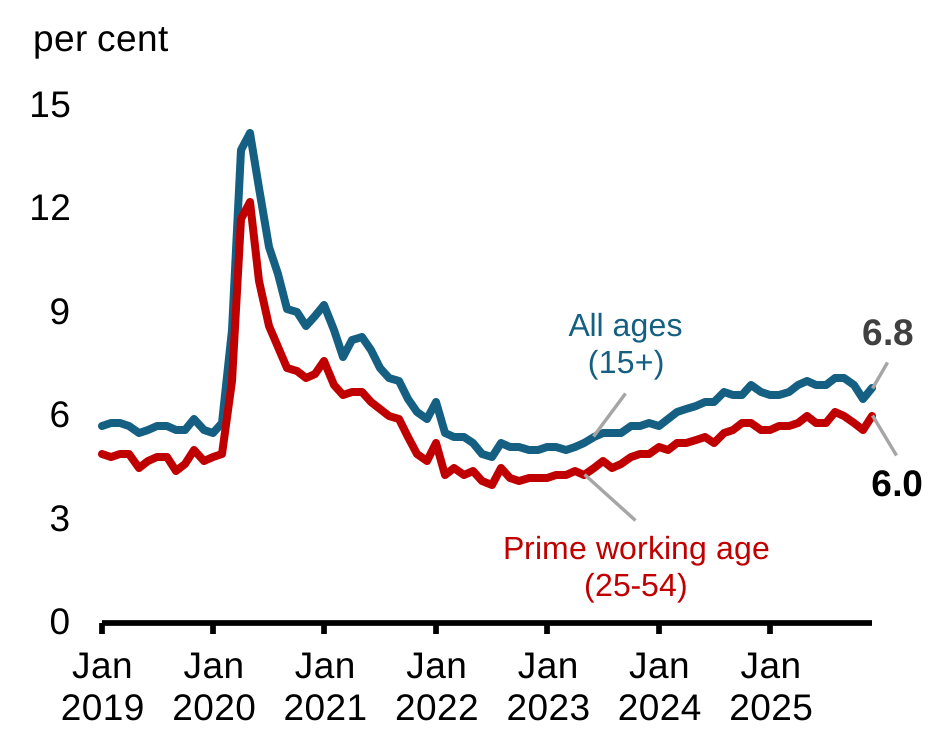
- The unemployment rate is 6.8%, below Budget 2025 expectations, and more people are returning to the labour force.
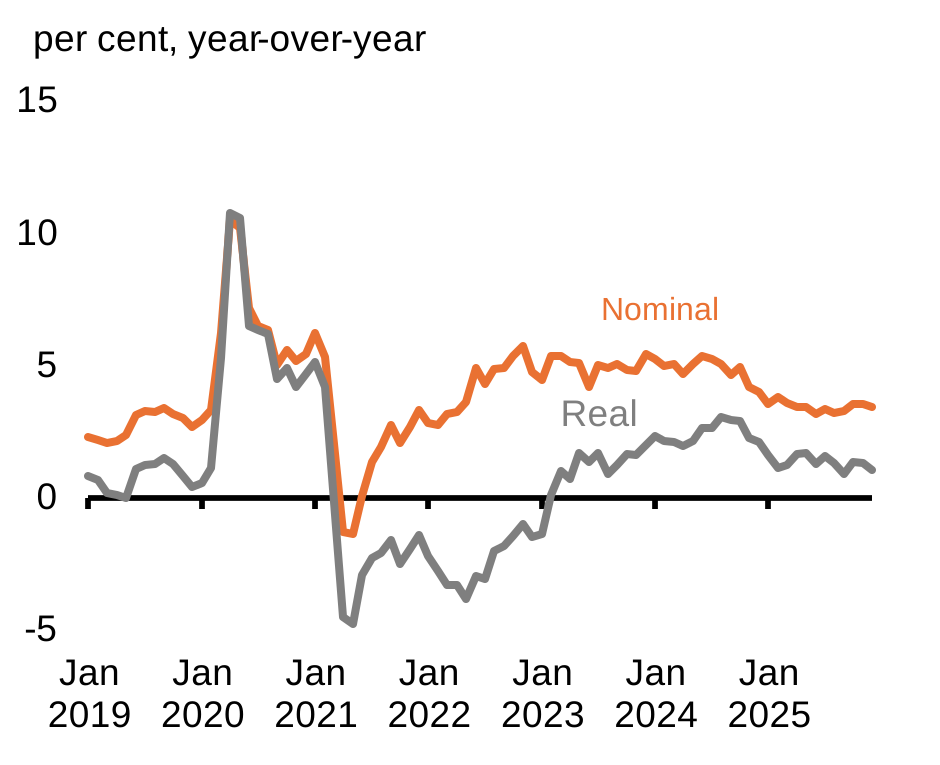
- Nominal average hourly wages rose by 3.4% in December, above the 2010-2019 average of 2.3%.
- Inflation has been close to 2 per cent for two full years, supporting household purchasing power.
- The economy is still expected to remain in a soft patch in the coming months. The trade conflict has weakened demand for exports and heightened uncertainty has led some businesses to postpone expansion plans. This is hampering the economy's ability to grow.
- But strong foundations are in place for growth to pick-up.
- The IMF expects Canada to have the second-strongest economy this year among G7 countries, after the U.S.
- While U.S. tariffs remain a challenge, 85 per cent of Canada's trade with the U.S. is tariff free and Canada enjoys the lowest effective U.S. tariff rate globally at 5.4 per cent.
- Budget 2025 is making significant, strategic capital investments to raise long-term growth and build the strongest economy in the G7.
Details & Supplementary Information
- After a weak first half of 2025, economic activity resumed in the second half of the year as global conditions stabilized and domestic demand held up better than expected. While growth remains subdued, recent data suggest the slowdown has been less pronounced than anticipated at the time of Budget 2025.
- The economic backdrop has improved modestly since Budget 2025 was tabled. Job creation has totaled 159,000 since January of last year, more than 100,000 of which has been in full-time work. This has helped bring the unemployment rate down to 6.8% as of December, below the expectations of private sector economists at the time of Budget 2025.
- Business sentiment is also improving. Firms are adapting to the new trade environment and partly mitigated the impact of tariffs by diversifying export markets and building inventories. Furthermore, 85% of Canada's trade with the U.S. remains tariff-free, and the average tariff rate on Canadian goods is about 5.4%—the lowest among U.S. trading partners.
- Inflation remains well contained. Headline inflation edged up slightly late in 2025 due to temporary factors, while underlying inflation pressures continue to ease overall. This environment has supported real household purchasing power and allowed interest rates to move lower. *Redacted*.
- Looking ahead, the economy is expected to regain momentum gradually throughout 2026. *Redacted*. Risks to Canada's economic outlook remain closely tied to the duration of U.S. tariffs and the uncertainty they create for capital-intensive, globally dependent industries.
- Budget 2025 is making generational investments in housing, infrastructure, defence, productivity and competitiveness. These investments will drive productivity, boost the capacity of Canada's economy and secure a prosperous future for Canadians.
| Quarterly Annualized Growth (2025Q3) |
Year-over-Year Growth (2025Q3/2024Q3) |
|
|---|---|---|
| US | 4.3 | 2.3 |
| Canada | 2.6 | 1.4 |
| France | 2.2 | 0.9 |
| Italy | 0.5 | 0.6 |
| UK | 0.4 | 1.3 |
| Germany | 0.0 | 0.3 |
| Japan | -2.3 | 0.7 |
| 2025 | 2026 | 2027 | |
|---|---|---|---|
| OECD Economic Outlook – December 2025 | 1.1 | 1.3 | 1.7 |
| IMF World Economic Outlook – January 2026 | 1.6 | 1.6 | 1.9 |
| Bank of Canada Monetary Policy Report – January 2026 | 1.7 | 1.1 | 1.5 |
| PBO Economic and Fiscal Outlook – September 2025 | 1.2 | 1.3 | 1.8 |
| *Redacted* | *Redacted* | ||
| Department of Finance – Budget 2025 | 1.1 | 1.2 | 2.0 |
Inflation Narrative
Key Messages
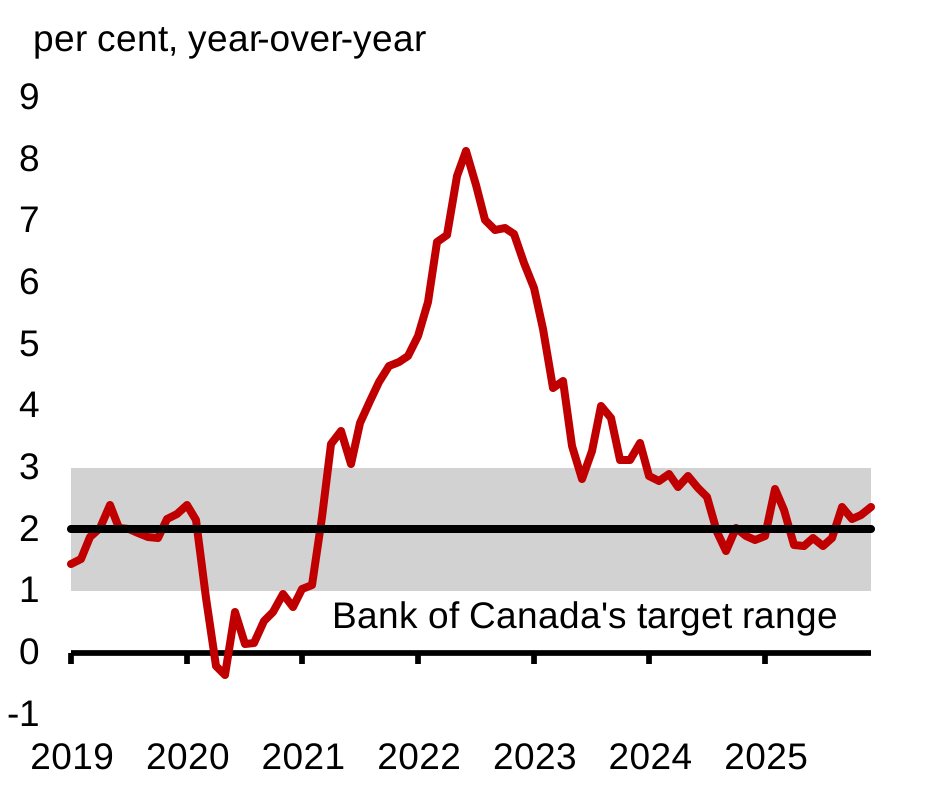
- Inflation remains close to 2%. Headline inflation was 2.4% in December 2025 and has remained within the Bank of Canada's 1-3 % target range for the past 24 consecutive months.
- Inflation is expected to remain near 2%. Both the Bank of Canada and private-sector forecasters anticipate inflation staying close to target over the foreseeable future.
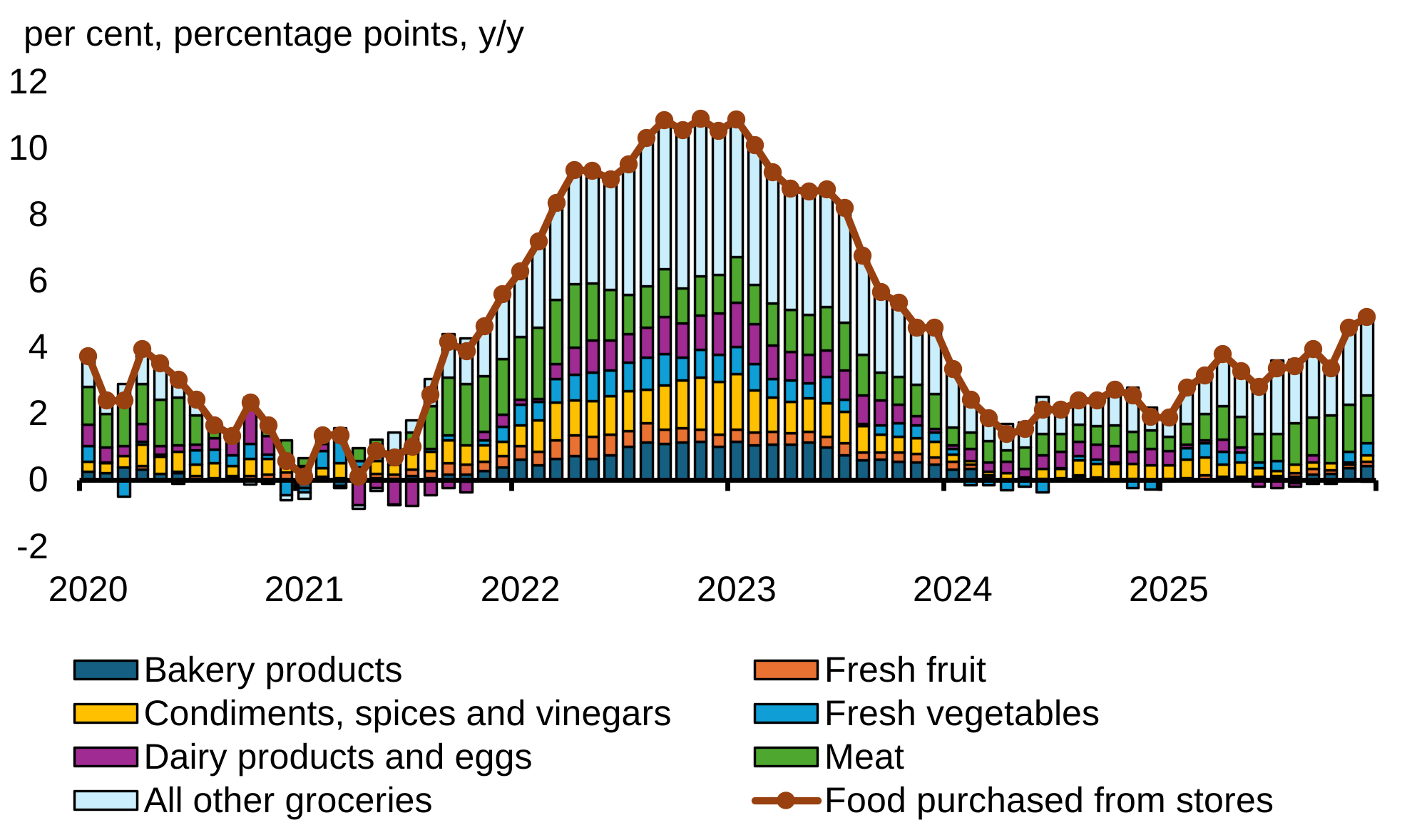
- Canadians remain concerned about the cost of living – including high food prices. In a market economy like ours, there will always be some prices rising faster than 2%, and some more slowly. For example, grocery prices were up 5% in December, while gasoline was down almost 14%.
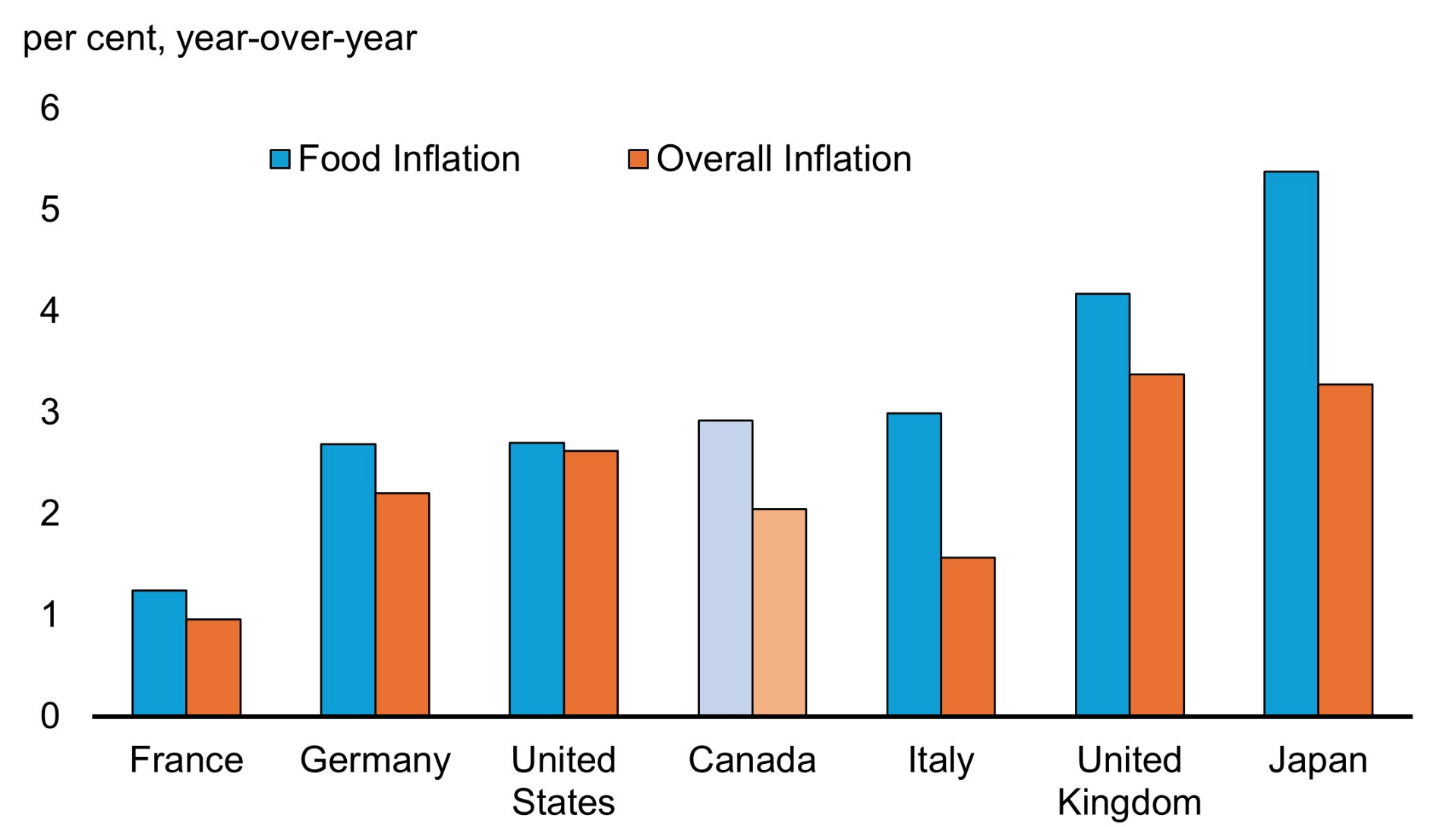
- Elevated food inflation reflects the tail end of input cost pressures earlier this year, and this is not unique to Canada. Many advanced economies have experienced elevated food inflation, and Canada sat roughly mid-range among peer countries in 2025.
- Lower overall inflation has allowed the Bank of Canada to reduce interest rates, which has significantly reduced mortgage costs for Canadians.
- This government recognizes that many Canadians are feeling the pressures of everyday expenses and need relief right now. Building on past actions to provide relief, like the elimination of the consumer carbon price, the government has proposed the new Canada Groceries and Essentials Benefit.
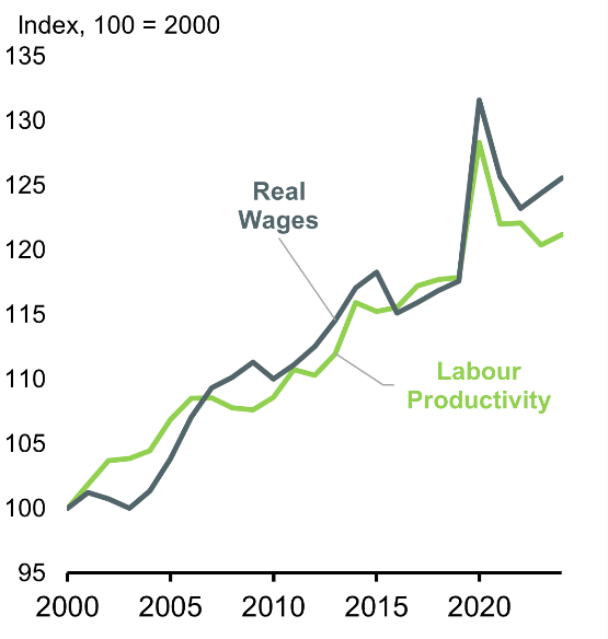
- At the same time, the government continues to plan to create better-paying jobs, increasing productivity and building the strongest economy in the G7, which will support stronger income growth.
Details & Supplementary Information
- Inflation reached a height of 8.1% in June 2022, driven by pandemic-related disruptions, supply chain congestion, and surging commodity prices following Russia's illegal full-scale invasion of Ukraine. Since then, inflation has come down and has been close to 2% for two years.
- In December, inflation picked up to 2.4% from 2.2% in November, reflecting the base-year effects from last winter's temporary GST/HST holiday. This particularly affected services excluding shelter. For example, restaurant prices increased by 8.5% year-over-year. Excluding indirect taxes, inflation eased from 2.8% in November to 2.5% in December.
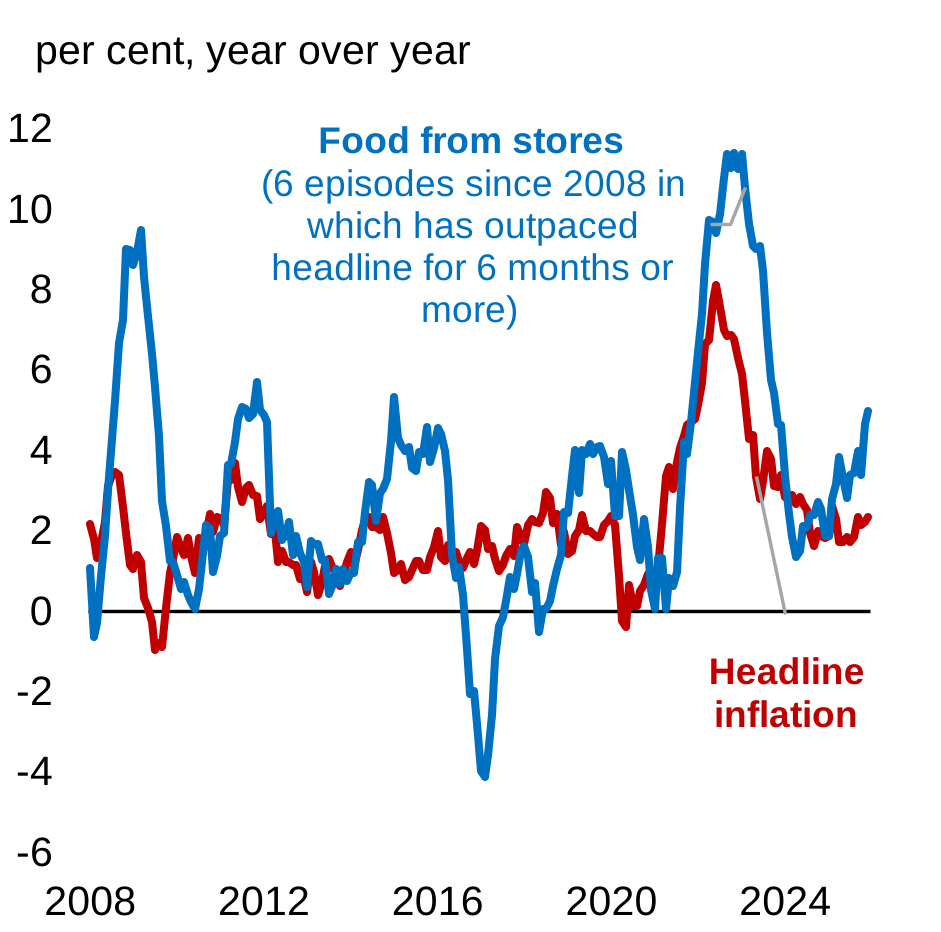
- On the flip side, higher food prices are still being boosted by earlier input cost pressures and this is
mitigating the broader moderation in inflation. The year over year pace for grocery inflation picked up
to 5.0%, well above its historical average of 2.0%.
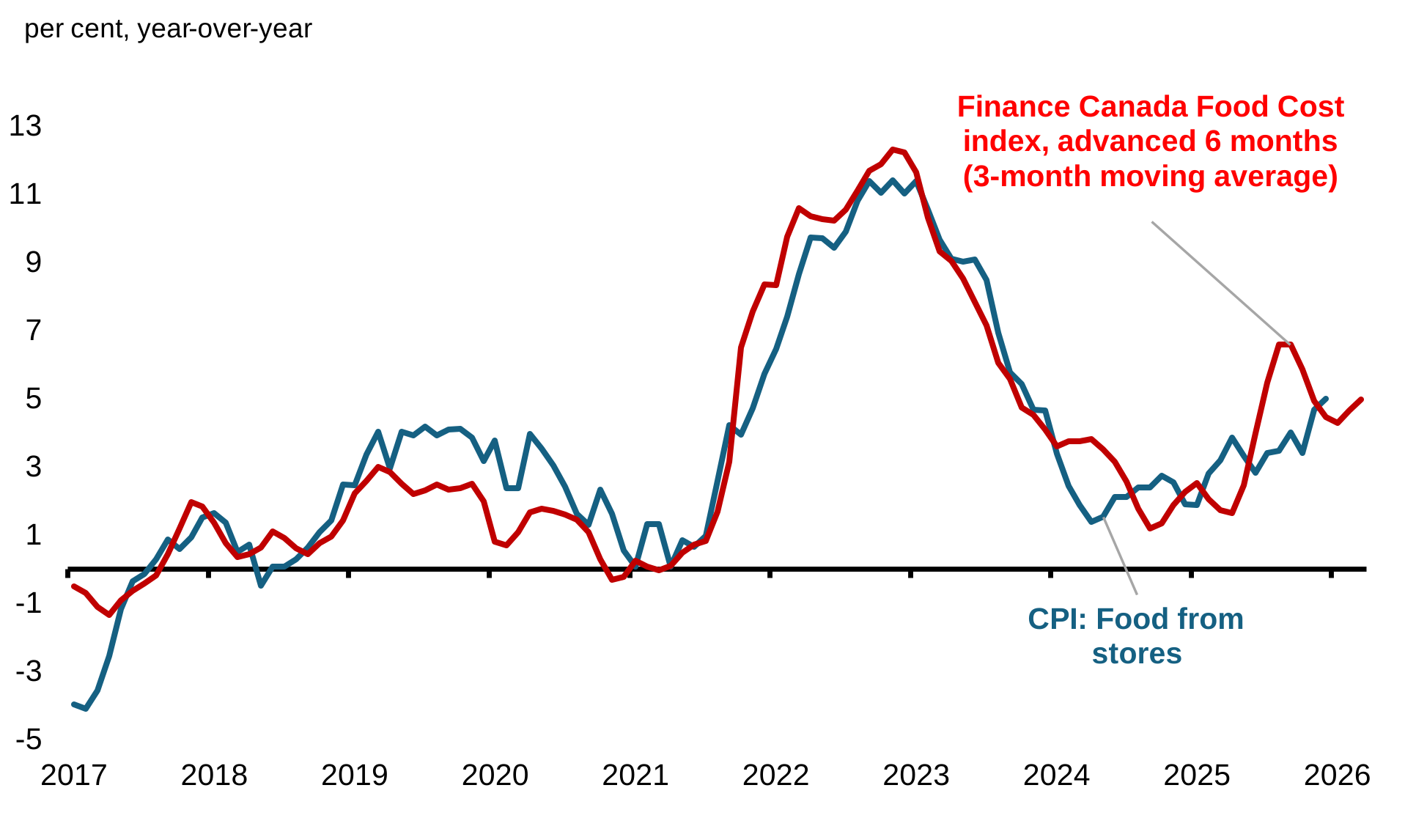
- Low crop yield, severe weather, transportation costs and other input costs have put upward pressures on food prices.
- These cost pressures are being experienced around the world, and Canada sits mid-range among peer countries for 2025.
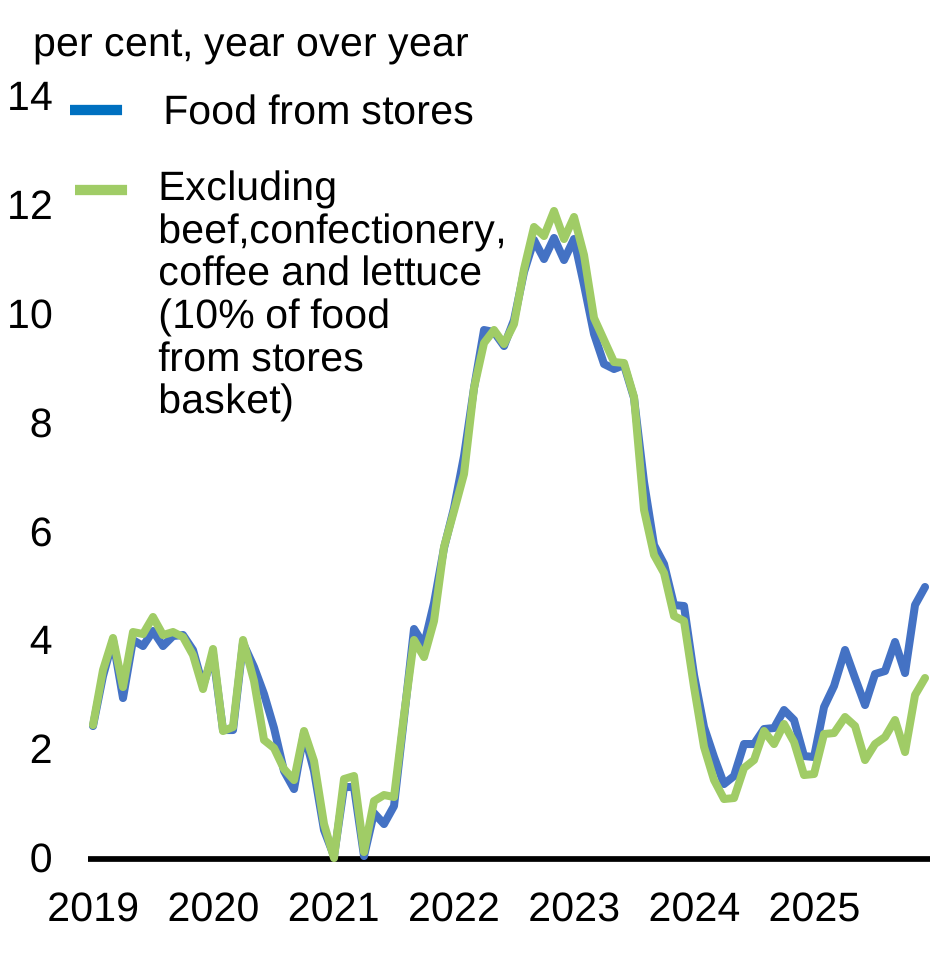
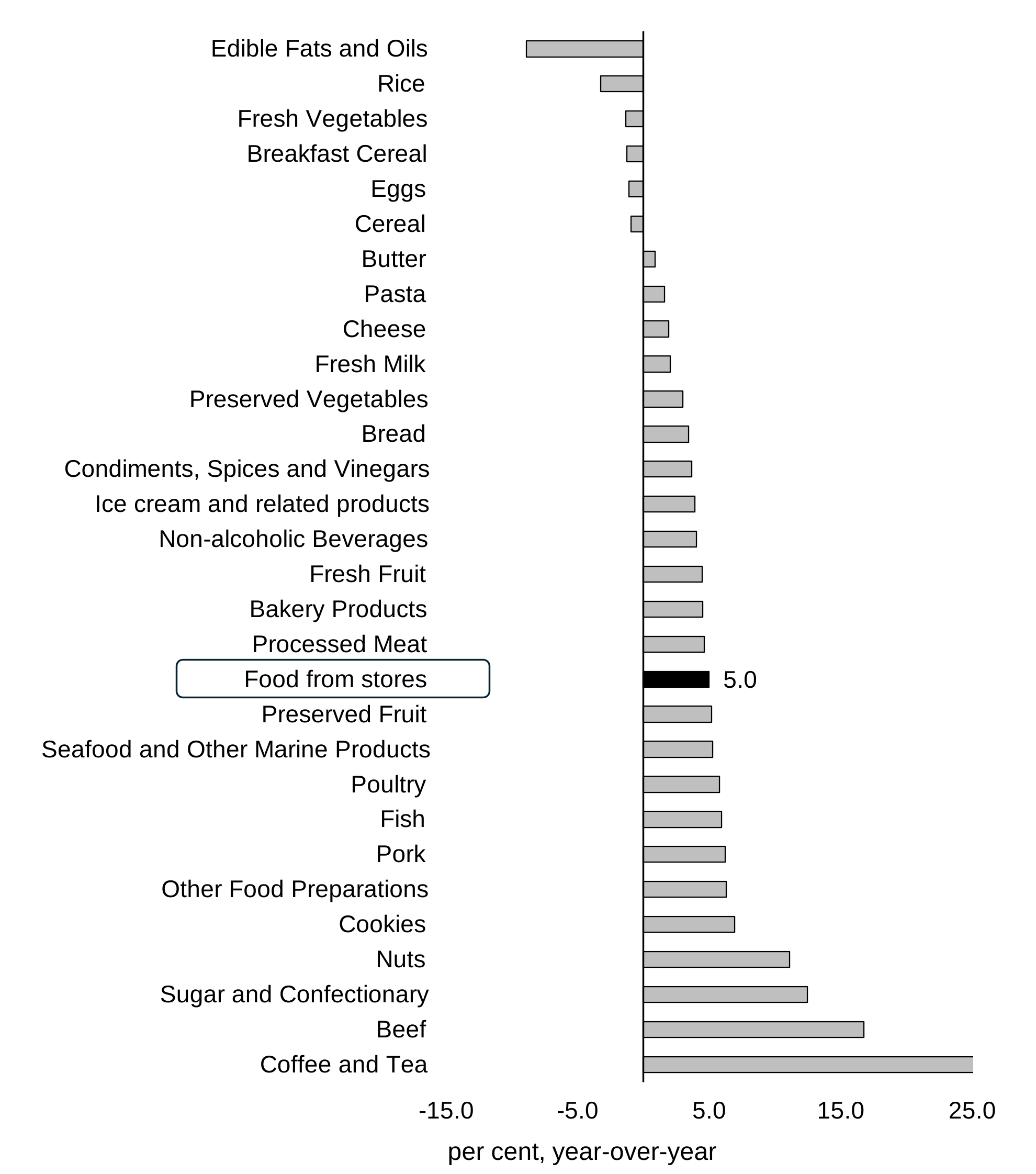
- This is particularly evidenced in inflation for products that are facing supply issues such as beef, poultry, coffee, and confectionary products.
- Growth in input costs has moved lower recently, so food price inflation should ease in the months ahead.
- There are many reasons inflation is expected to remain close to 2%:
- Measures of core inflation continue to ease. The average of measures of core inflation eased to 2.6% in December. The three-month annualized rate dropped to below 2%, showing a significant easing in momentum and pointing to further easing in year over year measures ahead.
- Input cost growth is easing and unit labour costs have been steady.
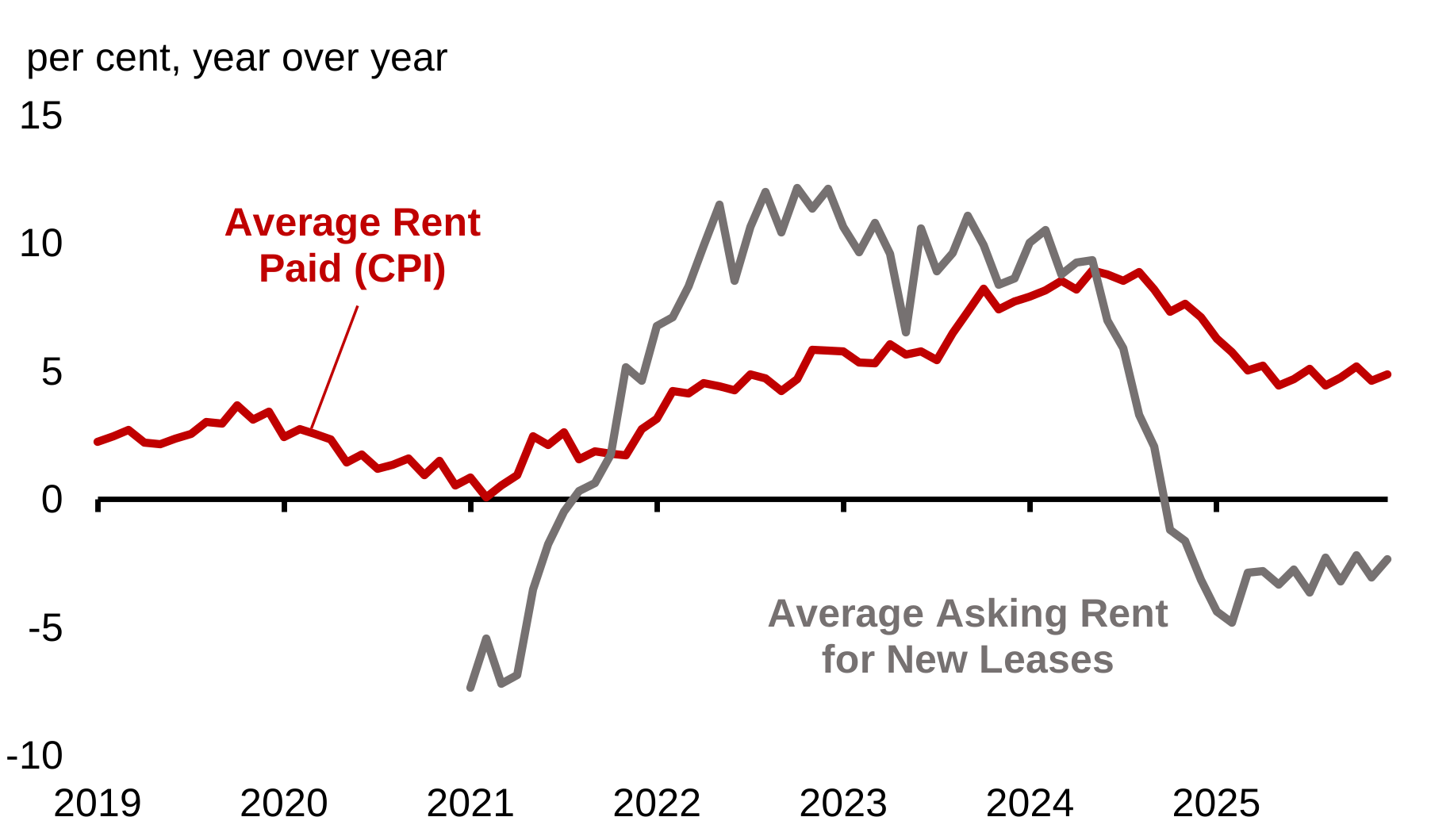
- Rent CPI inflation remains high at 4.9% in December, but slowing population growth and increased construction should contribute to easing pressure. Asking rents for new leases are down $300–400 in Toronto and Vancouver over last two years
| 2025 | 2026 | 2027 | |
|---|---|---|---|
| Finance Private Sector Survey – Budget 2025 | 2.1 | 2.0 | 2.0 |
| Bank of Canada Monetary Policy Report – January 2026 | 2.1 | 2.0 | 2.1 |
| OECD Economic Outlook – December 2025 | 2.0 | 2.1 | 2.0 |
| IMF World Economic Outlook – October 2025 | 2.0 | 2.0 | 2.1 |
| PBO Economic and Fiscal Outlook – September 2025 | 1.9 | 1.6 | 1.8 |
| 2024 Fall Economic Statement – December 2024 | 2.0 | 2.0 | 2.0 |
| Oct-25 | Nov-25 | Dec-25 | Latest Change | |
|---|---|---|---|---|
| Russia | 7.7% | 6.7% | n.a. | -1.0 p.p. |
| OECD | n.a. | 3.9% | n.a. | n.a. |
| G20 | n.a. | 3.6% | n.a. | n.a. |
| United Kingdom1 | 3.8% | 3.5% | n.a. | -0.3 p.p. |
| Norway | 3.1% | 3.0% | 3.2% | 0.2 p.p. |
| Australia2 | 2.4% | 2.1% | 3.2% | 1.1 p.p. |
| Japan | 3.0% | 2.9% | n.a. | -0.1 p.p. |
| Netherlands | 3.1% | 2.9% | 2.8% | -0.1 p.p. |
| United States | n.a. | 2.7% | 2.7% | 0.0 p.p. |
| G7 | n.a. | 2.5% | n.a. | n.a. |
| Canada | 2.2% | 2.2% | 2.4% | 0.2 p.p. |
| Euro area | 2.1% | 2.1% | 2.0% | -0.1 p.p. |
| Denmark | 2.1% | 2.1% | 1.9% | -0.2 p.p. |
| Germany | 2.3% | 2.3% | 1.8% | -0.5 p.p. |
| Italy | 1.2% | 1.1% | 1.2% | 0.1 p.p. |
| China | 0.2% | 0.7% | 0.8% | 0.1 p.p. |
| France | 0.9% | 0.9% | 0.8% | -0.1 p.p. |
| Sweden | 0.9% | 0.3% | 0.3% | 0.0 p.p. |
| Switzerland | 0.1% | 0.0% | 0.1% | 0.1 p.p. |
|
1 Inflation for the U.K. presented here is HCPI (CPI including owner occupied housing costs) for greater comparability with Canada. The U.K.'s headline inflation (excluding owner occupied housing costs and commonly reported in the media) was 3.6% in October. 2 Australia reports inflation on a quarterly basis. Inflation data is for 2025Q1, 2025Q2, and 2025Q3. |
||||
| Aug-2025 | Sep-2025 | Oct-2025 | Nov-2025 | Dec-2025 | 2025 average |
|
|---|---|---|---|---|---|---|
| Norway | 5.4 | 6.3 | 6.2 | 4.7 | 5.2 | 5.7 |
| Japan | 6.5 | 6.6 | 6.5 | 6.1 | 5.8 | 5.4 |
| Denmark | 5.8 | 5.3 | 4.5 | 3.5 | 3.5 | 4.9 |
| Sweden | 4.7 | 3.3 | 3.7 | 3.1 | 3.7 | 4.3 |
| United Kingdom | 5.1 | 4.5 | 4.9 | 4.2 | 4.5 | 4.2 |
| Netherlands | 4.2 | 4.3 | 4.3 | 3.4 | 3.3 | 4.0 |
| Ireland | 5.1 | 4.7 | 4.5 | 4.3 | 4.1 | 4.0 |
| Austria | 5.2 | 3.9 | 4.0 | 3.6 | 3.9 | 3.7 |
| Canada | 3.4 | 3.8 | 3.4 | 4.2 | 6.2* | 3.2 |
| Italy | 4.0 | 3.7 | 2.5 | 1.9 | 2.3 | 2.9 |
| Portugal | 4.0 | 4.0 | 3.5 | 3.5 | 3.5 | 2.8 |
| Belgium | 2.6 | 3.4 | 2.8 | 3.0 | 2.8 | 2.8 |
| United States | 3.1 | 3.0 | n/a | 2.6 | 3.0 | 2.7 |
| Germany | 3.2 | 2.9 | 2.0 | 1.8 | 1.4 | 2.6 |
| Spain | 2.3 | 2.4 | 2.4 | 2.8 | 3.0 | 2.4 |
| Finland | 2.6 | 2.5 | 1.6 | 1.7 | 2.0 | 2.1 |
| Greece | 2.2 | 1.4 | 2.3 | 2.8 | 3.6 | 2.0 |
| France | 1.8 | 1.9 | 1.4 | 1.5 | 1.8 | 1.3 |
| Switzerland | -0.5 | -0.8 | -0.5 | -0.4 | -0.8 | -0.5 |
|
*Includes food from restaurants. * The base-year effect of the December 2024 through February 2025 GST/HST holiday boosted inflation for food in restaurants in Canada in December 2025. This represented a contribution of approximately 1.8 percentage points towards Canada's reported food inflation of 6.2% in the month. Without the GST/HST holiday base year effect, food inflation in Canada would have been about 4.4% in December 2025. |
||||||
| Latest Price ($) | Year-over-year growth (%) | Nov 2019 Price ($) | |
|---|---|---|---|
| Beef top sirloin cuts, per kg | $27.25 | 38.9 | $14.72 |
| Ground beef, per kg | $15.54 | 19.3 | $9.69 |
| Pork rib cuts, per kg | $9.14 | 8.4 | $8.53 |
| Chicken breasts, per kg | $15.19 | 17.1 | $12.21 |
| Chicken thigh, per kg | $11.84 | 3.0 | $10.17 |
| Bacon, 500 g | $7.38 | 15.9 | $5.88 |
| Wieners, 400 g | $4.39 | 5.3 | $3.24 |
| Salmon, per kg | $26.21 | -0.5 | $25.07 |
| Shrimp, 300 g | $7.57 | 2.4 | $6.93 |
| Canned tuna, 170 g | $1.67 | 9.2 | $1.58 |
| Meatless burgers, 226 g | $6.80 | 15.3 | $5.51 |
| Milk, 2 l | $5.38 | 2.1 | $4.19 |
| Cream, 1 litre | $4.69 | 2.6 | $3.62 |
| Butter, 454 g | $5.62 | 0.2 | $3.83 |
| Block cheese, 500 g | $6.86 | -0.3 | $5.87 |
| Yogurt, 500 g | $3.73 | 4.5 | $2.57 |
| Eggs, 1 dozen | $4.74 | -2.3 | $3.50 |
| Apples, per kg | $4.81 | 5.5 | $4.13 |
| Oranges, per kg | $4.46 | 13.8 | $3.45 |
| Bananas, per kg | $1.67 | 1.8 | $1.60 |
| Strawberries, 454 g | $6.66 | 12.3 | $4.79 |
| Potatoes, per kg | $5.00 | 2.7 | $4.07 |
| Tomatoes, per kg | $5.06 | -13.9 | $4.67 |
| Carrots, 1.36 kgs | $3.09 | -12.2 | $2.50 |
| Onions, per kg | $5.36 | -4.5 | $4.26 |
| Celery, unit | $3.34 | 0.0 | $2.74 |
| Cucumber, unit | $1.66 | -7.3 | $1.88 |
| Mushrooms, 227 g | $2.26 | -7.8 | $1.88 |
| Iceberg lettuce, unit | $3.93 | 22.8 | $2.82 |
| Broccoli, unit | $2.58 | -1.9 | $2.58 |
| Peppers, per kg | $8.89 | -5.6 | $7.09 |
| Salad greens, 142 g | $4.48 | -0.4 | $3.99 |
| Frozen french fries, 750 g | $3.69 | 3.9 | $2.34 |
| Frozen vegetables, 750 g | $4.12 | 7.6 | $3.17 |
| Frozen pizza, 390 g | $4.71 | -1.7 | $4.05 |
| White bread, 675 g | $3.55 | 1.7 | $2.83 |
| Cookies, 300 g | $0.00 | 0.0 | $0.00 |
| Dry or fresh pasta, 500 g | $3.32 | 7.8 | $2.39 |
| White rice, 2 kgs | $9.59 | 3.2 | $7.77 |
| Cereal, 400 g | $4.21 | 1.4 | $3.15 |
| Wheat flour, 2.5 kgs | $5.03 | -1.9 | $4.43 |
| White sugar, 2 kgs | $2.97 | 4.2 | $2.09 |
| Orange juice, 2 l | $6.26 | 12.2 | $3.55 |
| Roasted/ground coffee, 340 g | $0.00 | 0.0 | $0.00 |
| Tea (20 bags) | $4.29 | 4.9 | $3.36 |
| Ketchup, 1 litre | $4.82 | 0.4 | $3.23 |
| Vegetable oil, 3 l | $10.30 | 3.7 | $6.13 |
| Baby food, 128 ml | $1.56 | -1.9 | $1.30 |
| Infant formula, 900 g | $50.97 | 11.5 | $29.47 |
| Peanut butter, 1 kg | $6.07 | -0.7 | $4.44 |
| Mayonnaise, 890 ml | $6.28 | -1.9 | $4.33 |
| Canned baked beans, 398 ml | $1.73 | -4.4 | $1.09 |
| Canned soup, 284 ml | $1.36 | 2.3 | $1.01 |
| Dry beans and legumes, 900 g | $3.45 | 1.5 | $2.80 |
| Tofu, 350 g | $2.88 | 8.3 | $2.26 |
| Hummus, 227 g | $3.69 | -1.3 | $3.40 |
| Salsa, 418 ml | $4.89 | 4.9 | $3.31 |
| Pasta sauce, 650 ml | $3.41 | 3.3 | $2.17 |
| Salad dressing, 475 ml | $3.52 | 4.1 | $2.44 |
| Almonds, 200 g | $5.21 | 14.3 | $4.93 |
| Peanuts, 450 g | $4.35 | 13.3 | $2.99 |
Productivity Narrative
Key Messages
- Productivity growth is the driving force behind sustained increases in living standards and economic competitiveness.
- When productivity grows, everyone benefits. The wages and incomes of hard-working Canadians rise, businesses have the conditions to grow and to create more jobs, and Canada stays competitive in global markets.
- A strong economy driven by productivity growth also provides the revenues needed to fund public services that Canadians count on.
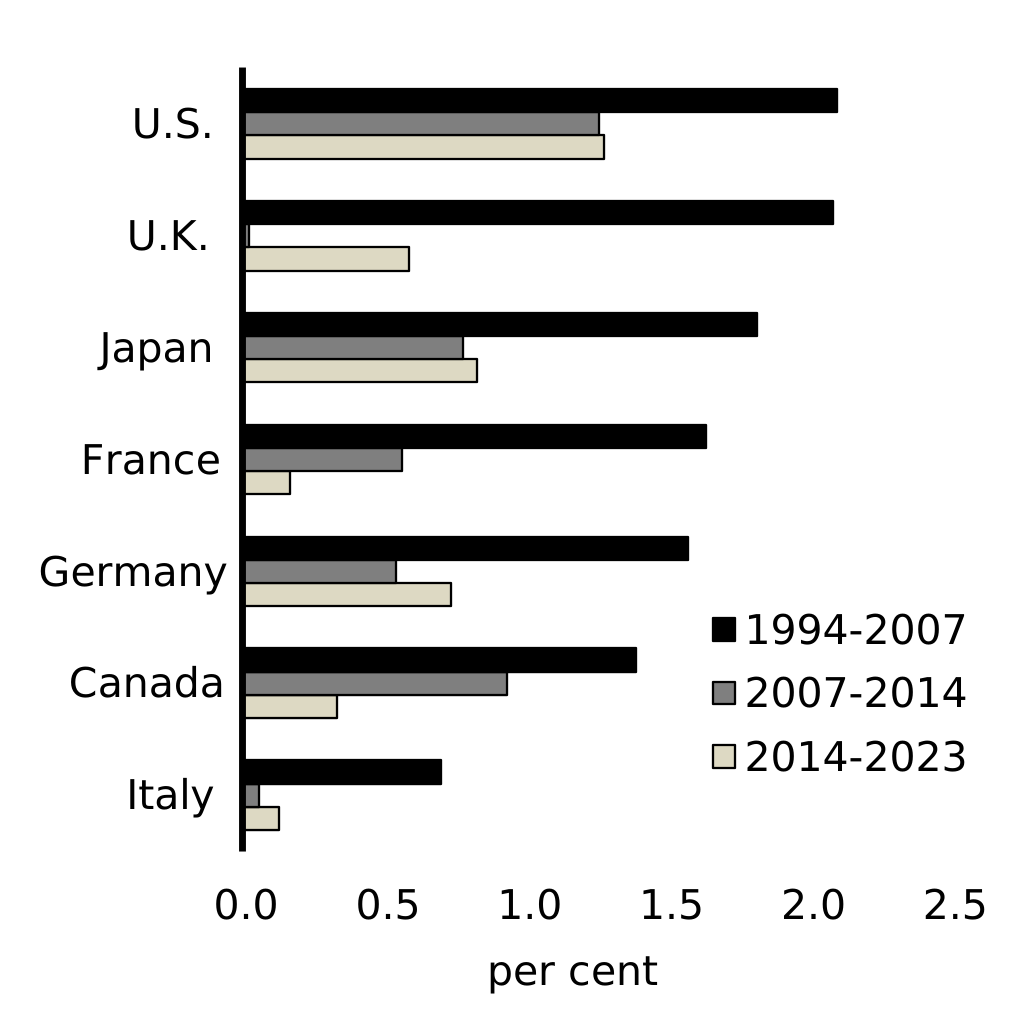
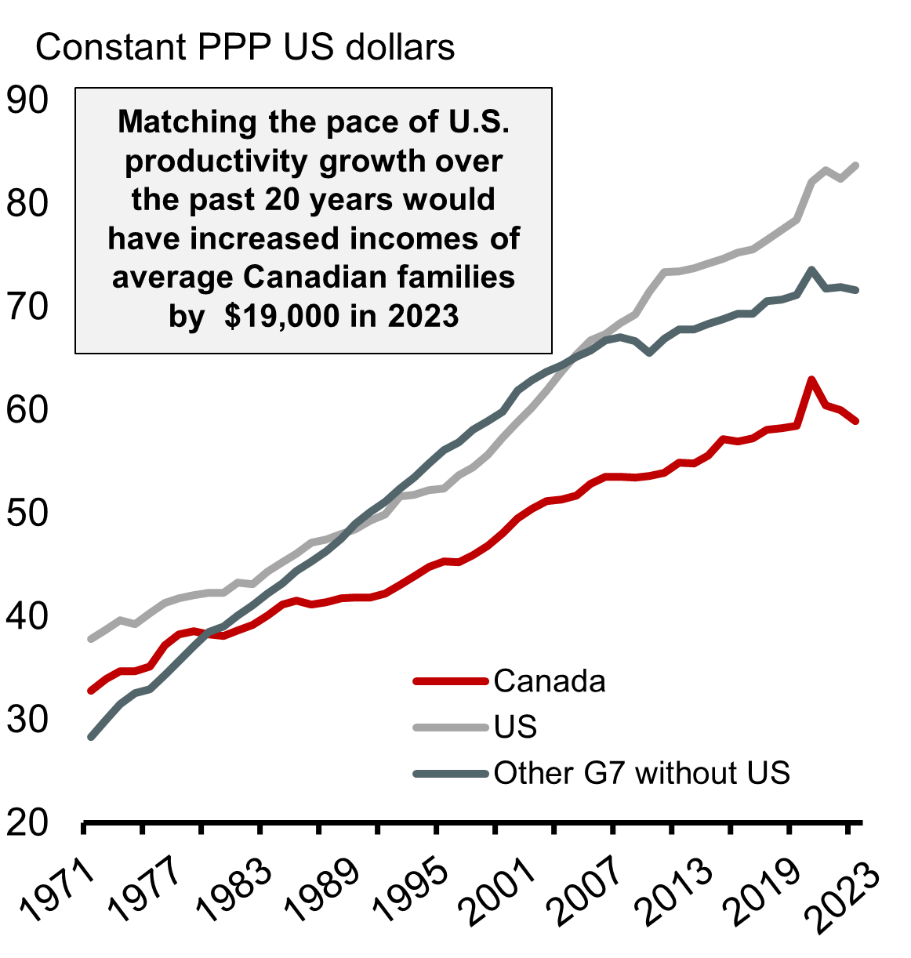
- Canada's productivity growth lags that of other G7 economies. Over the past decade, Canada's productivity grew by only 0.3 per cent annually.
- The economic impact of this gap is significant—if Canada's productivity growth had matched the U.S. from 2017 to 2023, the median income of a family with one child would be nearly $11,000 higher.
- Perennially weak productivity growth is closely tied to longstanding weakness in business investment.
- For decades, Canadian firms have invested less per worker than their American counterparts.
- Across many sectors, Canada's economy has seen weak investment in machinery and equipment, research and development, and intangible assets like intellectual property, data, and software.
- The most immediate way to jumpstart productivity growth is to address structural impediments and increase investment—in machinery, equipment, innovation, and infrastructure that allow workers to build faster and at a more competitive cost.
- Budget 2025 does exactly this with significant investments in infrastructure and emerging technologies, lower taxes on new investment and research and development—including through a Productivity Super-Deduction—and regulatory reforms to cut red tape, accelerate major projects, and increase competition.
Details & Supplementary Information
- Canada's productivity growth has been persistently weak and has generally lagged most G7 peers (Chart 1).
- From 2014 to 2023, it slowed to well below its pace over the 1994–2014 period.
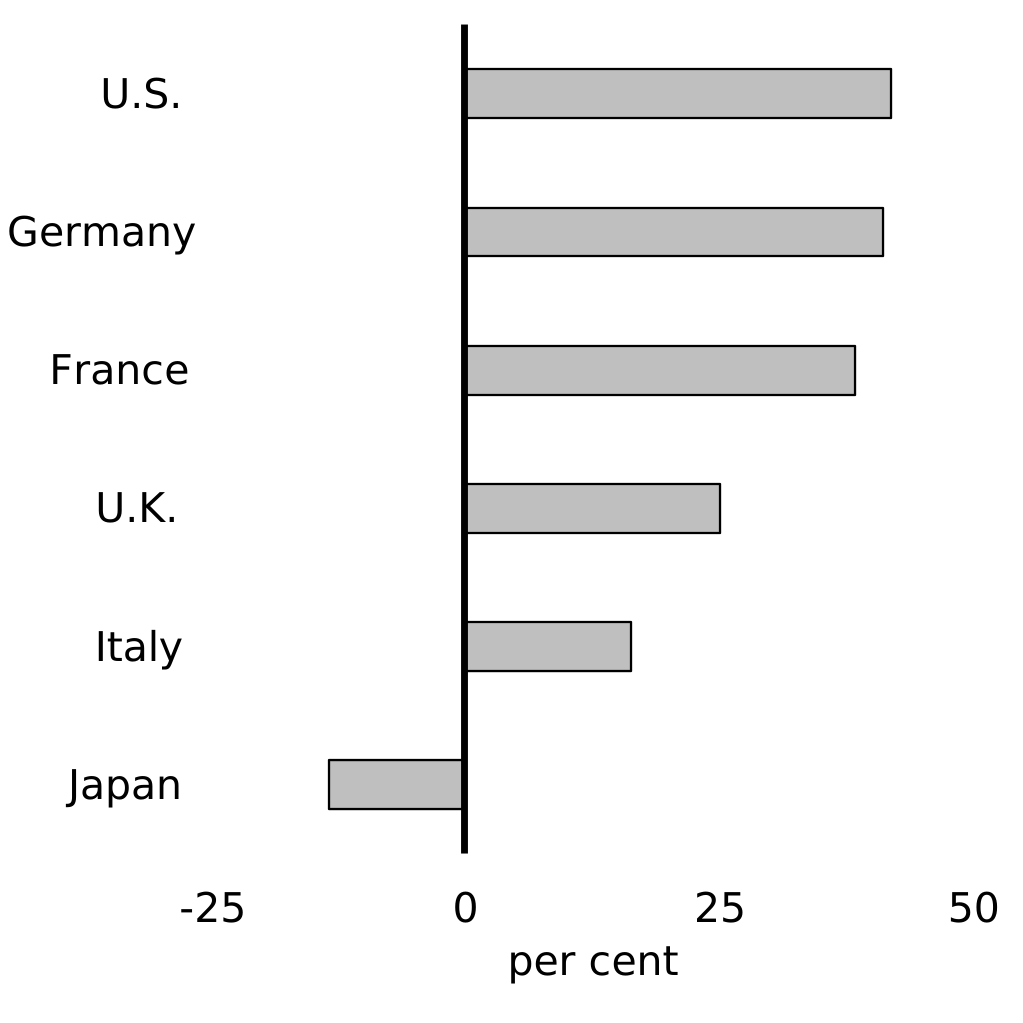
- This has contributed to a substantial productivity level gap between Canada and other G7 economies (Chart 2).
- The economic impact of this gap is significant—if Canada's productivity growth had matched the U.S. from 2017 to 2023, the median income of a family with one child would be nearly $11,000 higher.
Labour Productivity Growth, Total Economy, G7
Labour Productivity Level Relative to Canada, Total Economy, 2023
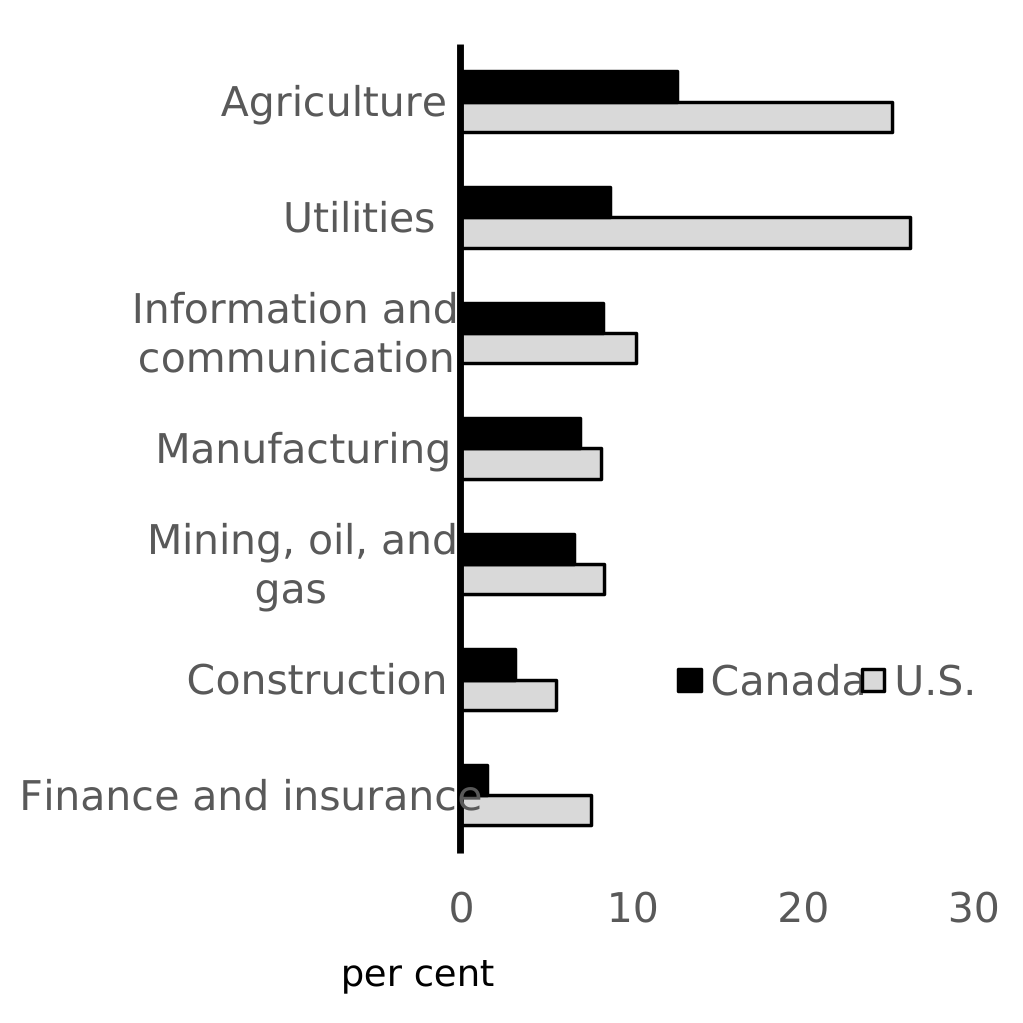
- Low business investment has been an important reason for our low productivity growth. Investment intensity in machinery and equipment and intangible assets, key drivers of productivity, have been lower than in the U.S for decades. As well, this investment gap has been pervasive across sectors (Chart 3).
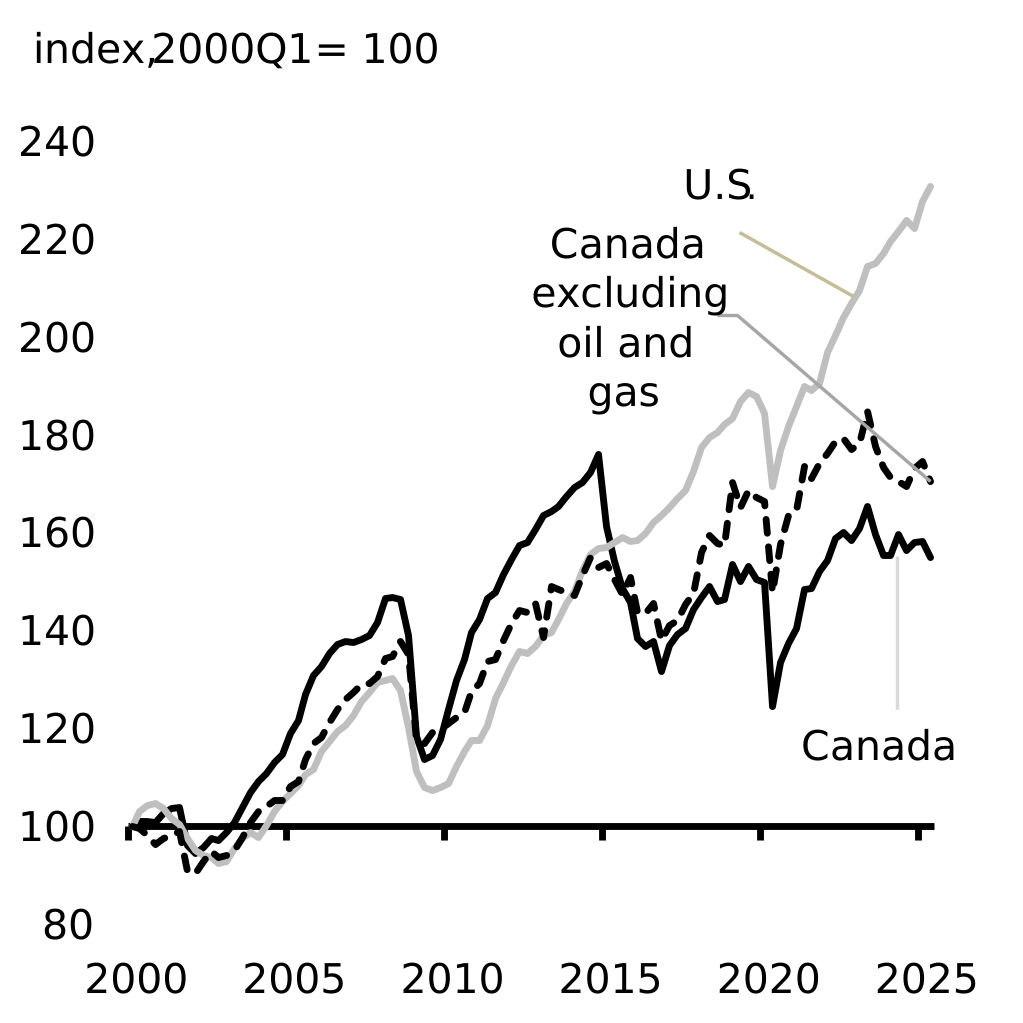
- Since 2015, Canada's relatively poor investment performance has worsened. Business investment in
Canada has been flat over the past decade, while business investment in the U.S. has risen sharply
(Chart 4).
- Much of this gap has been driven by a retrenchment in capital spending by Canada's energy sector following the sharp decline in global oil prices in 2015, and the contrasting increase in U.S. technology investment in recent years.
Machinery and Equipment Investment as a Share of Value Added by Industry, 2019
Real Business Investment Since 2000, Canada and U.S.
- Businesses often perceive the risks and costs of investments in high-risk and innovative assets as outweighing the rewards, a mindset reinforced by structural impediments such as the regulatory environment, limited competition, and scale constraints.
- The most immediate way to jumpstart productivity growth is to address structural impediments and increase investment—in machinery, equipment, innovation, and infrastructure that allow workers to build faster and at a more competitive cost.
- With a new comprehensive industrial strategy, the Budget 2025 is investing in trade diversification, housing and infrastructure, and advanced technology that can unlock Canada's economic potential. At the same time, it is providing tax incentives for new investment by the private sector. The government is also streamlining regulations and project approval process while promoting competition in key network sectors (i.e., telecom, financial service) to remove impediments to productivity growth.
The following provides further detail about Canada's relative investment performance in productive assets.
| 2000 | 2005 | 2010 | 2015 | 2020 | 2023 | |
|---|---|---|---|---|---|---|
| Canada | 1.1 | 1.1 | 0.9 | 0.9 | 1.1 | 1.1 |
| United States | 2.0 | 1.7 | 1.9 | 2.0 | 2.6 | 2.7 |
| OECD | 1.5 | 1.5 | 1.5 | 1.6 | 1.9 | 2.0 |
| Ratio Canada/U.S. | 0.6 | 0.6 | 0.5 | 0.4 | 0.4 | 0.4 |
| Ratio Canada/OECD | 0.7 | 0.7 | 0.6 | 0.6 | 0.6 | 0.5 |
| Software & Database | ICT Hardware | Total | |
|---|---|---|---|
| U.S. | 2.4 | 1.2 | 3.7 |
| Japan | 1.9 | 1.3 | 3.2 |
| France | 2.6 | 0.4 | 3.0 |
| U.K. | 2.1 | 0.7 | 2.8 |
| Canada (Ratio Canada / U.S.) | 1.6 (0.64) | 1.0 (0.78) | 2.5 (0.69) |
| Italy | 1.5 | 0.8 | 2.3 |
| Germany | 0.8 | 0.7 | 1.4 |
Fiscal Narrative
Key Messages
- At this pivotal moment, Canada faces a changing global order from a position of strength. With Budget 2025, the government is making generational investments that will protect and transform our industries, strengthen our economy, and empower Canadians.
- To remain fiscally sustainable, these investments are anchored by a new approach to fiscal discipline
and strategic investment. One that:
- Balances day-to-day operating spending with revenues by 2028–29, shifting spending toward investments that grow the economy; and
- Maintains a declining deficit-to-GDP ratio to ensure disciplined fiscal management for future generations.
- As announced in Budget 2025, the Comprehensive Expenditure Review will rein in government spending—saving $13 billion annually by 2028-29, for a total with other savings and revenues of $60 billion over five years.
- With these efforts, Budget 2025 makes the investments needed to grow our economy, while meeting both fiscal anchors, with a deficit of $78.3 billion, or 2.5 per cent of GDP in 2025-26, falling to $56.6 billion, or 1.5 per cent of GDP by 2029-30.
- Budget 2025 also projects the federal debt-to-GDP ratio to remain relatively stable across the horizon, rising from 42.4 per cent in 2025-26 to 43.1 per cent in 2029-30.
- As detailed in the latest Fiscal Monitor, the budgetary deficit for the April to November period of the 2025-26 fiscal year was $26.4 billion, compared to a deficit of $22.7 billion for the same period of 2024-25.
If pressed, contingent liability
- A contingent liability is recorded when the probability of a future payment is considered likely and the amount can be reasonably estimated.
- As of 2024-25, the total contingent liabilities recorded in the Public Accounts was $55 billion. The majority of this is associated with active alternative dispute resolution processes and pending or potential litigation.
Details & Supplementary Information
Table A1.7 outlines the summary of statement of transactions from Budget 2025.
Fiscal anchors in Budget 2025:
Balance operating spending with revenues by 2028-29, shifting the composition of spending from day-to-day operations to investments that support capital formation and productivity.
Maintain a declining deficit-to-GDP ratio, reflecting disciplined fiscal management that safeguards economic stability for future generations.
Source: Fiscal anchors, Page 59, Economic and Fiscal Overview, Budget 2025.
The following graph outlines the stock of total contingent liabilities since 2011-12.
Annual Stock of Contingent Liabilities from 2011-12 to 2024-25
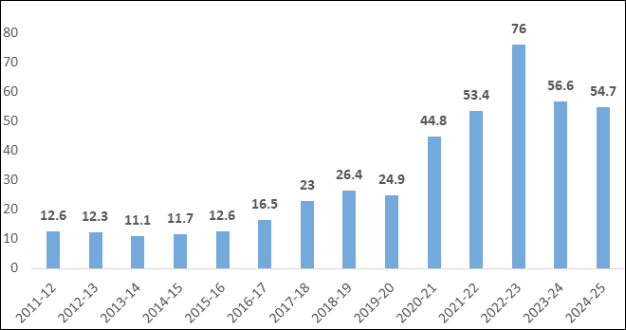
Each year previously recognized contingent liabilities may be reduced or extinguished through payments, while new obligations or revaluations are recorded to reflect updated estimates. The resulting balance represents the stock of outstanding contingent liabilities.
Changes in provisions due to revisions in estimates or the addition of new obligations are reflected in direct program expenses in the budget and impact the budgetary balance in the year the liabilities are recorded. In recent years, this expense has averaged over $10 billion per year.
Debt Management Strategy 2026-27
Key Messages
- The 2026-27 domestic borrowing program is projected to be $589 billion, $20 billion lower than
in 2025-26 ($609 billion).
- Despite an increase of financial requirements, the year-over-year reduction of the borrowing program is due to fewer bond maturities.
- The maturity of COVID-era 5-year bonds led to an elevated maturity profile in 2025-26.
- The Budget proposes to increase the maximum amount of borrowing under Section 4 of the Borrowing Authority Act (BAA) from $2,126 billion to $2,541 billion to ensure uninterrupted borrowing capacity to meet government's priorities over the next three fiscal years.
- Public debt charges for 2025-2026 were 1.8% of GDP, far below the long-term average of 3.2% over the past 40 years.
- Canada has the lowest net debt-to GDP ratio in the G7 (12.5% for 2025), according to the IMF.
- Canada is rated AAA by S&P, Moody's and DBRS, and AA+ by Fitch.
Details & Supplementary Information
Q: Can you provide a breakdown of the domestic borrowing program?
Q: What is the Government's average term to maturity?
The Average Term to Maturity (ATM) of the government's market debt at the end of 2024-25 was 6.47 years. ATM is expected to be 6.80 years by the end of 2025-26 and 6.75 years by the end of 2026-27.
This is in the range of 6-7 years seen in recent years and represents a prudent balance of cost and risk. It is also within the range of Canada's peers.
| Canada | Australia | Germany | U.S. | U.K. | France | Japan | Italy | |
|---|---|---|---|---|---|---|---|---|
| ATM | 6.5 | 6.3 | 7.8 | 5.9 | 13.9 | 8.5 | 8.7 | 7.1 |
| Source: Bloomberg, as of March 31 2025 | ||||||||
Q: What is the amount of outstanding debt stock under the BAA?
Public Accounts 2025 reflect that the debt stock under the BAA was estimated at $1,787 billion at the end of March 31, 2025. The debt stock is projected to reach $1,928 billion by the end 2025-26. The maximum debt stock under the BAA includes Government of Canada market debt securities, eligible borrowings from agent Crown corporations, and Canada Mortgage Bonds (CMBs) not held by the Government of Canada.
Q: How did you arrive at the proposed maximum BAA amounts?
The proposed $2,541 billion includes:
- the expected debt stock of $1,787 billion as of March 31, 2025 (per Public Accounts),
- the government's anticipated incremental borrowing needs until March 31, 2029, of $580 billion (per Budget Annex 1 financial sources and uses)
- the expected net increase in outstanding CMBs of $47 billion over the same period,
- $12.5 billion of anticipated incremental borrowing by agent Crown corporations (per corporate plans) over the same period, and
- a contingency margin, as has been the practice in the three previous maximum borrowing amounts.
Q: When will the government issue a Transition Bond?
The government remains committed to regular green bond issuances and will explore the development of a sustainable bond framework that would allow the issuance of both green and transition bonds.
Work is underway to develop Canada's sustainable investment guidelines (also known as a taxonomy) by the end of 2026. These guidelines will credibly identifying "green" and "transition" investments and are required to support the development of transition bonds.
International Trade
Key Messages
- The government's primary focus is on diversifying our trade partnerships and attracting investment into Canada. Canada has what the world wants, including strong fundamentals, energy, critical minerals, sophisticated investors, and the most educated population in the world.
- Canada has secured a dozen international trade and security partnerships on four continents in six months. We are also the only G7 country with a free trade agreement with all the other G7 countries.
- The government remains prepared to engage with the U.S. to resolve outstanding tariffs, as well as on the upcoming CUSMA review.
Trade Relations with the United States
- The U.S. maintains harmful and unjustified tariffs on Canadian exports in strategic sectors – 50 per cent on steel, aluminum, and copper products, 25 per cent on autos and trucks, and 10 per cent on lumber. Tariffs also apply on upholstered furniture and kitchen cabinets (25 per cent) and buses (10 per cent).
- The government continues to maintain tariffs on imports on $51.4 billion of annual steel, aluminum,
and autos imports from the U.S. – sectors directly affected by U.S. actions – to defend our interests.
- With respect to the Public Accounts of Canada 2025, of the $6.3 billion in total customs import duties for FY2024–25, $388 million (net amount) are attributed to the counter-tariffs on imports from the U.S.
- This figure is relatively low since some of the countermeasures were only implemented as of March 2025, near the end of the fiscal year.
- Budget 2025 projects net revenues from the counter-tariffs to amount to approximately $4.4 billion for the 2024-25 to 2026-27 fiscal years.
- While we work to achieve reductions in U.S. tariffs, the government is focused on improving Canada's resilience, such as strengthening our steel sector, increasing global competitiveness, and further diversifying our trade.
Trade Relations with China
- China is the world's second-largest economy and Canada's second-biggest trading partner, with $130.9 billion in two-way trade in 2024.
- To diversify our trade partnerships and increase Canada's economic resilience, the government is focused on pursuing a pragmatic, results-driven relationship with China.
- To that end, Canada reached an agreement-in-principle to remove tariffs and to boost exports to China by 50 per cent by 2030.
- Together, these results will help unlock nearly $3 billion in export orders for Canadian workers and businesses. Both countries will also keep working to resolve remaining trade challenges in the months ahead.
- The agreement-in-principle includes commitments on electric vehicles (EVs), agriculture, seafood, and
steel and aluminium:
- For EVs, Canada committed to eliminate the 100 per cent surtax for 49,000 units.
A portion of the quota volumes (reaching 50 per cent by 2030) will be reserved for
imports of low-priced EVs of $35,000 or less, to ensure the availability of affordable EVs.
- This represents less than 3 per cent of Canada's new vehicle market and restores import volumes to 2023-24 levels before the 100 per cent surtax took effect in October 2024.
- For EVs, Canada committed to eliminate the 100 per cent surtax for 49,000 units.
A portion of the quota volumes (reaching 50 per cent by 2030) will be reserved for
imports of low-priced EVs of $35,000 or less, to ensure the availability of affordable EVs.
- For the surtaxes on Chinese steel and aluminum, Canada committed to extend the remission, which expired at the end of 2025, for the 2026 calendar year and to add nine products to that remission, in addition to certain steel derivative goods (i.e., metal furniture).
- In return, Canada expects China to reduce the combined tariff on canola seed from 84.8 per cent to approximately 15 per cent and to suspend its anti-discrimination tariffs on canola meal of 100 per cent, and on lobster, crab and peas at 25 per cent from March 1 to December 31, 2026.
Details & Supplementary Information
Current U.S. tariffs imposed on Canadian goods
- In aggregate, the current U.S. effective tariff rate against all Canadian exports is estimated to be 5.4 per cent, with 85 per cent of Canadian exports entering the U.S. tariff-free.
- U.S. International Emergency Economic Powers Act (IEEPA) tariffs: As of August 1, 2025, U.S. tariffs of 35 per cent on all Canadian non-CUSMA originating goods, and 10 per cent on energy resources (including critical minerals) and potash imports. Currently, 97.5 per cent of Canadian exports covered by the IEEPA tariffs are CUSMA-compliant and enter the U.S. duty-free. The U.S. Supreme Court is expected to rule on the legality of these tariffs in early 2026.
- U.S. Section 232 Tariffs: The U.S. currently maintains Section 232 "national security" tariffs on $150.5 billion of Canadian exports in specific sectors. These include: steel, aluminum, copper, non-CUSMA compliant autos and trucks and CUSMA-compliant auto and truck parts, lumber and wood products (i.e., upholstered furniture, kitchen cabinets and vanities) and buses. The U.S. also maintains tariffs on certain advanced computing chips and derivatives, as well non-CUSMA compliant pharmaceutical products, but the impacts of these are more limited for Canada
- Potential future Section 232 sectoral tariffs: The Section 232 investigation on processed critical minerals and their derivative products (PCMDPs) is completed, with the President directing negotiations on a trade agreement with the threat of tariffs if negotiations to adjust the imports of PCMDPs into the U.S. are unsuccessful. Additional Section 232 investigations are ongoing for the following sectors, which could result in additional tariffs: (1) commercial aircraft and jet engines; (2) polysilicon; (3) unmanned aircraft systems; (4) wind turbines and their components; (5) robotics and industrial machinery; and (6) medical products.
Canadian counter-tariffs on the U.S. and tariff-based mitigation measures
- Canada initially imposed counter-tariffs on the U.S. affecting approximately $95 billion of annual imports from the U.S. Since September 1, 2025, the government has maintained counter-tariffs on $51.4 billion of annual steel, aluminum, and autos imports from the U.S. (sectors directly affected by U.S. actions).
- To minimize the negative effects of the counter-tariffs, the government established a remission framework to provide exceptional tariff relief on a case-by-case basis. More broadly, the government has extended temporary tariff relief (remission), until June 30, 2026, for all goods imported from the U.S. for the manufacturing of motor vehicles, aerospace goods, and their parts, as well as those that support public health, public safety, and national security. Tariff remission is also provided for goods used in manufacturing, processing, food and beverage packaging, or agricultural production to provide time for Canadian businesses to adjust their supply chains, until January 31, 2026 (for steel imports) and June 30, 2026 (for aluminum imports).
- For autos, the government provided a performance-based remission framework that allows automakers to import a certain number of U.S.-assembled, CUSMA-compliant vehicles into Canada, free of the counter-tariffs. This remission is contingent on the automakers continuing to produce vehicles in Canada and on completing planned investments. In this context, on October 23, 2025, the government reduced General Motors' annual remission quota by 24.2 per cent, and Stellantis' annual remission quota by 50 per cent, in response respectively to GM's decision to reduce their production in Oshawa and in Ingersoll facilities, and Stellantis' decision to cancel its production plans for the Brampton assembly plant. The remission framework will remain in force until April 2026.
Revenues from U.S. counter-tariffs
- As of October 17, 2025, the government assessed more than $3.7 billion revenue, net of remissions and other relief programs, from Canada's counter-tariffs on U.S. goods, as detailed in Chart A1.1 of Budget 2025.
- For the 2024-25 to 2026-27 fiscal years, combined net revenues from the counter-tariffs are projected in Budget 2025 to amount to approximately $4.4 billion, as detailed in the table below.
| 2024– 2025 |
2025– 2026 |
2026– 2027 |
2027– 2028 |
2028– 2029 |
2029– 2030 |
|
|---|---|---|---|---|---|---|
| Countermeasures and Remission1 | -359 | -4,025 | -16 | 0 | 0 | 0 |
| U.S. Surtax Order 2025 (Revenue) | -273 | -2,300 | 0 | 0 | 0 | 0 |
|
Expected remission and other duties
relief
|
0 | 662 | 0 | 0 | 0 | 0 |
| U.S. Surtax Order (Steel and Aluminum 2025) (Revenue) | -86 | -3,200 | 0 | 0 | 0 | 0 |
|
Expected remission and other duties
relief
|
0 | 1,524 | 0 | 0 | 0 | 0 |
| U.S. Surtax Order (Motor Vehicles 2025) (Revenue) | 0 | -3,222 | -72 | 0 | 0 | 0 |
|
Expected remission and other duties
relief
|
0 | 2,511 | 56 | 0 | 0 | 0 |
| Revenues | -359 | -8,722 | -72 | 0 | 0 | 0 |
| Remission and other duties relief | 0 | 4,697 | 56 | 0 | 0 | 0 |
CUSMA review
- The U.S. has indicated its intent to initiate the review of CUSMA in January 2026. Minister LeBlanc is expected to speak to the United States Trade Representative (USTR) in January for further clarity on process and next steps.
- The USTR reported to Congress on December 17, 2025, that it intends to raise the following issues with Canada: expanded dairy market access, reforms to online streaming and news acts affecting U.S. digital services, ending provincial boycotts of U.S. alcohol, and addressing provincial procurement and customs issues. The USTR did not foreclose the possibility of U.S. withdrawal from the agreement and/or reverting to separate agreements with Canada and Mexico.
Canada-China Trade Relations
At the invitation of President Xi Jinping, Prime Minister Mark Carney made his official visit to Beijing, China (January 14-17), where leaders secured a preliminary agreement-in-principle to address trade issues:
| Canada Outcomes | China Outcomes | |
|---|---|---|
| Electric Vehicles | Potential Chinese joint-venture investments for auto jobs and EV supply chain; 50 per cent quota reserved for affordable EVs ($35,000 CAD or less) by 2030. | Access to Canadian market with 49,000 EV quota/year at reduced 6.1 per cent most-favoured-nation rate (less than 3% of Canadian new vehicle market). |
| Canola Seeds | China lowers tariffs to 15 per cent combined rate by March 1, 2026 (from 84 per cent), improving access for $4 billion in annual exports | |
| Canola Meal, Lobsters, Peas, Crabs & Others | No anti-discrimination tariffs on specified products (valued at $2.6 billion in exports) from March 1-Dec 31, 2026; accelerated resumption of market access for beef, pet food, animal genetics. | |
| Steel and Aluminum | Canada will expand and extend to the end of 2026 previous remission measures for certain Chinese steel and aluminium products that are in short supply in Canada. |
Revenues from China Surtax Order (2024)
- The Fall Economic Statement 2024 projected revenues from the China Surtax Order (2024) to amount to approximately $1.1 billion over six years (from 2024-25 to 2029-30). Budget 2025 projected the China Surtax Remission Order (2024) would lead to foregone revenues of $183 million over two years (from 2024-25 to 2025-26). The expected increase in foregone revenue as a result of the China outcomes will be confirmed once the remission extension is implemented by Order in Council.
Trade Measures on Steel Products
The government implemented trade measures to mitigate the acute risk of diversion arising from U.S. actions, as well as to facilitate the steel industry's long-term adjustment and to promote domestic opportunities for Canadian producers.
- Steel Tariff Rate Quotas (TRQs): Initially imposed in June 2025, this measure currently limit imports from non-CUSMA FTA and non-FTA partners to 75 per cent and 20 per cent, respectively, of 2024 import levels above which a 50 per cent surtax applies.
- Steel Goods and Aluminum Goods Surtax Order: Effective July 30, 2025, Canada imposed a 25 per cent surtax on steel goods containing steel melted and poured in China, and aluminum goods containing aluminum smelted and cast in China.
- Steel Derivative Goods Surtax Order: Effective December 26, 2025, Canada imposed a 25 per cent surtax on imports of steel derivative products from all countries.
Remission remains available for these surtax measures.
Budget 2025: Broad Key Messages
Key Messages
- Budget 2025 is our plan to respond to a pivotal moment for Canada and the world. The rules-based global order that drove Canada's prosperity for decades has been ruptured, putting Canada's prosperity at risk.
- To meet the challenges of our time and seize new opportunities, Canada must make generational investments to build strength at home—by protecting and transforming our industries, reducing reliance on other economies, and empowering Canadians.
- Through Budget 2025, the government is taking a proactive approach that drives investment and strengthens our economy while addressing key public policy priorities—improving affordability for Canadians and protecting our industries, workers, and sovereignty.
- Key elements include:
- Improving affordability by eliminating the consumer carbon tax, introducing a middle-class tax cut, and making the National School Food Program permanent
- Building affordable housing at scale through Build Canada Homes
- Accelerating major projects to attract more capital
- Increasing investment in trade-enabling and other infrastructure
- Investing in defence industry to boost our industrial capabilities
- A Buy Canadian policy to boost domestic production
- Budget 2025 introduces a new approach for matching responsible fiscal management with the need to
drive strategic investment:
- Balancing day-to-day operating spending with revenues by 2028–29, shifting spending toward investments that grow the economy; and,
- Maintaining a declining deficit-to-GDP (gross domestic product) ratio.
- Budget 2025 also delivers on the Comprehensive Expenditure Review—which will rein in government spending—saving $13 billion annually by 2028-29, for a total with other savings and revenues of $60 billion over five years.
Details & Supplementary Information
Key Facts and Figures
- Budget 2025 projects the budgetary deficit in 2025-26 to be $78.3 billion, or 2.5 per cent of GDP, falling to $56.6 billion, or 1.5 per cent of GDP by 2029-30.
- Budget 2025 also projects the federal debt-to-GDP ratio to remain relatively stable across the horizon.
- Comprehensive Expenditure Review: To remain fiscally sustainable, the shift in spending toward capital investment requires a reduction in day-to-day operating spending. Budget 2025 delivers on the Comprehensive Expenditure Review (CER), which will achieve savings of $9 billion in 2026-27, $10 billion in 2027-28, and $13 billion in 2028-29. Combined with other savings and revenues in Budget 2025, this will total $60 billion over five years, starting in 2025-26.
Summary of statement of transactions from Budget 2025:
Table A1.7 of Annex 1: Details of economic and fiscal projections, Budget 2025.
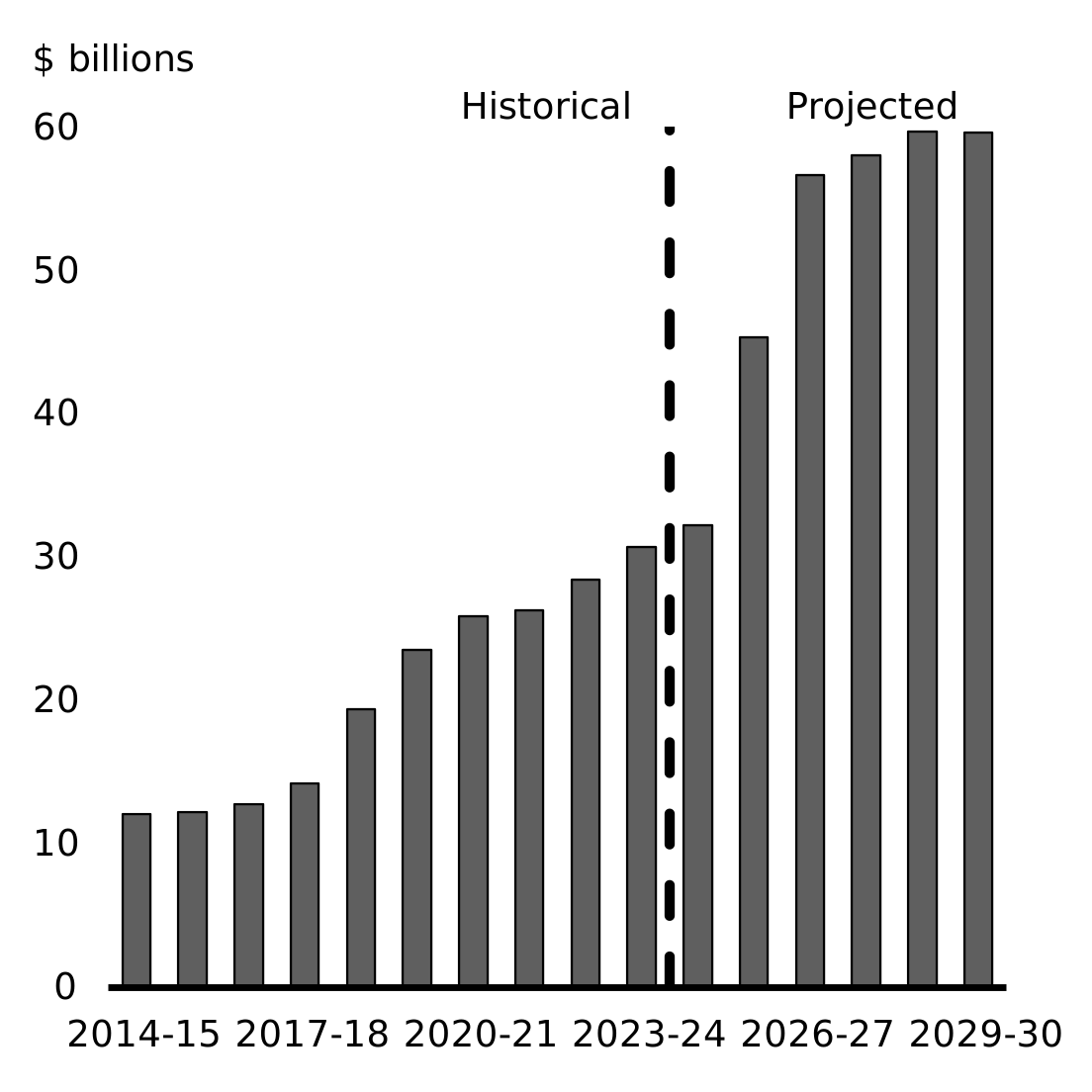
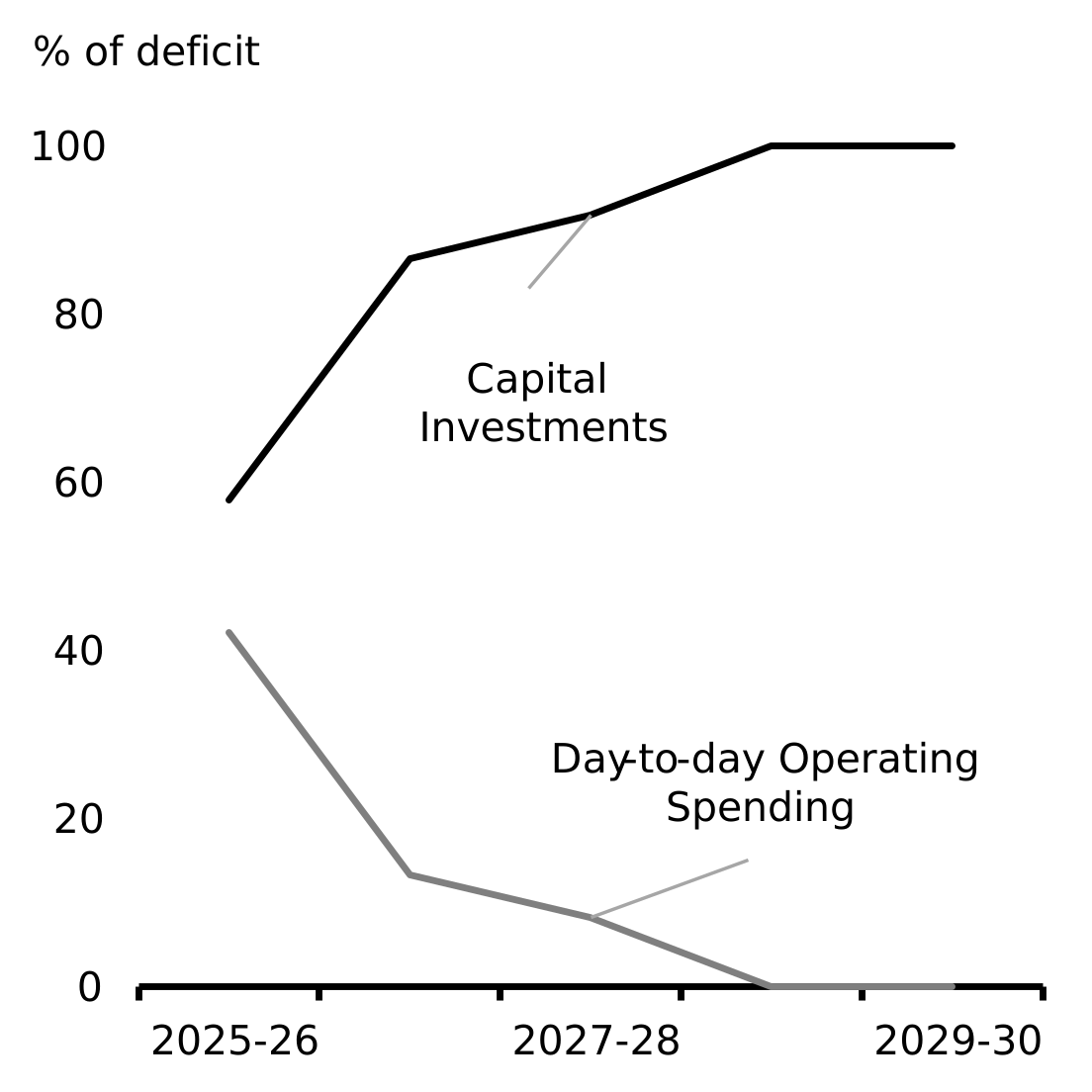
Capital Investments
The following charts illustrate the historical and projected levels of capital investment presented in Budget 2025, along with the relative shares of capital investments and operating spending as a per cent of deficit.
Capital investments, historical and projected
Spending Less to Invest More
Budget 2025: Defence
Key Messages
- Budget 2025 announced that Canada will spend an additional $84.8 billion on defence over five
years on a cash basis, starting in 2025-26. This consists of:
- $81.8 billion over five years on a cash basis, starting in 2025-26, to rebuild, rearm, and reinvest in the Canadian Armed Forces (CAF).
- $30.8 million over four years, starting in 2026-27, and $7.7 million ongoing to establish a new Defence Investment Agency.
- $52.5 million over five years, starting in 2026-27, and $12.2 million ongoing to modernise and increase capacity for the Industrial Security Program to meet the needs of the new Agency and support Canada's defence industry.
- $2.7 billion over three years on a cash basis, starting in 2026-27, to renew Operation REASSURANCE, the CAF's largest overseas mission.
- $300.1 million over three years on a cash basis, starting in 2025-26, to support Operation AMARNA, the CAF's operation in the Middle East.
Details & Supplementary Information
Budget 2025 announced $81.8 billion over five years on a cash basis, starting in 2025-26, to rebuild, rearm, and reinvest in the Canadian Armed Forces (CAF), which includes over $9 billion in 2025-26 that was announced by the Prime Minister in June 2025. Key investments are as follows:
- $20.4 billion over five years to recruit and retain a strong fighting force, including generational pay raises for the CAF, and support for CAF health care.
- $19.0 billion over five years to repair and sustain CAF capabilities and invest in defence infrastructure, including expanding ammunition and training infrastructure.
- $10.9 billion over five years for upgrades to Department of National Defence, CAF, and Communications Security Establishment digital infrastructure, including those needed for modern warfare, such as cyber defence.
- $17.9 billion over five years to expand Canada's military capabilities, including investments in additional logistics utility, light utility, and armoured vehicles, counter-drone and long-range precision strike capabilities, and domestic ammunition production, among other investments.
- $6.6 billion over five years to strengthen Canada's defence industry through a Defence Industrial Strategy, the implementation of which will develop our defence industrial base so that more of our military capabilities are procured from Canadian supply chains.
- $6.2 billion over five years to expand Canada's defence partnerships, including expanded military assistance to Ukraine and increased military training and international policy programming.
- $805 million over five years to the Canadian Coast Guard, the Canadian Security Intelligence Service, and Public Services and Procurement Canada for complementary initiatives to support Canada's defence capabilities.
Budget 2025: Housing
Key Messages
- Through Bill C-15, Budget 2025 Implementation Act, No. 1, the Government is proposing to invest
$13 billion to help double the pace of affordable homebuilding over the next decade through Build
Canada Homes.
- This includes an $11.5 billion appropriation to Build Canada Homes to support affordable housing projects across the country and catalyse the housing industry.
- It also includes $1.515 billion to capitalize Canada Lands Company Ltd to support housing construction on its properties held by the corporation, in partnership with Build Canada Homes.
- These investments complement the government's commitment to eliminate the GST for first-time home buyers on homes up to $1 million and to reduce the GST on homes between $1 million and $1.5 million. This measure is included in Bill C-4, introduced in Spring 2025.
- This builds on its efforts and investments in recent years to reduce local barriers to build, support more development through the tax system, significantly increase financing available to builders, and support housing-enabling infrastructure.
Budget 2025: Infrastructure
Key Messages
- Budget 2025 identified $115.2 billion over the next five years in infrastructure capital investments, including core public infrastructure (e.g., water, public transit); trade and transportation infrastructure; Indigenous community and municipal infrastructure; and other infrastructure (e.g., health, innovation).
- Key investments include:
- Build Communities Strong Fund: $51 billion over 10 years, starting in 2026-27, and $3.0 billion ongoing per year in new and existing funding to Housing, Infrastructure and Communities Canada to support public infrastructure projects of local and regional significance.
- Canada Infrastructure Bank (CIB): Division 4 of Part 5 of the Budget Implementation Act proposes to amend the Canada Infrastructure Bank Act, No.1 to increase the CIB's statutory envelope from $35 billion to $45 billion. Budget 2025 also announced that the CIB would be enabled to make investments in any nation-building projects referred to the Major Projects Office, to invest in artificial intelligence infrastructure, and to increase investment target for Indigenous infrastructure to at least $3 billion across its priority sectors.
- Trade Diversification Corridors Fund: $5 billion over seven years, starting in 2025-26, to Transport Canada to strengthen supply chains, unlock new export opportunities, and build a more resilient, diversified economy by funding trade infrastructure, including port, air, rail, and road infrastructure, that will alleviate key trade bottlenecks.
- Arctic Infrastructure Fund: $1 billion over four years, starting in 2025-26, to Transport Canada to support transportation projects in Canada's North, including deep-water ports, sealift infrastructure, airstrips, and all-season roads, that would directly support dual-use capabilities for military and non-military purposes.
- First Mile and Last Mile Fund (formerly the Critical Minerals Infrastructure Fund): $371.8 million over four years, starting in 2026-27, for Natural Resources Canada to provide $1.5 billion through 2029-30 to support the development of critical minerals projects and supply chains at the upstream and midstream segments.
Details & Supplementary Information
Build Communities Strong Fund
- The Build Communities Strong Fund will include three streams:
- a Provincial and Territorial Stream to support provincial and territorial infrastructure projects and priorities. Funding will support housing-enabling infrastructure (e.g. water/wastewater, roads), health-related infrastructure (e.g. hospitals), and infrastructure at colleges and universities. To access funds, PTs must agree to cost-match federal funding and to substantially reduce development charges and not levy other taxes that hinder the housing supply. As part of this stream, $5.0 billion over three years will be dedicated for a Health Infrastructure Fund.
- a Direct Delivery Stream to support projects that are regionally significant, large building retrofits, climate adaptation, and community infrastructure.
- a Community Stream consisting of a rebranded Canada Community-Building Fund to support local infrastructure projects.
- The Build Communities Strong Fund will be funded in part by repurposing unallocated funding under the Canada Housing Infrastructure Fund.
- Community Projects: Funding was announced for several infrastructure projects with funding to be sourced from the Direct Delivery stream of the Build Communities Strong Fund, or from other existing federal programs, where appropriate.
Canada Infrastructure Bank
- The CIB is an independent Crown corporation and makes its own investment decisions. Unlike other projects the CIB invests in, projects referred to the CIB by the Major Projects Office (MPO) will not need to fall within the CIB's priority sectors. However, the CIB will only be able to invest in projects referred by the MPO that fall within the CIB's legal mandate (i.e., projects that are revenue generating, that crowd in private capital and that are infrastructure projects in the public interest).
Responsive Lines
If pressed on the Build Communities Strong Fund / community projects:
- More information about the Build Communities Strong Fund and the community projects will be released by the Government in due course.
- The Minister of Housing and Infrastructure is responsible for the Build Communities Strong Fund. I encourage you to engage with him to share your views on program design elements as the program is developed.
If pressed about what is included in the generational investments figure ($115 billion over five years):
- This figure is presented on an accrual basis and the total includes all federal capital investments in infrastructure, both existing and newly announced in Budget 2025 like the Trade Diversification Corridors Fund and the Build Communities Strong Fund. Capital investment is broadly defined as spending that supports capital formation.
If pressed on what portion of the generational investments in infrastructure referenced in budget ($115 billion over five years) is new spending:
- Budget 2025 announced the government's intention to invest $115 billion in infrastructure. This includes existing and new investments including the Build Communities Strong Fund, the Trade Diversification Corridors Fund, and the Arctic Infrastructure Fund.
- For the Build Communities Strong Fund, Budget 2025 provided incremental funding over the fiscal horizon of $9 billion over five years (out of a total of $20.1 billion). The incremental funding over the 10-year period is $17.4 billion (out of a total of $51 billion).
- When we add other infrastructure investments announced in Budget 2025, such as the Trade Diversification Corridors Fund ($5 billion over 7 years) and the Arctic Infrastructure Fund ($1 billion over 4 years), Budget 2025 provided $13.2 billion over five years in incremental funding for infrastructure (out of a total of $24.3 billion). In percentage terms, 54% of this funding over 5 years is incremental. Over 10 years, Budget 2025 provided $23.4 billion in incremental funding for infrastructure (out of a total of $57 billion), or 41% incremental.
If pressed on the increase of the CIB statutory envelope and the impact of the CIB on the government's fiscal position:
- Funding provided to the CIB to finance its investing activities, including the proposed increase in its statutory capital envelope, does not have a direct impact on the government's deficit, as this represents an internal cash transaction within the government. Loans and investments recorded by the CIB through its deployment of those additional funds would be captured as part of the government's total loans, investments and advances. Revenues and expenses flowing from the CIB's loans and investments, such as interest revenues or loan loss provisions, would however have a direct accrual impact on the government's deficit.
Budget 2025: Major Projects Office
Key Messages
- The Major Projects Office (MPO) will advance efforts to catalyze $500 billion in private sector investment over the next five years in Canada, paving the way for a total investment of $1 trillion.
- Launched in August 2025, the MPO seeks to accelerate the delivery of nation-building projects in Canada and act as a single window for project proponents into the federal regulatory process to simplify and accelerate project approvals.
- Projects referred to the MPO are the kinds of projects that will expand Canadian exports to new global partners, unleash Canada's considerable resource potential, and fuel economic growth.
- The MPO is leading a review of Canada's regulatory approval process to ensure all major projects receive federal legislative and regulatory decisions within two years. This will accelerate decision-making and enhance certainty for investors while maintaining responsible and sustainable development that respects the rights of Indigenous Peoples.
- Proponents of projects that are not referred to the MPO will still benefit from regulatory streamlining and financial coordination as they move through other departments more efficiently.
Details & Supplementary Information
Projects referred to the Major Projects Office represent $116 billion in capital investment
1 port project, 3 electricity projects, 5 mining projects, 2 energy projects
- LNG Canada Phase 2 (Kitimat, BC): This project would double the facility's LNG production, making it the world's second largest LNG terminal and attracting $33 billion in private capital. It will deliver low carbon Canadian LNG to global markets and strengthen local economic growth. Budget 2025 introduced measures to improve LNG competitiveness, including longer export licences and accelerated capital cost allowances for top performing low carbon facilities.
- Darlington New Nuclear Project (Bowmanville, ON): This project will make Canada the first G7 country to operate a grid scale small modular reactor. Its first unit will power 300,000 homes and support 200 permanent and 1,600 construction jobs. Up to $3 billion in equity from the Canada Growth Fund and the Building Ontario Fund is helping de risk construction, and Budget 2025 confirmed a 15% Clean Electricity Investment Tax Credit for eligible nuclear equipment.
- Contrecœur Terminal Container Project (Contrecœur, QC): This expansion will increase the Port of Montreal's container capacity by 60%, strengthening supply chains and creating thousands of jobs. Work is advancing under a Memorandum of Understanding between the Major Projects office, the Canada Infrastructure Bank, and the Port Authority, and preparatory construction began in October 2025 following federal permitting.
- McIlvenna Bay Foran Copper Mine (East Central SK): This project will supply low emission copper and zinc for clean energy and advanced manufacturing while creating hundreds of jobs. Budget 2025 expanded eligibility for the Clean Technology Manufacturing Investment Tax Credit to include polymetallic mining equipment.
- Red Chris Mine Expansion (Northwestern BC): This expansion will extend the mine's life by more than a decade, increase Canada's copper output by over 15%, and support 1,500 operational and 1,800 construction jobs. Budget 2025 confirmed expanded tax credit eligibility for polymetallic mining.
- North Coast Transmission Line (Northwestern BC): This three-phase project will twin major transmission lines from Prince George to Terrace and north to Bob Quinn, bolstering telecommunications and electricity access for remote communities and major industrial projects. It is now linked to the Yukon–BC Grid Connect initiative to extend clean power benefits further north.
- Ksi Lisims LNG (Pearse Island, Nisg̱a'a Territory, BC): This floating LNG facility will be one of the world's lowest emission LNG operations, attracting nearly $30 billion in investment and creating thousands of skilled careers. The project received coordinated federal and provincial environmental assessment approvals in September 2025.
- Canada Nickel's Crawford Project (Timmins, ON): This project will produce high quality, low carbon nickel for batteries and green steel, drawing $5 billion in investment and creating thousands of jobs.
- Nouveau Monde Graphite – Matawinie Mine (Saint Michel des Saints, QC): This project will support QC's battery hub through an integrated graphite mine and materials plant, creating more than 1,000 jobs and attracting $1.8 billion in investment.
- Northcliff Resources' Sisson Mine (Sisson Brook, NB): This project would restore Canada's tungsten production—critical for defence and advanced manufacturing—and produce molybdenum for high strength steel and superalloys. It would reestablish Canada as a secure supplier of tungsten.
- Iqaluit Nukkiksautiit Hydro Project (Iqaluit, Nunavut): This 15–30 MW Inuit owned hydro project will replace Iqaluit's reliance on 15 million litres of imported diesel each year, eliminating 130,000 tonnes of emissions and delivering affordable, reliable, emissions free power.
Transformative strategies under development by the MPO
- Alto High-Speed Rail: Canada's first high-speed railway, spanning approximately 1,000 km from Toronto to Québec City and reaching speeds of up to 300 km/hour to cut travel times in half and connect close to half of Canada's population.
- Port of Churchill Plus: This project will upgrade the Port of Churchill and expand trade corridors with an all-weather road, an upgraded rail line, a new energy corridor, and marine ice-breaking capacity.
- Critical Minerals Strategy: A priority for the Major Projects Office will be to get more critical minerals projects to final investment decisions, with a focus on sustainability and regulatory certainty.
- Atlantic Energy: A project that would leverage over 60 GWs of wind power potential in NS, and more across Atlantic Canada, connecting that renewable, emissions-free energy to Eastern and Atlantic Canada to meet rapidly growing demand.
- Pathways Plus: An Alberta-based carbon capture, utilization, and storage project with additional energy infrastructure that would support a strong conventional energy sector while driving down emissions and emissions intensity from the oil sands. Pathways creates the prospect of facilitating low-carbon oil exports from the Alberta oil sands to a variety of potential markets.
- The Northwest Critical Conservation Corridor (Northwest BC and the Yukon): Canada's northwestern coast is home to the Golden Triangle - one of the world's richest reserves of the minerals and metals that are essential for the energy transition as well as defence supply chains for Canada and our allies.
- Arctic Economic and Security Corridor: The Arctic and Security Corridor is a strategic lifeline. Designed as dual-use infrastructure, it supports both Canada's defence and economic goals. From fortified ports and all-season roads to runways and communications systems, it is built to serve military operations and commercial development alike.
Affordability Measures Overview
- This fall, the government launched Build Canada Homes, a new federal agency that will build affordable housing at scale with an initial investment of $13 billion over five years. The government is also eliminating the GST for first-time home buyers on new homes up to $1 million and reducing it on new homes between $1 million and $1.5 million.
- In May 2025, the government announced a middle-class tax cut that would lower the first marginal personal income tax rate by one per cent, from 15% to 14%, effective July 1, 2025. Nearly 22 million Canadians would see tax savings of up to $420 per person in 2026.
- The government committed to starting automatic federal benefits for the 2026 tax year that will reach up to 5.5 million low-income Canadians by the 2028 tax year. This will help eligible individuals receive the government benefits they qualify for such as the GST/HST credit and the Canada Child Benefit.
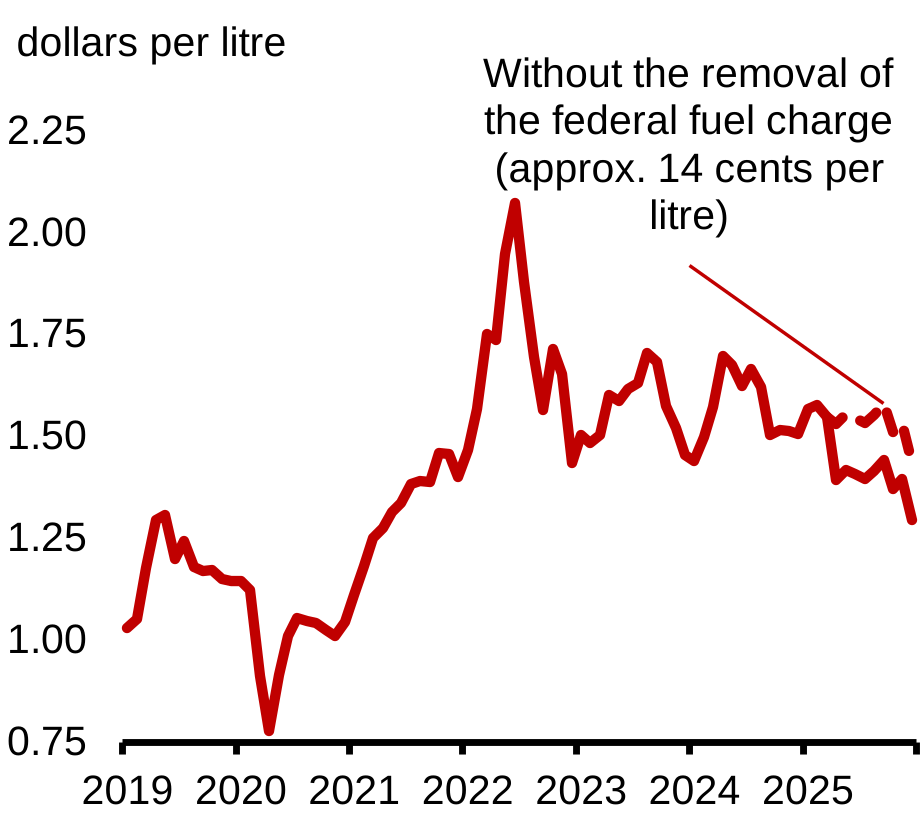
- The government cancelled the consumer carbon price, bringing down gasoline prices by approximately 18 cents per liter in most provinces and territories, effective April 1, 2025.
- The government will make the National School Food Program permanent—beyond the initial investment of $1 billion over five years. It aims to provide meals for 400,000 more kids every year, beyond those served by existing school food programs.
- The government is making groceries and other essentials more affordable through the new Canada Groceries and Essentials Benefit, which will provide a family of four up to $1,890 this year, and about $1,400 a year for the next four years. We are also taking steps to tackle food insecurity, support producers, and strengthen supply chains.
- The government remains focused on empowering Canadians—by lowering costs, expanding opportunity, and protecting the vital social programs Canadians rely on, including child care and dental care.
Details & Supplementary Information
Launching Build Canada Homes
The government launched Build Canada Homes (BCH) in the fall—a new federal agency that will build affordable housing at scale. It is mandated with building and financing more affordable homes and catalyzing a new housing industry. The government also announced the agency's first four investments and initiatives. This includes protecting existing affordable housing by launching the $1.5 billion Canada Rental Protection Fund under Build Canada Homes. Additionally, BCH will provide $1 billion to build transitional and supportive housing for people who are homeless or at risk of homelessness.
First-Time Home Buyers' GST Rebate
Bill C-4, the Making Life More Affordable for Canadians Act, which was tabled in Spring 2025 and is currently before Parliament, would eliminate the GST for first-time home buyers on new homes at or under $1 million and reduce the GST for first-time home buyers on new homes between $1 million and $1.5 million by introducing a new First-Time Home Buyers' GST Rebate. As a result of this rebate, first-time home buyers will be able to save up to $50,000 on a new home. This measure is expected to deliver $3.9 billion in tax savings to Canadians over five years, starting in 2025-26.
Middle-class Tax Cut
In May 2025, the government announced it would lower the first marginal personal income tax rate from 15 per cent to 14 per cent. The rate reduction, which is currently before Parliament as part of Bill C-4, applies to the first $58,523 of an individual's taxable income. Nearly 22 million Canadians will benefit from tax relief of up to $420 per person, saving two-income families up to $840 this year.
The majority of tax relief will go to Canadians with incomes in the two lowest tax brackets. Nearly 45 per cent of the tax relief will go to Canadians with income below $58,523 (the first tax bracket) and 40 per cent to Canadians with income approximately between $58,523 and $117,045 (the second tax bracket).
Automatic Federal Benefits
To help lower-income individuals receive the benefits to which they are entitled, the government committed to implementing Automatic Federal Benefits for the 2026 tax year, which will reach up to 5.5 million low-income Canadians by the 2028 tax year. Budget 2025 also proposed:
- To amend the Income Tax Act to allow the CRA to file a tax return on behalf of certain eligible individuals with lower incomes in simple tax situations who do not owe tax and do not file themselves.
- To provide $71 million over five years, starting in 2025-26, with $10.4 million in remaining amortisation and $8.3 million ongoing, to the CRA to implement these new services.
Consumer Fuel Charge
On March 14, 2025, the government announced that it will cease the application of the federal fuel charge, effective April 1, 2025. It also removed the requirement for provinces and territories to maintain a consumer-facing carbon price. These actions have reduced gasoline prices at the pump in most provinces and territories by up to 18 ¢/L compared to 2024–25 levels, thereby contributing to lower headline inflation.
The government is winding down mechanisms used to return direct fuel charge proceeds to Canadians, small and medium-sized businesses, farmers, and Indigenous governments. Eliminating the fuel charge, which is currently before Parliament as part of Bill C-4, will give Canadian consumers and businesses certainty that the consumer carbon price is being permanently removed from legislation.
National School Food Program
Originally announced on April 1, 2024 with an investment of $1 billion over five years, the program aimed at providing meals to 400,000 more kids every year, beyond those served by existing school food programs. In Budget 2025, the program received permanent funding of $216.6 million per year, starting in 2029-30.
Bill C-15 (Budget Implementation Act, 2025) enacts the National School Food Program Act, which sets out the Government of Canada's vision for the National School Food Program and commits to maintaining long-term funding to provinces, territories, and Indigenous peoples for the ongoing implementation and maintenance of the Program.
As of March 2025, all 13 provinces and territories have signed agreements with the federal government to flow funding under the program until March 2027. The rollout of the program's distinctions-based funding for First Nations on reserve as well as Inuit, Métis, and Modern Treaty and Self-Government agreement holders remains ongoing.
Canada Groceries and Essentials Benefit
The Canada Groceries and Essentials Benefit would build on the existing Goods and Services Tax (GST) Credit and provide $11.7 billion in additional support over six years to over 12 million individuals and families, by:
- providing a one-time top-up payment to be paid as early as possible this spring and no later than June 2026 (based on January 2026 eligibility)—equal to a 50% increase in the annual 2025-26 value of the GST Credit. This would deliver $3.1 billion in immediate assistance to individuals and families who currently get the GST Credit.
- increasing the value of the Canada Groceries and Essentials Benefit by 25% for five years starting in July 2026. This increase would deliver $8.6 billion in additional support over the 2026-27 to 2030-31 period, including to 500,000 new individuals and families.
These changes are subject to Royal Assent of enabling legislation.
Recipients would not need to apply for the additional payments, but should file their 2024 tax return if they have not done so already to be able to receive the top-up, and must file their 2025 tax return to receive the increased Canada Groceries and Essentials Benefit payments as of July 2026.
Tackle food insecurity, support producers, and strengthen supply chains
To help keep food affordable for Canadians and strengthen the resilience of Canada's food supply chain, the government has announced targeted measures to support businesses, producers, and local organisations, including:
- The government is setting aside $500 million from the Strategic Response Fund to help businesses address the costs of supply chain disruptions without passing those costs on to Canadians at the checkout line.
- For the same purpose, the government will create a $150 million Food Security Fund under the existing Regional Tariff Response Initiative for small and medium enterprises and the organisations that support them.
- To lower the cost of food production, the government is introducing immediate expensing for greenhouse buildings. This allows producers to fully write off greenhouses acquired on or after November 4, 2025, and that become available for use before 2030. This measure supports increased domestic supply and investment in food production over the medium-term.
- To ease immediate pressures with food banks, the government is providing $20 million to the Local Food Infrastructure Fund. This supports food banks and other national, regional, and local organisations to deliver more nutritious food to families in need.
- To tackle the root causes of food insecurity, the government is developing a National Food Security Strategy – one that strengthens domestic food production and improves access to affordable, nutritious food. This strategy will also include measures to implement unit price labelling and support the work of the Competition Bureau in monitoring and enforcing competition in the market, including food supply chains.
Canadian Dental Care Plan
The Canadian Dental Care Plan is available to uninsured Canadians with a family income of less than $90,000, with no co-pays for families under $70,000. The program first launched in 2023, starting with seniors. Program eligibility gradually expanded to individuals with a valid Disability Tax Credit, children under the age of 18, and then individuals between the ages of 18 to 64. As of May 2025, all eligible uninsured Canadians of all ages can apply.
Canada-wide child care system
As part of Budget 2021 the government committed to build a Canada-wide Early Learning and Child Care system with PTs. Key targets that PTs have committed to through bilateral agreements under the Canada-wide system include:
- Reduce fees for regulated child care by 50% by December 2022 (completed);
- Reduce fees for regulated child care to an average of $10-a-day by March 2026; and
- Build 250,000 new regulated child care spaces by March 2026.
The majority of PTs have signed extension agreements for 2026-27 to 2030-31, which provide them with a 3 per cent funding top-up to sustain their systems without any additional targets. Alberta, Saskatchewan and Ontario have not yet signed extension agreements. As of March 31, 2026, the government will have provided over $35 billion for ELCC, including for Indigenous ELCC, and committed to ongoing funding of $9.2 billion annually.
Section 1: Economic Context and Affordability
Headline CPI Inflation
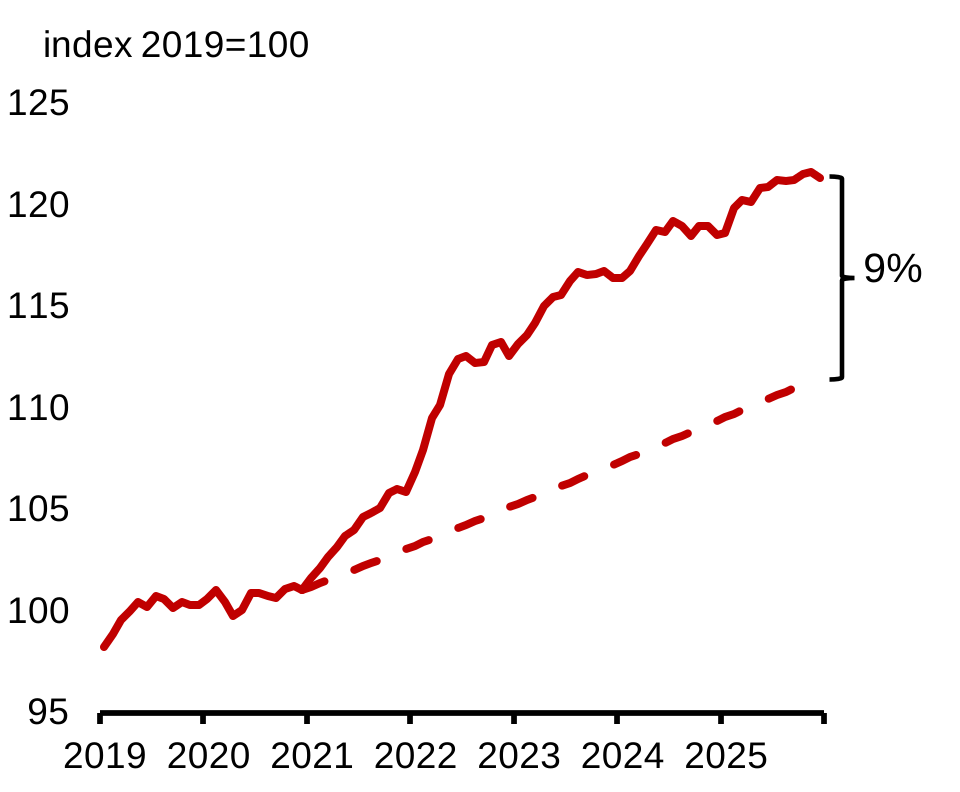
Consumer Price Index
Unemployment Rate by Age Group
Wage Growth, Nominal Versus Real
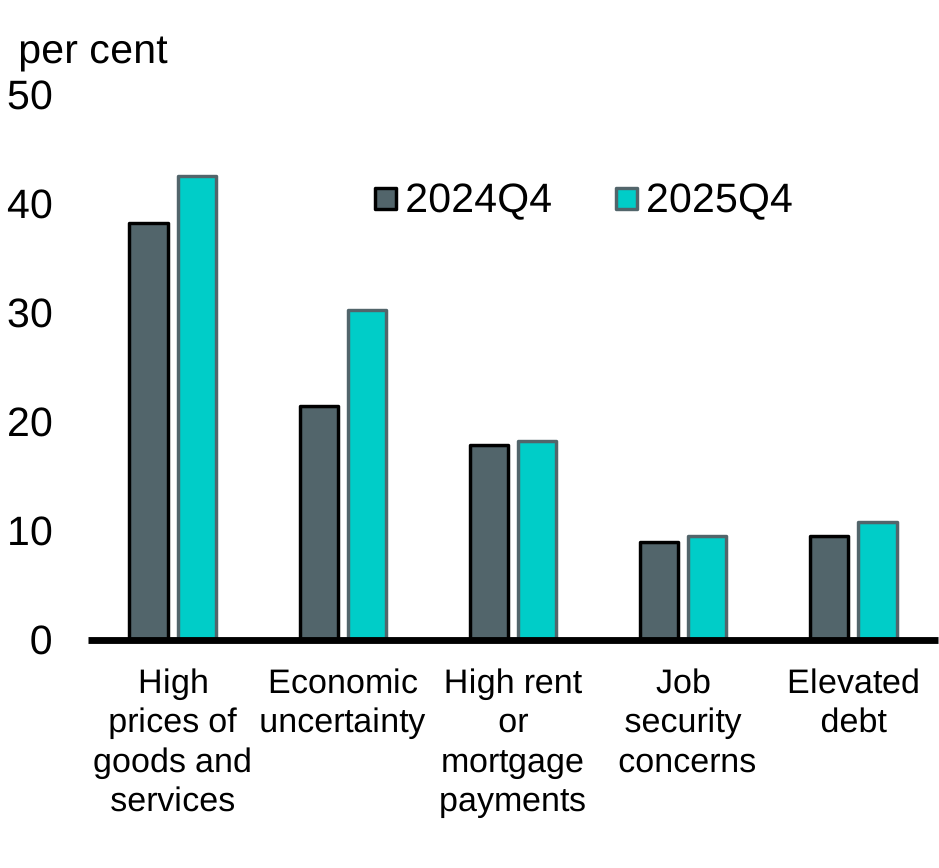
Factors Negatively Affecting Consumer Spending
Consumer Confidence
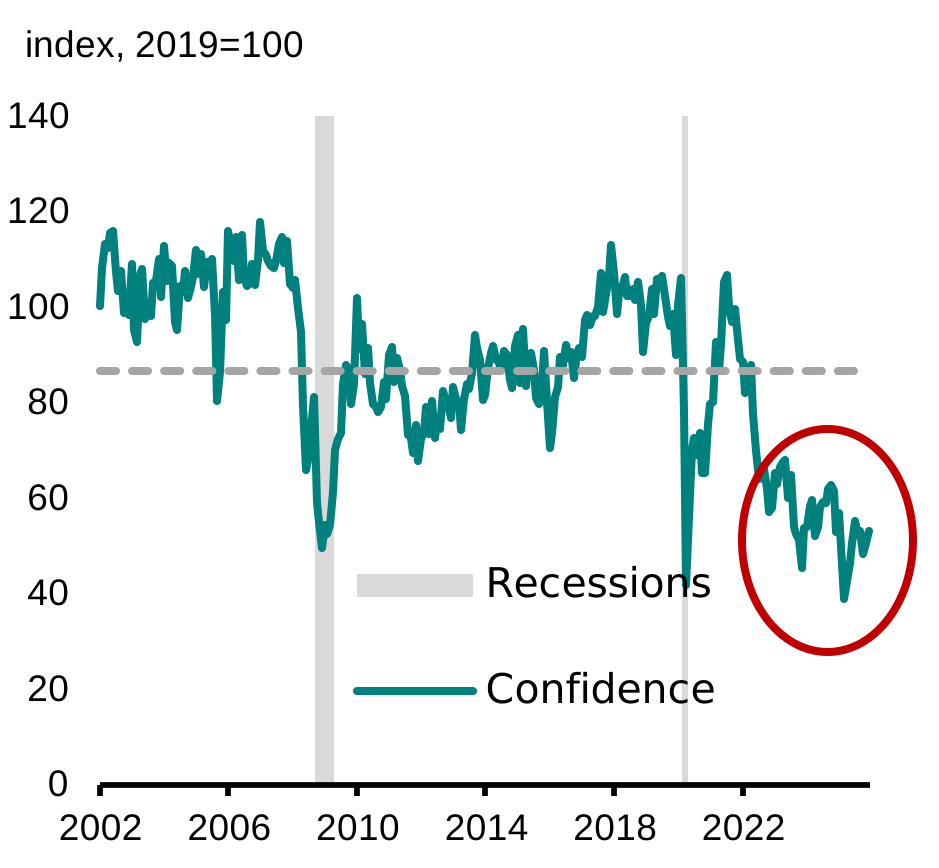
CPI Inflation
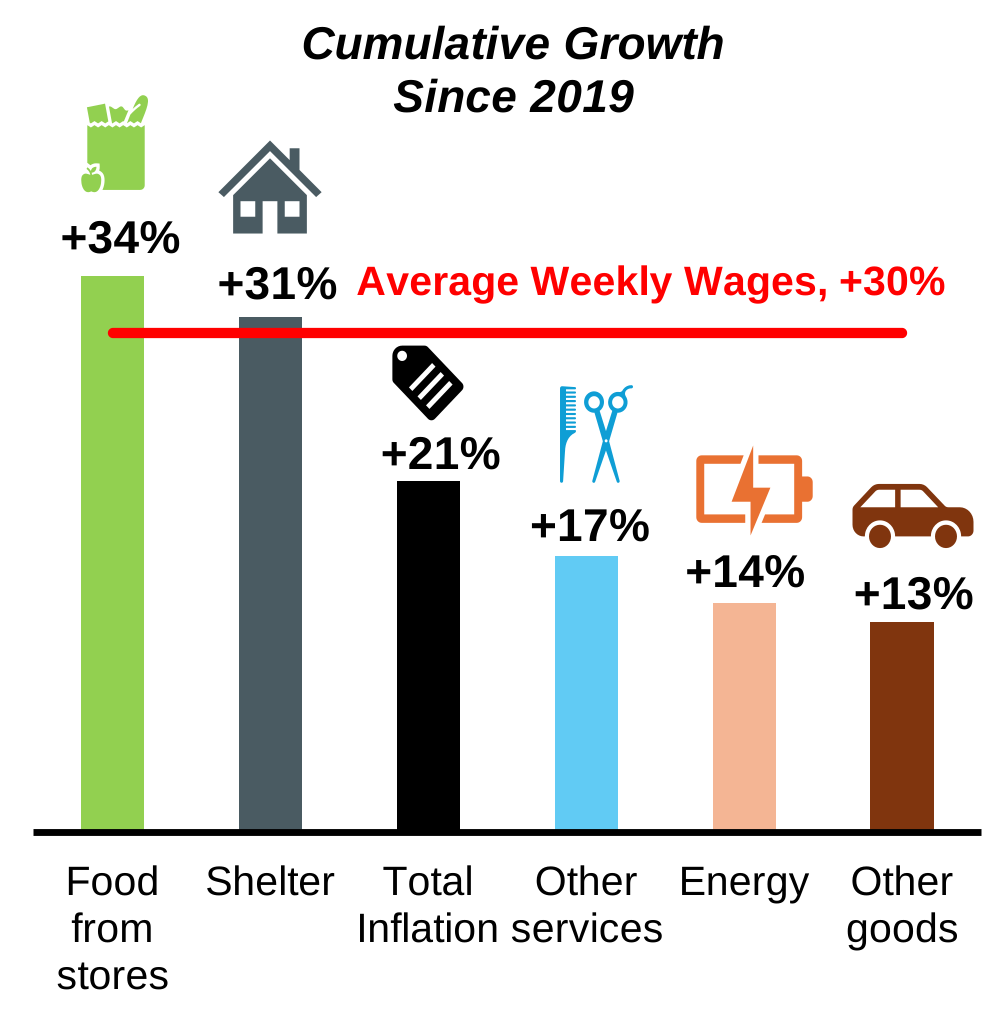
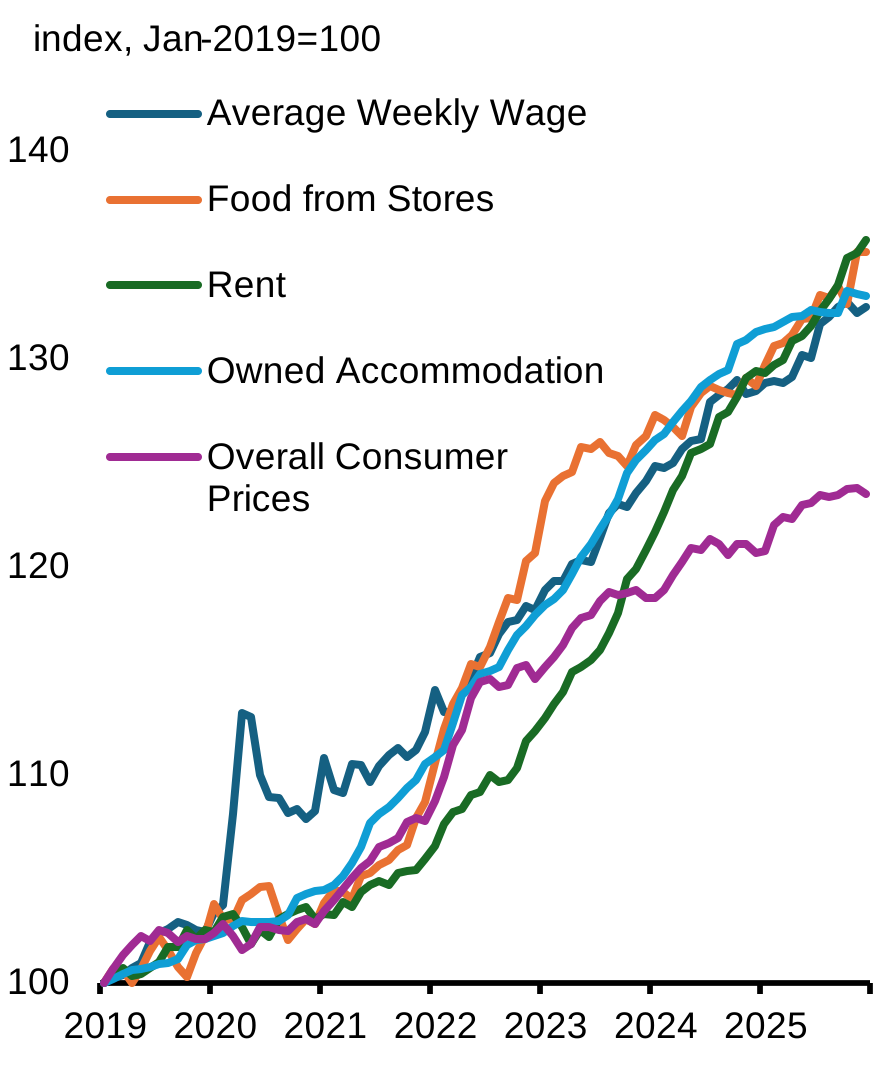
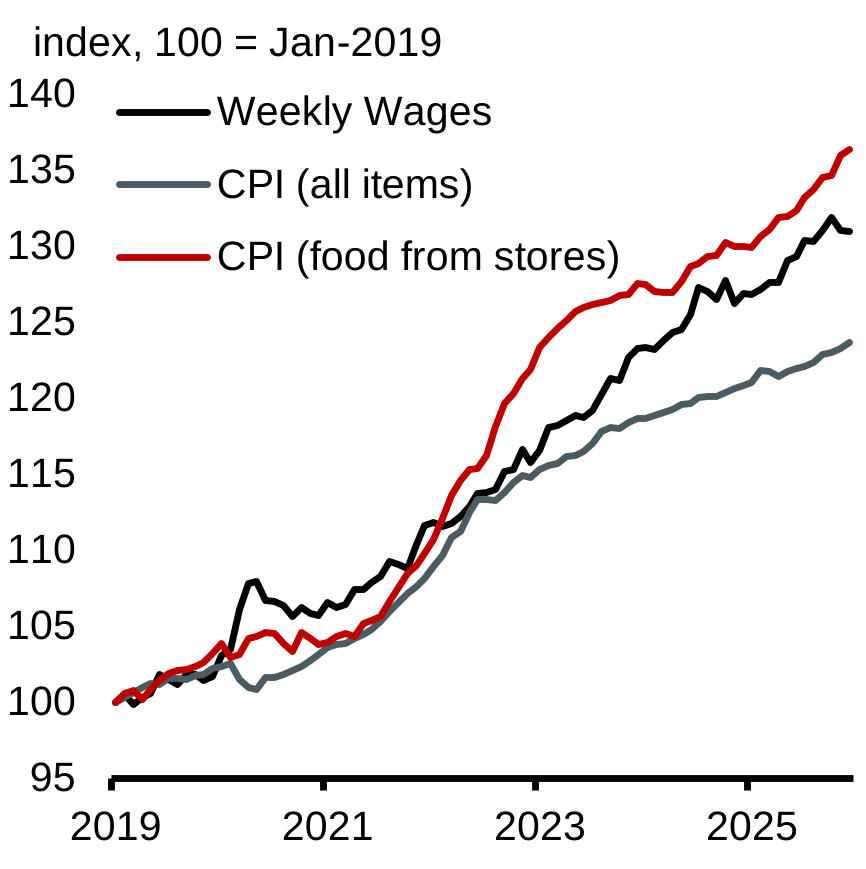
Change in Key Prices and Nominal Wages Since 2019
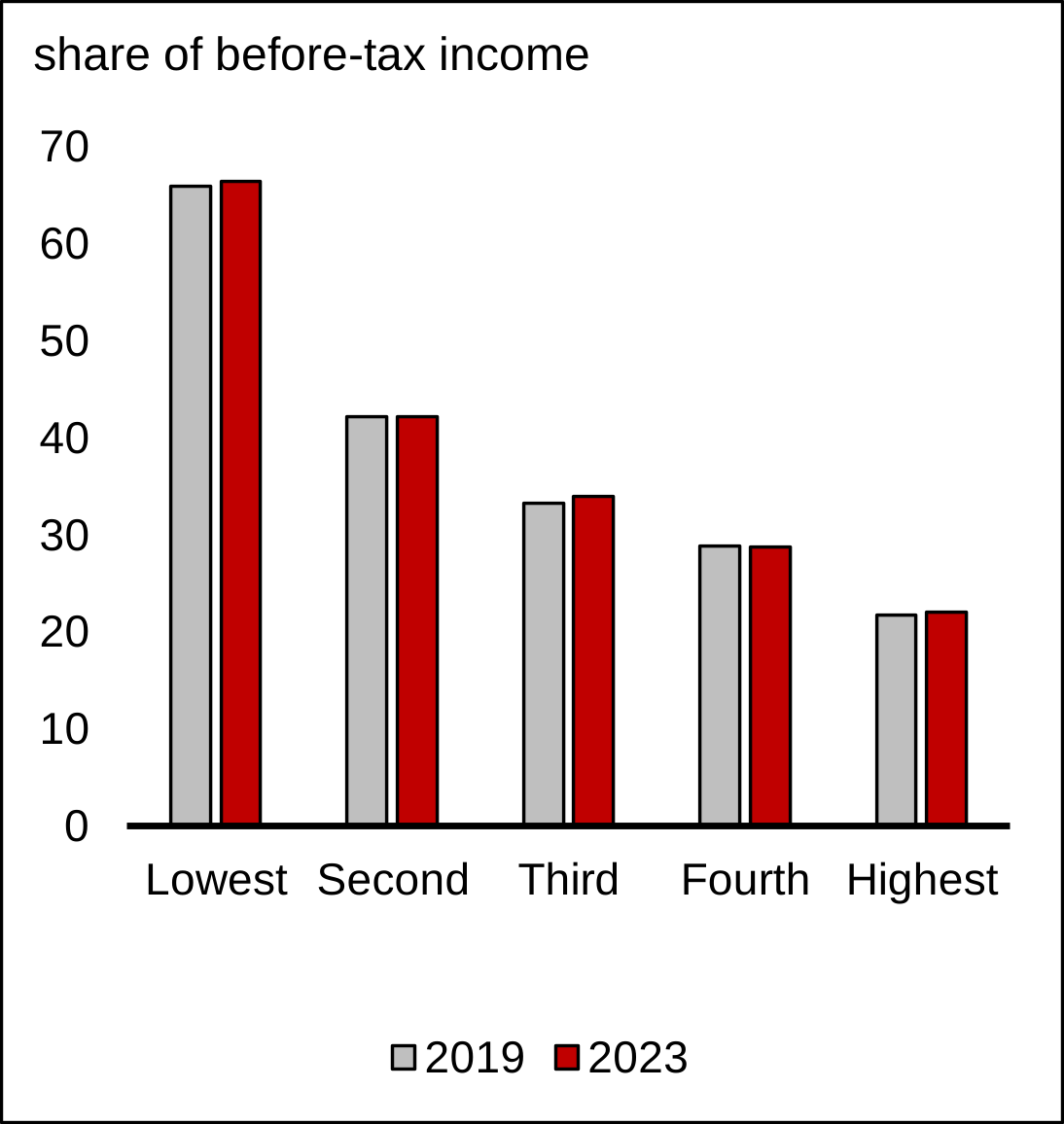
Median Share of Income Spent on Food and Shelter, by Income Quintiles
Labour Productivity and Real Wages
Labour Productivity Level
Section 2: Grocery Prices
Headline and Food from Stores Inflation
Food from Stores Inflation
Contributions to Grocery Price Inflation by Component
Grocery Inflation by Component, December 2025
Food Inflation and Underlying Input Costs
Grocery and Overall Inflation, G7 Countries
Jan-Nov 2025 vs. Jan-Nov 2024
Section 3: Housing, rent and other important prices
Rent Inflation Metrics
| Jurisdiction | Asking rents (2 bedrooms) | Y/Y |
|---|---|---|
| Alberta | $1,819 | -3.1% |
| Calgary | $1,847 | -4.4% |
| Edmonton | $1,625 | -1.8% |
| Nova Scotia | $2,477 | 2.4% |
| Halifax | $2,522 | -2.0% |
| British Columbia | $2,640 | -5.6% |
| Vancouver | $3,255 | -5.1% |
| Ontario | $2,450 | -4.4% |
| Toronto | $2,797 | -9.1% |
| Mississauga | $2,467 | -8.3% |
| Burlington | $2,463 | -2.6% |
| Kingston | $2,550 | 23.5% |
| Ottawa | $2,455 | -1.2% |
| London | $2,057 | -4.9% |
| Windsor | $1,921 | -2.9% |
| Saskatchewan | $1,517 | 6.9% |
| Saskatoon | $1,591 | 8.3% |
| Regina | $1,553 | 7.9% |
| Quebec | $2,166 | -0.6% |
| Montreal | $2,260 | -0.3% |
| Gatineau | $2,088 | -3.2% |
| Quebec City | $1,668 | -13.2% |
MLS Benchmark Home Price
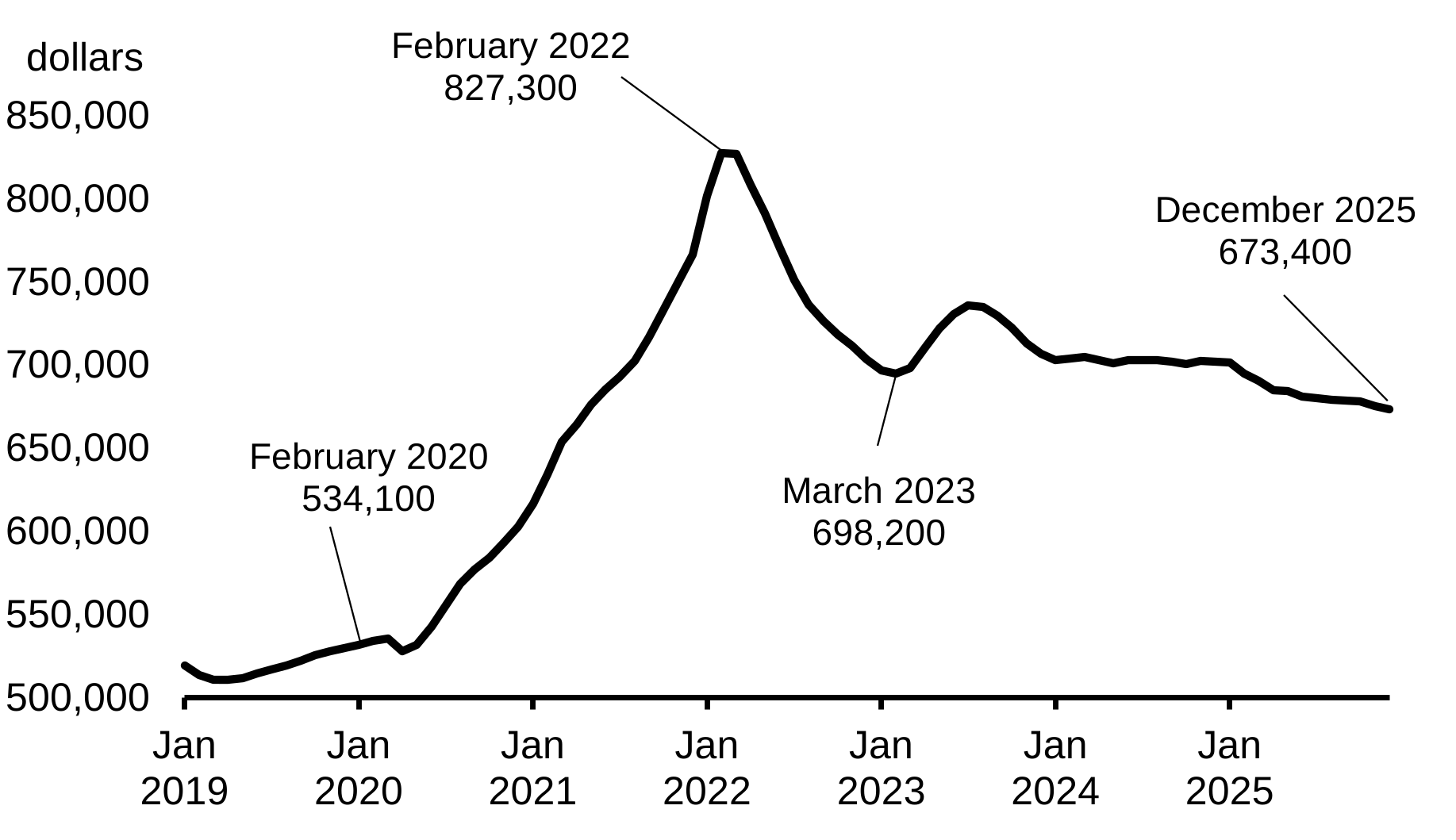
Home Price Changes as of December 2025, Selected Cities
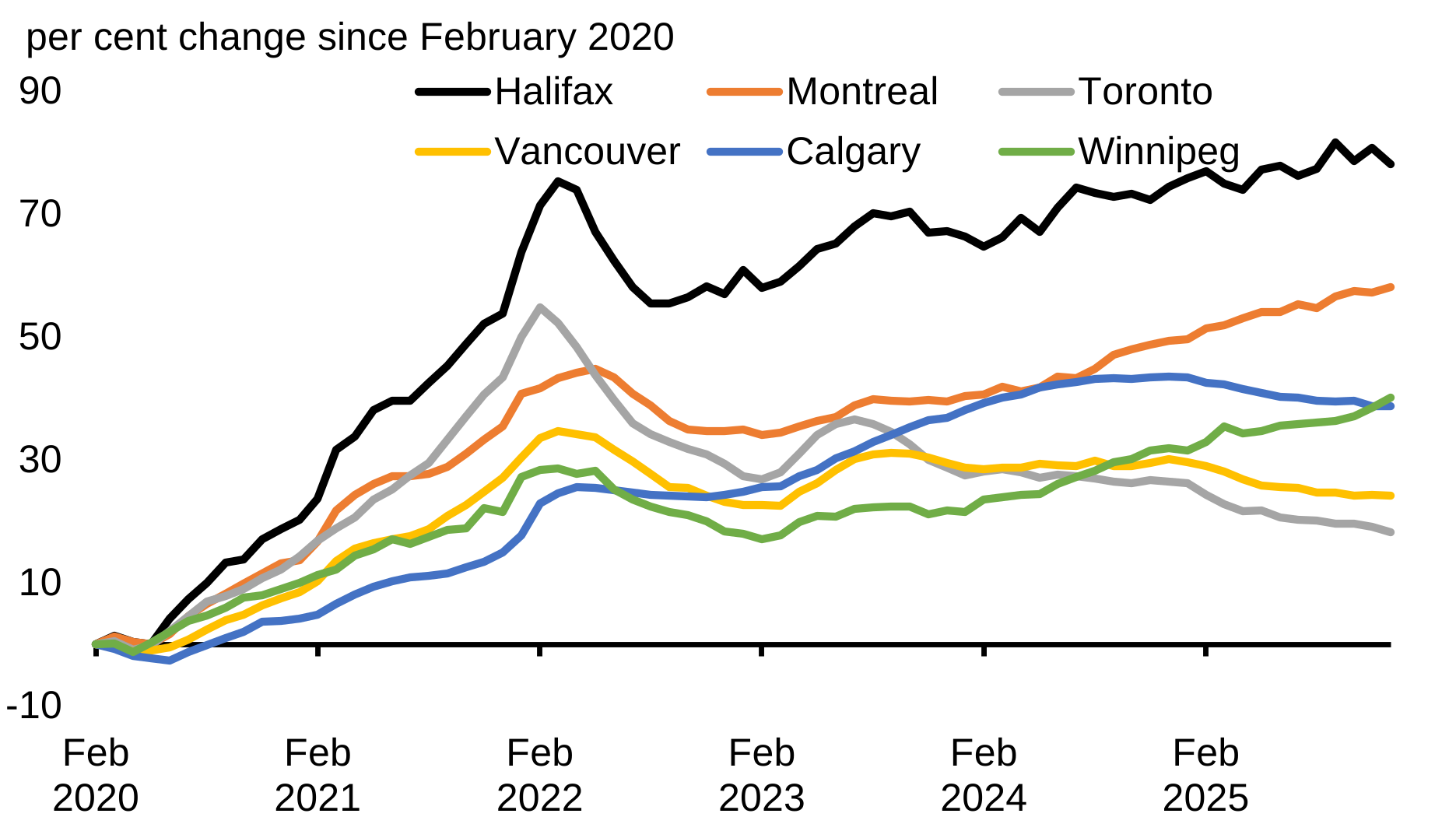
| m/m | y/y | vs. Feb 2020 | |
|---|---|---|---|
| Halifax | -1.5 | 2.1 | 78.0 |
| Montreal | 0.6 | 5.8 | 58.1 |
| Quebec | 3.2 | 17.0 | 79.6 |
| Toronto | -0.7 | -6.4 | 18.3 |
| Hamilton | -0.4 | -7.4 | 25.6 |
| Waterloo | -0.6 | -8.6 | 24.8 |
| Ottawa | 0.0 | 0.3 | 36.6 |
| Winnipeg | 1.2 | 6.2 | 40.0 |
| Saskatoon | 0.5 | 6.5 | 38.3 |
| Calgary | 0.1 | -3.4 | 38.7 |
| Edmonton | -0.3 | 3.1 | 23.4 |
| Fraser Valley | -0.2 | -6.2 | 34.9 |
| Vancouver | -0.1 | -4.5 | 24.1 |
| Victoria | 0.0 | -0.6 | 37.1 |
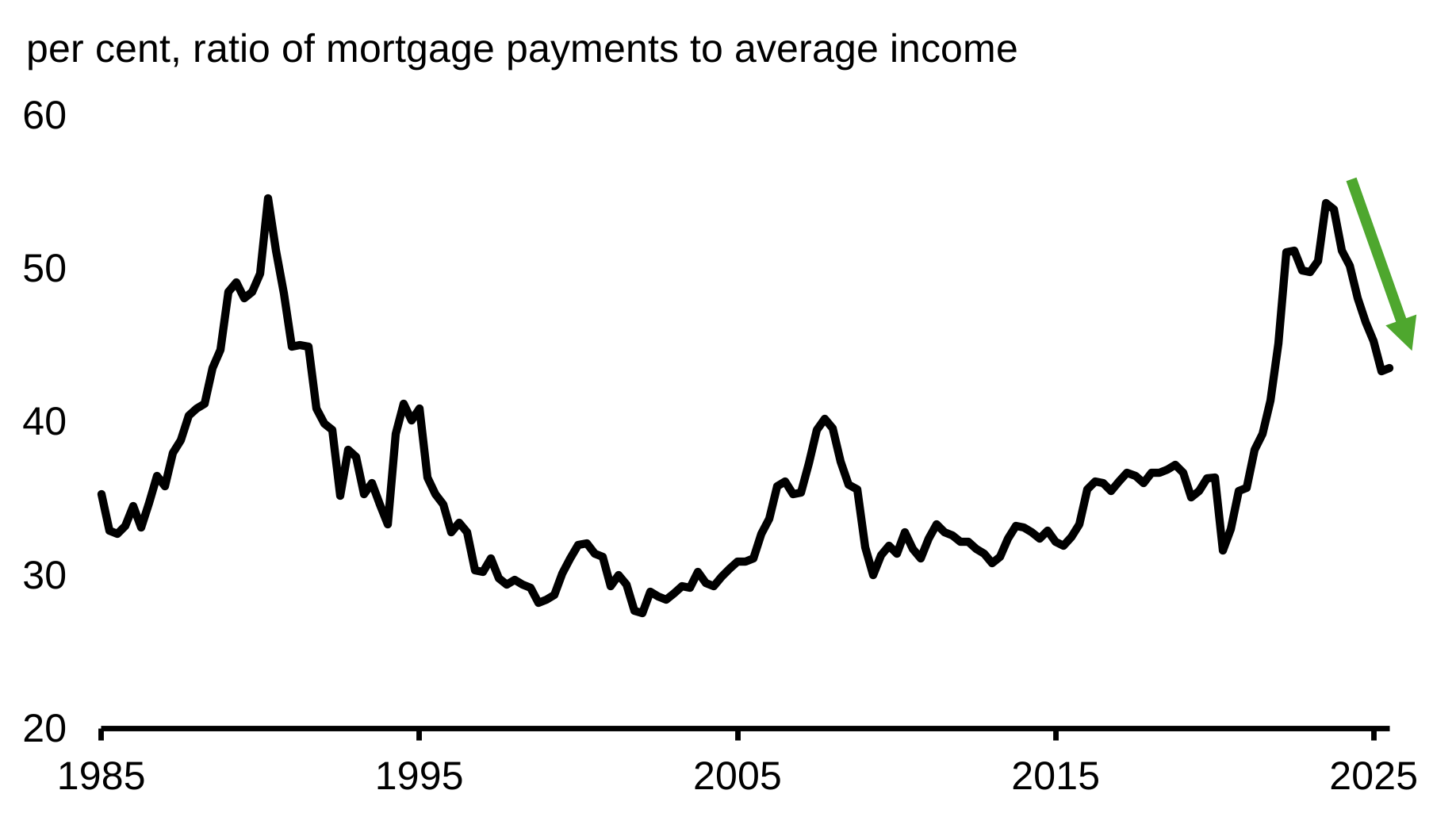
National Housing Affordability Index
Retail Gasoline Prices, Canada
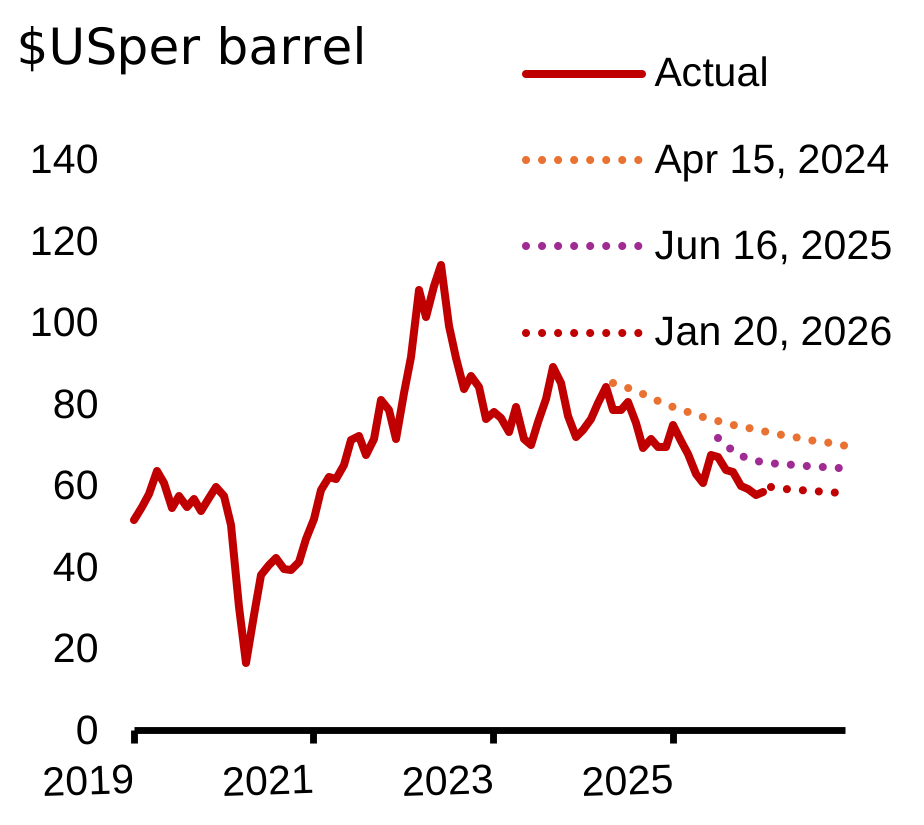
WTI Crude Oil Price
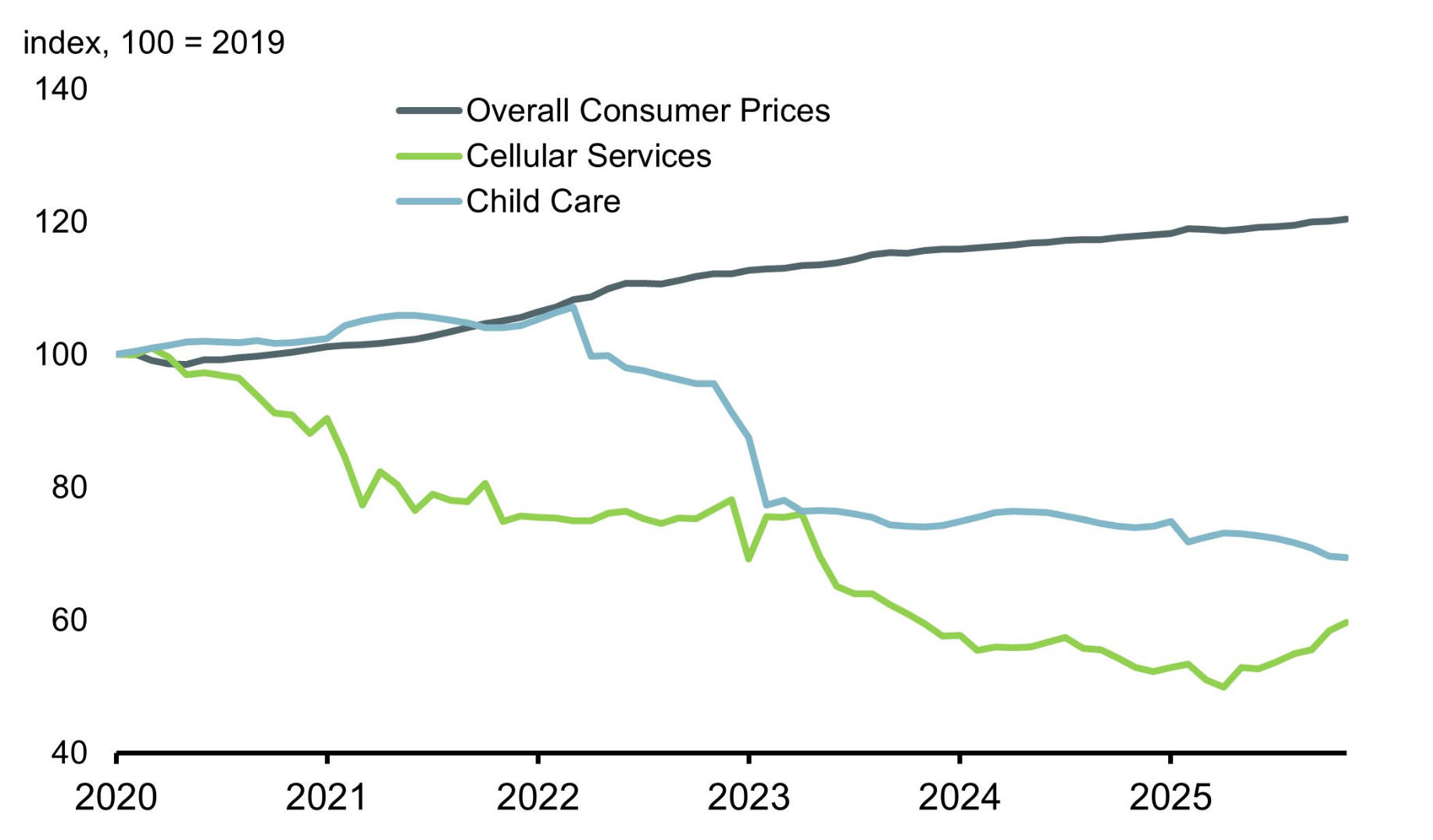
Price of Child Care and Cellular Services
Appendix: Additional Wage Charts
Real Weekly Wage Growth
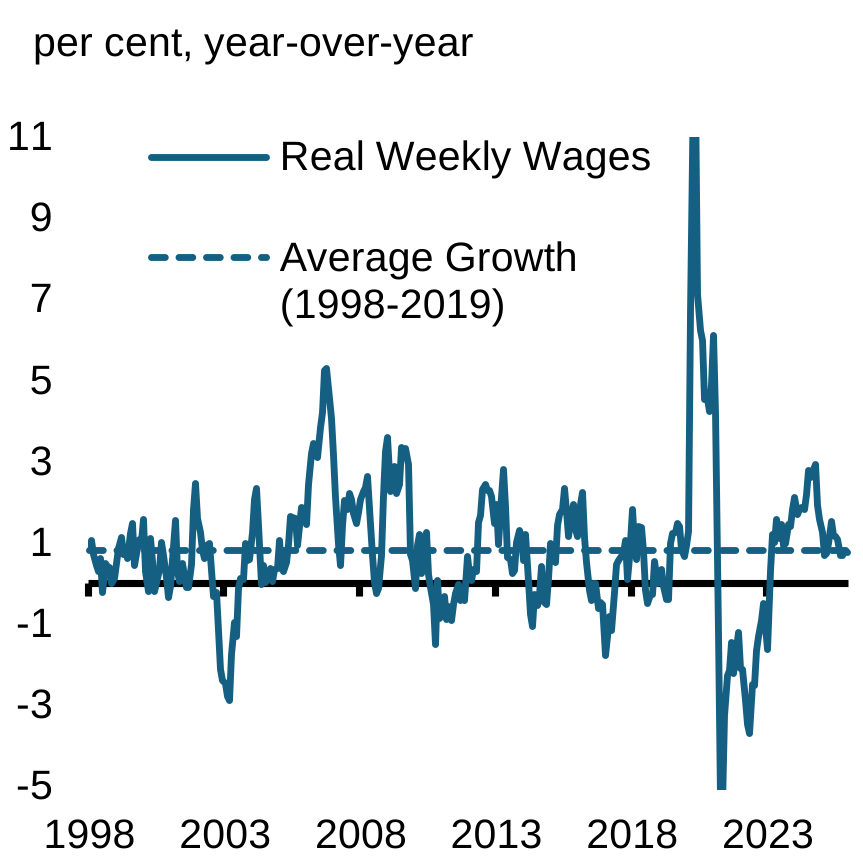
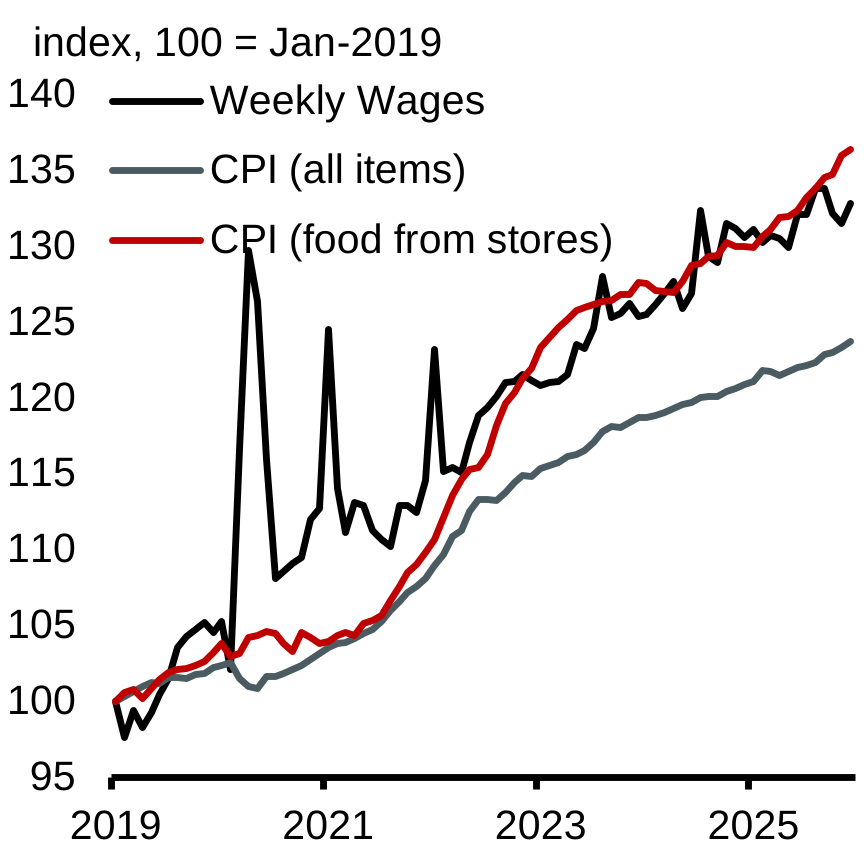
Wages and Inflation – Lowest Wage Quintile
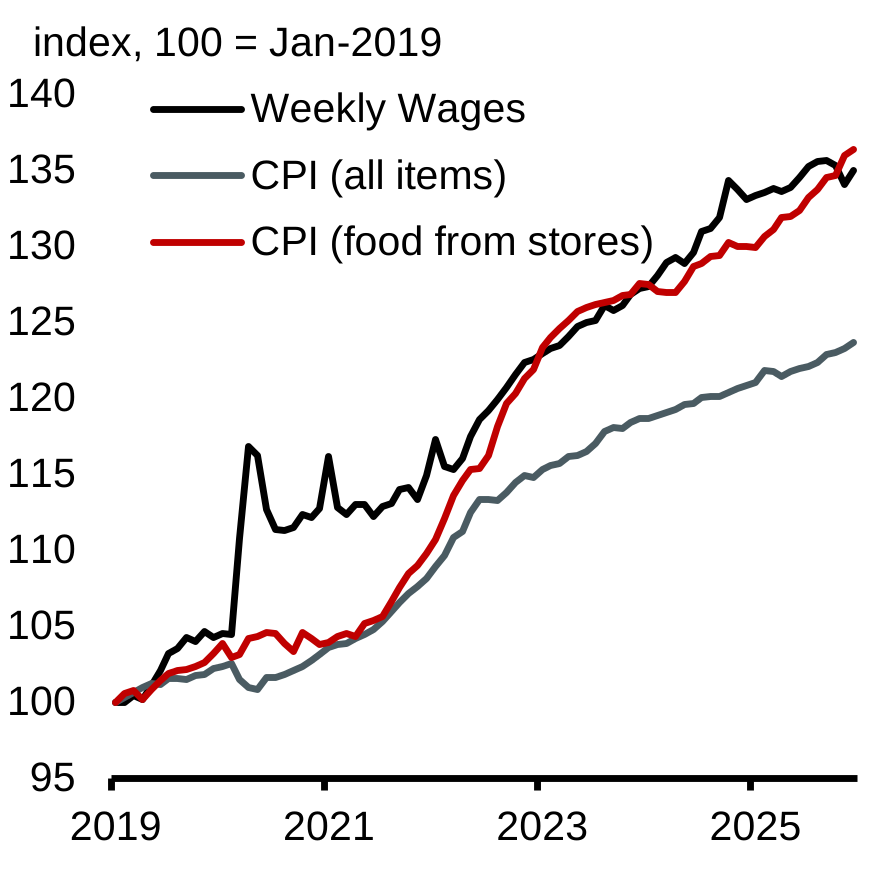
Wages and Inflation – Second Wage Quintile
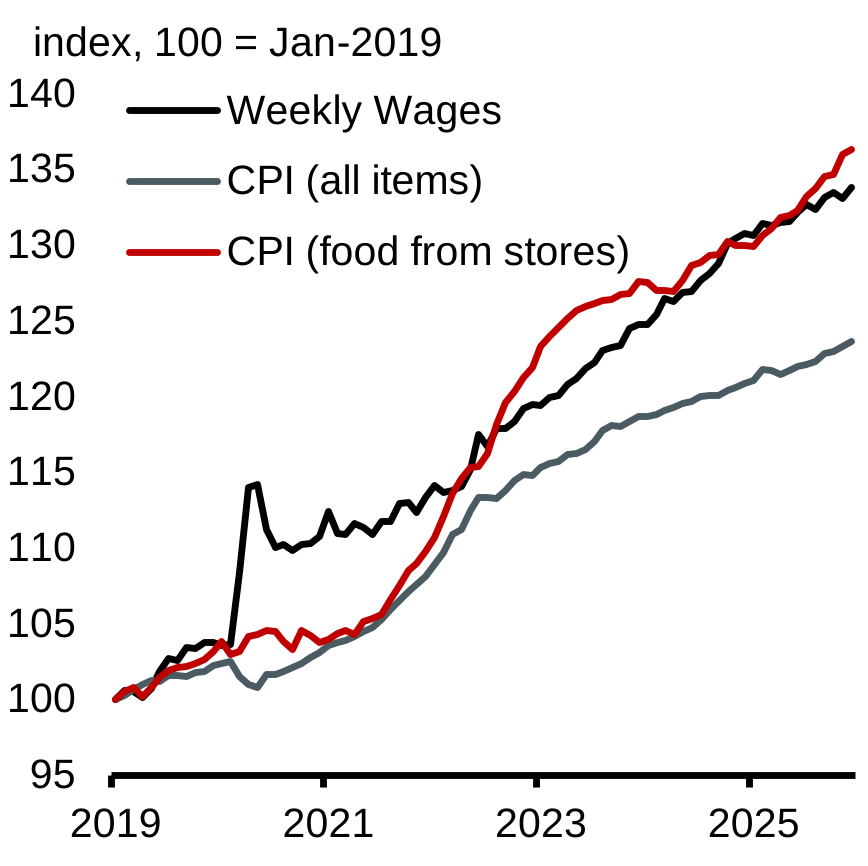
Wages and Inflation – Middle Wage Quintile
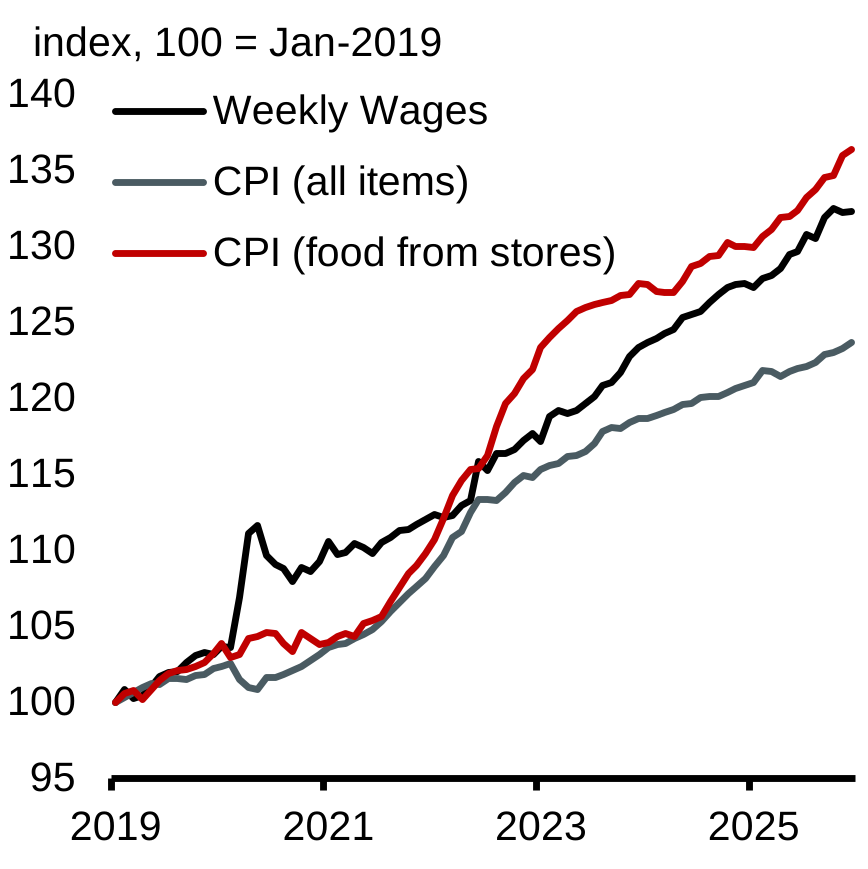
Wages and Inflation – Fourth Wage Quintile
Wages and Inflation – Highest Wage Quintile
Grocery Affordability and Food Inflation
Key Messages
- Grocery affordability is top of mind for Canadians and also for the Government. All families in Canada deserve access to affordable, safe, nutritious and high-quality food.
- Recently, food price increases have been mainly limited to specific products such as beef, coffee, cocoa, and lettuce. These are largely due to global supply factors. However, grocery prices are running ahead of CPI by approximately 2.5 per cent since February 2025.
- On January 26, the government announced new measures to make groceries and other essentials more
affordable:
- A Canada Groceries and Essentials Benefit – formerly the Goods and Services Tax (GST) Credit – that will increase by 25% for five years beginning in July 2026, and a one-time payment, equivalent to a 50% increase this year.
- $500 million set aside from the Strategic Response Fund to help businesses address the costs of supply chain disruptions.
- $150 million Food Security Fund under the existing Regional Tariff Response Initiative.
- Immediate expensing for greenhouse buildings.
- $20 million for food banks through the Local Food Infrastructure Fund.
- Developing a National Food Security Strategy which will include measures to implement unit price labelling and support the work of the Competition Bureau.
- Existing measures to tackle these rising food prices include:
- Over $130 million in funding for the Local Food Infrastructure Fund and food banks;
- $14.9 million to support food security in the North through the regional development agencies;
- Over $1.5 billion in funding for Nutrition North Canada; and
- $1 billion investment into the National School Food Program, which we have made permanent with ongoing funding of $216.6 million per year starting in 2029-30.
Details & Supplementary Information
Grocery price inflation, at 4.7 per cent year-on-year in November 2025, has been running ahead of both headline CPI and its pre-pandemic pace (both 2.2 per cent) by 2.5 per cent since February 2025.
PM News Release (Jan 26): "To bring down your costs, Canada's new government is:
- Putting more money back in Canadians' pockets
- The government is introducing the new Canada Groceries and Essentials Benefit – formerly the Goods and Services Tax (GST) Credit. We are increasing its amount by 25% for five years beginning in July 2026.
- In addition to that, we are providing a one-time payment, equivalent to a 50% increase this year.
- Combined, this means that a family of four will receive up to $1,890 this year, and about $1,400 a year for the next four years; and a single person will receive up to $950 this year, and about $700 a year for the next four years.
- The new Canada Groceries and Essentials Benefit will provide additional, significant support for more than 12 million Canadians.
- Tackling food insecurity, supporting producers, and strengthening supply chains
- The government is setting aside $500 million from the Strategic Response Fund to help businesses address the costs of supply chain disruptions without passing those costs on to Canadians at the checkout line.
- For the same purpose, the government will create a $150 million Food Security Fund under the existing Regional Tariff Response Initiative for small and medium enterprises and the organisations that support them.
- To lower the cost of food production, we are introducing immediate expensing for greenhouse buildings. This allows producers to fully write off greenhouses acquired on or after November 4, 2025, and that become available for use before 2030. This measure supports increased domestic supply and investment in food production over the medium-term.
- To ease immediate pressures with food banks, the government is providing $20 million to the Local Food Infrastructure Fund. This supports food banks and other national, regional, and local organizations to deliver more nutritious food to families in need.
- To tackle the root causes of food insecurity, we are developing a National Food Security Strategy – one that strengthens domestic food production and improves access to affordable, nutritious food.
- This strategy will also include measures to implement unit price labelling and support the work of the Competition Bureau in monitoring and enforcing competition in the market, including food supply chains."
Housing Affordability (and Immigration)
Key Messages
- The Government has committed to making homes more affordable for Canadians. In Spring 2025, the government tabled legislation to eliminate the GST for first-time home buyers on homes up to $1 million and to reduce the GST on homes between $1 million and $1.5 million.
- The Government has committed doubling the pace of residential construction over the next decade. This commitment is supported by an initial $13 billion investment in Build Canada Homes to catalyze the housing industry.
- This builds on efforts and investments made in recent years, including to reduce local barriers to build, support more development through the tax system such as the removal of GST on purpose-built rental housing, significantly increasing financing available to builders, and supporting housing-enabling infrastructure.
- In parallel, the Government has taken steps to align permanent and temporary immigration more closely with housing capacity and to remove federal barriers to trade and labour mobility.
- The 2026-2028 Immigration Levels Plan maintains permanent resident arrivals at less than one per cent of the population beyond 2027 and reduces the total number of temporary residents to less than five per cent of Canada's population by the end of 2027.
Details & Supplementary Information
- Budget 2025 included significant commitments related to housing affordability, such as:
- Launching Build Canada Homes: As announced on September 14, 2025. The 2025 Budget Implementation Act would establish a statutory appropriation of up to $11.5 billion to defray costs related to Build Canada Homes and a statutory appropriation of up to $1.515 billion to capitalize Canada Lands Company Ltd. The Government also proposes to introduce legislation establishing the final organizational form of Build Canada Homes.
- Building More Multi-Unit Homes: Budget 2025 announced that the government will increase the Canada Mortgage Bond (CMB) annual issuance limit from $60 billion to $80 billion, starting in 2026 to unlock incremental funding for mortgage providers to support thousands of new multi-unit housing units per year.
- Eliminating the Goods and Services Tax (GST) for First-Time Home Buyers: Bill C-4, the Making Life More Affordable for Canadians Act, which was tabled in Spring 2025, would eliminate the GST for first-time home buyers on new homes at or under $1 million and reduce the GST for first-time home buyers on new homes between $1 million and $1.5 million.
- Improving Foreign Credential Recognition: As announced on October 27, 2025, Budget 2025 proposed to provide $97 million over five years, starting in 2026-27, to Employment and Social Development Canada to establish the Foreign Credential Recognition Action Fund to work with the provinces and territories to improve the fairness, transparency, timeliness, and consistency of foreign credential recognition, with a focus on health and construction sectors. This funding will be sourced from existing departmental resources.
- Expanding the Union Training and Innovation Program: Budget 2025 proposed to provide $75 million over three years, starting in 2026-27, to Employment and Social Development Canada to expand the Union Training and Innovation Program, which supports union-based apprenticeship training in the Red Seals trades.
- In addition, Budget 2025 announced that the 2026-2028 Immigration Levels Plan stabilises permanent resident admission targets at 380,000 per year for three years, while setting a target for new temporary resident arrivals at 385,000 in 2026 and 370,000 in 2027 and 2028. The fiscal cost is $168.2 million over four years, starting in 2026-27, and $35.7 million ongoing.
The Free Trade and Labour Mobility in Canada Act received Royal Assent on June 26, 2025, demonstrating the government's continued commitment to remove federal barriers for trade and labour mobility, including those which are important to the homebuilding sector.
- Specifically, federal standards for licenses and certifications for workers are now considered met when authorized provincially/territorially and goods and services that meet provincial/territorial requirements are also recognized federally. Many provinces have entered into related bilateral agreements.
Automotive Sector Support
Key Messages
- The Government recognizes that the Canada's automotive manufacturing sector, and the 125,000 direct jobs it supports, are facing an existential threat due to unwarranted and unjustified U.S. tariffs.
- In response to U.S. tariffs on Canadian vehicles, we implemented reciprocal counter-tariffs on vehicles imported from the U.S. These measures are designed to defend Canadian interests, signal that unfair trade actions will not go unanswered, and encourage a return to rules‑based trade.
- To support auto companies continuing to manufacture vehicles in Canada during this period of uncertainty, we announced a performance-based remission framework. The remission granted is contingent on these companies continuing to produce vehicles in Canada and on completing planned investments.
- Recognizing the need for near-term flexibility, we also announced a pause of the Electric Vehicle Availability Standard requirements for model year 2026 vehicles, along with a 60-day review of the regulations. This review will help determine whether the framework remains effective, realistic and aligned with current market conditions.
- Since March 2025, the federal government has announced more than $25 billion in new measures to support workers and businesses most impacted by U.S. tariffs and other trade disruptions, including those in the automotive sector. These measures reflect the scale of the challenge and the government's commitment to responding with resolve.
- Among these supports, the Strategic Response Fund can help companies adapt to tariffs and position themselves for future growth. At the same time, auto workers are benefiting from a comprehensive reskilling package, a more flexible Employment Insurance system with extended benefits, and from a new digital jobs and training platform being developed with private-sector partners to connect Canadians more quickly to careers.
Details & Supplementary Information
U.S. Tariffs
- On April 3, 2025, under Section 232 of the Trade Expansion Act, the U.S. implemented 25 per cent tariffs on all passenger vehicles and light trucks, applicable to imports from all countries. For vehicles imported in compliance with CUSMA, the 25 per cent tariff will apply to the value of non-U.S. content only.
- On May 3, 2025, the U.S. implemented 25 per cent tariffs on all auto parts for passenger vehicles and light trucks, applicable to imports from all countries. CUSMA-compliant auto parts are currently not subject to these tariffs.
- In response to the U.S. section 232 tariffs on autos, Canada imposed countermeasures on
April 9, 2025, which included:
- 25 per cent tariffs on non-CUSMA compliant vehicles imported into Canada from the U.S.; and,
- 25 per cent tariffs on non-Canadian and non-Mexican content of CUSMA compliant vehicles imported into Canada from the U.S.
- On April 15, 2025, the government implemented a performance-based autos remission framework for the five companies that produce autos in Canada to incentivize production and investment in Canada. This is in recognition that Canadian sales of imported U.S. vehicles support domestic manufacturing. Remission is contingent on continued production in Canada. If companies reduce their production, the number of vehicles they are permitted to import without paying tariffs will also be reduced.
- Since November 1, 2025, Canadian-made medium/heavy duty vehicles also face a 25 per cent U.S. tariff on non-U.S. content. There is also a 10 per cent tariff on buses with no exemption for U.S. content.
Electric Vehicle Availability Standard
- On September 5, 2025, to support the automotive sector as it navigates the immediate challenges from U.S. trade actions while preparing for a zero-emissions future, the government announced it will remove the 2026 target from the Electric Vehicle Availability Standard (EVAS) and launch a 60-day review of the overall regulation.
- The EVAS currently requires that at least 20 per cent of new light-duty vehicle sales in Canada be zero emissions by 2026, rising to 60 per cent by 2030 and reaching 100 per cent by 2035. The EVAS has been amended to remove the target for the 2026 model year vehicles to help reduce the economic pressure due to tariffs.
- The review of the EVAS will ensure that it continues to reflect market realities, remains effective for Canadians, and does not place undue burden on automakers.
Surtax on Chinese Electric Vehicles
- On January 16, Canada and China announced commitments to reduce certain trade barriers. As part of this, Canada committed to allow 49,000 Chinese EVs to be imported into Canada free or any surtax (only Canada's 6.1 per cent most-favoured nation tariff will apply). This amount is subject to a 6.5 per cent annual growth rate. The deal also requires a certain amount of imports to be less than $35,000 (culminating in 50 per cent of imports by 2030) to support EV adoption in Canada and limit competition with Canadian-produced vehicles.
- The deal is intended to catalyse new Chinese joint-venture investment in Canada with trusted partners to protect and create new auto manufacturing jobs for Canadian workers, and ensure a robust build-out of Canada's EV supply chain.
Business and Worker Support Measures
- Since March 2025, the federal government has announced more than $25 billion in new measures to protect workers and businesses in sectors most impacted by U.S. tariffs and other trade disruptions. This includes $5 billion over six years, starting in 2025-26 for the Strategic Response Fund to address trade pressures by ensuring companies can pivot, grow, or diversify their operations. Up to $1 billion over three years, starting in 2025-26, was provided to the Regional Development Agencies for the Regional Tariff Response Initiative to support businesses impacted by tariffs across all sectors, including automotive and automotive parts companies. The government has also introduced liquidity measures to assist small, medium, and large Canadian businesses.
- With regard to worker supports, the government is implementing a new reskilling package for workers – including workers in the automative sector ($570 million over three years, starting in 2025-26), will launch new Workforce Alliances and a new Workforce Innovation Fund to bring together employers, unions and industry groups to work on ways to help businesses and workers succeed in the changing labour market ($382.9 million over five years, starting in 2026-27, and $56.1 million ongoing), has made Employment Insurance – including the Work-Sharing program – more flexible and with extended benefits, and is launching a new digital jobs and training platform with private-sector partners to connect Canadians more quickly to careers ($50 million over five years, starting in 2026-27, and $8 million ongoing).
Bank of Canada and Foreign Exchange Reserves
Key Messages
Bank of Canada Negative Equity
- Beginning in March 2020, in response to the COVID crisis, the Bank of Canada purchased over $300 billion in Government of Canada bonds at historically low interest rates.
- As interest rates rose, the variable interest (based on the policy rate) the Bank pays on the settlement balances it created to purchase government bonds has exceeded the fixed interest it receives on the bonds it purchased, so the Bank is now incurring net interest losses.
- Losses associated with COVID-era quantitative easing are a common outcome internationally, with central banks including the United States Federal Reserve, the European Central Bank, and the Reserve Bank of Australia — alongside the Bank of Canada — experiencing significant losses following rapid post-pandemic rate increases.
- In the Budget Implementation Act, 2023, No. 1 (BIA-1 2023), the government amended the Bank of Canada Act to allow the Bank to not pay the government dividends until such time as the Bank is no longer reporting a negative equity position on their balance sheet.
- According to the Bank's 2024 annual report, the Bank recorded a net loss of $3.1 billion as at December 31, 2024. The Bank also reported a negative equity (deficiency) position of $8.7 billion as at December 31, 2024.
- The negative equity position has stabilized at $8.7 billion, as of September 30, 2025. The Bank's third quarter positive net income was its first since 2022.
- The Bank projects a modest return to profitability in 2025-2026. The negative equity position is expected to persist until 2028-2029, after which dividends to government will resume.
- Negative equity is not expected to affect the Bank's ability to conduct monetary policy.
Foreign Exchange Reserves
- The Government of Canada has a highly liquid foreign exchange reserves portfolio valued at US$128 billion. This portfolio is meant to support the currency or provide the government with emergency liquidity during a crisis.
- We do not hold any gold in our foreign exchange reserves. Instead, we believe that highly liquid financial assets are best suited to meeting the purposes of the portfolio.
- The foreign exchange reserves are more like an insurance fund than an investment fund.
Details & Supplementary Information
Negative Equity
- In March 2020 during COVID, the Bank of Canada (Bank) introduced the Government of Canada Bond Purchase Program (GBPP) to provide liquidity to the Canadian financial system.
- At the peak of the purchase program, the Bank had purchased over $300 billion in Government of Canada bonds. These bonds are now declining over time as they mature.
- As interest rates rise, the variable interest (based on the policy rate) the Bank pays on the settlement balances it created to purchase government securities under GBPP has exceeded the fixed interest it receives on the bonds it purchased, so the Bank is now incurring net interest losses.
- The accumulation of these losses has resulted in the Bank of Canada reporting a negative equity position on their balance sheet.
- According to the Bank's 2024 annual report, the Bank recorded a net loss of $3.1 billion as at December 31, 2024. The Bank also reported a negative equity (deficiency) position of $8.7 billion as at December 31, 2024.
- The Bank projects a modest return to profitability in 2025-2026 and the negative equity position is expected to persist until 2028-2029, after which dividends to government will resume.
- Going forward, the size and duration of these losses will depend on the path of interest rates.
- Such losses are not unique to the Bank. Many other central banks, including Australia, the U.K. and U.S., are also experiencing such losses.
- Negative equity is not expected to affect the Bank's ability to conduct monetary policy.
- In the Budget Implementation Act, 2023, No. 1 (BIA-1 2023), the government amended the Bank of Canada Act to allow the Bank to not pay the government dividends until such time as the Bank is no longer reporting a negative equity position on their balance sheet.
Foreign Exchange Reserves
- Canada's foreign exchange reserves are held in the name of the Minister of Finance. Department of Finance officials have responsibility for the management of this portfolio delegated to them by the Minister, while the Bank of Canada (as the fiscal agent for the government) is responsible for the day-to-day management of the portfolio.
- Canada's foreign exchange reserves were valued at US$128 billion in December 2025. The vast majority of these reserves are held in the Exchange Fund Account, which consists of highly liquid securities and deposits along with International Monetary Fund (IMF) Special Drawing Rights. The remainder of reserves consist of other IMF assts.
- Securities and deposits held in the portfolio are denominated in US dollars (70%), euros (16%), pound sterling (8%), and Japanese yen (6%). These assets are held in bonds issued by sovereigns, supranational agencies (e.g. World Bank, multilateral development banks, etc.), and agencies (e.g. highly rated government agencies separate from the sovereign). These highly liquid financial instruments must have a minimum A- credit rating and are meant to be able to be drawn upon during a crisis.
- The foreign exchange reserves portfolio does not hold any gold assets. In the early 1980s, the Government of Canada decided to convert the bulk of its gold holdings into high credit quality, marketable fixed-income securities that earn interest income and are denominated in foreign currencies. Canada's final gold assets were sold in 2016. Compared to gold, investments in liquid fixed-income securities are more clearly aligned with the purpose of the EFA.
Capital Budgeting Framework and New Budget Cycle
Key Messages
Capital Budgeting Framework
- The government has introduced a new approach to fiscal discipline and strategic investment, underpinned by a new Capital Budgeting Framework.
- The Framework provides a consistent way to classify spending that contributes to capital investment from day-to-day operating spending.
- A significant portion of net new spending in Budget 2025 is classified as capital investment,
totaling more than $32.5 billion over five years. This includes:
- Generational investments in infrastructure,
- Driving growth through a new productivity super deduction.
- Supercharging homebuilding and productivity through Build Canada Homes.
- Rebuilding domestic production capacity through a Defense Industrial Strategy.
New Budgeting Cycle
- With Budget 2025, the government also transitioned to a new fall budgeting cycle.
- This new timing will facilitate expenditure oversight by Parliamentarians and help builders, investors, and every level of government to make smarter, faster decisions.
- Providing certainty and predictability is what unlocks investment—so that projects can begin as soon as construction season starts.
- Fall budgets will be complemented by economic and fiscal updates in the spring.
Details & Supplementary Information
Capital Budgeting
- Cumulative capital investment over the 2024-25 to 2029-30 period, inclusive of planned investments in Budget 2025, is projected to total $311.5 billion on an accrual basis, or $502.2 billion on a cash basis.
- Capital investments over the budget horizon account for a larger share of spending than during the previous decade (see chart below).
Capital investments, historical and projected
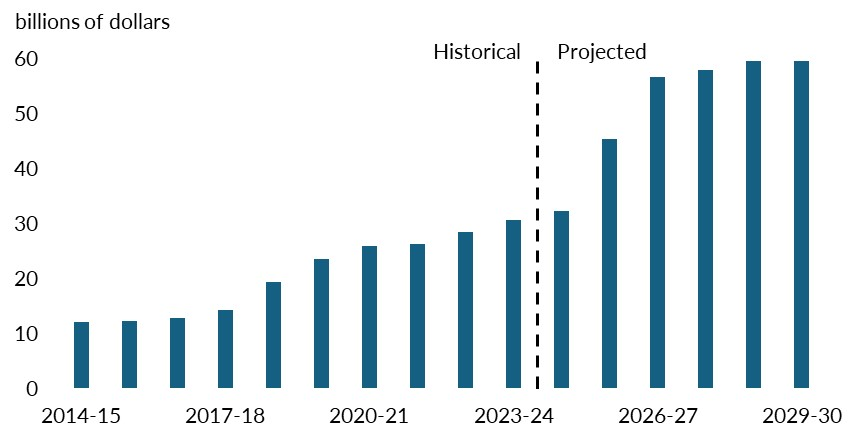
Fall Budgeting Cycle
| The new fall budgeting cycle* | ||
|---|---|---|
| Before a new fiscal year** | ||
| June - Aug | Pre-budget consultations | |
| Fall | Federal budget | |
| Federal | Provincial / Territorial*** | |
| Feb - April | Main estimates | Budgets Main estimates |
| Departmental plans | ||
| Interim supply | ||
| During the fiscal year | ||
| Spring | Economic and Fiscal Update | |
| May | Supplementary estimates (A) | |
| June | Approval of full supply / End of supply period | |
| Oct - Nov | Supplementary estimates (B) | |
| Dec | End of supply period | |
| Feb | Supplementary estimates (C) | |
| Mar | End of supply period | |
| After the fiscal year | ||
| Spring to fall | Traditional construction season | |
| Oct | Public Accounts of Canada | |
| Nov | Departmental results reports | |
|
*Table replicated from the House of Commons' Financial Procedures website ("An Overview of the Financial Cycle"), with date adjustments to reflect the change to a fall budgeting cycle, provincial and territorial budgeting dates, and the timing of the traditional construction season. **Presently, House of Commons Standing Order 83.1 provides that the Standing Committee on Finance shall conduct a pre-Budget consultations study each September to December. In light of the Government's change to a fall Budget, the House may decide to change its Standing Orders to require the committee to conduct this study in the spring for the following fall Budget. ***Dates vary by province and territory and may occasionally fall outside of these conventional timelines. Source: Department of Finance Canada. |
||
Timing of Federal Budgets and Estimates
- Previously, the federal budget has conventionally tabled in February or March, with some exceptions particularly in recent years.
| Year | Budget Date | BIA Introduction Date |
|---|---|---|
| 2011 | 6-Jun-2011 | 14-Jun-2011 |
| 2012 | 29-Mar-2012 | 26-Apr-2012 |
| 2013 | 21-Mar-2013 | 29-Apr-2013 |
| 2014 | 11-Feb-2014 | 28-Mar-2014 |
| 2015 | 21-Apr-2015 | 7-May-2015 |
| 2016 | 22-Mar-2016 | 20-Apr-2016 |
| 2017 | 22-Mar-2017 | 11-Apr-2017 |
| 2018 | 27-Feb-2018 | 27-Mar-2018 |
| 2019 | 19-Mar-2019 | 8-Apr-2019 |
| 2021 | 19-Apr-2021 | 30-Apr-2021 |
| 2022 | 7-Apr-2022 | 28-Apr-2022 |
| 2023 | 28-Mar-2023 | 20-Apr-2023 |
| 2024 | 16-Apr-2024 | 2-May-2024 |
| 2025 | 04-Nov-2025 | |
| Source: Department of Finance Canada. | ||
- Release dates for the Estimates follow the supply calendar:
- Period ending June 23: Usually considers full supply of Main Estimates which, under House of Commons Standing Orders, must be tabled by March 1 each year and Supplementary Estimates (A).
- Period ending December 10: Considers Supplementary Estimates (B).
- Period ending March 26: Considers Supplementary Estimates (C) and interim for Main Estimates.
Timing of PT Budgets and Estimates
- Provincial and territorial governments have their own fiscal cycles and schedules.
- Budget dates generally vary within an 8-week period, with March being the most typical month.
- The Main Estimates are released annually, generally either at the same time as budgets or shortly thereafter.
- Supplementary Estimates are released as needed throughout the year. They are rare for some jurisdictions. In some instances, they may be published along with periodic economic and fiscal updates rather than stand-alone documents.
Typical Provincial Budget Dates
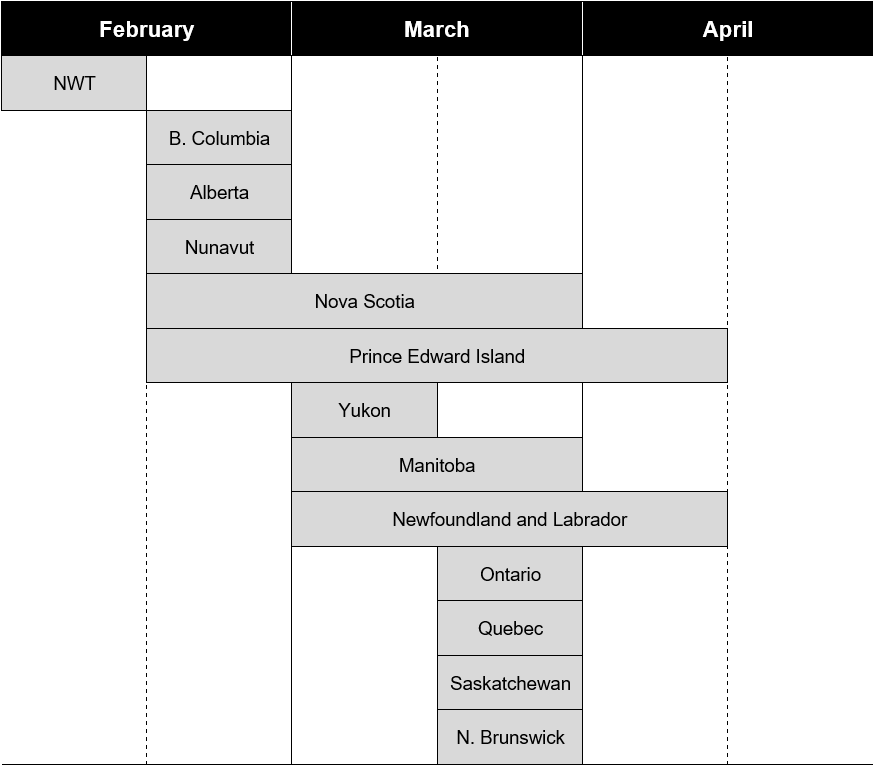
| 2023 | 2024 | 2025 | |
|---|---|---|---|
| British Columbia | |||
| Budget | Feb 28 | Feb 22 | Mar 4 |
| Main estimates | Feb 28 | Feb 22 | Mar 4 |
| Supplementary Estimates | – | – | – |
| Public Accounts | Aug 29 | Aug 22 | Aug 7 |
| Alberta | |||
| Budget | Feb 28 | Feb 29 | Feb 27 |
| Main estimates | Feb 28 | Feb 29 | Feb 27 |
| Supplementary Estimates | – | – | – |
| Public Accounts | Jun 29 | Jun 27 | Jun 27 |
| Saskatchewan | |||
| Budget | Mar 22 | Mar 20 | Mar 19 |
| Main estimates | Mar 22 | Mar 20 | Mar 19 |
| Supplementary Estimates | – | Dec 5 | – |
| Public Accounts | Jun 29 | Jun 27 | Jun 30 |
| Manitoba | |||
| Budget | Mar 7 | Apr 2 | Mar 20 |
| Main estimates | Mar 7 | Apr 2 | Mar 20 |
| Supplementary Estimates | – | – | – |
| Public Accounts | Sep 29 | Sep 27 | Sep 26 |
| Ontario | |||
| Budget | Mar 23 | Mar 26 | May 15 |
| Main estimates | Apr 20 | Apr 17 | Jun 4 |
| Supplementary Estimates | Nov 29 | – | – |
| Public Accounts | Sep 27 | Sep 19 | Sep 26 |
| Quebec | |||
| Budget | Mar 21 | Mar 12 | Mar 25 |
| Main estimates | Mar 20 | Mar 12 | Mar 25 |
| Supplementary Estimates | – | – | – |
| Public Accounts | Dec 11 | Oct 2 | Sep 26 |
| New Brunswick | |||
| Budget | Mar 22 | Mar 19 | Mar 18 |
| Main estimates | Mar 22 | Mar 19 | Mar 18 |
| Supplementary Estimates | – | – | – |
| Public Accounts | Sep 27 | Sep 16 | Sep 29 |
| Nova Scotia | |||
| Budget | Mar 23 | Feb 29 | Feb 18 |
| Main estimates | Mar 23 | Feb 29 | Feb 18 |
| Supplementary Estimates | – | – | – |
| Public Accounts | Sep 12 | Jul 26 | Sep 22 |
| Prince Edward Island | |||
| Budget | May 25 | Feb 29 | Apr 10 |
| Main estimates | May 25 | Feb 29 | Apr 10 |
| Supplementary Estimates | – | – | – |
| Public Accounts | Nov 6 | Oct 11 | Oct 8 |
| Newfoundland and Labrador | |||
| Budget | Mar 23 | Mar 20 | Apr 9 |
| Main estimates | Mar 23 | Mar 20 | Apr 9 |
| Supplementary Estimates | – | – | – |
| Public Accounts | Oct 30 | Oct 29 | Sep 8 |
| Yukon | |||
| Budget | Mar 2 | Mar 7 | Mar 6 |
| Main estimates | Mar 2 | Mar 7 | Mar 6 |
| Supplementary Estimates | – | – | – |
| Public Accounts | Nov 21 | Oct 24 | Oct 31 |
| Northwest Territories | |||
| Budget | Feb 8 | May 24 | Feb 6 |
| Main estimates | Feb 8 | May 24 | Feb 6 |
| Supplementary Estimates | – | – | – |
| Public Accounts | Dec 19 | Nov 15 | Nov 14 |
| Nunavut | |||
| Budget | Feb 23 | Feb 26 | Feb 24 |
| Main estimates | Feb 23 | Feb 26 | Feb 24 |
| Supplementary Estimates | – | – | – |
| Public Accounts | May 7 | Dec 20 | N/A |
| Source: Department of Finance Canada. | |||
| Province | Notes |
|---|---|
| British Columbia | The budget must be delivered on (or before) the fourth Tuesday of February unless an election year, and the main estimates also have to be tabled on or before that same date. |
| Alberta | Under the Financial Administration Act (FAA), the Government of Alberta is required to prepare and table its budget in the Legislative Assembly. While the FAA does not prescribe a specific date for tabling the budget, it mandates that the budget, known as the "Estimates," be tabled before the end of February each year. |
| Ontario | The estimates are required to be tabled within 12 sessional days of the budget." (Schedule of estimates | Legislative Assembly of Ontario) |
| Yukon | The Financial Administration Act requires that the Public Accounts be tabled by October 31. |
| Northwest Territories | The Financial Administration Act mandates that the Government of the Northwest Territories prepare and table its public accounts in the Legislative Assembly on or before December 31 following the end of the fiscal year; or if the Legislative Assembly is not then in session, on or before the fifth day of the next sitting of the Legislative Assembly. |
| Source: Department of Finance Canada. | |
Climate Policy
Key Messages
Government Climate Agenda
- Climate action is not just a moral obligation—it's an economic necessity. To compete internationally, Canada will need to reduce its carbon intensity to meet the growing demand from global markets for products with low associated greenhouse gas emissions.
- Budget 2025 outlined the government's Climate Competitiveness Strategy, creating the conditions for the investment needed to build an affordable net-zero future.
- The government's commitment to a low-carbon economy is reflected in the work of the Major Projects Office. One of the criteria for designation as a "Project of National Interest" is how a project will contribute to clean growth and to Canada's objectives with respect to climate change.
Impact of Removal of Fuel Charge
- On March 14, 2025, the government announced that it will cease the application of the federal fuel charge, effective April 1, 2025. It also removed the requirement for provinces and territories to maintain a consumer-facing carbon price as of that date. These actions have reduced gasoline prices at the pump in most provinces and territories by up to 18 ¢/L compared to 2024–25 levels, thereby contributing to lower headline inflation.
- The government is winding down mechanisms used to return direct fuel charge proceeds to Canadians, small and medium-sized businesses, farmers, and Indigenous governments.
- Eliminating the fuel charge, which is currently before Parliament as part of Bill C-4, will give Canadian consumers and businesses certainty that the consumer carbon price is being permanently removed from legislation.
Impact of Clean Fuel Regulations
- The goal of the Clean Fuel Regulations is to significantly reduce pollution by making the fuels cleaner, while increasing incentives for the development and adoption of clean fuels, technologies and processes.
- The regulations require liquid fossil fuel (gasoline and diesel) suppliers to gradually reduce the carbon intensity – or the amount of pollution – from the fuels they produce and sell for use in Canada, leading to a decrease of approximately 15% (below 2016 levels) in the carbon intensity of gasoline and diesel used in Canada by 2030.
- The CFR are anticipated to increase the cost of fuels with an estimated price impact of $0.06 to $0.13 per litre for gasoline and $0.07 to $0.16 per litre for diesel (2021 dollars) in 2030.
Canada-Alberta MOU
- The Canada-Alberta Memorandum of Understanding, signed on November 27, 2025, outlines a shared commitment to collaborate on major energy and economic projects, including expanding electricity generation, advancing large-scale carbon capture and storage, and ensuring meaningful Indigenous participation
- The agreement emphasizes improving regulatory efficiency and coordination, including aligning carbon pricing, methane reduction measures, and using federal investment tax credits to support clean energy projects and attract private investment.
- It also focuses on developing future energy infrastructure, such as new interprovincial electricity interties and a nuclear power strategy, to achieve a net-zero power grid by 2050.
- The Canada-Alberta Memorandum of Understanding also commits to expanding federal Investment Tax Credits
to encourage large scale carbon capture investments, including the Pathways projects and enhanced oil
recovery projects.
- Once constructed, the Pathways projects would help reduce the carbon intensity of Alberta oil and make some oil production among the lowest carbon-intensity in the world.
- Enhanced oil recovery generates demand for captured CO2, which can enable additional carbon capture projects to be financially viable while storing the captured CO2 so it is not released into the atmosphere.
2030 Emissions Reduction Plan
- Canada's 2030 Emissions Reduction Plan was established in 2022, providing a sector-by-sector pathway towards achieving Canada's 2030 emissions reduction target and a road to net-zero by 2050, supported by $9.1 billion in federal investments.
- In December 2025, the government released the 2025 Progress Report on the 2030 Emissions Reduction Plan. It stated that Canada's announced measures are expected to reduce emissions by 28 per cent below 2005 levels by 2030 – below the government's 40-45 per cent target, which continues to be an ambitious target for Canada and serves as an important milestone on the path to net-zero by 2050.
- The Government of Canada will continue to explore the full suite of tools available to reduce emissions, including implementing those discussed in the Climate Competitiveness Strategy.
Details & Supplementary Information
- The Climate Competitiveness Strategy is anchored by three pillars:
- Boosting investment through Clean Economy Investment Tax Credits to
meet growing demand for clean energy, modernize electricity grids, and expand renewables, energy
storage, and interprovincial interties.
- Four of the Clean Economy investment tax credits have already been delivered and are now available to claim, which includes the Carbon Capture, Utilization, and Storage, Clean Technology, Clean Hydrogen, and Clean Technology Manufacturing investment tax credits.
- Bill C-15 introduces legislation to deliver the 15% Clean
Electricity investment tax credit and enhancements to investment tax
credits that have already been implemented:
- Expand eligibility to include systems that produce electricity, heat, or both electricity and heat from waste biomass and change the eligibility requirements for small nuclear energy under the Clean Technology investment tax credit.
- Expand eligibility to include qualifying equipment used in eligible polymetallic mining projects and expand the list of critical minerals eligible under the Clean Technology Manufacturing investment tax credit.
- Extend the availability of full credit rates for the Carbon Capture, Utilization, and Storage investment tax credit by five years, to 2035.
- The government will be introducing legislation to deliver expanded eligibility to include hydrogen produced from methane pyrolysis under the Clean Hydrogen investment tax credit.
- Strengthening industrial carbon pricing to reduce emissions and provide
long-term certainty for businesses and investors. Effective industrial carbon markets are
integral to driving investment in clean growth and emissions reductions. The Strategy will:
- Engage with provinces and territories to develop a post-2030 carbon pricing trajectory. The government will set an industrial carbon price trajectory that supports net-zero by 2050, giving businesses the confidence they need to make long-term investments in climate competitiveness.
- Engage with provincial and territorial governments on improvements to the federal benchmark. This process will ensure pricing systems across the country are working effectively and enable the implementation of a strengthened benchmark. Additionally, the government will explore opportunities to harmonize or link carbon credit markets.
- Apply the federal backstop whenever a provincial or territorial system falls below a strengthened federal benchmark, to ensure a stringent price signal and level playing field across the country.
- Boosting investment through Clean Economy Investment Tax Credits to
meet growing demand for clean energy, modernize electricity grids, and expand renewables, energy
storage, and interprovincial interties.
- The Canada Growth Fund will continue to issue contracts for difference as a means of further improving future carbon price certainty for investors making large, long-duration capital investments.
- Clarifying greenhouse gas regulations, including finalizing enhanced methane regulations for the oil and gas sector. By tightening these regulations, we will significantly reduce emissions across Canada, while providing clarity and predictability for industry. The government has also finalize new methane regulations for landfills. Methane is one of the most potent greenhouse gases—80 times more harmful than carbon dioxide over a 20-year period—and one of the easiest to reduce.
Comprehensive Expenditure Review
Key Messages
Government-wide messages
- Budget 2025 outlines the details of the Government of Canada's Comprehensive Expenditure Review (CER), which will contribute to balancing the government's operating budget by 2028-29.
- The CER will achieve savings of $9 billion in 2026-27, $10 billion in 2027-28 and $13 billion in 2028-29. Combined with other savings and revenues in Budget 2025, this will total $60 billion over five years, starting in 2025-26.
- Statutory transfer payments to provinces, territories and individuals were outside the scope of the review.
- Participating organizations are in the process of communicating these measures to their employees and collective bargaining agents, and the federal government will continue to identify more efficiencies and potential savings, which will be communicated in the 2026-27 Main Estimates and Departmental Plans.
Department of Finance
- The Department of Finance will implement CER measures resulting in savings of $10.7 million in 2026–27, increasing to $14.2 million in 2027–28 and $21.3 million in 2028–29 and ongoing, representing a cumulative reduction of 94 full-time equivalent positions by 2029–30.
- CER savings are being implemented through a planned reduction in staffing levels over three years, supported by workforce realignment and organizational changes that maintain delivery of core policy and corporate functions. As a result of careful planning, vacancy management, and limiting external staffing, the Department has already achieved approximately 60 per cent of the required CER savings.
- The remaining savings are being focused on reorganizing resources within and across policy branches, centralizing administrative functions across the Department, and achieving efficiencies in internal service areas by modernizing tools, processes, and functions.
- In December 2025, the Department provided affected letters to 84 employees, advising them that their services may no longer be required and introducing a voluntary departure program that will run to February 3rd. The Department plans to reduce up to 40 positions through the voluntary departure program or subsequent workforce adjustment measures, as required.
Details & Supplementary Information
- The CER is not an across-the-board reduction exercise. It is a measured and strategic approach to improve public service productivity. To achieve this objective, federal departments and agencies undertook a thorough review of their organizations, identifying programs and activities that were underperforming, duplicative, or that had strayed away from the core federal mandate.
- The process applied to federally appropriated organizations, with the following exceptions:
- agents of parliament and arms-length organizations to preserve their independence, and
- cost-recovered organizations, because including them would not generate savings.
- Departments were directed to develop proposals using Gender-Based Analysis Plus to understand how
Canadians, including vulnerable groups, would be affected. Planned savings fall under three themes
generally:
- Modernizing Government Operations ($25.2 billion over four years)
- Streamlining Program Delivery ($1.5 billion over four years)
- Recalibrating Government Programs ($17.5 billion over four years)
- Savings from the CER across departments and programs vary, reflecting the need to protect the important
mandates that some organisations have in delivering frontline services, social programs, and priorities
such as defence and security. As such, the government is setting a lower savings target of 2% for
the following organizations:
- Canada Border Services Agency (CBSA)
- Canadian Institutes of Health Research (CIHR)
- Canadian Security Intelligence Service (CSIS)
- Communications Security Establishment (CSE)
- Crown-Indigenous Relations and Northern Affairs Canada (CIRNAC)
- Indigenous Services Canada (ISC)
- Department for Women and Gender Equality (WAGE)
- Department of National Defence (DND)
- Natural Sciences and Engineering Research Council (NSERC)
- Royal Canadian Mounted Police (RCMP)
- Social Sciences and Humanities Research Council (SSHRC)
- The savings identified through CER will contribute to returning the size of the public service to a more sustainable level, with an estimated reduction of 16,000 full-time equivalents, or roughly 4.5% of the workforce as of March 2025. Of these reductions, some 650 will be executive positions, representing about 7% of the executive population. These reductions will continue the trend towards a more sustainable public service size of roughly 330,000 by 2028-29.
- Savings will involve workforce adjustments and attrition to return the size of the public service to a more sustainable level. To manage these reductions to the greatest extent possible through attrition and voluntary departures, Budget 2025 proposes to offer a voluntary Early Retirement Incentive through the Public Service Pension Plan. Public servants at age 50 or above for Group 1 and age 55 or above for Group 2 who have at least ten years of employment, with at least two years of pensionable service in the Plan may apply to participate under parameters set by Treasury Board. Eligible employees will be able to retire with an immediate pension based on years of service with no penalty for early retirement. Implementation would proceed by January 15, 2026, or – as now is the case – when legislation receives Royal Assent, and the government intends to conclude the process within one year.
Housing Sector Overview
Key Messages
- Housing market activity softened in early 2025 amid trade policy uncertainty. Activity has since partially recovered but remains subdued, with most markets moving sideways or down in recent months.
- That said, housing starts remained elevated in 2025 and ended the year on a strong note, rising 11% in December following a similar gain in November. Overall, starts proved resilient in 2025, with nearly 260,000 units—up 5.6% from 2024.
- Federal policies have supported record levels of rental construction.
- Pent-up demand for housing, reflecting past strength in population growth, will continue to support residential investment.
- Housing affordability has improved but remains a challenge for people in major urban centers such as Toronto and Vancouver, suggesting growth in residential investment will be uneven across markets.
- Slower population growth combined with a steady increase in housing supply is helping the housing market gradually rebalance.
- Home prices are about 19 per cent below their February 2022 peak, easing the upfront cost of homeownership.
- Lower mortgage rates have reduced financing costs, with average monthly payments for new homebuyers down by more than $400 over the last two years.
- Rental market conditions have also improved in many regions. Rent inflation in December slowed to 4.9% from a peak of 8.9% in August 2024. The average asking monthly rent for an apartment has fallen by $330 in Toronto and $400 in Vancouver over the last two years.
- Through Budget 2025 and other targeted measures, the government is taking concrete action to expand the housing stock, support affordability, and ensure Canadians have access to the housing they need.
Details & Supplementary Information
- Housing affordability deteriorated sharply during the pandemic, as rapid price growth coincided with higher interest rates.
- As a result, the Bank of Canada's Housing Affordability Index—measuring the share of income a new homebuyer must devote to housing costs—rose from a 2015–2019 average of 36% to a peak of 54% in 2023Q3.
- Conditions have since improved. Home prices have declined to $673,000, and interest rates have moderated. As a result, housing affordability has improved from its peak, with the index declining to 44%, though it remains above pre-pandemic norms.
- Housing supply has responded. Housing starts remained strong in 2025, totalling 259,000 units for the year—well above the 2015–2019 average of 206,000 units. Recent policy measures have helped sustain elevated construction activity, with a notable surge in purpose-built rental housing, partially offsetting softer activity in the ownership and oversupplied condo segments.
- Resale market pressures have eased. The sales-to-new-listings ratio, a key indicator of resale market tightness, eased to 52% in December 2025 from a peak of 87% in January 2021, signalling a return to broadly balanced market conditions at the national level and reducing upward pressure on home prices.
|
|
2015-2019 Average |
Pre-pandemic |
Peak |
Year Ago |
Latest |
|
|---|---|---|---|---|---|---|
|
National Home Price Index ($) |
$496,000 |
$534,000 (Feb 2020) |
$827,000 (Feb 2022) |
$702,000 (Dec 2024) |
$673,000 (Dec 2025) |
|
|
Bank of Canada's Housing Affordability Index |
35.5% |
36.3% (2019 Q4) |
54.3% (2023 Q3) |
46.5% (2024 Q4) |
43.5% (2025 Q3) |
|
|
Housing Starts (units, 6-month moving average) |
206,000 |
209,000 (Feb 2020) |
285,000 (Jun 2021) |
243,000 (Dec 2024) |
264,000 (Dec 2025) |
|
|
Sales-to-New-Listings Ratio |
58.4% |
64.4% (Feb 2020) |
86.6% (Jan 2021) |
55.8% (Dec 2024) |
52.3% (Dec 2025) |
|
|
National Average Asking Rents ($) |
N/A |
$1,784 (Feb 2020) |
$2,202 (May 2024) |
$2,109 (Dec 2024) |
$2,060 (Dec 2025) |
|
Tax Debt and Corporate Write-offs
Key Messages
- The Canada Revenue Agency (CRA) is responsible for collecting tax debts owed to federal, provincial, and territorial governments under various acts, including the Income Tax Act and Excise Tax Act.
- Once the CRA has exhausted all avenues of collection, the CRA will deem the debt to be uncollectible, at which point it will be administratively written-off.
- With certain limited exceptions (e.g., debts that have reached collection limitation period), writing off a debt does not release the taxpayer from their obligation to pay off the debt. An improvement in the taxpayer's financial situation will result in efforts to collect the debt once again.
- In 2024-25, $5.3 billion in tax debt was written-off, including $1.0 billion in corporate tax debt. This is up from 2023-24, when $4.9 billion was written-off, including $0.5 billion in corporate tax debt.
- Corporate tax debt was the third largest write-off category, following GST/HST, and individuals and trusts.
- Under section 241 of the Income Tax Act, the CRA is legally prohibited from releasing "taxpayer information," which reveals the identity of a taxpayer, including corporations.
- The CRA continues to develop and implement collection strategies to improve its capacity to manage tax debt and avoid new debt from accumulating.
- Information relating to debts, obligations and claims written off or forgiven are itemized under each relevant federal act. They are available online under the Public Accounts of Canada, Volume III, Section 2 for each fiscal year.
Details & Supplementary Information
Write-offs
($ billions)
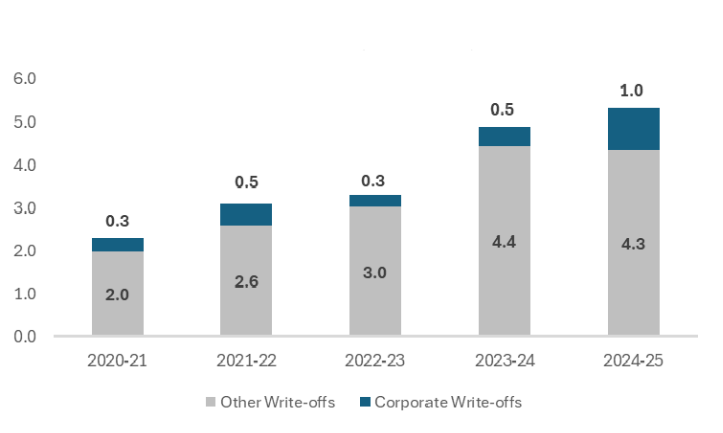
- Corporate write-offs have averaged $0.5 billion annually. This is an average 13.1 per cent of total write-offs over the last five fiscal years (based upon Note 3 of the CRA Financial Statements and Public Accounts of Canada, Volume III, Section 2).
- Other write-offs, including debts owing from GST/HST, employers, individuals and trusts, non-residents, COVID-19 recoveries and excise taxes and duties, were 82 per cent of all write-offs in 2024-25.
- A corporation may have multiple accounts (for example, a corporate account, a GST/HST account, and a payroll account), a credit on one account may be applied to a debt on another related account.
Bill C-15: Concerns and Questions & Answers
Part 1(j) - Personal Support Workers
Canadian Union of Public Employees (CUPE) is concerned this measure is only temporary and is not a proper substitute for living wages.
- Response: The government signed agreements with British Columbia, Newfoundland and Labrador, and the Northwest Territories to provide funding over five years to support them to increase wages for personal support workers. The tax credit would also be available for five years for personal support workers employed in other provinces and territories.
Part 1(n) – Canada Carbon Rebate for Small Businesses (CCRSB)
Stakeholders, including Members of Parliament, have asked when the Canada Revenue Agency will return carbon pricing proceeds for the 2024-25 fuel charge year to small businesses.
- Response: The Canada Revenue Agency has already begun to issue the final, 2024-25 fuel charge year payments of the Canada Carbon Rebate for Small Businesses to eligible tax filers. Bill C-15 does not affect the timing of these payments.
- CCRSB-related amendments in Bill C-15 primarily serve to deem the rebate payments for all fuel charge years to be non-taxable, and extend the eligible filing date for the 2019-20 through 2023-24 years.
Part 1(o) - Carbon Capture, Utilization, and Storage ITC – Full Rate Extension
The Bloc Québécois has traditionally opposed public support for Carbon Capture and Storage, and have spoken in opposition to this measure, stating that the ITC will disproportionately benefit the oil and gas sector.
The NDP or Bloc Québécois may not be supportive of extending the full credit rates for the Carbon Capture, Utilization and Storage (CCUS) Investment Tax Credit (ITC) to 2035, which would offer a higher level of ITC support for CCUS projects.
It may be argued that technology is not proven, or that the ITC is a fossil fuel subsidy for the oil and gas sector.
- Response: CCUS technologies are an important tool for reducing emissions in high-emitting sectors where other pathways to reduce emissions may be limited or unavailable.
- CCUS is a proven technology, including three large-scale CCUS projects already operating in Canada that capture and store about 3 megatonnes of CO2 annually.
The CCUS-ITC is not considered an inefficient fossil fuel subsidy the government's framework (published on July 24, 2023). The framework specifies that production processes abated using CCUS technologies are efficient.
Part 1(p) - Clean Technology Investment Tax Credit
The Bloc Québécois has asserted that the objective of expanding the clean technology investment tax credit to include small nuclear reactors is to support the oil and gas sector.
- Response: Bill C-15 proposes amendments to the existing definition of small modular nuclear reactor under the Clean Technology investment tax credit.
- The Clean Technology investment tax credit is meant to incent the adoption of clean technologies in Canada, as well as support Canada's emission reduction targets. Small nuclear reactors can be used as a non-emitting alternative to fossil fuel-based heat and power generation and can therefore help to reduce greenhouse gas emissions, primarily in the electricity sector.
Part 1(q) - Clean Technology Manufacturing Investment Tax Credit
The mining industry has been supportive of the proposed adjustments to the Clean Technology Manufacturing investment tax credit but has also expressed concerns that they may not be enough to provide viable and/or predictable support for certain mining projects.
- Response: The Clean Technology Manufacturing investment tax credit encourages the investment of capital for clean technology manufacturing and processing and critical mineral extraction and processing in Canada.
- The adjustments to the credit proposed in Bill C-15 would provide greater support and clarity to businesses engaged in polymetallic mining projects. This includes the implementation of a "safe harbour" rule to mitigate against the effects of mineral price volatility, and an expansion of the list of critical minerals that are eligible for the credit.
Part 1(r) - Clean Electricity Investment Tax Credit
The Bloc Québécois have raised concerns that the Clean Electricity Tax Credit will benefit oil companies and oil and gas producing provinces.
- Response: The Clean Electricity investment tax credit would be available to all taxable Canadian corporations, and certain tax-exempt corporations, such as provincial and territorial Crown corporations, that are investing in eligible clean electricity property, which includes low-emitting electricity generation systems (i.e., wind, solar, hydro, wave and tidal, geothermal, waste biomass, nuclear, or natural gas with carbon capture and storage), stationary electricity storage systems that do not use fossil fuels in operation, and equipment for the transmission of electricity between provinces and territories.
- The Clean electricity investment tax credit is mainly expected to benefit clean electricity investments in Ontario, British Columbia and Quebec.
Part 1(z) – Productivity Super-Deduction
The Aluminum Association of Canada is recommending that primary aluminum production be made eligible for immediate expensing of machinery and equipment used in manufacturing or processing activities under the Productivity Super-Deduction, similar to steel production.
- Response: The Productivity Super-Deduction provides enhanced tax support for investment in all capital assets. Primary aluminum producers are eligible for the Accelerated Investment Incentive component of the Productivity Super-Deduction, which provides an accelerated first-year capital cost allowance (CCA) equal to three times the normal rate. This would allow an enhanced 45 per cent CCA deduction in the first year for most primary aluminum production investments.
Part 2 - Repeal of the Digital Services Tax Act
The Conservative Party of Canada, The Bloc Québécois and the New Democratic Party of Canada have asserted that the repeal of the Digital Services Tax was done only to placate U.S. President Donald Trump.
- Response: On June 29, 2025, the Government announced its intention to rescind Canada's DST in support of negotiations on a new economic and security partnership with the United States. Repealing the Digital Services Tax Act would fulfill this commitment.
Part 3, Division 3 - Eliminating the Luxury Tax on Aircraft and Vessels
The Conservative Party of Canada and the New Democratic Party of Canada have raised concerns that eliminating the luxury tax on aircraft and vessels will only benefit the wealthy.
- Response: The aircraft and vessel components are being eliminated to support the aviation and boating industries during a time of ongoing global economic uncertainty.
- These components of the tax also raise relatively limited revenue, and bring complexity and associated compliance and administration burdens.
Part 4 - Fuel Alcohol Cannabis (FACT) Tax and other Indigenous Tax Arrangements
Chief Maracle from the Tyendinaga Mohawk Council raised concerns that Bill C-15 does not reference section 35 of the Constitution Act, 1982 (Aboriginal and treaty rights), and that it does not reference the United Nations Declaration on the Rights of Indigenous Peoples.
The Chief is also concerned that this measure would create a two-tiered taxation system.
- Response: Part 4 of Bill C-15 proposes to establish a new opt-in value-added sales tax framework on fuel, alcohol, cannabis, tobacco, and vaping (FACT) products.
- The FACT tax would be fully harmonized with the federal GST and would allow interested Indigenous governments to generate important revenues for community priorities.
- The development of the FACT Framework involved a multi-year engagement by Finance Canada officials, and included feedback and input from a number of Indigenous governments and Indigenous organizations.
- A key design element of the framework is that it is voluntary, meaning that only Indigenous governments that are interested will participate and generate tax revenues that can be used for their own communities' priorities. No Indigenous governments are obligated to be part of this framework and instead, can choose to keep the status quo.
- The First Nations Tax Commission is highly supportive of the initiative, as are other Indigenous leaders, but have put forward proposals and amendments to expand the proposed FACT framework.
- Finance Canada officials look forward to continuing discussions with interested Indigenous governments and organizations on these proposals. The government's priority is to implement the existing proposed legislative framework now because the proposals that have been brought forward require additional assessment and consideration.
Part 5, Division 1 – High-Speed Rail Network Act
Various parliamentarians have raised concerns about the expropriation of land, and whether the relevant provincial and any other applicable jurisdictions have consented, or will have the ability to consent to it.
Response:
Expropriation Process
- The High-Speed Rail Network Act (HSR Network Act), introduced via
Bill C-15, features targeted legislative measures to enable the timely and effective delivery of Canada's HSR project – a transformative national infrastructure initiative. - The HSR Network Act modernizes the framework of the current Expropriation Act to ensure procedural efficiency and legal certainty in a project of this magnitude (spanning approximately 1,000 km and requiring 8,000–10,000 parcels of land).
- The Act introduces four critical adjustments:
- a streamlined acquisition pathway allowing earlier ministerial requests;
- the removal of Governor in Council approval to reduce administrative burden;
- the elimination of mandatory public hearings while preserving the opportunity for affected individuals to submit written objections; and
- an extended legislative timeline to support bundled land acquisitions at scale.
Consultation on the High-Speed Rail Network Act
- The federal Expropriation Act does not provide for a formal role for provincial or municipal governments in the expropriation decision making process, and the HSR Network Act maintains this approach.
- Now that the proposed HSR Network Act has been introduced in Parliament and is publicly available, Transport Canada is informing Quebec and Ontario through bilateral discussions to outline the objectives of the legislation, share information, and hear their views on the implementation.
- The development of the HSR network is carried out in a manner that respects established intergovernmental practices and promotes collaboration and coordination with provincial and municipal governments, as well as social acceptability for the initiative. Consistent with these principles, land acquisition, whether through negotiated willing buyer–willing seller agreements or, where necessary, expropriation, is approached with transparency and fairness.
- Ongoing dialogue and engagement with stakeholders on land-related matters remain essential to ensuring this transparency, fostering alignment across jurisdictions, and supporting effective project delivery.
- Furthermore, the proposed legislative changes reflect proven Ontario and Quebec practices adapted to the federal context.
Agriculture and Farmland
- Alto has developed a Land Acquisition Strategy that prioritizes early engagement, negotiated agreements, and the mitigation of impacts, particularly on agricultural lands. The approach recognizes the economic and social importance of these lands and is grounded in transparency, respect and predictability.
- Negotiated solutions are the preferred outcome, supported by clear and consistent compensation principles and structured engagement with agricultural organizations in Quebec and Ontario.
- In Quebec, Alto is negotiating a framework agreement with the Union des Producteurs Agricoles (UPA) to establish shared principles related to access, drainage, permissions to enter, and compensation. In Ontario, Alto is also engaging agricultural organizations through early dialogue, information-sharing, and issue-specific collaboration.
Part 5, Division 2 - Canada Post Corporation Act
The Canadian Union of Postal Employees (CUPE) has raised concerns that with the removal of the "library material" clauses, there is no guarantee that the government will maintain its promise that library materials will continue to be shipped at a reduced rate, and materials for the blind will be shipped free of charge.
- Response: The policy and legal intent of the proposed amendments is to grant the Canada Post Corporation pricing autonomy and remove Governor in Council's approval over postage rates and related terms, including refunds, reduced rates, and free materials (paragraph 19(1)(g)(i)).
- The decision not to include paragraph 19(1)(g)(i) was made to ensure consistency and clarity by establishing a single, deregulated rate‑setting process, thereby reducing administrative burden. This does not change the Government of Canada's position, and it will maintain the free mailing of materials for the blind and Canada Post will continue to receive compensation for providing this important service.
Part 5, Division 3 – Build Canada Homes
The Conservative Party of Canada have raised concerns that this measure will add bureaucracy to home building and are skeptical of the program's efficacy.
- Response: Build Canada Homes (BCH) works differently from previous government entities, by combining flexible financial tools—including low interest loans, equity investments, contributions and guarantees, land access and development expertise under one roof. It will make large-scale, mixed-market developments financially viable, attract private capital and safeguard long-term affordability.
- In addition to providing land, development expertise, and flexible financial tools, Build Canada Homes will work in partnership to reduce risk, address barriers, and guide projects through the development process.
- BCH will partner with the non-profit and co-operative housing sector, private developers, Indigenous organizations and all levels of government on mixed-income housing developments that combine affordable rental with market units. This approach will help unlock new sources of private capital, create more housing supply, and ensure housing remains financially viable and affordable over the long term.
The Bloc Québécois have argued that this program has no funding criteria, no plan, no accountability and no agreement with the Quebec government.
- Response: Its Investment Policy Framework sets out how Build Canada Homes (BCH) invests to deliver housing that is affordable, scalable, and built faster. It marks a new federal approach to housing investment—one that is flexible, impact-driven, and focused on real results.
- The Government of Canada and the Government of Quebec have signed a Memorandum of Understanding (MOU) to collaborate on deploying BCH in Quebec.
- Housing affordability is a top priority across the country, including in Quebec. This MOU will help address the housing crisis by increasing the supply of affordable housing and reducing barriers to construction through a structured and collaborative approach.
- Both governments commit to streamlining administrative processes, eliminating duplication, and accelerating project delivery.
Part 5, Division 4 – Canada Infrastructure Bank
The Conservative Party of Canada have been very critical of the Canada Infrastructure Bank (viewing it as ineffective and costly) and have called for its abolishment.
- Response: Working in cooperation with provinces and territories, as well as Indigenous and private investor partners, the Canada Infrastructure Bank (CIB) advances infrastructure projects across Canada that deliver on public interest outcomes to Canadians such as contributing to Canada's long-term and sustainable economic growth, supporting infrastructure that helps build more housing stock, supporting the transition to a low-carbon economy, and improving connectedness.
- The CIB is a mature organization overseeing a portfolio of 106 projects, including eight completed and 89 in construction. The CIB has committed $17.9 billion in capital towards projects with a total capital value of $54.4 billion, supporting Canada's economic growth, community development, and energy security, by making public dollars go further. It is an organization that is moving at a fast pace, attracting $25.2 billion in private capital, and helped create approximately 313,500 jobs during construction.
- Every dollar invested by the CIB is repaid and also leverages $1.40 in private investment. As funds are repaid and reinvested, that same dollar supports multiple projects over time, multiplying impact and maximizing value for taxpayers.
The Bloc Québécois have questioned the funding distribution of the Canada Infrastructure Bank, noting that the funds should go directly to the provinces.
- Response: The Canada Infrastructure Bank (CIB) plays a critical role in helping Canada build the infrastructure Canadians need and that delivers real benefits to the economy, the environment, and communities across the country. It also brings into focus the need for innovative policy and investment solutions to overcome the infrastructure barriers Canada faces today.
- The CIB works in partnership with provinces and territories and does not impose projects unilaterally. Provinces retain full authority over project selection and delivery within their jurisdictions. The CIB provides an optional financing tool that provinces can choose to use based on their needs.
- Direct transfers and CIB investments are complementary tools serving different project types. The CIB helps accelerate projects while respecting constitutional jurisdictions. Flexible financing models allow provinces to retain ownership and control.
- The CIB has reached financial close on 106 projects across the country, with at least one project for each province and territory.
The New Democratic Party of Canada have raised concerns with private sector involvement in federally funded projects.
- Response: Our government's focus is on spending less and investing more, by using public funds to unlock private-sector involvement and build the strongest economy in the G7. The Canada Infrastructure Bank (CIB) is a powerful tool to support this approach.
- We will use the CIB to catalyze private-sector investment, making public dollars go further—attracting more private investment, accelerating delivery, and maintaining fiscal discipline.
- The CIB represents an additional federal tool to help close the infrastructure gap. Its unique model of investing in revenue-generating projects and attracting private capital allows the CIB to take on risks that the private sector alone would not be able to bear. The CIB's model is helping projects get built at a lower cost to taxpayers.
- Private investment is used strategically to accelerate delivery and transfer construction and performance risk away from taxpayers. Private sector participation allows governments to build more infrastructure sooner without compromising public values.
Part 5, Division 5 - Red Tape Reduction Act
Various stakeholders and Senators have raised concerns that the use of regulatory sandboxes are potentially open to abuse, diminish transparency and accountability, and could weaken the protections that regulations are designed to provide. For example, the Centre québécois du droit de l'environment are concerned about environmental protections being weakened.
- Response: To protect the economy, environment and welfare of Canadians in
the use of regulatory sandboxes, the legislation includes several safeguards, including:
- providing clear time limits for exemptions;
- requiring exemptions be in the public interest;
- requiring that public health, public safety, and the environment be protected; and
- limiting exemptions to individual entities, not entire sectors of industry.
- The President of the Treasury Board will issue additional direction through a Policy on Sandboxes under the
Cabinet Directive on Regulation to promote further due diligence in the use of regulatory sandboxes, such as
requiring regulators to:
- consider and address any domestic, international, sectoral, social, economic, labour, and environmental implications before the regulatory sandbox;
- identify and engage in meaningful consultation with stakeholders and work in consultation and cooperation with implicated Indigenous peoples; and,
- ensure transparency, including publicly reporting and providing mechanisms for stakeholders to provide feedback during and after a regulatory sandbox.
- The Policy will be tabled in Parliament to inform and support Parliamentarians' consideration of the proposed legislative amendments to the Red Tape Reduction Act.
*Redacted*
Part 5, Division 9 - Consumer-Driven Banking
Committee members on the Standing Senate Committee on Banking, Commerce and the Economy raised concerns over the oversight and the implementation of consumer-driven banking.
Senator Ringuette raised concerns that the Bank of Canada will have supervisory roles rather than OSFI.
Concerns over data protection and privacy were also raised by Senate committee members.
- Response: Transferring the administration and oversight of consumer-driven banking (CDB) to the Bank of Canada (the Bank) was done with a view to efficiency, expediency in establishing the framework, and consistency for future participants.
- Leveraging the Bank's existing resources, expertise and infrastructure in the registration and supervision of retail payment service providers under the Retail Payment Activities Act (RPAA) will reduce costs for the framework's initial set up, enable the government to advance its goals for consumer-driven banking quickly, and streamline processes for participants of both regimes.
- Further, the move promotes competition in the financial sector by reducing barriers to entry for new participants of both regimes and supporting a more efficient path to payment initiation for the framework.
- As the government has committed to accelerating consumer-driven banking, by advancing policy work on the next phase, including payment initiation, placing oversight of both payments and consumer-driven banking under the same regulator, is both logical and efficient.
Part 5, Division 16 – Bank Act (Consumer-targeted fraud)
Option consommateurs raised concerns that this measure does not go far enough to hold banks responsible for the losses suffered by the consumer. They believe it should include requirements for banks to reimburse clients who are victims of bank fraud, unless they were grossly negligent.
The Public Interest Advocacy Centre raised concerns that the language itself is not consumer-centric, nor is it consumer-friendly. A lot of language is about the criteria set by the bank.
Responses:
Q. Why are banks being made responsible for consumers being deceived by fraudsters?
A. Banks must do more to ensure consumers do not bear an unreasonable burden in avoiding falling prey to fraud. However, the government recognizes that fraudsters engage potential victims long before banks have an opportunity to detect suspicious activity, by soliciting victims through SMS, e-mail, phone calls and social media platforms.
That is why the government announced in Budget 2025 the development of a cross-sectoral National-Anti Fraud Strategy, implicating the telecommunications sector and social media platforms. Several federal government departments and agencies are collaborating to coordinate a multi-sector approach to prevent fraud and mitigate its harms to Canadians.
Q. Why is the language in the bill not consumer-centric and simply focused on criteria set by the bank?
A. The changes included in the bill represent a first step in the development of the National Anti-Fraud Strategy. The bill establishes a series of new consumer protection requirements for banks. Banks will have to allow consumers to opt in or out of key account features, including payment capabilities. Banks will also be required to establish policies and procedures to detect and prevent consumer-targeted fraud and to mitigate its impact. Banks will need to have criteria to identify suspicious transactions and for determining when to suspend or cancel such a transaction. The government will develop regulations to further specify requirements for banks related to consumer-targeted fraud.
To help Canadians understand their rights and protections, the Financial Consumer Agency of Canada (FCAC) provides plain language explanations of consumer protection measures on their website.
Q. The government consulted on expanding limited consumer liability protections to all types of transactions. Why isn't the government doing that now?
A. Budget 2025 announced the development of a cross-sectoral National-Anti Fraud Strategy. Several federal government departments and agencies are collaborating to coordinate a multi-sector approach to prevent fraud and mitigate its harms to Canadians. The Government has not ruled out any possible tools or measures as part of this Strategy.
Q. Why are we only making these changes for banks? What about other federally regulated financial institutions?
A. The majority of Canadians continue to bank with traditional banks, while the remainder largely bank with provincially-regulated financial institutions, such as credit unions. The legislative amendments proposed in Budget 2025 will affect a significant majority of financial consumers.
Part 5, Division 19 Basic Pension & Accommodation & Meal Charge and Part 5, Division 20 - Earnings Loss Benefit
Canadian Union of Public Employees (CUPE) has raised that it is not clear how over four years $5.8 billion would be saved with respect to the RCMP pension.
- Response: The proposed legislative amendments under Part II of the Royal Canadian Mounted Police Superannuation Act is expected to generate a savings of approximately $5.8B over four years, on an accrual basis, by reducing the long-term liability associated to the cost of life-time benefits for existing and future beneficiaries. The proposed change does not reduce existing benefit payments to current and former members or their survivors.
- The estimated savings were calculated by the Office of the Chief Actuary, who independently assesses government long‑term liabilities, including those associated with RCMP disability pensions.
- Veterans Affairs Canada is responsible for the proposed changes to the definition of 'province' to exclude territories in the Budget Implementation Act, 2025. There is no impact to the RCMP since the proposed change to the annual adjustment formula for disability pensions uses the Consumer Price Index which accounts for provinces and territories in its calculation.
The National Association of Federal Retirees raised concerns that the definition of "province" should remain as it is in the Interpretation Act where provinces means both provinces and territories.
- Response: Section 3(1) of the Interpretation Act states that the provisions of that Act only apply to the extent that there is no contrary intention.
- Veterans Affairs Canada's view is that the definition of "province" was always intended to mean the ten provinces and not the territories.
- The accommodation and meals charges were linked to the lowest monthly provincial charge beginning in 1993.
- Bill C-15 will clarify the methodology used to calculate annual adjustments to the accommodations and meals charge to plainly reflect the original intent.
C-15: An Act to implement certain provisions of the budget tabled in Parliament on November 4,
2025
Overviews, Key Messages and Questions and Answers
Part 1(a) Capital Gains Rollover on Investments
Overview
The capital gains rollover on business investment ensures that Canadian small businesses can access the capital that they need to grow by allowing investors to defer taxation of capital gains on certain investments. Specifically, the taxation of a gain can be deferred to the extent that the proceeds of disposition from the sale of eligible small business shares are reinvested in other eligible small business shares during the year of disposition or within 120 days following that year. This is subject to certain conditions, including that each of the corporations that issued the initial shares and that issued the replacement shares must not have had greater than $50 million in assets immediately before or after the share issuance, and the shares must be common shares.
This measure would expand the rollover and make more investments eligible. Specifically, it would allow preferred shares to qualify for the rollover, increase the asset limit of eligible small business corporations that qualify for investment to $100 million, and increase the length of the period to acquire new investments to within the year of disposition and one full calendar year following the year of disposition.
These changes would apply to qualifying dispositions that occur on or after
January 1, 2025.
Key Messages
- The capital gains rollover on business investment ensures that Canadian small businesses can access the capital that they need to grow by allowing investors to defer taxation of capital gains on certain investments, provided they are reinvested in eligible small businesses and meet certain other requirements.
- This measure implements changes proposed in the 2024 Fall Economic Statement to expand the rollover and make more investments eligible.
- These changes would apply to qualifying dispositions that occur on or after January 1, 2025.
Questions & Answers
Q. What is the purpose of this measure?
A. Expanding the rollover will help to ensure that Canadian small business can access the capital that they need to grow.
Q. What is the expected revenue impact of this measure?
A. The measure is expected to reduce tax revenues by $5 million over 5 years.
Part 1(b) Disability Supports Deduction
Overview
Persons with disabilities can incur additional costs not faced by other taxpayers in order to earn business or employment income or to attend school. While the Disability Supports Deduction is intended to provide tax recognition of costs for disability supports through a legislated list of eligible expenses, this list does not include certain newer technologies available to persons with disabilities.
To improve tax recognition, this measure would add items to the list of expenses eligible for the Disability Supports Deduction, including: costs in respect of a service animal, alternative input devices, ergonomic work chairs, bed positioning devices, and navigation devices for low vision.
Consequential to this change, the list of expenses eligible for the Medical Expense Tax Credit is also being expanded through this measure to include navigation devices for low vision.
This measure would apply to the 2024 and subsequent taxation years.
Key Messages
- The purpose of the Disability Supports Deduction is to provide tax recognition of costs for specific disability supports that are incurred by persons with disabilities in order to earn business or employment income or to attend school, through a legislated list of eligible expenses.
- To improve this tax recognition, this measure would add items to the list of expenses eligible for the Disability Supports Deduction, including: costs in respect of a service animal, alternative input devices, ergonomic work chairs, bed positioning devices, and navigation devices for low vision. The measure also includes a consequential amendment to the Medical Expense Tax Credit to recognize navigation devices for low vision on its list of eligible expenses.
- This measure responds directly to recommendations made by the Canada Revenue Agency's Disability Advisory Committee for expanding the Disability Supports Deduction.
- To continually improve the Disability Supports Deduction in meeting the needs of Canadians, the government
also intends to consult persons with disabilities and stakeholders on the list of eligible expenses every
four years, beginning in 2028.
Questions & Answers
Q. What expenses would be added to the Disability Supports Deduction through this measure?
A. The expenses that would be added to the list of eligible expenses for the Disability Supports Deduction through this measure are summarized in the table below, along with the conditions for which the expenses would be eligible to be claimed by an eligible taxpayer.
| Type of Expense | Condition |
|---|---|
| Ergonomic work chair (including ergonomic assessment) | Severe and prolonged impairment in physical function |
| Bed positioning device (including ergonomic assessment) | Severe and prolonged impairment in physical function |
| Mobile computer cart | Severe and prolonged impairment in physical function |
| Alternative input device | Impairment in physical or mental function |
| Digital pen | Impairment in physical or mental function |
| Navigation device for low vision | Vision impairment |
| Memory or organizational aids | Impairment in mental functions |
| Acquisition and maintenance of service animals | As under the Medical Expense Tax Credit |
Q. Who can claim expenses under the Disability Supports Deduction?
A. To be eligible for the disability supports deduction, a taxpayer must have a mental or physical impairment and have incurred expenses that enable them to:
- be employed;
- carry on a business (either alone or as an actively engaged partner);
- attend a post-secondary educational institution or a secondary school;
- carry on research in respect of which the taxpayer received a grant; or
- perform the duties of an office.
The taxpayer does not have to be eligible for the Disability Tax Credit to access this measure, although certain criteria may apply for eligibility of particular types of disability supports.
Q. Why are only certain expenses recognized?
A. The Disability Supports Deduction is a targeted tax measure that recognizes expenses for items and services needed by persons with mental or physical impairments to enable them to work, own a business or go to school.
To ensure that the Disability Supports Deduction remains up to date, the government would consult on the list of expenses eligible under the deduction every four years, beginning in 2028.
For medical and disability-related expenses that are not required to work, carry on a business or attend school, tax recognition on the above-average portion of these expenses is provided through the Medical Expense Tax Credit. Common eligible expenses under that credit include for attendant care, prescription drugs, and fees to medical practitioners.
Q. Are similar changes being made to the Medical Expense Tax Credit?
A. The proposed changes respond directly to requests made by the Canada Revenue Agency's Disability Advisory Committee for expanding the Disability Supports Deduction, for expenses that are specifically needed by some individuals to enable them to work, carry on a business, or attend school.
The purpose of the Medical Expense Tax Credit (METC) is to recognize the effect of above-average medical expenses on an individual's ability to pay tax. Expenses that are eligible for this credit are typically those that are generally designed for and used by persons with disabilities or a medical condition. Of note, the credit already provides recognition of costs in respect of a service animal.
Since navigation monitors for low vision may also be required by individuals outside of work or education purposes, and are generally designed for and used by persons with a disability, they would also be added to list of expenses eligible for the METC through this measure.
Where an expense qualifies under both the METC and the Disability Supports Deduction, taxpayers must choose under which measure to claim the expense (they cannot claim the expense under both).
Q. How many individuals would be expected to benefit from this measure?
A. This measure is estimated by the Department of Finance to carry an annual cost, in terms of foregone revenues, of about $1 million. While a precise estimate of the number of individuals who would benefit cannot be provided, the Disability Supports Deduction is claimed by just under 5,000 people annually, for a total tax expenditure of about $3 million per year.
Q. What other expenses are eligible under the Disability Support Deduction?
A. In order for an expense to qualify, it must be listed in the Income Tax Act and a medical practitioner must either prescribe or otherwise certify in writing that the expense is required.
For example, individuals may claim expenses related to services such as: attendant care, tutoring, and reading and note taking services. In addition, individuals may claim expenses related to specific devices such as talking textbooks, synthetic speech systems, and Braille printers.
Part 1(c) Canada Disability Benefit – Exemption from Income
Overview
Under existing legislation, persons with disabilities who receive the Canada Disability Benefit, under which payments began in July 2025, have to report amounts received under this program in their income for tax purposes. While an offsetting deduction is provided to make these payments effectively non-taxable, the amounts received could affect income-tested benefits and credits delivered through the federal tax system, such as the Canada Child Benefit. Other income-tested government programs that rely on income as computed under the federal Income Tax Act would also be impacted by amounts received under the Canada Disability Benefit.
To help ensure that amounts received under the Canada Disability Benefit Act do not impact entitlements to other federal income-tested benefits and credits that are available to persons with disabilities, this measure would exempt the Canada Disability Benefit from the computation of income under the Income Tax Act.
This measure would apply as of the 2025 taxation year.
Key Messages
- The purpose of the Canada Disability Benefit is to reduce poverty and increase the financial well-being of low-income working-age persons with disabilities.
- Recipients would not be able to realize the full value of the Canada Disability Benefit if their entitlements under other income-tested benefits are reduced as a result.
- To help ensure that other federal supports are not reduced because of receipt of the Canada Disability Benefit, this measure would exempt the Canada Disability Benefit from the computation of income under the Income Tax Act.
- As a result, amounts received under income-tested benefits and credits delivered through the federal tax system would not be affected by the introduction of the Canada Disability Benefit. This would include the Canada Child Benefit, Canada Workers Benefit, and Goods and Services Tax (GST) Credit, as well as certain non-refundable tax credits such as the Spousal Amount. It would also ensure that amounts paid under other federal programs that rely on the computation of income in the Income Tax Act (e.g., the Canada Disability Savings Program) would also not be reduced due to introduction of the Canada Disability Benefit.
- This action would build on the commitment in Budget 2024 to provide up to $2,400 annually to support low-income working-age Canadians eligible for the Disability Tax Credit, beginning July 2025. It would also underline the calls of the federal government to provinces and territories to ensure that Canada Disability Benefit recipients do not face reductions in support provided under their programs.
- This measure would apply as of the 2025 taxation year.
Questions & Answers
Q. How many individuals would benefit from this measure?
A. Individuals are expected to benefit from this measure through the preservation of amounts they receive through government programs that rely on the computation of income in the Income Tax Act to determine entitlements. As the Department does not have access to beneficiary data on all programs that rely on this definition of income, it is not possible to provide an estimate of the total number of beneficiaries. However, about 600,000 individuals receive the Canada Disability Benefit. With respect to federal tax measures only, it is estimated that about 90,000 individuals would benefit through the preservation of amounts received under the Canada Child Benefit, Canada Workers Benefit and GST Credit.
Q. Why is there no cost associated with this measure?
A. The fiscal impact of this measure was reflected in the funding allocated in Budget 2024. In Budget 2024, the government set out funding of $6.1 billion over six years, beginning in 2024-25, and $1.4 billion per year ongoing, for a new Canada Disability Benefit, including costs to deliver the benefit.
Q. Would this change also apply to provincial/territorial programs?
A. The proposed change would ensure that the calculation of entitlements for measures that rely on the Income Tax Act definition of income would not be adjusted for payment of the Canada Disability Benefit.
- At the federal level, this would apply to entitlements to federal credits and benefits delivered through the tax system (e.g., the Canada Child Benefit, Canada Workers Benefit, Goods and Services Tax (GST) Credit, and non-refundable tax credits such as the Spousal Amount), as well as certain other federal programs that rely on the definition of income in the Income Tax Act (e.g., under the Canada Disability Savings Program).
- With respect to provincial and territorial programs, the Canada Disability Benefit is intended to supplement, not replace, any existing income support measures. For support provided under provincial/territorial programs that rely on the federal Income Tax Act definition of income, the Canada Disability Benefit would not reduce entitlements for these programs provided provinces/territories do not introduce changes to use a different definition of income in determining entitlements.
Q. Why would this measure come into effect for the 2025 and subsequent taxation years?
A. The Canada Disability Benefit Act came into force in June 2024. As payments of the Canada Disability Benefit began in July 2025, an effective date of January 1, 2025 would ensure that no payments made under the Canada Disability Benefit Act would be required to be included in income.
Part 1(d) Substantive CCPCs – Deferring Tax Using Foreign Resident
Corporations
Overview
This measure would implement the second component of a tax integrity measure announced in Budget 2022.
The Canadian income tax system aims to achieve neutrality by ensuring that income earned directly by a Canadian-resident individual is taxed at roughly the same rate as income earned through a domestic or foreign corporation. This objective is commonly referred to as integration.
The active business income of a private corporation is subject to a low rate of tax in the corporation and is integrated once dividends are paid out to shareholders. In contrast, additional refundable taxes, which approximate the highest marginal tax rate payable by Canadian-resident individuals, apply to investment income earned by Canadian-controlled private corporations (CCPCs) in the year in which it is earned. These taxes generally aim to remove any advantage obtained by Canadian-resident individuals earning their investment income through a holding corporation rather than directly.
The foreign accrual property income (FAPI) rules aim to prevent Canadian taxpayers from gaining a similar tax deferral advantage by earning investment income and other highly mobile income through controlled foreign corporations. The rules do this by requiring a Canadian (individual or corporate) shareholder to include in its income its share of any controlled foreign affiliate's FAPI for the year on an accrual basis.
However, the existing FAPI rules do not differentiate between FAPI earned by a foreign affiliate that is owned by a Canadian public corporation versus one owned by a CCPC and assume a 25% Canadian tax rate is payable in all cases. This allows Canadian individuals and their private corporations to benefit from a deferral advantage by earning passive income through a foreign corporation (subject to a 25% tax rate) rather than directly (subject to a roughly 50% tax rate).
This measure would correct this historical shortcoming in the FAPI rules by aligning the Canadian tax treatment of passive income earned by foreign corporations held by CCPCs and substantive CCPCs with the treatment of passive income earned in Canada.
This measure would generally apply to taxation years that begin on or after April 7, 2022, with exceptions for certain aspects of the measure that would apply later.
Key Messages
- This measure proposes to recalibrate certain components of the foreign accrual property income (FAPI) regime to ensure that Canadian-controlled private corporations (CCPCs) and substantive CCPCs cannot benefit from a deferral advantage by earning passive income in a foreign-resident corporation, rather than directly.
- This measure would only affect CCPCs and substantive CCPCs that earn passive income through foreign-resident corporations.
- This measure corrects a loophole in the FAPI regime. It is an important measure that protects the integrity
and fairness of the tax system.
Questions & Answers
Q. Who does this measure impact?
A. This is a targeted measure that affects primarily passive income earned by foreign resident corporations owned by Canadian-controlled private corporations. As such, it should affect only a small subset of Canadian corporations. This measure would not impact wholly domestic Canadian businesses.
Q. How many taxpayers would be affected by this measure?
A. Tax data indicates that approximately 237 corporations would be affected by this measure. The affected taxpayers are private corporations ultimately held by Canadian individuals that earn passive income in foreign-resident subsidiaries.
Q. Why was this portion (the international portion) of the Su bstantive CCPC measure not implemented alongside the domestic part of the measure announced in Budget 2022?
A. Draft legislative proposals with respect to both portions of the measure were initially released at the same time, in August 2022. As part of the Department of Finance's consultation process, the government received a number of submissions from stakeholders focused on the international portion of the Substantive CCPC measure announced in Budget 2022. These submissions led the Department to incorporate a relieving elective regime in the proposed rules for foreign source income that is, in substance, business income (and not passive investment income).
This elective relieving regime is introduced along with this integrity measure to account for the fact that FAPI includes certain types of income that are not passive in nature. It allows CCPCs and substantive CCPCs to preserve the existing treatment of amounts that are, in substance, business income. This elective regime is intended to improve neutrality and integration by aligning the treatment of these amounts under the domestic and foreign anti-deferral regimes.
Q. How does this measure work?
A. The existing foreign accrual property income (FAPI) rules require a Canadian (individual or corporate) shareholder to include in its income its share of any controlled foreign affiliate's FAPI (which generally means passive income) for the year on an accrual basis, regardless of whether such amounts are distributed to the Canadian shareholder. To prevent double taxation, a deduction is available in respect of foreign taxes paid on FAPI included in a Canadian shareholder's income.
The deductible amount is determined by grossing up the foreign taxes paid by a factor based on the tax rate that would have applied to the FAPI if the income had been earned directly by the Canadian taxpayer. The gross-up is currently the same whether the shareholder is a public corporation or a CCPC.
Absent this amendment, foreign tax of $25 on FAPI of $100 would be sufficient to eliminate any Canadian income inclusion under the FAPI rules. With this change, each dollar of foreign tax paid would provide CCPCs and certain partnerships with approximately half of the tax shelter it previously provided (which reflects an effective tax rate of approximately 50% on passive income earned by Canadian-resident individuals and their private corporations).
Part 1(e) Charitable Donation Deadline Extension
Overview
Concerns were raised that the Canada Post strike in late 2024 may have impeded charities from receiving donations at a time of year when they tend to receive a significant volume of donations. To mitigate any potential impacts, the Government announced an extension of the deadline by which donations must be made in order to be claimed on 2024 tax returns to February 28, 2025.
Eligible donations include personal or corporate donations made to registered charities by way of cash, cheque,
credit card, money order or electronic payment.
Key Messages
- The Government of Canada recognizes the crucial role that charities play in improving socioeconomic outcomes for Canadians, relieving poverty and hunger, keeping communities connected and informed, and more.
- The Canada Post strike in late 2024 may have disrupted donations to charities, impacting their ability to receive the funds that allow them to deliver critical services to Canadians.
- To help mitigate the impact of the strike on charities, the Government announced it would extend the
deadline by which charitable donations must be made in order to be claimed on 2024 tax returns until
February 28, 2025. This extension offers additional time for donations to be sent, received, and
processed.
Questions & Answers
Q. What does the deadline extension do?
A. The deadline extension gives individuals and corporations the option to claim donations that were made between January 1, 2025 and February 28, 2025 on their 2024 tax returns.
Q. Does the extension apply to all donations?
A. The extension applies to donations made by way of cash, cheque, credit card or money order. These are the donations that would have most likely been impacted by the Canada Post strike.
Q. Does a donor have to claim a donation made between January 1, 2025 and February 28, 2025 on their 2024 tax return?
A. Donors have the flexibility of claiming returns made between January 1 and February 28, 2025 on either their 2024 or 2025 tax return.
Part 1(f) Lifetime Capital Gains Exemption (LCGE) increase
Overview
The income tax system provides an individual with a lifetime tax exemption for capital gains realized on the disposition of qualified small business corporation shares and qualified farm or fishing property. The amount of the Lifetime Capital Gains Exemption (LCGE) was $1,016,836 in 2024 and is indexed to inflation.
This measure would implement the government's commitment to increase the Lifetime Capital Gains Exemption limit
to $1.25 million on the sale of small business shares and farming and fishing property effective
June 25, 2024. The indexation of the limit would resume in 2026.
Key Messages
- The income tax system provides an individual with a lifetime tax exemption for capital gains realized on the disposition of qualified small business corporation shares and qualified farm or fishing property.
- This measure would increase the LCGE limit to $1.25 million on the sale of small business shares and farming and fishing property effective June 25, 2024. The indexation of the limit would resume in 2026.
- The increase in the LCGE would provide additional incentive for small business owners, farmers and fishers
to invest and grow.
Questions & Answers
Q. What is the LCGE?
A. The income tax system provides an individual with a lifetime tax exemption for capital gains realized on the disposition of qualified small business corporation shares and qualified farm or fishing property. The amount of the Lifetime Capital Gains Exemption (LCGE) was $1,016,836 in 2024 and is indexed to inflation.
Q. What is the change proposed?
A. This measure would implement the increase the Lifetime Capital Gains Exemption (LCGE) limit to $1.25 million on the sale of small business shares and farming and fishing property that occur on or after June 25, 2024. The indexation of the limit would resume in 2026.
Q. Have the qualifying conditions for the LCGE changed?
A. No. The measure only increases the value of the lifetime amount, with no other changes to the underlying policy.
Part 1(g) Capital Gains Exemption for Employee Ownership Trusts and Worker
Cooperatives
Overview
An Employee Ownership Trust is a form of employee ownership where a trust holds shares of a corporation carrying on a business for the benefit of the business's employees. Budget 2024 provided a $10 million exemption on capital gains realized by an individual upon a sale of shares to an employee ownership trust, provided that certain conditions are met.
This measure would expand qualifying business transfers to include the sale of shares to a worker cooperative corporation. The worker cooperative would generally need to meet the definition set out under the Canada Cooperatives Act. Provided the relevant requirements are met, this would allow an individual to claim an exemption on capital gains realized upon a sale of a business to a worker cooperative.
This measure would also implement technical changes to the existing exemption for sales to employee ownership trusts.
The tax exemption is available on qualifying sales between January 1, 2024 and December 31, 2026.
Key Messages
- This measure expands the $10 million exemption for capital gains realized on the sale of a business to an Employee Ownership Trust to include the sale of a business to a worker cooperative corporation.
- The capital gains exemption would encourage owners to effectively sell their business to their employees and help Canadians become employee-owners.
- This measure would apply to qualifying sales made between January 1, 2024 and December 31, 2026.
- This measure includes rules on which types of businesses can be sold, who is eligible to claim the exemption, and tax consequences if a disqualifying event occurs after the sale.
Questions & Answers
Q. What does this measure achieve?
A. This measure expands the capital gains exemption to encourage owners to sell their business to their employees, whether that be an employee ownership trust or a worker cooperative, and to help Canadians become owners of the businesses that they work for.
Q. How does this measure work?
A. An owner could receive a tax exemption on up to $10 million in capital gains realized upon a qualifying business sale to a worker cooperative. If multiple sellers sell to a worker cooperative, they may each claim the exemption, but the maximum amount exempted cannot exceed $10 million.
Q. When does this exemption expire?
A. This exemption would apply to qualifying sales between January 1, 2024 and December 31, 2026.
Q. Can an individual also claim the Lifetime Capital Gains Exemption (LCGE) if the shares sold meet the "Qualified Farm and Fishing Property" or "Qualified Small Business Corporation" definitions?
A. Yes, an individual could access both this exemption and the LCGE on the same sale of shares when they have a sufficiently large capital gain.
Part 1(h) Synthetic Equity Arrangements
Overview
The ability of a corporation to deduct the amount of any dividends received on a share of a corporation resident in Canada (i.e., a dividend received deduction) is subject to certain anti-avoidance rules. One such anti-avoidance rule applies where a taxpayer enters into a synthetic equity arrangement in respect of the share. A synthetic equity arrangement is an arrangement that provides all or substantially all of the risk of loss and opportunity for gain or profit (the "economic exposure") in respect of the share to another person.
This anti-avoidance rule includes an exception where the taxpayer establishes that no tax-indifferent investor has all or substantially all of the economic exposure in respect of the share. An associated exception is also available for synthetic equity arrangements traded on a derivatives exchange.
This measure proposes to remove these exceptions to simplify the anti-avoidance rule and prevent taxpayers from claiming the dividend received deduction for dividends received on a share in respect of which they do not have material economic exposure.
This measure applies to dividends received on or after January 1, 2025.
Key Messages
- The Income Tax Act contains an anti-avoidance rule intended to prevent the dividend received deduction from being used to artificially generate tax losses (using "synthetic equity arrangements").
- This anti-avoidance rule incorporates an exception where the taxpayer establishes that no tax-indifferent investor holds all or substantially all of the risk in respect of the share. An associated exception is also available for synthetic equity arrangements traded on a derivatives exchange.
- Budget 2024 proposed to remove these two exceptions. This measure would simplify the anti-avoidance
rule and help protect the integrity of the tax system by limiting the ability for taxpayers to use complex
financial arrangements to avoid tax.
Questions & Answers
Q. What are synthetic equity arrangements?
A. Synthetic equity arrangements are arrangements that provide all or substantially all of the risk of loss and opportunity for gain or profit in respect of a share to another person. For example, a taxpayer may enter into an equity derivative contract with another party to fully hedge their exposure to the share.
The synthetic equity arrangement rules were introduced in Budget 2015 and are part of a series of anti-avoidance rules called the dividend rental arrangement rules that may apply to deny taxpayers the ability to claim the dividend received deduction for dividends received on shares in which the taxpayer holds minimal economic risk.
Q. Why should a taxpayer be denied the dividend received deduction in respect of synthetic equity arrangements?
A. Where a taxpayer enters into a synthetic equity arrangement in respect of a share, the taxpayer is generally obligated to compensate the other person for the amount of any dividends paid on the share. This compensation payment may result in a tax deduction for the taxpayer in addition to the dividend received deduction. Unless the anti-avoidance rule applies to deny the dividend received deduction, a tax loss would generally arise as a result of the two deductions.
Q. What is the no tax-indifferent investor exception?
A. Unlike other components of the dividend rental arrangement rules, the synthetic equity arrangement rules incorporate an exception that is available where the taxpayer establishes that the synthetic equity arrangement was entered into with a person that is not a tax indifferent investor. A tax-indifferent investor generally includes Canadian pension funds and non-resident persons (i.e., persons that are tax-exempt or that are otherwise indifferent for tax purposes as to whether they legally own or hold a share of a Canadian corporation for which a dividend received deduction may otherwise be available).
Q. What does this measure propose?
A. This measure would remove the no tax-indifferent investor exception (and an associated exception for synthetic equity arrangements traded on a derivatives exchange). This measure would simplify the anti-avoidance rule and prevent taxpayers from claiming the dividend received deduction for dividends received on a share in respect of which there is a synthetic equity arrangement.
Q. What is the fiscal impact of this measure?
A. While the fiscal impact of this measure cannot be easily quantified, it is a measure designed to protect the integrity of the tax system and therefore is expected to have a positive revenue impact.
Q. Budget 2023 proposed a measure to deny the dividend received deduction for dividends received by financial institutions on shares that are mark-to-market property. Why is the Government introducing another measure related to the dividend received deduction a year later?
A. The Budget 2023 measure does not apply to taxpayers that are not financial institutions. The proposal to remove the no tax-indifferent investor exception from the synthetic equity arrangement rules would strengthen these rules in respect of taxpayers not impacted by the Budget 2023 measure.
Q. Who is expected to be impacted by removing the no tax-indifferent investor exception?
A. This measure would mostly impact sophisticated taxpayers (including investment funds) that eliminate all or substantially all of their economic exposure to shares through complicated financial instruments (e.g., equity derivative contracts), or that enter into arrangements with other taxpayers to obtain economic exposure in shares, each with the expectation that the dividend rental arrangement rules (including the synthetic equity arrangement rules) would not apply.
Banks are not expected to be materially affected by this measure as their ability to claim the dividend received deduction is already restricted under the changes announced in Budget 2023 for dividends received by financial institutions (which received royal assent in Bill C-59 on June 20, 2024).
Part 1(i) Home Accessibility Tax Credit and Medical Expense Tax Credit
Overview
Under the current rules, individuals may be able to double claim a single medical expense under both the Home Accessibility Tax Credit (HATC) and the Medical Expense Tax Credit (METC), provided the eligibility criteria for both credits are met.
- The HATC is a non-refundable tax credit on up to $20,000 of eligible home renovation expenses per calendar year. Expenses must be incurred to improve the safety, accessibility and functionality of a dwelling of a qualifying individual who is aged 65 and over or eligible for the Disability Tax Credit.
- The METC is a non-refundable tax credit on the amount of qualifying medical and disability-related expenses in excess of the lesser of $2,834 (for 2025) and 3 per cent of the claimant's net income. Eligible expenses include certain costs to build or renovate a home to improve access and mobility for persons who lack normal physical development or who have a severe and prolonged mobility impairment.
To help improve the integrity of the tax system, the government proposes to amend the Income Tax Act such that expenses claimed under the METC could not be claimed under the HATC, effective as of January 1, 2026.
Key Messages
- The government is taking steps to improve the integrity and efficiency of the tax system and to ensure that tax recognition is provided in a fair and consistent manner.
- It is generally not the case that multiple deductions can be claimed in respect of a single expense.
Therefore, taxpayers would need to choose whether to deduct a particular expense under the Home
Accessibility Tax Credit or the Medical Expense Tax credit, as of January 1, 2026.
Questions & Answers
Q. Why is the government making this change?
A. No longer providing tax relief under both the Medical Expense Tax Credit and the Home Accessibility Tax Credit in respect of the same expense would improve tax fairness by ensuring that the impact that the expense has on the ability to pay tax is considered once in determining an individual's tax liability. This is similar to how other types of expenses are treated in the income tax system, such as those related to moving, child care and disability supports.
Q. Who would be impacted by this change and how?
A. Seniors aged 65 and up and those eligible for the Disability Tax Credit (DTC), as well as certain family members, may be eligible to claim expenses under the Home Accessibility Tax Credit, provided these were incurred to improve the safety, accessibility and functionality of the senior or DTC-eligible individual's dwelling.
In the case of expenses that would also be eligible for the Medical Expense Tax Credit, the proposed change would mean that these individuals would have to determine under which credit they wish to claim these expenses. The Home Accessibility Tax Credit provides a non-refundable credit on up to $20,000 in eligible expenses, while the Medical Expense Tax Credit provides a non-refundable credit on the amount of qualifying medical and disability-related expenses that exceed the lesser of $2,834 (for 2025) and 3 per cent of the claimant's net income.
Q. How much savings would this measure generate for the government?
A. It is estimated that this measure would result in savings of roughly $21 million over the fiscal horizon and $5 million per year ongoing.
Q. When would this change take effect? / How would this change affect expenses that have already been incurred?
A. This measure would be effective as of January 1, 2026. What this means is that any expense incurred after December 31, 2025, that could be a qualifying expense under both the Home Accessibility Tax Credit and the Medical Expense Tax Credit, would only be permitted to be claimed under the Home Accessibility Tax Credit if it has not been claimed under the Medical Expense Tax Credit. Where both credits are claimed in respect of the same expense, only the claim for the Medical Expense Tax Credit would be allowed in respect of the expense.
Q. How would individuals determine whether to claim the Home Accessibility Tax Credit or the Medical Expense Tax Credit?
A. Provided that a medical expense qualifies for both the Medical Expense Tax Credit and the Home Accessibility Tax Credit, it would ultimately be the responsibility of taxfilers to determine which credit would be more beneficial, based on their individual circumstances and eligibility (e.g., whether they have other medical expenses, whether they would also qualify for the Refundable Medical Expense Supplement, etc.).
Part 1(j) Personal Support Workers Tax Credit
Overview
This measure amends the Income Tax Act to introduce a temporary refundable Personal Support Workers Tax Credit, which would provide eligible personal support workers with a tax credit equal to 5 per cent of their eligible earnings, up to $1,100 per year, for five years.
Different employers may use different titles to refer to personal support workers for the same (or similar) jobs. For the purpose of this tax credit, eligible personal support workers would include individuals who provide one-on-one care and essential support to optimize and maintain another individual's health, well-being, safety, autonomy, and comfort consistent with that individual's health care needs as directed by a regulated health care professional or a provincial or community health organization, and whose main employment duties include helping patients with activities of daily living and mobilization.
Eligible personal support workers would need to work for eligible health care establishments, which would include hospitals, nursing care facilities, residential care facilities, community care facilities for the elderly, home health care establishments, and any other similar health care facility or establishment.
Eligible earnings would include all taxable employment income—including wages and salaries, and employment benefits, as well as similar tax-exempt income and benefits earned on a reserve—that is earned as an eligible personal support worker working for an eligible health care establishment.
Amounts earned in British Columbia, Newfoundland and Labrador, and the Northwest Territories would not be eligible, as these jurisdictions have instead signed bilateral agreements with the federal government to include a "Personal Support Workers and Related Professions Addendum" to their Aging with Dignity funding agreements, which provide funding over five years to increase personal support workers' wages.
The proposed refundable tax credit would apply to the 2026 to the 2030 taxation years.
Key Messages
- Personal support workers support Canadians in living and aging with dignity and helped us get through the COVID-19 pandemic. Funding of $1.7 billion over five years was previously announced as part of the February 2023 Working Together to Improve Health Care for Canadians plan to increase wages for personal support workers, and bilateral agreements were signed with British Columbia, Newfoundland and Labrador, and the Northwest Territories.
- This measure would introduce a refundable Personal Support Workers Tax Credit, which would provide eligible personal support workers employed in the remaining provinces and territories with a tax credit equal to 5 per cent of earnings up to $1,100 per year, for five years, from 2026 to 2030.
- This tax credit empowers the personal support workers that care for us by putting more of their hard-earned
money back in their pockets.
Questions & Answers
Q. What is the purpose of this measure?
A. Personal support workers are at the front line of Canada's health care systems. They support Canadians in living and aging with dignity and helped us get through the COVID-19 pandemic.
In 2023, the federal government announced it would provide $1.7 billion over five years to support wages of personal support workers through bilateral agreements with provinces and territories. The 2024 Fall Economic Statement announced that the federal government would pivot from those bilateral agreements and provide personal support workers financial assistance through the tax system.
This measure amends the Income Tax Act to introduce a temporary refundable Personal Support Workers Tax Credit, which would provide eligible personal support workers with a tax credit equal to 5 per cent of earnings up to $1,100 per year, for five years.
Q. Who would be eligible to claim this refundable tax credit?
A. Eligible personal support workers working for eligible health care establishments with eligible earnings can claim this refundable tax credit.
Eligible personal support workers would include individuals who provide one-on-one care and essential support to optimize and maintain an individual's health, well-being, safety, autonomy and comfort consistent with that individual's health care needs, whose main employment duties include helping patients with activities of daily living and assisting patients with mobilization.
Eligible personal support workers would need to work for eligible health care establishments, which would include hospitals, nursing care facilities, residential care facilities, community care facilities for the elderly, home health care establishments, and any other similar health care facility or establishment.
Eligible earnings would include all taxable employment income, including wages and salaries, and employment benefits, as well as similar tax-exempt income and benefits earned on a reserve, that is earned as an eligible personal support worker working for an eligible health care establishment.
Amounts earned in British Columbia, Newfoundland and Labrador, and the Northwest Territories would not be eligible, as these jurisdictions have instead signed bilateral agreements with the federal government to include a "Personal Support Workers and Related Professions Addendum" to their Aging with Dignity funding agreements, which provide funding over five years to increase personal support workers' wages.
Q. How would employers have to certify their employee's eligible earnings?
A. The Canada Revenue Agency has confirmed that the employer certification would be done through a new information code on each employee's T4 slip. The employer would have to report the employee's eligible earnings earned as an eligible personal support worker working for an eligible health care establishment.
Q. Why is this measure only available for five years?
A. The government signed agreements with British Columbia, Newfoundland and Labrador, and the Northwest Territories to provide funding over five years to support them to increase wages for personal support workers. The tax credit would also be available for five years for personal support workers employed in other provinces and territories.
Q. When would the first payments from this refundable tax credit be made to personal support workers?
A. This refundable tax credit will apply for the 2026 to the 2030 taxation years. This means that the first payment will be made upon tax filing for the 2026 tax year, in spring 2027.
Part 1(k) Enhancing the Scientific Research and Experimental Development Tax
Incentive Program
Overview
Under the Scientific Research and Experimental Development (SR&ED) tax incentive program, qualifying expenditures are fully deductible in the year they are incurred and eligible for an investment tax credit.
The tax credit is provided at two rates:
- A fully refundable tax credit at an enhanced rate of 35 per cent is available for Canadian-controlled private corporations (CCPCs) on up to $3 million of qualified SR&ED expenditures annually. The $3 million expenditure limit is gradually phased out where a CCPC's taxable capital employed in Canada for the previous taxation year is between $10 million and $50 million. This limit is shared within an associated group.
- A non-refundable tax credit at the general rate of 15 per cent is available for corporations other than CCPCs and for qualified SR&ED expenditures of CCPCs that do not qualify for the enhanced credit.
Eligible expenditures under the SR&ED program generally include salary and wages, as well as the cost of materials, contract payments, third-party payments and overhead expenditures. Capital expenditures were removed from eligibility for property acquired after 2013.
The proposed amendments would:
- Increase the expenditure limit on which an enhanced 35-per-cent tax credit can be earned, from $3 million to $6 million;
- Increase the taxable capital phase-out thresholds, from $10 million and $50 million to $15 million and $75 million, respectively;
- Extend eligibility for the enhanced tax credit beyond CCPCs to small- and medium-sized Canadian public corporations (i.e., those with less than $75 million of gross revenue on average over the preceding three years); and
- Reinstate the eligibility of capital expenditures (e.g., machinery and equipment) for both the deduction against income and investment tax credit components of the SR&ED program.
The proposed changes to determining eligibility for the enhanced tax credit would apply for taxation years that begin or after December 16, 2024 (i.e., the date of the 2024 Fall Economic Statement).
The proposed reinstatement of eligibility of capital expenditures would apply to property acquired on or after
December 16, 2024, and, in the case of lease costs, to amounts that first become payable on or after
December 16, 2024.
Key Messages
- The proposed enhancements to the SR&ED program would incent business investment in research and development and help foster a more innovative Canadian economy.
- Increasing the phase-out thresholds and expenditure limit used for determining eligibility for the enhanced refundable 35-per-cent investment tax credit, and extending the enhanced tax credit to Canadian public corporations, would support small- and medium-sized innovative Canadian businesses, including scale-ups and start-ups.
- Restoring the eligibility of capital expenditures would improve the SR&ED program's neutrality and more equitably support businesses conducting capital-intensive research and development.
- Investments in innovation help support Canada's long-term prosperity and drive economic growth.
Questions & Answers
Q. Why are the expenditure limit and capital taxable thresholds being increased? How were the new thresholds determined?
A. The increased thresholds would incent small- and medium-sized Canadian businesses to make additional investments in research and development (R&D), an important contributor to long-term economic growth. Notably, the changes would provide more support to scale-ups and reduce that support more gradually as they grow, potentially facilitating their continued growth.
The new capital phase-out thresholds represent an increase from previous levels of 50 per cent, which roughly accounts for the impacts of inflation since they were last adjusted in 2008. The increased expenditure limit would double the current limit, as a further means to support innovative small-medium enterprises.
Q. How many businesses would benefit from the changes to the expenditure limit and phase-out thresholds, and by how much?
A. It is estimated that about 550 Canadian-controlled private corporations (CCPCs) would benefit from these changes.
The increased expenditure limit would allow a CCPC to earn up to $1,050,000 in additional refundable SR&ED credits per year.
Q. What is the rationale for extending the SR&ED program's enhanced credit to small- and medium-sized Canadian public corporations? How many businesses are expected to benefit?
A. Under the SR&ED program's current design, a business can experience a significant decline in support if it transitions from a CCPC to a publicly listed company. As a result, a CCPC may experience disincentives to growth and ultimately choose against going public, even if this would otherwise be its optimal path to scale. Extending the SR&ED program's enhanced credit to small- and medium-sized Canadian public corporations would help mitigate these potential distortions, as well as more equitably support similarly sized R&D-performing CCPCs and public corporations.
This change would also address concerns that enhanced support is scaled back right at the point when an innovative business attempts to accelerate its growth by accessing public capital markets.
Up to roughly 250 businesses could benefit from this extension of the program's enhanced credit.
Q. What is the reason for restoring the eligibility of capital expenditures under the SR&ED program? How many businesses are expected to benefit?
A. Restoring the eligibility of capital expenditures would improve the SR&ED program's neutrality and more equitably support businesses conducting capital-intensive R&D, which would put Canada in line with R&D regimes in many other OECD countries. As well, it would incentivize R&D performers to invest in the types of capital assets that can help boost their productive capacity.
Roughly 15 per cent of SR&ED-performing corporations (approximately 3,400) are expected to have capital expenditures and could benefit from this measure.
Part 1(l) Mineral Exploration Tax Credit
Overview
Flow-through shares allow resource companies to renounce or "flow through" tax expenses associated with their Canadian exploration activities to investors, who can deduct the expenses in calculating their own taxable income.
The Mineral Exploration Tax Credit (METC) provides an additional income tax benefit for individuals who invest in mining flow-through shares. The METC is equal to 15 per cent of the specified mineral exploration expenses incurred in Canada and renounced to flow-through share investors. The METC is legislated to expire on March 31, 2025.
The government announced on March 3, 2025 that it would extend eligibility for the METC for an additional
two years, to flow-through share agreements entered into on or before March 31, 2027.
Key Messages
- The Mineral Exploration Tax Credit is a 15% non-refundable tax credit for specified mineral exploration expenses incurred in Canada and renounced to flow-through share investors.
- The Mineral Exploration Tax Credit supports mineral exploration efforts by making the shares of junior mining companies more attractive to investors. In 2023, the tax credit supported about 200 companies to raise equity by issuing eligible flow-through shares to more than 8,100 investors.
- The government announced on March 3, 2025 the extension of eligibility for the
Mineral Exploration Tax Credit for an additional two years, to flow-through share agreements entered into on or
before March 31, 2027.
Questions & Answers
Q. Why is the Government extending the Mineral Exploration Tax Credit (METC)?
A. The Government recognizes the importance of the mining industry to the Canadian economy and local communities across Canada, especially in northern and remote areas. The proposal to extend the credit will help keep investment flowing to support the earliest stages of mineral exploration.
Q. Why is the Government extending the METC for only two years?
A. The temporary nature of the credit allows the Government to regularly review the measure and ensure that it remains appropriate in light of evolving economic conditions.
Q. Has the METC increased mining exploration?
A. The METC supports exploration efforts by making the shares of junior mining companies more attractive to investors. In 2023, the tax credit supported about 200 companies to raise equity by issuing eligible flow-through shares to more than 8,100 investors.
The deduction provided to investors for expenses "flowed through" from the company, and the supplemental credit, allow flow-through shares in mineral exploration companies to be sold at a premium.
Part 1(m) Critical Mineral Exploration Tax Credit
Overview
Flow-through shares allow resource companies to renounce or "flow through" tax expenses associated with their Canadian exploration activities to investors, who can deduct the expenses in calculating their own taxable income.
The Critical Mineral Exploration Tax Credit provides an additional income tax benefit for individuals who invest in eligible flow-through shares. The credit is equal to 30 per cent of specified mineral exploration expenses incurred in Canada and renounced to flow-through share investors.
The following critical minerals are currently eligible for the Critical Mineral Exploration Tax Credit: nickel, cobalt, graphite, copper, rare earth elements, vanadium, tellurium, gallium, scandium, titanium, magnesium, zinc, platinum group metals, uranium, and lithium (including lithium from brines).
The measure would expand the eligibility for the Critical Mineral Exploration Tax Credit to include the following additional critical minerals: bismuth, cesium, chromium, fluorspar, germanium, indium, manganese, molybdenum, niobium, tantalum, tin, and tungsten.
This measure would apply to expenditures renounced under eligible flow-through share agreements entered into
after November 4, 2025 (i.e., the date of the 2025 Budget) and on or before March 31,
2027.
Key Messages
- The Critical Mineral Exploration Tax Credit is a 30% non-refundable tax credit for specified mineral exploration expenses incurred in Canada and renounced to flow-through share investors.
- The Critical Mineral Exploration Tax Credit supports critical mineral exploration efforts by making the shares of junior mining companies more attractive to investors. In 2023, the tax credit supported mining companies to raise equity by issuing eligible flow-through shares to more than 9,000 investors.
- The measure would implement the Budget 2025 proposal to expand the Critical Mineral Exploration Tax
Credit to include 12 additional critical minerals necessary for defence, semiconductors, energy, and clean
technologies.
Questions & Answers
Q. Why did the government choose the specific additional minerals that would be eligible?
A. The critical minerals that are currently eligible for the Critical Mineral Exploration Tax Credit are used in the production of batteries and permanent magnets, both of which are used in zero-emission vehicles, or are necessary in the production and processing of advanced materials, clean technology, or semi-conductors.
The proposed changes to the Critical Mineral Exploration Tax Credit are intended to expand the eligibility of the credit to include additional critical minerals necessary for defence, semiconductors, energy, and clean technologies.
Q. Has the Critical Mineral Exploration Tax Credit increased exploration for critical minerals?
A. The Critical Mineral Exploration Tax Credit supports exploration efforts by making the shares of junior mining companies more attractive to investors. Based on the latest data for the credit, it was claimed by more than 9,000 individuals in 2023.
The deduction provided to investors for expenses "flowed through" from the company, and the supplemental credit, allow flow-through shares in mineral exploration companies to be sold at a premium.
Part 1(n) Canada Carbon Rebate for Small Businesses
Overview
In provinces where the fuel charge applied, a portion of fuel charge proceeds from the price on pollution is returned to eligible small and medium-sized businesses via the Canada Carbon Rebate for Small Businesses, an automatic, refundable tax credit provided directly to eligible businesses.
This measure would amend the Income Tax Act to:
- ensure that all Canada Carbon Rebate for Small Businesses payments received by corporations with respect to the 2019-20 to 2023-24 and 2024-25 fuel charge years would be tax-free; and
- allow corporations that filed their 2023 income tax return late, but still by December 31, 2024, to receive a rebate payment in respect of the 2019-20 to 2023-24 fuel charge years.
Key Messages
- The Government is bringing forward changes that will improve the Canada Carbon Rebate for Small Businesses.
- The proposed amendments provide for the non-taxability of the rebate payment, retroactive to its inception.
- In addition, the changes would allow corporations that filed their 2023 income tax return on or before December 31, 2024 to receive a payment for eligible 2019-20 to 2023-24 fuel charge years.
Questions & Answers
Q. When will the payments be made?
A. These changes will be processed and administered by the Canada Revenue Agency once granted the legislative authority to do so following Royal Assent to the enabling legislation.
At that point, the Canada Revenue Agency would also be in a position to process amended returns so that previous rebates would also be tax-free.
Part 1(o) Carbon Capture, Utilization, and Storage Investment Tax Credit –
Full Rate Extension
Overview
The Carbon Capture, Utilization, and Storage (CCUS) investment tax credit is a refundable tax credit that provides support for eligible expenditures relating to CCUS.
The CCUS investment tax credit provides three different credit rates depending on the purpose of the equipment, with the following credit rates applying to eligible CCUS expenditures incurred from the start of 2022 to the end of 2030:
• 60 per cent for eligible capture equipment used in a direct air capture project;
• 50 per cent for all other eligible capture equipment; and
• 37.5 per cent for eligible transportation, storage and use equipment.
These rates are reduced by half for eligible expenditures that are incurred from the start of 2031 to the end of 2040.
As proposed in Budget 2025, this measure would amend the Income Tax Act to extend by five years, from 2030 to 2035, the availability of the full credit rates for the Carbon Capture, Utilization, and Storage (CCUS) investment tax credit. Credit rates would remain unchanged from 2036 to 2040.
Key Messages
- The Government is bringing forward changes that will improve the effectiveness of the Carbon Capture, Utilization, and Storage investment tax credit (CCUS-ITC) to incent investments in CCUS projects.
- The proposed amendments implement the Budget 2025 measure to extend by five years, from 2030 to 2035, the availability of the full credit rates for the CCUS-ITC.
- Credit rates would continue to be reduced by half from 2036 to 2040.
Questions & Answers
Q. Why is the government increasing the credit rate for the Carbon Capture, Utilization, and Storage investment tax credit (CCUS-ITC) over the 2031 to 2035 period?
A. CCUS investments can take several years to develop and build. In a rapidly shifting global landscape, providing greater certainty to investors on the available credit rates over the next decade will encourage deployment of CCUS in order to further decarbonize heavy industries.
Q. Is the investment tax credit for CCUS a fossil fuel subsidy?
A. CCUS technologies are an important tool for reducing emissions in high-emitting sectors where other pathways to reduce emissions may be limited or unavailable. The measure will help advance the Government's objective of reaching net-zero emissions by 2050.
The CCUS-ITC is not considered an inefficient fossil fuel subsidy as per the framework published by the government on July 24, 2023. The framework specifies that production processes abated using CCUS technologies are efficient (criterion #6).
Q. How many more companies are expected to claim the investment tax credit as a result of the extension?
A. The number of companies that will be able to claim the investment tax credit will depend on the uptake of CCUS technologies.
Currently, it is expected that somewhere between 20-40 projects could be supported by the tax credit.
The full rate extension could increase this number by 5 to 10 projects.
Q. What is the cost of the measure?
A. The measure is expected to add $3 billion to the cost of the CCUS-ITC over six years starting in 2030-31.
The Budget 2025 forecast horizon was from 2024-25 to 2029-30, and there is no cost associated with the measure over this timeframe.
Part 1(p) Clean Technology Investment Tax Credit
Overview
The Clean Technology investment tax credit (ITC) is a refundable 30-per-cent tax credit that is available to taxable Canadian corporations and real estate investment trusts for investments in certain clean electricity generation equipment, stationary electricity storage, low carbon heating, and non-road zero emission vehicles and related charging and refuelling infrastructure. The tax credit is generally available for property that is acquired and becomes available for use on or after March 28, 2023 and before 2035, subject to a phase out in 2034.
This measure would expand eligibility for the Clean Technology ITC to include systems that generate electricity, heat, or both electricity and heat from waste biomass. The expansion would apply in respect of property that is acquired and becomes available for use on or after November 21, 2023.
This measure would also introduce more minor amendments to the Clean Technology ITC to improve the functioning of
the measure, including changes to the definition of "small modular nuclear reactor".
Key Messages
- The Clean Technology investment tax credit encourages investments in clean technology assets in Canada ensuring Canadian businesses remain globally competitive while also supporting Canada's emission reduction targets, including achievement of net-zero emissions by 2050.
- To reduce waste biomass and support affordable electricity and heat generation, the measure expands eligibility the Clean Technology ITC to include systems that generate electricity, heat, or both electricity and heat from waste biomass.
- Turning waste biomass into electricity and heat is, on a lifecycle basis, a carbon-neutral energy solution,
with potential to be carbon negative when combined with carbon capture, utilization and storage.
Questions & Answers
Waste Biomass Eligibility Expansion
Q. Why is the government expanding the Clean Technology ITC to include systems that generate electricity and/or heat from waste biomass?
A. Expanding the Clean Technology investment tax credit to include systems that generate electricity, heat, or both electricity and heat from waste biomass recognizes the role these technologies can play in the transition to a clean economy.
Waste biomass is a renewable resource that can be used to generate electricity and/or heat instead of being burned, left to decay or landfilled. This could help reduce greenhouse gas emissions by displacing the use of fossil fuels and divert waste to more productive uses.
Q. How many businesses are expected to benefit from this expansion of the Clean Technology ITC?
A. There are a wide range of potential beneficiaries, including businesses operating in agriculture, forestry and forest products manufacturing, and utilities, as well as communities seeking to produce their own electricity and/or heat.
According to Natural Resources Canada, in 2021, there were 38 operational co-generation units at pulp and paper mills, and there were 35 independent power producers using biomass to generate electricity in Canada. In 2023, a study commissioned by Natural Resources Canada found nearly 650 bioheat systems in operation across Canada. Going forward, beneficiaries of the measure could be expected to be in a similar range over the life of the credit.
Q. Why is only waste biomass an eligible feedstock?
A. Waste biomass has environmental benefits in that net greenhouse gas emissions reductions can be realized when the biomass feedstock is waste that would otherwise have been burned, left to decay, or landfilled. Most of the electricity generated from biomass in Canada already mainly comes from waste biomass, as non-waste biomass tends to be diverted to higher value uses.
Changes to Definition of Small Modular Nuclear Reactor
Q. Why is the government introducing changes to the definition of small modular nuclear reactor (SMR) under the Clean Technology investment tax credit?
A. Changes to the definition are proposed to ensure that it supports investment in small nuclear reactors in Canada.
Changes include removing the modularity requirement and megawatt electric threshold and increasing the megawatt thermal threshold for all nuclear fission reactors at a nuclear facility to 1,400 megawatts thermal.
Part 1(q) Clean Technology Manufacturing Investment Tax Credit Support
for Polymetallic Extraction and Processing
Overview
The Clean Technology Manufacturing investment tax credit is a refundable tax credit equal to 30 per cent of the costs of investments by corporations in new machinery and equipment used for clean technology activities. The credit is available for machinery and equipment used to manufacture or process key clean technologies, and to extract, process, or recycle key critical minerals.
This measure would modify the Clean Technology Manufacturing investment tax credit to provide greater support and clarity to businesses engaged in the extraction and processing of qualifying materials at polymetallic projects (i.e., projects engaged in the production of multiple metals).
The following adjustments are proposed:
- Modifying eligible expenditures to include the cost of investments in eligible property used primarily to produce qualifying critical minerals at mine or well sites.
- Using the value of qualifying materials as the appropriate output metric when assessing the extent to which property is used or is expected to be used for qualifying mineral activities producing qualifying materials.
- Providing a safe harbour rule to mitigate against the effects of mineral price volatility on the potential recapture of the tax credit. Under the safe harbour rule, if the calculation of the expected production from the eligible property when claiming the tax credit is done using specified five-year historical average mineral prices, then the same specified mineral prices would be used to calculate the ratio of qualifying materials produced from the property over the ten-year recapture period.
These changes would apply for property that is acquired and becomes available for use on or after January 1, 2024 (i.e., the same application date as the Clean Technology Manufacturing investment tax credit).
Expanding the list of Critical Minerals for the Clean Technology Manufacturing Investment Tax Credit
The Clean Technology Manufacturing investment tax credit is a refundable tax credit equal to 30 per cent of the costs of investments by corporations in new machinery and equipment used for clean technology activities. The credit is available for machinery and equipment used to manufacture or process key clean technologies, and to extract, process, or recycle key critical minerals (currently: lithium, cobalt, nickel, copper, graphite, and rare earth elements).
To support investments in the extraction, processing, and recycling of co-product and by-product critical minerals, this measure would expand the list of critical minerals eligible for the Clean Technology Manufacturing investment tax credit to include antimony, indium, gallium, germanium, and scandium.
These changes would apply for property that is acquired and becomes available for use on or after November 4, 2025 (i.e., the date of the 2025 Budget).
Key Messages
- The Clean Technology Manufacturing investment tax credit supports Canadian companies in the manufacturing and processing of clean technologies, and in the extraction and processing of critical minerals.
- Recognizing that the processing of critical minerals may occur at polymetallic projects (i.e., projects engaged in the production of multiple metals), the proposed adjustments to the Clean Technology Manufacturing investment tax credit provide greater support and clarity to businesses engaged in these activities.
Expanding the List of Critical Minerals for the Clean Technology Manufacturing Investment Tax Credit
- The Clean Technology Manufacturing investment tax credit supports Canadian companies in the manufacturing and processing of clean technologies, and in the extraction and processing of critical minerals.
- The proposed expansion of the list of critical minerals eligible for the Clean Technology Manufacturing investment tax credit would support investments in the extraction, processing, and recycling of co-product and by-product critical minerals.
Questions & Answers
Q. Why did the government propose to replace the "all or substantially all" threshold with a "primarily" threshold as the requirement for eligible property used at mine or well sites to produce qualifying materials?
A. Under the current law, in order to qualify for the tax credit property must be used in a mineral activity that produces all or substantially all (which is generally interpreted to mean about 90%) qualifying materials (i.e., copper, nickel, cobalt, lithium, graphite, and rare earth elements). The proposed amendments would reduce that threshold to "primarily" (which generally means more than 50%) for property that is used at a mine or well site.
The government recognizes that significant production of qualifying materials can occur at mine and well sites producing multiple metals (i.e., polymetallic mine and well sites) due to the mineral compositions of economically viable mineral deposits in Canada. The nature of these deposits could make it difficult for property used at mine and well sites (particularly property used for activities prior to separation of minerals such as extraction and crushing) to qualify for the Clean Technology Manufacturing investment tax credit under an "all or substantially all" threshold.
Q. Why does the government propose to provide businesses with a safe harbour rule for eligible property used for qualifying mineral activities?
A. Commodity prices can be volatile. Without the proposed changes, businesses could face situations where, even if they were to use their eligible property for its intended purpose (i.e., to produce qualifying materials), unforeseen changes in commodity prices could cause property to no longer satisfy the eligibility threshold, resulting in a recapture of the Clean Technology Manufacturing investment tax credit. Introducing the safe harbour rule provides greater certainty for businesses and investors.
Q. How many businesses will benefit from the expansion to the Clean Technology Manufacturing investment tax credit?
A. It is expected that approximately 30 projects could benefit from this proposed expansion to the Clean Technology Manufacturing investment tax credit.
Expanding the list of Critical Minerals for the Clean Technology Manufacturing Investment Tax Credit
Q. What is the reasoning for expanding the list of critical minerals?
A. The measure would expand the list of critical minerals eligible for the Clean Technology Manufacturing investment tax credit to include antimony, indium, gallium, germanium, and scandium, in order to support investments in the extraction, processing and recycling of co-product and by-product critical minerals.
Q. Why were only antimony, indium, gallium, germanium, and scandium chosen for inclusion?
A. These five minerals were chosen because they have clean technology applications and are generally developed or processed as co-products or by-products of other minerals such that they are not usually the primary target for exploration or exploitation.
Q. What is the distinction between these five newly added critical minerals and the six original priority critical minerals?
A. The original six critical minerals (i.e., lithium, cobalt, nickel, graphite, copper, and rare earth elements) were chosen as priority critical minerals essential for clean technology supply chains.
The new five are distinguished by being materials generally developed or processed as co-products or by-products of other minerals, they are not typically the primary target for exploration or exploitation.
Part 1(r) Clean Electricity Investment Tax Credit
Overview
This measure would implement a refundable 15 per cent investment tax credit for clean electricity investments. The Clean Electricity investment tax credit would be available to eligible investments in new equipment or refurbishments related to:
- Low-emitting electricity generation systems that use energy from wind, solar, water, geothermal, waste biomass, nuclear, or natural gas with carbon capture and storage;
- Stationary electricity storage systems that do not use fossil fuels in operation, such as batteries and pumped hydroelectric storage; and
- Transmission of electricity between provinces and territories.
The Clean Electricity investment tax credit would generally be available to taxable Canadian corporations, provincial and territorial Crown corporations, corporations owned by municipalities, corporations owned by Indigenous communities, and pension investment corporations. The Canada Infrastructure Bank and the Canada Growth Fund would also be eligible entities.
The Clean Electricity investment tax credit would generally be available as of April 16, 2024 for projects that began construction after March 28, 2023. The credit would be unavailable after 2034.
In the case of the Canada Infrastructure Bank and the Canada Growth Fund, the Clean Electricity investment tax
credit would be available for eligible property that is acquired and that becomes available for use on or after
December 16, 2024 and November 4, 2025, respectively.
Key Messages
- The Clean Electricity investment tax credit would deliver broad-based support to adopt clean electricity technologies and accelerate progress towards a Canada-wide cleaner electricity grid.
- Taxable and certain non-taxable corporations such as provincial and territorial Crown corporations, corporations owned by municipalities, corporations owned by Indigenous communities, and pension investment corporations would be eligible for the tax credit.
- Both new equipment and refurbishments of existing equipment would be eligible.
Questions & Answers
Q. Why is the government introducing this credit?
A. The credit would support a broad range of entities in Canada's electricity sector in adopting clean electricity technologies and would accelerate progress towards a Canada-wide cleaner electricity grid.
Q. How many entities are expected to benefit from the Clean Electricity investment tax credit?
A. The measure would be of particular benefit to provincial and territorial Crown corporations that build and operate a significant amount of the clean electricity generation, storage, and interprovincial transmission assets in Canada. Municipal corporations, corporations owned by Indigenous communities, pension investment corporations, and some private sector corporations undertaking eligible clean electricity investments are also expected to benefit.
Overall, it is expected that about 200 entities could benefit from the tax credit over its duration.
Q. Why is the Government removing the previously announced conditions that would have been imposed on provincial and territorial governments in order for Crown Corporations to access this investment tax credit?
A. Budget 2025 announced that these conditions will be removed so that the tax credit is broadly accessible to provincial and territorial Crown corporations. Removing the conditions will ensure that provincial/territorial Crown corporations can access the investment tax credit and effectively and efficiently support clean electricity investment while reducing administrative burden.
Part 1(s) The Alternative Minimum Tax
Overview
The Alternative Minimum Tax (AMT) is a second personal income tax calculation that allows fewer exemptions, deductions and tax credits than under the regular income tax rules. After calculating tax using both the AMT and regular tax methods, individuals and trusts owe whichever is highest.
Budgets 2023 and 2024 announced reforms to the AMT that limited the tax relief provided by a broad range of exemptions, deductions and tax credits, among other changes, to ensure that high-income individuals pay a minimum amount of tax in a given year.
As part of this reform, Budget 2024 announced the second phase of the government's consultation on a proposed exemption from the AMT for Indigenous settlement and community trusts. This consultation invited stakeholders, including Indigenous organizations, to provide feedback on draft legislation. It concluded in June 2024.
This bill includes legislative changes that would provide an exemption from the AMT for trusts created as part of an act, treaty or settlement agreement between Canada (or a province/territory) and an Indigenous community, as well as trusts established for the benefit of Indigenous communities. These legislative changes incorporate stakeholder feedback that the Department of Finance received during the consultation process.
The proposed legislation also includes technical amendments to the AMT to ensure the rules reflect the policy intent of the Budget 2023 reform.
The proposed amendments to the AMT would apply to taxation years beginning after 2023, along with the broader
changes to the AMT that received royal assent in June 2024.
Key Messages
- Indigenous settlement and community trusts would be made exempt from the Alternative Minimum Tax to ensure that they are not unintentionally affected by the new rules that were announced in Budget 2023 and 2024. This follows a two-stage consultation process in which stakeholders, including Indigenous organizations, were invited to share their feedback on a proposed exemption.
- The proposed legislation also includes technical amendments to the Alternative Minimum Tax to ensure the
rules reflect the policy intent of the Budget 2023 reform.
Questions & Answers
Q. The government announced an exemption for Indigenous settlement and community trusts from the Alternative Minimum Tax. What trusts would be made exempt and when?
A. The government proposes an exemption from the Alternative Minimum Tax for Indigenous settlement and community trusts. This includes trusts created as part of an act, treaty or agreement between Canada and an Indigenous community, as well as trusts established for the benefit of Indigenous communities to help support their economic development.
These legislative changes would be effective for tax years beginning after 2023, along with the broader changes to the Alternative Minimum Tax that received Royal Assent in June 2024.
Q. The government previously announced that it would consult on its proposal to exempt Indigenous settlement and community trusts from the Alternative Minimum Tax. What was this process and who was consulted?
A. The Department of Finance conducted a two-stage consultation on a proposed exemption from the Alternative Minimum Tax for Indigenous settlement and community trusts.
The first consultation ran from October to December of 2023 and sought feedback on a preliminary proposal for an exemption. Indigenous partners, as well as other interested parties with knowledge of Indigenous settlement and community trusts, were contacted directly to invite them to participate in the public consultation. This approach involved Indigenous partners earlier in the development process, prior to the drafting of legislation.
Budget 2024 announced a second public consultation, which was held from April to June 2024, on draft legislative amendments that incorporated feedback received by the Department of Finance during the first round of consultations. Indigenous partners and other interested parties were also contacted directly and invited to share their views.
Q. Why is the government adding to the list of expenses that are partially denied under the Alternative Minimum Tax?
A. The proposed legislation would provide a technical fix to ensure that the treatment of financing expenses is consistent with the policy intent of the Alternative Minimum Tax reform that was announced in Budget 2023.
Specifically, the government is proposing an amendment to the Alternative Minimum Tax rules that would include fees paid to investment counsel to the list of interest and financing expenses in respect of an amount borrowed to earn income from property that are denied by one-half.
Q. What adjustments are being made to the Alternative Minimum Tax treatment of publicly listed flow-through shares that are donated?
A. The proposed legislation would provide a technical fix to ensure that the rules are consistent with the policy intent of the Alternative Minimum Tax reform that was announced in Budget 2023.
As currently written, 130 per cent of the capital gains on the donation of a flow-through share would be included in adjusted taxable income for minimum tax purposes. Instead, the proposed amendment would ensure that only 30 per cent of the capital gains on the donation of a flow-through share is taxable under the Alternative Minimum Tax as intended by the policy.
Part 1(t) Mutual Fund Corporations
Overview
A mutual fund corporation (MFC) is a type of Canadian corporation specifically defined in the Income Tax Act (Act). A mutual fund is an investment vehicle intended for investors to pool their resources to invest in assets without purchasing the assets directly. The Act includes specific rules that apply to an MFC to facilitate its function as a mutual fund (a conduit for investors).
Certain large corporate groups are using MFCs that they control to access these specific rules to inappropriately defer or avoid income taxes for the benefit of the corporate group.
This measure would amend the Act to exclude a corporation from qualifying as an MFC where that corporation is controlled by or for the benefit of a corporate group, subject to certain exceptions.
This measure would apply to taxation years that begin after 2024, unless a corporation was controlled by or for
the benefit of a real estate investment trust on April 16, 2024, in which case the amendments would apply
to taxation years of the corporation that begin after 2025.
Key Messages
- A mutual fund corporation is a type of Canadian corporation intended for investors to pool their resources to invest in assets without purchasing the assets directly. The Income Tax Act includes specific rules that apply to an MFC to facilitate its function as a mutual fund (a conduit for investors).
- Some corporate groups have established in-house mutual fund corporations to benefit from the special rules available to mutual fund corporations in an unintended manner.
- This measure would ensure that the mutual fund corporation rules are available only to widely held pooled
investment vehicles.
Questions & Answers
Q. What are the consequences if a corporation ceases to be a mutual fund corporation (MFC)?
A. The corporation would not be able to access the specific rules available to MFCs, such as a capital gains refund mechanism, a capital gains election, as well as an exemption from the application of the mark-to-market rules.
Q. Who would be impacted by this measure?
A. This measure would impact those corporate groups that control an MFC, other than widely held pooled investment vehicles. A corporate group for these purposes includes any combination of corporations, individuals, trusts or partnerships that do not deal with each other at arm's length.
Q. Would this measure adversely impact any public investors in the MFC?
A. Any public investors who hold their shares of the MFC as a qualified investment in a tax-deferred registered account (and that are not members of the corporate group) would not be adversely affected by the measure if the corporation continues to maintain its status as a public corporation.
Q. Are there exceptions to this measure?
A. The measure includes two exceptions to ensure it does not negatively impact widely held pooled investment vehicles:
- A fair value exception: permitting a corporate group to control an MFC if the corporate group does not own more than 10% of the fair market value of all issued and outstanding shares of the MFC.
- A start-up exception: permitting a corporate group to both control an MFC and own more than 10% of the fair market value of the MFC for the first 2 years of the MFC, if the corporate group does not provide more than $5 million of seed capital to the MFC.
Q. What is the fiscal impact of this measure?
A. This is a measure designed to protect the integrity of the tax system. It is proposed in response to specific avoidance strategies that, if not addressed, could allow certain corporations to avoid material amounts of income tax. Accordingly, while the exact revenue impact of this measure cannot be easily quantified, it is expected to help prevent the erosion of the base.
Part 1(u) Agricultural Cooperatives: Deferral of Tax on Patronage Dividends
Paid in Shares
Overview
Prior to 2005, patronage dividends paid in shares by an agricultural cooperative to its members were taxable to the members in the year the shares were received. The cooperative paying the dividend was also required to withhold an amount from the dividend and remit it to the Canada Revenue Agency on account of the recipient's tax liability.
In 2005, the tax rules were amended to allow for the temporary deferral of income taxes and withholding obligations on patronage dividends received as eligible shares until the disposition of the shares.
The current deferral is set to expire at the end of 2025.
This measure would extend the deferral until the end of 2030.
Key Messages
- Prior to 2005, when patronage dividends were paid in shares, agricultural cooperatives typically would have issued a portion of the patronage dividend in cash in order to fund the member's tax liability.
- This cash portion could represent an outlay of capital for the agricultural cooperative.
- In 2005, the tax rules were amended to allow for the temporary deferral of income taxes on patronage dividends received as shares until the disposition of the shares.
- The tax deferral allows agricultural cooperatives to retain more capital during the deferral period.
- This measure would extend the deferral until the end of 2030.
Questions & Answers
Q. Why is the government extending this measure?
A. The measure aims to support the capitalization of agricultural cooperatives.
Prior to the measure being introduced in 2005, patronage dividends paid in shares by an agricultural cooperative to its members were taxable to the members in the year the shares were received.
As such, agricultural cooperatives would often issue a portion of that patronage dividend in cash in order to fund the member's tax liability.
This cash portion could represent a significant outlay of capital for the agricultural cooperative.
The amendments would extend by five years the period within which they can issue tax-deferred patronage shares, allowing agricultural cooperatives to retain more capital during the deferral period.
Part 1(v) Enhanced Trust Reporting
Overview
This measure provides clarifying amendments for the enhanced trust reporting requirements under the Income Tax Act. Enhanced reporting requirements for trusts, including the requirement for bare trusts to file a tax return, were enacted in December 2022 and began to apply for the 2023 taxation year (meaning returns were first due in early 2024).
The rules include a requirement to report beneficial ownership information for trusts known as "bare trusts". A bare trust is a true trust where there has been a division of legal and beneficial ownership, but the legal owner acts as the agent of the beneficial owner with respect to the property of the trust.
This measure provides clarifying amendments to the bare trust reporting requirements, including to add additional exceptions for specific types of bare trusts. In addition, it would delay the application of the reporting obligation for all bare trusts. The proposed rules provide that the beneficial ownership reporting requirement for bare trusts is to begin to apply for trust taxation years that end after December 30, 2026 (meaning most trusts would be required to report for 2026 since most trusts have a calendar year fiscal period). This means that reporting for bare trusts would begin in early 2027. The CRA intends to use this additional time to prepare guidance for taxpayers in light of the clarifying amendments in this measure.
The measure also contains some relieving amendments to the reporting requirements that would apply to trusts in
general. For example, the proposed amendments also provide a $250,000 fair market value threshold for certain
trusts, such as where a child is listed on a parent's bank account to assist the parent with paying their
parent's bills. In such circumstances, there would not need to be beneficial ownership reporting provided the
bank account did not exceed $250,000. These additional exceptions would mostly apply to the 2024 and later
taxation years.
Key Messages
- This measure is intended to clarify the reporting requirements under Canada's enhanced trust reporting rules. The enhanced trust reporting rules are part of Canada's commitment to implement international standards on anti-money laundering and tax transparency, which are intended to address risks associated with the anonymity of individuals behind transactions and activities.
- The collection of beneficial ownership information of trusts, including bare trusts, is necessary for Canada to comply with the beneficial ownership reporting requirement standards of the Financial Action Task Force.
- This measure delays the reporting requirement of beneficial ownership information for bare trusts until the
2026 taxation year, with reporting beginning in 2027. This would allow the Canada Revenue Agency to
prepare guidance for taxpayers in light of the clarifying amendments in this measure.
Questions & Answers
Q. What do the existing trust reporting rules do and what is their purpose?
A. The trust reporting rules were first announced in Budget 2018. They were intended to help the CRA acquire sufficient information in order to determine taxpayers' tax liabilities and to effectively counter aggressive tax avoidance, as well as tax evasion, money laundering and other criminal activities. They were also implemented to comply with the standards developed by the Financial Action Task Force related to access to beneficial ownership information.
Q. What does this measure do?
A. This measure proposes to amend the trust beneficial ownership reporting rules in the Income Tax Act to provide clarification as to what constitutes a trust that must report beneficial ownership information and what circumstances are expressly excluded from the reporting requirements.
Q. Does the measure provide any exclusions for certain common circumstances that some parties were concerned may constitute a bare trust?
A. Yes, this measure proposes to expressly exclude from the scope of the rules many common circumstances from the enhanced reporting requirement. Some of the common exclusions would include:
- a parent going on title to real property with their child to allow the parent to cosign for a child's mortgage on the child's principal residence;
- an adult child on an elderly parent's bank account to help their parent pay the parent's bills, so long as the balance of the account does not exceed $250,000 (also applicable where a parent is on a bank account with a minor child); or
- spouses with a joint bank account.
Some exceptions are included in the legislation for greater certainty, notwithstanding that the underlying relationships may not legally constitute trusts and therefore would not be subject to reporting. For example, provincial laws may provide that in order for there to be a trust with respect to real property, the trust must be in writing. Nonetheless, there was some uncertainty as to whether a parent going on title to property as a condition for cosigning a child's mortgage would constitute a reportable trust. The relieving amendments clarify that this circumstance would not constitute a reportable relationship.
Q. Are there any other clarifying rules regarding bare trusts?
A. Yes. The measure clarifies that in order for a bare trust to fall within the scope of the reporting requirements, it must be an express trust, that is a trust that was established with the intent to create a trust relationship. As such, the rules clarify that certain trusts, such as a constructive trust established by a court order on the breakdown of a spouse-like relationship, would not be subject to the reporting requirements.
Q. When would bare trusts be required to begin reporting beneficial ownership information?
A. Bare trusts would be required to begin reporting for the 2026 taxation year, meaning that returns would be due at the end of March 2027. The CRA has previously waived the bare trust filing requirement for earlier years.
Part 1(w) Non-Resident Service Providers
Overview
Non-residents that carry on a business in Canada are generally subject to Canadian tax on the income they earn from the business (for example, non-resident consultants who perform services in Canada). Since administration and enforcement of tax rules in relation to non-residents can be difficult, a person who pays a non-resident for services provided in Canada is required to withhold 15% of the payment and remit it to the CRA.
This withheld amount acts as a pre-payment of any Canadian income tax that the non-resident may ultimately owe on its income from the payment. However, many non-resident service providers do not ultimately owe Canadian tax because the income is exempt from Canadian tax.
Under existing rules, non-resident service providers can apply to the CRA for an advance waiver of the withholding requirement in respect of a specific planned transaction, or alternatively, file a tax return for the year to obtain a refund. While intended to provide relief to taxpayers, these two options are inefficient in many situations. Instead, many non-residents pass the cost of the withholding on to the Canadian payors.
To improve the efficiency of the rules, this proposal would provide the CRA with the authority to waive the withholding requirement, over a specified period, for payments to a non-resident service provider – or a specified class of non-resident service providers – if any of the following conditions are met:
- the non-resident would not be subject to Canadian income tax in respect of the payments because of a tax treaty;
- the non-resident would not be subject to Canadian income tax in respect of the payments because they do not carry on a business in Canada; or
- the income from providing the services is exempt income from international shipping or from operating an aircraft in international traffic.
This measure would come into force on royal assent.
Key Messages
- When a non-resident receives a payment for services provided in Canada, 15% of the payment is withheld and remitted by the payor to the CRA as a pre-payment of any Canadian tax the non-resident ultimately owes.
- However, in certain common situations, non-resident service providers do not ultimately owe Canadian tax. In these situations, the withholding requirement is an unnecessary administrative step.
- Although the CRA can currently waive the withholding requirement for a specific planned transaction, this transaction-by-transaction waiver process is often inefficient. Non-residents frequently pass the cost of the withholding on to the Canadian payors instead. This increases costs for Canadians and reduces their competitiveness internationally.
- To address these inefficiencies and reduce the burden, this proposal would allow the CRA to waive the
withholding requirement on many transactions with a single waiver in common situations where the
non-resident would not ultimately owe tax.
Questions & Answers
Q. Why is there a requirement for payors to withhold 15% when paying non-resident service providers?
A. Non-residents that carry on business in Canada are generally subject to Canadian tax on the income that they earn from the business. The amount withheld by a payor acts as a pre-payment of any Canadian tax the non-resident ultimately owes. Because it can be challenging for the CRA to identify non-residents that owe tax in Canada and to collect the tax, the withholding requirement helps to ensure that the CRA has information about the income that non-residents are earning from Canada and helps to facilitate collection.
Q. Why aren't the current waiver or refund systems sufficient to address situations where the non-resident does not ultimately have any Canadian tax liability?
A. The current waiver and refund systems are often inefficient.
To obtain a waiver for a specific planned transaction, a non-resident must apply to the CRA and demonstrate that a waiver or reduction of the withholding is justified. Waivers are generally available on a 30-day timeline. However, in many industries, such as international shipping and transportation, contracts are often concluded quickly and are traded in a fluid commodity-like market. As such, the 30-day timeline does not reflect the commercial realities of these industries. Additionally, obtaining a waiver for each contract may not be realistic for companies that enter into a large number of contracts over a short time period.
If a waiver is not obtained, a non-resident can file a Canadian income tax return for the taxation year during which the payments were made. If the Canadian income tax liability, as determined on the return, is less than the amount that was withheld the non-resident can receive a refund. However, the delay between the withholding and the refund would impede the non-resident's cash flow.
In some cases, the cost of hiring a professional to apply for a waiver, or prepare and file a Canadian tax return, might outweigh the amount of recoverable Canadian tax.
Lastly, the fact that non-resident service providers often have the ability to pass the cost of the withholding on to the Canadian payors decreases their incentive to pursue a waiver or refund.
Q. How could a non-resident not carry on a business in Canada but still receive a payment for services provided in Canada?
A. A non-resident that contracts to perform services in Canada might subcontract another service provider to perform those services. In these situations, the main contractor might not carry on any business in Canada itself. For example, a foreign professional services firm that is part of a global network of separately owned firms may engage a Canadian member within the network to perform certain services in Canada for its multinational client.
Q. How do non-resident service providers pass the cost of the withholding on to the payors? Why don't the payors find Canadian service providers instead?
A. Non-resident service providers sometimes pass on the cost of the withholding on to Canadian payors by contractually requiring grossed-up payments (i.e., the Canadian payor must pay an extra amount so that the non-resident receives the net amount it would have received absent the withholding). The ability of a non-resident service provider to pass the cost of the withholding on the Canadian payor would be a result of market conditions, including whether there are other service options and the relative costs of those options.
Q. Why would this proposal provide the CRA with the discretion to grant blanket waivers?
A. The withholding requirement is a pre-collection mechanism. It helps to address challenges with the administration and enforcement of tax rules in respect of non-residents. Since the CRA administers and enforces the tax rules, they have the information needed to determine how the administrative burden can best be reduced without increasing compliance risks. Additionally, providing the CRA with the discretion to determine when and how changes to the waiver system should occur would ensure that they can adjust the system, if needed, over time without the need for legislative amendments.
Part 1(x) Information Sharing – Worker Misclassification
Overview
Budget 2024 announced that Employment and Social Development (ESDC) and the Canada Revenue Agency (CRA) would enter into necessary data-sharing agreements to facilitate inspections and enforcement. The misclassification of employees as independent contractors is of particular concern in the trucking industry. ESDC recently began sharing information with the CRA, but information-sharing restrictions in the tax rules prevent the CRA from sharing the required information with ESDC.
This measure would amend the Income Tax Act and Part IX of the Excise Tax Act to allow the CRA to share information with ESDC for the purpose of addressing worker misclassification under the Canada Labour Code.
This amendment would come into force on royal assent.
Key Messages
- This measure would provide ESDC with access to better information, which could in turn allow it to more effectively address the issue of driver misclassification in the trucking industry.
- This measure is focused on restoring fairness to the trucking sector and ensuring workers receive the
benefits they deserve.
Questions & Answers
Q. What is the purpose of this amendment?
A. This measure is intended to help address the use of contract drivers in the trucking industry (commonly referred to as Driver Inc.) by allowing the CRA to share information with ESDC. Although many of the contract drivers are, in substance, employees of the trucking company with which they have contracted, the legal form of the arrangement characterizes them as independent contractors. This "worker misclassification" is undertaken by companies to save money on payroll taxes. In turn, it is hurting drivers as it strips them of protections and benefits under the Canada Labour Code.
The Canada Labour Code applies to federally regulated businesses, including trucking. It explicitly prohibits the misclassification of employees, which is defined broadly to potentially include individuals who provide services through corporations. ESDC is responsible for administering the Canada Labour Code and addressing worker misclassification from a labour law perspective. The CRA is responsible for employee classification for tax purposes (including for employment insurance and Canada Pension Plan purposes).
Q. What other actions were announced in Budget 2025 with respect to the misclassification of workers in the trucking industry?
A. Budget 2025 announced that the CRA would be provided with $77.0 million over four years (with $19.2 million per year ongoing) to lift the moratorium on the penalties for failure to report fees for service transactions in the trucking industry and to implement a focused program that addresses non-compliance issues related to personal services businesses and reporting fees for services.
Part 1(y) Reforming Canada's Transfer Pricing Rules
Overview
Transfer pricing rules are used to allocate profit among the various entities of a multinational enterprise group for tax purposes. Canada's transfer pricing rules were first introduced in 1997. Since that time, the international transfer pricing landscape has evolved considerably.
Recent Canadian transfer pricing cases have underscored the need to reform and modernise Canadian legislation to better align with the international consensus reflected in the Organisation for Economic Co-operation and Development's Transfer Pricing Guidelines for Multinational Enterprises and Tax Administrations (the OECD Transfer Pricing Guidelines), and the application of the arm's length principle outlined in them. There is concern that without this reform, shortcomings in the current transfer pricing rules present a serious risk to the Canadian tax base, and could encourage the inappropriate shifting of income—and resulting tax revenue—out of Canada.
Following a consultation announced in Budget 2021, this measure would modernise Canada's transfer pricing rules to better align with the international consensus on the application of the arm's length principle. In particular, it would amend Canada's transfer pricing rules by:
- ensuring that a transaction is determined pursuant to its economically relevant characteristics and that, in particular, more emphasis is put on a transaction's factual substance rather than solely relying on its legal form;
- replacing the current rule allowing for the substitution of an in-scope transaction with the transaction that would have been entered into by parties dealing at arm's length, with a new definition of arm's length conditions to address concerns raised in recent jurisprudence and to provide better alignment with the OECD Transfer Pricing Guidelines;
- providing an interpretive rule to support consistency with the OECD Transfer Pricing Guidelines;
- providing relief for taxpayers through an increase in the threshold for the transfer pricing penalty to apply from an assessment (from a $5 million transfer pricing adjustment to a $10 million adjustment);
- updating and clarifying the transfer pricing documentation requirements, along with simplified documentation requirements when prescribed conditions are met; and
- reducing the time required for taxpayers to provide transfer pricing documentation from 3 months to 30 days.
This measure would apply to taxation years or fiscal periods that begin after November 4, 2025.
Key Messages
- Since the introduction of Canada's transfer pricing rules in 1997, the international transfer pricing landscape has evolved considerably.
- Recent Canadian transfer pricing cases have underscored the need to reform and modernise Canadian legislation to better align with the international consensus reflected in the OECD Transfer Pricing Guidelines.
- There is concern that without this reform, shortcomings in the current transfer pricing rules present a serious risk to the Canadian tax base, and could encourage the inappropriate shifting of income—and resulting tax revenue—out of Canada.
- Following a consultation, Budget 2025 proposed to modernize Canada's transfer pricing rules to better align with the international consensus on the application of the arm's length principle.
- The new rules would also modify certain administrative measures. These are intended to balance the need for
the Canada Revenue Agency to have timely, accurate, and relevant information to conduct transfer pricing
risk assessments and efficient audits, while not imposing excessive or unnecessary compliance burdens on
taxpayers.
Questions & Answers
Q. What are the transfer pricing rules?
A. For tax purposes, transfer pricing rules are used to allocate profit among the various entities of a multinational enterprise (MNE) group.
MNE groups may establish conditions in their intra-group relations that differ from those that would be established between independent enterprises. Such differences may result in distortions in the profits accrued by associated enterprises. Transfer pricing rules are based on the arm's length principle, which requires that the profits accrued by associated enterprises be in accord with the profits that would have accrued between independent enterprises.
Domestic transfer pricing rules are required to ensure that the income recognised for Canadian tax purposes properly reflects the respective contributions of taxpayers and participating non-arm's length persons in cross-border transactions.
Q. What does this measure achieve?
A. This measure would amend the Income Tax Act to modernise Canada's transfer pricing rules to better align with the international consensus on the application of the arm's length principle. The new rules would provide more detail on how cross border transactions between non-arm's length persons must be analyzed. In addition, the new rules would modify certain administrative measures.
Q. What is the expected impact of these new rules on Canadian businesses?
A. The main impact of the new rules is closer alignment with the international consensus on the application of the arm's length principle, as found in the OECD Transfer Pricing Guidelines. In addition, the new rules provide relief for taxpayers through an increase in one of the thresholds for the transfer pricing penalty to apply, while clarifying documentation requirements and providing for simplified documentation requirements when prescribed conditions are met.
Q. What is the coming into force date of this measure?
A. This changes would apply to taxation years that begin after November 4, 2025.
Part 1(z) Extending the Accelerated Investment Incentive and Immediate
Expensing Measures
Overview
The capital cost allowance (CCA) system determines the deductions that a business may claim each year for income tax purposes in respect of the capital cost of its depreciable property. Depreciable property is generally divided into CCA classes in Schedule II to the Income Tax Regulations with each having its own CCA rate.
The Accelerated Investment Incentive (AII), which provides an enhanced first-year CCA of up to three times the amount that would otherwise apply for most depreciable capital property, began phasing out in 2024 and is set to be fully eliminated after 2027. Immediate expensing measures, which allow a 100-per-cent first-year deduction for manufacturing or processing machinery and equipment, clean energy generation and energy conservation equipment, and zero-emission vehicles are also currently phasing out on the same timeline.
This measure would fully re-instate the AII and immediate expensing measures for a five-year period. It would
apply to qualifying assets acquired on or after January 1st, 2025, and that become available for use before
2030. The full re-instatement of these measures would be followed by a four-year phase-out between 2030 and
2033.
Key Messages
- The government is committed to ensuring that Canada's corporate tax system is competitive so that businesses seeking to expand and grow can confidently choose to invest in Canada.
- To boost productivity and attract investment, the Government is proposing to re-instate immediate expensing measures for manufacturing or processing machinery and equipment, clean energy generation and energy conservation equipment, and zero-emission vehicles.
- For other capital assets, the Government is proposing to re-instate the Accelerated Investment Incentive, which provides an enhanced first-year capital cost allowance of up to three times the amount that would otherwise apply.
- These measures would be re-instated for a five-year period, with a four-year phase-out after 2029.
- These measures are part of the government's new Productivity Super-Deduction - a set of enhanced tax
incentives covering all new capital investment that allows businesses to write off a larger share of the
cost right away - which is aimed at boosting productivity and attracting investment.
Questions & Answers
Q. Who is expected to benefit from these measures?
A. These measures would provide widespread benefits to all businesses that make new capital investments.
In particular, businesses that invest in manufacturing or processing machinery and equipment under capital cost allowance (CCA) Class 53, clean energy generation and energy conservation equipment (Class 43.1), and zero-emission vehicles (classes 54, 55, and 56) will be able to immediately write off the full cost of these assets.
Further, businesses that invest in all other CCA classes would benefit from the Accelerated Investment Incentive, which provides an enhanced first-year CCA of up to three times the amount that would otherwise apply.
Overall, it is estimated that more than 500,000 business would benefit from the measures.
Q. Why did the government choose to reinstate these measures?
A. These measures are part of the government's new Productivity Super-Deduction - a set of enhanced tax incentives covering all new capital investment that allows businesses to write off a larger share of the cost right away - which is aimed at boosting productivity and attracting investment.
Part 1(z.1) Accelerated Capital Cost Allowance for Purpose-Built Rental
Housing
Overview
The capital cost allowance (CCA) system determines the deductions that a business may claim each year for income tax purposes in respect of the capital cost of its depreciable property. Depreciable property is generally divided into CCA classes with each having its own rate in Schedule II to the Income Tax Regulations.
Currently, purpose-built rental buildings are eligible for a CCA rate of four per cent under class 1. This measure would provide an accelerated CCA rate of ten per cent for new purpose-built residential rentals.
A purpose-built residential rental would be a building or part of a building situated in Canada that meets the following criteria:
- It contains either: 1) four or more residential rental units, at least four of which contain private kitchen facilities, a private bath and a private living area; or 2) 10 or more residential rental units; and
- All or substantially all of its residential rental units are rented or offered for rent for continuous periods of at least 28 consecutive days.
This measure would apply in respect of purpose-built residential rentals that begin construction after
April 15, 2024, and before 2031, and become available for use before 2036. It would also be available where
a commercial property has been converted for use to a purpose-built residential rental.
Key Messages
- The government recognizes the need to act urgently in deploying a wide range of incentives, including through the tax system, to stimulate the construction of rental housing across Canada.
- This measure would provide a temporary accelerated capital cost allowance rate of 10 per cent on eligible purpose-built residential rentals. Projects would generally be eligible if construction that begins after April 15, 2024, and before 2031, and they are available for use before 2036.
- Increasing the capital cost allowance rate from 4 per cent to 10 per cent will
incentivize builders by allowing them to recover their costs faster, leading to increased after-tax returns
on investment.
Questions & Answers
Q. How will this measure help the rental housing sector?
A. This measure would allow businesses and individuals that invest in eligible new purpose-built residential rentals to depreciate their investment at a faster rate, meaning they would be permitted to claim higher deductions against taxable rental income in the short term. This provides a time value of money benefit, effectively increasing the after-tax return on investment in purpose-built rental projects, which is expected to help stimulate investment.
Part 1(z.2) Immediate Expensing for Productivity-Enhancing Assets
Overview
The capital cost allowance (CCA) system determines the deductions that a business may claim each year for income tax purposes in respect of the capital cost of its depreciable property. Depreciable property is generally divided into CCA classes with each having its own rate in Schedule II to the Income Tax Regulations.
Currently, assets included in class 44 (patents or the rights to use patented information for a limited or unlimited period), class 46 (data network infrastructure equipment and related systems software), and class 50 (general-purpose electronic data-processing equipment and systems software) are prescribed CCA rates of 25 per cent, 30 per cent, and 55 per cent, respectively.
This measure would provide immediate expensing (i.e., a 100-per-cent first-year deduction) for new additions of
property in respect of these three classes, if the property is acquired and becomes available for use after
April 15, 2024 and before 2027. The enhanced allowance would be available only for the year in which the
property becomes available for use.
Key Messages
- The government recognizes the importance of creating conditions that support business investment, technological adoption and improved productivity.
- To boost productivity and attract investment, the government is proposing to temporarily allow businesses to immediately write off the full cost of investments in patents, data network infrastructure equipment, computers and other data processing equipment.
- This measure would apply to property that is acquired and become available for use after April 15, 2024, and before 2027.
- This measure is part of the government's new Productivity Super-Deduction - a set of enhanced tax incentives
covering all new capital investment that allows businesses to write off a larger share of the cost right
away - which is aimed at boosting productivity and attracting investment.
Questions & Answers
Q. Who is expected to benefit from this measure?
A. All taxable businesses that invest in assets included in capital cost allowance (CCA) classes 44, 46, and 50 would benefit. This includes investments in patents or the rights to use patented information, data network infrastructure equipment (e.g., routers, modems) and systems software for that equipment, and general-purpose electronic data processing software (e.g., computers, laptops) and systems software for that equipment.
It is estimated that about 240,000 corporations could benefit from the accelerated CCA.
Q. Why did the government choose these asset classes?
A. The selection of these classes reflects the government's aim to incent business investment in the tangible and intangible capital that could help improve productivity and enable innovation, including investments in information and communications technologies, intellectual property assets and artificial intelligence capabilities.
Part 1(z.3) A Top-Up Tax Credit
Overview
The rate applied to most non-refundable tax credits is linked to the lowest personal income tax rate. The middle-class tax cut announced in May 2025 and included in Bill C-4 (the Making Life More Affordable for Canadians Act) reduces this tax rate, and thus the rate applied to most non-refundable tax credits, from 15 per cent to 14.5 per cent for 2025 and to 14 per cent for 2026 onwards.
In rare cases where an individual's non-refundable tax credit amounts exceed the first income tax bracket threshold ($57,375 in 2025), the decrease in the value of their non-refundable tax credits may exceed their tax savings from the rate reduction. These are typically one-time cases and individuals would generally benefit from the tax cut in future years.
To offset this effect and help Canadians transition to the lower credit rate, the government proposes a
non-refundable tax credit applicable where an individual's non-refundable tax credit amounts exceed the first
income tax bracket threshold. This credit would be available for the 2025 to 2030 tax years.
Key Messages
- As one of its first actions to bring down costs for Canadians, the government announced a middle-class tax cut that reduces the first marginal personal income tax rate from 15 per cent to 14 per cent, effective July 1, 2025, and provides tax relief to nearly 22 million Canadians, saving two-income families up to $840 a year.
- The rate applied to most non-refundable tax credits would continue to be the same as the first income tax rate. In rare cases where an individual's non-refundable tax credit amounts exceed the first income tax bracket threshold ($57,375 in 2025), the decrease in the value of their non-refundable tax credits may exceed their tax savings from the rate reduction.
- To offset this effect and help Canadians transition to the lower credit rate, the government proposes a
temporary non-refundable tax credit applicable where an individual's non-refundable tax credit amounts
exceed the first income tax bracket threshold.
Questions & Answers
Q. Why is the amount of tax relief provided by non-refundable tax credits decreasing?
A. The rate applied to most non-refundable tax credits is linked to the first marginal personal income tax rate. It is intended to offset the tax on income that was used to pay for the expenses that are recognized by these credits, up to the point where the individual no longer pays tax. This means that if the individual's tax payable is lower, then the required offset for tax on these expenses is also lower.
The lowest tax rate is used to determine this offsetting amount given that taxpayers in every tax bracket pay tax at the lowest rate on at least a portion of their income. Using the same credit rate for all individuals ensures that those claiming similar amounts receive the same amount of tax relief, regardless of their income level.
As such, the credit rate will automatically adjust to reflect the middle-class tax cut's lower tax rate of 14.5 per cent for 2025 and 14 per cent for 2026 onwards. This is consistent with previous instances when the first tax rate was lowered.
Virtually all taxpayers would be better off and owe less tax because of the middle-class tax cut, as their savings from the tax rate reduction would be larger than the reduction in the value in their non-refundable tax credits. Individuals who do not owe personal income tax would not be affected by the tax and credit rate reduction, though they may benefit in future years in which they owe tax.
Q. Why is the credit offered for six years?
A. The credit would be offered on a temporary basis to help Canadians transition to the new lower marginal income tax rate. It is only in rare cases that an individual's non-refundable tax credit amounts exceed the first income tax bracket threshold ($57,375 in 2025). These are typically one-time cases and individuals would generally benefit from the lower tax rate in future years.
Q. How would Canadians owe more tax because of a tax cut and how would a Top-Up Tax Credit offset this effect? Who and how many will benefit from the temporary Top-Up tax credit?
A. A very small group of individuals could owe more personal income tax in a given year due to the middle-class tax cut because their income places them in at least the second tax bracket and they claim very large non-refundable tax credit amounts that exceed the first income tax bracket threshold ($57,375 in 2025). In this scenario, a portion of these tax credits are applied to offset tax on income that is taxed at a higher rate.
As a result, the decrease in the value of their non-refundable tax credits may exceed their tax savings from the rate reduction. These individuals would not normally owe more tax year after year and would benefit from the rate reduction in future tax years.
An example would be someone who has started a well-paying job putting them well into the second tax bracket after several years of paying high tuition fees (and carrying forward unused tuition amounts because they did not need them to reduce their tax payable when they were a student with little income). In the first year of working, they claim a very large amount of tuition fees carried forward from previous years, such that their total non-refundable tax credits are greater than the top of the first tax bracket. In subsequent years, when they have used up all their tuition amounts, they would benefit fully from the rate reduction because they would only claim their ongoing non-refundable tax credits.
The Top-Up Tax Credit would offset this effect by maintaining the tax relief that an individual would have received under the previous 15-per-cent rate on the portion of the individual's tax credit amounts that exceed the first income tax bracket. The Top-Up Tax Credit would apply to fewer than 0.3 per cent of tax filers in a given year. This includes individuals with taxable income in the second tax bracket and above, earning more than $57,375 in 2025.
Q. Why does the credit not apply to non-refundable tax credit amounts (such as for the Disability Tax Credit) below the first income tax bracket threshold?
A. For millions of Canadians, including 4.5 million individuals who claim the Disability Tax Credit and/or Medical Expense Tax Credit, tax savings from the middle-class tax cut will outweigh the reduction in the value of non-refundable credits.
Non-refundable tax credits, like the Disability Tax Credit, are designed to offset tax payable on the income used to pay for the expenses recognized by these tax credits, up to the point where the individual no longer pays tax. The lowest tax rate is used to determine this offsetting amount given that taxpayers in every tax bracket pay tax at the lowest rate on at least a portion of their income. If the individual's tax payable is lower, then the required offset for these expenses is also lower.
While individuals could see tax savings as high as $420 per person, or $840 per couple, in 2026, the tax savings of any individual claiming additional tax credits such as the Disability Tax Credit and Medical Expense Tax Credit, on top of the Basic Personal Amount, would be lower than this maximum amount, regardless of which tax credits are claimed. This is because their tax credits have already reduced the amount of tax that they owe, such that they see less benefit from a tax rate reduction.
The government is proposing the introduction of a Top-Up Tax Credit that would maintain the tax relief that an individual would have received under the previous 15-per-cent rate on the portion of the individual's tax credit amounts that exceed the first income tax bracket. This credit would be available to all individuals who claim very large tax credits, including those who claim the Disability Tax Credit, to ensure they are not made worse off by the middle-class tax cut. It is estimated that under half of those who are expected to claim the new Top-Up Tax Credit would also claim the Disability Tax Credit.
This approach would help to maintain the fairness of the tax system while preserving the purpose of a non-refundable tax credit, which is to offset the tax on income that was used to pay for the expenses recognized by these credits.
Q. What is the cost of the Top-up Tax Credit?
A. The cost would be approximately $70 million over five years, starting in 2025-26.
Part 1(z.4) Technical Amendments
Overview
This measure would implement several technical amendments to the Income Tax Act, which are intended to align the law with its intended policy. They generally fall into the following categories:
- Amendments that correct drafting errors or clarify uncertainties, including typographical errors and differences between the English and French versions of the Income Tax Act.
- Relieving changes that address situations where the law does not apply appropriately in a particular situation, having regard to the policy objectives of the relevant rules.
- Integrity changes that address deficiencies in the wording of the legislation, and which are generally intended to prevent sophisticated taxpayers from obtaining unintended tax benefits through tax planning.
The coming into force dates for the changes in this measure vary depending on the nature of the change. In
general, relieving amendments would have retroactive effect while tightening changes would apply as of the date
the proposed amendments were first publicly announced.
Key Messages
- This measure makes important technical changes to the Income Tax Act, many of which were requested by taxpayers or the Canada Revenue Agency.
- Tax legislation is highly complex. It's necessary for the government to do the work of making timely updates
to ensure the tax system works properly and fairly for all Canadians.
Questions & Answers
Q. What is the purpose of this measure?
A. From time-to-time, the Department of Finance releases packages of technical amendments that are intended to improve tax statutes and better align the law with the intended policy effect of the relevant rules. The need for these changes, which are usually of limited application, are identified internally, often as a consequence of reviewing an area of the law in the course of the Department's policy analysis, or by taxpayers or the Canada Revenue Agency in the course of applying the law to particular situations.
The most recent package was released in August 2025 for stakeholder consultation. This measure would implement several of the technical amendments to the Income Tax Act that were included in that release.
Q. What types of changes are included in this measure?
A. Most of the changes in this measure are relieving changes that have been requested by taxpayers or the Canada Revenue Agency. These changes are generally intended to address situations where a particular rule does not work as intended in a particular context, creating unintended and unfair tax consequences. A smaller number of tightening changes address deficiencies and potential loopholes in the rules.
Other changes in this measure would simply correct inconsistencies or drafting errors.
Part 2 Repeal of the Digital Services Tax Act
Overview
Consistent with the government's June 29th announcement, this measure would repeal the Digital Services Tax Act, retroactive to June 20, 2024, the date of its original enactment.
This measure would also ensure that DST payments received by the Canada Revenue Agency are refunded with interest at the rate that is generally applicable to corporate tax refunds, payable from the day the payment was received to the day that the refund is paid.
Consequential amendments would also be made to other Acts to remove references to the Digital Services Tax
Act.
Key Messages
- On June 29, 2025, the government announced its intention to rescind Canada's digital services tax (DST) in support of negotiations on a new economic and security partnership with the United States.
- Consistent with this commitment, this measure would retroactively repeal the Digital Services Tax Act, effective June 20, 2024, the date of its original enactment.
- Any DST payments received by the Canada Revenue Agency would be refunded with interest.
Questions & Answers
Q. What is the Digital Services Tax?
A. Canada's Digital Services Tax (DST) was first announced in 2020, and it came into force on June 28, 2024. First DST payments were due on June 30, 2025.
The DST would apply a 3 percent tax on certain revenues from online business models reliant on the engagement, data and content contributions of Canadian users: online marketplaces, online targeted advertising, social media, and certain sales and licensing of user data.
Entities, both foreign and domestic, would only be subject to the DST if they met a €750 million global revenue threshold and a $20 million in-scope revenue threshold.
Q. Why is the Government proposing to repeal the Digital Services Tax Act?
A. On June 29, 2025, the Government announced its intention to rescind Canada's DST in support of negotiations on a new economic and security partnership with the United States. Repealing the Digital Services Tax Act would fulfill this commitment.
Q. What would this measure do?
A. This measure would repeal the Digital Services Tax Act retroactively, effective June 20, 2024, the date of its original enactment. In effect, it would be as if the DST had never existed.
For DST taxpayers that made DST payments to the Canada Revenue Agency in anticipation of DST obligations, these payments would be refunded with interest at the rate that is generally applicable to corporate tax refunds, payable from the day the payment was received by the Receiver General to the day that the refund is paid.
Consequential amendments would also be made to other Acts to remove references to the Digital Services Tax Act.
Q. What were the projected revenues for the DST?
A. Revenues from the DST were projected to be $2.3 billion in 2024-25 (reflecting revenues from the 2022, 2023 and 2024 taxation years) and $900 million in each of the following four years.
Q. Why would the government pay refund interest on Digital Services Tax payments?
A. Fairness is an important part of the Canadian tax system. Refund interest on tax overpayments is generally provided in order to compensate taxpayers for the government's use of their money during the period in which a tax overpayment has not yet been refunded.
Part 3 – Division 1(a) GST/HST Treatment of Manual
Osteopathic Services
Overview
Under the Goods and Services Tax/Harmonized Sales Tax (GST/HST), certain health care services rendered to individuals by physicians, dentists and certain other listed health care practitioners set out in the GST/HST legislation are tax-exempt.
Budget 2025 proposed to remove an outdated reference to osteopathic services from the list of GST/HST-exempt health care services. This was originally intended to cover services rendered by osteopathic doctors, who have since been regulated as osteopathic physicians and are now therefore covered by the general exemption for individuals who practice the profession of medicine. On June 6, 2025, New Brunswick passed legislation to become the first province to establish a regulatory body to govern the profession of manual osteopathy. As a result, osteopathic services supplied by qualifying manual osteopathic service providers have unintentionally become tax-exempt.
This proposal would clarify the longstanding policy that osteopathic services rendered by individuals who are not osteopathic physicians are taxable under the GST/HST.
This measure would apply to supplies made after June 5, 2025, except that it would not apply to a supply of
osteopathic services made after June 5, 2025 but on or before November 4, 2025 if the supplier did not
charge, collect or remit any amount as or on account of tax in respect of the supply.
Key Messages
- This measure implements a proposal announced in Budget 2025.
- The proposed amendment removes an outdated reference to osteopathic services from the list of Goods and Services Tax/Harmonized Sales Tax (GST/HST)-exempt health care services. This would clarify the longstanding policy that osteopathic services rendered by individuals who are not osteopathic physicians are taxable under the GST/HST.
- The proposal would provide clarity to stakeholders while ensuring a fair and efficient tax system by
protecting the erosion of the tax base.
Questions & Answers
Q. Why is the government removing a GST/HST exemption for osteopathic services?
A. The list of GST/HST-exempt health care services currently includes an outdated reference to osteopathic services. This was originally intended to cover services rendered by osteopathic doctors, who have since been regulated as osteopathic physicians and are now therefore covered by the general exemption for individuals who practice the profession of medicine. This proposal clarifies the longstanding policy that osteopathic services rendered by individuals who are not physicians are taxable under the GST/HST.
Q. Why is this change being made at this time?
A. On June 6, 2025, New Brunswick passed legislation to become the first province to establish a regulatory body to govern the profession of manual osteopathy. As a result, without the proposed amendment, osteopathic services supplied by qualifying manual osteopathic service providers who are not physicians would unintentionally become tax-exempt under the GST/HST legislation. This is due to the existence of an outdated reference to osteopathic services in the legislation.
Q. How will this amendment affect osteopathic physicians?
A. Osteopathic services that are provided by licensed physicians would continue to remain tax-exempt under the existing rules.
Part 3 – Division 1(b) 100% GST Rebate for Purpose-Built Rental Housing
– Cooperative Housing and Student Residences
Overview
To encourage the construction of new rental housing, the government announced on September 14, 2023 that the Goods and Services Tax (GST) would be temporarily removed from purpose-built rental housing projects, such as apartment buildings built specifically for long-term rental accommodation. This policy was implemented through a temporary 100% rebate of the GST paid for new purpose-built rental housing projects where construction begins after September 13, 2023 and before 2031, and is substantially completed before 2036.
In the 2023 Fall Economic Statement, the government announced that cooperative housing corporations that provide long-term rental accommodation would also be eligible for the removal of the GST on new rental housing, provided certain conditions have been met, including that the cooperative housing not be of the type where occupants have an ownership or equity interest.
These proposed amendments clarify which cooperative housing corporations are eligible to claim the 100% GST Rental Rebate in respect of purpose-built rental housing projects and fully implement the rebate for cooperative housing corporations that provide long-term rental accommodation.
Additionally, to incentivize Canada's educational institutions to build more student housing, Budget 2024 announced that the Excise Tax Act would be amended to ensure that universities, public colleges and school authorities could also benefit from the temporary removal of GST for new student residences they acquire or construct. The proposed amendments would also implement this previously announced measure.
The proposed amendments would be deemed to have come into force on September 14, 2023.
Key Messages
- A temporary 100% Goods and Services Tax (GST) rebate for new purpose-built rental housing projects was introduced in 2023 to incentivize the construction of new long-term rental housing throughout Canada.
- This measure ensures that cooperative housing corporations that provide long-term rental accommodation would also be eligible for the 100% GST rebate for new purpose-built rental housing.
- Cooperative housing corporations where occupants would have an ownership or equity interest would not qualify for the rebate.
- This measure would also ensure that universities, public colleges and school authorities that provide student accommodation would also be eligible to fully recover the GST paid on new student residences they acquire or construct.
- The measure is applicable to projects for which construction begins after September 13, 2023 and before 2031, and is substantially completed before 2036.
Questions & Answers
Q. What is purpose-built rental housing?
A. Purpose-built rental housing encompasses buildings that meet the following conditions:
- they have at least four private apartment units (i.e., a unit with a private kitchen, bathroom, and living areas) or at least 10 private rooms or suites (e.g., a 10-unit residence for students, seniors, or people with disabilities); and
- 90% of their residential units are designated for long-term rental.
Q. What cooperative housing would not be eligible for the 100% GST rebate for purpose-built rental housing?
A. The 100% GST rebate for purpose-built rental housing is intended to incentivize the construction of new, long-term purpose-built rental housing throughout Canada. Owner-occupied housing is not eligible for the rebate.
To ensure neutrality and fairness, certain cooperative housing where the occupants have an ownership or equity interest is not eligible for the rebate.
Specifically, a cooperative housing corporation would not be eligible for the rebate if it supplies a cooperative housing share to a person (that gives the person a right to possess a residential unit) and the person would not be prohibited from selling that share (to the corporation or another person) for an amount that exceeds the total consideration paid for the share.
Q. What student residences would qualify for GST relief?
A. A student residence would first have to qualify as "purpose-built rental housing".
Purpose-built rental housing generally includes buildings with at least four private apartment units (i.e., a unit with a private kitchen, bathroom, and living areas) or at least 10 private rooms or suites (e.g., a 10-unit student residence).
The GST rebate will be available to new student residences where construction begins after September 13, 2023 and before 2031, and is substantially completed before 2036.
Q. How will the GST rebate for purpose-built rental housing work for a university, public college or school authority? When can the rebate be claimed and how much would it be?
A. The amount of the rebate will generally be equal to the GST paid on the costs incurred to construct the student residence, to the extent that a university, public college or school authority cannot recover it as an input tax credit or public service body rebate.
The rebate will generally be available at the time the new student residence is substantially completed.
Part 3 – Division 1(c) Clarifying the GST/HST Coupon Redemption
Rules
Overview
Under the Goods and Services Tax/Harmonized Sales Tax (GST/HST), supplies of financial services are generally tax-exempt. This means that suppliers of financial services do not charge GST/HST in respect of their exempt financial services, but they also generally cannot claim input tax credits to recover the GST/HST paid on inputs they acquire to make those exempt supplies.
A Federal Court of Appeal decision has allowed financial institutions to claim input tax credits under the GST/HST coupon rules for loyalty point redemption payments made in the course of supplying exempt financial services. This decision is contrary to the policy that GST/HST-exempt supplies should generally not be eligible for input tax credits.
The amendments provide that only redemption payments made exclusively in the course of commercial activities are eligible for input tax credits. This is a tax integrity measure aimed at improving the fairness and efficiency of the tax system and protecting the GST/HST revenue base.
The proposed amendments would apply as of August 16, 2025 and in respect of any input tax credits for
payments not already claimed in a return filed on or prior to August 15, 2025.
Key Messages
- The proposed amendments clarify the Goods and Services Tax/Harmonized Sales Tax (GST/HST) coupon redemption rules and provide that only redemption payments made exclusively in the course of commercial activities are eligible for input tax credits.
- The amendments prevent financial institutions from claiming input tax credits under the GST/HST coupon rules for loyalty point redemption payments made in the course of supplying exempt financial services. This is based on the policy that GST/HST-exempt financial services should generally not be eligible for input tax credits.
- This is a tax integrity measure aimed at improving the fairness and efficiency of the tax system and protecting the GST/HST revenue base.
Questions & Answers
Q. Why is the government proposing this change?
A. A Federal Court of Appeal decision has allowed financial institutions to claim input tax credits under the GST/HST coupon rules for loyalty point redemption payments made in the course of supplying exempt financial services. This decision is contrary to the policy that GST/HST-exempt supplies should generally not be eligible for input tax credits.
These amendments clarify that only redemption payments made exclusively in the course of commercial activities are eligible for input tax credits. This is a tax integrity measure aimed at improving the fairness and efficiency of the tax system and protecting the GST/HST revenue base.
Q. Will this change affect consumers?
A. These amendments would apply only to payments made by businesses (e.g., financial institutions) and not to consumers' use or holdings of loyalty points.
Part 3 – Division 2 Eliminating the Underused Housing Tax
Overview
The Underused Housing Tax (UHT) is a 1% annual tax on vacant and underused housing generally owned by non-resident non-Canadians. The UHT took effect in January 2022.
The proposed amendments would eliminate the UHT and associated annual filing requirements, effective beginning the 2025 calendar year.
The proposed changes are intended to simplify Canada's tax system and reduce compliance burdens on homeowners and
administrative costs for government.
Key Messages
- The 1% annual Underused Housing Tax (UHT) was introduced in January 2022 to raise revenues and encourage foreign owners to sell or rent their underused homes.
- To prioritize housing for Canadians, the government also implemented a ban on the foreign purchases of residential real estate in 2023. Certain provincial and municipal governments have also recently introduced vacant home taxes or have expanded or enhanced vacant home taxes that were already in place. These policies reduce the rationale for a UHT.
- The amendments would eliminate the UHT, which will simplify Canada's tax system and reduce compliance burdens on homeowners and administrative costs for government.
- The elimination of the UHT would take effect beginning with the 2025 calendar year.
Questions & Answers
Q. Why is the government eliminating the UHT?
A. In 2023, the federal government introduced a two-year ban on foreign purchases of residential real estate. This ban was extended a further two years. Certain provincial and municipal governments have also introduced new vacant home taxes, or have expanded or enhanced vacant home taxes that they had previously introduced. These policies have reduced the rationale for the UHT.
Eliminating the UHT would simplify Canada's tax system and reduce compliance burdens for homeowners and administrative costs for government.
Q. Do owners still have to file for years prior to 2025?
A. Yes, the UHT would continue to apply for the 2022, 2023, and 2024 calendar years. Affected owners who did not file a UHT return for those calendar years would remain liable for any UHT owing, as well as potential penalties for non-filing and interest on overdue amounts.
Part 3 – Division 3 Eliminating the Luxury Tax on Aircraft and
Vessels
Overview
The Select Luxury Items Tax Act (SLITA) currently imposes a tax on subject vehicles and subject aircraft with a value above $100,000 and subject vessels (e.g., boats) with a value above $250,000.
The measure would amend the SLITA to remove subject aircraft and subject vessels from the luxury tax base.
This measure would apply to all instances of the luxury tax on subject aircraft and subject vessels that would have become payable after November 4, 2025.
Vendors of these subject items would no longer be required to be registered with the CRA, nor would they be required to file a return for reporting periods that begin after November 4, 2025; however, they may still file a return to claim rebates to which they are entitled. Registrations in respect of subject aircraft and subject vessels would be automatically cancelled as of February 1, 2028.
The luxury tax would continue to apply to subject vehicles that retail for over $100,000.
Division 3 of Part 3 would also make the Select Luxury Items Tax Regulations to implement several previously announced technical measures in respect of the application of the luxury tax.
Key Messages
- This measure implements the Budget 2025 proposal to end the luxury tax on subject aircraft and subject vessels.
- All instances of the tax on subject aircraft and subject vessels would cease to be payable as of November 5, 2025, including the tax on sales, the tax on importations, and the tax on improvements.
- This measure is intended to support the aviation and boating industries during a period of economic turbulence.
- Amendments would also make the Select Luxury Items Tax Regulations to provide certainty to taxpayers and the CRA regarding previously announced technical measures in respect of the application of the luxury tax.
Questions & Answers
Q. Why is the luxury tax being eliminated on aircraft and vessels?
A. The aircraft and vessel components are being eliminated to support the aviation and boating industries during a time of ongoing global economic uncertainty.
These components of the tax also raise relatively limited revenue, and bring complexity and associated compliance and administration burdens.
Part 4 Fuel, Alcohol, Cannabis, Tobacco, and Vaping Sales Tax Framework
Overview
The First Nations Goods and Services Tax Act currently provides a legislative framework for interested Indigenous governments to levy a broad-based value-added tax, referred to as the First Nations Goods and Services Tax (FNGST), that is fully harmonized with the federal Goods and Services Tax or federal component of Harmonized Sales Tax, including applying at the same rate (five per cent).
This measure would amend the First Nations Goods and Services Tax Act to implement a new opt-in Fuel, Alcohol, Cannabis, Tobacco, and Vaping (FACT) value-added sales tax framework, enabling interested Indigenous governments to enact a value-added sales tax, under their own laws, on any or all of the following five products sold within their reserves or settlement lands: fuel, alcohol, cannabis, tobacco, and vaping products.
Proposed amendments also include provisions to incorporate process improvements and machinery of government changes to streamline the administration of taxes under the Act.
Like FNGST arrangements, FACT taxes would be implemented through tax administration agreements entered into between the Minister of Finance on behalf of the federal government and participating Indigenous governments.
Key Messages
- This measure would establish a new opt-in Fuel, Alcohol, Cannabis, Tobacco, and Vaping value-added sales tax framework, known as the FACT framework, providing additional flexibility to Indigenous governments seeking to exercise tax jurisdiction on their lands.
- Through this new framework, interested Indigenous governments could levy a tax, under their own laws, on any or all of the FACT products. The FACT sales tax would be analogous to the First Nations Goods and Services Tax, including applying at the same five per cent GST rate, but would be limited to FACT products.
- Indigenous tax jurisdiction helps build self-determination and stronger fiscal relationships by generating important revenues for Indigenous governments to advance community priorities.
- Significant Indigenous engagement has helped inform the design of the FACT sales tax framework and bring it to fruition.
- This measure would also include provisions to incorporate process improvements and machinery of government changes to streamline the administration of taxes under the First Nations Goods and Services Tax Act.
Questions & Answers
Q. Why is it important to implement this new framework?
A. This framework would provide a new, flexible option for interested Indigenous governments to exercise tax jurisdiction on their lands and generate revenues to support their community priorities.
The framework would enable Indigenous governments to levy their own value-added taxes on sales of FACT products on their reserves or settlement lands. The new framework would allow Indigenous governments to tax only a subset of products rather than the full GST base, as is currently the case under the First Nations Goods and Services Tax, also called the FNGST.
Interested Indigenous governments could choose to tax any or all of the FACT products, which include fuel, alcohol, cannabis, tobacco and vaping products.
Q. Who has been consulted on this measure?
A. Finance Canada held an engagement on the FACT framework from August 9, 2022 to June 30, 2023. The engagement included publishing an online discussion paper for comment, presentations and exchanges at a number of Indigenous-led forums, and hosting discussions with individual Indigenous groups and other key stakeholders, including the First Nations Tax Commission.
The draft legislation to enable the FACT framework was shared for public consultation between July 12, 2024 and August 30, 2024.
Q. How soon can FACT taxes be implemented by interested Indigenous governments?
A. The proposed legislative amendments would enable the new FACT framework, including the enabling of FACT tax administration agreements. Following royal assent of the enabling legislation, interested Indigenous governments would need to be listed on Schedule 3 to the Act and would need to pass their own laws to levy FACT taxes.
In parallel, tax administration agreements would need to be negotiated and brought into force. These agreements would include the technical provisions related to the calculation and administration of FACT taxes by the federal government. The Canada Revenue Agency would administer the taxes at no charge to taxing Indigenous governments.
Given the time required for Indigenous governments to pass laws and the time needed to finalize the required tax administration agreements, it is anticipated that FACT taxes would be implemented sometime during the 2026 tax year.
Q. Does this measure include sharing of excise duty revenues with Indigenous communities?
A. Proposed FACT sales tax agreements would enable interested Indigenous governments to levy a direct, value-added sales tax harmonized with the federal GST (or federal component of HST) – including applying at the same five-per-cent rate – on FACT products.
The proposed FACT sales tax agreements would not include sharing of excise revenues with Indigenous groups on these products, although some Indigenous governments have expressed interest in sharing the federal excise revenues associated with these products.
Q. Who will pay the FACT taxes?
A. FACT sales taxes would apply to all individuals buying the FACT products subject to taxation sold on the lands of an opt-in Indigenous government, including members and other status individuals. On products for which a FACT sales tax applies, the federal GST, or federal component of HST, would not apply.
Q. Will taxing Indigenous governments receive all of the FACT tax revenues levied on their lands?
A. FACT revenues would be remitted back to Indigenous governments in accordance with negotiated provisions of tax administration agreements. Similar to existing Indigenous taxation frameworks, such as the First Nations Goods and Services Tax, tax administration agreements would include provisions for the appropriate sharing of tax room between Indigenous governments and Canada in circumstances where Indigenous government FACT revenues are generated primarily from persons who would otherwise pay the federal GST or federal component of HST.
Q. How much will this initiative cost the federal government?
A. The proposed legislative amendments are enabling in nature to establish a new FACT framework. The potential future revenues generated by Indigenous governments under the proposed FACT framework, once implemented, are dependent on factors such as the number of tax administration agreements that are successfully reached, the sales volumes of FACT products that are taxed and the characteristics of each taxing Indigenous community.
Tax administration agreements reached under the FACT framework would include provisions for the appropriate sharing of tax room between Indigenous governments and Canada in circumstances where Indigenous government FACT revenues are generated primarily from individuals who would otherwise pay the federal GST or federal component of HST.
Part 5 – Division 1 High-Speed Rail Network Act
Overview
Adjustments to the Expropriation Process for the Initiative
Given its nature as a linear infrastructure project as well as its magnitude and complexity, acquiring lands for the high-speed rail (HSR) initiative will pose unique challenges, including:
- High volume of land transactions: Thousands of parcels of land will need to be permanently or temporarily acquired across two provinces and through hundreds of municipalities and cities.
- Tight and reduced timelines: The Government has set ambitious timelines for the start of the construction and acquiring lands in a timely manner is essential to meeting those timelines.
Transport Canada anticipates that expropriation will be an essential tool to acquire the necessary lands. Consistent with policy intent at the time, legislative measures adjusting the process outlined in the Expropriation Act to address some of the challenges are being proposed:
- Removal of prerequisite for expropriation requests: Alto will not need to prove unsuccessful attempts to purchase land before seeking expropriation, ensuring timely requests to the Minister of Transport can be made.
- Removal of Governor in Council approval: The Minister of Public Works and Government Services will be able to commence the expropriation process on the basis of the opinion of the Minister of Transport.
- Abbreviated public notices: Notices of Intention to Expropriate will still be registered in their entirety, but for publication in the Canada Gazette and newspaper, it will be possible to publish them in an abbreviated form, focusing on essential information such as the location and details of the registration at the office of the registrar for the county, district or registration division in which the land is situated.
- Digital notifications: Allow certain expropriation-related notices to be sent via e-mail.
- Public hearings: The requirement to hold a public hearing if an objection to a contemplated expropriation has been received will not apply in the context of the initiative. A person may still object to an intended expropriation in writing.
- Extended decision periods: The timeline for confirming expropriations will be extended from 120 days to two years as expropriation processes will be done for large bundles of parcels of lands and given the size and scope of the project, sufficient time is needed for the successful completion of each process.
- Fair appraisal rules: Any unauthorized work after a Notice of Prohibition on Work has been registered will not be taken into account when determining any increase in value of the expropriated interest or right.
Allow Land Acquisition, Including Through Expropriation, and Notices of Prohibition on Work to Proceed Prior to an Impact Assessment Decision
The section 8 prohibition under the Impact Assessment Act (IAA) requires that a federal authority not "exercise any power or perform any duty or function conferred on it under any Act of Parliament other than this Act that could permit a designated project to be carried out in whole or in part" until after a decision that an impact assessment (IA) is not required, or a positive IA decision statement has been issued.
For HSR, this prohibition creates some uncertainty for land-related decisions that would be made pursuant to an Act of Parliament (e.g., expropriation). The proposed measure would clarify that land acquisition, including through expropriation, for HSR will not be subject to section 8 of the IAA. This is intended to provide greater certainty and transparency as to whether the prohibition applies, help facilitate earlier land acquisition and expropriation, and manage cost increases associated with land availability. Furthermore, private proponents can acquire land in advance of a federal IA decision, and provincial proponents can acquire lands and expropriate pursuant to provincial expropriation legislation without falling under this prohibition.
Once the preferred alignment is known, speculation will impact the cost and availability of land needed to make HSR a reality. Another proposed legislative measure is the registration of notices of prohibition on work, which would prohibit certain work activities on lands that are subject to such notices. As with expropriation and other land acquisition decisions, the Act would clarify that section 8 of the IAA would not apply to decisions related to these notices of prohibition on work.
Unless otherwise authorized, work would not take place on lands acquired until the alignment is determined, and necessary IA and regulatory review requirements are met. Clear communication will be essential to help Canadians understand that any early land decisions are about preparation and efficiency, not bypassing the federal IA requirements. By aligning land decisions with the needs of this initiative, the initiative can be better positioned to deliver benefits while respecting regulatory requirements.
Approach to Assessment of the Initiative Under the Impact Assessment Act
Canada intends to deliver the benefits of HSR as a series of "segments" which, once integrated and constructed, will collectively form the HSR network. Advancing HSR in segments between certain city pairs will allow Canadians to benefit from more frequent, reliable and faster intercity train services sooner.
Under the Physical Activities Regulations of the IAA, a railway line is considered a "designated project" requiring an IA if it involves 50 km or more of new right-of-way. To benefit from a robust planning process and avoid perception that the segmented approach to implementation has been proposed to circumvent federal IA requirements, this measure clarifies that all segments (each complementary, but distinct in purpose) would be subject to federal IA requirements.
Any ambiguity in how the IAA will apply to HSR has the potential to create uncertainty and delays. By setting clear rules upfront, this measure minimizes these risks and promotes transparency with Indigenous groups and the public that all segments will be subject to federal IA requirements.
Declare the Railways Constructed for the High-Speed Rail Network for the General Advantage of Canada
The proposal is to have a legislative declaration stating that the railways constructed for the HSR network are considered works for the general advantage of Canada. This declaration would use the authority given in paragraph 92(10)(c) of the Constitution Act, 1867, to clarify and confirm federal jurisdiction over the railways for all segments in the initiative, even those that are located entirely within a single province.
Although a declaration is not required for Canada to have constitutional jurisdiction over the HSR network, it would provide added confidence, clarity, emphasize federal leadership, and foster collaboration while reducing the likelihood of legal disputes. This is particularly important to confirm that the declaration will not undermine provincial laws or diminish the need for cooperation between governments.
This type of declaration has been used in past Canadian initiatives. For example, section 16 of the CN Commercialization Act declared that the railway and transportation works of CN are works for the general advantage of Canada.
Deem any VIA HFR-VIA TGF Inc. (Alto) Railway Line to Have Received a Section 98 Approval
This measure ensures that any railway line built for the initiative, whether planned or under construction by Alto or its private sector partners, will not need approval from the Canadian Transportation Agency (Agency) under section 98 of the Canada Transportation Act (CTA).
Under current rules, a railway company cannot build a railway line without approval by the Agency under section 98 of the CTA. This change will streamline the process by removing the need for this step, as long as the railway line is part of the initiative.
The Agency typically balances the needs of railway operations with the interests of affected localities. However, this requirement is being removed because those considerations will be addressed through other processes, such as Cabinet decisions and reviews under the IAA.
This measure brings two key benefits:
- It simplifies and speeds up the regulatory process without sacrificing public interest as the IAA covers many of the same considerations.
- It prevents potential conflicts between the Agency's review and Cabinet's decisions on the location of the railway line.
The IAA focuses on public interest, while the Agency review considers community-level impacts. In similar past cases, these considerations have aligned, meaning additional Agency conditions were not required.
The Agency will maintain oversight on specific rail issues, like noise, vibration and road crossings, after the railway is built.
As the railway alignment, as foundational to the business case, will be approved through Cabinet, this measure avoids situations where the Agency might challenge or contradict decisions made by Cabinet. If the Agency's approval process were required and Governor in Council disagreed with the outcome, the Governor in Council would ultimately have the authority to vary or rescind the Agency's decision. This change prevents duplication and streamlines the decision-making process.
Protection of Indigenous Knowledge when provided in Confidence
This measure provides a mechanism for protecting Indigenous knowledge that is provided in confidence, when it is shared with Alto, Transport Canada (TC) or Public Services and Procurement Canada (PSPC) in relation to this initiative. Canada has committed to considering Indigenous knowledge (e.g., sacred site locations) in the initiative and will therefore need to be able to protect its confidentiality and respect Indigenous laws and protocols for its use.
TC, PSPC and Alto are subject to Access to Information and Privacy (ATIP) legislation and trying to protect confidential Indigenous knowledge through this legislation can be challenging as TC, PSPC and Alto would have to rely on existing provisions in the ATIP legislation to try to protect confidential knowledge on a case-by-case basis. This approach does not offer sufficient assurance to Indigenous communities that would likely be needed for them to feel comfortable sharing confidential information. Disclosing knowledge provided in confidence could harm Canada's relationship with Indigenous Peoples and would not be aligned with Canada's commitments to advance reconciliation through the initiative.
The consideration of any Indigenous knowledge provided is mandatory during certain regulatory processes, including to inform decisions made under the IAA and the Canadian Navigable Waters Act (CNWA). However, the protections for Indigenous knowledge provided in these acts only applies to the decision makers (i.e., IAAC and TC) in relation to their respective decisions (i.e., under the IAA or CNWA). Given the broad nature of the HSR initiative, the proposed legislative measure would allow Indigenous knowledge shared in confidence with TC, PSPC or Alto to be considered and protected throughout the lifecycle of the initiative.
If this measure was not implemented, there is a risk that:
- Indigenous knowledge holders may be reluctant to share Indigenous knowledge, which would limit available information to inform good planning decisions and could delay project timelines.
- If confidential knowledge is shared and subsequently released without authorization, Indigenous sites (such as sacred sites) could be damaged, or resources (such as medicinal plants) lost.
- Canada is working to build nation-to-nation relationships that are built on trust with Indigenous peoples, and not having the ability to respect Indigenous laws and protocols for the use of Indigenous knowledge would be likely to have a negative effect on TC and Alto's efforts to build positive relationships with Indigenous peoples through this initiative.
Building strong, positive, long-term relationships with Indigenous communities and organizations is critical to the success of this initiative. This measure will provide communities with greater confidence that Indigenous knowledge provided in confidence in the context of this initiative will respect protocols for its use and remain confidential.
Official Languages Act Application
This legislative measure ensures that the Official Languages Act (OLA) applies to any entity
(e.g. the private partner or its assign or successor) with which Alto enters into a contract respecting the
operations or maintenance of the HSR network. It also ensures that Parts IV to VI and VIII to X of the OLA apply
to any entity that:
-
- Operates passenger rail services between Quebec City and Windsor (Local Services) that were, on the day on which section 1 of the High-Speed Rail Network Act comes into force, operated by VIA Rail Canada Inc. (VIA Rail);
- Operates a railway that is part of the HSR network (High-Speed Railway).
This measure will align with the public-private partnership model while ensuring these entities, including those operating the Local Services and a High-Speed Railway, will be responsible for maintaining accountability for the protection of official languages in accordance with their obligations under the OLA, during the operation and maintenance of the initiative.
As such, Canadians will continue to receive bilingual services and communications in the operation of the initiative for the Local Services and the High-Speed Railway. This measure will also eliminate any gaps in official language obligations of these entities to their employees, including the transferred VIA Rail employees.
It is noteworthy that precedents exist with the privatization of Crown corporations such as Air Canada and with the transfer of airport administration to local airport authorities. The Air Canada Public Participation Act, provided that the OLA continued to apply to Air Canada, following its privatization. Similarly, where the Minister of Transport has leased airports to local airport authorities, the Airport Transfer (Miscellaneous Matters) Act provides that various Parts of the OLA apply to the local airport authorities as if they were federal institutions. This measure follows a similar approach to these precedents and will fulfill the need for robust protection of official language rights in this large scale, federally supported infrastructure initiative.
Provide the Minister of Public Works and Government Services with the Authority to Establish Prohibition on Work for the Purposes of the Initiative
Registering a Notice of Prohibition on Work ("Prohibition") on properties that could potentially be acquired for the initiative would prohibit the undertaking of any work to that property, other than work to prevent the normal deterioration or to maintain normal functional state, to help prevent land speculation and ensure potential acquisition costs are not driven up significantly prior to acquisition, including by expropriation.
The process to register a Prohibition would be initiated by a request from Alto to the Minister of Transport, who would then assess if the lands subject to the request may be required for the Initiative and whether they should be subject to such Prohibition. If the Minister of Transport agrees, they would then ask the Minister of Public Works and Government Services to register the Prohibition. This process is modeled after the concept of a Notice of Intention to Expropriate under the Expropriation Act, ensuring a clear and cohesive approach.
A Prohibition could be established on key strategic areas early in the planning process. It is intended to be a temporary measure, typically lasting no longer than four years. If a Prohibition is deleted, this would entitle affected persons to compensation, in a manner similar to what is done in cases of abandonment of a Notice of Intention to Expropriate. By establishing a Prohibition, land acquisition costs can be better managed, and design and construction planning of the initiative can be facilitated.
Additionally, the proposal ensures that if a change of ownership occurs, the restrictions stemming from the Prohibition would bind the new owner.
Property
This legislative proposal would allow VIA HFR – VIA TGF Inc. (Alto), an agent Crown corporation under the Financial Administration Act (FAA), to sell, lease, or otherwise dispose of property it holds in its name, so it can benefit from the exception under ss. 99(3) of the FAA.
As Alto was incorporated under the Canada Business Corporations Act, Alto was not specifically
empowered by legislation to sell, lease or otherwise dispose of property it holds. As such, this
proposal would allow Alto to take advantage of the exception under ss. 99(3) of
the FAA, so that it would not have to obtain authorization from the Governor
in Council first before proceeding with a sale, lease or disposal of its
property, as is otherwise required under
s. 99(2) of the FAA.
Given the high number of real property transactions required for the initiative, a requirement to obtain Governor in Council authorization before proceeding with such a transaction would be inefficient and burdensome. For example, the initiative will likely require relocating hundreds of public utility services which would require extinguishing the existing easement and creating a new easement right for the utility provider. Without this proposed legislative measure, the Governor in Council would need to authorize each transaction in accordance with ss. 99(2) of the FAA. This would be less efficient and would have increased costs than this proposal, which would streamline these transactions, allowing Alto to manage property more effectively and efficiently. Other agent corporations, including Canada Post, the Canada Mortgage and Housing Corporation, and the Bank of Canada, have express legislative authority to sell, dispose or lease their property.
Right of First Refusal
This legislative measure would make it possible for VIA HFR – VIA TGF Inc. (Alto) to subject certain lands that it considers may be required for the Initiative to a right of first refusal. Effected through the registration of a notice on a given land, the right of first refusal would give the opportunity to Alto to match an offer to purchase the land, if and when an owner who was otherwise looking to sell these lands accepts an offer from a third party to purchase them.
Alto would need to purchase the land at the same price provided in the offer from a third-party purchaser. This should assist Alto in securing lands for the initiative in a fair and transparent manner by purchasing lands at a price and at a time that were acceptable to the landowner in a willing buyer/willing seller context.
Alto would register the notice at the land registry office in which the land is situated and send a copy to the landowner. The right of first refusal could remain in force for up to eight years.
Key Messages
General
- Building the first High-Speed Rail network in Canada is a generational initiative that will turbocharge our economy, create tens of thousands of good paying jobs, and deliver Canadians with the transportation system deserving of a major economy.
- This High-Speed Rail initiative will boost GDP by $35 billion annually, create over 51,000 jobs, and unlock enhanced productivity for generations of Canadians.
- This project will connect economic hubs at rapid speeds, boost tourism, cut travel times in half, and spur affordable housing development across the Toronto-Quebec City Corridor.
- Without the swift passage of this legislation, High-Speed Rail may not ever be built in Canada and our country will miss out on the enormous economic benefits associated with this project.
If more information is needed:
- This Act will cut red-tape, provide greater clarity and certainty around regulatory processes required, while also eliminating duplication with other regulatory processes. It will also help prevent delays, provide predictable project timelines, increase project efficiency, support consultation with Indigenous groups and community engagement. Finally, it will protect the environment, and enshrine the Official Languages Act into the operations of Canada's High-Speed Rail Network.
- To acquire social acceptability, Alto will continue to conduct public consultations with more than 100 communities along the Corridor.
Jurisdiction
- The railways constructed for the High-Speed Rail network will be declared to be works for the general advantage of Canada under the Constitution Act, 1867. This declaration will provide clarity and certainty that High-Speed Rail falls under federal jurisdiction.
- As the project is being constructed in segments, it will be important that it is clear in law that Parliament can legislate with respect to it, with federal oversight of the railway, including segments located wholly within a single province.
- While the initiative is under federal jurisdiction, provincial laws of general application may still apply to the initiative. The declaration does not override the need for intergovernmental cooperation; it simply signals federal leadership for a national priority initiative while respecting provincial authorities.
- This declaration is a proactive and well-established legislative approach that has been made for other major railways and infrastructure projects that are similar with this initiative's scale, complexity and importance to Canadians.
- Similar declarations have been made for other major railways and infrastructure projects in the past, such as the CN Commercialization Act.
- This declaration provides clarity for the High-Speed Rail, without it, the initiative could face unnecessary challenges and delays. In the worst-case scenario, it may not ever be built in Canada, and our country will miss out on the enormous economic benefits associated with this project.
Land Expropriation
Adjustments to the expropriation process for the high-speed rail (HSR) Initiative
- Given the size and complexity of building Canada's first High-Speed Rail network, this Act is intended to make administrative requirements more manageable the initiative, in light of the scale and complexity of the possible acquisition of lands needed.
- The adjustments to expropriation regime specific to this initiative aim to facilitate the acquisition of lands required for the High-Speed Rail initiative by adapting the expropriation procedure to a large-scale project, reduce regulatory duplication, enable efficient and timely communication to relevant landowners, and ensure the existing compensation for expropriations remains in place for this project.
- We have seen the challenges associated with the current expropriation regime in Lac Megantic. There, despite significant support from the community, local leaders, and the province, 12 years after the devastating Lac Megantic disaster the much-needed rail bypass is not yet complete.
Allow land acquisition, including through expropriation, and notices of prohibition on work to proceed prior to a decision under the Impact Assessment Act (IAA)
- Environmental protection and reconciliation with Indigenous Peoples remain key priorities and are integral to building a successful High-Speed Rail network in Canada.
- This clarifies that decisions to acquire land, including through expropriation, and to issue notices of prohibition on work, can be made at an earlier stage, without being contingent on an impact assessment decision for HSR. However, construction on HSR would not begin on these lands without required regulatory decisions.
- This will help reduce costs, increase the efficiency of the project's construction, and ensure this project is aligned with best practices internationally, in the private sector, and with Governments across Canada.
- Construction on HSR would not begin on any land acquired until required regulatory decisions.
- In fact, similar measures are well established for major infrastructure projects in both Ontario and Quebec through the Building Transit Faster Act, 2020 and the Act Respecting Expropriation.
If more information is needed:
- This provision does not change the scope of what any impact assessment would consider for HSR.
Provide the Minister of Public Works and Government Services with the authority to register Notice of Prohibition on Work for the purposes of the initiative
- This initiative is a large-scale project that will require the acquisition of thousands of parcels of land. A Notice of Prohibition on Work is intended to prevent undue increases in land value prior to acquisitions by limiting improvements and work on lands that may be required for this initiative, other than work to prevent the normal deterioration of the land, work to maintain its normal functional state or the completion of work that had begun. This measure should help manage and minimize land acquisition costs while also facilitating effective planning for design and construction.
- The protection of certain lands is an approach well-established for other major infrastructure projects in both Ontario and Quebec, with similar frameworks found in the Building Transit Faster Act, 2020 and the Act Respecting Expropriation.
- Land speculation in anticipation of the HSR initiative announcement could drive up land costs and delay implementation, impacting taxpayers and project timelines. This measure also prevents situations where new developments on land that may be required for the initiative must later be demolished, fostering greater public acceptability and avoiding additional time and costs associated with demolition activities.
- This approach draws on provincial precedents, such as the Act Respecting Expropriation in the Province of Québec, which was successfully applied in projects such as the Réseau Express Métropolitain, a recent linear corridor example.
Property Authorities
- This measure empowers Alto to sell, lease or otherwise dispose of property without being required to obtain authorization from the Governor in Council.
- This measure is a step forward in modernizing Canada's federal infrastructure processes and aligns this Crown corporation with other agents like Canada Post, the Canada Mortgage and Housing Corporation, and the Bank of Canada who also have this authority.
- Given the high number of such property transactions required for this initiative, including the relocation of utilities and the granting of easements, this legislative measure is essential to reducing red tape and administrative bottlenecks, and ensures this project is completed in a manner that is efficient and cost effective.
Right of First Refusal
- To further Canada's commitment to responsible infrastructure development and foster greater community support, collaboration and trust, this bill introduces measures which promotes land acquisitions and reduces the need for expropriation. This includes providing Alto with a right of first refusal for lands that may be required for the initiative
- This measure provides a modernized and fair approach to building this High-Speed Rail initiative as it aligns with similar measures at the provincial level.
- The City of Montréal has had a similar regime since 2018, and the Government of Quebec since 2022. This regime is available to all municipalities, cities and public transit authorities, and continues to be utilized today.
Environmental / Impact Assessment
Assessment of the initiative under the Impact Assessment Act (IAA)
- Canada intends to deliver the benefits of HSR as a series of "segments" between key cities which, once integrated and constructed, will collectively form the HSR network.
- This measure clarifies that each segment that forms part of the HSR network will be subject to the IAA.
- The federal impact assessment process will provide for a robust review process for this important nation building project by considering both positive and negative impacts, including any impacts on the rights of Indigenous peoples,
- Advancing the design and construction of the HSR network in segments is consistent with best practices from other large scale infrastructure projects around the world.
- Advancing HSR in segments will allow Canadians to benefit from more frequent, reliable and faster intercity train services sooner.
Deem any Alto railway line to have received a Section 98 Approval under the Canada Transportation Act.
- Section 98 normally requires approval of the location of a railway line. As HSR will be subject to the requirements of the Impact Assessment Act, the Government can leverage this process to consider impacts, including any impact on the rights of Indigenous peoples, in a single review process to reduce administrative burden.
- Also, since HSR is a Government of Canada initiative, the location of the railway line will ultimately be approved by the government. For HSR, the section 98 decision would therefore be duplicative.
- The Canadian Transportation Agency will retain its regulatory oversight role throughout the lifecycle of the project, addressing issues such as noise, vibration, road crossings and disputes.
- We have seen the challenges of duplicative processes that can come from section 98, such as in Lac Megantic. There, despite significant support from the community, local leaders, and the province, 12 years after the devastating Lac Megantic disaster the much-needed rail bypass is not yet complete.
Official Languages
Official Languages Act Application
- This legislative measure ensures that the Official Languages Act (OLA) applies to any entity with which Alto enters into a contract with respect to the operations or maintenance of the HSR network.
- It also guarantees that the relevant parts of the OLA apply to any entity that operates a federally regulated railway between Québec City and Windsor.
- Applying the OLA to these entities eliminates any gaps in language obligations, addresses official languages obligations towards members of the public. It also addresses union concerns by safeguarding the language rights of VIA Rail employees that are transferred to the private partner or operator.
- Canadians will continue to receive services and communications in their preferred official language in the operation of the initiative. This includes public signage, notices, consultations and services.
Indigenous Relations
Protection of Indigenous Knowledge when provided in Confidence
- Indigenous Knowledge that is provided will play an important role in informing outcomes for the HSR initiative.
- The Government of Canada knows Indigenous Knowledge enhances the understanding of potential impacts and leads to better project design, construction, operations and more effective monitoring.
- Similar provisions exist in the Impact Assessment Act, Fisheries Act, Canadian Energy Regulator Act, and Canadian Navigable Waters Act.
- The measure supports Canada's commitment to reconciliation through a renewed nation-to-nation and government to government relationship, based on the recognition of rights, respect, co-operation and partnership.
- This measure affords protection to confidential Indigenous Knowledge by protecting it from disclosure under the Access to Information Act, subject to certain legislative exceptions, including procedural fairness and natural justice or for use in legal proceedings.
- Before disclosure under these exceptions, consultations would occur with the knowledge provider and the
intended recipient to define the scope and conditions of disclosure.
- For example, procedural fairness means that Indigenous Peoples and proponents may have a right to participate, to know what information the decision-maker is relying on when making the decision, and may be given a chance to respond to that information.
Questions & Answers
Declare the Railways Constructed for the High-Speed Rail Network for the General Advantage of Canada
Q. What does it mean to declare the railways constructed for the high-speed rail network for the "general advantage of Canada"?
A. This declaration utilizes Parliament's constitutional powers under section 92(10)(c) of the Constitution Act, 1867. It establishes federal jurisdiction over the railways constructed for the high-speed rail network, including segments that may fall entirely within a single province. This provides clarity that the initiative is within federal jurisdiction and that Parliament can legislate with respect to it, ensuring federal oversight and implementation of the initiative.
Q. Why is this declaration necessary if the railway already spans multiple provinces?
A. While federal jurisdiction over interprovincial railways is clear, the declaration removes any uncertainty about federal authority for segments located wholly within a province. This minimizes the risk of jurisdictional challenges.
Q. Does this declaration mean provincial laws no longer apply?
A. No, provincial laws of general application may still apply to the initiative. For example, provincial occupational health and safety legislation would generally apply to those contractors working on the high-speed rail network who normally fall under provincial jurisdiction while the Canada Labour Code would be applicable to federally regulated workers, such as employees of Alto. Each provincial law must be analysed individually to determine whether it applies to the initiative. The declaration does not override the need for intergovernmental cooperation. Rather, it signals federal leadership for a national priority initiative while respecting provincial authorities.
Q. What risks are associated with not making this declaration?
A. Without the declaration:
- Federal jurisdiction over railway works between certain intra provincial city-pairs could be questioned, leading to potential legal challenges;
- The initiative could face significant delays, increased costs, and reputational impacts; and
- Important relationships and cooperation with provincial governments might be strained due to perceived jurisdictional ambiguities.
Q. Are there precedents for such a declaration?
A. Yes, precedents include: section 16 of the CN Commercialization Act, which declared CN's railway and transportation works to be for the general advantage of Canada.
Q. Why not rely on existing constitutional powers without this declaration?
A. The purpose of this declaration is to provide absolute clarity and certainty for Canadians. It mitigates risks of litigation or delays by pre-emptively addressing any residual jurisdictional doubts, especially for intra-provincial segments.
Deem any VIA HFR-VIA TGF Inc. (Alto) Railway Line to Have Received a Section 98 Approval
Q. Why is the requirement for section 98 approval being removed for Alto's railway lines?
A. This measure is designed to streamline the regulatory process for building the railway lines associated with the initiative. Since potential impacts on the rights of Indigenous peoples, public interest, and community impacts will already be reviewed under the Impact Assessment Act (IAA) and considered in Cabinet decisions, the additional step of approval under the Canada Transportation Act is not required.
Q. Does removing this requirement compromise the interests of affected communities?
A. No. The impact assessment (IA) process will thoroughly consider the potential for HSR to impact on the rights and interests of Indigenous groups and will evaluate environmental and community impacts based on public interest factors. Additionally, the Canadian Transportation Agency will continue to oversee specific rail-related issues such as noise, vibration, and road crossings during the construction and operational phases of the railway.
Q. How does this measure benefit the initiative?
A. It simplifies and accelerates the regulatory process, helping railway construction move forward without delays that could be caused by overlapping reviews. By removing potential conflicts between Canadian Transportation Agency and Cabinet decisions, it also supports a more cohesive and efficient consultation and decision-making process.
Q. Will there be less oversight for the construction of these railway lines?
A. No, oversight remains robust. The Cabinet approval and IA process help make sure that public interest and community-level considerations are assessed. The Canadian Transportation Agency will still participate in any IA process and manage issues like noise, vibration, and road crossings.
Q. Why is Cabinet approval sufficient to replace Agency's role in approving railway alignments?
A. Cabinet approval considers the broader public interest and reflects the Government's policy priorities. By integrating community and environmental considerations into the Cabinet approval process and the IA review, the need for an Agency review is considered not required for this initiative.
Approach to Assessment of the Initiative Under the Impact Assessment Act
Q. Why is this measure necessary?
A. This measure helps guarantee that all segments between certain city-pairs of the high-speed rail initiative will be considered designated projects under the Impact Assessment Act (IAA) and will be subject to the federal impact assessment (IA) requirements, regardless of their length or new right-of-way is used. By applying a consistent process to all segments, this measure avoids uncertainty and provides greater transparency.
Q. What assurances does this provide to Canadians?
A. By setting clear rules upfront, this measure minimizes the risk of potential delays to delivering the benefits of an HSR network and promotes transparency with Indigenous groups and the public that all segments be consistently subject to federal IA requirements and will benefit from a robust planning process.
Q. What is the significance of assessing the initiative in "segments"?
A. Advancing planning and assessment of the HSR network using this approach is expected to make the review and consideration of environmental, social and economic information more manageable for everyone during the planning process. This approach also intends for Canadians to benefit from more frequent, reliable, and faster intercity train services sooner.
Q. Doesn't the IAA already require assessments for large railway projects? Why the additional measure?
A. Under the current IAA regulations, the construction of a new railway line will be a "designated project" under the IAA if it requires 50km or more of new right-of-way. This measure clarifies that segments, regardless of whether they involve 50 km of new right-of-way, will be subject to the same robust planning processes under the IAA.
Q. How does this measure improve transparency for the public?
A. This measure improves transparency in two ways. First, it clarifies that the "project" for the purposes of any IA process is not the full network, but rather each segment (each complementary, but distinct in purpose) will advance as a separate planning process to eventually form a high-speed rail network. Secondly, it commits up front, that each segment, regardless of whether it is on 50km or more of new right of way, will be subject to the requirements of the IAA. By treating all segments as designated projects under the IAA, this measure guarantees that every segment of the initiative will be subject to the same federal IA requirements. It removes ambiguity and demonstrates the government's commitment to comprehensive and transparent planning.
Q. How does this save time and money?
A. A consistent and predictable process reduces administrative burdens, minimizes unexpected costs, and helps to keep the initiative on schedule.
Allow Land Acquisition, Including Through Expropriation, and Notices of Prohibition on Work to Proceed Prior to an Impact Assessment Decision
Q. What benefits will these changes deliver to Canadians?
A. These changes will help keep the initiative on track, reduce delays and costs while making sure that regulatory requirements are respected. By promoting efficient land acquisition, the initiative can deliver its benefits more effectively on behalf of Canadians.
Q. What changes are being proposed to how Section 8 of the Impact Assessment Act (IAA) is applied to HSR?
A. No change is being made to section 8 of the IAA itself, but rather this measure clarifies that the section 8 prohibition does not apply to land acquisition, including through expropriation, or notices of prohibition on work for the HSR initiative. The proposed changes would therefore allow federal authorities to make early decisions about lands, including the possibility of expropriation, and notices of prohibition on work prior to an Impact Assessment (IA) decision being made. This is necessary to help make sure that this large-scale initiative is ready to proceed without delays once required approvals are in place.
Q. Why is early land acquisition and the ability to issue notices of prohibition on work necessary for this initiative?
A. The initiative requires significant amounts of land. Without a process to allow the Crown to acquire lands prior to an IA decision being made, there is a risk of the land being developed and no longer being available for HSR once it is approved. Furthermore, once the proposed alignment and station locations are announced, speculation will drive developers to purchase lands needed for HSR, which will drive up costs and can impact on social acceptability. These issues would create significant public concern (e.g., if new condo buildings need to be expropriated and torn down), would cause significant delays to project timelines, and would significantly increase costs to the Crown.
Q. How will safeguards under the Impact Assessment Act be maintained?
A. HSR will be subject to the requirements of the IAA, which includes consideration of the potential impacts of HSR and any required mitigation measures. Unless otherwise authorized, work would not take place on lands acquired until the alignment is determined, and necessary IA and regulatory review requirements are met.
Q. How will the Government maintain transparency during this process?
A. Clear and transparent communication will be prioritized to help Canadians understand the rationale behind earlier land acquisition and notices of prohibition on work over land, where these decisions are made prior to an IA decision.
Q. How will this impact communities in affected areas?
A. Early land acquisition and notices of prohibition on work are designed to minimize disruption by ensuring a transparent, planned and targeted approach to securing needed land. Proactive communication and engagement with local communities will be needed to address concerns and maintain public licence for the initiative. Consultation will also occur early and on an ongoing basis with Indigenous communities along the proposed corridor with respect to land decisions that may impact their rights and interests.
Q. Will this lead to increased costs for taxpayers?
A. No, these measures are intended to reduce overall costs by securing land early, avoiding speculative price increases, and ensuring the initiative remains on schedule.
Right of First Refusal (ROFR)
Q. What is the "Right of First Refusal"?
A. A "Right of First Refusal" provides Alto a priority in acquiring land that may be required for the high-speed rail initiative. If the owner of land against which a Right of First Refusal has been registered has put his property for sale and accepts an offer, Alto can elect to purchase it instead, at the price specified in the offer.
Q. Why is this measure necessary?
A. This measure helps Alto to acquire critical land for the Initiative while respecting market conditions.
Q. How does this measure ensure fairness for landowners?
A. Even if lands are subject to a Right of First Refusal, landowners are free to list their property on the market and negotiate sale conditions with a third party. Only when an offer is accepted will Alto be given an opportunity to match that offer price and purchase it instead, helping landowners receive fair market value for their property. Additionally, Alto will compensate the third party who made the offer to purchase for reasonable costs they incurred during the negotiation process. The right of first refusal does not limit a landowner's ability to list or sell their property on the open market. Rather, it is intended to facilitate timely land acquisition and reduce the need for expropriation.
Q. How does Alto subject land to its right of first refusal in a property?
A. Alto does so by registering a notice to that effect with the land registry and sending a copy to the landowner. This notice identifies the property in question, states that it may be needed for the high-speed rail initiative and sets out the effect of the right of first refusal.
Q. How long does the Right of First Refusal last?
A. The Right of First Refusal could last for up to eight years from the time the notice is registered.
Q. What happens if a landowner accepts an offer to purchase the property subject to the Right of First Refusal?
A. If a landowner accepts an offer from a third party to purchase their property, they must inform Alto immediately. They are required to provide a copy of the signed agreement of purchase and sale to Alto so that it can analyse that offer and decide whether it will exercise its right.
Q. How much time does Alto have to decide on the purchase?
A. Alto has 60 days after it receives a copy of the signed agreement of purchase and sale to decide whether it will exercise its right of first refusal to purchase the property.
Q. What happens if Alto declines or doesn't respond?
A. If Alto declines to exercise its right or fails to respond within the 60-day period, the transaction between the landowner and the third-party can proceed normally. In that context, Alto will cause the notice of right of first refusal to be deleted from the land registry.
Q. What protections exist for potential buyers?
A. If Alto chooses to purchase the property instead of the potential buyer, it must compensate that third party for expenses they reasonably incurred in the course of negotiating the agreement of purchase and sale.
Q. What happens if no offer to purchase is accepted within the eight-year period of the Right of First Refusal?
A. If no offer to purchase is made and accepted within eight years of the registration of the notice of right of first refusal, the notice expires, and the landowner has no further obligations towards Alto.
Q. Are there similar measures in place elsewhere?
A. Yes, a similar system exists in the province of Quebec and has been utilized at the municipal levels.
Provide the Minister of Public Works and Government Services with the Authority to Establish Prohibitions on Work for the Purposes of the Initiative
Q. Why is there a need to establish a Prohibition on Work?
A. This measure aims to help prevent land speculation and increases to property value on certain lands that may be required for the Initiative. The measure also helps maintain properties in a condition suitable for acquisition by limiting changes (such as new construction) to protect the initiative's objectives and manage costs effectively.
Q. How does a Prohibition on Work help manage costs and streamline the planning process?
A. A Prohibition on Work helps the Government prevent certain price increases for lands that that may be required for the Initiative, supporting acquisition at fair market value. By stabilizing property conditions and values, a Prohibition on Work reduces uncertainty and allows planning, design, and construction to proceed without unnecessary financial or logistical hurdles.
Q. How long will a Prohibition on Work typically last?
A. A Prohibition on Work is temporary and is expected to last no longer than four years. This duration provides sufficient time for planning and land acquisition while keeping the process reasonable and fair for property owners.
Q. How will this affect property owners?
A. The process is modeled on provisions in the Expropriation Act which include clear, transparent, and fair procedures. Property owners will be informed about the registration of a Notice of Prohibition on Work. Necessary repairs and maintenance can still be made by landowners to properties to which a prohibition applies. In order to ensure that their properties remain in good condition and preserve the property's value.
Q. What if there is a change in land ownership during the period a Notice of Prohibition on Work is registered?
A. A Notice of Prohibition on Work that is registered on title will bind the new owner. As such, land subject to a change in ownership would still be covered by the notice.
Q. Who determines which lands will be subject to a prohibition, and how is this decision implemented?
A. The Minister of Transport, based on requests from Alto, will identify the lands where a prohibition will be established. The Minister of Public Works and Government Services will then take the steps to register the Notice of Prohibition on Work in the appropriate land registry office.
Q. Can landowners still make improvements to their properties during the prohibition period?
A. Landowners can only perform necessary repairs and maintenance to help keep their properties remain in good condition.
Adjustments to the Expropriation Process for the Initiative
Q. How do these adjustments to expropriation benefit Canadians?
A. The proposed changes should contribute to reduce land acquisition-related costs and risks of delays by reducing the administrative burden associated with expropriations.
Q. Will those expropriated still receive fair compensation?
A. Yes, the existing compensation regime for expropriations is not affected by the proposed adjustment. Individuals and organizations subject to expropriation will continue to receive fair compensation based on established principles, including market value and other eligible costs, ensuring that affected parties are treated equitably and consistently throughout the process. Affected parties will also retain the right to negotiate compensation and to appeal the amount before the Federal Court if they are not satisfied.
Q. Why are adjustments to the Expropriation Act necessary for this initiative?
A. Given the scale and complexity of delivering Canada's first high-speed rail network—nearly 1,000 kilometres in length and requiring the acquisition of 8,000 to 10,000 parcels—the adjustments are designed to adapt the expropriation process to the realities of a large linear infrastructure project. The geometric requirements of high-speed rail impose strict limits on allowable curvature, leaving only a narrow range of technically viable alignments and highlighting the need for a fit-for-purpose and efficient land-acquisition regime.
Q. What precedent exists for adjusting the expropriation process for large infrastructure projects?
A. Multiple provinces, including Quebec, Ontario, British Columbia, and Alberta, have introduced alternative expropriation processes for major infrastructure projects in their jurisdictions. While there are differences in the federal and provincial regimes, these changes are designed to address similar challenges and expedite land acquisition.
Q. Why is Alto being exempted from proving unsuccessful attempts to purchase land?
A. This does not mean that no attempts will be made. Rather, this will provide additional flexibility to Alto in determining whether to proceed with expropriation. We believe Alto to be in an appropriate position to determine when to request an expropriation, taken into account various project-related factors.
Q. Why is consent from the Governor in Council being removed for expropriation decisions?
A. Requiring Governor in Council consent would significantly slow the process. In our view, since Cabinet will approve the business case and, as part of this, the initiative's alignment, this step is not needed and would duplicate decision-making.
Q. Why are public hearings under section 10 of the Expropriation Act being waived for this initiative?
A. The scale of this initiative, which covers over 100 communities across multiple jurisdictions, makes holding public hearings for each expropriation impractical. Throughout the initiative's development, there has been and will continue to be numerous community engagement activities where people will have the occasion to better understand the Initiative, including the proposed alignment, and its potential impacts.
Q. Why allow publication of an abbreviated Notice of Intention to Expropriate?
A. Publishing detailed technical descriptions for thousands of parcels in both the Canada Gazette and local publications is burdensome and costly. An abbreviated notice will provide the essential information and maintain transparency.
Q. Why is email being allowed for notification of affected parties?
A. Email notifications are more efficient and timely communication for affected landowners.
Q. Why is the timeline for issuing a Notice of Confirmation of the Intention to Expropriate being extended?
A. As expropriation processes will be done for large bundles of parcels of lands and given the size and scope of the initiative, adequate time is needed to complete the process.
Q. What are the risks if these legislative adjustments are not implemented?
A. These measures aim at facilitating land acquisitions. Not implementing them could delay project timelines and increase costs, affecting benefits to Canadians and undermining public confidence in the initiative.
Q. Does this approach undermine public transparency or accountability?
A. No. The adjusted processes maintain transparency through notices, consideration of written objections, and public documentation. Adjustments are made solely to address initiative-specific challenges.
Property
Q. What is the purpose of this proposal?
A. This proposal allows VIA HFR – VIA TGF (Alto), an agent Crown corporation, to sell, lease, or otherwise dispose of its property in accordance with ss. 99(3) of the Financial Administration Act (FAA), without requiring approval from the Governor in Council for such transactions under ss. 99(2) of the FAA. Given the high number of such real property transactions required for the initiative, the goal is to streamline these property transactions and enable Alto to manage its assets more efficiently in the interests of the high-speed rail initiative.
Q. Why is this change necessary for the initiative?
A. Property management is a critical component of the initiative's development and operations, particularly for projects like relocating public service utilities. Without this measure, such sale, lease, or other disposition of property would require authorization from the Governor in Council in accordance with s. 99(2) of the FAA, which would create delays, administrative burdens and additional costs.
Q. Are other federal agent corporations exempt from Governor in Council authorizing the sale, lease or other disposition of its property?
A. Yes, several federal entities, such as Canada Post, the Canada Mortgage and Housing Corporation, and the Bank of Canada, have express legislative authority to sell, lease or otherwise dispose of its property. Bringing Alto in line legislatively with these organizations grants it the same level of flexibility in managing such property transactions.
Q. How will this change affect the process of relocating public service utilities for the initiative?
A. Relocating utilities often requires such property transactions, such as releasing existing easements and creating new ones. With this measure, Alto can undertake these transactions directly without having to obtain Governor in Council authorization first, thus reducing delays and helping the initiative move forward efficiently.
Q. Does this proposal reduce oversight of property transactions?
A. No, the proposal does not reduce oversight. Alto remains subject to existing federal accountability frameworks and financial management standards. The change simply removes an additional layer of administrative approval to streamline operations.
Q. How can parliamentarians ensure transparency in Alto's property transactions?
A. Alto will continue to report on its financial and operational activities, including property management, in its annual reports and through parliamentary committees, helping maintain accountability to Canadians.
Q. What impact will this proposal have on stakeholders like utility providers or local communities?
A. The streamlined process benefits stakeholders by minimizing delays in infrastructure adjustments, helping utilities and other services be relocated promptly and with minimal disruption to communities.
Protection of Indigenous Knowledge When Provided in Confidence
Q. Why is this measure necessary?
A. This measure helps protect the Indigenous Knowledge provided in confidence to Transport Canada (TC), Public Services and Procurement Canada (PSPC) or Alto throughout the lifecycle of the initiative. Existing mechanisms, such as the Access to Information and Privacy (ATIP) legislation, include provisions to protect knowledge on a case-by-case basis, but do not provide sufficient broader guarantees to Indigenous communities that their knowledge shared in confidence will remain confidential. Without this protection, Indigenous communities may hesitate to share Indigenous Knowledge critical to project planning and reconciliation efforts.
Q. What types of Indigenous Knowledge are being protected?
A. The legislative measure is designed to protect any Indigenous Knowledge shared in confidence, such as sacred site locations, traditional resource use, or cultural practices. This knowledge is often sensitive and requires adherence to Indigenous laws and protocols regarding its use and confidentiality.
Q. How does this measure align with Canada's commitment to reconciliation?
A. Protecting Indigenous Knowledge provided in confidence demonstrates respect for Indigenous laws, cultures and protocols. It also fosters trust and strengthens nation-to-nation relationships that are fundamental to Canada's reconciliation efforts and the successful implementation of the high-speed rail initiative.
Q. How does this measure impact Indigenous communities?
A. This measure provides Indigenous communities with greater confidence that their knowledge will be respected and protected. It encourages collaboration and supports their contributions are considered during regulatory processes and decision-making without the risk of unauthorized disclosure.
Q. Why are existing protections under legislation like the Impact Assessment Act (IAA) and Canadian Navigable Waters Act (CNWA) insufficient?
A. Protections under the IAA and CNWA are limited to specific decision-making processes involving the Impact Assessment Agency of Canada (IAAC) and TC. However, the high-speed rail initiative spans a broader scope and lifecycle, requiring additional protections to promote the confidentiality of Indigenous Knowledge and to help safeguard its respect beyond these processes.
Q. What are the potential consequences if this measure is not implemented?
A. Without this measure, Indigenous communities may be reluctant to share Knowledge, leading to:
- Delays in project planning and decision-making;
- Incomplete information, resulting in less informed decisions;
- Potential damage to sacred sites or loss of resources if knowledge is shared and later disclosed; and
- Erosion of trust between Indigenous communities and Canada, undermining reconciliation efforts.
Q. How will this measure contribute to the success of the initiative?
A. By building trust and collaborating with Indigenous communities, this measure will help provide access to valuable Knowledge that informs better planning and decision-making. It will also reduce potential delays caused by hesitancy to share information and strengthen relationships critical to the initiative's long-term success.
Official Languages Act Application
Q. Why is it necessary to extend Official Languages Act (OLA) obligations to any entity operating the high-speed rail network?
A. This large scale, federally supported infrastructure initiative uses a public-private partnership model, meaning the entity contracting with Alto in regard to the operations or maintenance of the high-speed rail network (i.e. the Private Partner or its assign or successor) and the entities operating a railway that is part the high-speed rail network (High-Speed Railway) or the passenger rail services between Quebec City and Windsor (Local Services) will assume certain responsibilities currently handled by VIA Rail Canada Inc. (VIA Rail), which is already subject to the OLA. Extending these obligations help make the entity accountable for the protection of official languages in its operations, including in their public facing activities and for their employees, including the VIA Rail employees that will be transferred.
Q. What specific responsibilities will such entities have under the OLA?
A. The Private Partner will be required to comply with all parts of the OLA. Operators will be subject to certain OLA requirements, including the requirements of Parts IV through VI of the OLA, which relate to services and communications with the public, language of work, and the participation of English and French-speaking Canadians in the work force. All of this supports the upholding of official language obligations during the initiative's operation and maintenance phase.
Q. How will compliance by the Private Partner or operator be ensured?
A. As part of their language obligations under the OLA, the Private Partner and operators are also subject to the provisions of Parts IX and X of the OLA, which provide a number of measures regarding compliance and remedies.
Q. Has a similar approach been taken in the past with public-private partnerships?
A. Yes, a precedent exists with the privatization of Crown corporations such as Air Canada and with the transfer of airport administration to local airport authorities. The Air Canada Public Participation Act provided that the OLA continued to apply to Air Canada, following its privatization. Similarly, where the Minister of Transport has leased airports to local airport authorities, the Airport Transfer (Miscellaneous Matters) Act provides that various Parts of the OLA apply to the local airport authorities as if they were federal institutions. This measure follows a similar approach to those precedents and supports consistent application of official language obligations for the Private Partner and the operators of the Local Services and the High-Speed Railway that are involved in the initiative.
Q. How does this measure affect VIA Rail employees that will be transferring to the operator of the Local Services?
A. The measure protects workplace language rights provided under Part V of the OLA for employees of the Private Partner or operator, including those that will be transferring from VIA Rail to the entity operating the Local Services. In other words, these employees will continue to have the right to use either official language in accordance with Part V of the OLA.
Q. Does this measure impose additional costs or delays on the initiative?
A. The measure is designed to integrate smoothly into the initiative's existing framework. Since VIA Rail and Alto already adhere to OLA obligations, extending OLA obligations to the Private Partner or operator supports consistency when providing railway services to Canadians and for existing VIA Rail employees that will be transferred in regard to the initiative. These are necessary to uphold Canada's commitment to bilingualism, particularly in the context of an initiative that will operate in regions where both official languages are widely used.
Q. What happens if any entity deemed to be a federal institution for the purposes of the OLA under the High-Speed Rail Network Act fails to comply with the OLA?
A. As such entity are subject to the OLA, a failure to comply with the OLA would subject them to the OLA's measures regarding compliance and remedies, which are set forth in Parts IX and X of the OLA.
Part 5 – Division 2 Canada Post Corporation Act
Overview
The Government is proposing amendments to the Canada Post Corporation Act to reduce the administrative burden of the postage rate-setting process. These changes would modernize and expedite the stamp-rate setting process by deregulating the setting of rates and would enable Canada Post to set rates in a timely and responsive manner without seeking Governor in Council approval.
The proposed amendments preserve key safeguards in the existing legislation, including making stamp rates
publicly available, and ensuring they are fair and reasonable, and sufficient to cover costs. This legislative
proposal directly supports the Government's Budget 2025 announcement to deregulate stamp rates and
commitment to reduce regulatory red tape.
Key Messages
- The Government is proposing changes to reduce administrative burden by allowing Canada Post to set stamp rates without seeking Governor in Council approval.
- Canada Post will have more flexibility to set rates in a timely and responsive manner, but appropriate guard-rails and checks and balances will be maintained. Rates will remain fair, transparent, and sufficient to cover costs.
- Oversight will be maintained via the annual Ministerial letter of expectations issued to Canada Post's Board of Directors, and stamp rates will be included in Canada Post's annual corporate plan, which will continue to be approved by the Treasury Board of Canada.
- This proposal delivers on the proposed legislative measure in Budget 2025 to deregulate stamp rates and our commitment to reduce regulatory red tape. It also responds directly to recommendation #7 from the Industrial Inquiry Commission into Canada Post to amend the time-consuming process for postage increases.
- These changes are expected to benefit all Canadians by helping improve the future financial sustainability
of Canada Post's operations.
Questions & Answers
Q. Why is the Government proposing changes to the Canada Post Corporation Act?
A. The proposed amendments aim to reduce the administrative burden of postage rate-setting, allowing Canada Post to respond more quickly and effectively to financial pressures. The current requirement for Governor in Council approval is time-consuming and limits Canada Post's ability to adjust rates in a timely manner.
Q. Will Canada Post have complete freedom to set postage rates under the new proposal?
A. No. While the proposal grants Canada Post greater autonomy, it retains key guard rails and appropriate Ministerial oversight. Canada Post will still be required to ensure rates are fair, reasonable, publicly available, and sufficient to cover costs, in line with existing principles in the Canada Post Corporation Act. Ministerial oversight will continue through the annual letter of expectations issued to Canada Post's Board of Directors and the rate increases will be included in the Corporation's corporate plan which will continue to be reviewed and approved by the Treasury Board of Canada.
Q. How does this proposal align with broader government priorities and activities?
A. The proposal supports the Government's Budget 2025 announcement to deregulate stamp rates and commitment to reduce regulatory red tape. It also responds to Recommendation #7 from the May 2025 Report of Industrial Inquiry Commission on Canada Post, which called on the Government to amend the time-consuming approval process for postage increases.
Q. What impact is expected from these changes on Canada Post's financial health?
A. By streamlining the rate-setting process, Canada Post will be better positioned to address its financial challenges. The increased flexibility is expected to improve cost recovery and operational sustainability while maintaining public accountability.
Part 5 – Division 3 Build Canada Homes
Overview
This measure will establish a statutory appropriation of up to $11.5 billion on a cash basis to fund the operations and activities of Build Canada Homes. It will also provide a contribution of capital of up to $1.515 billion to Canada Lands Company Limited to support housing construction on properties held by the corporation. These funds will be paid out of the Consolidated Revenue Fund.
This measure takes direct action on one of the government's seven priorities outlined in the Prime Minister's mandate letter, notably to make "housing more affordable by unleashing the power of public-private cooperation, catalysing a modern housing industry, and creating new careers in the skilled trades".
The $1.515 billion to Canada Lands Company Limited will support Build Canada Homes' objectives as it begins to develop sites under Canada Lands Company Limited's portfolio, deploying a "direct-build" approach, overseeing and leading construction projects focused on affordable mixed-income communities. This first tranche of sites will be in Dartmouth, Longueuil, Ottawa, Toronto, Winnipeg, and Edmonton.
The Government also proposes to introduce legislation establishing the final organisational form of Build Canada
Homes.
Key Messages
- Canada is facing a steep housing supply gap that threatens affordability, economic opportunity, and the ability for Canadians to build a life and a future here at home. Restoring housing affordability is one of the government's key priorities.
- That's why the government has launched Build Canada Homes— a new federal agency with the mandate to scale up the supply of affordable housing across Canada.
- As part of a national effort to double housing construction, restore affordability, and reduce homelessness, Build Canada Homes will deploy modern methods of construction, leverage public lands, offer flexible financial tools, attract private capital, and support manufacturers to deliver the homes that Canadians need – using Canadian technology, Canadian workers, and Canadian-sourced materials in the process.
- Build Canada Homes will partner with the non-profit and co-operative housing sector, private developers, Indigenous organizations and all levels of government on mixed - income housing developments that combine affordable rental with market units. This approach will help unlock new sources of private capital, create more housing supply, and ensure housing remains financially viable and affordable over the long term.
- In Budget 2025, Build Canada Homes received $13 billion over five years, starting in 2025-26, to quickly enable financing, provide land, and help builders get big projects off the ground.
- Among its already-announced first investments and initiatives, Build Canada Homes will partner with the
Nunavut Housing Corporation to build over 700 public, affordable and supportive housing units, begin
developing 4,000 factory built homes on six public land sites under Canada Lands Company's portfolio, deploy
$1 billion to build transitional and supportive housing for people who are homeless or at risk of
homelessness, and launch the $1.5 billion Canada Rental Protection Fund to acquire at-risk rental
apartment buildings.
Questions & Answers
Q. The Government has announced $13 billion to build 4,000 homes. How is this value for money?
- The $13 billion announced for Build Canada Homes will support a suite of new investments. Initial investments include:
- Build Canada Homes has dedicated $1.515 billion to develop public land sites under Canada Lands Company's portfolio, prioritizing innovative, factory-built housing. Build Canada Homes will prioritize six sites to build 4,000 factory-built homes on public land.
- To help protect existing affordable rental housing, the $1.5 billion Canada Rental Protection Fund will be launched under Build Canada Homes. This initiative will support the community housing sector in acquiring at-risk rental apartment buildings, ensuring they remain affordable over the long term.
- Build Canada Homes will deploy $1 billion to build transitional and supportive housing for people who are homeless or at risk of homelessness. It will collaborate with key provincial, territorial, municipal, and Indigenous partners to pair these federal investments with employment and health care supports.
- Build Canada Homes will partner with the Nunavut Housing Corporation to build over 700 public, affordable, and supportive housing units. Approximately 30% of the units are expected to be built off site, using innovative construction methods such as factory-built housing. Together, Build Canada Homes, the Inuit Housing Fund, and Igluvut Corporation represent a new model for scalable, Inuit-led housing delivery, combining innovation, accountability, and community design to build homes that reflect Inuit values and aspirations.
A significant portion of the funding remains available beyond these initial investments to be leveraged by Build Canada Homes to support future projects to increase the supply of affordable housing and catalyze a more productive construction industry, including by deploying flexible financial tools, leveraging public land, and helping builders get big projects off the ground.
Q. The Liberal platform promised $36 billion to support housing. Has the government decided that the housing crisis no longer requires that level of support?
- The Government has been clear that the $13 billion over five years is an initial investment. Build Canada Homes will evolve into a standalone federal entity reporting to the Minister of Housing and Infrastructure at which point the federal government will re-evaluate Build Canada Homes' early successes and consider additional long-term funding as necessary.
The initial $13 billion will allow Build Canada Homes to scale up, in advance of its evolution into a standalone federal entity.
Q. Why is the government giving a statutory appropriation and not a voted appropriation to be voted on in Parliament?
A. Build Canada Homes has a mandate to provide flexible financial incentives and to move quickly. As such, the statutory appropriation allows Build Canada Homes to manage its $13 billion budget with the flexibility that is required to manage multi-year portfolio deals and provide certainty of availability of funds to project proponents, in alignment with Build Canada Homes' mandate to deliver affordable housing at scale.
This approach is similar to the Canada Infrastructure Bank, which uses its statutory appropriation to make infrastructure investments in a flexible manner.
Q. The provision says that the money will go to "the portion of the federal public administration known as Build Canada Homes or of any other entity designated by the Governor in Council on the recommendation of the Minister of Housing." What is the point of this provision and who else is this money going to?
A. Budget 2025 proposes to introduce legislation establishing the final organisational form of Build Canada Homes.
This provision allows for flexibility to change the legal status of Build Canada Homes, in anticipation of Build Canada Homes' evolution into a standalone federal entity
Q. If the funding is for Build Canada Homes, why is $1.515 billion going directly to Canada Lands Company Limited?
A. As the Prime Minister outlined in the September 2025 announcement of Build Canada Homes, Canada Lands Company will be transferred under the Build Canada Homes portfolio to streamline construction on public lands.
In the meantime, the $1.515 billion announced for Canada Lands Company Limited allows the government to start building homes on public land as quickly as possible. This funding will support the direct construction of 4,000 new homes that will remain publicly owned over the long term.
Build Canada Homes will develop parcels at six Canada Lands Company sites in Dartmouth, Longueuil, Ottawa, Toronto, Winnipeg, and Edmonton. These sites will prioritize innovative, modern methods of construction to build up to 4,000 homes, quickly, affordably, and sustainably.
- How does Build Canada Homes align with the Government's key priorities?
- Build Canada Homes directly supports one of the government's seven mandate commitments: to make housing more affordable by unleashing the power of public-private cooperation, catalysing a modern housing industry, and creating new careers in the skilled trades.
Build Canada Homes will lead the development of affordable housing at scale by leveraging public land, deploying flexible financial tools, and catalyzing a more productive and innovative homebuilding industry.
Build Canada Homes will partner across the housing ecosystem to drive the development of affordable housing options that serve a large segment of the working population, as well as students and seniors living on fixed income that are priced out of the market. Build Canada Homes will also act as a developer, building on public land, or working with other partners to develop underutilized public land.
As it conducts these activities, Build Canada Homes will help transform Canada's housing industry by generating demand for new and innovative methods of construction that reduce build time, cost per unit, or amount of resources (materials/workers) needed to get more homes built faster.
Q. How many housing units will Build Canada Homes build?
A. The vastness of the housing crisis in Canada requires innovative leadership and investment. In addition to the 4,700 units already committed as part of its initial investments, Build Canada Homes will deploy innovative financial solutions, access to public land, and the time and cost saving power of modern methods of construction to deliver as much affordable housing as possible within its existing envelope.
Q. How does this align with the new Buy Canadian policy?
A. Build Canada Homes will adopt the government's new Buy Canadian policy launched in November 2025 and prioritise projects that use Canadian materials, as outlined in the policy.
Q. What is the final organisational form of Build Canada Homes and when will the Government introduce legislation establishing Build Canada Homes?
A. The Government will introduce legislation establishing the Build Canada Homes as a standalone federal entity shortly.
As the Government prepares and introduces legislation to establish Build Canada Homes (BCH), the BCH Special Operating Agency within Housing, Infrastructure and Communities Canada will continue to advance early investments and deliver results for Canadians.
Part 5 – Division 4 Canada Infrastructure Bank Act
Overview
Budget 2025 announced the government's intention to increase the CIB's statutory capital envelope from $35 billion to $45 billion.
This increase would allow the CIB to accelerate investment in high-impact infrastructure projects aligned with national priorities. It would also enable the CIB to unlock significantly more private investment in infrastructure, support the delivery of projects of national interest designated under the Build Canada Act referred to the Major Projects Office, and directly advance priorities such as housing acceleration, trade and transportation infrastructure and infrastructure for Northern and Indigenous communities, while continuing to invest in its priority sectors.
By maintaining fiscal discipline—investing rather than spending, and by crowding in private capital—the CIB stretches public dollars further using financing that is repaid over time and reinvested into future projects. The capital increase would allow the CIB to scale up its annual project investments from approximately $3.5 billion to $5 billion.
This measure acts on the government's priorities outlined in its Mandate Letter, Speech from the Throne and Budget commitments to build a stronger, more competitive, and more prosperous Canadian economy by building more with less.
The proposed statutory increase in capitalization would require legislative amendments to the Canada
Infrastructure Bank Act through the Budget Implementation Act and would come into force upon
it receiving Royal Assent.
Key Messages
- Budget 2025 proposes to increase the Canada Infrastructure Bank (CIB)'s statutory capital envelope from $35 to $45 billion.
- The increase in available capital will enable the CIB to continue to make investments in core infrastructure while also investing in nation-building projects.
- The increased funding will support the Major Projects Office for which the Canada Infrastructure Bank will play a key role in helping to unlock the financing needed to build large infrastructure projects across the country.
- This will encourage more private sector investments into major national infrastructure projects.
Questions & Answers
Q. Is the $10 billion in additional capital specifically for projects of national interest?
A. The additional capital would allow the CIB to invest in large national interest projects and in projects across its priority sectors. The CIB is expected to prioritize projects of national interest referred to the Major Projects Office.
Q. When would the CIB be able to start investing the $10 billion in additional capital?
A. The CIB will be able to begin deploying additional capital as soon as the legislative amendments receive royal assent. With access to these new funds, it would be positioned to immediately accelerate investment activity across all priority areas.
Part 5 – Division 5 Red Tape Reduction Act
Overview
Existing regulations may not fit the needs of new technologies, and this can cause significant delays or even stop new products or services from entering the Canadian marketplace.
To help regulation keep pace with the speed of innovation, the Government announced in Budget 2025 its intent to broaden the use of regulatory sandboxes, which allow for temporary, limited authorizations of innovative products and methods and demonstrate the real-life impacts of innovation. Regulators can use evidence from a regulatory sandbox to reduce red tape and create a more responsive regulatory environment for innovation.
To accomplish this, the Government is proposing amendments to the Red Tape Reduction Act to allow all Ministers to issue limited, temporary exemptions from legislation or regulations to enable regulatory sandboxes. Currently, only some existing legislation and regulation permit respective Ministers to run regulatory sandboxes.
To ensure regulatory sandboxes are used responsibly and consistently across the Government in a way that continues to protect the best interests of Canadian workers, consumers, businesses, the public, and the environment, the Government has included safeguards in both legislation and supporting policy.
The amendments to the Red Tape Reduction Act will come into force in alignment with Budget
Implementation Act 2025.
Key Messages
- To help regulation keep pace with innovation, the government committed in Budget 2025 to expand the use of regulatory sandboxes through amendments to the Red Tape Reduction Act.
- Regulatory sandboxes permit a new product or service to be tested in the marketplace under a temporary set of rules and controlled by regulatory supervision. This can help a regulator safely decide whether to make any permanent changes to how that product or service should be regulated.
- Regulatory sandboxes will help support economic growth, reduce red tape, and improve Canada's investment
environment by permitting new products and technologies to get to market in both a safe and efficient
manner.
Questions & Answers
Q. Why can't the regulatory system keep up with innovation?
A. The current federal system has over 3,000 regulations, many of which are prescriptive and outdated. The traditional approach to developing or changing regulations can be reactive, take a long time, and often does not enable innovative products or methods to be introduced into the marketplace.
Regulators are trying to become more agile by using different approaches to solve problems, such as using performance-based regulations, incorporation by reference, or stock review, but it is not a one-size-fits-all approach.
Q. What is a regulatory sandbox?
A. Regulatory sandboxes allow for temporary limited authorizations of innovative products and methods and help regulators gather evidence about how innovation works in practice, including determining if there are barriers in the existing system preventing its adoption in the marketplace. This can help a regulator safely decide whether to make any permanent changes to how that innovation should be regulated or if the regulatory framework should be updated to facilitate the future adoption of innovation.
Q. Why are the proposed Red Tape Reduction Act (RTRA) amendments needed?
A. Few authorities in existing legislation and regulation can be used to enable regulatory sandboxes and their
features and processes vary. This has led to unequal opportunities for innovators across different sectors;
inconsistent administration and use of regulatory sandboxes by regulators; and delays and/or missed
opportunities for the adoption of innovation in the Canadian marketplace.
The proposed RTRA amendments aim to facilitate broad use and a consistent approach for regulatory
sandboxes, by expanding authority for their use to all ministers. This would have the impact of reducing the
need for regulators to individually seek piecemeal changes to their respective legislation.
Q. What is an example of an existing use of a regulatory sandbox in Canada?
A. Transport Canada ran a regulatory sandbox to explore using light sport aircraft for pilot training – a practice that is not currently permitted under existing regulations. The objective was to gather evidence that would help Transport Canada decide if the innovative use of the aircraft should be permanently allowed at Canadian flight schools and what regulatory changes would be needed to do so. Transport Canada will use the results to make revisions to its regulations and to its flight instructor guide. Transport Canada hypothesizes that amended regulations to permit the use of light sport aircraft for pilot training could foster the adoption of new technology, reduce costs for Canadian businesses, lower pollution levels, and enhance Canada's competitiveness internationally.
Q. How do regulatory sandboxes help support economic growth and reduce red tape?
A. Regulators can use evidence from a regulatory sandbox to support updates to regulations, creating a more
responsive regulatory environment for innovation. This allows for regulatory amendments that work for Canadian
businesses and ultimately support economic growth.
For instance, Transport Canada
created a regulatory sandbox in collaboration with Canadian businesses to test new Remotely Piloted Aircraft
Systems (drone) applications with government oversight, in a safe and innovative way. The evidence collected has
informed—and will continue to inform—amendments to the Canadian Aviation Regulations, to safely bring
more complex drone operations to the Canadian marketplace.
In other instances, a regulatory sandbox could be used to test the removal of a regulation that would streamline innovation. For example, a regulatory sandbox could be used to test the suitability of recognizing another country's regulations to allow for a product to get to market more quickly.
Q. Do all regulators have the authority to enable regulatory sandboxes under their current respective frameworks?
A. No, only select regulators have the authority to enable regulatory sandboxes.
To enable a regulatory
sandbox, regulators must have the authority to allow flexibility from certain legislative or regulatory
requirements. The proposed RTRA amendments will expand the authority to all ministers, removing the burden on
regulators to explicitly request this authority each time.
Q. Why do some regulators already have the authority to enable regulatory sandboxes?
A. Select regulators, such as Transport Canada and Health Canada, have pursued the authority to enable regulatory sandboxes individually for some of their legislative regimes where the cost/benefit was evident.
The parameters and processes (e.g., time limits, application process, purpose) associated with individual regulatory sandbox authorities are catered to each circumstance but create inconsistencies in how they are applied across the government.
Q. What is an example of regulatory sandbox that could be enabled using the proposed Red Tape Reduction Act (RTRA) amendments?
A. The authority to run a regulatory sandbox is now extended to all ministers where previously only certain ministers had this authority.
For example, the proposed RTRA authorities could be used to create a regulatory sandbox to test updates to labour standards under the Canada Labour Code that would account for the use of artificial intelligence in the workplace with select companies before implementing these updates permanently. A regulatory sandbox would balance fostering innovation and worker protections, while also allowing for flexible and rapid responses to emerging technologies.
Q. Have other countries pursued regulatory sandbox authorities?
A. While regulatory sandboxes are a relatively new tool, some countries, such as Japan, France and South Korea, have established authorities that span several or all sectors. Meanwhile, the United Kingdom and Italy, have set up regulatory sandbox authorities in individual sectors, particularly for financial technologies. The proposed Red Tape Reduction Act amendments are a middle-ground approach, tailored to the federal Canadian context. They balance the need for a consistent approach to regulatory sandboxes across the government, while preserving the accountability of regulators for their individual regulatory frameworks.
Q. How would the proposed authorities in the Red Tape Reduction Act (RTRA) interact with existing regulatory sandbox authorities? How would the government ensure consistent practices for the use of regulatory sandboxes?
A. The proposed exemption authority under the RTRA would not interfere with or apply to the use of regulatory sandbox authorities under existing legislation.
To complement legislation, the government will provide further direction through a Policy on Regulatory Sandboxes under the Cabinet Directive on Regulation to establish common criteria for any regulatory sandbox conducted by a federal regulator, ensuring consistent practices for their use. This policy will apply to all regulatory sandboxes, including those enabled using the proposed authorities in the RTRA or other enabling legislation.
Q. How do the proposed Red Tape Reduction Act (RTRA) amendments ensure regulatory sandboxes do not hurt the economy, environment and welfare of Canadians?
A. To protect the economy, environment and welfare of Canadians in the use of regulatory sandboxes, the legislation includes several safeguards, including:
- providing clear time limits for exemptions;
- requiring exemptions be in the public interest;
- requiring that public health, public safety, and the environment be protected; and
- limiting exemptions to individual entities, not entire sectors of industry.
The President of the Treasury Board will issue additional direction through a Policy on Sandboxes under the Cabinet Directive on Regulation to promote further due diligence in the use of regulatory sandboxes, such as requiring regulators to:
- consider and address any domestic, international, sectoral, social, economic, labour, and environmental implications before the regulatory sandbox;
- identify and engage in meaningful consultation with stakeholders and work in consultation and cooperation with implicated Indigenous peoples; and,
- ensure transparency, including publicly reporting and providing mechanisms for stakeholders to provide feedback during and after a regulatory sandbox.
The Policy will be tabled in Parliament to inform and support Parliamentarians' consideration of the proposed legislative amendments to the RTRA.
Part 5 – Division 6 Public Service Superannuation Act Amendments
(Operational Service)
Overview
As announced in Budget 2025, this measure amends the Public Service Superannuation Act to expand the eligibility for the operational service early retirement benefits to new groups of contributors, which would be designated in the Public Service Superannuation Regulations.
It also includes certain program design improvements for all groups of contributors employed in operational service. For example, persons employed in operational service are provided with the ability to elect to not count pensionable service to their credit as operational service, with the ability to revoke or amend their election, as per the terms and conditions to be set out in regulations. Employees who cease to be employed in operational service but continue to be employed in the public service are also provided with expanded mobility provisions.
These amendments to the Public Service Superannuation Act would come into force on a day to be fixed by
order of the Governor in Council.
Key Messages
Budget 2025 announced the Government's intention to propose legislative amendments to the Public Service Superannuation Act to support retirement after 25 years of service for certain frontline safety and security workers. This was first announced by the President of the Treasury Board in June 2024 following a recommendation from the Public Service Pension Advisory Committee and reaffirmed by the Prime Minister in October 2025.
- The Government of Canada is committed to introducing legislative changes for frontline employees who promote the safety and security of Canadians.
- This change recognizes the demanding nature of public servants in critical frontline safety and security roles and who work tirelessly to keep Canadians safe.
- With these legislative changes, along with necessary regulatory amendments, early retirement measures will allow eligible federal and territorial public servants in critical frontline safety and security roles to retire after 25 years of service without a reduced pension.
- The cost of expanding early retirement eligibility is estimated to include one-time costs of approximately
$163M and ongoing annual costs of approximately $21M shared between the employer and
employee.
Questions & Answers
Q. Why is the Government making this change?
A. Further to announcements made by the Prime Minister on October 17, 2025, and by the Government in Budget 2025, these amendments facilitate the expansion of operational service early retirement eligibility to frontline employees of additional safety and security occupational groups. Expansion of eligibility to those employees mirrors a commitment made under the former Government on June 13, 2024.
This program allows certain frontline members of the public service pension plan to transition to retirement at an earlier age without penalty, in recognition of the difficult nature of their responsibilities and their critical roles in promoting and protecting the safety and security of Canadians. Eligibility for the program is currently limited to frontline Correctional Service Canada employees.
Q. When will this change come into effect?
A. Expanding early retirement eligibility under the operational service program will require legislative changes to the Public Service Superannuation Act as well as subsequent regulatory changes. These legislative and regulatory amendments will come into force on a date to be fixed by the Governor in Council.
Q. What groups are included in the proposed expansion?
A. Per the announcements by the Prime Minister on October 17, 2025, and in Budget 2025, early retirement eligibility will be expanded to frontline employees in the following groups:
- Firefighters (federal and territorial governments)
- Paramedics (federal and territorial governments)
- Correctional service employees (territorial governments)
- Border services officers (federal government)
- Parliamentary protection officers (federal government)
- Search and rescue personnel (federal and territorial governments)
More specific details on eligibility will be confirmed and included as part of subsequent regulatory amendments.
Q. Why were these groups chosen to be included in the expansion?
A. Per its announcement, the Government acknowledges the dedication of numerous employee groups that have difficult roles under challenging circumstances.
The expansion of the program is being made pursuant to a recommendation by the Public Service Pension Advisory Committee. The policy criteria used by the Committee in making their recommendation for inclusion in the expanded program were applied strictly to ensure consistency of application. These criteria included, among other things, a critical role in promoting the safety and security of Canadians. The program is being expanded only to frontline employees who meet these criteria.
Q. Why does this change apply only to "frontline" members of the specified groups?
A. The operational service program is intended to recognize the unique and demanding nature of frontline duties. This is aligned with the current program already in place, which applies to Correctional Service Canada employees who work in federal correctional institutions. Similar provisions are also available to members of the Canadian Armed Forces and the Royal Canadian Mounted Police.
Q. Does the Government intend to provide a similar benefit to additional groups or to all employees in the future?
A. The public service pension plan is already a robust and fully indexed pension plan backstopped by the Government of Canada. The average retirement age for most employees is 60 or 65, depending on when they joined the plan and their years of service. There are no plans to change the eligibility requirements for employees not part of the announcement made by the Prime Minister on October 17, 2025.
Q. What is the difference between actual and deemed operational service?
A. Per the Public Service Superannuation Regulations, actual operational service is service performed in an operational position, which is commonly referred to as a "frontline" position. Currently, actual operational service is accrued by any Correctional Service Canada employee whose principal place of work is in a federal correctional institution. Subsequent amendments to the regulations will confirm and include what is considered actual operational service for the specified groups.
Deemed operational service is a non-operational service that a former operational employee has deemed to count as operational. A former operational employee can deem service if they have completed at least 10 years of actual operational service and pay an additional contribution rate.
Q. What changes will newly eligible members see in their pension benefits?
A. These legislative changes, coupled with the subsequent regulatory amendments, will allow the newly eligible members to retire earlier with an immediate unreduced pension at any age after completing 25 years of actual operational service, or at age 50 with a combination of 25 years of actual and "deemed" operational service (at least 10 years must be actual).
Pension benefits of the newly eligible members will continue to accrue at a rate of approximately 2% per year of pensionable service, as is the case for all members of the public service, Canadian Armed Forces, and Royal Canadian Mounted Police pension plans, up to a maximum of 35 years. For example, a member who accrues 25 years of pensionable operational service will generally earn a pension that equals 50% of their five best years of pensionable salary. Pension benefits continue to be coordinated with those of the Canada Pension Plan or the Quebec Pension Plan.
Q. What changes will newly eligible members see in their pension contributions?
A. With respect to all members of the public service pension plan, a higher pension contribution rate is paid by members who joined the plan on or before December 31, 2012 (Group 1), as compared to those who joined the plan on or after January 1, 2013 (Group 2). This higher contribution rate recognizes that Group 1 members have access to an earlier normal retirement age (age 60) than Group 2 members (age 65).
With respect to the operational service program, newly eligible members who joined the plan on or before December 31, 2012 (Group 1) that participate in the expanded program will not see an increase in their contributions. However, newly eligible members who joined the plan on or after January 1, 2013 (Group 2) that participate in the expanded program would see an increase in their contributions to match those that are paid by Group 1 members. Additionally, as with current members, any operational service members will be required to pay an additional contribution rate if they elect to deem non-operational service as operational.
Q. Will newly eligible members be able to buy back their past service as operational so that it will count under the expanded program?
A. Newly eligible members who are currently serving in operational roles will have their past frontline service counted as operational. Complete details on the terms and conditions of the program for newly eligible members will be communicated to plan members once regulatory amendments have been completed.
Q. Are there any changes being made to the current operational service program for Correctional Service Canada employees?
A. These changes primarily facilitate an expansion of eligibility for the current program; however, they also permit enhancements to program design that provide additional fairness and flexibility for all eligible members. Correctional Service Canada employees who are currently eligible for the program will remain eligible while also benefiting from enhanced program fairness and flexibility.
Q. How will these changes provide members with more fairness and flexibility?
A. These changes will provide employees with additional fairness and flexibility surrounding their participation in the program. For example:
- Rather than the program being mandatory, eligible employees will be able to opt out of the program.
- Eligible employees will be able to maintain their participation in the program even if they transfer between multiple frontline positions.
- Eligible employees will be able to deem non-operational service as operational when working in any organization in the public service, provided they meet eligibility criteria and pay an additional contribution rate.
Further details on these program enhancements, including related terms and conditions, will be included as part of subsequent regulatory amendments.
Q. What is the cost of expanding the operational service program?
A. Expanding the operational service program is expected to cost $216.8 million over five years, starting in 2025-26, and $10.8 million ongoing.
Part 5 – Division 7 Public Service Superannuation Act (Workforce
Reduction)
Overview
To support the commitments made in Budget 2025, these amendments to the Public Service Superannuation Act would offer an Early Retirement Incentive Program through the Public Service Pension Plan. Under the program, the pension reduction for early retirement would be waived for eligible public servants who volunteer to depart from the public service. Public servants at age 50 or above for Group 1 (those who joined the public service pension plan on or before December 31, 2012) and age 55 or above for Group 2 (those who joined the public service pension plan on or after January 1, 2013) who have at least ten years of employment, with at least two years of pensionable service in the Plan may apply to participate. Treasury Board will set parameters for approval to maintain essential services and business continuity.
Amendments to the Public Service Superannuation Act are to come into force on January 15, 2026, or on the date the legislation receives Royal Assent, whichever is later. The Early Retirement Incentive will be concluded within one year.
Key Messages
- Budget 2025 identified savings that will contribute to returning the size of the public service to a more sustainable level of roughly 330,000 employees.
- To manage these reductions to the greatest extent possible through voluntary departures, Budget 2025 proposes a temporary Early Retirement Incentive program.
- This program would be funded from the Public Service Pension Plan and designed to maintain essential
services and business continuity.
Questions & Answers
Q. Why is the Government making this change?
A. Budget 2025 proposes an Early Retirement Incentive (ERI) to help manage reductions to the public service to the greatest extent possible through attrition and voluntary departures.
Q. When would this change come into effect?
A. Implementation would proceed on January 15, 2026, or when legislation receives Royal Assent, whichever is later. The government intends to conclude the process within one year of implementation.
Q. How would the Early Retirement Incentive program work?
A. If approved by Parliament, eligible employees would be able to apply to retire with an immediate pension based on years of service with no reduction for early retirement subject to approval from their deputy head and parameters established by the Treasury Board.
Eligible employees would need to apply to participate in the program, and Treasury Board would set parameters for approval to maintain essential services and business continuity.
The annual pension amount would be calculated using the total years of pensionable service up to the early retirement date. Pensionable service refers to the period during which the employee contributed to the Public Service Pension Plan.
Normally, when an employee retires before meeting the age and service requirements, their pension is permanently reduced. The reduction is 5% for each year of early retirement.
For example, if they retire 5 years early, their pension will be reduced by 25%. However, under the Early Retirement Incentive program, this reduction would be waived for eligible employees.
Q. Who would be eligible for this incentive?
A. This voluntary incentive program, if approved by Parliament, would be available to federal public service pension plan members who apply to participate, and Treasury Board would set parameters for approval to maintain essential services and business continuity. Federal public service pension plan members would also need to meet the following criteria:
- Group 1: Members who joined the public service pension plan on or before December 31, 2012 and who
- Are at least 50 years old
- Have at least 2 years of pensionable service
- Have at least 10 years of employment in the public service
- Group 2: Members who joined the public service pension plan on or after January 1, 2013 and who
- Are at least 55 years old
- Have at least 2 years of pensionable service
- Have at least 10 years of employment in the public service
Additional parameters for participation would be set by Treasury Board and would be designed to maintain essential services and business continuity.
Q. How would employees know if they are eligible?
A. If approved by Parliament, eligible employees who have access to the Pension Portal wwould receive an email notifying them that a message is available in the Pension Portal. Eligible employees who do not have access to the Portal would receive a letter in the mail.
As such, all employees are encouraged to ensure their mailing and email address is up to date by updating it in the Pension Portal.
The Proposed Early Retirement Incentive information notice will be updated as new information becomes available. We urge employees to refer to it regularly for the most up to date information.
Q. If an employee may be eligible for the incentive program, where can they get a general estimate of how much their pension would be without the reduction for early retirement?
A. Two pension tools are available to employees who wish to generate estimates of their pension based on different scenarios.
Employees can sign in to the Pension Portal to create personalized pension estimates. Employees who can't access the pension portal can use the Basic pension calculator to get a general idea of their pension amount.
It is important to note that eligible employees would need to apply to participate in the program, subject to parameters established by the Treasury Board.
Q. If an employee may be eligible and interested, how would they participate?
A. Details would be provided as soon as they are available. If approved by Parliament, all the necessary information would be communicated to employees, including the application process and steps they would need to take if they are interested in a voluntary Early Retirement Incentive.
The Proposed Early Retirement Incentive information notice will be updated as new information becomes available. We urge employees to refer to it regularly for the most up to date information.
Q. An employee may want to participate but still have service that they would like to buy back. How does this impact their participation?
A. Service buybacks must be started while employees are employed in the public service and contributing to the Public Service Pension Plan.
To initiate a service buyback, employees must complete the following form, keep a copy for their records and send the original by registered mail to the address indicated on the form.
Service buyback form (PWGSC-TPSGC 3006-E) (accessible on Government of Canada network only).
If employees retire prior to paying the cost of their service buyback in full, the required installments will be deducted from their monthly pension benefit once their service buyback has been finalized.
Q. How would employees be supported in making their decision of whether or not to apply to voluntarily retire?
A. All the necessary information would be communicated to employees, including the application process and steps they would need to take if they are interested in applying for a voluntary Early Retirement Incentive.
Employees will continue to have access to pension calculators available to them to generate estimates of their pension based on different scenarios.
Q. If an employee has already received a letter informing them that they have been affected by workforce adjustment, would they be eligible for this incentive program?
A. Employees are asked to reach out to their manager or departmental Human Resources to discuss their personal situation. For more information about Work Force Adjustment, employees can visit the Workforce adjustment information notice.
The Proposed Early Retirement Incentive information notice will be updated as new information becomes available. We urge employees to refer to it regularly for the most up to date information.
Q. If an employee has already received a letter informing them that they have been affected by workforce adjustment AND submitted their resignation, will they be eligible for this incentive program and if so, can they revoke their resignation?
A. Employees are asked to reach out to their manager or human resources advisor to find out how they may be personally affected.
Q. If an employee is on long-term disability under the Disability Insurance Plan or Public Service Management Insurance Plan, are they eligible for the incentive program?
A. The incentive program is not available yet. If Parliament approves the proposed amendments to the Public Service Superannuation Act and Income Tax Regulations, they may be eligible.
The Proposed Early Retirement Incentive information notice will be updated as new information becomes available. We urge employees to refer to it regularly for the most up to date information.
The insurance providers, Sun Life and Industrial Alliance cannot respond to questions about this Government of Canada initiative or if employees on long-term disability will be eligible for the incentive program.
Q. What is the expected cost of providing the waivers on the reductions to the pensions?
A. The exact cost of the Early Retirement Incentive program will vary based on many factors including:
- The number of voluntary participants
- The value of the deferred annuities
- The years of service accrued to date; and
- The age of the annuitant at the time of early retirement
This program will be sourced from the Public Service Pension Fund at an estimated net fiscal impact of $1.5 billion over five years, beginning in 2025-26, while providing ongoing savings of $82.0 million annually.
Q. How long is the Early Retirement Incentive program expected to last?
A. The intent is to conclude the Early Retirement Incentive program within one year.
Q. If a significant amount of voluntary departures were to occur, how would the Government manage the continuity of operations and maintaining a high level of service to Canadians?
A. Treasury Board would set parameters for participation in the Early Retirement Incentive. These parameters would be designed to maintain essential services and business continuity.
Q. Where do employees find more information about the Early Retirement Incentive program?
A. The Proposed Early Retirement Incentive information notice will be updated as new information becomes available. We urge employees to refer to it regularly for the most up to date information.
Q. Will all eligible employees be able to take advantage of the incentive?
A. Meeting the eligibility requirements does not guarantee access to the incentive.
Participation in this program would be entirely voluntary and acceptance is not guaranteed even if employees meet the eligibility requirements.
This program would be available to certain federal public service pension plan members who apply under parameters that would be set by the Treasury Board to maintain essential services and business continuity.
Part 5 – Division 8 Farm Credit Canada Act
Overview
In Budget 2025, the Government of Canada announced its intention to amend the Farm Credit Canada (FCC) Act to introduce a requirement for regular legislative reviews of FCC's operations and mandate to ensure alignment with the needs of the agriculture and agri-food sector. The amendment aims to ensure that FCC continues to effectively support the evolving needs of Canada's agriculture and agri-food sector.
FCC plays a key role in providing financial services, advice, and support to farmers and agribusinesses across the country. As the sector faces new challenges such as climate change, market volatility, and shifting demographics, the government wants to ensure that FCC remains responsive to producers' needs and aligned with government priorities.
Unlike other federal financial Crown corporations like the Business Development Bank of Canada (BDC) and Export Development Canada (EDC), which already undergo periodic legislative reviews, FCC's governing legislation does not include the requirement for a legislative review. This measure aims to align the requirement for review of FCC with other financial Crown corporations to ensure it continues to deliver value to Canadians while remaining responsive to the changing needs of farmers and businesses in the agriculture and agri-food sectors.
The amendment will come into force upon royal assent.
Key Messages
- Farm Credit Canada (FCC) is Canada's leading agriculture lender, fully invested in supporting Canadian agriculture and food. FCC provides flexible financing, capital solutions, and specialized business services.
- In Budget 2025, the Government of Canada announced its intention to amend the Farm Credit Canada (FCC) Act to introduce a requirement for regular legislative reviews of FCC's operations and mandate to ensure FCC continues meet the evolving needs of the agriculture and agri-food sectors.
- The agriculture sector is facing significant challenges, including climate risks, trade disruptions, and economic pressures. The government wants to ensure that FCC remains responsive and aligned with sector priorities.
- This measure aligns FCC's legislative framework with other financial Crown corporations such as the Business Development Bank of Canada (BDC) and Export Development Canada (EDC), which already undergo legislated decennial reviews.
- Implementation will occur through legislative amendments, with periodic reviews led by
Agriculture and Agri-Food Canada (AAFC) in collaboration with Finance Canada.
Questions & Answers
Q. Who is Farm Credit Canada (FCC)?
A. Farm Credit Canada (FCC) is a Canadian Crown corporation and the country's largest agricultural lender, dedicated to supporting the agriculture and agri-food sectors. FCC is governed by the Farm Credit Canada Act, which defines its mandate and governance.
Q. What services does FCC offer?
A. FCC offers a range of services including:
- Loans and financing for farms and agribusinesses.
- Venture capital investments.
- Business advisory services.
- Learning resources and tools for producers.
- Support for young farmers, Indigenous clients, and women in agriculture.
Q. How does FCC support the agriculture sector?
A. FCC helps farmers and food producers grow their businesses by offering flexible financing, industry expertise, and tools to manage risk and plan for the future. It plays a key role in strengthening the sector's financial resilience.
Proposed Legislative Change
Q. What is the proposed legislative change to the Farm Credit Canada Act?
A. The amendment to the FCC Act would require regular review of FCC's operations and mandate to ensure it continues to meet the evolving needs of the agriculture and agri-food sector.
Q. Why is this change being introduced now?
A. The agriculture sector is facing significant challenges, including climate risks, trade disruptions, and economic pressures. The government wants to ensure that FCC remains responsive and aligned with sector priorities.
Q. What prompted the government to propose regular review of FCC?
A. The proposal stems from a desire to ensure that FCC remains aligned with the evolving needs of the agriculture sector, especially in light of climate change, market volatility, and demographic shifts in farming.
Review Process and Purpose
Q. What will these reviews focus on?
A. While details are pending, it is expected that reviews will assess FCC's effectiveness in:
- Meeting the financial needs of farmers and agribusinesses.
- Supporting innovation and sustainability.
- Addressing gaps in service for underserved groups.
- Aligning with government priorities for economic growth and food security.
Q. Who will conduct the review?
A. The review will be led by Agriculture and Agri-Food Canada (AAFC) in collaboration with Finance Canada.
Q. Will stakeholders be involved in the review process?
A. While details are pending, the review process will include consultations with farmers, industry groups, and other stakeholders to ensure diverse perspectives are considered.
Q. Could a review lead to changes in FCC's mandate?
A. Yes, if a review reveal gaps or emerging needs, the government may adjust FCC's mandate or strategic priorities to better serve the sector.
Q. When will the first review happen?
A. The timing of the first review will be determined once the legislative amendment is in force.
Q. How does this amendment compare to the review requirements for Business Development Bank of Canada (BDC) and Export Development Canada (EDC)?
A. This amendment aligns the requirement for review of FCC with that of BDC and EDC, which are required to undergo a review every 10 years.
Impact and Outlook
Q. Will this change affect FCC's current services or clients?
A. No immediate changes to services are expected. However, future reviews could lead to adjustments in FCC's programs, lending criteria, or strategic focus to better serve the sector.
Q. How will these amendments benefit producers?
A. The amendments will help ensure FCC remains responsive to producers' evolving needs and enhances support for innovation, sustainability, and underserved groups.
Part 5 – Division 9 Consumer-Driven Banking
Overview
The legislation introduces amendments to complete the Consumer-Driven Banking Act, and related amendments to the Financial Consumer Agency Act.
The completed Framework will include elements related to governance, technical standards, data scope, and common rules, including accreditation pathways, national security, liability, consent, and more.
The legislation shifts the administration and oversight of the Framework to the Bank of Canada.
Establishment of the Consumer-Driven Banking Act
The Consumer-Driven Banking Act (CDB Act) sets out the objects of the Bank of Canada. This includes:
- Supervising participating entities, accredited third-party service providers, the external complaint body, and the technical standards body;
- Fostering participation in consumer-driven banking; and
- Fostering competition in the interest of consumers.
The CDB Act sets out elements pertaining to accreditation and common rules that address security, national security, liability, and consent.
The CDB Act also introduces a competition purpose as a key policy objective of the framework.
The CDB Act also requires the Bank of Canada to maintain a public registry that contains specific information, which will be specified in regulations.
The initial scope of data that the CDB Act will require participating entities to share, at the direction of the consumer, includes:
- Deposit accounts;
- Registered investment accounts;
- Non-registered investment accounts;
- Payment products;
- Lines of credit, mortgages and other kinds of loans; and
- Other products or services provided for by regulations.
"Derived data" is out of scope. This refers to data about a consumer, product or service that has been enhanced to significantly increase its usefulness or value.
Functional scope for participating entities will be limited to "read access." This means that participating entities will only be able to see, not change, the data held by another participating entity, should a consumer request it. The scope does not include payment initiation, or "write access" as it is sometimes called.
The CDB Act establishes three entry pathways for accreditation. The first one consists of federal financial institutions and provincial financial institutions. The second consists of registered payment service providers; and the third of other entities, including fintechs. Certain banks, based on retail size, will be mandated to participate in the Framework. There will also be a pathway for certain types of third-party service providers to be accredited to carry out activities related to the management of consent, authentication and data transfer.
The CDB Act also empowers the Bank of Canada to refuse, suspend or revoke accreditation in specific circumstances.
Accredited third-party service providers have certain duties once they are accredited into the framework. They must notify the Bank of any changes to the information they provided or to the activities they perform, they must keep records to demonstrate compliance to the Bank.
Participating entities have duties under the CDB Act, too. These include:
- Data sharing – must share a consumer's data with other participating entities as directed by the consumer.
- Security – must implement security safeguards, including establishing policies and procedures. They also have reporting obligations in respect of these.
- Consent – must obtain consumer's express consent using communication that is clear, simple and not misleading.
- Consumer authentication –must confirm a consumer's authentication information before providing the consumer's data.
- Consumer measures – must prominently display a sign to indicate they are a participating entities and must not provide false or misleading information.
- Provision of information – must notify the Bank of any changes to their activities and information provided. They also have annual reporting obligations.
- General - must keep records and have policies and procedures in place to ensure their security and integrity.
The CDB Act states that consumers are not liable for any financial loss unless they demonstrate gross negligence. The Act also states that participating entities are responsible for safeguarding consumer data under their control and are liable for any loss, even if they use a third-party service provider.
Participating entities are required to have complaints procedures in place, including internal and external complaints procedures. The Act also empowers the Bank to designate an external complaints body that participating entities must join.
The CDB Act grants the Minister the authority, upon application by a province, to designate a provincial authority to supervise certain participating entities under its jurisdiction with respect to certain provisions of the Act. The Act also grants the Minister the authority to remove this designation.
The CDB Act authorizes the Minister to designate a technical standards body to be responsible for establishing the technical standard.
The process for designating the technical standards body is by order, which must be published in the Canada Gazette. When designating the technical standards body, the Minister is required to consider:
- The need to ensure the safe and efficient sharing of data among participating entities;
- The principles of fairness, accessibility, transparency and good governance;
- The need for the body to be incorporated in Canada and its independence in performing its duties and functions.
- Any other principles that the Minister considers relevant; and
Any other principles provided for by regulations.
The Minister must review the designation of the technical standards body every three years and has the power to revoke the designation under certain circumstances.
The designated technical standards body must submit an annual report to the Bank of Canada including any changes with significant impact on the technical standard or technical standards body.
The Bank must keep information confidential and disclose it only in specific situations.
The CDB Act establishes a federal-provincial-territorial advisory committee and authorizes the establishment of other committees to advise the Bank on matters relating to consumer-driven banking.
Amendments to the Financial Consumer Agency of Canada Act
The FCAC Act is amended to remove its previously established role as the administrator for the Framework,
including repealing the position of senior deputy commissioner.
Key Messages
- Consumer-driven banking, also known as open banking, refers to a secure framework that enables consumers and businesses to share their financial data with approved service providers of their choice.
- Through Budget 2025, the government is introducing amendments to the Consumer Driven Banking Act
to:
- Complete the framework, by establishing the path to entry for entities wishing to participate (accreditation) and baseline rules for all participants that address risks related to security, national security, consent and liability.
- Streamline governance and accreditation by transferring governance to the Bank of Canada, leveraging its existing supervision of retail payments activities.
- Establish competition as a key objective for the framework, by including it as a purpose in legislation and establishing new pathways to entry for payment services providers.
- Support provincial participation by establishing a process to designate certain provisions of the framework to the oversight of a provincial authority.
- Reinforce the importance of a meaningfully Canadian technical standards body.
- The Government will also amend PIPEDA to include a right to data mobility in sectors that develop secure and interoperable frameworks. Consumer-driven banking will be the first iteration of such a framework.
- Following Royal Assent, the Government will move quickly to advance regulations, with a view to concluding these by early 2027. The Department of Finance will also concurrently undertake consultation and policy work over the next 12 to 18 months to advance legislative amendments that will bring about the next phase of consumer driven banking, including payment initiation, as soon as possible.
- Leveraging the Bank of Canada's existing resources, expertise and infrastructure in the registration and supervision of retail payment service providers under the Retail Payment Activities Act (RPAA) will reduce costs for the framework's initial set up, enable the government to advance its goals for consumer-driven banking quickly, and streamline processes for participants of both regimes.
- As part of its mandate to strengthen the financial literacy of Canadians, the FCAC will retain its role for educating consumers of financial products and services, including consumer-driven banking.
- Giving Canadians greater control over their financial data opens the door to new financial products and
greater choice between providers, fostering a more dynamic financial sector and productive economy.
Unlocking these new opportunities will enable consumers to securely transfer their financial data through an
application programming interface (API) to accredited service providers of their choice, providing access to
more tailored products and services at lower costs.
Questions & Answers
Q. Why was the Bank of Canada chosen to oversee consumer-driven banking in Canada?
A. Transferring the administration and oversight of consumer-driven banking (CDB) to the Bank of Canada (the Bank) was done with a view to efficiency, expediency in establishing the framework, and consistency for future participants.
Leveraging the Bank's existing resources, expertise and infrastructure in the registration and supervision of retail payment service providers under the Retail Payment Activities Act (RPAA) will reduce costs for the framework's initial set up, enable the government to advance its goals for consumer-driven banking quickly, and streamline processes for participants of both regimes.
Further, the move promotes competition in the financial sector by reducing barriers to entry for new participants of both regimes and supporting a more efficient path to payment initiation for the framework.
As the government has committed to accelerating consumer-driven banking, by advancing policy work on the next phase, including payment initiation, placing oversight of both payments and consumer-driven banking under the same regulator, is both logical and efficient.
Q. Will the Financial Consumer Agency of Canada continue to play a role in the implementation of consumer-driven banking?
A. As part of its mandate to strengthen the financial literacy of Canadians, the FCAC will retain its role for educating consumers about financial products and services, including how to safely share their data through consumer-driven banking.
Q. How will this impact the independence of the Bank of Canada?
A. The legislation does not change the governance of the Bank of Canada, nor does it propose any amendments to the Bank of Canada Act.
The Bank of Canada will be responsible for oversight and administration of the framework. The Bank will determine how best to organize its operations.
Q. How will this be funded?
A. Although the Bank of Canada has existing staff and processes that can be leveraged to operationalize the consumer-driven banking framework, additional costs will be funded through a reduction of up to $19.3M over two years in its remittances to the government's Consolidated Revenue Fund.
Once the framework is fully implemented, the Bank of Canada will transition to a cost-recovery model, like those in place for other financial sector frameworks.
Q. When will the government launch Canada's Consumer-Driven Banking Framework? What are the next steps?
A. The government is committed to a 2026 timeframe for establishing the framework and once legislation has passed, we will move quickly to advance regulatory development process to ensure the framework can be in place as quickly as possible.
The government will table amendments to the Consumer Driven Banking Act to complete the Framework through Budget 2025. Following Royal Assent of the Consumer-Driven Banking Act, the Department of Finance will develop and consult on the supporting regulations with a continued focus on enabling innovation, protecting consumers, and promoting positive economic outcomes. The Department will engage closely with all implicated stakeholders and Canadians, including through public consultations once draft regulations are published.
Concurrently, the Department will conduct policy work and consultation over the next 12 to 18 months with a view to advancing legislative amendments that will bring about the next phase of consumer-driven banking by mid 2027. These next steps will help build a competitive, consumer-focused financial sector that drives inclusive growth in secure, data-driven financial services.
The Department will also work with the Bank of Canada and other key government and regulatory partners to prepare for the successful launch of Canada's Consumer-Driven Banking Framework.
Q. What are the amendments the government is introducing in Budget 2025?
A. Through the Budget, the government will introduce amendments to the Consumer-Driven Banking Act to complete the Framework, including:
- Shifting oversight and administration of the Framework to the Bank of Canada.
- Establishing accreditation and baseline rules governing security, national security, consent and liability.
- Reinforcing competition as a key goal for the framework, by including it as a purpose in legislation and establishing new pathways to entry for payment services providers.
- Supporting provincial participation by establishing a process to designate certain provisions of the framework to the oversight of a provincial authority
- Reinforcing the importance of a meaningfully Canadian technical standards body.
Concurrently, the government will amend PIPEDA to include a right to data mobility in sectors that develop secure and interoperable frameworks.
Q. How is the government planning on increasing competition in the consumer-driven banking framework?
A. A number of steps are being taken to reinforce the role of competition in the Framework. Theses include the addition of competition to the purpose clause of the Consumer-Driven Banking Act, establishing a new pathway to entry for payment services providers, and reinforcing competition considerations in the selection of the technical standard.
Collectively, these measures clearly articulate competition as a core policy objective for the Framework and will ensure that the participants and the regulator operate in a manner that considers competition.
The government will also move quickly to advance the next phase of the legislative framework, with legislative amendments by mid-2027.
Jurisdiction
Q. Does the shift to the Bank of Canada mean changes to the approach for credit unions (e.g., Desjardins)?
A. The Framework maintains a streamlined path for provincial entities like credit unions to "opt-in" to participation and be subject to supervision for adherence to common rules by the Bank of Canada for the purpose of consumer-driven banking only.
Once in the framework, all participating entities will be required to adhere to the common rules. This is with a view to establishing a system, where all Canadians have equal access and protections, and all participants are competing on a level playing field – subject to and following the same rules.
Entities will continue to be required to adhere to existing legislative requirements and provincial governments will retain the ability to impose additional rules.
The goal is to establish one framework that ensures all Canadians have equal access and protections when sharing their financial data and all participating entities are able to compete on a level playing field, subject to the same rules.
The framework will also maintain the additional steps to support provincial participation in the framework previously announced, by amending the Consumer-Driven Banking Act to provide the Minister of Finance with the authority to designate a provincial regulator to oversee certain provisions of the Act for the entities within its jurisdiction (e.g., provincial credit unions). This will strengthen the role of the provinces, facilitate greater cooperation and minimize duplication and regulatory burden for participants.
The Government of Canada's belief is that the proposed governance model will achieve the best results for all Canadians, regardless of where they live and which services they choose to use.
Q. Have you been speaking with provincial Ministries, recognizing that they are responsible for policy development and regulators are responsible for implementation?
A. Yes, both policy makers and regulators have been consulted at every phase of the development of the framework in the last six years.
Q. Why does the legislation not include tiered accreditation?
A. Legislation will establish a streamlined accreditation pathway for registered payment service providers under the RPAA. The intent is to take steps toward tiering by creating a streamlined path to leverage certain requirements under the RPAA where it makes sense This will avoid duplication and fast-track payment service providers into the framework. The accreditation requirements for registered payment service providers will be detailed in forthcoming regulations. Tiered accreditation will be considered as part of forward policy work on the next phase of consumer-driven banking.
Q. When will the Government designate the technical standard?
A. Following Royal Assent, the Minister of Finance will advance policy work with the Department to designate a (single) technical standards body, with a view to issuing a Ministerial order in the early part of 2026. The Minister will consider a set of public policy principles that include ensuring the safe, secure and efficient sharing of data between participating entities, fairness, accessibility and good governance, ensuring Canadian oversight and the ability to give full and timely effect to Canadian public policy decisions as well as any principle the Minister considers relevant.
Q. How will the designated regulator work?
A. A province will make a request to the Minister to designate certain provisions to be supervised by the provincial regulator. Once an agreement or Memorandum of Understanding with the Bank of Canada is in place and a Ministerial order is issued, the designated provincial or territorial regulator would gain responsibility for the supervision of the agreed upon provisions.
The provisions that will be eligible for designation relate to areas where provinces already supervise provincial financial institutions, and include security, privacy (including consumer consent and authentication), liability, complaints, and consumer protection. Provisions that relate to accreditation (entry into the framework), suspension and revocation, or national security, will remain the responsibility of the federal government.
Once a designated regulator determines that a violation of the Act has occurred, it would work collaboratively with the Bank of Canada to determine the appropriate next steps. The Bank of Canada will retain the enforcement powers to issue fines and penalties and apply them consistently across all the provinces, regardless of the province in which the participating entity is located and will work closely with provincial regulators in this regard.
The Government of Canada's belief is that the proposed governance model will achieve the best results for all Canadians, regardless of where they live and which services they choose to use.
We look forward to continuing to work with provincial and territorial governments as we develop and refine the CDB framework to ensure that barriers to participation are minimized and that all consumers have equal access and protections within the framework.
Q. With the new responsibilities of the Bank of Canada, will there be duplication of consumer protection rules for participating entities?
A. Careful work and consultation have been done avoid duplication with respect to consumer protection and privacy. Rules within the CDB framework are meant to be additive without supplanting existing frameworks. All participating entities will be required to continue to comply with existing provincial and federal frameworks.
The Bank of Canada will be responsible for overseeing these rules as they apply to the consumer-driven banking framework only.
Governance
Q. How will consumers be protected under the new governance model?
A. The Bank of Canada will be solely responsible for the oversight and administration of the consumer-driven banking framework, including common rules for privacy, liability and security, with specific activities undertaken by the Minister of Finance and national security partners. The FCAC will maintain its mandate for financial literacy including for educating Canadians about how to safely share their financial data through consumer driven banking.
Q. Wouldn't an industry led framework like be more efficient?
A. The legislation allows for roles for both government and industry in implementing a framework for financial data sharing. To ensure that Canadians are empowered and protected when sharing their financial data, and that there is a level playing field for all participating entities, there is a need for a consistent set of rules and oversight of those rules. As we have throughout this process, we will continue to engage with industry as work on the framework progresses.
Scope
Q. When will write access be introduced?
A. The framework will launch with "read access," where participating entities can share consumer financial data with each other when directed to do so by a consumer. After the amended Consumer Driven Banking Act receives Royal Assent, the government will move quickly to legislate "write access" (e.g., the ability to initiate payments, by mid-2027. This will align write-access with the timing of other payment initiatives in the payments space, expand functionality in a risk-based manner, and support key public policy objectives related to competition and innovation in the financial sector.
Q. When will you phase out screen scraping?
A. Canada's Consumer-Driven Banking Framework will eliminate the need for screen-scraping by providing a secure and efficient framework for the permissioned sharing of consumers' financial data.
Once the framework is operational, the Government will work in consultation with stakeholders to determine how and when to phase out screen-scraping. This will include review of other jurisdictions' approaches to screen-scraping.
Q. Which banks will be mandated to participate?
A. Initially, banks that surpass a certain threshold of retail volume would be mandated to participate. The exact threshold and mechanism to mandate participation will follow but will include Canada's largest retail banks. Other banks will have the ability to "opt-in" to participate in the system, provided they demonstrate conformance with technical and security requirements.
Q. Will banks continue being prohibited to share data with insurance companies?
A. The Consumer Driven Banking Act aligns with existing prohibitions on sharing data for insurance purposes. Insurance products are not in scope.
Accreditation
Q. How will the Bank of Canada handle the accreditation of entities already registered under the RPAA?
A. Forthcoming legislation will establish a separate accreditation pathway for registered payment service providers under the RPAA. The intent is to leverage certain requirements under the RPAA where it makes sense to do so to avoid duplication. The accreditation requirement for registered payment service providers will be detailed in forthcoming regulations.
Q. Can any business choose to become part of the consumer-driven banking framework?
A. Yes, provided they meet the accreditation requirements. All entities will be required to comply with the technical and security requirement as a condition of participation.
Technical Standard
Q. How will the technical standard be chosen and who makes that decision?
A. The legislation provides authority for the Minister of Finance to designate a (single) technical standards body – by a ministerial order – against a set of public policy factors that include ensuring the safe, secure and efficient sharing of data between participating entities, fairness, accessibility and good governance, and independence of the technical standards body. The legislation also provides the Minister the ability to suspend or revoke the designation which is the main mechanism to influence the standards body post designation.
Q. How will the current geopolitical environment influence the Minister in choosing the technical standard?
A. CDBA includes specific provisions to ensure that Minister's designation of the technical standards body is informed by the analysis of the technical standards body ability to exercise Canadian sovereignty over the standard's development in a manner that is independent of potential geopolitical uncertainties.
The Department of Finance Canada is closely monitoring the development of consumer financial rights in US. The Department is aware that the US Consumer Financial Protection Bureau (CFPB) has recognized FDX as a standards body in the US. However, revisiting 1033 Rule making by the CFPB, impending legal challenges, and the market shift to using bilateral proprietary API designs have raised questions about whether the US government's approach to open banking is aligned with Canadian Government's policy toward consumer-driven banking.
Security/Privacy/Liability
Q. Will there be national security safeguards in consumer-driven banking?
A. To protect the integrity and security of Canada's Consumer-Driven Banking Framework and maintain Canadians' confidence in the financial sector, the framework will include safeguards and provide authorities to the Minister of Finance that align with existing financial sector statutes. These authorities will enable the Minister to refuse, suspend, or revoke access to the framework for national security-related reasons.
Q. Will every participant be required to undergo a security assessment?
A. Yes. Regardless of your business model, risk and size, due diligence of a participants security controls will be conducted before allowing them to participate in the framework. This helps set an equal and high bar for security measures and gives confidence to consumers that their data is safe.
Q. Will the Bank of Canada require ongoing reporting from participating entities?
A. Yes. There will be several reporting requirements that participating entities, alongside ATPSP, ECB and the technical standards body will need to comply with. More details of what the reports will consist of will be provided in regulations.
Q. Is Consumer-Driven Banking safe? Can Canadians trust that their data will be secure?
A. Canada has a strong, well-regulated financial sector that has proven to be stable, resilient, and trusted by Canadians. Consumer-driven banking will contribute to the strength of the sector and protect financial consumers. Implementing Canada's Consumer-Driven Banking Framework with government-led oversight of security requirements, technical standards and consumer protections will enable consumers to securely and confidently exercise their right to use and move their data without the use of screen-scraping.
Q. Will participating entities have access to all of a consumer's data once they join the framework?
A. No, data can only be shared if a consumer provides consent to a participating entity to make a request for in-scope data on their behalf. In-scope data is listed in the legislation.
At the request of a consumer, participating entities will be required to share consumer provided data, account information, balance data, transaction data and product data that they hold for these accounts.
Derived data is excluded from scope. Derived data refers to data about a consumer, product or service that has been enhanced by a participating entity to significantly increase its usefulness or commercial value.
Q. What kind of privacy protections will be in place to secure Canadians' data when transferring information with an open banking system?
A. The consumer-driven banking framework will include common rules that address privacy and consent, security, and liability to ensure that individuals and businesses have secure access to innovative financial services and products that can help them manage and improve their finances.
In terms of privacy, participating entities are already required to comply with existing applicable legislative frameworks. The consumer-driven banking framework includes additional rules that are unique to financial data sharing which will address the difference between consent and authentication activities, the provision of express consent to access data, consent management, and the withdrawal of consent. Participating entities will be required to manage consent in a manner that is clear, simple, and not misleading manner and free of undue pressure or coercion.
Miscellaneous
Q. How will this benefit consumers?
A. When authorized by a consumer, in-scope data would be shared in its unaltered, original format, free of charge. Overall, through a consumer driven banking system, consumers should benefit from better financial outcomes through increased choice and secure access to services that facilitate more timely and more informed financial decisions.
Q. Will this mean the government has access to our banking data?
A. No, the government would not be involved in the data sharing activities under the Consumer-Driven Banking Act, only administering the framework and ensuring that participating entities are adhering to their obligations.
The framework will provide consumers with control over who they share their data with, a mechanism to revoke access to that data and rules governing which entities may access that data and how they use and safeguard it.
Under a consumer driven banking framework, data sharing requests are only actioned when a consumer directs an organization to do so.
Q. How will the new data mobility rights to be included in PIPEDA be implemented?
A. To reinforce the importance of data-driven innovation and the role it plays in enhancing competition, the legislation will also amend PIPEDA to ensure Canadians have access to an economy-wide right to data mobility in sectors that develop secure and interoperable frameworks. Consumer-driven banking will be the first iteration of such a framework. We know there is considerable value in cross-sectoral data sharing and many of our international partners have adopted or are in the process of adopting this approach. The UK, for example, estimates that wider data sharing could increase its GDP by 27.8B pounds annually.
Questions about how this will unfold should be directed to ISED.
Part 5 – Division 10 Legislation Related to Financial Institutions
(Sunset Provisions)
Overview
The proposed measure would amend the Bank Act, the Insurance Companies Act, and the Trust and Loan Companies Act to extend their sunset date from June 30, 2026, to June 30, 2033.
The measure would come into force upon Royal Assent.
Key Messages
- The proposed measure would amend the Bank Act, the Insurance Companies Act, and the Trust and Loan Companies Act to extend their sunset date by 7 years, from June 30, 2026, to June 30, 2033.
- As the timing of the financial sector legislative review is determined by the sunset date, this would provide the timeline for planning and executing the next review.
- Renewing for 7 years would provide an appropriate amount of time for the Government to implement
reforms from the ongoing legislative review and assess the impacts of those reforms before launching the
next review. It would also provide stakeholders with a clear timeline for consultations and reforms.
Questions & Answers
Q. Why is the government proposing to renew by 7 years the sunset dates of the financial institutions statutes instead of 5 years as has been done previously?
A. Renewing for seven years would provide an appropriate amount of time to implement and assess the impacts of reforms from the current legislative review, and other developments in financial sector.
Q. Would stakeholders be able to make representations to the Department of Finance before the launch of the next review?
A. Stakeholders can make representations to the Department during the period between reviews. Furthermore, the Government continuously examines and updates the financial sector framework to address urgent issues and to ensure that it serves Canadians well.
Part 5 – Division 11 Legislation Related to Financial Institutions
(Modernizing Limits on Borrowing, Loans and Investments)
Overview
The proposed measure would amend the Bank Act, the Insurance Companies Act, and the Trust and Loan Companies Act to repeal limits on borrowing and portfolio investments in consumer and commercial loans, real property and equity, as applicable.
The provisions of this Part 5 – Division 11 come into force on a day or days to be fixed by order of the
Governor in Council, allowing the Superintendent of Financial Institutions to put in place guidelines to address
any outstanding prudential concerns.
Key Messages
- Budget 2025 proposes to catalyse investment by insurers and financial institutions by repealing the limits on borrowing and portfolio investments in the financial institutions statutes and replacing them with more flexible guidance from the Office of the Superintendent of Financial Institutions.
- Specifically, the government is proposing amendments to the Bank Act, the Insurance Companies Act, and the Trust and Loan Companies Act to repeal legislative limits on borrowing and portfolio investments in consumer and commercial loans, real property, and equity, as applicable.
- The measure would come into force by order of the Governor in Council, enabling the Office of the Superintendent of Financial Institutions (OSFI) to issue prudential guidelines that address any outstanding supervisory concerns.
- Because these limits are prudential in nature, they are better suited to guidance than legislation. Moving them into OSFI's prudential framework will provide the flexibility to update and recalibrate thresholds as conditions evolve — for example, in response to market developments, changes in accounting standards, or shifts in the economic environment.
- Financial sector stakeholders, including industry associations, expressed support for this approach during
the Financial Sector Legislative Review, recognizing the benefits for greater flexibility, modernization,
and streamlined updates.
Questions & Answers
Q. What is the purpose of these limits?
A. The limits on borrowing, commercial loans and portfolio limits are primarily prudential in nature. In general, the borrowing limits are intended to limit credit risk while the limits on investment and commercial loans are intended to promote sound risk management.
Q. Why are these limits being repealed?
A. These limits are primarily prudential in nature and are more appropriately managed through regulatory guidance rather than legislation.
Q. When will these changes take effect?
A. The amendments would come into force by order of the Governor in Council. This timing will allow OSFI to establish prudential guidelines to address any outstanding prudential concerns before the legislative limits are repealed.
Q. How were stakeholders consulted on this measure?
A. Financial sector stakeholders, including industry groups, expressed broad support for this approach during the Financial Sector Legislative Review. They agreed that prudential limits are better suited to guidance rather than legislation and are generally supportive of updating statutory thresholds and relaxing investment limits.
Part 5 – Division 12 Legislation related to Financial Institutions
Statutes (Electronic Delivery of Governance Documents)
Overview
Part 5 Division 12 introduces amendments to allow federally regulated financial institutions (FRFIs) to electronically provide governance documents to shareholders, credit union members, and voting insurance company policyholders, using a "notice-and-access" method of delivery.
Currently, the Bank Act, Insurance Companies Act and Trust and Loan Companies Act (the "Financial Institutions Statutes") require FRFIs to send paper copies of governance documents used in connection with meetings (e.g., voting forms or forms of proxy, financial statements, proxy circulars for annual general meetings) to owners, unless they comply with the requirements for electronic delivery in the Financial Institutions Statutes, including obtaining consent.
The amendments would allow FRFIs to provide any governance documents that are to be used in connection with a meeting (e.g. annual general meeting) by making them available online and providing a notice containing information on how to access the electronic documents. Shareholders, members and voting policyholders would maintain the right to request paper copies at any time.
The proposed amendments to the Financial Institutions Statutes would enter into force on Royal Assent.
Key Messages
- Budget 2025 set out the Government's intention to modernize how federally regulated financial institutions (FRFIs) can deliver governance documents to their shareholders, members and voting policyholders by introducing a "notice-and-access" method of delivery.
- Currently, the Bank Act, Insurance Companies Act and Trust and Loan Companies Act (the "Financial Institutions Statutes") require FRFIs to mail paper copies of governance documents to owners for governance meetings, including annual general meetings (e.g., voting forms or forms of proxy, financial statements, proxy circular), unless they receive prior consent for electronic delivery.
- The proposed amendments would give FRFIs the option to make governance documents available online by providing a notice containing information on how to electronically access the documents. Under this "notice-and-access" model, shareholders, members, or voting policyholders would maintain the right to request paper copies of these documents at any time.
- These amendments are consistent with the 2018 changes to the Canada Business Corporations Act that allowed notice-and-access for other federal corporations.
- These amendments have been long requested by stakeholders and reflect the way the vast majority of Canadians
access and communicate information today. Electronic delivery reduces administrative costs and regulatory
burden related to sending governance documents in paper form.
Questions & Answers
Q. Why is the government proposing the adoption of a "notice-and-access" method of delivery for governance documents?
A. The proposed amendments align with similar amendments to the Canada Business Corporations Act made in 2018, allowing for a "notice-and-access" method of delivery for federally regulated corporations. Provincial securities regulators also allow publicly listed companies, including distributing FRFIs, to use "notice-and-access". Accordingly, the Office of the Superintendent of Financial Institutions (OSFI) has routinely granted exemptions to certain publicly traded FRFIs to follow the provincial securities "notice-and-access" rules. These amendments would allow all FRFIs to use "notice-and-access", without an exemption from OSFI. This measure also reflects the way the vast majority of Canadians access and communicate information today. It also reduces administrative costs and regulatory burden related to sending governance documents in paper form.
Q. Will this measure apply only to listed federally regulated financial institutions?
A. No. The proposed amendments provide the option of the "notice-and-access" model to federally regulated financial institutions (FRFIs), irrespective of their status as distributing or non-distributing financial institutions and would cover shareholders, credit union members and voting insurance company policyholders.
Q. What documents would federally regulated financial institutions be able to make available electronically to shareholders, members and voting policyholders without prior consent?
A. The proposed measures would allow FRFIs to provide governance documents used in connection with a meeting, including voting forms, proxy circulars and financial statements, electronically without prior consent from shareholders, members and voting policyholders.
Q. Will this measure disadvantage Canadians who do not have access to internet?
A. No. The proposed amendments would permit shareholders, members and voting policyholders who do not wish to receive these documents electronically to request paper copies at any time and to leave standing instructions for delivery by mail.
Q. Will these amendments require regulations like those for notice-and-access in the Canada Business Corporation Act?
A. No. This initiative will not require regulations as the legislative amendments would include all the detailed requirements for providing governance documents through notice-and-access, directly in the Financial Institutions Statutes. More specifically, the proposed amendments incorporate by reference the relevant provincial securities notice-and-access rules (i.e., National Instrument 51-102, National Instrument 54-101) for publicly listed FRFIs and outline a parallel regime for non-publicly listed FRFIs.
This ensures a timely implementation of the measure and will minimize regulatory burden for publicly listed FRFIs who previously sought an exemption by the Office of the Superintendent of Financial Institutions (OSFI) to follow the provincial securities notice-and-access rules.
Q. Were financial stakeholders consulted on the adoption of a "notice-and-access" method of delivery?
A. Yes. Feedback received during the public consultation carried out in 2022, demonstrated that financial stakeholders unanimously support options that would allow for governance documents to be made available electronically, as it better reflects the way most Canadian prefer to communicate.
Part 5 – Division 13 Legislation Related to Financial Institutions
(Equity Threshold Related to Public Holding Requirement)
Overview
The proposed measure would introduce amendments to the Bank Act, Insurance Companies Act, and Trust and Loan Companies Act to raise the equity threshold for the 35 per cent public holding requirement from $2 billion to $4 billion, allowing small federally-regulated financial institutions to grow larger without changing their ownership structure, and makes related changes to other provisions that are based on this size threshold.
The measure would come into force upon Royal Assent.
Key Messages
- This proposed measure would introduce legislative amendments to the Bank Act, Insurance Companies Act, and Trust and Loan Companies Act to raise the equity threshold that triggers the 35 per cent public holding requirement from $2 billion to $4 billion. It would also make related changes to other provisions in these Acts that are based on this size threshold.
- Under the current rules, medium-sized financial institutions with equity of more than $2 billion are required to have 35 per cent of their voting shares publicly listed and widely-held. This threshold has not been raised since 2007.
- Raising the equity threshold from $2 billion to $4 billion would allow small federally-regulated financial institutions (FRFIs) greater flexibility in determining their ownership structure, which can reduce costs and disincentives for growth. This can help them compete more effectively with larger financial institutions, supporting lower prices and better-quality financial services.
Questions & Answers
Q. Why is the government doubling the equity threshold for the 35 per cent public holding requirement from $2 billion to $4 billion?
A. The government is proposing legislative amendments to increase the equity threshold for the public holding requirement from $2 billion to $4 billion in order to help small financial institutions grow and compete without having to change their ownership structure. The threshold was last raised in 2007.
Q. How do the ownership rules work?
A. Federally regulated financial institutions have a size-based ownership regime with tailored rules that reflect the size of the institution and the level of risk it could pose to the financial system. As an institution grows, the ownership regime requires a change in ownership structure. This approach supports the safety and soundness of while providing flexibility to encourage new entrants and enhance competition.
Under the current rules, medium-sized financial institutions with equity of more than $2 billion are required to have 35 per cent of their voting shares publicly listed and widely-held to provide greater market oversight. Small institutions with equity less than $2 billion that pose minimal risk to the financial system are exempted from this public holding requirement and may be 100 per cent owned and controlled by a single person.
Banks with equity of $12 billion or more (and demutualized life insurers with equity of $5 billion or more at the time of demutualization) are considered large. Large institutions, which pose the greatest risk to financial stability, are subject to stricter ownership requirements. No person may hold more than 20 per cent of voting shares or 30 per cent of non-voting shares of a large institution (i.e., the widely held rule) and no person may control a large institution.
Q. How will financial institutions be impacted by this change?
A. Federally-regulated financial institutions with equity below $4 billion will have flexibility in determining their ownership structure. They will be able to be 100 per cent owned and controlled by a single owner. Based on current projections, this could impact 8 or more financial institutions within the next 4 years.
FRFIs with equity greater than $4 billion will remain subject to the existing ownership rules.
Q. Will this proposal increase risks to financial stability?
A. Small FRFIs with equity below $4 billion pose minimal risk to the financial system and would remain subject to robust supervision by OSFI.
Part 5 – Division 14 Legislation Related to Financial Institutions
(Powers of the Superintendent of Financial Institutions)
Overview
Division 14 of Part 5 amends, the Bank Act, the Insurance Companies Act, the Trust and Loan Companies Act and the Office of the Superintendent of Financial Institutions Act to enhance the Superintendent of Financial Institutions' and Minister of Finance's authorities to address integrity and security risks.
Specifically, the amendments would expand the existing authority of the Superintendent to:
- issue a direction of compliance to a federally regulated financial institution (FRFI) when it is not adhering to its policies and procedures to protect itself against threats to its integrity or security, or to address unsafe or unsound practices in the conduct of a FRFI's affairs;
- examine the business and affairs of a FRFI to determine whether it is adhering to its policies and procedures to protect itself against threats to its integrity or security;
- enter into a prudential agreement with a FRFI for the purpose of maintaining or improving adherence to its policies and procedures to protect itself against threats to its integrity or security; and,
- order the production of information and documents to be satisfied that a FRFI is adhering to adequate policies and procedures to protect itself against threats to its integrity or security.
The amendments would also provide new authorities to the Superintendent to share information with and obtain information from federal government agencies or bodies for purposes related to the Superintendent's regulation or supervision of financial institutions.
Further, the amendments would expand the existing authority of the Minister of Finance, in granting an approval, to impose terms and conditions or require an undertaking to ensure that a FRFI adheres to policies and procedures to protect itself against threats to its integrity or security.
If Parliament passes the budget implementation bill into law, these measures would come into force upon Royal Assent.
Key Messages
- The government proposes to amend the Bank Act, Insurance Companies Act, and Trust and Loan Companies Act to enhance the Superintendent of Financial Institutions' authorities to address integrity and security risks.
- The government also proposes to amend the Office of the Superintendent of Financial Institutions Act to expand the Superintendent's ability to receive and share information with federal government agencies and bodies.
- These amendments will enhance the Superintendent's authority to:
- Promote adherence by federally regulated financial institutions (FRFIs) with policies and procedures to protect themselves against threats to their integrity and security,
- Issue directions of compliance related to the affairs (e.g., including the governance) of FRFIs to address a broader range of integrity and security risks not related to their day-to-day business, and
- Improve the Superintendent's ability to efficiently receive and share information with federal government agencies or bodies.
- These measures would similarly expand the existing authority of the Minister of Finance to impose terms and conditions in granting an approval for consistency.
- Protecting against integrity and security risks is critical to maintaining Canadians' confidence in the
financial sector. These measures will benefit Canadians by enhancing OSFI's authorities to protect the
financial sector from these risks.
Questions & Answers
Q. Why do these authorities need to be enhanced to protect the financial sector against integrity and security risks?
A. The amendments would enhance the Superintendent's authorities to (i) promote adherence by federally regulated financial institutions (FRFIs) with policies and procedures to protect themselves against threats to their integrity and security, (ii) permit the Superintendent to issue directions of compliance to address integrity and security risks related to the affairs of FRFIs, and (iii) improve the Superintendent's ability to receive and share information with federal government agencies or bodies.
These amendments are important to ensuring that the Superintendent can effectively address evolving integrity and security risks.
Q. Will these measures increase regulatory burden on federally regulated financial institutions?
A. These measures do not introduce additional regulatory requirements for FRFIs.
Q. Why do the Minister of Finance's authorities need to be expanded?
A. These amendments would expand the Minister of Finance's existing authority to allow the Minister to impose terms and conditions or require an undertaking when granting an approval. This is necessary to maintain consistency with the proposed enhancements to the Superintendent's authorities.
Part 5 – Division 15 Bank Act (Funds Deposited by Cheque)
Overview
This measure will increase the amount of deposited cheque funds that can be immediately withdrawn from a retail deposit account from $100 to $150 and will eliminate the existing distinction which currently permits banks to hold the initial amount for an additional business day when a cheque is not deposited in person (e.g., using an ATM or the mobile deposit function of a bank app).
This change reflects increases to the cost of living since cheque rules were introduced in 2012. While cheque usage has decreased from that time, many Canadians, including vulnerable segments of the population, continue to be paid by cheque. Early access to adequate funds reduces consumers' need to draw upon alternative financial services, such as payday lenders, to meet day-to-day needs.
These changes will be brought into force on a day to be set by Governor in Council.
The government intends to introduce regulations to further amend existing cheque rules for banks and other
federally regulated financial institutions, as announced in Budget 2025, including the reducing the maximum
length of cheque hold periods and increasing the cheque value threshold at which longer hold periods
apply.
Key Messages
- This measure provides consumers immediate access to more of their funds when they deposit a cheque, reflecting increases to the cost of living since rules for cheque fund access were first introduced in 2012.
- An increase of the immediately available first amount of deposited cheque funds from $100 to $150 will ensure consumers still reliant on cheque payments have access to adequate short-term funds if banks place holds on the remainder of deposited funds. This can help consumers manage expenses, reducing the need to seek out costly short-term credit.
- Processes for clearing cheques have evolved since 2012, permitting deposits by digital means, without the need for a bank teller. In addition to automated teller machines (ATMs), many banks permit consumers to deposit funds using mobile apps.
- Banks may not release the first amount in certain circumstances, including if they have reasonable grounds to believe a deposit is being made for illegal or fraudulent purposes, if a consumer's account has been open for fewer than 90 days, or if a cheque is dated more than six months before it is deposited.
- The government will soon develop regulations to reduce maximum cheque hold periods for the remaining deposited amount (currently between four and eight days, depending on the value of the cheque and the means it is deposited) and will raise the cheque value threshold (currently $1,500) above which longer hold periods can apply.
- Amendments would come into force on a date to be fixed by Governor in Council.
Questions & Answers
Q. Why is the government making these changes now?
A. While cheque use has decreased in recent decades, a significant share of the Canadian economy remains reliant on cheque payments. According to Payments Canada, cheque payments accounted for only two per cent of total payments made in Canada in 2024, but represented 22 per cent of all payment value.
Cheque hold rules have not been updated since they were introduced in 2012. The increase to the first available amount from $100 to $150 reflects cost of living increases since that time. The Bank of Canada estimates that that cost of living has increased by approximately 32 per cent since 2012.
Q. How will consumers benefit from these changes?
A. Consumers who remain reliant on cheque payments will have immediate access to a greater minimum amount of funds ($150) deposited by cheque. This will allow those consumers to better manage expenses in the event banks hold the balance of deposited cheque funds. Greater short-term access to funds will reduce consumers' need to access costly alternative financial services, including payday loans, which can contribute to consumers entering a cycle of high-cost debt.
Q. Will earlier access to cheque funds raise fraud concerns?
A. Processes for clearing cheques have evolved since 2012, permitting deposits by digital means, without the need for a bank teller. Following these changes, banks will continue to be able to hold cheque funds if they have valid concerns that a cheque may be fraudulent. The Bank Act also permits banks to hold funds for longer than the maximum hold period if deposit accounts have been open for fewer than 90 days.
Payments Canada rules will mandate that all its members use Image Capture Payments by December 31, 2026. This change will eliminate the need for the exchange of physical cheques and further streamline the process for clearing cheques.
Part 5 – Division 16 Bank Act (Consumer-targeted Fraud)
Overview
As a first step of the National Anti-Fraud Strategy announced in Budget 2025, Part 5 Division 16 proposes legislative amendments to the Bank Act to enhance fraud-related consumer protections in the financial sector.
The legislative amendments proposed in Budget 2025 will require banks to have detailed policies and procedures in place specific to consumer-targeted fraud, including with respect to detecting and preventing suspicious transactions, staff training, and remediating consumers.
Banks will also be required to obtain consumers' express consent before enabling certain capabilities associated with their chequing and savings accounts, including transfer and payment capabilities, limiting their exposure to fraud in the event their account is compromised. Consumers will also be able to disable features they do not want or need and to adjust their transfer and withdrawal limits. These features will be prescribed in regulation.
Banks will also be required to collect prescribed data on fraud and report it annually to the Financial Consumer Agency of Canada (FCAC). This data will help fill existing knowledge gaps about the extent and severity of fraud and inform future policymaking.
The FCAC will oversee banks' compliance with these requirements and will have the authority to take enforcement actions against banks that do not comply, including issuing administrative monetary penalties.
These legislative amendments would come into force on a day to be fixed by order of the Governor in
Council.
Key Messages
- Canadians are being defrauded more than ever. There is every indication that fraudsters will continue to leverage technological advances to perpetrate increasingly elaborate forms of fraud by leveraging artificial intelligence.
- In 2024, the Canadian Anti-Fraud Centre (CAFC) reported that Canadians lost $643 million to fraud, which represents nearly a 300% increase since 2020. The CAFC estimates that this figure only represents 5 to 10% of total fraud losses in Canada, given that many victims are reluctant to report fraud.
- That is why the government announced its intention in Budget 2025 to develop a federal strategy to
combat financial fraud. As an initial step of the new proposed National Anti-Fraud Strategy, the government
will enhance fraud-related consumer protections in the financial sector by amending Bank Act to
require banks to:
- Have policies and procedures in place to detect and prevent consumer-targeted fraud and mitigate its harms.
- Obtain the express consent of consumers before offering certain account features, to be prescribed in regulation.
- Permit consumers to disable certain account features, to be prescribed in regulation.
- Permit consumers to adjust maximum transaction limits.
- Report fraud-related data to the Financial Consumer Agency of Canada (FCAC), with data points to be prescribed in regulation.
- Fraud is a multi-sectoral issue that implicates not only the financial sector, but also the
telecommunications and digital media sectors, which is why the government is developing a National
Anti-Fraud Strategy.
Questions & Answers
Q. Why is the government introducing these measures now?
A. Existing fraud-related consumer protections are limited. The Bank Act currently only limits consumer liability in the event of unauthorized transactions made using a credit card, while the Canadian Code of Practice for Consumer Debit Card Services limits consumer liability in the event of unauthorized transactions made using a debit card. There are no liability limits with respect to any other forms of unauthorized transactions, such as Interac e-Transfers or wire transfers.
Q. How does the government know these measures will help financial consumers?
A. The proposed legislative amendments will strengthen protections for financial consumers by enhancing obligations for banks. The legislative amendments proposed in Budget 2025 will require banks to have detailed policies and procedures in place specific to consumer-targeted fraud, including with respect to detecting and preventing suspicious transactions, staff training, and remediating consumers who fall victim to fraud.
Banks will also be required to allow consumers to adjust certain capabilities associated with their chequing and savings accounts, including transfer and payment capabilities, limiting their exposure to fraud in the event their account is compromised. Consumers will also be able to disable features they do not want or need and to adjust their transfer and withdrawal limits. These features will be prescribed in regulation.
Banks will also be required to collect prescribed data on fraud and report it annually to the Financial Consumer Agency of Canada (FCAC). This data will help fill existing knowledge gaps about the extent and severity of fraud and inform future policymaking.
The FCAC will oversee banks' compliance with these requirements and will have the authority to take enforcement actions against banks that do not comply, including issuing administrative monetary penalties.
Q. The government consulted on expanding limited consumer liability protections to all types of transactions. Why isn't the government doing that now?
A. While the legislative amendments do not include an expanded limited consumer liability regime, the government will conduct further policy work related to consumer-targeted fraud, including liability, as the National Anti-Fraud Strategy is developed.
Q. The government consulted on what constitutes an unauthorized transaction. Why isn't the government introducing a definition of what constitutes an unauthorized transaction now?
A. The distinction between authorized and unauthorized transactions is important in the determination of consumer liability in the event of fraud. The government will conduct further policy work on this issue in the context of future measures to address consumer-targeted fraud.
A definition of "consumer-targeted fraud" is included in the proposed legislative amendments and includes "a transaction that is unauthorized or that is authorized as a result of coercion or deception." The definition was intentionally kept broad, so that the policies and procedures requirements, and the data reporting requirement, would capture a wide range of consumer-targeted fraud.
Q. The government consulted on requiring banks to prevent or delay transactions they believe to be fraudulent. Why isn't the government introducing rules for when banks must do this?
A. At this time, the government is requiring that banks establish and adhere to policies and procedures to detect and prevent consumer-targeted fraud and to mitigate its impacts. This includes establishing criteria that banks will use to decide whether a transaction is suspicious and the appropriate course of action, including potentially preventing or delaying those transactions.
The government will conduct further policy work related to consumer-targeted fraud as the National Anti-Fraud Strategy is developed.
Q. Why are banks being made responsible for consumers being deceived by fraudsters?
A. Banks must do more to ensure consumers do not bear an unreasonable burden for avoiding falling prey to fraud. However, the government recognizes that fraudsters engage potential victims long before banks have an opportunity to detect suspicious activity, by soliciting victims through SMS, e-mail, phone calls and social media platforms. That is why the government announced in Budget 2025 the development of a cross-sectoral National-Anti Fraud Strategy, implicating the telecommunications sector and social media platforms.
Q. Why are we only making these changes for banks? What about other federally regulated financial institutions?
A. According to a 2024 FICO survey that measured the bank customer experience in Canada, they found that 76% of Canadians are still banking with traditional banks. The legislative amendments proposed in Budget 2025 will affect a large share of financial consumers.
Banks have also recently taken proactive steps to address financial fraud. The Canadian Bankers Association played a key part in the 2025 launch of the Canadian Anti-Scam Coalition, an industry-led initiative to collaborate across multiple sectors of the economy – including the financial and telecommunications sectors – to increase consumer awareness of the threat posed by scams.
Q. How long will it take the government to bring these changes into force?
A. These amendments will be introduced in the Budget Implementation Act. The government will then develop regulations to bring the new requirements into force and further specify fraud protection requirements for banks.
Q. Is this all the government is doing to address fraud?
A. Budget 2025 announced the government's intention to develop a federal strategy to combat financial fraud. As an initial step of the of the new National Anti-Fraud Strategy, the government will enhance fraud-related consumer protections in the financial sector by amending the Bank Act.
In the Budget, the government also announced that it will establish a new Financial Crimes Agency to lead Canada's efforts in combatting sophisticated financial crimes. This agency will unite the expertise needed to investigate complex cases of money laundering, organized criminal activity and online financial scams, and to recover illicit proceeds. The Minister of Finance and National Revenue will work with the Ministers of Justice and Public Safety to introduce legislation to stand up this agency by spring of 2026.
Q. Other jurisdictions have taken steps to address fraud perpetrated using crypto ATMs. Why isn't the government doing that in this bill?
A. The Government continues to work closely with federal and provincial regulators to assess these risks and evaluate measures that could be considered to mitigate them, without unduly limiting innovative opportunities.
Part 5 – Division 17 Supporting Federal Credit Union Growth
Overview
In 2012, the federal government established a federal credit union framework designed to offer a choice to credit unions that want to operate nationally and to be complementary to the existing provincial credit union system.
The Budget Implementation Act 2025, no 1, introduces amendments to the Bank Act, the Canada Deposit Insurance Corporation Act, and the Financial Consumer Agency of Canada Act, to support the growth of federal credit unions and ease the entry of credit unions into the federal framework, including via amalgamation or asset acquisitions and by allowing their existing auto-leasing business to continue on a permanent basis.
Specifically, changes will:
- No longer require a federal credit union to hold a member or shareholder vote on an amalgamation with a credit union that is 25% or less the asset size of the federal credit union.
- Extend transitional relief measures that exist for amalgamations to asset transactions where a federal credit union buys all or substantially all the assets of a provincial credit union. For example, the acquired deposits could be insured to the level provided by the applicable province for a transitional period, like what is currently available for an amalgamation.
- Ease the entry of a credit union into the federal framework by giving time, where appropriate, for the credit union to become fully compliant with federal market conduct requirements – which can vary from provincial requirements – and by providing flexibility for credit unions that previously engaged in auto leasing while under provincial jurisdiction to continue to engage in this activity under the federal framework.
- Clarify how deposit insurance applies and how a premium is charged during amalgamations or acquisitions involving federal credit unions. This includes clarifying that separate deposit insurance coverage will extend for a transitional period to the deposits of a provincial credit union that is acquired or amalgamated into a federal credit union and that deposit insurance will apply up to the level that had been provided by the applicable province during an amalgamation or asset acquisition involving provincial credit union deposits.
Section 337, subsection 339(1) and sections 340, 343, 344, 348, 349 and 351 of this division that
provide targeted relief from market conduct and auto-leasing requirements and provide clarity on how deposit
insurance applies, and a premium is charged during amalgamations come into force upon Royal Assent. All other
provisions of this Division, including those related to asset transactions and amalgamations with small credit
unions, come into force on a day or days to be fixed by order of the Governor in Council.
Key Messages
- Budget 2025 set out the Government's intention to introduce amendments to support the growth of federal credit unions and make entry into the federal credit union framework easier, including by amending the amalgamation and asset acquisition processes for federal credit unions.
- Amendments will make entry into the federal credit union system easier for provincial credit unions by providing flexibility for them to continue their existing auto-leasing business on a permanent basis and, where appropriate, permitting temporary relief from full compliance with federal market conduct requirements.
- Amendments will also make it easier for a federal credit union to grow through amalgamations and acquisitions in two ways: First, federal credit unions amalgamating with substantially smaller credit unions would not be required to hold a vote with federal credit union members on the amalgamation. This will reduce the cost and time required for the amalgamation.
- Second, federal credit unions acquiring all or substantially all of the assets of a provincial credit union would be able to access benefits available under an amalgamation. This includes access to transitional relief measures like a transitional period for winding down business activities that are prohibited under the federal framework.
- Amendments will also make it clearer how deposit insurance applies, and premiums are charged for federal credit unions involved in asset acquisitions or amalgamations. This includes extending deposit insurance up to the level that had been provided by the applicable province during an amalgamation or asset acquisition involving provincial credit union deposits. This will support the continuity of protection for depositors during the transition.
- Credit unions play an important role in Canada's financial sector and the amendments aim to give them an
option to grow and compete, while being complementary to the provincial credit union frameworks. The
amendments will also address concerns raised by industry stakeholders during the Department of Finance's
regular financial sector review process.
Questions & Answers
Q. Will these changes encourage more provincial credit unions to become federal?
A. The federal credit union framework is designed to offer a choice to credit unions and be complementary to the existing provincial system.
The amendments will facilitate entry in the federal framework, however, provincial credit unions who wish to become federal will continue to need authorization from the relevant provincial jurisdiction.
Q. Why is the government permitting some credit unions to engage in auto leasing?
A. The proposed amendments would allow flexibility for federal credit unions to engage in auto leasing, only if they previously engaged in the business while under provincial jurisdiction. This will remove a disincentive for provincially regulated credit unions to joining the federal framework without fundamentally changing the framework. Under the proposal, the Minister would have the authority to impose terms and conditions under which auto leasing could continue.
Q. If a federal credit union receives transitional relief from market conduct requirements, will its consumers have no protection during that time?
A. In certain cases, it is not practicably feasible for provincial credit unions to fully comply with federal requirements immediately upon entry into the federal regime, especially in circumstances when the provincial credit union will be implementing an existing federal credit union's system following an amalgamation.
Any transitional relief would be subject to terms and conditions imposed by the Minister, and would specify the alternative, fully enforceable requirements that must be met during the period.
Q. Would these changes prevent members of the federal credit union from having a say on an amalgamation with a small credit union?
A. While federal credit unions will not be required to hold a member vote on an amalgamation with sufficiently small credit unions, members of a federal credit union would be able to use the existing powers to requisition a meeting and require a vote on the amalgamation, if desired.
Provincial credit union members will continue to need to meet all provincial requirements to continue out of the provincial regime and, even if not required under provincial law, provincial credit union members must approve the amalgamation by special resolution before amalgamating with a federal credit union.
Part 5 – Division 18 Special Economic Measures Act
Overview
Mitigating Potential Financial Sector Risks from Sanctions
The integrated nature of the global financial system means that targeting certain foreign financial institutions with sanctions could lead to unintended consequences for Canada's financial system, especially when a foreign financial institution is active in Canada or is large enough that their failure could raise financial stability concerns.
This Division proposes amendments to the Special Economic Measures Act that would require the Minister of Foreign Affairs to consult the Minister of Finance when sanctioning the following entities: globally systemically important banks; foreign banks authorized to operate in Canada; foreign payment service providers operating in Canada; foreign central banks; and foreign entities operating as a stock exchange and/or clearing and settlement system.
Targeted Windfall Profit Charge
Individuals and entities in Canada are obligated to immobilize any property of a sanctioned person under Canada's Special Economic Measures Act. Immobilized assets can generate interest or be leveraged while frozen, creating unintended profits for the holder of the assets.
To help prevent undue profiting from sanction obligations, this Division proposes amendments to the Special
Economic Measures Act is proposed allowing a windfall profit charge on the profits federally regulated
financial institutions earn from holding immobilized assets.
Key Messages
Mitigating Potential Financial Sector Risks from Sanctions
- Due to the integrated nature of the global financial system, imposing sanctions on certain foreign financial institutions could have unintended consequences for Canada's financial system, especially when a foreign financial institution is active in Canada or is large enough that its non-compliance raises financial stability concerns.
- A mechanism is established to formalize consultations between the Ministers of Finance and Foreign Affairs when the imposition of sanctions on certain financial entities could pose risks to financial stability.
Targeted Windfall Profit Charge
- Since the start of Russia's illegal invasion of Ukraine, Canada has frozen more than $185 million in Russian assets.
- In certain cases, frozen assets can give rise to undue profits for the custodian institution.
- Canada is introducing a targeted windfall profit charge to prevent financial institutions from profiting
from their sanction obligations and to demonstrate solidarity with international partners introducing
similar initiatives.
Questions & Answers
Mitigating Potential Financial Sector Risks from Sanctions
Q. Why is this change necessary?
A. The development of sanctions involves a collaborative approach, leveraging subject matter experts from across the government. This change formalizes this process and ensures the preparation of comprehensive advice to the Governor in Council where there could be a material impact on Canada's financial sector.
Q. When would the Minister of Finance be required to be consulted?
A. The Minister of Finance would need to be consulted when the Minister of Foreign Affairs sanctions the following entities: globally systemically important banks; foreign banks authorized to operate in Canada; foreign payment service providers operating in Canada; foreign central banks; and foreign entities operating as a stock exchange and/or clearing and settlement system.
Targeted Windfall Profit Charge
Q. Why is this change necessary?
A. The targeted windfall profit charge would help ensure financial institutions do not unduly profit from sanction obligations. The charge would also demonstrate solidarity with international partners introducing similar initiatives.
Q. How can financial institutions profit from sanctions?
A. Immobilized assets can remain on financial institution balance sheets for extended periods, allowing financial institutions to generate undue profits. For example, immobilized bank deposits represent a funding source that may be leveraged to provide loans and support other profit generating activities.
Q. What is the value of assets immobilized under the Special Economic Measures Act (SEMA)?
A. As of December 2024, the RCMP reports that approximatively $185 million in assets have been immobilized under SEMA's Russia Regulations. In addition, approximately $0.2 million has been immobilized under SEMA's Belarus and Iran Regulations.
Q. Do Canadian financial institutions hold immobilized Russian sovereign assets?
A. Specific assets holding are required to be reported directly to the RCMP and CSIS by the institutions concerned. There are legal constraints on the public disclosure of information received in this way.
Q. How much money will the charge raise?
A. Future revenues are expected to be modest. Revenue would depend on how the charge is applied (e.g., certain immobilized Russian assets vs all immobilized assets) and how much profit these immobilized assets generate for financial institutions.
Q. How will revenue be used?
A. Any revenues received from the charge would be paid into the Consolidated Revenue Fund (CRF). The Government could rely on this fiscal room to support aid to Ukraine, or advance other priorities.
Part 5 – Division 19 / 20 Basic Pension and Accommodation and Meals
Charge & Earning Loss Benefit
Overview
Division 19 – Basic Pension and Accommodation and Meals Charge
Each year, Veterans Affairs Canada (VAC) adjusts the amount of monthly disability pension payments, long-term care fees, and other benefits, much like other Government of Canada programs. In recent years, there have been *redacted* challenges to the way VAC has calculated these annual adjustments. The proposed legislative and regulatory amendments clarify the annual adjustment calculations in order to resolve historical differences in interpretation and avoid ambiguity going forward.
The Pension Act is being amended to clarify that the definition of province does not include the Yukon, Northwest Territories, or Nunavut when calculating income tax in the province with the lowest combined provincial and federal income tax rate. This amendment reflects the manner in which annual disability pension adjustments have been calculated for decades. It comes into force on the later of January 2, 2026 and the day on which the Budget Implementation Act receives royal assent, and it has retroactive effect.
The Department of Veterans Affairs Act and Veterans Health Care Regulations are being amended to clarify that the definition of province does not include the Yukon, Northwest Territories, or Nunavut when calculating the lowest monthly user charge for accommodation and meals permitted by a province for a patient in residential care. These amendments reflect the manner in which accommodation and meals charges have been calculated for decades. They come into force on the day on which the Budget Implementation Act receives royal assent, and they have retroactive effect.
The proposed legislative amendments under Part II of the Royal Canadian Mounted Police Superannuation Act will modify the annual adjustment formula to clarify that disability pensions are solely escalated using the Consumer Price Index (CPI) for serving and former RCMP members.
The changes will take effect on January 1, 2027.
Currently, there are two prescribed methods of calculation for the annual adjustment of the basic pension used by Veterans Affairs Canada, i.e. (1) the CPI; and, (2) the Wage Rate Calculation. The method that is adopted each year to adjust the disability pension is the calculation which yields the greater increase to the basic pension.
The Wage Rate Calculation uses the average annual gross composite wage, at a point in time in which the adjustment is made, of select occupational categories of the federal public administration, minus income tax for a single person calculated in the province with the lowest combined provincial and federal income tax rate.
CPI is widely considered to be the most accurate and transparent measure to ensure that benefits keep up with the cost of living. This proposed change will ensure that benefits are indexed in a transparent manner, consistent with other Government of Canada benefits such as the Canada Pension Plan, Canada Child Benefit, Old Age Security and other federal government pension plans, including the Royal Canadian Mounted Police Pension Plan.
The Government is not withdrawing or cancelling any benefits, but rather, is realigning the system for consistency.
Division 20 – Earning Loss Benefit
The Veterans Well-being Regulations are being amended to clarify how the first annual adjustment to
certain amounts used in the calculation of the Earnings Loss Benefit are to be prorated. These amendments
reflect the manner in which the Earnings Loss Benefit was calculated when it was in effect between 2006 and
2019. These amendments come into force on various dates once the Budget Implementation Act receives
Royal Assent, and they have retroactive effect. Proposed amendments also provide for regulation making
authority, with retroactive effect, in relation to the Earnings Loss Benefit as required in future.
Key Messages
Disability Pension Benefit Escalation Formula
- The government is clarifying how annual increases to Disability Pension and related benefits are calculated.
- The change responds to concerns raised *redacted* and confirms the fairness of the current approach.
- The change will resolve historical differences in interpretation and avoid ambiguity going forward. *Redacted*
- It will confirm how the term "province" is defined in the calculation of annual disability pension adjustments under section 75 of the Pension Act.
- These updates will apply retroactively and going forward.
- Veterans and their families can be confident that their benefits are being calculated transparently and fairly.
Accommodation and Meals Charges in Long-Term Care
- The government is clarifying how monthly charges for accommodation and meals in Veterans' long-term care are calculated.
- The change responds to concerns raised *redacted* and confirms the fairness of the current approach. *Redacted*
- The change will resolve historical differences in interpretation and avoid ambiguity going forward.
- It will confirm how the term "province" is defined in the calculation of annual adjustments to accommodation and meals charges under section 33.1 of the Veterans Health Care Regulations for patients in residential care. These updates will apply retroactively and moving forward.
- Veterans and their families will benefit from greater transparency.
Royal Canadian Mounted Police Superannuation Act
- The Government is committed to ensuring accuracy and transparency in how it calculates disability pensions for Royal Canadian Mounted Police members.
- Currently, all disability pensions and related allowances delivered by Veterans Affairs Canada are indexed each year, beginning January 1 by applying the Consumer Price Index (CPI) or the Wage Rate Calculation prescribed methods. The method that is adopted each year is the calculation which yields the greater increase to the basic pension.
- The Government is proposing to modify the annual adjustment formula to clarify that disability pensions and related allowances are solely escalated using the CPI for current and former RCMP members. The CPI is widely considered to be the most accurate and transparent measure to ensure that benefits keep up with the cost of living.
- The Government is not withdrawing or cancelling any benefits, but rather, is realigning with how other Government of Canada benefits are calculated such as the Canada Pension Plan, Canada Child Benefit, Old Age Security and other federal government pension plans, including the Royal Canadian Mounted Police Pension Plan.
- The changes will be effective on January 1, 2027.
Earnings Loss Benefit Indexation Adjustments
- The Earnings Loss Benefit (ELB) was designed to relieve financial pressures while a Veteran participated in a VAC-approved rehabilitation or vocational assistance plan for a health problem resulting primarily from service. It provided a taxable monthly income replacement payment and was indexed annually.
- As per regulations, certain amounts used in the calculation of monthly ELB payments were adjusted on an annual basis in accordance with annual percentage increases in the Consumer Price Index (CPI).
- As outlined in VAC's published program policies at the time, VAC pro-rated the first annual adjustments as part of these calculations.
- The proposed amendments specify how annual adjustments to certain amounts used in the calculation of the earnings loss benefit were to be prorated and authorize future regulatory amendments respecting the earnings loss benefit, as necessary.
- No changes to ELB or IRB eligibility or amounts payable will occur as a result of these amendments.
Questions & Answers
Q. What change is the government proposing?
A. First, the Pension Act is being amended to clarify that the definition of province does not include Yukon, Northwest Territories, or Nunavut when calculating annual disability pension adjustments.
Second, the Department of Veterans Affairs Act and Veterans Health Care Regulations are being amended to clarify that the definition of province does not include the Yukon, Northwest Territories, or Nunavut when calculating accommodation and meals charges.
Third, the Veterans Well-being Regulations are being amended to clarify how the first annual adjustment to certain amounts used in the calculation of the Earnings Loss Benefit are to be prorated. Proposed amendments also provide for regulation making authority, with retroactive effect, in relation to the Earnings Loss Benefit as required in future.
Q. Why is the Government proposing these changes?
A. Each year, VAC adjusts the amount of monthly disability pension payments, long-term care fees, and other amounts, much like other Government of Canada programs. In recent years, there have been *redacted* challenges to the way VAC has calculated these annual adjustments. The proposed legislative and regulatory amendments clarify the annual adjustment calculations in order to resolve historical differences in interpretation and avoid ambiguity going forward.
Q. Does this change how the annual escalation to the basic pension is calculated?
A. These amendments do not change how the annual escalation to the basic pension or other amounts are calculated. They simply clarify how the calculation has been and will continue to be applied.
Q. Does this change the calculation of the maximum monthly accommodation and meals rate?
A. These amendments do not change how the how the maximum monthly accommodation and meals charge is calculated.
Q. Will this change reduce current pension benefits for Veterans?
A. No. This proposal will not decrease the value of existing pension benefits. Veterans will continue to receive their current level of benefits, and those benefits will still increase each year as they have in the past.
Q. Will this change reduce current income replacement benefits that Veterans and other clients receive?
A. No. These amendments will not reduce income replacement benefits currently received by Veterans and other clients.
Royal Canadian Mounted Police Superannuation Act
Q. Why is the Government making this change?
A. CPI is widely considered to be the most accurate and transparent measure to ensure that benefits keep up with the cost of living. Generally, federal government benefits are annually adjusted using a CPI method to ensure the amounts keep pace with inflation. This indexation change is consistent with other Government of Canada benefits such as the Canada Pension Plan, Canada Child Benefit, Old Age Security and other federal government pension plans, including the Royal Canadian Mounted Police Pension Plan.
Q. Will members receive less than they might have under the proposed approach.
A. The Government is not withdrawing or cancelling any benefits, but rather, is realigning the system for consistency.
Over the last 23 years, the CPI has been used more often than the wage rate calculation to increase the basic pension and other amounts, as it has yielded the greater increase to the basic pension amount. The wage rate calculation has only been used six (6) times since 2002, with the last time being 2018.
Q. What is the difference between the current CPI and Wage Rate Calculation?
A. The difference between the CPI and Wage Rate Calculation:
- CPI: This method adjusts benefits based on the year over year change in the general rate of inflation (the percentage increase in the cost of living).
- Wage Rate Calculation: This method adjusts benefits based on changes in specific public service salaries, after accounting for a single person's income tax.
Q. What are some advantages of the CPI method?
A. The CPI methodology has several advantages, including:
- it is a more transparent and efficient method, as it uses a measure of inflation (CPI) that is easily recognized by the Canadian public and is published by Statistics Canada each month of the calendar year;
- it is a less ambiguous annual adjustment approach that will reduce the risk of future errors in the calculation or misinterpretation of the calculation; and
- it is commonly used for the indexation of other federal government benefits, such as the Canada Pension Plan, Old Age Security and the Guaranteed Income Supplement, Canada Child Benefit, and federal pension plans, including the RCMP Pension Plan.
Q. Why will there be a difference between the methods used to calculate the indexation for RCMP disability benefits and CAF benefits after December 31, 2026?
A. The RCMP and the CAF are different organizations with different legislated benefits. RCMP members receive their disability benefits pursuant to Part II of the RCMP Superannuation Act. Beginning on January 1, 2027, the RCMP benefits will be indexed annually in a way that is more consistent with other Government of Canada benefits.
Part 5 – Division 21 Clarifying the authority to administer RCMP
benefits
Overview
The proposed legislative amendments under Part II of the Royal Canadian Mounted Police Superannuation Act will clarify and make explicit the vested legal authority of the Minister of Public Safety and Emergency Preparedness for the Member Injured on Duty benefit program.
The Minister of Public Safety and Emergency Preparedness retains overall authority for the RCMP Superannuation Act and the Member Injured on Duty benefit program, despite the fact that the Minister of Veterans Affairs administers the benefit program on behalf of the RCMP for service-related injury or illness of RCMP members.
These proposed legislative amendments also confirm that the Minister of Veterans Affairs has the legal authority under Part II for the administration of the benefit program, including the adjudication of member disability applications and the payment of awards, on behalf of Public Safety Canada, on a retroactive and prospective basis.
The proposed legislative amendments under Part II of the RCMP Superannuation Act will facilitate the exchange of information, including personal information, among the Minister of Public Safety and Emergency Preparedness, the Minister of Veterans Affairs and the Commissioner of the RCMP.
This legislative amendment permits the Minister of Public Safety and Emergency Preparedness, the Minister of Veterans Affairs and the Commissioner of the RCMP to share information, including personal information for the management of disability benefits and to support the RCMP in the management of its employees.
The amendments will also ensure that the Minister of Veterans Affairs, the Minister of Public Safety and
Emergency Preparedness, and the RCMP Commissioner are authorized to share this information both prospectively
and retrospectively.
Key Messages
- The Government is proposing changes to the Royal Canadian Mounted Police Superannuation Act to clarify and make explicit the vested legal authority of the Minister of Public Safety and Emergency Preparedness for the Member Injured on Duty (MIOD) Benefit Program.
- Benefits under the MIOD program are statutory entitlements for current and former RCMP regular and civilian members and special constable members, injured in the performance of their duties or the aggravation of an injury or illness by their service.
- Given that applications from RCMP members are managed in accordance with the Pension Act, the proposed changes will also clarify that the Minister of Veterans Affairs can administer, adjudicate, and pay awards on behalf of the Minister of Public Safety and Emergency Preparedness.
- Additionally, these changes will permit the Minister of Public Safety and Emergency Preparedness, the Minister of Veterans Affairs, and the Commissioner of the RCMP to share information for the effective management of the MIOD Benefit Program and RCMP workforce.
- Enhanced information sharing will enable the RCMP to identify injury trends, implement prevention measures and ultimately improve overall member health and wellness.
- Strong MIOD program management will ensure effective oversight and ensure benefits remain available to RCMP members under the program.
Questions & Answers
Q. What are the proposed amendments to the RCMP Superannuation Act?
A. The Government is introducing amendments to Part II of the RCMP Superannuation Act that would:
- clarify that the Minister of Public Safety is responsible for the Member Injured on Duty benefits program under the Act;
- clarify that the Minister of Veterans Affairs will deal with and determine awards consistent with the Pension Act; and
- ensure that information can be exchanged among key entities.
Clarifying Authorities
Q. Why was there a need to change the legislation regarding the Member Injured on Duty benefit?
A. There was legislative ambiguity with respect to overall program management and determination of awards, i.e., the current legislation did not clearly identify and make explicit the vested legal authority of the Minister of Public Safety and Emergency Preparedness for the Member Injured on Duty benefits.
Q. Does this legislative amendment provide VAC with the legal authority to administer the Member Injured on Duty Program?
A. The legislative amendments confirm that the Minister of Veterans Affairs has the legal authority to administer, adjudicate and pay benefit awards under Part II of the RCMP Superannuation Act.
Q. Did the Minister of Veterans Affairs Canada have this legal authority prior to this legislation amendment?
A. This legislation amendment clarifies that the Minister of Veterans Affairs Canada had the legal authority to administer, adjudicate and pay awards in the past.
Information Sharing
Q. Why is a legislative amendment under Part II of the RCMP Superannuation Act required for the sharing of information between implicated federal entities?
A. A legislative amendment will authorize and facilitate the exchange of information between specific government officials for the management of disability benefits and will further support the RCMP in managing its employees following an injury on duty.
Q. What type of information is permitted to be shared under this legislation?
A. The legislation permits the sharing of various types of information, including personal information, that is relevant to the management of disability benefits and workforce management within the RCMP. The sharing of personal information will only be undertaken in the context of administrative and regulatory contexts.
Q. Has VAC shared information in the past on the Member Injured on Duty Program?
A. Previously, information sharing among Veterans Affairs Canada, Public Safety and the RCMP was limited, given legislative ambiguity. These amendments under Part II of the RCMP Superannuation Act will facilitate the necessary level of exchange of information for the administration of the disability benefit and the administration and management of the RCMP.
Part 5 – Division 22 Canada Development Investment Corporation Act
Overview
The Canada Development Investment Corporation (CDEV) provides commercial and financial advice to the Government of Canada, manages assets on behalf of the government, and acts as the agent of divestiture for federal assets. CDEV is a Schedule III, Part II enterprise Crown corporation that reports to Parliament through the Minister of Finance. CDEV was incorporated in 1982 under the Canada Business Corporations Act, and does not currently have its own enabling statute.
Division 22 of Part 5 would introduce enabling legislation for CDEV that would become a standalone statute (in other words, a "CDEV Act"). The effect of this Act would be to continue CDEV as a special Act Crown corporation, causing it to no longer be subject to the Canada Business Corporations Act. This would align CDEV with similar enterprise Crown corporations (e.g., Export Development Canada, the Business Development Bank of Canada) that have their own enabling statutes. The CDEV Act would allow CDEV to operate with greater clarity, and therefore efficiency, and provide greater transparency to Parliamentarians and the Canadian public. The CDEV Act would continue CDEV's existing mandate and operations, as set out in CDEV's articles of incorporation and by-laws and as governed by the accountability and control framework for federal Crown corporations under Part X of the Financial Administration Act (FAA).
Division 22 of Part 5 would provide certain new powers in respect of CDEV, including introducing a funding mechanism for CDEV by authorizing the Minister of Finance to lend to the corporation, or to capitalize it via share purchases. This mechanism would ensure that CDEV has the ability to efficiently receive capital in order to fulfill federal priorities.
Division 22 of Part 5 also exempts CDEV from certain provisions of Part X of the FAA regarding the
acquisition and disposition of shares, the incorporation of subsidiary Crown corporations, and the sale and
lease of real estate. These exemptions would allow CDEV to more efficiently deliver on initiatives aligned with
its mandate and for which it has established expertise. Appropriate government oversight would be retained
through CDEV's corporate planning process, which requires the approval of the Treasury Board.
Key Messages
- Division 22 of Part 5 would continue the Canada Development Investment Corporation (CDEV), an enterprise Crown corporation in the portfolio of the Minister of Finance, under its own statute.
- CDEV was incorporated in 1982 but does not have its own statute. This makes CDEV an anomaly when compared to peer enterprise Crown corporations, such as Export Development Canada or the Business Development Bank of Canada.
- The purpose of this measure is to ensure that CDEV can more efficiently carry out its mandate to provide advice to the government on commercial matters, to manage certain federal assets, and to act as the agent of divestiture for federal assets.
- Division 22 of Part 5 preserves CDEV's mandate, operations, and governance structure, as set out in the Financial Administration Act and the corporation's articles and by-laws.
- Division 22 of Part 5 also provides CDEV with authorities to better fulfill its commercial mandate. These include allowing CDEV to more quickly incorporate subsidiary corporations and to acquire, hold, and dispose of shares.
- Division 22 of Part 5 also authorizes the Minister of Finance to provide loans or to purchase shares in
CDEV in order to provide it with a funding mechanism to more effectively deliver on its commercial mandate.
No funding is currently being proposed for CDEV or any of its wholly owned subsidiaries.
Questions & Answers
Q. What is the Canada Development Investment Corporation (CDEV)?
A. CDEV is a self-sustaining enterprise Crown corporation that reports to Parliament through the Minister of Finance. CDEV plays a key role in providing commercial and financial advice to the government, managing federal assets on behalf of the government, and acting as the government's agent of sale for federal assets. CDEV was incorporated in 1982 under the Canada Business Corporations Act.
Q. Why is the government seeking to introduce legislation for CDEV now?
A. Unlike other enterprise Crown corporations (e.g., Export Development Canada, the Business Development Bank of Canada, Farm Credit Canada, etc.), CDEV does not currently have its own statute. Introducing legislation to continue CDEV under its own act would bring it into alignment with its peer organizations. CDEV's role has also grown in recent years, including operating subsidiaries like Canada Indigenous Loan Guarantee Corporation, Canada Growth Fund, and continuing to hold the government's ownership of the Trans Mountain Corporation. Providing CDEV with enabling legislation would provide greater transparency on the corporation for Parliament and Canadians, while ensuring it can operate efficiently and with appropriate funding mechanisms consistent with other similar Crown corporations.
Q. Will this legislation change CDEV's operations or governance?
A. The mandate and purpose of CDEV are not being changed. The proposed legislation would preserve CDEV's existing governance, structure and operations, while strengthening its ability to deliver on its mandate of providing commercial and financial advice and services to the government.
Q. How much funding is being provided to CDEV?
A. The proposed legislation does not include any funding for CDEV; however, it would establish a mechanism for the Minister of Finance to capitalize CDEV in the future, through the purchase of shares or through lending it money out of the Consolidated Revenue Fund (CRF), for the purposes of carrying out initiatives assigned to it.
Q. How will Parliament be made aware if the Minister capitalizes CDEV?
A. The government currently has no plans to capitalize CDEV from the CRF.
As a Schedule III, Part II Crown corporation, CDEV is intended to operate in a self-sustaining manner and does so today. Likewise, CDEV's operating subsidiaries each have an identified source of funds (e.g., the Minister of Finance has access to funding to capitalize Canada Growth Fund, which was approved as part of previous legislation).
Due to the nature of CDEV's role in holding commercial assets, and in certain circumstances investing on behalf of government, the proposed legislation would provide a clear and accountable way for the Minister of Finance to capitalize CDEV to deliver on the government's priorities. The government would provide information on capitalization to CDEV through the Estimates process for Parliamentary transparency. CDEV would also report on any capitalization it receives from the Minister of Finance through its regular corporate reporting (quarterly) and annual reports tabled in Parliament by the Minister of Finance.
Q. Why does the legislation seek to exempt CDEV from certain provisions of the Financial Administration Act? Will this result in less oversight over CDEV?
A. The exemptions would allow CDEV to undertake transactions without the approval of the Governor in Council (e.g., the incorporation of subsidiary Crown corporations, the acquisition of shares, and the disposal of real property, among others). This would enable CDEV to move at the speed of business and offer it more flexibly to deliver on its purpose to make investments and manage assets that advance Canada's economic growth and development.
CDEV would still require the approval of the Minister of Finance and the Treasury Board, through approval of corporate plans, to undertake any new business activity.
Q. Why is there a provision to delay certain companies from becoming Crown corporations?
A. In order to protect its financial interests in the exercise of its commercial duties, CDEV may be required to take possession of companies through the realization of a security interest, or as a result of a process under the Companies' Creditors Arrangements Act or other similar legislation. Where such a company would immediately be deemed a Crown corporation under existing legislation, the proposed legislation would delay this action so that CDEV would be able to quickly restructure and divest the company before it became a Crown corporation.
Q. Why are there references to the Aeronautics Act in this legislation? What does this have to do with CDEV?
A. Section 9 of the Aeronautics Act allows the Governor in Council to make regulations regarding compensation for employees of the federal public service injured or killed during any flights undertaken in the course of their duties. Th proposed legislation would extend those regulations to the employees of CDEV and its wholly owned agent subsidiary corporations. The same provision has been included in legislation for other Crown corporations (e.g., the Canada Infrastructure Bank Act).
Q. What is the purpose of the provisions with respect to guarantees?
A. CDEV's subsidiary, the Canada Indigenous Loan Guarantee Corporation (CILGC), issues loan guarantees under the Indigenous Loan Guarantee Program to provide access to capital to Indigenous borrowers to invest in major projects. CILGC is mandated to stack, where possible, with provincial Indigenous loan guarantee programs.
These provisions would enable CILGC to better stack with provincial Indigenous loan guarantee programs by excluding from the calculation of its loan guarantees amounts for which it has been indemnified (i.e., by a provincial Indigenous loan guarantee organization). This would allow CILGC to issue a greater number of loan guarantees in furtherance of its mandate.
Part 5 – Division 23 Personal Information Protection Electronic
Documents Act
Overview
This division would amend the Personal Information Protection and Electronic Documents Act (PIPEDA) to provide a new right to "data mobility" – allowing consumers to direct the transfer of their personal information from one organization to another – for example, a competitor, or another organization that provides a similar service, so long as they are subject to a data mobility framework. This would implement a commitment made by the Government in Budget 2025. It should also be noted that the consumer-driven banking framework, introduced in the Consumer-Driven Banking Act, in Division 9 of Part 5 of the Budget 2025 Implementation Act, No. 1, is one such data mobility framework.
The bill would also provide the Governor in Council with the ability to make regulations to establish minimum
data security and interoperability requirements that must be met by a data mobility framework, and identify
which categories of organizations, sectors, or activities will be subject to data mobility
obligations.
Questions & Answers
Q. What do the amendments to PIPEDA in the Budget Implementation Act mean for Canadians?
A. The changes to PIPEDA would introduce a new right to "data mobility" – allowing consumers to direct the transfer of their personal information from one organization to another – for example, a competitor, or another organization that provides a similar service, so long as they are subject to a data mobility framework, such as the Consumer Driven Banking framework.
By enabling data mobility, the Government aims to empower consumers to switch services more easily, which will help to promote competition, encourage innovation, and enhance trust in the digital economy.
Q. How does data mobility increase the protection of personal information for consumers?
A. Data mobility is an important extension of the right to access personal information. It will increase individuals' control over their personal information by enabling them to direct the transfer of personal information from one organization to another.
Regulations under PIPEDA will establish minimum data security and interoperability requirements that must be met by a data mobility framework and identify which categories of organizations, sectors, or activities will be subject to data mobility obligations.
In keeping with all other protections under PIPEDA, compliance with the right to data mobility under the Act would be overseen by the Privacy Commissioner of Canada. Individuals who believe that organizations are not living up to their obligations under PIPEDA can file a complaint with the Office of the Privacy Commissioner.
Q. Why are these amendments being made now? What does this mean for PIPEDA reform?
A. The right to data mobility has been identified as a key privacy protection measure for several years. Implementing these amendments to PIPEDA now will clarify how PIPEDA applies to the Consumer Driven Banking framework, also being implemented in Budget 2025. It will confirm that transfers of personal information in the context of open banking are backed by the federal privacy law, and overseen by the Privacy Commissioner of Canada.
The Minister of Artificial Intelligence and Digital Innovation has publicly stated his intent to bring forward legislation to more broadly modernize PIPEDA to ensure that Canadians' personal information continues to enjoy the highest standards of protection, including to address emerging risks.
Part 5 – Division 24 Broadcasting Act
Overview
The text being introduced would return section 2 of the Broadcasting Act to what would have been but for Bill C-13's accidental deletion of the text on the privacy rights of Canadians in that section.
An identical clause to the one offered here was first introduced in the Senate during the C-11 process, on the advice of Philippe Dufresne, the Privacy Commissioner of Canada. The House approved the change, and after Bill C-11 received royal assent in April 2023, the Broadcasting Act was amended to include this provision in section 2(3)(b). This new clause displaced the "linguistic communities clause" to the subsequent paragraph, that is section 2(3)(c).
However, during that time, Bill C-13, a bill on official languages, was also making its way through the House, ultimately receiving royal assent in June 2023, 2 months after Bill C-11 became law. Among other things, Bill C-13 proposed updating the clause in what was then paragraph 2(3)(b) of the Broadcasting Act. Due to the simultaneous work on both bills, each amending the Broadcasting Act in their own ways, the wrong paragraph was amended in June 2023, an inadvertent legislative mistake.
This measure would return to the original intent of Parliament by including the text originally passed on the
recommendation of the Privacy Commissioner and also address the duplicative "linguistic communities" clauses.
Key Messages
- The purpose of amending the Broadcasting Act is to restore a privacy provision that was inadvertently deleted during the passage of the Act for the Substantive Equality of Canada's Official Languages.
- This measure will ensure Parliament's original intent - to ensure the right of privacy of the individual is upheld. It will also remove inadvertent redundancy – the duplicative "linguistic communities" clauses.
- The proposal is to amend Section 2(3)(b) and 2(3)(c) of the Broadcasting Act and replace 2(3)(b) with the original language introduced and passed in the Senate and 2(3)(c) with the updated language around official languages provided in the Act for the Substantive Equality of Canada's Official Languages.
- The Government of Canada is committed to upholding a clear and transparent legislative process that reflects
the original intent of Parliament. Mistakes and oversights happen, and it is important the Government
correct them quickly in clear and transparent manner.
Questions & Answers
Q. Why is this change necessary?
A. A change is required to correct an inadvertent legislative error affecting the privacy provision in the Broadcasting Act.
After the Online Streaming Act was passed in the House, the Senate introduced an amendment to the privacy provision in the Broadcasting Act – identical to the clause offered here – on the advice of Philippe Dufresne, the Privacy Commissioner of Canada. The House approved the change, and after Bill C-11 received royal assent in April 2023, the Broadcasting Act was amended to include this provision in paragraph 2(3)(b). This new clause displaced the linguistic communities clause to the subsequent paragraph, that is 2(3)(c).
However, during that time, Bill C-13, a bill on official languages, was also making its way through the House, ultimately receiving royal assent in June 2023, 2 months after Bill C-11 became law. Among other things, Bill C-13 proposed updating the official language clause in what was then paragraph 2(3)(b) of the Broadcasting Act.
Due to the simultaneous work on both bills, each amending the Broadcasting Act in their own ways, the wrong paragraph was amended in June 2023, an inadvertent legislative mistake.
Q. Did the Government delete the privacy clause intentionally?
A. No. It was never the intent of the Government to delete this privacy provision in the Broadcasting Act. The fact that the most recent version of the Broadcasting Act included duplicate clauses on official language minority communities (both with the original and revised wording) indicates the wrong clause was modified. Instead of updating the official language clause, the legislation replaced the privacy paragraph that was inserted between the time Bill C-13 was initially introduced and the time it ultimately received royal ascent.
Q. Does this mean Canadians privacy was unprotected during this time?
A. No, public- and private-sector privacy laws, like the Privacy Act, and the Personal Information Protection and Electronic Documents Act, continue to apply to the CRTC and Canadian broadcasters. Those frameworks are in force despite the error in the Broadcasting Act being corrected here.
Q. Why is this being fixed in the Budget Implementation Act (BIA)?
A. We have been prepared to address this error at the first available opportunity. This is the most expeditious way to fix this legislative error, while minimizing the disruption for parliamentarians.
Part 5 – Division 25 Human Pathogens and Toxins Act
Overview
The Government proposes to amend the Human Pathogens and Toxins Act (HPTA) to modernize and strengthen oversight of human pathogens and toxins to enable safe and secure operations in Canada's biomanufacturing and life sciences sector. These amendments are being proposed in response to significant investment in the sector and a rapidly evolving threat landscape that could impact biosecurity and biosafety in Canada.
These changes to the HPTA would provide legal authority for measures to: strengthen oversight; modernize compliance and enforcement tools; and increase flexibility to keep pace with the evolving landscape and emerging risks.
These measures will allow the Government to better protect the health, safety and security of the people of Canada from risks associated with human pathogens and toxins and bolster national resilience and emergency preparedness, while still enabling Canadian researchers to continue performing world-leading scientific research that contributes to Canada's prosperity and the well-being of its citizens.
Modernizing the framework and taking a targeted, risk-based approach will increase regulatory efficiency and certainty, which will better support and protect Canada's life sciences sector. This will also be essential to keep pace with new investments and support the Government of Canada's mandate priorities in "protecting Canadian sovereignty", "keeping Canadians safe" and helping "build our economy". It also aligns with the new NATO Defence Investment Pledge, and broadly supports the 2025 Speech from the Throne's commitment to building a safer and more secure Canada.
Facilities working with human pathogens and toxins are vital to the biotechnology, biomanufacturing and life sciences sectors in Canada. Government investments in biomanufacturing and life sciences have resulted in rapid expansion of the sector. The work conducted in such facilities is key to Canada's health security, with billions of public and private dollars invested in cutting-edge research, life-saving vaccines, and protection against biological threats, outbreaks and pandemics.
Canadian researchers perform world-leading scientific research that contributes to Canada's economic prosperity
and the health of people of Canada. With a surge in facilities potentially handling dangerous human pathogens
and toxins, the proposed measures strengthen Canada's biosafety and biosecurity oversight of this sector to
address evolving threats and emerging risks identified by security and intelligence partners.
Key Messages
- The Government of Canada is proposing to amend the Human Pathogens and Toxins Act (HPTA) to modernize and strengthen oversight of human pathogens and toxins and enable safe and secure operations in the evolving biomanufacturing and life sciences sector. These amendments will lead to an enhanced biosecurity oversight framework, help build resiliency, and bolster Canada's emergency preparedness.
- Proposed amendments to the HPTA will enable modernization of the Government of Canada's biosafety and biosecurity oversight framework to help mitigate emerging risks due to growth in the biomanufacturing and life sciences sector, as well as strengthen the current regime to address the evolving threat landscape. This will allow the Government to better protect the health, safety and security of the people of Canada from these risks, while still enabling Canadian researchers to continue performing world-leading scientific research that contributes to Canada's prosperity and the well-being of its citizens.
- Amendments to the HPTA include, but are not limited to, changes that will:
- Provide flexibility to respond to threats and support emergency preparedness;
- Provide clarity for regulated parties;
- Improve security safeguards against potential threats;
- Reduce reporting thresholds to prevent underreporting of potentially dangerous incidents; and
- Modernize compliance and enforcement measures.
- Canada will need to increase its ability to study the highest-risk human pathogens and toxins to advance scientific knowledge, prevent disease outbreaks, and enhance public health response. Canada's approach to human pathogen and toxin oversight balances the need to protect the people of Canada against harmful pathogens and toxins while supporting innovative domestic research and scientific progress.
- Modernizing the framework and taking a targeted, risk-based approach will increase regulatory efficiency and certainty, which will better support and protect Canada's life sciences sector. This will also be essential to keep pace with new investments and support the Government of Canada's mandate priorities in "protecting Canadian sovereignty", "keeping Canadians safe" and helping "build our economy".
- It also broadly supports the 2025 Speech from the Throne's commitment to building a safer and more secure Canada and aligns with other priorities, including Canada's commitment to the NATO Defence Investment Pledge.
- The Public Health Agency of Canada (PHAC) is the federal authority for the biosafety and biosecurity of
human pathogens and toxins, supporting both the biomanufacturing and global health security agendas (e.g.
the Biological and Toxin Weapons Convention and the Australia Group) through licensing and oversight of
organizations that handle human pathogens and toxins in Canada (e.g., vaccine manufacturers, diagnostic
laboratories, academia, etc.).
Questions & Answers
Q. Why are amendments to the Human Pathogens and Toxins Act (HPTA) being proposed now?
A. The purpose of the proposed amendments to the HPTA is to provide legislative authority for measures to modernize biosafety and biosecurity oversight, taking into consideration the rapid expansion of the biomanufacturing and life sciences sector and an evolving domestic and global threat landscape. Additionally, the amendments take into consideration stakeholder feedback on potential regulatory amendments.
In 2021, the Government of Canada (GoC) announced upwards of $2.2 billion in the Biomanufacturing and Life Sciences Strategy (BLSS) including in health security and research infrastructure, to accelerate the development of products and ensure readiness for future pandemics and other health threats. These investments are intended to promote growth in the domestic life sciences sector.
These investments in the biomanufacturing and life sciences sector have led to the emergence of biosafety and biosecurity considerations related to the potential licensing of non-Government of Canada (non-GoC) maximum containment facilities, which could handle pathogens such as Ebola and Marburg virus. If approved, this would be the first time that a non-GoC facility in Canada is granted this licence. More recently, the 2024 Budget included $30 million over three years, starting in 2024-25, to support the completion of such a facility.
Q. What internal and external consultations were done related to this measure?
A. Stakeholders that work directly in this field, including public health labs, academic institutions, industry (pharmaceuticals, biotech, technology), and other regulated parties, have been consulted as part of the legislative lifecycle, from evaluating the existing framework to informing future regulatory changes. This has helped inform Canada's approach to updating and strengthening its biosafety and biosecurity framework.
Multiple targeted consultations were held between 2019-2021 to inform the formal evaluation on the effectiveness and efficiency of the regulatory framework from 2015-16 to 2020-21.
PHAC also conducted broad thematic public consultations in August 2023 in order to gather meaningful input and advice to strengthen Canada's biosafety and biosecurity oversight framework.
Q. What are the benefits of these amendments to Canada and people of Canada?
A. There are four key benefits of these amendments to the people of Canada and the country:
- Canada has a world-class biosafety and biosecurity oversight regime, which oversees Canadian facilities that perform industry-leading scientific research in life-saving vaccines and the protection against biological threats, outbreaks and pandemics, contributing to Canada's economic prosperity and the health and safety of the people of Canada.
- To enhance pandemic preparedness and emergency response by modernizing biosafety and biosecurity laws and regulations to further strengthen oversight and safe operations in the evolving biomanufacturing sector.
- These proposed amendments will create a safer and more secure environment, enabling development of the biomanufacturing and life sciences sector with appropriate safeguards in place, building resilience and allowing Canada to better respond to future pandemics or health emergencies.
- Canada needs to increase its ability to study the highest-risk pathogens and toxins to advance scientific knowledge, prevent disease outbreaks, and enhance public health response safely and securely. Canada's approach to human pathogen and toxin oversight balances the need to protect public health, safety and security against harmful human pathogens and toxins while supporting innovative Canadian research.
Q. How will the new authorities introduced in this measure improve the current HPTA? Can you provide some examples of specific amendments?
A. These proposed amendments will improve the current HPTA by:
- Enabling additional security measures to safeguard against potential breaches that could lead to theft, loss
or compromise of dangerous pathogens and toxins and mitigate the risks of insider threats;
- E.g. adding new foreign ownership, control and influence assessments to inform whether the conduct of controlled activities in the facility poses no undue risk to the health, safety or security of the public.
- Providing flexibility to respond to evolving threats and greater clarity for stakeholders;
- E.g., establishing an evergreen, non-exhaustive registry of human pathogens and toxins published online and removing out-of-date schedules in the HPTA listing a limited number of agents.
- Reducing regulatory burden;
- E.g. adding an exclusion for medical devices with the goal of avoiding duplicative oversight with the Food and Drugs Act.
- Reducing reporting thresholds to prevent underreporting of potentially dangerous incidents;
- Modernizing enforcement measures;
- E.g. updating offences and punishments to align with the current threat landscape;
- Enhancing monitoring activities to keep pace with the growing number of facilities, operations and risks of concern.
Part 5 – Division 26 Customs Tariff
Overview
The duty drawback framework under the Customs Tariff allows importers to receive a refund of duties when
they re-export or destroy unsold goods in their original condition. To reduce waste from the destruction of
usable goods, the Government proposes to amend the Customs Tariff to allow for duty drawback for
certain goods when they are donated to a registered charity and not re-sold into the Canadian economy. These
amendments would initially apply, as a pilot project, to apparel, footwear, and certain textiles and
accessories. This measure would come into force through an Order in Council once the CBSA has taken the
necessary steps to prepare to administer and enforce the pilot program.
Key Messages
- The duty drawback framework under the Customs Tariff allows importers to receive a refund of duties when they re-export or destroy unsold goods in their original condition.
- Destroying unused and undamaged goods offers importers a low-cost option to receive duty relief while ensuring the goods do not enter the economy of Canada without paying applicable duties. However, there has been some criticism of this framework for incentivizing environmental waste by requiring the destruction of goods, rather than allowing them to be donated in Canada.
- To reduce waste from the destruction of usable goods, the government proposes to amend the Customs Tariff to allow for duty drawback for certain goods when they are donated to a registered charity.
- These amendments would initially apply, as a pilot project, to apparel, footwear, and certain textiles and
accessories. This would allow the government to assess the feasibility and efficacy of the donation option
to determine whether this option should be extended to other sectors.
Questions & Answers
Q. What is the Obsolete or Surplus Goods Program and what changes are being proposed?
A. The duty drawback framework under the Customs Tariff allows importers to receive a refund of duties when they re-export or destroy unsold goods in their original condition. Under this framework, the Obsolete or Surplus Goods Program allows importers to save the costs of re-export and receive duty drawback for obsolete or surplus imported goods, provided those goods are destroyed and thus do not enter the Canadian market.
To reduce waste from the destruction of usable goods, the government is proposing amendments to the Customs Tariff to allow for duty drawback for certain goods when they are donated to a registered charity. These amendments would initially apply, as a pilot project, to apparel, footwear, and certain textiles and accessories.
Q. Why start with a pilot project? Why limit to apparel, footwear and certain textiles?
A. Starting with a pilot project will allow the government to assess the efficacy of the donation option and the feasibility of extending it to other goods. It will focus on non-perishable goods where additional donations are in demand and on sectors where tariffs are higher relative to other goods, helping to incentivize use of the program. Use of the donation option would be monitored to assess potential extension to other goods.
Q. How much waste will these changes divert from landfills?
A. These changes will allow importers the option to donate rather than destroy or re-export their goods. Therefore, uptake of the program depends on choices made by individual companies. Overall, the effect of the proposed changes is expected to be modest as the Obsolete or Surplus Goods Program accounts for only a small portion of the duties remitted under the Duty Drawback Program.
Q. When would these changes come into effect?
A. The measure would come into force through an Order in Council once the CBSA has taken the necessary steps to prepare to administer and enforce the pilot program.
Q. Will donated goods eligible for duty drawback also be eligible for a charitable tax receipt?
A. Yes, provided that the importer complies with all necessary requirements. Providing an avenue for donated goods to qualify for duty drawback will help create an incentive for donations, similar to charitable tax receipts.
Q. What is the costing implication of the proposed change?
A. The impact of the proposed changes is expected to be revenue neutral for the government. As the proposed charitable donation option simply provides an alternative mechanism to receive the same rates of duty drawback, the program's usage and the amount of duties relieved are expected to remain constant. With respect to taxes, the effect of the new pilot program is expected to be neutral, as corporations receive similar tax benefits for destroying or donating inventory items to a registered charity, which respectively allow for roughly equivalent deductions under the Income Tax Act.
Part 5 – Division 27 Export and Import Permits Act
Overview
Proposed amendments to the Export and Import Permits Act (EIPA) would allow the Governor in Council to:
- Add articles to the Export Control List (ECL) if the Governor in Council deems it necessary to control the export of those articles to respond to acts, policies, or practices of a foreign country or association of countries that may harm the economic security of Canada;
- Add articles to the ECL and/or Import Control List if the Governor in Council deems it necessary to control the export and/or import of those articles to ensure that there is an adequate and secure supply and distribution of the articles in Canada or internationally for the economic security of Canada.
These amendments would make it possible for the government to control exports and imports of selected goods and technologies if needed to protect Canada's economic security. This would address gaps in current legislative authorities that affect Canada's ability to monitor and manage economic security risks in a changing international trade landscape (for example, managing exports and imports to ensure critical minerals supply chain resiliency). These authorities will bolster the Government's ability to respond to economic threats like economic coercion targeting Canada or supply chain vulnerabilities that could harm Canada's economic security interests.
The amendments would come into force with the passage of the Budget Implementation Act (BIA). The passage of the
BIA would not control the import or export of any new items but only empower the Governor in Council to do so if
they consider it necessary. Any new controls implemented under these authorities would need to follow the normal
regulatory process.
Key Messages
- These amendments to the Export and Import Permits Act would give the government new tools to protect our economy from foreign actions and supply chain shocks that could harm Canadian jobs, supply chains, and access to essential goods.
- Canada already has strong tools in the Customs Tariff and the Special Import Measures Act to protect Canada's economy from unfair trade practices by regulating or addressing injuries from imports.
- These changes would complement the existing toolkit by allowing Canada to control imports or exports when supply chains are at risk and to control exports to respond when another country tries to pressure us economically.
- Canadians would benefit through stronger protections against shocks like weaponized trade practices or shortages of key goods including industrial or technological inputs or other goods essential to the Canadian economy.
- Canada remains committed to open, fair and rules-based trade. Still, we cannot ignore the fact that other countries are increasingly using coercive trade practices to exert pressure. It is prudent to have such tools in our toolkit, even if they will only be used sparingly. The proposed powers are similar to economic security approaches taken by other countries like the U.S., E.U., Japan and Germany.
- These amendments would not automatically create new import or export controls. However, they would give the government more tools if needed to respond to respond to supply chain problems or economic coercion. Any new controls would only come into effect following a regulatory process.
- These amendments draw on feedback from 2024 public consultations on economic security conducted by
Global Affairs Canada. Respondents highlighted emerging challenges in the trade landscape and supported
government action to safeguard Canada's economic security.
Questions & Answers
Q. Why are these new authorities needed in addition to existing export/import controls?
A. The Export and Import Permits Act currently allows the government to control exports and imports for
a limited set of reasons. For example, exports can be controlled to meet Canada's international obligations, for
national security reasons, or to manage processing of domestic natural resources and collect information to
support trade investigations and disputes. Import controls are similarly limited in scope.
These new
amendments would expand existing authorities to allow Canada to control selected imports and exports in response
to foreign actions and supply chain shocks that threaten Canada's economic security.
Q. What does the government mean by "economic security"?
A. The term "economic security" is broad. It includes the ability of Canada to manage foreign threats and shocks
while guiding economic activity to support national security objectives and foster growth.
Other
jurisdictions such as Japan, Germany, the U.S. and EU have adopted economic security strategies to protect their
interests from foreign threats. Introducing an economic security rationale for controlling imports and exports
gives the government powers to respond to weaponized trade tactics like economic coercion, and exploitation of
supply chain dependencies.
Q. What kinds of trade could be subject to new controls under these amendments?
A. Export controls under these amendments would apply to selected goods and technologies. Import controls under
these amendments would only apply to selected goods, but not technologies.
This is the case for all
existing controls under the Export and Import Permit Act.
Q. How do the proposed amendments relate to Canada's international trade commitments and priorities related to free trade?
A. As a trading nation, Canada's prosperity relies on a system of rules and institutions that provides
predictability and stability for international trade and investment. Canada remains firmly committed to
supporting an open, fair and inclusive rules-based international trade system.
At the same time, Canada
cannot ignore the fact that trade is increasingly being used to coerce, which could pose direct and
unprecedented threat to Canada's prosperity and standard of living. It is better to have these tools and not
need them than to need them and not have them.
Q. Doesn't Canada already have tools to address economic security? Why are new tools needed at all?
A. Canada does have a robust economic security toolkit, including laws and enforcement tools to detect crimes,
safeguard natural resources, protect intellectual property, promote trade, and respond to many kinds of economic
coercion. For example, in cases of economic coercion, the Government can use powers under Section 53 of the
Customs Tariff or powers under the Special Import Measures Act with respect to
imports. However, there are currently no equivalent tools with respect to exports.
These new
amendments would add to that toolkit, giving Canada an extra layer of security where other tools may not get the
job done. This would include the ability to monitor, limit, prevent or collect information on select imports or
exports where doing so helps to protect Canada from an economic security threat or address supply chain
vulnerabilities.
Q. How do the proposed authorities compare to tools used by other countries to protect their economic security?
A. Each country has its own unique control framework. Canada collaborates with many countries around the world to
align our export controls to advance international security (e.g., with respect to military and dual-use
products, nuclear technologies, missile technologies, and chemical and biological weapons).
Most
countries do have the ability to implement unilateral controls for a variety of reasons. In many cases these
reasons relate to economic security, though each country approaches this in a distinct way.
Q. Would any new controls come into effect when the amendments are passed?
A. No. Passing these authorities would not automatically result in any new controls, however they would enable the government to put controls in place if they are necessary.
Q. What safeguards are there to ensure that new authorities aren't misused?
A. The Export Control List and Import Control List are regulations, which means that any amendments to these lists need to comply with requirements under the Statutory Instruments Act, Financial Administration Act, and other legislative requirements. In general, this means that new controls implemented under these powers would go through a full regulatory process, usually including rigorous consultation, analysis and publication of findings.
Part 5 – Division 28 Aeronautics Act
Overview
The proposed legislative amendments would enhance air transportation safety and security by aligning domestic aviation legislation and regulations with international agreements and standards, for example provisions under the 19 Annexes adopted by the International Civil Aviation Organization and addressing gaps in aviation safety and security oversight and enforcement authorities.
The proposed amendments would also address the ability of the Government of Canada to deliver on its aeronautical safety and security mandate following the rapid innovation across the sector and the continuous evolution of global standards, in addition to aligning the enforcement authorities and penalties in the Aeronautics Act with other federal legislation.
Furthermore, updating the authorities under the Aeronautics Act would meet Transport Canada's objectives to: better enforce aviation safety and security requirements; assign more appropriate fines and penalties; extend the maximum validity period of interim orders to address immediate risks; improve aeronautics information sharing; and support the safe use of counter-drone technologies.
Finally, these changes support the Government's priority of strengthening collaboration with reliable trading partners and allies around the world by aligning Canada's legislation with requirements from the International Civil Aviation Organization. The legislation also supports Government priorities to keep Canadians safe by improving aviation enforcement and enabling the safe use of counter-drone technologies.
The proposed amendments will come into force upon Royal Assent of the 2025 Budget Implementation Act.
Key Messages
- The proposed amendments modernize the Aeronautics Act for the first time in over 20 years to reflect the evolution of the aviation sector over the past two decades and ensure Canadians are safe, secure, and efficient as they travel by air. These amendments are critical for Canadians, the Canadian economy and Canada's standing as a global leader in the aviation sector
- These targeted amendments allow airplanes from Canada to continue to fly internationally without facing costly operational delays, strengthens our ability to collaborate with reliable trading partners and allies around the world and further aligns Canada with the International Civil Aviation Organization's requirements.
- If these amendments are not adopted, Canadian airlines operating abroad could experience costly operational delays from increased inspections, audits by foreign states, and restrictions or additional safety and security measures imposed by foreign states.
- These amendments also modernize the regulation-making powers related to the development and compliance with systems related to aviation safety and security and establishes a regime for sharing of information related to aviation safety and security.
- Furthermore, the amendments establish appropriate penalties and fines for violations and offences in the aviation sector.
- To keep Canadians safe, the Bill also amends the Aeronautics Act to prohibit interference with drones allowing the Minister of Transport to authorize such interference by law enforcement or others as appropriate.
- Industry has been consulted about the need for these initiatives.
Questions & Answers
Q. What is the impact of implementing the proposed amendments overall?
A. Modernizing the Aeronautics Act would provide Canadians with continued access to a safe, secure, efficient and environmentally responsible aviation transportation. This would allow Canadians to continue to fly internationally and support the Government's priority of strengthening our collaboration with reliable trading partners and allies around the world. If nothing is done, Canada and Canadian airlines operating abroad could see costly operational delays from increased numbers of inspections, audits by foreign states, and restrictions or additional safety measures imposed on them by other states. There could also be reputational damage to the Canadian aviation system resulting in an erosion of passenger confidence and a decline in business.
Overall, the proposed amendments would address existing gaps in Canada's legislative framework to meet Transport Canada's objectives to improve aviation safety, security, enforcement, oversight and data-sharing mechanisms.
Q. What other changes would these amendments bring?
A. While other federal legislation has been modernized in recent years, the Aeronautics Act continues to have provisions that have not been updated for over 20 years. During this time, new technologies have emerged which require, among other things, clarification of authorities respecting drone and counter-drone security. The maximum amounts for penalties in the Aeronautics Act were set in 1992 and are now among the lowest of any transportation-related legislation and are no longer high enough to deter non-compliance with safety and security regulations. Authorities to issue interim orders have not been updated since 2015, and have not kept pace with other federal legislation that have moved to extend their validity periods. Furthermore, notices issued under the Aeronautics Act are restricted to paper-based mailing processes and have not been updated to include more efficient electronic means of delivery.
Q. Was Canada recently audited by the International Civil Aviation Organization?
A. Canada's aviation safety system was audited in 2023 and received an effective implementation score of 65.1 percent (%), down from the 95% received in 2005. Canada used to be ranked amongst other G20 countries, but has fallen and is now ranked among emerging economies. As a result of this lower score, the Canadian aviation sector now faces heightened risk of operational exclusion or limitations in other countries that could result in economic and job loss if the situation is not addressed.
The aviation industry and Canada's regulatory and oversight landscape have evolved since 2005 when Canada was last audited. Emerging technologies and departmental reorganizations have also contributed to the decrease in Canada's score from the last audit. Additionally, Transport Canada also missed the mark on ensuring that the domestic reality of our aviation industry (for example, large geography with many remote communities dependent on aviation for connectivity) is adequately reflected in the international standards adopted by the International Civil Aviation Organization and that they remain flexible enough to reflect the reality of a complex aviation state like Canada.
Given the complex structures and systems in place, the modernization of certain Canadian practices and standards is now required. The audit has provided Transport Canada with specific areas where attention can be focused moving forward.
With the proposed authorities in place, Canada would be able to deliver against all legislative findings in the audit, and half of the regulatory findings. This progress should contribute to a jump in Canada's audit score from 65% to 80%, of which 5% are directly attributable to the authorities being sought. If achieved, this would score Canada well above the global average.
Q. What is the challenge enforcing performance-based regulations and why does it need to be fixed?
A. Performance-based regulations frequently compel industry to develop in-house policies or programs to deliver on prescribed objectives. Unlike traditional regulations that require industry to do or have very specific things, this approach is more flexible, cost effective, organization specific, and is often preferable when regulating a sector as diverse as aviation. However, Transport Canada stopped enforcing the majority of these types of regulations and repealed many after a 2018 Standing Joint Committee for the Scrutiny of Regulations ruling that authorities in the Aeronautics Act were not sufficient. Though there are existing authorities to make performance-based regulations requiring industry to develop a documented program, the Department does not have the authority to take enforcement action against industry if they do not implement them.
This needs to be fixed because:
- Transport Canada will not be able to demonstrate alignment with increasing numbers of performance-based International Civil Aviation Organization standards;
- Transport Canada does not have all the regulatory tools it needs to incorporate new entrants safely, securely and effectively into the aviation system; and
- Transport Canada cannot adequately enforce these particular safety and security regulations.
Q. What are the expected outcomes of the proposed new provisions respecting drone and counter-drone security?
A. Consistent with direction provided in Budget 2023 to support the development of a National Drone Security Program and Counter-Drone Security Program, the proposed amendments would prohibit the use of counter-drone technology, unless authorized by the Minister of Transport and in accordance with certain conditions. If the legislative amendments are brought into place, Transport Canada would continue developing a Drone Security Program and Countermeasure Strategy that would establish the policy and create any necessary regulatory requirements to address drone interference risks and threats. As part of the program, Transport Canada would work closely with the Royal Canadian Mounted Police and other government departments to protect airports and other critical infrastructure sites across Canada from drone threats and establish new means of authorizing specific entities (for example, law enforcement) to carry out safe counter-drone operations according to technical standards and other requirements.
Q. What are the potential impacts of raising the maximum amounts for administrative monetary penalties?
A. Increasing the maximum amounts for administrative monetary penalties under the Aeronautics Act would provide Transport Canada the ability to further assign the appropriate administrative monetary penalty amounts for each existing and new designated provision in regulations such as the Canadian Aviation Regulations and the Canadian Aviation Security Regulations. This would grant Transport Canada greater flexibility in the future to assign higher administrative monetary penalty amounts for certain contraventions such as unruly passenger behaviour and for repeat offences.
By raising the administrative monetary penalty amounts for certain contraventions, aviation safety and security would be improved by further deterring non-compliance with the Aeronautics Act and the safety and security regulations made under it.
Q. How were the maximum amounts of $150,000 for individuals and $1.5 million for corporation chosen?
A. In general, the current maximum penalties or fines for administrative monetary penalties and summary conviction proceedings are $5,000 for individuals and $25,000 for corporations (for example, private sector businesses, air navigation service providers, crown corporations etc.), which are not high enough to deter non-compliance with safety and security regulations (i.e., many consider administrative monetary penalties to be a minor business expense). It is proposed to increase those amounts to $150,000 for individuals and $1.5 million for corporations, and provide flexibility to conduct enforcement against contraventions through monetary penalties or prosecutions, as appropriate. These combined amendments would provide more capacity to deter regulatory non-compliance and provide more tools to counter the rise of unruly behaviours aboard aircraft. The maximum monetary penalties for each individual designated provision would be further defined in regulation and would be at or lower than the statutory maximum amounts set by the Aeronautics Act.
The new maximum amounts would be lower compared to some other acts, for example, the Pilotage Act which sets maximum amounts of $250,000 for both individuals and corporations. These numbers haven't been updated since 2019 while inflation increased by 20 percent since. Other acts, like the Radiocommunication Act sets maximum amounts to $25,000 for the first violation with a maximum of $50,000 for a subsequent contravention for individuals and $10,000,000 for the first violation with a maximum of $15,000,000 for a subsequent contravention for organizations. These numbers were last updated in 2014, and inflation increased by 28 percent since.
Q. How would Transport Canada's safety analysis and programming be improved through the implementation of legislative changes for voluntary information sharing?
A. The proposed legislative protections for voluntarily shared safety and security information are necessary for Transport Canada to establish new collaborative means of leveraging industry safety and security data to identify and address emerging aviation safety and security issues, trends and risks. This would allow the Department to access a wider set of information to improve safety and security, information that would not otherwise be collected by the Government in the first place. For example, industry has information related to events, aircraft operations, and organizational performance factors that could be useful for data analysis but are not currently required to be reported. The proposed amendments aim to encourage industry voluntary reporting to increase the level of insight into evolving safety and security risks occurring during the course of their operations. This approach is aligned with practices in the United States for the last 20 years
Q. Given the amendments to the Access to Information Act, is transparency being reduced with the proposed data amendments?
A. No, transparency is not being reduced. The amendments would not reduce the access to data and information to which the public currently has access and does not otherwise interfere with regular aviation safety oversight activities. These protections would also increase the availability of safety data and intelligence to the public as Transport Canada may, in some cases, seek to share de-identified and aggregated data and findings collected under the initiatives as broadly as possible where the data sharing participants consent to the disclosure of information.
Q. What is vicarious liability and why is it important to fix it in the Canadian Aviation Regulations?
A. Vicarious liability is when an organization is held liable for the actions of their employees. This is a longstanding gap in the Aeronautics Act, where it is sometimes impossible to hold certain organizations liable for offenses committed by their personnel. For example, existing authorities allow Transport Canada to hold owners of aircraft, pilots-in-command, or operators of an aerodrome, liable for offenses committed by their employees. No such authority exists for Approved Maintenance Organizations (e.g., the certified maintenance arm of Air Canada or Bombardier) or Air Traffic Service Providers (namely, NAV CANADA). This is an unacceptable scenario because these organizations are critical for aviation safety and organizational accountability for personnel activities is necessary.
Q. Why is clarification around Ministerial delegations and Civil Aviation Documents (CADs) required?
A. This clarification is needed to address long-standing confusion that Ministerial delegation authorizations are a kind of CAD, which means that administration around authorizations have become incorrectly and cumbersomely subject to the oversight framework for CADs in the Aeronautics Act. This amendment would resolve that confusion.
Q. Why is clarification required to explicit state that an electronic means is a valid method for a notice issued under the Aeronautics Act?
A. Currently, the Aeronautics Act contains explicit language that limits the methods of service of notices to only personal service or certified/registered mail (contrary to other statutes), which increases administrative burden and costs to Government. Amendments to expressly include electronic means (e.g., emails) would eliminate workaround strategies that deviate from legislated requirements.
Q. Why is there a need to implement and enforce regulatory requirements to support national and international policy decisions on matters related to passengers and their good on flights inbound to Canada?
A. Transport Canada is seeking to further strengthen transportation security and meet its International Civil Aviation Organization obligations by regulating cargo before it is loaded on to an aircraft as the language in the Aeronautics Act is ambiguous and causes inconsistent application of regulations and enforcement on persons or goods outside of Canada on foreign aircraft. The proposed amendment would clarify that the Act applies to non-Canadian aircraft, passengers and cargo flying to Canada.
Q. What is a compliance agreement?
A. The Minister would have the authority to enter into compliance agreements with persons issued an administrative monetary penalty for non-compliance with regulatory requirements. These agreements would be used when considered an efficient and effective approach to bring entities into compliance and may result in a penalty being reduced or waived once the agreements are satisfied. These agreements reflect the purpose of an administrative monetary penalty, which is to bring persons into compliance with regulatory requirements, rather than to punish.
Part 5 – Division 29 Canada Transportation Act
Overview
The proposed amendments to the Canada Transportation Act would strengthen Canada's alignment with international standards and obligations across all modes of transportation. They would authorize the Minister of Transport to issue interim orders under any provision of an act that they administer or enforce, for a period of up to three years, specifically for matters related to alignment and compliance with international standards or obligations.
The amendments would reduce delays in aligning with international standards, improve Canada's global competitiveness by enabling rapid adaptation to changing economic and security conditions, support trade and security diversification, close safety and security gaps, and accelerate technology adoption through international collaboration.
The proposed amendments to the Canada Transportation Act would come into force upon the royal assent of
the Budget Implementation Act, 2025.
Key Messages
- The proposed amendment to the Canada Transportation Act authorizes the Minister of Transport to make interim orders to facilitate the timely alignment of its transportation regulatory regime with international standards and obligations, where it is in Canada's interest.
- The authority to rapidly align with international standards and obligations would bring significant benefits to Canadians. It would: enhance competitive advantage for Canadian companies; reduce trade barriers and improve economic diversification efforts; promote economic growth; lower costs to businesses from regulatory delays and misalignment; cuts red-tape and unnecessary duplication of regulations; makes it easier for Canadian companies to find new markets; and contributes to improved safety, security and environmental protection.
- The proposed amendment would authorize the Minister of Transport to make interim orders, which would be
valid for up to three years, to align its regulations with trusted international standards or to implement
international obligations into domestic law. This authority would only be exercised when it is determined to
be in the public interest and while a more permanent regulatory solution is being developed.
Questions & Answers
Q. What prompted Transport Canada's proposed amendment?
A. The proposed amendment to the Canada Transportation Act was made in response to calls from regulated parties to enhance the use of trusted third-party standards in Transport Canada's regulations and to adopt those standards in a timely manner.
Transport Canada recognizes that the timely incorporation of international standards and obligations into domestic law, where appropriate, can contribute to lower costs for businesses, increased trade and economic growth and diversification, and improved safety, security and environmental protection outcomes for Canadians.
The amendment supports efforts to strengthen efficient and reliable supply chains within Canada and with its trading partners, lowers costs for Canadians, and helps them get ahead by minimizing regulatory delays and unnecessary compliance costs. It also supports the Government's commitment to reducing red tape to enable the introduction of new products, services and technologies into the Canadian market.
Q. What does the proposed amendment entail?
A. The proposed amendment would give the Minister of Transport the authority to make interim orders to align Transport Canada's regulations with trusted international standards, or to implement international obligations that the Government of Canada has committed to into domestic law, when it is in the public interest.
The authority is intended to facilitate the timely adoption of international standards and obligations, while a more permanent regulatory solution is being pursued. A three-year maximum validity period is being recommended to provide sufficient time for a regulation to be made.
Q. What is the purpose of the proposed amendment?
A. The purpose of the proposed amendment is to provide an efficient mechanism to adopt international standards and obligations into domestic law, to:
- Respond to calls from regulated parties for increased alignment between Transport Canada's regulations and international standards and obligations to reduce costs, complexity, and unnecessary differences;
- Better support Canada's economic growth, diversification and competitiveness by facilitating the interoperability between Transport Canada's regulatory regime and international standards; and obligations; and
- Advance the public interest by expediting alignment with international best practices, for improved safety, security and environmental protection outcomes.
The proposed authority would also help Transport Canada's regulatory framework remain responsive to the rapidly evolving transportation sector by allowing for quick alignment with evolving standards due to new technology, innovation, and shifting international trade conditions.
Q. How would stakeholders and the Canadian public benefit from the proposed amendment?
A. The proposed amendment would address calls from regulated parties for enhanced and timely alignment with international standards. It is intended to facilitate the interoperability between Transport Canada's regulations and international standards and obligations to reduce complexity and costs to industry caused by misalignment, and to support trade, competitiveness, diversification and economic growth.
The amendment is also intended to benefit the Canadian public by expediting alignment with global best practices, for improved safety, security and environmental protection outcomes for Canadians.
Q. Why are you proposing a three-year maximum validity period?
A. The authority is intended to facilitate the timely adoption of international standards and obligations, while a more permanent regulation is being pursued. A three-year maximum validity period is being proposed to provide sufficient time for a regulation to be made. In the meantime, the issuance of an interim order would signal to industry and Canadians that change is in progress and allow them to reap the benefits of early implementation.
Q. When and how would this authority be exercised?
A. Transport Canada would establish robust policy parameters to help maintain rigour and discipline around the decision to exercise this authority. The Minister of Transport would determine whether to use this authority on a case-by-case basis, following an appropriate assessment. The primary considerations would be whether alignment would meet domestic public policy objectives, and be in the public interest.
Transport Canada would also consider the source of the standard when determining whether to recommend an interim order. The authority would only be used to align with highly credible standards that were developed through collaboration, deliberation, and consensus between technical experts, interested parties and participating jurisdictions, including Canada. For example, the authority would be used to align with standards developed by an international organization of states, such as the International Maritime Organization, or a standards development organization, such as the International Organization for Standardization.
In addition, Transport Canada would consider the significance of the public policy issue when determining the suitability of using an interim order. The Department would not recommend using this authority for sensitive, complicated or controversial public policy matters, including matters that impose considerable costs on industry, in recognition that such matters require comprehensive regulatory development, and public scrutiny.
Q. When and how would this authority be exercised?
A. The proposed authority could be used for the following types of regulatory proposals:
- Transport Canada undertakes a recurrent process to align the Transportation of Dangerous Goods Regulations with international standards as well as codes such as the United Nations Model Regulations on the Transport of Dangerous Goods. This work is complex and has, in some cases, taken a number of years to complete. The proposed authority could help expedite future updates, reducing regulatory lag and associated costs for industry.
- The International Maritime Organization develops measures that are implemented in Canada through the federal Vessel Pollution and Dangerous Chemicals Regulations. The International Maritime Organization continuously reviews these measures to promote the highest levels of safety and environmental protection, while also adapting to emerging technologies. Once the International Maritime Organization approves a regulation, code or standard, it should be implemented promptly to prevent negative impacts on the Canadian market and affected shippers.
Q. This is a broad ministerial power – are there any checks and balances on the exercise of this authority?
A. The exercise of this authority would be subject to appropriate checks and balances. First and foremost, it would be time-limited: any permanent changes would be subject to existing regulation-making processes. In addition, the authority would be subject to a "public interest test", meaning that the Minister of Transport could only exercise it when of the opinion that doing so is in the public interest. This analysis would take into account relevant public interest considerations such as cost, safety, security, environmental protection, competitiveness and economic growth in Canada.
In addition, to promote transparency, openness and accessibility, the Minister of Transport would be required to consult with regulated parties prior to making an interim order, and to make interim orders publicly available when disclosure would not compromise public safety or security.
Q. How would you ensure that the standards adopted using this proposed authority are in Canada's best interest?
A. First and foremost, this authority would only be used to harmonize with standards that achieve Canada's policy objectives, and that are in the public interest.
There may be situations where complete uniformity with an international standard may not be appropriate in Canada. The proposed authority would therefore give the Minister of Transport the flexibility to make adaptations to a standard to tailor it to the Canadian context, when necessary. The Minister could modify a standard, to the extent necessary, due to unique Canadian considerations such as its geography or infrastructure. The Minister could also modify rules set out in a standard if more precision was required to give the rules meaning or to suit Canada's particular legal context.
For example, under the Motor Vehicle Safety Regulations, vehicles are allowed to be equipped with headlamps that conform to United Nations Regulations. However, the Canadian legal regime includes a unique class of vehicles for three-wheeled vehicles that is not included in the United Nations regime. Transport Canada has adapted the United Nations Regulations respecting headlamps in the Motor Vehicle Safety Regulations so that they apply to this unique Canadian vehicle classification.
Although the Minister would be authorized to modify international standards when necessary, the purpose of this authority is to encourage and reap the benefits of alignment with international standards. If significant changes to a standard are required to make it practical in Canada, this would not be an appropriate authority to use.
Q. What are the projected costs associated with this legislative proposal?
A. There are no funding implications for this proposal. It would supplement current program activities within Transport Canada, and any activities stemming from the amendment would be conducted within existing reference levels.
Part 5 – Division 30 Judges Act
Overview
Division 30 of Part 5 amends the Judges Act to repurpose 10 previously approved trial pool positions as follows: eight for unified family courts allocated to Ontario, and two for the Ontario Court of Appeal. This means that it would decrease the number of judicial salaries that may be paid under paragraph 24(3)(b) of the Judges Act from 79 to 69 but would increase the number of judicial salaries that may be paid under paragraph 24(4) from 58 to 66, and the number of judicial salaries that may be paid under paragraph 12(b) from 14 to 16. These legislative amendments will come into force on Royal Assent.
These judicial positions will allow Ontario to establish a new unified family court site in Brampton, and to
respond to existing workload pressures at the Ontario Court of Appeal.
Key Messages
- These amendments repurpose funding originally authorized in Budget 2018 for unified family courts and reprofiled in Budget 2024. Salaries for 10 judicial positions already allocated to the Ontario Superior Court of Justice through Budget 2024 will be repurposed as follows: two for the Ontario Court of Appeal and eight for the unified family court.
- The amendments allow for the timely allocation of judicial resources in a way that allows superior courts in Ontario to respond to pressures in the justice system, including workload pressures at the Ontario Court of Appeal.
- The Ontario government, with the support of the Ontario Superior Court of Justice, has indicated that it
wishes to prioritize the establishment of a new unified family court site in Brampton. This will benefit
people and families by improving access to justice in family matters.
Questions & Answers
Q. What do these amendments do?
A. These amendments create authority to appoint eight additional superior court judges to unified family courts, which will support the establishment of a new unified family court site in Brampton, Ontario. They also create authority to appoint two additional judges to the Ontario Court of Appeal to respond to demonstrated workload pressures.
Q. What is the cost of these 10 judicial positions?
A. Budget 2025 does not authorize any new spending for judicial resources.
The costs of judicial salaries and benefits are paid under the Judges Act as a statutory draw from the Consolidated Revenue Fund; however, no costs are incurred until a judicial appointment is made. Provincial governments are responsible for court administration costs for provincial superior courts.
The current annual salary for a puisne judge is $414,900.
Q. Why are these amendments being included in this Bill?
A. The funding for these positions was originally authorized in Budget 2018 for the expansion of unified family courts. Budget 2024 reprofiled 17 of the 39 unified family court positions originally authorized in Budget 2018 to be used for any provincial superior trial court. Necessary amendments to the Judges Act were enacted through the Budget Implementation Act, 2024, No.1.
In December 2024, the Fall Economic Statement announced that 10 of those 17 positions would be further reprofiled to move 10 judicial positions in Ontario to unified family courts positions (8 positions) and Ontario Court of Appeal positions (2 positions). However, the necessary Judges Act amendments were never implemented. Budget 2025 implementation legislation includes those necessary Judges Act amendments.
Q. How many federally-appointed judges are there? How many of them are women?
A. As of November 1, 2025, there were 1188 federally-appointed judges in office (including supernumerary judges). Of those, 584 (49.16 percent) were women.
Source: https://www.fja.gc.ca/appointments-nominations/judges-juges-eng.aspx
Part 5 – Division 31 / 32 Administrative Tribunals Support Service of
Canada Act and the Canadian Environmental Protection Act, 1999
Overview
Division 31 and 32 of Part 5 amends the Administrative Tribunals Support Service of Canada Act and the Canadian Environmental Protection Act, 1999 to give the Administrative Tribunals Support Service of Canada (ATSSC) statutory authority to continue providing administrative support services to territorial bodies, including Yukon labour relations boards, and to the statutorily created Environmental Protection Tribunal of Canada. These legislative amendments will come into force on Royal Assent.
At no additional cost to the federal government and at a reduced cost to the ATSSC through cost recovery from
territorial governments, these amendments will regularize longstanding practice, improve cost-effective service
delivery, support the independence of environmental review officers and maintain essential partnership between
federal and territorial (Yukon) governments. This proposal is consistent with the government's priorities to
create a more efficient government and spend less on the day-to-day operations of government, while also
strengthening governance in the specific areas of labour relations and environmental protection.
Key Messages
- These amendments will give the Administrative Tribunals Support Service of Canada (ATSSC) statutory authority to continue providing administrative support services to the Yukon labour relations boards and to the Environmental Protection Tribunal of Canada (EPTC).
- They will confirm existing practice and allow the Yukon labour relations boards and environmental review officers to permanently and consistently benefit from the full suite of ATSSC support services, including a streamlined, single point of contact, case management systems, translation services and enhanced digital capabilities.
- Continued federal support for the Yukon labour relations boards will confirm the longstanding historical and preferred practice, ensure appropriate cost recovery from the Yukon and maintain true partnership with the Yukon territory.
- Formalizing the EPTC in statute and permanently transferring responsibility for support services from Environment and Climate Change Canada to the ATSSC will ensure environmental review officers are well supported to effectively carry out their mandate under various federal environmental statutes.
- In short, these amendments will regularize longstanding practice, improve cost-effective service delivery, support the independence of environmental review officers and maintain ongoing collaboration between federal and Yukon governments.
- These amendments will improve good governance and generate economies of scale without requiring any new
federal funding.
Questions & Answers
Q. What do these amendments do?
A. These amendments will allow the Administrative Tribunals Support Service of Canada (ATSSC) to continue providing administrative support services to two Yukon labour relations boards, and to the Environmental Protection Tribunal of Canada (EPTC). They will also make minor consequential amendments to other federal statutes to reflect the formal change in administrative support for the EPTC.
The proposed amendments will improve service delivery and the client service experience by allowing Yukon labour relations boards and environmental adjudicators to permanently and consistently benefit from the full suite of ATSSC support services, including a streamlined, single point of contact, case management systems, translation services and enhanced digital capacities.
Q. Will these changes require new funding?
A. No, these amendments will not require new funding.
The territorial board amendments aim to reduce the amount of federal spending currently required to support the Yukon labour relations boards by enabling fair cost recovery from the territory. The Minister of Justice will only be able to add territorial bodies to ATSSC Act Schedule where he is satisfied that a satisfactory funding arrangement is in place.
Funds are currently transferred annually from Environment and Climate Change Canada (ECCC) to the ATSSC by way of a temporary agreement. Once the legislative amendments are enacted, ECCC will proceed with a permanent transfer of funds to the ATSSC. The transfer will be based on an estimate of ongoing costs, developed through consultations between the ATSSC and ECCC. The transfer of responsibility from ECCC to the ATSSC is expected to generate cost savings through economies of scale.
Q. Why will the ATSSC be given authority to support members of territorial bodies?
A. Pursuant to two pieces of territorial legislation, the Yukon labour relations boards are constituted of full-time members of the Federal Public Sector Labour Relations and Employment Board (FPSLREB). Federal legislation permits FPSLREB members to also hold office as members of the Yukon labour relations boards. The federal government has supported this arrangement since the 1970s. The amendments will allow the ATSSC to continue this longstanding tradition of over 50 years of cooperation between the federal government and the territory.
Q. What are the current functions of the Chief Review Officer and review officers?
A. The Chief Review Officer and review officers are administrative adjudicators, appointed under the Canadian Environmental Protection Act, 1999 (CEPA) that, although not named as a tribunal in the law, operate as the "Environmental Protection Tribunal of Canada". They review compliance orders and administrative monetary penalties, which are enforcement measures issued by ECCC enforcement officers under environmental and wildlife conservation legislation.
Any person who has been issued one of these two enforcement measures may ask for its review by a review officer. Review officers have the authority to confirm or cancel a compliance order, or amend, suspend, add or delete one of its conditions, or in the case of administrative monetary penalties, to review the penalty or the facts of the alleged violation, or both.
Q. Will the current functions of the Chief Review Officer or review officers change when formally constituted as a tribunal?
A. No, the amendments do not modify the existing powers, duties and functions of the Chief Review Officer and of review officers. The amendments simply formally constitute these officers as the "Environmental Protection Tribunal of Canada." The EPTC will then be a body that can be added to the list of tribunals the ATSSC supports in the ATSSC Act Schedule. The Chief Administrator of the ATSSC will be responsible for continuing to provide facilities and administrative support services to the EPTC.
Q. What are the advantages of ATSSC support services for territorial bodies and to the Environmental Protection Tribunal of Canada?
A. Amendments giving the ATSSC authority to continue supporting territorial bodies like the Yukon labour relations boards will confirm the longstanding historical and preferred practice, ensure appropriate cost recovery from the Yukon and maintain true partnership with the Yukon territory at no additional cost to the federal government. They will also ensure consistency in the support services provided to members of federal tribunals who also sit on territorial labour relations boards.
Amendments creating the EPTC will permanently transfer responsibility for support services to the ATSSC, will maintain ATSSC support currently provided, and will allow environmental review officers to benefit from the full range of administrative support services offered by the ATSSC. This will better position the EPTC to efficiently fulfill its mandate to conduct hearings and make impartial decisions in response to challenges to enforcement measures imposed under environmental protection and wildlife conservation legislation. The amendments will also support the independence of review officers from ECCC, the department that issues the compliance orders and administrative monetary penalties that are subject to review by the tribunal.
Whereas the ATSSC already currently supports 11 other federal administrative tribunals with similar functions to the Yukon labour relations boards and the EPTC, these amendments will generate cost savings from economies of scale.
Q. Why are these amendments being included in this Bill?
A. Upon the ATSSC's creation in 2014, it was anticipated that additional tribunals could be added to the ATSSC's support mandate.
The ATSSC is better placed to provide the specialized support services needed by these independent adjudicators to more efficiently carry out their mandate.
The Memorandum of Understanding that is currently in place between the ATSSC and the Yukon for the provision of administrative support services to Yukon labour relations boards will expire in March 2026. These amendments will allow the ATSSC to continue providing support services to territorial bodies, avoiding duplication of services in the territories and achieving greater efficiencies and economies of scale.
Part 5 – Division 33 Freshwater Fish Marketing Corporation
Overview
The proposed legislative amendments enable the divestiture of the Freshwater Fish Marketing Corporation (FFMC) and the eventual repeal of the Freshwater Fish Marketing Act (FFMA).
In November 2023, Fisheries and Oceans Canada announced the Government of Canada's decision to divest the FFMC through an open, transparent and competitive process, which allows the Department to assess the merits of any proposal received. The divestiture process is structured to eliminate, or significantly reduce, financial liabilities to the Crown while promoting Indigenous economic reconciliation and continued market access for rural, remote and isolated harvesters.
The process began with the Solicitation of Interest (February 19 – April 5, 2024) followed by the Request for Proposals (RFP), launched December 5, 2024. The solicitation of non-binding final letters of intent has concluded.
The authorities provided by these amendments are required prior to the Minister of Fisheries entering into any formal divestiture agreement for the acquisition of the FFMC, should an acceptable bid be identified (i.e., the Financial Administration Act states that shares of Crown corporations cannot be sold or otherwise disposed of, and Crown corporations cannot be dissolved or amalgamated, unless authorized by an act of Parliament).
The clauses providing authority to divest the FFMC come into force upon Royal Assent. The clauses for dissolution
of the FFMC and repeal of the FFMA come into force on a date or dates to be set by the
Governor-in-Council.
Key Messages
- In November 2023, Fisheries and Oceans Canada announced the Government of Canada's decision to divest the Freshwater Fish Marketing Corporation (FFMC) through an open, transparent and competitive process, which allows the Department to assess the merits of each proposal.
- The proposed legislative amendments are necessary to enable the divestiture of the FFMC and the eventual repeal of the Freshwater Fish Marketing Act (FFMA), as the Financial Administration Act states that shares of Crown corporations cannot be sold or otherwise disposed of, and Crown corporations cannot be dissolved or amalgamated, unless authorized by an act of Parliament.
- The competitive process, led by Fisheries and Oceans Canada, began with the Solicitation of Interest (February 19 - April 5, 2024) followed by the Request for Proposals (RFP), which opened on December 5, 2024. The RFP process has concluded and bids have been evaluated against predetermined criteria informed by engagements with harvesters, Indigenous organizations, provinces and territories, and a recommendation will be made to the Minister of Fisheries on next steps.
- The divestiture process is structured to eliminate, or significantly reduce, financial liabilities to the Crown while promoting Indigenous economic reconciliation and continued market access for rural, remote and isolated harvesters.
- Indigenous organisations, who have historically faced barriers to accessing capital, have been provided the opportunity to access capacity funding to facilitate their participation in the competitive bidding process to provide a more level playing field with private sector interests.
- Should the Government of Canada select a preferred bidder to acquire the FFMC, the proposed amendments will
enable the transfer of ownership to a successor entity and provide for the eventual repeal of the
FFMA.
Questions & Answers
Q. Why are these proposed amendments necessary?
A. The proposed legislative amendments are necessary to enable the divestiture of the Freshwater Fish Marketing Corporation (FFMC), as the Financial Administration Act states that shares of Crown corporations cannot be sold or otherwise disposed of, and Crown corporations cannot be dissolved or amalgamated, unless authorized by an act of Parliament.
Q. What are the proposed amendments?
A. The proposed amendments authorize the taking of various measures, such as the sale or disposal of property, to support the eventual divestiture should an acceptable bid be identified. The policy intent in this legislative package follows a legislative approach similar to previous federal divestitures. This approach provides flexibility for the Minister and Governor-in-Council, with a variety of tools to enable the divestiture, as the specific form of the transaction will not be known until bids are evaluated and a final agreement is concluded with a successful bidder, if any.
Q. Why is the Government of Canada divesting the FFMC?
A. Ontario, Saskatchewan, and Manitoba withdrew from the Freshwater Fish Marketing Act in 2011, 2012, and 2017, respectively, in favour of an open market. Alberta remains a signatory but closed its commercial fishery in 2014. The Northwest Territories is the sole remaining signatory to the FFMA with an active commercial fishery, but is seeking greater independence from the FFMC as it implements its Great Slave Lake Revitalization Strategy. These changes prompted the need to divest the FFMC to a new owner so it can remain modern and competitive in today's open market and continue to meet the needs of harvesters into the future.
Q. How will remote Indigenous harvesters be served?
A. Bid rating criteria were developed for the RFP process to promote Indigenous economic reconciliation and continued market access for rural, remote and isolated harvesters. Indigenous organisations, which have historically faced barriers to accessing capital, have been provided the opportunity to access capacity funding to facilitate their participation in the competitive bidding process.
Q. How has the Government of Canada ensured transparency and fairness in bidder selection?
A. The divestiture process was intentionally designed to adhere to the requirement for procedural fairness in government decision making. The department has regular meetings with implicated provinces and territories to share advancements on the process, and has publicly posted the two-step divestiture process (i.e., open solicitation of interest and request for proposals) and timelines on its FFMC Transformation webpage. Bids have been assessed against pre-established criteria, which were informed through engagements with harvesters, Indigenous organizations, and provinces and territories.
Q. What will happen to FFMC employees at the end of the competitive process?
A. Should a successful bidder be selected, and negotiations prove productive, their formal non-binding Final letter of intent and Purchase Agreement will detail plans with respect to FFMC employees.
Q. When will the Freshwater Fish Marketing Act (FFMA) be repealed?
A. The FFMA will be repealed following the dissolution of the FFMC. The proposed amendments allow the repeal of the FFMA to come into force on a date to be set by the Governor-in-Council.
Part 5 – Division 34 Government Annuities Improvement Act
Overview
This proposal is seeking an amendment to the Government Annuities Improvement Act (GAIA) to repeal
Section 16 of the act which requires an audit of the Government Annuities Account (GAA). This audit
provides no value added to Canadians, is a low value account ($54million) at March 31, 2025, with a small
number of annuitants (approximately 11,500) who have access to more useful information as the Office of the
Chief Actuary prepares an annual Actuarial Report on the Government Annuities. The amendment would enable the
department and the Office of the Auditor General to reallocate resources to better serve Canadians.
Key Messages
- The GAA is a Specified Purpose Account (SPA) managed through the Consolidated Revenue Fund and presented as a liability in the Departmental and the Government of Canada (GOC)'s financial statements. The audit requirement was established in 1975, when the liability amount was approximately $1.2 billion. The GAA liability is constantly decreasing as this is a closed group, the most recent published financial statements are showing a liability amount of $59 million.
- Removing the audit requirement will:
- Avoid Duplication: GAA are part of the Public Accounts of ESDC, which are audited on an annual basis by the OAG. A separate audit of GAA financial statements duplicates assurance activities without adding significant value. Also consider that overall, the value of the liability is not material to the reporting or audit of the Public Accounts of Canada. A small number of annuitants (approximately 11,500) have access to more useful information as the Office of the Chief Actuary prepares an annual Actuarial Report on the Government Annuities.
- Reduce Cost and create efficiency: Removing this requirement streamlines reporting and
reduces regulatory burden while maintaining accountability. It will enable the department and the Office of
the Auditor General to reallocate resources to better serve Canadians.
Questions & Answers
Q. Why are we proposing to remove the audit requirement for GAA financial statements?
A. The primary reason is efficiency. Auditing the GAA statements duplicates assurance that is already available through the Office of the Chief Actuary (OCA) report, which undergoes a rigorous review process. Removing the audit eliminates unnecessary overlap while maintaining strong accountability.
Q. How will Canadians be assured that financial information remains accurate and reliable without this audit?
A. Canadians will continue to have assurance through OCA's independently validated reporting. OCA's report is subject to oversight and scrutiny. The removal of the audit requirement does not reduce transparency—it simply eliminates low value processes.
Q. How does this proposal align with government commitments to transparency and fiscal responsibility?
A. It aligns directly. By removing redundant processes, the government demonstrates prudent stewardship of public funds, while still ensuring transparency through OCA's reports. It reinforces a principle of "right-sized" oversight: focusing efforts where they provide real value to Canadians.
Q. Who supports this change, and has there been consultation?
A. Key financial management stakeholders—including the Office of the Auditor General and the Department of Finance—were consulted. There is broad agreement that duplication adds cost without improving transparency. Stakeholders support streamlining while preserving accountability.
Q. What is the total value of the account?
A. The GAA liability is constantly decreasing as this is a closed group, the most recent published financial statements are showing a liability amount of $59 million. The audit requirement was established in 1975, when the liability amount was approximately $1.2 billion.
Part 5 – Division 35 Naskapi and the Cree-Naskapi Commission
Act
Overview
On April 14, 2015, the Naskapi Nation of Kawawachikamach filed a motion in the Superior Court of Quebec, alleging that Canada and Quebec failed to respect Section 13 of the Northeastern Quebec Agreement (NEQA), which relates to funding for Naskapi policing. In 2022, Cabinet approved a mandate for negotiations that resulted in the signature of the Complementary Agreement No. 4 and the Transaction and Release Agreement.
Amending Section 13 via Complementary Agreement No. 4 ensured that litigation was resolved without needing to initiate a process through the Courts. However, the amendment resulted in an inconsistency between sections 195 and 196 of the Naskapi and the Cree-Naskapi Commission Act (Naskapi Act) and the NEQA regarding the territorial authority of the Naskapi police force. Specifically, under the new Section 13 the NEQA provides for Naskapi policing on Category IA-N lands and Category III lands surrounded by IA-N lands, while the Naskapi Act provides for policing only on Category IA-N lands.
Repealing sections 195 and 196 and subclauses resolves potential inconsistent interpretations of the territorial
authority of the Naskapi police between the Naskapi Act and the NEQA, as amended by Complementary
Agreement No. 4.
Key Messages
- Complementary Agreement No. 4 to the Northeastern Quebec Agreement (NEQA) amends Section 13 (Policing) of the NEQA and provides the Naskapi police force authority on both Category IA-N lands and Category III lands surrounded by IA-N lands, which creates a potential inconsistency between the Naskapi and Cree-Naskapi Commission Act (Naskapi Act) and the NEQA.
- Repealing sections 195 and 196 of the Naskapi Act is necessary to remove any discrepancies with the NEQA.
- Section 13 of the NEQA had not been amended since the Northeastern Quebec Agreement came into effect in 1978. The amendment of Section 13 via Complementary Agreement No. 4 ensures that policing provisions under the NEQA reflect modern processes and policies, enables the Government of Canada to resolve litigation, and positions the Naskapi Nation of Kawawachikamach to meet community needs.
- Sections 195 and 196 of the Naskapi and the Cree-Naskapi Commission Act needs to be
repealed to avoid discrepancies between the Naskapi Act and the NEQA. The repeal will finalize the
modernization of the police services, which is a key priority for the Naskapi.
Questions & Answers
Q. What is the Northeastern Quebec Agreement?
A. The Northeastern Quebec Agreement (NEQA), signed in 1978, is Canada's second modern treaty and fulfills a commitment on behalf of Canada and Quebec to settle outstanding Naskapi claims on Indigenous rights and title. Under the NEQA, the Naskapi obtained treaty-protected funding commitments for a variety of government services including policing through Section 13 of the Agreement.
Q. Why was Section 13 (Policing) of the Northeastern Quebec Agreement amended?
A. Section 13 had not been amended since the NEQA came into effect in 1978 and it reflected an outdated policing model. Amending this Section, via Complementary Agreement No. 4, ensured that Naskapi policing provisions were modernized and funding issues were resolved. The amendment also resolved outstanding litigation on police funding.
Q. Why is the repeal of sections 195 and 196 of the Naskapi and the Cree-Naskapi Commission Act important?
A. Sections 195 and 196 of the Naskapi and the Cree-Naskapi Commission Act (Naskapi Act) should be repealed to resolve an inconsistency between the Naskapi Act and the NEQA, as amended by Complementary Agreement No. 4. Currently, the Naskapi Act states that the Naskapi police force has territorial authority over Category IA-N only. However, the new provisions of NEQA stipulates that the Naskapi police has authority on Category IA-N lands and Category III lands surrounded by IA-N lands. Repealing clauses 195 and 196 of the Act removes possible inconsistency in territorial authority of Naskapi police between NEQA and the Act and confirms the Naskapi police's territorial authority.
Q. What is the risk level between the coming into force of the amendment and the repeal?
A. It could cause inconsistent interpretations of the Naskapi police force's territorial authority. There is a low legal risk in the period between the coming into force of the amendment to the NEQA and the repeal of the provisions.
Q. Why did the Naskapi seek to resolve policing matters via litigation?
A. In 2015, the Naskapi filed litigation in the Superior Court of Quebec alleging that Canada and Quebec had not respected their obligations to adequately fund the Naskapi police force, and that both Canada and Quebec did not negotiate the tripartite policing funding agreement in good faith and in accordance with the honour of the Crown. Funding issues have since been resolved. As part of the 2015 litigation, the Naskapi also requested that Section 13 of the NEQA be modernized to align with current police service delivery standards in Quebec and federal-provincial cost-sharing of policing services. Section 13 has since been amended per Naskapi's request, and litigation has been resolved.
Q. Did the amendment to Section 13 of the Northeastern Quebec Agreement resolve the litigation?
A. Yes, the amendment to Section 13 of the NEQA via Complementary Agreement No. 4 resolved the litigation.
Q. What type of engagement informed the repeal?
A. Naskapi, Quebec and Canada collaborated to develop Complementary Agreement No.4, which amends the NEQA. Through the collaboration process, the Naskapi were made aware of the legislative inconsistency created by Complementary Agreement No. 4 and the subsequent need for legislative repeal of sections 195 and 196 of the Naskapi Act. The Naskapi support the repeal and have not raised any concerns.
Q. What impacts might the repeal have for the Government of Quebec?
A. The repeal has no anticipated impacts for the Government of Quebec. There is no legal impact on the parties from this repeal.
Part 5 – Division 36 Canada Student Financial Assistance Act
Overview
In recent years, there have been growing concerns around certain educational institutions related to fraud, integrity and growing financial risk to the Government of Canada and students.
To address these concerns, this section proposes two new legislative measures. The first measure would provide the Minister with the flexibility to align with provincial/territorial (PT) decisions to suspend or deny provincial student financial assistance (SFA) by also suspending or denying federal SFA in certain circumstances.
The second measure would deny federal SFA to students attending private, for-profit international institutions. This measure would include a provision to allow students who have previously received SFA while enrolled in their current program of study to remain eligible for SFA until July 31, 2029, provided that they stay at the same institution and in the same program of study.
Division 36 Part 5 amends the Canada Student Financial Assistance Act to deny the provision of
federal SFA to students attending private, for-profit international educational institutions, and to provide the
Minister the flexibility to suspend or deny federal SFA in certain circumstances to align with PT suspensions or
denials.
Key Messages
- Post-secondary education is a key driver of economic growth and well-being in Canada. Through the Canada Student Financial Assistance (CSFA) Program, the Government provides Canada Student Grants and Loans to help students pay for their post-secondary education.
- In recent years, there have been growing concerns around certain educational institutions related to fraud, integrity and growing financial risk to the Government of Canada and students.
- To address these concerns, two new legislative measures are proposed. The first measure would provide the Minister with the flexibility to align with provincial/territorial (PT) decisions to suspend or deny provincial student financial assistance (SFA) by also suspending or denying federal SFA in certain circumstances. This new authority would better position the Government to more proactively address fraud, integrity, and financial risk, and to align federal and PT SFA. It would apply only to affected students in the relevant province or territory.
- The second measure would deny federal student financial assistance to students attending private, for-profit international institutions. This would address concerns regarding the quality of private, for-profit international institutions, including increased risk of fraud due to a lack of direct federal or provincial and territorial oversight of these institutions.
- This measure would include a provision to allow students who have previously received SFA while enrolled in their current program of study to remain eligible for SFA until July 31, 2029, provided that they stay at the same institution and in the same program of study.
- If these measures are approved, Employment and Social Development Canada would collaborate closely with PT
partners to help ensure a smooth implementation.
Questions & Answers
Q. What led the Government of Canada to commit to reviewing educational institutions for the purposes of the Canada Student Financial Assistance (CSFA) Program?
A. Post-secondary education (PSE) is a key driver of inclusive economic growth and well-being in Canada. Through the CSFA Program, the Government of Canada makes PSE more affordable and accessible for Canadian students by providing non-repayable grants, interest-free loans and repayment assistance to eligible borrowers. As part of the Government of Canada's mandate to ensure stewardship of public funds, the CSFA Program conducts regular reviews of its operations to identify areas of risk and concern.
Concerns have been growing about fraud and misuse of student financial assistance; some of the issues identified have resulted in some provinces and territories (PTs) taking unilateral actions regarding the provision of their own student aid.
These concerns taken together have led the Government to take action to protect students and taxpayers from poor educational outcomes and financial risk.
Q. What are the two measures being introduced?
A. Two new legislative measures are being proposed. The first measure would provide the Minister with the flexibility to align with PT decisions to suspend or deny provincial student financial assistance (SFA) by also suspending or denying federal SFA in certain circumstances. This would provide the Minister with a greater ability to address concerns related to fraud, integrity, and growing financial risks. The second measure would deny federal SFA to students attending private, for-profit international institutions. This would address concerns regarding the quality of these institutions, including increased risk of fraud due to a lack of direct federal or PT oversight of these institutions.
Aligning with PT decisions
Q. Why is the Government of Canada proposing to provide the Minister with the flexibility to align with PT decisions regarding the provision of SFA?
A. As PTs have direct oversight of educational institutions, they are better placed to monitor and ensure compliance, observe trends, and probe concerning indicators that could jeopardize successful student outcomes or represent fraud, integrity or financial risk to government. To address concerns related to fraud, integrity and growing financial risks, a number of jurisdictions have recently taken unilateral action and have suspended or denied provincial student financial assistance. The new authority would provide the Minister the ability to align with PT decisions when warranted. Federal alignment with a PT decision would apply only to impacted students in the relevant jurisdiction; federal alignment would not apply to all SFA borrowers across the country.
International Private For-Profit Schools
Q. Why is the Government of Canada proposing to deny federal SFA to students attending private, for-profit international institutions?
A. Denying federal SFA for students attending private, for-profit international institutions would help address emerging concerns regarding the quality of these institutions, and increased risk of fraud due to a lack of direct federal or PT oversight with respect to international schools. Specifically, PTs have limited oversight mechanisms and controls for international schools given that there is no single jurisdiction responsible for managing these institutions. In addition, PTs have also noted challenges with assessing eligibility and compliance at international schools given varying institutional standards among different countries.
Q. Who will be impacted by the proposed measure to deny SFA to students attending private, for-profit international institutions, and how will it affect students currently studying at these institutions and receiving federal SFA?
A. Students currently attending private, for-profit international institutions and in receipt of federal SFA, as well as prospective students who intend to apply to these institutions, could be impacted. In 2024-2025, a total of $26.8M in SFA was disbursed to approximately 2000 students who attended these institutions.
However, this measure would include a provision to allow students who have previously received SFA while enrolled in their current program of study to remain eligible for SFA until July 31, 2029, provided that they stay at the same institution and in the same program of study. This provision would allow students the flexibility to adjust and pivot their studies if needed, while providing a fixed funding cut-off date.
Q. When will these measures come into effect?
A. Both of these measures would come into effect upon Royal Assent.
Part 5 – Division 37 Proceeds of Crime (Money Laundering) and Terrorist
Financing (Various Measures)
Overview
This Division proposes Technical Amendments to ensure anti-money laundering and anti-terrorist financing (AML/ATF) requirements operate as intended. Specifically, this Division proposes to amend:
- the Proceeds of Crime (Money Laundering) and Terrorist Financing Act (PCMLTFA), and Schedule II of the Access to Information Act, to ensure confidentiality of beneficial ownership discrepancy reports received pursuant to paragraph 73(1)(c) of the PCMLTFA;
- the PCMLTFA to clarify that regulations under the PCMLTFA are made on the recommendation of the Minister of Finance;
- the Proceeds of Crime (Money Laundering) and Terrorist Financing Regulations (PCMLTFR) to ensure inclusion of mortgage administrators, mortgage brokers, mortgage lenders in subsection 4.1(c); and
- the PCMLTFA and the PCMLTFR to provide that certain provisions apply to all financial donations, regardless of whether the donation is 'charitable'.
Key Messages
- The pace of anti-money laundering and anti-terrorist financing (AML/ATF) legislative reforms undertaken in recent years has created opportunities to clarify certain provisions to ensure they operate as intended. These technical amendments would reduce uncertainties and enhance efficiencies in AML/ATF regulation.
- The changes would clarify:
- the prohibition on disclosing information included in beneficial ownership discrepancy reports to avoid publicizing that a specific customer has been flagged as high-risk by their financial institution to avoid tipping-off criminals about actual or potential criminal investigations;
- the Minister of Finance's responsibility for regulation-making;
- the application of certain AML/ATF obligations to mortgage administrators, brokers and lenders; and
- that the reference to 'donations' applies to all donations and not only certain 'charitable' donations.
Questions & Answers
Q. Why are these changes necessary?
A. These changes are required to reduce uncertainty and enhance efficiency in AML/ATF regulation. Specifically:
- The amendment clarifying the prohibition on disclosing information included in reports regarding discrepancies in beneficial ownership information is needed to ensure that information related to a specific customer that has been flagged as high-risk by their financial institution is not publicized. Such publication could impact the ability of financial institutions to comply with AML/ATF obligations and could serve to tip-off criminals about actual or potential criminal investigations.
- The amendment clarifying the Minister of Finance's responsibility for regulation-making under the Proceeds of Crime (Money Laundering) and Terrorist Financing Act is needed to address possible confusion arising from amendments to combat trade-based money laundering that were announced in the 2023 Fall Economic Statement, given the Canada Border Services Agency's role in implementing some of these provisions.
- The amendment clarifying the application of certain AML/ATF obligations to mortgage administrators, brokers and lenders is needed to correct an inconsistency that was created when the AML/ATF regulation of title insurance came into force on October 1, 2025.
- The amendment clarifying reference to 'donations' is needed to ensure these provisions apply to all donations and not only certain 'charitable' donations.
Part 5 – Division 38 Borrowing Authority Act
Overview
Enacted in 2017, the Borrowing Authority Act provides the Minister of Finance the authority to borrow money up to a maximum overall amount as set by Parliament.
The maximum borrowing amount was set at $2,126 billion in July 2024.
The Debt Management Strategy 2026-27, released as part of Budget 2025, estimates that total government borrowing will approach this maximum amount by the end of 2026-27.
This division amends the Borrowing Authority Act to increase the maximum borrowing amount permitted under the Act to $2,541 billion.
The amendment would come into force pending Royal Assent.
Key Messages
- Enacted in 2017, the BAA provides the Minister of Finance the authority to borrow money up to a maximum overall amount as set by Parliament.
- The maximum borrowing amount was set at $2,126 billion in July 2024. It followed the release of the BAA report in May 2024.
- The proposed measure will raise the borrowing limit to $2,541 billion for the next three years to support smooth financing operations for the government and Crown corporations.
Questions & Answers
Q. Why is the government amending the Borrowing Authority Act?
A. This amendment is part of the prudent management of the Government of Canada's debt. The current legislative maximum amount is $2,126 billion.
Based on Budget 2025 projections, the debt stock by fiscal year end of 2026-2027 will approach the current maximum amount.
A higher maximum borrowing amount is being sought to support smooth financing operations for the government and Crown corporations.
Q. Why did the Government add a buffer to the maximum borrowing amount?
A. Given the three-year horizon of the statutory authority, the government built in a five per cent buffer in the event of an unexpected increase in financial requirements.
Adding a five per cent buffer has been the practice in the three previous instances of setting the maximum borrowing amount in the BAA.
Q. Will this impact Canada's credit rating?
A. Canada remains among the top-rated countries in the G7. All major credit rating agencies have affirmed Canada's rating over the last number of months.
The IMF's October 2025 World Economic Outlook noted that Canada has the lowest general government net debt-to-GDP ratio in the G7 by a significant margin.
Q. Will the Government continue to purchase Canada Mortgage Bonds?
A. Yes, the government will continue to purchase up to $30 billion Canada Mortgage Bonds annually. Funding for these purchases has no impact on Canada's net debt.
Part 5 – Division 39 Measures Related to the Dissolution of Certain
Corporations and Cooperatives (Listed Entities)
Overview
The Government of Canada is amending the Canada Business Corporations Act (CBCA), Canada
Cooperatives Act (CCA) and Canada Not-for-profit Corporations Act (CNCA) to ensure that
corporations listed as terrorist entities under the Criminal Code can be quickly dissolved after their
designation. These amendments aim to reduce the time between an entity being listed as a terrorist entity and
its dissolution as a federal corporation. More specifically, the amendments will add an additional ground for
the Director of Corporations Canada to administratively dissolve a federal corporation upon notification that a
corporation is a listed entity under the Criminal Code. The Director will be able to take action
without a waiting period, enabling a quick dissolution of the identified corporation.
Key Messages
- These amendments will ensure that federal corporations that are listed as terrorist entities under the Criminal Code can be dissolved quickly.
- This change aims to address the apparent disconnect between a terrorist listing under the Criminal Code and the maintenance of an active federal incorporation.
- The new law will enable Corporations Canada to dissolve a federal corporation, be it a for-profit, not-for-profit or cooperative, when it is notified by the Minister of Public Safety that the corporation is a listed terrorist entity.
- Advance notice of dissolution for listed entities will not be required, but due process is available for
listed entities through the Criminal Code.
Questions & Answers
Q. What legislative amendments is the Government proposing?
A. The Government of Canada is amending the Canada Business Corporations Act (CBCA), Canada Cooperatives Act (CCA) and Canada Not-for-profit Corporations Act (CNCA) to ensure that listed terrorist entities can be quickly dissolved.
More specifically, these amendments will add an additional ground enabling the Director of Corporations Canada to administratively dissolve a federal corporation when it is notified that a corporation is a listed entity under the Criminal Code.
The amendments also include an exemption from the standard requirements to notify the corporation of intent to dissolve, and to wait 120 days before dissolution, ensuring the ground will be immediately actionable.
Q. Why is the Government making it possible to dissolve corporations that are listed terrorist entities?
A. These amendments aim to address the apparent disconnect between a terrorist listing under the Criminal Code and the maintenance of an active federal incorporation. They will allow for the expeditious dissolution of a listed entity that is a federal corporation, aligning corporate statutes with the process for identifying terrorist organizations under the Criminal Code.
Q. Who will implement the dissolutions?
A. The Governor in Council places organizations on the list of terrorist entities by regulation, on the recommendation of the Minister of Public Safety. Corporations Canada, which administers federal corporate statutes, will be dissolving the corporations that are listed terrorist entities upon being notified of a corporation's designation by the Minister of Public Safety.
Q. What corporations will it cover?
A. The amendments will be to all major federal corporate statutes, covering federal for-profit corporations, not-for-profit corporations and cooperatives. Specifically, the new ground for dissolution will apply to any federal corporation that is, or becomes, a listed entity. The amendments do not apply to provincial or territorial corporations, though it remains prohibited under the Criminal Code for any corporate registry in Canada to accept any fee from a listed terrorist entity.
Q. What are the new obligations for federally incorporated businesses and how will the Government limit administrative burden?
A. Designated terrorist entities that are also corporations are rare. The administrative burden to federal corporations is expected to be negligible.
Q. What safeguards are in place to protect due process?
A. The Governor in Council places organizations on the list of known terrorist entities by regulation under the Criminal Code, on the recommendation of the Minister of Public Safety. The Department of Public Safety works with its security partners to establish the list, and holds all information related to the listings. Corporations Canada, which will implement the new ground for dissolution, will rely on the listing and the evidence gathered by the Department of Public Safety as evidence of the terrorist designation.
There is a process built into the Criminal Code for an organization to request that the Minister of Public Safety recommend its removal from the list, and to seek judicial review if the Minister decides not to remove it.
Under the corporate statutes, an application can be made to a court to reverse a decision to dissolve. Application can also be made to Corporations Canada for revival, for example if a corporation is eventually removed from the list under the Criminal Code.
Q. How does the proposed regime compare to domestic and international best practices?
A. Some domestic and international jurisdictions have broad provisions allowing for dissolution in the public interest, which could potentially lead to the dissolution of terrorist entities. However, these amendments would be the first in Canada to establish a ground specifically targeting listed entities that are also corporations for expeditious dissolution.
Q. When will the new obligations come into force?
A. Obligations will come into force upon Royal Assent.
Part 5 – Division 40 Building Canada Act
Overview
The proposed amendment consists of a minor correction to the Building Canada Act to ensure that the public registry reporting requirements align with each of the five factors considered in listing a project in the national interest under the Act.
The Building Canada Act received Royal Assent and came into force on June 26, 2025. Among other things, the Building Canada Act enables the government to expedite projects deemed in the national interest by streamlining federal review and approval processes.
Section 5(6) of the Building Canada Act outlines five factors, listed from (a) to (e), that the Governor in Council considers when determining whether a project is of national interest. Namely, the extent to which a project can:
- strengthen Canada's autonomy, resilience and security;
- provide economic or other benefits to Canada;
- have a high likelihood of successful execution;
- advance the interests of Indigenous peoples; and
- contribute to clean growth and to meeting Canada's objectives with respect to climate change.
Section 5.1 of the Act requires that a public registry of national interest projects be established and maintained, and paragraph 5.1(2)(b) requires that information be posted on the extent to which a project meets the outcomes associated with the factors set out in paragraphs 5(6)(a) to (d), reflecting only four of the five factors.
The proposed amendment would change paragraph 5.1(2)(b) of the Building Canada Act to require that
information be posted on the extent to which a project meets the outcomes set out in paragraphs 5(6)(a) to (e).
This will ensure the content available on the public registry aligns with all five factors that are considered
under the Building Canada Act.
Key Messages
- The proposed amendment consists of a minor correction to the Building Canada Act to ensure that the public registry reporting requirements align with each of the five factors considered in listing a project in the national interest under the Act.
- The factors considered by the Governor in Council in determining whether a project is in the national
interest remain unchanged, namely, the extent to which a project can:
- strengthen Canada's autonomy, resilience and security;
- provide economic or other benefits to Canada;
- have a high likelihood of successful execution;
- advance the interests of Indigenous peoples; and
- contribute to clean growth and to meeting Canada's objectives with respect to climate change.
Questions & Answers
Q. What is the Building Canada Act?
A. The Building Canada Act (BCA, the Act) received Royal Assent and came into force on June 26, 2025. The BCA aims to streamline federal approval processes and increase regulatory certainty of projects of national interest, shifting the focus of federal regulatory review from "whether" these projects should be built to "how" they will be built. The BCA only applies to projects that are designated as ones of national interest and added to the Schedule 1 of the Act through the designation process outlined in the Act. The BCA is one of the tools the federal government can use to support nation-building projects.
Q. What is the public registry of national interest projects?
A. Section 5.1(1) of the BCA requires that a public registry of national interest projects be established and maintained. This registry must be accessible to the public through the Internet. Information that must be included on the registry is listed at section 5.1(2), and generally covers project details, national interest justification, cost estimates, and estimated timelines for completion. The public registry of national interest projects will increase transparency on the implementation of the BCA.
Q. What is the proposed amendment?
A. Section 5(6) of the Building Canada Act outlines five factors, listed from (a) to (e), that the Governor in Council considers when determining whether a project is of national interest. Namely, the extent to which a project can:
- strengthen Canada's autonomy, resilience and security;
- provide economic or other benefits to Canada;
- have a high likelihood of successful execution;
- advance the interests of Indigenous peoples; and
- contribute to clean growth and to meeting Canada's objectives with respect to climate change.
Section 5.1 of the Act requires that a public registry of national interest projects be established and maintained, and paragraph 5.1(2)(b) requires that information be posted on the extent to which a project meets the outcomes associated with the factors set out in paragraphs 5(6)(a) to (d), reflecting only four of the five factors.
The proposed amendment would change paragraph 5.1(2)(b) of the Building Canada Act to require that information be posted on the extent to which a project meets the outcomes set out in paragraphs 5(6)(a) to (e). This will ensure the content available on the public registry aligns with all five factors that are considered under the Building Canada Act.
Part 5 – Division 41 Canadian Energy Regulator Act
Overview
As announced in Budget 2025, the Government of Canada is proposing to provide targeted support for Canadian liquefied natural gas (LNG) projects with the objective of generating investment in the sector and enabling long-term global competitiveness.
Canada must build critical new infrastructure at speeds not seen in generations. This includes the infrastructure to diversify our trading relationships and to become a clean and conventional energy superpower. With that in mind, the Building Canada Act, which received Royal Assent on June 26, 2025, enables the Government to streamline federal review and approval processes to increase regulatory certainty, helping to attract capital and strengthen our industries in support of the Government's priority to advance projects of national interest. LNG projects have gained national significance for their strategic role in advancing economic, energy, and environmental priorities.
To that end, the Government will seek to make a legislative amendment to the Canadian Energy Regulator Act (CERA) to extend the maximum validity period for LNG export licences.
Currently, under CERA (S.C. 2019, c. 28, s. 10), the Canada Energy Regulator (CER) can grant export licences for natural gas exports up to 40 years, should it be satisfied that the quantity of oil or gas to be exported does not exceed the surplus remaining after estimated domestic demand. This is commonly known as the "surplus test."
The Government will seek to amend this section of the Act to allow for a 50-year maximum validity period for LNG export licences. Amendments will also be proposed to distinguish LNG export licences from other natural gas export licences, for which the maximum validity period will remain at 40 years.
This measure will provide LNG proponents with legislative certainty to secure fully approved 50-year export licences. In this case, the proposed amendments will strengthen the business case for major LNG projects by increasing the potential return on investment for proponents by permitting production to go on longer, helping to incentivize long-term investments in Canada's energy sector. This extension will also serve to enhance project economics for phased projects, as it permits later phases to benefit from longer production horizons. This would help expand Canada's energy output and increase associated economic benefits such as job creation, royalties, and government revenues.
The proposed amendments are also aligned with the Government's priority to reduce regulatory burden and costs and supports the objectives of the ongoing Red Tape Reduction Initiative. Longer licence terms allowing for larger total export volume would enable proponents to operate under a single export licence, eliminating the need for export licence amendments as the project evolves. This would ultimately reduce the number of applications required over the project's lifespan, enhancing regulatory efficiency, and lowering costs for market participants.
Given Canada's large gas resource base, any shortfall in meeting both domestic and export needs would likely
only arise in the very long term. If significant domestic supply adequacy concerns were to arise, the CER could
respond by halting or limiting the issuance of new short-term orders, or—subject to Ministerial approval—by
varying or revoking existing licences.
Key Messages
- Canadian LNG is a growing industry that supports global energy security as a transition fuel by providing reliable, lower-emission energy to countries that might otherwise rely on coal and other high-emitting fuels.
- Canada is uniquely positioned to become a global leader in LNG due to several strategic advantages like our vast resource base, proximity to global markets and the fact that our LNG is among the cleanest in the world. However, LNG projects require significant capital investment.
- The proposed measure seeks to extend the maximum validity period of LNG export licences from 40 years to 50 years, at no additional cost to the government.
- Longer licence terms provide certainty for investors, improve project economics and reduce regulatory burden by minimizing future amendments – consistent with federal priorities like the Red Tape Reduction Initiative.
- This measure builds on previous government commitments to support LNG development, including designating major projects such as LNG Canada Phase 2 and Ksi Lisims LNG, as projects of national significance that have been referred to the Major Projects office.
- Extensions are not automatic. Existing LNG export licence holders must apply to the Canada Energy Regulator for an amendment and where applicable, update environmental assessments to address environmental concerns and Indigenous considerations.
- Canada's LNG exports remain surplus-based, ensuring domestic energy needs are met while diversifying markets, while supporting global demand and reducing reliance on higher-emitting fuels.
- Canadian LNG projects continue to pursue near-zero and net-zero operations, reinforcing Canada's leadership
in clean energy production.
Questions & Answers
Economic and Investment Implications
Q. What is the purpose of amending the maximum validity period of export licences for LNG projects?
A. Canada is uniquely positioned to become a global leader in LNG due to several strategic advantages like our vast resource base, proximity to global markets and the fact that our LNG is among the cleanest in the world.
However, LNG projects require significant capital investment. Canada's first large-scale LNG facility is estimated at approximately $40 billion.
Extending the maximum validity period of export licences at the outset provides greater certainty for investors and improves project economics by ensuring a longer operational window. This change will:
- Boost investor confidence by reducing long-term risk and increasing predictability.
- Support regulatory efficiency by minimizing the need for future amendments.
- Align with federal priorities to reduce regulatory burden and costs, consistent with the goals of the Red Tape Reduction Initiative.
Q. What impact will a 50-year LNG export licence have on domestic natural gas supply and prices for Canadians?
A. The proposed licence extension measure is not likely to significantly affect domestic gas prices beyond the expected impact of LNG exports under current 40-year licences, as any changes in LNG exports beyond the 40-year time horizon is expected to be limited.
However, LNG export growth in BC is expected to increasingly narrow the price differential between global and North American natural gas markets, but will depend on Canadian LNG production capacity, upstream gas production and global gas or LNG incentives (supply/demand, prices, geopolitics).
This increase in prices would better reflect the resource's value in the global natural gas market, improve returns for Canadian producers, grow government revenues through royalties and stimulate further upstream investment.
Canadian producers are often forced to sell their gas well below international benchmarks, due to limited offtake options and increased North American production which significantly dampens investment in the sector. For example, in 2025, prices in western Canada averaged US$1.30 per MMBtu, compared to US$3.65 per MMBtu at the US Henry Hub benchmark.
Further, natural gas utilities use physical, financial, and regulatory tools to manage natural gas price volatility and protect customers from cost spikes.
Any increase in the cost of gas in domestic consumers' bills would likely not translate to a direct multiplier increase on the overall total. The cost of natural gas commodity is only one component of consumers' natural gas bills.
Q. Will this amendment attract more foreign investment or accelerate final investment decisions (FIDs) for pending LNG projects?
A. This measure will allow proponents to offer longer-term offtake agreements, which are essential for reaching a Final Investment Decision.
In this case, longer export licences provide greater regulatory certainty. It improves the bankability of projects, making it easier to secure financing from lenders and equity partners.
Q. What economic benefit does extending the export licence duration for LNG potentially provide?
A. Extending the term of LNG export licences at the outset provides several economic benefits, the scale of which will be individual to each LNG project:
- Improved Financial Planning: A longer licence duration allows proponents to model capital and operating costs over a 50-year horizon, which supports more accurate and stable financial forecasting while reducing risk for investors.
- Economies of Scale: With a longer timeframe, proponents can plan for larger-scale infrastructure and operations, which may reduce per-unit costs and improve overall project efficiency.
- Enhanced Competitiveness: Long-term licences can help Canadian exporters compete globally by reducing administrative burden associated with frequent renewals.
- Extended Employment Benefits: Provides guaranteed employment opportunities for the extended life of the project.
- Extended Indigenous Benefits: Project extensions support continued employment opportunities, uphold long-term benefit agreements, and, where applicable, enable sustained economic participation.
- Increased Government Revenues: Stable, long-term projects are more likely to generate sustained economic activity, which can translate into increased government revenues through taxes, royalties, and other fiscal instruments over the life of the project.
Q. Is it possible that exporting LNG could lead to a shortage of natural gas for Canadians?
A. Before approving any LNG export licence, the Canada Energy Regulator must determine that there is a surplus of natural gas available to meet Canadian demand. This safeguard, known as the surplus test, ensures that exports won't compromise domestic supply.
Environmental and Climate Considerations
Q. How does this amendment align with Canada's climate commitments, including net-zero targets?
A. Canadian LNG is widely recognized for its low emissions intensity compared to global averages, making it a strong option for countries seeking to transition away from higher-emission energy sources like coal.
For example, LNG Canada emissions are projected to be 35% lower than the world's best-performing LNG facilities and 60% lower than the global weighted average. Other proposed projects such as Ksi Lisims LNG, Tilbury LNG and Woodfibre LNG are working towards net zero emissions and Cedar LNG, led by Indigenous partners, also ranks among the lowest-emitting LNG facilities worldwide.
The amendment to extend the maximum validity of LNG export licence reflects a balanced approach to advancing both economic growth and climate responsibility. By providing greater regulatory certainty for lower-carbon LNG projects, it supports long-term investment in infrastructure aligned with Canada's clean growth objectives.
This measure also contributes to global efforts to reduce emissions intensity within the energy sector. Initiatives like this help to enable a responsible and competitive energy transition.
Q. Will longer licence durations increase greenhouse gas emissions over time?
A. No, longer LNG export licence durations do not necessarily lead to increased greenhouse gas emissions. The duration of a licence simply determines how long a project is authorized to export LNG, it does not change the volume of LNG approved for export or the environmental obligations of the project.
Projects seeking to export more LNG must submit a separate application for increased volumes, which would trigger additional regulatory review. Regardless of licence length, all projects are still required to undergo environmental assessments under applicable legislation, ensuring emissions are evaluated and mitigated appropriately.
While a longer licence may extend the life of emissions (i.e., over more years), many Canadian LNG projects are actively pursuing net-zero or near-zero emissions targets such as Ksi Lisims LNG, Tilbury LNG and Woodfibre LNG.
If climate conditions worsen, LNG export licences can be suspended or revoked if it is deemed to be in the public interest, under the authority of the Canadian Energy Regulator Act.
Indigenous and Community Engagement
Q. What measures were taken to ensure the laws are consistent with Section 5 of Canada's United Nations Declaration on the Rights of Indigenous Peoples Act (UNDA)?
A. Recognizing that a legislative amendment would trigger Section 5 of the United Nations Declaration on the Rights of Indigenous Peoples Act (UN Declaration Act), steps will be taken to ensure the Government of Canada meets its obligation to, in consultation and cooperation with Indigenous peoples, take all measures necessary to ensure that this amendment is consistent with the Declaration.
Q. Will longer licence terms affect Indigenous rights or land use agreements?
A. Longer export licence terms continue to respect Indigenous rights and/or land use agreements. Any extension must align with an approved environmental assessment, which includes meaningful Indigenous consultation. This ensures that rights and agreements are respected throughout the extended project timeline.
Q. What benefits or risks does this pose for Indigenous-led LNG projects?
A. For Indigenous led LNG projects, or any natural gas project across Canada, an extension of the export licence validity brings greater security to the proponent's investment and could reduce financial risk, which would be welcomed.
Rightsholders potentially opposed to LNG export activity, or natural gas production more broadly, may not welcome any proposed extension in that it potentially prolongs the period for which the activity can occur without renewal of the permit by the federal government.
Regulatory and Legal Framework
Q. How transparent and rigorous is the regulatory process in assessing the cumulative environmental and economic impact of approving multiple long-term LNG export licences?
A. Both federal and provincial environmental assessment frameworks include mechanisms to evaluate cumulative effects. Under the federal Impact Assessment Act, the Impact Assessment Agency of Canada (IAAC) requires projects to assess cumulative environmental impacts, including those from other existing or proposed developments in the region.
Similarly, provinces like British Columbia have their own legislation, such as the BC Environmental Assessment Act, which also mandates cumulative effects assessments, particularly in areas with multiple resource projects. These frameworks ensure that cumulative impacts are considered as part of the overall environmental review, as part of a one project, one review, approach.
Q. Why is it necessary to distinguish LNG from natural gas in legislation?
A. For the last few decades, the CER has not received export licence applications for natural gas, except for those tied to LNG exports due to its role in underpinning financing and contracts for the LNG export facilities.
Since the 1985 North American gas market deregulation, licences have not been needed to export gas to the United States, with pipeline gas markets operating efficiently under short-term orders.
Q. How will this extension impact existing LNG export licences?
A. Existing LNG export licence holders will need to request an amendment to their licence. An extension will not be automatic.
This amendment would require an assessment to determine whether the proposed exports could negatively impact Canadian domestic supply or if the exports are surplus to domestic needs, referred to as the "surplus test."
Additionally, where applicable, proponents would be required to amend their environmental assessments to address both environmental and Indigenous considerations.
Q. Does this amendment reduce regulatory burden or create new complexities?
A. This measure will provide proponents with legislative certainty to secure fully approved 50-year export licences, reducing regulatory burden by minimizing administrative processes associated with shorter-term licences, allowing both industry and government to focus resources on project development and oversight rather than repetitive licensing procedures.
Market and Supply Considerations
Q. Is there sufficient long-term supply of natural gas to support 50-year LNG exports?
A. At present, there are no anticipated domestic supply shortages. Canada's gas resource is large, with an estimated 130 trillion cubic feet (Tcf) of proven gas reserves in the Western Canada Sedimentary Basin alone.
Canada is strongly positioned as one of the world's leading holders of natural gas reserves, with estimated resources that could sustain approximately 150 years of supply at current rates of production. This strength underpins Canada's role as a reliable long-term energy partner.
Currently, under CERA (S.C. 2019, c. 28, s. 10), the Canada Energy Regulator (CER) can grant export licences for natural gas exports up to 40 years should it be satisfied that the quantity of oil or gas to be exported does not exceed the surplus remaining after estimated domestic demand, commonly known as the "surplus test."
If significant domestic supply adequacy concerns were to arise, the CER could respond by halting or limiting the issuance of new short-term orders, or—subject to Ministerial approval—by varying or revoking existing licences.
Q. What happens if global LNG demand declines before the licence term ends?
A. Should the global LNG demand decline prior to the licence end date, proponents, would decide how to proceed. The licence does not require that projects export until a specified date, it merely provides the licence to do so.
International Trade and Geopolitical Context
Q. How does this amendment position Canada relative to other LNG-exporting countries like the US, Qatar, or Australia?
A. This amendment and other related actions position Canada as a next-generation LNG supplier, part of our plan to become an energy superpower, not just competing on volume, but on sustainability, reliability, and strategic geography. By 2035, Canada's potential emergence as the 4th largest exporter will diversify global supply chains, reduce reliance on traditional producers, and reinforce its role in global energy security.
Part 5 – Division 42 Canadian Environmental
Protection Act, 1999
Overview
Division 42 of Part 5 amends the Canadian Environmental Protection Act, 1999 to: 1) remove the mandatory five-year limit for administrative agreements and equivalency agreements; and 2) clarify that equivalency agreements can be entered into when provisions in force by or under the laws applicable to the jurisdiction of another government are equivalent in effect, which reflects current practice. These legislative amendments will come into force upon Royal Assent.
This proposal is consistent with the government's priorities to create a more efficient government as it reduces
the administrative burden associated with an unnecessary obligation to negotiate and publish a new agreement
every five years, even when a current arrangement is satisfactory.
Key Messages
- Proposed amendments to the Canadian Environmental Protection Act, 1999 (CEPA) would remove the automatic five-year termination for administrative and equivalency agreements made under the Act and codify existing practice that the provisions of another government's laws must be "equivalent in effect" to certain CEPA regulations (rather than "equivalent").
- Amendments would apply to administrative and equivalency agreements entered into after these amendments come into force.
- Although the amendments provide flexibility to enter into longer-term agreements, they would not prevent parties from entering into administrative or equivalency agreements with a 5-year or shorter duration, and this may be more appropriate for certain agreements.
- If adopted, the proposed amendments to remove the automatic 5-year termination for administrative and equivalency agreements would significantly reduce administrative burden on the federal government as well as negotiating parties (mainly provincial governments), in situations where existing agreements remain effective.
- Environment and Climate Change Canada is developing an operational policy to guide it in assessing
equivalency and improving transparency and accountability associated with equivalency agreements. The policy
will include safeguards, such as guidance on terminating agreements, to ensure that equivalent effects are
maintained throughout the duration of an agreement.
Questions & Answers
Q. What do these legislative amendments do?
A. The amendments to the Canadian Environmental Protection Act, 1999 (CEPA) will 1) remove the mandatory five-year limit for administrative agreements and equivalency agreements; and 2) clarify that equivalency agreements can be entered into when provisions in force by or under the laws applicable to the jurisdiction of another government are equivalent in effect, which reflects current practice (current wording is "provisions that are equivalent").
The amendments will come into force upon Royal Assent. They will apply prospectively, which means that they will only apply to agreements entered into after the amendments come into force.
Q. What are administrative agreements under CEPA?
A. Administrative agreements are work-sharing arrangements that can cover any matter related to the administration of CEPA. Such matters can include inspections, investigations, gathering information and monitoring.
Q. What are equivalency agreements under CEPA?
A. CEPA authorizes the Minister to enter into equivalency agreements when there are provisions in force under the laws of another government equivalent to certain CEPA regulations. Establishing equivalency agreements requires robust modelling and analysis to determine that the provisions in force are equivalent in effect. Where such an agreement is in place, the Governor in Council can make an Order declaring that the provisions of the CEPA regulations (or provisions thereof) that are the subject of the agreement do not apply in the jurisdiction of that government.
Q. Will these changes require new funding?
A. No, these amendments are enabling in nature and will not require new funding.
Removing the five-year requirement is expected to generate cost savings as it avoids the costs associated with renegotiating and publishing a new agreement every five years. Negotiating and developing new agreements require significant resources and time (over a year or more on the part of both the federal government and the relevant partner). For example, for equivalency agreements, the time and resources required to negotiate equivalency agreements can increase substantially, particularly when dealing with multiple equivalency agreements for a single regulation, or multiple equivalency agreements for different regulations within a specific sector. The agreements may expire at different times, complicating negotiations even further.
Q. Why is the Government proposing these legislative amendments now?
A. CEPA currently requires that both equivalency and administrative agreements terminate after five years, which results in significant administrative burden on negotiating parties (federal, provincial, Indigenous) since they must renegotiate and publish a new agreement every five years, even when an existing agreement remains effective and the regimes remain equivalent.
Proposing these amendments now aligns with the government's priorities to reduce administrative burden and improve efficiency.
Q. Are there any additional steps Environment and Climate Change Canada is taking to support these amendments?
A. The Department is developing an operational policy to guide it in assessing equivalency (e.g. guidance on periodic reviews, on terminating agreements) to ensure that equivalent effects are maintained throughout the duration of an agreement as well as considerations for determining the length of an agreement.
Q. How will you ensure that there is transparency and accountability associated with equivalency agreements?
A. The policy is expected to include elements to improve transparency and accountability associated with equivalency agreements, including ways to better support public consultation and reporting on the results and implementation of these agreements.
Part 5 – Division 43 Competition Act
Overview
Amendments to the Competition Act in 2024 made through Bill C-59, the Fall Economic Statement Implementation Act, 2023, included new provisions on the practice of "greenwashing," or making unsubstantiated claims about the environmental benefits of a certain product, or the environmental track record of a given firm. One of these provisions placed requirements on businesses for how evidence about the environmental benefits that they attribute to their business activities must have been collected in order for their assertions not to be considered false or misleading. Such claims must be based on adequate and proper substantiation "in accordance with internationally recognized methodology", and the burden of proof rests on the claimant. The law also introduced the possibility of enforcement of deceptive marketing provisions by private parties in limited circumstances.
After the passage of Bill C-59, however, many stakeholders expressed concern regarding businesses' ability to advertise and seek investment in green innovations without undue liability. They cited uncertainty as to how to be compliant, particularly where no universal methodologies existed, or when only domestic standards had been established. The monetary penalties and prospect of private enforcement were identified as having a strong potential to dissuade communications about environmental innovations or achievements. According to certain stakeholders, such a "greenhushing" effect threatened to diminish ambition and investment in green innovation, running counter to the initial objectives.
Supporting Canada's Climate Competitiveness Strategy, the proposed amendments address these concerns while maintaining strong overall protection of integrity and transparency in the marketplace. The part of the provision that has given rise to the most pressing concerns, namely the reference to "internationally recognized methodology", will be removed. At the same time, the prospect of private enforcement of this provision will be closed off. If approved, only the Commissioner of Competition will be able to initiate proceedings related to greenwashing claims about overall business activities. Private enforcement of other deceptive marketing provisions will continue to remain open to authorized private parties. Notably, private proceedings would still be possible under those provisions dealing with product-specific greenwashing as well as statements that can be shown to be false or misleading.
Taken together, these changes will permit flexibility in the ways that businesses can comply with the law, and reduces fears of over-enforcement that may lead to a chilling effect, all while continuing to require that businesses be able to demonstrate how their claims are genuine.
These amendments would come into effect immediately upon royal assent.
Key Messages
- False or unverifiable claims of environmental benefit ("greenwashing") have become a prominent issue in recent years, with companies and products marketed as environmentally-friendly to attract customers.
- False or misleading representations have long been unlawful under the Competition Act, but Bill C-59 in 2024 added dedicated anti-greenwashing provisions to the Act, which place the onus on businesses to have real evidence to back their claims.
- However, the formulation that requires statements about business activities to be based on substantiation "in accordance with internationally recognized methodology" gave rise to concerns about difficulty in complying.
- Many stakeholders raised concerns that they would face undue liability for discussing their innovations or seeking investment where no such standards exist, particularly with expanded private enforcement and recently-increased penalties.
- Canadian businesses must be able to differentiate their products and promote their environmental achievements without unreasonable fear of legal liability.
- The proposals will remove reference to internationally recognized methodology, while preserving the overall requirement for claims to be based on proper substantiation. The burden of proof remains on the person making the claim.
- Enforcement of this provision will also be limited to the Competition Bureau, to ensure principled application and marketplace certainty.
- The current proposals support the Climate Competitiveness Strategy and help foster green innovation without
compromising the need for truth in advertising.
Questions & Answers
Q. Why is the Government proceeding with these amendments?
A. In 2023, the Competition Act was modernized significantly through Bill C-59, the Fall Economic Statement Implementation Act, 2023. One amendment required that claims about the environmental benefits of businesses or their activities be based on adequate and proper substantiation "in accordance with internationally recognized methodology", with the burden of proof lying on the person making the claim. At the same time, Bill C-59 also broadened the private access regime, enabling private parties to seek leave to bring deceptive marketing cases before the Competition Tribunal.
Following the passage of Bill C-59, stakeholders ranging from business associations to government institutions have communicated concerns regarding the wording of the provision being vague and causing uncertainty, especially as the use of novel language was coupled with a reverse onus.
As the Government seeks to spur the investments needed to achieve a net-zero economy, it is critical to allow firms the flexibility to operate in the marketplace and seek investment in green innovations without an undue fear of liability. Therefore, the Government is seeking to recalibrate the provision to increase market certainty while still maintain protections for truth-in-advertising.
Q. What will the proposed amendments do?
A. The measure adjusts the operation of the provision in the Competition Act concerning adequate and proper substantiation of environmental claims about businesses or business activities, which is a precondition in order for such claims not to be considered deceptive. It does so by removing the requirement that substantiation be done in accordance with an "internationally recognized methodology". Additionally, with these amendments, private parties will not be able to bring cases before the Competition Tribunal on the basis of the provision, therefore limiting its enforcement to the Competition Bureau.
Q. How would these amendments affect the Competition Bureau's enforcement of environmental claims?
A. By removing the use of uncertain terminology from the provision, and by precluding its enforcement by third
parties, these amendments allow the Competition Bureau to offer greater clarity and guidance to industry as to
how the provision will be enforced. The measures allow the Bureau to focus on whether substantiation is adequate
and proper, in the manner those terms are legally understood. It notably ensures that Canadian companies can
rely on environmental standards established by Canadian governments without fear of liability.
As the
independent agency responsible for enforcement of the Competition Act, following legislative amendments
in 2024, the Competition Bureau set out to develop guidelines outlining its enforcement approach to the new
provisions, prioritizing guidance for environmental claims. Following two rounds of public consultation, the
Bureau released its final enforcement guidelines on environmental claims in June 2025, designed to help
businesses ensure compliance. Given the lack of private enforcement, these guidelines – with appropriate
revisions – will allow the Bureau to present a more authoritative benchmark as to how to substantiate claims
about business activities.
Q. Will these amendments make it easier for bad actors to engage in greenwashing?
A. The removal of the need for an "internationally recognized methodology" is intended to increase clarity so that parties do not abstain from discussing their authentic achievements because of a lack of confidence that an uncertain requirement can be met, especially where no international standard exists. The intent is not to relax the overall requirement for truthfulness — parties must still be able to provide proof that their claims were adequately and properly substantiated.
Q. Why doesn't the Government just repeal the provisions that have caused concern?
A. False or unverifiable claims of environmental benefit have become a prominent issue in recent years, with companies marketing their businesses and products as environmentally-friendly in order to attract customers. Therefore, it is crucial that these claims remain supported, and that there is an avenue for the Commissioner of Competition to bring cases where there are legitimate concerns relating to a particular environmental claim.
Such claims cannot be easily verified by consumers or the Competition Bureau. Much as there has been a longstanding provision in the Act that requires product performance claims to be based on adequate and proper tests, it is reasonable to expect that vendors making claims about environmental performance be prepared to provide their evidence when called upon.
Q. If there is no longer a reference to "internationally recognized methodology", how will parties know what is "adequate and proper" for substantiation?
A. The terminology of "adequate and proper" testing has long existed in the Act for product performance claims with court jurisprudence and Competition Bureau guidance material outlining how the requirement may be met. The phrase has been identified as a flexible standard based on the circumstances of an individual claim, making compliance more achievable following the amendment.
Furthermore, the Competition Bureau's existing guidelines on environmental claims interpret the phrases "adequate and proper" and "internationally recognized methodology" separately. The removal of the latter language would not render the guidance for "adequate and proper" inapplicable.
Q. Do private parties no longer have any Competition Act recourse with respect to greenwashing?
A. While private parties will not be able to bring applications specifically based on the particular paragraph of the Competition Act that requires prior substantiation of environmental claims about a business activity, they may still be able to bring a private challenge under another provision. For example, claims may relate to the performance of a product, or an applicant may simply be able to prove that the claim amounts to a false or misleading representation instead of challenging the manner in which substantiation was conducted. In either of these cases, private parties must first be granted leave from the Tribunal to apply.
Part 5 – Division 44 National School Food Program Act
Overview
Announced in Budget 2024 and launched in 2024-25 with an investment of $1 billion over five years, the National School Food Program is supporting provinces, territories, and Indigenous partners to enhance and expand access to school food programs across Canada, guided by the National School Food Policy.
As of March 2025, the Government of Canada has signed bilateral agreements with all provinces and territories on the Program and is also working directly with Indigenous partners on the rollout of distinctions-based funding for First Nations on reserve as well as Inuit, Métis, and Modern Treaty and Self-Government agreement holders.
Budget 2025 proposes to introduce legislation and provide $216.6 million per year, starting in 2029-30, to Employment and Social Development Canada, Indigenous Services Canada, and Crown-Indigenous Relations and Northern Affairs Canada, to make the National School Food Program permanent. This will ensure kids get access to nutritious meals, while bringing down costs for parents.
The legislation to make the National School Food Program permanent will set out the Government of Canada's long-term vision for the Program, guided by the National School Food Policy. It will also cement the government's commitment to maintain long-term funding for the Program, and to continue working with provinces, territories and Indigenous partners to enhance and expand school food programs across Canada. The legislation will come into force on Royal Assent of the bill.
The National School Food Program aims to provide up to 400,000 children each year with access to
nutritious food at school. School food programs provide immediate and long-term benefits for children and their
families and have been shown to improve academic performance, support positive health outcomes and health
equity, and foster connections with culture and traditional food systems, all of which have positive lifelong
impacts. Additionally, school food programs can reduce food-related spending for families. Research suggests
that participation in such programs can save families with two children in school around $800 per
year.
Key Messages
- Announced in Budget 2024 and launched in 2024-25 with an investment of $1 billion over five years, the National School Food Program aims to provide meals to up to 400,000 kids every year, by supporting provinces, territories, and Indigenous partners to enhance and expand access to school food programs across Canada, guided by the National School Food Policy.
- Budget 2025 proposes to introduce legislation and provide $216.6 million per year, starting in 2029-30, to Employment and Social Development Canada, Indigenous Services Canada, and Crown-Indigenous Relations and Northern Affairs Canada, to make the National School Food Program permanent.
- Making the National School Food Program permanent is an important step by the Government of Canada and a generational investment in the future of children, representing a strong commitment to work towards the long-term goal of every child in Canada having access to nutritious school meals.
- The National School Food Program Act, which will be enacted through the Budget Implementation Act, will set out the Government of Canada's long-term vision for the Program, guided by the National School Food Policy. It will also cement the government's commitment to maintain long-term funding for the Program, and to continue working with provinces, territories and Indigenous partners to implement a program that enhances and expands school food programs across Canada.
- School food programming has been shown to improve academic performance, support positive health outcomes and health equity, and foster connections with culture and traditional food systems, all of which have positive lifelong impacts. Additionally, school food programs can reduce food-related spending for families. Research suggests that participation in such programs can save families with two children in school around $800 per year.
- The National School Food Program is part of the federal government's work to build a more affordable Canada.
These include the Canada Child Benefit and other investments made through targeted social programs and
income supplements, helping to bring down costs for families so they can get ahead.
Questions & Answers
Q. Why is the Government of Canada making the National School Food Program permanent?
A. Announced in Budget 2024 and launched in 2024-25 with an investment of $1 billion over five years, the National School Food Program is supporting provinces, territories, and Indigenous partners to enhance and expand access to school food programs across Canada, guided by the National School Food Policy.
As of March 2025, the Government of Canada signed three-year agreements with all thirteen provinces and territories under the Program.
The National School Food Program is providing real support to children and families across Canada. This program will enable up to 400,000 children each year to participate in school food programs. At the same time, for a participating family with two children in school, this program can result in annual savings of $800.
As announced on November 4, 2025, Budget 2025 proposes to introduce legislation and provide $216.6 million per year, starting in 2029-30, to Employment and Social Development Canada, Indigenous Services Canada, and Crown-Indigenous Relations and Northern Affairs Canada, to make the National School Food Program permanent. This will ensure kids get nutritious meals at school, while bringing down costs for parents. This is an important step by the Government of Canada and a generational investment in the future of our children, representing a strong commitment to work towards the long-term goal of every child in Canada having access to nutritious school meals.
The National School Food Program is part of the federal government's work to build a more affordable Canada. These include the Canada Child Benefit and other investments made through targeted social programs and income supplements, helping to bring down costs for families so they can get ahead.
Q. Why is legislation required to make the National School Food Program permanent, and what will it cover?
A. Making the National School Food Program permanent through legislation will ensure children across Canada have long-term access to school food programs. The National School Food Program Act, which will be enacted through the Budget Implementation Act, 2025, No.1, sets out the Government of Canada's long-term vision for the National School Food Program, guided by the National School Food Policy. It will also cement the government's commitment to maintain long-term funding for the Program, and to continue working with provinces, territories and Indigenous partners to enhance and expand school food programs across Canada.
Q. How will the federal government report on the impact of continued investment in the National School Food Program?
A. As prescribed in the proposed legislation, the Government of Canada will prepare an annual report on the National School Food Program, summarizing federal investments and progress made towards establishing and maintaining an accessible, health-promoting, inclusive, flexible, sustainable, and accountable Program. The report will be tabled in each House of Parliament.
Q. What are the next steps for the bilateral agreements with provinces and territories?
A. The federal government will continue to work with provinces, territories, and Indigenous partners to deliver on the National School Food Program, building on the progress achieved during the initial years of implementation.
As of March 2025, the Government of Canada signed three-year bilateral agreements with all provinces and territories under the National School Food Program. The Government of Canada is committed to supporting provinces and territories in meeting the commitments outlined in these bilateral agreements.
The Program's implementation will continue to support the federal vision, principles and objectives set out in the National School Food Policy, including ensuring access to school meals without stigma or barriers, fostering healthy practices, and strengthening connections with the environment, culture and local food systems.
Q. What are the next steps for the bilateral agreements with First Nations, Inuit, Métis and Self-Governing and Modern Treaty partners?
A. For Indigenous partners receiving federal investment in school food programming, funding will flow through existing agreements with Indigenous Services Canada and Crown-Indigenous Relations and Northern Affairs Canada. Indigenous partners will have flexibility to determine how best to implement programming in their communities.
Q. What is the role of the provinces and territories in school food programming?
A. Provinces and territories play a critical role in school food programming as it falls under their
jurisdiction, and all currently provide funding for school meals. The National School Food Program builds on
these existing efforts by working collaboratively with provincial and territorial governments. The Program is
designed to account for local and regional diversity and to provide maximum flexibility to invest according to
jurisdictional needs.
By making the National School Food Program permanent, the federal government will
continue working with provinces and territories to enhance and expand school food programs across Canada over
the long-term.
Q. What are the benefits of investments in school food programming?
A. School food programming has been shown to improve academic performance, support positive health outcomes and health equity, and foster connections with culture and traditional food systems, all of which have positive lifelong impacts.
Studies have estimated that every dollar invested in school food programs yields a return of two to six dollars in educational, health, social, economic, and environmental benefits.
Additionally, school food programs can reduce food-related spending for families. Research suggests that participation in such programs can save families with two children in school around $800 per year.
Q. What is the National School Food Policy?
A. The National School Food Policy, released on June 20, 2024, sets a collaborative, long-term vision for school food programs across the country. It emphasizes universal access to school meals without stigma or barriers, the promotion of healthy eating practices and the integration with local food systems, cultures, and environments.
As will be set out in the National School Food Program Act, the permanent Program will continue to be guided by the long-term vision, principles and objectives for school food programs set out in the National School Food Policy.
Q. What will the National School Food Program in Canada cost?
A. As announced in Budget 2024, the Government of Canada is investing $1 billion from 2024-25
to 2028-29 to implement the National School Food Program. The announcement to make the National School Food
Program permanent in Budget 2025 builds on the initial investment with annual investment of
$216.6 million, starting in 2029-30.
This includes investments for First Nations, Inuit, and
Métis communities, as well as Self-Governing and Modern Treaty Partners, many of whom have some of the highest
rates of food insecurity in Canada.
Q. Will provinces and territories be required to match the federal spending to implement a national school food program?
A. No, the federal funding announced in Budget 2025 will not require dollar-for-dollar cost matching of the federal contribution.
Q. How many children will be reached by making the National School Food Program permanent?
A. The National School Food Program aims to provide up to 400,000 children each year with access to nutritious food at school.
Q. Why is the government not creating a universal school food program?
A. The proposed legislation will make the National School Food Program permanent. This long-term investment will support an ambitious and impactful national program.
There it is not a "one-size-fits-all" approach to school food programming, each jurisdiction is best placed to determine their programming needs. That is why federal funding through the National School Food Program provides the flexibility for provincial and territorial governments, and Indigenous partners, to determine their priorities and respond to needs. Funding will go towards enhancing and expanding existing school food programming, and towards expanding school food programming to communities where it is not currently available.
This is aligned with the National School Food Policy, contributing towards the long-term vision of working towards universal access to school meals.
Q. How are provinces and territories expected to use federal funding received through the National School Food Program?
A. Provinces and territories have jurisdiction over health and education and are already actively supporting school food programming in their jurisdictions. Federal funding through the National School Food Program builds on these existing efforts by working collaboratively with provincial and territorial governments.
Given variation in the current state of school food programs within each jurisdiction, alongside the diversity in regional priorities and needs, provinces and territories will have the flexibility to decide how best to allocate federal school food funding. It is important that federal funding go towards enhancing or expanding existing school food programming or expanding school food programming to communities where it is not currently available.
Each province and territory will be responsible for maintaining commitments made through their National School Food Program bilateral agreement with the Government of Canada, which will include commitments on the use and reporting of federal funding.
Q. Why does the government not transfer money to parents instead of investing in a school food program?
A. School food programs provide immediate and long-term benefits for children and their families. Studies have found that school food programs can reduce families' monthly grocery bills by 5% to 19%, which would amount to about $800 in relief for a family of four in Canada over the course of a year. Additionally, school food programming has been shown to improve academic performance, support positive health outcomes and health equity, and foster connections with culture and traditional food systems, all of which have positive lifelong impacts.
The National School Food Program is part of the federal government's work to build a more affordable Canada. These include the Canada Child Benefit and other investments made through targeted social programs and income supplements, helping to bring down costs for families so they can get ahead.
Q. Have you engaged partners and stakeholders on the National School Food Policy and Program?
A. Extensive consultations were conducted throughout 2022 and 2023 with thousands of Canadians across the country, including with provinces, territories and Indigenous partners. These consultations showed strong support for a National School Food Policy and Program.
Another public engagement was undertaken from January to February 2025. Through this engagement, a diverse group of 285 respondents from across Canada shared their views on school food data and research, including areas to prioritize for the future.
What We Heard Reports for both the 2022-23 and 2025 engagements can be found online.
Engagements are key
to making the National School Food Program a strong, evidence-based program that helps improve children and
youth's health, learning, and access to nutritious food at school—so every generation has the support they need
to reach their full potential.
Q. Are partners and stakeholders supportive of a federal role in the National School Food Policy and Program?
A. In response to the Budget 2024 announcement of funding for a National School Food Program, many stakeholders publicly voiced their support for the program. The Breakfast Club of Canada released a statement saying that this program marks "a turning point in the country's commitment to the well-being of all children". The Coalition for Healthy School Food, also released a statement applauding the federal government for the investment and urged "all premiers in each province and territory to sign on to the federal government's new policy and to provide more nutritious, culturally appropriate, sustainable and affordable food to school children all across Canada as soon as possible."
Prior to the announcement on the Program's permanency, stakeholders continued to advocate for the federal government to do more to support school food programs, including a long-term funding commitment, given increased demand and elevated food costs. In their pre-Budget 2025 submissions, stakeholders, including the Breakfast Club of Canada and the Coalition for Healthy School Food, called for the federal government to make the National School Food Program permanent through legislation.
Most recently, stakeholders, including the Breakfast Club of Canada and the Coalition for Healthy School Food, welcomed the Budget 2025 proposal to introduce legislation to make the National School Food Program permanent, just as they welcomed the introduction of the Program in Budget 2024.
Further, all provinces and territories have signed bilateral agreements with the Government of Canada under the Program. Indigenous partners are also working with the Government of Canada on the rollout of distinctions-based funding for First Nations on reserve as well as Inuit, Métis, and Modern Treaty and Self-Government agreement holders.
The announcement to make the National School Food Program permanent enables the federal government to continue this important work with provinces, territories, and Indigenous partners to enhance and expand school food programs across Canada over the long-term.
Q. What commitments will Indigenous governments and populations be expected to meet to receive this new funding?
A. For Indigenous partners receiving federal investment in school food programming, funding will flow through existing agreements with Indigenous Services Canada and Crown-Indigenous Relations and Northern Affairs Canada. Indigenous governments will have flexibility over how best to implement programming in their communities.
Q. Why aren't all Indigenous groups being funded through the Indigenous funding stream?
A. The National School Food Program provides funding to Indigenous governments for school food programming. The federal government exclusively provides funding for elementary and secondary education for First Nations students ordinarily resident on reserve, and has commitments (e.g., the Collaborative Modern Treaty Implementation Policy) to support Modern Treaty implementation, self-determination and to uphold the right to self-government.
Part 5 – Division 45 Stablecoin Act
Overview
The proposed legislation creates a new framework to regulate the issuance of fiat-backed stablecoins in Canada.
- The framework does not apply to issuers that are regulated financial institutions or that issue a fiat-backed stablecoin used exclusively within a province.
It subjects issuers to a rigorous approval process, stringent prudential and operational requirements, and ongoing supervision and oversight by the Bank of Canada. Requirements include:
- maintain fully backed reserves in high-quality, cash-equivalent assets sufficient at all times to meet all redemption obligations,
- establish prudential risk management policies respecting governance, operations, data security, and recovery and resolution, and
- generally, to operate in accordance with the Bank's safety and soundness standards.
The proposed legislation provides broad powers to the Bank to ensure that issuers comply with the Act and that they are safe and sound.
It gives the Minister ultimate control over the registration of issuers, and their activities, to address national security risks or to further the public interest.
The framework is built for cross-border interoperability.
- Requirements align with leading international standards which positions Canadian issuers to seek reciprocal treatment under foreign regulatory frameworks.
- The Governor of the Bank has the power to provide reciprocal treatment to foreign issuers that are subject to substantially similar requirements under another regulatory framework.
To administer the legislation, the Bank of Canada will retain $10 million over two years, starting in 2026-27, from its remittances to the Consolidated Revenue Fund. Administrative costs in subsequent years are projected to be $5 million per year and will be offset from fees charged to stablecoin issuers regulated under the Act.
The legislation makes related amendments to the:
- Retail Payment Activities Act to enable the regulation of payment service providers that carry out payment functions using prescribed stablecoins.
- Proceeds of Crime (Money Laundering) and Terrorist Financing Act to allow FINTRAC to disclose any information that relates to national security or safeguarding the integrity of Canada's financial system to the Minister for the purposes of the Minister exercising his powers under the Stablecoin Act.
- Access to Information Act to prohibit the disclosure of information that is collected and produced
under the Stablecoin Act.
Key Messages
- The legislation creates a new framework to regulate the issuance of fiat-backed stablecoins in Canada by non-financial-institution issuers.
- The legislation outlines the high-level requirements for issuers and provides broad authorities to further define and operationalize them through regulations.
- The framework is a made-in-Canada regulatory response to the rapid growth of stablecoins. It respects the jurisdictional roles of federal and provincial governments.
- The core policy objective is to foster innovation and competition in Canada's financial sector by ensuring that fiat-backed stablecoins are safe for Canadians and businesses. This will help build trust in digital payments.
- The framework subjects issuers to a rigorous approval process, stringent prudential and operational requirements, and ongoing supervision and oversight by the Bank of Canada.
- It also provides the Minister of Finance with the authority to work with national security agencies and FINTRAC to ensure that issuers do not pose risks to national security and ensure compliance with Proceeds of Crime (Money Laundering) and Counter Terrorist Financing Act.
- The proposed framework focuses on stablecoin issuance, and does not regulate how fiat-backed stablecoins are used, traded, or distributed after being issued.
- Related amendments to the Retail Payment Activities Act will also be made to enable regulation of
payment service providers that carry out payment functions using prescribed stablecoins.
Questions & Answers
General
Q. What are stablecoins and fiat-backed stablecoins ?
A. A stablecoin is a digital asset designed to maintain a stable value relative to an underlying asset.
A fiat-backed stablecoin is a particular type of stablecoin that is pegged to one fiat currency of reference (e.g., CAD or USD).
Q. What are fiat-backed stablecoins currently used for?
A. Fiat-backed stablecoins are currently used mainly as a liquidity tool within the crypto ecosystem, allowing investors to move seamlessly between digital assets without converting back into traditional currencies – reducing exchange costs and enabling faster trading across platform.
They are also increasingly used for cross-border remittances.
Given that fiat-backed stablecoins are designed to maintain a stable value relative to fiat currencies, they reduce price-variability risk for those accepting them as payment and could therefore have potential future applications as a payment instrument.
Q. What is the policy objective of the framework?
A. The core policy objective is to foster innovation and competition in Canada's financial sector by ensuring that fiat-backed stablecoins issued to Canadians are safe. This will also help build trust in digital payments.
Q. What does the framework do?
A. The legislation creates a new framework to regulate the issuance of fiat-backed stablecoins in Canada by non-financial-institution issuers.
The framework subjects issuers to a rigorous approval process, stringent prudential and operational requirements, and ongoing supervision and oversight by the Bank of Canada.
Requirements include:
- maintain fully backed reserves in high-quality, cash-equivalent assets sufficient at all times to meet all redemption obligations,
- establish prudential risk management policies respecting governance, operations, data security, and recovery and resolution,
- generally, to operate in accordance with the safety and soundness standards.
Q. Will all stablecoins be captured in this framework?
A. The framework only applies to fiat-backed stablecoins. The issuance of other types of digital assets is not covered by the Act.
The framework does not apply to issuers that are regulated financial institutions or that issue a fiat-backed stablecoin used exclusively within a province.
Q. Why is the focus only on fiat-backed stablecoins? Who will regulate other types of stablecoins?
A. The characteristics of fiat-backed stablecoins allow them to function as cash-like digital assets.
Other cyptoassets, including other types of stablecoins such as algorithmic stablecoins, continue to be subject to all applicable requirements under provincial and territorial regulatory frameworks for securities and derivatives.
Q. Who is covered under the proposed framework?
A. The framework applies to non-financial-institution issuers of fiat-backed stablecoins.
The financial service activities of federal, provincial and foreign financial institutions are already subject to comprehensive regulation and are not subject to additional restrictions under the Act.
Q. Will federal, provincial or territorial, or foreign regulated financial institutions be able to issue fiat-backed stablecoins under the proposed framework?
A. Financial institutions should contact their regulators if they are interested in issuing stablecoins. They should review the new Act once released and assess the opportunities available to them.
Q. Who will administer the framework?
A. The Bank of Canada is responsible for administering the framework and for the ongoing supervision and oversight of issuers.
Q. Why was the Bank designated as the administrator of this Act?
A. The Bank can leverage its expertise and infrastructure related to the registration and supervision of retail payment service providers and oversight of payment systems and financial market infrastructures. This will facilitate the framework's initial set up and streamline regulatory processes for industry participants.
The Bank currently supervises retail payment service providers and oversees payments systems and financial market infrastructures. So, it is well placed to supervise and oversee stablecoin issuers.
Q. How are fiat-backed stablecoins currently regulated in Canada?
A. There is currently no dedicated legislative framework regulating how fiat-backed stablecoins are issued.
The trading and distribution of fiat-backed stablecoins, like that of any other asset, could be subject to applicable provincial and territorial regulatory frameworks for securities and derivative. As part of this, stablecoin issuers are required to submit an undertaking with the relevant securities regulator in order for their stablecoin to be listed on a regulated cryptocurrency or securities exchange.
The exchange and transfer of fiat-backed stablecoins and any other virtual currencies are currently subject to anti-money laundering and anti-terrorist financing obligations and regulation under the Proceeds of Crime (Money Laundering) and Terrorist Financing Act (PCMLTFA).
Q. How does the federal framework compare to the frameworks in other jurisdictions?
A. The framework is built for cross-border interoperability.
Requirements are interoperable with leading international standards which positions Canadian issuers to seek reciprocal treatment under foreign regulatory frameworks.
The Governor of the Bank has the power to provide reciprocal treatment to foreign issuers that are subject to substantially similar requirements under another regulatory framework.
Q. How will the Act protect monetary sovereignty if foreign issuers of foreign denominated stablecoins can easily operate in Canada?
A. The Act will create a regulated space for Canadian issuers to issue CAD-backed stablecoins.
The Government will continue to monitor longer-term monetary sovereignty concerns and respond to risks and opportunities as appropriate.
Q. Will issuers be required to hold reserves within Canada?
A. The proposed legislation does not contain requirements respecting the geographical location of the assets in the reserve.
It however provides authority for the GIC to make regulations respecting the composition of the reserve and the manner in which it is held, including the geographical location of the custodian holding the assets.
Q. You mentioned the framework is a made in Canada approach. What are the key differences between this framework and the US and EU approaches?
A. The proposed legislation regulates issuance of stablecoins. Unlike the US and EU approaches, it does not cover the use or sale of stablecoins.
The proposed legislation differs from the US approach in that it is agnostic to how fiat-backed stablecoins are used, rather than regulating stablecoins intended for use in payments. It also differs in how the Act would be implemented and regulated – unlike in the US where there are multiple possible regulators, in Canada only the Bank of Canada would supervise stablecoin issuers under the Act.
The proposed legislation differs from the EU approach in that it does not consider stablecoins to be e-money, instead remaining agnostic on the classification of the type of asset.
The Canadian approach respects constitutional boundaries unique to Canada.
Q. Will stablecoin issuers be regulated under the Retail Payment Activities Act?
A. The proposed legislation does not subject issuers to the RPAA.
The proposal includes related amendments to the RPAA to enable the regulation of payment service providers that carry out payment functions using prescribed units, which could include fiat-backed stablecoins.
Q. When will the framework be implemented?
A. The implementation of the framework requires regulations.
The Department intends to start developing the regulatory framework once the legislation has received royal assent.
Q. Will the proposed legislation regulate the issuance of tokenized deposits?
A. No. The legislation does not regulate deposits.
Deposit-taking activities undertaken by provincial or federal financial institutions remain subject to applicable prudential regulatory frameworks.
Q. How much will the proposed framework cost to implement?
A. To administer the relevant legislation, the Bank of Canada will retain $10 million over two years, starting in 2026-27, from its remittances to the Consolidated Revenue Fund. Administrative costs in subsequent years are projected to be $5 million per year and will be offset from fees charged to stablecoin issuers regulated under the Act.
Q. What are the cost estimates based on? How many issuers do you expect to sign up under the framework?
A. The Government is currently consulting with stakeholders to estimate the number of entities could apply for registration with the Bank of Canada.
The cost estimates for supervision assume that 10 entities will obtain regulatory approval and start issuing fiat-backed stablecoins in Canada.
Given that the framework will operate on a cost-recovery basis, fees charged to issuers are expected to cover the administrative costs of the program, regardless of the actual number of issuers that will apply to operate under the framework.
Q. Do the provinces and territories support this framework?
A. The Government has engaged the provinces and territories on this work.
This federal action is intended to be complementary to existing provincial and territorial regulatory frameworks, including for securities and derivatives.
Q. Why does the federal government see itself as having jurisdiction to regulate fiat-backed stablecoins?
A. The proposed legislative framework is grounded in the extra-provincial branch of the federal trade and commerce power, which enables Parliament to regulate the flow of trade or of cross-border transactions.
The Government views the issuance of fiat-backed stablecoins as an activity which is primarily interprovincial and/or international in nature.
There is still a role for provinces and territories to regulate how fiat-backed stablecoins are used, traded, or distributed after issuance.
The Government will continue to work with provinces and territories during the regulatory development stage to ensure consistency between regulatory approaches.
Q. How will this framework work with other pieces of frameworks already regulating the crypto space?
A. This framework will be complementary to other frameworks already regulating the crypto asset space.
Issuers of fiat-backed stablecoins, and persons dealing in them after issuance, remain subject to all applicable federal, provincial, and territorial laws – for example, those related to anti-money-laundering and anti-terrorist-financing obligations, or securities and derivatives regulations.
This includes the current requirements for cryptocurrency dealers and exchanges to register with FINTRAC as a money services business, implement a compliance program, adhere to "know your client" customer due diligence and record-keeping requirements, conduct transaction monitoring and reporting (e.g., suspicious transaction reports), and abide by all Ministerial directives (e.g., transaction restrictions and/or countermeasures).
Q. What are the national security safeguards?
A. The proposed legislation gives the Minister of Finance ultimate control over the registration of issuers, and their activities, to address national security risks. This includes Ministerial authorities to:
- refuse an application for registration or prohibit an issuer from issuing a stablecoin;
- issue national security orders to participants, including requiring undertakings, imposing conditions, or directing them to take any action; and
- designate persons or government authorities who can request any relevant information to verify compliance with the national security safeguards.
These authorities are consistent with those found in the federal financial institutions statutes, such as the Bank Act, as well as the Retail Payment Activities Act and the consumer-driven banking framework .
Q. Why is the Retail Payment Activities Act being amended?
A. Amendments to the Retail Payment Activities Act are proposed to enable the regulation of payment service providers that carry out payment functions using prescribed units, which could potentially include fiat-backed stablecoins issued under the Stablecoin Act.
Technical
Q. Does the Stablecoin Act claim paramountcy over the regulation of fiat-backed stablecoins?
A. No. The Act only applies to the activities of issuers related to the issuance and redemption of fiat-backed stablecoins.
Fiat-backed stablecoins in general, including as an asset class, or the manner in which they are used, traded, or distributed, remain subject to all applicable provincial and territorial regulatory frameworks, including for securities and derivatives.
The legislation does clarify that issuance activities undertaken in compliance with the Act are not subject to specific securities-related prohibitions in the investment regime of the Bank Act, Trust and Loan Companies Act, and Insurance Companies Act.
This clarifies that federally regulated financial institutions are not prohibited from undertaking issuance activities through a non-financial-institution subsidiary.
Q. Are fiat-backed stablecoins securities?
A. The proposed legislation does not classify fiat-backed stablecoins as a particular type of asset or asset class.
Persons dealing in stablecoins after issuance remain subject to all applicable federal, provincial, and territorial laws – for example, those related to anti-money-laundering and anti-terrorist-financing obligations, or securities and derivatives regulations.
Q. Would stablecoins be eligible for CDIC insurance?
A. No. Fiat-backed stablecoins issued in accordance with the Act are not deposits and are not eligible for deposit insurance.
Q. Would stablecoin issuers be subject to anti-money laundering legislation?
A. Yes. Under the PCMLTFA, stablecoin issuers are considered to be dealers in virtual currencies, which would be considered "money services businesses" (MSBs) under the Proceeds of Crime (Money Laundering) and Terrorist Financing Act.
As such, they would be subject to all the requirements and obligations currently prescribed for MSBs by the PCMLTFA.
Q. What are closed-loop FSBs and why are they exempted from the Act?
A. The specific definition of closed-loop stablecoins will be established as part of the regulations. The Department is still reviewing existing and emerging business models involving stablecoins to determine the appropriate scope of the exemption.
The policy objective is to exempt from the Act certain types of fiat-backed stablecoins that are used within internal systems and not offered to Canadians broadly (e.g., within members of a corporate group).
Q. Would foreign issuers be subject to the Stablecoin Act?
A. Yes. All non-financial-institution issuers of fiat-backed stablecoins in Canada would be subject to the Act, irrespective of whether they are incorporated in Canada or abroad.
The proposed legislation empowers the Governor of the Bank to provide reciprocal treatment to foreign issuers that are subject to substantially similar requirements under another jurisdiction.
Q. Will there be flexibility to prohibit foreign denominated stablecoins to be issued in Canada, e.g., should they be a threat to monetary sovereignty?
A. Yes. The proposed legislation provides the Minister of Finance with the authority to refuse an application, revoke an existing registration, or prohibit an issuer from continuing to issue a stablecoin in Canada, on national security or public interest grounds.
Q. Can the Bank of Canada refuse to register a stablecoin issuer?
A. The authority to refuse or revoke registration lies with the Minister of Finance (on national security grounds).
The Bank of Canada has broad powers to ensure that applicants and registered issuers comply with the Act and conduct their business on a safe and sound manner, including the authority to make a recommendation to the Minister to refuse or revoke a registration.
Q. Could an issuer offer yield on their stablecoin?
A. No. The legislation prohibits an issuer from directly or indirectly offering interest or yield to stablecoin holders.
This general prohibition could be the subject to additional clarification and conditions in regulations.
Q. Could an issuer offer rewards, like some existing stablecoins available in the US?
A. No. Under the proposed legislation, an issuer cannot not directly or indirectly offer any form of interest or yield to stablecoin holders.
This prohibition only applies to issuers. Third parties can offer yield or rewards to stablecoin holders, but only where it is done independently from the issuer.
Rules surrounding the provision of yield, interest, or rewards could be the subject of additional clarification and conditions in regulations.
Q. Are issuers required to offer redemption to stablecoin holders?
A. Yes. Issuers are obligated to redeem outstanding stablecoins in the reference currency, at par value.
In addition, issuers must establish and make publicly available a redemption policy which contains all applicable terms and conditions (e.g., timing and fees) and the role of third parties in the redemption process.
Rules surrounding the redemption obligations could be the subject of additional clarification and conditions in regulations.
Q. Are issuers required to maintain a reserve of assets?
A. Yes. Issuers are obligated to maintain a reserve of assets that has a value equal to or greater than the value of all outstanding stablecoins.
In addition, the reserve of assets must:
- consist exclusively of the reference currency or other high-quality liquid assets denominated in the reference currency;
- be placed with a qualified custodian and be segregated, unencumbered, and protected in insolvency
Rules respecting the reserve of assets, including its composition and the manner in which it is held, could be the subject of regulations.
Q. Would reserve assets be protected in insolvency?
A. Yes.Issuers are obligated to hold the assets in a manner that ensures they are not available to satisfy the creditors of the issuer or custodian under the Bankruptcy and Insolvency Act or an equivalent provincial or foreign bankruptcy and insolvency law.
More detailed requirements will follow through regulations.
Q. How would an issuer need to protect data and other information that they have about stablecoin holders?
A. Issuers are obligated to establish, implement and maintain a data security policy describing measures to protect personal information and any other data it holds against loss, theft or unauthorized access.
Q. What fees would issuers need to pay to the Bank of Canada?
A. Issuers would be required to pay an application fee when applying for registration and an annual supervisory fee to cover the Bank of Canada's costs in administering and overseeing the framework.
The annual fee would be set in accordance with the regulations on a cost-recovery basis.
Q. How could the Bank of Canada ensure compliance with the proposed legislation?
A. The Bank of Canada has broad powers to ensure that applicants and registered issuers comply with the Act and conduct their business on a safe and sound manner.
The Bank can impose conditions on issuers, require them to provide undertakings or enter into compliance agreements, issue binding directives, impose administrative monetary penalties, or make a recommendation to the Minister to refuse or revoke a registration.
The Governor can also apply to the court to enforce compliance with the Act.
Q. When would the proposed legislation come into force?
A. The legislation will come into force at a date set by the Governor in Council.
The implementation of the framework requires regulations.
The Department intends to start developing the regulatory framework once the legislation has received royal assent.
Q. What are the proposed amendments to the Retail Payment Activities Act?
A. There are two proposed amendments. One is a new definition, and the other is a regulation-making-authority.
- The new definition would clarify that activities associated with digital wallet providers are in scope of the Retail Payment Activities Act.
- A new regulation-making authority would allow the Governor in Council to add to the list of entities in the Retail Payment Activities Act that are notified by payment service providers when they have an operational incident, such as a cyber-attack.
Q. What steps would be required to bring entities that facilitate payments in stablecoins under the Retail Payment Activities Act?
A. Regulations under the Retail Payment Activities Act would first be needed to prescribe a stablecoin unit. Once prescribed, payment service providers performing payment functions in that unit would be subject to the Retail Payment Activities Act.
These payment service providers would be required to register with the Bank of Canada and comply with applicable obligations, including meet operational risk management requirements, safeguard the stablecoin unit, and comply with reporting requirements and national security safeguards.
Q. What is the difference between the Stablecoin Act and Retail Payment Activities Act?
A. The Stablecoin Act would regulate the issuance of fiat-backed stablecoins in Canada by non-financial-institution issuers.
The Retail Payment Activities Act would regulate payment service providers that perform payment functions in a fiat-backed stablecoin, subject to that stablecoin being prescribed in regulation.
Costing Summary of Bill C-15, Budget Implementation Act, 2025, No. 1
The total fiscal impact of measures in the 2025 BIA is a cost of $44.1 billion over six years (2024-25 to 2029-30), on an accrual basis.
Among the largest expenditure measures in this bill, we have:
- Income Tax: Extending the Accelerated Investment Incentive and Other Accelerated Capital Cost Allowance Measures (FES 2024): $17.4 billion
- Income Tax: Clean Electricity Investment Tax Credit Implementation (Budget 2023): $9.1 billion
- Repeal of the Digital Services Tax Act (Budget 2025): $6.8 billion
The largest revenue/savings measure in the bill is:
- Indexing RCMP Disability Pensions to the Consumer Price Index (Budget 2025): $5.8 billion
- Income Tax: Reforming and Modernizing Canada's Transfer Pricing Rules (Budget 2025): $510 million
| Accrual | ||||||||||
|---|---|---|---|---|---|---|---|---|---|---|
| Item Part 1 Amendments to the Income Tax Act and Other Legislation | Publication | Section | 24-25 | 25-26 | 26-27 | 27-28 | 28-29 | 29-30 | Total | |
| 1 | Income Tax: Capital Gains Rollover on Small Business Investments | FES 2024 | Ch. 2.2 | 0 | 1 | 1 | 1 | 1 | 1 | 5 |
| 2 | Income Tax: Disability Supports Deduction† | Budget 2024 | Ch. 2.1 | 1 | 1 | 1 | 1 | 1 | 1 | 6 |
| 3 | Income Tax: Substantive Canadian Controlled Private Corporations (CCPCs)1 | Budget 2022 | Ch. 9.1 | -85 | -70 | -70 | -65 | -65 | -60 | -415 |
| 4 | Income Tax: Charitable Donation Deadline Extension | Budget 2025 | Table A1.18 | 115 | -115 | 0 | 0 | 0 | 0 | 0 |
| 5 | Income Tax: Lifetime Capital Gains Exemption Increase2 | Budget 2024 | Ch. 8.1 | 150 | 215 | 220 | 225 | 230 | 240 | 1,280 |
| 6 | Income Tax: Home Accessibility Tax Credit | Budget 2025 | Ch. 5.9 | 0 | -1 | -5 | -5 | -5 | -5 | -21 |
| 7 | Income Tax Act: Tax Credit for Personal Support Workers3 | Budget 2025 | Ch. 3.2 | 0 | 70 | 285 | 290 | 295 | 305 | 1,245 |
| 8 | Income Tax: Completing the SR&ED review* | Budget 2025 FES 2024 |
Ch. 1.2 Ch. 2.1 |
0 | 382 | 475 | 430 | 430 | 440 | 2,157 |
| 9 | Income Tax: Extend the Mineral Exploration Tax Credit | Budget 2025 | Table A1.18 | 0 | 80 | 55 | -25 | 0 | 0 | 110 |
| 10 | Income Tax: Expansion of the Critical Mineral Exploration Tax Credit | Budget 2025 | Ch. 1.3 | 0 | 4 | 2 | -1 | 0 | 0 | 5 |
| 11 | Income Tax: Expanding the list of critical minerals for the CTM ITC | Budget 2025 | Ch. 1.3 | 0 | 0 | 1 | 1 | 1 | 1 | 4 |
| 12 | Income Tax: Canada Carbon Rebate for Small Business* | Budget 2025 FES 2024 |
Table A1.18 Ch. 2.2 |
0 | 225 | 26 | 0 | 0 | 0 | 251 |
| 13 | Income Tax: Extending the full credit value of the Carbon Capture, Utilization, and Storage ITC4 | Budget 2025 | Ch. 1.3 | 0 | 0 | 0 | 0 | 0 | 0 | 0 |
| 14 | Income Tax: Clean Technology Investment Tax Credit Waste Biomass Expansion5 | FES 2023 | Ch. 3.1 | 0 | 5 | 10 | 10 | 50 | 100 | 175 |
| 15 | Income Tax: Clean Technology Manufacturing Investment Tax Credit Support for Polymetallic Extraction and Processing and Tweaks6*† | Budget 2024 | Ch. 4.9 | 0 | 200 | 190 | 150 | 165 | 160 | 865 |
| 16 | Income Tax: Clean Electricity Investment Tax Credit Implementation7 | Budget 2023 | Ch. 3.1 | 0 | 0 | 1,260 | 2,010 | 3,200 | 2,655 | 9,125 |
| 17 | Income Tax: Agriculture Cooperatives: Deferral of Tax on Patronage Dividends | Budget 2025 | Ch. 5.9 | 0 | 0 | 8 | 9 | 8 | 8 | 33 |
| 18 | Income Tax: Reforming and Modernizing Canada's Transfer Pricing Rules | Budget 2025 | Ch. 5.3 | 0 | -10 | -55 | -100 | -145 | -200 | -510 |
| 19 | Income Tax: Extending the Accelerated Investment Incentive and Other Accelerated Capital Cost Allowance Measures* | FES 2024 | Ch. 2.2 | 0 | 2,325 | 2,500 | 2,290 | 5,510 | 4,725 | 17,350 |
| 20 | Income Tax: Accelerated Capital Cost Allowance for Purpose-Built Rental Housing*† | Budget 2024 | Ch. 1.1 | 0 | 28 | 140 | 335 | 585 | 815 | 1,903 |
| 21 | Income Tax: Accelerated Capital Cost Allowance for Productivity Enhancing Assets*† | Budget 2024 | Ch. 4.1 | 0 | 1,610 | 490 | -795 | -580 | -190 | 535 |
| 22 | Income Tax: Middle-Class Tax Cut and Non-Refundable Tax Credits (Top-Up Tax Credit) | Budget 2025 | Ch. 3.9 | 0 | 10 | 15 | 15 | 15 | 15 | 70 |
| Part 2 Digital Services Tax (Repeals and Other Measures) | ||||||||||
| 23 | Repeal of the Digital Services Tax Act | Budget 2025 | Table A1.18 | 2,300 | 900 | 900 | 900 | 900 | 900 | 6,800 |
| Part 3 Amendments to the Excise Tax Act (GST/HST), the Underused Housing Tax Act, the Select Luxury Items Tax Act and Other Related Texts | ||||||||||
| 24 | GST: Enhanced (100%) Rental Rebate – Cooperative Housing and Student Residences*† | Budget 2024 | Ch. 1.1 | 0 | 4 | 5 | 5 | 5 | 5 | 24 |
| 25 | Eliminating the Underused Housing Tax | Budget 2025 | Ch. 5.3 | 0 | 30 | 30 | 30 | 30 | 30 | 150 |
| 26 | Ending the Application of the Luxury Tax on Aircraft and Vessels | Budget 2025 | Ch. 5.3 | 0 | 11 | 26 | 31 | 31 | 36 | 135 |
| Part 5 Various Measures | ||||||||||
| 27 | Build Canada Homes | Budget 2025 | Ch. 3.1 | 0 | 803 | 1,815 | 1,695 | 1,401 | 981 | 6,695 |
| 28 | Canada Infrastructure Bank8 | Budget 2025 | Table A1.18 | confidential | ||||||
| 29 | Early Retirement Benefits for Frontline Workers in the Public Service | Budget 2025 | Ch. 5.1 | 0 | 163 | 0 | 0 | 0 | 0 | 163 |
| 30 | Workforce Renewal (Public Service Superannuation Act) | Budget 2025 | Ch. 5.1 | 0 | 11 | 760 | 464 | 200 | 61 | 1,496 |
| 31 | Completion of the Consumer-Driven Banking Legislative Framework | Budget 2025 | Ch. 1.4 | 0 | 2 | 5 | -9 | 4 | 5 | 8 |
| 32 | Indexing RCMP Disability Pensions to the Consumer Price Index | Budget 2025 | Ch. 5.1 | 0 | 0 | -1,515 | -1,443 | -1,442 | -1,356 | -5,756 |
| 33 | Making the National School Food Program Permanent | Budget 2025 | Ch. 3.2 | 0 | 0 | 0 | 0 | 0 | 217 | 217 |
| 34 | Advancing Stablecoin Regulation | Budget 2025 | Ch. 1.4 | 0 | 0 | 5 | 5 | 0 | 0 | 10 |
| Total | 2,482 | 6,883 | 7,580 | 6,454 | 10,825 | 9,890 | 44,114 | |||
|
Note: profiles presented in the this table reflect full costs of the measure irrespective of provisions in previous publications. 1 Costs expected in 2027-28 to 2029-30 were not previously announced in Budget 2022. 2 Profile was announced with the Canadian Entrepreneurs' Incentive under "A Tax Break for Entrepreneurs" in Budget 2024. The profile here matches the profile of this measure in 3 Of this amount, $1.17 billion would be sourced from the funding previously committed to support wage increases for personal support workers. 4 The measure is expected to add about $3.0 billion to the cost of the CCUS-ITC over six years starting in 2030-31. 5 The original cost projections for this expansion of the Clean Technology ITC were first announced in the 2023 FES. The profile here reflects a re-estimation of the cost. 6 Of this amount, $610 million would be sourced from funding previously provisioned in the fiscal framework. 7 The original cost projections of the Clean Electricity ITC were first announced in Budget 2023. The profile here reflects a re-estimation of the cost. 8 To preserve confidentiality, non-announceable costs associated with this measure are not shown in the above table and excluded from overall costing calculations. *Due to delay in passing the bill, costs previously projected for 2024-25 will be incurred in future years. † Costs expected in 2029-30 were not previously announced in Budget 2024. |
||||||||||
Standing Committee on Finance (FINA)
Committee Member Biographies
About the Committee
The mandate of the Standing Committee on Finance, as established under Standing Order 108 of the Standing Orders of the House of Commons, is to examine and enquire into all matters referred to it by the House and to send for persons, papers, and records, as it operates in accordance with its mandate.
Standing committees are empowered to study and report on all matters relating to the mandate, management and operation of the department or departments of government that are assigned to them from time to time by the House. For the Standing Committee on Finance, these include the Department of Finance and the Canada Revenue Agency.
The committee also has the responsibility to consider budgetary policy, as outlined in Standing Order 83.1, including studies on proposals for the government's budgetary policy and the budget itself. The committee normally undertakes its pre-budget consultations during the first sitting week of September and presents its report by the third last sitting day in December, as outlined in Standing Order 28(2).
In each parliamentary session, the committee's work may include:
- pre-budget consultations;
- briefing sessions by departmental officials on federal programs;
- examination of planned expenditures of the Department of Finance and the Canada Revenue Agency;
- a review of Order in Council appointments;
- a review of Monetary Policy Reports of the Governor of the Bank of Canada;
- a review of the Minister of Finance's economic and fiscal updates;
- consideration of proposed legislation;
- special studies on topics within the committee's mandate; and
- consideration of reports of subcommittees.
Conservative Party

Sandra Cobena
Conservative, Newmarket—Aurora (Ontario)
Biography
Sandra Cobena was first elected as the Member of Parliament for Newmarket—Aurora in 2025.
Before entering politics, Ms. Cobena worked as a senior manager at TD Bank. Her professional background includes advising Ontario-based companies on a wide range of financial strategies related to mergers, acquisitions, growth, and restructuring.
Ms. Cobena immigrated to Canada from Ecuador as a teenager. She holds a master's degree in management from the London School of Economics and a combined honours degree in global commerce and finance from Western University.
Overview of Issues Raised
In committee, Ms. Cobena's questions have focused on the government's overall management of the economy. She has expressed concern about the government's fiscal anchors, deficit levels, and debt management. Moreover, she regularly speaks to cost-of-living concerns of Canadians. In the House, Ms. Cobena has spoken about affordability concerns, economic growth, and support for law enforcement to ensure community safety.

Jasraj Singh Hallan, Vice-Chair
Conservative, Calgary East (Alberta)
Opposition Critic for Finance
Biography
Jasraj Singh Hallan has been the Member of Parliament for Calgary East since 2019. He is the Opposition Critic for Finance—continuing this role from the 44th Parliament.
Before his role as finance critic, he served as Opposition Critic for Immigration, Refugees and Citizenship from 2021 to 2022. In that role, Mr. Hallan's parliamentary activities largely focused on issues related to Canada's immigration system, application backlogs and processing time, and temporary foreign workers.
Mr. Hallan was raised in northeast Calgary, where he earned an accounting diploma from the Southern Alberta Institute of Technology. He has a certified Master Builder designation and ran a homebuilding business in Calgary.
Overview of Issues Raised
Mr. Hallan's questions have focused on the government's management of the economy and its impact on living standards (i.e., affordability and GDP per capita), productivity levels, and job creation. Last session, he initiated a study in committee on the impact of inflation and interest rates on mortgages.
Mr. Hallan has also expressed interest in Canada's energy and natural resources sectors, namely oil and gas. He has questioned government regulation of the sector and the impact of phasing out fossil fuels on the economy and workers. In line with his party's position, Mr. Hallan has advocated for repealing the Impact Assessment Act and Canadian Energy Regulator Act, and Oil Tanker Moratorium Act.
Private Members' Bills and Motions
In the 43rd Parliament, Mr. Hallan introduced Bill C-304, An Act to amend the Criminal Code (grooming), which dropped from the Order Paper with the 2021 election. The bill aimed to make grooming an aggravating factor when a court imposes a sentence for certain sexual offences. It would also consider grooming as a practice where the offender has communications or conducts relations with victims with the intention of leading them to participate in the offence.

Pat Kelly
Conservative, Calgary Crowfoot (Alberta)
Biography
Pat Kelly has been the Member of Parliament for Calgary Crowfoot since 2015. He is the Associate Opposition Critic for Prairie Economic Development and Economic Advisor to the Conservative Leader.
Prior to his election, Mr. Kelly worked as a mortgage broker and co-owned a brokerage. He served as President of the Alberta Mortgage Brokers' Association and sat on the Real Estate Council of Alberta, a provincial regulatory body. He also taught pre-licensing education at Mount Royal University.
Mr. Kelly graduated from the University of Calgary with a bachelor's degree in political science.
Overview of Issues Raised
In the House, Mr. Kelly has spoken about Canada's economic position, regulatory barriers to natural resources development, and affordable housing for the Canadian military. In line with his party's position, he opposes additional government spending and regulatory barriers to natural resources projects. He has advocated for repealing the Impact Assessment Act and Canadian Energy Regulator Act, and Oil Tanker Moratorium Act.
Private Members' Bills and Motions
In the 44th Parliament, Mr. Kelly introduced Bill C-266, An Act to amend the Excise Act and the Excise Act, 2001 (adjusted duties - beer, malt liquor, spirits and wine), which was dropped from the Order Paper with the 2025 election. The bill aimed to repeal or amend sections that provide for annual adjustments to the duties imposed on beer, malt liquor, spirits and wine.

Éric Lefebvre
Conservative, Richmond—Arthabaska (Quebec)
Biography
Éric Lefebvre was first elected as the Member of Parliament for Richmond—Arthabaska in 2025. Mr. Lefebvre is the Associate Opposition Critic for Finance.
Mr. Lefebvre was previously a member of the National Assembly of Quebec representing the electoral district of Arthabaska from 2016 to 2025. He was a member of the Coalition avenir Québec (CAQ) until he sat as an independent in 2024. From 2018 to 2024, he was Chief Government Whip.
From 2001 to 2008, Mr. Lefebvre was a city councillor in Victoriaville, Quebec. He left the position to run in the 2008 federal election. During this time, he worked as a senior assistant to former Conservative minister Denis Lebel.
He holds a bachelor's degree in physical education from the Université du Québec à Trois-Rivières.
Overview of Issues Raised
In committee, Mr. Lefebvre has raised questions on the government's overall management of the economy. He has questioned the government's transparency over its fiscal anchors and debt management. He has spoken to supporting seniors' cost-of-living and financial security, highlighting increased fraud committed against seniors. In the House, Mr. Lefebvre has sought information on Canada's fiscal position and deficit projections.
Bloc Québécois

Jean-Denis Garon, Vice-Chair
Bloc Québécois, Mirabel (Quebec)
Biography
Jean-Denis Garon has been the Member of Parliament for Mirabel since 2021. He is the Bloc Québécois Critic for Finance, National Revenue, and Aeronautics.
In Parliament, Mr. Garon previously served as Vice-Chair of the Standing Committee on Industry and Technology (INDU) and Standing Joint Committee for the Scrutiny of Regulations. He also served as the Bloc Critic for Industry and Entrepreneurship.
Before entering politics, Mr. Garon was an economics professor at Université du Québec à Montréal's (UQAM) School of Management, teaching at the undergraduate, master's and doctoral levels. Moreover, he was an economic columnist and commentator for the Journal de Montréal, TVA, QUB radio, CKOI among other media. He also served as Vice-President of Knowledge Transfer at CIRANO (Centre interuniversitaire de recherche en analyse des organisations)—a Quebec-based research centre.
Mr. Garon holds a PhD in economics from Queens University, and bachelor's and master's degrees in economics from UQAM.
Overview of Issues Raised
In the House, Mr. Garon has spoken on a range of issues, including tax fraud, privacy and data protection, support for small businesses, and climate change mitigation. He has expressed concern about the impact of open banking on credit unions and provincially regulated financial institutions, arguing that participation should be optional for them. According to his website, his priorities include increasing the Canada Health Transfer, automatic enrolment for the Guaranteed Income Supplement, creating a tax credit for working seniors, ending fossil fuel subsidies, and developing a national aerospace strategy. In line with his party's stance, he advocates for Quebec's interests and increased autonomy over its own affairs.
Private Members' Bills and Motions
During the 44th Parliament, Mr. Garon introduced Bill C-290, An Act to amend the Public Servants Disclosure Protection Act and to make a consequential amendment to the Conflict of Interest Act, which dropped from the Order Paper with the 2025 election. The bill aimed to expand the application of the Act to additional categories of public servants and extend the period for filing a reprisal complaint.
Liberal Party

Peter Fragiskatos
Liberal, London Centre (Ontario)
Biography
Peter Fragiskatos has been the Member of Parliament for London Centre since 2015. He currently serves as the Parliamentary Secretary to the Minister of Immigration, Refugees and Citizenship.
In Parliament, Mr. Fragiskatos previously served as the Parliamentary Secretary to the Minister of Housing, Infrastructure and Communities, as the Parliamentary Secretary to the Minister of National Revenue, and as a Member of National Security and Intelligence Committee of Parliamentarians.
Prior to entering federal politics, Mr. Fragiskatos was an academic at Western University and a media commentator. His works have been published by major Canadian and international news organizations, including Maclean's, The Globe and Mail, Toronto Star, BBC News, and CNN.
In his riding, he has served on the boards of Anago (Non) Residential Resources Inc. and the Heritage London Foundation. He also ran a youth mentorship program and has worked with several local not-for-profit groups such as the London Food Bank, the London Cross-Cultural Learner Centre and Literacy London, a charity dedicated to helping adults improve their reading and writing skills.
Mr. Fragiskatos holds a political science degree from Western University, a master's degree in international relations from Queen's University, and a PhD in international relations from Cambridge University
Overview of Issues Raised
In his role as Parliamentary Secretary to the Minister of Immigration, Refugees and Citizenship, Mr. Fragiskatos's interventions have largely focused on Canada's immigration system. He has linked immigration policy as fundamental to economic policy and economic growth. In addition, he has expressed interest in health and social assistance measures including the National School Food Program.

Hon. Karina Gould, Chair
Liberal, Burlington (Ontario)
Biography
Karina Gould has been the Member of Parliament for Burlington since 2015.
In Parliament, she has held several roles including Leader of the Government in the House, as well as the Minister of Families, Children and Social Development, Minister of International Development, and Minister of Democratic Institutions.
Before entering politics, Ms. Gould worked as a trade and investment specialized for the Mexican Trade Commission in Toronto, a consultant for the Migration and Development Program at the Organization of American States in Washington, D.C. She also spent a year volunteering at an orphanage in Mexico.
In addition, she has volunteered in her community for several organizations including the Iroquoia Bruce Trail Club, the Burlington chapter of the Canadian Federation of University Women, the Mississauga Furniture Bank, Halton Women's Place, among others.
Ms. Gould attended McGill University and University of Oxford.
Overview of Issues Raised
As chair, Ms. Gould's role is focused on maintaining order and outlining procedures. She typically would not intervene to express her views on a given matter or ask questions to witnesses.

Carlos Leitão
Liberal, Marc-Aurèle-Fortin (Quebec)
Biography
Carlos Leitão was first elected as the Member of Parliament for Marc-Aurèle-Fortin in 2025.
Mr. Leitão was previously a member of the National Assembly of Quebec representing the electoral district of Robert-Baldwin from 2014 to 2022. He was a member of the Quebec Liberal Party and served as Quebec's Minister of Finance from 2014 to 2018.
Mr. Leitão worked in the financial sector for over 30 years. He held different roles at the Royal Bank of Canada before becoming Chief Economist of Laurentian Bank Securities in 2003.
Mr. Leitão immigrated with his family to Canada from Portugal in 1975. He holds a bachelor's degree in economics from McGill University.
Overview of Issues Raised
In committee, Mr. Leitão's questions typically focus on the context surrounding government actions, particularly Canada's trade relationship with the U.S. In the House, Mr. Leitão has spoken about the need for trade diversification and business supports due to U.S. tariffs.

Kent MacDonald
Liberal, Cardigan (Prince Edward Island)
Biography
Kent MacDonald was first elected as the Member of Parliament for Cardigan in 2025.
Before entering politics, Mr. MacDonald operated Pondsedge Farms, his family's dairy and beef operation. He is a past director, vice-chair and chair of Dairy Farmers of PEI., as well as director and vice-chair of the PEI Federation of Agriculture.
Overview of Issues Raised
In committee, Mr. MacDonald's questions typically focus on the impact of government actions on Atlantic Canadians. He has expressed interest in measures that support small agricultural producers and businesses. In the press, he has expressed support for removing interprovincial trade barriers, increasing defence spending, and defending supply management. He also expressed interest in the condition of local wharves following damage from Hurricane Fiona.

Jake Sawatzky
Liberal, New Westminster—Burnaby—Maillardville (British Columbia)
Biography
Jake Sawatzky was first elected as the Member of Parliament for New Westminster—Burnaby—Maillardville in 2025.
Mr. Sawatzky received a bachelor's degree in neuroscience from the University of British Columbia (UBC) in 2024. During his time at UBC, he was a member of Beta Theta Pi fraternity and served as co-president of their annual hockey event, Drop the Puck for Mental Health, to raise funds for the Canadian Mental Health Association.
Overview of Issues Raised
In committee, Mr. Sawatzky's questions typically focus on the impact of government actions on young Canadians. He has also expressed support for measures that support low-income Canadians and those living with disabilities. In the press, Mr. Sawatzky has spoken about mental health and addiction, affordable housing, and public safety.