
Departmental Results Report 2022–23
From the Deputy Prime Minister and Minister of Finance

The Honourable Chrystia Freeland P.C., M.P.
Deputy Prime Minister and Minister of Finance
Throughout 2022-23, the Department of Finance played a critical role in helping Canada navigate a year marked by profound global upheaval, with challenges ranging from elevated global inflation to Putin's illegal invasion of Ukraine. At the same time, Finance played a leading role in helping to shape transformative investments which will benefit Canadians for generations to come.
From an historic $120 billion clean economy jobs plan, to major investments in public health care and the introduction of a new Canadian Dental Care Plan, to delivering a Canada-wide system of affordable early learning and child care, Finance has been at the forefront of policies which will create good careers and improve the lives of Canadians from coast to coast to coast.
Underlying these significant investments is our government's continued focus on sound fiscal management. This commitment to fiscal responsibility is the foundation of Canada's AAA credit rating and is ensuring Canada maintains both the lowest deficit and net debt-to-GDP ratio in the G7.
Today, over a million more Canadians are employed than before the pandemic. Both the International Monetary Fund (IMF) and the Organisation for Economic Co-operation and Development (OECD) project that Canada will have the strongest economic growth in the G7 in 2024.
As we look to the future and both the challenges and opportunities we will face in the years to come, Canada will be building upon a strong economic foundation.
I have never been more optimistic about the future of our amazing country than I am today—and I am looking forward to the hard work that lies ahead as we continue to build an economy that works for everyone.
Signed,
Results at a glance
In 2022–23, the Department of Finance Canada (the department) carried out its core responsibility for economic and fiscal policy in the face of an unusual sequence of circumstances ranging from floods and wildfires to war, supply chain issues, inflation and rising interest rates. Despite these challenges, we carried out our responsibility for the overall stewardship of the Canadian economy, while finishing the fight against COVID-19, and supporting the government's clear direction to take concrete action to build a healthier, more resilient future.
To this end, the department continued to work with all orders of government, Indigenous communities and other partners to enable investments that will rebuild a more adaptive, inclusive and stronger economy for everyone. Our goal has been to achieve meaningful results that will improve quality of life and support a cleaner and healthier environment for all Canadians. Finally, and most importantly, through the delivery of a federal budget and an economic and fiscal update, we supported the Deputy Prime Minister and Minister of Finance and the Minister of Tourism and Associate Minister of Finance in delivering on their mandate commitments. A summary of our results is provided below.
Priority #1: Sound Fiscal Management
The department continued to ensure the effective management of the economic and fiscal framework, including responsible management of the federal budget and the federal debt. In support of this priority, we:
- Developed the federal budget as well as the economic and fiscal update.
- Continued to implement the sound fiscal plans outlined in Budgets 2021 and 2022.
- Developed sound economic policy advice based on an assessment of current and future economic conditions and accurate fiscal planning, including an assessment of the pandemic recovery and other emerging challenges.
- Efficiently managed the federal government's debt and international reserves.
- Enhanced the fairness, neutrality, competitiveness and efficiency of Canada's tax system.
Priority #2: Inclusive and Sustainable Economic Growth
Strong, inclusive, and sustainable growth was at the centre of the department's policy agenda in the development of regional, sectoral, and microeconomic policies and programs that benefit all Canadians. For example, the department:
- Delivered fiscal policy support to the economy as needed to support affordability and ensure a rapid and resilient recovery as the country continued to emerge from the COVID-19 recession.
- Bolstered inclusive economic recovery and growth that supported the government's efforts to achieve its 2030 climate goals and accelerate the transition to a net-zero economy by 2050.
- Moved forward with tax policies that support Canada's climate objectives and the transition to a clean economy.
- Continued to develop and support policies that focus on the efficient management of Crown investments as well as the federal government's debt and international reserves.
- Provided policy advice on maintaining a stable, resilient and innovative financial sector that continues to meet the needs of Canadians.
- Collaborated with departments and other central agencies to advance long-term inclusive economic growth through policies that advance skills, training, innovation, labour force participation, immigration and internal trade.
Priority #3: Sound Social Policy Framework
The department continued to manage major transfer payments to provinces and territories and worked in collaboration with stakeholders, other government departments, central agencies and provincial and territorial partners to develop policy proposals that deliver on the government's social priorities. To support this priority, we:
- Continued to manage the major transfer payment programs to provinces and territories. Total support of $89.6 billion was provided through the Canada Health Transfer ($47.1 billion), Canada Social Transfer ($15.9 billion), Equalization ($21.9 billion) and Territorial Formula Financing ($4.6 billion).
- Implemented measures to make life more affordable for middle class Canadians and their families, including through a continued and sustained investment in early learning and child care, and by taking significant action on addressing housing affordability.
- Collaborated with other government departments, central agencies, and provincial and territorial governments to develop policy proposals that address the government's priorities across a range of social policy issues from advancing reconciliation and Indigenous Peoples rights to addressing profound systemic inequities and disparities.
Priority #4: Effective International Engagement
Through its international engagements, the department focused on monitoring international, economic and financial conditions and developments to manage risks associated with pressures on the fiscal framework and Canada's economic growth and competitiveness. To support this priority, we:
- Supported the government's ongoing response to Russia's invasion of Ukraine.
- Collaborated with international partners and organizations to ensure a strong, coordinated, and effective multilateral response to the COVID-19 pandemic and ensure a strong and sustained global recovery.
- Engaged with other countries to implement the Organisation for Economic Co-operation and Development/Group of Twenty (OECD/G20) international tax reform plan.
- Promoted bolder climate actions.
- Supported the government in its work to achieve realistic, meaningful and pragmatic reforms to the World Trade Organization.
- Supported the government in maintaining Canada's leadership and engagement globally, while deepening market access and trading relationships.
Performance summary
In 2022–23, the department aimed to achieve 20 results, which it measured using 40 performance indicators.
- Targets met: 33 (these include targets related to gross domestic product and sovereign rating)
- Targets not met: 0
- Targets with no results available: 7 (due to reports not being published for the current reporting year)
In 2022–23, total actual spending for the department was $117,314,990,348, which includes $116,985,671,198 in statutory programs and transfers to other levels of government, and total actual full-time equivalents were 924.
For more information on the Department of Finance Canada's plans, priorities and results achieved, see the "Results: what we achieved" section of this report.
Results: what we achieved
Core responsibilities
Economic and Fiscal Policy
Description
The department is responsible for developing the federal budget and economic and fiscal update, as well as providing ongoing analysis and advice to the Government of Canada on economic, fiscal, and social policy. In addition, we work with federal-provincial-territorial partners to advance areas of mutual interest, including support provided through federal transfers and taxation payments, as well as on financial sector and tax policy, international trade and finance.
Results
Priority #1: Sound Fiscal Management
In 2022–23, the department aimed to achieve sound fiscal management through three results, which are detailed below.
- Canada's public finances are sound, sustainable and inclusive.
- Canada has a fair and competitive tax system.
- The Government of Canada's borrowing requirements are met at a low and stable cost to support effective management of the federal debt on behalf of Canadians.
Throughout 2022–23, the department's work focused on efforts to support Canada's transition to economic recovery following the pandemic recession. This agenda was complicated by emerging global challenges including rising inflation, climate impacts such as wildfires and flooding, the ongoing invasion of Ukraine, supply chain issues and labour shortages. Despite these challenges, the government remained fiscally responsible and maintained Canada's position as the G7 country with the lowest net debt-to-gross domestic product (GDP).
It was in this context that the department:
- Developed the 2022 Fall Economic Statement, providing an update on the state of the Canadian economy and the government's fiscal outlook.
- Delivered Budget 2023, which included measures to improve affordability, bolster health care, launch a new dental care plan and support the green transition.
- Together, these reports emphasized the government's commitment to reducing the federal debt-to-GDP ratio over the medium term.
The department also ensured that borrowing costs remained low. This allowed the government to proceed with needed economic investments while protecting Canada's low net debt-to-GDP ratio. More specifically, the department:
- Reduced future annual debt refinancing needs and increased predictability of debt servicing costs by maintaining a long-term emphasis in issuance and ceasing the real return bond program. This helped Canada maintain the second highest sovereign credit rating among G7 countries, tied with the U.S. through 2022–23.
- Efficiently managed Canada's liquid reserves portfolio by achieving the key objectives of capital preservation and maintaining high liquidity, while cautiously optimizing returns.
- Maximized return on invested taxpayer dollars by providing strategic advice to enhance the long-term value of Crown investments.
- In March 2023, published the Allocation Report on the issuance of Canada's first ever green bond to support climate and environmental initiatives, delivering on commitments made in Budget 2021.
Launching Canada's first ever green bond
Announced in Budget 2021, Canada's green bond program is an innovative approach to raising capital for Canada's environmental and climate objectives. Proceeds from the bonds are used to finance a wide range of green projects.
The program meets the demand of investors looking for green investment opportunities with a triple-A credit rating and contributes to the growth and development of Canada's sustainable finance market.
The department played a leadership role in several key program milestones, including:
- Introduction of Canada's 2030 Emissions Reduction Plan in March 2022.
- Publication of the Green Bond Framework in March 2022.
- Issuance of the inaugural $5 billion green bond, the largest in Canadian history.
- Release of the inaugural Green Bond Allocation Report in March 2023.
Approximately 64 per cent of proceeds have been used for clean transportation (40 per cent), natural resources (12 per cent) and renewable energy (12 per cent) projects, with the remainder used for other green infrastructure and nature conservancy projects.
In addition, the department developed advice to enhance the fairness and effectiveness of Canada's tax system with a focus on:
- Supporting work on the October 2021 agreement among 143 countries on a two-pillar plan for international tax reform. The plan ensures that large multinational enterprises pay their fair share of tax and are subject to a minimum effective tax rate in every jurisdiction in which they operate.
- Introducing draft legislation to strengthen the general anti-avoidance rule in response to Canadians' input on measures needed to address tax avoidance.
- Modernizing the Alternative Minimum Tax rules, which require high-income individuals to pay a minimum amount of tax.
- Introducing a two per cent tax on public companies that buy back their own shares, encouraging them to re-invest in their people and businesses.
- Supporting the implementation of a tax on the sale of new luxury cars and aircraft priced over $100,000, and on new boats or yachts over $250,000.
- Supporting the implementation of a new tax on the value of non-resident, non-Canadian owned residential property that is vacant or underused.
Priority #2: Inclusive and Sustainable Economic Growth
In 2022–23, the department aimed to achieve two results in ensuring inclusive and sustainable economic growth, with more detail provided below:
- Canadians enjoy stronger, more sustainable, and inclusive economic growth that contributes to higher standards of living.
- Canada has a sound efficient financial sector.
Throughout 2022–23, the department worked tirelessly to support the Canadian economy, helping it to emerge strongly from the pandemic recession. In the past year, Canada has had the fastest economic growth in the G7, an unemployment rate close to historic lows, and more people aged 15 to 64 years engaged in the labour market than ever before. As a result, Canada's ranking has improved from 14th to the 12th highest working-age employment rate among 38 OECD countries.
In 2022–23, the government focused on a new set of economic challenges including rising global inflation, higher interest rates, labour shortages, geopolitical unrest, and the shift towards a net-zero economy.
Consequently, the department developed a plan to address these challenges. The plan was highlighted in Budget 2023 and included targeted inflation relief in the form of a $2.5 billion Grocery Rebate for those who need it most, increased funding of $198.3 billion over the next ten years to sustain the health care system, and significant investments and tax credits to build the clean economy, all while maintaining Canada's strong fiscal position. In addition, the department ensured that sufficient and appropriate targeted supports remained available to struggling Canadian workers and businesses while the government finished the fight against COVID-19. To this end, the department:
- Helped protect jobs in Canada by working with the Canada Enterprise Emergency Funding Corporation to provide additional support and flexibility under the Large Employer Emergency Financing Facility.
- Helped support small businesses and not-for-profit organizations with outstanding Canada Emergency Business Account loans by working with the Canada Revenue Agency, Export Development Canada, Global Affairs Canada, and Innovation, Science and Economic Development Canada to ensure the effective execution of the program.
- Supported the government's wind-down of temporary support programs, given the strength of the post-pandemic economic recovery, including the successful wind-down by May 2022 of the Tourism and Hospitality Recovery Program, the Canada Recovery Hiring Program, and the Canada Recovery Caregiving Benefit.
- Oversaw the return to pre-pandemic Employment Insurance rules.
In response to rising inflation and increased living costs, the department undertook the following to ensure all Canadians have a safe and affordable place to call home:
- Provided advice and support on affordable housing and homelessness policy priorities, including the Housing Accelerator Fund, the Rapid Housing Initiative, the one-time top-up to the Canada Housing Benefit, and the Veteran Homelessness Program.
- Supported the introduction of a new one per cent annual underused housing tax on the value of non-resident, non-Canadian owned residential property that is vacant or underused.
- Drafted legislation for the implementation of Budget 2022 tax measures, including the new First Home Savings Account, the doubling of the First-Time Home Buyers' Tax Credit and the new Multigenerational Home Renovation Tax Credit.
Another key area of work involved support for the government's economic and reconciliation policy objectives. This included the Trans Mountain Expansion Project, where the department:
- Implemented the government's February 18, 2022 announcement that no additional public money would be spent on the Trans Mountain Expansion Project.
- Established Contribution Agreements worth over $657 million between Trans Mountain Corporation and 81 Indigenous groups, with the project generating over $4.8 billion in Indigenous-based contracts.
- Continued engagement with Indigenous communities on further meaningful economic participation in Trans Mountain.
In Budget 2023 and the 2022 Fall Economic Statement, the government delivered significant new investments to ensure Canada's clean economy can deliver prosperity, middle class jobs, and more vibrant communities across Canada. This included a regime of clear and predictable investment tax credits to encourage investment in technologies to decarbonize industry, as well as targeted investments and programming to respond to the unique needs of sectors and projects of national significance. To support these objectives, the department:
- Developed the suite of clean growth investment tax credits announced in Budget 2023 and the 2022 Fall Economic Statement, including the Clean Electricity, Clean Technologies, Clean Technology Manufacturing, and Clean Hydrogen Investment Tax Credits, plus enhancements to the previously announced Carbon Capture, Utilization, and Storage Investment Tax Credit.
- Created the Canada Growth Fund—a $15 billion arm's length public investment vehicle to attract private capital to build Canada's clean economy by using investment instruments to lower the risk of investing in low carbon projects, technologies, businesses, and supply chains.
- Launched a review of the federal government's impact assessment and regulatory permitting processes for major projects to make them more efficient, predictable and transparent, while reducing duplication.
- Brought into force section 23 of the Canadian Net-Zero Emissions Accountability Act, which will require the government to prepare and release an annual report respecting key measures taken to manage its financial risks and opportunities related to climate change.
- Advanced work to strengthen freshwater management in Canada through the Freshwater Action Plan and the establishment of the Canada Water Agency.
The department also continued to provide analysis and advice to support an effective policy framework for achieving long-term sustainable and inclusive growth by improving the quality and scope of Gender-based Analysis Plus and developing the Integrated Climate Lens (ICL). This included incorporating the Quality of Life (QoL) framework and the ICL into government decision making and budgeting. The QoL framework considers factors that matter most to Canadians' well-being such as prosperity, health, environment, social cohesion, and good governance, while the ICL considers climate change risks. This approach broadened the focus of government policy objectives beyond GDP to include health, society, the environment and good government, while looking at the distribution of outcomes across Canada.
Further, the department continued to provide policy advice to support a well-functioning financial sector that continues to meet the needs of Canadians. Accordingly, the department:
- Provided advice on the Budget 2023 announcement to amend the Canada Deposit Insurance Corporation Act to provide expanded authorities to increase deposit insurance thresholds in the event of a market disruption.
- Supported the development of an accreditation framework and technical standards for an open banking system that would give Canadians greater control over their financial data and better equip them to manage their finances.
- Engaged stakeholders in consultations on crypto-assets and central bank digital currencies as part of the review on the digitalization of money announced in Budget 2022. The department subsequently introduced new disclosure requirements for crypto-asset exposures of federally regulated financial institutions and pension funds and continued work with the Bank of Canada to assess the need for a central bank digital currency in Canada. The new disclosure requirements were announced in Budget 2023.
- Developed regulations to support the Retail Payment Activities Act, enacted on June 30, 2021, to regulate and supervise electronic payment service providers so that payment services such as card networks, payment processors and digital wallets remain reliable and safe for Canadians.
- Secured agreements with Visa and Mastercard to lower credit card transaction fees for small businesses, while also protecting reward points for Canadian consumers offered by Canada's large banks.
- Implemented amendments to the Criminal Code to lower the criminal rate of interest to 35 per cent annually and to require payday lenders to charge no more than $14 per $100 borrowed, as announced in Budget 2023.
- Strengthened Canada's ability to combat financial crimes by proposing changes to the Proceeds of Crime (Money Laundering) and Terrorist Financing Act and its regulations.
Priority #3: Sound Social Policy Framework
In 2022–23, the department aimed to achieve one result in exercising its sound social policy framework responsibility. Details are provided below.
- The Government of Canada effectively supports provinces, territories and Indigenous governments.
Social policy priorities continued to be at the forefront of the department's work throughout the year. As first announced on March 25, 2022, the government delivered an additional $2 billion Canada Health Transfer payment to help provincial and territorial governments reduce backlogs and respond to urgent pressures in emergency rooms, operating rooms, and pediatric hospitals. In Budget 2023, the federal government laid out further plans to provide $2 billion over ten years of additional support for Indigenous health priorities and an additional $195.8 billion over ten years in health transfers to provinces and territories. This includes $46.2 billion in new funding through new Canada Health Transfer measures, tailored bilateral agreements to meet the needs of each province and territory, personal support worker wage support, and a Territorial Health Investment Fund.
During the year, the department supported further implementation of the federal government's historic Budget 2021 investment of $30 billion over five years in a Canada-wide early learning and child care system. As a result, by April 2, 2023, six provinces and territories were providing regulated child care for an average of $10-a-day. In Quebec, federal investments are making the existing child care system more accessible through the creation of new spaces. All other provinces and territories remain on track to achieve $10-a-day child care by 2026.
In addition, the department:
- Supported the government's discussions with provincial and territorial Ministers of Finance on increased federal health funding to provinces and territories, the renewal of Equalization and Territorial Formula Financing, economic growth and collaboration, and various tax policy issues.
- Continued to advance reconciliation with Indigenous Peoples, including addressing past harms and discrimination against Indigenous children and families, improving health outcomes in Indigenous communities, investing in Indigenous housing and supporting economic development in Indigenous communities.
- Supported the October 2022 implementation of a tax on vaping products through the introduction of a new excise duty framework.
- Published regulations on the modernization of the Fiscal Stabilization program in the Canada Gazette in March 2023.
- Consulted provinces and territories on the development of priorities for the 2022–2024 Triennial Review of the Canada Pension Plan.
- Supported development of the Budget 2023 proposal to renew the Equalization and Territorial Formula Financing programs for a five-year period, beginning April 1, 2024, and to make technical changes to improve the accuracy and transparency of the programs.
- Supported the launch of the interim Canada Dental Benefit in 2022, and in Budget 2023, announced the new Canadian Dental Care Plan, which will provide dental coverage for uninsured Canadians with an annual family income under $90,000.
Priority #4: Effective International Engagement
In 2022–23, the department aimed to achieve the following result in advancing the priority of effective international engagement, with further details provided below.
- Canada maintains its leadership and engagement globally and deepens its trading relationships.
The worldwide effects of the COVID-19 pandemic, Russia's war of aggression against Ukraine, and the associated inflationary pressures continued to affect the department's work on the global stage. While the global economy has shown resilience against these shocks, G7 and G20 Finance Ministers recognize the need to remain vigilant and stay agile and flexible in macroeconomic policy amid heightened uncertainty about the global economic outlook. They have committed to achieve a stable and growth-oriented macroeconomic policy mix that supports medium-term fiscal sustainability and price stability. To ensure a coordinated global economic recovery, the department did the following in 2022–23:
- Worked closely with international partners at the International Monetary Fund (IMF), World Bank Group and other Multilateral Development Banks, OECD, Asia-Pacific Economic Cooperation forum, and the G7 and G20 to assess the impact of the pandemic and cost of living increases on financial markets and economies and coordinate the international response.
- Worked to improve debt sustainability and transparency across the international system by supporting G20 and Paris Club initiatives to address debt vulnerabilities of countries in need, and advocated for coordinated, timely and transparent debt treatments.
- Worked within the G7 and beyond to enhance economic resilience globally, protect our shared values, and preserve economic efficiency by upholding the free, fair and rules-based multilateral system.
- Advanced G20 efforts to improve coordination between Finance and Health Ministries, and address pandemic prevention, preparedness and response, including the establishment of the Pandemic Fund to help developing countries better prepare for and respond to future pandemics.
- Supported G7 and international partners' efforts to fight against illicit financial flows, including being chosen to serve as Vice-President of the Financial Action Task Force.
Supporting the government's response to Russia's invasion of Ukraine
In 2022–23, Canada remained united with its allies as Russia continued its war of aggression against Ukraine. To support the government's ongoing response to the invasion, the department took the following actions:
- Championed the IMF Administered Account for Ukraine, through which Canada provided $4.35 billion in financial assistance.
- Supported Ukraine's US$15.6 billion IMF financing program and engaged international financial institutions to mobilize funds.
- Issued an innovative $500 million Ukraine Sovereignty Bond backed by Canada's AAA credit rating.
- Signed a dedicated loan guarantee of $50 million to support gas purchases for Ukrainian households and businesses.
- Provided $115 million in financing through the World Bank's Ukraine Relief, Recovery, Reconstruction and Reform Trust Fund.
- Worked with international partners to provide temporary debt relief and to commit to Ukraine's debt sustainability by 2027.
- Led international trade measures, such as revoking the Most-Favoured-Nation tariff status for Russia and Belarus, and implemented temporary tariff relief for imports from Ukraine.
- Supported and helped implement Canada's trade-related sanctions regime against Russia.
- Supported the successful conclusion of a modernized Canada-Ukraine Free Trade Agreement.
- Worked with partners in the Russian Elites, Proxies, and Oligarchs Task Force to freeze more than US$58 billion of assets of sanctioned parties.
Work also continued in support of Canada's government-wide trade priorities, where the department:
- Led or co-led core elements of free trade agreement negotiations.
- Promoted the effective implementation of existing trade agreements.
- At the World Trade Organization (WTO), supported Canadian leadership to achieve meaningful reform to the WTO, and to modernize the multilateral rules-based trading system.
- Advised on issues related to Canada's import policy to support the competitiveness of Canadian manufacturers and to protect industries against unfair trade.
- Supported the Budget 2023 government commitment to buy goods and services from countries that grant Canadian businesses similar access to their government procurement markets by co-leading public consultations on the domestic implementation of reciprocal procurement measures.
Finally, the department made the following contributions to international work to advance climate action and other priorities:
- Advanced exploration of carbon leakage risks and potential mitigations strategies, including border carbon adjustments, through international engagement with key trading partners.
- Engaged in multilateral negotiations on government-backed export financing to modernize the rules of the OECD Arrangement on Officially Supported Export Credits, to promote strong environmental, social and governance practices and to align export credit agency financial flows with climate objectives.
- Finalized Canada's $2.44 billion contribution to the new IMF Resilience and Sustainability Trust, in support of Canada's commitment to channel at least 20 per cent of newly allocated IMF Special Drawing Rights to low-income and vulnerable countries, which provides longer-term support for structural issues including climate change.
- Continued to support the negotiation and implementation of the two-pillar international tax reform plan to address tax challenges arising from the digitalization and globalization of the economy.
Gender-based Analysis Plus
Gender-based Analysis Plus (GBA Plus) is an analytical process used to assess systemic inequalities and determine how gender and other diverse identity factors impact access to programs and services. Gender-based analysis was originally conceived to reveal and address the inequalities experienced by women and girls in the implementation of policies, programs, and initiatives. Gender-based Analysis "Plus" emerged with the recognition that other diverse identity factors such as age, ethnicity, sexual orientation, disability, and geography also require analysis, as they can intersect with sex and gender identity and reinforce gender inequalities.
The department continued to play a significant and strategic role in advancing the quality of GBA Plus in government decision making by ensuring all budgetary and off-cycle proposals were informed by GBA Plus analysis. This set an expectation that GBA Plus considerations need to be addressed early in the development of funding proposals and was supported through tools, such as the department's GBA Plus Template, and related user guidance for departments and agencies on applying a GBA Plus lens to budget submissions.
The department also played a lead role in advancing Canada's approach to gender budgeting. The Canadian Gender Budgeting Act requires that the Minister of Finance publish an annual GBA Plus study of the impacts of existing tax expenditures based on various key identity factors. Budget 2022 and 2023 each included impact summaries for over 200 budget measures, which illustrated how decisions would be expected to impact various demographic groups across intersecting factors such as gender, income level and age. Where applicable, impact summaries also highlighted measures expected to advance the Gender Results Framework. A quality of life framework was also added in Budget 2021, as a means to enrich the considerations taken into account for all new and existing budget measures. Budget 2022 and 2023 also included a Statement on Gender Equality and Diversity in Canada, which used a dashboard of key statistics to summarize the status of gender equality and diversity. In addition, the 2023 Report on Federal Tax Expenditures analyzed the benefits from federal tax expenditures accruing to Canadians with disabilities using a newly developed database.
Canada is viewed as a world leader on gender budgeting, and for our work in integrating gender and diversity considerations into decision making. In 2022–23, the Department of Finance Canada chaired the OECD's 6th Gender Budgeting Network forum in Paris, France, where over 25 countries met to discuss best practices and key research in the area of gender budgeting.
More detailed information about the department's GBA Plus activities, including data collection strategies, can be found in the GBA Plus Supplementary Information Table.
United Nations 2030 Agenda for Sustainable Development and the Sustainable Development Goals
The Government of Canada is committed to advancing the 17 Sustainable Development Goals (SDGs) of the United Nations 2030 Agenda for Sustainable Development through its Federal Sustainable Development Strategy (FSDS). The FSDS supports the government's vision that Canada's economic, social, and environmental health is secure, and the quality of life of Canadians continues to improve by integrating these dimensions into its decision making.
Under the FSDS, each contributing department is required to prepare its own Departmental Sustainable Development Strategy (DSDS) that supports the goals of the broader federal strategy and must report on its progress each year in implementing its DSDS.
In 2022–23, the department remained focused on ensuring Canada's economy grows in a sustainable and inclusive manner by incorporating environmental considerations into our analysis. Along with other central agencies, the department ensures that SDGs are considered, accounted for, and reflected in the Government of Canada's priorities. The Department of Finance Canada is a key contributing department to several SDGs: No Poverty; Good Health and Well-Being; Gender Equality; Industry, Innovation and Infrastructure; Reduced Inequalities; and Responsible Consumption and Production.
Additionally, all budgetary and off-cycle funding proposals submitted to the department must also meet strategic environmental assessment requirements and demonstrate that the potential impact on climate change has been considered and mitigated. In reviewing these packages, the department also contributes to advancing SDG 13.3: improve education, awareness-raising and human and institutional capacity on climate change mitigation, adaptation, impact reduction and early warning.
The department also supports FSDS goals, which focus on the environmental aspects of each SDG. These include Greening Government; Effective Action on Climate Change; and Clean Energy. The Quality of Life Framework and the Canadian Indicator Framework for the SDGs are mutually reinforcing and share many common indicators.
Results achieved
The following table shows, for Economic and Fiscal Policy, the results achieved, the performance indicators, the targets and the target dates for 2022–23, and the actual results for the three most recent fiscal years for which actual results are available.
| Departmental results | Performance indicators | Target | Date to achieve target | 2020–21 actual results | 2021–22 actual results | 2022–23 actual results |
|---|---|---|---|---|---|---|
| Canadians enjoy stronger, more sustainable, and inclusive economic growth that contributes to higher standards of living | 1.1 Gross domestic product (GDP) per capita (ranking among Organisation for Economic Co-operation and Development (OECD) countries) | Rank in the top 15 OECD countries for highest levels of GDP per capita | March 2023 | Ranked 16th among 38 OECD countries (2020 calendar year)Footnote 1 | Ranked 15th among 38 OECD countries (2021 calendar year) | Ranked 15th among 38 OECD countries (2022 calendar year) |
| 1.2 Employment rate among the population 15 to 64 in age (ranking among OECD countries) | Rank in the top 15 OECD countries for highest employment rates | March 2023 | Ranked 19th among 38 OECD countries (2020 calendar year)Footnote 2 | Ranked 14th among 38 OECD countries (2021 calendar year) | Ranked 12th among 38 OECD countries (2022 calendar year) | |
| 1.3 Real disposable income across income groupsFootnote 3 | Growth is broad-based across income groups | March 2023 | Report not available at the time of releaseFootnote 4 | MetFootnote 5 | MetFootnote 6 | |
| 1.4 Amount of Canada's annual greenhouse gas emissions (Mt CO2 equivalent) | 40-45% reduction in greenhouse gas emissions relative from 2005 levels by 2030Footnote 7 | March 2023 | 724 Mt CO2 eq in 2019. 1.1% below 2005.Footnote 8 | 659 Mt CO2 eq in 2020. 10.0% below 2005.Footnote 9 | 670 Mt CO2 eq in 2021. 8.4% below 2005. | |
| Canada's public finances are sound, sustainable and inclusive | 2.1 Federal debt-to-gross domestic product ratio | Stable over the medium-term (defined as the end of the 5-year projection period for the budget) | March 2023 | Met | MetFootnote 10 | Met |
| 2.2 The annual federal budget includes an assessment of the impact of new expenditure and revenue measures on diverse groups of people | Presence of a clear "Gender Statement" in the annual budget document where the impact of budgetary measures is presented from a gender perspective | March 2023 | Met | Met | Met | |
| 2.3 General government net debt to gross domestic product ratio | Low by international standards defined as compared to G7 countries | March 2023 | MetFootnote 11 | Met | Met | |
| Canada has a fair and competitive tax system | 3.1 Taxes on labour income | Lower than the G7 average | March 2023 | Met | Met | MetFootnote 12 |
| 3.2 Tax rate on new business investment | Lower than the G7 average | March 2023 | Data not availableFootnote 13 | Met | MetFootnote 14 | |
| Canada has a sound efficient financial sector | 4.1 Percentage of leading international organizations and major ratings agencies that rate Canada's financial policy framework as favourable | 100% | March 2023 | 100% | 100% | 100% |
| 4.2 Ranking of Canada's financial sector in the World Economic Forum's Global Competitiveness Report | Above the G7 average | March 2023 | Data not available | Data not available | Data not availableFootnote 15 | |
| The Government of Canada's borrowing requirements are met at a low and stable cost to support effective management of the federal debt on behalf of Canadians | 5.1 Percentage of the government's borrowing requirements met within the fiscal year | 100% | March 2023 | 100% | 100% | 100% |
| 5.2 Canada's sovereign rating | Equal to or better than the G7 average | March 2023 | Canada was the second highest rated among G7 countries, tied with the US | Canada was the second highest rated among G7 countries, tied with the US | Canada was the second highest rated among G7 countries, tied with the US | |
| The Government of Canada effectively supports provinces, territories and Indigenous governments | 6.1 Degree to which timely statutory federal transfer programs assist and support provincial and territorial governments in delivering important public services, including accessible and quality health care | 5 (100% of payments reviewed did not reveal errors; 100% of payments to provincial and territorial governments were made within the required time frames) | March 2023 | 5 | 5 | 5 |
| 6.2 Degree to which payment issues identified with respect to tax agreements with provinces, territories and Indigenous governments are addressed | At most 2 (mostly addressed)Footnote 16 | March 2023 | 1 (fully addressed) | Not applicableFootnote 17 | Not applicableFootnote 18 | |
| Canada maintains its leadership and engagement globally and deepens its trading relationships | 7.1 Canada's overall score on the OECD Trade Facilitation Indicators | Score of 1.7 or higherFootnote 19 | March 2023 | Data not available | Data not available | 1.81Footnote 20 |
| 7.2 Degree to which Canadian priorities are reflected in initiatives at various international financial institutions to which the Department of Finance provided resources | Score of 4 or higherFootnote 21 | March 2023 | Met | Met | Met |
Financial, human resources and performance information for the Department of Finance Canada's program inventory is available in GC InfoBase.
Budgetary financial resources
The following table shows, for Economic and Fiscal Policy, budgetary spending for 2022–23, as well as actual spending for that year.
| 2022–23 Main Estimates | 2022–23 planned spending | 2022–23 total authorities available for use | 2022–23 actual spending (authorities used) | 2022–23 difference (actual spending minus planned spending) |
|---|---|---|---|---|
| 110,616,722,035 | 110,616,722,035 | 117,342,657,452 | 117,257,491,323 | 6,640,769,288 |
Financial, human resources and performance information for the Department of Finance Canada's program inventory is available in GC InfoBase.
Human resources
The following table shows, in full‑time equivalents, the human resources the department needed to fulfill this core responsibility for 2022–23.
| 2022–23 planned full-time equivalents | 2022–23 actual full-time equivalents | 2022–23 difference (actual full‑time equivalents minus planned full‑time equivalents) |
|---|---|---|
| 677 | 602 | -75 |
Financial, human resources and performance information for the Department of Finance Canada's program inventory is available in GC InfoBase.
Internal services
Description
Internal services are those groups of related activities and resources that the federal government considers to be services in support of programs and/or required to meet corporate obligations of an organization. Internal services refer to the activities and resources of the 10 distinct service categories that support program delivery in the organization, regardless of the internal services delivery model in a department. The 10 service categories are:
- acquisition management services
- communication services
- financial management services
- human resources management services
- information management services
- information technology services
- legal services
- material management services
- management and oversight services
- real property management services
Results
The Department of Finance Canada is a knowledge-based organization that is committed to developing and maintaining a high-performance, diverse and inclusive workforce. In 2022–23, the department's internal services:
- Provided Canadians with access to factual, non-partisan and plain language information on the Government of Canada's policies and programs designed to create a healthy and inclusive Canadian economy.
- Implemented the Departmental Anti-Racism Action Plan, which anchors the department's anti-racism efforts and ensures the organizational dialogue on systemic racism continues.
- Published the department's first Accessibility Action Plan, which lays out the specific actions it will take to achieve a barrier-free workplace and initiates an organizational dialogue on barriers to inclusion for all employees. In addition, the department worked with LiveWorkPlay to identify meaningful employment opportunities at the department for people with intellectual capacity differences, or who are neurodivergent.
- Continued to build and develop a skilled and diverse workforce, mainly through its annual University Recruitment campaign and its Economics and Social Services Development Program.
- Built a more diverse and representative workforce by ensuring all executives, hiring managers and human resources advisors received training on inclusive and bias-free hiring processes.
To foster a healthy and respectful workplace, internal services:
- Provided tailored guidance and training opportunities to employees and managers on a range of topics, including employees' transition to the hybrid work model, leading through empathy, and creating environments of community, purpose and belonging.
- Promoted wellness-related supports, tools, programs and services to employees and held organization-wide consultations on workplace well-being to help inform decision making pertaining to the provision of mental health and wellness supports.
- Implemented the Positive Space Initiative to foster workplace inclusion, offer support for employees, raise awareness, and enable employees and their workspaces to be open, respectful and safe for 2SLGBTQI+ conversations and experiences.
- Coordinated the return to the physical workplace and supported employees in their transition to the new, formal hybrid work model. This included public health measures to protect the health and safety of employees, the use of a dashboard to keep employees informed, and introducing new tools and equipment to support hybrid work.
Top 100 Employer Award
Not only was the department recognized as one of Canada's Top Employers for Young People in 2023 but it was also named one of the National Capital Region's Top Employers for 2023. This marks the 11th consecutive year that the department received this special designation, which recognizes the employers in the Ottawa-Gatineau metropolitan area that lead their industries in providing exceptional places to work.
During fiscal year 2022–23, our department embarked on a transformational journey toward becoming a digital, collaborative, and secure workplace. The initial phase of this journey encompassed the implementation of the following strategic initiatives:
- Digital Transformation Strategy: We modernized how we manage information, improved our record-keeping practices, and automated various processes. This included initiating a transition from local servers to a cloud-based SharePoint platform, resulting in heightened accessibility and flexibility.
- Hybrid Work Environment at 90 Elgin: Using state-of-the-art technologies, we established a vital hybrid work setting at our 90 Elgin location. These technologies played a pivotal role in enhancing our correspondence and meeting capabilities, thus fostering seamless collaboration.
- Evolution of Our Service Model: By strategically adapting our service approach, we promptly addressed emerging support needs, bolstered our cybersecurity posture, and consistently delivered service excellence.
- Evergreening Efforts: Our commitment to maintaining up-to-date and efficient software tools led us to upgrade outdated hardware equipment, ultimately providing a foundation for faster, more reliable performance within the hybrid work setup.
Contracts awarded to Indigenous businesses
The Government of Canada is committed to reconciliation with Indigenous Peoples and to improving socio‑economic outcomes by increasing opportunities for First Nations, Inuit and Métis businesses through the federal procurement process.
Under the Directive on the Management of Procurement, which came into effect on May 13, 2021, departments must ensure that a minimum of 5 per cent of the total value of the contracts they award are held by Indigenous businesses. This requirement is being phased in over three years, and full implementation is expected by 2024.
Indigenous Services Canada has set the implementation schedule:
- Phase 1 departments: April 1, 2022, to March 31, 2023
- Phase 2 departments: April 1, 2023, to March 31, 2024
- Phase 3 departments: April 1, 2024, to March 31, 2025
The Department of Finance Canada is a Phase 2 organization and is aiming to achieve the minimum 5 per cent target by the end of fiscal year 2023–24.
Effective for the 2023–24 fiscal year, the department will incorporate Indigenous procurement considerations in its Annual Procurement Plan, conduct monthly monitoring of contracting activity and adjust its strategy if needed to ensure that it is on track to achieve the minimum 5 per cent target.
The department utilizes its internal contract database as well as those established by Indigenous Services Canada to review the accuracy and completeness of Indigenous contract data. Internal procurement processes will be updated in fiscal year 2023–24 to reflect current guidance and best practices for Indigenous procurement. This includes identifying commodities for which Indigenous businesses have market capacity for various goods and services, and collaborating with business owners to ensure they are aware of Indigenous suppliers that may be qualified to complete the work. Use of Indigenous set-aside tenders will be encouraged when appropriate to do so.
All departmental procurement officers completed the mandatory course Indigenous Considerations in Procurement (COR409) from the Canada School of Public Service as of March 31, 2023.
All procurement officers will have completed the course Procurement in the Nunavut Settlement Area (COR410) by September 30, 2023. New officers to the department will be required to complete both courses within six months of their arrival if they have not already done so.
The senior designated official on the management of procurement will present at various departmental governance committees on Indigenous procurement progress throughout fiscal year 2023–24.
The department's procurement division will develop a communications plan, including posting it on its intranet site, to engage with business owners and raise awareness of the importance to achieve the 5 per cent target.
The department's procurement division actively participates in intergovernmental working groups and training sessions on Indigenous procurement, and collaborates with Public Services and Procurement Canada, Shared Services Canada, the Treasury Board Secretariat and Indigenous Services Canada on various Indigenous procurement initiatives.
Budgetary financial resources
The following table shows, for internal services, budgetary spending for 2022–23, as well as spending for that year.
| 2022–23 Main Estimates | 2022–23 planned spending | 2022–23 total authorities available for use | 2022–23 actual spending (authorities used) | 2022–23 difference (actual spending minus planned spending) |
|---|---|---|---|---|
| 49,021,146 | 49,021,146 | 57,189,146 | 57,499,025 | 8,477,879 |
Human resources
The following table shows, in full‑time equivalents, the human resources the department needed to carry out its internal services for 2022–23.
| 2022–23 planned full‑time equivalents | 2022–23 actual full‑time equivalents | 2022–23 difference (actual full‑time equivalents minus planned full‑time equivalents) |
|---|---|---|
| 252 | 322 | 70 |
Spending and human resources
Spending
Spending 2020–21 to 2025–26
The following graph presents planned (voted and statutory spending) over time.
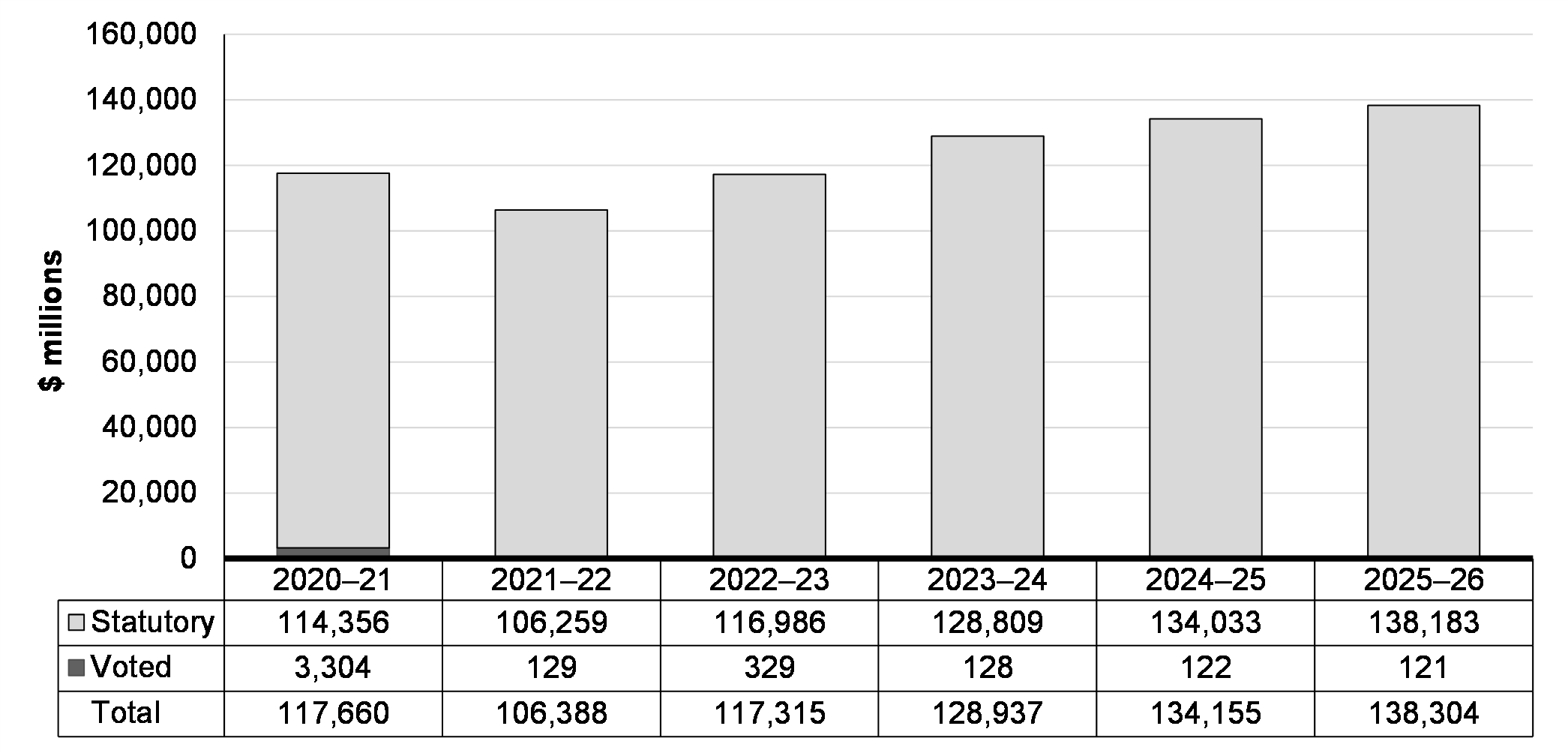
In the graph above, the amounts from 2020-21 to 2022–23 represent actual expenditures, whereas the amounts from 2023–24 to 2025–26 represent planned expenditures as presented in the 2023–24 Departmental Plan.
Budgetary performance summary for core responsibilities and internal services
The "Budgetary performance summary for core responsibilities and internal services" table presents the budgetary financial resources allocated for the Department of Finance Canada's core responsibilities and for internal services.
| Core responsibilities and internal services | 2022–23 Main Estimates | 2022–23 planned spending | 2023–24 planned spending | 2024–25 planned spending | 2022–23 total authorities available for use | 2020–21 actual spending (authorities used) | 2021–22 actual spending (authorities used) | 2022–23 actual spending (authorities used) |
|---|---|---|---|---|---|---|---|---|
| Economic and Fiscal Policy | 110,616,722,035 | 110,616,722,035 | 128,889,898,527 | 134,107,971,818 | 117,342,657,452 | 117,609,934,584 | 106,340,024,056 | 117,257,491,323 |
| Internal Services | 49,021,146 | 49,021,146 | 47,181,155 | 46,840,743 | 57,189,146 | 50,293,291 | 48,028,313 | 57,499,025 |
| Total | 110,665,743,181 | 110,665,743,181 | 128,937,079,682 | 134,154,812,561 | 117,399,846,598 | 117,660,227,875 | 106,388,052,369 | 117,314,990,348 |
The cumulative net decrease of $345 million in spending from 2020–21 to 2022–23 is mainly related to the decline in payments to provinces and territories related to COVID-19 measures, offset by an increase in the outstanding unmatured debt and other public debt costs.
Human resources
The "Human resources summary for core responsibilities and internal services" table presents the full-time equivalents allocated to each of the Department of Finance Canada's core responsibilities and to internal services.
| Core responsibilities and internal services | 2020–21 actual full‑time equivalents | 2021–22 actual full‑time equivalents | 2022–23 planned full‑time equivalents |
2022–23 actual full‑time equivalents | 2023–24 planned full‑time equivalents | 2024–25 planned full‑time equivalents |
|---|---|---|---|---|---|---|
| Economic and Fiscal Policy | 569 | 589 | 677 | 602 | 677 | 648 |
| Internal Services | 308 | 310 | 252 | 322 | 253 | 249 |
| Total | 877 | 899 | 929 | 924 | 930 | 897 |
The increase in the number of full-time equivalents from 2020–21 to 2022–23 is mainly attributable to increases in funding for key government priorities.
Expenditures by vote
For information on the Department of Finance Canada's organizational voted and statutory expenditures, consult the Public Accounts of Canada.
Government of Canada spending and activities
Information on the alignment of the Department of Finance Canada's spending with the Government of Canada's spending and activities is available in GC InfoBase.
Financial statements and financial statements highlights
Financial statements
The Department of Finance Canada's financial statements (unaudited) for the year ended March 31, 2023, are available on the department's website.
Financial statement highlights
| Financial information | 2022–23 planned results | 2022–23 actual results | 2021–22 actual results | Difference (2022–23 actual results minus 2022–23 planned results) |
Difference (2022–23 actual results minus 2021–22 actual results) |
|---|---|---|---|---|---|
| Total expenses | 106,223,429,459 | 120,990,918,172 | 104,632,388,096 | 14,767,488,713 | 16,358,530,076 |
| Total revenues | - | 25,800 | 18,765 | 25,800 | 7,035 |
| Net cost of operations before government funding and transfers | 106,223,429,459 | 120,990,892,372 | 104,632,369,331 | 14,767,462,913 | 16,358,523,041 |
The 2022–23 planned results information is provided in the Department of Finance Canada's Future-Oriented Statement of Operations and Notes 2022–23.
| Financial information | 2022–23 | 2021–22 | Difference (2022–23 minus 2021–22) |
|---|---|---|---|
| Total net liabilities | 1,346,489,544,421 | 1,323,294,233,894 | 23,195,310,527 |
| Total net financial assets | 281,617,083,427 | 244,652,803,128 | 36,964,280,299 |
| Departmental net debt | (1,064,872,460,994) | (1,078,641,430,766) | 13,768,969,772 |
| Total non-financial assets | 8,207,133 | 9,073,514 | (866,381) |
| Departmental net financial position | (1,064,864,253,861) | (1,078,632,357,252) | 13,768,103,391 |
The 2022–23 planned results information is provided in the Department of Finance Canada's Future-Oriented Statement of Operations and Notes 2022–23 .
Corporate information
Organizational profile
Appropriate minister[s]: The Honourable Chrystia Freeland P.C., M.P.
Institutional head: Chris Forbes
Ministerial portfolio: Department of Finance Canada
Enabling instrument[s]: The Minister of Finance has direct responsibility for a number of Acts and is assigned specific fiscal and tax policy responsibilities relating to other Acts that are under the responsibility of other ministers. A list of some of these Acts can be found below:
- Air Travellers Security Charge Act
- Asian Infrastructure Investment Bank Agreement Act
- Bank Act
- Bank for International Settlements (Immunity) Act
- Bank of Canada Act
- Bills of Exchange Act
- Borrowing Authority Act
- Bretton Woods and Related Agreements Act
- Budget Implementation Acts (under various titles)
- Canada Deposit Insurance Corporation Act
- Canada Pension Plan
- Canada Pension Plan Investment Board Act
- Canadian International Trade Tribunal Act
- Canadian Gender Budgeting Act
- Canadian Payments Act
- Canadian Securities Regulation Regime Transition Office Act
- Cooperative Credit Associations Act
- Currency Act
- Customs Tariff
- Depository Bills and Notes Act
- European Bank for Reconstruction and Development Agreement Act
- Excise Act, 2001
- Excise Tax Act
- Federal-Provincial Fiscal Arrangements Act
- Financial Administration Act
- Financial Consumer Agency of Canada Act
- First Nations Goods and Services Tax Act
- Greenhouse Gas Pollution Pricing Act (Part 1)
- Income Tax Act
- Income Tax Conventions Interpretation Act
- Insurance Companies Act
- Interest Act
- Nova Scotia and Newfoundland and Labrador Additional Fiscal Equalization Offset Payments Act
- Office of the Superintendent of Financial Institutions Act
- Payment Card Networks Act
- Payment Clearing and Settlement Act
- Pension Benefits Standards Act, 1985
- Pooled Registered Pension Plans Act
- Proceeds of Crime (Money Laundering) and Terrorist Financing Act
- Protection of Residential Mortgage or Hypothecary Insurance Act
- Retail Payment Activities Act
- Royal Canadian Mint Act
- Special Import Measures Act
- Tax-Back Guarantee Act
- Trust and Loan Companies Act
- Winding-up and restructuring Act (Parts II and III)
Year of incorporation / commencement: 1867
Raison d'être, mandate and role: who we are and what we do
"Raison d'être, mandate and role: who we are and what we do" is available on the Department of Finance Canada's website.
For more information on the department's organizational mandate letter commitments, see the Deputy Prime Minister and Minister of Finance Mandate Letter and Minister of Tourism and Associate Minister of Finance Mandate Letter .
Operating context
Information on the operating context is available on the Department of Finance Canada's website .
Information on the Department of Finance Canada's Sustainable Development Strategy is available on the Department of Finance Canada's website.
Reporting framework
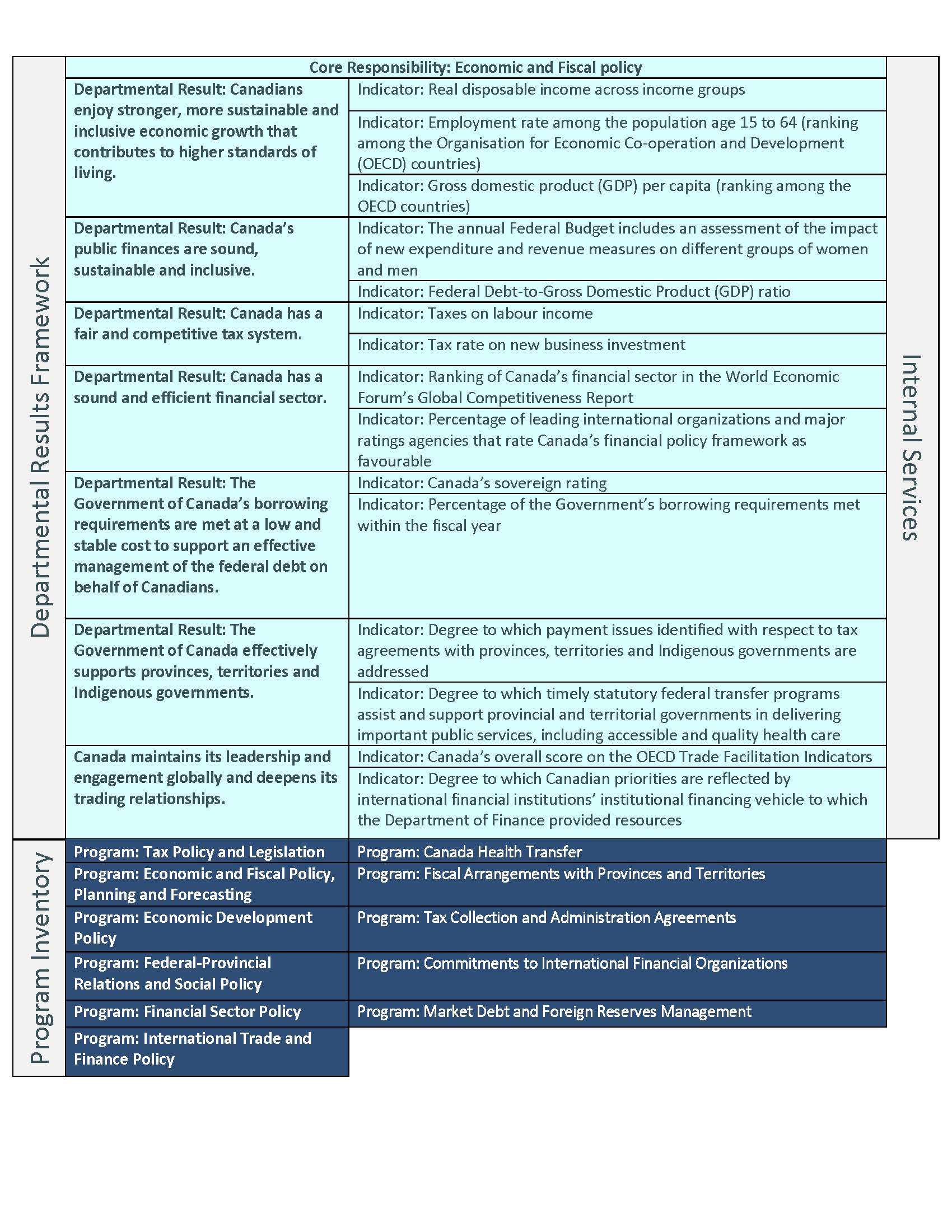
The Department of Finance Canada's departmental results framework and program inventory of record for 2022–23 are shown below.
Supporting information on the program inventory
Financial, human resources and performance information for the Department of Finance Canada's program inventory is available in GC InfoBase.
Supplementary information tables
The following supplementary information tables are available on the Department of Finance Canada's website:
- Departmental Sustainable Development Strategy
- Details on transfer payment programs
- Gender-based Analysis Plus
- United Nations 2030 Agenda for Sustainable Development and the Sustainable Development Goals
- Response to Parliamentary Committees and external audits
Federal tax expenditures
The tax system can be used to achieve public policy objectives through the application of special measures such as low tax rates, exemptions, deductions, deferrals and credits. The Department of Finance Canada publishes cost estimates and projections for these measures each year in the Report on Federal Tax Expenditures. This report also provides detailed background information on tax expenditures, including descriptions, objectives, historical information and references to related federal spending programs as well as evaluations and GBA Plus of tax expenditures.
Organizational contact information
Mailing address:
Department of Finance Canada
15th Floor
90 Elgin Street
Ottawa, Ontario K1A 0G5
Telephone: 613-369-3710
TTY: 613-995-1455
Fax: 613-369-4065
Email:fin.publishing-publication.fin@canada.ca
Website(s):Canada.ca
Appendix: definitions
appropriation (crédit)
Any authority of Parliament to pay money out of the Consolidated Revenue Fund.
budgetary expenditures (dépenses budgétaires)
Operating and capital expenditures; transfer payments to other levels of government, organizations or individuals; and payments to Crown corporations.
core responsibility (responsabilité essentielle)
An enduring function or role performed by a department. The intentions of the department with respect to a core responsibility are reflected in one or more related departmental results that the department seeks to contribute to or influence.
Departmental Plan (Plan ministériel)
A report on the plans and expected performance of an appropriated department over a 3‑year period. Departmental Plans are usually tabled in Parliament each spring.
departmental priority (priorité ministérielle)
A plan or project that a department has chosen to focus and report on during the planning period. Priorities represent the things that are most important or what must be done first to support the achievement of the desired departmental results.
departmental result (résultat ministériel)
A consequence or outcome that a department seeks to achieve. A departmental result is often outside departments' immediate control, but it should be influenced by program-level outcomes.
departmental result indicator (indicateur de résultat ministériel)
A quantitative measure of progress on a departmental result.
departmental results framework (cadre ministériel des résultats)
A framework that connects the department's core responsibilities to its departmental results and departmental result indicators.
Departmental Results Report (Rapport sur les résultats ministériels)
A report on a department's actual accomplishments against the plans, priorities and expected results set out in the corresponding Departmental Plan.
full‑time equivalent (équivalent temps plein)
A measure of the extent to which an employee represents a full person‑year charge against a departmental budget. For a particular position, the full‑time equivalent figure is the ratio of number of hours the person actually works divided by the standard number of hours set out in the person's collective agreement.
Gender-based Analysis Plus (GBA Plus) (analyse comparative entre les sexes plus [ACS Plus])
An analytical tool used to support the development of responsive and inclusive policies, programs and other initiatives; and understand how factors such as sex, race, national and ethnic origin, Indigenous origin or identity, age, sexual orientation, socio-economic conditions, geography, culture and disability, impact experiences and outcomes, and can affect access to and experience of government programs.
government-wide priorities (priorités pangouvernementales)
For the purpose of the 2022–23 Departmental Results Report, government-wide priorities are the high-level themes outlining the government's agenda in the November 23, 2021, Speech from the Throne: building a healthier today and tomorrow; growing a more resilient economy; bolder climate action; fighting harder for safer communities; standing up for diversity and inclusion; moving faster on the path to reconciliation; and fighting for a secure, just and equitable world.
horizontal initiative (initiative horizontale)
An initiative where two or more federal organizations are given funding to pursue a shared outcome, often linked to a government priority.
Indigenous business (entreprise autochtone)
For the purpose of the Directive on the Management of Procurement—Appendix E: Mandatory Procedures for Contracts Awarded to Indigenous Businesses and the Government of Canada's commitment that a mandatory minimum target of 5 per cent of the total value of contracts is awarded to Indigenous businesses, an organization that meets the definition and requirements as defined by the Indigenous Business Directory.
non‑budgetary expenditures (dépenses non budgétaires)
Net outlays and receipts related to loans, investments and advances, which change the composition of the financial assets of the Government of Canada.
performance (rendement)
What an organization did with its resources to achieve its results, how well those results compare to what the organization intended to achieve, and how well lessons learned have been identified.
performance indicator (indicateur de rendement)
A qualitative or quantitative means of measuring an output or outcome, with the intention of gauging the performance of an organization, program, policy or initiative respecting expected results.
performance reporting (production de rapports sur le rendement)
The process of communicating evidence‑based performance information. Performance reporting supports decision making, accountability and transparency.
plan (plan)
The articulation of strategic choices, which provides information on how an organization intends to achieve its priorities and associated results. Generally, a plan will explain the logic behind the strategies chosen and tend to focus on actions that lead to the expected result.
planned spending (dépenses prévues)
For Departmental Plans and Departmental Results Reports, planned spending refers to those amounts presented in Main Estimates.
A department is expected to be aware of the authorities that it has sought and received. The determination of planned spending is a departmental responsibility, and departments must be able to defend the expenditure and accrual numbers presented in their Departmental Plans and Departmental Results Reports.
program (programme)
Individual or groups of services, activities or combinations thereof that are managed together within the department and focus on a specific set of outputs, outcomes or service levels.
program inventory (répertoire des programmes)
Identifies all the department's programs and describes how resources are organized to contribute to the department's core responsibilities and results.
result (résultat)
A consequence attributed, in part, to an organization, policy, program or initiative. Results are not within the control of a single organization, policy, program or initiative; instead they are within the area of the organization's influence.
statutory expenditures (dépenses législatives)
Expenditures that Parliament has approved through legislation other than appropriation acts. The legislation sets out the purpose of the expenditures and the terms and conditions under which they may be made.
target (cible)
A measurable performance or success level that an organization, program or initiative plans to achieve within a specified time period. Targets can be either quantitative or qualitative.
voted expenditures (dépenses votées)
Expenditures that Parliament approves annually through an appropriation act. The vote wording becomes the governing conditions under which these expenditures may be made.